Posts Tagged With: Alaska

2019 Trip 5: Alaska: August 29

Alaska

Girdwood, AK. Thursday August 29

A most interesting day. You will get your fill of animal and scenery pictures. Thursday was dedicated to one activity, a five hour boat cruise out of Whittier in Prince William Sound. But first, we had to get there. As noted yesterday, Whittier was not inviting as a lodging option. We are staying in Girdwood, about 45 minutes west of Whittier. The challenge in reaching Whittier is that if you are coming by car, you have to use the Whittier Tunnel. There is no other option.

The tunnel was constructed during WWII for railroad traffic and only much later converted to combined rail and auto traffic. And I mean combined. It is one lane wide with trains and autos using the same path. To enter Whittier from the west, you line up and wait for the tunnel to allow east bound traffic at 30 minutes after the hour. To leave Whittier, you line up and wait to enter the tunnel at the hour. If you miss your time, you wait an hour.

It should take 45 minutes to reach the tunnel from Girdwood. We allowed an hour. But, experienced travelers that we are, we missed the turn-off! We were zipping along when suddenly the road signs just seemed wrong. No cell service to check on Google maps. We decided we had to re-trace our steps. Going speeds I have not reached since the wide open spaces of west Texas, we reached the line at 10:35. Luckily at that time there were enough cars that the line was long and the tunnel was still open. Close call.
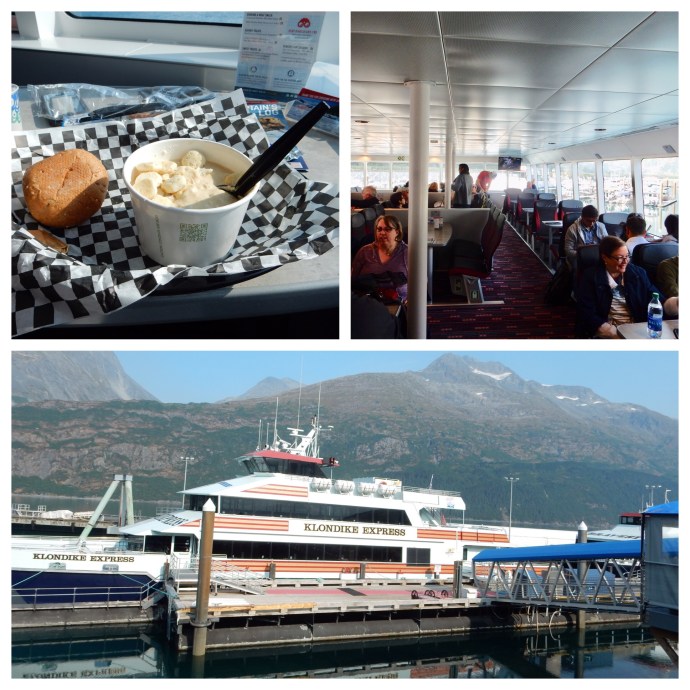
Logistics of the day: Boat, Lunch (plus a kale salad not in the photo), Seats (Top deck, front row, right by window) Chris at the far right front

Our cruise was with Phillips Cruises for a five hour journey on a new boat. They assign seats and since we had booked back in March, we had prime seats in front, by ourselves, looking forward, right next to windows in front and to our right. For the next five hours we took in magnificent scenery and a long list of sea animals. Once out on the Sound, the smoky haze was minimal. Whittier and this area of Alaska receive huge amounts of rain and snow but today was clear. Temps were in the high 50s, we did not need the extra gear we brought to stay warm on the water.
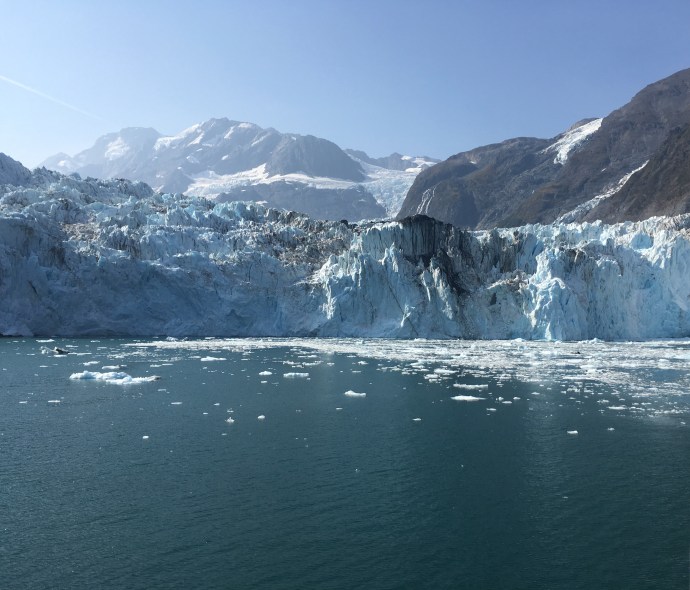
Glaciers
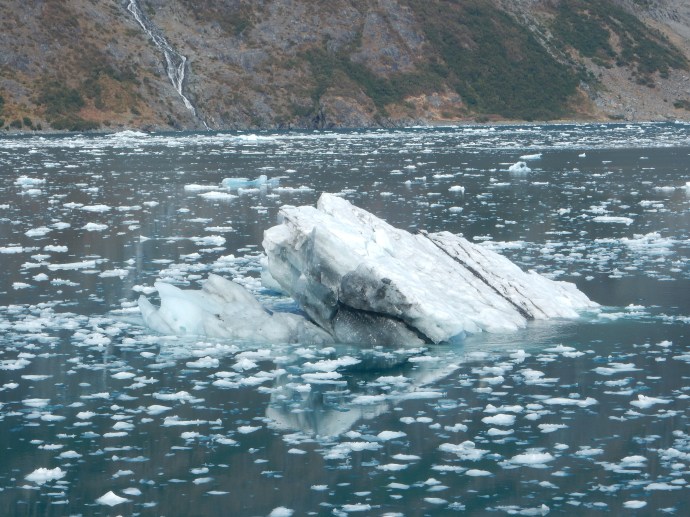
A U.S. Forest Service Ranger from the Chugach National Forest was on board providing narration. The Chugach is our second largest U.S. forest and includes huge swaths of water surface within its boundaries. He discussed glacier formation, the weather, the impact of climate change and the dramatic shrinking of the glaciers.
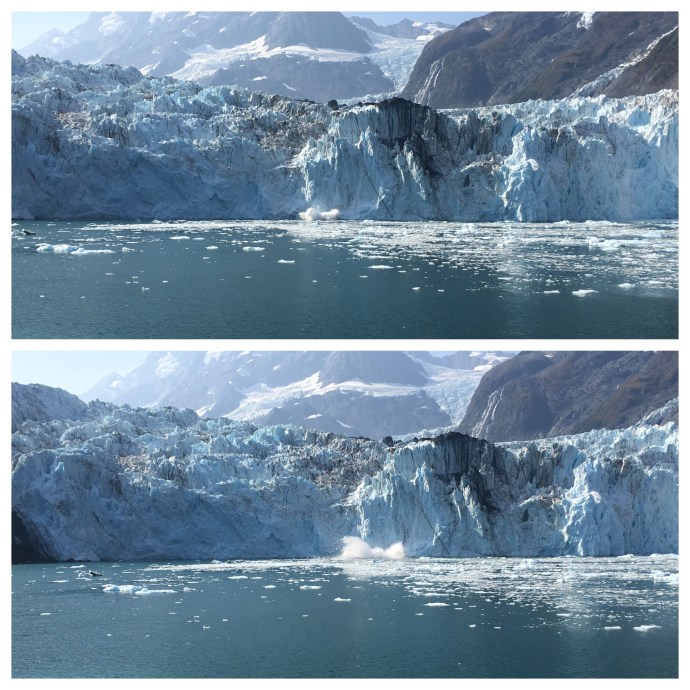
Glacier calving: Breaking off top, splashing bottom

Waterfalls

Alaska water falls that seemed so puny before were dramatic in height as water from melting snow and glacial ice poured down tall mountain sides.
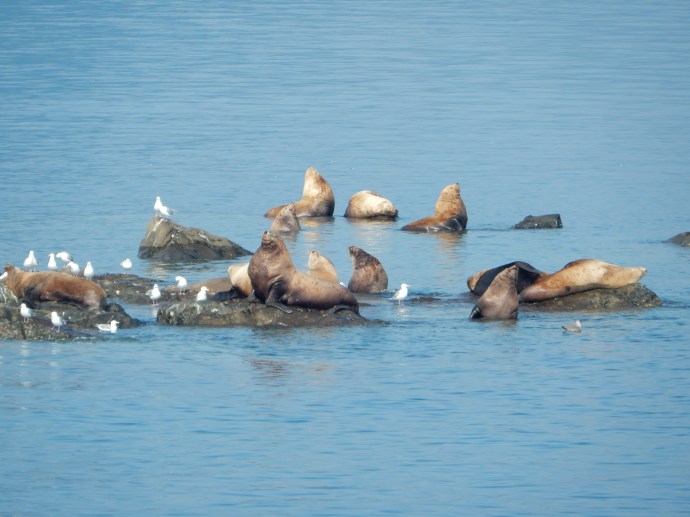
Stellar seal lions

I could discuss the habits of Stellar sea lions and the other animals; we picked up fact sheets on all of them. But I won’t except for a few brief comments here and there.

Sea otters at play
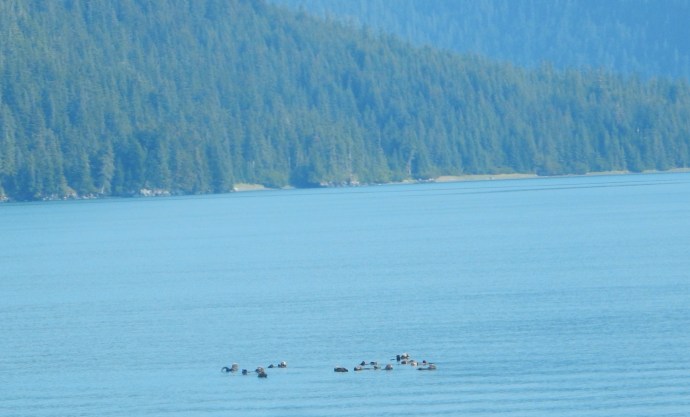
Sea otters in Prince William Sound

Sea otters were almost hunted to extinction. Their pelts are amazing in their ability to resist water and keep warmth. If you want to be disgusted, read a history of how they were hunted and natives here treated.

Dall’s porpoises
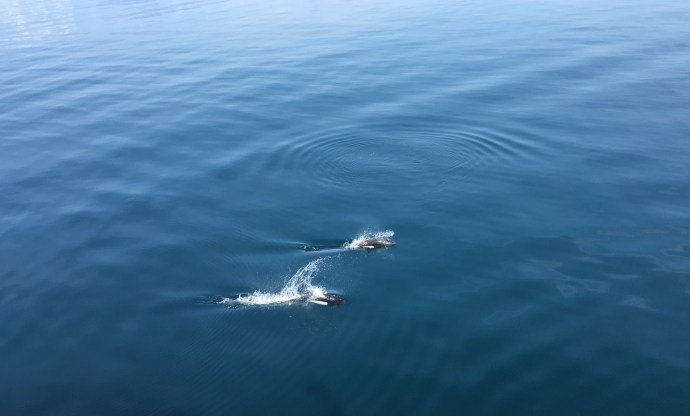
The porpoises were the highlight. They buzzed the ship. They dived and splashed. They went out and “played” with the humpbacks whales. There must have been at least ten of them. Porpoises are fast. It was hard to take a photo; by the time they jumped out of the water, they were gone again.

Harbor seals in Prince William Sound
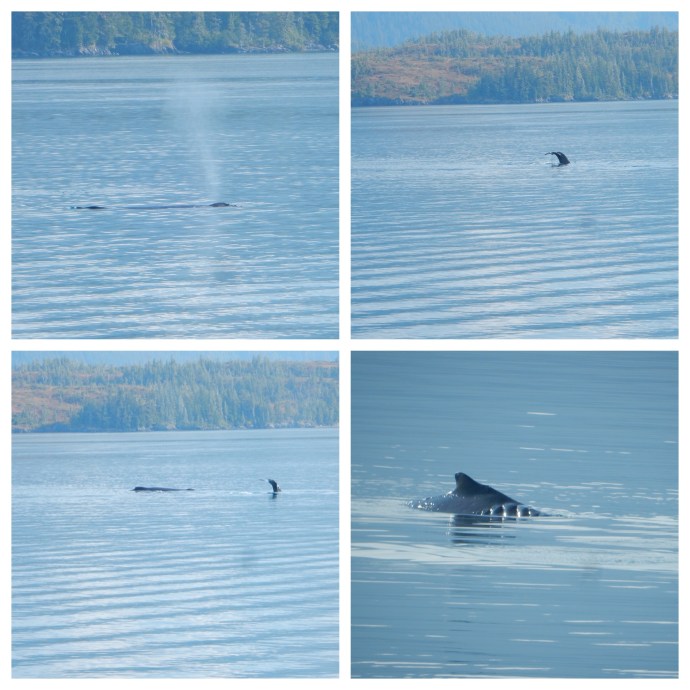
Humpback whales

This is not the season for orcas, so humpbacks were the “only” whales we saw today.

We did not bother taking pictures of bald eagles. Kind of ho-hum for a couple from Minnesota.

This was the Alaska of our imagination. A great cruise. A lucky day weather wise. A wealth of wildlife to observe and glaciers to marvel at.

Oh, we have canceled our first night in Cooper Landing due to fire issues. Our river rafting excursion has been canceled also. Still debating the next two nights in Cooper Landing and our three days in Homer. A Homer cancellation will hurt; we had splurged on an air trip over Cook Inlet to Lake Clark or Katmai National Park. They are remote and only reached by air or boat.
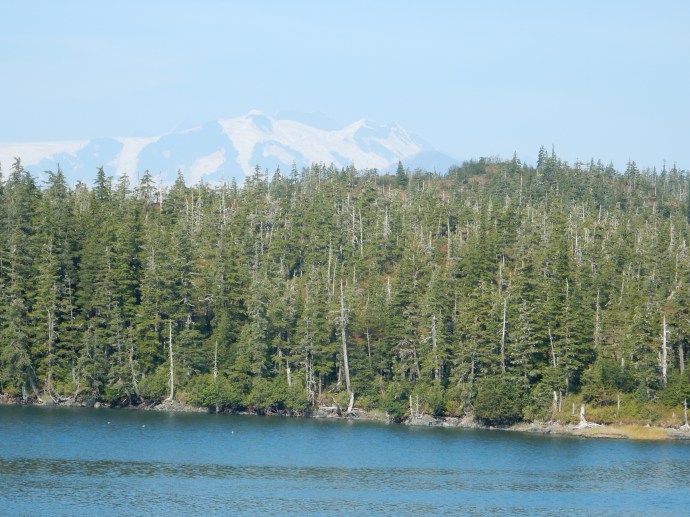
Alaska

Ed and Chris August 30. 3:30 AM
Categories: road trip, travel | Tags: , , , , , , , , , , , , , | 1 Comment

2019 Trip 5: Alaska: August 22

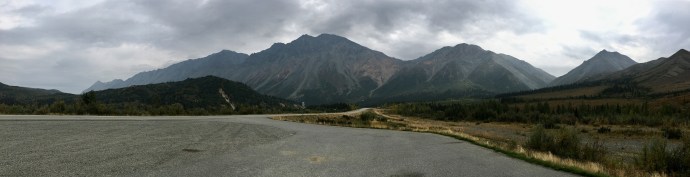
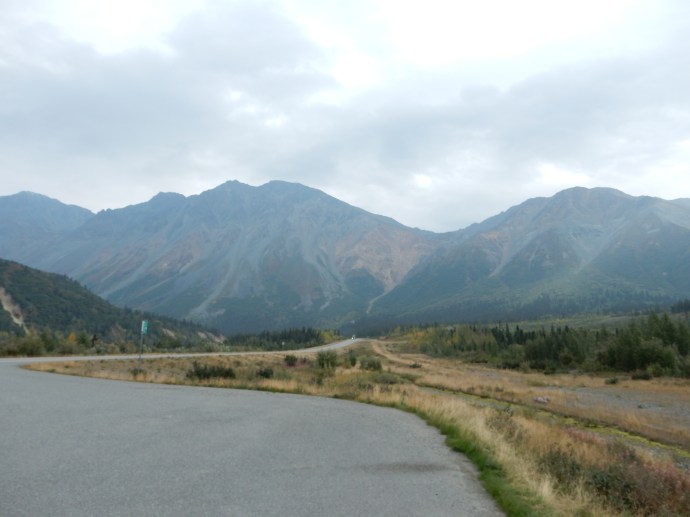
Part of the Alaska Range along Richardson Highway

Fairbanks Alaska Thursday August 22

The Richardson Highway stretches from Valdez to Fairbanks and was Alaska’s first major road. Today we drove the 250 mile stretch from Copper Center to Fairbanks. For a major road, we were surprised by light traffic, sections of road with narrow lanes and no shoulders, and portions of road with dips, bumps, gravel, and just plain rough road. We guessed the dips are caused by permafrost problems; slowing down was smart to avoid being tossed into the air. We passed a patching crew on a hill in the section of road with no shoulders and had to stop and wait for them to signal it was safe to pass.

Driving the Richardson Highway

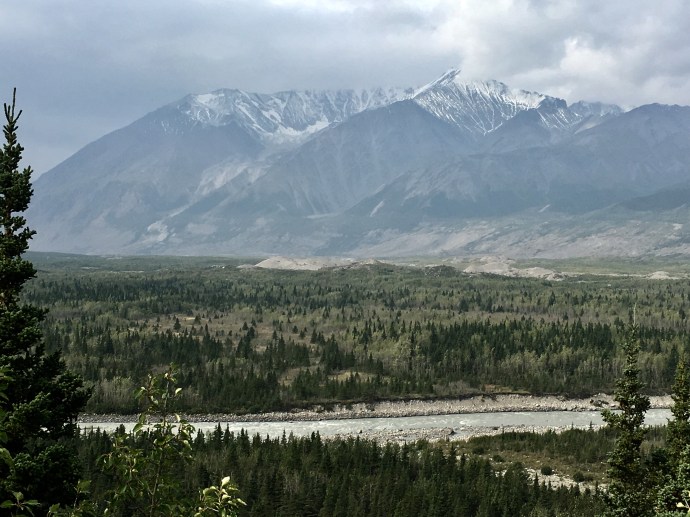
Our scenery started in the hilly areas with black spruce forests around us. We drove along portions of the Copper, Delta and Tanana rivers. The TransAlaska pipeline crossed from left to right and back again. No caribou, moose, bear, etc. made an appearance. Portions of the route were treeless with only scrubby brush. We drove through two military reservations. The show stopper for scenery was the Alaska Range with peaks, glaciers, lakes, and colored rock formations.

Along the Richardson Highway

The route contains only small towns, some where roadhouses used to exist. Despite looking, we missed the remnants supposedly by the side of the road. Fortunately, pull-offs are common, so we could take pictures of the pipeline, the colored talus slopes of Rainbow Ridge, the creek flowing out of Summit Lake where other travelers were looking for fish that normally inhabit the creek, the early fall colors . Unfortunately, seeing the sun was rare; the photos would have been fantastic with a bright blue sky behind the mountains for contrast.

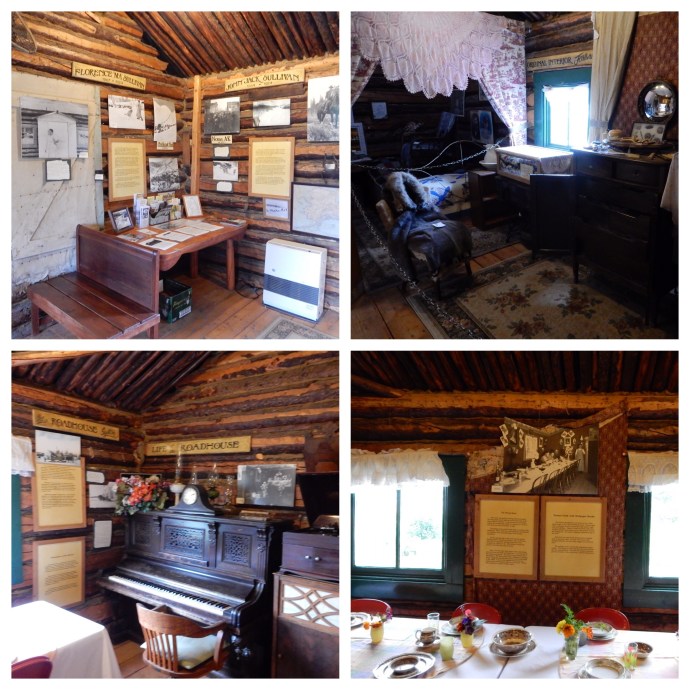
Two vignettes for you. We stopped at Sullivan Roadhouse Historical Museum in Delta Junction. Alaska Roadhouses were an important historical landmark in the early 1900s, particularly on the Richardson Highway. Roadhouses provided food and lodging for people and horses. Given the difficulty of Alaskan life then, the costs were high. For instance, at Sullivans a meal cost $2 when a fancy meal in Seattle cost 15 cents. Roadhouses began a decline around 1917 when car travel became possible on the road.

Interior of Sullivan Roadhouse

But the story at Sullivan’s has multiple angles, two of which we will relate. First comes the beginning of the story. The owners came separately to Alaska in the mid-1890s seeking their fortune in the gold fields. Separately they both traveled during the winter of 1899-1900 from Dawson City to Nome. She hired two men to pull her sleds of goods while she walked in front through the snow and broke the trail. It was only after several years in Alaska that they met in Nome and married in 1900. They built the Roadhouse in Delta Junction in 1905. It was well-known and well-regarded having surmounted all of the hassles involved in running such an establishment in Alaska in the early 1900s.

The Sullivan Roadhouse in Delta Junction AK

The second angle of the story relates to the building itself. The vast majority of Alaskan roadhouses burned, were abandoned and fell apart,etc. The Sullivan Roadhouse survives intact. Why? Well, the Sullivans had to move from the original site when the road moved. When moving, they installed a metal roof, rare at the time, to replace the sod roof. This contributed to the building’s permanence.

But in 1921 the trail was abandoned and the Sullivans did the same with the building. It sat empty even through WWII when it became attached to a new Army base used as a bombing range. Wildfires came close but the building survived. In the 1970s the artifacts in the building were unofficially squirreled away to a private site. Finally a federal program to save historic buildings on Army land, as its last job before budget cuts killed it, moved the roadhouse to its current site by taking each individual log by helicopter to the site it occupies today.

We heard this story while viewing the museum and talking to the guide, a man who still has family land around Portage WI. And, of course, the next people in the museum were from southern MN visiting a son/sibling stationed at the military base nearby.

The second vignette relates to Pennsylvania, our home for almost 30 years. We had a late lunch/early dinner at North Pole, Alaska at Little Richards Family Diner. In chatting with the wait staff, we learned she has been with the diner for nine years, since it was established. The owners, who work the breakfast shift, used to own a similar diner in Camp Hill PA, close to where Chris worked. Chris remembered eating breakfasts and lunches there. Another small world incident.

Inside the Morris Thompson Cultural and Visitor Center

We finished the day at the Morris Thompson Cultural and Visitor Center in downtown Fairbanks. It is very well done and has a wealth of information available through displays, materials, and volunteers. The exhibits display history on native cultures and life even today. There are 11 distinct Athabascan groups, each with its own characteristics, language, and territory. Also, only 11 of 42 Athabascan villages in interior Alaska are connected to the outside world by roads.

TransAlaska Pipeline

Ed and Chris Fairbanks AK Friday Aug. 23 6 AM

Categories: road trip, travel | Tags: , , , | Leave a comment

2019 Trip 5: Alaska August 17

Eklutna Historical Park near Palmer AK

Palmer AK. August 17

If you divide Alaska in half, Texas would be the third largest state. Given that fact, it is egotistical to state that we will know Alaska by the time we leave the state on Sept. 10. However, we will certainly do our best to see as many different areas as we can. Today was an excellent start.

Thunder Bird Falls in Chugach State Park, AK

Thunder Bird Falls is only 25 miles northeast of Anchorage. It is viewable after a one mile hike along a cliff side trail that features a constant parade of up and down hills. The trail is wide and relatively smooth. Halfway along the trail is an overlook that presents views of the falls on Thunder Bird Creek which flows into the Eklutna River. Another half mile brings you to the view of the falls; today, however, the angle of the sun created poor photo opportunities. Still, the walk was in a forest, temperature was 65 degrees, and the sun was shining. A pleasant interlude to begin the Alaskan adventure.

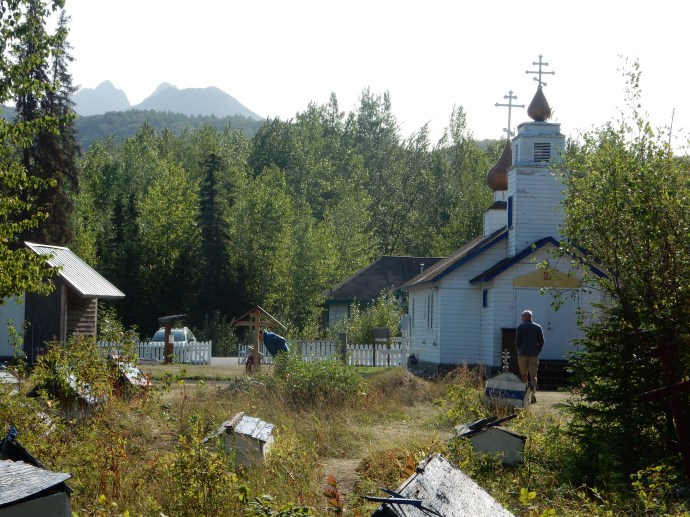
Our next stop was the Eklutna Historical Park. This small collection of buildings is a result of the intermingling of the Dena’ina Athabaskans and Russian hunters and traders. The Athabaskans moved in here from the west thousands of years ago. The Russians came in the 1700s searching for pelts; beaver, sea otter, etc. as well as copper and gold. The story of Russian exploration is long and complicated; murderous and greedy combine with concern and compassion. By the time they sold Alaska to the U.S. in 1867, Russian Orthodox churches had gained a foothold in various settlement areas.

A variety of spirit houses at Eklutna Historical Park

The Eklutna Historical Park retains the old St. Nicholas Church originally built in Knik and moved to Eklutna in 1900. The new St. Nicholas Church was built in 1962. Both are very small and are locked on Saturdays, we only viewed the outsides. An unusual feature of the area are the “spirit houses”. These burial markers are a unique combination of Athabaskan tradition married to Russian Orthodox practices. While small in number, it appeared to us be about 50 or so spirit houses, they exhibit a variety of styles and care. Some are care-worn, possibly reflecting the end of a family line who no longer live in the area. Others are painted, well-maintained, and have fresh flowers on display.

The Matanuska River near Palmer AK

We left Eklutna for Palmer, our lodging site for the next two nights. To get to Palmer, we took the Old Glenn Highway which ambles along the Knik River. The Knik River begins at Knik Glacier-which we did not drive to. The river is a milky white color with wide, sandy beaches. With the Talkeetna Mountain Range across the river to the west, it made for a much better photo op than Thunder Bird Falls. Then, as we got closer to Palmer, we were driving along another river, the Matanuska, which was flowing much faster than the Knik. It is the Matanuska River that we will be following on Monday, over to Wrangell St. Elias National Park and Preserve.

In Palmer, we took a 90 minute docent tour of the historic Palmer Colony. Forgive me, but I need to present a little background data first. 10,000 years ago the last great ice age had this part of Alaska under thousands of feet of ice. The glacial melt left glacial drift in the valleys, dirt that is finely ground and fertile. (Similar to the plains of the Midwest.) This section of Alaska is thus one of the few areas in the state that presents great agricultural opportunity. With a short growing season but long hours of daylight, this fertile soil produces vegetables that are much larger than normal. Some of the record vegetables at the Alaska State Fair include: 39.2 pound turnip, 82.9 pound rutabaga, 138.25 pound green cabbage, a 1469 pound pumpkin, and a 71.75 pound carrot-all world records.

The Colony Inn B & B, formerly a dormitory for service personnel for the Palmer relocation program

During the Great Depression, one of the lesser-known recovery efforts was the transplanting of 203 Midwestern farm families to the Palmer area. This federal government program was conceived, planned, and put into execution with the first families arriving in Alaska in May 1936. Without going into great detail, the effort failed and succeeded. One-half of the families returned to the lower 48 by the end of 1937. But the effort laid the groundwork for greater development of Palmer and its agricultural resources which proved vital when WWII began. With the Japanese invading and capturing several Aleutian Islands, the American armed forces began a swift build-up in Alaska. The bases built then, and still maintained, provided labor for the farmers, a ready market for produce, and an introduction to the area for military personnel; some of whom made the area their permanent home.

The docent tour presented the story well. We saw several of the original homes, one of the churches, and a former dormitory now a B and B. The docent provided plenty of time for questions and we obliged by asking a lot.

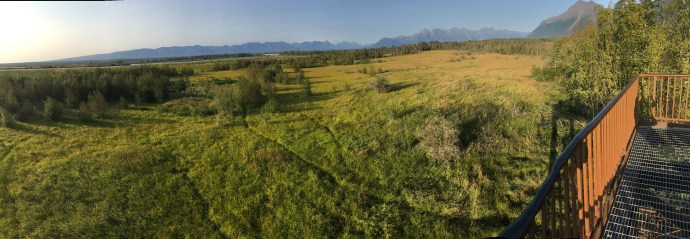
After the Palmer tour, we checked in to our Airbnb lodging, got groceries, and had dinner at a small cafe in downtown Palmer. Since it is still light out, we drove down to the Hay Palmer flats and took a one mile hike around Reflection Lake. Hay Palmer Flats are a wildlife refuge at the confluence of the Knik and Matanuska Rivers and the Knik Arm of the Cook Inlet.

Of particular interest is the fact that this area had been a hay growing area for the dairy farms around Palmer. On Good Friday 1964, a 9.2 earthquake with a resulting tsunami, the largest in North American history, struck Alaska causing widespread death and destruction. The ground was pushed up in some places and depressed in others. Here, at Hay Palmer, the land subsided 4-6 feet and the hay fields became too swampy for growing hay. The marshes and swamps became a gathering place for wildlife. Reflection Lake is in the refuge and there is a pleasant one mile hike around it.

Ed and Chris. 10:30 PM

A view at Hay Palmer wildlife refuge, Palmer AK

Categories: travel | Tags: , , , , ,

Blog at WordPress.com.