
Ajo, AZ. Thursday May 24

Organ Pipe Cactus National Monument
Only one major goal for today, Organ Pipe Cactus National Monument. It was founded in 1937 to protect the Sonoran Desert and the organ pipe cactus here. Organ pipe cactus are more at home in Mexico than the U.S. This location is at the northern reaches of the cactus’ range. Organ Pipe Cactus National Monument protects a wide variety of plants and animals, allowing them to flourish in their native environment without much human interference. The United Nations recognized the monument’s value and its success in protecting the environment in its natural state by naming it an International Biosphere Reserve in 1976.
It took us all morning to reach the monument. We left Green Valley, going north in I-19. I-19 is an interesting anomaly. It is the only United States Interstate Highway marked in kilometers, not miles. According to our Evergreen hosts, the highway was being built during a time when the U.S. was planning to convert to the metric system. The highway planners did not want to install signs with miles as a measuring unit if they would shortly have to take the signs down and install new signs in kilometers. The decision was made to install kilometer signs from the beginning. Then, the U.S. backed down on the metric conversion but the I-19 signs were already up. Locals did not want to change their address on all of their marketing measures. The decision was made to support the local preference and the use of kilometers continues to this day. It did throw us off the first time we drove on I-19.
I-19 was just a blip today as we turned off it and headed west on Arizona 86. Shortly after leaving the Interstate we were on a two lane road, speed limit 65. We went through the Tohono O’odham Indian Reservation for the entire drive to Why, AZ. Why, population 162, was our lunch and gas stop. Restaurants and gas stations are not plentiful here so you gas up when you have the chance.

One of the more elaborate memorials along AZ 86
Along AZ 86, we observed roadside crosses and memorial displays. When driving through the U.S., particularly on two lane roads, one observes a white cross where a person died in a traffic accident. On AZ 86, these crosses were too numerous and too elaborate to fit that pattern, at least in my mind. Upon arrival at Organ Pipe, I checked in with a ranger (new, so she had to talk to a more veteran, locally knowledgeable ranger). The Tohono O’odham have a deep reverence for the dead, the memorials on the highway do reflect where a fatal accident occurred. It is just that the memorial is maintained for decades by family members.
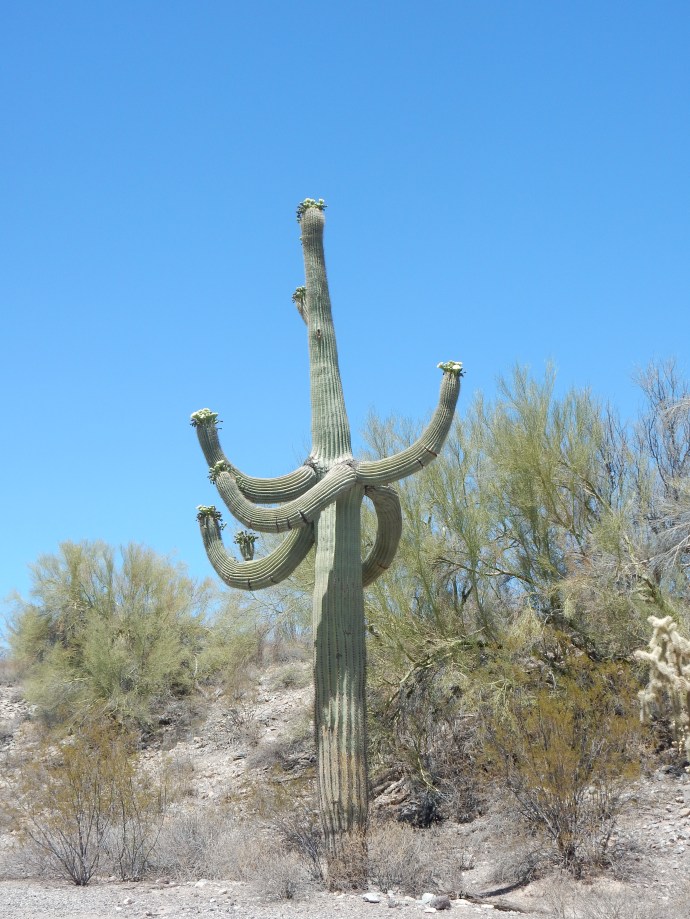
Saguaro cactus
Organ Pipe is 20 miles south of Why. We stopped in for the introductory video and then drove around for an hour and a half. I make no apologies for not hiking. It was hot and the scenery did not vary dramatically in the areas we could reach. Some of the roads were high clearance vehicles only. I did not want to risk the rental car on those roads. It is a long way from any AAA service station.
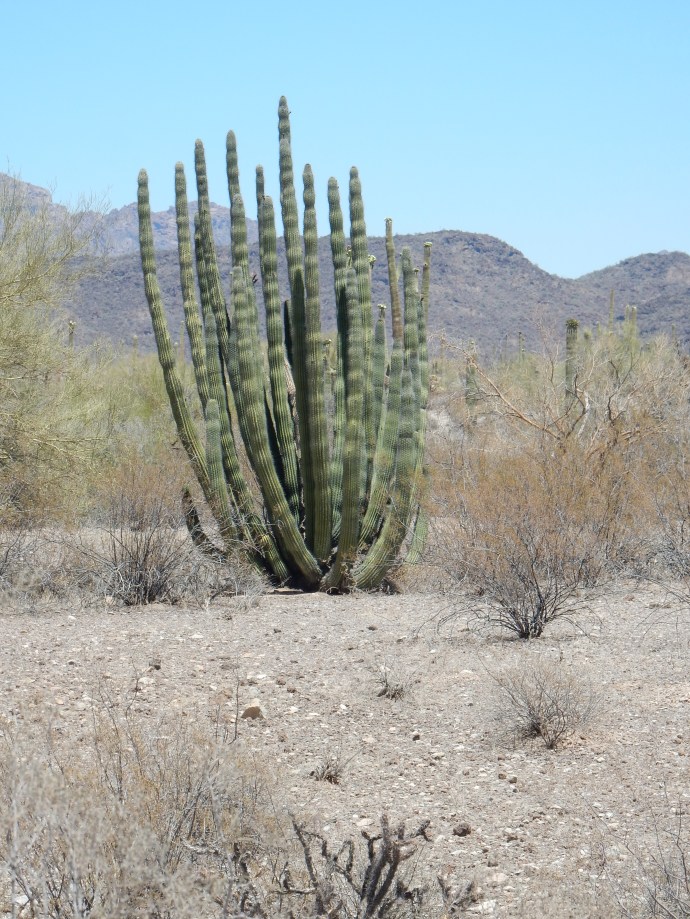
Organ Pipe Cactus
The organ pipe cactus were not the primary variety of cactus we saw. In fact, sometimes we had to really look around to spot them. The combination of desert vegetation and mountain backdrops did make for enjoyable viewing.
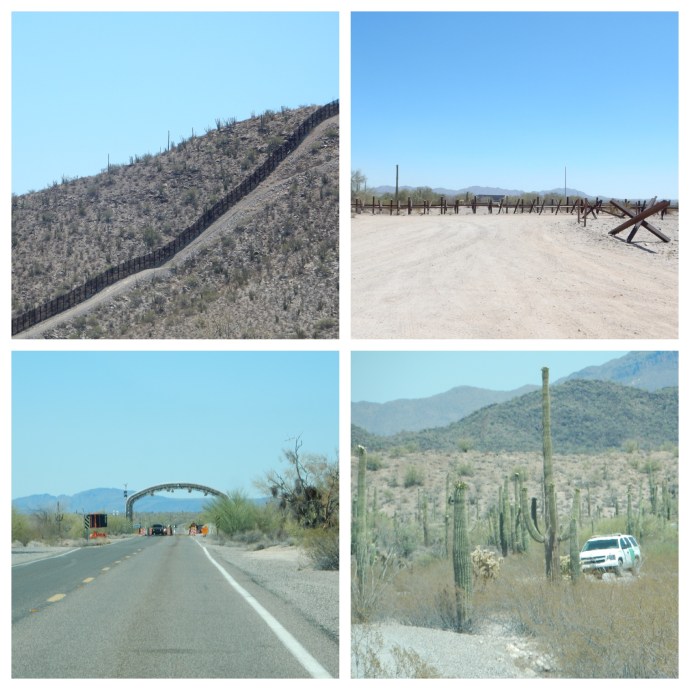
Border shots; the wall, the first wall for cars, road checkpoint, and Border Patrol vehicle in Organ Pipe Cactus National Monument
Organ Pipe backs up to the Mexican border and the monument road provided a great opportunity to view “The Wall”. Two versions were visible. One was an initial fence built like construction barricades to prevent cars from driving over the border. The second fence type appeared newer and designed to stop individuals. The visitor center is named for a park ranger who was killed in 2002 while responding to the illegal border crossing of two violent criminals fleeing an incident in Mexico. Border patrol vehicles were frequently spotted in the monument, we were not stopped. We passed through two roadside checkpoints during the trip, again we were just waved through.
After Organ Pipe, we drove to Ajo. For the third night in a row, unplanned, we have slept, or will be sleeping, in the shadow of copper mines and their disposal sites. Ajo is the site of a large copper mine, closed in 1985, and now owned by Freeport-McMoRan. Same owners as the Bisbee copper mine.
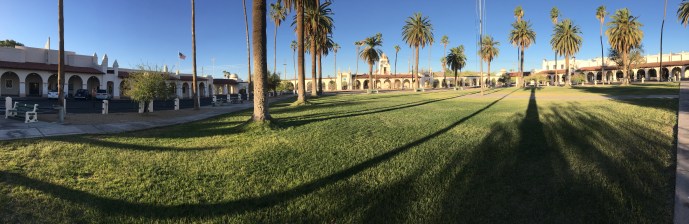
Downtown Ajo plaza and park
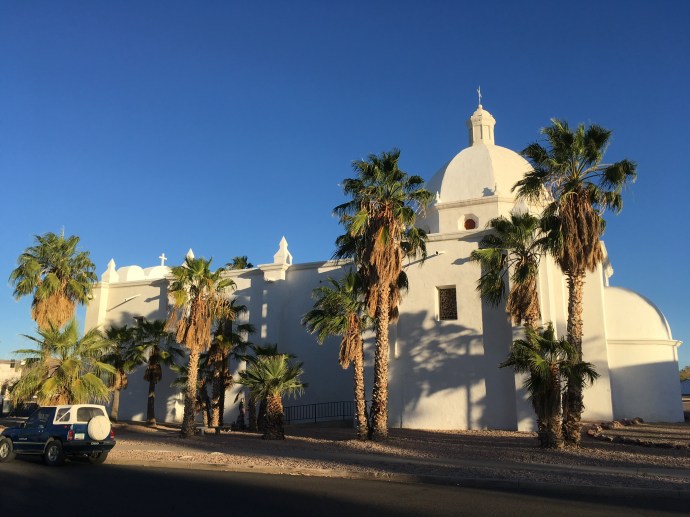
Catholic Church Ajo AZ
Ajo was built as a company town. The downtown plaza, two churches, school, and hospital were built and are still impressive although some are vacant and some have been repurposed. Initial mine owners tried to send the ore to Wales but that was not economical. The next owners were from St. Louis and after several false starts and more new ownership, in 1915 open-pit mining began here. It was the first open-pit copper mine in Arizona. The pit today is 1.5 miles wide and 1,100 feet deep. We saw mountains of remains, probably the overburden removed to reach the ore and the slag produced from the smelting process. Our B and B is just blocks from the pit.
Ajo is not a major summer destination. Our dinner was at Pizza Hut, one of the very few options available. The town has decreased by 50% since the mine shut down but has been stable for the last two decades. New residents appear to be retirees and Border Patrol workers. There was a “scandal” as the feds built very expensive new housing for the Border Patrol employees rather than buying and rehabbing the many vacant homes. One industry in town is the business of selling Mexican insurance. It is only 100 miles from here to the Gulf of California. RVs and trucks towing boats were the primary vehicles on the road.
Ed and Chris. May 24
 Chris Klejbuk and Ed Heimel travel adventure
Recent Comments