travel

Our road trips around the U.S.

2018 Trip 3: KY & TN: March 17

Paducah, KY. March 17

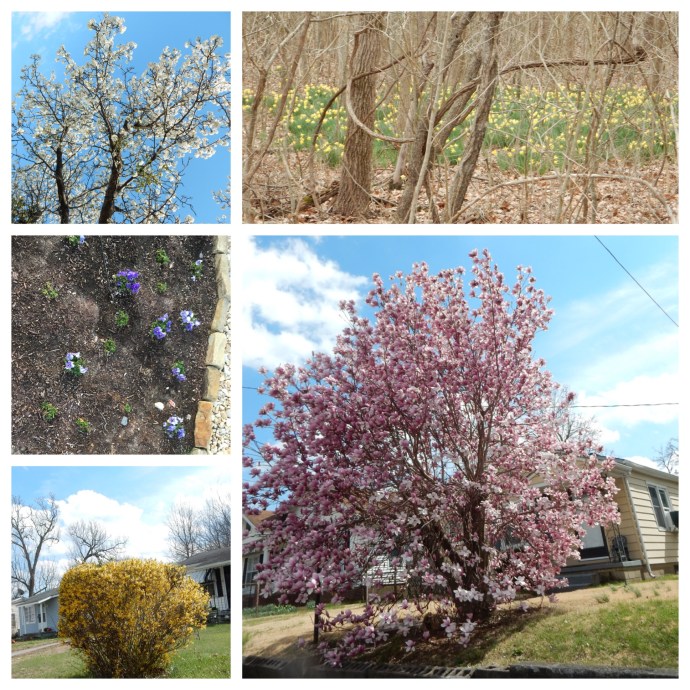
The first signs of spring occurred in southern Illinois.

We were on the road early this morning. Last night provided extra incentive to make sure we arrived at breakfast early. When we had checked in, we noted our hotel had as guests numerous families with young people. Champaign was the host site for the Illinois State wrestling tournament for boys ten and under. Evidently when you have wrestlers under age ten, the whole family comes along for the event. Our assumption was that if we were downstairs for breakfast by 6:30 AM, we would be in good shape.

Wrong. Evidently our assumption was based on when our daughters would prefer to get up. Wrestlers are up early and on their way to the tournament which started at 8:30 AM. There were three people for every two seats in the meal area when we arrived at 6:30 AM. A glass of orange juice was our sole take-away and we set out on the road. Breakfast ended up being at a local restaurant located inside of the IGA grocery store in Effingham Illinois, an hour south of Champaign.

Our daily journey was projected at 280 miles, most of it on two lane, 55 mph roads below Effingham, but that allowed us to make several stops today. First off was the “Garden of the Gods” Recreation Area in Shawnee National Forest. The journey there did take us by oil fields and coal mining locations. Illinois was supposedly the first state in which Europeans discovered coal. Today, it is still the fifth largest coal-producing state, but the amount of coal shipped is decreasing and the number of miners has dropped dramatically.

A view from the Garden of the Gods Recreation Area in Shawnee National Forest

A close-up of rock formations in Garden of the Gods Recreation Area

Located in extreme southeast Illinois just above the Ohio River, Garden of the Gods provides some of the most photographed outdoor locations in Illinois. We opted for the Observation Trail that contains unique rock formations and outstanding views of the valleys and hills that line the southern most portions of Illinois.

Trails abound in the forest and wilderness area surrounding the observation trail but today was not meant to be a major hiking day. After we saw the sights, we drove the Ohio River Scenic Byway to Paducah, KY. Unfortunately, the scenery was not all that spectacular with only one view of the Ohio River. While daffodils became abundant, few other trees were blooming. The temperature increased nicely though, from 32 degrees in Champaign to 68 degrees around the Shawnee Forest.

While Effingham appeared prosperous, the smaller towns we passed through on our way to Paducah seemed poorer and passed over. There appeared to be a more liberal attitude of what was permissible to store outside your house along with the quantity of what was stored in the yard. Possibly the decrease in coal mining jobs led to this but agriculture still seemed to be strong economic factor.

We made it to Paducah in time to visit the River Discovery Center, also called the River Heritage Museum. It is not open Sunday so we had to ensure our arrival allowed us to visit it today. The museum focuses on several rivers in this area, the Ohio, Tennessee, and Cumberland also with the Mississippi. Paducah has a long history with the Ohio River, and its location at the confluence of the Ohio and the Tennessee has led to the city having boat building and maintenance facilities.

The museum educated us about the 1937 Ohio River flood where 90% of Paducah was flooded, 30,000 people here were evacuated, the river was seven miles wide with flood waters, and the flood was so extensive along the Ohio that it led to the building of new levies to try to limit flooding. A new factoid for me was the use of “snagboats”, steel covered boats that would ram submerged trees and tree trunks (snags) to remove them or to use it’s on board cranes to lift the snags out of the river.

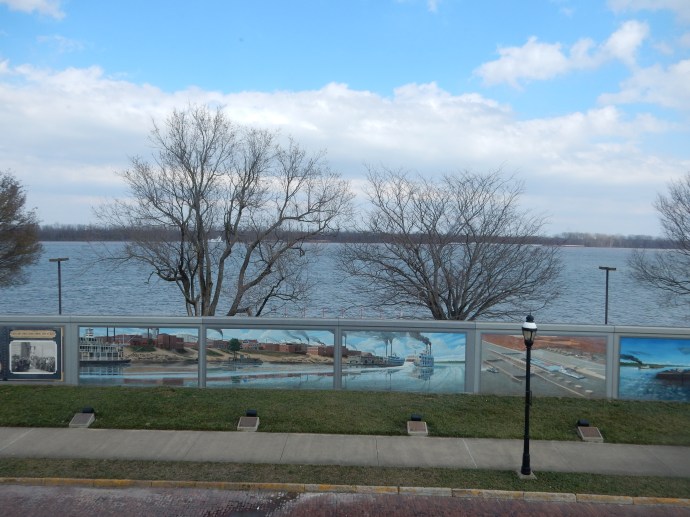
A view of some of the murals and the Ohio River from the River Discovery Center.

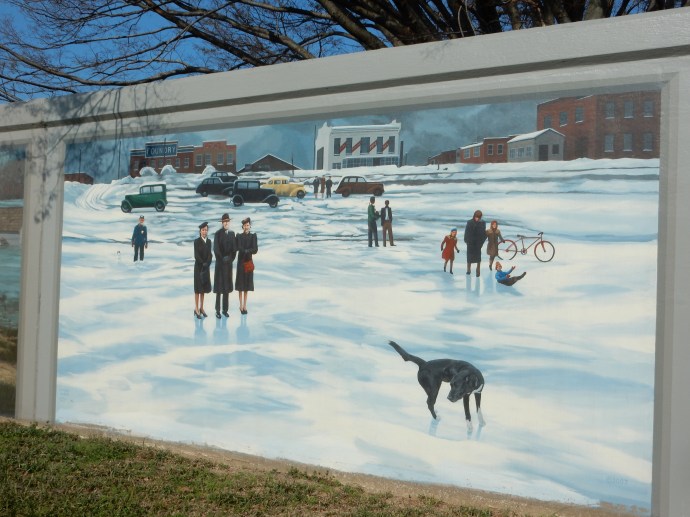
A close-up of just one of the murals, this one depicts a rare occurrence when the Ohio River froze over.

After the museum, we walked along the riverfront to enjoy the river murals. The murals, sponsored by local businesses or individuals, portrayed notable events in the history of Paducah. We had observed similar murals in Vicksburg TN, but the murals in Paducah seemed smaller. The murals here have the advantage of being located still in the downtown district; in Vicksburg who have to walk a few blocks out of the downtown to see the murals up close. Robert Dafford is the painter; well-known for his murals and having created murals in several other Ohio river towns.

Wacinton statue in Paducah KY

Our final stop was at the 35 foot tall wood carving of Wacinton. This carving started with a 56,000 pound red oak and was completed over thirty years ago. The statue is meant to honor the Chickasaw Indians who lived in the area prior to the arrival of European settlers. The sculptor is Peter Wolf Toth who has completed statues in each of the fifty states-although not all are still standing. His message is to honor the indigenous peoples of America.

Ed and Chris March 17

Epilogue: Snippets on life in America from Chris

Day 2: Driving along the 2 lane road at the posted 55 MPH (or a little above), one sees on either side acres and acres of farmland. Houses, barns and silos are off in the distance as the deep brown soil lies quietly near the road, prepped for spring planting. We are alerted to a speed change to 35 MPH; an assortment of houses close to the road announces a town. No traffic signals, no sidewalks, no schools, some boarded stores, no green park space. In a minute or two, after the Dollar General store, we are back to 55 MPH, passing again part of America’s farmlands.

Categories: road trip, travel | Tags: , , , , , , , , , | Leave a comment

2018 Trip 3: KY and TN: Caves and Crafts, Booze and Bluegrass (Music and Horses): March 16

Champaign, IL. March 16, 2018

This trip will last six weeks, possibly to be our longest of 2018. The primary goal is to spend more time in Kentucky and Tennessee with a week in Miami Beach, FL. We are calling the trip: “Caves (Mammoth Cave) and Crafts (handmade Appalachian crafts), Booze (for bourbon distilleries) and Bluegrass (for the music and Thoroughbred horses).

Approximate route for 2018 Trip 3.

Today, Friday is a travel day with no real stops to sightsee; that will begin tomorrow. Our initial route is an old familiar one, I-94 out of the Twin Cities down through Illinois on I-39. Thus, breakfast was on the road and lunch was at the largest Culver’s in Edgerton WI (which we had been at before). Dinner was different, a lenten fish fry at St.Patrick’s Church in Champaign. The fish for dinner was one of the tastiest we have experienced this Lenten season.

Only incident of note, stopping at a rest stop in north central Illinois, we came out of the rest room to observe two young college students, men, examining our car, even looking under the car. Our first thought: “Oh, s***, they hit our car and damaged it.” We went over to talk with them and to understand their concern. They were discussing how the car was making a strange sound and the young men thought a piece of the car was hitting the front passenger tire. It took several minutes for them to realize they might be right about the sound but they had the wrong car. Evidently the young men were riding with another student, a woman, and could not well identify the car they were riding in.

The guys were tossing swords back and forth, evidently props from their circus studies at Illinois State University at Normal. Evidently the intent on catching the swords disrupted their car identification skills. We passed pleasantries after the clarification and headed back on the road.

Ed and Chris

Chris has decided to add a daily addition to our travel blog.
Epilogue: Snippets on life in America from Chris
Day 1: We decided to start this trip early today and get breakfast on the road. Around 9, we stopped for breakfast at a fast-food restaurant in WI. We went in and 8 elderly women were seated around a table enjoying morning coffee and conversation. Around the corner from them was a group (eventually 12) of elderly men with coffee and occasional breakfast sandwich; jeans, working boots, occasional military cap and an exciting conversation at one end of the tables was about bees. Welcome to McDonald’s.

Categories: road trip, travel | Leave a comment

2018 Trip Two: Boston Again

Boston, January 22-29

Another trip to Boston. Well I never wrote up this trip to Boston and since we leave in 10 days for another six-week trip down through Kentucky and Tennessee, I thought I’d better get caught up. Much of the trip was family related but this blog will cover the sites that we saw in the Boston area. We have been to Boston numerous times, but we are still able to find a few things that are new to us.

One of the Map Room maps

Our plan was to leave on Monday, January 15 for about a week. However, a major snowstorm was projected and Delta was offering free flight changes, so we took them up on their offer and left on Sunday the 14th. Hertz rental car company was not as agreeable. Changing our reservation and adding one day would’ve doubled the cost. Instead, Deb picked us up on Sunday at the airport. Monday morning Rebecca gave us a ride to downtown Boston. We spent the morning going through the Boston Public Library. That might seem a strange way to spend the morning but the library is home to numerous famous murals. Chartered in 1848 as the first large, free American municipal library, it was so successful it outgrew its home.

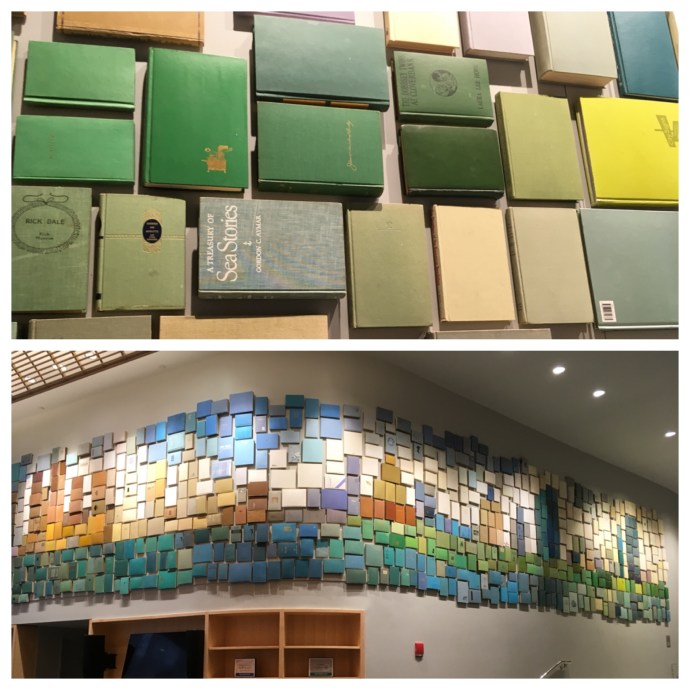
The current Boston Public Library, built in 1895 and expanded in 1972, has three sets of murals of dramatic import and size which are noteworthy. However, our first stop was at the Map Room. The Leventhal Map Center is primarily a research center but has a changing exhibit of maps. The exhibit expands one’s understanding of the numerous varieties of maps depending on the material to be presented. The area had children sized nooks and desks also to allow kids the opportunity to explore at a less overwhelming level of detail. As we headed on to the murals, we passed an interesting wall mounted art piece that upon closer inspection was a mural/painting/composition created by various book covers.

The book collage at the Boston Public Library

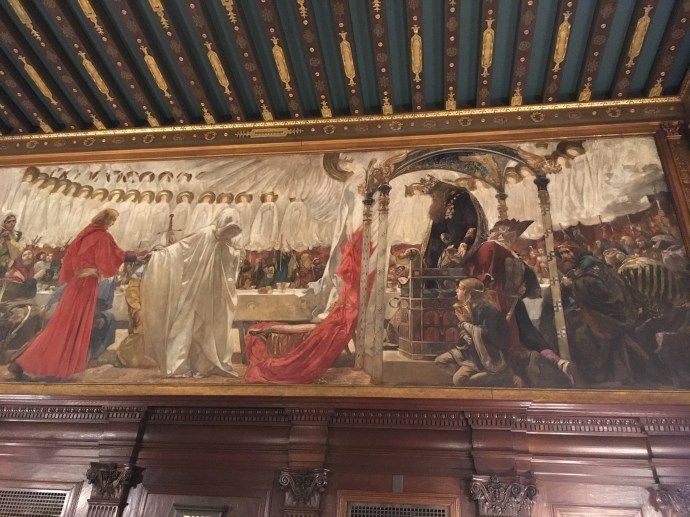
From the map room we headed to the murals. The murals are all located in the McKim Building, the 1895 building. Edwin Austin Abbey was an American who worked primarily in Europe. His mural is entitled “Sir Galahad’s Quest for the Holy Grail” and was installed in 1902. It is installed on all four walls below the ceiling in the Abbey Room on the 2nd floor. The 15 paintings depict the Arthurian legend.

One of the Abbey murals at Boston Public Library

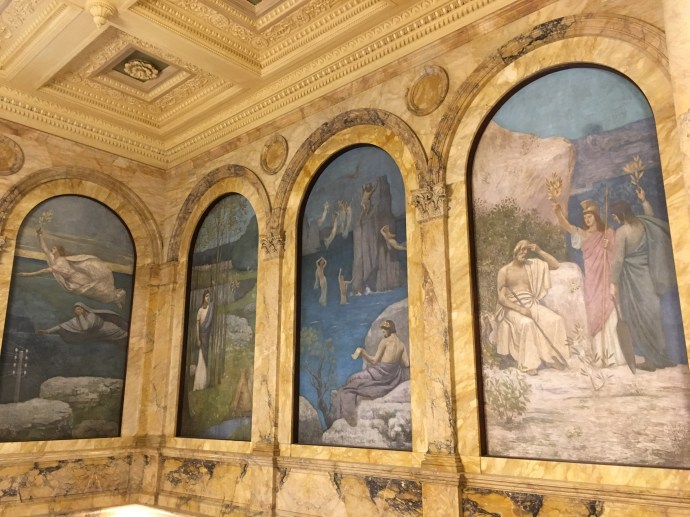
Pierre de Chavannes mural at Boston Public Library

Part of the Sargent murals at Boston Public Library

The French Artist Pierre de Chavannes’ “Muses of Inspiration” was completed in 1895 and is installed outside of Bates Hall on the second floor and on the grand stairway leading from the first floor to the second. Finally, John Singer Sargent’s “Triumph of Religion” was completed during the period of 1895-1919 and is installed in the Sargent Gallery on the third floor of the McKim building. During our time in the library, numerous people and even groups came in to examine the murals. Given that my art knowledge is rudimentary, if you are interested there are numerous on-line articles that provide greater detail regarding the murals. While at the library, we made a stop in the Bates Room which had genealogical records and looked up some family names but had no luck in finding anyone halfway related to our ancestors.

From Copley Plaza we hopped on an airport shuttle that took us directly to Logan airport and the rental center where we picked up our rental car and managed to avoid the heavy penalty Hertz would have charged us for coming in a day early.

Tuesday was a wet, rainy day, excellent for inside activities so we visited The Boston Museum of Fine Arts (MFA) which is the fifth largest museum in the United States. Obviously one does not see the entire museum in one visit. Our plan was to partake of docent tours; a.) Three Masterpieces from Asia (30 minutes); b.)Art of the Americas (60 minutes); and c.) Art of Europe (60 minutes). Seven different tours are available; docents have to be able to lead all seven. After training, a docent is active for only four years, providing for a rotation of new docents and greater opportunities to lead. After the four years are over, a docent can provide sporadic tours. A little different than most museums we have visited. All three of our docents were knowledgeable and easy to understand.

Our Asia tour talked about Buddha and the development of Buddhism. Evidently the first portrait of Buddha in art did not allow for a human visage. The next development allowed for the image of a footprint and it was not until the third phase that Buddha himself was portrayed. Interestingly, even though Buddhism started in India, the real development and current strength of Buddhism is in China; India is primarily Hindu.

Art of the Americas exhibit

Art of the Americas took us into the newest wing of the museum. We found it notable that the galleries are not white and glass like so many new museum galleries, but are painted in a series of shades that I would call neutral naturals contrasting with wall fabrics to break up the gallery features. After lunch, the third tour was the Art of Europe. It was a good way to spend a rainy day in Boston.

Tuesday evening we attended the open house for REACH, the domestic violence center and shelter for which our daughter Deb is the Associate Executive Director. The organization was finally able to move to a new administrative office where they are able to provide individual advocacy, run support groups, offer child art therapy and a safe place to meet. It was exciting to see an arrangement that provides a proper working environment.

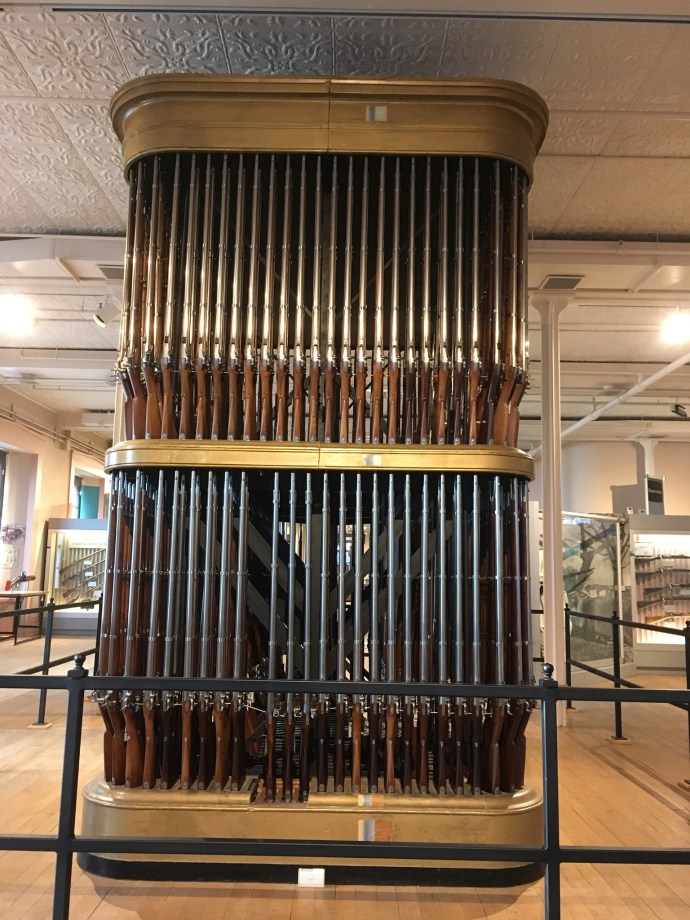
Exhibit at the Springfield Armory

Our travels for family and a funeral also took us to Springfield Massachusetts. This town of 150,000 is home to numerous museums and attractions. We revisited (actually Chris does not remember us being here but I am certain we visited decades ago) the Springfield Armory, part of the National Park Service. The Armory was established in 1794 to manufacture muskets so that the new country would not be dependent on foreign countries for its arms. A second armory was established at Harpers Ferry VA (think John Brown’s raid of 1859). The Armory was a large facility; the NPS site is reduced to one building while the rest of the buildings and grounds are home to the Springfield Technical Community College with over 7,500 students.

Exhibit at the Springfield Armory

Until 1968, the Armory was the pivotal point for the manufacture, research and development of military weapons (pistols and rifles). Along the way, the military arms development also developed advancements in manufacturing processes and the inventiveness of Springfield employees flowed also to other industries. One of the creative geniuses at Springfield was instrumental in developing early manufacturing replicating machinery to produce exact copies of each gun, in creating an automobile, and a steamboat.

Chris and I got a little over exposed to gun models but did note a display covering the development of the Lyle Life Saving Cannon which we had seen at other NPS sites. It was used to rescue sailors at sea. “These line guns are used primarily for shore based rescue operations. The Lyle Gun was hauled to the shoreline usually by U.S.L.L.S. surfmen in specially made beach carts. The iron wheels that supported the cart had wide bands outside the wheel to keep it from sinking into soft sand. The Surfmen would set up and fire the Lyle gun, aiming over the stranded or wrecked vessel and then pull the line within reach of the victims. The line fired to the ship in distress was a messenger line that was in turn tied to a heavier line, the Tally Board (with instruction in English and French), and a Tail block designed to support the breeches buoy. Once the breeches buoy lines and the Crotch Pole(an A frame) assembled, the survivors could be removed from the vessel by hand hauling the breeches buoy lines. The Lyle Gun could shoot the projectile about 700 yards (640 m), although in actual rescues the practical range was much less. Rescues at greater distances were to be accomplished by lifeboats.” (Wikipedia)

In 1964 the decision was made to close the Armory, ostensibly to save money despite local cost/benefit studies that deemed the Defense report inaccurate. Closing went ahead due to “the basic evolution” of Defense Department policies that were never explained. By then, Rock Island Illinois was performing administrative functions and private manufacturers were producing our weapons. (Note that the Colt firearms company facility in Hartford CT has also closed and another NPS site has been proposed there. As usual, Congressional approval for the site was relatively easy and funding to create the site almost impossible.)

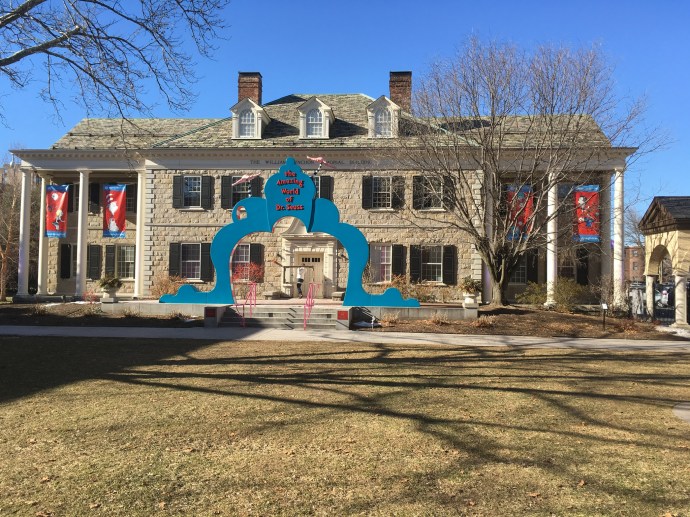
Dr. Seuss museum in Springfield MA

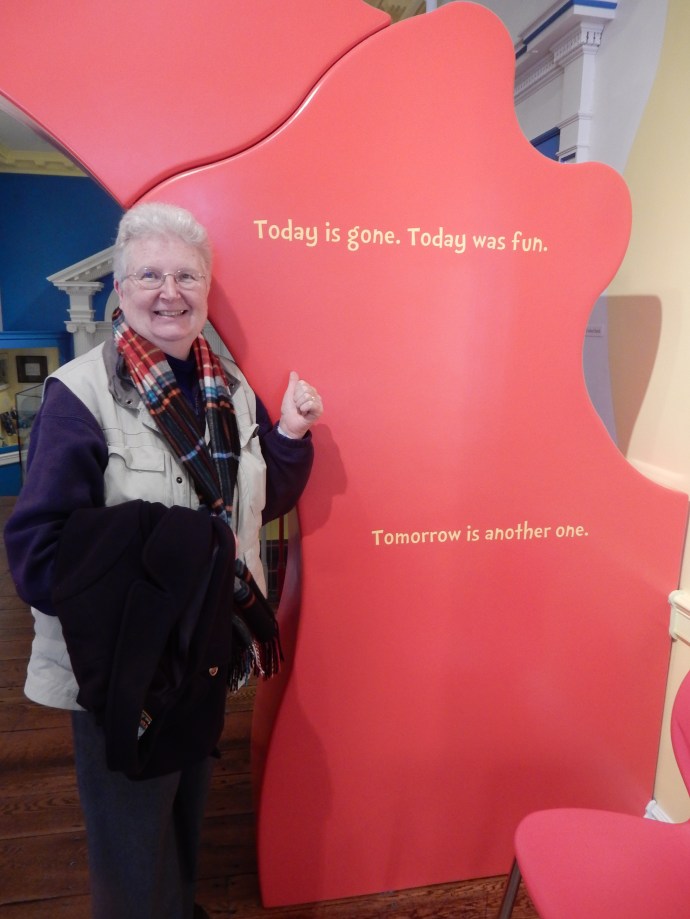
Friday before returning to Boston we visited the Springfield Museums with Chris’ cousin and her husband. The Museum complex includes a science museum, a history museum, two art museums and the Dr. Seuss museum. Our first stop was the delightful, although small, “Amazing World of Dr. Seuss Museum”. Theodor Seuss Geisel was born in Springfield MA in 1904 and while he moved to CA after WWII, many of the ideas, locations, and concepts in his childrens’ books are based on Springfield images and occurrences. Even though he died in 1991, his books are still popular. Chris frequently looks for his books as a gift idea. He is ranked in the top ten fiction authors of all time by the number of books sold.

Dr. Seuss museum in Springfield MA

Part of the museum recounts his life through photos, displays and personal letters and while we enjoyed learning more about him, it was the exhibits based on characters in his books that tugged at the emotions. Good memories all around.

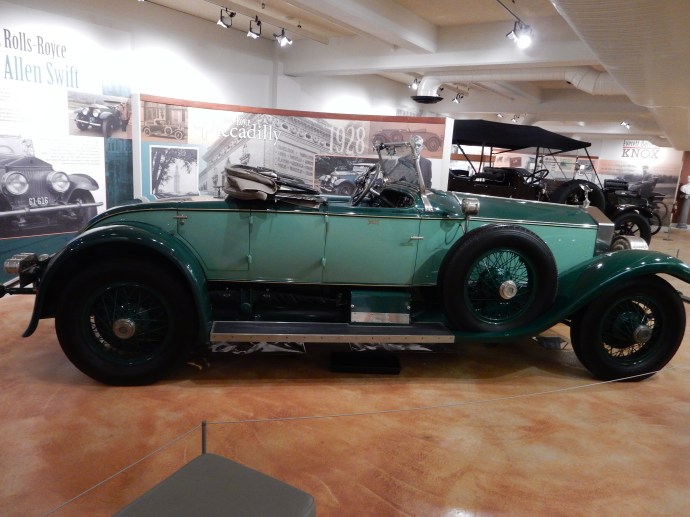
A Rolls Royce Phantom built in Springfield MA

After Dr. Seuss, we visited the Museum of Springfield History. Even Chris’ cousin was not aware of the extent of Springfield’s history and the number of companies that began here. Springfield was home to Breck shampoo, Milton Bradley games, Merriam Webster books (think dictionary), Fisk (Uniroyal) rubber, Indian motorcycles, Knox automobiles, and the only U.S. manufacturing facility of Rolls Royce back in the 1920s, among others. The museum is new, well laid out and was a pleasure to visit.

Replica of U.S. Senate at Sen. Edward Kennedy Institute

The rest of the weekend was family oriented with one visit to the Edward Kennedy Institute for the United States Senate on the University of Massachusetts Boston campus. The Institute is less about his life and more designed to educate people about the role and processes of the U.S. Senate. Sen. Kennedy had served from 1962 to 2009. The Institute includes a full size replica of the U.S. Senate and visitors are encouraged to take part in a mock debate and vote on rotating issues.

The displays are all electronic with each visitor touring with a tablet computer around the building. Frankly, it turned me off, the information struck me as limited and pre-packaged. Evidently, my impression is not unique, the attendance numbers for this institute are well below projections.

Chris and Dr. Seuss message

Ed and Chris
March 6, 2018

Categories: road trip, travel | Tags: , , , , , , , , , , , | Leave a comment

2018 Trip One: Return to Mississippi Headwaters; Jan. 7-10

Itasca State Park, Tuesday Jan. 9

Tired. Tired and Sore. Six more miles today along somewhat packed snow trails on top of the eight from yesterday equals tired legs and bodies. Yes it was glorious and quiet and all of that, but mainly right now I am thinking tired and sore. Is 8 PM too early to go to bed???

Our trip is being squeezed in between last week’s brutal cold and the expected snowstorm starting tomorrow night followed by more bone-chilling cold. We lucked out. Temperatures stayed in the high twenties and the overcast early morning skies gave way to bright sunlight by noon.

Morning hike

Our morning hike was on a portion of the North Country National Scenic Trail. When completed, this trail will be 4600 miles stretching from New York to North Dakota; longer than the Appalachian Trail or the Pacific Crest Trail. While sponsored by the National Park Service, most of the work to develop the Trail and to maintain it is accomplished by local groups of volunteers. The local group is composed of about 60 members maintaining a 75 mile stretch of the trail. Thank you Itasca Moraine Chapter of the North Country Trail Association.

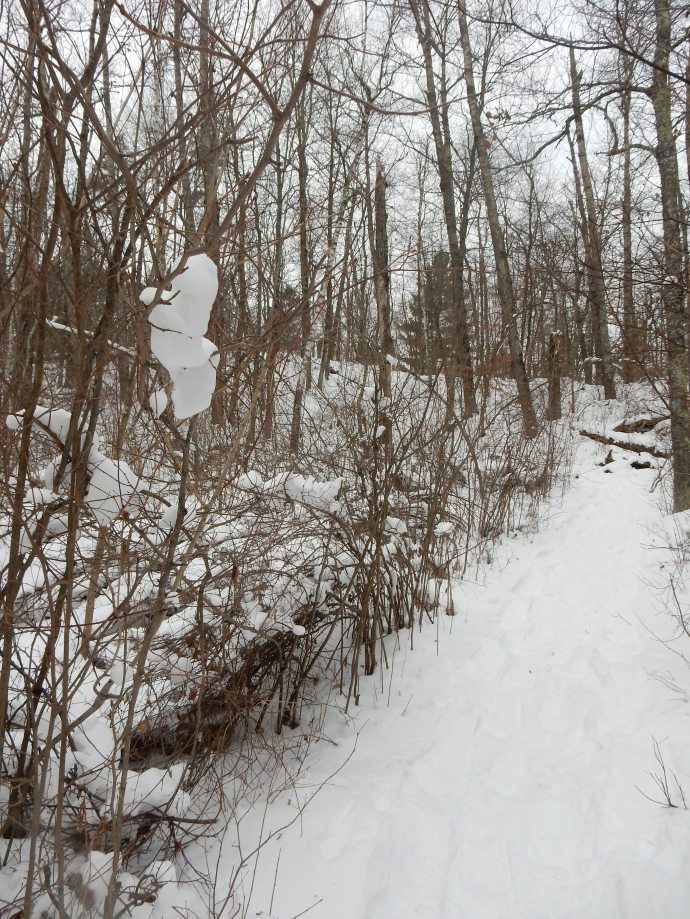
Some views along the hike

The hike was up and down hills, through woods, and past small lakes and wetlands. The color palette was mainly white and grayish brown. The green of the conifer trees was above us, closer to the blue or gray of the sky. Our eyes were normally on the path. We observed little wildlife, a few birds mainly, a squirrel here or there.

The sun comes out and brightens the hike

The suites we are staying in are two pods of 6 units. There have only been two other vehicles here. One of the vehicles belonged to a couple out cross-country skiing. We saw them yesterday at the headwaters. Today we ran into them in the later afternoon. They had run across a freshly killed beaver and a lot of wolf tracks on their ski journey.

The park naturalist had a children’s interpretative session this morning. We saw the 20 passenger bus that brought them here. Nothing scheduled for adults today. We also ran across a young man who was lost. At our afternoon hike, he was scanning one of the informational kiosks and looking for a trail. He was in the wrong area of the park. We directed him to the right area. However, when we completed our hike and on our way back to the cabin, we noticed him reading another kiosk in the general area but still not on the right trail. I got out and led him to the trail head about a 1/4 mile away. I hope he completed it before dusk. Apparently he was here to shoot some photos.

Tomorrow we leave and we have agreed three nights with two full days is about right for us. Assuming we are back here next January.

Ed and Chris

Categories: travel | Tags: , | 1 Comment

2018 Trip One: Return to Mississippi Headwaters: Jan.7-10

Looking at the headwaters of the mighty Mississippi River as it flows out of Lake Itasca in northern MN

Itasca State Park, MN

To start off the year 2018, Chris and I have returned to the headwaters of the mighty Mississippi River found in Itasca State Park near Park Rapids MN. 230 miles north of Saint Paul, we drove a slightly different stretch, one more westward than the usual U.S. route 10. I-94 took us to Sauk Rapids, scene of the Sinclair Lewis novel “Main Street”. U.S. 71, goes from Ely at the Canadian border to the Iowa border by Jackson MN and Spirit Lake IA. Our stretch took us through agricultural fields used for potato growing and turkey raising. In this stretch, we saw three Amish horse and buggy combos.

Along US 71 north of Sauk Centre MN

Towns like Wadena, Long Prairie, and Park Rapids have about 4,000 people each with thriving downtowns that support the smaller towns of 200-800 people. The agricultural lands closer to I-94 gave way to mixed hardwood fields and forests as we traveled north, with snowmobiles riding the roadside ditches instead of the buggies. In Long Prairie, we had a late breakfast at the Countryside Restaurant, a staple in town. Other than us, everyone seemed to know at least one other customer. The woman with the walker due to a broken pelvis took longer to leave the restaurant as she talked with people than it took her to eat her meal.

In Park Rapids, we stopped at the “Beagle and Wolf” bookstore. Family and friends were helping take inventory with newfangled optical scanners used here even in a small store. As visitors, we had numerous discussions with the staff as we purchased several books, just for the heck of it. We did already bring books to read along with us.

Last year about this time we spent two nights at Itasca. The all-season suites are heated, with well equipped kitchens and with linens. We are staying three nights this year and brought an extra blanket and slippers since last year the concrete floors, even with carpet, were cool to the touch. Wouldn’t you know it, the heaters were replaced this past summer so the cabin was toasty warm right off the bat.

The weather is cooperating. Last week, the temperatures at night were in the minus 30 to minus 40 degree range. Today the temperature during the day was in the mid to high twenties (F) with just a mild wind. Sunny, blue skies set off the snow. We had planned to do some snowshoeing but the snow amount is meager and better just for hiking. Last year the snow was much deeper.

Views from our morning hike at Itasca State Park

Our Monday morning hike was on a trail along Lake Itasca. The visitor center gave us a map since trails here during the winter are specified specifically for snowmobiling, hiking, skate cross-country skiing, or classic cross-country skiing. Our four mile hike took us about two hours, it is slow going on the uneven terrain. The park is quiet, some birds, a few snowmobiles, and periodic wind rustling the remaining leaves on bushes. The loudest noise has been the crunching of the packed snow under our boots.

Soup and crackers for lunch re-invigorated us and we went to the Headwaters of the Mississippi River for our afternoon hike. The Mississippi begins as a small stream leaving under the ice-covered lake at its northern end. The clear water ripples over the rocks as it heads northward before eventually beginning its southward trek. It is a much different river than what we are used to.

Back in St. Paul the Mississippi is already running strong and deep through the gorge area between Minneapolis and St. Paul. The river widens as new tributaries add muscle to its flow. We have viewed the river from locks and dams along the Wisconsin border; from a canoe south of St. Paul; from a 30’ x 100’ long car ferry with its deck just a few feet above the river south of St. Louis; from the painted murals along the levees at Vicksburg; and from the walkway along the river at New Orleans where it is 200 feet deep. Here the slight stream with the clear water seems a mystery from that which it becomes later.

Schoolcraft Island in Lake Itasca

Henry Schoolcraft is credited with the “discovery” of the headwaters. Before him, other European explorers believed sources south of here were the beginning of the river. Unlike those earlier explorers, Schoolcraft was humble enough to ask the Native Americans for assistance and an Anishinabe Indian named Ozaawindib led Schoolcraft’s team to the source of the river.

Our brief moment of fame on the Internet

The headwaters area has a web cam available for viewing over the Internet. We texted our daughters and Sarah was able to log in and view us at the site. Our two minutes of fame over, we headed out on the trail to visit Schoolcraft Island. The trail was snow packed but pleasant as we hiked through the woods along the western edge of Lake Itasca. It was another two mile hike out and back and we returned to our cabin around 4 PM, tired but satisfied and glad that we brought our crockpot to have dinner ready for us.

Ed and Chris Monday Jan. 8, 2018

Categories: road trip, travel | Tags: , , , , , , | Leave a comment

2017 Travel: Minnesota State Parks

Saint Paul, MN. October 2017
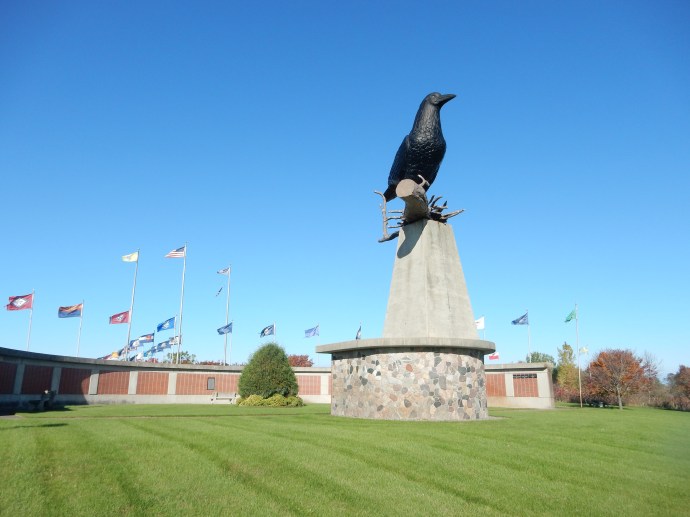
Belgrade Minnesota Memorial Park

Success! Two and one-half years ago, Chris had another travel idea. Join the Minnesota State Parks Passport Club with a goal of visiting all of the 76 Minnesota state parks. (Note: two parks have since been combined into one so there are now 75 state parks; you can waive four of the locations that are extremely remote, only accessible by water, or designed only for off-road vehicles.)

On April 12, 2015 we began the Passport Club by visiting Fort Snelling State Park. On Sunday, October 8, 2017 we visited park number 74, Glacial Lakes State Park. The only place we missed was Garden Island State Recreation Area, an island in the Northwest Angle of Minnesota that juts into Canada, north of International Falls. We set rules for ourselves; even if we had visited parks previously, we had to visit them again after April 12, 2015, and we had to take a hike of at least one mile in each park. Normally our hikes were much longer. There were two or three places where the bugs were too bad or the trails were lost in the snow that we did not hike a mile. During the last 2.5 years, we have documented in this blog a good number of the state parks as we have traveled around Minnesota.

What did we accomplish? Primarily, the Passport Club made us visit parts of Minnesota we had not seen before. In traveling to parks, we spent time driving on dirt roads, visiting very small towns, and talking to a wide range of people. We slept in B and B’s, in camper cabins at the parks, in small hotels, in a bunk house, at casinos and lake resorts. Note we are not campers; we do not own a tent or drive an RV and have no desire to do so. We ate at some nationally franchised restaurants but primarily at locally owned small town eateries.
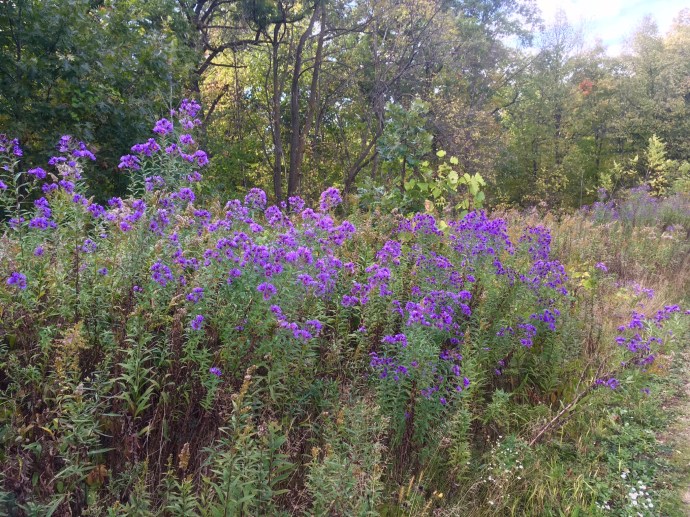
Wildflowers at Nerstrand Big Woods State Park

We observed fields of blooming sunflowers; took factory tours, hiked up mountains (Minnesota sized), saw innumerable waterfalls, gloried in fall colors and colorful prairie flowers. Most parks were immaculate and a treasure to behold, a few were more ramshackle and in need of visitors and maintenance. Oh yes, we saw lakes. Lot and lots of lakes. While the lakes almost always presented clear water, we understand phosphorus and nitrogen can be unseen problems. Invasive species did not jump out and say “Here we are”.

I was generally impressed with the quality of the roads in outstate Minnesota (or Greater Minnesota as it is frequently termed). Farm equipment was frequently encountered; we were amazed at the size and heft of some of the machinery. During this two and one-half years, we bought a new car and found the new one gave a smoother ride-even on dirt roads. Inside the parks, while we usually hiked, bike trails are numerous and located all over the state. Several times we rented bikes locally to enjoy the bike trails. A few other times we rented canoes and enjoyed the views from the level of the water.

Moose and wolves hid from us but numerous small mammals and tons of birds were viewed. We are not birders, so we will not bore you with an attempted list of all that we saw. On occasion we observed more birds here in St. Paul along the Mississippi River than we did along birding trails. We do not fish so don’t inquire about the quality of the fishing. There were plenty of people fishing though so it must be at least reasonable.

Only two parks were visited during the dead of winter (not counting winter hiking locally at parks like Afton and Fort Snelling which we visit frequently). La Salle Lake State Recreation Area which was one of the ones for which we could not find a winter trail and Lake Itasca to observe the headwaters of the Mississippi River in the dead of winter-gorgeous!

Are we going to do it again? Not really in this form. Since there are some parks that really were not that great, we expect to frequent parks that greatly appealed to us or which have sections we did not visit on our first time there. The list of parks to visit again is much longer now than I would have expected.

We agreed when this was over we would each make a list of the top 10% of the parks (seven each) that we enjoyed. The criteria are nebulous and changing, at least for me. I made myself limit the list to only one North Shore park, otherwise the waterfalls along Lake Superior would put every one of those parks on my short list. Surprisingly, our lists were quite different.

Chris: not in any particular order
Big Bog
Forestville/Mystery Cave
Red River
Hill Annex Mine
Nerstrand Big Woods
Tettegouche
Crow Wing

Ed: again not in any particular order
Big Bog
Judge C.R. Magney
Frontenac
Tower Soudan (and Lake Vermillion as combined park)
Blue Mounds
Interstate
Fort Snelling

To reach our final three parks, we left Saturday morning Oct. 7th under gray, rainy skies. As we drove west through Minnesota agricultural land, the skies cleared and the temperature hit the high 60s. On the drive we went through Cosmos MN, a new town for us. As its name implies, all of the streets have cosmic names-Mars, Vega, Libra, etc. We drove by a winery with music Sunday afternoons that we made a note of. We passed by the official location to obtain the stamp for Greenleaf State Recreation Area and we got our stamp. Actual visit will be on Sunday.

Monson Lake State Park

First real stop Monson Lake, a small state park dedicated to the memory of several European immigrants killed in the Dakota War of 1862. A story told before in our blogs, but this park was the site of the deaths of 13 members of two families. There is a small marker here. Fishing and camping are the highest uses here, not a memorable spot for our type of park activity. We drove the short distance to New London MN and had lunch at a downtown restaurant, McKale’s Family Restaurant.

View from Mount Tom at Sibley State Park

Sibley State Park was next, a park we had visited in the past. Notable for Mount Tom, a high point in the surrounding area, this park offers a fuller range of activities. As we went to the top with its viewpoint, we discovered biting bugs of some nature were out. Sunday when we visited Glacial Lakes, only fifty miles away and with the same weather, no biting bugs were encountered.This park offers nice hikes and the beach along the shore of Andrew Lake provides a pleasant respite to sit and watch the lake.The park was busy. The ranger signed our Passport Club book and filled out the paperwork for our plaque. She wanted to chat a bit more to congratulate us on completing the visit of parks but we did not want to slow down the campers waiting in line. (Technically we did not have to visit the park on Sunday to complete our Pasport Club Book, Sibley would have completed the requirements.)

While at Sibley, I saw this guy taking pictures of the bathrooms (from the outside) and he said I was probably wondering why he was doing so. I was. He organizes the Tour of Minnesota Bike Ride; as they state: “Welcome to the Tour of Minnesota formerly the Klobuchar Bike Ride. The Tour of Minnesota is in our 44th year and the ride will be June 15th – 22nd, 2018. We will start in Willmar, ride to Morris, Fergus Falls, Alexandria with a day off in Alexandria, Little Falls, St. Cloud and back to Willmar. We will meet on June 15th at the Willmar Civic Center. I would estimate the daily mileage will range from 45 miles to about 70 miles with an average daily mileage of about 55 miles even though the route is not complete.” He was at Sibley to plan the 2018 trip and the pictures become part of the tour guide to help him and riders know where they will be riding and what they will encounter. Chris and I are more recreational riders but any of you who might be interested should check out their website for the 2018 ride. http://www.tourofminnesota.com

Spicer MN was the site of our night’s lodging at a newly constructed Hampton Inn which offers bike rentals to its guests. Good information for next time. Both New London and Spicer were well-kept communities with a population of about 1200-1400. We have friends from our college days living in Spicer and had dinner at their home. They had previously been living in St. Paul but after retirement decided to move to Spicer; both have family connections in the area.

Sunday our destination was Glacial Lakes State Park. On our way there, we passed through Belgrade Minnesota and our attention was grabbed by a large statue of a crow. The Middle Fork of the Crow River rises near Belgrade and the town has constructed a memorial park to honor “who we are, what we are doing, and where we are going”. Each state’s flag flies, the picnic tables fly the flags of the seven countries (Germany, Norway, Sweden, Denmark, Ireland, Poland, and Czechoslovakia) sending early settlers to this area, and then the flags of Canada and local civic groups such as the Lions and VFW are flown. The walls have bricks memorializing local residents as well as school superintendents, local pastors, veterans, county road crew members, scouts, etc. The crow is 18 feet high and weighs 3,000 pounds.

Glacial Lakes State Park

Normally when I think of Minnesota lakes, I think “Up North”, that area generally north of a line drawn through St. Cloud. However, this area of west-central Minnesota is south of that line and yet is well populated with numerous lakes, generally created by glacial action. The ranger at Glacial Lakes was not as busy and took our picture. I complained to her about the new MN DNR maps/descriptive handouts for each park that while providing larger and easier type to read, have deleted most of the background information about the park-its history, geology, wildlife, etc. They have dumbed down the information. Their new publication listing all MN State Parks is in a different format also. Rather than the 4″ x 9″ folded booklet, there is a large map with the location and list of the parks. I think it is a mistake, the map is difficult to read easily and again, has less information about each park on it. Oh, if I was in charge everything would be perfect. We hiked around a lake, noting kame (cone-shaped hills), kettles (water-filled depressions), and eskers (“a long ridge of gravel and other sediment, typically having a winding course, deposited by meltwater from a retreating glacier or ice sheet).

Fall foliage has been relatively poor. The greatest color has come from shrubbery. A few trees were brilliant, most had not changed or were a dull color. Once again, we are seeing better fall foliage here in the Twin Cities. Last weekend we visited Nerstrand State Park (not for the first time) and the colors there were blah. The brilliant colors at the heading for this blog were taken last fall in St. Paul.

Greenleaf State Recreation Area

After Glacial Lakes, we visited Greenleaf State Recreation Area. Greenleaf was authorized in 2003 but the property is small and development has been spotty due to low funding. It is only a day use area with no facilities but six other people were at the lake access area, more than we have seen sometimes at small state parks. We left Greenleaf in time to visit Crow Wing Winery just east of Hutchinson (14,000 people). The winery is heavy into Minnesota grapes; grapes developed by the University of Minnesota to fare well in our colder climate. A guitarist was playing and we had onion rings and a great pizza to go with our pop. Our final stop was at the Apple House affiliated with the University of Minnesota Arboretum. We picked up an apple pie to bake at home; I was not in the mood to make another apple crisp-maybe later this week.
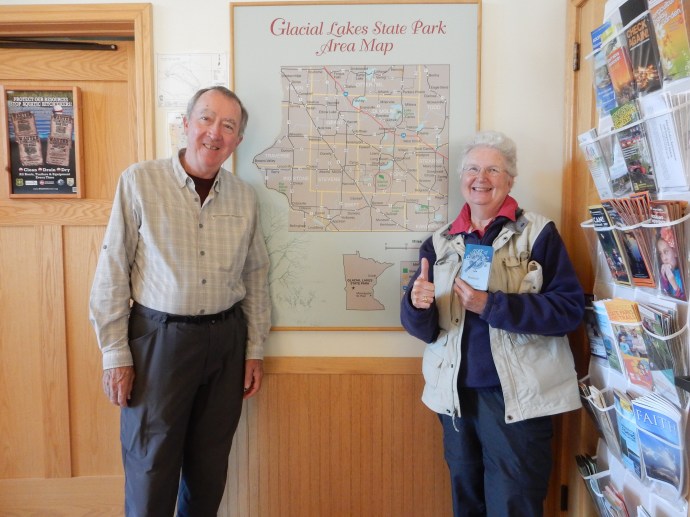
At Glacial Lakes State Park

Another good journey and a successful conclusion to our 2.5 year odyssey to visit all MN state parks. We would highly recommend the experience to others.

Ed and Chris October 10, 2017

Categories: road trip, travel | Tags: , , , , , , , , , , | 1 Comment

2017 Trip Seven: Acadia and Cape Cod: Sept. 25-26
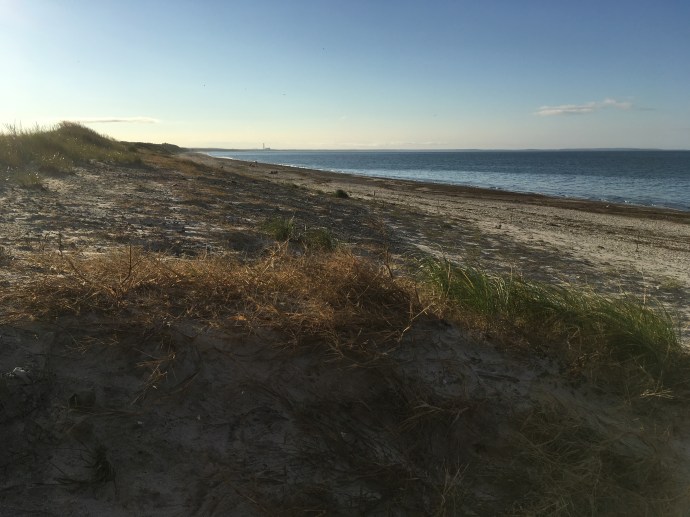
Barnstable, MA. Tuesday Sept. 26

Cape Cod National Seashore

We left Mattapoisett at 9:30 Monday morning, able to miss any rush hour traffic. The Salt Pond Visitor Center of the Cape Cod National Seashore was our initial destination. The park is normally jammed in summer months, and just busy in the fall. The park itself is long and narrow, extending over much of the eastern coast line. Like Acadia, the park intermingles publicly owned land among private parcels or whole towns. Cape Cod though is about four times the size of Mount Desert Island; while the Cape Cod National Seashore is about 15% smaller than Acadia National Park. So, the national seashore has less of an impact on the Cape than Acadia has on Mount Desert Island.

Part of the marsh area of Cape Cod National Seashore

The visitor center offers several short videos which provided a background to the geology and history of the cape. (Until 1914, Cape Cod was physically attached to the mainland. In 1914 the Cape Cod canal was created to aid shipping in avoiding the storms around the Cape which took thousands of ships in storms over the years.) Cape Cod is a product of the Glacial Ages, which over years of advancement and retreat formed the higher elevation which still exists today. One of the park rangers was kind enough to provide me with a few written handouts providing greater detail on several topics so that my comments here would be completely accurate. Unfortunately, I seem to have misplaced them.

Cliffs and beach at Cape Cod National Seashore

Before hiking, we had lunch at an ice cream/fish stand, Arnold’s, in existence for 40 years. The cliffs and surf attracted us after lunch. There were some people at the beach, just relaxing. The surf was running well, although a heavy mist/fog limited the view out to sea. The location is historically important. The international transatlantic telegraph cable was first completed here. The small wood building where the messages were received is still standing at the top of the cliff although the cable buried in the ocean is no longer used.

Another hike took us through the woods at the top of the cliff to a marker noting the location of the first housing site of the seven families who in 1644 moved from Plimouth Plantation to Nauset on Cape Cod.

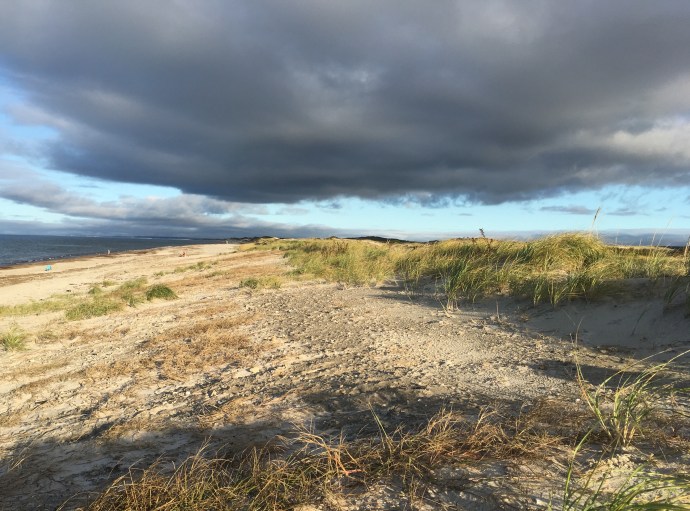
Sandy Neck Beach

Sandy Neck Beach

Our Evergreen hosts for Monday and Tuesday nights suggested we might also enjoy visiting the local coast. The Sandy Neck Beach at Barnstable had great sand beaches and sand dunes. We hiked along both as the sun was just starting to set. This beach offers the opportunity to drive vehicles on the sand which we did not chance with a rental car. Dinner at a Barnstable restaurant offered excellent clam chowder soup.

Some scenes from around Cape Cod

Tuesday morning we headed back to Salt Pond via the two lane, curvy back roads through little towns. We stopped at a local park to photograph an 18th century windmill located next to the last remaining primitive one room house on the Cape. Before we made it to Salt Pond, we saw another windmill-the first windmill erected in Cape Cod in 1680.

At the visitor center we listened to a part-time ranger regale us with stories from his youth on Cape Cod. His family goes back 12 generations on the cape on both sides of his parents.

We had debated how to spend the rest of the day. Monday we stopped at a bike shop and got quotes and a map of local bike trails. If we return to Cape Cod, I would not mind spending a day or more biking. However, a tour of a local organic cranberry bog won out. Cranberries are a native fruit, introduced to the European settlers by the Native Americans. Wisconsin is the largest producer of cranberries and I comment on them when volunteering on the Amtrak Empire Builder for the National Park Service.

The Cape Farm Supply and Cranberry Farm is the largest organic cranberry grower in the East. There were 18 of us on the tour which utilized a small bus to take us around the farm. The narrator is the wife/co-owner of the farm. Her story line revolves around the activities necessary during each month of the year to keep the cranberry farm operating.

Organic cranberry farm

A few of the comments made during the tour included: A.) Cranberries grow in a mixture of sand and water. The sand needs to be replenished every two to three years which occurs by spreading sand over ice in winter, or if the winter weather does not cooperate with enough ice, by spreading dry sand in April and then irrigating the sand.

B.) Dry picking uses a machine to comb through the vines for fresh, whole berries which are sold in stores, generally for home cooking. Wet harvesting results in the harvest of fruit used for juice, jams, etc. The bog is flooded and a machine agitates the vines to release the berries which float to the top and are scooped up.

C.) Since this is an organic farm, she noted the positive impact of birds, bees, and bats to pollinate the plants and to reduce harmful pests.

After the bog tour, we visited a bookstore at the western end of Cape Cod. It is owned by a friend of our daughter Sarah. I picked up a book for the airplane ride home. We walked the downtown Main Street of Falmouth and had a freshly made brownie to share at the local bakery. The visitor center had mentioned a light house in Falmouth for us to visit. Turns out the lighthouse is being repaired and was wrapped in white sheets.

The drive back to Barnstable was through congested traffic, summer time must be a real bear. Dinner was in Barnstable Village again, this time instead of the Barnstable Tavern, we ate at the Dolphin. Both of them have excellent clam chowder soup.

The evening finished with another period of conversation with our Evergreen hosts. When Chris and I started using Evergreen five years ago, I was quite hesitant. Now it is one important and interesting component of our travels.

Wednesday we fly back to Saint Paul Minnesota. We should be just in time to check out the fall colors on the trees. The header picture at the top of the blog was taken in the fall of 2016 and is of the Mississippi River Gorge, looking at Minneapolis from the Saint Paul side.

Ed and Chris. Sept. 26

Categories: road trip, travel | Tags: , , , , , | Leave a comment

2017 Trip Seven: Acadia and Cape Cod: Sept. 23-24

Mattapoisett, MA Sunday Sept. 24

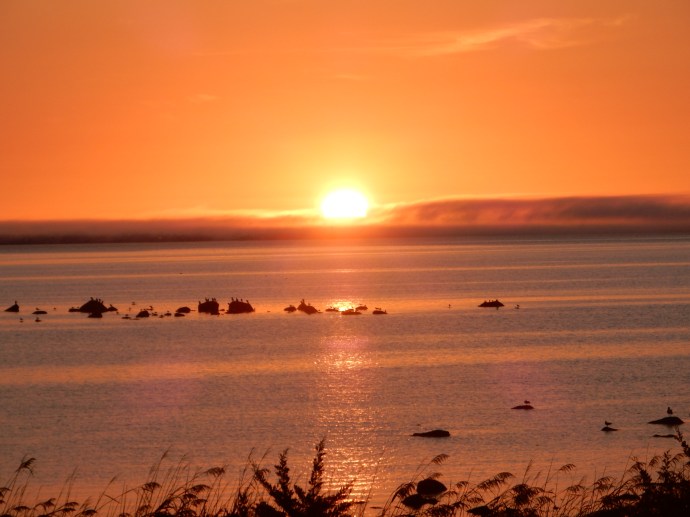
Sunday morning sunrise over Buzzard Bay

Saturday morning the wind and rain ended but the day remained cloudy and wet giving us another good reason to relax and take life easy. Since we live 1200 miles from Deb and Rebecca, these relaxed days provide an opportunity to just spend time together rather than continue our hectic touring pace.

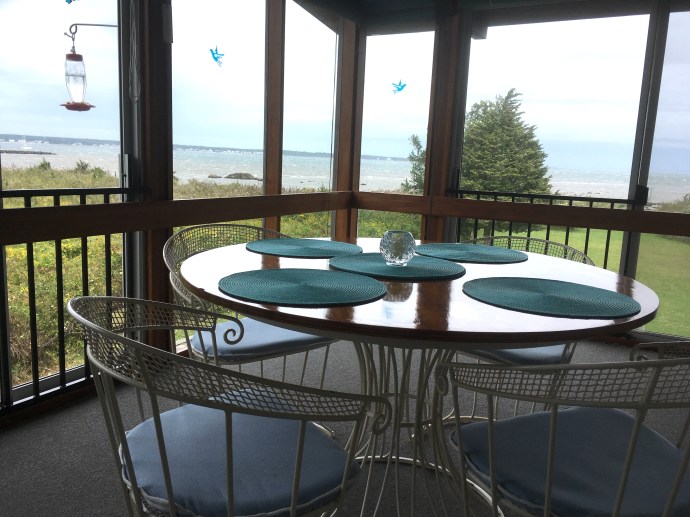
Our home and its view

Relaxing on a rainy day

Our rented house is in Mattapoisett,MA, not a touristy town. The home is located on Buzzards Bay, directly across from Falmouth and Woods Hole on Cape Cod. The location offers quick access to and from the Boston area while we have vistas of the bay, birds, and boats from the numerous windows and porches of the home. Like most of New England, sandy beaches are far and few between. We explored the beach of our house and discovered it has the standard shoreline with a marshy, rocky beach.

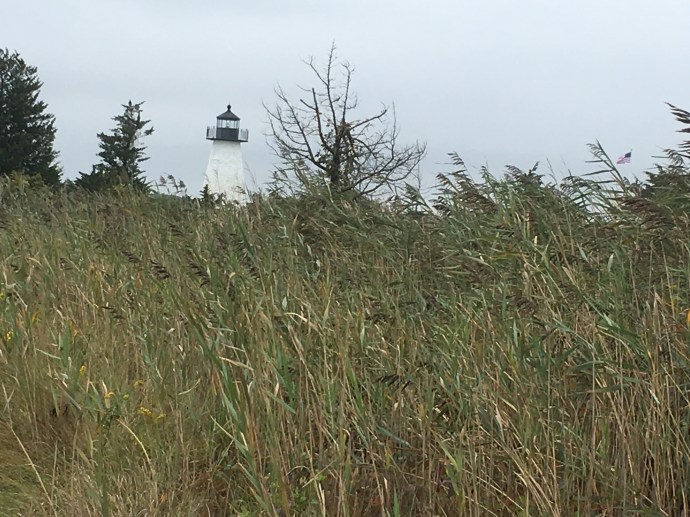
Ned’s Point Lighthouse Mattapoisett MA

We ventured out and visited a lighthouse in Mattapoisett that we can see at night. The back seat riders had eagle eyes and spotted Oxford Creamery, a local ice cream and short order restaurant that has been operating for 85 years in Mattapoisett. Yes, we stopped and enjoyed several of their many flavors.

After church, Rebecca’s parents and sister arrived from Connecticut and brought dinner. We spent a delightful evening touching base on current happenings with each family.

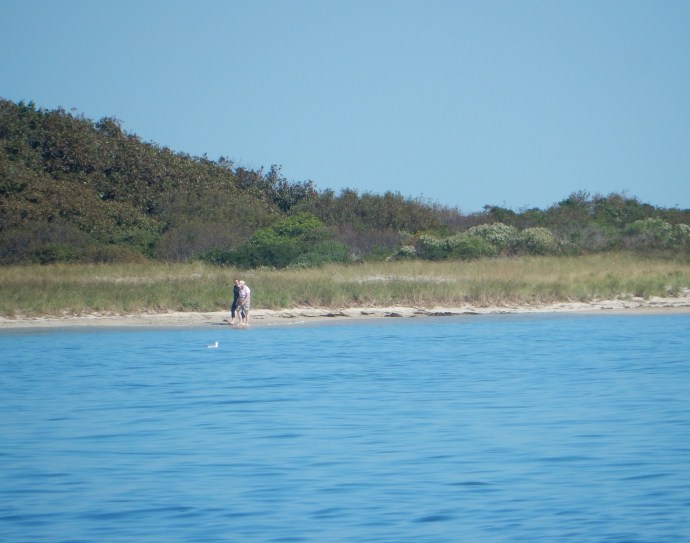
Chris and Deb out walking at West Island Town Beach

West Island Town Beach

Sunday morning the sunrise was beautiful and was an accurate harbinger of the day’s weather. Chris had managed to find a sandy beach only half an hour away. We arrived before the crowds and enjoyed 90 minutes strolling on the beach and/or just enjoying the sun. It was enough time to satisfy the beach desire.

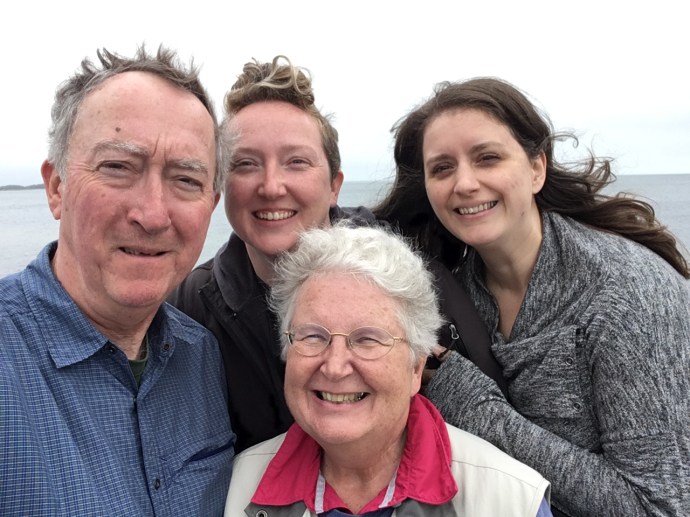
The four of us

Deb and Rebecca left in late afternoon to head back to Boston. Chris and I will spend the last evening here alone and Monday drive an hour over to Cape Cod and start visiting the national seashore there.

Ed and Chris. Sept.24.

Categories: road trip, travel | Tags: , , , , | Leave a comment

2017 Trip Seven: Acadia and Cape Cod: Sept.21-22

Mattapoisett, MA. Friday Sept. 22

Just arriving at Mattapoisett at our AirBnb location

In no way am I seeking sympathy.

We have been watching 24 hours so far of rain and winds ranging between 20-45 mph, an effect of tropical storm Jose. We were without power or water for two hours in a strongly built house. What the experience demonstrated in a personal way was a faint feeling of what others in the South and in the Caribbean have experienced over the last few weeks.

Our wind was strong but probably more like a melodic CD featuring ocean sounds, waterfalls and bird calls compared to the hurricane levels they went through. We only saw one tree branch down on our drive to dinner compared to roofs missing and homes destroyed. Our refrigerated food stayed cold with only a two hour power outage. And while our water is a well system relying on an electric pump, we had a decent supply of bottled water. There were candles in the house and we had the small flashlights we take with us on our trips.

We can sit inside and read and be amazed at the power of the wind and waves. Birds flap their wings and get nowhere or, if flying with the wind, travel maybe three times their normal speed. Even during the night, we could watch the two lighthouses flash on a regular basis. Inconvenienced a bit, but suffering, no. Let us all say a prayer, donate time and material, or give money to those in great need today.

Thursday was a travel day. Today, Friday, we are spending the day reading, doing puzzles, and playing games. An easy way to spend a rainy, windy day which in five years of travel is probably the longest continuous spell of bad weather we have encountered.

Wind and rain video

Ed and Chris. Sept. 22

Categories: road trip, travel | Tags: , | 1 Comment

2017 Trip Seven: Acadia and Cape Cod: Sept. 20
Ellsworth. Maine Wednesday Sept. 20

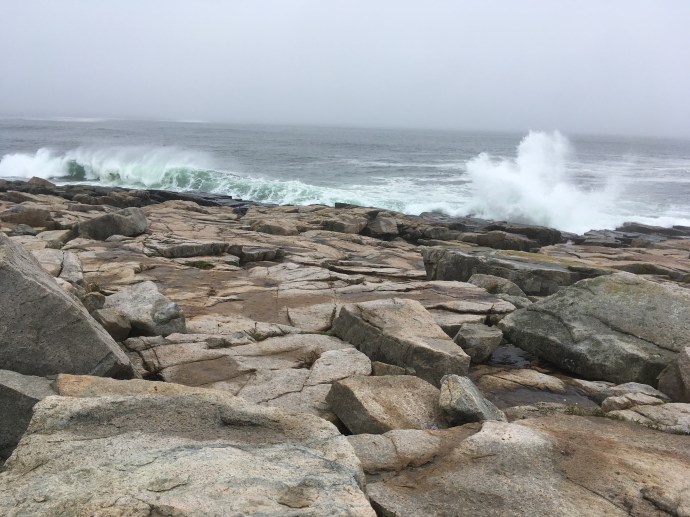
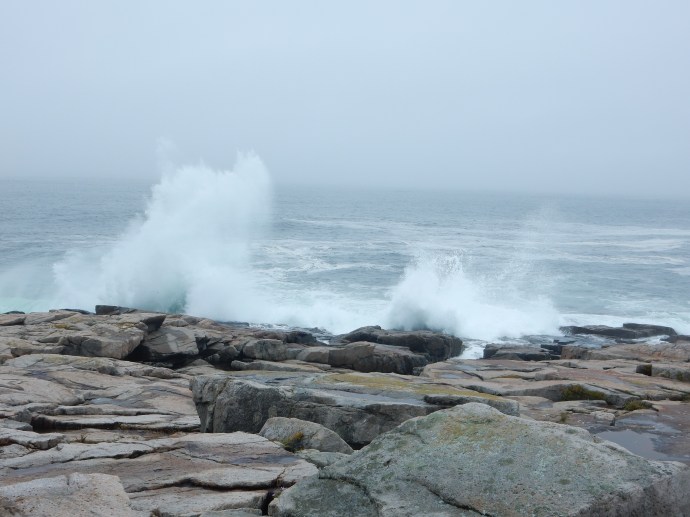
Schoodic Point

The sun came out today, briefly, and weakly. But that did not matter to us. We accomplished two priorities: Schoodic Peninsula and Cadillac Mountain.

Schoodic Point

High tide was at 11:30 AM. Tropical storm Jose was expected to increase the height and power of the normal waves. We thought, a Ranger confirmed, that the Schoodic Peninsula would be a good place with smaller crowds to observe the waves. Schoodic Peninsula is about an hour from Ellsworth. Its name probably derives from an Indian name meaning end point or end of land.

Schoodic Point

The Schoodic Peninsula portion of Acadia National Park has an interesting origination. A wealthy Maine resident who moved to New York and made a fortune in the telegraph business and banking bought property in this area. His money also bought influence in the United States Senate under conditions that today would be considered corruption and bribery. He wanted to develop the area on the Schoodic Peninsula in a manner similar to that of Bar Harbor. While he was able to amass property and lots of money, he died before his development desires in Schoodic came to fruition. His widow and daughters wanted to get rid of the 2000 acres of land and spend their time in New York and Europe. George Dorr, one of the originators of what was then called Lafayette National Park, worked out a deal changing the name from the French based Lafayette National Monument Park to Acadia National Park. The Moore daughters loved the British but disliked the French and the land donation was confirmed.

Two further arrangements added to Schoodic Peninsula park land. The first involved another land swap whereby a US naval facility used for listening to telegraph traffic on shipping in the Atlantic was transferred from the Bar Harbor area where it was in the way of John D Rockefeller’s plans for Acadia National Park to Schoodic Peninsula. That facility has since been decommissioned and is now park property.

The second arrangement occurred in the 2000s when a developer proposed to build a 3200 acre resort community directly north of the Schoodic Peninsula park property. An anonymous donor bought the property, built a modern campground, developed biking and hiking trails, built a visitor center and then donated everything to the NPS to be added to the Schoodic Peninsula park portion of Acadia National Park. This new section just opened two years ago.

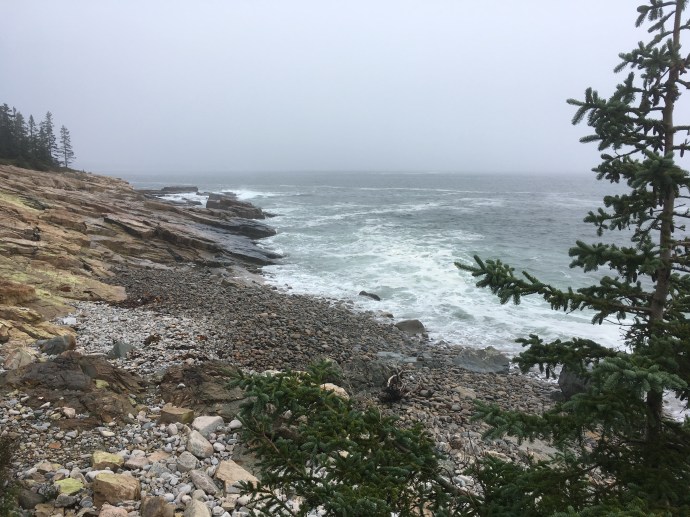
Blueberry Hill and its cobble stones

Okay, enough with the history. We arrived at Schoodic Point at 9:30 AM, early enough to obtain a parking spot. Waves were crashing and surf coming in. We took pictures, listened to the waves, and then moved on to Blueberry Hill. Blueberry Hill was unique; the waves here pick up cobble stones-rounded stones between the size of an apple and a basketball. The stones make a tinkling sound as the waves move them off and on the shore. The waves today were most effective in doing this. I made a video but the wave and wind sound hides the sound of the cobble stones. Sorry.

Bunker’s Harbor where we had lunch

Schoodic Peninsula has a one-way loop road similar to the main Acadia Park. We left Blueberry Hill and returned to Schoodic Point to watch the waves some more. When we left at 11:45, the line to get in to the parking area was several blocks long. Slackers. We went to Bunkers Wharf for lunch where we split a fish and chips dinner which guaranteed us room for dessert, chocolate hazelnut mousse and pumpkin cake.

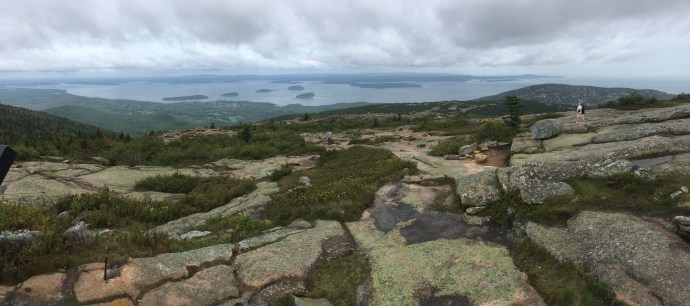
View from Cadillac Mountain

A little shopping in the small town of Winter Harbor followed but nothing grabbed our eyes. By now it was 1:30 PM, and the skies were getting lighter and no fog was present. We decided to take a chance and head to Cadillac Mountain. It took us 75 minutes to get there and the sky changed frequently. As we ascended the mountain, the skies were clear. When we reached the top, the fog and clouds had gathered; yet there was enough visibility to see a partial vista from the top. We submit them as proof that we made it to Cadillac Mountain and actually saw something.

We are back at the hotel, doing laundry and getting ready to spend Thursday driving to the Cape Cod area.

Ed and Chris Wednesday Sept. 20

Categories: road trip, travel | Tags: , , , , | Leave a comment

Blog at WordPress.com.