travel

2019 Trip 3: South Florida: April 2

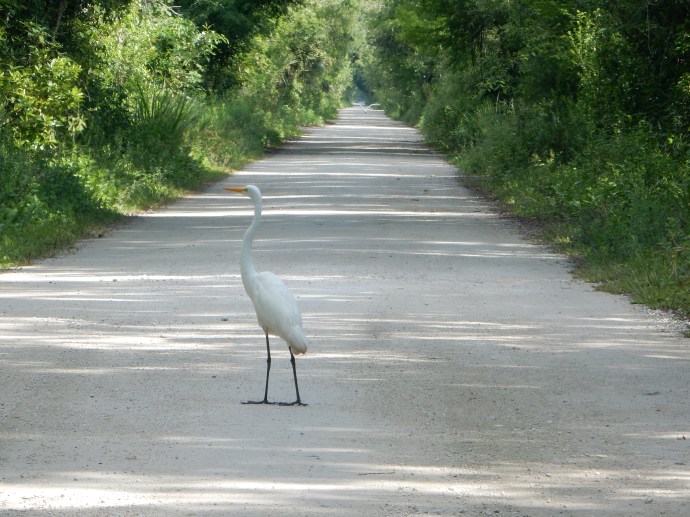
This bird knows he owns the road and he is not moving until he feels like it

Everglades City, FL April 2

We spent much of the day in the Fakahatchee Strand Preserve State Park. Fakahatchee is Seminole for forked river and a strand means a long narrow, swamp forest. The Fakahatchee is Florida’s largest state park and is home to numerous wild orchids, one of which is in bloom now. The FSPSP connects Florida Panther National Wildlife Refuge (one of Sunday’s stops) to the Gulf of Mexico. FSPSP is the orchid capital of the US and has the largest population of native Royal Palms in the US.
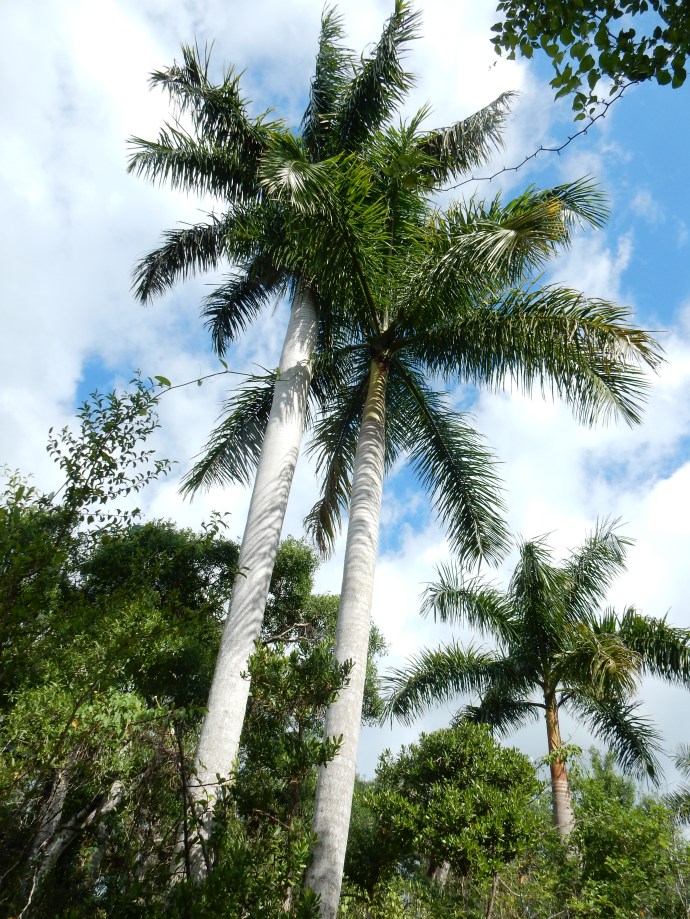
Royal Palms in Fakahatchee Strand Preserve State Park

Met another volunteer couple staffing the welcome center; they summer in Rhinelander WI and have been volunteering here for over six years. They gave us a few pointers about the best places to hike. Instead, we ended up driving most of the time we viewed the park. The Janes Scenic Drive is gravel (not a problem) but full of potholes that suggest strongly that one drive slowly and carefully. The portion of the road that is open for cars is only 6 miles; we drove it at speeds of 3-6 mph. There were just many birds to see and it was relaxing to motor along nice and slow.
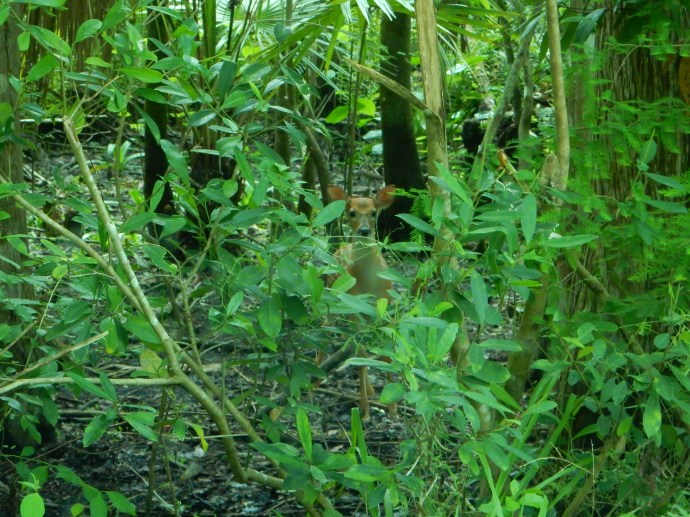
Can you spot the fawn?

Twice we headed out on hikes. For the first one, we chose to be safe rather than sorry. Signs about alligators tell you not to harass them, not to feed them, etc. The signs we read were not specific how to deal with them sitting in your trail path.
In general, alligators are not aggressive and do not attack humans. But what if they are just right there?? Alligators are big, have strong jaws and tails, and can move fast for short distances. On this first hike, the alligator was taking up about one-third of the trail. Oh, did we say they frequently just stay in one spot? Thus, the likelihood of the gator ambling along soon was low. We chose to turn around and abort this hike.
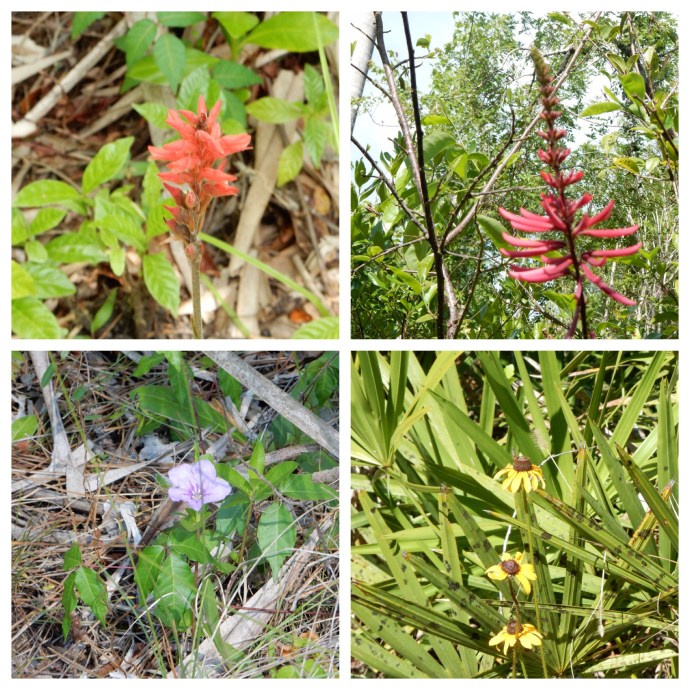
Along our hikes

On our second hike, we met another volunteer clearing the trail to assist people in walking along. We asked him about the alligator and he suggested that in the future, we should use a big stick and gently touch the alligator on the tail. That touch normally would encourage it to just move forward a bit. We thanked him but I am not sure we will take advantage of this suggestion in the future.

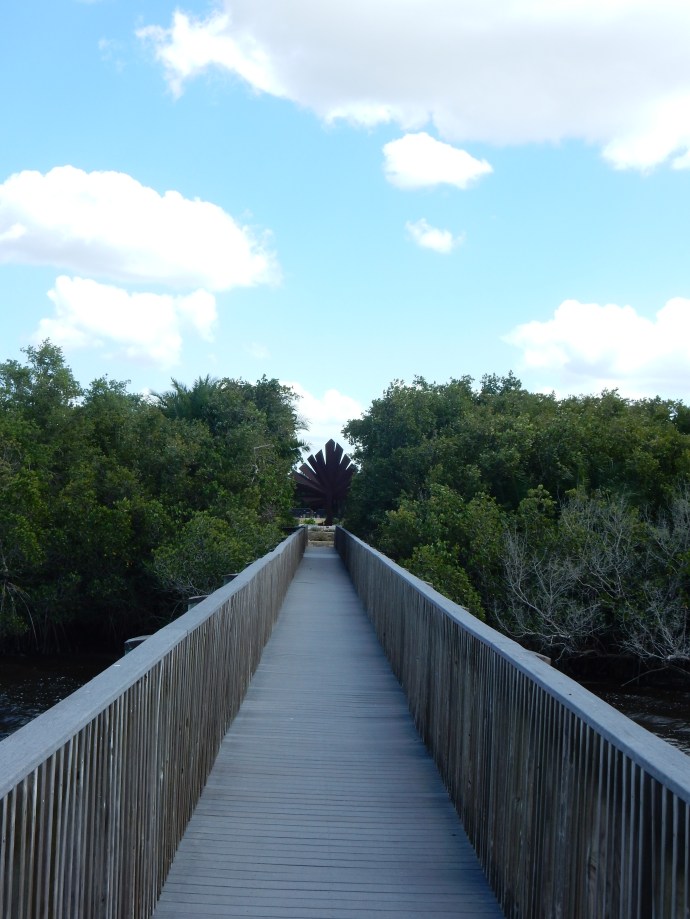
Along the Big Bend Cypress Boardwalk at Fakahatchee Strand Preserve State Park

All in all, we spent about three hours at Fakahatchee Strand Preserve State Park. We returned to the Ivey House, had a snack, went in the pool, and then returned to our exploring. This time we went to a different portion of the park to explore the Big Cypress Bend Boardwalk Trail. Here, we were told that a bear was just ahead on the right side and to be quiet as we approached it. Well, we were quiet but alas, the bear had disappeared. Chris, who was not excited about seeing any bear, was nonetheless 30 feet ahead of me on the trail; I was trying to look everywhere and she was just marching at double pace. In any event, it was just a walk in the woods.

Our final stop was exciting. Monday we had taken in a presentation at the Everglades National Park Visitor Center. The ranger giving the talk, besides telling us about his adventures in Alaska, advised us to take the Marsh Trail to watch the birds returning to the roost at sunset. The experience was magnificent. An observation tower is strategically placed for bird watching. We spent at least 45 minutes there until sunset had occurred.

Birds landing along the Marsh Trail at Ten Thousand Island Wildlife Refuge

Birds at Marsh Trail at Ten Thousand Island National Wildlife Refuge

When we arrived, the ponds and marsh were already busy with roosting birds. As we watched, more birds arrived in groups of 1, 2, 3 or 4. As time went on, the groups grew in size to have 20, 30, or 40 returning birds. A variety of species were landing, chirping, and gathering. But as time went on, many of the birds which had landed in the pond to our right picked up and flew to a group of trees on our left to roost for the night. It must be a safer location to avoid predators there. Only about 20 people were here, it was a great experience and lightly attended. Several of the human attendees had cameras that likely cost at least 10 times the cost of our point and shoot but our pictures are sufficient to illustrate the experience.

On our way back to the car, we saw an alligator crossing the paved trail from west to east about 100 feet in front of us, heading home evidently for the night. When we passed the point where the gator had crossed, we could see the wet trail his feet and tail had made on the pavement. This time we did not have to worry about what to do with a gator on the trail.

This marsh area was also part of Ten Thousand Islands National Wildlife Refuge. We did not observe any damage from Hurricane Irma here, evidently the barrier islands had helped to mitigate the storm. When we had taken the boat ride Monday, several islands had been hit with a 14 foot tidal surge. The amount of salt water was enough to kill a long line of mangrove trees at the edge of the islands. We did not observe that here.

Ed and Chris Everglades City FL. April 3

Sunset over the Everglades and Ten Thousand Islands

Categories: road trip, travel | Tags: , , , , , , , , | 1 Comment

2019 Trip 3: South Florida: April 1

A section of Florida not usually seen by visitors

Everglades City, FL. April 1

Florida has panthers. Not black panthers but mountain lion beige. We really had no hopes of seeing one but we hiked the only accessible trail in Florida Panther National Wildlife Refuge just because. Most of the refuge is off-limits to humans and most sightings of panthers have either been on trail cameras at night or dead panthers who have tried to cross the highway. About 10% of the panther population is killed each year by cars.

Since we wanted to get a stamp in our wildlife refuge Blue Goose Passport, we drove the interstate to the office address listed on the Internet brochure. The office was located in the Comfort Inn just off the interstate-or at least, it was until several years ago. Hoping there would be a stamp at the trailhead, we continued our drive to the refuge. There were two other cars in the lot, one belonging to the U.S. Fish and Wildlife Service.

Maybe 10 minutes into our hike, we encountered the refuge ranger and a college intern. We mentioned the error for the refuge headquarters address and he gave us directions to the office. At the office (after the hike), the woman at the front desk was from Wisconsin and we chatted for a while about the Midwest. Yes, we did obtain the stamp and one for Ten Thousand Islands National Wildlife Refuge which we will be visiting during the next two days.

It is estimated that only 120 to 230 panthers still exist in the wild. Needing large acreage to exist, they live in this wildlife refuge and adjacent public land preservation areas. Generally they eat deer, raccoons, and wild hogs. The panthers are an endangered species with loss of habitat the largest challenge to their continued existence. As you have probably guessed, we did not see any on our hike.

The Florida Panther National Wildlife Refuge is 26,000 acres and our 1 1/3 mile trail hike was behind the fencing used to help protect the panthers but limited to a small section of the refuge. We hiked through wetlands, prairie and hardwood forest with a view of Florida not seen by most visitors.

Entering the western portion of Everglades National Park

After the hike, we drove to Everglades National Park. ENP has several visitor centers, this one is at the western edge of the park. ENP is the third largest national park in the lower 48 after Death Valley and Yellowstone. The views here are not similar to the grand parks of the western U.S. Even getting this area declared a national park was a challenge; Ernest Coe was a Floridian instrumental in raising the awareness of the possibilities of this area for a national park. One of the visitor centers is named after him.

A second important person in spreading the knowledge of the value of the Everglades as a national resource was Marjory Stoneman Douglas. Marjory Stoneman Douglas was born in Minneapolis but spend most of her life in Miami as a reporter and writer. Her influential book The Everglades: River of Grass was published in 1947 and was an instant best seller. It has sold over half a million copies since it was first published.

Originally we were planning to take a 10 AM boat tour Tuesday of the ten thousand island area. We changed our plans and went on the 5 PM tour today. While the Everglades includes wetlands on the mainland, it also extends into the Gulf of Mexico. The water around Everglades City at low tide is only 2-4 feet deep, even though it stretches as far as one can see. Any thing sticking out of the water is classified as an island, thus in reality there are over 16,000 islands in this area off the coasts. Islands might be just mangroves growing on a sandbar, a higher piece of land created by the Colusa Indians out of shells, or a combination of limestone and washed up sand from ocean tides.

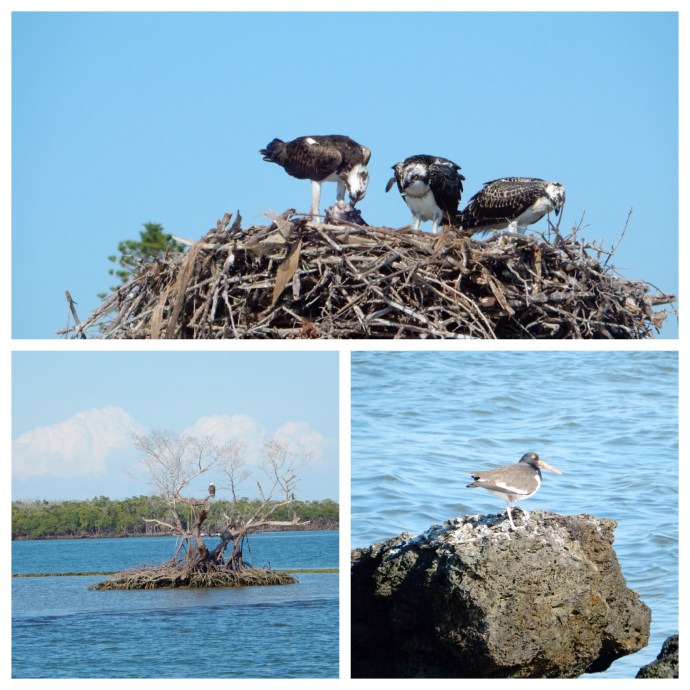
Our boat tour was on a pontoon boat and lasted 90 minutes. We observed numerous islands obviously, some dolphins, and lots of birds. Several fishing boats were returning to the harbor after spending the day in the Gulf fishing for crabs; Everglades City is a major crab fishing locale, we hope to try some local fish Tuesday.

Osprey and chicks top, bald eagle lower left, American oyster catcher lower right

The tour was delightful way to end the evening. We will be staying in Everglades City for three nights at a local place, Ivey House. It is a combination lodge, inn, B &B. Half of the establishment is open for business, half was destroyed in Hurricane Irma and is under re-construction now. Everglades City is another town with Hurricane Irma damage. Over at the National Park, the visitor center was destroyed by the hurricane while the maintenance building next to it and constructed similarly was spared. The park is operating out of a series of modular buildings at the moment.

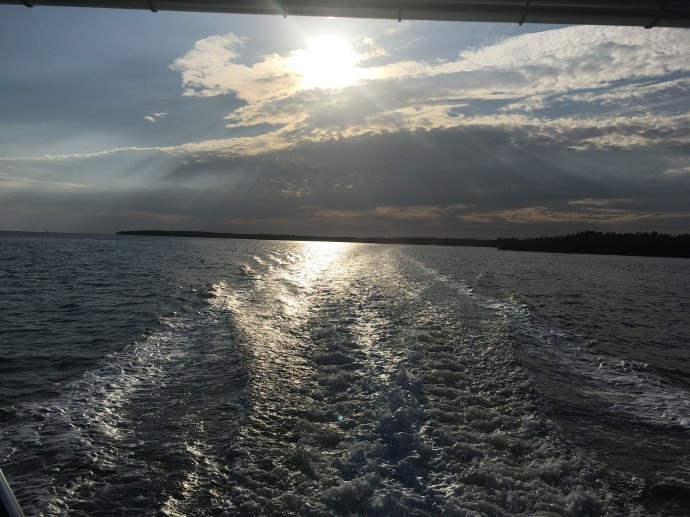
End of day after boat tour in Ten Thousand Islands

Ed and Chris. April 2

Categories: travel | Tags: , , , , , , , , | Leave a comment

2019 Trip 3: South Florida: March 31

Corkscrew Swamp, Florida

North Fort Myers, FL. March 31

Sunday was a little slower. Our Evergreen hosts had a delicious egg bake for breakfast before we went to church with the husband. We headed out exploring about 12:30 to Corkscrew Swamp Sanctuary, an Audubon sponsored preserve. The first detailed governmental report on this Everglades area described it as: “useless to civilized man, for any purpose”. Another description characterized our attitude towards the Everglades as fear (alligators, bears, bugs, snakes, etc), followed by greed (cattle, crops, bird feathers,etc) and concluding (hopefully) with understanding as we learn the interconnectedness of nature and how our short-sighted actions have long-term consequences (farming and over-building eliminate the fresh water aquifer that feeds both the Gulf Coast and Atlantic Coast urban areas).

Corkscrew Swamp Sanctuary

Corkscrew Swamp Sanctuary had to be preserved twice. In the early 1900s, hunters were killing massive numbers of herons and egrets to sell their feathers as decorations in ladies hats. Feathers were more valuable than gold on a per pound basis. Locals and the Audubon Society hired wardens to successfully chase away the plume hunters. Then after WWII, the area around Corkscrew was being logged heavily, primarily for cypress trees used in rebuilding Europe. Once again, groups of local residents and the Audubon Society worked together with the lumber companies to stop the lumbering, preserving the last and largest collection of old growth cypress trees.

When the state of Florida was unwilling to spend money to preserve the area, the Audubon Society took possession of the property and still owns it today. The initial acreage of 5,680 acres has grown to almost 16,000 acres. The most important rookery in the country for wood storks is also preserved-and off-limits.

The transition between two types of habitat, an ecotone where marsh and cypress forest come together

Our walk was on a 2.25 mile boardwalk above the swamp, allowing one to look down and up without fear of getting wet. The eco system includes (in their terms) marsh, pond cypress, wet prairie, pine flatlands, bald cypress, and lettuce lakes. The Sanctuary has numerous landmark trees, the really large and old bald cypress trees.

However, Hurricane Irma came through this area in September 2017. Nearby Naples recorded gust winds of 142 mph. Corkscrew Swamp was just 2.5 miles east of the eye of the storm. Many trees were felled by high winds, either at the root level or twenty feet up. At least three of the 12 landmark trees were victims to the storm. Rainfall was 12.6 inches on the Sanctuary over three days. Volunteers responded to the call for assistance and came out to clear debris and repair the boardwalk; it took two months before the full boardwalk and visitor center were re-opened.

A strangler fig wrapped around a tree at Corkscrew

The walk took us 90 minutes as we wandered at a slow pace, enjoying the view and listening for birds. At one point, I waited for 5-10 minutes to try to find the bird (likely a woodpecker of some species) that made a tremendously loud drumming sound. Several of us strolling on the boardwalk tried but were unable to spot it.

When we finished up Corkscrew, we headed over to another sanctuary. CREW, Corkscrew Regional Ecosystem Watershed Land and Water Trust is a public-private partnership and non-profit that coordinates the purchase and protection of 50,000 acres of land. Land once purchased is turned over to the South Florida Watershed Management District for land management. They sponsor five main pieces of land and we walked a portion of one of them, Bird Rookery Swamp.

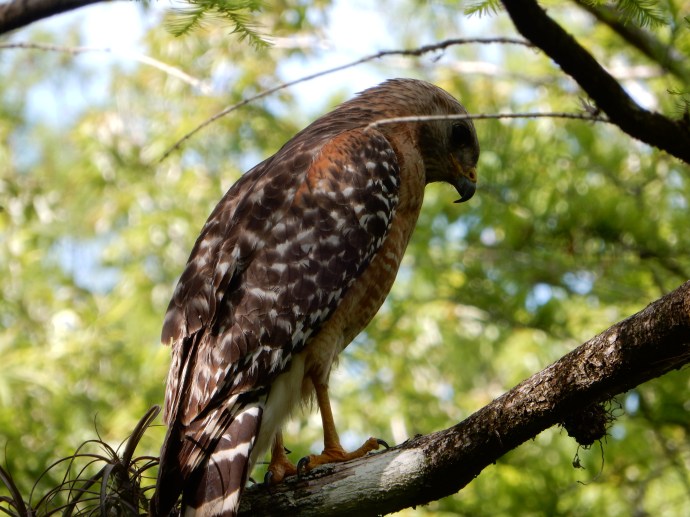
Red tailed hawk at CREW Bird Rookery Swamp

The CREW trail starts out on a boardwalk and then segues into a grassy trail. The trail follows the old route used by logging companies to cut the cypress in the mid-twentieth century. We did not hike the entire 12 mile trail, only about three miles. The highlight of this hike was a red-tailed hawk perched on a railing and then in a tree just feet away from us. During the hike, we talked with several other hikers. One couple mentioned how a bobcat had been seen by friends of theirs on the trail a week ago. Five minutes after we left them, we heard a strange cat-like sound. We looked and looked but did not see anything. Two women coming from the opposite direction stopped and, being more knowledgeable than us, speculated that we had just heard a grey catbird. No bobcat for us.

Sunday was our final night with our second Evergreen hosts. Their home in North Fort Myers suffered only minor damage from Hurricane Irma. There were several homes in the area completely destroyed but, in general, it appears that North Fort Myers suffered less from Hurricane Irma in 2017 than Punta Gorda had suffered in 2004 from Hurricane Charlie. We expect to see continued hurricane damage left over from Hurricane Irma as we drive through the Everglades and on to the Keys.

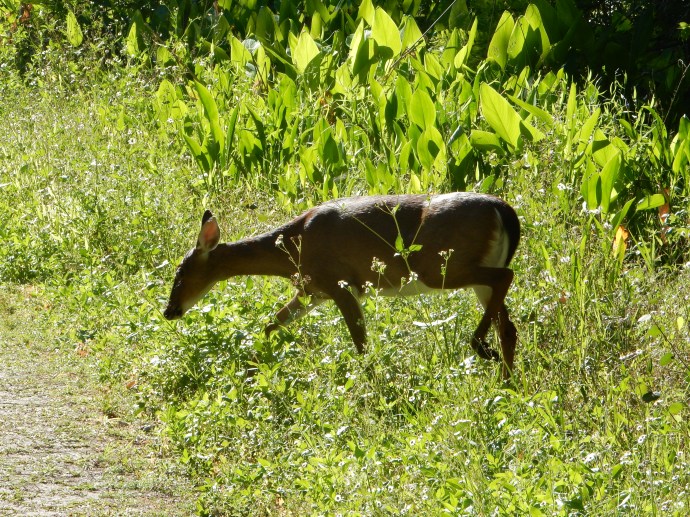
No bob cat at CREW, just a deer

Ed and Chris. Everglades City. April 1

Categories: road trip, travel | Tags: , , , | Leave a comment

2019 Trip 3: South Florida: March 30

Can you find the alligator?

North Fort Myers, FL. March 31

Ding Darling National Wildlife Refuge is located on Sanibel Island on the Gulf Coast of Florida. It occupies about one-third of Sanibel, about another one-third is protected conservation areas under other authorities and about one-third is developed with buildings no higher than the tallest pine tree. Ding Darling is the most visited national wildlife refuge in the U.S. with about one million visitors per year. We have frequently encountered people and Refuge rangers who said we just had to visit here. So we did.

Saturday, we spent the entire day at Ding Darling, arriving around 8:30 AM to hike the Bailey tract, a marsh area near the Gulf of Mexico. The area was quiet, some people were out hiking but it was not real busy. In terms of beauty, the area was so-so; but the function of wildlife refuges are to protect the habitat for birds and animals, not to grow public gardens.

Our tram-it filled up completely and we also observed people being turned away from the 1 PM tour

We had previously made reservations for a 90 minute tram ride at 11:30 AM along Wildlife Drive with a naturalist to talk about the refuge and what we were seeing. By now it was 9:30 and at the visitor center we made arrangements to transfer our reservation to the 10 AM tour which had a few seats available. It was a good decision, the naturalist was knowledgeable and she enlightened us about numerous topics as we drove along. Bird sightings were plentiful.

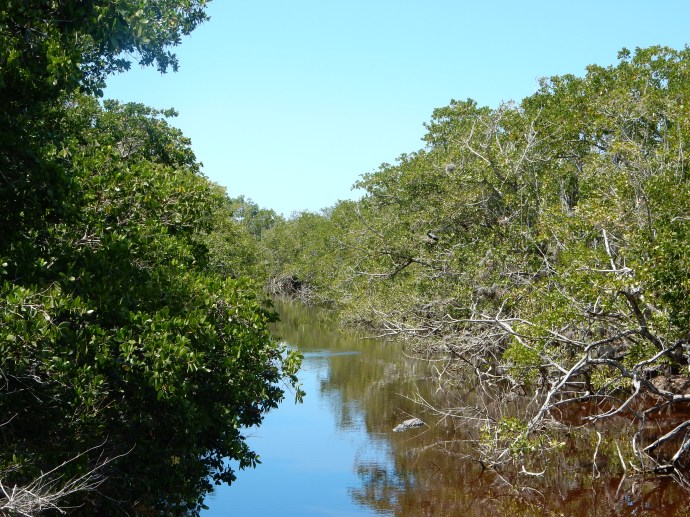
Red mangrove at Ding Darling National Wildlife Refuge

Ding Darling was hit by Hurricane Irma in 2017, we could see where some of the oldest and tallest mangroves had been knocked down. Research has shown that mangrove forests can decrease hurricane impact by 30%. Where mangroves had been knocked over, new mangroves were already growing, their new shoots green under the open sky created by the destroyed, taller trees. Red mangroves have a root system that looks like your hand upside down with fingerlike roots growing down into the water that makes the tree look like it is a person walking. (There are also white and black mangrove trees.)

This estuary refuge with its combination of salt and fresh water is the only place mangroves grow, they can tolerate the mix of water types. On one stop we noticed mangrove crabs, ugly crabs that thrive living on the trees, not along the beach. At another stop, we could see manatees in the distance doing their courtship ritual, splashing and frolicking in the water instead of their usual just cruising along.

Squadron of American pelicans and a reddish egret

A squadron of pelicans was standing in a marsh, surrounded by smaller shore birds and a reddish egret. We were informed that the reddish egret is relatively rare and this refuge is one of the few where you can frequently see them. Great blue herons, ibis, egrets, swallowtail kites, osprey, and other birds were easily seen. The American pelican is the second largest U.S. bird, after the California condor. The pelican has a nine foot wingspan; the bald eagle has a wingspan ranging from 6-8 feet.

After the tram ride, we had a quick sandwich for lunch at one of the many retail hubs on the island and then back to the refuge. This time, we went on the Indigo trail with a volunteer guide. This woman and her husband are spending five months here before taking a month off to “re-position” themselves and their RV to Grand Teton National Park for their sixth, five month summer volunteering stint there.

While Ding Darling is the most visited national refuge, it has still seen its annual federal allocation reduced by 50% in the last years-a reflection of our national priorities. Volunteers are critical to its existence. The refuge has over 300 volunteers, they staff the visitor center. The volunteer groups raised the funds and built the new visitor center without federal dollars.

Ding Darling Refuge is named after J.N. “Ding” Darling, a Midwesterner who drew editorial cartoons for the Des Moines IA Register. He also spend vacations in Florida. Darling was known for his fierce emphasis on protecting the natural environment and his cartoons were an important messenger in an era where newspapers were the critical force in national life. He began the national duck stamp program, was the founder of the National Wildlife Federation, and served as FDR’s first head of the agency that was the forerunner of today’s Fish and Wildlife Service.

The two friendly alligators

The Indigo trail hike was too much for a family with three young children who preferred the beach today but the rest of us enjoyed the hike through the refuge, learning about the inter-relationship among the plants, insects, water, trees and birds. Towards the end of the hike, we watched two alligators. Initially 100 feet apart, the second slowly drifted towards the second gator, eventually laying quietly together on the shore bank just inches from each other.

A new mangrove tree growing in the estuary, likely to form another island in the future.

Following the hike, Chris and I drove the Wildlife Drive in our car, replicating the ride we had on the tram. This time although the pelicans were still around, fewer birds were to be seen and the manatees were no long visible. Switching to the 10 AM tram ride had been a good decision. After visiting the lighthouse, we left Sanibel Island at 5 PM to re-fuel at dinner for Sunday’s adventure.

Sanibel Island lighthouse

Ed and Chris. April 1

Categories: road trip, travel | Tags: , , , , , , , , , , , , , , | Leave a comment

2019 Trip 3: South Florida: March 29

The autonomous vehicle in Babcock Ranch

Babcock Ranch, March 29

We rode on our first autonomous, driverless vehicle today. And, we rode on a bumpy old school bus through mud and swamps. Quite a variation. Both rides occurred within a few miles of each other at Babcock Ranch.

With a history that goes back to the late 1800s, Babcock Ranch has changed focus with the years. Its first owner was a Montana gold miner who struck it rich. Perry McAdow moved to the warmer climes of Florida and chartered the Punta Gorda Bank. He purchased thousands of acres of land in the area. Edward Babcock was a Pittsburgh native who owned a lumber company, at one time the largest in the world. He also liked the warmer climes of Florida and bought out McAdow in 1914. Babcock added on to McAdow’s holdings, eventually owning over 100,000 acres.

Cracker cattle at Babcock Ranch Preserve

The Babcock Ranch cut timber, using much of the cypress logs for shoring in mining due to cypress’ ability to resist rot. After the timber was cut, Babcock added raising cracker cattle, rock mining, and agricultural products. You may recall from an earlier Florida posting that cracker cattle were brought over by the Spanish. Cracker cattle can live off the land but their meat is low quality. The term cracker comes from the sound of the whips used by the Spanish cowboys to control the cattle.

The ranch lies astride an important water connection between Lake Okeechobee and the Gulf of Mexico. By the late 1900s, the ranch was run by Babcock descendants willing to part with the land. A plan was devised to divide the ranch into two parts; making most of the land into a preserve with about 20% going into a planned community. Today that division has resulted in the state-run Babcock Ranch Preserve and Eco-tour as one part and the Babcock Ranch planned development as the other. We visited both today.

Momma alligator with baby alligators on her back

The preserve is 67,000 acres and continues the timbering and ranching operations. The preserve protects critical waterways and diverse natural habitats. In addition, a eco-tour is offered that brings visitors through grasslands, swamps, and woodlands. In Florida, an elevation difference of just a few feet changes the habitat from swamp to woodland in just a blink of an eye.

Wild pigs on the eco-tour

Barred owl in the swamp

Our tour and bus driver has his own horse and cattle and enjoys hunting wild pigs. His understanding of the Florida environment added immensely to the tour experience. We had arrived early and were able get on a tour that had about 15 people. Each of us had our own window seat. Luckily (for us), the school kids who arrived had their own tour and a separate bus.

Alligators and birds on the eco-tour

On the tour, we came across wild pigs, sandhill cranes, alligators, deer, egrets, limpkins, several types of herons, and a barred owl. None of these were new to us but still it was a pleasure to observe them again and hear the tour leader’s additional information.

The preserve has a small cafe on the premises and the cook gave us special attention, making sure our hot dogs were well burnt-after we assured her we truly did want them burnt.

After the preserve, we drove a few miles to Babcock Ranch. This planned community expects to eventually have 20,000 housing units, with only a few multi-unit properties. A mix of housing, commercial, retail, and public facilities are planned. Initial homes were just completed a year ago but signs of rapid construction are evident. We stopped in at the town center where the information center is located. We also observed a school, day care, health care facility, a restaurant, etc. open for business.

It was at the town center that we rode the autonomous self driving “bus”. The vehicle has six seats and standing room. Our vehicle did have a human manipulating some controls. The system is still being planned, programmed, and de-bugged. For instance, the vehicle stopped and would not move at a pedestrian crossing where a temporary sign indicating pedestrian crosswalk had been placed in the middle of the street. Since the temporary sign was not included it its programming, the vehicle thought the sign was a pedestrian and would not advance. Our human overrode the system while a few cars backed up behind us. Eventually the system will have individual addresses programmed and will take riders anywhere in the community. The vehicles will be called and dispatched via a smart phone app.

One of the initial features planned into the community is solar power generation. Between solar power, batteries, and natural gas, the community should be green beyond belief. It re-uses waste water for irrigation and individual homes must receive at least bronze level energy conservation certification. Fiber internet is everywhere. The Babcock Preserve surrounds the community. All in all, the vision of a livable, pleasant community seems doable.

The home prices are not outrageous although it seems certain to be an income-segregated community. The sales lady I talked to you professed ignorance of the concept of “affordable housing”. For all the talk of a planned community, though, our new Evergreen hosts mentioned that the county until just recently has not even planned road improvements to the existing road network to handle the increased traffic which will be generated.

After the autonomous vehicle ride, I worked outside on the blog in the town square. We had an early dinner there before driving to North Fort Myers where we will be staying for the next three nights.

Working on the blog at Babcock Ranch

Ed and Chris. March 29

Categories: road trip, travel | Tags: , , , , | Leave a comment

2019 Trip 3: South Florida: March 28

The north lighthouse on Gasparilla Island

Punta Gorda, FL. March 28

Our plans were to bike Gasparilla Island, one of the Gulf Coast islands with a state park, two lighthouses, an old town and new fancy housing. We did not, for two reasons. First, it was a little breezier than we prefer for biking. Second, the paths/trails were overrun by golf carts, sometimes driven by adults, sometimes by kids, sometimes by adults holding toddlers in one arm while driving with the other arm.

Gasparilla Island is reached via a toll causeway bridge connecting the mainland to the island. The southernmost lighthouse has a nice museum detailing the history of the area. Gasparilla Island was home to the Calusa Indians who used the area for fishing and harvesting the natural vegetation. They did not practice cultivation farming, they had no need to. When the Spanish arrived, the Indians refusal to farm resulted in the Spanish assumption of Indian ignorance and low intelligence. Over time, the Spanish ways predominated and with the later English settlements, the Calusa either died off or moved with the Spanish to Cuba.

The island and its population center of Boca Grande survived based on the fishing industry; first shipping salted fish to Cuba, and then with the arrival of the railroad and ice, shipping fresh fish to the eastern seaboard. Recreational fishing for tarpon and other fish also contributed to the marketing of Gasparilla Island to wealthy northerners. Later, the shipment of potash replaced the fishing industry. Eventually potash shippping was cheaper from other locations and today the island subsists on tourism and second homes.

We wandered around the island and the beach, visited the museum and had lunch at a small bakery. Lazy beach days will probably wait for Key West and Miami Beach.

Peace River Botanical and Sculpture Garden

In the afternoon we drove a little northeast of Punta Gorda to the new Peace River Botanical and Sculpture Gardens. Only open for 18 months but years in the planning, the gardens are the vision of a former chief executive of McDermott Industries and his wife. McDermott is big in oil drilling pipelines and drilling rigs. At one time, McDermott also owned Babcock and Wilcox which is deep into energy and environamental technology. The present appearance of the gardens is that a bundle of money has been spent on the project, with more to come when a planned art museum opens. A very nice project. Many of you know my biases; it is money from an overpaid executive who is spending funds that could have been paid to company employees instead of being used to create an appearance of a local philanthropist.

View from Peace River towards the botanical and sculpture garden

Putting my uninformed biases aside, the gardens combine manicured lawns, water features, shrubs and sculptures among 11 acres on two sides of a road. The western side fronts on the Peace River. The gardens need more flora to be truly memorable; at present it is pleasant with real promise for the future. The sculptures have a flavor of whimsy. While I am not conversant with the names of top sculptors, the signs informed us that one of them at least has created works for well-known celebrities from around the world.

Chris and I returned to Punta Gorda, did some book shopping and had a picnic dinner watching the water. We finished up the evening chatting with our great Evergreen hosts and playing a few games of Mexican Train which I only mention since I was the winner.

Ed and Chris. March 29

Categories: road trip, travel | Tags: , , | Leave a comment

2019 Trip 3: South Florida: March 26-27

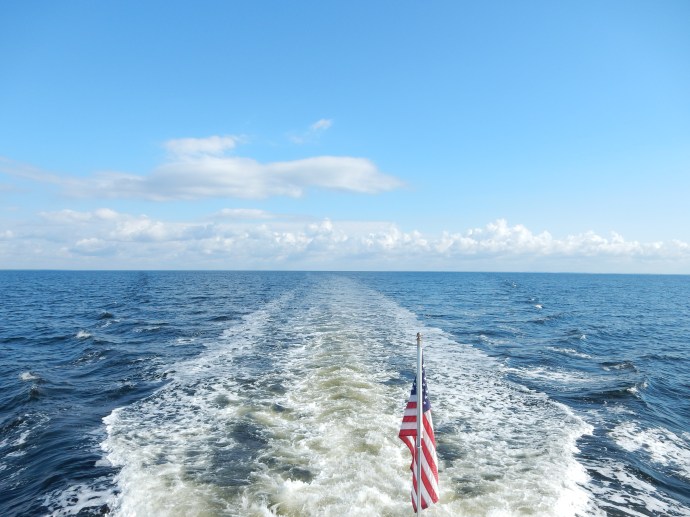
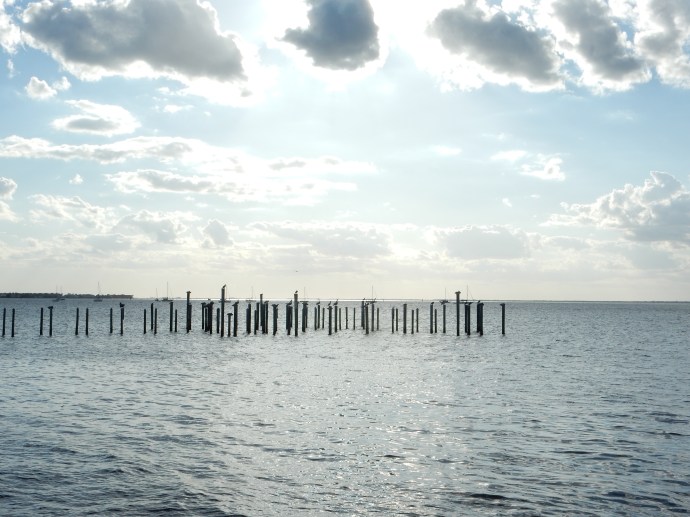
Charlotte Harbor from the back of the Island Star

Punta Gorda, Florida. March 27

We are on the Gulf Coast of Florida, about 100 miles south of Tampa. This trip, 3.5 weeks long, will likely be slower paced, more relaxing than many of our trips. Today was an excellent example of that slower pace.

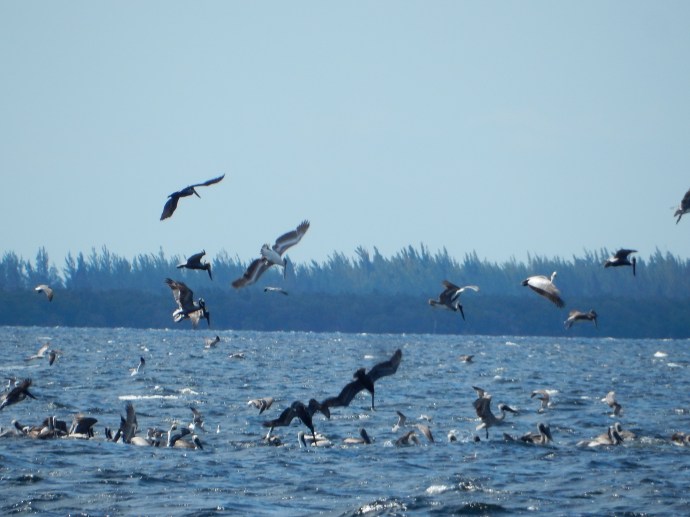
One shot of the feeding frenzy on the way back

We took a 2.5 hour cruise on Charlotte Harbor out of Punta Gorda to Cabbage Key, had a two hour lunch break, and returned on the same 2.5 hour cruise. So pretty much the entire day was occupied by the cruise. The water was relatively smooth and we just relaxed and enjoyed the ride and the view. I admit I might have even dozed off a few times. This was not a manatee or dolphin spotting cruise, although one dolphin did race alongside us, perform three jumps and then disappear. There was also a feeding frenzy of birds evidently attacking a school of fish. Otherwise it was just taking life easy.

Map of Charlotte Harbor with Fisherman’s Village at upper right and Cabbage Key at lower center.

Charlotte Harbor is fed by the Peace River and the Myakka River. It is shallow, usually 6-12 feet in depth. Boaters have to be careful to avoid sandbars. Part of the journey to Cabbage Key is through the Intracoastal Waterway which is dredged as necessary and marked by buoys and channel markers.

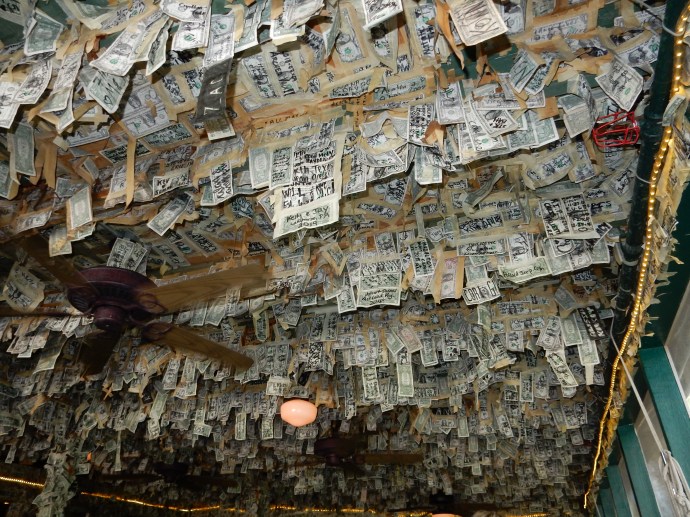
Island Inn restaurant at Cabbage Key with dollar bills hanging from the ceiling

Cabbage Key has a resort and restaurant, partially made famous by Jimmy Buffett. It also has dollar bills hanging from the ceiling of two rooms of the restaurant. Legend has it the tradition began with one customer taping a dollar bill to the ceiling way back when so that he would always have money to pay his tab. The practice has grown over the years. The ceiling in the two rooms are covered with dollar bills (of various denominations) and when they fall, they are collected and given to charity.

Several cruise boats (about 30-80 passenger size) from up and down the area land here for lunch at staggered times to spread out the business and reduce waiting times. Many of the wait staff live on the island and from overhearing one of them, the tips are very good and the isolation is well offset by the pay.

Our boat, the Island Star from King Fisher Cruises, leaves and departs from Fisherman’s Village, a combination shopping, marina, and resort. It was built on an abandoned wharf that used to house fish packing factories. Nowadays it hums with people, particularly it seems with grandparents and their grandchildren here on visits during spring break. We ate at two restaurants, had popcorn and ice cream but did no shopping.

Some of the murals in downtown Punta Gorda

After the harbor cruise, we went to downtown Punta Gorda. The city has a new Harborwalk and the community has installed about thirty murals on the walls of various buildings downtown. On our walk, we met the artist responsible for many of them as he was working on a new installation on the slanted wall of the Harborwalk underneath a highway. Murals are not his only artistic endeavor, he also paints and does digital photography.

We had also stopped to see one of his murals on two walls of the bays of the PG Fire Department. Our Evergreen hosts had specifically mentioned this location; the husband knew several of the firefighters from supervision classes he had taught at the local college. At the Fire Department offices, they said just go and look, so we did. Sure enough, the firefighter we met inside the bays knew our host and asked after him. Reinforced that knowledge that staying with Evergreeners gives you a greater local flavor of the community.

Punta Gorda was hit by Hurricane Charley in 2004, a Cat IV hurricane with winds of 150 mph. It destroyed much of the town. In effect, it was instant urban renewal. While many people suffered, particularly those in mobile home parks, 15 years later, the city has seen an influx of new housing and re-built public buildings and infrastructure. Many of the homes that were damaged, versus destroyed, were re-built. Thus, walking downtown presents a view of buildings, sidewalks and street in good repair.

We had arrived in south Florida Tuesday and landed at Fort Meyers Regional Airport. After getting the rental car and picking up a few odds and ends, we spent the balance of the afternoon at Fisherman’s Village. They have a small military history museum there, staffed by volunteers. It was heavy on uniforms and weapons but we found two different but similar interesting facts we had never previously known.

WWII playing cards with hidden escape route.

During WWII, the Red Cross was allowed to ship a very limited number of items to POWs. Playing cards and games were allowed items. The US made special playing cards that when steamed, separated to reveal an escape route map printed on the inside. Putting together the various pieces created a detailed route that could be used to reach Allied territory. The maps were created and sent to specific POW camps. On display at the museum was one such map.

The British created speical Monopoly pieces that had similar information on a silk like material that could handle being folded multiple times without tearing and fold into a very small, hideable item. Monopoly pieces also had foreign currency and a tiny magnet hidden into the board pieces. Only certain sets of Monoploy had the tools, marked by a tiny red dot on the “Free Parking” space. This ruse was not revealed until 2007. Both of these two maps were successfully used by thousands of escapees; it is estimated one-third of the escapees used the Monopoly maps.

Charlotte Harbor

Ed and Chris. March 28

Categories: road trip, travel | Tags: , , , , , , | 1 Comment

2019 Trip 2: Arizona: Feb. 16-17

Lou and Joyce’s house in Flagstaff

Phoenix Feb. 17

Flagstaff Arizona is a town of 70,000 people in northern Arizona, a jumping off place for tourists to the Grand Canyon. It is also home to Northern Arizona University, Lowell Observatory, and some companies manufacturing plants like W.L. Gore and Nestle Purina. Most importantly for us, it is where Chris’ brother Lou and his wife Joyce have their future retirement home.

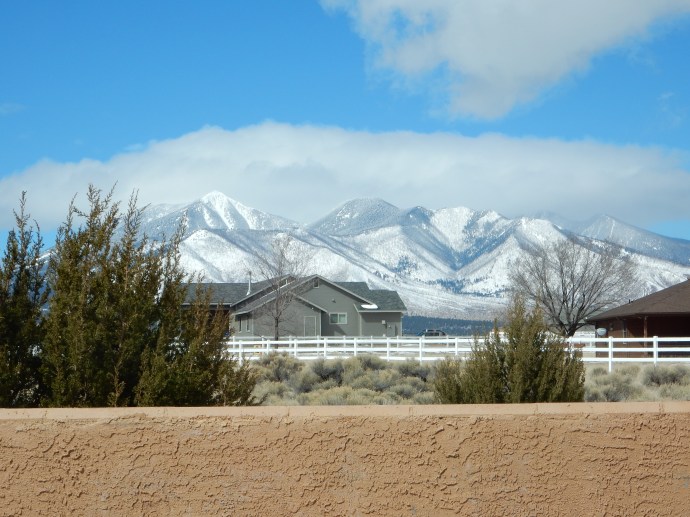
A view of San Francisco Peaks, Flagstaff

When here, we take life easy and throw in a few visits to local attractions. We try some new and some familar restaurants and usually go for a few hikes. This trip was less about hiking and more about relaxation. Lou and Joyce have a home in view of the San Francisco Peaks which include Humphreys Peak, the tallest in Arizona at 12,637 feet. It is a pleasure to look out the windows at differing times of the day and during varying seasons of the year.

San Francisco Peaks from Lou and Joyce’s house

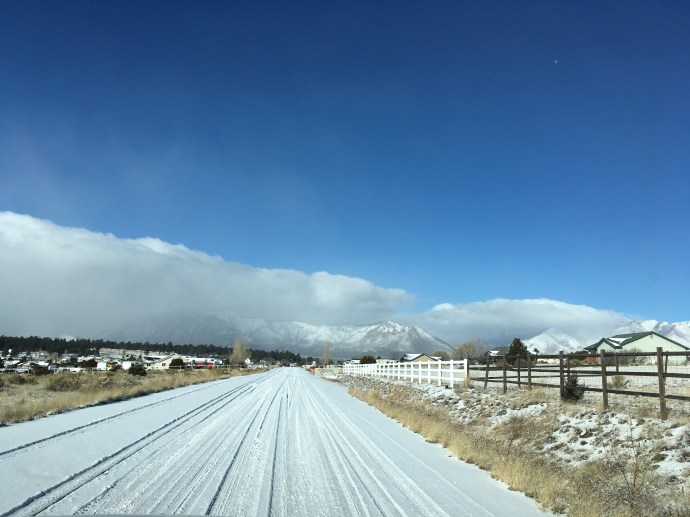
The weather in Flagstaff has both cold and snow (after all, it does have a ski peak and is at 7,000 feet in elevation). This weekend was cool with snow showers so the pictures here show nice contrast between the mountains and blue skies. What we don’t show is the 6-9 inches forecast for Sunday afternoon and Monday night after we will have returned to Phoenix.

After returning to Phoenix, we chose to visit the Arizona Museum of Natural History. The choice was not difficult; many museums are closed on Sundays and those which would normally be open on Monday are closed due to Presidents Day. Tuesday will have to be our day to visit other museums. The Arizona Museum of Natural History is in Mesa AZ, a town of 440,000 people but yet a suburb of Phoenix (a town of 1,5000,000 people and the fifth largest in the U.S.).

The Arizona Museum of Natural History is about 74,000 s.f.of space located in the old Mesa City Hall with additonal expansions. We would summarize the place (unfairly probably) as rocks and dinosaurs. Yes, there are exhibits on Native Americans, and some other topics. If we knew before what we know now, we would have passed it by. It strikes us a place for parents and grandparents to take their kids where they can quickly scan important topics and leave without learning much.

Leaving Flagstaff, heading for Phoenix

Ed and Chris. Phoenix Feb. 17

Categories: road trip, travel | Tags: , | Leave a comment

2019 Trip 2: Arizona: Feb. 14-15

At the Museum of Northern Arizona

Flagstaff AZ. February 15

We left Prescott Thursday morning, driving to Flagstaff in a steady rainstorm. Unusual for this section of Arizona, the rain produced a flash flood warning for a wide swath of northern Arizona. Creek beds that are normally dry and rocky were full of running water. Not a great day for exploring outdoors so we stopped at the Phippen Museum showcasing art and heritage of western art.

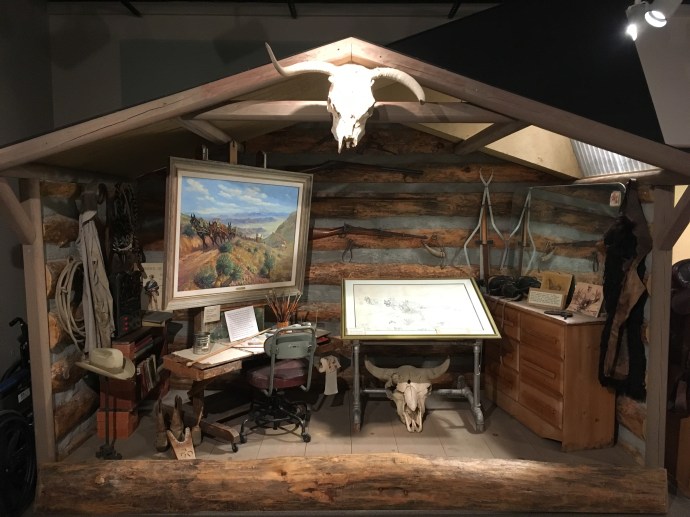
Studio of George Phippen

The Phippen Museum was founded by George Phippen, one of three artists who founded the Cowboy Artists of America association. Phippen also drew calendars for Brown and Bigelow, once upon a time a major calendar producer based in St. Paul, MN. His children kept up the sculpting tradition with foundries located in the Prescott area. On display were sculptures by Chris Navarro, a former bull rider; and sculptures by Solon Borglum, a well-known early 20th century sculptor of western works and monumental works included at locations like Vicksburg National Military Park.

One small section mentioned Tom Mix, a famous movie actor of the early 1900s. He was a star of silent films, making close to 300 movies. More than half of them were Westerns. Mix moved to Prescott, which is why the gallery has a section about him.

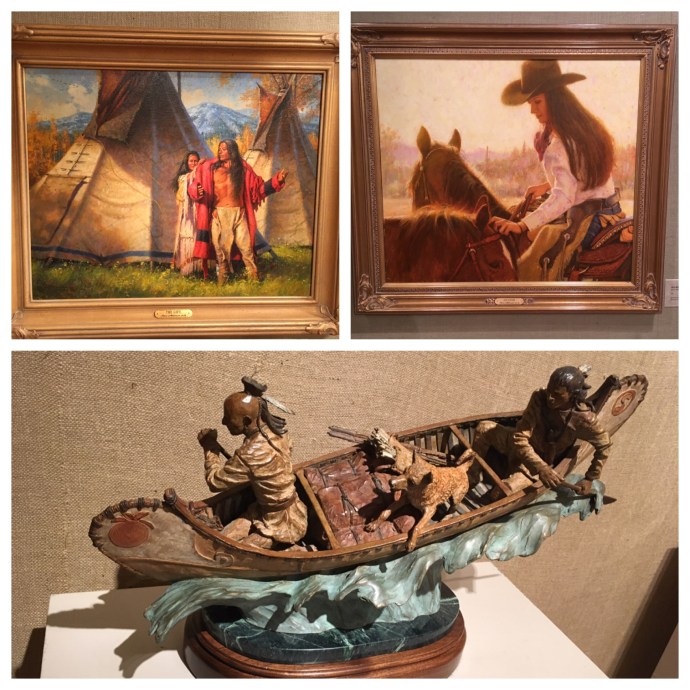
Sample work from local artists at Phippen Museum in Prescott

The exhibit the three of us enjoyed the most, however, was a display of paintings and sculptures by local artists. The variety of works were more inspiring and colorful, factors that appeal to my basic artistic sense.

Our arrival in Flagstaff occurred with more rain and temperatures in the mid-thirties. Snow was on the ground in high elevations and sun-protected locations. Fortunately, the temperature never reached the freezing mark so icy conditions did not prevail. Winds were strong and stayed that way through the night, along with continued rain.
Native Peoples of the Colorado Plateau exhibit

Friday morning though was clear and cold and Chris, Joyce, and I ventured out to the Museum of Northern Arizona. The Museum has recently renovated their 1980 exhibit on “Native Peoples of the Colorado Plateau”. The renovation was 10 years in the making and the museum collaborated extensively with members of each of the tribal communities. The main goal of the tribal communities was to explicitly state “We are still here”; not a cold rendition of old history.

The exhibit showcases each community, where they live, their history, current members, arts and cultural activities, and a message from at least one member of each community. We thought it was well done and we spent most of our visit in this gallery. A visitor begins by touring a gallery discussing the geology of the Colorado Plateau; since geology has such a substantial impact on how life has been and is being formed here.

Pottery display at Museum of Northern Arizona

Other galleries cover traditional exhibits of pottery and jewelry. A new exhibit showcases art of contemporary Native American artists. The exhibit has a neat twist; artists used skateboards as their canvas. Skateboarding is not the focus, just a different type of canvas to be used which grabs ones attention to its uniqueness and yet uniform size.
One specific artist painting on skateboards

The museum is 90 years old and portrays a timeline of the development of the museum along with outside influences. Chris found this section quite interesting. After the museum we picked up Lou and had lunch at the Galaxy Diner where malts and shakes were the focus but not the only foods we enjoyed for lunch.

Ed and Chris. Feb. 15

Categories: road trip, travel | Tags: , , , , | Leave a comment

2019 Trip 2: Arizona: Feb. 13

The Verde Canyon Railroad crossing a trestle along the 20 mile trip our to Perksinville

Prescott, AZ. February 13

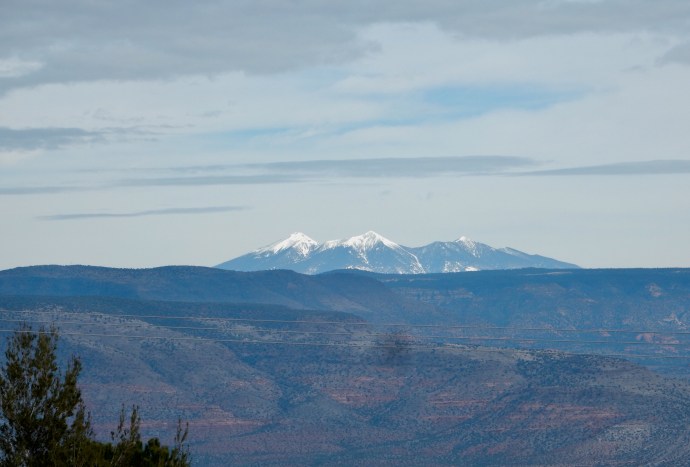
Mingus Mountain Road is a designated scenic highway and today’s journey took us on the road for times two and three on this trip. The road goes through canyons and wooded hillsides of the Prescott National Forest on a twisty road with switchbacks and ends up in Jerome. Views are of the San Francisco Peaks, Mogollan Rim, and red sandstone cliffs. We were on our way to Clarkdale, AZ, home to the Verde Canyon Railroad.

Riding the rails was our primary activity for the day. The Verde Canyon railroad takes us from Clarsdale, home to a major cement producing factory, through the Verde River valley, to Perkinsville ghost ranch. The rail line transports finished cement and raw materials to the main BNSF line in the morning and transports people on excursion journeys in the afternoon. The rail line was completed in 1895 as a spur line to transport copper from the smelters to the outside world. The line was built by all manual labor in one year; the area was too remote to have mechanical equipment shipped in.

One of the first sites we see as the train leaves the station is the 40 acre, 40 foot deep pile of slag left over from 40 years of copper smelting. Slag is the molten byproduct of applying heat to the copper ore dug out of the mines in Jerome to extract the base mineral. The slag is poured out of pipes and the resulting piles, while looking like sand, are solid rock. In contrast, tailings are the unused rock and water used in mining the copper ore from the ground.

Once we leave the slag piles behind, though, the view is of plains, mountains, the Verde River, and the protected areas of two national forests and a wilderness area. Train trestles cross creeks and gullies that while dry today, must handle the flow from periodic flash floods. Train passengers must keep hands and heads inside since rock walls are just inches away. The coach cars are your base seating but each coach car has an open air car where passengers can sit or stand without windows or walls blocking the view. The winter’s leafless trees provide a view of the river not possible in other seasons. All the while, various colored cliffs and mountains loom in the background, providing a color contrast not presented by green leaves. Looking up, periodic cliff dwellings of the Sinagua peoples can be seen along the 20 miles of railroad track. All in all, it is a three and one-half to four hour journey.

Since this excursion was about scenery and not a history of Jerome or Clarkdale or mining or even the railroad, the rest of the blog will focus on what we saw. Hopefully you will enjoy the trip.

One of the views coming over Mingus Mountain

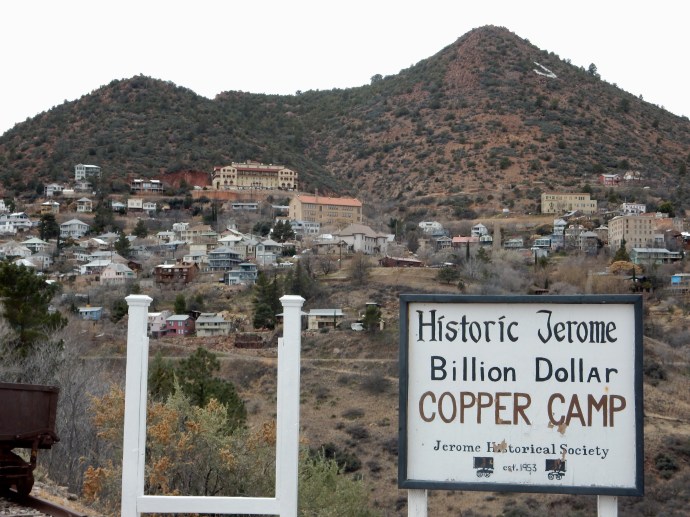
Jerome AZ, former mining boom town, now home to 444 souls.

Starting the journey

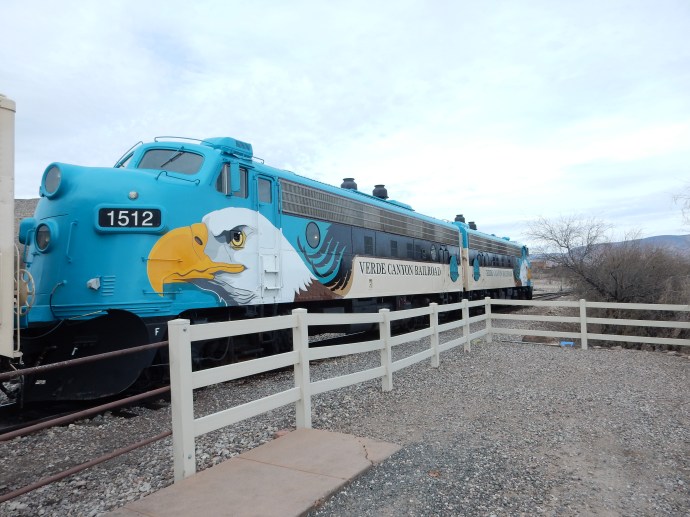
Our locomotives

The Verde River

Sinagua cliff dwelling

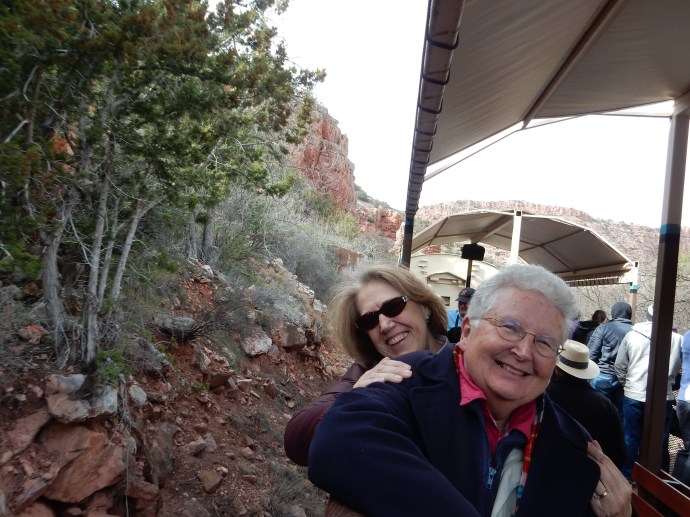
Joyce and Chris on the Verde Canyon Railroad

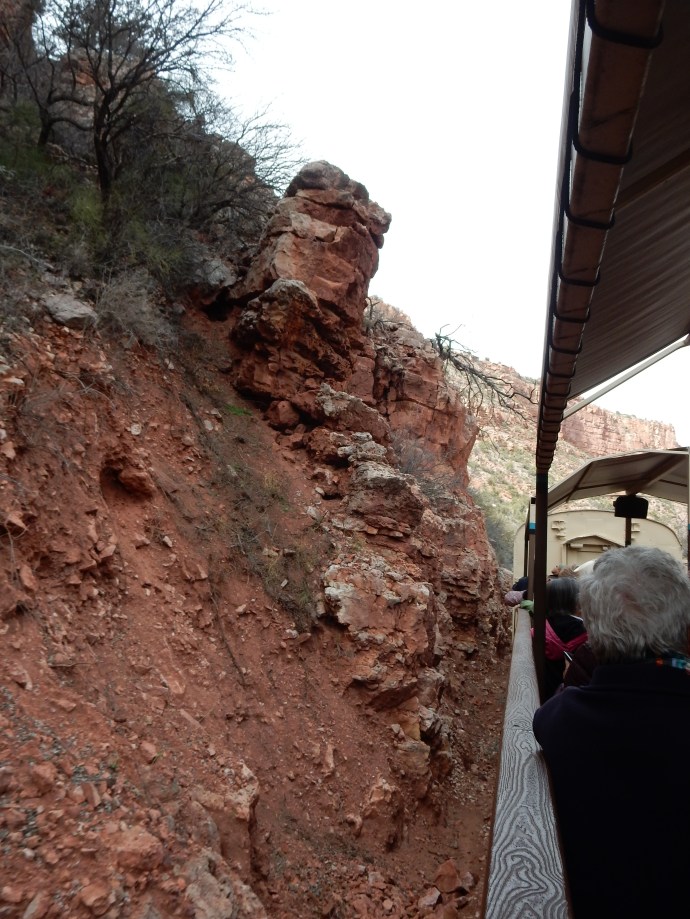
Riding close to the rock walls

During the journey

Along the journey

River, trees, rocks

Chris and Ed. Feb. 14

Categories: road trip, travel | Tags: , , , | Leave a comment

Blog at WordPress.com.