travel

2019 Trip 5: Alaska: August 21

Driving to Valdez

Copper Center, AK. Wednesday August 21

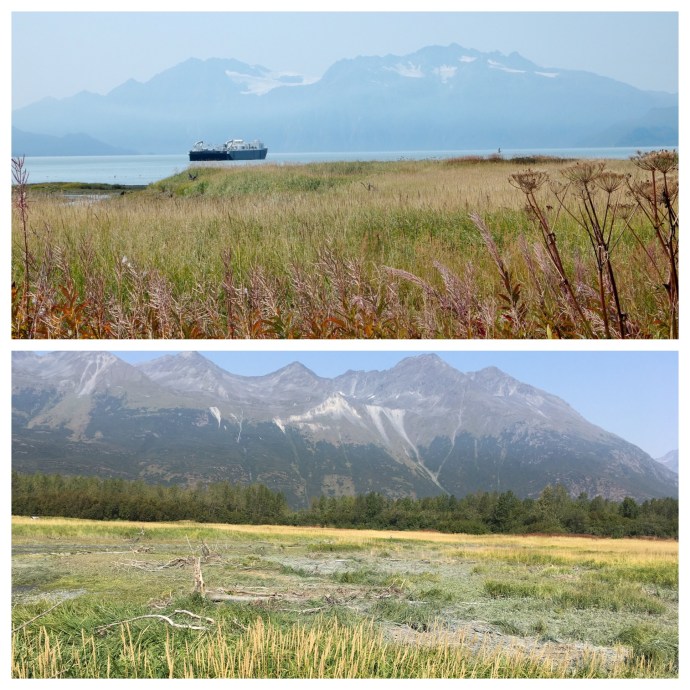
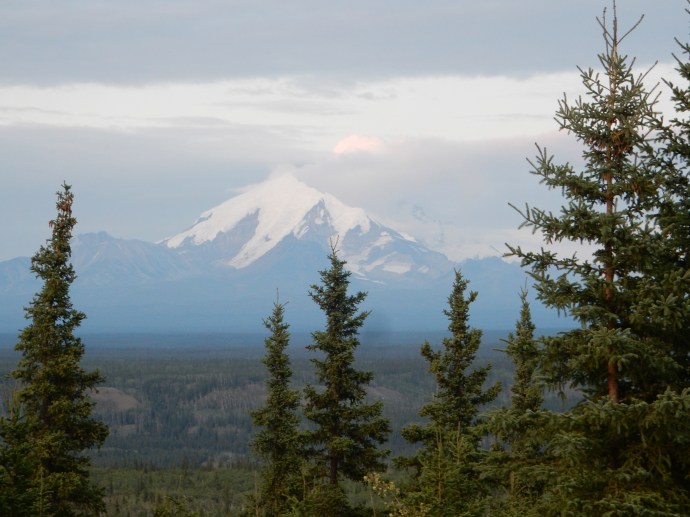
The combination of wild fires by Denali and over in Siberia are making the skies hazy. The picture of Mt. Drum that finished yesterday’s blog could not be repeated today, you can not see the mountain. This was true all 100 miles south to Valdez, our destination for the day. Our original plan was to simply drive the Richardson Highway south to observe the glaciers and waterfalls that are just north of Valdez. But Valdez is only a short distance more and who wouldn’t want to visit Valdez??

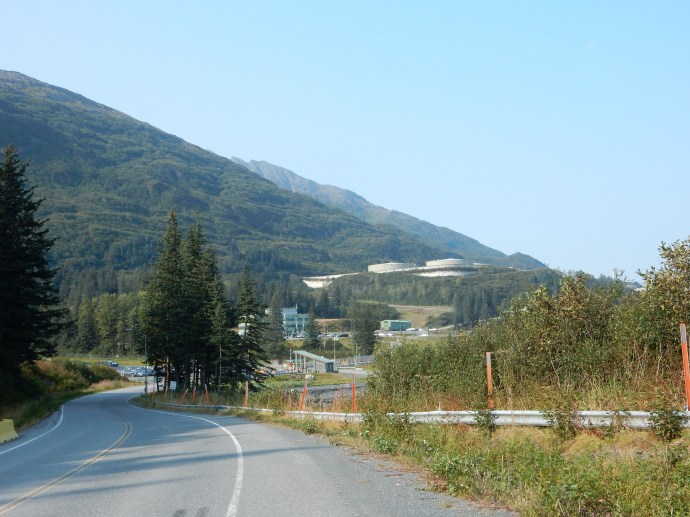
Trans Alaska Pipeline terminus

Valdez has been called the Switzerland of America since it is ringed by mountains. It has the northernmost ice-free harbor in America. It is the terminus of the Trans-Alaska Pipeline. It was founded as one of many towns to outfit gold miners heading to the northern gold fields. Its population is about 4,000. On Good Friday 1964 the town was destroyed by the largest recorded earthquake to hit North America. On Good Friday 1989, the Exxon Valdez tanker spilled 10.8 million gallons of crude oil into Prince William Sound.

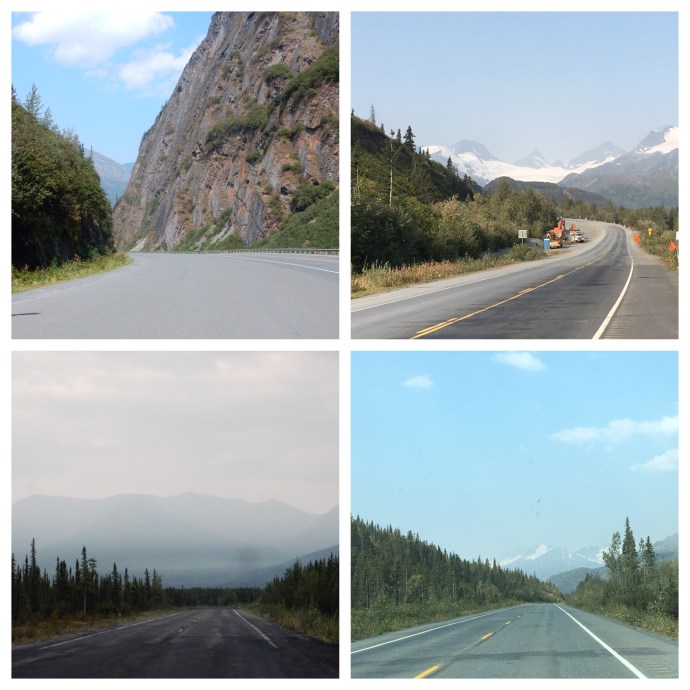
Driving the RIchardson Highway to Valdez

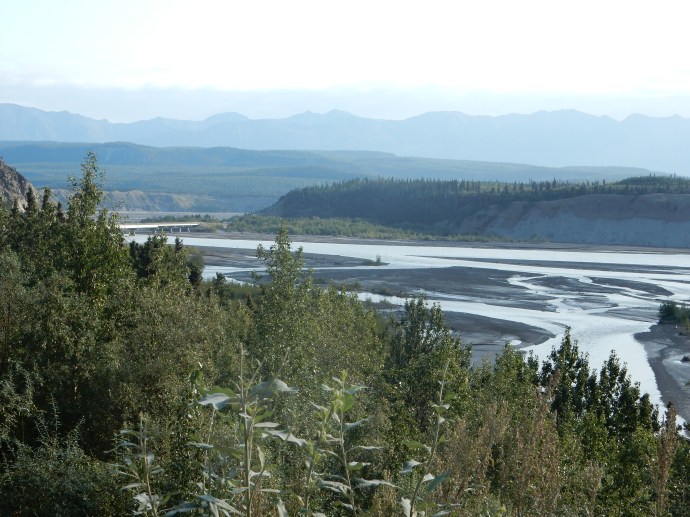
The Richardson Highway south from Copper Center was very lightly traveled. We had been warned that culverts were being installed and to expect travel delays. Delays there were. Two long areas where one had to wait for a pilot car which led you through the construction zone at 12-20 mph. Each zone, each way, probably added 20 minutes to our day’s drive time. I earned my Coca-Cola reward when we got back to the Copper Princess Wilderness Lodge.

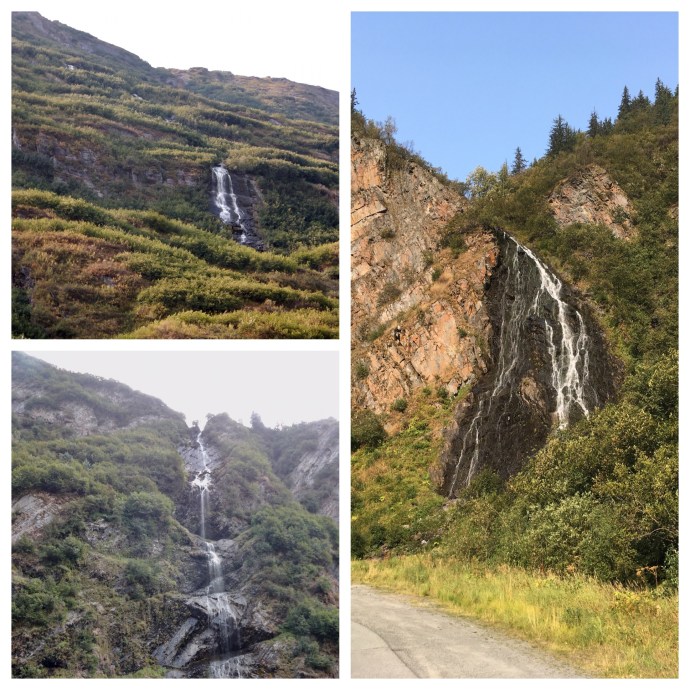
Waterfalls along the Richardson Highway north of Valdez

The scenery was blah for the first 50 miles or so, then the last 50 miles are in the middle of mountains on both sides, with numerous glaciers. Waterfalls were to be a highlight, two of them named similar to Yosemite, Bridal Veil Falls and Horsetail Falls. They did not truly resemble Yosemite’s falls. These two were pleasant but not overwhelming. All across America waterfalls superior to these exist; if you come to Valdez, don’t get your hopes too high.

We ate in downtown Valdez, pleasant sitting outside on a windless day in the 60s with hazy, smoky skies. We were able to people watch. The oil tankers load at the terminus of the pipeline, an area off-limits to civilians and beyond our view.

Town site of old Valdez destroyed in 1964 earthquake

We drove to the old town site of Valdez. The earthquake caused a tsunami and underwater earth slide. The town was destroyed as well as damage to several neighboring areas. In Valdez, 31 people died, mainly children. The town was so destroyed and the earth so messed up that the Army Corps of Engineers declared the area unsuitable for reconstruction. A new town site about four miles away was selected and is where Valdez is now located.

the gull “waterpark”

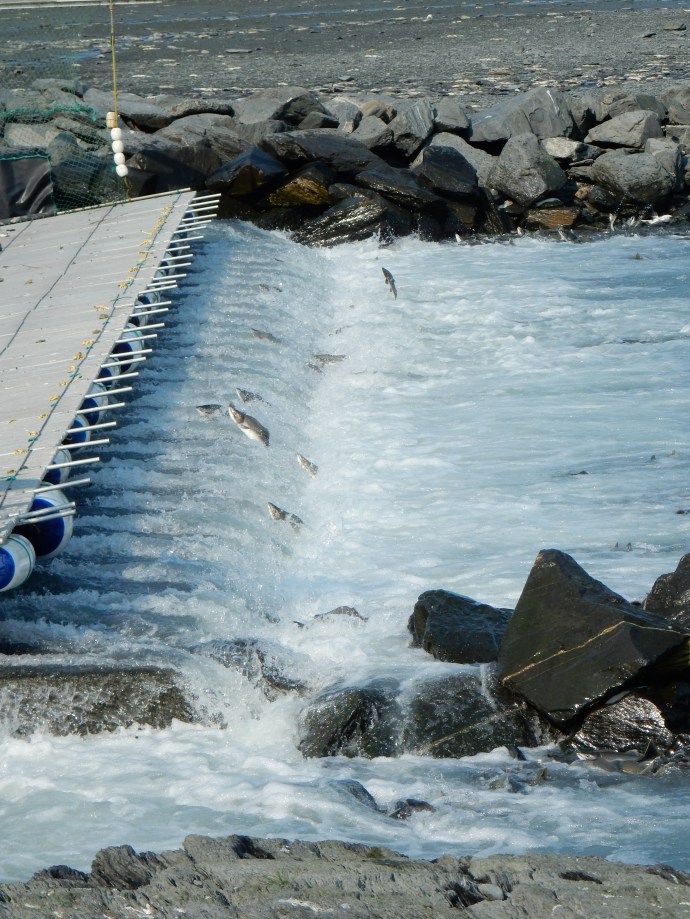
In Valdez we visited the salmon hatchery. Salmon have been overfished and streams blocked so the fish hatchery acts as an artificial spawning grounds. Fish have been raised here, released, then return to the hatchery where the eggs are artificially fertilized and raised. More salmon return than are needed to raise the next crop; one can observe dead salmon outside the hatchery decomposing and returning to nature. Supposedly bears come here to feast-we did not see any.

We did see some sort of gulls, lots of them. While most are just sitting around, a sizable group presented the appearance of birds at a water park. Water coming out of the hatchery and stream create a strong current. Gulls land at the head of the current and ride the current down to the sound where they then fly back to the head of the current and ride it down again. Amazing.

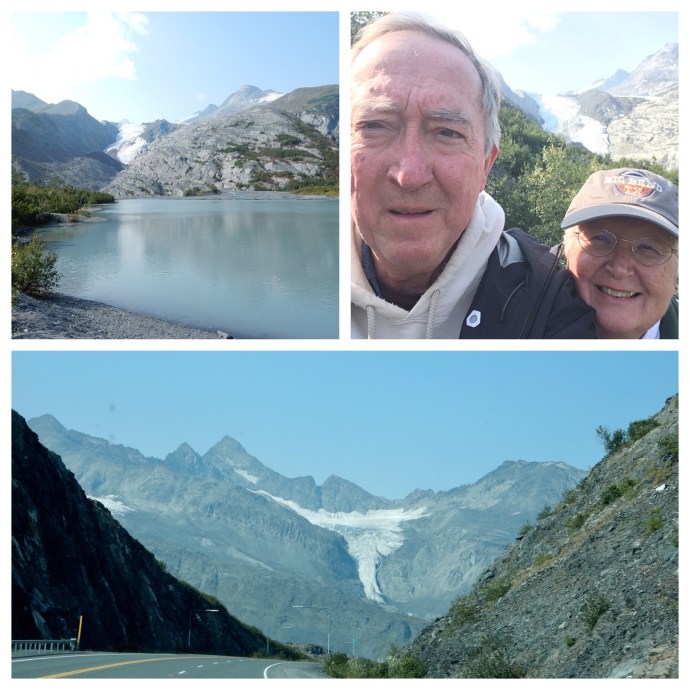
Worthington Glacier

On our way back to Copper Center we stopped at Worthington Glacier and hiked up a bit to get a better picture. The glacier has retreated but we also watched the water melt into a lake at its foot before tackling the construction zone.

A pleasant day, not overwhelming but pleasant. A lot of driving in order to see as much of Alaska as possible. Tomorrow it is up to Fairbanks. Current fire conditions have travel possible but slow south of Denali and road closed on a portion of the Kenai Penninsula-directly where we will be driving.

Salmon fighting to get back to the hatchery to spawn.

Ed and Chris. Copper Center August 22. 3:30 AM

Categories: travel | Tags: , , , , | Leave a comment

2019 Trip 5: Alaska. August 20

Confluence of the Chitina and Copper Rivers

Copper Center, Alaska, August 20 Tuesday

Copper Center. Copper River. Gee, I wonder why the name is used here. Well, today we found out as we traveled long into Wrangell-St. Elias National Park and Preserve. The Ahtna Athabascan people who lived here mined copper well before European immigrants arrived and the Ahtna traded copper and other materials with tribes in the region. When the Russians and Americans came to the area and saw the copper usage by the Ahtna, the Ahtna chief told them where copper could be found-although not the best locations. Over time, prospectors discovered copper high on the Kennecott Mountain. That discovery led to the Kennecott Copper Company after more than $100 million of profits were made by the owners (in today’s dollars, about 1.5 billion dollars in profits.)

But I get ahead of myself. After a great breakfast buffet with plenty of bacon, we left the Copper Princess Wilderness Lodge around 7:45 AM. The first stretch of our journey was on paved roads with only a smattering of gravel sections. We had a brief scare with the car. Entering Chitina, where there are vault toilets at a NPS ranger station just before the park begins, we heard a scary dragging noise underneath the car. Stopping and investigating discovered nothing amiss. Starting up the car brought back the noise. Another inspection. Nothing. Driving the car into the ranger station parking lot, the noise disappeared. It seemed some item got caught and then worked its way free. We drove carefully for the next 10 minutes or so but the sound did not return. Good thing, it probably would have taken hours to get auto repair service to Chitina from Valdez.

So why else did we drive carefully? This was the McCarthy Road, written up as a thing of terror for many drivers. A road you should not take per many rental car companies. 60 miles in and 60 miles out, the only way to get to the towns of McCarthy and Kennecott, site of the famous Kennecott copper mine and Kennicott glacier. (As I was informed today, Kennicott with an “i” refers to the glacier and water related objects, Kennecott with an “e” refers to everything else. i=ice, e=everything else-get it?) Discussions of the road are hot topics on the Internet and at the visitor center.

Driving on the McCarthy Road

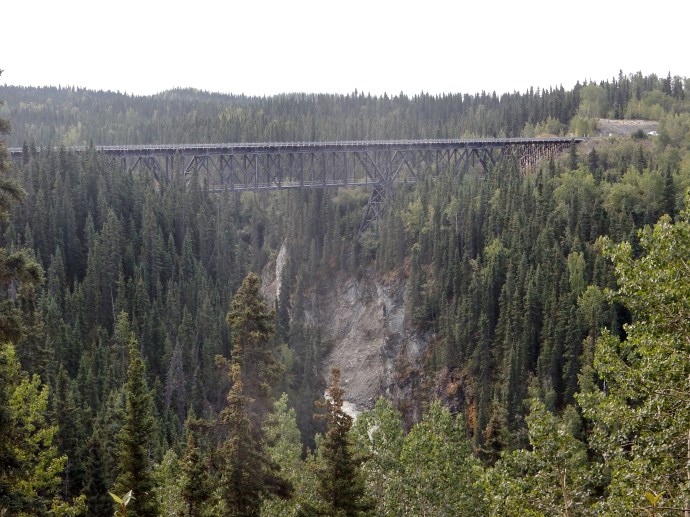
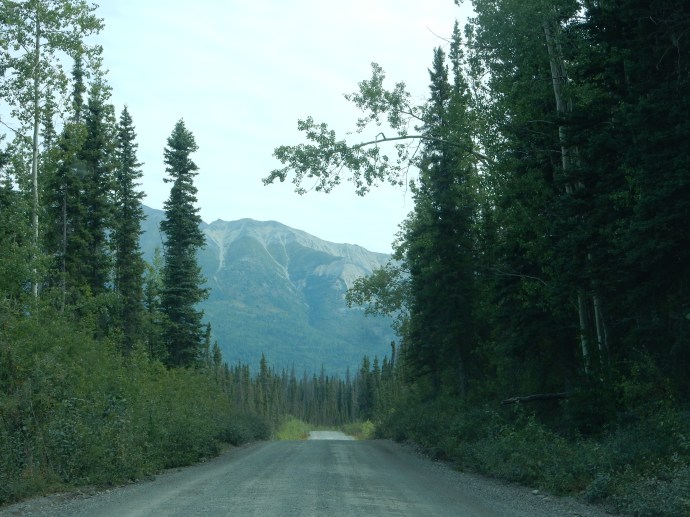
Warnings are justified but the road was doable. It is primarily gravel with a section of poorly maintained asphalt. The gravel is usually in a washboard state with big potholes only in a couple of miles of the road. There is one dramatic bridge to drive over, a 525 foot one-lane bridge over a river 285 feet below you with a wood plank surface currently under renovation. Portions of the road we drove at 20 mph, much of it was okay at 30-35 mph if you had high clearance and a good suspension. Clouds of finely grained sand dust swirled behind us. I was happy we were in a rental rather than my own car. The drive in was two and one-half hours with stops for pictures, the drive out was closer to two hours. Kennecott is at 2200 feet elevation while Chitina is at 600 feet so there is some elevation gain, most of it in the first five miles. When meeting oncoming cars you normally have to slow down; for larger vehicles (pickups with campers in the bed) one pulls over and stops.

Since Wrangell-St.Elias is mountainous, mountain peaks are all around you. The road follows much of the old railroad bed that was built to haul in supplies and haul out coal; transporting it to the port of Cordova about 120 miles away. Construction of the Copper River and Northwestern Railway was expensive and a feat of accomplishment as the route went over mountains with numerous trestles. Portions of it were built during the Alaskan winter during the years of 1908-1911.

The Root and Kennicott glaciers became visible as we arrived at McCarthy. McCarthy was the private town, providing entertainment to the miners living in the company town of Kennecott just five miles away. 600 people lived at Kennecott, primarily single men but some families. Today the roles are similar, McCarthy has a few bars and shops and a population of 28; Kennecott has the restored buildings and ranger talks of the National Park Service. To reach McCarthy itself after the drive, one walks across a footbridge over the river and either walks another quarter mile to the town or takes a private shuttle. After driving for three and a half hours from Copper Center, a brief walk felt good.

The Kennecott Copper Mill

Chris and I had lunch, finishing in time to take the 1 PM shuttle (they run every half hour and cost $15 round trip per person) the five miles and 25 minutes to Kennecott-the road here is uphill and full of potholes also. Kennecott is full of stories, the discovery of the mother lode, the back breaking work to construct the railroad and town, its abandonment in 1938 (truly abandoned, it was too expensive to remove items so buildings,dishes, food, etc. were all left here), the lives of the miners, the huge profits made here by the Guggenheim and J.P. Morgan families, the years of neglect, and finally the resurrection by the National Park Service and the ongoing restoration of many of the buildings. We learned as much as we could from videos, exhibits, and ranger talks before taking the 4 PM shuttle back to McCarthy and the footbridge to our car.

Glacial drift at Kennecott Mine

The glaciers here are receding but our preconception that we were looking at tons of mining waste in the valley was corrected. Down below us as we stood in Kennecott were miles of glacial drift. Remnants of the Root and Kennecott glaciers have become covered with dirt and ground up rock and look like a moonscape below us, stretching out everywhere we look. Even more amazing, when the miners were here, the glacier drift we see now were glaciers towering 300 feet above them. Talk about living next to an icebox, it must have provided summer air conditioning to the entire valley.

We did not stop along the road on our way out although we slowed down frequently as we passed numerous prime moose viewing areas. We looked and looked but no moose came into view. We were feeling pretty despondent. We have seen moose in Yellowstone and Grand Tetons but missed them in northern Minnesota and at Isle Royale National Park. But this is Alaska, moose are supposedly everywhere.

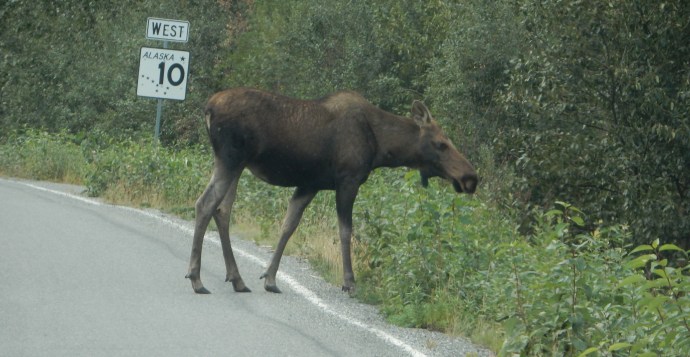
Our moose!

We made a restroom stop at the wayside in Chitina (population of 126), scene of our car scare on the way in this morning. As we left town, standing on the left side of the road was a moose! It ambled across the road, ate some leaves from bushes on the right side and continued on in to the brush and out of view. It took maybe two minutes between sighting and disappearance, just a lucky coincidence in our favor this time.

View from the Copper Princess WIlderness Lodge, 9:15 PM August 20

Ed and Chris Wdnesday 6 AM

Categories: road trip, travel | Tags: , , , , , , , | 1 Comment

2019 Trip 5: Alaska. August 19

We are in Alaska

Copper Center Alaska. Monday August 19

On this, the fourth day of this trip, Chris could finally say that she felt she was in Alaska, that the views matched her expectations of Alaska, not her previous feelings that we were traveling in the Canadian Rockies or even New Zealand. Today was primarily a travel day, a day of observing, a day of stopping to take photos, a day to have the scenery change. Fortunately the weather was pleasant. The strong winds died down as we left Palmer, with sunny to partly cloudy skies. Temperatures are starting to get cooler, highs in low 60s but dropping to mid 40s for part of the day.

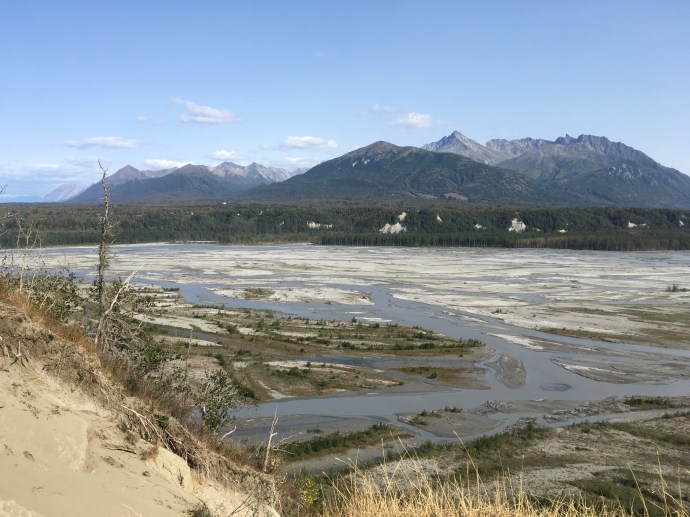
The drive begins as we follow the Matanuska River, in the valley between the Talkeetna Mountains to our north (left) and Chugach Mountains to our south (right). The Glenn Highway was constructed in the 1920s, is designated Route 1, and was the first major highway in Alaska. It is primarily two lanes at this stretch with some passing lanes as one ascends hills. The river is frequently visible, still with that braided style of multiple channels and the milky white color from glacial “flour”, or ground up rocks, originating from glacial ice/snow/water moving over the mountains. But the river is below us, not a bubbling creek rushing alongside the roadbed, but a broad river a little distance away.

Roadside scenic overlooks are frequent, we take constant advantage of them, stretching out the time it would normally take to drive the 150 miles from Palmer to Copper Center. Towns are rare, even those are generally a small cluster of buildings, not a concentrated downtown or even a strip mall type of gathering. Traffic is busy with numerous pickups, travel trailers, and RVs.

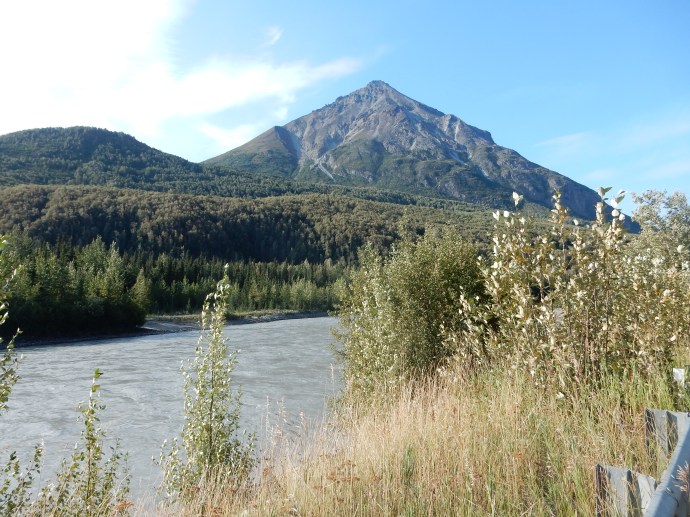
King Mountain and the Matanuska River

Glaciers appear

It seems about two-thirds of the way into the journey that the snow on the mountains begins. We pass a definite glacier, than a few more; recognizing that we do not know if they are interconnected and just one official glacier with multiple views or separate glaciers. In any event, snow in the crevasses is more frequent and easily visible in the Chugach Mountains to the south. The Talkeetna Mountains are drier and steeper, no snow is visible there. We pass King Mountain, a massive looking mountain that squats ponderously across the river.

The “tundra” area

Finally the Chugach and the Matanuska river veer away from us, angling to the south. We enter an area of what I call tundra, a series of rolling hills and plains with spruce trees and low vegetation. These are black spruce we later learn, heavily infested with an invasive beetle that is killing many of them. We can see the difference, the dying trees are blacker with the needles still on them but not as green. The difference is quite noticeable as the dead and living trees are intermingled.

Again later we learn that even here there is permafrost; that permanently frozen ground that may be just 16 inches or 16 feet below the surface. Black spruce is aptly suited to grow where the soil is shallow. We take a break in Eureka to have a piece of pie at the Eureka Roadhouse, an 83 year old small cafe and gas station with a few rooms to rent.

Mountains or clouds??

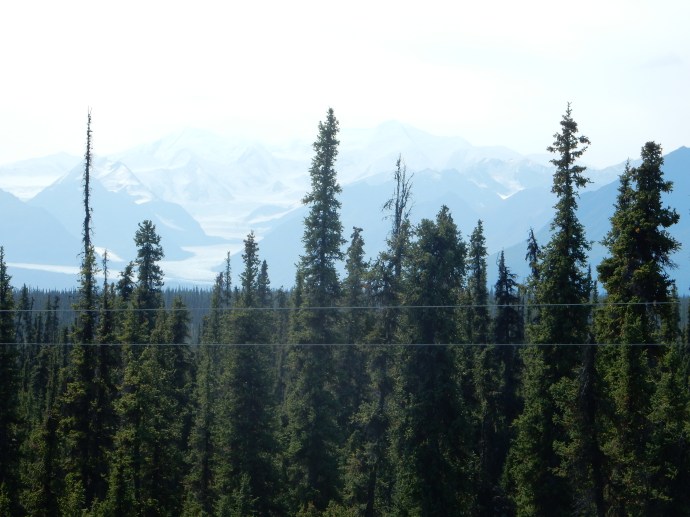
As we leave and continue our drive, to the east appear either clouds or a new mountain chain. As we get closer it is clear, the view is more mountains but more massive than the Chugach or Talkeetna. This is our first, far off view of what will be Wrangell-St. Elias National Park and Preserve. We drive to Glennallen, a slightly larger community with a grocery store and three gas stations. We gas up here as the Glenn Highway meets the Richardson Highway. The Glenn will continue on to Tok and the Alaska (Alcan) Highway. The Richardson travels between Valdez to the south and Fairbanks to the north. Here the Richardson is our choice as it follows the Copper River which forms the western boundary of Wrangell-St.Elias.

Lunch at the visitor center of Wrangell-St.Elias National Park and Preserve AK

The main visitor center for Wrangell-St. Elias is 10 miles south of the juncture of the two highways. We spend about two hours here; talking with the rangers, viewing the movie, shopping, viewing the exhibits, having a late lunch that we had packed, and taking a short hike.

Wrangell-St.Elias is huge. It is the largest national park. It is the size of six Yellowstones, bigger than New Hampshire and Vermont combined, bigger than Switzerland. 20% of the park is covered by snow and there are only about 100 miles of road in the entire park, concentrated on two spurs that enter the park, one from the north, and the McCarhy Kennecott Road that we will be taking Tuesday. Parts of four mountain ranges are in the park; the Alaska Range, the Wrangell Mountains, the Chugach, and the St. Elias. It has nine of the 16 highest mountains in the U.S. These monsters are over 13,000 feet with Mt. St. Elias at 18,008 feet being the second highest in the U.S.; the Hatcher Pass mountains were only 4-5,000 feet. The park is 150 miles wide and 200 miles top to its bottom at the Gulf of Alaska. This is one massive park, most of which is wilderness and challenging to explore.

We will tackle a small piece of the park Tuesday. Tonight we are staying at the Copper Princess Wilderness Lodge; one of four lodges Princess Cruises has set up in Alaska. It is about the only lodging of substance and size in the area. This one closes in mid-September. Until then though the park service offers talks and walks here on a daily basis. Our ranger presenter tonight is a seasonal with experience in Alaska and Iceland with her home base being a small cabin in Maine.

Our walk around the forest surrounding the lodge discusses the animals and vegetation common in this area. For instance, she led us to a branch that had been eaten by a snow-shoe hare and recounted how one time she had been crouched down to examine some bushes when a snow-shoe hare ran past her without stopping. Moments later a lynx also ran past but as it passed it realized she was there and skidded to a halt, turned around and just stared at her for half a minute before bounding off. Chris and I related immediately to the story, we have a diorama at the Bell Museum in St. Paul that tells the story of the interconnectedness between the hare, the lynx and food sources.

Later, after the walk, the ranger presented a talk and slide show in one of the meeting rooms of the hotel. Open to all, it did seem to have a hard time competing with the bus travelers who headed straight for the dining room. This presentation covered climate change with detailed historical backing to present how the current change in the climate occurs, and how the current increase is so dramatic in such a short period of time without any connection to past changes caused by rotation of the sun, etc.

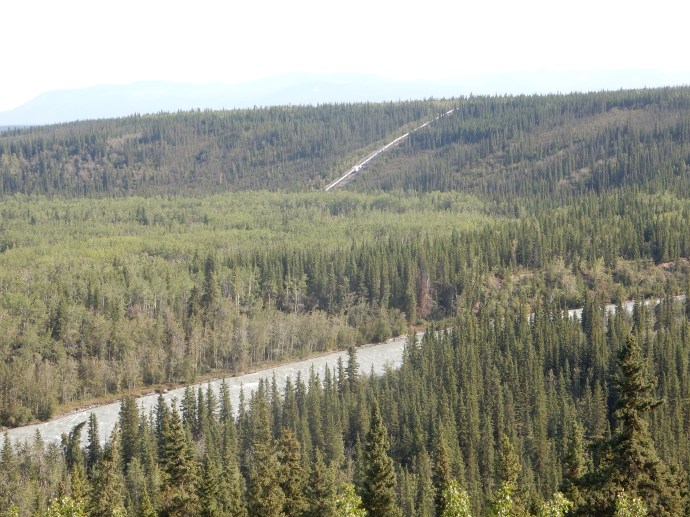
Our first view of the Trans Alaska pipeline

Of particular note for us traveling in Alaska is the danger caused by the melting of the permafrost. Just one obvious example is the danger posed to the Trans-Alaska Pipeline. The pipeline is built and heavily dependent on permafrost. If the permafrost melts, the stability of the pipeline is threatened and pipeline breaks are likely; threatening the supply of oil, the economics of the companies and of Alaska, and the resultant environmental damage.

Part of her presentation discussed Wrangell-St. Elias. Between her presentation and the movie, we could understand the beauty and majesty of the park, most of which we will not be able to see firsthand. Snow, ice and glaciers abound here; actually there are more glaciers in this southeastern section of Alaska due to the effect of the high mountains stopping the Pacific storms. Parts of the park receive over 60 feet of snow per year; the areas down around Juneau and Sitka can receive up to 100 feet of snow. The more northerly parts of the state, while colder, are drier.

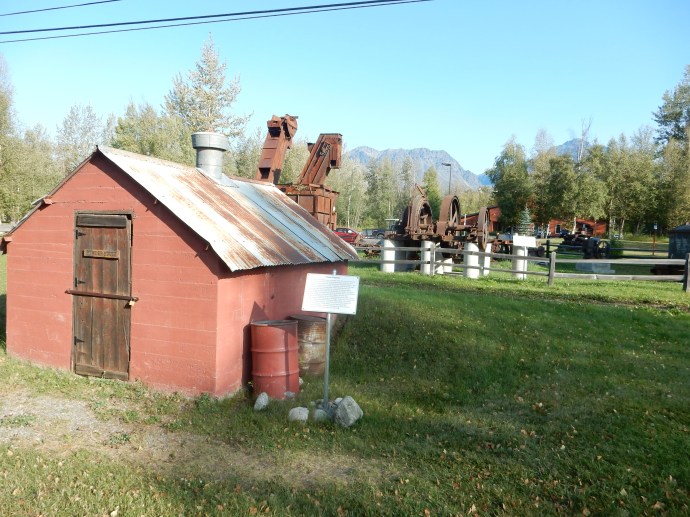
Wrangell-St.Elais houses a building showcasing the Ahtna native culture but it was not open today and has not been most of the summer. It was unclear if funding or staffing was an issue but we will miss learning about the Ahtna. They are part of the Athabaskan group of indigenous peoples and were well-known as a trading people. Just east of Palmer as we started off the day, we were able to visit the Alpine Heritage Park in Sutton-Chickaloon. It is a small but well-maintained grouping of buildings that serves a historical purpose and as a community park. The Dene’ branch of the Athabascan tribe lived in this area.

The Alpine Historical Park in Sutton, Chickaloon AK

The Alpine Historical Park related the native culture and the history of the Russian and American coming to the area. Coal had been discovered in the area and a railroad spur was constructed to provide coal to the U.S.Navy. Unfortunately, the Navy switched to diesel fuel before the coal could have a major impact on the economy here. The park has numerous building well-preserved with descriptive information available about each one. We were impressed with the quality of the work, particularly for such a small community.

Ed and Chris. Copper Center AK August 20. 6 AM

Categories: road trip, travel | Tags: , , , , , , | Leave a comment

2019 Trip 5: Alaska: August 18

Independence Mine State Historical Park near Palmer AK

Palmer, AK. Sunday August 18

Today will be a day that justifies our Jeep rental. Yesterday, Chris was a little hesitant to drive the Jeep through a water crossing along the Knik River. Today, however, we will be driving Hatcher Pass, a gravel road with sharp switchbacks and only open from July 4 to mid-September. Now, we could come here in the winter and do dog sledding, skiing, snowmobiling, or even backpacking, etc. but for now our adventurousness is limited to driving a few remote roads.

Hatcher Pass leads into and over the Talkeetna Mountains. Miners looking for gold found flakes in the creeks flowing from these mountains and explored the mountains to find a mother lode. In 1906 the first mother lode was discovered and mines operated here until 1951 when the high cost of underground mining forced the decision to close the last mines. Today, Independence Mine State Historical Park maintains the mine site and buildings.

That is the plan as we sit here at 6 AM listening to the wind howl, marveling at the mountain peaks across the valley, watching the almost full moon in the sky, and waiting for official sun rise. Yesterday our guide was talking about the wind in Palmer. There are three mountain ranges that produce strong winds throughout the year and we experienced it during the day. During the night one could hear it blowing even stronger. We have not yet explored if there are any wind farms here.

The day started with instant oatmeal and church. The local church was well attended for 8 AM Mass with several large families. Two people came up to us and discussed their St. Paul background. (Chris stood up and introduced us when they asked if there were any visitors present.) After the service ended, we were off to Independence Mine and to Hatcher Pass. A bright blue sky accompanied us although the winds were strong, giving a slight nip to the air as we left Palmer.

Driving up to Hatcher Pass

The drive to Independence Mine is paved. There is a lush green color on the agricultural fields which continues as one goes up the mountains. The mountain tops are at 4-5,000 feet. Some are granite, rocky, and steep. Others are still steep but covered in green trees or grass. Somehow, despite reading, seeing, and hearing otherwise, one still expects to see snow everywhere in Alaska. The green mountainsides, in this area, were a constant source of amazement.

Independence Mine State Historical Park, Alaska

Independence Mine jumps out at you. The buildings are abandoned and many are falling down. However, the first impression is of the mountains. The first gold claim was near the top of Skyscraper Mountain, to the left as you drive up. There is a gap in your view and then Granite Mountain takes over on the right side. The buildings, creek, waste piles, etc. are bunched in the middle gap between the two peaks. Information boards give the history of the mine and of each building.

The mines here produced 141,000 ounces of gold, at today’s prices that is 210 million dollars. But of course, for much of the time the mine was operating, the price of gold was fixed at $35 per pounce, so only about $5,000,000. At its peak, 203 miners worked here, with only Christmas and the 4th of July off. The 38 mines around here were the second most productive gold hard-mining area in the state of Alaska.

Some views of Independence mine State Park

This mine was costly to operate. Supplies were shipped to Seattle or San Francisco from the east and then re-shipped to Seward. Finally supplies were placed on trains to Palmer where the final leg brought them up to the mine site. Some families lived here; a school was begun to teach the children. One young girl raised here learned to ski the mountains and went on to be on the 1956 U.S. Olympic Alpine ski team. Generally miners and other workers were single men living in bunk houses and were fed at the commissary. Huge quantities of ore had to be extracted from deep in the earth, with machinery to pulverize the rock before separating the gold.

Today it is abandoned. As we walked among the ruins, the wind increased in intensity. We had to wear both a fleece jacket and a down jacket to stay warm. While we could enjoy the views while warmly dressed, the miners would have had to work even during the worst of the winter.

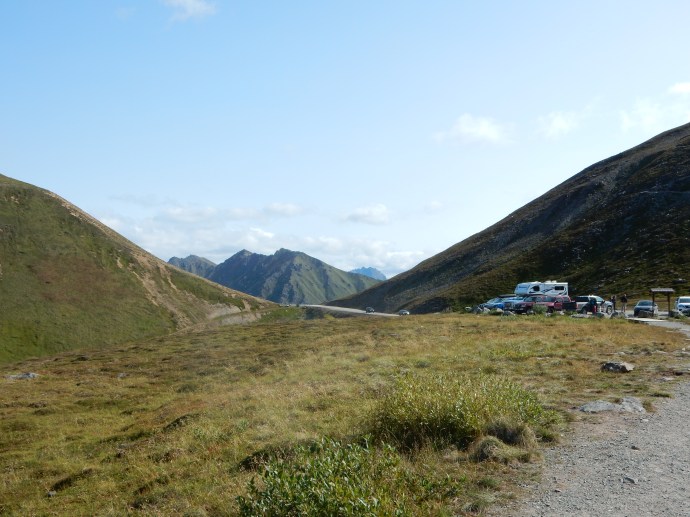
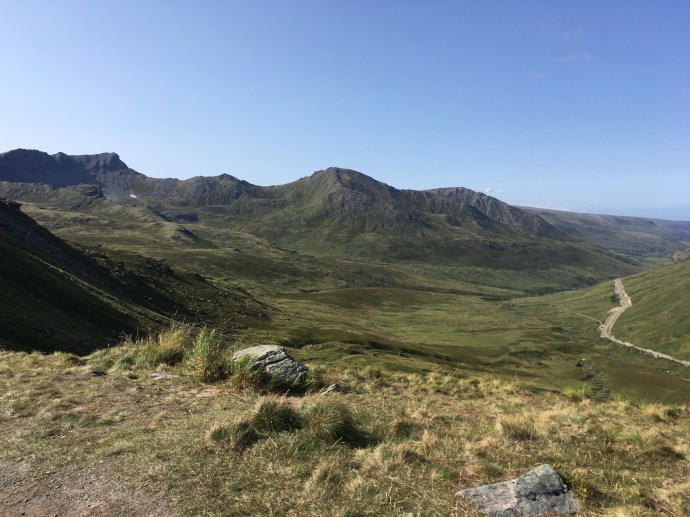
Hatcher Pass

Hatcher Pass

Hatcher pass

We left the mine and looked forward to our drive over Hatcher Pass and a nice meal at the Hatcher Pass Lodge with potential scenic views of the valleys and mountains. Unfortunately, the lodge was accommodating lodgers but the cafe part of the lodge, supposedly open according to the web site, was closed. Chris and I each had a granola bar for lunch instead.

The Hatcher Pass Road was not as bad as its reputation. I think the most difficult part of it may be the likelihood the road will be closed due to snow. The road is wide enough for two cars and only the first few miles (of 23) were washboardy. There is a drop-off at the sides of course, but we have experienced much worse.

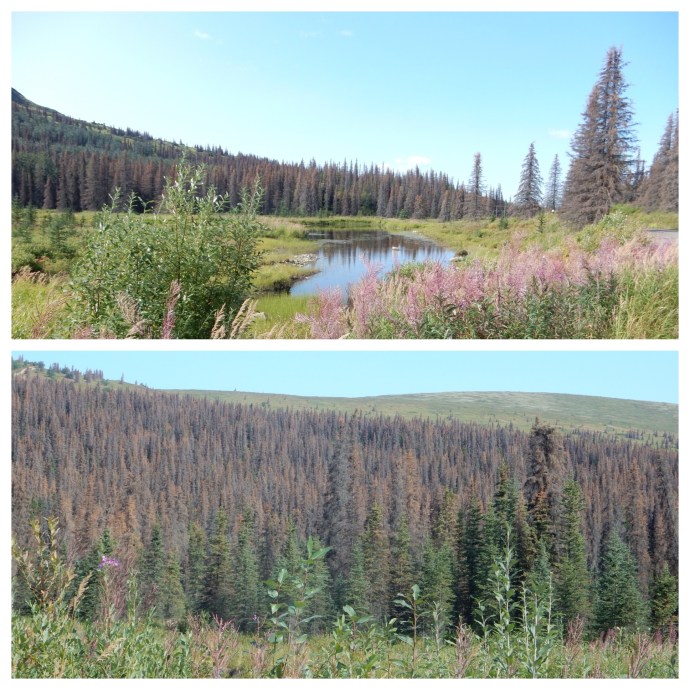
Dead trees on west side of Hatcher Pass

Numerous pull-offs provided opportunities for short hikes and for picture-taking. We frequently observed groups of people picking berries in the fields along the road; off road vehicles could be seen off in the distance but rarely on the road itself. After the pass, as we went west and down, the Little Susitna River was frequently by the side of the road. No moose were seen grazing along its banks. BUT, remember those nice comments about the lush green grass and trees?? On the west side of the pass, dead trees were everywhere. I am not sure what insect or disease is at work here, but the result was devastating.

At one of the overlooks, we met again two brothers (they were at the mine site earlier) originally from Miami (although one now lives north of Anchorage) who warned us that fires and smoke were closing portions of the Parks Highway connecting Fairbanks and Anchorage, usually right in the Denali area. We will have to monitor that, it could be a major disruption in our plans.

Hatcher Pass Road took about an hour but now we are west of Palmer. It took us another hour or so to return to Palmer. We could smell smoke in the air and traffic was heavy on the Parks highway. Eventually we made it back to Palmer and had a late lunch downtown at the same small cafe we enjoyed Saturday. Sunday is a much busier day for them, lucky to find a table.

But after lunch it was off to our last stop of the day, the Musk Ox Farm. Chris and I were particularly interested in this since our docent work at the Bell Museum in St. Paul includes a display of a musk ox-and a wooly mammoth. Both existed in Minnesota thousands of years ago. Musk ox became extinct in the U.S. but were re-introduced from small herds still remaining in Canada and Greenland. Our admission includes a 30 minute tour; our guide, a young man, made a nice presentation about musk ox, the farm, and fire plans for the farm-which is located on one of the Great Depression colony farms.

Musk ox in Palmer AK

This group of about 80 animals are domesticated and raised for their hair, called quivut. Pound for pound it is the warmest material on the planet and the quivut combed and gathered from the oxen are provided to indigenous women to weave into scarfs, mittens and hats. The techniques replicate the traditions of their heritage. Nowadays one can buy the finished products-although at a hefty price. The musk ox calves born each year are named after a theme: cheese (Gouda and Munster), national parks (Zion, etc), trees (larch, maple, oak), etc.

Dinner was take out from the local grocery store; fried chicken with two sides and a roll. Good food and we came back to our lodging and relaxed.

Matanuska River north of Palmer, looking toward Chugach Mountains

Ed and Chris Palmer AK 9:30 PM

Categories: road trip, travel | Tags: , , , , , | 1 Comment

2019 Trip 5: Alaska August 17

Eklutna Historical Park near Palmer AK

Palmer AK. August 17

If you divide Alaska in half, Texas would be the third largest state. Given that fact, it is egotistical to state that we will know Alaska by the time we leave the state on Sept. 10. However, we will certainly do our best to see as many different areas as we can. Today was an excellent start.

Thunder Bird Falls in Chugach State Park, AK

Thunder Bird Falls is only 25 miles northeast of Anchorage. It is viewable after a one mile hike along a cliff side trail that features a constant parade of up and down hills. The trail is wide and relatively smooth. Halfway along the trail is an overlook that presents views of the falls on Thunder Bird Creek which flows into the Eklutna River. Another half mile brings you to the view of the falls; today, however, the angle of the sun created poor photo opportunities. Still, the walk was in a forest, temperature was 65 degrees, and the sun was shining. A pleasant interlude to begin the Alaskan adventure.

Our next stop was the Eklutna Historical Park. This small collection of buildings is a result of the intermingling of the Dena’ina Athabaskans and Russian hunters and traders. The Athabaskans moved in here from the west thousands of years ago. The Russians came in the 1700s searching for pelts; beaver, sea otter, etc. as well as copper and gold. The story of Russian exploration is long and complicated; murderous and greedy combine with concern and compassion. By the time they sold Alaska to the U.S. in 1867, Russian Orthodox churches had gained a foothold in various settlement areas.

A variety of spirit houses at Eklutna Historical Park

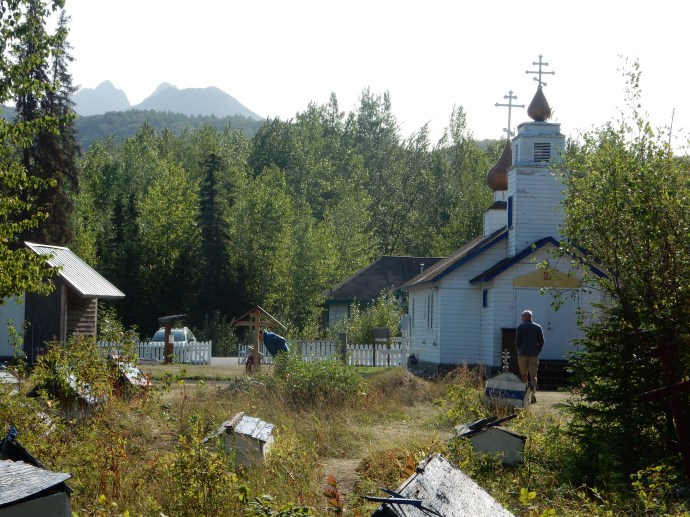
The Eklutna Historical Park retains the old St. Nicholas Church originally built in Knik and moved to Eklutna in 1900. The new St. Nicholas Church was built in 1962. Both are very small and are locked on Saturdays, we only viewed the outsides. An unusual feature of the area are the “spirit houses”. These burial markers are a unique combination of Athabaskan tradition married to Russian Orthodox practices. While small in number, it appeared to us be about 50 or so spirit houses, they exhibit a variety of styles and care. Some are care-worn, possibly reflecting the end of a family line who no longer live in the area. Others are painted, well-maintained, and have fresh flowers on display.

The Matanuska River near Palmer AK

We left Eklutna for Palmer, our lodging site for the next two nights. To get to Palmer, we took the Old Glenn Highway which ambles along the Knik River. The Knik River begins at Knik Glacier-which we did not drive to. The river is a milky white color with wide, sandy beaches. With the Talkeetna Mountain Range across the river to the west, it made for a much better photo op than Thunder Bird Falls. Then, as we got closer to Palmer, we were driving along another river, the Matanuska, which was flowing much faster than the Knik. It is the Matanuska River that we will be following on Monday, over to Wrangell St. Elias National Park and Preserve.

In Palmer, we took a 90 minute docent tour of the historic Palmer Colony. Forgive me, but I need to present a little background data first. 10,000 years ago the last great ice age had this part of Alaska under thousands of feet of ice. The glacial melt left glacial drift in the valleys, dirt that is finely ground and fertile. (Similar to the plains of the Midwest.) This section of Alaska is thus one of the few areas in the state that presents great agricultural opportunity. With a short growing season but long hours of daylight, this fertile soil produces vegetables that are much larger than normal. Some of the record vegetables at the Alaska State Fair include: 39.2 pound turnip, 82.9 pound rutabaga, 138.25 pound green cabbage, a 1469 pound pumpkin, and a 71.75 pound carrot-all world records.

The Colony Inn B & B, formerly a dormitory for service personnel for the Palmer relocation program

During the Great Depression, one of the lesser-known recovery efforts was the transplanting of 203 Midwestern farm families to the Palmer area. This federal government program was conceived, planned, and put into execution with the first families arriving in Alaska in May 1936. Without going into great detail, the effort failed and succeeded. One-half of the families returned to the lower 48 by the end of 1937. But the effort laid the groundwork for greater development of Palmer and its agricultural resources which proved vital when WWII began. With the Japanese invading and capturing several Aleutian Islands, the American armed forces began a swift build-up in Alaska. The bases built then, and still maintained, provided labor for the farmers, a ready market for produce, and an introduction to the area for military personnel; some of whom made the area their permanent home.

The docent tour presented the story well. We saw several of the original homes, one of the churches, and a former dormitory now a B and B. The docent provided plenty of time for questions and we obliged by asking a lot.

After the Palmer tour, we checked in to our Airbnb lodging, got groceries, and had dinner at a small cafe in downtown Palmer. Since it is still light out, we drove down to the Hay Palmer flats and took a one mile hike around Reflection Lake. Hay Palmer Flats are a wildlife refuge at the confluence of the Knik and Matanuska Rivers and the Knik Arm of the Cook Inlet.

Of particular interest is the fact that this area had been a hay growing area for the dairy farms around Palmer. On Good Friday 1964, a 9.2 earthquake with a resulting tsunami, the largest in North American history, struck Alaska causing widespread death and destruction. The ground was pushed up in some places and depressed in others. Here, at Hay Palmer, the land subsided 4-6 feet and the hay fields became too swampy for growing hay. The marshes and swamps became a gathering place for wildlife. Reflection Lake is in the refuge and there is a pleasant one mile hike around it.

Ed and Chris. 10:30 PM

A view at Hay Palmer wildlife refuge, Palmer AK

Categories: travel | Tags: , , , , ,

2019 Trip 5: Alaska

St. Paul, Minnesota August 16, 2019

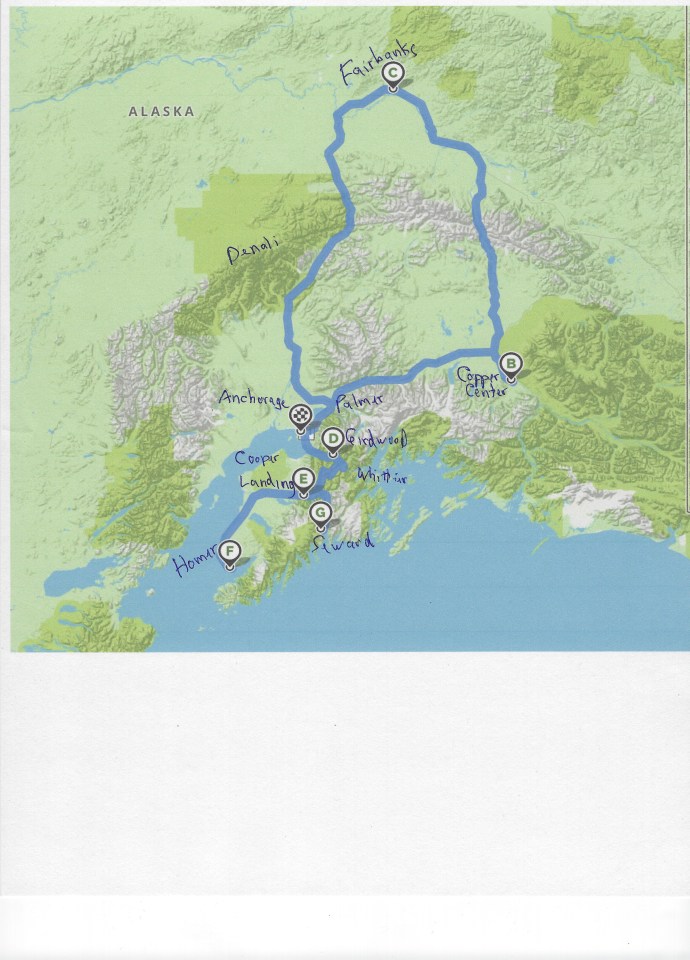
Well, our next trip starts this Friday, as we leave for Anchorage and 3.5 weeks driving around Alaska, wrapped up with an Amtrak train ride from Seattle home to St. Paul. As usual, planning is detailed and finished.

Anchorage, Saturday 17, 2019

A five hour and 45 minute plane ride brought us to Anchorage. We were unable to view much from the plane windows (hint for future travelers: Should the weather cooperate, choose the “F’ window seat for a view of the mountains.). The ride to our hotel at sunset (9:30 PM-no longer daylight for 24 hours but the sun is still setting later than it did back home) just showcased the business side of Anchorage.

We were a little embarrassed on this trip. We packed an additional suitcase in addition to our two carry-ons and backpacks and used the baggage check service. This is the first time in eons we have done this but with the variety of weather, outdoor conditions, and tours we are taking, it seemed essential.

Our Jeep arrives at 9 AM and after packing it so our usual tools of the trade are close to hand, we will be off. Our first stop is Palmer, a town of about 7,000 people. We will be in Palmer for two nights. (Hint to travelers: We rented a Jeep from Alaska 4 x 4 and obtained a great rate; ability to drive roads Hertz, etc. would not allow; and the drop-off at the hotel avoids about $300 in airport rental car fees).

Anchorage we will visit in more detail at the end of the trip. We did discover that the Anchorage airport is the second busiest U.S. airport for cargo, and the fifth busiest cargo airport in the world. Population here is just under 300,000; so the weather and population are not dissimilar from that of St. Paul. Anchorage’s winter weather is less dramatic than much of Alaska.

An article in a local Alaska business magazine spotlighted greenhouses/nurseries and the impact climate change has on them. Plants are being started 2-4 weeks earlier than the historical average. Another current article highlights the negative impact salmon are facing due to the higher summer heat. Draw your own conclusions.

Ed and Chris. Much more to come.

Categories: travel

2019 Trip 4: New England: June 19-20

Teddy Roosevelt slept here at The Fells and planted a tree on the property which is still growing.

St. Paul MN June 22

Our last stop on this trip surprised us by having unexpected tie-ins to the two NPS sites we had visited on Monday and Tuesday. Our destination was the John Hay National Wildlife Refuge in Newbury New Hampshire. It was less than 30 miles from our lodging, was on the route back to Boston, and seemed to be an interesting wildlife refuge. A few years back we began adding interesting national wildlife refuges to our list of go-to sights as we travel; many refuges have little or no public access, created for the animals, not people.

The John Hay Refuge website kept defaulting to The Fells, a preserve and gardens. Well it turns out that there are three inter-related properties: the wildlife refuge, a tract of land owned or managed by the Society for the Protection of New Hampshire Forests, and Fells which is the home and grounds of John Hay. Hay had quite the background; private secretary toAbraham Lincoln, Secretary of State under two U.S. Presidents, diplomat for the U.S. in Europe, and author/writer. He married well and became quite wealthy through his wife’s family. Hay was responsible for the Open Door policy with China. He and his friend Henry Adams purchased next door homes in DC that lent their name to the Hay-Adams hotel.

Henry Adams wife Marian committed suicide and Adams commissioned Augustus Saint-Gaudens to sculpt a memorial to her which is located in Rock Creek Park in D.C. A replica of that memorial was at the Saint-Gaudens park site. Similar to the effort in Vermont led by John Marsh and Frederick Billings, New Hampshire in the late 1800s was poor with large swaths of land de-forested by lumber interests. Rich families were encouraged to buy property in New Hampshire and to help re-vitalize land in the state. Hay purchased 1000 acres of land along Lake Sunapee and made it into a summer retreat for his family and friends. Cabins grew in size and gardens added. After Hay’s death, his son and then grandson continued to add to the now mansion and grounds. The grounds were used to showcase extensive gardens and natural hiking trails to demonstrate the connection between nature and man.

The family donated a portion of the property to the Society for the Protection of New Hampshire Forests, a portion to the U.S. Fish and Wildlife Service, and the rest to the Fells, a non-profit to maintain the mansion. The Forest Society brought beaver back to NH, bring in two breeding pairs from Minnesota in 1920; beaver had been extinct in NH for 30 years. The wildlife refuge has hiking trails and The Fells is open for public viewing.

The Fells building

We took a self-guided tour of the building and grounds. The mansion showcases summer estate living and all over the grounds flowers were in bloom. It was a pleasant two hour excursion before returning to Boston.

The Fells grounds

Wednesday was Deb’s (and Sarah’s) birthday and we made it back to Boston in time celebrate her birthday. Thursday we were up early and at the airport in plenty of time to make our flight home.

Next major trip will be four weeks in Alaska starting in mid-August.

Ed and Chris

St. Paul MN June 22

Categories: travel | Tags: , | Leave a comment

2019 Trip 4: New England: June 17-18

The Robert Shaw Memorial-original in Boston Commons-from the Saint-Gaudens National Historic Site in Cornish NH

Grantham, NH. June 18

Decades ago when I first drove through Connecticut I was surprised by the hills and greenery. I just had this vision of the state as all urban concrete. I thought of that long ago memory Monday as we drove from Gloucester MA to Cornish NH. My sense of the geography of this region has certainly become more accurate but my pleasure at viewing the hills and greenery has not diminished. The rocky coast along Gloucester gave way (after the Boston urbanization area) to the hills, mountains and forests of New Hampshire. Along I-93 as we crossed into NH, there were several stretches where wildflowers must have been planted in the median. Combinations of white intermixed with yellow flowers were followed by a blueish-purple tinged flower. The woman at the NH information center was not aware of them, not driving that way to get to her job. They were profuse enough that they reminded us of our drives among the bluebonnets of Texas highways.

Driving along New Hampshire highways

Trying to be accurate, I did some Internet research to discover the types of flowers. Well, I found out that they are lupine, oxeye daisies, black eyed Susans, and coreopsis. The state has planted them for erosion control and visual impact. Evidently the seeding occurred before this spring because the same article indicated that due to budget cuts, state roads were having streetlights turned off, grass not cut, pavement marking lines not painted, and less guardrail maintenance. Ironically, at another stop, the cashier proudly stated that NH has no state income tax or general sales tax.

We are in New Hampshire and Vermont to visit two National Park sites. Monday we visited Saint-Gaudens National Historic Site in Cornish NH, along the Connecticut River which forms the Vermont border. (And we passed a section of road where one of the two lanes had washed out.) Augustus Saint-Gaudens (1848-1907) was a great American sculptor who came to Cornish for summers beginning in 1885 and to live year-round from 1900 until his death. This is only one of two National Park Service sites dedicated to the visual arts. The property was donated to the National Park Service in 1965.

The property includes his home, studios and galleries and is situated on 195 acres of woods, gardens and farm land.Our plan was to catch the 15 minute presentation at noon about sculpting but the in-residence sculptor had the day off. We walked along the ravine trail listening to the gurgling brook and enjoying the cool forest air. The park offers an 18 minute introductory video about Saint-Gaudens, his life, and works. (The video did not mention his mistress or the son he had with her.)

Two of Saint-Gaudens major works

Saint-Gaudens came as an infant to America from Ireland and was apprenticed early to a cameo maker. He attended classes in New York, Paris, and Rome where he met his wife. Returning to New York, he received his first major commission, a statue of Civil War Admiral David Farragut. When completed in 1881, it received overwhelming adulation. Over his career, he created several monumental sculptures still well-known today: The Shaw Memorial on Boston Commons, the Sherman Monument in New York’s Central Park, the “Standing Lincoln” in Chicago’s Lincoln Park. The Shaw Memorial took 14 years to complete and features Col Shaw leading the Massachusetts 54th Regiment, the first all African American regiment from a Northern state. The individual features of the numerous soldiers is striking.

Saint-Gaudens created numerous smaller sculptures, miniatures, and cameos over his career. President Teddy Roosevelt made him the first sculptor to fully design an American coin; the one cent coin, and the 10- and 20-dollar double eagle gold coin. He died in 1907 from cancer.

Aspet House, Saint-Gaudens home in Cornish NH

Aspet House, his home in Cornish, was open for visitation and we explored it thoroughly. We took a tour of the grounds with a ranger whose presentation focused on Saint-Gaudens influence on the Gilded Age, that period from after the Civil War to about 1900. The Gilded Age was marked by rapid industrialization, wage growth for all but still with great concentrations of wealth and marked poverty. The people who commissioned Saint-Gaudens were among the very elite and had no problem with demonstrating their wealth.

Dinner (and lunch) was a quick bite at Wendy’s and a large ice cream at Fore-U Ice cream, a local store in West Lebanon. Our lodging is a wonderful AirBnB in Grantham, NH; out in the country surrounded by woods and gardens. The unit is a two bedroom stocked with multiple options for breakfast.

Tuesday we drove 40 miles to Woodstock Vermont, home to the Marsh-Billings-Rockefeller National Historical Park. The site has three names to reflect the three families that lived here and who each played a role in the national conservation movement and the evolving nature of land stewardship in America.

George Perkins Marsh (1801-1882) grew up here on the farm, was a U.S. Congressman, and a long-serving American ambassador. From the vantage point of overseas postings, he realized the impact humans made on the land. The timber industry in Vermont denuded mountainsides of trees, with no tree re-plantings and increased erosion. He advocated for a new, more caring focus on land stewardship. In 1864, he wrote Man and Nature, a book still in publication and which became a bedrock for future conservation efforts.

Frederick Billings ((1823-1890) grew up in Vermont, about 20 miles north of Woodstock. Trained as a lawyer, he made his fortune resolving land sales and issues in California during the Gold Rush era. He returned to Vermont, purchasing the Marsh family farm in 1869. By the time of his return, the Vermont mountains were stripped of trees, erosion had filled rivers, and farm fields were unproductive. Billings created a model farm to help educate farmers and revitalize Vermont agriculture. Sustainable, scientific forestry was a major focus of his life.

Inside the Marsh-Billings-Rockefeller mansion

After Billings death, his wife and daughters continued the commitment to sustainable forestry. Eventually the property passed to his granddaughter Mary French who married Laurance Rockefeller, grandson of John D. Rockefeller. The Rockefellers had played a major role in U.S. National Parks and Laurance continued that tradition in many ways. Here, he and his wife transferred the land and an endowment to the National Park Service and this became a National Historical Park in June 1998.

walking the grounds at Marsh-Billings-Rockefeller

Besides the park video, we participated in two ranger talks and hikes. During the tour of the mansion, besides viewing the interior, the ranger explained in greater detail how the three families played an important role in creating and sustaining a view of improved stewardship of our natural resources. On our ecology hike through the forest, we discussed with the park ranger the damage still being done to forests by man, creature, and climate.

Two Minnesota notes. One of the volunteers, while living in Vermont now, had a connection to Minnesota as his grandfather lived in North St. Paul, one of the towns of my youth. His grandfather started the Ramsey County Review, the local newspaper. Frederick Billings had a strong role in the development of the Northern Pacific Railway, which fueled the development of the U.S. from the Dakotas to the Pacific Ocean. The Northern Pacific was constantly plagued by financial issues and eventually was absorbed by the Great Northern. Billings time with the Northern Pacific was well-regarded, and the town of Billings Montana is named after him.

Ed and Chris. Grantham NH. June 18

Categories: road trip, travel | Tags: , , , , , , , , | Leave a comment

2019 Trip 4: New England: June 14-16

Gloucester, MA. June 16, 2019

Whales!! Yes!! A whale watch was our agenda for Saturday June 15. We are in New England again to visit Deb and Rebecca. Generally we spend a few days touring parts of New England other than Boston. This trip we are in Gloucester for 3 nights and then two nights in New Hampshire before one last day in Boston.

Gloucester is currently a whale watching hub, with its roots in sailing and fishing going back to its founding in 1623. Gloucester predates both Salem and Boston. It is located on Cape Ann, about 40 minutes northeast of Boston on the Atlantic Ocean.

View from our room towards Good Harbor beach.

We arrived Friday night and are staying at the Vista motel on Good Harbor Bay. Our room has a view of the ocean and the beach is a ten minute walk. Friday night we had dinner at the Franklin Cape Ann in downtown Gloucester with Deb and Rebecca.

Saturday morning at Good Harbor Beach

Saturday morning was an hour on the beach, sunny skies and temps in the mid-60s. We had a fresh fish lunch at Gloucester House restaurant overlooking the harbor before boarding the Privateer IV, the newest whale watching boat from Seven Seas Whale Watching. The boat offers indoor and outdoor seating. As we boarded, the seats outside were great, pleasant and sunny. After a brief tour of the Gloucester Harbor, we headed out to sea and the breezes picked up. Everyone added on their extra jackets and hoodies to stay warm in the breeze. Blue skies and blue water surrounded us on all sides.

Actually seeing whales is never guaranteed; the ocean is large and the whales travel on their own schedule. Prime watching area is about 45 minutes from the harbor. While there are several whale watching tour companies in Gloucester, ours managed to be first to the area and the first to spot a whale. Once a whale is spotted, the excitement is palpable and no one is cold anymore.

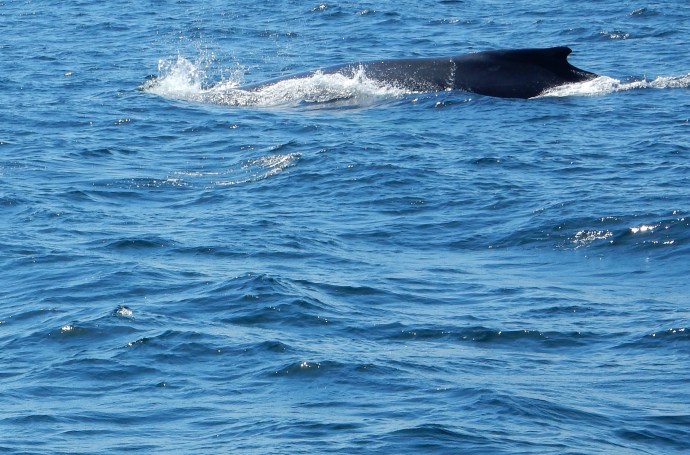
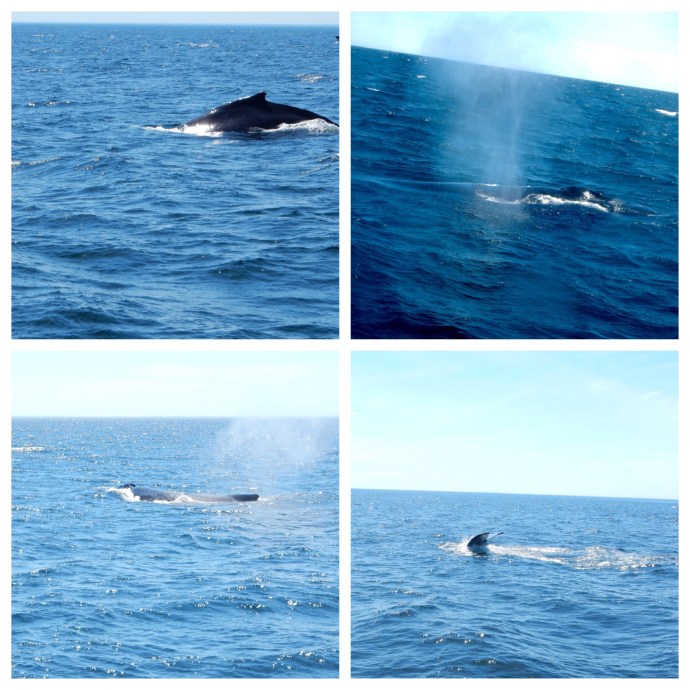
We really lucked out. Yes, we only saw one humpback whale but that whale stayed around us, even diving under the boat several times and coming up on the other side. That really freaked people out! We did leave the first area for a while to look for whales of other species but after being unsuccessful, returned to our first whale.

Our whale

The naturalist on the boat was pleased that not only did we see the whale feeding, but we were able to see the tail of the whale come up completely and splash down several times. Evidently that is not a frequent occurrence. The whale would spout, come up, dive down, and blow air bubbles to concentrate the fish schools it was feeding on. This happened repeatedly, with dives under water lasting several minutes and people searching the ocean to be the first to see it re-appear.

I was lucky enough to get several nice pictures of the whale, even with our point and shoot camera. There is also one nice video that I hope attaches well to this post. I believe you will enjoy watching it. It is only 28 seconds but has a lot of action.

The video

Finally, we had to head back to shore, the whale was still feeding but our time was done. We were probably watching the whale for at least 45 minutes, if not longer. It was a memorable occasion, not soon to be forgotten.

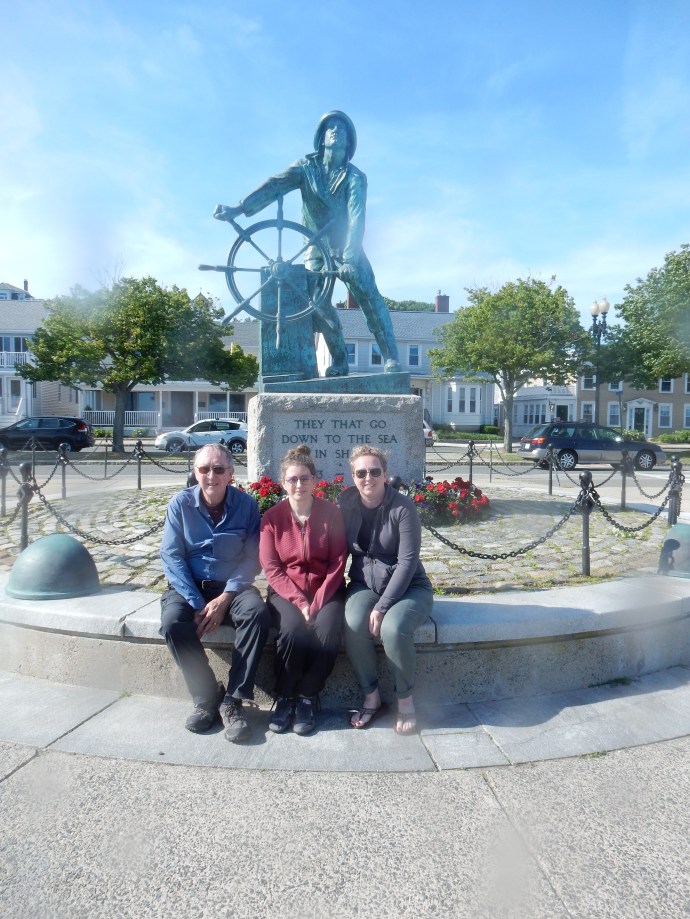
Man at the Wheel statue

Back in Gloucester, we did a short walk around the harbor before heading back to the hotel. Two stops on the walk, one for ice cream and one at the famous Gloucester Man at the Wheel statue. The statue honors the Gloucester fishermen who have been lost at sea; it is inscribed with the words: “They that go down to the sea in ships.” Dinner was just pizza in the room, the fish lunch had been quite filling.

Our Lady of Good Voyage church in Gloucester

Sunday was rainy, we used up our weather luck on Saturday. We went to an 11:45 Mass at the Lady of Good Voyage church, a long-time Portuguese congregation in Gloucester. We arrived early since we wanted to take some pictures and as we pulled up, there was a crowd in front of the church, many dressed up in fancy clothes. First thought: uh-oh, a long service of some nature. But while it was a special occasion to honor their recently deceased pastor’s forty years of service, the Mass was no longer than usual and we were able to observe some local customs to honor the Portuguese fishing community.

After Mass we drove the scenic route all of 15 miles to Rockport, another ocean harbor community with narrow streets, upscale art galleries, and crowded harbor. The rain limited the enjoyment of potential shopping. My goal on Father’s Day was to visit the Rockport Art Association and Museum. The description portended extensive art galleries and a healthy dose of Rockport history. When we entered the building, I asked the receptionist where the history section was-the art sections were obvious and close at hand. She looked a little quizzical and stated she did not think they had any. They did not. My hopes to learn some history of the community were dashed, but I made the most of the art sections.

Ed enjoying the art in Rockport

Deb and Rebecca took Chris and I out to dinner for Mothers and Father’s Day. The Passports restaurant in downtown Gloucester came well recommended and it had popovers. This was Rebecca’s first experience with popovers and Passport’s did not disappoint. The meals were great and we saved enough room to share two desserts. I really celebrated and had a glass of sangria.

Ed and Chris. June 18

Categories: travel | Tags: , , , , , , | 1 Comment

2019: Out and About in the Cities

St. Paul MN May 22, 2019
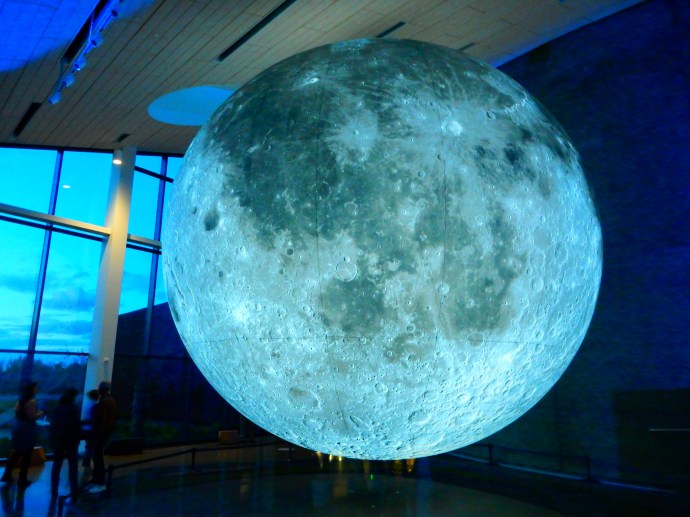
Museum of the Moon at the Bell Museum St. Paul

Almost all of our blog posts are travel adventures; trips away from the Cities, whether elsewhere in Minnesota or more likely, around the U.S. or Canada. In the past two weeks however, we experienced a diverse set of activities that seemed worthy of mention. The activities  reflected the non-standard activities available to a person in the Cities, not just the museums and historical locations.
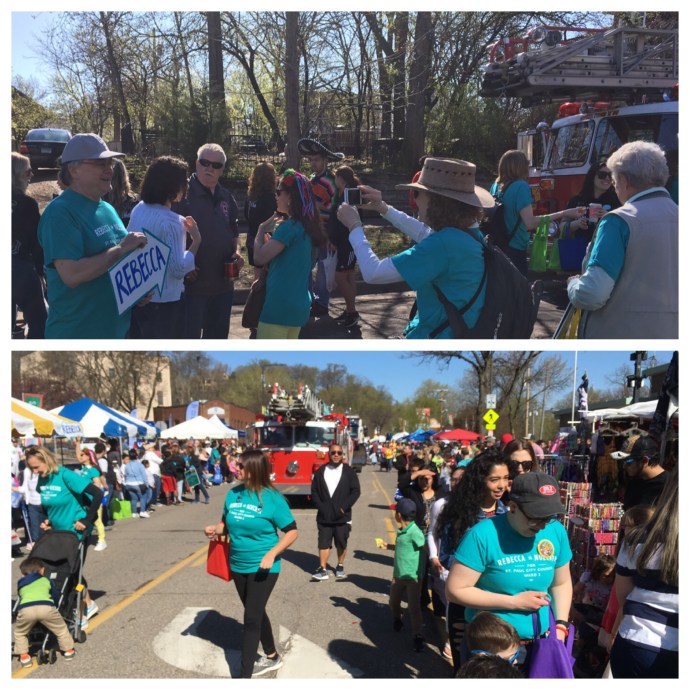
The Noecker group marching

Our tale starts on Saturday May 4 for the 34th annual Cinco de Mayo parade on the West Side of St. Paul. This year, we marched with a group sponsored by our St. Paul Councilmember, Rebecca Noecker. As is our style, we arrived plenty early and had chatting time with other parade marchers and volunteers. The West Side of St. Paul is actually south of the Mississippi River since the river here takes a bend and changes from a north-south orientation to an east-west orientation for about eight miles. Thus, here the city is considered to be on the west bank of the Mississippi. It is the only section of St. Paul located on the south or west shore. Historically, this area was Dakota land and as treaties removed the Dakota from their homeland, French-Canadian, German and Irish immigrants settled here. (My German father’s house was on the West Side.) Later Eastern Europeans moved in and then it became home to a thriving Mexican immigrant community, which it still is today.

Cinco de Mayo parade St. Paul MN

The Cinco de Mayo festival and parade here is reported to be one of the ten largest in the U.S. But as a parade participant, we saw more of the crowd and less of the parade. The day was pleasant and the crowd numerous and relaxed. Families with children and grand-parents composed the large majority of the people lining the street.

The crowds at the Mayday Parade Minneapolis

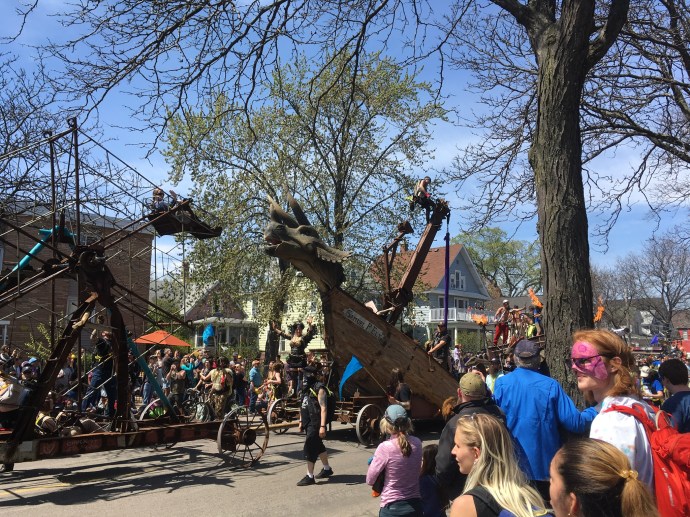
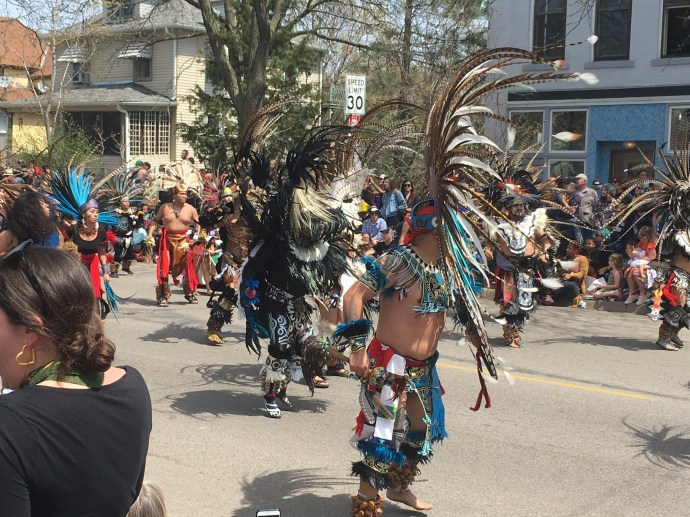
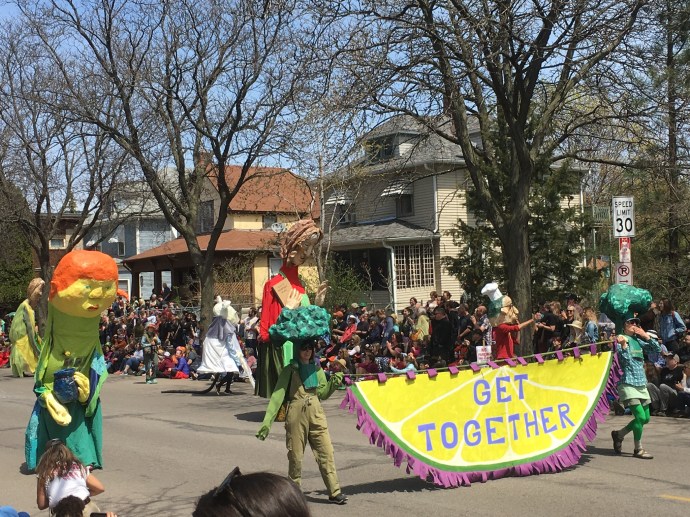
On Sunday, May 5, we traveled compass-west and river-north to Minneapolis for the 45th annual MayDay Parade, Ceremony, and Festival sponsored by In the Heart of the Beast Puppet and Mask Theatre. Boy, this was the time to really see diversity in Minneapolis. The parade runs down Bloomington Avenue to Powderhorn Park where festivities continue all afternoon. Knowing there would be an even bigger crowd for this parade, we arrived with plenty of time to people watch. We were the unusual ones; we did not have a dog, did not ride a bike, did not color our hair, did not have a tattoo, did not have a child present, did not wear clothes with a message, etc. Once again the crowd was polite; maybe more boisterous and jolly, but still uneventful. The parade is self-managed, no police cars leading the way. In fact, no motorized vehicles are allowed in the parade, unlike Cinco de Mayo which has a large crop of public organization vehicles. The crowd lined the sidewalks and curb area, leaving a small walkway for people to get through.
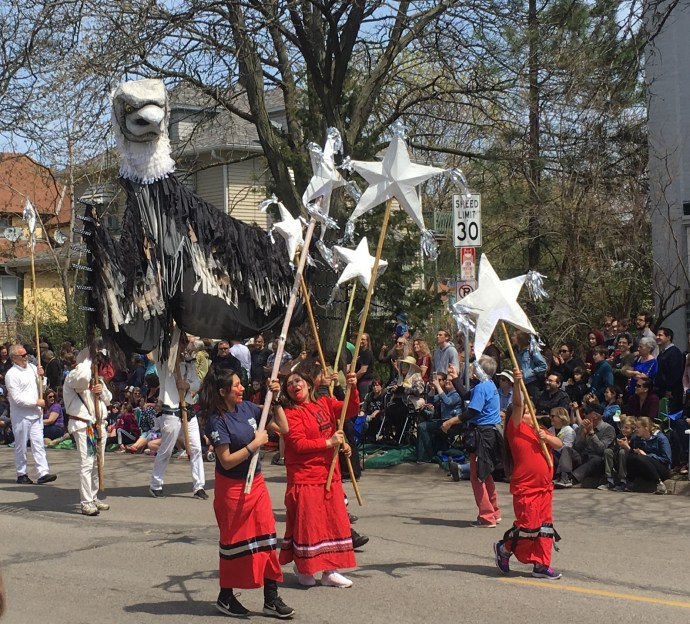
Mayday Parade
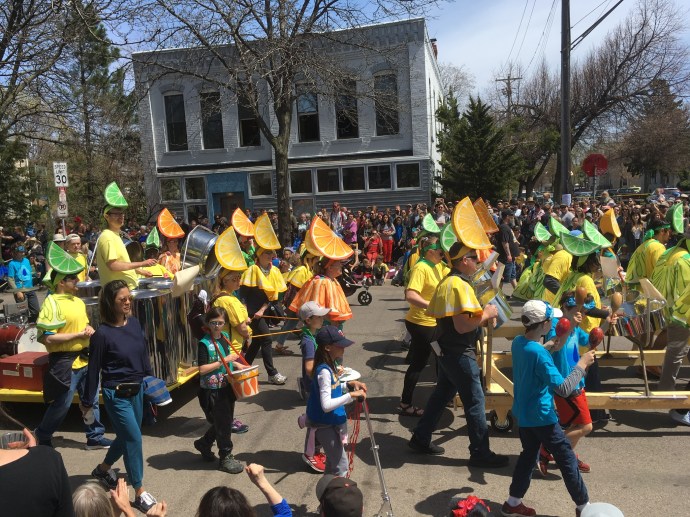
Mayday Parade
Mayday Parade Minneapolis
Mayday Parade Minneapolis
Mayday Parade

This year’s theme was Beloved Community revolving round reconciliation and respecting our earth. Community groups are encouraged to participate with their own display that ties into the overall theme. After the parade, there is a community festival at Powderhorn Park.
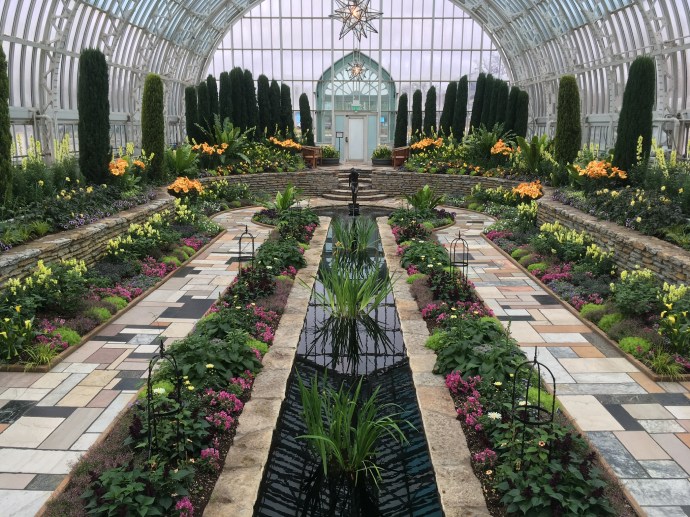
Como Park Conservatory
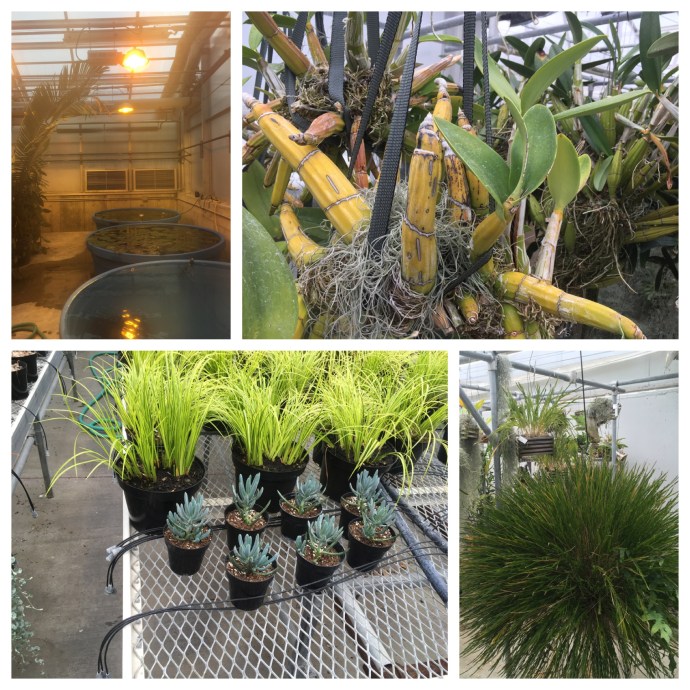
Inside the greenhouses at Como Park Conservatory

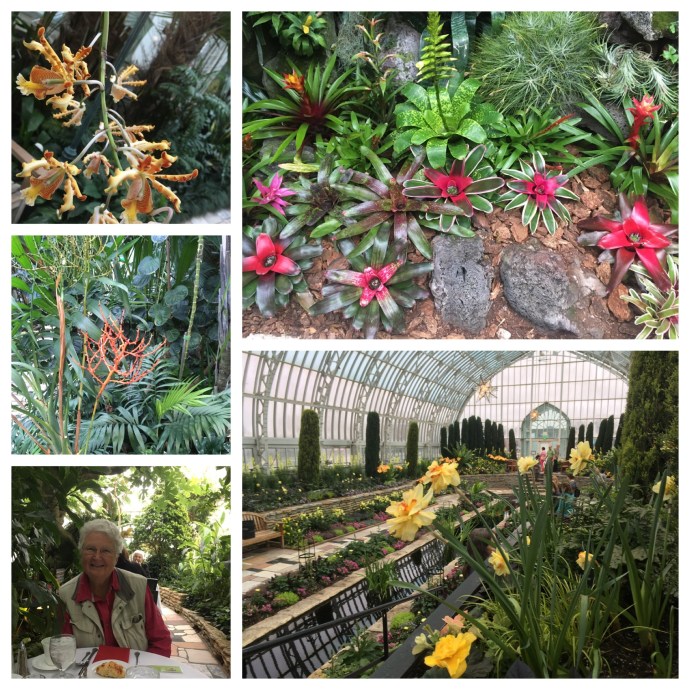
Thursday, May 9 brought us back to a familiar site but with a different focus. We have visited Como Park, Zoo, and Conservatory frequently. Today, though, we had a catered breakfast in one of the gardens followed by a behind the scenes tour of the greenhouses. The Conservatory grows many of its plants and will rotate specimens during the year. Rotating exhibits are designed by horticulturists and other Como staff. In the off-season for that plant, many plants are stored in the greenhouses at the appropriate off-season temperature.
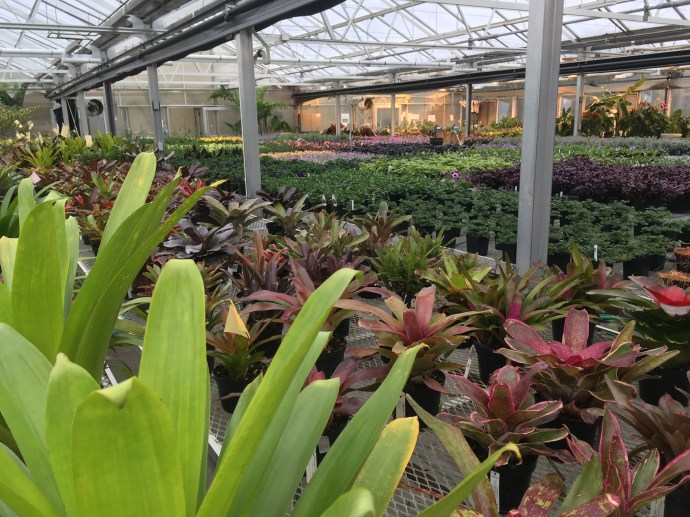
Inside the greenhouses at Como Park Conservatory

The greenhouses are awash in colors, row upon row of plants in various stages of their growth cycle. Drip irrigation systems contrast with overhead irrigation. Large tubs of water host the first growth of the large pond Victoria Water Lilies that will appear outside Como come late July. Winter blooming plants are kept chilled until they are ready to pop. The chilling goes so far that the combination of cold and moisture sometimes creates a few flakes of snow. Would this not be a great place for someone to volunteer if they are into gardening?

Saturday May 11 we switched gears again. For 8 hours we saw and heard about the history and significance of several places of cultural, religious and historical importance to the indigenous peoples who lived here prior to European immigration. While the Dakota people were not the only indigenous people to live here, they were the ones present when Americans started moving here from the Eastern states in the 1800s. Fur trappers preceded the settlers and while the fur trappers did not take the Dakota land, their pattern of trapping the native beaver to near extinction created long-term destruction of natural habitat that still persists today. The treaties signed by the U.S. were never sufficient in the eyes of the new settlers. Treaty violations and treaty non-compliance by the U.S. government drove the Dakota in 1862 to declare war on the settlers, killing hundreds. The state raised an army and defeated the Dakota. After the war, 38 Dakota men were hung in the largest mass hanging in U.S. history. The remaining Dakota were shipped out of state after forced marches and winter imprisonment in camps. This fulfilled the demand of then-Governor Ramsey of Minnesota that, “the Sioux (Dakota-note Ed) Indians of Minnesota must be exterminated or driven forever beyond the borders of the state.”

CF960BEF-BE65-4F1B-92CD-1B9941B06BF8

Mounds Park

7249B7D7-C470-4067-87F0-9F75542B3B1A

Wakan Tipi

During the daylong event, we listened to speakers and visited several sites. Mounds Park (Kaposia) is the site of six remaining burial and spiritual mounds; others have been excavated and bulldozed with the relics sold to museums. Wakan Tipi or Bruce Vento Nature Sanctuary is located below the bluffs of Mounds Park. The site remains a Dakota sacred site today even after the railroads bulldozed the front portion of the cliff entrance to the cave for more railroad tracks. At Fort Selling historic site and at the overlook to the confluence of the Minnesota and Mississippi Rivers, we heard how the Dakota used to converge on this spot for mothers to give birth. Unfortunately, this spot was chosen by the U.S. soldiers for a fort and was used as the internment camp for Dakota people during the winter after the Dakota War of 1862. (The actual internment site is located in Fort Snelling State Park on the river below the Fort and the park was closed due to high water.)
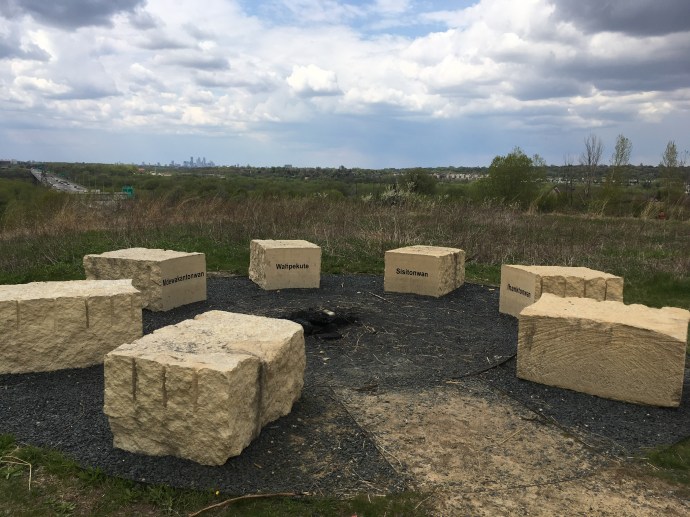
233A51A8-AF7E-4935-BB4F-5450FB4C7588

Looking from Pilot Knob towards downtown Minneapolis in the distance

Finally we stopped at Pilot Knob. To the Dakota the prominent hill was known as Oheyawahi, or “a hill much visited.” It was here that the Dakota buried their dead and Dakota villages dotted the river below during the early 1800s. The hill remains a sacred place to the Shakopee Mdewakanton Dakota. All in all, it was an awakening experience to learn the beliefs of the Dakota people who preceded us here and who still fight for respect and treaty rights.

Wednesday night, May 15, the Voyageur National Park Association hosted an event in Minneapolis. (You will read more about Voyageurs on this blog come October.) It was held at Open Book’s auditorium and about 60 people showed up. The speaker was Ben Goldfarb, author of the award-winning book “Eager, the Surprising, Secret Lives of Beavers and Why They Matter”. Ben is an environmentalist journalist, editor, and beaver believer. We were surprised; the author was an excellent speaker and provided in an interesting way new information about beavers.  There is a movement in the country to allow beaver freer rein to build their dams; improved water retention, fishing, and decreased flooding are likely to result if we can resist our emphasis on man-made answers to the problems we have created in our environment.


Beaver pelt were the only export early American settlers had to pay for their English made goods. Beaver hunting fueled the economy, drove westward expansion and settler anger at British limits on expansion, and by the late 1800s had practically exterminated beavers in North America. This over hunting resulted in topography that is drier, has less animals, and is more barren then pre-1700s. The impact is still felt today and the American instinct to build man-made structures to replace what nature does on its own continues to haunt us. We bought a copy of the book and suggested to the Bell Museum store that they stock it.

Just one interesting tidbit: The Catholic Church, in 17th century Quebec, after discussions with theologians in France, declared beaver a fish since even though a mammal, it swims. Therefore, Catholics could eat the red meat of beaver on Friday during Lent without a guilty conscience.

Last weekend, May 18-19, was the inaugural Doors Open Minneapolis event. 115 buildings throw open their doors and invite the public to visit and take a peek behind doors normally closed. Venues included historic buildings re-used for hotels and offices, public works locations like a hydro plant or recycling facility, churches normally open only to their members, public yet private areas like the Federal Reserve or Post Office.

St. Anthony Falls Lock and Dam was one of the 115 venues open to the public. Each venue had its open staff or volunteers welcoming guests. In addition, Doors Open planned to have two volunteers at each of the 115 venues, working in two shifts of four hours each. Doors Open needed 900 volunteers. I do not know the final result, but it seemed like they came close to reaching their goal.

On Saturday, I was a volunteer for the National Park Service and Army Corps of Engineers (not a volunteer for Doors Open) at the St. Anthony Lock and Dam. We had over 400 visitors between 10 and 2, on a blustery dreary day.
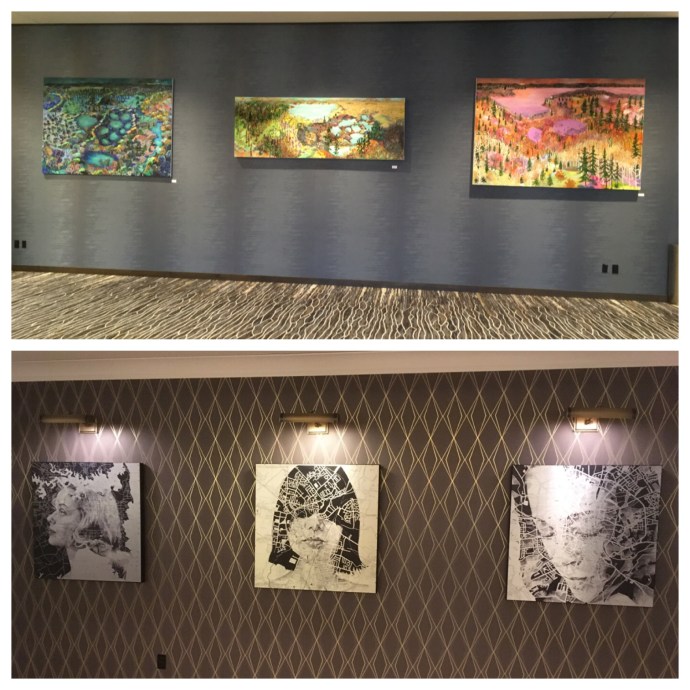
Sample artwork at the Intercontinental Hotel MSP AIrport

On Sunday, Chris and I were volunteers for the Doors Open program. Our shift was at the Intercontinental Hotel at MSP airport. It opened in July of 2018 and has a very nice collection of art work. The hotel manager gave us a tour, visitors received a hand-out for a self-guided tour. Our gig as Doors Open volunteers required us to greet visitors pleasantly, answer questions, guide them as to the best route and provide them with complimentary parking garage passes. During the other half of the day, we visited two sites.

F41B7BB2-81BF-4FF3-BAF6-52C67ECB5E4D

Danish American Center

325EB29E-57F6-4E64-9C68-EDFE6B96D129

Pancakes

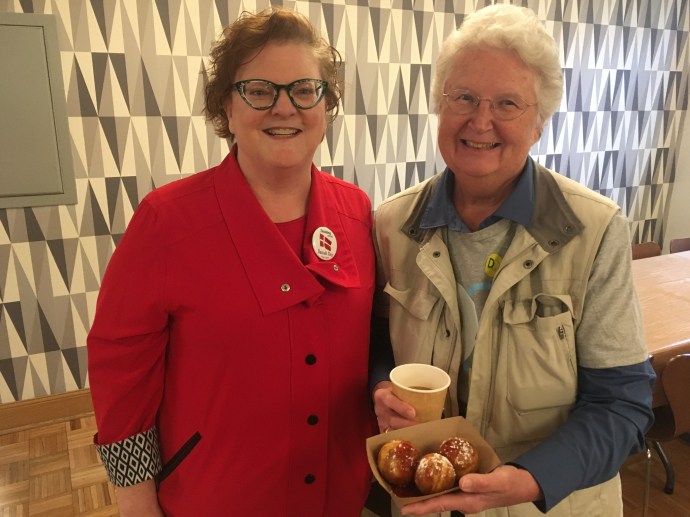
First, we stopped at the Danish American Center, a building we have passed innumerable times along West River Road in Minneapolis. Over a hundred years ago it began as a home for seniors, today it is a community center and offers overnight lodging for out of town visitors to members. All Doors Open visitors received a personal tour and a serving of Danish pancakes, a round pastry called an Aebleskiver.
B5C127D7-4C05-41BE-8B7E-3FA2EAFA7BB4

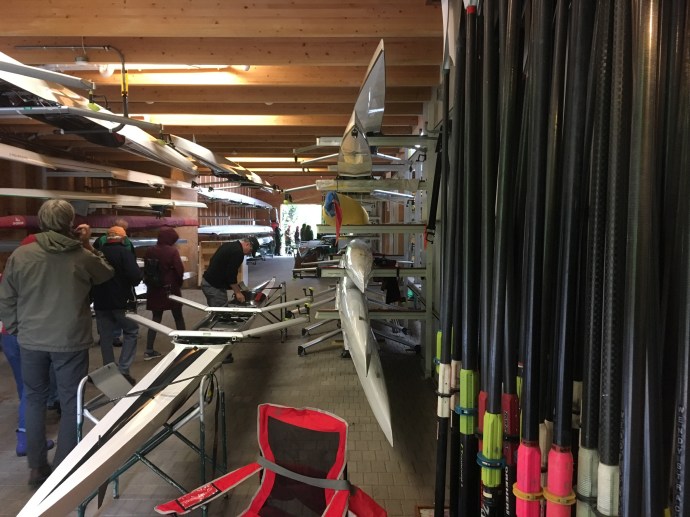
Minneapolis Rowing Club boathouse

Our second stop was at the Minneapolis Rowing Club. Their boathouse along the Mississippi, after their previous A-frame building burnt down in the late 1990s, is designed to resemble a duck in flight. Inside we were treated to a tour and discussion of rowing; single, double, four and eight person. Note: if a rower uses two hands to hold two oars, it is sculling. If a person holds only one oar with both hands, it is called sweep rowing. As you walk in, you are overwhelmed with the rows of boats, the lined up oars, and the second floor exercise room. The exercise area can have one wall opened to provide fresh air and an up-close view of the Mississippi River. All ages are welcome, we talked with one woman who had just begun rowing three years ago when she retired.

In an interesting note, at St. Anthony Falls Lock and Dam on Saturday, numerous visitors asked about the publicized study being undertaken by the Army Corps of Engineers to determine the fate of the lock which was closed four years ago. No answer is expected for 18 months; implementation will take longer no matter the recommendation. One option discussed has been to remove the lock and allow the river to flow freely. This would likely eliminate the ability of the rowing club to practice on this stretch of the river.

6085EA31-B968-4D65-9BA0-BDEAEC872827

Flood waters at Crosby Farm Regional park in St. Paul on April 26

479C27E5-AEA3-4941-92A7-F957BB6BDBC3

May 20th at Crosby Farm park

372264EC-0A5A-4D26-923E-71614FFC8504

May 20th at Crosby Farm Park

58C2E692-C5E6-40B8-B760-106069F08100E83623BC-7ACE-4D34-AF17-EBA1E8DAC8B5

BDD852A2-DB6A-40E4-83AD-FCC8E40B78E0

The family swimming in Crosby Lake

C89B2F8F-BB71-4DFB-9DA5-3B38A6B45CAB

The flood residue is over 7 feet high on this tree

Monday night I explored Crosby Farm Park, located across the street from our condo. The trail has been closed for weeks due to high water. On my visit Monday, the water has receded in most places leaving behind muck and debris. The woods were full of bird songs, chirping and tweeting and honking. A few hardy bicyclists had taken the path, I could see their trails in the mud. One couple was walking along, when they reached the inch or two high water crossing the path, the woman climbed on the back of the man who carried her over to the next patch of dry pavement. One pair of Canada Geese were perched on washed up grasses on the path, they moved into the water and swam away as I approached. 100 feet further on, another pair did the same only this time they had their eight or so chicks in between them. With more rain coming, it will be a while until the paved path is free and clear.

29D980AD-52FB-4159-A575-065E817D701D

Wolf diorama at the Bell Museum

Wednesday night, May 15 we returned to the Bell Museum to listen to a talk about wolves. Two University of Minnesota researchers have been studying wolves in Voyageurs National Park. This multi-year study was one of the first, if not the first, to capture wolves on film catching fish in a stream.

As a supplemental treat, the Bell has a three week exhibit on the Moon, closing Sunday June 9th. The view of the lighted moon is spectacular. A 20 minute presentation was offered to tonight’s visitors so we added two experiences for just one trip.

We hoped you enjoyed this post, just a note about different activities that are available to one, even in your home town.

Ed and Chris  St. Paul May 23
Como Park Conservatory, St. Paul MN

Categories: road trip, travel | Tags: , , , , , , , , , , , , , , , , | 1 Comment

Blog at WordPress.com.