travel

2022 Trip 1: Searching for our 300th National Park Site: April 18-19

Norfolk, VA April 19

Salisbury has been a good choice for us. Today (April 18) was an easy 45 minute drive to Assateague Island National Seashore. Assateague Island is home to a state park, the national seashore, and Chincoteague National Wildlife Refuge. One can not drive directly on the island between the national park and the wildlife refuge. The bridges to the national seashore and the bridge to the national wildlife refuge are over an hour apart. With rain scheduled, and arrived, for Monday afternoon, we decided just to visit the national seashore today.

It was warm in DC last week and Chris had hoped we could spread a blanket on the beach and listen to the waves. One of the signs leading to the beach even read South Beach. Unfortunately the weather was not South Beach Florida material. The temperature was 48 degrees F and the wind was 15-18 mph. Having those winter jackets and hats from the first part of our trip came in handy today.
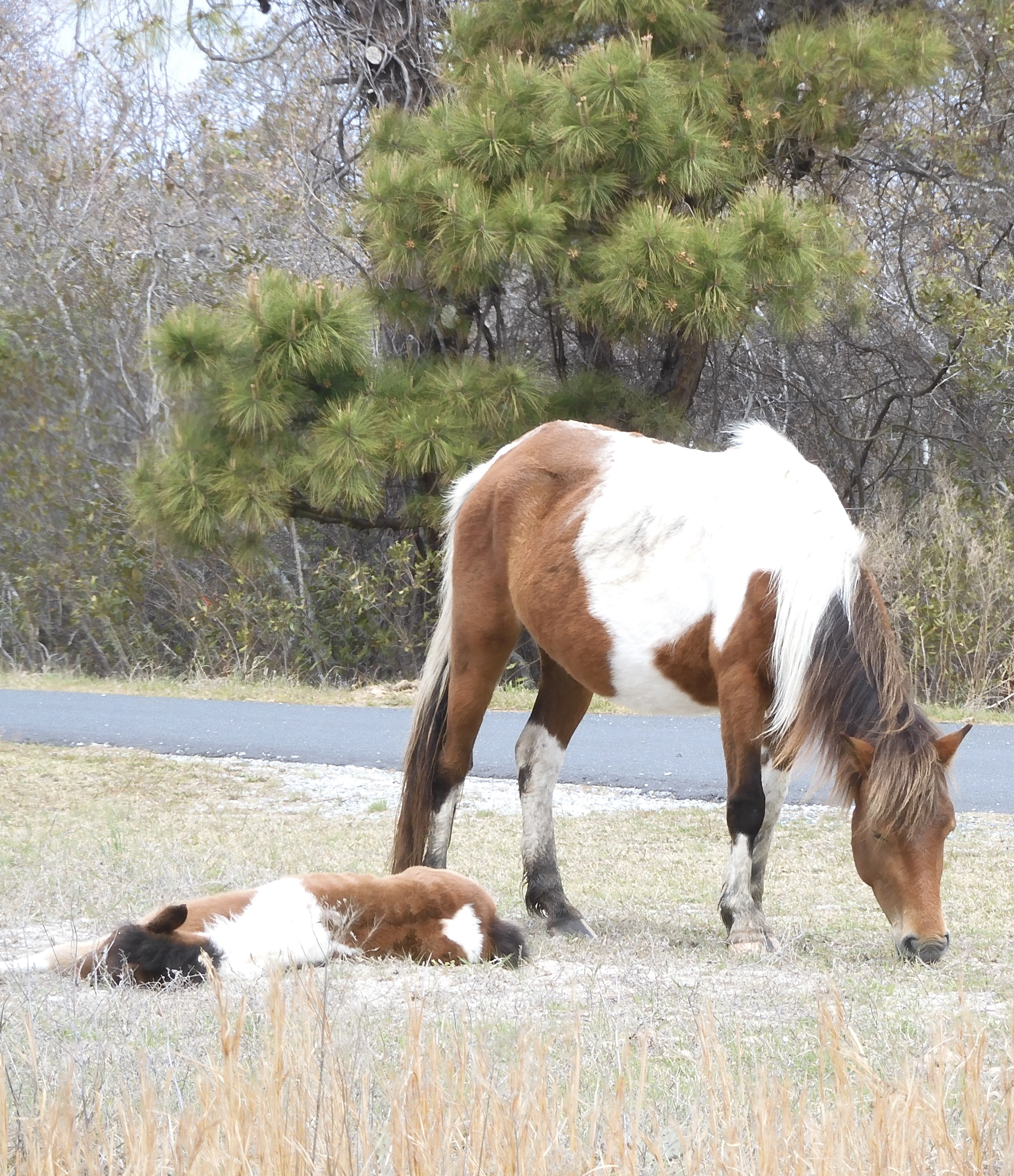
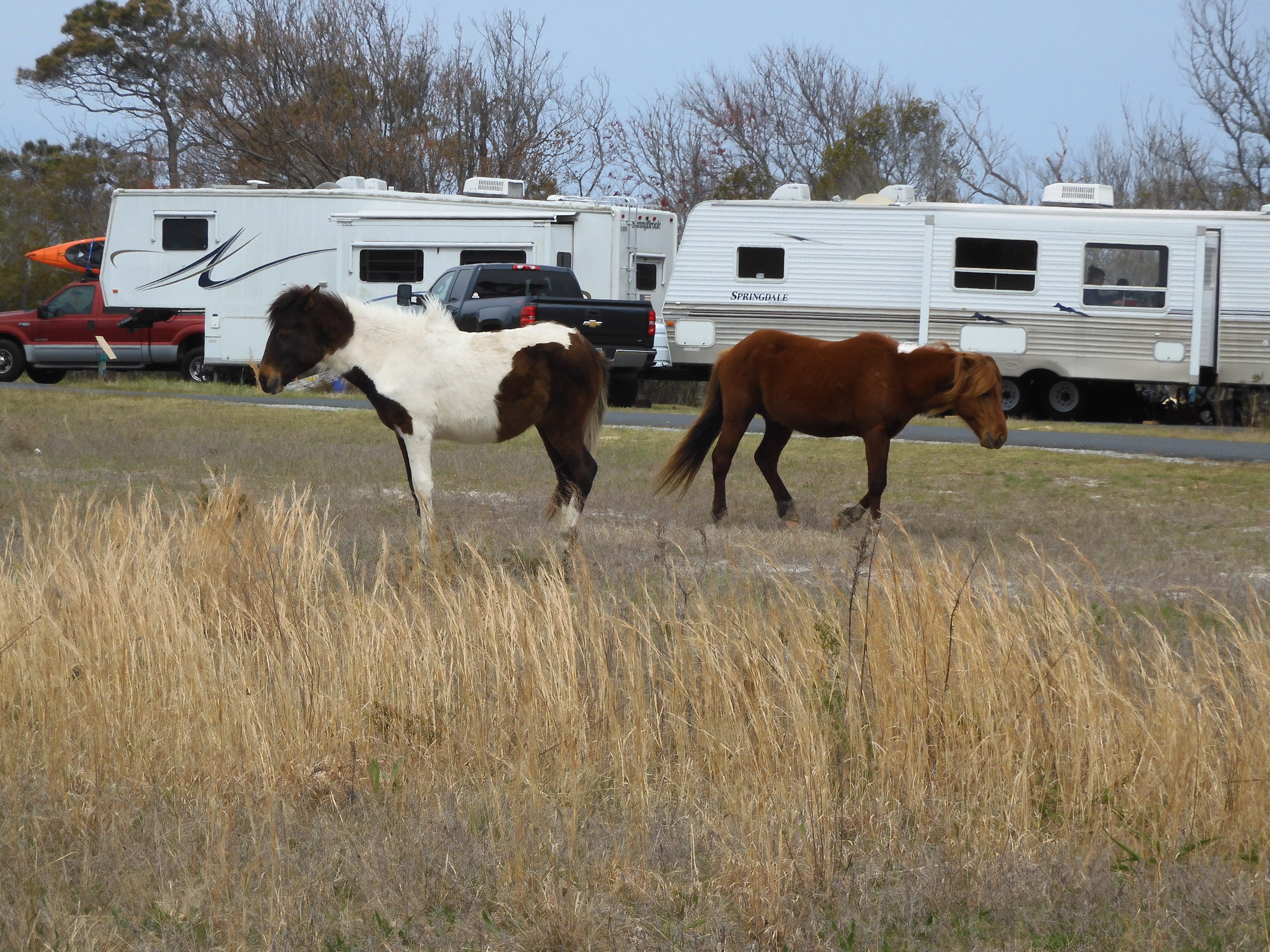
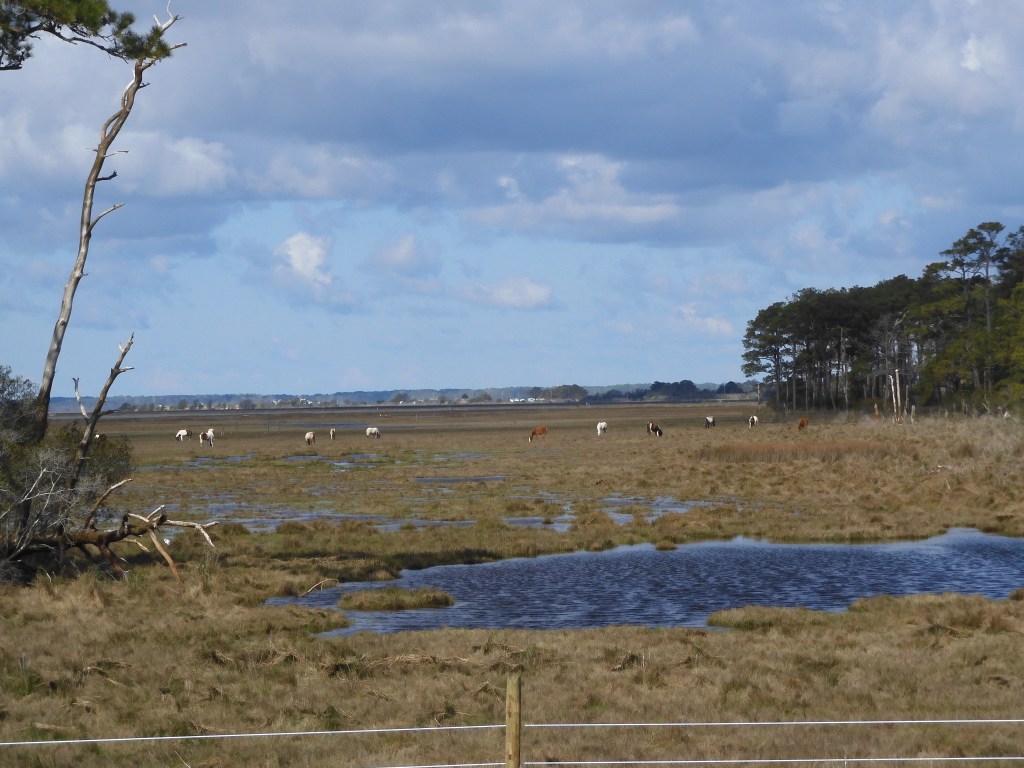
Wild horses are one of the notable draws bringing visitors to Assateague and Chincoteague. Assateague has fewer horses and they range freely wherever they desire. Chincoteague has more horses and their range is more limited. Thus, one would expect to see the horses more at Chincoteague. Maybe the horses at Assateague knew Chris was disappointed by not being able to lay on the beach so they cooperated. We viewed 11 horses in three locations, including one new foal.
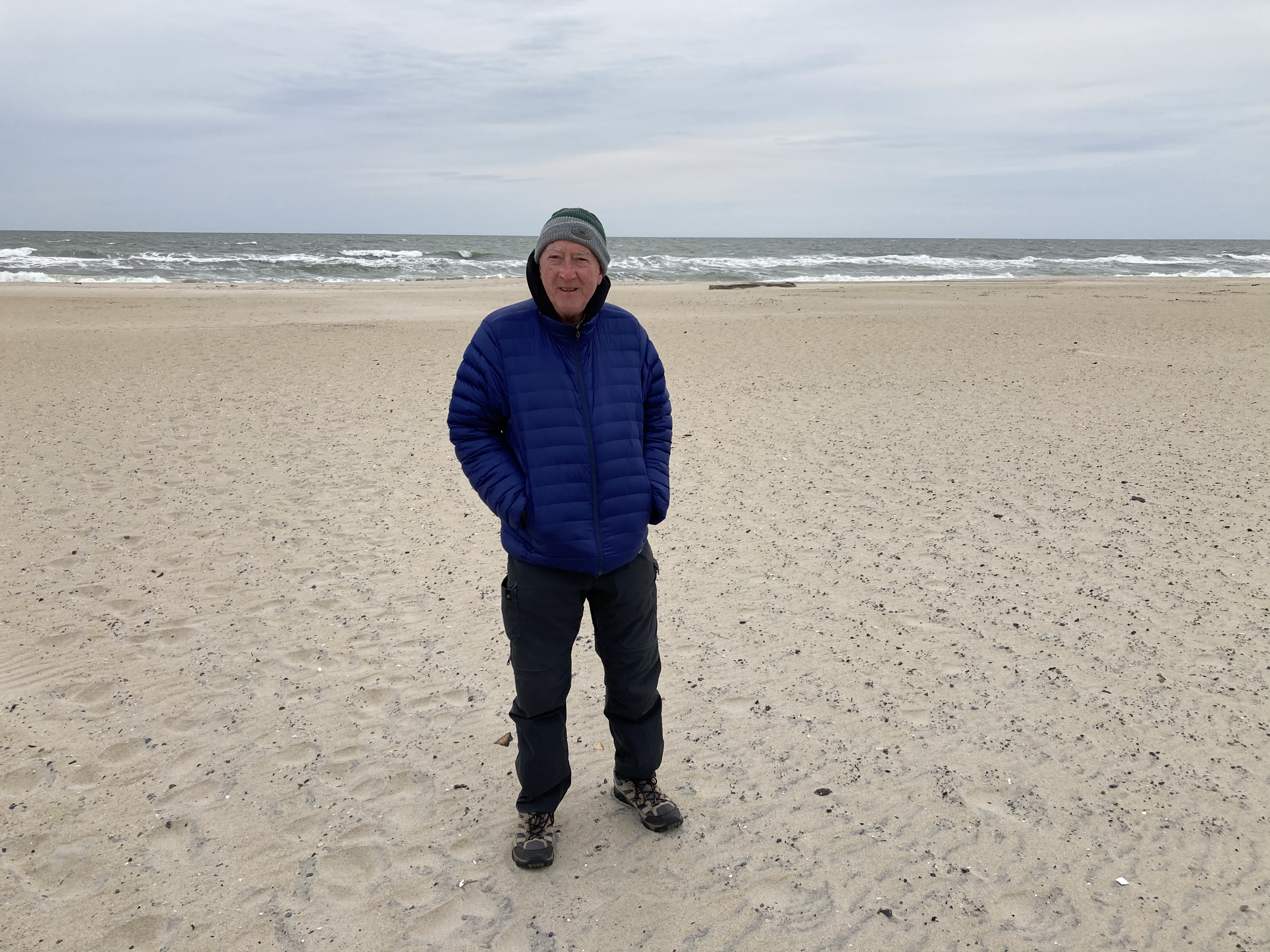
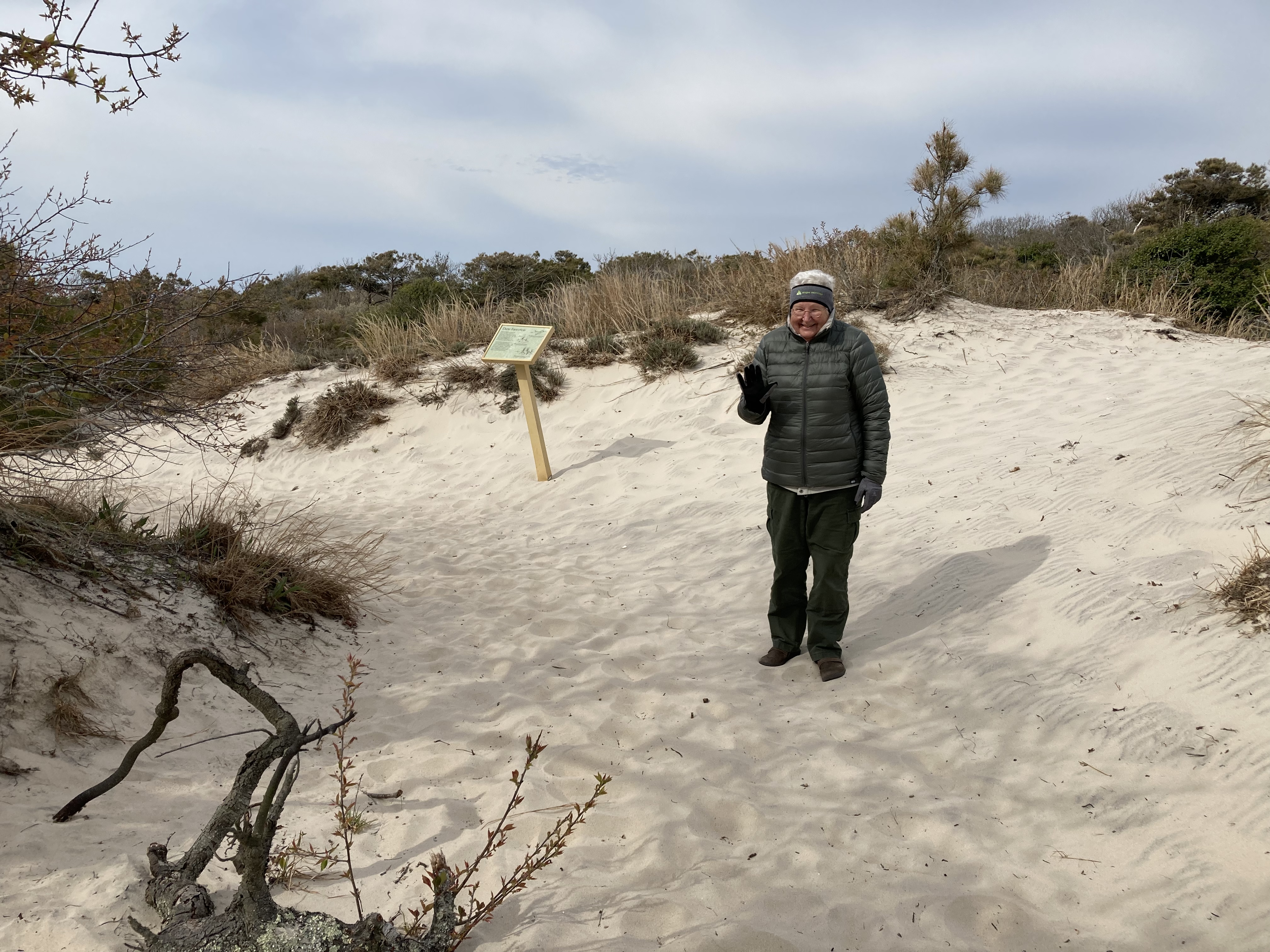
We did walk on the Assateague Island National Seashore beach-briefly, but hiked three other trails. The dune trail was the most taxing as the soft sand requires more energy. The forest walk was the most enjoyable as the trees sheltered us from the wind and moderated the chill of the air. Our thought was the hikes might bring us into closer proximity to the horses. Not so. The horses were all viewed from the car along roadsides and in a camping area. I don’t blame the horses, the grass looked greener and softer along the roadsides.

Assateague almost did not make it to being part of the National Park Service. Back in the early 1900s, it was connected to Fenwick Island, where Ocean City MD is located. A major storm in 1933 cut through Fenwick Island, creating a new channel and making one island into two islands. After WWII, in the 1950s, this new island was divided into building lots and a new coastal town called Ocean Beach was planned. Street name signs were up. On Ash Wednesday 1962, a major storm hit the island, destroying homes and structures. On one trail, we came across a fresh water pond. In 1962 there had been a home here. The 1962 storm destroyed the home, ground it into the dirt, and created the pond which still exists in that location. Pieces of the home’s foundation still lie at the bottom of the pond which is fed by rainwater. Well, that 1962 storm made it clear that building on unstable land was not a good idea. The Park Service was able to purchase all of the property.

Assateague Island National Seashore has a large and pleasant visitor center. We were greeted by a young female ranger from Stillwater MN. This was her first assignment with the National Park Service, a summer seasonal position. Assateague seems a good place to begin one’s career.

We returned in the early afternoon to the Hampton Inn. Chris spent the afternoon doing laundry and we reviewed our plans for the next few days. I had hoped we could visit Fort Monroe in Norfolk VA but their hours are still limited and closed on Mondays and Tuesdays.

Assateague Island is long and the northern section is in Maryland and the southern section is in Virginia. Tuesday morning we set out for the southern section of Assateague Island. Most of the southern section is a national wildlife refuge, Chincoteague National Wildlife Refuge. There are wild horses here also. There are differences. Virginia’s wildlife refuge has about 25% more horses, they are fenced in, have vets check them out, and have the pony round up and auction managed by the Chincoteague Volunteer Fire Department. In Maryland, the horses are free to go where they want, which is good and bad for viewing. Bad in that they are dispersed over a wide area and it is difficult to predict if you will see them. Good in that the horses can come right up to you-or to the camping area as we observed Monday. There is a fence dividing the two herds.

Today in Chincoteague, the horses were in the penned area, which is many acres. We were not long into the drive in the refuge when we saw our first horses of the day. They were easily visible from the road, but that was a long distance from the horses to the road. Luckily our camera has a wonderful zoom feature. Hoping to see more, we hiked out on a trail that overlooks the penned acres but the horses were not visible from that location.
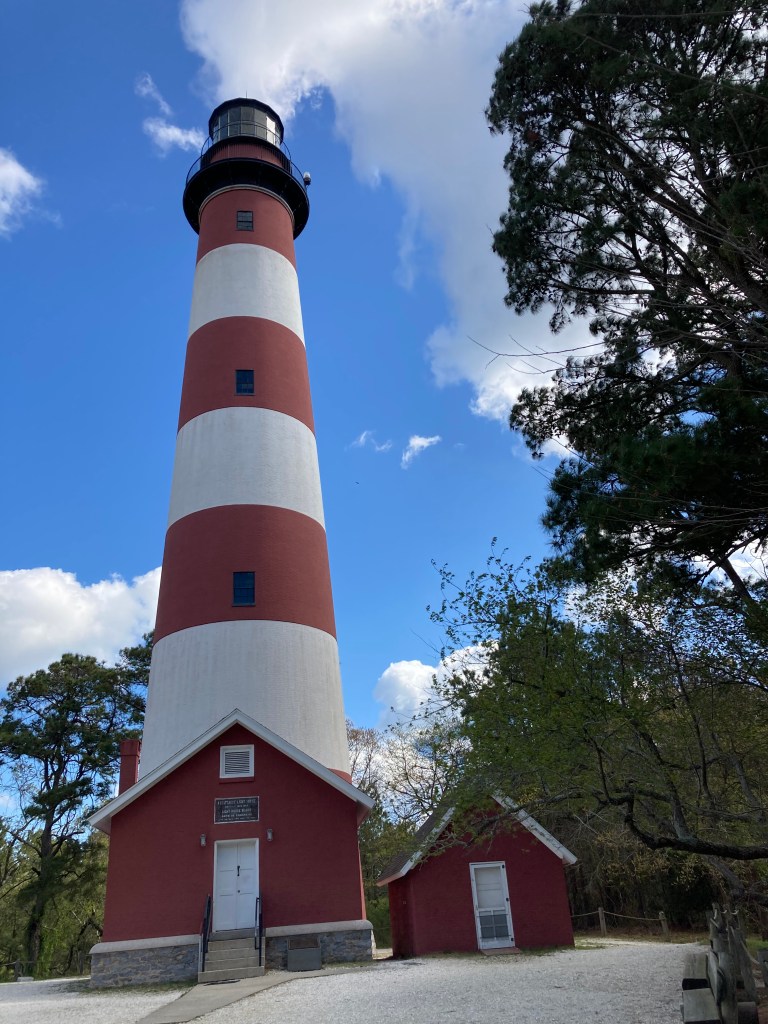
The Assateague Lighthouse is 142 feet high and is still active. Under today’s conditions, tours are not allowed but we were able to walk to see it. The lighthouse is situated on a hilly point of the island. It too has a story. When the lighthouse was built in 1867, it stood on the south end of the island. Over the years, wind and waves have created a fish hook shaped extension of sand to the southern end of the island. Now the lighthouse looks lonely, out of place, and far removed from its functional location.

The wind and waves were strong today again. We tried walking along the beach at Chincoteague but gave up quickly. We had spent the morning here and after lunch began our two hour drive to Norfolk. The journey is over the Chesapeake Bay Bridge-Tunnel. This is a 20 mile combined bridge with two tunnels crossing the end of the Chesapeake Bay. The winds were evident as one drives over the bridge portions, which is most of the drive. It wasn’t completely white knuckle but I kept my eyes on the road and did not look out or down at the bay.

We had two options to occupy our afternoon in Norfolk. The Norfolk Botanical Garden is lovely, azaleas would probably be blooming, but we had been here once before. The Chrysler Museum of Art would be indoors and warm, and its glass exhibit made us choose it over the gardens. The Museum was setting up for a big bucks donor event tonight but the doors were still open, and free, to visitors.

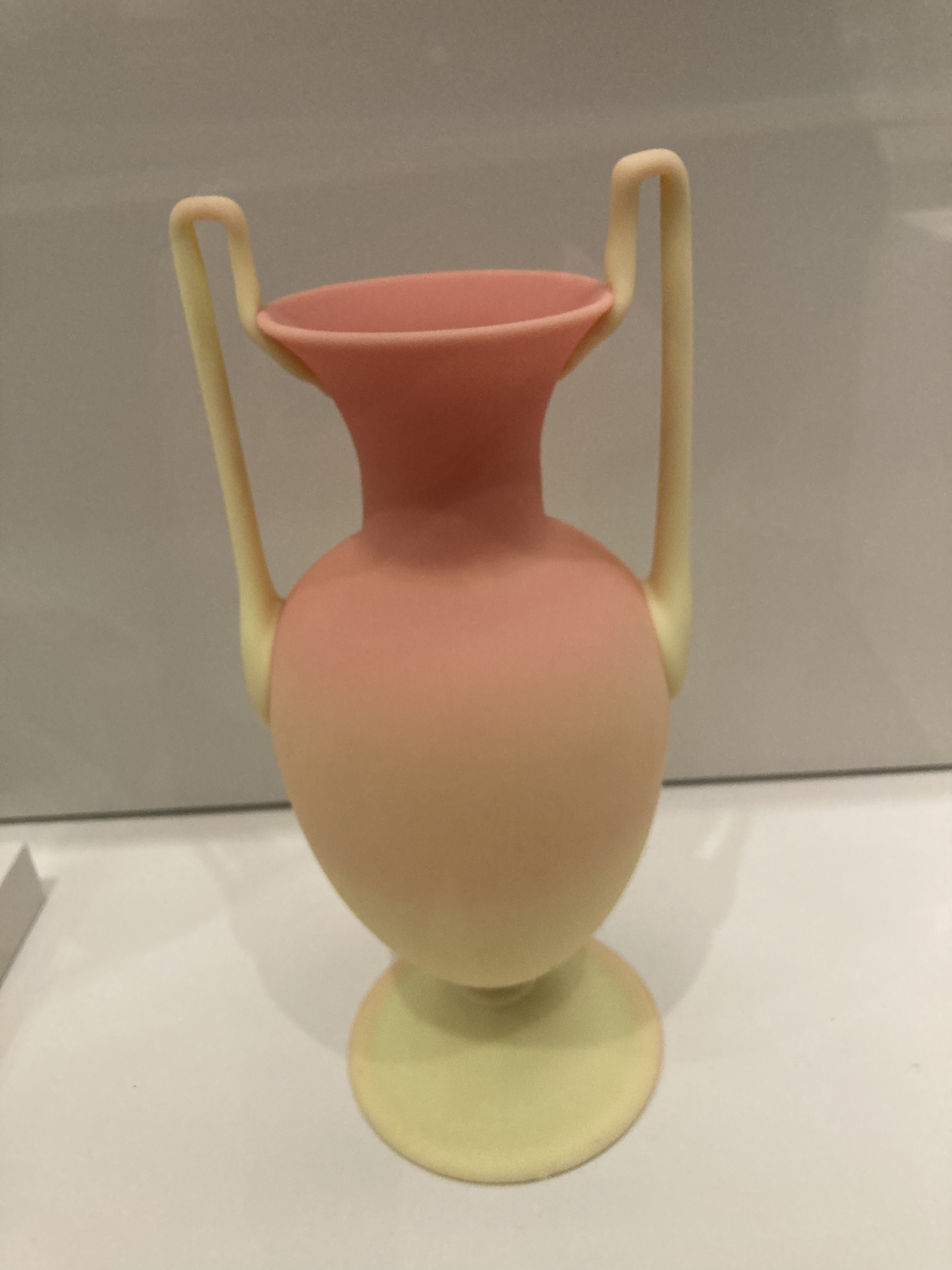
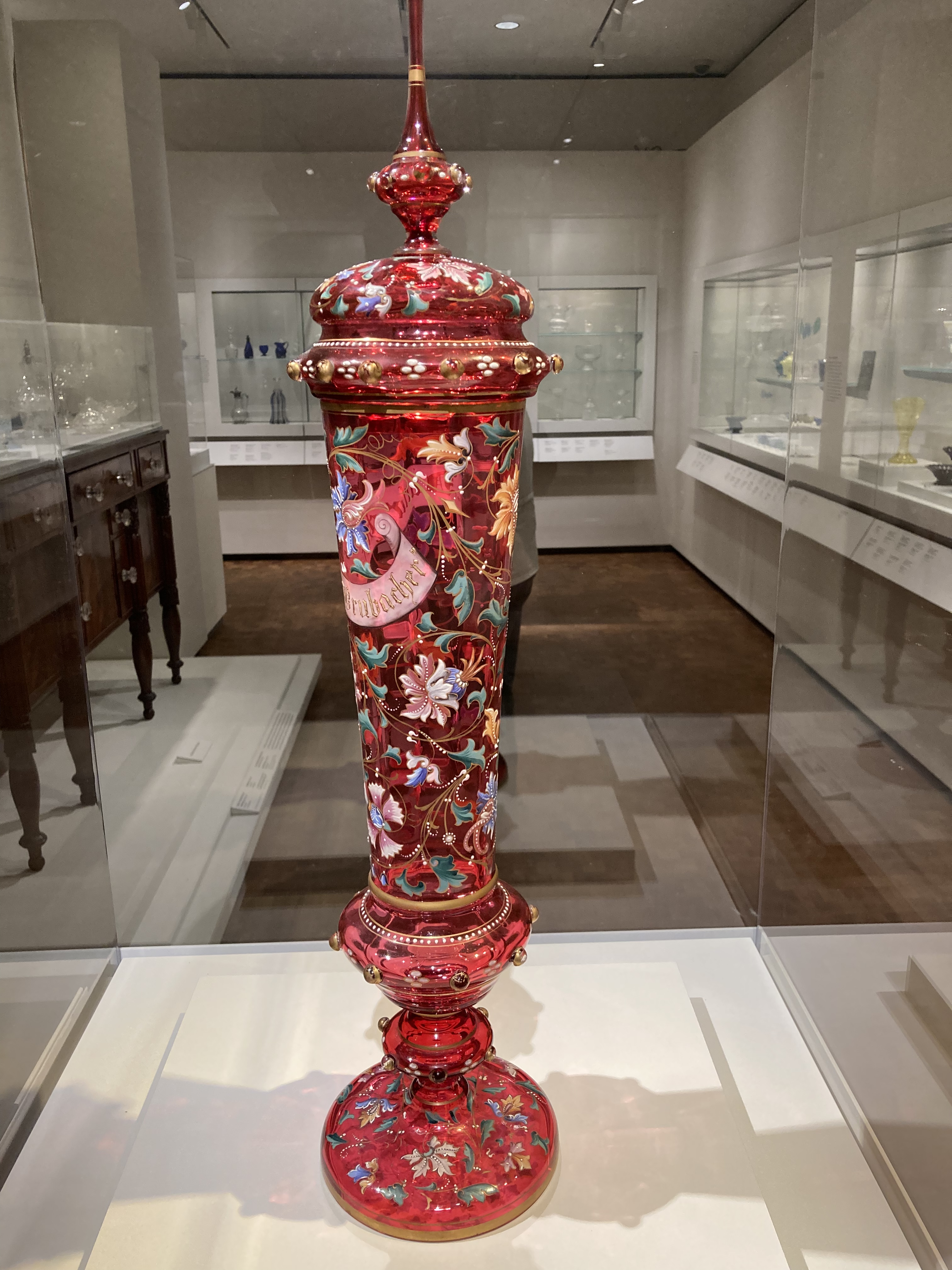
The glass exhibit took the bulk of our 90 minute visit. The museum states it has one of the largest and most comprehensive collections of glass in the world. The exhibit provides a history of glass making. The exhibits showcase notable techniques and artists through the ages. We could have spent all day going just through the glass but I focused on works that struck me as more unusual or inspiring. A few of my favorites are shown below: early clear glass from Murano, Italy; a huge, red covered goblet from Germany; a blue French vase showcasing new etching techniques; a blown glass vase in varying colors from the Mount Washington Glass Company in New Bedford; and an Italian glass chess set.

Our one night in Norfolk is at a Homewood Suites south of the city. Wednesday morning our journey continues south to Cape Hatteras and the Outer Banks.

Chris and Ed, Norfolk VA April 19
Categories: travel | Tags: , , , , , , , , | Leave a comment

2022 Trip 1: Searching for our 300th National Park Service Site: April 16-17–We Hit 300!

Salisbury, MD April 17

Our two and a half hour drive to Dover DE was much more relaxing than the Friday drive. There were fewer cars early in the morning so less congestion. Still plenty of high speed dragster type speeders to be seen though.

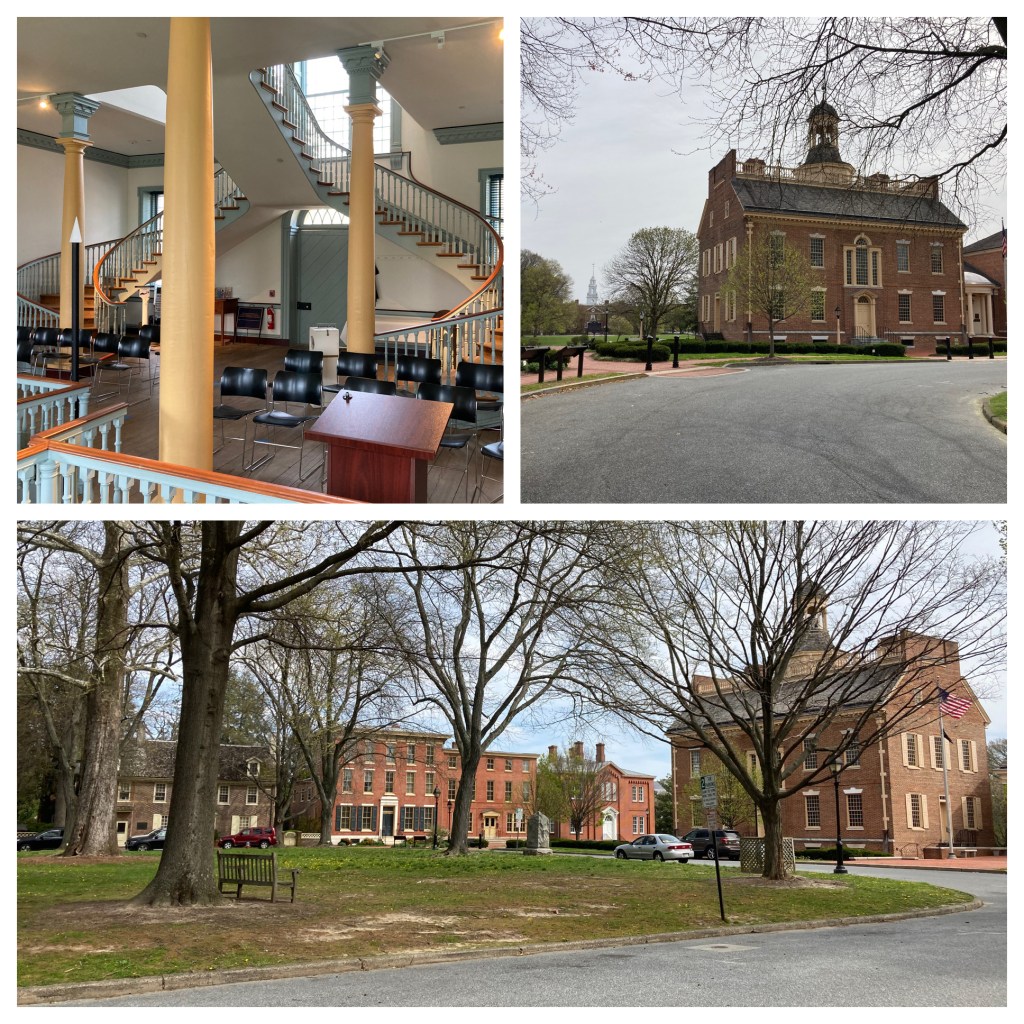
Our NPS destination was Dover Green and the Old State House, one of the sites constituting the First State National Historical Park. Delaware has an interesting history. The Dutch and the Swedes were two major immigrant groups that set up colonies in what is now Delaware. From 1638 to 1655, Sweden had a colony centered around present day Wilmington DE. The Dutch established a colony at Lewes DE and took over the Swede’s colony in 1655. The English kicked out the Dutch in 1664 and through a land grant gave Delaware’s three counties to William Penn and Pennsylvania. The Delaware people resented the Quaker control from Pennsylvania and depending on who you believe, either broke away or were allowed to leave Pennsylvania. (If you are looking for an interesting history to read, try Russell Shorto’s “The Island at the Center of the World”. The book tells the history of the Dutch colony of New York and how the Dutch customs had a lasting influence on America.)

Delaware’s claim to being the First State is rooted in the December 7, 1787 vote by the 30 delegates elected to a state convention to consider ratification of the U.S. Constitution. The vote to ratify was taken at the Golden Fleece Tavern on the Dover Green where they were meeting. Delaware was only one of three states where the vote to approve was unanimous. Delaware’s vote to approve beat Pennsylvania by five days.

We walked around The Green, established in 1717 according to standards set by William Penn; had a tour of the Old State House; and walked by the site of the Golden Fleece. The Golden Fleece Tavern was demolished around 1830, evidently historic preservation laws did not exist then. One interesting factoid. The Old State House has two replica staves, poles with a wooden triangle at the top, one side red and one side white. When a decision was made by a court in the olden days, the staves were placed outside. If the white side was showing, the defendant was innocent. If red, guilty.

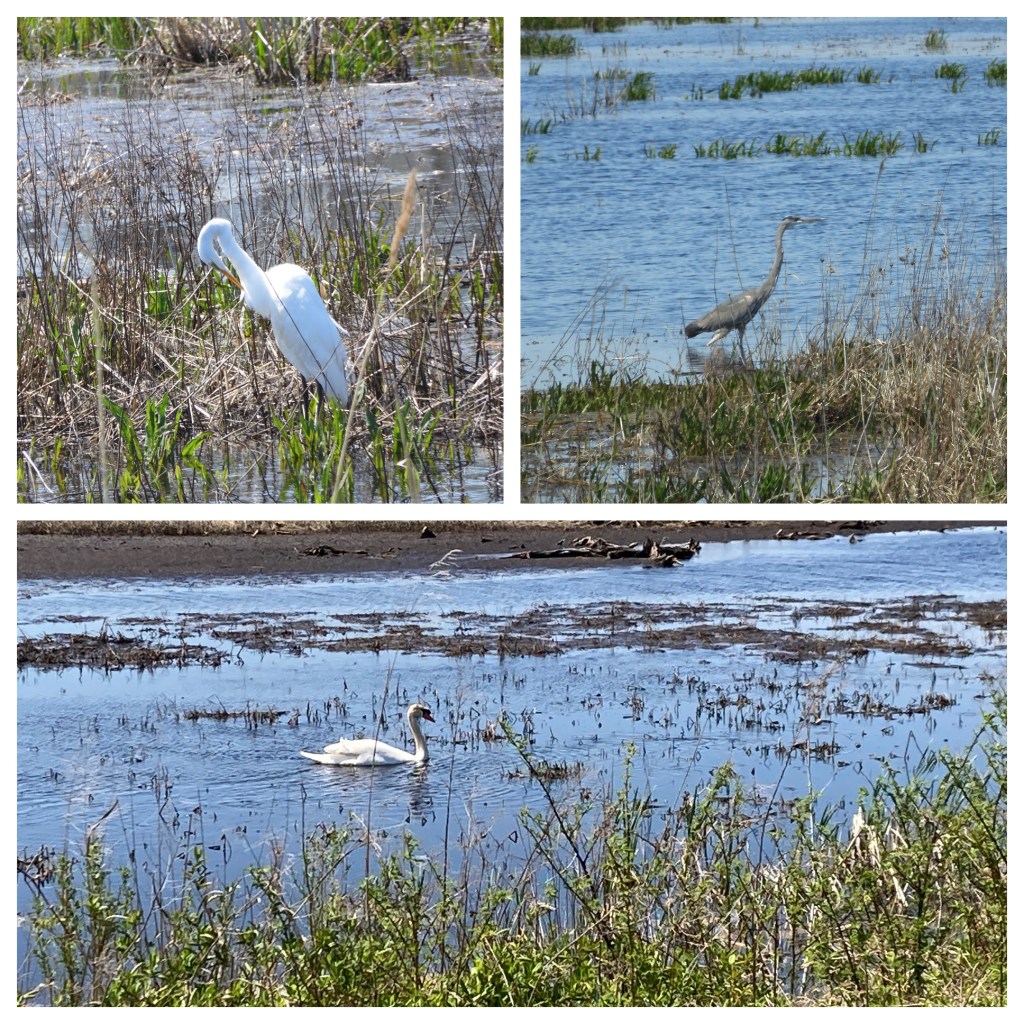
Hoping to not repeat the bust of viewing very few big birds at Mason Neck and Occoquan Bay wildlife refuges, we stopped at Bombay Hook National Wildlife Refuge. This refuge was established in 1937 and has 16,000 acres along the flyway for the Atlantic coast. The name comes from a poor translation of the Dutch “Bompies Hoeck” or little tree point. The Civilian Conservation Corps built dikes, cut timber, ran ditches for mosquito control, and generally built the first level of improvements between 1938 and 1942. Our luck improved, heron, egret and various and unidentified waterfowl were present.

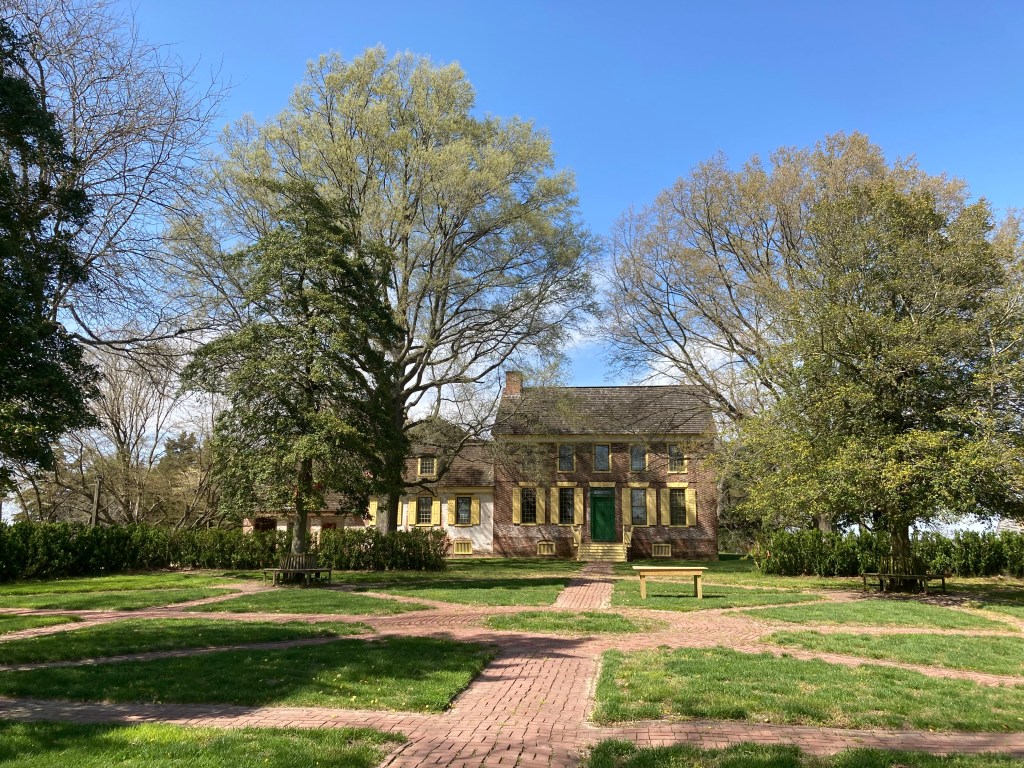
Our final stop of the day was another plantation owned by a wealthy founding father. John Dickinson was a delegate to the Continental Congress, primary author of the Articles of Incorporation, and drafter and signer of the U.S. Constitution. He had homes in Wilmington and Philadelphia and his plantation in Delaware. He served in both PA and DE legislatures depending on his residency at the time. His signing of the U.S. Constitution came as a delegate from Delaware. He authored numerous tracts that helped solidify support for the Union although he abstained from signing the Declaration of Independence. He was one of the moderates who was not sure if independence’s time had come. After the Declaration of Independence passed, he joined his local PA militia and reached the rank of Brigadier General.

When we toured the house, the front door was facing an empty field. The tour guide explained that in Dickinson’s day, the St. Jones River was just outside the house. Through the passage of time, the river changed its course and is now off in the distance. The river access was important, it was the means of transport to move the crops to market. Without having taken the tour, we would have been left wondering about the placement of the house.

John Dickinson always brought a sense of pride for us. We lived for several decades in Carlisle PA where Dickinson College is located. Although Dickinson was founded by Benjamin Rush, a signer of the Declaration of Independence, he had it named after John Dickinson, a good friend of his.

For three nights we are staying at a Hampton Inn located in Salisbury MD. It offers a central location allowing us to easily journey to our next planned stops.

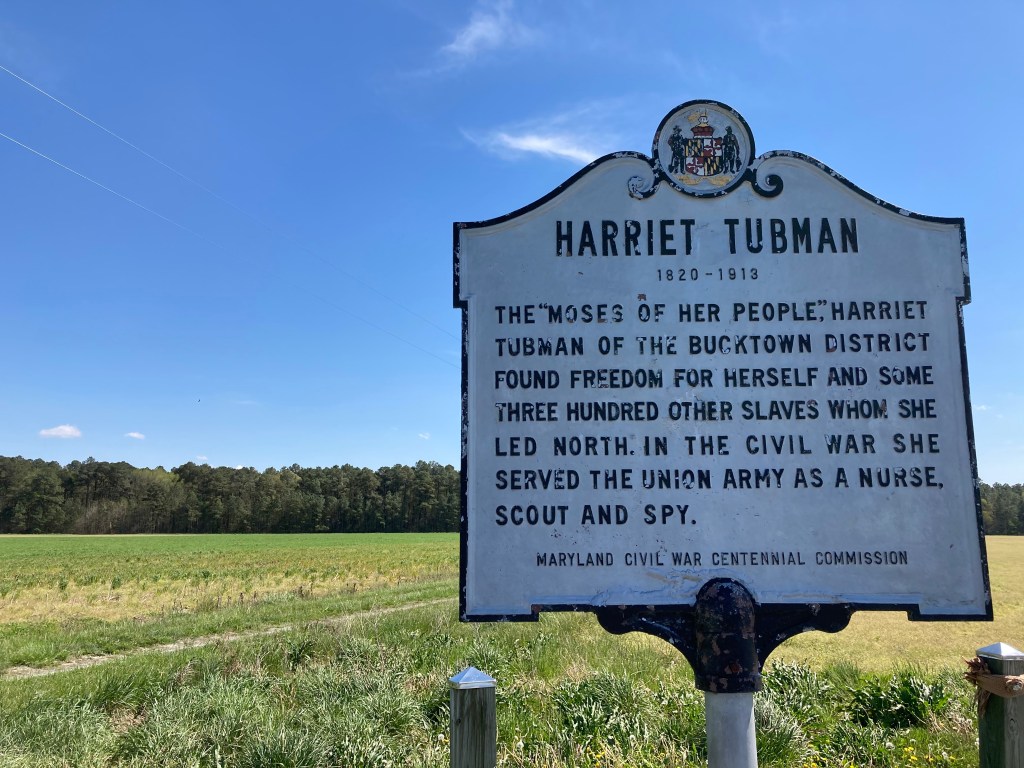
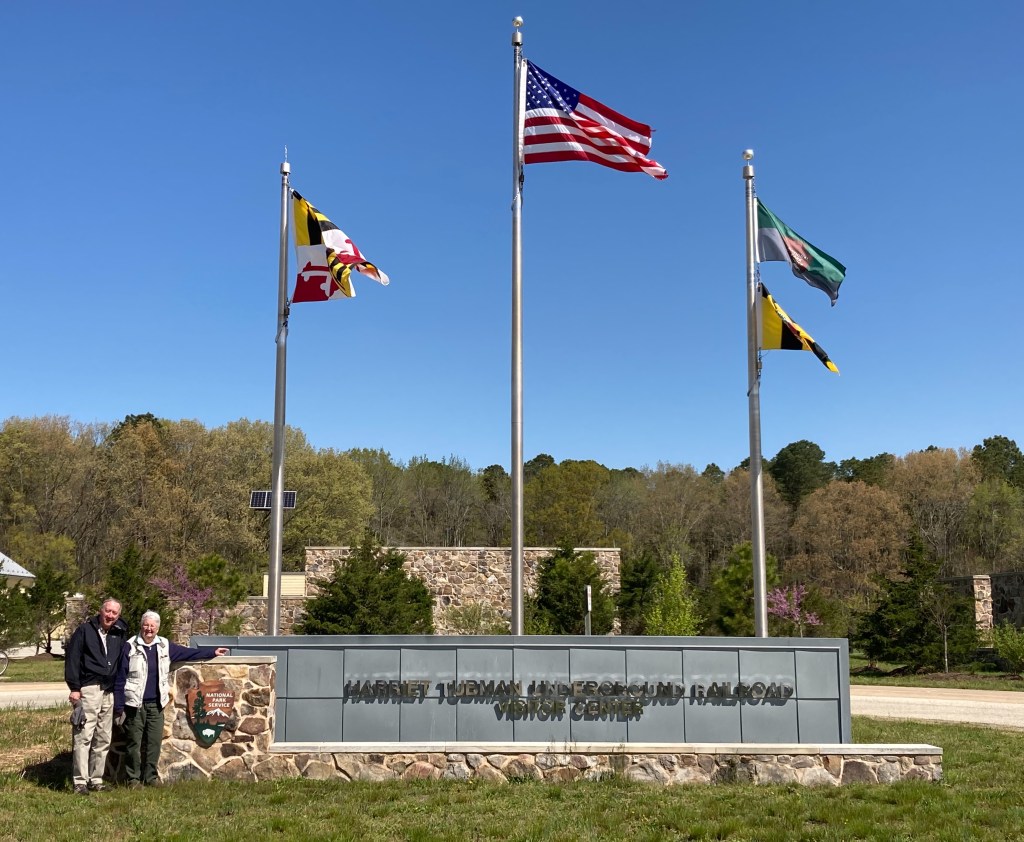
Today started at the Harriet Tubman Underground Railroad National Historical Park-OUR 300TH National Park Service Site. A moving story of one amazing woman. Born into slavery; watched her sisters sold away and never saw them again; married to a free Black man but left him at age 27 to escape herself being sold to another owner; personally helped 70 enslaved people reach freedom through 13 return trips over 10 years including her parents and siblings while advising hundreds of other enslaved people; served the Union Army as a nurse and spy; worked for women’s suffrage; and founded a home for the elderly and disadvantaged. Whew! And what have you, and I, done to win or protect civil rights?

Even more striking to me was not her many accomplishments against much adversity but the realization once again that enslaved people just had no rights. How horrendous to watch your children beaten or sold away never to be seen again. You had no rights, no courts, no appeal to social media, no internet funding for your problems, not even the right to strike the hand of the person doing this to you.

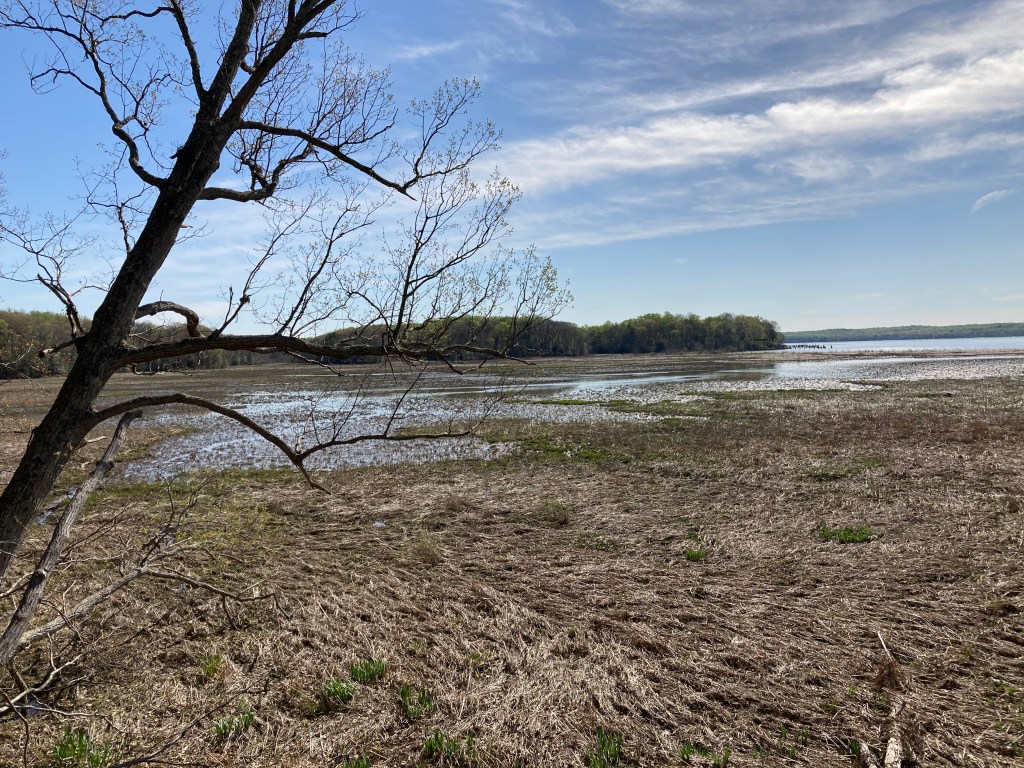
Our next stop was the Blackwater National Wildlife Refuge. Here once again, in an area of natural beauty, we find man’s inhumanity to man. In 1642 Maryland Governor Cecil Calvert declared war against the Nanticoke Indian tribe. For the next 26 years, it was legal for any Englishman to shoot any Indian who got in his way.

Today most of the Nanticoke are long gone but this area along the Chesapeake Bay houses a wonderful visitor center to go with its 30,000 acres of wetlands, tidal marshes, crop lands and forests. Most wintering species of birds have left the area but we spotted great blue heron, great egrets, osprey, and the biggest thrill, a red eastern screech owl in a tree cavity. Okay, another person pointed out the owl to us but still we saw it. It almost looks like a small cat in a tree.

We spent the rest of the afternoon traveling back roads to visit locations along the Harriet Tubman Underground Railroad Byway. We saw where she is believed to have been born; the general store where she was hit by a two pound weight tossed by a white man at a fleeing slave; a church which housed a free Black preacher who helped Harriet Tubman escape (he served five years in prison for owning a forbidden copy of Harriet Beecher Stowe’s novel ”Uncle Tom’s Cabin); a grist mill functioning as a networking site for free and enslaved people, and a river location on the Underground Railroad.

On the right, the red eastern screech owl, on the left the tree cavity it was sitting in at the end of the diagonal tree trunk

Ed and Chris, Salisbury MD April 17

Yes, 300 National Park Service sites!!

Categories: travel | Tags: , , , , , , , , , , | Leave a comment

2022 Trip Searching for our 300th National Park Site: April 14-15

Dahlgren, VA Friday April 15

The last two days have not been horrendous but they were certainly not great days. Nothing terrible, just numerous minor disappointments. Thursday the 14th we walked to the Mary McLeod Bethune Council House National Historic Site. This townhouse was the headquarters of the National Council of Negro Women and the last home of Mary McLeod Bethune.

Mary McLeod Bethune was the founder of what is now Bethune-Cookman University. The University is home to 2600 students and is located in Daytona Beach FL. Bethune served as an advisor to Presidents Coolidge, Hoover, Roosevelt, and Truman. She founded the National Council of Negro Women which currently reaches out to four million women through affiliate organizations.

She probably did other things too. I only know the above from doing Internet research. We were unable to gain access to this NPS site. All of the apps, etc. indicated this site should be open Thursday beginning at 9 AM. At 9:30 AM, the outside entry door was open but the inside door was locked. That door had a note telling one to ring the buzzer/entry speaker to gain access. No one answered any of the three rings. No one responded to the knocks on the door. (Lights appeared to be on inside.) Phone calls to the operator went unanswered and the voice mail box was full. Not only that, but the voice mail message mentioned how this site was one of 390 National Park Service sites. Since there are currently 424 NPS sites, this group has some serious organizational issues. We decided to add this site to our list of visitations. We were here at an appropriate time, not our fault they screwed up.

Now we had a hole in our schedule. Rain was forecast for the afternoon so we did not want to go walking great distances. We found the Chinese American museum on 16th St, not far from the Bethune Council House. It was open and greeted visitors warmly. The first floor had a movie about the experience of Chinese immigrants to the U.S. The message I walked away with was that after decades of being ignored and actively discriminated against (think the Chinese Exclusion Act of 1882 which banned the immigration into this country of all Chinese; the act was not repealed until 1943.), things are looking up. As one example, history is finally acknowledging the over whelming role of Chinese labor in building the Transcontinental Railroad. On the third floor was an exhibit about textiles, needlework, and embroidery. The fourth floor had visual art interpretations of the theme ”East meets West”.

Walking back to the hotel, Chris spotted the D.C. public school museum and archives. Named after Charles Sumner, a Massachusetts abolitionist, the museum occupies portions of four floors of the old Charles Sumner School. Built in 1872, it was one of the first public elementary school buildings for African Americans in Washington DC. It was rescued from demolition in the late 1970s, lovingly renovated, and repurposed as the official museum, archives, and repository for artifacts for DC schools. It was pleasant but there is no need for you to add it to your top list of things to see in DC.

The rain held off until we returned to the hotel. In the evening I had another St. Paul related Zoom meeting.

Friday we were off early for visits to two national wildlife refuges and one NPS site, all three well south of DC. Wisely, we chose the George Washington Memorial Parkway as our route. It was relaxing, scenic, and not crowded. As we passed Mount Vernon, we saw over 15 tour buses lined up and a long line waiting to enter Mount Vernon. We continued on to Elizabeth Hartwell Mason Neck National Wildlife Refuge. Mason Neck was established in 1969 and was the first wildlife refuge established specifically for the protection of the bald eagle. Mason Neck is the name for the peninsula and Elizabeth Hartwell’s name was added due to her activism to protect this area from development.

We hiked the Woodmarsh Trail out to an overlook with tidal marshes facing the Potomac River. We did not see any bald eagles, but that was not a problem. It just seemed appropriate to visit a place that has been a part of the resurgence of the bald eagle in the United States.

Twenty miles from Mason Neck is Occoquan Bay National Wildlife Refuge. Only a quarter as large as Mason Neck, we chose this one primarily because it has an auto drive. Our hope was we might spot migratory birds without consuming a large chunk of our time. No luck. Either we did not look closely or the migratory birds have moved on. In any event it was a bust.

On to stop three for the day. George Washington Birthplace National Monument. Before we could get there, we checked Google Maps for the best route. Surprise, there was a crash on I-95 southbound. Our shortest route to stop three was to go back north to Washington, then south through the parts of Maryland we drove Wednesday to reach Thomas Stone NHS, cross over the Potomac on a major but backlogged bridge under construction to Virginia, and then on to George Washington Birthplace National Monument. Two and a half hours.

George Washington Birthplace National Monument is located on Pope’s Creek just as it joins the Potomac River with a grand looking building and a Washington Monument replica.

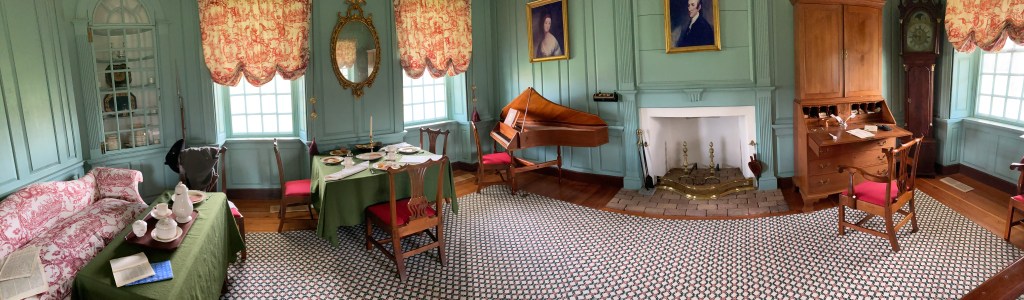
We made it in time to talk to two rangers, view the video, and enjoy a half hour tour. Major surprising item learnt: The building on the site was not the home where George Washington was born. His actual birth home burned in the late 1700s. We had assumed too much by the name of the NPS site This is the family plantation where he was born-his father actually had three plantations. The exact location of the birth home on this family plantation is not known. The building erected here is typical of the times and the tour focuses heavily on the characteristics of life of a colonial plantation farmer and on Washington family history.

The exact location of the home may not be known but efforts are continuing to pinpoint it. Twice In the past, a brick foundation had been uncovered, examined, and then recovered without definitive answers. Another effort is now underway. Modern underground imaging techniques are working alongside humans with shovels. At first, the monument was placed where the house is now located but as part of the deal to give the property to the Park Service, the monument was moved and the home built in its place.

The Washingtons had been living in this area for over seventy years before George was born. While the Washingtons did well, family fortunes were aided frequently by marriages to daughters of wealthy men. George too was helped in that regard. Also, as the third son of his father, his two older brothers would have inherited the bulk of the family wealth. George was aided by the mentoring, training, and business and social connections provided by an older brother, Lawrence. It was Lawrence who deeded the future Mount Vernon to George after Lawrence, and then his wife, died.

We are staying at a Hampton Inn in Dahlgren, just south of the bridge over the Potomac. We chose it due to its proximity to George Washington’s birthplace and thinking we would be getting here late after our long drive. Now I wish we had planned to push a little farther for tonight’s lodging. Tomorrow, we drive to Dover DE, another two and a half hour drive.

Ed and Chris, Dahlgren VA Saturday April 16

Categories: travel | Tags: , , , , , , , | Leave a comment

2022 Trip 1: Searching for 300th National Park Site: April 12-13

Washington, D.C. April 13

With five days in D.C., we have sufficient time to wander around and see some old haunts. On Tuesday, we walked down to the National Mall again, enjoying the architecture in the city and observing spring flowers. Although the flowers had been planted by the landscaping companies responsible for various buildings, the colors brightened up our day. We passed by numerous memorials, people deemed important to the U.S. or to their country. No police motorcade today but several occasions of a trio of fire and rescue vehicles responding to some emergency.

We had decided to spend time in one of the Smithsonian museums that had been updated since we left Pennsylvania 20 years ago. We chose the Museum of Natural History. It might have been a mistake. Most families with children also chose that museum for the day’s outing. Given the difficulty of truly enjoying the displays, we left earlier than we had planned.

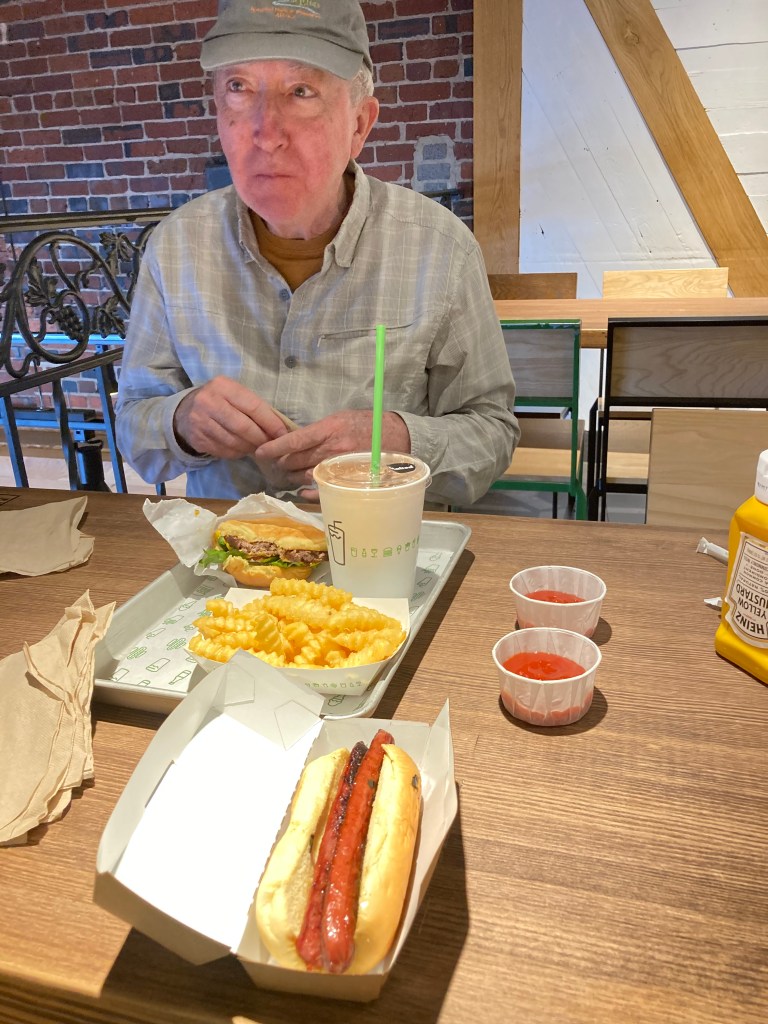
The food experts that we are, we tried a new restaurant for us. Don’t laugh. We had not been to Shake Shack before. Certainly had heard of it, but never felt a need to stop in. We were pleased; Chris enjoyed her hotdog. My malt, even though it was made with chocolate custard rather than vanilla ice cream and chocolate syrup, was pretty good.

We had to be back at the hotel in mid afternoon for another Zoom meeting which I had to attend. Dinner was downstairs in the hotel restaurant and then it was to bed early.

Today we changed up our schedule. It was originally thought we would visit another museum. Friday was going to be a long day. Friday after checking out of the hotel early we would head out, tackling three new, for us, National Park Service sites. Friday’s first site would be just south of DC, go down to Richmond, VA, and finish close to Mount Vernon. Instead we did part of Friday’s journey today.

The day started out at Prince William Forest Park. This park is 15,000 acres, located 35 miles south of DC. It was originally established as Chopawamsic Recreation Demonstration Area (RDA) in 1935. This was the first RDA in the country and was a model for other similar parks. You may recall this concept from Catoctin Park that we visited a week ago. During WWII, the military used the area. The Marine base Camp Quantico is located next to the park. The park’s visitor center is only open Friday to Monday. No passport stamp for us. All outside park brochure holders were empty so my history and description of the park are basic.

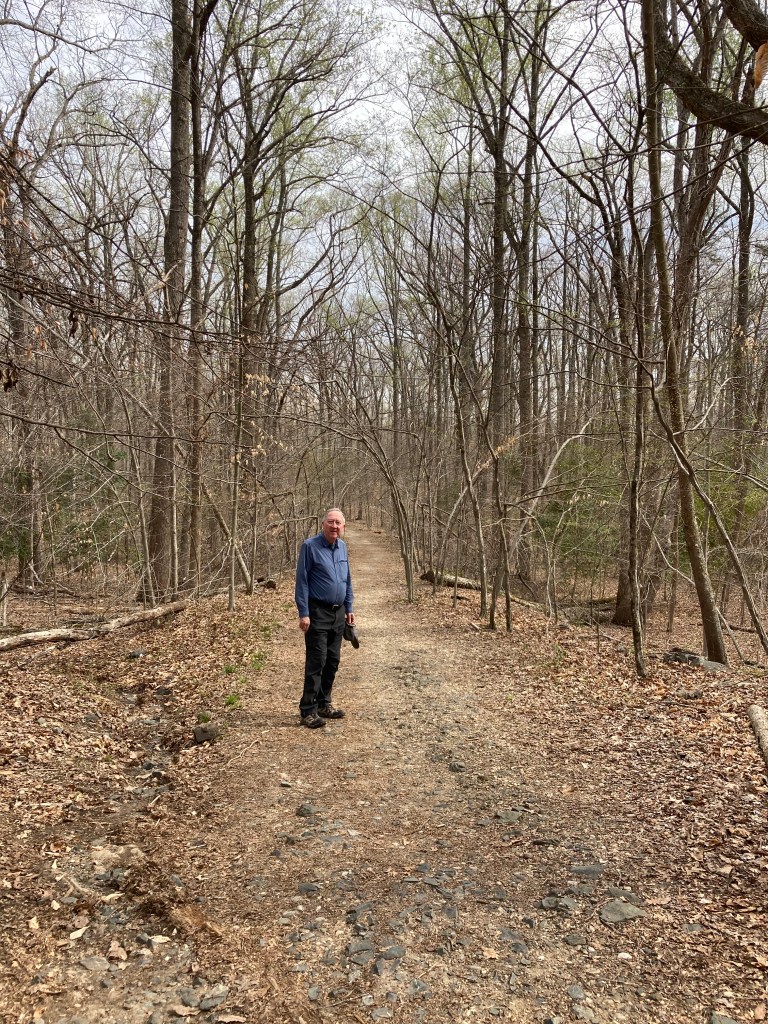
We hiked the Laurel Trail. Surprising to us, the vegetation was still primarily brown. Not much greenery on the leaves or understory. It took almost halfway through the hike before we found any significant numbers of small, early spring flowers. This park offers camping. There were numerous people utilizing the trails and picnic areas.

After hiking in the park, we continued our journey driving down to Richmond Virginia. We had visited Richmond in 2013 but this next national park site was not on our radar then. The Maggie L Walker National Historic Site has been a part of the National Park Service since 1979. You, like us, may well ask: who was Maggie L Walker? A very impressive woman. A quick, but incomplete, answer would be that she was the person who established the first chartered bank in the United States founded by a black woman.

Maggie Walker understood the multitude of problems facing black women. As a teacher, she was forced to quit her profession when she got married. She was determined to empower black women both economically and educationally. She spoke out for civil rights, equal rights and fair employment. In 1899 she took responsibility for transforming a struggling benevolent society (think insurance and medical care for blacks) and molded it into a successful financial organization.

In 1903 she began the Saint Luke Penny Savings Bank. She oversaw the bank to successfully survive the bank failures of the Great Depression and it still exists today through several mergers and bank consolidations. For 30 years she published a local black newspaper, only to see it unable to survive the Great Depression. In all of her endeavors, newspaper, banking, benevolent society, it was a point of pride for her to employ African-Americans, particularly women. In the community, she was an activist and humanitarian. For the last six years of her life, she was required to use a wheelchair due to complications from diabetes.

The national historic site preserves her home and tells the many stories of her accomplishments. We truly enjoyed the opportunity to tour her home, learn about her, and can’t understand why it didn’t come up during our trip research and planning back in 2013.

Ed and Chris, Washington DC Wednesday April 13

National Park Service sites visited: 297

Categories: travel | Tags: , , , , , , | Leave a comment

2022 Trip 1: Searching for our 300th National Park Site: April 10-11

Washington D.C. April 11

Back in the District of Columbia, one of Chris’ favorite cities. Sunday we made it through my only stress point concern of the trip, getting a parking place for our car at our DC hotel. The day started okay, cool and cloudy but not too bad. We stopped at Greenbelt Park, another National Park Service site and took an hour walk. In the 1930s, Greenbelt Maryland became the first planned community in the United States built as a federal venture in housing. It was supposed to be a complete city with homes, businesses, schools etc.

Greenbelt Park occurred as a result of the building of the Baltimore Washington Parkway. The parkway planning predates the interstate highway system. The parkway was designed to connect the two cities of Washington and Baltimore. It was built along the fall line where the piedmont and coastal plains meet. The parkway was completed in 1954 and runs for 29 miles. Greenbelt Park was part of the land purchased for the parkway and for green space for Greenbelt city. The park’s mission is to be an urban natural area and recreational oasis. The 1,100 acre park has 174 campsites just minutes from urban congestion. Other than being so near to urban settings, it’s no different than many other parks and natural areas set aside to protect wildlife and wilderness, and to offer recreation. The park ranger’s vehicle was one of those “motorcycles with a cover”-my description. See below.

We are staying at The District, basically a time-share offering of the Hilton Grand Vacations Club located on the top three floors of an Embassy Suites in downtown Washington DC. Parking for your automobile is not guaranteed to guests. We were told to arrive early and cross our fingers. Well, we arrived early, 11 AM, and were told no spots were available there or expected for the rest of the week. We were directed to use the parking garage at the Ritz Carlton, one block away. The hotel people were helpful in that they told us that by using the SpotHero app we would be able to get a lower price and In-N-Out privileges. Both of these were beneficial. The Ritz Carlton price through SpotHero was $20 a night less than the Embassy Suites charges.

In order to find this out, I had to park the car in the driveway of the Embassy Suites while Chris went inside and talked to the check-in people on the eighth floor. Parking my car in the driveway of the Embassy Suites while all around me people were using their cars to were actively check out and Uber type vehicles were picking up passengers is not my favorite activity. I felt I was misusing the space. I could have driven around the block several times. Today I put that apprehension aside. I sat there looking important and letting the other cars drive around me. It worked. AND , our room was ready and we checked in.

Sunday was a little cooler and breezy. We set ourselves up in our room, caught up on some details, and then did a little exploring. We had some recommendations for bakery/dessert type places so we checked them out. I came home from Un je ne sais Quoi with a delicious chocolate mousse and Chris had a white meringue style dessert. I guess you could call that our lunch. We shared a meal downstairs in the hotel restaurant and called it an early night.

On Monday, Chris dressed for the morning and I dressed for the afternoon. The morning temperature when we left was 40°. The afternoon temperature when we returned was 67°. This was our day to visit National Park Service sites we had not previously visited. It started with a walk, first through residential neighborhoods, and then through governmental and university neighborhoods, to Constitution Gardens.

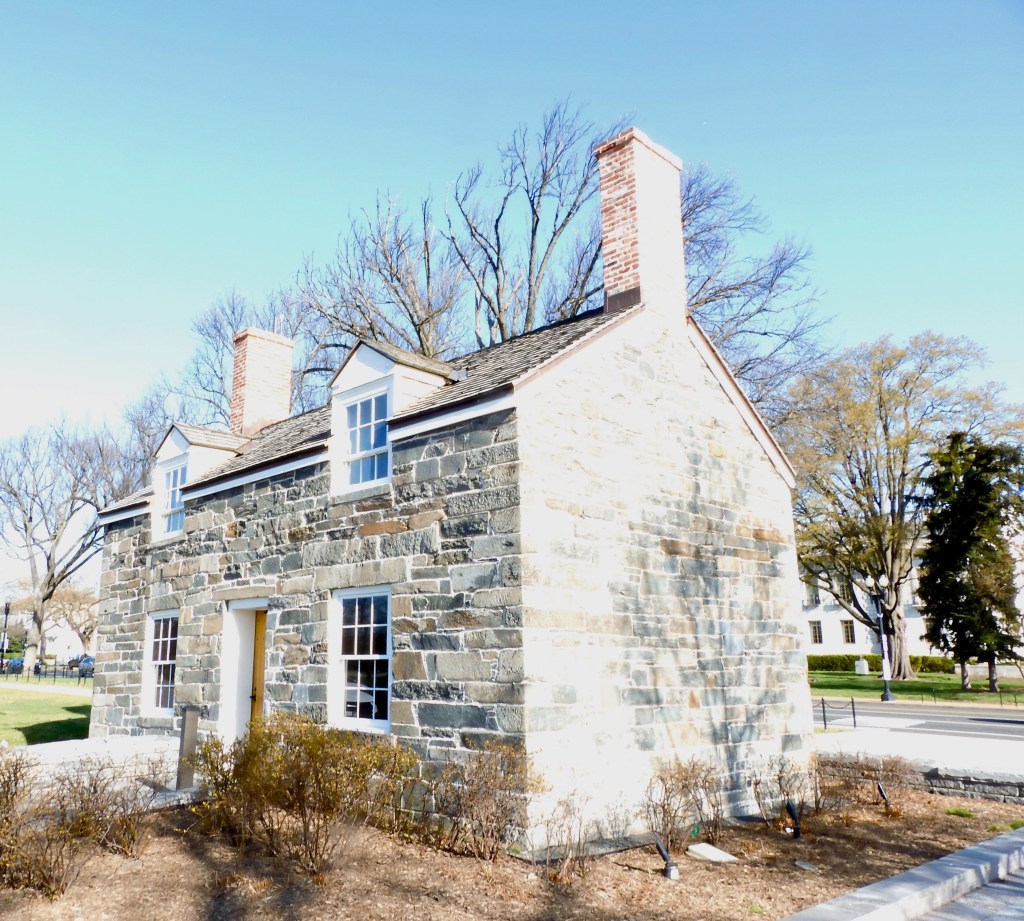
Constitution Gardens is a part of the National Mall that had been covered with World War I temporary structures. In 1971 the area was refurbished to include lawns, trees and gardens, water features, and memorials. This section of the mall had been the Washington city canal in the mid-1800s and had been partially filled in by the Baltimore and Potomac Railroad. We visited the memorial to the 56 signers of the Declaration of Independence, including the stone for Thomas Stone. At one corner of Constitution Gardens is the lockmasters house. This is a refurbished 180 year old home and toll collection facility for the freight canal. It had been vacant and deteriorated. The house has been extensively rehabilitated and looks great, even ready to collect some more tolls.

We walked along the south side of the mall to the Dwight Eisenhower Memorial. This is a Frank Gehry designed memorial, new to the list of memorials in D.C.. There are sayings from Eisenhower‘s life along with statues of Eisenhower as a boy, a general, and as president.

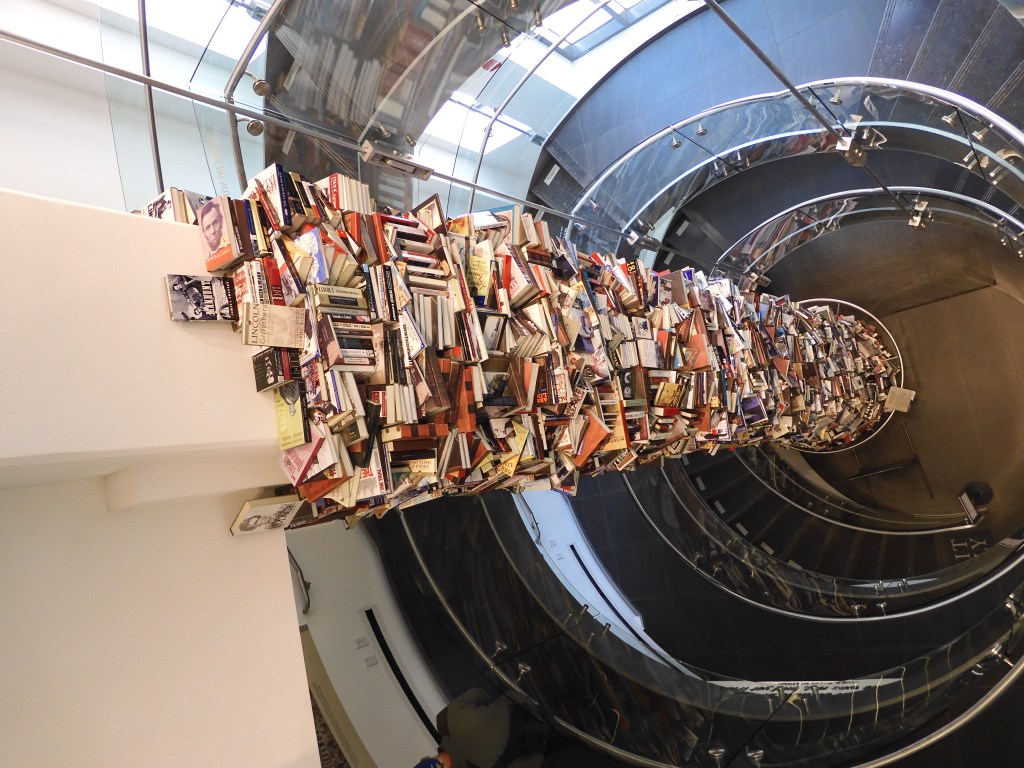
After Eisenhower we went to the north side of the mall. We meandered, first going north, then going west depending on which traffic lights were being friendly. Then Chris noted a Ford’s Theater directional sign. Chris asked how close we were and if we would be stopping there. Now, there is a back story here. Of all the many times we have been to D.C., we do not recall actually being in Ford’s Theater. It is a NPS site which we are missing so it would be on our priority list.

Tickets are required to enter. I had called gone online to purchase tickets but tickets for the time period we would be in D.C. were all sold. The only option was a few tickets given out daily on a first come basis. The box office person I talked to indicated people normally started lining up for these daily tickets at 7:45 AM. The box office opens at 8:30 AM and the tickets are normally gone in minutes. It seemed better to just come back to Ford’s Theater the next time we visit. After all, there are several sites here that are under construction and not viewable on this trip.

Despite my protestations, Chris wanted to get closer and ask about the possibility of getting in. I humored her. After all, I knew the drill and there wouldn’t be any tickets available. As we got closer, Chris saw a sign outside showing tickets available for afternoon entrance times of every half hour. I still had my doubts. We went into the box office area where the person standing there said oh, yes, we have plenty of tickets today. What time do you want? Well it’s about 11:35 and they had tickets available for noon so we took them. We went outside, got in line with the other people waiting for the 12 o’clock entrance and then, at noon, entered Ford’s Theatre.

Ford’s theater is still active and showing plays in the evening. Our ticket got us into a basement exhibit area where we read various exhibit about Lincoln and the Civil War. After a period of time, you were able to go upstairs and sit in the theater. A park ranger was inside the theater and held a question and answer session rather than a specific presentation. The box were Lincoln sat when he was assassinated was clearly marked and obviously no one was allowed in it.

After we had our fill of discussion time, we went across the street to the Petersen house. This is the boarding house where Lincoln was brought while doctor‘s tried to save his life. You can see the room where he died and there were several floors with more displays. In the Peterson house, the displays cover the aftermath of the assassination and the pursuit of John Wilkes Booth and his co-conspirators.

Leaving Ford’s Theater, we had lunch at Au Bon Pain. On our way to our next NPS site, the World War I Memorial, we stopped by the Treasury Department Building and watched a police escorted motorcade arrive. We figured it was probably the assistant to the clerk to the administrator to the under secretary of the office for purchasing.

The World War I Memorial is located on the site of, and incorporates, the Pershing memorial. The WWI Memorial opened in 2021. While it looks finished, currently there is artwork depicting the sculpture which is being cast now and will be installed in 2024. The sculpture will depict the journey of one solder who leaves his family, goes through war experiences, and then returns home to his family. It reminds me of the visual experience of the Korean War Memorial with its collection of soldiers moving through a battlefield .

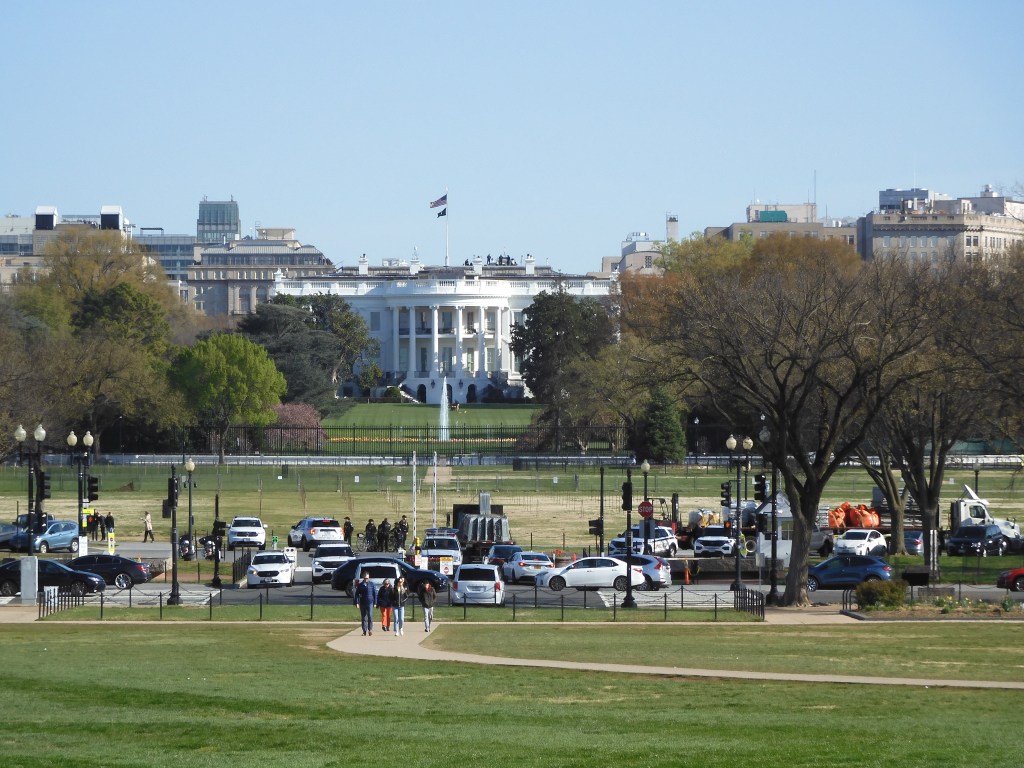
We walked through Lafayette Square, sitting for a while to experience the vision of the White House. Then it was up Connecticut Avenue to buy two brownies for Ed from a different bakery before returning to the hotel. I had a evening Zoom meeting for our condo board to attend. According to Google maps, we put it over 6 miles of walking. We could feel it.

Ed and Chris, Washington DC April 12 Tuesday

National Park Service total sites visited: 295

Categories: travel | Tags: , , , , , , , , | Leave a comment

2022 Trip 1: Searching for our 300th National Park Site: April 9

Glenarden, MD Saturday April 9

Pleasant surprises awaited us today, particularly at Thomas Stone National Historic Site. We left the Hampton Inn around 8:30 for a day of NPS sites to the southeast of D.C. in Maryland. In less than an hour, we left densely built up towns with crowded roads, speeders, and long waits at traffic lights. We drove through suburbia with nice homes and yards. We entered into exurbia, that mix of some new housing developments, old stone houses dating back over a hundred years, hobby farms, modular homes and large, new mansions. We arrived at Thomas Stone National Historic Site before the gates were open.

Thomas Stone National Historic Site is situated along a creek leading to an arm of the Potomac River. The old town of Port Tobacco is nearby. Named after Native American terms, not the tobacco of smoking, the town was once a thriving port and the county seat. Today the town is basically deserted. Thomas Stone was born in 1743 near Port Tobacco and he settled nearby. His house was both a country home and a country plantation. The crops and animals were simple: hogs, sheep, cattle, flax, cotton and fruit trees. The soil was too depleted to be used for tobacco growing. So why do we care, why is this location a National Park site?

Well, certainly Stone was wealthy. He was a lawyer, his plantation grew from 442 acres to over 1,000 acres, and he owned slaves. His family spent generations in service to government and their community. But, more importantly, Stone was a member of the Second Continental Congress. Stone was a moderate, not a fire breathing radical hungry to leave England far in the distance. Stone spoke little at the congress, instead listening and writing. He began as a representative hoping for a rapprochement with England. He ended up agreeing to form a new country and signed the Declaration of Independence. This NPS site speaks to the uncertainty in the 13 colonies as to which path was best for the future. Maryland, for instance, was economically well off. Why throw off this certainty for a new, unproven arrangement?

Thomas Stone NHS is staffed by only one ranger, indicative of the NPS underfunding. But Ranger Dave gave us and others a wonderfully evocative portrayal of Stone, his life, and the colonial times in which he lived. He has to close down the visitor center while he leads tours of the Stone home and interprets those times for us. I don’t intend to repeat his stories; it would do you well to visit here and learn more about our early era for yourself.

We left the Revolutionary time period and moved to the War of 1812 and the Civil War. Fort Washington Park preserves Fort Washington, the site of the first fort built to protect the capital city of this fledging country. In 1808 construction was begun on Fort Washington, initially Fort Warburton, on the Potomac River to the south of Washington D.C. The fort did little to stop the British and was blown up by our troops in 1814 to prevent if from falling into British hands.

It seems decision making was as muddled then as it is now. Progress on rebuilding Fort Washington had its ups and downs depending on federal budgets and prognostications about the need for defense. During the Civil War, it was the first fort protecting the Potomac River and a linchpin in the ring of forts built around Washington DC to protect the city from Confederate forces. After the Civil War, changes in the technology of warfare and budgetary issues kept the fort in operation and then decommissioned several times. Eventually in 1946, Fort Washington was turned over to the Department of the Interior and has been a public park ever since. It serves as a recreational area but also a public park to commemorate the long history of coastal fortifications.

We departed Fort Washington Park and made our way up the road a few miles to Piscataway Park and the National Colonial Farm. Piscataway Park is directly across the Potomac from Mount Vernon, the home of George Washington. Concerned citizens wanted to make sure that this area did not fall prey to suburban development and wanted it kept in the same natural state as when George Washington was living at Mount Vernon and looking east across the Potomac to this site. Those concerned citizens, the National Park Service, and several foundations along with local and state agencies worked to obtain the park’s 5000 acres stretching for 6 miles along the river.

One of the features at Piscataway Park is the National Colonial Farm. This reconstructed farmstead from the late 1700s presents the view of what life was like for typical southern Maryland tobacco planters. This was not a plantation of wealthy owners; but more average to slightly above average farmers of the time. The farm uses historically accurate varieties of field crops and livestock. They practice rotational grazing by the livestock and allow students to experience farm work first hand.

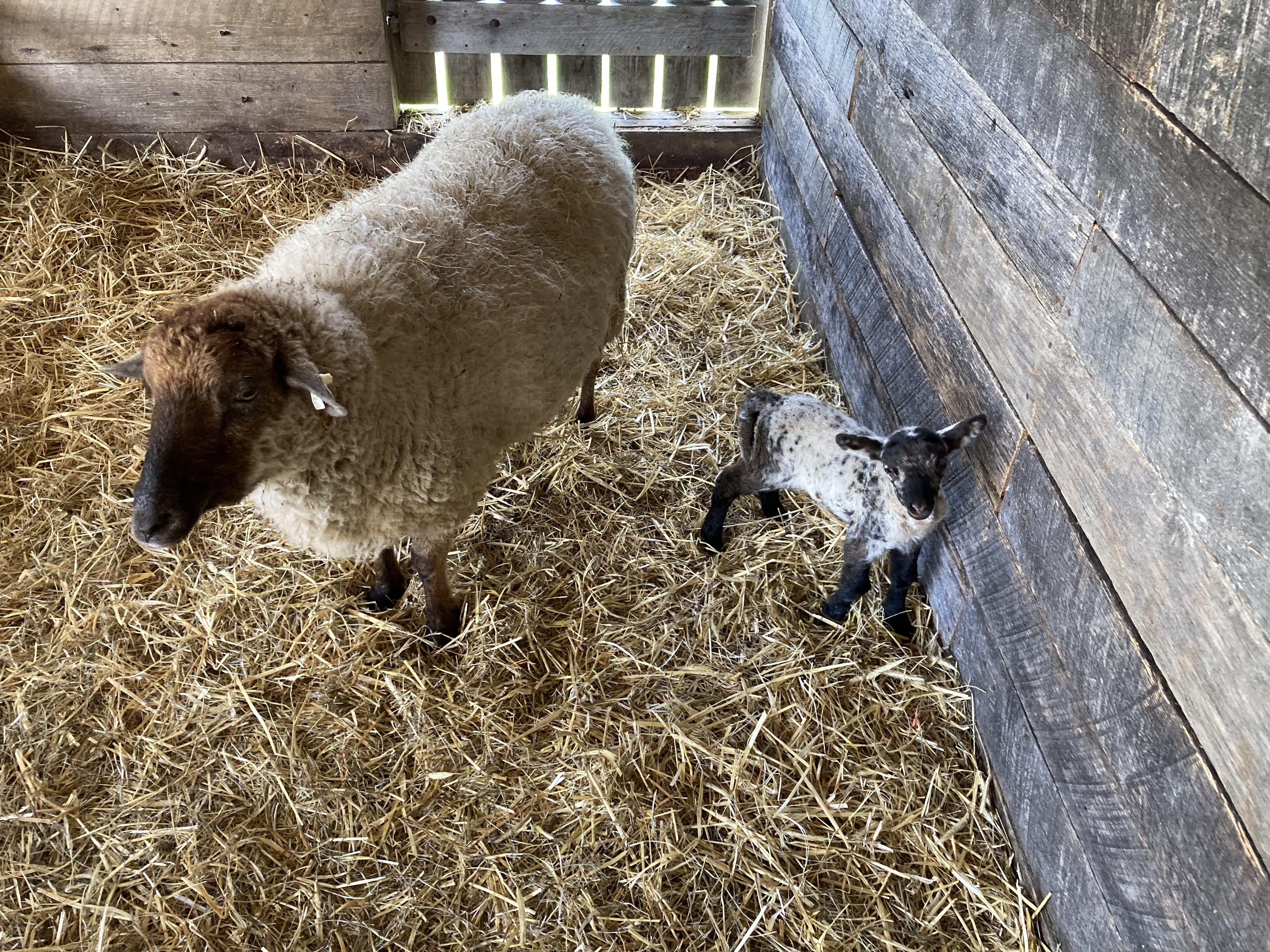
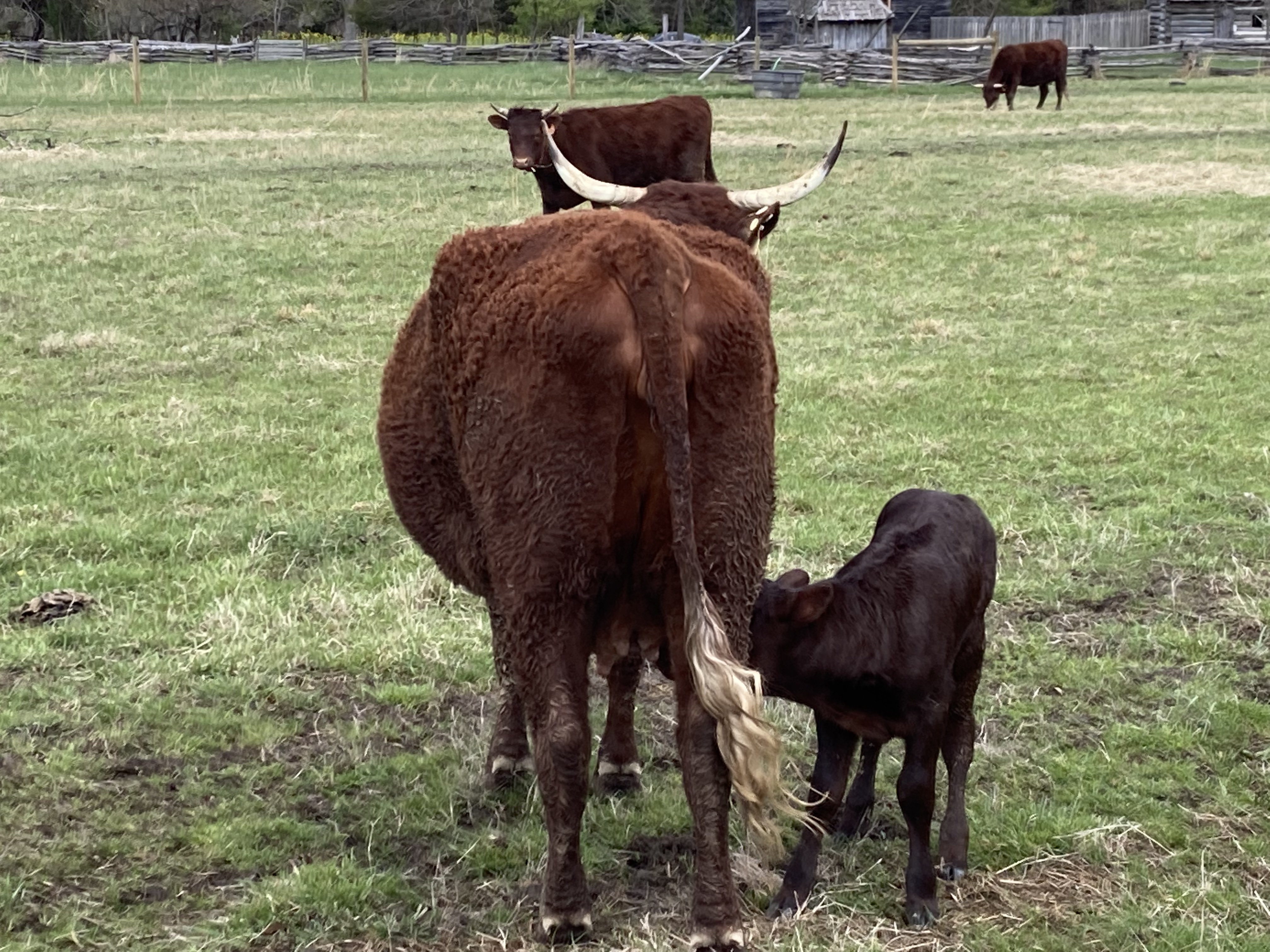
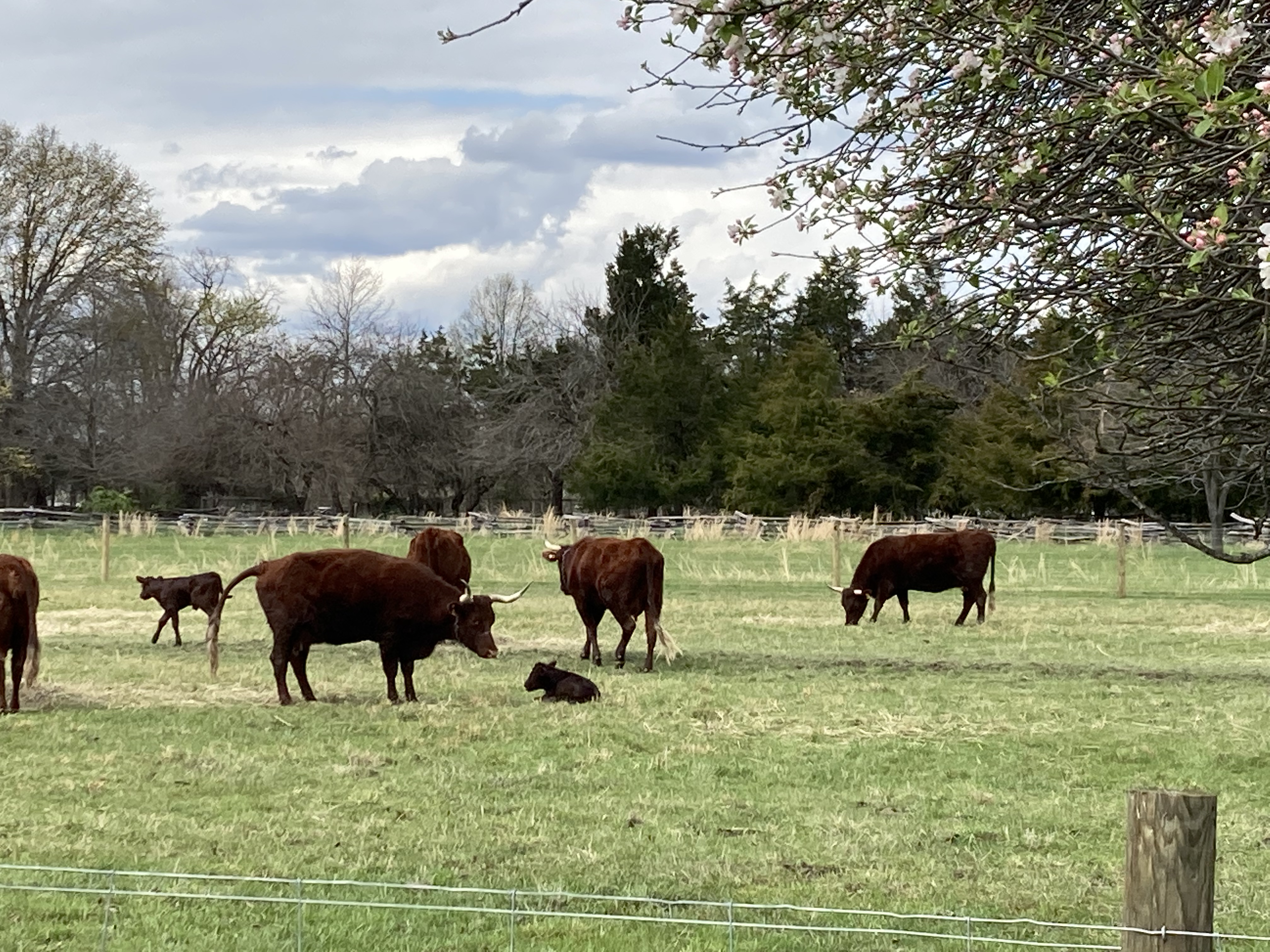
While we are not farmers, this type of exhibit is not unknown to us. We did enjoy observing the newly born lambs and calves as we walked around the farm. Other than that, we didn’t spend an extraordinary amount of time here. We also made a quick stop at Fort Foote, another of the ring of Civil War defense forts around Washington DC. A lack of parking was a determining factor in deciding not to do a major walk here.

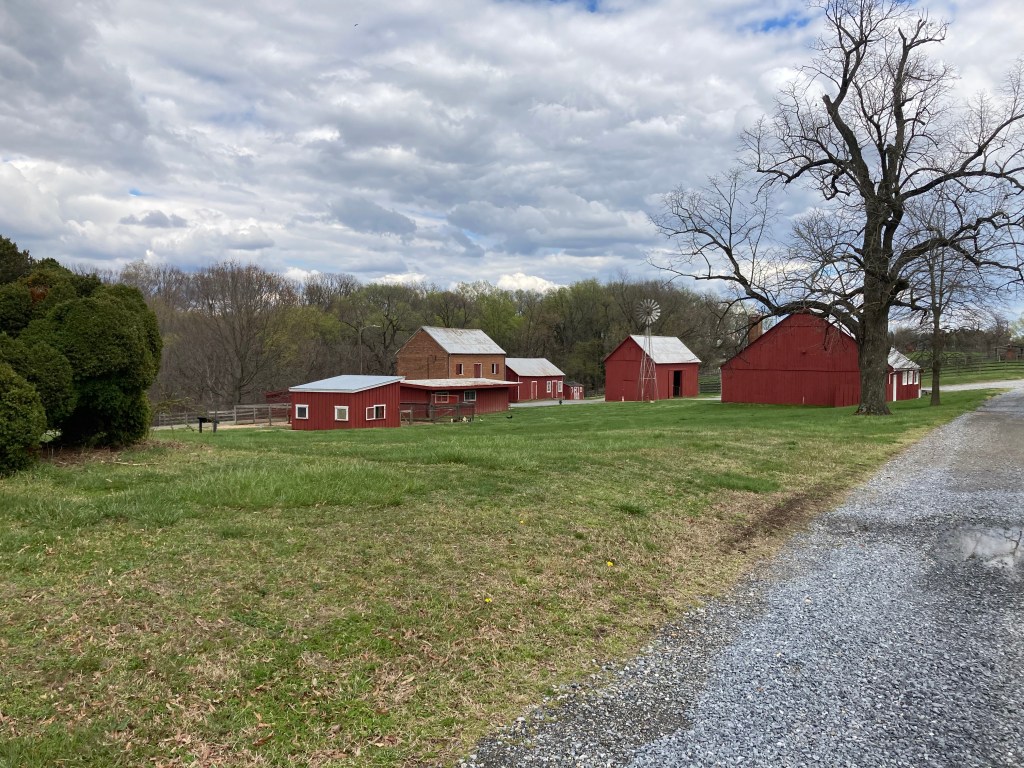
Our final stop of the day was at Oxon Hill Farm. This site is part of the Capital Parks East grouping of parks around the District of Columbia. Oxon Hill Farm represents farming in the early 1900s in comparison to Colonial Farm’s 1770s. Oxon Hill was used to raise cattle, wheat, corn, and fruit by private farmers until 1891 when the US government acquired the land. It established a farm for patients at Saint Elizabeth Hospital in DC. Saint Elizabeth’s Hospital was established as, and still is, the only national public health service hospital solely concerned with the recovery of the mentally ill. In the mid-1960s, the farm was entrusted to the National Park Service. Now it represents a working farm from the early 1900s when horses moved farm implements.

Dinner was the second half of the fish fry dinner purchased last night at the Wegman’s grocery store across the parking lot. Tomorrow we head for five nights in downtown D.C.

Ed and Chris, Glenarden MD, Saturday April 9

Current total of National Park Service sites visited: 290

Categories: travel | Tags: , , , , , | Leave a comment

2022 Trip 1: Searching for our 300th National Park site. April 7-8

Glenarden, MD April 8

Thursday, April 7 was a rainy day in Harpers Ferry. Fortunately we have been to the National Historical Park before so we didn’t spend time walking in the rain. Instead we drove down 50 miles to a new NPS site, Cedar Creek and Belle Grove National Historical Park. Cedar Creek and Belle Grove are in the Shenandoah Valley of Virginia, a major battleground during the Civil War. Control of the territory passed between the two frequently.

In late summer of 1864, the Union adopted a new policy of burning the buildings, crops, and animals that were supplying the Confederate troops here in the Shenandoah Valley. The battle of Cedar Creek was fought on October 19, 1864. Early Confederate success came from surprising the sleeping Union soldiers. However, the Union troops were rallied and returned to the battlefield to defeat the Confederates. Helped by the Cedar Creek victory and with Sherman‘s victories in the south, Lincoln was reelected that November.

Belle Grove was founded by the Hite family. Isaac Hite Junior married Nelly Madison, sister of President James Madison Jr.. Isaac Hite, Jr received 483 acres from his father. He expanded the farm to encompass 7500 acres at one time. Belle Grove became the heart of their plantation. Belle Grove grew a wide variety of crops, raised cattle and other animals, and operated as its own little town with various mills, smokehouses, quarries and blacksmithing.

Belle Grove is combined with Cedar Creek as one National Historical Park. That combination is because much of the battle was fought around the Belle Grove mansion and its farm land. Despite the proximity to the battle, Belle Grove was not destroyed and only suffered multiple bullet “wounds” to the building.

We received an excellent tour by a volunteer docent. Details of the home, its construction, its furnishings, and its historical ties to the area were all covered extremely well. As is finally occurring with many other historical properties, Belle Grove is coming forward and detailing its ties to slavery. Isaac and Nelly Hite began their married life with a gift of 15 slaves from her parents, James Madison,Sr.. Over the duration of the plantation, over 200 enslaved people were here.

A new feature we had not seen elsewhere was a collection of biographies of enslaved people. Each person receives about two pages of information detailing what was known about them. The task was obviously difficult since most enslaved people did not receive a second name, slaves were not allowed to be married and thus fathers were frequently not listed, and multiple enslaved people had the same first name. The attempt, however, is important and the stories presented helped to create an understanding of life for enslaved people.

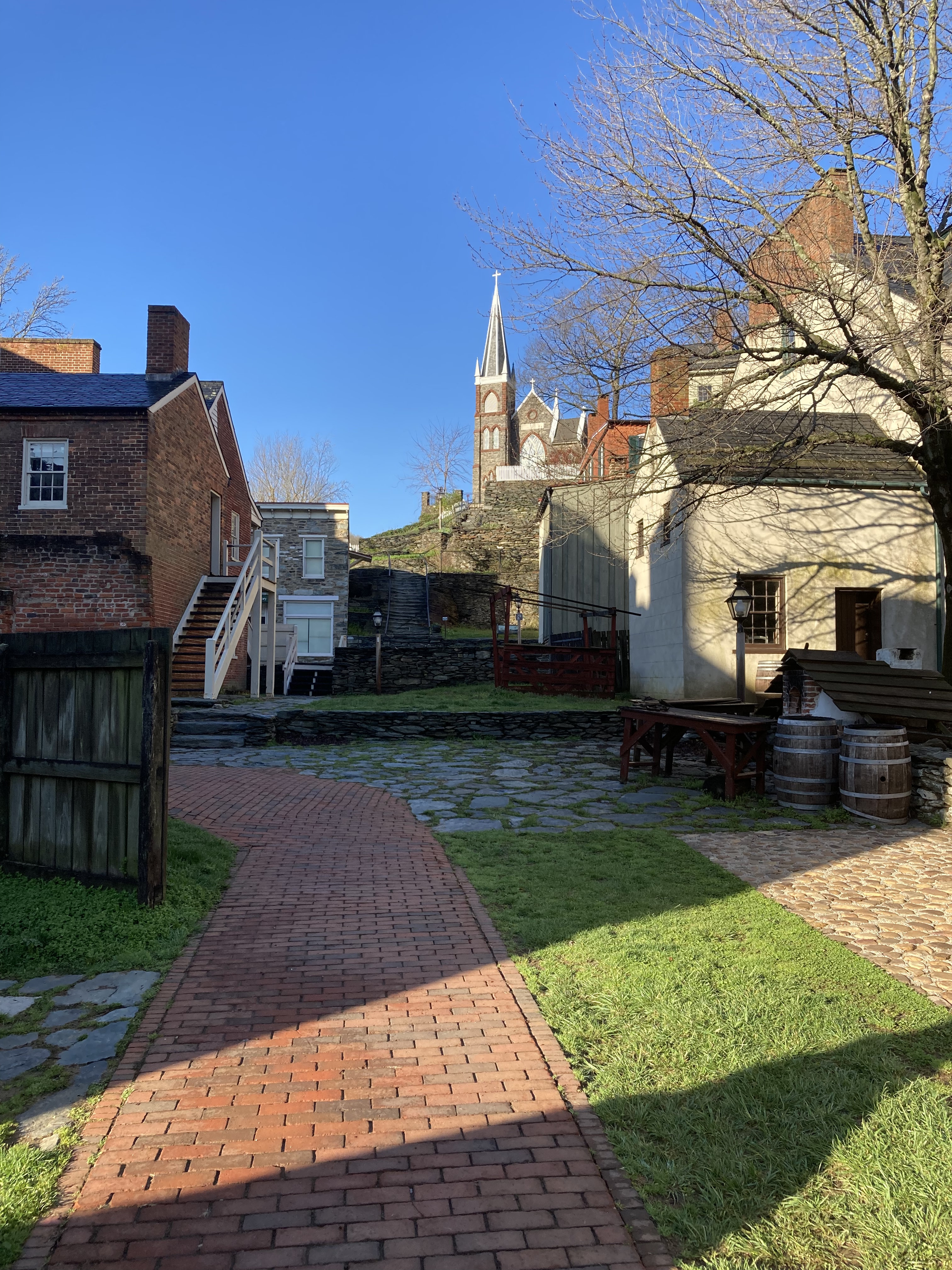
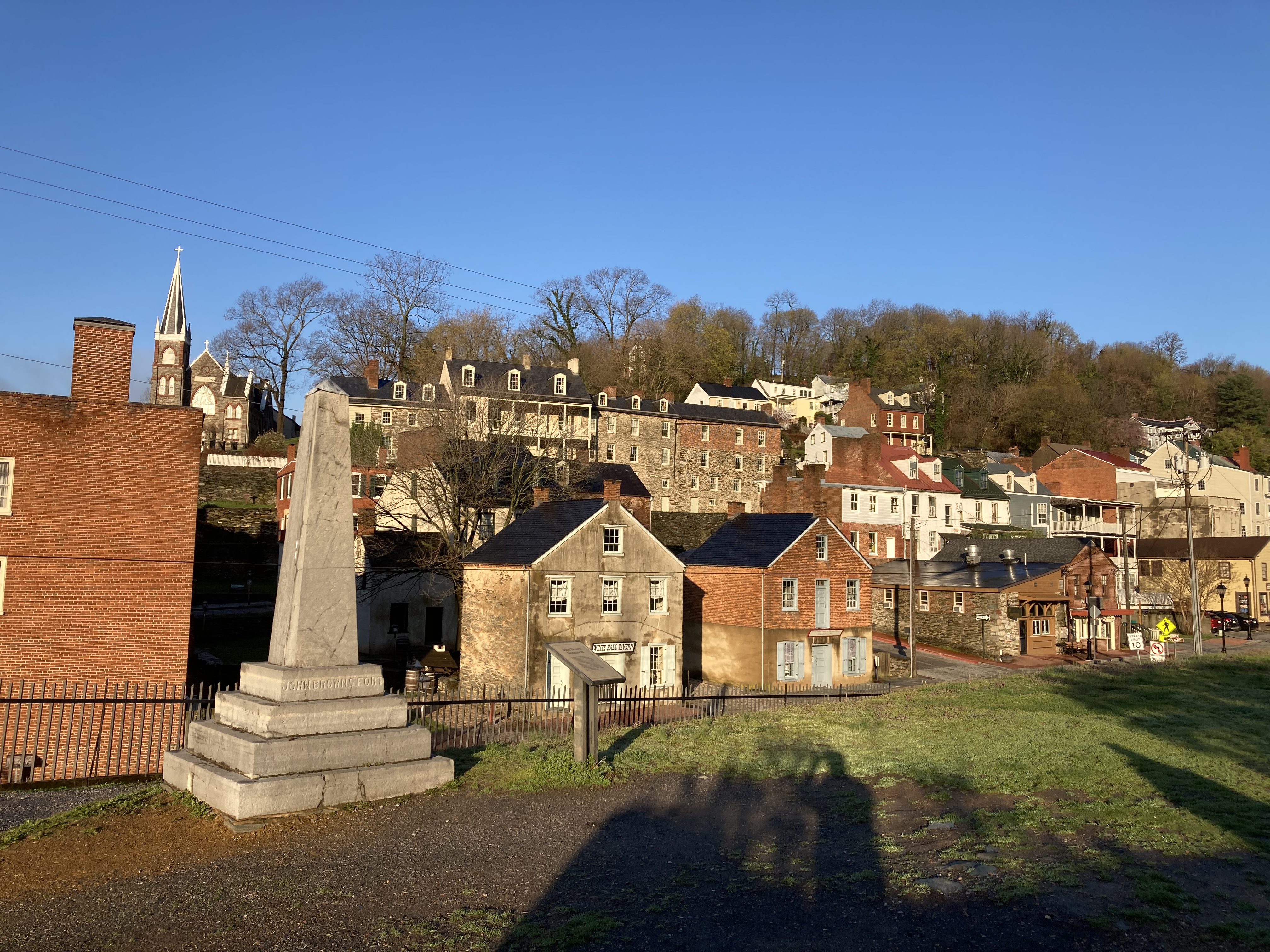
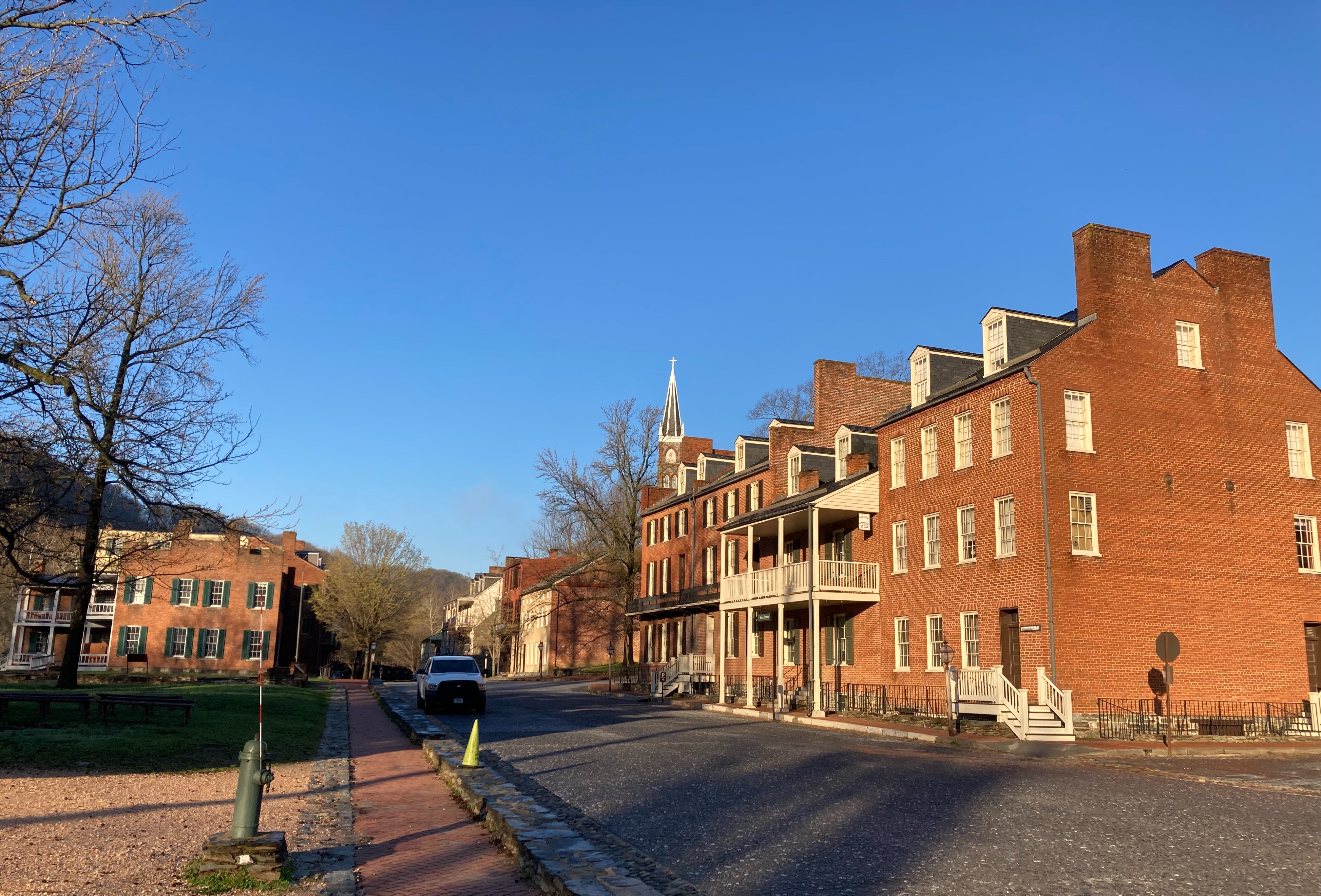
Since it rained Thursday, Friday morning we returned to Harpers Ferry Historic District. Harpers Ferry is situated at the confluence of the Potomac and Shenandoah rivers. It is a narrow pass through the high hills surrounding it. Early canal and railroads traversed the gorge on their way to the Ohio River. George Washington established an armory and arsenal here. That combination of transportation and munitions made Harpers Ferry a strategic location during the Civil War. The town changed hands eight times during the war. The constant battles and threat of battles decreased the population from 3000 prior to the Civil War to less than 200 at its conclusion. The armory was gutted during the Civil War. Afterwards it was torn down and the railroads, as they did so often around the country, took the land and incorporated it into their rail yards.

Views of historic Harpers Ferry-above

The other major historical activity for which Harpers Ferry is well known is the raid by John Brown in 1859. John Brown was an famous (even in those days) abolitionist who calculated on breaking in to the arsenal and stealing arms. The weapons would be used to ignite a revolt by slaves-he hoped. His rebellion lasted over three days and by the end, 10 of his men were killed while seven were captured, tried and executed, and five escaped. This incident was broadcast by telegraph around the country to huge headlines. It was later tagged as a precursor to the Civil War.

We left Harpers Ferry to go to Nirvana. Slight joke, but also somewhat true. In our quest to obtain national park stamps, we go to those locations and they have a stamp to use in your passport book. However, around the District of Columbia, there are a number of parks which don’t really have visitor centers. I have not researched it but I’m not really sure why these parks are part of the National Park Service and not just a county or state park. For whatever reason, they are part of the National Park Service. We will be visiting them over the next week.

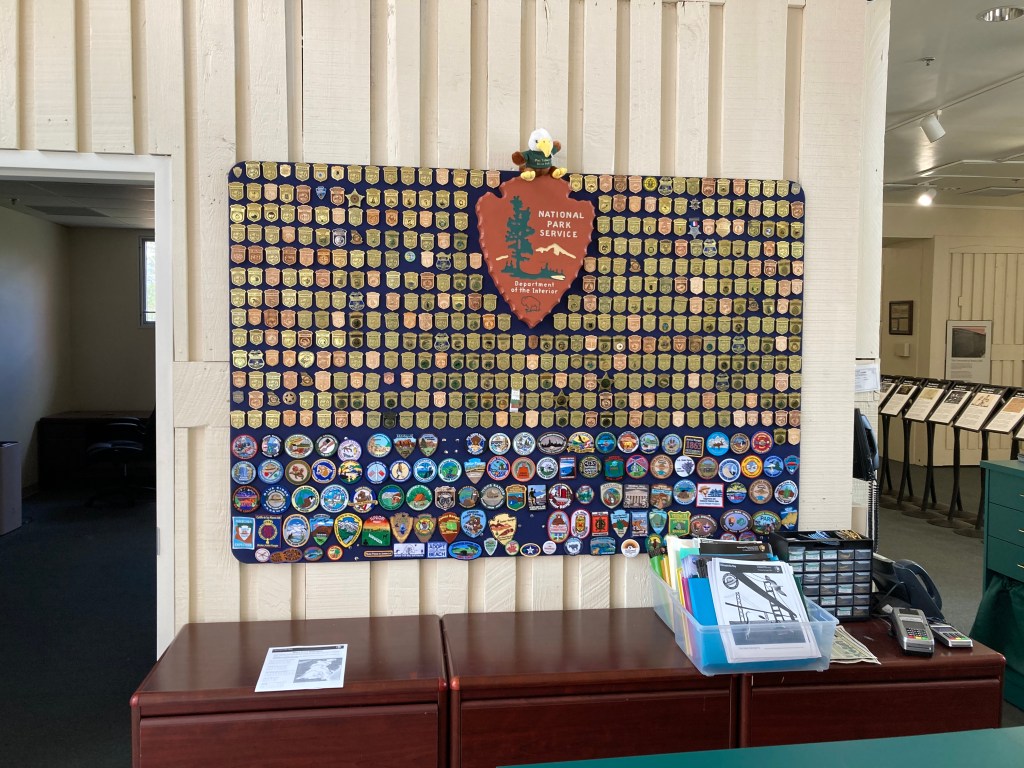
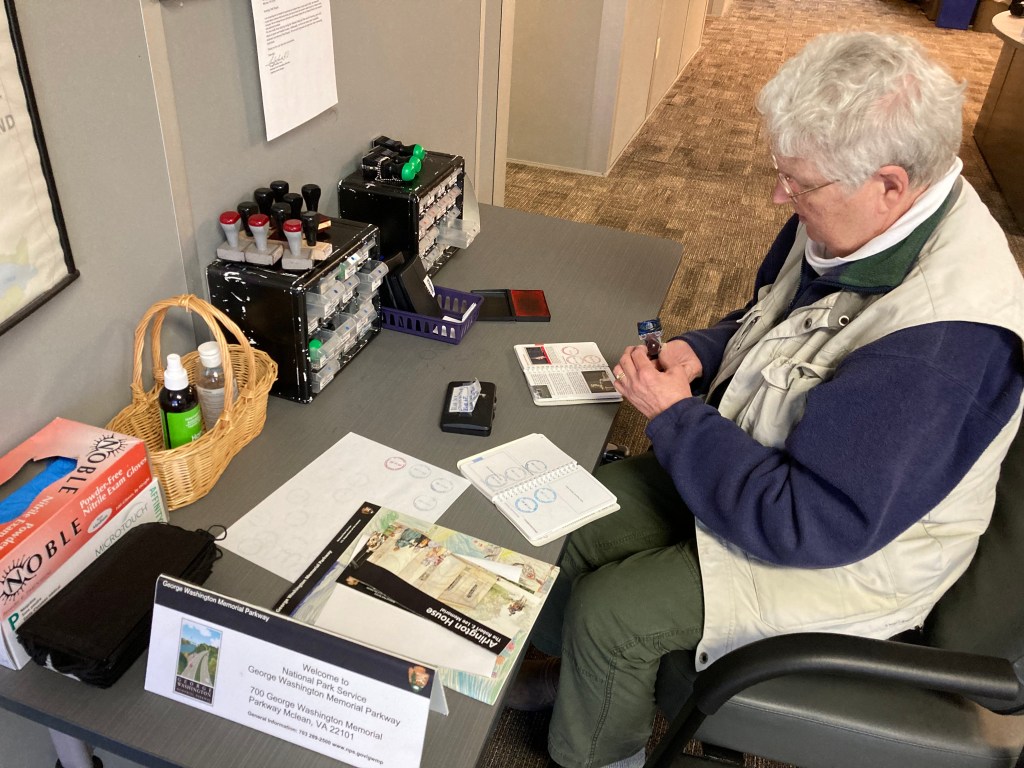
Chris did some research and found out that there are a few locations which have a collection of stamps for those parks that don’t have a visitor center. One central location was the headquarters for the George Washington Memorial Parkway. This office is for administrative services but there was a table in the front lobby with multiple stamps. Chris had a field day, parking herself on the chair in front of the multiple stamps and applying them to the correct pages. The George Washington Parkway is a 7,600 acre national park area protecting the landscape and native habitat of the Potomac shoreline. Within the park are over 25 sites associated with George Washington’s life and the life of the nation he helped establish. It extends from Great Falls MD to Mount Vernon.

As you probably know, Washington DC is a magnet for memorials to various people, causes, and events. Some memorials rank high enough to become an official National Park Service site. President Lyndon Johnson’s memorial is one of these. It is a grove of trees on an island not far from the Pentagon. There is a large stone monument that marks the location where he and his wife, Lady Bird, would frequent and gaze over at Washington DC. You can see the Washington Monument, Lincoln Memorial, and Thomas Jefferson Memorial from this location. The LBJ Memorial is not ostentatious nor highly visited but we could see why the view would be comforting.

Patuxent Wildlife Refuge and Research Station

Our final stop for the day was at the Patuxent Wildlife Refuge and Research Station. This is one of the 560 wildlife refugees around the country. Among wildlife refuges, it has the largest exhibit display area—Minnesota Valley National Wildlife Refuge is the next largest. Notable research has been completed here. Their efforts were critical to the saving of Whooping Cranes well as the discovery of DDT as the primary cause for the near extinction of bald eagles. DDT caused the thinning of eagle egg shells. When the parents were warming and incubating the eggs, their weight was too great and the eggs cracked. Since DDT was banned, the bald eagle population has soared.

We learned this and more from a knowledgeable volunteer at the front desk. Patuxent has a wall dedicated to volunteers. Their names and plaques line the wall listing the total hours worked. Their totals put my efforts at the Mississippi National River and Recreation Area to shame-there are numerous plaques with 5,000, 10,000, 15,000 hours volunteered by one person. Amazing. Of course, part of the reason their effort is critical is the shortfall in funds for staffing many Department of Interior programs.

We finished the afternoon with a hike along one of the many trails offered at this large refuge in the middle of a major metropolitan area. No rain and pleasant temperatures created a nice ending to a good travel day.

Ed and Chris, Glenarden MD Friday April 8

Categories: travel | Tags: , , | Leave a comment

2022 Trip 1: Searching for our 300th National Park Service site: April 6

Harpers Ferry, WV Wednesday April 6

Stops at four National Park Service sites today only produced one new and additional National Park for our total collection. The other three national parks were places we visited 20 or more years ago, well before we had purchased the National Park Service passport book. So, we made additional stops in order to add a few more stamps to the passport book. The additional stops were not a hassle since they are all conveniently close to each other.

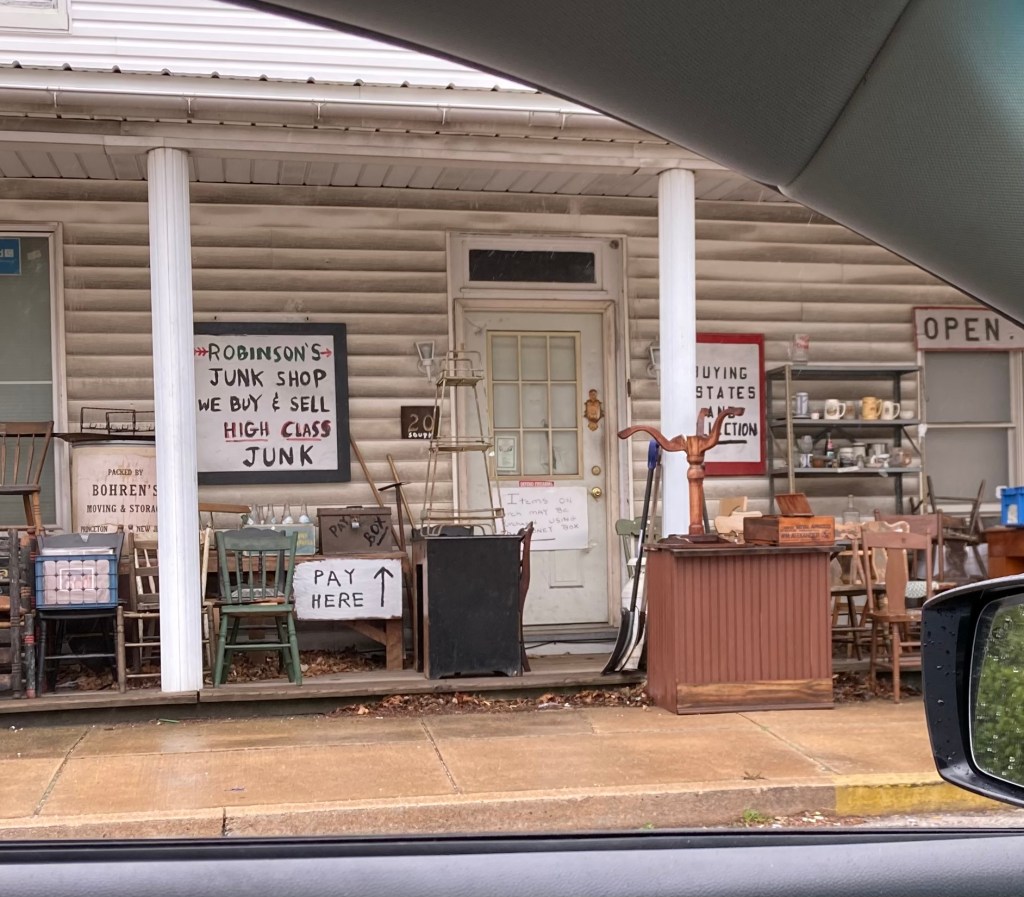
We left Wilmington Delaware in the rain. The drive to Gettysburg National Military Park was on two lane back roads. Google maps had us taking about 2 to 3 dozen different roads as they went over curvy and hilly terrain between Wilmington and Gettysburg. Speed limits were rarely over 45 mph but the fields were green and flowering trees were in abundance along the roadways. Antique stores are frequent in the small towns and crossroads we drove through

We moved from Pennsylvania to Minnesota in 2003. In 2008, a new visitor center was completed at Gettysburg. We had not been here since then. I had to take an hour and a half training session for the National Park Service today and while I was doing that, Chris enjoyed the new film, exhibits, and cyclorama.

Gettysburg National Military Park was not a destination but a way station. For all of the many, many times we have been to Gettysburg, we have never visited Eisenhower National Historic site. This site is the home and farm of former President Dwight and First Lady Mamie Eisenhower. They purchased this property after his military career. It was their first and only home that they owned. While president, Eisenhower would bring numerous dignitaries to Camp David in the Catoctin Mountains and then also bring them up to his home and farm. It is only 20 miles between the two locations. At the farm, the Eisenhowers raised Angus cattle which won championships at the Pennsylvania Farm Show.

The home they originally selected was red brick and in some disrepair. The architect hired to oversee the renovations found a decaying 200 year old log cabin beneath the brick. The house could not be saved. Mamie Eisenhower told the contractors to save as many pieces of brick and other materials that they could. Those pieces were then incorporated into the new home. We were only able to see and walk around the outside of the home. The inside of the home is still closed due to Covid and lack of staffing reasons. However we were able to talk to the park ranger responsible for the property and gather information from him. Unlike some recent presidents, the Eisenhowers were down to earth and the interior furnishings reflect a very simple and common decor and furnishings.

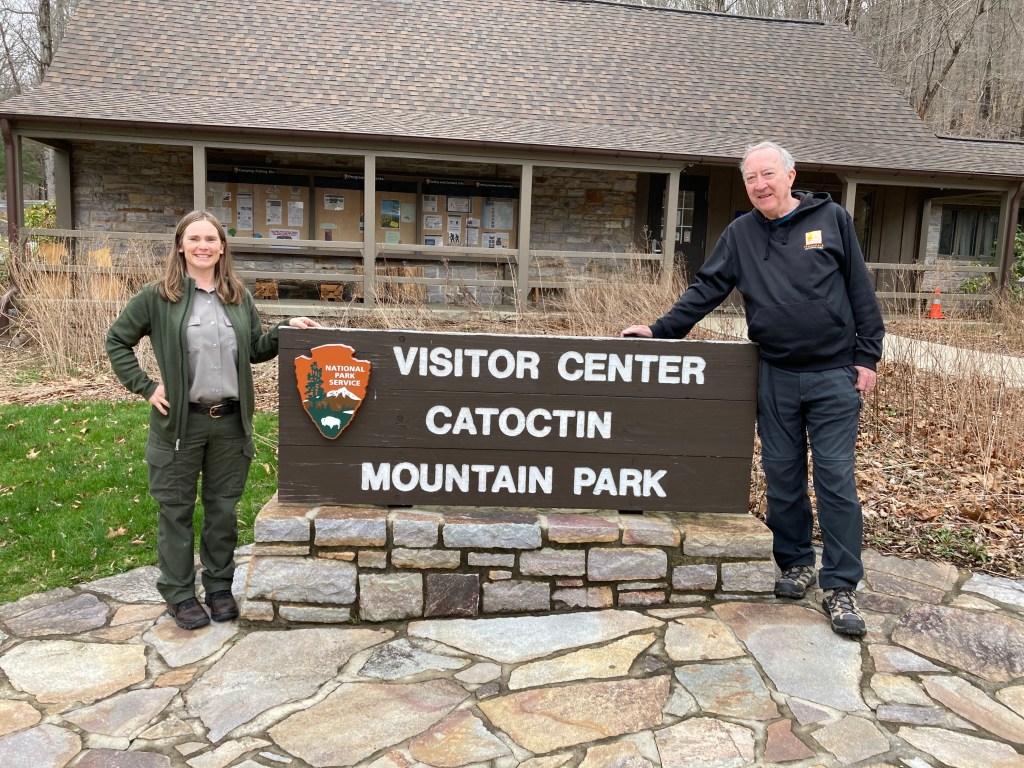
Leaving Gettysburg, we drove to Catoctin Mountain Park. The purpose was to obtain a passport stamp since we had been here previously. Catoctin Mountain Park traces its roots to the Great Depression and a program called Recreational Demonstration Areas. 46 of these RDAs were created in 24 states, most eventually became state or national parks. Catoctin was built on 10,000 acres and Civilian Conservation Corps crews helped to restore the eastern hardwood forests. The forest had been depleted through decades of tree cutting for charcoal making, tannin, heating, and buildings. The plan was to give the finished park to Maryland.

Before this occurred, President Franklin D Roosevelt chose part of the property as a presidential retreat. The retreat was later named Camp David. Since it would not be appropriate or legal for the federal government to control state parkland, the Catoctin Recreational Demonstration Area was cut into two pieces. The northern portion is Catoctin Mountain Park and the home of the presidential retreat and the national park unit. The southern portion became Maryland’s Cunningham Falls State Park. In Catoctin, Camp Greentop is the oldest camp in the U.S. for children with disabilities. Greentop was built by the WPA and is still operating today.

In the process of obtaining the Junior Ranger booklet from the Ranger at the visitor center, she made us aware that another ranger stationed here had worked in the early 2000s at the Mississippi National River And Recreation Area (MISS). Ranger Carrie Andresen-Strawn came out and chatted with us and we shared information about the people we and she knew at MISS.

Our last park service stop was tonight‘s overnight location at Harpers Ferry, West Virginia. We made it to Harpers Ferry National Historical Park in time to have the passport book stamped. We have been here previously so no cheating was involved. Wednesday morning we hope to visit another NPS site farther south in Virginia. We will return to Harpers Ferry in the afternoon and re-acquaint ourselves with it. The forecast is for rain all day so we might cut down on our outside walking around.

Lodging for two nights is at an Airbnb. No fancy meals today, we had plenty of delicious meals over the last several days.

Ed and Chris, Harpers Ferry, West Virginia Wednesday April 6

Categories: travel | Tags: , , | Leave a comment

2022 Trip 1: Searching for our 300th National Park Site: March 31-April 5

Wilmington DE Tuesday, April 5

Well we are back on the road after five wonderful days in Framingham MA visiting family. Obviously part of the time with them is just being together, cooking, eating, talking, playing games. We do manage to squeeze in some activities, though.

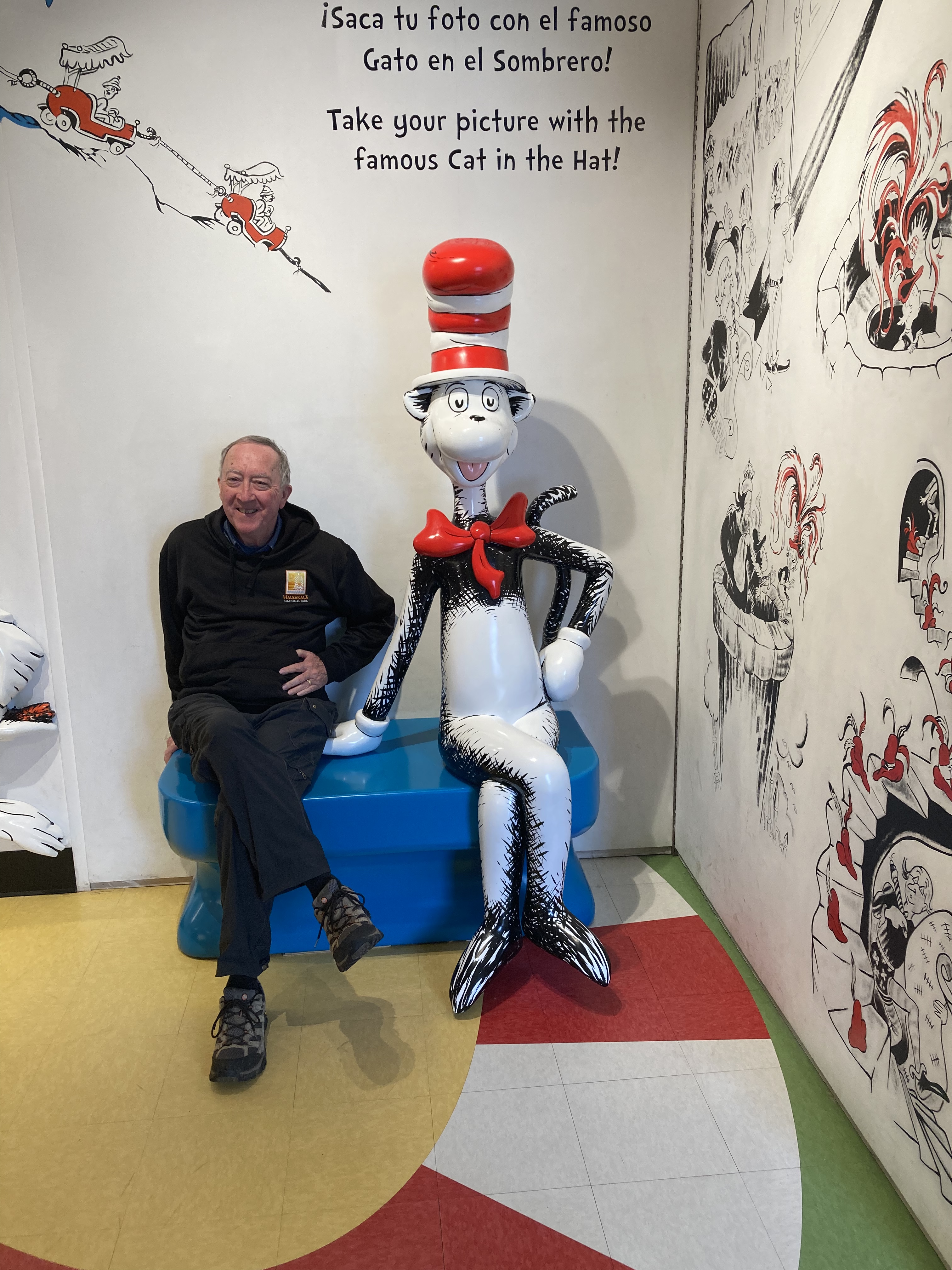
We took Deb down to Springfield to introduce her to a childhood friend-Dr. Seuss. Springfield has a museum quad with five different museums. Ted Geisel was born in Springfield and his life here directly impacted his imaginative books. Chris and I have been here before but the chance to share the Dr. Seuss museum with Deb was too great of an opportunity to pass by. Chris goes kind of nuts remembering various Dr. Seuss characters and books. At one stop, a Smart Board was set up for children, and not so young children, to doodle. Chris had a senior moment figuring out how to use it. A mother sitting nearby offered her eight year old daughter as a tutor. The daughter did a great job and Chris had a chance to enjoy her moment of creativity.

After some yard work Saturday, the four of us visited an Audubon sanctuary, the Broad Meadow Brook Conservation Center. Part of the trails were a little muddy but we managed to spot some skunk cabbage, an early blooming spring ephemeral. Spring ephemerals need to pop up quickly before trees leaf out and block the sunlight. Skunk cabbage are usually one of the first to be spotted in spring.

Sunday after church we visited the Mapparium which is part of the Christian Science complex in Boston. The Mapparium is a three story walk through globe built in 1935 showing nations as they existed at that time. I found it less interesting than I expected, even causing a little dizziness from looking up at the globe countries. Instead, I would recommend the map library at the Central Boston Public Library if maps interest you.

Deb was able to take Monday off from work so we visited the Commonwealth Museum. This is a MA state museum attached to the state Archives. The exhibit area is quite well done even though the quantity of the exhibits is small. The focus is on MA history and given Massachusetts’ role in establishing the United States, it includes national history. I found the exhibits even handed in their handling of state history. For instance, the Puritans had a positive impact on the development of democratic institutions even as their religious intolerance still has an impact on today’s society.

There was an educational chart contrasting Native American living and farming methods with those of the European colonists. It has taken 300+ years for us to acknowledge that many of the native agricultural practices are so less destructive on the land. Maybe if we spent more time trying to scale up their practices, we could have caused less damage to the land while still feeding many more people. One final note. Hopefully you recall that untold hundreds of thousands of Native Americans died from being exposed to European sicknesses for which the Native Americans had not developed any immunity. Many Indians converted to Christianity, believing that the Christian god must be better since the Europeans did not die of these diseases.

Massachusetts complicated history with slavery was covered. First, slavery was allowed, then prohibited. Shippers participated in the slavery trade. MA was a hotbed for abolitionists while the textile mills profited from Southern cotton grown with slave labor. Free blacks were accepted and integrated into the state militia before the Revolutionary War-but not after the Revolutionary War in the country which proclaimed: ”all men are created equal.”

In the afternoon, the three of us went hiking at Callahan State Park, not far from the Airbnb Chris and I were staying at. While the trails were easy to follow, there were no maps available. We managed to get in an hour hike without getting lost and made it safely back before dinner time. Dinner was take out from Bella Costa Ristorante Italian restaurant and dessert from Dulce D Leche Gelato Cafe.

Tuesday, today, we went back on the road where we will be for the next three weeks plus. Paterson Great Falls National Historic Site is a National Park Service site in progress. In other words, it still leaves a lot to be desired. The Great Falls on the Passaic River are impressive at 77 feet high. The Great Falls are the location of America’s first manufacturing center.

In 1792, Alexander Hamilton founded Paterson and for 150 years Paterson fulfilled Hamilton’s dream to wean America from foreign goods. When Paterson was created, England sold America its manufacturing goods. Even though we were an independent country, lack of a manufacturing base made us dependent on England. Paterson mills used the water power, and later hydropower, from the Great Falls of the Passaic River to manufacture textiles including cotton, flax, silk, and rayon, to build aircraft engines and railroad locomotives, and make paper.

Immigrants flocked to the city, creating a diverse culture and melting pot, and cheap labor. But in the early 20th century, workers realized they were getting a raw deal. They banded together and a six month strike eventually produced better working conditions, shorter hours, and higher pay.

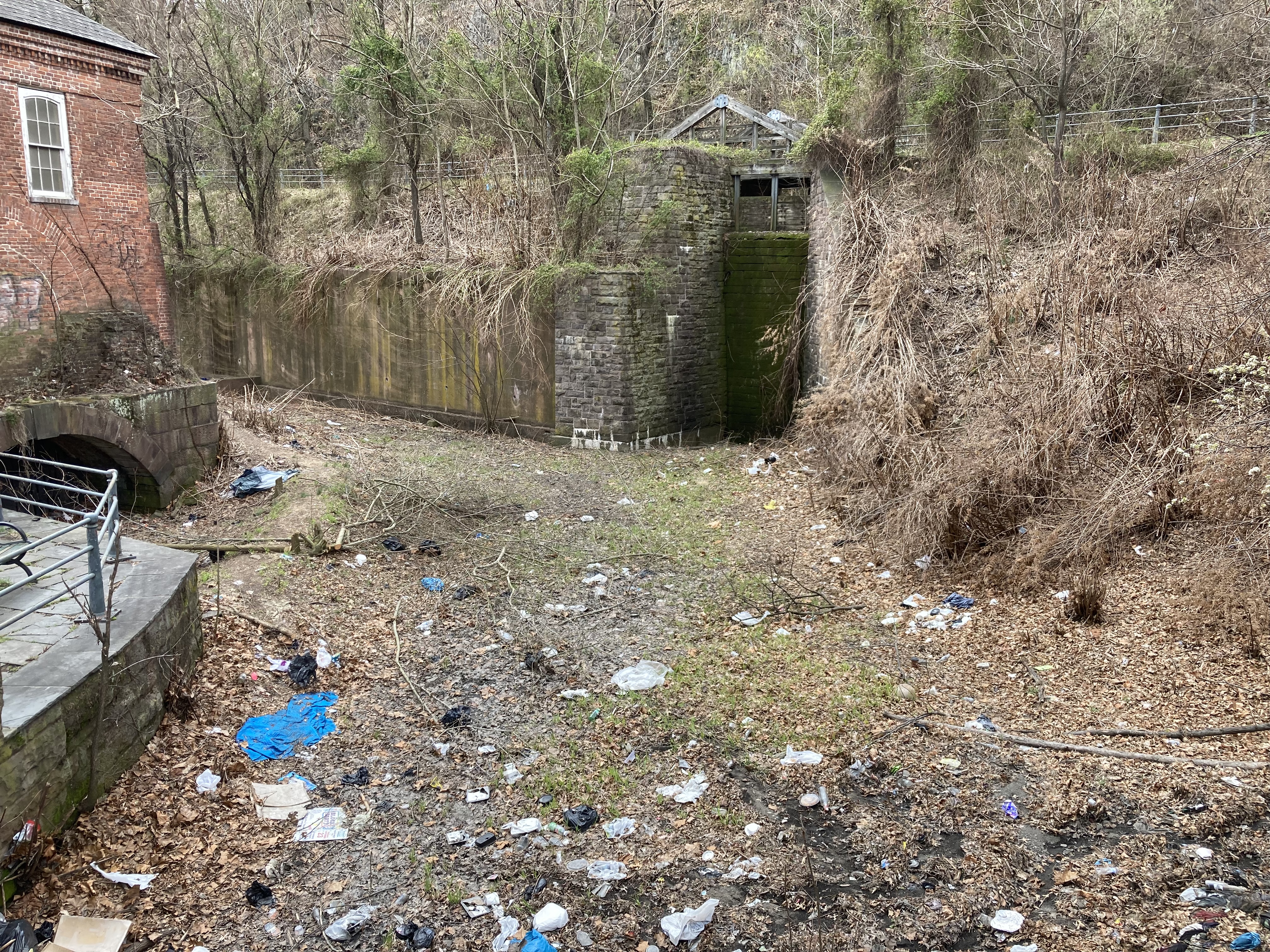
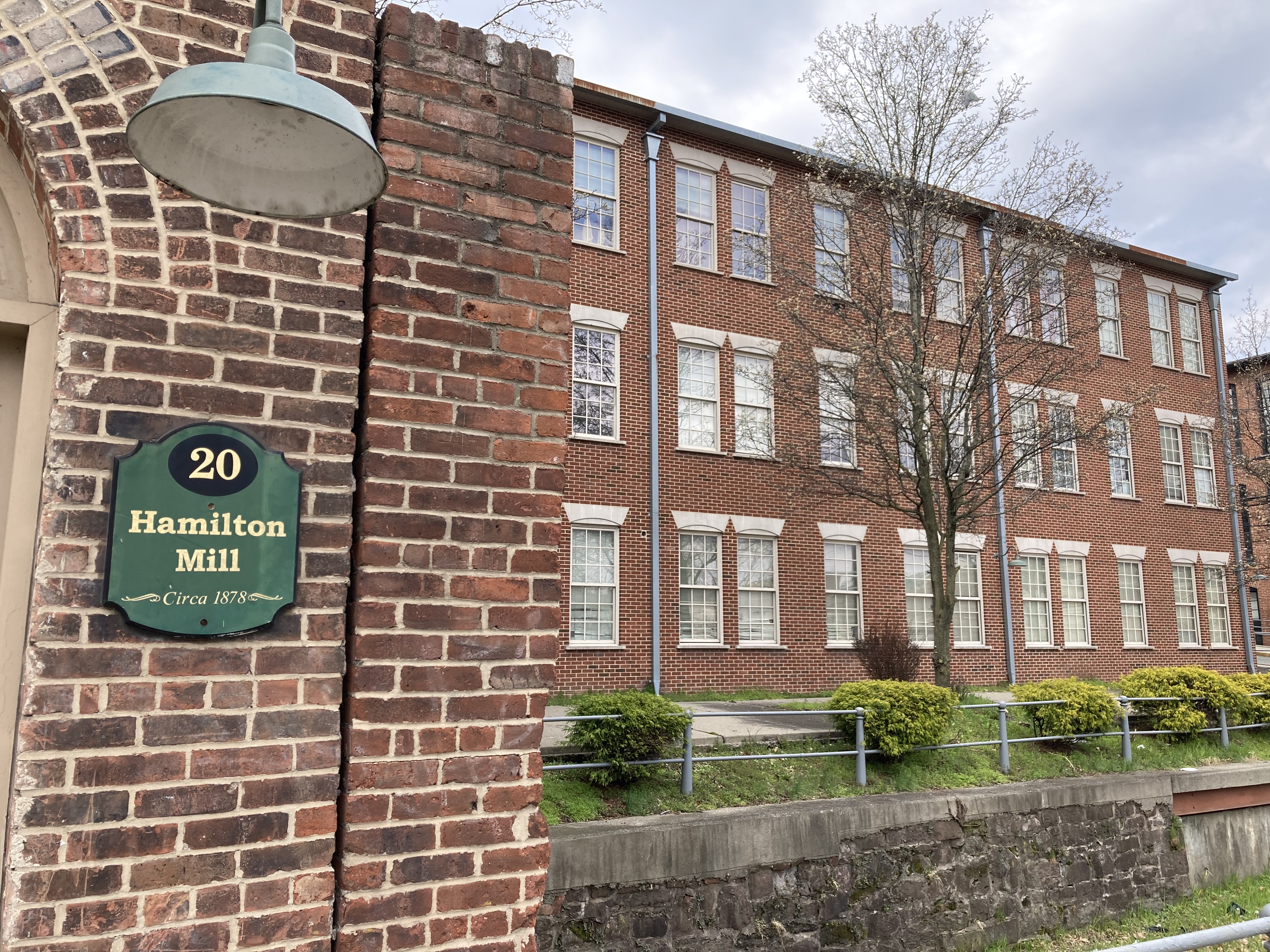
The view today around the falls is of a city struggling to reclaim its lost grandeur. Some of the mills have been rehabilitated and are economically productive once again. But across the street from one of those will be a mill with broken windows and fallen in roof. Trash and litter line several of the once mighty raceways that brought water power to the mills. The contrast between the Great Falls of the Passaic and St. Anthony Falls in Minneapolis (Mississippi National River and Recreation Area) is striking. Minneapolis is the clear winner with parklands lining the river, residential complexes created from rehabbed mills and newly built high rises. Offices and entertainment options create a vibrant community. Lets hope Paterson’s vision can be reached.

As for the national park, Paterson Great Falls National Historical Park does not have a functioning visitor center although a viewing overlook has been created. We had to knock on the locked door of the admin center to get our passport stamp. It works, but not so much that one wants to brag about it to others.

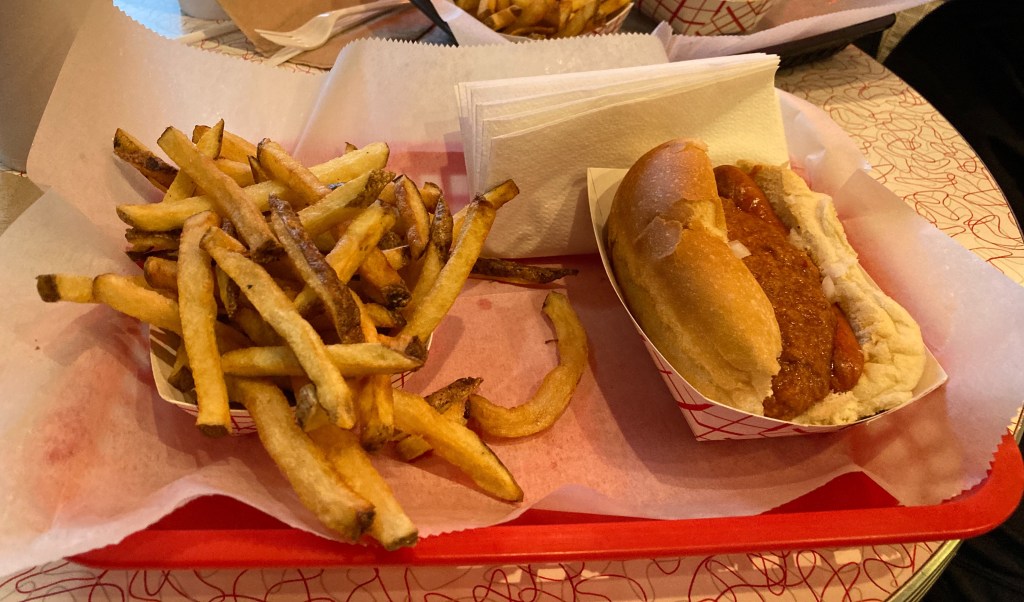
Tuesday night we ate hot dogs at a Wilmington DE landmark institution, Deerhead Hot Dogs. A special sauce is their signature dish. The sauce and restaurant date back to 1935. A local car club was having their monthly meeting while we were there. They took up 18 of the 24 seats in the restaurant.

Ed and Chris, Wilmington DE Tuesday April 5, 2022

Categories: travel | Tags: , , , , | Leave a comment

2022 Trip 1: Searching for our 300th National Park Site, March 30

Framingham, MA March 31

Wednesday started out lousy. Rain, 29 degrees F, driving over central Pennsylvania mountains with their curves and hills—and very aware of the crash on Interstate 81 Monday a little east of here with a 80 car/truck pile up that killed six people. Chris and I are very familiar with that stretch of I-81, we always knew that if fog was around, it could be found in that stretch. In Monday’s situation, though, it was a sudden snow squall. For us, our drive had no problems although we drove a bit slower and left later to try to reach above freezing temps. It was not until we reached Scranton, three hours later, that the temperature was above freezing.

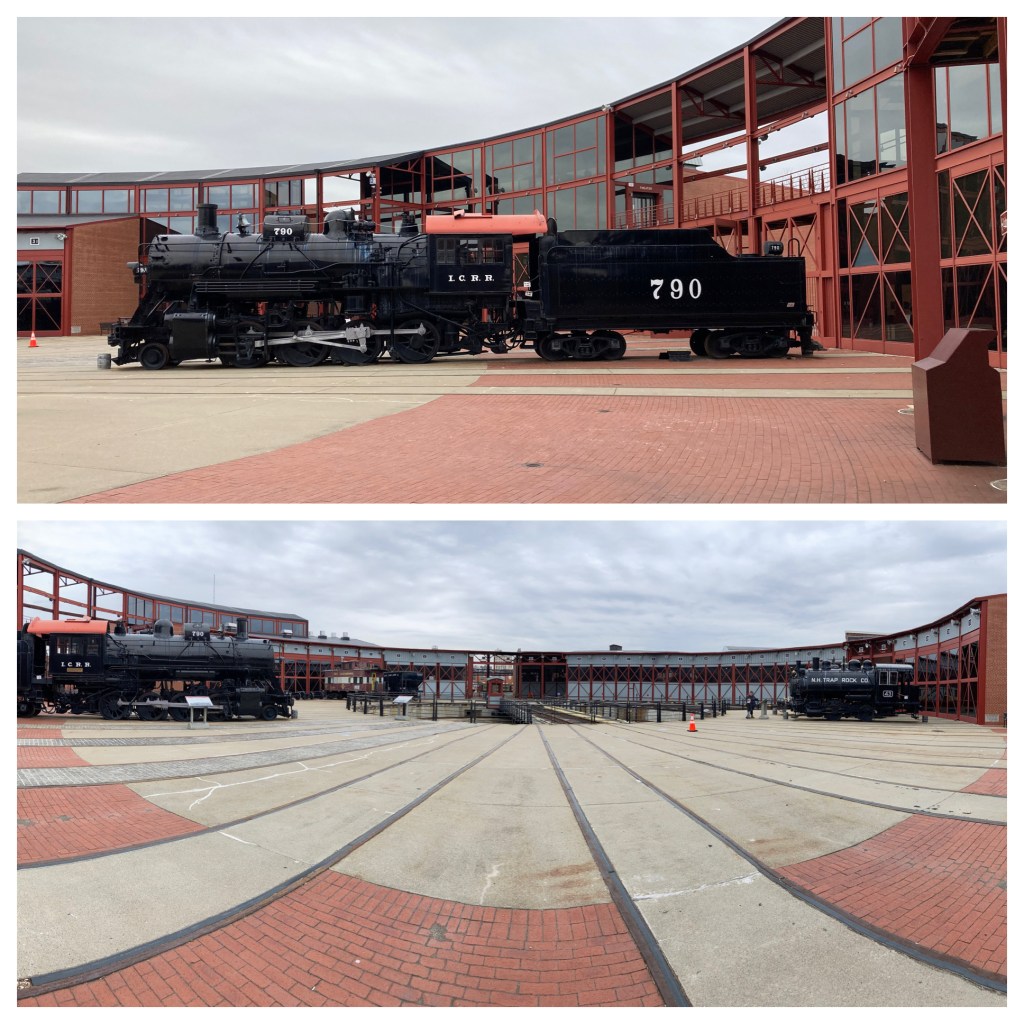
Our one stop of the day was at the Steamtown National Historic Site, a National Park Service (NPS) unit. I had thought we had been here before many years ago but it did not look familiar. Chris was sure she had never been here. In any event, the complex is large and impressive. The major focus of the exhibit is railroading, specifically the Delaware Lackawanna and Western railroad. This railroad was a major connector between New York and the anthracite coal mines of northern Pennsylvania. Like many other railroads, it was the result of the merger of several smaller, local rail lines.

The National Park Service’s role at this site is to interpret the role of railroads in the development of the United States. In particular, Steamtown focuses on the industrial development of the Lehigh Valley around Scranton, the steel factories and coal mines, and the role of immigrants newly arrived in the US who filled jobs in this location. Steamtown has a 18 minute video, and a wonderful series of exhibits surrounding a central Roundhouse. The buildings have been well restored, as have the railroad locomotives on display. During warmer times of the year, train rides are offered.

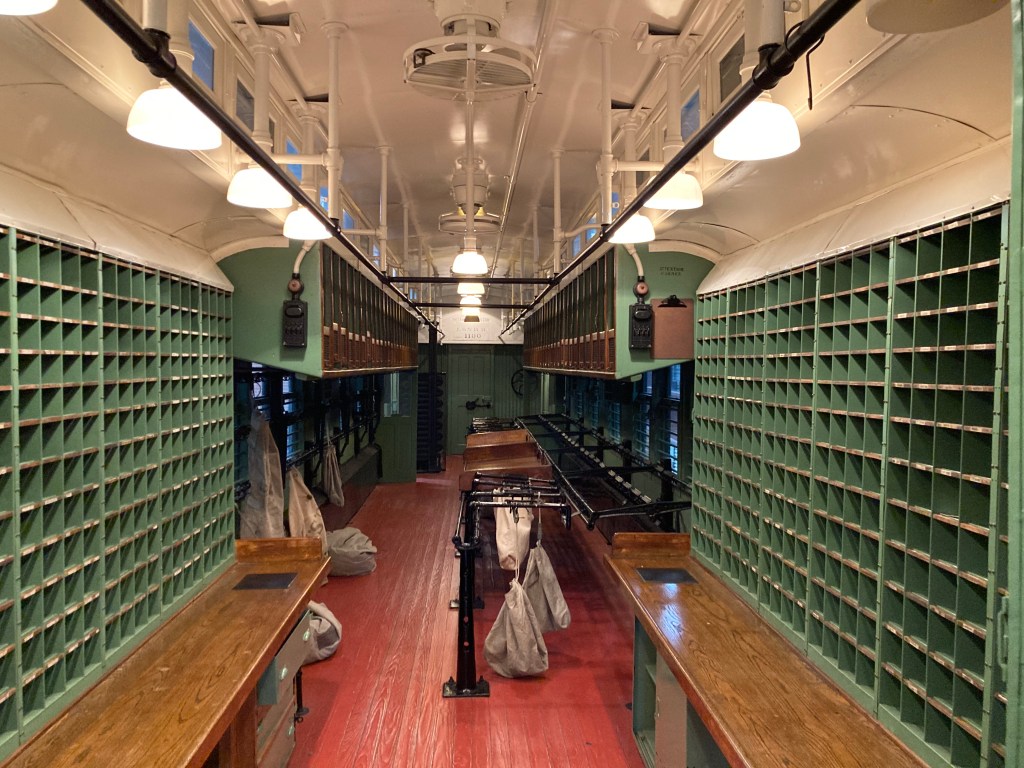
I found one display of particular interest. There was a Railroad post office car included in the collection of train equipment. These cars were used for sorting mail along the train route, even to the point of dropping off mail at locations without a formal stop by means of a bag tied to a hook. In my talks for the NPS Trails and Rails program on the Amtrak Empire Builder, I try to mention this old time process while speaking in the observation car.

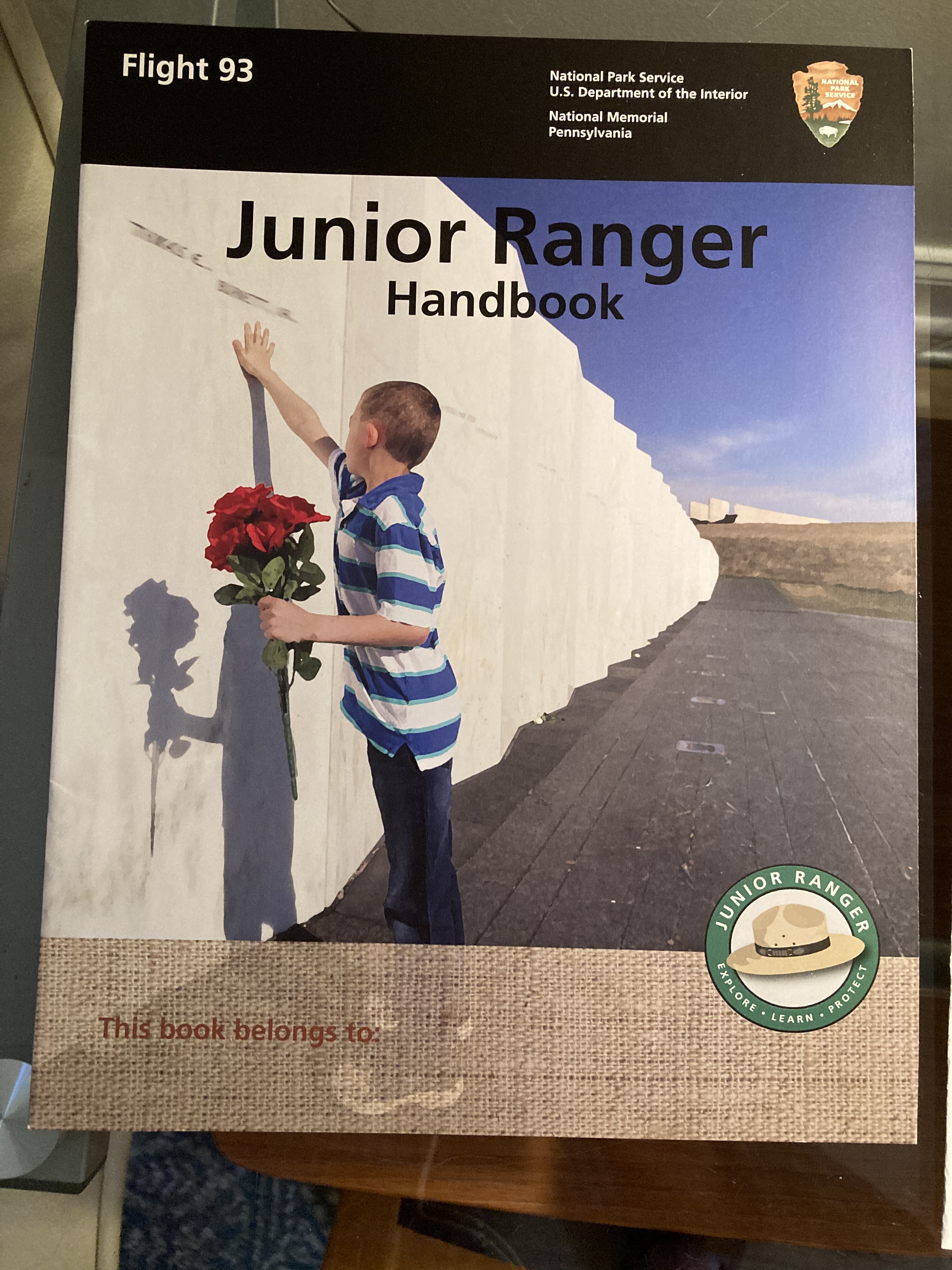
The park ranger we met, a woman originally from Hagerstown Maryland, was gracious and accommodated my request to pick up Junior Ranger booklets. If you are not aware of these, most National Park Service sites have a booklet designed for young visitors to help them explore and learn about the purpose of that specific NPS site. While called Junior Ranger booklets, they can be used by people of any age.

The Ranger responsible for these booklets at my park site, Mississippi National River And Recreation Area in the Twin Cities, will be receiving a packet of Junior Ranger booklets that I will be picking up as we visit 30 or so NPS sites during this trip. Here at Steamtown, the Park Rangers have developed a series of four booklets designed for different ages. One booklet is for ages five and under, one for ages 6 to 8, one for ages 9 to 12, and the last one for people like me, ages 13 to 130. The Steamtown booklets are less fancy, printed with a color printer. In contrast, the Junior Ranger book at Flight 93 National Memorial was printed by a commercial printer on heavy, glossy paper.

Each booklet requires the user to answer questions, draw pictures, and in general interact with the knowledge presented at the NPS site. Completion of the booklet allows the person to be sworn in as a junior ranger and receive a badge. We have found that it can be quite popular with people interested in learning about American history and culture.

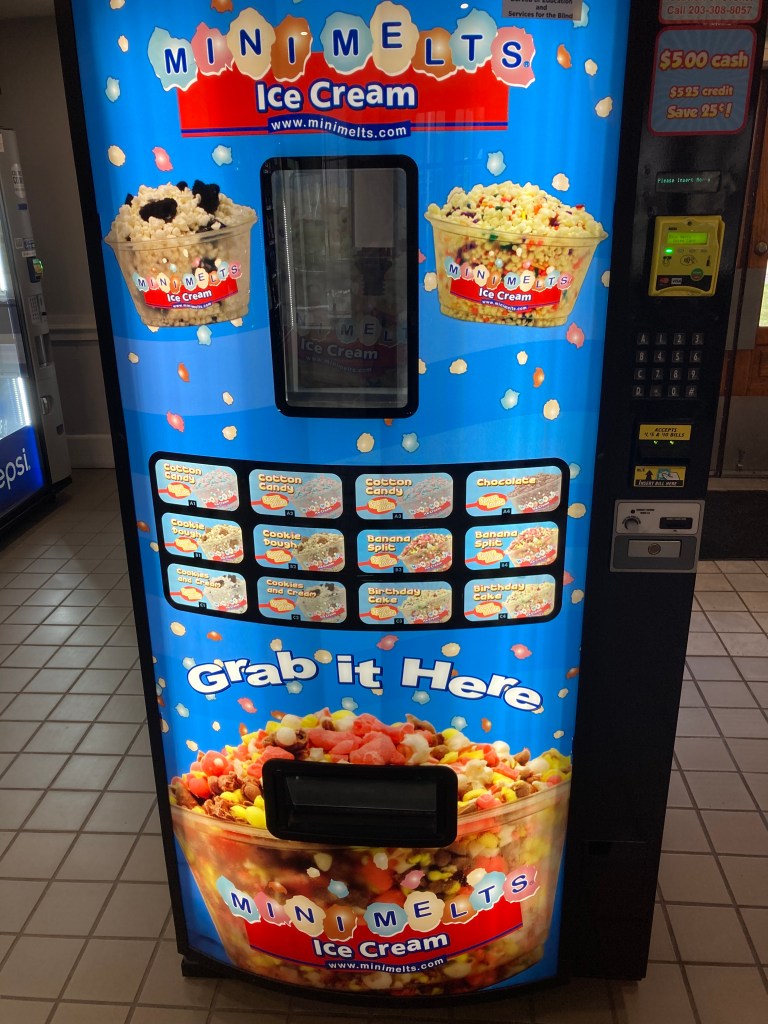
The rest of the drive was uneventful. Heavy traffic once we hit New York, then really heavy through the usual traffic jam around Danbury Connecticut. Over the years, most of our visits to Boston from Minnesota have been by air. It was nice to drive old familiar territory, even being surprised by local restaurants that are still in existence from 30 and 40 years ago. When we stopped at the first rest stop in Connecticut, we recollected that this was a dramatic improvement to the trip we used to take from Minnesota and then Pennsylvania to visit Chris’s parents in Connecticut. The rest stop was completed in 1971, a year before we were married. It has an older style than what is now common Interstate rest stops design, but it still was a nostalgic and useful stop. One new addition was a vending machine, see picture, that we have not come across previously. Either it is new or we are just out of touch.

For the next several days we will be in the Boston area. Lodging is a Airbnb, a former garage apparently converted into an attached dwelling unit. I still usually prefer a nice Hampton Inn. There are two people on this trip and cooperation in lodging choices must be made.. The Hampton Inn Monday night in Crawfordsville IN, offered dinner for guests from 5 to 7 pm. We took advantage of it. Over the course of this month, we will be staying at three Airbnb‘s, about a dozen Hampton Inns, a Hilton Grand Vacations Club offering in downtown Washington DC, and three nights at a West Virginia state park resort.

Ed and Chris, Framingham MA March 31.

Categories: travel | Tags: , , , , | Leave a comment

Blog at WordPress.com.