road trip

2018 Trip 4: Arizona: May 31

Flagstaff, AZ. Thursday May 31

Floating on the Colorado River south of Glen Canyon Dam

Supposedly only 1% of the 5,000,000 people who visit the Grand Canyon area actually get down into the canyon. Well, we are part of the 1%. As mentioned yesterday, hiking down is not an option, nor is hiring a helicopter. We chose to float on 15 miles of the Colorado River. Wilderness River Adventures is a licensed NPS concessionaire and we chose their three-hour float trip.

Downstream side of Glen Canyon Dam from the Colorado River

Yes, much of the Colorado River in the Grand Canyon has rapids. But we started just below the Glen Canyon Dam which creates Lake Powell. Lake Powell is the second largest reservoir in the U.S. and the water that is released provides a relatively calm ride for the next 15 miles. The canyon walls in this section rise from 700 to over 1500 feet above the floater. The float trip includes riding through Horseshoe Bend, a well-known tourist vista normally seen from up above.

Our raft

The trip begins with a 6 A.M. check-in, including a TSA safety check since the trip begins in a restricted area beneath the dam. A bus transports us from the Page AZ gathering point to the base of the dam, including a two-mile tunnel ride from above ground to the dam base. Our raft held 19 people and our guide; the raft could probably have held as many as thirty people. Four rafts left this morning (yes, all came back) from a combination of individual ticket buyers like us to chartered bus trips.

Some of the petroglyphs

For the next three hours, we traveled downriver. Early on the day was cool. As the hours went by, the sun rose higher and it became warm, making us glad we did not take an afternoon trip. For part of the trip, a wind developed along the river and cooled us off. We stopped once for a bathroom break and short hike to view petroglyphs chiseled by the Ancient Puebloans and Hopi.

The boat pulled over to one side of the canyon walls by a spring that pours water into the river. The spring is purified by seeping through hundreds of feet of limestone. Adventurous souls like me tried a sip or two. Not bad, but I was expecting it to be cooler.

Top-part of mountain goat group; bottom-close-up

When we began the journey, Cole, our guide who also has a second job at Bonkers where we ate dinner last night, indicated that mountain goats inhabit the area. If we were lucky we might see some. However, he has only seen them twice in the last year. I was lucky enough to spy a group of nine of them and alerted the rest of the boat. A fortunate circumstance.
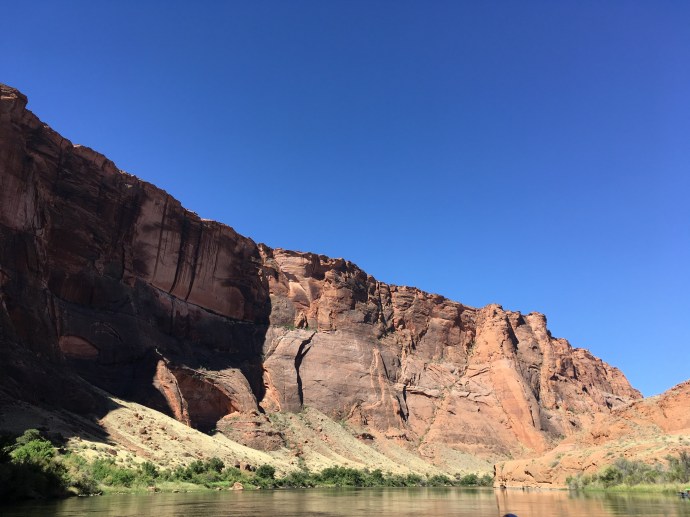
The beginning of Horseshoe Bend

As usual on such trips, the guide is eager to point out rock formations that resemble people, or animals, or shapes. Our guide was no exception but frequently to see the rock formation shape would take more imagination than I have. When we went through Horseshoe Bend, we could see the tiny figures of people 1000 feet above. When we visited Horseshoe Bend a few years ago, we stayed further back from the edge due to my vertigo and I would probably not have been visible to anyone on the river.

The trip finished at Lees Ferry, one of the few areas along the river with slopes gentle enough to allow early travelers access to the river. The LDS church sponsored an early ferry here to assist its members in their travels to Salt Lake City. Today it is a major jumping off point for river rapids rafters. Just downstream from Lees Ferry is a bridge that automobiles and travelers take to reach the North Rim of the Grand Canyon. That drive is spectacular, we took it in 2016.

View of Colorado River from Lees Ferry bridge

Buses were waiting to transport us back to Page. The journey takes an hour; roads are infrequent and the road back is not direct. The view of the Colorado River and the rock formations managed to keep it awake for the first 15 minutes. Lunch was at a Page restaurant called The Dam Bar and Grill. It was okay.

After lunch we headed back to Flagstaff for a last night with Lou and Joyce. We did make a stop at the Cameron Trading Post. This is a 100 year old store, restaurant and lodge and for many years was the major resting point between Flag and Page. Ice cream was our only purchase.
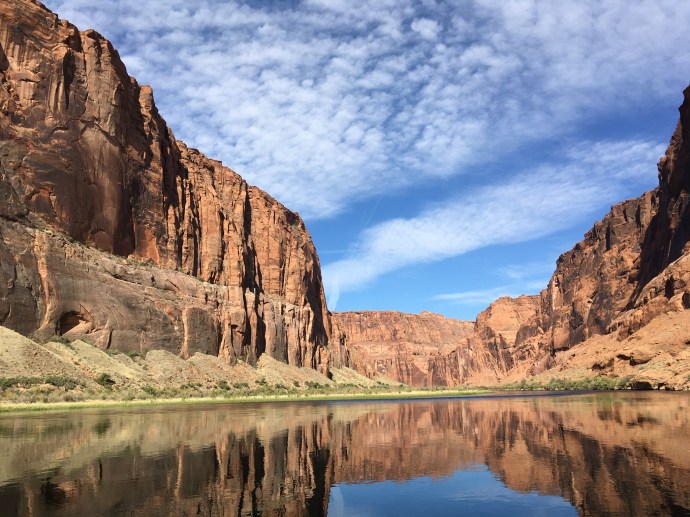
A beautiful morning on the Colorado River

Ed and Chris, June 3 Phoenix AZ

Categories: road trip, travel | Tags: , , , , | Leave a comment

2018 Trip 4: Arizona: May 30

Page, Arizona. Wednesday May 30

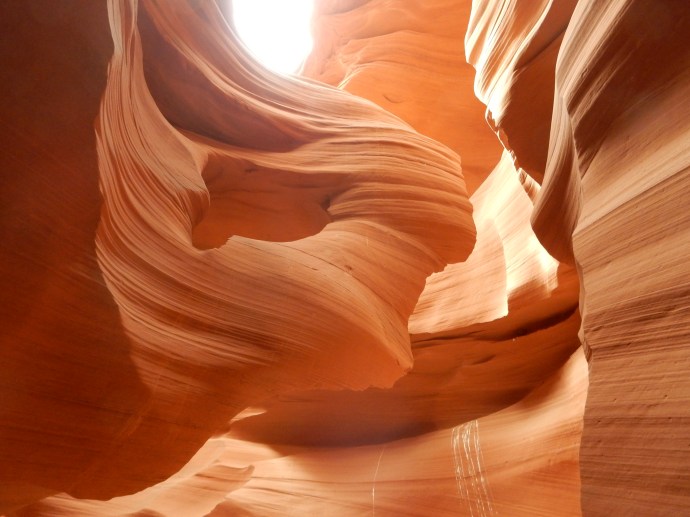
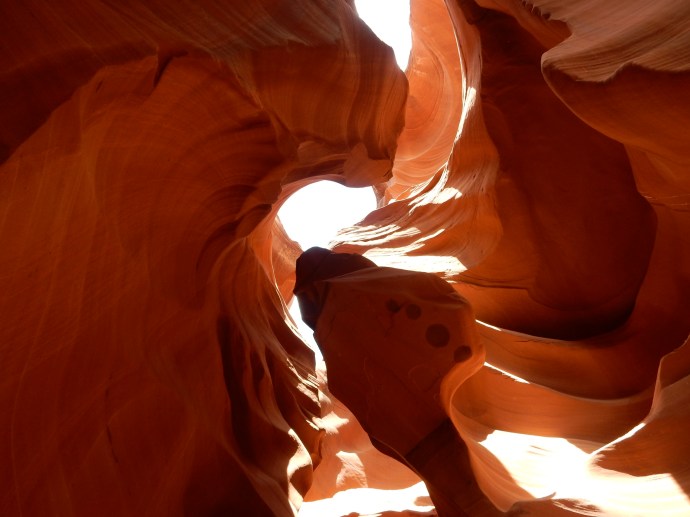
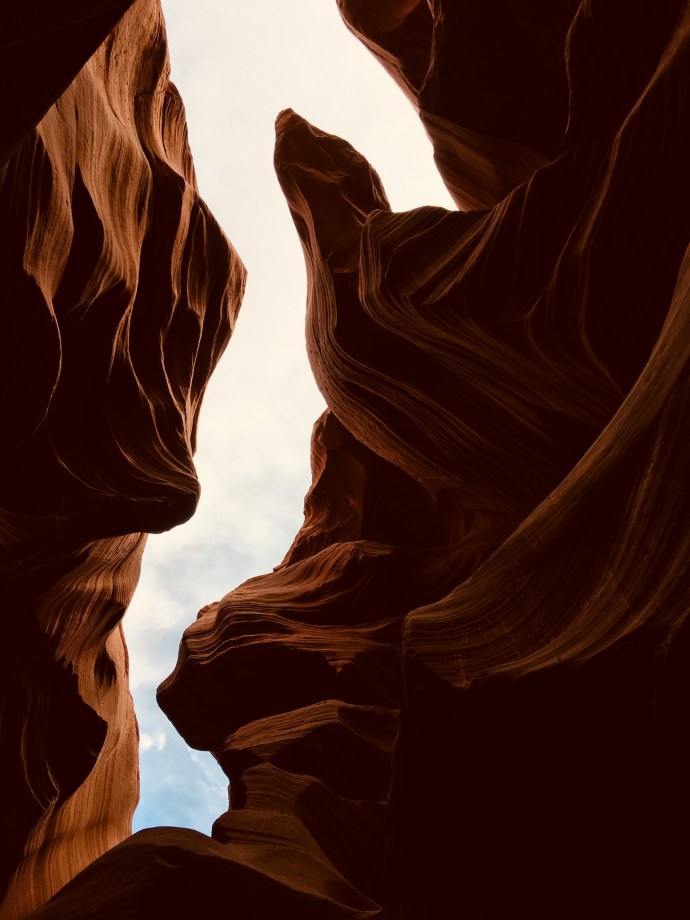
Lower Antelope Canyon, Page AZ

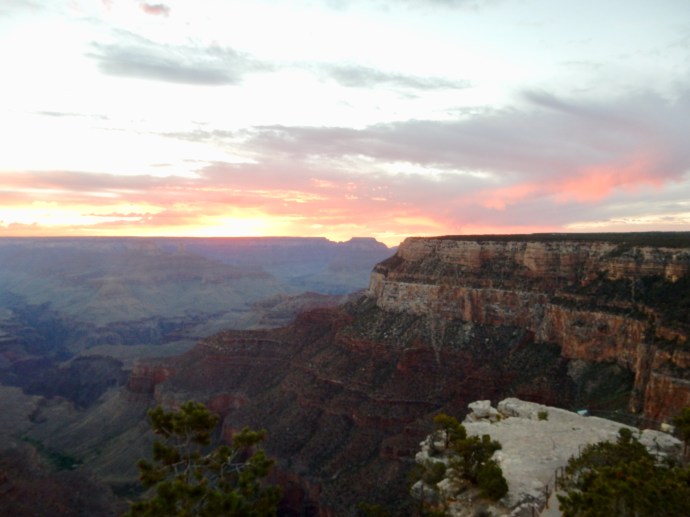
Chris and I were the good ones, getting up at 4:15 A.M. to view a Grand Canyon sunrise. Frankly, we should have stayed in bed. It was alright, but not dramatic. Too many clouds and not much red and orange to make the sunrise stand out. Still, we were proud of ourselves for getting up and walking to the Trail View Overlook for the sunrise.

Sunrise at Grand Canyon, Trail View Overlook

Bright Angel trail from South Rim Grand Canyon top; bottom hikers just starting out on trail.

Trail View Overlook is on the Hermits Rest rim trail. Cars are not allowed there most of the year; you either walk or take the shuttle. Hermit’s Rest juts out into the canyon so it is a good trail to use for sunrise viewing. Trail View is named because you can look down onto Bright Angel Trail, the trail taken by mules and most people hiking on the trail. Readers of the blog have read that I have vertigo now so walking along that trail is just not something on my agenda. Even at 5 AM we saw people beginning the hike. It usually takes twice as long to hike back up as it does to go down. You can choose just to walk a short portion, no pressure to do it all.

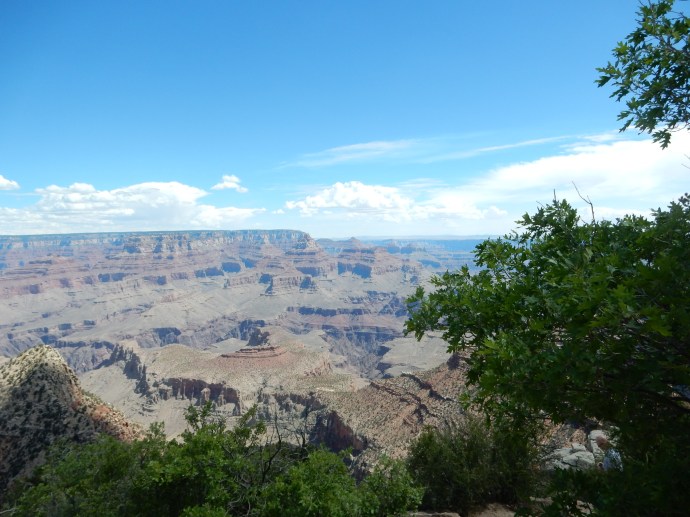
A departing view of Grand Canyon

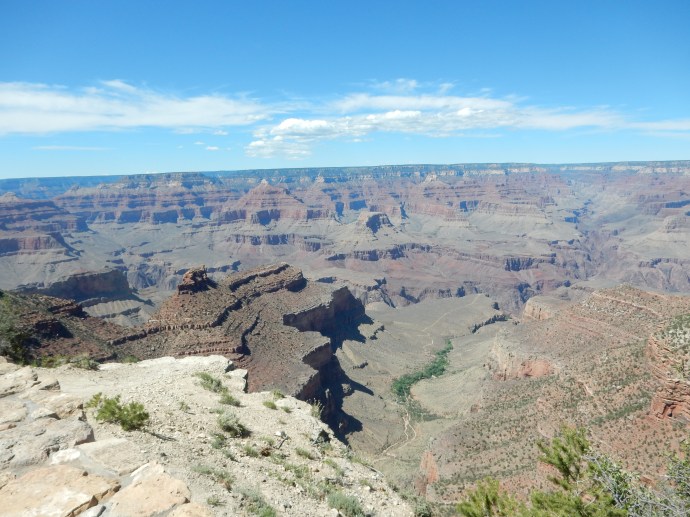
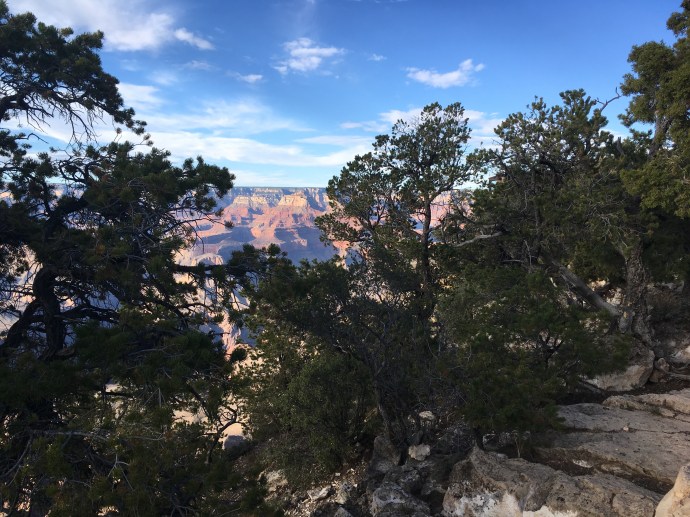
The four of us had breakfast and left a little before ten on our drive to Page, AZ. We stopped at two other overlooks on the way out. The view can change from stopping point to stopping point. Views of the Colorado River are infrequent; it is a mile down and the canyon is 10 to 12 miles wide here. The canyon twists and turns and canyon walls and lesser eroded walls block your view. During the 24 hours we were here, and including sunrise and sunset, I did not find the canyon as colorful as is frequently portrayed in paintings and photographs. Outstanding and awe-inspiring, yes.

On the drive to Page we stopped at McAllister’s Deli at Cameron. This interchange in the middle of nowhere has been improved with a roundabout and new restaurants and gas stations. Our destination was to reach Ken’s Tours at Lower Antelope Canyon by 2 PM. There are tours for Upper and Lower Antelope Canyon. Both are located on Navajo reservation land and the guides are Navajo. We prefer the Lower Antelope tours since: a. You do not have to ride an open air Jeep on dusty roads to reach the canyon; b. The walk through the canyon is one-way, you do not have to jostle and deal with people coming at you in order to take your photos.

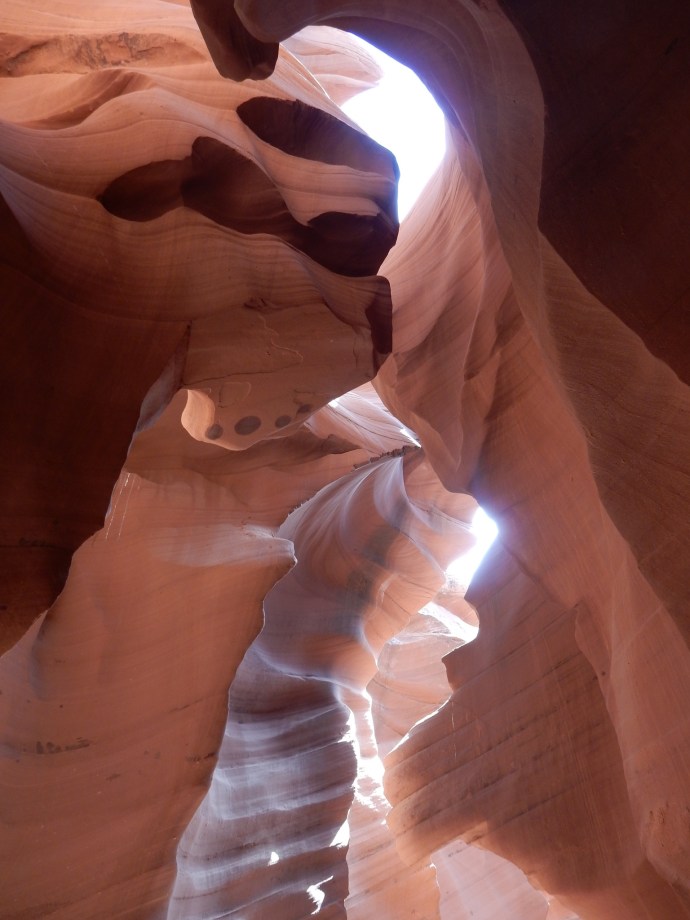
The tour takes an hour to an hour and a half. The canyon is formed by rushing waters after the monsoon season (July and August) rains erode away the sandstone. It is called a slot canyon, it is wider at the bottom and narrower at the top. As you walk through, watching for low overhangs and protruding walls, you are amazed by the wavy designs and formations observable all around you. There are also metal stairs that must be dealt with as you enter and a few times through the canyon.

Chris and I had been here once before, it was the first time for Deb and Rebecca. My words are poor efforts to describe the effect, I will allow pictures to paint the view for you.

Dinner was at Bonkers, a local restaurant with very good food. All of us were pleased, with the meal and the chocolate desserts.

Chris, Ed, Rebecca, Deb at Lower Antelope Canyon

Lower Antleope Canyon

Lower Antleope Canyon

Lower Antelope Canyon

Lower Antelope Canyon, Page AZ

Ed and Chris. June 1

Categories: road trip, travel | Tags: , , | 2 Comments

2018 Trip 4: Arizona: May 29

Grand Canyon, AZ. Tuesday May 29

Grand Canyon with the Colorado River from Desert View Watchtower at Grand Canyon National Park

It was a glorious day for visiting the Grand Canyon. Our plan had been to leave Flagstaff, drive through the San Francisco Peaks and Coconino Forest to enter Grand Canyon through the South Entrance. Reviewing the park’s web site made us switch plans. Road construction inside the park and summer attendance were forecast to cause delays in reaching the park. Instead, we drove north to Cameron and then west to enter through the East Entrance at Desert View Watchtower. I had been reluctant to go this route because we will leave the park through this gate Wednesday. It is our preference to view as much different territory as possible on our trips. Later on Tuesday we encountered the road construction and it verified the wisdom of using the East Entrance.

The drive up from Flagstaff begins with numerous inactive/extinct volcanoes on either side of the road. As we progressed north, the trees and volcanoes disappeared to be replaced with scrub brush and rolling buttes and escarpments. The Little Colorado River joins the road just after our turnoff to the national park. We stopped at Cameron Trading Post about a mile past the turnoff for some lunch which we packed away for later. The road has been improved since we last drove here and a McAllisters Deli added at the junction of US 89 and AZ 64. It did not open until 10 AM though so we catch it for lunch Wednesday or Thursday.

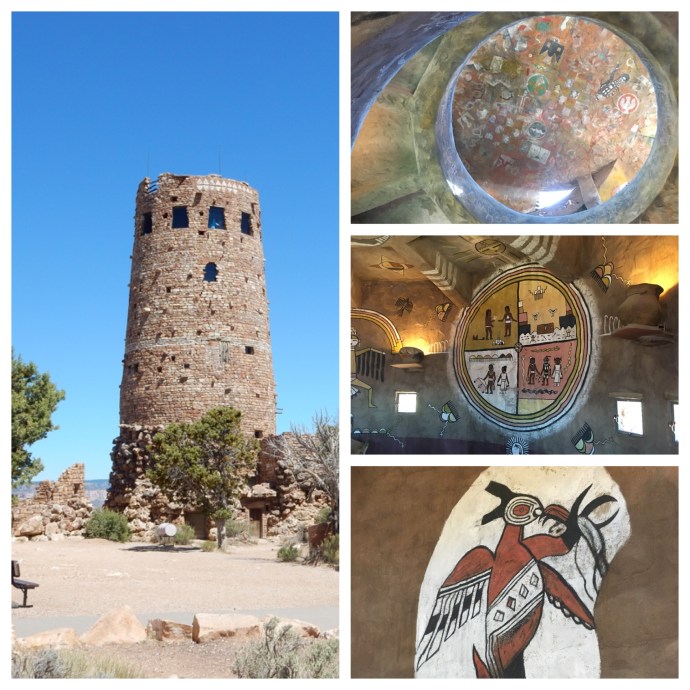
Desert View Watchtower with Interior Native American Indian symbols

Our first stop in Grand Canyon National Park was at Desert View Watchtower. This building, and several others, were designed by Mary Coulter, a famous female architect and designer who worked for the Fred Harvey Company and Santa Fe Railroad for 38 years. She incorporated Native American Indian styles into much of her work. The Watchtower is 70 feet high with a stunning view of the landscape. She designed the building with a modern steel structure but an exterior of weathered looking stone. It has Native American symbols on the interior walls.

As our first stop, we took our time here. The crowds were not too bad. The views from outside on the overlooks and from inside the tower gave us a great introduction to the canyon and the Colorado River. The temperature was in the high 70s and sunny all day; it made for great walking and picture-taking. The drive to the main south rim area is 22 miles. We saw some elk along the way and stopped at a few overlooks.

The main visitor center has an excellent introductory film which we viewed along with a few other displays. We ate our lunch outside and then walked the two some miles from the visitor center at Mather Point to the El Tovar/Hopi Point area.

Another view from the rim walk


Along the way we took pictures, took pictures of other people with the canyon in the background, and just enjoyed the day. By now it was after 3 PM. Chris, Deb, and Rebecca walked along the rim a bit more and then headed over to Maswik Lodge to check in.

Grand Canyon

Along the rim walk at Grand Canyon

Waiting for sunset at Grand Canyon

If you are paying attention, you remember that the car is back at the visitor center. I tried to take the shuttle back to pick it up. As I waited at the shuttle bus stop, a construction worker (remember the road work?) told me that the shuttle no longer stops here due to the construction. No sign was posted to that effect. So I took the Greenway Trail, a pedestrian/biking path through the trees most of the way back to the visitor center before I was able to catch a shuttle. The construction has messed up the timing of shuttles too. The shuttle I took was jammed-I compared it to the shuttle buses we take to the MN State Fair. Everybody gets in to fill the bus and then 20 more people pack in.

The four of us separated for a while and then met up at dinner at the food court in Maswik Lodge. Sunset viewing is a big deal here, good spots are taken early. We chose to drive out to the Geology Museum at Yavapai Point, getting a good parking spot and a good viewing spot. Since we had over an hour to kill before sunset, individually we walked a bit, took some pictures, and talked to people. Deb spotted a young elk along the path, drinking from water pooled by a water fountain.

Chris and I spent fifteen minutes chatting with a ranger. She was feeling sore. Last night, she and her partner transported a prisoner to Flagstaff. On the return trip, a deer hit the patrol car. She was in the passenger seat where most of the impact was and the air bag deployment was a little rough.

Sunset and moon rise at Grand Canyon National Park

The crowds increased as sunset neared and we took more than our share of photos. Last night was also a full moon. We hung around to watch the moon rise before heading back to our room.

All in all, a grand day at the Grand Canyon.

Ed and Chris. May 30

Categories: road trip, travel | Tags: , , | Leave a comment

2018 Trip 4: Arizona: May 26-28

Flagstaff, Arizona. May 28

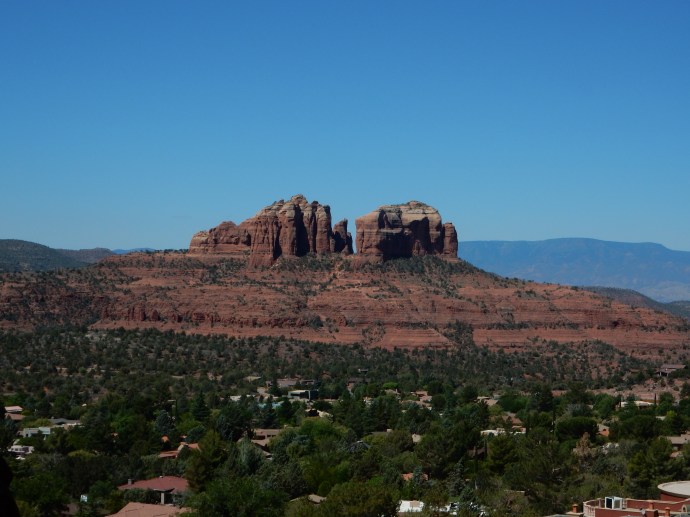
Sedona AZ view

Red Rocks of Sedona Arizona

The last three days have been a relaxing time with Chris’ brother Lou and his wife Joyce. We picked up Deb and Rebecca at the Sky Harbor airport in Phoenix late Friday night and spent the night in Phoenix. Saturday morning we drove the 150 miles to Flagstaff. Deb and Rebecca spent some time with an old friend of Deb’s; we walked around Flag. We picked up Deb and Rebecca at 4 and went to Lou and Joyce’s house.

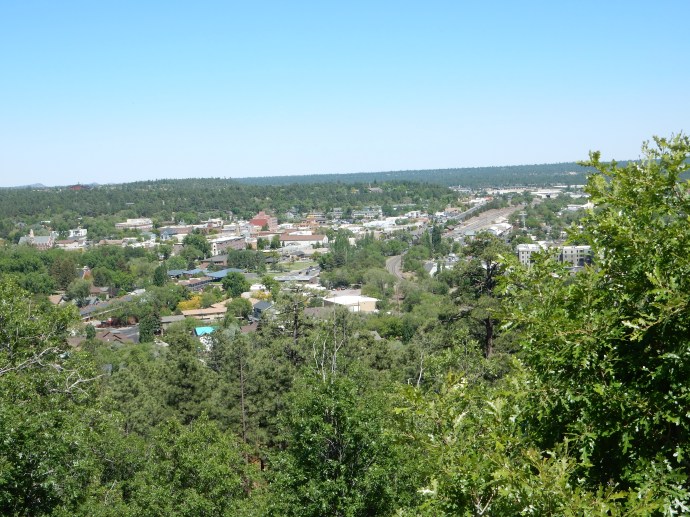
Downtown Flagstaff AZ

Looking at Flagstaff from the Lowell Observatory

Going for a walk along a created pond in Flagstaff

Sunday and Monday have been family oriented, spending time together, touring Flagstaff and nearby Sedona. Instead of writing narrative, we are just giving you photos. Greater narrative will resume as we visit the Grand Canyon.

Hiking in Sedona

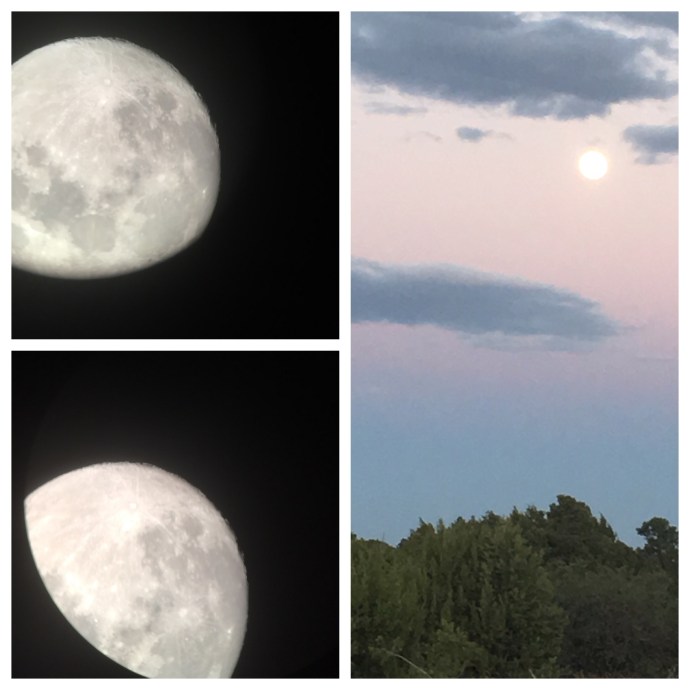
Left, moon photos taken through Lou’s telescope; right, full moon early this evening

View of Oak Creek Canyon towards Sedona

Chapel of the Holy Cross, Sedona AZ

Lunch in downtown Flagstaff

Ed and Chris. May 28

Categories: road trip, travel | Tags: , | Leave a comment

2018 Trip 4: Arizona: May 25

Phoenix, AZ. Friday May 25

Breakfast at the Guest House Inn at Ajo AZ to start the day off right

Ajo is now but a memory, a stronger one when I discovered this morning that a Minnesota designed the town in 1914. Lodging at Guest House Inn was great, Michael was a gracious host. Breakfast was delicious and the bed gave me a great night’s sleep. The B & B had been the location where visiting dignitaries to the copper mine stayed when the mine was still operational. (By the way, RW if you are reading this, I hope you saw our email and responded to Michael.)

As we drove out of town, we stopped at the offices of the Cabeza Prieta National Wildlife Refuge. Cabeza is the third largest refuge in the lower 48 states and is primarily desert and mountain. But as the introductory video states, desert does not equal barren of life.

One needs a wilderness permit to enter the refuge which we obtained but we could have skipped it. Once again, high clearance vehicles are “suggested”. We tried the first mile or so of road but decided once again to be cautious and avoid the potential for damaging the bottom of the rental vehicle. Some time we will have to visit and make sure we have a true high clearance vehicle and go wild on back road trips. We passed another wilderness area, Sonoran Desert National Monument on the way back to Phoenix and just kept driving.

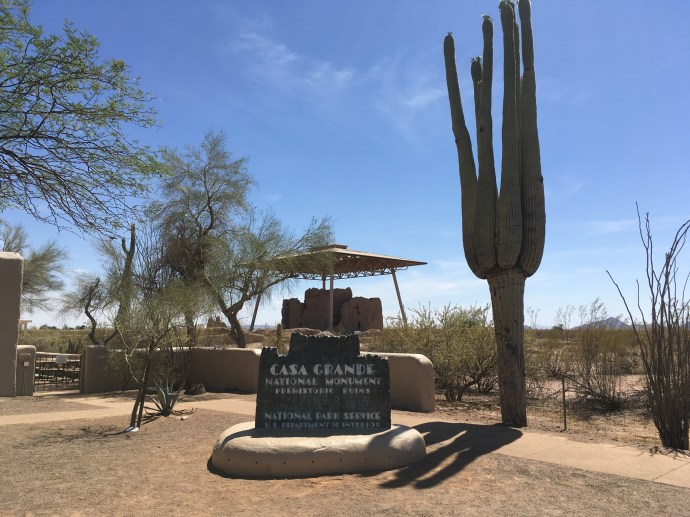
Casa Grande Ruins National Monument, Coolidge AZ

Phoenix was our eventual destination to pick up Deb and Rebecca who will join us for the next eight days. Their flight does not land until late in the evening so we dropped in at Casa Grande Ruins National Monument. This is a NPS unit that Chris and I had disagreed whether we had been here before. I said yes, Chris said no. Once we arrived, we realized Chris was right.

The area around Phoenix was home to people now called the “Ancestral People” who probably arrived around 300 C.E. Over the next thousand years various changes took place, including the change from smaller settlements to larger ones. Casa Grande is the largest known of those large settlements, home to about 2,000 people. Casa Grande is named due to the still-standing four-story Great House.

By the time European explorers arrived in the area, the Ancestral People had dispersed. While not known for certain, best theories believe a combination of weather related conditions caused a societal breakdown and the people dispersed. Six Native American tribes claim ancestry to the Ancestral People.

Map of irrigation canals top; bottom remnant of canal by Casa Grande

We do know that the Ancestral People created a system of canals, close to 220 miles worth, to be able to irrigate crops with water from the Gila River. Without steel implements, this would have been a major task for the community to create. Highly skilled craft remains have been found, indicating the communities had time for more than just work.

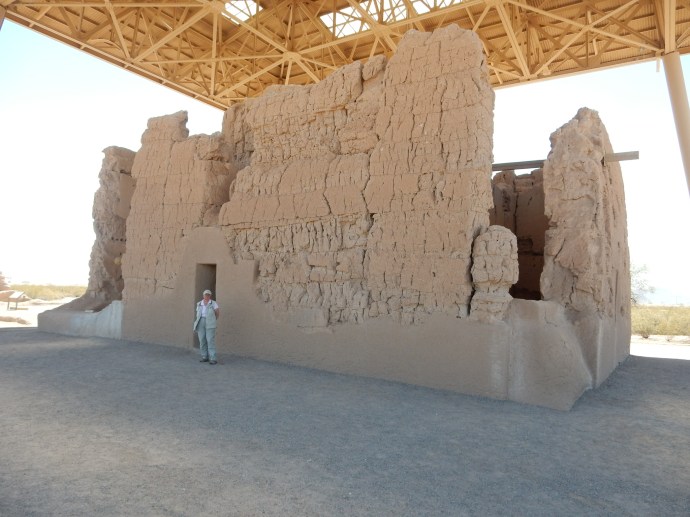
Casa Grande up close

Casa Grande was constructed in layers of local building material called caliche, a desert sand high in calcium carbonate mixed with water to form a concrete like substance. The building is oriented north and south with astronomical openings that line up to record the spring and fall equinoxes and the summer solstice.

Casa Grande Ruins was declared the nation’s first archaeological preserve in 1892 and a national monument in 1918. From the picture, you can observe a shelter over the ruins to protect them from the elements. The shelter is called a “Ramada”, or open air shelter, was designed by Frederick Law Olmsted, Jr. and constructed in 1932.

The wispy residue of a dust devil

While walking around the site, we experienced a short but nasty wind storm, with the wind creating the type of dust devil I wrote about a few days ago. This time, we had to close our eyes and turn away from the wind; by the time it died down enough for me to get my camera out, I was only able to snap the few wisps of dirt in the air above us.

The rest of the day was spent driving back to Phoenix, checking in to the hotel and having dinner. We picked up Deb and Rebecca at the airport. As usual for us, we did a test run to the airport and spotting the best location to meet them. Of course, the test run was done flawlessly with few cars or people around. Pick-up time at 9:30 PM was jammed though. But we found them.

Saturday we will head to Flagstaff for the second half of this trip, visiting Lou and Joyce, and taking Deb and Rebecca to the Grand Canyon, Antelope Canyon, etc.

Ed and Chris. May 26

Categories: road trip, travel | Tags: , , , | Leave a comment

2018 Trip 4: Arizona: May 24

Ajo, AZ. Thursday May 24

Organ Pipe Cactus National Monument

Only one major goal for today, Organ Pipe Cactus National Monument. It was founded in 1937 to protect the Sonoran Desert and the organ pipe cactus here. Organ pipe cactus are more at home in Mexico than the U.S. This location is at the northern reaches of the cactus’ range. Organ Pipe Cactus National Monument protects a wide variety of plants and animals, allowing them to flourish in their native environment without much human interference. The United Nations recognized the monument’s value and its success in protecting the environment in its natural state by naming it an International Biosphere Reserve in 1976.

It took us all morning to reach the monument. We left Green Valley, going north in I-19. I-19 is an interesting anomaly. It is the only United States Interstate Highway marked in kilometers, not miles. According to our Evergreen hosts, the highway was being built during a time when the U.S. was planning to convert to the metric system. The highway planners did not want to install signs with miles as a measuring unit if they would shortly have to take the signs down and install new signs in kilometers. The decision was made to install kilometer signs from the beginning. Then, the U.S. backed down on the metric conversion but the I-19 signs were already up. Locals did not want to change their address on all of their marketing measures. The decision was made to support the local preference and the use of kilometers continues to this day. It did throw us off the first time we drove on I-19.

I-19 was just a blip today as we turned off it and headed west on Arizona 86. Shortly after leaving the Interstate we were on a two lane road, speed limit 65. We went through the Tohono O’odham Indian Reservation for the entire drive to Why, AZ. Why, population 162, was our lunch and gas stop. Restaurants and gas stations are not plentiful here so you gas up when you have the chance.

One of the more elaborate memorials along AZ 86

Along AZ 86, we observed roadside crosses and memorial displays. When driving through the U.S., particularly on two lane roads, one observes a white cross where a person died in a traffic accident. On AZ 86, these crosses were too numerous and too elaborate to fit that pattern, at least in my mind. Upon arrival at Organ Pipe, I checked in with a ranger (new, so she had to talk to a more veteran, locally knowledgeable ranger). The Tohono O’odham have a deep reverence for the dead, the memorials on the highway do reflect where a fatal accident occurred. It is just that the memorial is maintained for decades by family members.

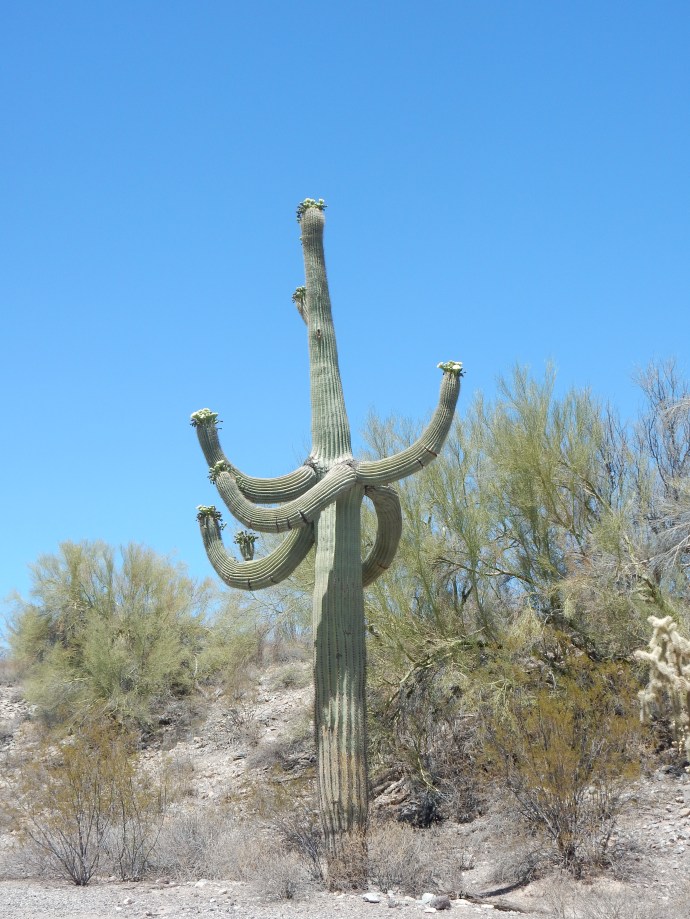
Saguaro cactus

Organ Pipe is 20 miles south of Why. We stopped in for the introductory video and then drove around for an hour and a half. I make no apologies for not hiking. It was hot and the scenery did not vary dramatically in the areas we could reach. Some of the roads were high clearance vehicles only. I did not want to risk the rental car on those roads. It is a long way from any AAA service station.

Organ Pipe Cactus

The organ pipe cactus were not the primary variety of cactus we saw. In fact, sometimes we had to really look around to spot them. The combination of desert vegetation and mountain backdrops did make for enjoyable viewing.

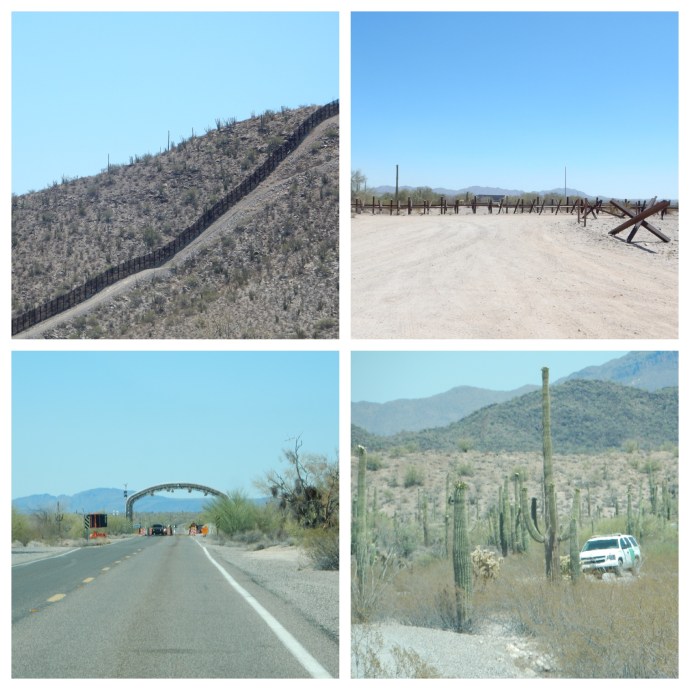
Border shots; the wall, the first wall for cars, road checkpoint, and Border Patrol vehicle in Organ Pipe Cactus National Monument

Organ Pipe backs up to the Mexican border and the monument road provided a great opportunity to view “The Wall”. Two versions were visible. One was an initial fence built like construction barricades to prevent cars from driving over the border. The second fence type appeared newer and designed to stop individuals. The visitor center is named for a park ranger who was killed in 2002 while responding to the illegal border crossing of two violent criminals fleeing an incident in Mexico. Border patrol vehicles were frequently spotted in the monument, we were not stopped. We passed through two roadside checkpoints during the trip, again we were just waved through.

After Organ Pipe, we drove to Ajo. For the third night in a row, unplanned, we have slept, or will be sleeping, in the shadow of copper mines and their disposal sites. Ajo is the site of a large copper mine, closed in 1985, and now owned by Freeport-McMoRan. Same owners as the Bisbee copper mine.

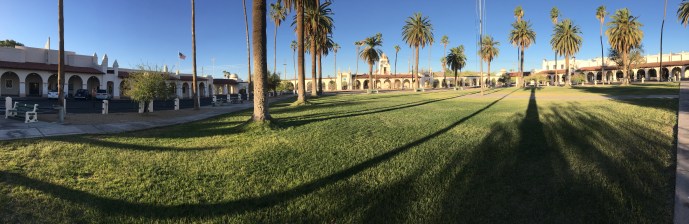
Downtown Ajo plaza and park

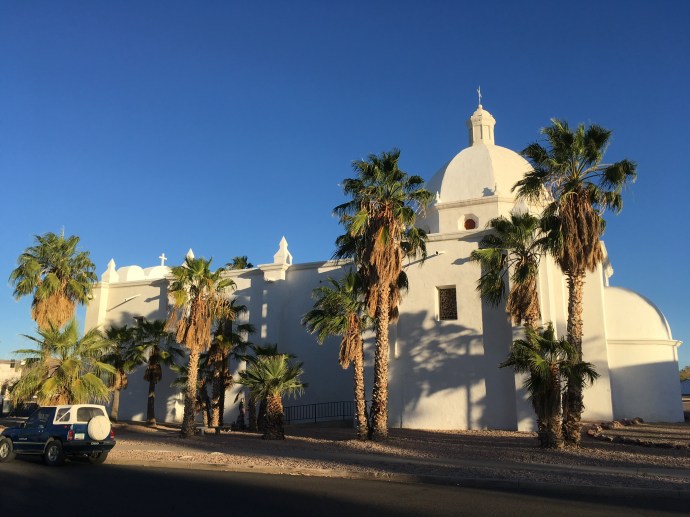
Catholic Church Ajo AZ

Ajo was built as a company town. The downtown plaza, two churches, school, and hospital were built and are still impressive although some are vacant and some have been repurposed. Initial mine owners tried to send the ore to Wales but that was not economical. The next owners were from St. Louis and after several false starts and more new ownership, in 1915 open-pit mining began here. It was the first open-pit copper mine in Arizona. The pit today is 1.5 miles wide and 1,100 feet deep. We saw mountains of remains, probably the overburden removed to reach the ore and the slag produced from the smelting process. Our B and B is just blocks from the pit.

Ajo is not a major summer destination. Our dinner was at Pizza Hut, one of the very few options available. The town has decreased by 50% since the mine shut down but has been stable for the last two decades. New residents appear to be retirees and Border Patrol workers. There was a “scandal” as the feds built very expensive new housing for the Border Patrol employees rather than buying and rehabbing the many vacant homes. One industry in town is the business of selling Mexican insurance. It is only 100 miles from here to the Gulf of California. RVs and trucks towing boats were the primary vehicles on the road.

Ed and Chris. May 24

Categories: road trip, travel | Tags: , , , , | Leave a comment

2018 Trip 4: Arizona: May 23

Green Valley, AZ. Wednesday May 23

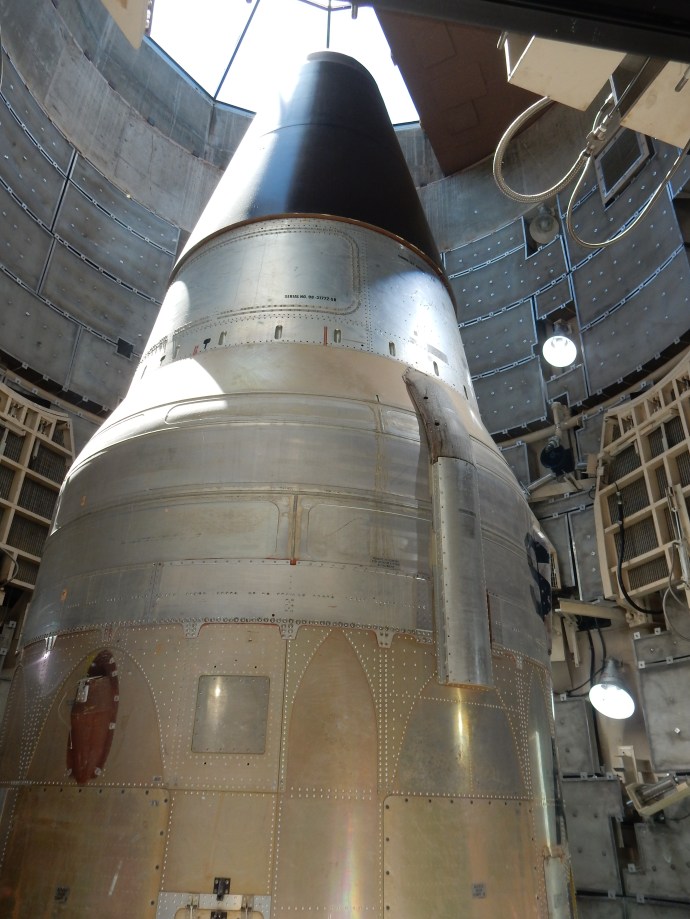
The inoperable Titan II missile

Arizona is a major mining state, this we knew coming in. We did not know that there had been 18 Titan II missile sites ringing Tucson AZ. Missile sites in ND, SD, Nebraska, etc. we knew about previously. Arizona missile sites are a new piece of information that we learned today at the Titan Missile Site Museum just south of Tucson. There were a similar number of sites around Little Rock, Arkansas and around Wichita Kansas. The tour takes 75 minutes and includes a visit to the missile silo and command room.

Our docent at the command center at Titan Missile Museum

The site was built in 1963 and de-commissioned in 1984. Successful efforts to make it a museum began right at the time of the de-commissioning efforts. The museum includes a real missile unable to fly and a dummy warhead, along with the original control center and mechanical equipment. As part of the nuclear de-armament process, we have to make de-commissioned missile sites available to be inspected by Russians as non-operational. Thus, the warhead has a window in it to show it was disarmed and the silo cover is permanently made inoperable.

Our tour discussed the construction of the silo and command center, with details on the redundancy of fail-safe systems, the ability to withstand nuclear strikes near-by, the protection from intruders, etc. The Titan II missile was extremely powerful and when de-commissioning occurred, the remaining missiles were removed and have been used to send up communications satellites and to send some of the early space exploration efforts.

Just minutes from the missile museum is a mining museum run by ASARCO, a huge U.S. mining company owned by a Mexican company. Kind of ironic, we took Arizona from Mexico and Spain who were seeking gold and other minerals. Spaniards did not find it in the 1500s to 1700s, not until the mid to late 1800s was mineral wealth discovered in Arizona. Now the minerals are being mined by a Mexican company.

The ASARCO Mineral Discovery Center only offers mine tours on Saturdays at this time of the year but exhibits and films explain the mining process and necessity. Certainly the films are presented from the company viewpoint, I can not accurately evaluate their true safety and environmental actions and record. I came away with two major points.

A wall map of the Mission mine site by Green Valley

First, the mine here in Green Valley-Sahuarita is massive, a conglomeration of several previous mines that are now one big mine. The mine goes two miles long and 1.75 miles wide. The reclaimed mine-related area stretching along I-19 seems to me to stretch over 20 miles. ASARCO has two other, large mines in Arizona.

Second, the world needs minerals which only come from mining. If we expect to construct buildings, to use electronics,to eat nutritiously, than mining has to occur. Not stated at the ASARCO museum, but self-evident, is our society has to determine under what conditions and at what cost that mining occurs.

Madera Canyon

By now it was time for a late lunch, which we satisfied at Manuel’s Mexican restaurant. After lunch, we drove to Madera Canyon, a well-known part of the Coronado National Forest. There are trails and picnic tables in a shady canyon with a (today at least) dry creek. Madera Canyon is a well-known birding location with birders from around the nation coming here. It was a warm afternoon and we took short hikes and did some bird-watching before returning to our Evergreen hosts.

Ed and Chris. May 23

Categories: road trip, travel | Tags: , , | Leave a comment

2018 Trip 4: Arizona: May 22

Green Valley, AZ. May 22, Tuesday

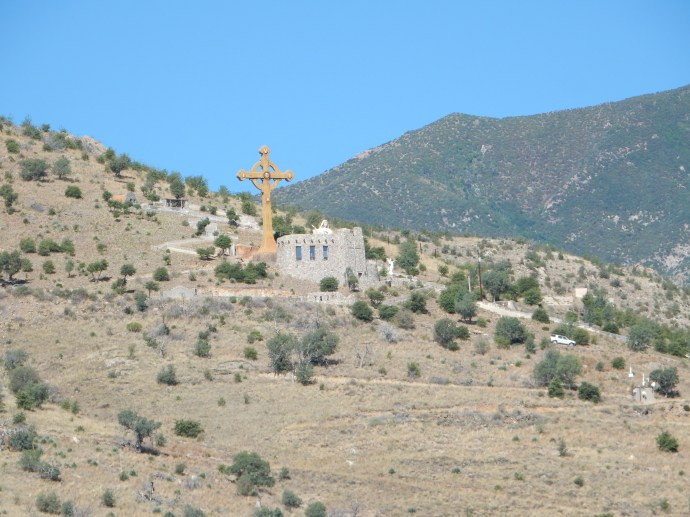
The shrine that drew us in

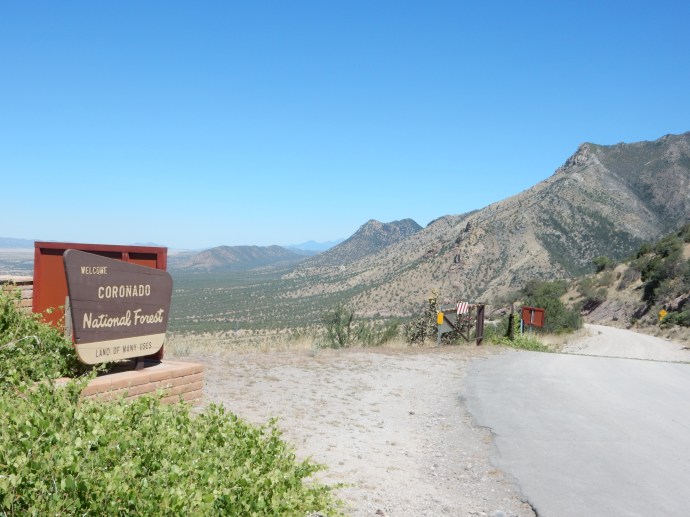
We have been to the mountain top and back to the valleys. Leaving Sierra Vista, our primary goal was to traverse the Huachuca Mountains and end up in Green Valley AZ, our lodging stop for the next two nights. Coronado National Memorial was our intended first stop and home to the road taking us over the mountains.

Looking down from the shrine

On our drive south from Sierra Vista, we knew we would pass the The Lady of the Sierras Shrine. We had not planned to stop. From Highway 92, though, the shrine stood out on the eastern slope of the mountains. It drew us in. The shrine has a chapel which is supposed to open at 9 AM but was still closed when we left around 9:15. A large cross and statue of an angel were also attention grabbers.

Stations of the Cross at Our Lady of the Sierras shrine south of Sierra Vista

After parking in the main lot, we hiked up the slopes past the Stations of the Cross; each one built into the side of the mountain, the next one always a little higher up than the previous one. The culmination of the 14th station was the tomb built into the hillside. We were not planning to do a lot of hiking today, the steps up this hillside were unplanned but proved to be sufficient exercise for the day.

On to Coronado. This NPS unit was created in 1941 with a hope that an adjoining park would be created in Mexico. The result would be a joint park like Glacier-Waterton on the U.S. Canada border. Mexico did not reciprocate. The purpose of the park is to recognize the goodwill and cooperation between the U.S. and Mexico through recognition of the endeavors of Francisco de Coronado. Coronado was a Spaniard who led a large expedition through a large swath of the southwestern United States. He and his subordinates went east as far as Kansas between 1540 and 1542. They were looking for gold, particularly the rumored “Seven Cities of Gold” which never did exist.

On the next turn after this one we encountered an oncoming NPS jeep.

The Coronado National Memorial visitor center has exhibits and displays, which we read. After the visitor center, we began the driving journey, about 20 miles on a twisty mountain road. Tight corners and switchbacks gave little warning of oncoming vehicles (nothing over 23’ allowed); at one corner we had to back up a ways to find a spot where we and an oncoming NPS pick-up were able to pass each other.

The view from Montezuma Pass in Coronado National Memorial

Three miles in, twenty minutes, and 1,300 feet higher, at 6,575 feet we reached Montezuma Pass Overlook. Far ranging views both east and west greeted us. The road continues westward as a gravel mountain journey for another 18 miles to Parker Canyon Lake. Other than the sections that resembled a washboard, the road surface was reasonable. On this stretch we encountered half a dozen Border Patrol vehicles. None stopped us.

Looking west from Montezuma Pass

Parker Canyon Lake is maintained by the Forest Service, part of the Coronado National Forest. Reclamation efforts were visible to stop erosion. Parker Canyon Lake is used to provide irrigation water for the surrounding lands. We just made a picture-taking stop since it was nice seeing a lake in Arizona. Pictures completed, we moved on to Sonoita to have lunch. No luck, no restaurant open.

Next town was Patagonia where the downtown was more thriving. Of course, Patagonia has more people, about 900 compared to Sonoita’s 800. We had lunch at a hotel with an attached restaurant, good food. The free Patagonia Regigonal Times newspaper did have a headline though that lead zinc mining sludge has been seen leaching out of a local, long-abandoned mine.

To reach our next destination, we drove southwest toward Nogales before heading north to Tumacacori National Historical Park. In 1908 Tumacacori was recognized as a National Monument to recognize and protect the then deteriorating buildings of a mission started in 1691. In 1990 it was redesignated as a National Historical Park.

The mission church at Tumacácori National Historical Park

Tumacácori was founded in 1691 by a Jesuit missionary (Padre Kino) to convert and aid the O’odham people who had requested assistance from the “Black Robes” (Jesuits) in improving the O’odham peoples agricultural practices. Kino was to work in this area for over 20 years and established numerous missions. The Santa Cruz River is less than a mile away and provided irrigation water.  Kino introduced wheat, livestock and fruit to diversify the food supply.  The O’odham and Yaqui Indians were taught Spanish and Catholicism.

Like most of the history of Spain in America, conflicts developed. Apache raids, Spanish infighting back home, lack of government support, encroaching settlements, disease, the Mexican Revolution all contributed over time to a dwindling Indian presence and to a dwindling Spanish and Mexican presence at the mission. It was abandoned in 1848.

Interior of the mission church at Tumacácori National Historical Park

When named a national monument in 1908, the buildings had deteriorated but restoration efforts have been effective. The brightly colored paintings that existed at the time of the active church are not present, only a few faint images. The site includes Tumacácori and two neighboring missions. Main visitation is at Tumacácori where the later mission church stands, along with several outbuildings foundations.  The intro video is old but between it and a well done museum, the story of the mission and the people of the area is effectively told.

After the mission we drove to Tubac. Tubac historically was the site of a military presidio, now a state park,  which we skipped. Tubac is a collection of bright painted and decorated adobe style buildings occupied by a variety of artists and accompanying tourist stores. We stopped for some ice cream and enjoyed the pleasant day in the shade.

Our lodging for the next two nights is with an Evergreen host in Green Valley. Green Valley has a population of over 20,000 and is just 20 miles south of Tucson. It is primarily a retirement community surrounded by agricultural and mining lands. As we drove in we could observe the recognizable terraced hillsides of a mining area being reclaimed.

Ed and Chris May 23

Categories: road trip, travel | Tags: , , , , | 1 Comment

2018 Trip 4: Arizona: May 20

Sierra Vista, Arizona Sunday May 20

Entering into the Queen Mine Tour

Sunday, normal weather for Arizona. Sunny and warm. Only question seems to be if the day will be windy. The forecast says sunny with highs in the 80s and 90s for the rest of week for southern Arizona. We checked out of the Holiday Inn Express in Willcox; on the positive side the rooms were fine, the milk at breakfast was cold and they had great, warm cinnamon buns. On the negative side, our room was overlooked for cleaning Saturday and the hot food at breakfast was bland.

The next two nights we will be staying in Sierra Vista, AZ. From Willcox, we drove west on I-10, stopping again at the Texas Canyon rest stop for pictures from the other side of the road. We went to church in Sierra Vista and then drove to Tombstone. Most Americans think of Tombstone and connect it with the gunfight at the O.K. Corral. Tidbit: O.K.stood for Old Kindersley. Kindersley was the previous owner and people referred to the corral as Old Kindersley’s corral eventually shortening it to O.K.

I am not going to make a drawn out discussion of the gunfight, suffice it to say that it put Tombstone on the map and later movies and books have made it a permanent fixture in American lore. We went to Tombstone more to understand the history of the old West and this town. Like many places in Arizona, mining played a boom and bust cycle here. The old courthouse in Tombstone is now a state historic park and has displays of that early time. It was our first stop.

Historic Tombstone Courthouse State Park

Tombstone is named due to its first successful prospector who was told he would not find rocks with minerals in the area, only his own tombstone since the Apache Indians were still fighting the U.S. Army. In 1877 he discovered silver and gold ores and named his claim Tombstone and the city was founded in 1879 with that name. By 1882 the town had between ten and fifteen thousand residents. In 1883 and 1884, silver production boomed and the price declined. Combined with operational difficulties at the mines with too much water seeping into the underground mines despite huge pumps, the mines went bust.

A few years later the price was back up and silver mining increased. Then the Panic of 1893 caused another bust. One more boom period occurred before the silver mining closed completely due to the water issues and the low price of silver. Silver mining does not occur in Tombstone any more. The population decreased, the county government was moved to another town, and Tombstone sank towards oblivion. Movies and TV kept the Tombstone name alive and today Tombstone is primarily a tourist city with a population of 1,300.

Downtown Tombstone

Since we were in Tombstone, we did shell out to watch a documentary and visit the site of the O.K. Corral Gunfight. There are frequent re-creations and characters dressed in period costume roam the streets. Stage coach rides, walking tours, T-shirts, trinkets, etc. are omnipresent. Lunch was at a small family restaurant where we had some good burgers.

After Tombstone, we continued the history tour by driving to Bisbee, a former mining town. Bisbee began as a copper, gold, and silver mining town in 1880. Its production of these minerals was vast but not without hassle. Around the First World War, the Phelps-Dodge company and the local government twice deported hundreds of miners who were viewed as a threat to start mining unions in the area. Mining and the town’s population went through boom and bust cycles. Open pit mining began during WWI, underground mining continued also. By the 1970s, the higher grade ores had been mined and all mining ceased until a few years ago when it resumed on a small-scale basis.

The Lavender Pit-named for the man who began open pit mining in Bisbee

The Queen Mine Tour takes one underground to view the mining tunnels of a mine closed since the mid-1970s. The tour was part of an effort to help the economy stabilize after mining ceased. Today the tour and a cutesy, art scene keeps Bisbee alive although it does still lose population at each census. The town looks like a mine town. While environmental efforts are at work to reclaim mined out areas, there is a hundred year history of mining to overcome. The Lavender Pit is a huge hole in the ground and it with surrounding scalloped mountainsides are the major impression one has when leaving Bisbee.

The mine tour was worthwhile, though. It lasts 75 minutes. You ride on an authentic mine car into the mine on a horizontal tunnel. For this tour, besides a hard hat and vest, you have a light to get to play along the sides and roof of the mineshaft. The tour guide covers the mining process from its earliest days until the 1970s. There are over 1200 miles of tunnels carved into mountainsides of Bisbee. Through a period of consolidation, Phelps Dodge acquired ownership of the vast majority. In 2007, Phelps Dodge was bought out by Freeport-McMoRan, a vast mineral mining and development company, located in Phoenix.

We drove back to Sierra Vista and checked in at the Hampton Inn. Dinner was at Outback where our waitress had recently moved to Sierra Vista from Hastings MN to be near her aging mother. We shared numerous stories and left stuffed.

Ed and Chris. Sierra Vista May 21.

Categories: road trip, travel | Tags: , , , , , | Leave a comment

2018 Trip 4: Arizona: May 19

Willcox AZ Saturday May 19
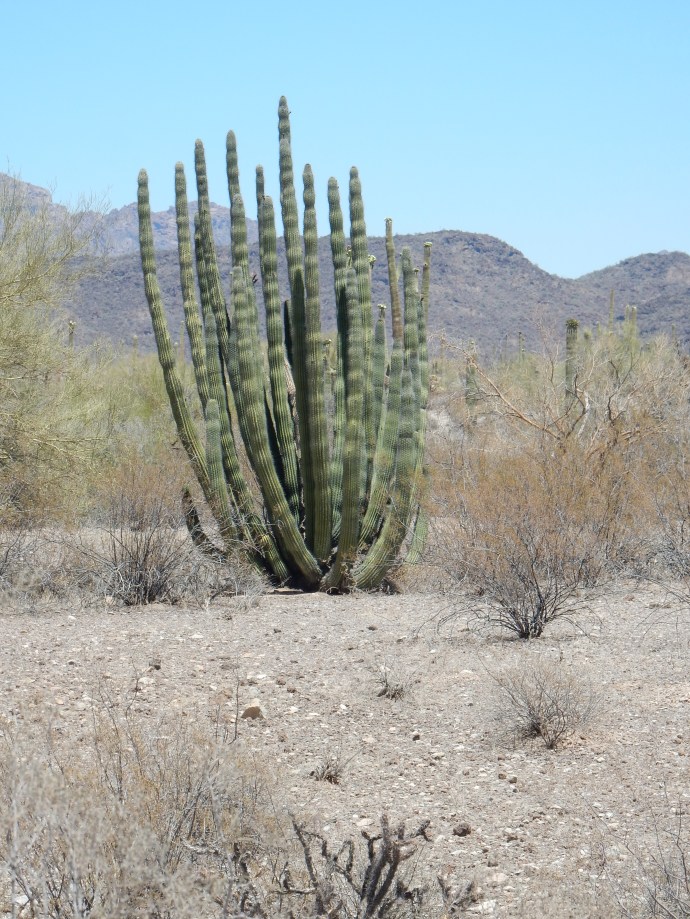
Organ Pipe Formation at Chiricahua National Monument

Up and out early today. When climbing in hot weather, one wants an early start. So we were away from the hotel by 8 AM and at the trailhead by 8:45 AM.

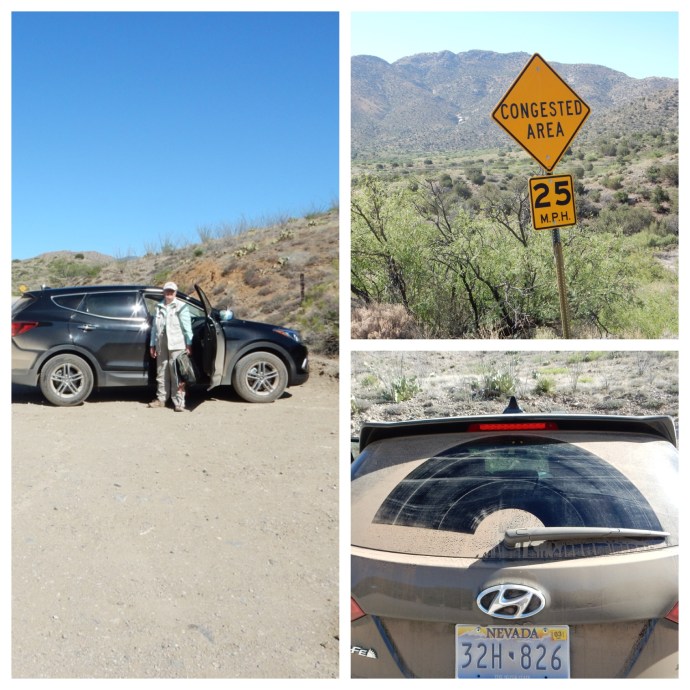
Fort Bowie Trailhead parking lot. Dirt road leads to it, we thought it was interesting to see the congested area sign and no one else in the parking lot when we arrived

Fort Bowie National Historic Site has an unusual feature. One must hike 1.5 miles from the parking lot up to the fort at Apache Pass in the Chiricahuan Mountains. Actually I liked the requirement. The hiker not only observes the change from grasslands to thickets of small trees and brush, but can visualize being on one of the early stage coaches on the Butterfield Line and seeing Indians on horseback on the ridges above. Of course, that visualization is more due to TV westerns than reality, but still it resonates.

As related at the Amerind museum Friday, the Apaches had seven different but related tribes. The Chiricahuas were one of the seven and lived in southern Arizona and New Mexico. Apache Pass was part of their normal territory. If you have the time, the trail to Fort Bowie provides several opportunities to learn more about the Chiricahua and about westward expansion by settlers eager to cross Chiricahua territory to reach California and other western locations.

The spring at Apache Pass, another reason the area was so important

You may recall the names Cochise and Geronimo. Both were Chiricahua Apache. Cochise came to leadership before the Civil War and in many ways preferred accommodation to fighting. Unfortunately, circumstances did not always assist. In 1861 a raiding party of unknown Apaches stole cattle and the stepson of a local rancher. Cochise and the military met to discuss this at Apache Pass. Cochise was accused of being the guilty party. Cochise denied it but offered to help find the boy. The U.S. military did not believe him. Cochise, insulted, escaped and for the next eleven years the U.S. military and the Chiricahua were at war.

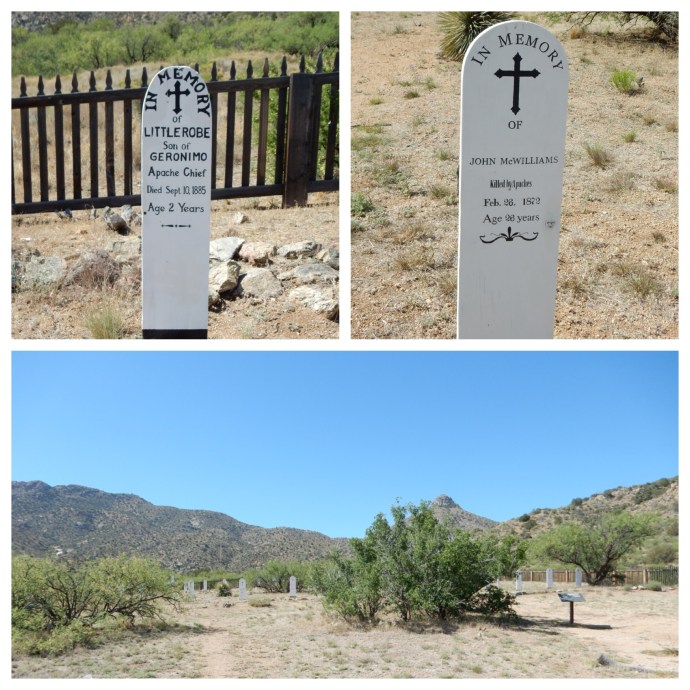
The cemetery along the trail to Fort Bowie

At another spot, you come upon a cemetery. Here the soldiers buried their dead. But you also find graves of Indians, including one of Little Robe, a two year old son of Geronimo. Little Robe was one of 15 Chiricahua captured by the U.S. in Mexico in 1885 and brought back to Fort Bowie as captives. The soldiers grew attached to the two year old boy but he died soon after, probably of dysentery. He is buried here. Apache custom was to bury their dead in small caves or crevices and to conceal the location. Cochise, for instance, was buried in a location not found to this day.

Fort Bowie close up

Upon reaching Fort Bowie, you can observe the value of the pass in crossing the mountains on either side of you. As usual, the ranger on duty was informative and helpful, after visiting over 200 NPS sites, I don’t think we have met even 5 rangers who were less than great. We also met a couple from Doylestown PA who have been retired for 13 years and we swapped various travel suggestions.

The fort itself is not reconstructed as were several forts we have visited. Various buildings have partial walls showing and you can walk the area and visualize what the site would have looked like in the latter half of the 1800s. Fort Bowie had a short life. A first fort was built in crude style and lasted less than six years. A larger, better fort was built in 1868 and these are the main ruins you can view. From 1862 to 1868, Fort Bowie was active in the campaigns against the Chiricahua. Geronimo surrendered in 1886. He and the whole tribe were exiled, the reservation abolished, and Geronimo ended up in Florida. We had previously visited Fort Pickens in Florida and the Castillo de San Marcos in St.Augustine where he and his family were separately housed for a number of years.

One other sad note. We lived in Carlisle PA for over 20 years. Particularly in the early years there, one read of the Carlisle Indian School (now home to the U.S. Army War College) and how the U.S. trained Native Americans in work skills and reading. It was only in the latter years and as we have traveled that one learns that the Indian children sent to Carlisle were forcibly removed from their families and forbidden to learn or practice their native religion or culture. Fort Bowie displays stated that the Chiricahua children were primarily sent to Carlisle and how many of them died there.

View of Fort Bowie from above on the return hike, the visitor center is at the lower left

Our hike back took a different path to create a loop. We began the hike by climbing up above the Fort and looking down at it. The view was stupendous. All in all, a rewarding three hour journey.

Hiking back from Fort Bowie

A side note. The NPS sites we are visiting participate in a program they call “I Hike for Health”. Each park sets its rules, generally you must hike three to five miles in order to win an award. Our hike to and from the trailhead to Fort Bowie qualifies so we received a Fort Bowie NHS I hike for health pin. Hooray for us.

Yesterday’s blog informed you that Chiricahua National Monument, one of our planned stops, was closed due to a forest fire. The ranger at Fort Bowie informed us that it was opened today and we decided to make that our afternoon stop instead of the copper mine in Morenci. It took us less than 40 minutes to make the drive to Chiricahua NM.

Some of the hoodoos at Chiricahua National Monument

Chiricahua was made a national monument in 1924 to preserve and to protect unique rock formations. Turkey Creek Volcano, long inactive, was south of Chiricahua and its explosive eruptions gave rise to the rock formations here, including hoodoos. Hoodoos are columns of weathered rocks. For those of you who have been to Bryce National Park, you recognize hoodoos. Chiricahua NM is also an area where different geological forces met and four ecological systems resulted.

One unique feature is called “sky islands”, a term common in this part of Arizona. Sky islands refers to mountain ranges isolated from each other by intervening grasslands or deserts. The valleys act as a barrier to the movement of forest and mountain species of animals and fauna.

Along Bonita Canyon Drive in Chiricahua National Monument

I will admit upfront that after the morning hike at Fort Bowie I was in no mood, or condition, to do another hike (five miles at Chiricahua) to earn a second I Hike for Health pin. Instead we drove the 8 mile Bonita Canyon road and stopped at lookouts. In 1976, most of Chiricahua NM was designated a national wilderness and Bonita Canyon road is the only road open to vehicles. Our original plan when we left St. Paul had been to arrive here early today and spend most of the day hiking after having spent Friday at Fort Bowie. The fire and revised schedule meant no hikes but we still enjoyed the spectacular rock formations.

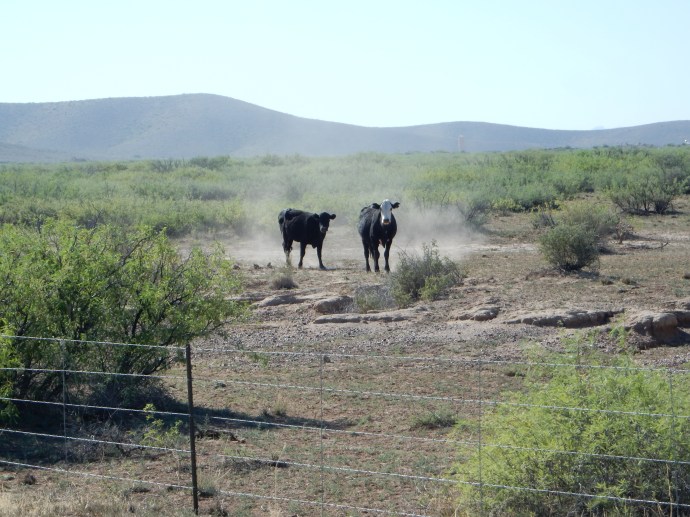
The source of our dust clouds

On our various drives the last two days, we kept seeing small dust clouds; a column, almost tornado looking, that appeared in the distance. I thought these were localized wind patterns creating an eddy stirring up the dust. We never seemed to get close enough to be able to take a good picture. Finally, one dust cloud was close enough to shoot—then we saw that the cloud was caused by cattle ambling along and stirring up the dirt on the ground.

The day wrapped up having an early dinner at a truck stop in Willcox. Dining options are not huge, the two or three local restaurants being in the area of the wine festival and everything else was a national burger/taco/pizza chain. But the food was quite good and helped to restore my flagging energy. Of course, we had dessert at Apple Annies again.

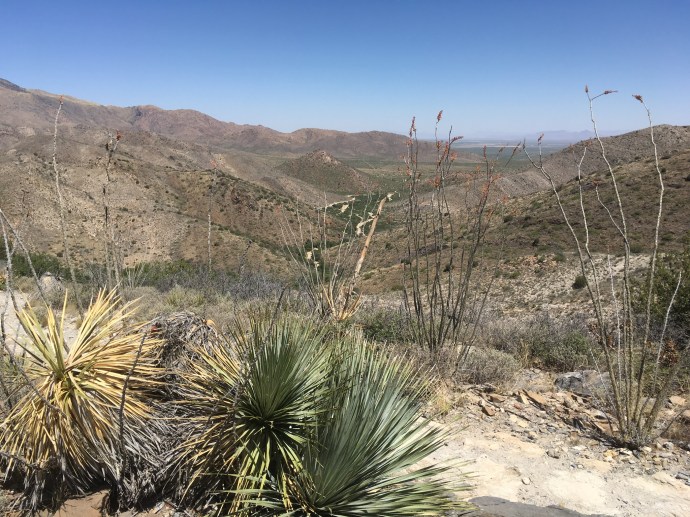
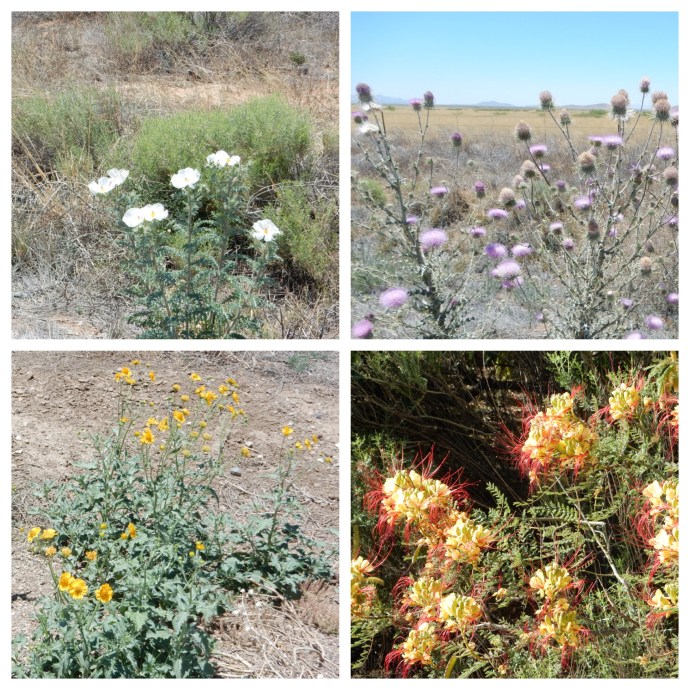
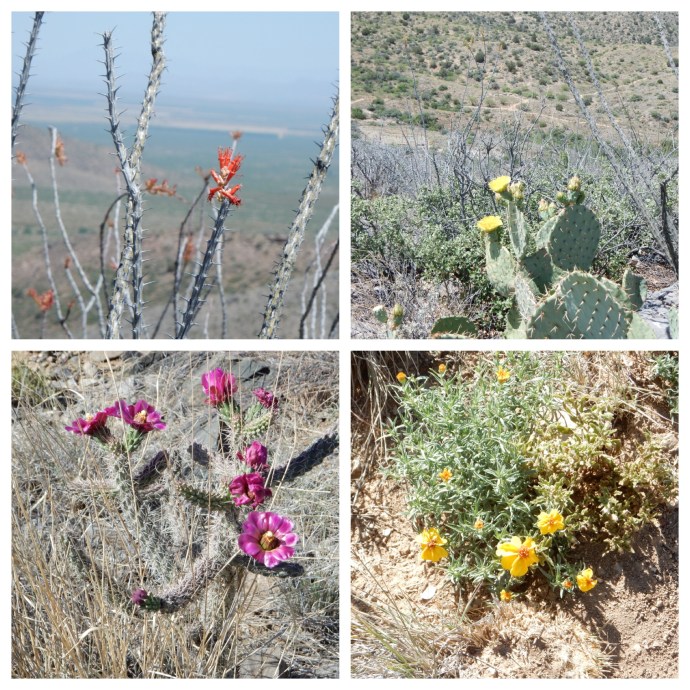
We thought we would end up this post with some flower pictures. Arizona is in drought conditions but some flowers are finding their way to bloom. Enjoy.

Flowers near Fort Bowie and Chiricahua

Ed and Chris. Willcox AZ May 20
Categories: road trip, travel | Tags: , , , , , , | Leave a comment

Blog at WordPress.com.