road trip

2019 Trip 1: Orlando Again: Jan. 13-15

Orlando Florida January 15

Cinderella Castle at Magic Kingdom

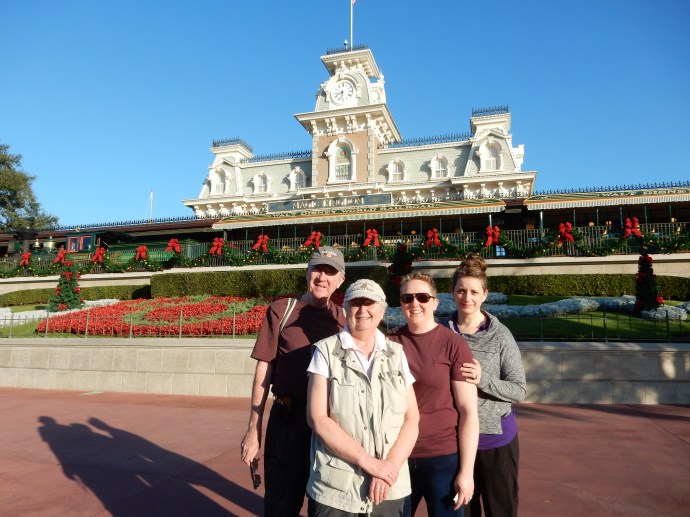
8:00 AM, Sunday, arrival at Magic Kingdom

Well made plans are no guarantee of success. A few too many rides, a long day, and some stomach queasiness resulted in our leaving the Magic Kingdom around 4 on Sunday, instead of staying until closing. Until then, the day had gone well. No hassle with traffic even though Sunday’s run was a marathon compared to the half marathon on Saturday. Our parking spot was almost right at the gate to the Ticket and Transportation Center. Deb and I made it to Space Mountain early, walking quickly from the Main Street area when gates opened at 9 AM. We even had tine for the three ladies to stop for a morning coffee before the gates opened.

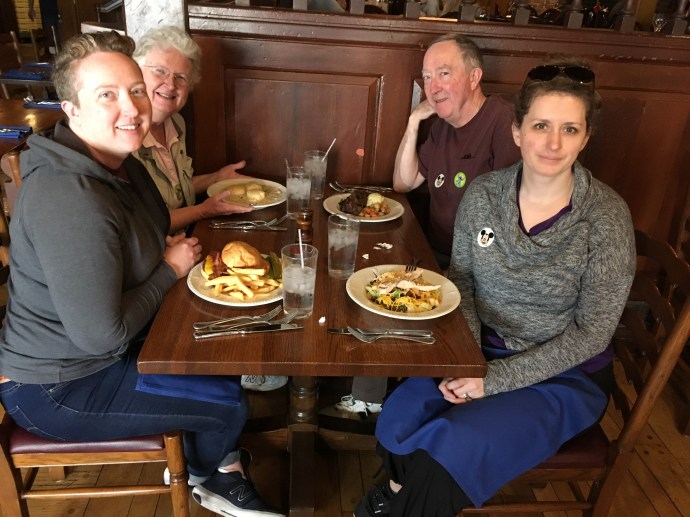
Lunch at Liberty Tree Tavern, Magic Kingdom

The predicted temperature high for the day was 80 degrees Fahrenheit but I doubt it reached that point. Certainly in the morning it was very pleasant. We walked around, made a few attractions and had early lunch at Liberty Tree Tavern. Four different meal choices, all were excellent. Several members of the group were emphatic that they were not going to the Hall of the Presidents since the current occupant of that position is included. So we passed it by.

Rebecca’s big request for the day was Pirates of the Caribbean. The wait advisory outside the attraction said a 20 minute wait but we timed it at 15 minutes. This ride has been updated; it has Jack Sparrow in it and has removed the scene with the bawdy bars. We walked by Swiss Family Robinson tree house, climbed up it, and had fond enough memories that on Monday we borrowed the video of the movie from the clubhouse here. The movie came out in 1960; I am sure some of the scenes and narration would be different if produced today. It brought back pleasant memories for all of us.

We have not observed any of the South American teen-age groups we observed at the Springhill Suites in their matching hoodies. Maybe Wednesday night had been their last day. Instead there were frequently families and couples with matching outfits; xxx family vacation 2019 was seen often. Disney themed t-shirts with Mickey and Minnie photos and individual names printed on them was another frequent sight. Colorful, almost tie-dyed, identical shirts popped up often. As usual, one needs to watch out for strollers, runaway toddlers, electric wheelchairs, etc. which all offer the potential for an accident.

One view of the Marriott Cypress Harbour.

We took it easy Monday, planning to go to Animal Kingdom Wednesday instead. Tuesday was Hollywood Studios and Chris really wanted to get a picture of us at the Sorcerer’s Hat which had stood in the main circle in front of Grauman’s Chinese Theatre. We did not see it-it had been big. After asking a crew member, we learned that it had been removed for a large stage showcasing a Star Wars major attraction to open later this year. That new attraction has closed off a large portion of the park including the space for the ride though a movie studio. Hollywood Studios can easily be seen in a day, or less than a day.

We planned a sit down meal at Mama Melrose’s Italian restaurant and the Fantasmic evening show as a finale for the day and to officially celebrate Chris’ birthday. Yes, we have been celebrating for a while but this was the actual day. Both the meal and the Fantasmic show were excellent, we had great seats at center stage to view the show. Last time we were here, we sat in just about the last seat in the house.

Fantasmic at Hollywood Studios

Ed and Chris. January 18

Categories: road trip, travel | Tags: , , , , , | Leave a comment

2019 Trip 1: Orlando Again, Jan. 9-12

Orlando, Jan. 15, 2019
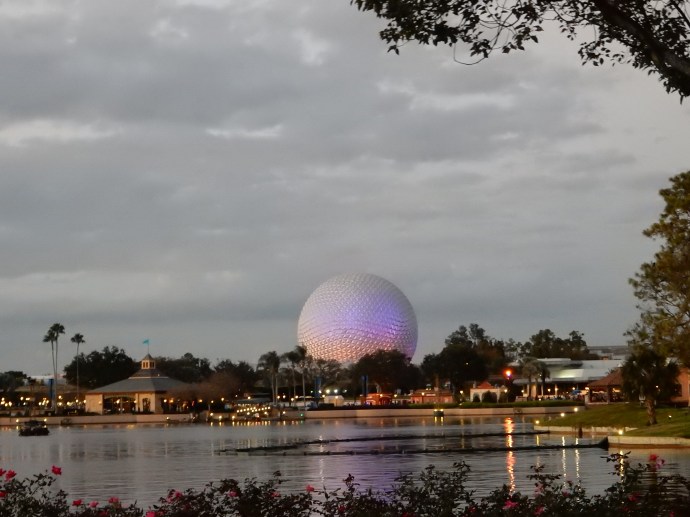
Spaceship Earth at Epcot Saturday late afternoon

This first trip of 2019 is a two-week period, entirely in the Orlando area. It is a combination of things: celebrating Chris’ 70th birthday, an opportunity to spend time with each daughter and her family, a winter break, and taking advantage of some great Delta air fares and lodging deals.

This first half of our trip is primarily at the Marriott Cyprus Harbour, a time share location where we were able to purchase excess capacity for a two bedroom suite. However, our first night was at a Marriott Springhill Suites. As we checked in there, we encountered large number of groups of teenagers. Small groups of 6-10 kids were wearing colorful matching hoodies with each group adorned in an amazing variety of individualized colors. At first, it seemed they might be in Orlando for a music, band, or gymnastics event. But as we looked closer and talked to staff, the teenagers and chaperones were from Colombia and were celebrating their 15th birthday.

We had encountered this on one other trip to Orlando. There is a big business in packaging tours for teenagers from South America for this rite of passage. Searching on-line, one can observe a variety of locations offered by tour operators; our ability to describe the tours is limited by our lack of Spanish.

The groups were well-behaved and seemed to be having a great time. We were wary about breakfast the next morning since the hotel has signs suggesting that one eat breakfast early, that the breakfast area is jammed after 8:15 AM. The breakfast area seats about 130 with multiple food serving areas to help handle the crush. We took their advice and were down there by 6:45 AM. There was no problem for us.

Other than experiencing several of the major theme attractions with our guests, we have no major plans for this trip. I know, very unlike us. The Orange County Historical Museum was a smaller museum that we had not previously visited so we made that our one visit for the day. It is located in downtown Orlando in the old courthouse building, solid but uninspiring architecture.

The museum was “blessed” with several school groups visiting that day; we worked our way around them as we explored. A notable new fact for us was the Florida Cracker cattle, a critically endangered domestic cattle breed dating back to the cattle brought over by the Spaniards. The cracker has several traits that helped it adapt here; heat tolerant and resistant to parasites. True crackers are relatively rare, they have been cross-bred to develop larger sizes and more meat. The Texas longhorn are one variety of cattle that traces its genetic roots back to the Florida cracker,

Florida is still a major cattle producing state, ranking 18th in 2018 statistics. (The exhibit must be outdated. The exhibit stated Florida is in the top ten cattle producing states.) The Mormon church owns a 300,000 acre ranch here, one of Florida’s largest. The exhibits documented the rise and continual cattle growing history of the state; including that the whip used here “cracks” over the cattle to direct them. The land is soft and full of scrub brush, unlike the open plains of Texas. The whip takes the place of the lasso.

Of course there is a display concerning citrus growing. This is Orange County, the center of orange growing in Florida, although numerous winter freezes and urban development have vastly shrunk the acreage under crop production. Florida is still number two in oranges, with one-third the amount grown in Brazil. China is a new competitor, not far behind Florida. On our way to the museum, we took secondary roads. On those roads we came across Dr. Phillips named schools, street, and neighborhoods. At the museum, it was explained that Dr.Phillips was the world’s largest citrus grower from 1920 to 1954. He innovated with crop dusting, elimination of the metallic taste in canned juice, and new marketing techniques.

Of course, raising crops does no good without being able to transport your product to market. The museum documents how, like many other states, the advancement from river transportation to railroads dramatically increased Florida’s opportunities to add population and to ship citrus and meat products to northern states.

The major impetus to growth in the Orlando area was not Walt Disney, but Martin Marietta which added a 2,700 employee plant in 1957 and by 1987 had 15,000 employees in the area. They began a movement by other technology companies to the area. When Disney came looking for land in the 1960s, he was able to amass enough parcels to create a large tract empty and still cheap. He purchased 27,000 acres; Disneyland in California operates on less than 300 acres. As they say, the rest is history.

Lake Eola in downtown Orlando

Chris and I walked around Lake Eola in downtown Orlando and had lunch at a local brewery. For a large town of 275,000 people in a metropolitan area of 2.7 million, the downtown was pretty quiet. A Gravely tractor commercial being filmed alongside the lake was the main generator of interest.

Thursday night we checked in to the Marriott Cypress Harbour, a very nice timeshare property. Our first night, they had a Hawaiian band playing for two hours which we enjoyed. Deb and Rebecca joined us Friday night. Saturday was our first day at Disney, visiting Epcot. Our travel planning has been aided by the “Unofficial Guide to Walt Disney World” and “Touring Plans”. Their predictions of crowd levels and customized touring plans has allowed us to optimize our time. The biggest hassle was the traffic. There are four marathons scheduled throughout the year on Disney property, we experienced one of them.

On Friday, we made a practice run to Epcot to make sure we knew the route for our early morning arrival at Epcot on Saturday. We made it; all the way to the parking lot pay gate where we had to explain we did not want to pay, just turn around and head back. They let us without a hassle. But no mention from them, from the Disney web site, the marathon web site, or anywhere else we could see that gave advance notice of the best way to manage the traffic Saturday morning. The detour routes marked on Saturday were more designed to get you to the Magic Kingdom. A helpful guard at Fort Wilderness campground got us pointed in the correct direction. We still arrived early and found out that Test Track, one of the main attractions and an attraction for which we were unable to get FastPass+ for, opened early. We headed to Test Track, got on the ride without any lines and thus began the day. Overall the day was less crowded than expected and we encountered few waits of any significance.

Biergarten restaurant in Epcot

Our dinner was at the Biergarten in the Germany Pavilion. The buffet meal was tasty with plenty of options. As a side benefit, we had dinner while the German band was playing.

Epcot Future World was disappointing to me in that several of the original attractions have been closed with no replacement, thus you observe these large buildings just empty and deserted. In Epcot World Showcase, several of the dramatic movies of countries were outdated. Minor disappointments but given the dollars one gives Disney, you hope for continual renewal of the attractions. Rebecca, however, who had not been to Epcot in over 20 years, liked the looks-it reminded her of its appearance when she first came, sort of a walk down memory lane.
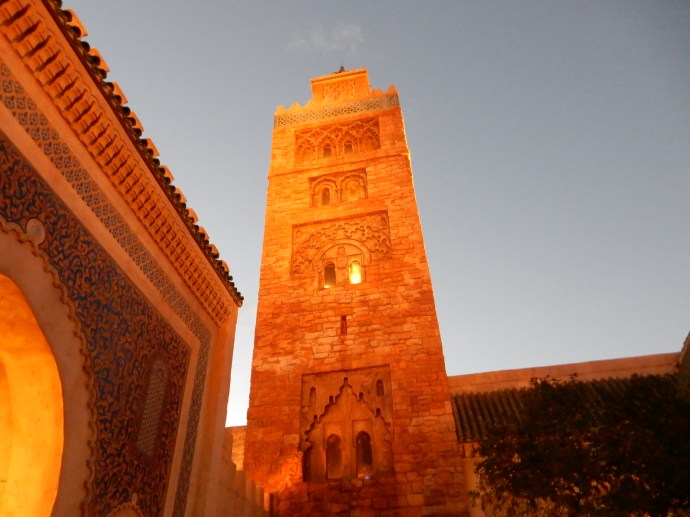
Morocco pavilion in Epcot

I see no need to give a blow-by-blow description of the day, either you have been to Disney World or you have not. If you have, my detailed description would be a poor substitute. If you have not, my description would have to go on forever to properly give it justice. Overall, it was an enjoyable day.

Ed and Chris
Orlando
January 15, 2019 (Happy Birthday Chris)

Categories: road trip, travel | Tags: , , , | 1 Comment

2018 Trip 6: The Gunflint Trail, Dec. 5-6

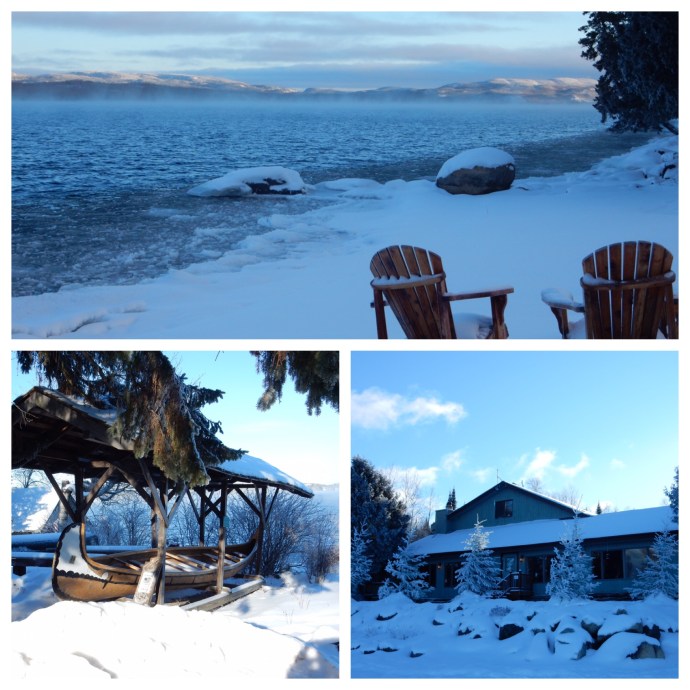
Gunflint Lake from Lookout Point

Gunflint Trail, Grand Marais, MN Dec. 5-6

Wednesday was our last full day at Gunflint. We hiked up to Lookout Point for a high view of the still unfrozen Gunflint Lake. We overheard at the lodge that almost all other lakes had frozen over, evidently Gunflint is frequently one of the last lakes in the area to freeze over. Of course, this is the same place where I heard one gentleman state: ” I used to drink Pabst Blue Ribbon but then in high school I switched over to Miller’s.”

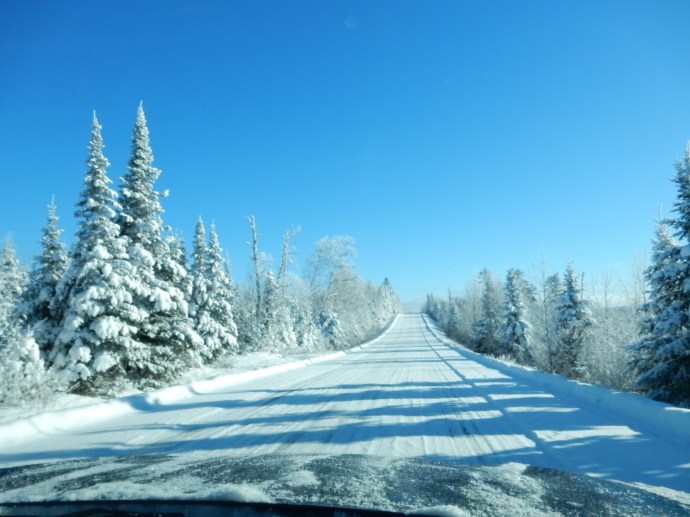
Driving to the end of the Gunflint Trail

Still hoping to see moose, who did not come wandering in front of our cabin window, we drove the last 12 miles of the Gunflint Trail. The day had started to lightly snow, sort of the snow that you know is fake on the Hallmark Channel Christmas movies; a light, wispery couple of flakes here and there. As we drove to the end of the trail, seeing neither people, autos, or moose, the snow increased. We probably ended up with an additional two inches of light, powdery snow that day. Chris took a few pictures of rocks to prove we had been here.

We even skipped lunch, despite it being paid for in our meal plan. We have just been enjoying the food, eating more than we normally would at home. Another meal might have had us explode-and it would have made it difficult to finish the larger meals served at dinner time. Our last Christmas cards were addressed, completing one of the tasks we had brought with us to work on during slow times. One more naturalist program awaited us. John, the naturalist, is a jack of all trades and gave an afternoon performance of country music. Besides enjoying the music, we conversed with him about various country artists. John knew much more than we did, but we were able to pitch in about several country western museums that our 2018 travels had brought us to.

Thursday morning at Gunflint Lodge

Leaving Gunflint Lodge and driving back to Grand Marais

Thursday morning we packed up and said good-bye, thoroughly enjoying our time at the Gunflint Lodge. I know I drove slower than the locals on the way back to Grand Marais and Highway 61 since I pulled over several times to let cars pass. The two inches of powder from the day before was primarily packed down; the snow plow we saw was heading up the Gunflint and had no impact on our driving lane. A shopping stop in Grand Marais was successful for some items for me and a few Christmas gifts. The drive to St. Paul was still another 4.5 hours but under sunny skies. The truism that cloudy skies in winter are usually warmer than clear skies was accurate today. The blue skies made for brighter pictures but it was probably 10-15 degrees colder than Monday through Wednesday.

Have you ever been asked by a company how you found them, internet, direct mail, etc? In most cases, when I even remember, it is a mix of factors. Such it was for our next stop, Wild Country Maple Syrup. We had left Grand Marais and were heading home. Along the side of the road, I observed one of those state transportation signs thanking a person, family, company, etc for picking up litter along a particular section of the road. This sign thanked Wild Country Maple Syrup. It rang a bell. My cousin and her husband had mentioned this place after their recent visit to the North Shore of Lake Superior. Chris did a quick search and found that the company was about a 20 minute drive off Highway 61. We looked at each other and said why not, we are retired, what is another hour or so for the drive home.

Sap collecting tubing lines at Wild Country Maple Syrup

The 20 minute one-way estimate was accurate even those the miles were much less. Once again, the paved clear road transitioned down to a snow-covered lane and a half road lightly traveled. As we neared Wild Country, we noticed the plastic lines my cousin had mentioned. This company taps into thousands of maple trees over the 320 acres of land they own. 60 plus miles of food grade PVC tubing collect the sap in the spring and bring it into the sugaring house. When sugaring is over, all of the lines and 18,000 plus taps have to be cleaned. At the site, the sales building had an open sign. Well, that was accurate. The door was open and interior notices indicated this was an honor system of payment. You took your selections of maple syrup, noted them in the ledger, and then dropped cash or a check in one box or used an app program to pay by credit card. We dutifully complied and left without seeing a soul.

We made two other quick stops, one at the gift store at Split Rock Lighthouse (nothing of interest) and at the Rustic Inn Cafe for a meal/snack. From there, it was all clear sailing until reaching St. Paul around 7 PM. Next trip, two weeks in Orlando in mid-January.

Wild Country Maple Syrup sales building

Ed and Chris Saint Paul MN Dec. 7

Categories: road trip, travel | Tags: , , , , , , | Leave a comment

2018 Trip 6: The Gunflint Trail: Dec. 2

Waves from Lake Superior crashing at Canal Park, Duluth

Duluth, MN. Sunday Dec. 2

As we peel off our cold weather gear, we can hear the sound of the waves from Lake Superior crashing on the rocks outside our hotel in Canal Park, Duluth MN. The focus for this trip is three nights lodging on the Gunflint Trail, a 50 some mile dead-end road, leading from Grand Marais MN on Lake Superior to the Boundary Waters Canoe Area Wilderness along the Canadian border. The Gunflint and other upcoming activities will be discussed in the next posts; today was an extra day tacked on to the trip to experience new places and to ease the total drive time of 5.5 hours from St. Paul to the Gunflint Lodge.

Saturday’s major snow storm was heavier south of the Twin Cities so the drive north from St. Paul to Duluth was generally on clear roads. We thought we would stop at Tobie’s world famous restaurant in Hinckley to have a pecan or cinnamon roll for a mid-way snack. Everyone else in the world had the same idea. We picked up a bag of peanut M & Ms (me) and a take-out coffee and donut holes (Chris) and kept going.

Chris and Ed at Amnicon State Park, WI. The park had a stand where you could place your camera or phone to take a selfie.

Our first stop was at Amnicon State Park east of Superior WI. Amnicon is an Ojibwa word meaning spawning ground, evidently relating to fishing. However the railroads and European settlers had other plans for the area; lumbering and quarrying. As the trees and quarries became less profitable, the land was given to the local town and then the state for a park.

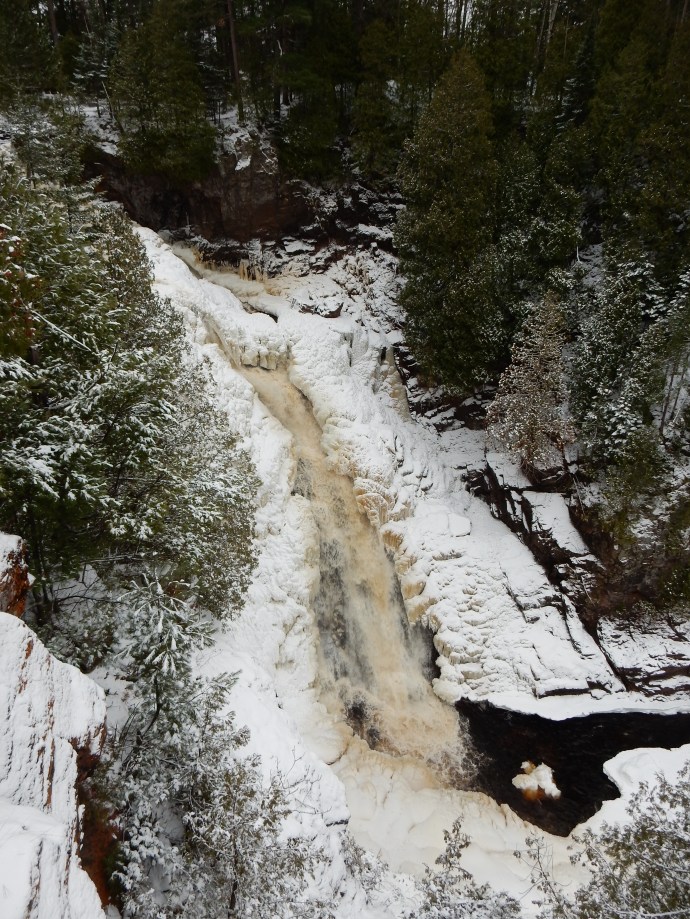
Our visit came about because the park is located on top of the Douglas Fault, a geological upheaval running from Lake Superior to the Twin Cities that occurred about a half billion years ago. The combination of that fault, glacial action, and the force of erosion created a series of water falls. We were curious to see the falls, particularly in early winter with the combination of snow and water tinted brown by the natural tannic acid in the area.

We had the park to ourselves. The falls are close to the parking area; a hike to see them was a pleasant diversion. Although the sky was gray, the green fir trees, the white snow, and the yellow-brown tinted water made for a pleasing sight to behold. These falls are not dramatically high, more a pleasant series of rapids. Given the cold weather, the flowing river cuts a channel through ice-lined stream banks and carves little ripples through the ice for the river to run underneath.

Manitou Falls at Pattison State Park, WI

About a half hour to the southwest is a second Wisconsin state park, Pattison State Park. This park is home to Manitou Falls, the highest falls in Wisconsin at 135 feet. Recent rains and high waters have put some of the trails impassable, limiting the view of the falls. Nevertheless, the proximity of the two waterfalls to each other gave us an opportunity to view both with just a limited expenditure of time.

After Pattison State Park, we drove to Duluth and our Hampton Inn hotel in Canal Park. We were a little early for check in, so we spent about 30 minutes watching the waves from Lake Superior crash on the shoreline. An earlier storm this summer was particularly violent and erased most of the paved boardwalk running from the Canal Park area up to the Rose Gardens of Duluth. Today’s wind storm was not as violent, but the crashing waves made interesting sounds and views. It was particularly unusual for us to see the waters of Lake Superior coming on-shore as a deep brown color. Normally, Lake Superior water is extremely clear but evidently today’s wave action is stirring up sediment from the lake bottom as it hits the shoreline.

For dinner, we ate at an old-time Duluth establishment, the Pickwick restaurant. My family frequently ate here when we visited Duluth when I was a kid. The decor was lovely and warm, with a view overlooking the lake. We observed two freighters coming into the harbor and two freighters leaving the harbor during our dinner time. Observing four freighters in the space of 90 minutes was unusual; we don’t usually see that many in such a quick time span. The meal was excellent, their apple crisp was not as good as mine, but was very tasty and more than sufficient for two people. Their prime rib soup, which is a specialty on Sundays, is made with the unused prime rib from Friday and Saturday night specials. It was delicious.

Some scenes from Bentleyville

We finished off our evening with an hour and a half to two hours walking through Bentleyville. Bentleyville is a 15-year-old attraction, started by one man in his backyard. Now it is a 40 night free attraction of millions of Christmas lights located in a Duluth waterfront park visited by over 300,000 people per year. Besides giving away free cookies, hot chocolate, marshmallows to roast, and popcorn, any kid under 10 gets a free stocking hat.

The lights seem to go on forever, with theme areas of rows of Christmas trees made of lights, an homage to armed forces, a Thomas the Train area, 12 days of Christmas, etc. The crowds are large and friendly; no talk of politics to spoil the ambience. This was our first time here and was a major reason to take this additional day to get to the Gunflint Trail.

Ed and Chris Dec. 2

Categories: road trip, travel | Tags: , , , , , , , | Leave a comment

2018 Trip 5: Orlando and Palm Beach: Nov. 2

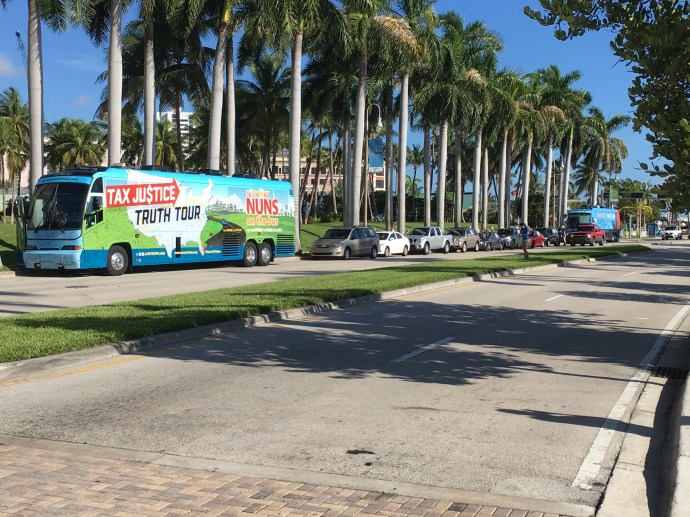
Part of the caravan to Mar-a-Lago, we are the red car.

West Palm Beach, FL Nov. 2

Nuns on the Bus. Well, this blog is political. Fair warning. One of the reasons we are down in Florida is to support the “Nuns on the Bus”; a group of Catholic religious women who are going around the country to educate the public about the inequalities in the 2017 tax bill. They make stops: at congressional offices, at local non-profits helping those in need of assistance, and at town hall locations to explain the tax bill.

This is the 6th time they have made a similar cross-country trip for justice. This trip began 27 days ago in California and ended today with a gathering that drove by Mar-a-Lago. Last night, they held one of their town hall meetings to explain the tax bill. Their explanation is easily understood. I will see if I can briefly highlight it. (They made it easier to visualize by having five individuals represent a person they actually met on the tour who are in one of the five quintiles.)

First divide the country in to quintiles by income. That is, the bottom 20% of the people by income, then the next 20-40% (the lower middle quintile), then the people in the 40-60% of income (the middle class), then the people in the 60-80% of income (upper middle), and finally the top 20% by income. The KEY STARTING FACT is that from 1940 to 1980, each quintile grew by an equal percent. There were still top earners and people at the bottom, but each group’s income grew at the same rate.

Starting with the Reagan tax cuts and continued with the Clinton and Bush tax cuts, this equal growth in income changed dramatically. From 1980 to 2016, the list below shows how dramatic that has been:
Bottom quintile income grew by 8%
Lower middle income quintile grew by 17%
Middle income quintile grew by 20%
Upper middle income grew by 32%
Upper quintile income grew by 66%
Oh, and by the way, the top 1% income grew by 205%
Quite a difference from a 1940 to 1980 growth pattern that was equal for all quintiles. The town hall meeting visualized this by having the person representing each quintile take a proportionate number of steps to dramatize the difference.

But the second part of the meeting discussed the proposed program cuts that MUST be made (as legislators such as Sen. McConnell has indicated just recently) to pay for the tax cuts. In this enactment of the proposed program cuts, first each person took steps forward to demonstrate average tax refunds. The lower quintile average refund was $90, the top quintile was $193,000. Then our representative individual took steps backward to represent the dollars they lose by the elimination of such programs as food stamps, Children’s Health Insurance Program, school lunches, Pell grants, etc. The lower two quintiles lost money; the top quintile’s gains far outpaced everyone else.

Personally I regret the lost opportunity for the country. If we were to spend well over a trillion dollars; an infrastructure program would have attracted bipartisan support. Jobs would have been created, business (large and small) would have revenue and profits, and streets, bridges, water and sewer plants and lines could be improved, electrical lines upgraded, and state and national parks improved. Probably the worst travesty is that the tax cut and ignoring infrastructure reflected true Republican priorities; support the donor group and ignore Americans.

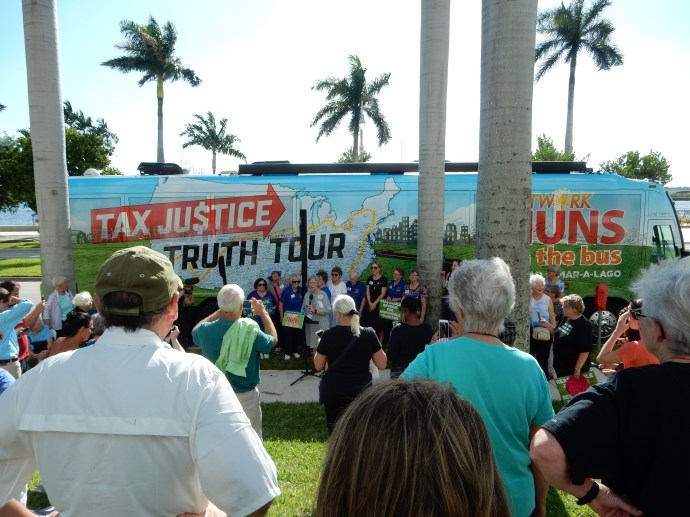
Welcome talks before the caravan departs.

Today the gathering at Meyer amphitheatre in West Palm Beach and the drive of a caravan of cars past Mar-a-Lago represented hope but possibly a futile gesture. When we wake up Wednesday morning, we should have a better indication.

Some personal tid bits. We are staying at a Hampton Inn in West Palm Beach. Unknown to us, the nuns stayed here also and we talked with several of them at breakfast. We were also able to renew acquaintance with several nuns we had met at the Cedar Rapids IA town hall meeting we attended earlier in October. At the drive to Mar-a-Lago we gave a ride to a couple; she was one of the original founders of Network Lobby. Network Lobby is the advocate arm of the U.S. women religious groups. She is married now and has four kids and 12 grandchildren. Her brother was one of the founders of Outback Steakhouse. He is out of that now and starting a new chain called Bolay, meals based on a bowl and healthy food options to fill it. As we left the rally and went to lunch, we happened to pass one and stopped there for lunch. It was quite nice.

Vote November 6


Ed and Chris

Categories: road trip, travel | Tags: , , | 1 Comment

2018 Trip 5: Orlando and Palm Beach; Oct.31-Nov.1

Great blue heron at Arthur Marshall Loxahatchee National Wildlife Refuge

West Palm Beach, FL. November 1

“The tram is down” said the voice on the phone. We were halfway between Kissimmee and West Palm Beach, on our way to the Arthur Marshall Loxahatchee National Wildlife Refuge after spending Wednesday at the pool again. At 1 PM we were scheduled for a 1.5-2 hour tram ride through the refuge, located just west of the sprawling suburbs of Palm Beach. The refuge is 145,000 acres and provides habitat and protection for endangered and threatened wildlife. American alligators, snail kites, herons, egrets, ibis, and wood storks call the refuge home. Migratory birds use it as a wintering grounds or a migratory stop-over.

The refuge caller offered us a walking tour instead of the tram tour and we accepted that as a reasonable alternative to the tram ride. (The other people scheduled for the ride declined the offer to hike instead. Possibly the 85 degree temperature had an impact on their decision.) After another lunch of peanut butter and jelly sandwiches eaten at the refuge listening to bird calls, we joined Kathy, a long-time volunteer at the refuge for our hike.

The hike took 90 minutes and while we certainly did not cover as much ground as a tram ride, the hike provided an opportunity to learn about the refuge. The history of the Everglades and the role of the Kissimmee River and Lake Okeechobee in feeding water to the Everglades were covered. Man’s modifications to the Everglades in favor of agriculture and settlement had dramatically reduced the size of the Everglades. Refuges like Loxahatchee attempt to ameliorate those effects by filtering polluted water and providing habitat for wildlife.

Loxahatchee National Wildlife Refuge

Once again on this trip we did not spot any alligators on the hike although they are numerous here. Birds were the primary wildlife observed, including snail kite (decades ago they were common in Minnesota but not anymore),limpkin, snowy egrets, gallinule, great blue herons, and a variety of ducks. Kathy’s expertise is in plants and she was able to inform us about many of the plants in the refuge and how they were used by Native Americans.

The refuge’s visitor center offered numerous interesting displays including two interactive ones. The first interactive was a mock airboat ride through the refuge complete with an airboat fan mimicking the wind in our faces as we would have experienced in real life. The second was a darkened room with the voices of a dad and his son listening to various calls of wild animals at night. Both were well done and a surprise.

Loxahatchee National Wildlife Refuge

Ed and Chris. Nov. 1

Categories: road trip, travel | Tags: , | Leave a comment

2018 Trip 5: Orlando and Palm Beach, Oct. 27-29

Rollins College in Winter Park, FL

Kissimmee, FL October 29

We have been to Orlando and Florida so frequently that I can visualize many of our highway exits in advance. The flight down on Saturday was easy but Chris had the window seat for a change. My cold and cough were practically gone but her hacking was still quite noticeable. She got the window seat away from people. Her inability to talk to her neighbor was mitigated since the aisle seat was only occupied for one-half of the flight anyway and we both watched inane movies that distracted us.

For the first five nights we are staying at Vacation Village at Parkway, one of many timeshares in the area. It is big; 20 buildings with 7 to 13 stories each. We have found it clean and pleasant with the usual amenities. VV at Parkway was chosen primarily because it is on the south side of Orlando and we will be driving south to Palm Beach Thursday.

Sunday was spent in the Winter Park area. In this part of Florida there are four “Winter” towns; Winter Park, Winter Haven, Winter Springs, and Winter Garden. All are in the 30-40 thousand population range but Winter Park is a bit older and more established as a town. We had been to the Charles Hosmer Morse Museum in Winter Park previously. Northern business magnates established the town in the late 1800s; with the arrival of the railroad the little town was prospering. The downtown area along a lake was active with people eating at cafes and strolling along the lake front. Today our first stop was for a one hour boat tour of three of the inter-connected lakes in the area.

Our boat excursion was with Scenic Boat Tours. On the tour, we found it was the oldest operating attraction in the state of Florida, beginning in 1938. The boats are comfortable, not fancy; basically stripped down pontoon boats with pleasant seats but no canopies. This tour covers Lake Virginia, Lake Osceola, and Lake Maitland. There are numerous spring-fed interconnected lakes in this part of Florida (Winter Haven has over 50) and the three lakes we rode on are home to expensive mansions.

Scenic Tour boats going through one of the canals

There are narrow canals that provide the waterway connection; creeks that had been previously used by lumber companies to ship timber to a sawmill on Lake Virginia. During the Depression, WPA crews widened and improved the banks so the canals are kept boat accessible year around. At least most of the time; our driver indicated two years ago during a dry time, the canals were not deep enough.

The canals operate on a chance basis. They are basically wide enough for one boat and you hope you do not encounter another boat coming at you before you complete the one-two block long winding canal. The tour operates 6-7 boats who go through the canal about 250 feet apart and the last one through tells any waiting traffic that it is clear to proceed. Our boat did encounter two paddelboarders working feverishly to get out of the canal before we caught up to them.

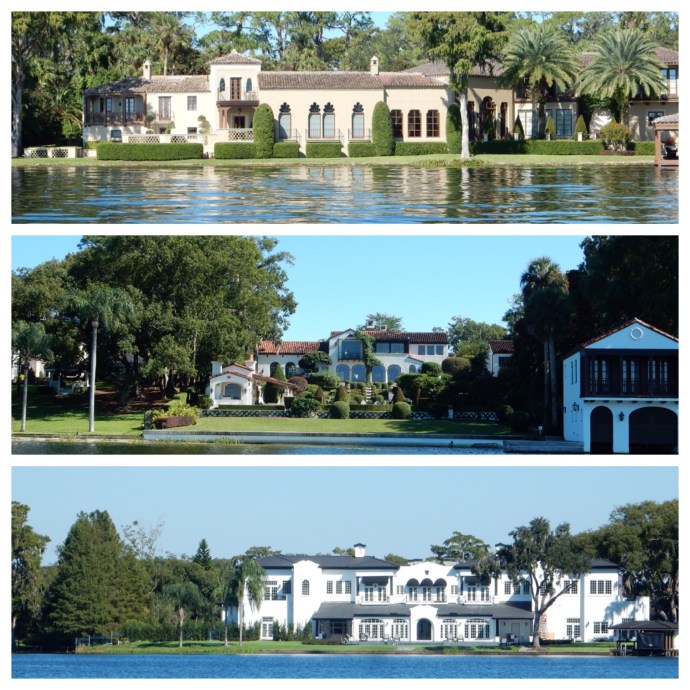
Examples of homes along the lakes in Winter Park and Maitland FL

The tour guide talks extensively of the homes along the shores. Stories such as: the home of the NBA star whose home when sold had to be renovated to lower the height of the light switches, counters, and toilets; the home of a Cortland NY 1800s lumber baron who in order to convince his wife to come down to Florida built an exact replica of their Cortland home; and the largest home on the chain of lakes at 30,000 square feet.

We saw the water side of Rollins College, a small liberal arts college with an endowment of $300 million, in the top ten percent of colleges. The lake has buoys marking the slalom practice area for the water skiing team. The tour guide extolled the chapel and art museum so we later stopped by there also.

It was a surprise to us to learn that Fred Rogers (Mr. Rogers’ Neighborhood) went to Rollins. Evidently his family had big bucks from local business operations and after one year at Dartmouth, Fred transferred here. His family bought a lake home for him and his grand piano while he finished the last three years at Rollins. He met his wife here and they wintered in a home along the lake frequently. (He also lived in the Squirrel Hill neighborhood of Pittsburgh.)

Knowles Chapel at Rollins College in Winter Park, FL

After the tour we visited a few land sites pointed out on the boat tour. The Kraft Azalea Garden is probably a nice site to hold a small wedding but nothing distinctive. The Knowles Memorial Chapel at Rollins College was designed by Ralph Adams Cram who designed more than 75 churches and cathedrals. He declared it his favorite. We were not impressed, it was pleasant but nothing notable. The exterior was more striking with the soft white across the blue sky, the interior dark.

The Cornell Art Museum at Rollins is small. It may have notable acquisitions but few, if any, were on display. There was a special, small, exhibit organized by the Ringling Museum out of Sarasota with several striking paintings under the theme of “Dangerous Women”.

Views along our walk at Mead Botanical Garden

The Mead Botanical Garden was our final stop. It is fall and not much flora was in flowering mode but we had a pleasant walk here. Most of the visitors were with a photography group that was utilizing the grounds for a special outing or with a weekly yoga group.

Sunday dinner was in our timeshare, one way to save money and avoid lines at restaurants in this top visitor destination. Monday we exercised walking throughout VV at Parkway in the morning and spent the afternoon by the pool.

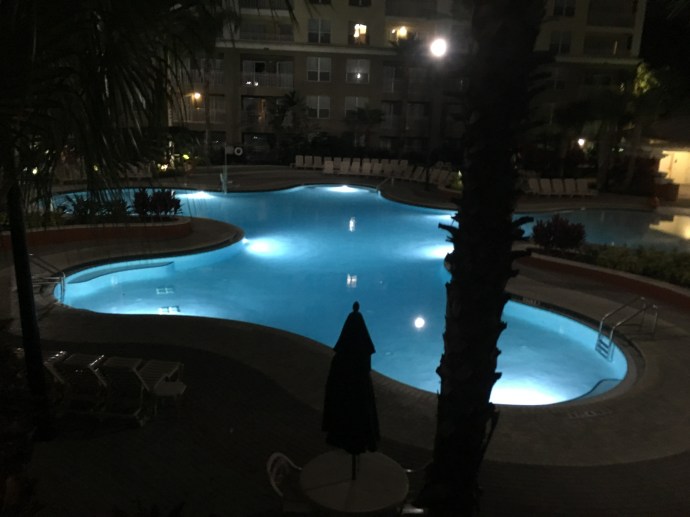
One of the pools at Vacation Village at Parkway, Kissimmee FL

Ed and Chris
October 30, 2018

Categories: road trip, travel | Tags: , , , , , | Leave a comment

2018: Staying Home for Awhile, October

Headwaters of the mighty Mississippi River at Itasca State Park in MN

Saint Paul, MN October 26

We will be leaving tomorrow for a week’s trip to Florida. We will blog about our travels and adventures in Florida next week so we want to wrap up our fall “close to home” activities.

Minnesota, like many other states in our diverse and beautiful country, has an extensive state park system. There are 76 state parks in Minnesota. Many people, we included, visit state parks that are near to their home and/or have a unique feature. To encourage people to visit all of the Minnesota state parks, the Minnesota Department of Natural Resources (DNR oversees our state parks) has a program called the Passport Club. A person buys a booklet at a state park and then when they visit a MN state park, the booklet is stamped and dated from that park. In retirement, we decided to see how long it would take us to visit all the parks. We started in April 2015 and got our 74th stamp last October. (Two parks do not have to be visited since they can only be accessed by boat.). We picnicked, hiked and participated in programs at parks we never would have visited except for this passport challenge.
We have decided to complete a second MN State Parks Passport and have added the challenge of doing the Hiker’s Club hike that is identified at each park. These hikes range from 1 mile to 6 miles. We have already visited 9 parks on our road to complete our second passport book.

Itasca State Park

Hiking at Wild River (top), Lake Louise (Chris in pic) and Interstate State Parks in MN
This month we visited Itasca State Park with Ed’s sister Jude. Itasca is the headwaters of the mighty Mississippi River. It begins its 2350 mile journey to the Gulf of Mexico as a small stream flowing out of Lake Itasca where flat rocks and a footbridge have been placed to allow people to walk across the Mississippi. Itasca is the second oldest state park in the nation, after Niagra State Park in New York. The park is home to over 100 lakes and thousands of acres of wetlands and forests. We also visited and hiked at Lake Louise, Interstate and Wild River State Parks this month.

The Nuns’ Bus in Cedar Rapids IA

Have you ever heard of the Nuns on the Bus? The advocacy arm of U.S. women religious (nuns) over the years has criss-crossed the country on a bus tour to talk about targeted political issues. This October a group started in California on a truth tour to talk about the Republicans’ tax policy. They hold town hall meetings, meet with members of Congress, have site visits and rally’s. Last week, they (and their bus) were in Cedar Rapids, Iowa for a town hall meeting on our nations’ recently enacted tax policies. We went down for the meeting, listened to the presentation and joined the small group discussions on what an individual can do (VOTE).

Prior to the evening gathering, we went to the National Czech and Slovak Museum and Library in Cedar Rapids. One gallery was a heart wrenching telling of Czechoslovakia during WWI and shortly thereafter. Czechoslovakia no longer exists; divided into the Czech Republic and Slovakia in 1993. If folks feel depressed about our current political climate, reflect on history, ours and that of other nations.

Returning to St. Paul from Cedar Rapids across IA farm land and along the Mississippi River

We stayed overnight in Cedar Rapids after the nuns’ program and since the next day turned out to be one of our rare (for this year) glorious fall days, we decide to take the long way back to St. Paul through western Wisconsin. We stopped at a wonderful conservation interpretation center in Clayton County, IA and were pleased to discover a new information center that opened this summer along the Great River Road in Genoa, WI by the U.S. Fish and Wildlife Service.

Mary of the Angels Chapel attached to St. Rose Convent

At the nuns’ program in Cedar Rapids, we met some nuns (Franciscan Sisters of Perpetual Adoration) who had come down from LaCrosse, WI. They invited us to stop at their convent, St. Rose Convent, if we had time; we did and were so glad we stopped. We had a tour, with historical commentary, of their chapel (located on the campus of Viterbo University) and their perpetual adoration chapel (a Catholic worship space) that has had uninterrupted prayers being said in it 24/7 since August 1878!

Sandhill cranes at Sherburne National Wildlife Refuge

Last weekend we participated in a bright and early (6:30 a.m.) activity at the Sherburne National Wildlife Refuge to watch the morning wake-up of about 9,000 sandhill cranes from their roost to forage in neighboring fields as they fatten up for their flight to Florida. It was 32 degrees out with 20 mph winds; there was no bird watching shelter, so were outside for 2 hours. We have seen 200,000 sandhill cranes in Kearney, Nebraska several years ago so this was a low-key affair but worth it. In an interesting fact (to us, at least) the Kearney sandhill cranes migrate north to Canada from Texas, going to the west of Minnesota. The Minnesota sandhill cranes migrate southeast to Florida. Maybe we will see some of the same birds next week, we did not check to see how long the cranes’ migration journey takes.

We continued this month our volunteer work with the Bell Museum of Natural History and Ed with the Mississippi National River and Recreation Area, including the annual volunteer dinner where Ed received a National Park Service backpack for exceeding 750 cumulative hours of service.

Did we mention to VOTE on November 6?!

Fall in St. Paul, two days apart

Chris and Ed
October 26

Categories: road trip, travel | Tags: , , , , , , , , | Leave a comment

2018: Staying Home for Awhile, June

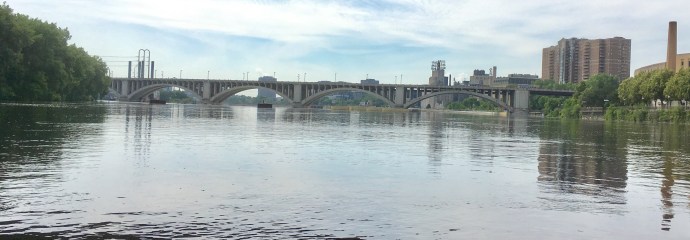
Hennepin Avenue bridge from the water taxi

Saint Paul, Minnesota. July 4, 2018

On June 3, we returned to St. Paul after a 18-day trip to Arizona. While there, we spent time with family, visited some iconic Arizona landmarks (the Grand Canyon, Tombstone, Organ Pipe National Park), and explored southeast Arizona where we had spent little time on previous trips to the state. We were only touring in one state, stayed several nights with relatives, had a comfortable rental care; however, found ourselves commenting on how long this trip seemed.

We had anticipated a fall 2018 trip to Idaho but after several days after our return from Arizona, we decided to put our out-of-state travels on hiatus and “stay home for a while”. Staying in Minnesota in the summer and fall is not a hardship. The opportunities for outdoors activities are numerous, the cultural scene is robust and family and friends are close by. It also seemed like the time for us to get more engaged with political work and community volunteer efforts.

Nicollet Island from the water taxi

We did an hour excursion in a “water taxi” on the Mississippi River from Boom Island in Minneapolis. It was a beautiful time to enjoy the Minneapolis skyline. The boat’s skipper did a wonderful job of combining history with contemporary landmarks and environmental issues. Later in the month, we hit the water again on a naturalist-led canoe trip on Lake Snelling at the nearby Fort Snelling State Park. The day after our canoe trip, the rains came and came, closing the lake because of unsafe, high water conditions.

Morning paddle on Snelling Lake

Minneapolis and Saint Paul host outside, somewhere, music and theater every night of the week. The concerts are usually at city parks so picnicking, biking, walking are encouraged. We heard two jazz groups and a large (56 members) brass ensemble at several venues this month. Ed’s sister took us to a remarkable performance of seniors (the group Alive & Kickin) whose singing was delightful and whose individual life stories were very moving.

Brio Brass at Lake Harriet Bandshell

We celebrated Father’s Day and daughters’ birthday; welcomed visitors from Houston; were inspired by the Parkland, Florida students’ visit to the area, and attended our state rep’s summer picnic.

Whether we are traveling or staying home, we are very blessed.

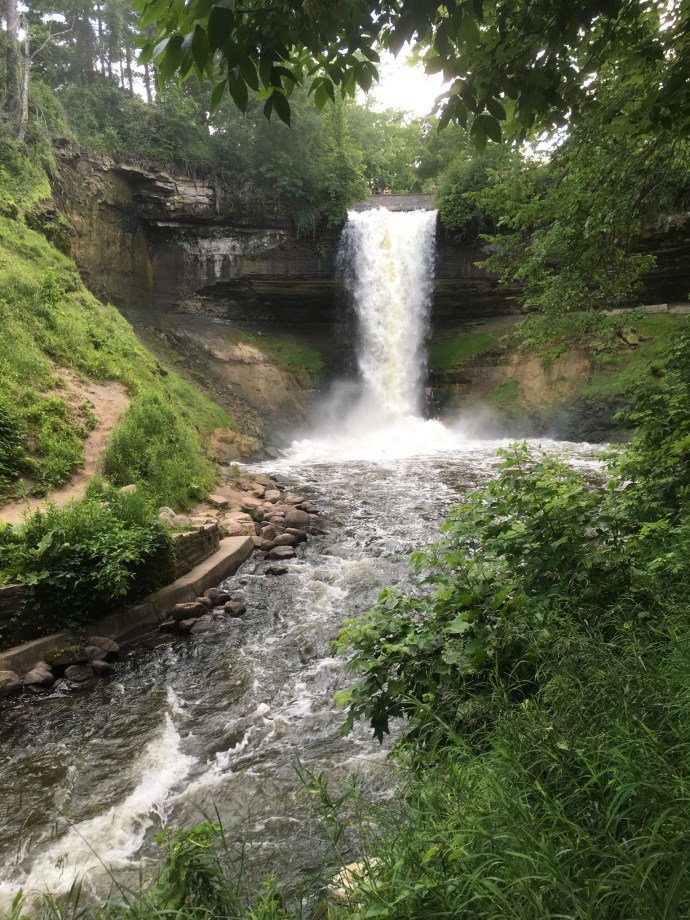
Minnehaha Falls

Chris and Ed
July 4, 2018

Categories: road trip, travel | Leave a comment

2018 Trip 4: Arizona: June 1-3

Flagstaff and Phoenix Arizona, Friday to Sunday, June 1 to 3

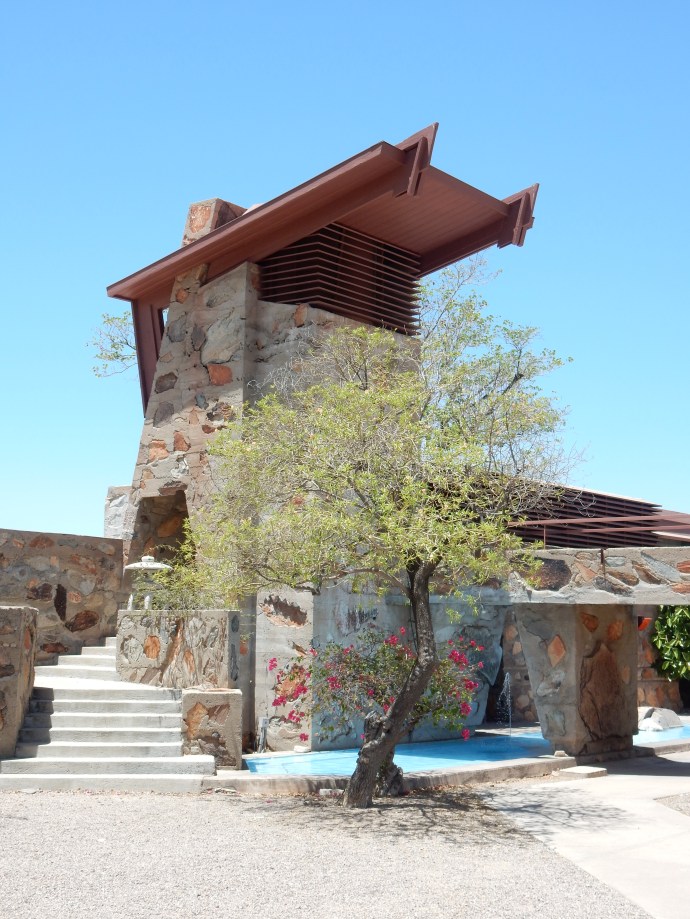
Part of Taliesin West, Scottsdale AZ

This 18 day trip wrapped up on a slower pace. Friday we started the day easy and then drove down to Phoenix. The scenery changes from the Ponderosa Pine forested mountains of Flagstaff, through the western end of the Mogollan Rim to the cactus studded area around Phoenix. We checked in to the Orange Tree Resort, a time share community from which we obtained our two nights lodging. Chris and I jumped in the pool, Deb and Rebecca lounged on their patio. Dinner was at Ajo Al’s, an authentic Mexican restaurant.

Dinner at Ajo Al’s, Phoenix

People here love the weather, so they say. I believe them. However, Chris and I found the 90 to 107 degree days hot, dry heat or not. I noticed people did not sit outside under the shady umbrellas at restaurants until evening. They hide indoors during the day. So, in my opinion, not much difference enjoying a warm indoors during a Minnesota winter as enjoying a cool indoors during an Arizona summer.

One other supporter of my belief-Frank Lloyd Wright, the famous architect (1867-1959). Wright founded an architectural studio and school just outside Scottsdale, Taliesin West. We toured it Saturday morning; Chris and Rebecca taking a three-hour tour. Deb and I settled for a 1.75 hour tour. Wright’s school, following in his past practice, packs up the students and faculty from mid-May to October and they study at Taliesin East in Spring Green Wisconsin. He was no dummy, it is hot in Arizona in the summer.

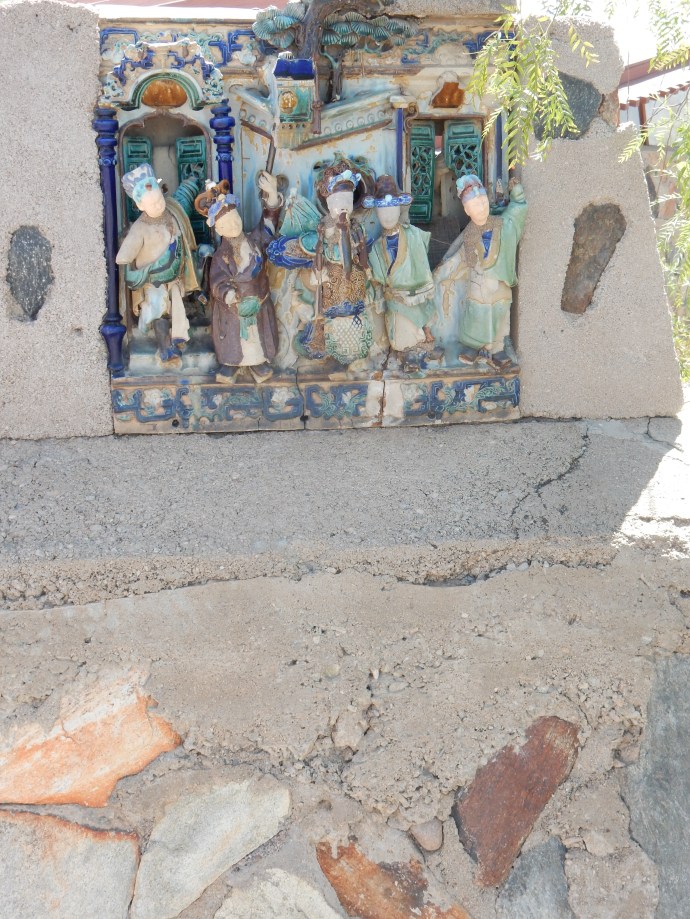
One example of the reconstructed Chinese art at Taliesin West

Taliesin East came first, Taliesin West was founded in 1937. I am not going to give you a history of Wright, there are many books about his life and his work. A few tidbits gleaned from our docent tours to liven up the narrative though. Frank Lloyd Wright:

    • had three wives and a mistress
    • was a challenging person to work with
    • designed over 1000 buildings, if an owner followed his design exactly, they were allowed to place a red icon on the building, around 20 owners qualified as most found some aspect of his design not to their liking
    • had his students live in the desert in tents for their first year at Taliesin West, years two and three they built their own small housing units in the desert which were torn down when they left
    • emphasized incorporating the building into the natural environment in which it was placed
    • purchased a large quantity of broken Chinese artifacts, had his students glue them together and many are placed around Taliesin West
    • designed his cabaret (small theater) with almost perfect acoustics and seating designed on a bias so a person’s view is not blocked by the individual seated in the row in front of her
    • The water features and stone walks and walls were fire prevention features
    • and his school have a zero drop-out rate, and a 100% placement rate for its graduates with a notable international representation
    • the doorways are a ducking place for people 6 foot tall and over

    The drafting studio at Taliesin West

    The
    Cabaret

    The Water Tower at Taliesin West – once Wright had enough money to drill deep enough to reach the aquifer

    After a lunch at Panera, it was back to the Orange Tree Resort for more pool and relaxation time.  Lou and Joyce had returned from Flagstaff and joined us for a pizza and pasta dinner in our room. Then Chris and I took Deb and Rebecca to the airport for their red-eye flight back to Boston.

    On Sunday, we found a Catholic Church nearby, Blessed Sacrament, that actually had decent singing by the congregation. We had lunch at In-N-Out, a west coast burger chain before joining Lou and Joyce at the Musical Instrument Museum. The Musical Instrument Museum is amazing but let me get my biases out of the way. A. I think corporate execs are paid way too much and this museum was started by a former chief exec of Target Corporation; B. As a Minnesotan, and since Target is headquartered in Minnesota, I would have preferred to see such a museum in the Twin Cities. Okay, on with the tale.

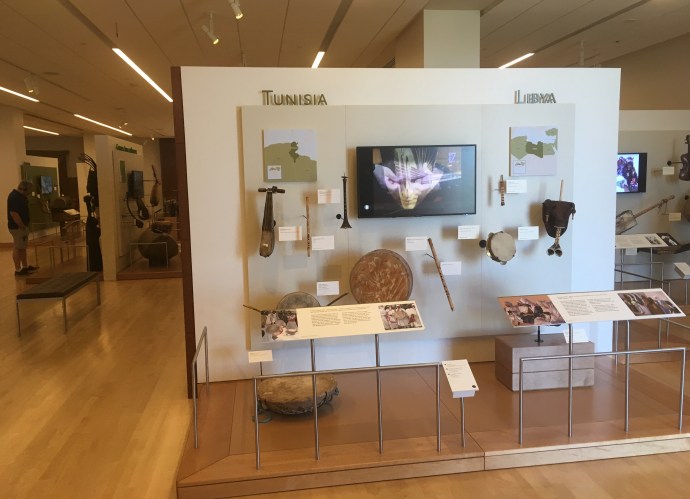
    One example of a country exhibit at Musical Instrument Museum Phoenix

    The Musical Instrument Museum (MIM) is housed in a building that does not wow you on its architectural style. It is clean, straight lines, white and beige colors. It is the inside, the exhibits, that make one say “WOW”. And I am not a major music listener. The second floor is devoted to collections of musical instruments from around the world, grouped by geographical regions. So what? you say. Well, the presentation includes examples of the musical instrument; a map so the geographically challenged can understand where the country is located (I did not remember that the New Hebrides are now called Vanuatu-did you?); and an audio-visual screen that comes to life as you approach it wearing your headset. Thus you understand the country’s location, see the instrument, and hear and see the instruments being played.

    Another country exhibit

    Just four of the 15,000 instruments in the collection at Musical Instrument Museum

    While numerous instruments are local adaptations of standard instruments (drums), there are unique examples also. The museum has a saying: “Music is the language of the soul”. The exhibits demonstrate the universality of music and the enjoyment and the ritual needs it fulfills. The first floor has a rotating exhibit room (currently a new exhibit is being set up), displays of instruments and related videos of famous musicians from around the world, a display of mechanical music, and an experience gallery where guests can play instruments similar to those on display. We spent two hours here and could have easily been here two or three times as long. Highly recommended.

    We said our good-byes to Lou and Joyce and headed to the airport where our flight got us home at 11 PM. A very enjoyable 18 days and 2200 miles of Arizona exploration-with a plus of family time.

    Ed and Chris. Saint Paul June 4

Categories: road trip, travel | Tags: , , , , , | Leave a comment

Blog at WordPress.com.