road trip

2019 Trip 3: South Florida: March 28

The north lighthouse on Gasparilla Island

Punta Gorda, FL. March 28

Our plans were to bike Gasparilla Island, one of the Gulf Coast islands with a state park, two lighthouses, an old town and new fancy housing. We did not, for two reasons. First, it was a little breezier than we prefer for biking. Second, the paths/trails were overrun by golf carts, sometimes driven by adults, sometimes by kids, sometimes by adults holding toddlers in one arm while driving with the other arm.

Gasparilla Island is reached via a toll causeway bridge connecting the mainland to the island. The southernmost lighthouse has a nice museum detailing the history of the area. Gasparilla Island was home to the Calusa Indians who used the area for fishing and harvesting the natural vegetation. They did not practice cultivation farming, they had no need to. When the Spanish arrived, the Indians refusal to farm resulted in the Spanish assumption of Indian ignorance and low intelligence. Over time, the Spanish ways predominated and with the later English settlements, the Calusa either died off or moved with the Spanish to Cuba.

The island and its population center of Boca Grande survived based on the fishing industry; first shipping salted fish to Cuba, and then with the arrival of the railroad and ice, shipping fresh fish to the eastern seaboard. Recreational fishing for tarpon and other fish also contributed to the marketing of Gasparilla Island to wealthy northerners. Later, the shipment of potash replaced the fishing industry. Eventually potash shippping was cheaper from other locations and today the island subsists on tourism and second homes.

We wandered around the island and the beach, visited the museum and had lunch at a small bakery. Lazy beach days will probably wait for Key West and Miami Beach.

Peace River Botanical and Sculpture Garden

In the afternoon we drove a little northeast of Punta Gorda to the new Peace River Botanical and Sculpture Gardens. Only open for 18 months but years in the planning, the gardens are the vision of a former chief executive of McDermott Industries and his wife. McDermott is big in oil drilling pipelines and drilling rigs. At one time, McDermott also owned Babcock and Wilcox which is deep into energy and environamental technology. The present appearance of the gardens is that a bundle of money has been spent on the project, with more to come when a planned art museum opens. A very nice project. Many of you know my biases; it is money from an overpaid executive who is spending funds that could have been paid to company employees instead of being used to create an appearance of a local philanthropist.

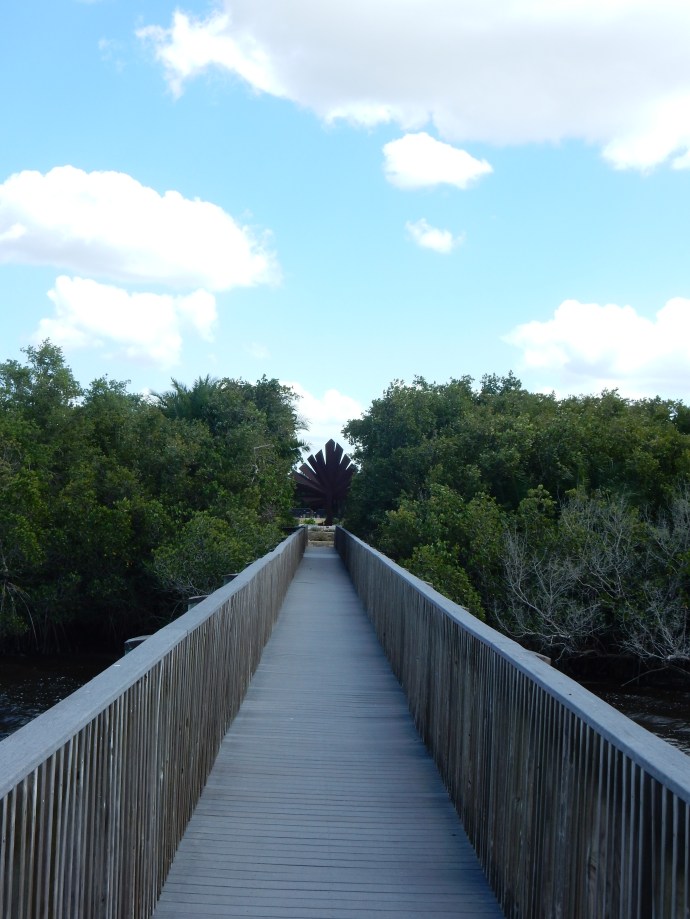
View from Peace River towards the botanical and sculpture garden

Putting my uninformed biases aside, the gardens combine manicured lawns, water features, shrubs and sculptures among 11 acres on two sides of a road. The western side fronts on the Peace River. The gardens need more flora to be truly memorable; at present it is pleasant with real promise for the future. The sculptures have a flavor of whimsy. While I am not conversant with the names of top sculptors, the signs informed us that one of them at least has created works for well-known celebrities from around the world.

Chris and I returned to Punta Gorda, did some book shopping and had a picnic dinner watching the water. We finished up the evening chatting with our great Evergreen hosts and playing a few games of Mexican Train which I only mention since I was the winner.

Ed and Chris. March 29

Categories: road trip, travel | Tags: , , | Leave a comment

2019 Trip 3: South Florida: March 26-27

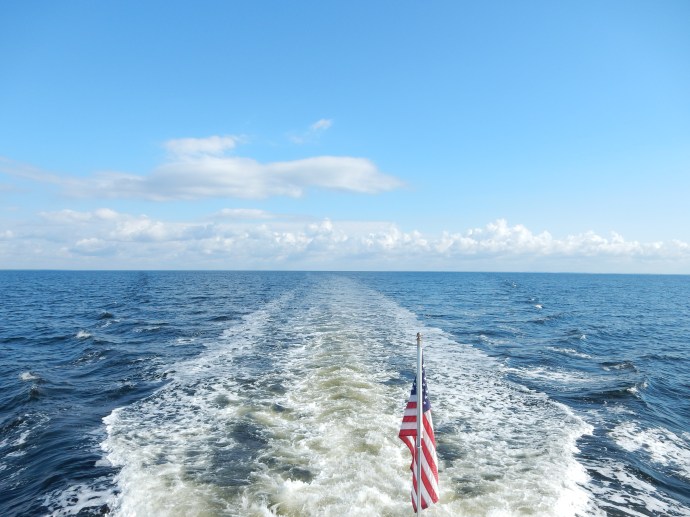
Charlotte Harbor from the back of the Island Star

Punta Gorda, Florida. March 27

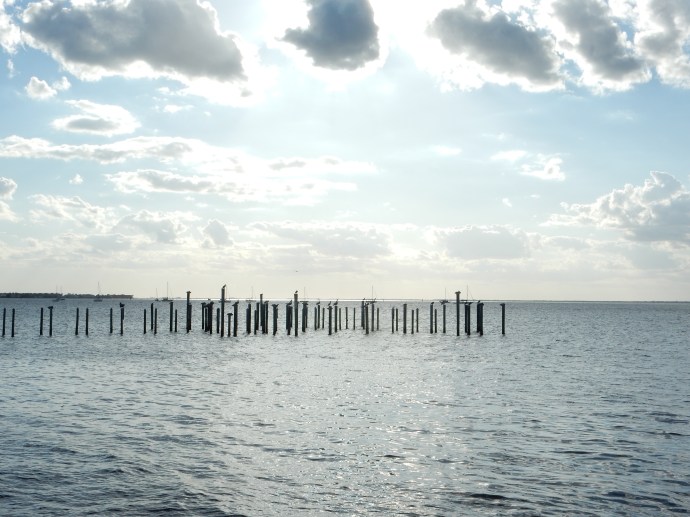
We are on the Gulf Coast of Florida, about 100 miles south of Tampa. This trip, 3.5 weeks long, will likely be slower paced, more relaxing than many of our trips. Today was an excellent example of that slower pace.

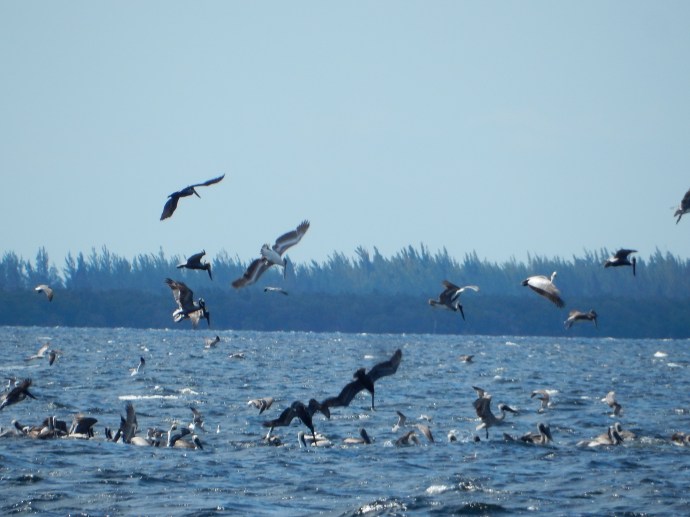
One shot of the feeding frenzy on the way back

We took a 2.5 hour cruise on Charlotte Harbor out of Punta Gorda to Cabbage Key, had a two hour lunch break, and returned on the same 2.5 hour cruise. So pretty much the entire day was occupied by the cruise. The water was relatively smooth and we just relaxed and enjoyed the ride and the view. I admit I might have even dozed off a few times. This was not a manatee or dolphin spotting cruise, although one dolphin did race alongside us, perform three jumps and then disappear. There was also a feeding frenzy of birds evidently attacking a school of fish. Otherwise it was just taking life easy.

Map of Charlotte Harbor with Fisherman’s Village at upper right and Cabbage Key at lower center.

Charlotte Harbor is fed by the Peace River and the Myakka River. It is shallow, usually 6-12 feet in depth. Boaters have to be careful to avoid sandbars. Part of the journey to Cabbage Key is through the Intracoastal Waterway which is dredged as necessary and marked by buoys and channel markers.

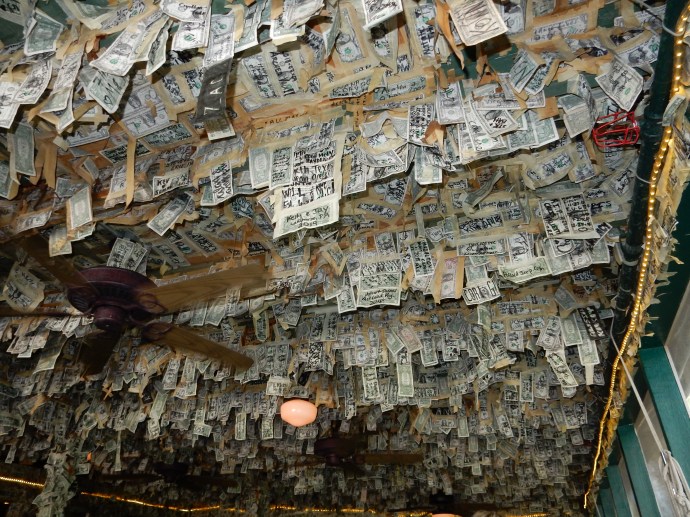
Island Inn restaurant at Cabbage Key with dollar bills hanging from the ceiling

Cabbage Key has a resort and restaurant, partially made famous by Jimmy Buffett. It also has dollar bills hanging from the ceiling of two rooms of the restaurant. Legend has it the tradition began with one customer taping a dollar bill to the ceiling way back when so that he would always have money to pay his tab. The practice has grown over the years. The ceiling in the two rooms are covered with dollar bills (of various denominations) and when they fall, they are collected and given to charity.

Several cruise boats (about 30-80 passenger size) from up and down the area land here for lunch at staggered times to spread out the business and reduce waiting times. Many of the wait staff live on the island and from overhearing one of them, the tips are very good and the isolation is well offset by the pay.

Our boat, the Island Star from King Fisher Cruises, leaves and departs from Fisherman’s Village, a combination shopping, marina, and resort. It was built on an abandoned wharf that used to house fish packing factories. Nowadays it hums with people, particularly it seems with grandparents and their grandchildren here on visits during spring break. We ate at two restaurants, had popcorn and ice cream but did no shopping.

Some of the murals in downtown Punta Gorda

After the harbor cruise, we went to downtown Punta Gorda. The city has a new Harborwalk and the community has installed about thirty murals on the walls of various buildings downtown. On our walk, we met the artist responsible for many of them as he was working on a new installation on the slanted wall of the Harborwalk underneath a highway. Murals are not his only artistic endeavor, he also paints and does digital photography.

We had also stopped to see one of his murals on two walls of the bays of the PG Fire Department. Our Evergreen hosts had specifically mentioned this location; the husband knew several of the firefighters from supervision classes he had taught at the local college. At the Fire Department offices, they said just go and look, so we did. Sure enough, the firefighter we met inside the bays knew our host and asked after him. Reinforced that knowledge that staying with Evergreeners gives you a greater local flavor of the community.

Punta Gorda was hit by Hurricane Charley in 2004, a Cat IV hurricane with winds of 150 mph. It destroyed much of the town. In effect, it was instant urban renewal. While many people suffered, particularly those in mobile home parks, 15 years later, the city has seen an influx of new housing and re-built public buildings and infrastructure. Many of the homes that were damaged, versus destroyed, were re-built. Thus, walking downtown presents a view of buildings, sidewalks and street in good repair.

We had arrived in south Florida Tuesday and landed at Fort Meyers Regional Airport. After getting the rental car and picking up a few odds and ends, we spent the balance of the afternoon at Fisherman’s Village. They have a small military history museum there, staffed by volunteers. It was heavy on uniforms and weapons but we found two different but similar interesting facts we had never previously known.

WWII playing cards with hidden escape route.

During WWII, the Red Cross was allowed to ship a very limited number of items to POWs. Playing cards and games were allowed items. The US made special playing cards that when steamed, separated to reveal an escape route map printed on the inside. Putting together the various pieces created a detailed route that could be used to reach Allied territory. The maps were created and sent to specific POW camps. On display at the museum was one such map.

The British created speical Monopoly pieces that had similar information on a silk like material that could handle being folded multiple times without tearing and fold into a very small, hideable item. Monopoly pieces also had foreign currency and a tiny magnet hidden into the board pieces. Only certain sets of Monoploy had the tools, marked by a tiny red dot on the “Free Parking” space. This ruse was not revealed until 2007. Both of these two maps were successfully used by thousands of escapees; it is estimated one-third of the escapees used the Monopoly maps.

Charlotte Harbor

Ed and Chris. March 28

Categories: road trip, travel | Tags: , , , , , , | 1 Comment

2019 Trip 2: Arizona: Feb. 16-17

Lou and Joyce’s house in Flagstaff

Phoenix Feb. 17

Flagstaff Arizona is a town of 70,000 people in northern Arizona, a jumping off place for tourists to the Grand Canyon. It is also home to Northern Arizona University, Lowell Observatory, and some companies manufacturing plants like W.L. Gore and Nestle Purina. Most importantly for us, it is where Chris’ brother Lou and his wife Joyce have their future retirement home.

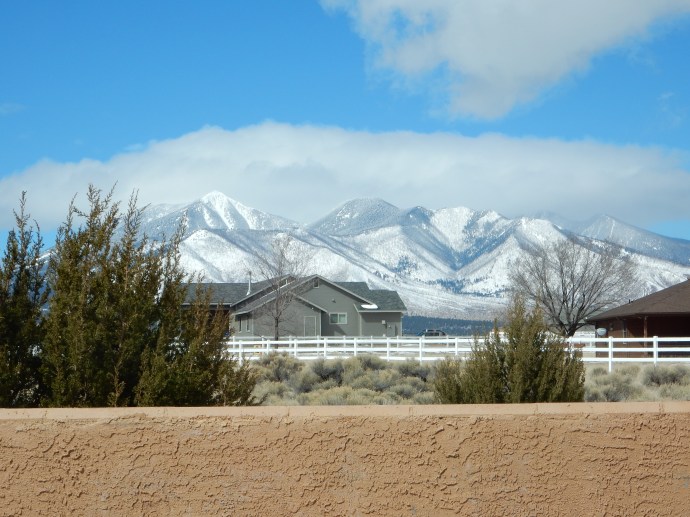
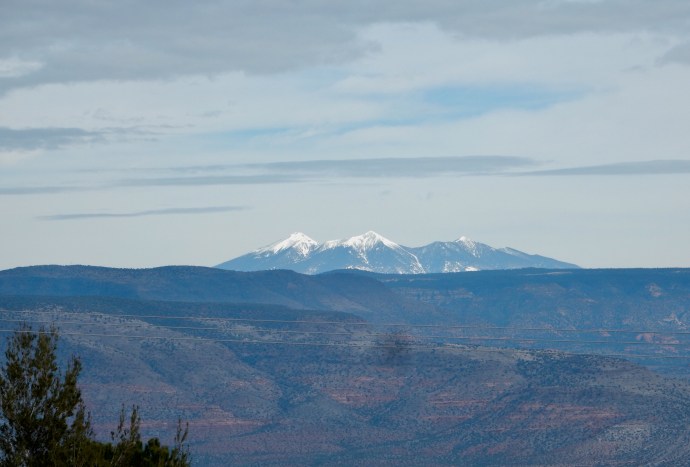
A view of San Francisco Peaks, Flagstaff

When here, we take life easy and throw in a few visits to local attractions. We try some new and some familar restaurants and usually go for a few hikes. This trip was less about hiking and more about relaxation. Lou and Joyce have a home in view of the San Francisco Peaks which include Humphreys Peak, the tallest in Arizona at 12,637 feet. It is a pleasure to look out the windows at differing times of the day and during varying seasons of the year.

San Francisco Peaks from Lou and Joyce’s house

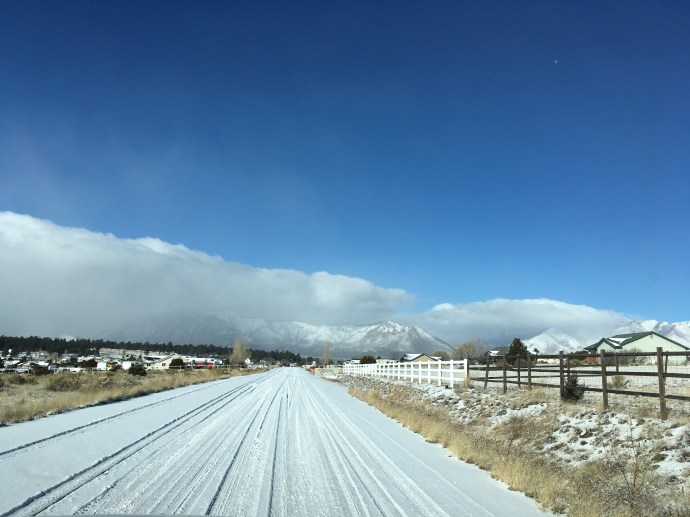
The weather in Flagstaff has both cold and snow (after all, it does have a ski peak and is at 7,000 feet in elevation). This weekend was cool with snow showers so the pictures here show nice contrast between the mountains and blue skies. What we don’t show is the 6-9 inches forecast for Sunday afternoon and Monday night after we will have returned to Phoenix.

After returning to Phoenix, we chose to visit the Arizona Museum of Natural History. The choice was not difficult; many museums are closed on Sundays and those which would normally be open on Monday are closed due to Presidents Day. Tuesday will have to be our day to visit other museums. The Arizona Museum of Natural History is in Mesa AZ, a town of 440,000 people but yet a suburb of Phoenix (a town of 1,5000,000 people and the fifth largest in the U.S.).

The Arizona Museum of Natural History is about 74,000 s.f.of space located in the old Mesa City Hall with additonal expansions. We would summarize the place (unfairly probably) as rocks and dinosaurs. Yes, there are exhibits on Native Americans, and some other topics. If we knew before what we know now, we would have passed it by. It strikes us a place for parents and grandparents to take their kids where they can quickly scan important topics and leave without learning much.

Leaving Flagstaff, heading for Phoenix

Ed and Chris. Phoenix Feb. 17

Categories: road trip, travel | Tags: , | Leave a comment

2019 Trip 2: Arizona: Feb. 14-15

At the Museum of Northern Arizona

Flagstaff AZ. February 15

We left Prescott Thursday morning, driving to Flagstaff in a steady rainstorm. Unusual for this section of Arizona, the rain produced a flash flood warning for a wide swath of northern Arizona. Creek beds that are normally dry and rocky were full of running water. Not a great day for exploring outdoors so we stopped at the Phippen Museum showcasing art and heritage of western art.

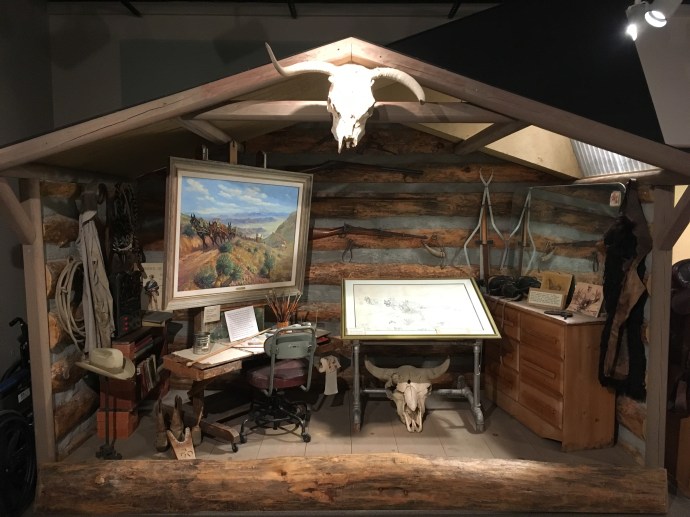
Studio of George Phippen

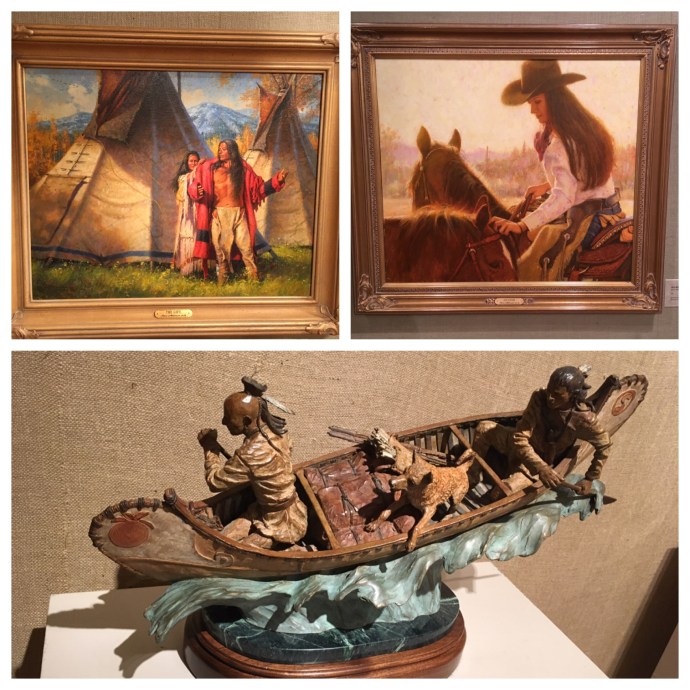
The Phippen Museum was founded by George Phippen, one of three artists who founded the Cowboy Artists of America association. Phippen also drew calendars for Brown and Bigelow, once upon a time a major calendar producer based in St. Paul, MN. His children kept up the sculpting tradition with foundries located in the Prescott area. On display were sculptures by Chris Navarro, a former bull rider; and sculptures by Solon Borglum, a well-known early 20th century sculptor of western works and monumental works included at locations like Vicksburg National Military Park.

One small section mentioned Tom Mix, a famous movie actor of the early 1900s. He was a star of silent films, making close to 300 movies. More than half of them were Westerns. Mix moved to Prescott, which is why the gallery has a section about him.

Sample work from local artists at Phippen Museum in Prescott

The exhibit the three of us enjoyed the most, however, was a display of paintings and sculptures by local artists. The variety of works were more inspiring and colorful, factors that appeal to my basic artistic sense.

Our arrival in Flagstaff occurred with more rain and temperatures in the mid-thirties. Snow was on the ground in high elevations and sun-protected locations. Fortunately, the temperature never reached the freezing mark so icy conditions did not prevail. Winds were strong and stayed that way through the night, along with continued rain.

Native Peoples of the Colorado Plateau exhibit

Friday morning though was clear and cold and Chris, Joyce, and I ventured out to the Museum of Northern Arizona. The Museum has recently renovated their 1980 exhibit on “Native Peoples of the Colorado Plateau”. The renovation was 10 years in the making and the museum collaborated extensively with members of each of the tribal communities. The main goal of the tribal communities was to explicitly state “We are still here”; not a cold rendition of old history.

The exhibit showcases each community, where they live, their history, current members, arts and cultural activities, and a message from at least one member of each community. We thought it was well done and we spent most of our visit in this gallery. A visitor begins by touring a gallery discussing the geology of the Colorado Plateau; since geology has such a substantial impact on how life has been and is being formed here.

Pottery display at Museum of Northern Arizona

Other galleries cover traditional exhibits of pottery and jewelry. A new exhibit showcases art of contemporary Native American artists. The exhibit has a neat twist; artists used skateboards as their canvas. Skateboarding is not the focus, just a different type of canvas to be used which grabs ones attention to its uniqueness and yet uniform size.

One specific artist painting on skateboards

The museum is 90 years old and portrays a timeline of the development of the museum along with outside influences. Chris found this section quite interesting. After the museum we picked up Lou and had lunch at the Galaxy Diner where malts and shakes were the focus but not the only foods we enjoyed for lunch.

Ed and Chris. Feb. 15

Categories: road trip, travel | Tags: , , , , | Leave a comment

2019 Trip 2: Arizona: Feb. 13

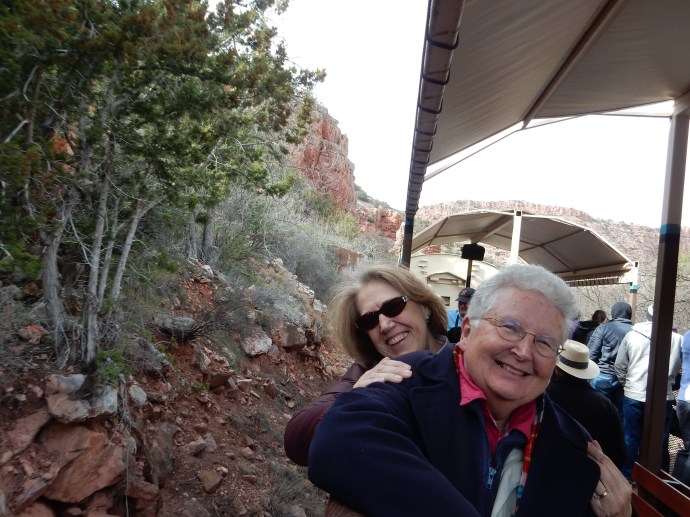
The Verde Canyon Railroad crossing a trestle along the 20 mile trip our to Perksinville

Prescott, AZ. February 13

Mingus Mountain Road is a designated scenic highway and today’s journey took us on the road for times two and three on this trip. The road goes through canyons and wooded hillsides of the Prescott National Forest on a twisty road with switchbacks and ends up in Jerome. Views are of the San Francisco Peaks, Mogollan Rim, and red sandstone cliffs. We were on our way to Clarkdale, AZ, home to the Verde Canyon Railroad.

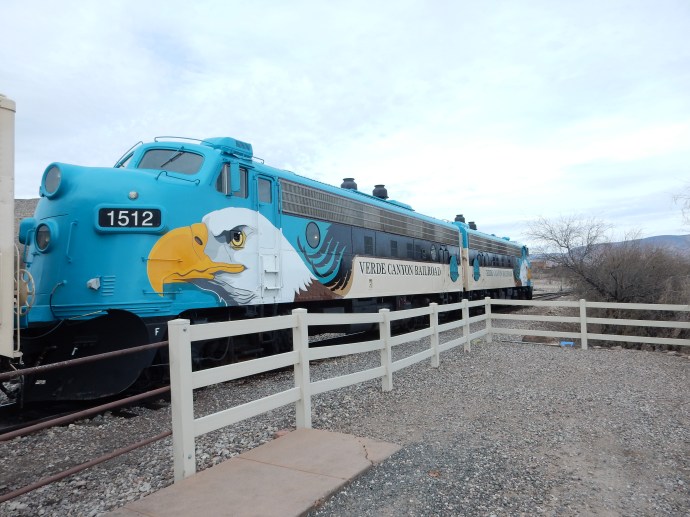
Riding the rails was our primary activity for the day. The Verde Canyon railroad takes us from Clarsdale, home to a major cement producing factory, through the Verde River valley, to Perkinsville ghost ranch. The rail line transports finished cement and raw materials to the main BNSF line in the morning and transports people on excursion journeys in the afternoon. The rail line was completed in 1895 as a spur line to transport copper from the smelters to the outside world. The line was built by all manual labor in one year; the area was too remote to have mechanical equipment shipped in.

One of the first sites we see as the train leaves the station is the 40 acre, 40 foot deep pile of slag left over from 40 years of copper smelting. Slag is the molten byproduct of applying heat to the copper ore dug out of the mines in Jerome to extract the base mineral. The slag is poured out of pipes and the resulting piles, while looking like sand, are solid rock. In contrast, tailings are the unused rock and water used in mining the copper ore from the ground.

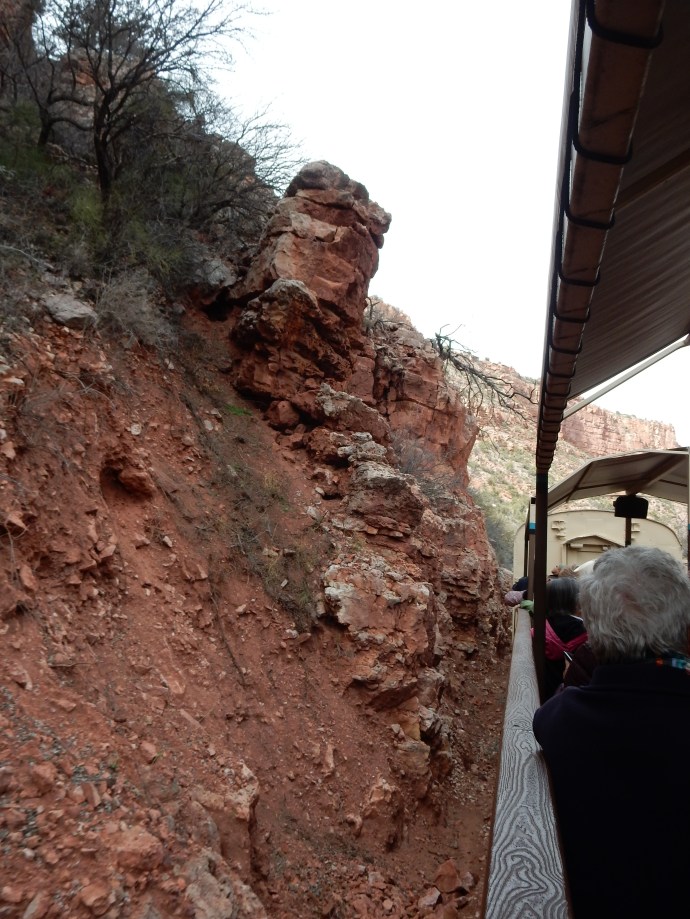
Once we leave the slag piles behind, though, the view is of plains, mountains, the Verde River, and the protected areas of two national forests and a wilderness area. Train trestles cross creeks and gullies that while dry today, must handle the flow from periodic flash floods. Train passengers must keep hands and heads inside since rock walls are just inches away. The coach cars are your base seating but each coach car has an open air car where passengers can sit or stand without windows or walls blocking the view. The winter’s leafless trees provide a view of the river not possible in other seasons. All the while, various colored cliffs and mountains loom in the background, providing a color contrast not presented by green leaves. Looking up, periodic cliff dwellings of the Sinagua peoples can be seen along the 20 miles of railroad track. All in all, it is a three and one-half to four hour journey.

Since this excursion was about scenery and not a history of Jerome or Clarkdale or mining or even the railroad, the rest of the blog will focus on what we saw. Hopefully you will enjoy the trip.

One of the views coming over Mingus Mountain

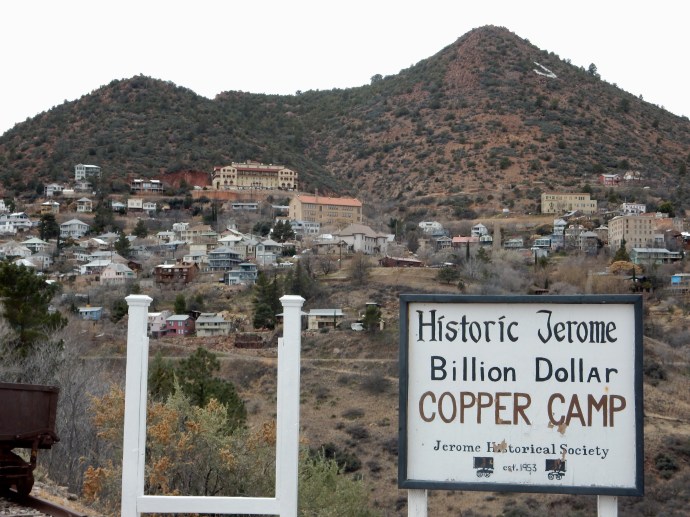
Jerome AZ, former mining boom town, now home to 444 souls.

Starting the journey

Our locomotives

The Verde River

Sinagua cliff dwelling

Joyce and Chris on the Verde Canyon Railroad

Riding close to the rock walls

During the journey

Along the journey

River, trees, rocks

Chris and Ed. Feb. 14

Categories: road trip, travel | Tags: , , , | Leave a comment

2019 Trip 2: Arizona: February 11-12

Chris and Joyce by Arizona Sycamores at Montezuma Castle National Monument

Prescott, Arizona February 12

Yes, there are still portions of Arizona we have not traveled to, through, or around. Prescott is one and Payson is a second. Hopefully this trip will cover both of them, although weather issues may derail Payson.

Tuesday, however, was glorious weather wise. Sunny and no wind. Prescott is north of Phoenix and our drives took us to elevations ranging from 3,000 to 7,000 feet. Prescott itself is at just under 5,400 feet above sea level. The temperature reached into the high 50s. We landed Monday night and I am sure we looked foolish to some since we were carrying a winter coat. Our car did not have a snow brush or ice scraper but you know, not everyone who lands in Phoenix stays there. Snow and ice and rain are all forecast for some time during the ten days of our trip.

But for Tuesday, we forgot about the future forecast and enjoyed the sun. We were not alone. After stopping in Scottsdale and picking up Joyce, Chris’ sister-in-law, our first stop was Montezuma Castle National Monument. The National Monument is a few miles east of Interstate 17 that traverses the mountains between Phoenix and Flagstaff. The drive there provides a pleasant view of the valleys between the mountains. The visitor center parking lot was almost full, including a cement mixer. Evidently many others took advantage of the weather and decided to visit this location, a national monument preserving the site of native peoples who lived in this Verde River valley.

Montezuma Castle National Monument, Arizona

The hike from the visitor center to the area of the cliff dwellings was short. Part of the walk was closed off as a crew was installing a concrete base for a new solar energy installation. Evidently, however, the contractor was too optimistic that the concrete could be pumped the 800 yards from the parking lot to the work site. Some of the concrete was being transported by a mechanized wheel barrow device while the rest of the crew was figuring out what to do next.

We discovered the construction issue during our pleasant and informative chats with park staff and volunteers. Yes, we also learned about the significance of the Sinagua people who built the five-story, 20-room dwelling during the period of time between 1100 and 1300. For unknown reasons, these people left the area in the early 1400s. Moving on, they populated other areas of Arizona. Numerous clans of Hopi Indians claim ancestry to the Sinagua and there are cultural and linguistic ties to others such as the Zuni, Yavapai and Pima.

The Sinagua are frequently separated by archaeologists into northern Sinagua, around Flagstaff and its related monuments, and the southern Sinagua. The southern Sinagua found the Verde River valley a good place to provide for themselves with running water and fertile land. The cliff dwelling at Montezuma was not the only location where they lived but this is one of the best preserved. The cliff here with its limestone base proved a reasonable location; living in the cliffs saved valuable agricultural land, and the cliff dwellings moderated the summer and winter temperatures.

Montezuma Well

Montezuma Well is a second section of the National Monument, about 10 miles away. The well site is a lake located in a limestone sink and fed by continuously flowing springs. The lake waters seep out into a nearby creek which passes Montezuma Castle on its way to the Verde River. The Sinagua people who lived in this area had constructed an irrigation system for farming. (See our earlier post about Casa Grande Ruins in Coolidge AZ from 2018 Trip 4.)

The well jumps out at you as you ascend a hill to the crest of the limestone sink. Several ducks enjoyed the water and easy feeding. Ruins of small houses and pueblos are nearby. The lake and creek seem out of place here in the desert but these creeks were a vital survival tool then and still are today as the Verde River is one of the few perennial streams in Arizona.

The largest Arizona Sycamore in the state, located at Montezuma Well

The two volunteers, husband and wife, staffing this site are part of the Volunteers in Park program. They live in their RV while volunteering here for three days per week. They have been here since August and then will move in May to North Cascades National Park. If it were not for the need to have an RV, Chris and I would have opted for that opportunity long ago. It was the husband who pointed out the largest Arizona sycamore tree in the state that had sprouted at the base of one of the cliffs where the water from the lake seeped into the creek. We found the bark of the tree stunning in its primarily white color and the form emphasized by the lack of leaves in winter. Arizona Sycamore trees were used by the Sinagua as the main beams in the Montezuma Castle dwelling and are still supporting the roof there after some 6-700 years.

One last comment about this national monument. The names Montezuma Castle and Montezuma Well were given by early American settlers who believed the structure had been constructed by the Aztecs. They were wrong but the name has remained.

Lunch was a choice between the casino and a Sonic. We opted for Sonic since this one had inside seating and I was hoping for a malt. My hopes were dashed as the powers that be had removed the malt option from the menu here, the manager did not know why. I did not complain, I saved a heap of calories.

A view of and from Tuzigoot National Monument

On to our third stop, Tuzigoot National Monument. Tuzigoot is located near the Verde River and consists of the remains of a 110 room pueblo with some second and third story rooms. The Sinagua who lived here also left the area around the 1400s. Excavation and refurbishment of the site led to the realization that the construction methods for the pueblo here differed from those used by the Northern Sinagua by Flagstone. No one knows why.

Tuzigoot is built into a hillside providing a great view of the surrounding area including the former gold mining town of Jerome built into the mountainside and the large cement factory owned and run by Salt River Pima-Maricopa Indian Community. The old mining operations left huge piles of tailings that polluted the water into azure blue. Not until the 1980s did residents have the ability to use new environmental laws to force compliance and begin remediation efforts. Phelps Dodge, the successor to the original mines fought the remediation efforts for two decades but in the early 2000s, the effort began.

The current owner, Freeport McMoRan Copper and Gold, has continued the remediation with numerous positive results. However, it takes decades at least to fully mitigate the damage and heavy metals continue to leach out of old mines and mine buildings. Slag from tailings piles still is being mined for minerals. The tailings ponds which covered acres of land leading to Tuzigoot have been covered but a visitor does not immediately recognize that the air pollution from the smelter which had been located in the air killed the native trees and the farming industry in the valley.

Near the top of Mingus Mountain Pass at 7,000 feet

Today we found the town of Jerome transformed into a cutesy shopping destination. Built on the mountainside, one named Cleopatra, Jerome went from nothing to a mining boom town of 15,000, to a ghost town, to a small community of 450 with artists, boutique shops and restaurants. We only drove through it today on our way over Mingus Mountain to our lodging in Prescott. Prescott has a population of 42,000.
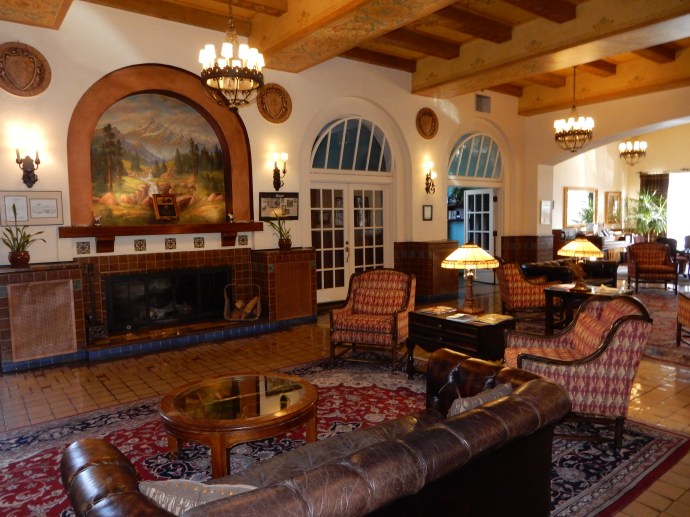
The lobby of the Hassayampa Inn

We are staying at the Hassayampa Inn, a historical hotel built in 1927 and restored in 1985. The vintage 1927 elevator has to be run by staff who helped us bring our luggage upstairs. After that, we walked the stairs although we were told that staff promptly answers the bell to operate the elevator as needed, or desired, by guests. The building still looks in good condition although rooms are small. Dinner was excellent.

The view partially up Mingus Mountain looking over the valley where Tuzigoot is located

Ed and Chris. Feb. 13

Categories: road trip, travel | Tags: , , , , , | Leave a comment

2019 Trip 1: Orlando Again: Jan. 21-22

At the start of the air boat ride, just south of Kissimmee FL

Orlando Monday Jan. 21

After two early mornings, we slept in Monday. Our activity today was a two-hour air boat ride through the headwaters area of the Everglades which starts just south of Orlando. Our tour operator (Spirit of the Swamp) was chosen because it offers headsets for better hearing of the guide’s presentation and because it is the only operator offering a two-hour tour, instead of just one hour. We were not disappointed; our guide, Lynn, did an excellent job.

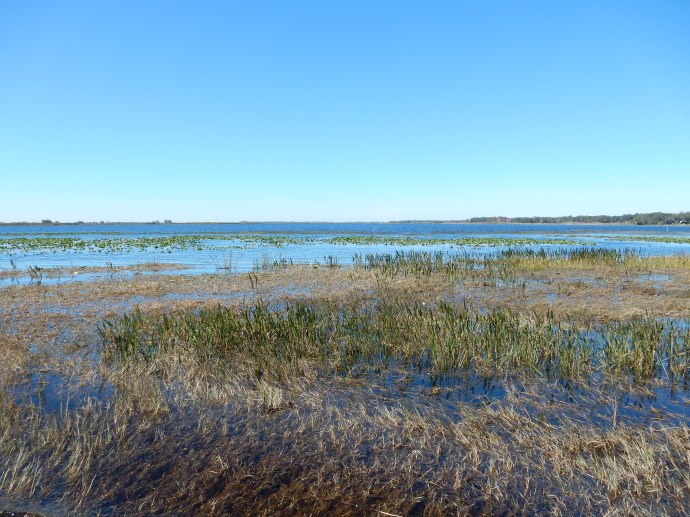
Part of the marshy area of our air boat ride

This section of Florida is critical to the Everglades, that 1.5 million acres of marshes, coastal mangroves, slow moving rivers of water, etc that crosses most of southern Florida where it had not been destroyed by encroaching urbanization and agriculture. Our air boat ride was not in the Everglades National Park, that is farther south. We were in the headwaters area where Shingle Creek, which flows southward out of Orlando, runs in to Lake Tohopekaliga. Through various lakes, rivers, and canals (much of the water is southern Florida is controlled by various watershed management agencies), the water flows into Lake Okeechobee and down through the Everglades to the Gulf. The land in this area seems to be divided between ranches, urban development, and conservation areas. I am sure there are in-depth articles on the battle between various groups to use and conserve water, I do not know how this area ties in to that. So I won’t go there.

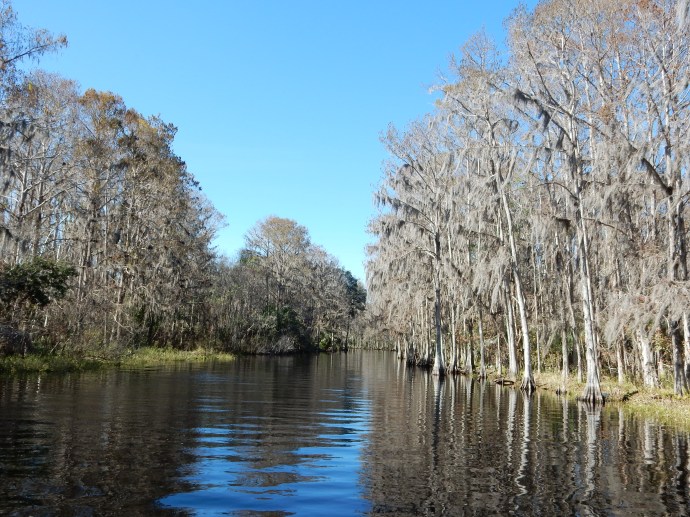
Cypress trees along Shingle Creek

Lynn, our captain, took us through a canal system into Lake Tohopekaliga, a shallow lake with numerous marsh areas. The air boat is able to go into areas with just inches of water or even areas of low grass. This versatility offered a wide variety of options as we covered marsh, grass, and open water. We saw the expected diversity of birds. We rode over a large swath of the lake area while Lynn identified numerous birds. The temperature, high of about 60 with a good wind, made us concerned whether we would see any alligators.

Up close and personal with one of the gators

Of course, a major highlight was seeing alligators. Mothers and hatchlings were not evident today but numerous large male alligators were sunning themselves. Most ignored us, one disappeared under the water as we got closer. With the air boat, we were able to come up within three feet of several of them. They just laid there, sometimes with an eye open, sometimes not, just enjoying the warmth of the sun on their backs. A few turtles were sunning themselves.

The five of us with CaptainLynn from Spirit of the Swamp air boat rides

The two hours went by quickly, we never tired of looking around the next corner to see what bird or animal would be present. Through it all, the landscape of water, trees, and grasses was a constantly changing backdrop of gorgeous greens and blues.

Tuesday, Jan. 22

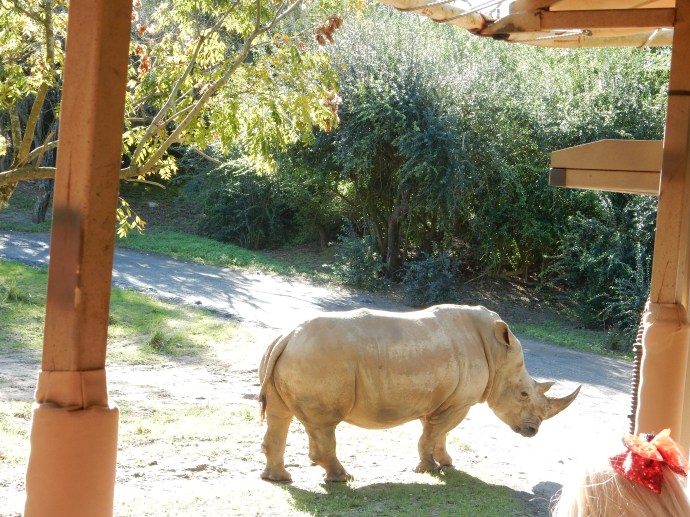
The rhino blocking our path

Back to Disney’s Animal Kingdom. Early arrival brought us to the gates around 8:30; gates were opening then. However, we had a glitch again and had to have guest relations re-authorize Sarah’s and Chris’ tickets to enter. We still made it to Na’vi River Journey before 9 AM and were able to easily enter the ride. From there we headed to Kilimanjaro Safaris Expedition and once again were ahead of the crowd for the 20 minute ride through various African terrains. Our ride was about 3 minutes longer as a rhino decided to park itself blocking the road just in front of us. We had to wait until it decided to back up enough for us to pass.
Some of the animals at Animal Kingdom

We wandered back and forth though the park trying various park experiences and had a great time. Lunch was at Satu’li Canteen with tasty and healthy meal combinations. In the afternoon, Sarah, Sarah and Daniel decided to separate and take a chance waiting in line for Avatar-Flight of Passage. They felt the just over two-hour wait was worth the experience, although a second ride would not have been.

We ended the day with a second ride on Kilimanjaro Safari Expedition and riding Expedition Everest (only 3 rode, you can guess which ones). As Expedition Everest ended, the evening river light show was beginning and we watched it from a bridge over one of the water channels. It was a pleasant way to finish enjoying the park and our two weeks in Orlando.

River of Light show at Walt Disney World’s Animal Kingdom

Ed and Chris Jan. 23

Categories: road trip, travel | Tags: , , , , , , | Leave a comment

2019 Trip 1: Orlando Again: Jan. 20

View of Hubble telescope which had been put into orbit by the space shuttle

Orlando, Sunday January 20

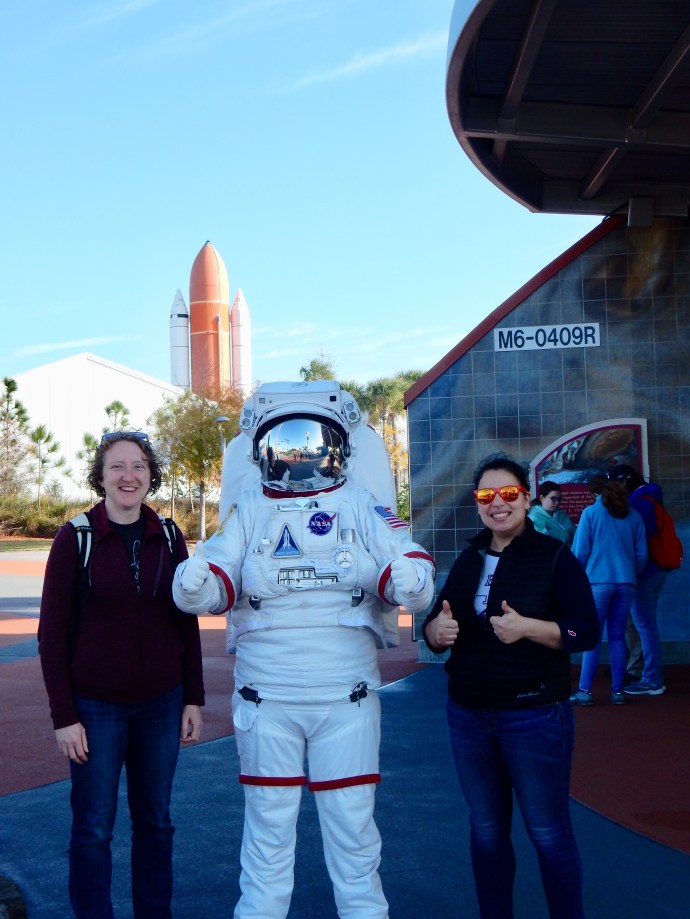
Up early again and off to Kennedy Space Center (KSC). KSC is an hour drive from Orlando and we wanted to be at the gates before it opened at nine. We were, but today the gates remained closed until the official opening time, no early jump. I, of course, added to the delay by grabbing the wrong gate ticket for Daniel and had to go to guest relations to have a new one issued. SL was excited to be here, her early career ambition was to be an astronaut.

At Kennedy Space Center

We grabbed one of the first tour buses that brought us to the Apollo/Saturn V complex. (Unfortunately, the partial government shutdown restricted us from visiting the Vehicle Assembly Building and various launch pads.) At the Apollo center, we viewed a series of films covering the Apollo program including a film shown behind a series of desks and consoles from the actual mission control room in Houston. Even though we knew the end result, the re-enactment still sends shivers down ones spine. Watching a film replaying the scenes from around the world as Neil Armstrong took the first step on the surface of the moon brought back the power of hope and adventure that America has frequently delivered to the world.

We returned to the main KSC complex where we experienced a variety of shows and exhibits. The group split up, Chris and I in one group, Sarah, Sarah, and Daniel in another. KSC offers a wealth of options, one could easily spend a day and a half trying to see everything, probably two days when the full tours are offered.

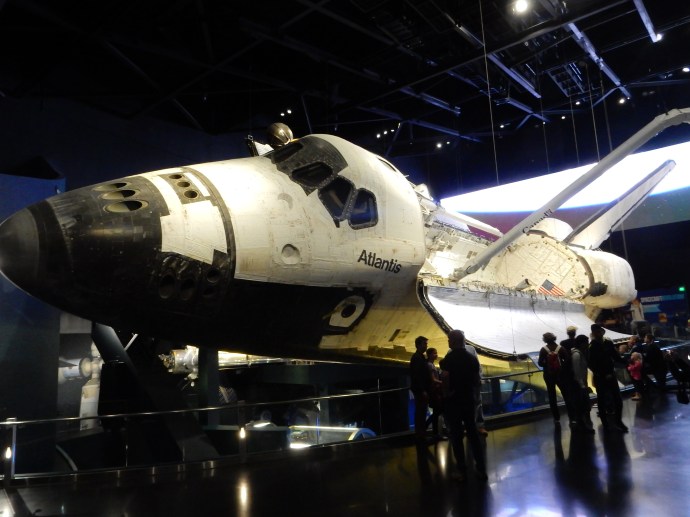
One of the theaters presents the history of the space shuttle Atlantis. Besides being informative, the ending has one of those dramatic moments when the film transitions to a curtain opening up to a view of the actual shuttle hanging in front of you.

Close up view of the white blankets on the space shuttle

In one of the activities, Chris and I had a docent tour about the Atlantis shuttle and heard some interesting details. First, while it is estimated 400,000 people worked at some point on the Atlantis project, an important element was the 18 women who sewed the thermal protection blankets used on about one-third of the shuttle. The use of tiles was more publicized but the blankets provided a lighter weight alternative that reduced the weight of the shuttle by 8500 pounds. We even met one of the women whose background was as a candy store operator but she could read blueprints and sew. That got her one of the jobs.

Second, the shuttle flew through space upside down and backwards. Upside down gave a view of Earth for the astronauts that provided a better sense of where they were than looking at the infinity of stars. Backwards allowed any floating debris in space or during re-entry to hit the strong rocket structure instead of the windshield of the shuttle.

The cargo area of the space shuttle Atlantis

Third, a young girl asked why the shuttle was so big. The docent gave an illuminating comparison: the shuttle is like a space pick-up truck. It was used to bring material into space to build the International Space Station.

Fourth, the docent related a tale of how the shuttle was hung in the museum. Several astronauts were consulting with the contractor. It had been agreed that the shuttle would be hung in a way to best showcase its form, at a 45 degree angle. The astronauts came back and said the shuttle had to be at a 43.21 degree angle. There was bickering back and forth but the astronauts won out. Later the contractor asked why 43.21 degrees. The astronauts answered, they wanted a countdown sequence somewhere in the display. Thus 43.21 degrees was the countdown sequence 4-3-2-1 lift-off.

Sarah, Sarah and Daniel went to a presentation put on by Mark Lee, an astronaut who had been on four shuttle missions.

All of us saw a large screen video of Planet Earth featuring views of earth from space. It was an emotional film, encouraging us all to continue space flight, to work cooperatively, and to undertake efforts that would preserve the quality of the Earth’s environment.

We would certainly encourage people to visit KSC if you go to central Florida. People from all over the world come here; on our small group docent tour were people from Brazil and Australia.

Our hope was to have dinner overlooking either the ocean or the Indian River. We lucked out at a small bar and restaurant on the Indian River, the Old Florida Grill and Oyster House in Cocoa. The initial appearance made us doubtful but the parking lot was busy so we gave it a chance. It turned out just fine although since it was so cool, we had to eat indoors and lost our view.

Atlantis hanging at its 43.21 degree angle

Ed and Chris. Jan. 23

Categories: road trip, travel | Tags: , , , , | Leave a comment

Trip 1: Orlando Again: Jan. 19

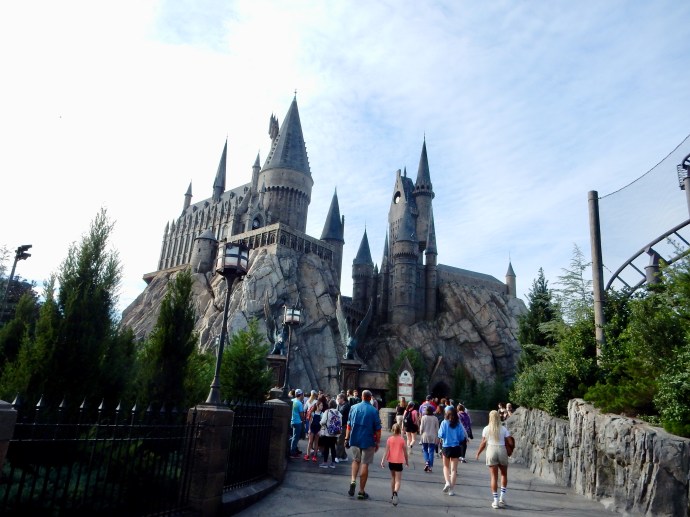
Hogwarts, Universal Studio’s Islands of Adventure theme park

Orlando, Jan. 21

Up early for the first day of the MN group travel in Orlando for our day at Universal Studios. We planned to visit both parks in one day, hoping to focus on the Harry Potter attractions. Early arrival got us a great parking place and an almost head of the line for admission at Universal’s Island of Adventure (IOA) park. Once again, we lucked out as the gates opened 15 minutes early. We made a beeline to Hogsmeade and Hogwarts Castle, and walked right in.

Chris was not going to ride, she had ridden once before years ago and that one occasion was plenty for her. The rest of us enjoyed the ride. By the time we were finished the line had grown exponentially. We visited the Hogsmeade shops, rode one more ride and decided to head over to the second Universal park, Universal Studios Florida (USF). The Universal parks are cheek to jowl; one could walk or if you had the park to park admissions, you were able to ride the Hogwarts Express. This train ride simulates the countryside from London to Hogwarts via simulations played on the windows next to your seat.

Upon arrival in USF we discovered the line for the Escape from Gingrotts ride was up to 90 minutes. It stayed about there or even longer all day. We never got in line to wait for it. Instead we visited the shops in Diagon Alley and wandered through the rest of the USF park. We purchased two glassess of Butterbeer and found it surprisingly pleasant-but not so much that we ordered another round.

Portions of the Hulk roller coaster

The favorite ride was the Hulk roller coaster where the riders were fortunate to get in two rides with the wait line only being 30-40 minutes. It was deemed “fantastic” with its rocket-like start, twisting curves and sharp drops. I felt the park was crowded (it was MLK weekend) and noisy. By 4 PM we had seen the shows we wanted and ridden enough rides to call it a day.

A visit to the pool was a great release; the day had been close to 80 degrees. After the pool, dinner at the Saltgrass steakhouse was a fitting end to the day.

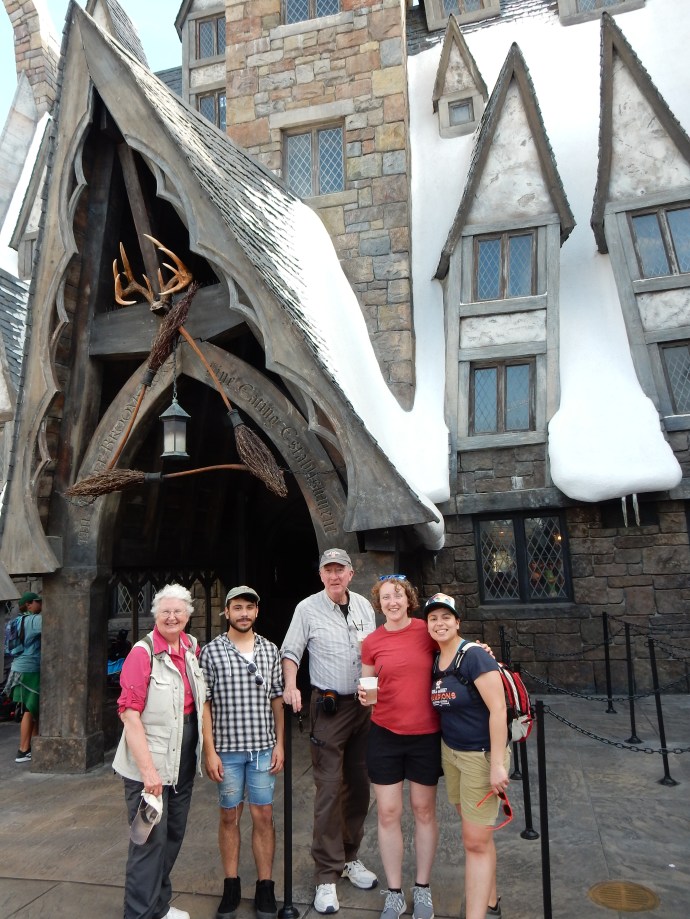
The five of us in Hogsmeade

Ed and Chris Jan. 21

Categories: road trip, travel | Tags: , , , , , , | Leave a comment

2019: Trip 1: Orlando Again: Jan. 16-18

Orlando Jan. 16

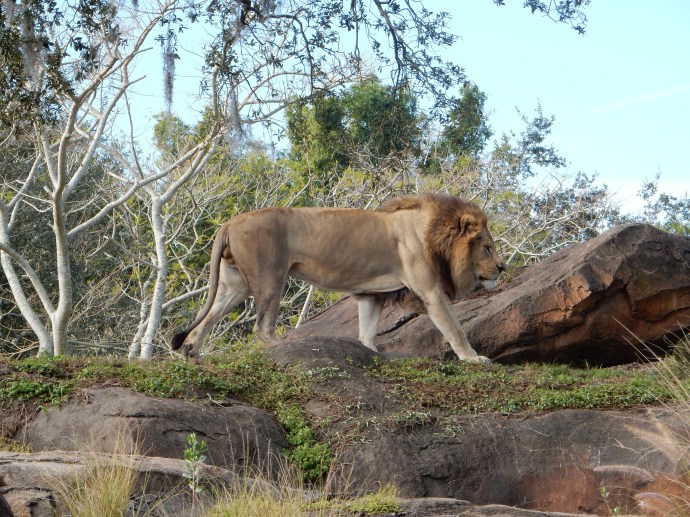
During Kilimanjaro Safari at Disney World Animal Kingdom

Well, I think Animal Kingdom wins our vote as the top park for Disney theme parks. As usual, we arrived early and the park opened before its regular, announced opening time. We headed for Na’vi River Journey and jumped on the ride with basically no wait. Na’vi, and its sister attraction Avatar, are based on the movie Avatar released in 2009. Na’vi River Journey is a boat ride making extensive use of 3D and 4D technology and luminescence. It was worth the early morning arrival.

On Kilimanjaro Safari ride

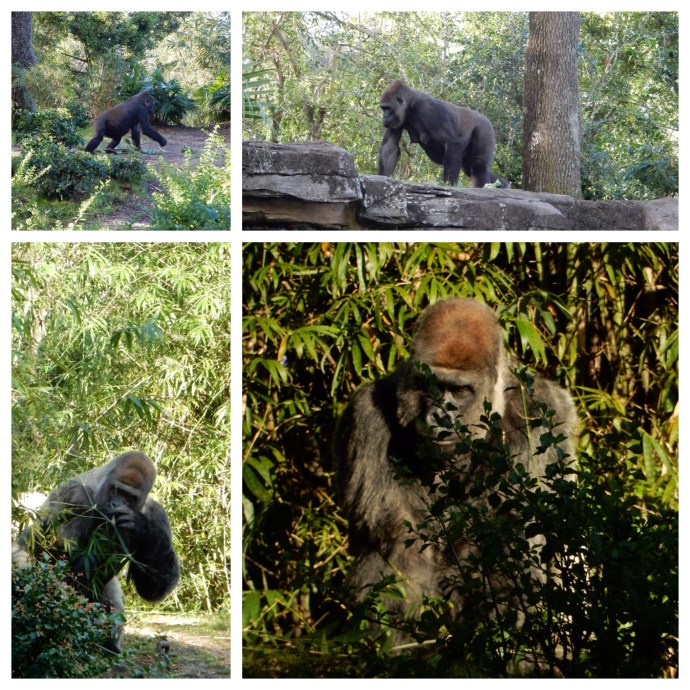
On Gorilla Falls walk

The four of us at the Tree of Life in Animal Kingdom

After Na’vi, we rode on the Kilimanjaro Safari, a bumpy ride in a large Jeep-like conveyance through the animal enclosures of Animal Kingdom. This ride was high on the request list and was well worth the bumpiness. In retrospect, we probably should have gone to the Avatar ride before Kilimanjaro as the lines for Avatar were never less than 105 minutes (it was not operating part of the day) and we did not want to spend that much time just waiting in line.

Deb and Ed with Expedition Everest in background

The rest of the day we wandered around, enjoying rides (including the roller coaster Expedition Everest that Deb and Ed rode) and shows. The lush setting and quieter atmosphere were a pleasant contrast to the other parks. The ability to see numerous animal species in close proximity was an added bonus. We left the park in late afternoon and ate at an Italian restaurant for dinner. It was Deb and Rebecca’s last full day as we brought them to the airport for an 8 AM flight home Thursday morning.

Left, Mickey and Minnie float at Magic Kingdom parade; right, It’s a Small World attraction

Thursday afternoon, Chris and I went back to the Magic Kingdom to catch the parade and a few more rides. There is no evening parade unfortunately; that had been a beauty. The afternoon parade seemed shorter than my memory recollected; not sure if my memory is correct or if the cost cutters have shortened it. Disney theme parks continue to raise prices and profits are still high; seems to me the evening parade should return.

Friday was our switch day. We moved from the Marriott Cyprus Harbor timeshare over to the Sheraton Vistana Villa Resorts. Another two bedroom place, the complex is much larger than Marriott but just as nice. One of the pools is just across the driveway from our unit.

Our MN guests were arriving at 5:15 PM so in the morning we went back to an art museum we had visited previously. The Mennello museum is relatively small. Another example of a wealthy couple donating their collection to create a museum. The city of Orlando gave them parkland near the city’s collection of museums to establish their museum. The Mennello collection focuses on the primitive paintings of Earl Campbell that Mrs. Mennello was enamored with. We arrived when the museum was in the midst of changing exhibits so no admission was charged to view the reduced number of works on view.

After the brief time at the Mennello, we headed over to a new art museum, the Albin Polasek Museum and Sculpture Gardens. The Polasek is another boutique museum. Polasek was a Czech-American sculptor. He had taught at the Chicago Art Institute. We were lucky enough to catch a docent tour.

Polasek’s Nativity carving done at age 15

Polasek’s themes included religion, man’s ability to persevere, and freedom. His monumental works include a sculpture of Woodrow Wilson in Czechoslovakia which had to be re-created from hidden molds since the Communists destroyed the work in their attempts to erase ideas of democracy.

Polasek moved to Florida after he left the Art Institute of Chicago and combined his home and studio. He suffered a stroke while living there which paralyzed the left side of his body. In the 15 years between his stroke and his death, he created 18 major sculptures. He would hold the chisel in his right hand and direct an assistant where and how to wield the hammer. His perseverance sculptures reflect this determination. Fascinating story.

Albin Polasek Museum and Sculpture Gardens, the painted cow relates to a traveling exhibit about cattle in Florida

Ed and Chris. Jan. 21

Categories: road trip, travel | Tags: , , , , , | 1 Comment

Blog at WordPress.com.