road trip

2019 Trip 3: South Florida: April 19-20

St. Paul MN April 22

Friday April 19

(UPDATE: 5/6/19
Congrats to Delta Airlines for calling us and discussing our concerns in person.)

It was a trip for the records books. Our flight home that is. We should not be writing this post. Our previous post stated it would be the last post for this trip unless something unusual occurred. Well, numerous unusuals happened. The trip was supposed to be a three-hour, forty-five minute non-stop flight from Miami to Minneapolis St. Paul. Hopefully you will find the actual trip amusing because it will be light on pictures unless we throw some in just for the heck of it.

The trip began innocently enough. We checked out of the HGVC timeshare in Miami Beach and our taxi driver obeyed the traffic laws. The three of us had a pleasant discussion about various sections of Florida and what to see in each section. He was properly appreciative of our extensive knowledge of and travels around Florida.

Upon arrival at the airport we checked our bags this time since we had purchased some hard cover books that weighted them down. Not a hassle and good experience for our upcoming trip to Alaska where it is likely we will have to bring a little more luggage. We have not checked baggage upfront for an air trip in years. Delta, or whomever, gave us TSA pre-check so getting through security was a breeze.

Our flight was scheduled to depart at 1:40 PM. Since we had to check out by 10AM, we were at the airport even earlier than usual. We settled in for some serious reading and a Nathan’s hot dog for lunch. Our incoming flight was coming from Atlanta. The weather forecast was for a line of north-south thunderstorms moving from west to east from Texas over to the Atlantic Coast. The board showing all Miami departures had delay and cancel as the most frequently used words. Our Atlanta incoming flight was delayed and our 1:40 PM departure did not occur until 2:45. (Some of these times may be approximate, we did not write down a detailed time line.) The plane left the gate and then we all sat on the tarmac for two hours. Water and snacks were provided.

After the two hours on the tarmac, the plane was directed to return to the terminal. Weather issues were unlikely to be resolved any time in the near future. But, and the word but will re-occur frequently, all of the gates were filled with planes unable to leave and there was no available gate for our plane. Finally the plane was sent to a gate at a non-Delta concourse. This means that the communications between Delta pilots, flight attendants, and “headquarters” were messed up. We removed our carry on luggage but checked luggage was still in the hold of the plane.

At this new non-Delta gate, the estimated departure time kept being delayed. It seemed obvious it was a complete guessing game about the weather system and no one wanted to go out on a limb and call the flight off. The pilots, who were still there, apologized and explained about the weather and safety.

After a few hours, the pilot explained we were being served by a crew that would not be cancelled due to a time-out of crew exceeding their legally mandated maximum hours. We were bonding now, we were in this together, this plane was going to go out tonight. There was another Delta flight to MSP scheduled to leave at 6:40 PM. It kept being delayed also, ending up with an estimated 12:10 AM (midnight) departure Saturday morning. Our plane looked like a 10 PM departure. Just in case, I had checked hotel availability several times, close by hotels still had rooms with reasonable rates. Since this was a weather delay, any hotel cost would be at our expense.

After numerous 30 and 60 minute push backs for departure time, our plane was canceled at 10:15 PM and rescheduled for 9:20 AM Saturday morning. We were to return to this non-Delta gate. The gang of us would have the same pilots, flight attendants, plane and the luggage stored in the plane. If you wanted to get your luggage from the hold of the plane, you would have to wait until the storms passed and the baggage could be safely removed and given to you. A couple from Saskatoon, Saskatchewan did that and had to wait until midnight to get their luggage. They slept in the airport. No free blankets were provided, evidently you had to buy them for $20 each. That Atlanta delayed flight was our downfall. If it had arrived on time, our non-stop flight to MSP would have departed and we would have been home by our scheduled time.

Chris and I had decided, depending on how early the plane was supposed to leave on Saturday, that we would get a hotel. By now, all of the hotels I had relied on earlier were full. Luckily, we got a Marriott Aloft hotel in Coral Gables, just 4 miles and a $22 cab fare away. We had noticed and passed by the hotel Friday April 12th after lunch at the Biltmore. Knowing the hotel’s location was helpful. The night was dark and raining hard. The taxi driver did not recognize the Aloft until the last minute. We had a few items with us in our carry on backpacks but the vast majority was in our checked luggage and unavailable to us. We did without. Interesting that this was the time we checked baggage.

Saturday April 20
Saturday AM we were up and back, via another taxi ride, at the airport by 7 AM. TSA pre-check came through again. The fact that our boarding pass was for a previous day did not seem to be a problem although Chris wanted to explain the whole situation to the TSA people. I pulled her away. This morning it was McDonald’s for breakfast.

The gate departure boards indicated our flight was going to leave from a Delta Concourse, not the non-Delta gate our pilot on Friday had told us to return to. We gathered around this new gate and swapped stories. Several people (I had not noticed this) received texts that their luggage had been taken off the plane last night. This was different from what the pilot told us Friday night. The two pilots arrived. We cheered them. The pilots chatted with us, made some announcements, and started doing some gate area assignments since the flight attendants and gate people had not shown up yet. About 9 AM, everyone in the gate area (including the pilots) received smart phone notifications from Delta. You could hear the buzzing and ringing all around the area. Our 9:20 am flight had been cancelled.

(Piecing information together later, it must have been that our flight attendants were needed somewhere more important Saturday morning. That afternoon Delta actually flew the plane with “our” pilots and our re-loaded luggage to MSP-but no passengers since there were no flight attendants.)

Rather than taking a chance again on not having our luggage, Chris and I left the gate area and went to baggage claim. Scads of luggage was stacked neatly in rows with no attendant in sight and cordoned off by a cord. Do we slip behind the cord and look for our luggage? No, we are good people and went to find an attendant. He lets one of us in at a time to look. No luggage!! Ah, but there is more luggage at a different carousel. We go down there. At first we find one, hurrah! Where is the other one? Not close to the first one but we locate the second one and go back to TSA.

Hi, TSA folks, remember us, the people with an outdated boarding pass? No response but the TSA Pre-check zips us through once again, just ahead of the hordes being deposited from the cruise ships that arrived this morning at the Miami cruise ship port.

Some people started making their own alternate arrangements. “Our” group was being broken up although we saw people throughout the day at various restaurants and gates. When we did, we swapped stories, facts and rumors. Chris and I relied on the Delta automatic re-booking. Our new flight was to leave at 11:04 AM to Atlanta where it would arrive at 1:25 PM. Our connection to MSP was to leave 30 minutes later from a different concourse. Oh-Oh. How likely is that to be successful??

Chris kept walking to the departure announcement boards to check on status updates. The Miami airport WiFi was terrible, whether due to heavy traffic because of the storms and delays or maybe it is always terrible. In any event, I turned on our portable hotspot, kept the smart phone charged from our portable battery or wall outlets and checked and re-checked the Delta app. This process notified us more quickly than the Delta flight notifications sent via text or email.

Once again, the 11:04 AM Saturday newly scheduled departure to Atlanta is bumped back in 15, 30 or 60 minute increments. Why, well it appears that there are no flight attendants! This plane needs four flight attendants to legally fly. Once we are told this, we understand and are concerned. But they have found three attendants back in Atlanta and they are on their way via a Delta flight and should arrive at the gate around 1:30. Hopefully a fourth attendant can be found. Around 1:30, four attendants arrive. When they do, we cheer them. Too soon.

When the flight attendants check things over on the plane, there is some unstated problem. A new plane will have to be brought over. Groans. The flight attendants head off to get some lunch. But then, it seems the problem is fixed and we can leave. But wait, the flight attendants went to eat lunch and now have to be paged. They run back and then we board the plane. After first class, we just get on in a group, no class announcements. The plane is only 2/3 full. It is 2:50 PM. On board, water is passed out and things are looking good. Too soon. We sit. We sit. We sit at the gate. The pilot tells us he is fighting for us with operations and the control tower. There appears to be a shortage of people and machines to push our plane away from the gate. What!!!

An hour later at 4 PM, the proper people and equipment arrives. The plane is pushed away, we get in line to take off. Everyone is holding their breath. Success; we are in the air and on our way to Atlanta. Of course, if you have been following closely, you recognize we will miss our 5 PM connection in Atlanta for MSP. But, our gate attendant in Miami (for the 11 AM original departure which was pushed to 1:04 which left the gate at 2:45 and finally pushed back at 3:45 to get in the air at 4 PM), with Chris’ encouragement, had gotten us standby seats for a 7:45 PM flight and GUARANTED seats on a 10:20 flight from Atlanta to MSP. But we will have to be get new boarding passes in Atlanta.

Once in Atlanta, six of us meet up at the re-booking location closest to our arrival gate in Atlanta. It is now 5:30 PM. Two of them, guys who have to drive two plus hours after arrival in MSP, get lucky and get guaranteed seats on the 7:45 PM flight due to a cancellation just as they were being rebooked. Chris and I get standby seats number two and three for the 7:45 PM flight.

We forego dinner and wait at the gate in the F terminal for the 7:45 flight to MSP. Standby is not determined until just before boarding. Still, if we do not get standby, there is plenty of time to get to the 10:20 pm flight way over at the A terminal. We chat with old friends and new friends. We check our app and the departure boards. Chris chats with the gate agent. Gee, it is after 7 PM and no word about boarding process. Is something happening?

Sure ‘nuff. The flight attendants for this 7:45 flight are coming in on a 7:25 PM flight at E terminal and after checking out their passengers will rush over here and our flight will leave. Chris and I prepare; how late do we wait here for standby before heading over to A terminal for our guaranteed seats on the last flight out tonight to MSP? But the P.A. system clicks on. More information is forthcoming. Our incoming flight attendants are on a flight from the Caribbean and have to go through international customs. It is now 8 PM. We decide to wait longer.

We recognize that our stand by options are decreasing. With the system wide delays still occurring, the chances are good that some passengers schedule to take the 7:45 PM flight will not arrive in time and we should be able to snag our two standby seats. With each minute that the 7:45 PM flight is delayed, we observe passengers running up to the gate to claim their seat.

More passenger type people are arriving and milling around our gate. Oh, a flight to Chicago has been re-assigned to leave from our gate after our plane does. At 8:45 PM, with no flight crew in sight, we leave F terminal and head to A terminal for our guaranteed flight. The new gate area is crowded, there are 18 standbys waiting here. Luckily we are guaranteed on this one.

No suspense now. The minutes tick by, boarding begins for the 10:20 PM flight to MSP. We board and the flight leaves on time, arriving in MSP at 11:50. Of course we are in the back of the plane. We get to the taxi waiting area, there are still a few waiting. For our guy, he will go home after he drops us off. We collapse into bed at 12:30 AM, 1:30 AM central time. Home sweet home.

A few tidbits on people and situations.
A. One of the Delta employees at the Atlanta re-booking counter understands our plight. She had been in Miami and had to report back to Atlanta to handle this rebooking. She can not get a flight to Atlanta either. She rents a car, drives the ten hours through the rain and reports for work with no rest. She has been working all day and will continue for a while.
B. A Delta gate attendant who worked by herself on Friday at the non-Delta gate to respond to passengers concerns after our two hours on the tarmac. Always composed, always polite.
C. The woman on Chris’s left on our two hour tarmac delayed plane was from Saskatoon, Saskatchewan. She had a conference in Myrtle Beach. Her husband flew down to join her in Miami Beach. She and Chris swapped note about Saskatoon, a town we visited in 2013 duirng our first year of travel. They were the couple who slept in the terminal Friday night. We ran into them over and over during the two days. They were flying through MSP to Saskatoon and had 7 PM flight reservations. They probably had to wait until late Sunday to get home.
D. While waiting for Saturday’s 7:45 PM flight, Chris met a person who had lived in Lake Elmo MN where my family lived for 4-5 years.
E. The two guys who snagged the last seats on Saturday’s 7:45 flight had just been hired for new jobs and were down in Miami for training.
F. One couple from the Netherlands and one from Belgium (with two kids) who use MPS as their connection to Europe. The family with kids had spent two weeks in Florida and really enjoyed the Everglades.

Ed and Chris. Saint Paul MN April 21

Categories: road trip, travel | Tags: , , | 3 Comments

2019 Trip 3: South Florida: April 13-18

Taking the beach walk to the beach

Miami Beach, FL. April 18

Our old haunts awaited us as we returned to Miami Beach. We have been coming here almost every year since 2001-18 years. Some things change, Hurricane Irma closed down one hotel which had a restaurant we used to frequent. A new transit option appeared, free rides in an electric driven small open air van paid for by advertising. Some things are the same, Front Porch restaurant is still open after 25 years and just half a block north of our place as is La Sandwicherie, a famous hole in the wall sandwich shop we frequent.

At the beach: pelicans, cruise ship in background and parasailing, typical beach scene, and moon rising over the ocean.

The people watching continues of course. A better writer than I could keep you spellbound with anecdotes of the various antics one sees on the beach and on the sidewalks. The family whose dad is complaining how the teenage daughters are whining about the experience and how much the parents are paying. We only heard the father’s many whines, few from the daughters. The people trying to open their less expensive store-bought umbrellas that turn inside-out in the strong wind. The woman and child walking down the middle of the street. You will have to use your imagination or your own experiences to expand the number of anecdotes.

Monday was supposed to rain and it was the day for our room to be cleaned so we went walking down to South Pointe, next to the ship channel that is the means for boats, cargo ships, and cruise ships to reach the ocean. We passed two hotels where, when we were working, we used to spend a night or two to extend our vacation. When we stayed at those hotels, we never went to the beach, just stayed at the hotel pool.

Wolfsonian examples of Art Deco inspired furniture: oven, dressing table, hutch,and desk.

The Wolfsonian Museum is a favorite of ours. Usually we go to the Friday night free admission and docent tour. Once we heard James Dyson talk about his revolutionary new vacuum cleaners. That gives you an idea of how long we have been coming here also. Monday we went and actually had to pay the senior admission rate of $8 each. While various exhibits come and go, the heart of the exhibits are items from the Art Deco period.

Wolfsonian: Art Deco in everyday life: mail box, radio, movie ticket taker booth, toaster

Art Deco was highlighted at a 1925 exposition in Paris and took off in the U.S. in the 1930s. Art Deco architecture was the driving style in Miami Beach’s expansion. But Art Deco took over in design for many everyday experiences. There are connections between styles and ornamentation visible on hotels from that period and furnishings and appliances created in the 1930s.

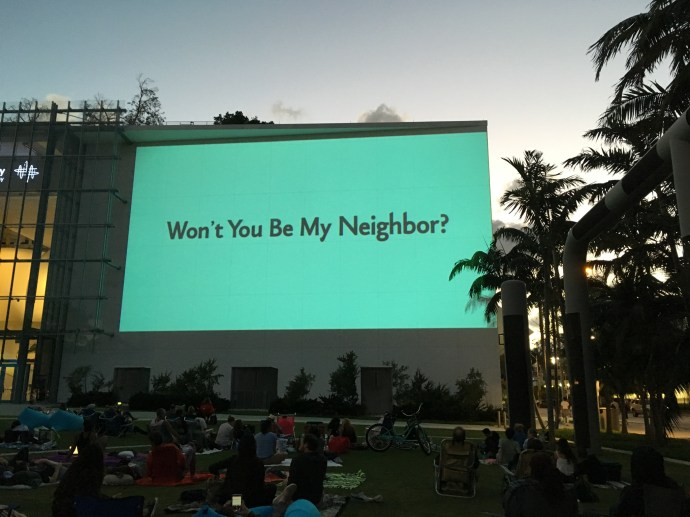
New World Symphony wallcast

The New World Symphony, started by Michael Tilson Thomas, is a post-graduate school training academy for musicians. For Wednesday night’s activity, its outdoor wall is used to simulcast some of their concerts and to host weekly outdoor movies during the winter season. We ambled over last night and watched “Won’t You Be My Neighbor”, the story of Fred Rogers. Besides enjoying the movie tremendously, we saw a new (to us at least) form of outdoor seating. The Porch Couch is a piece of plastic like material, open at one end, and you simply wave it around to fill it with regular air. It provides a couch like seating that held up well for the two groups we saw using it. When the event is over, let out the air and pack it up. Neat.

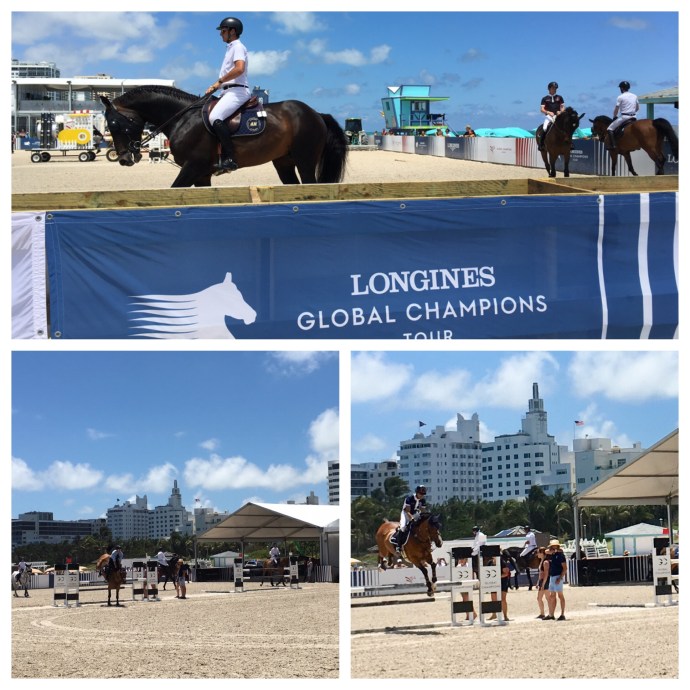
An unexpected experience wraps up our trip. When walking along the Beach Walk, I came across large tents being erected. Nothing unusual there, Miami Beach is host to many conferences and events. Upon closer perusal, I realized that the tents were for the Longines Global Championship, an international horse jumping competition. It runs Thursday (today) through Saturday on the beach. And attendance was free.

Preparing for the event, Longines Global Championship

Chris and I went to the opening day afternoon competition. Horse and rider teams from the U.S., Great Britain, Qatar, Sri Lanka, Czechoslovakia, Netherlands, Germany and Switzerland were represented. Several different levels of competition were scheduled, we have no clue as to the rules which determine who can enter each round. After two and half hours, our event winner was from the U.S. Listening to the announcers, it was evident that the competitors were top-level. This Global Championship has 20 events in cities like Mexico City, Shanghai, Montreal, Prague, London, Monaco, Stockholm, etc.

During the event.

I was surprised the horses were jumping outside in the heat, 86 degree Fahrenheit at show time. But the views of the ocean and the horses made for great viewing for the spectators. Given the high cost of the horses and of travel, I am sure the horses would not be jumping if it would harm them.

This will be the last post for this trip unless something unexpected happens in the next 24 hours. Friday we fly home.

Ed and Chris April 18 Miami Beach

Categories: road trip, travel | Tags: , , , , , , , , , , , , , | Leave a comment

2019 Trip 3: South Florida: April 10-11

Approaching Fort Jefferson at Dry Tortugas National Park after a 2.5 hour trip from Key West.

Key West Florida, April 11

Another day, another fort. Another day, another dip in the pool. Another day, another boat ride-but this one without any queasy feelings.

Wednesday April 10 was slated for our all-day trip to Dry Tortugas National Park. Dry Tortugas is the home to Fort Jefferson, located on an island 70 miles west of Key West. All of these keys are part of the third largest barrier reef system in the world. The keys are the exposed portion of ancient coral reefs extending from a point south of Miami to Dry Tortugas. Dry Tortugas is named for: Dry-to warn mariners that there is no fresh water here, and Tortugas (turtles) for the abundant turtles found by the earliest Spanish explorers which provided them with fresh food.

Inside of Fort Jefferson

Fort Jefferson was one of the many forts built by the United States in the mid-1800s to protect itself from foreign countries. Fort Jefferson would have been the largest and most heavily armed of all of the forts. At completion, the fort would have even able to train 120 cannons at any one spot in the water. Plus, land based cannon were more formidable than ship based; giving a huge advantage to the fort over attaching ships. But, given government funding and the difficulty of bringing construction materials all the way out here prevented the fort from ever reaching its intended size and armament.

One of the few remaining original cannon at Fort Jefferson

Fort Jefferson has one of those “what if” stories. The fort is located in Florida. At the time of Florida’s secession, Fort Jefferson had not been completely built and its cannon were still being shipped here. A Union ship had left Boston on a hurried trip to the island, landed here, and disgorged a battalion of artillery. The very next morning, a Confederate ship arrived and demanded the surrender of the fort. The Union artillery commander came out and basically told the Confederate ship to back off and tell all of the rest of the Confederates that this was their last and only warning, the next Confederate ship that approached would be blasted out of the water. The Confederate ship retreated. Lucky for the Union artillery battalion. The Confederates did not realize that the cannon for the fort were not yet here. Soon enough, the cannon arrived and Fort Jefferson proved an important part of the Union blockade of the Confederacy.

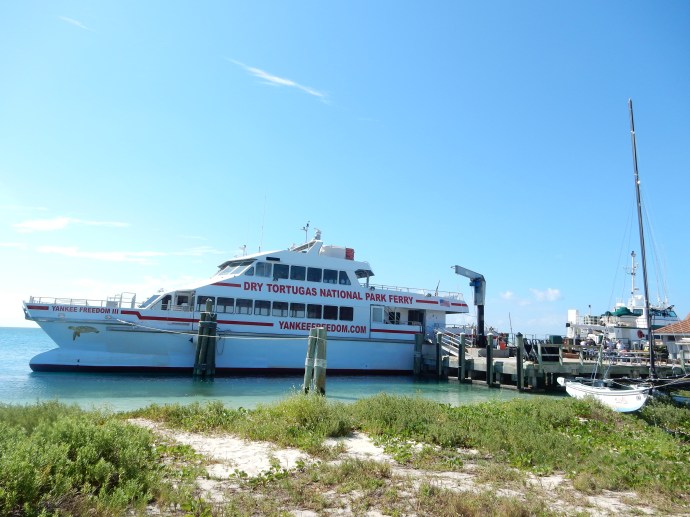
The Yankee Freedom III

We learned this and other details during an hour and a quarter tour given by a very knowledgeable crew member of the Yankee Freedom III. The Yankee Freedom is the authorized concessionaire to bring tourists out to the island. The boat ride is 2.5 hours out and leaves at 8 AM. We were warned there could be rough seas about one-half way out. We had taken our Dramamine but opted out of partaking in the free breakfast on the ship. Instead we chatted with our table mates, a couple from Eden Prairie MN and a couple from Annapolis MD-the wife had recently retired from the geography section of the U.S. Census Bureau.

The Dry Tortugas National Park was the impetus for our travel to Key West and was a worthwhile stop for us. Many of the people who rode the Yankee Freedom were here to scuba dive, a few others were here to camp out for a few nights. By the way, there is no fresh water on the island for them. We did meet and talk with a ranger who is responsible for running the island’s power generator and small desalinization plant. About 30 park employees live here year round, pretty much off the grid. We were happy to get back on our boat and take the 2.5 hour ride back to Key West. Both ways the seas were friendly enough and Dramamine worked its magic. We even ate lunch on the Yankee Freedom before venturing back to Key West.

After the day long journey, it was back to the Fairfield and its pool with water just the right temperature. It has an outdoor bar which we enjoyed also.

Today, Thursday, we rode the hotel shuttle to downtown Key West. Our primary destination was the Ernest Hemingway home. It is a major tourist draw, we got here early. Hemingway lived here from 1931 (with his second wife) until 1940 (when he moved to Cuba with his third wife). Tours begin every 5-10 minutes through the house and grounds. The home was originally built by a man who provided supplies to ships. He made a fortune and the home is the largest private residence on the island, built on the highest point (12 feet above sea level), has the largest pool, and has the only basement. His riches did not prevent personal misfortune and the home eventually fell into disrepair until Hemingway’s wife bought it with her uncles’s money.

One of the cats on the bed in the master bedroom at Hemingway house.

Of course the tour is full of anecdotes about Hemingway, his wives, his books, his famous friends, etc. One other highlight for some people is the 50+ cats on the premises. They all are related to a white cat given to Hemingway by a Key West friend. The original cat had 6 toes. The majority of the cats here have six toes and are all descended from the first one. Each female gets one litter before she is neutered; except for one female named Elizabeth Taylor who had two litters. The cats have free range, have staked our their own territory on the property, and chase away any stray cats that try to get in. THey have a full-time veterinarian and accompanying staff.

We spent some time wandering the streets of Key West. Plans to visit other museums went by the boards as the heat and humidity took its toll. We returned to the Fairfield to work on this blog post and to enjoy the pool.

Hemingway’s writing studio was in this building next to the pool.

Ed and Chris April 11

Categories: road trip, travel | Tags: , , , , | Leave a comment

2019 Trip3: South Florida: April 9

Inside Fort Zachary Taylor in Key West

Key West, FL. April 9

Well, I think we had the Rodney Dangerfield of park rangers today. We were at Fort Zachary Taylor State Historic Park at the extreme western end of Key West. So extreme, that when it was built it was actually constructed in the water and connected to the mainland only be a causeway. Our state park ranger gave a tour to about 15 of us on a hot, humid day.

Possibly he had not given this tour for a while. He seemed forgetful and his attempt at jokes were frequently a cover for his forgetfulness. Despite the humor or lack of it, we did gain some interesting knowledge of this little known fort. Fort Zachary Taylor was one of three U.S. military forts that remained in Union hands during the war. It never fired a hostile shot from its many cannons during any war.

Fort Zachary Taylor, Key West FL

It’s greatest claim to fame occurred during the Civil War. Through its role as a critical part of the effort to blockade Southern ports, Fort Zachary Taylor oversaw the detention of 1500 ships stopped for smuggling. As the Navy captured a ship, it would force the ship to drop anchor in the sea within the range of the big cannon at the Fort, effectively keeping the smugglers from leaving.

Our ranger enjoyed making little comments. For instance, the fort was begun as a reaction to the war of 1812, to protect the U.S. against British attack. As the fort’s usefulness wound down during WWII, the large coastal cannon then in service were removed and sent to Britain to be used to defend Britain from German attack. He thought the irony was rich.

Some of the Civil War armaments discovered buried at Fort Zachary Taylor

The history of the fort as a state park rests heavily on the work of one man, Howard England; another example of the power of a determined person. The Fort had been transferred to the Navy and the property was in disrepair. England was a civilian architect with the Navy. On his own and then with some other volunteers, in 1968 he began a thorough excavation of the site. His digging and his research uncovered the most extensive collection of Civil War armaments. The military had just taken outdated armaments and dumped them into a pit and covered them up. England’s work brought to light the historical significance of the fort. The property eventually was transferred to Florida for a state park, both for beach access and for the historical aspects.

Southernmost point in the U.S.

After our time at the fort, we traveled around downtown a little, stopping at the famous southernmost point in the U.S. for a picture. Thunderstorms were predicted for the afternoon and we returned to the hotel early. Not only did we get a thunderstorm, Key West and several of the keys east of it are now under a power outage. It has been going on for an hour, 5 PM to 6 PM, and we hope the people heading to the nightlife of Key West find their bar or restaurant able to serve them. The power outage reminds one of our comment about the water supply and how isolated this area can be in times of trouble. We are reasonably prepared for short outages with a flashlight, extra battery power for the laptop and phone, and our own internet connection.

Chickens and Roosters have been running loose in Key West for decades

Ed and Chris. April 9

Categories: road trip, travel, Uncategorized | Tags: , , , , | Leave a comment

2019 Trip 3: South Florida: April 6

The type of Nike air defense missile stationed at Everglades National Park from 1962 to 1979.

Florida City, FL. April 6

We never knew the U.S. had a missile base in the Everglades. Now we, and you, do. The Cuban missile Crisis of 1962 identified a lack in perceived readiness against a hostile missile attack. Previously the U.S. only prepared for a Soviet missile attack over the North Pole. The Cuban Missile Crisis made evident a need to protect against an attack from the south. This and more we discovered during an excellent presentation by Ranger Leon today on our second ranger led program.

We took advantage of two ranger led programs out of the Royal Palm Information Center. The Royal Palm area is the initial foundation of the Everglades. The Florida Federation of Women’s Clubs worked with the State of Florida to create a state park to protect about 1,000 acres of the Everglades. The state park was incorporated as the heart of the Everglades when it was made into a national park in 1947.

A large turtle along the Anhinga Trail at Everglades National Park

The first ranger program was a walk along Anhinga Trail. Once we got on the trail, Chris and I remembered this walk from a decade or more ago when a German couple on the ranger walk were shocked that an alligator had earlier that day just walked right by them on the path when they were pushing their baby stroller. No such excitement today although we took some excellent turtle pictures.

The ranger again talked about the wet and dry seasons. This year, the dry season which is just ending, has been wetter than usual. Some of the areas we have observed, including the canal along the Anhinga Trail, would have been dry most years. It is possible some of the increase in wetness is due to the recent bridges just built over U.S. 41 allowing more water to flow naturally south than has been the case for over a hundred years when canal building began.

Along the Anhinga Trail at Everglades National Park

Ranger Leon did a great job re-creating the feeling of October 1962 when the U.S. discovered the Soviet Union had installed offensive nuclear missiles in Cuba, 90 miles south of the U.S. The U.S., and indeed the world, was on tenterhooks while the two superpowers postured and negotiated. There was an extremely high chance of a nuclear confrontation. As in any conflict, the possibility of a mistake or an action taken by any one of many lower level military commanders of either side could escalate the conflict out of control. In fact, there were numerous near-chance accidents.

As one of the actions taken while the negotiations were occurring, an Army Missile Battalion deployed to an area just outside the Everglades. The Missile Battalion was on war readiness to shoot down incoming missiles while living in a tent city in mud and mosquitoes. Park Managers gave permission to build a site within the park and Nike Missile Site HM-69 was built within the park-the mosquitoes moved with them. It was operational until 1979. We were able to tour the site today.

The Administrative offices of the Nike Missile site, now the Everglades research offices.

The pink painted buildings were a surprise but otherwise Ranger Leon expressively laid out the reality of life on the base. Mud, snakes, lightning strikes (Florida has more lightning strikes than any other state and at least one soldier died here due to one.), snakes, high shoot to kill security, Jim Crow laws in nearby Homestead, etc. all were part of life here.

Replica of actual sign on missile site

Young men led by only slightly older officers had to maintain a state of high readiness for years. The closeness of Cuba meant immediate responses would be necessary. Other Nike missile sites were deployed around the country but this site was the last to be de-activated. This one site (U.S. Army’s 2nd Missile Battalion, 52nd Air Defense Artillery, A Battery) received exceptional honors for its performance during the tour of duty here.

It was gratifying to me to hear that this presentation was started by a National Park Service volunteer ten years ago. It is offered daily Dec. 1 to March 31st and the first two weekends in April and has become an extremely popular tour.

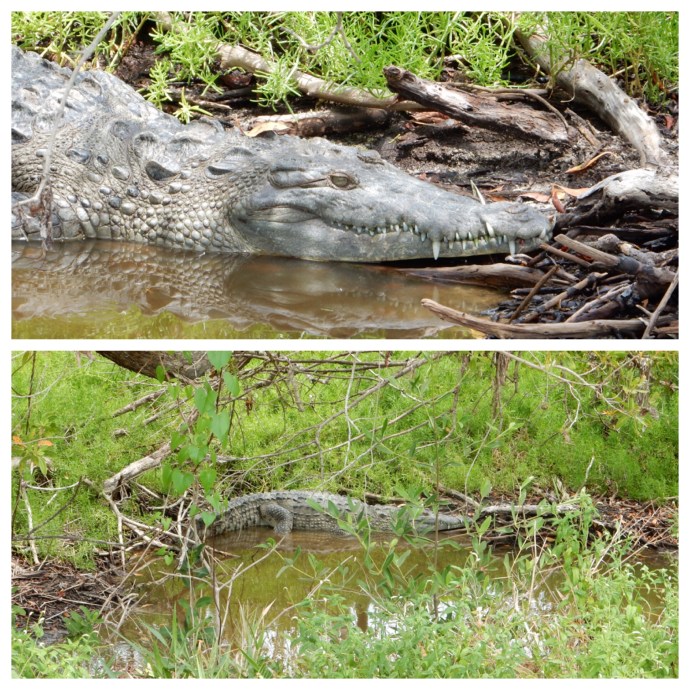
The only crocodile we saw in the Everglades. We did see hundreds of alligators.

Ed and Chris. April 7

Categories: road trip, travel | Tags: , , , , , , , | Leave a comment

2019 Trip 3: South Florida: April 4

The Everglades “River of Grass” from the observation Tower at Shark Valley, Everglades National Park

Florida City, FL. April 4

Today we entered what some people call the “real” Everglades, that eastern sea of grass and water fed by waters starting in Kissimmee and reinforced by waters from Lake Okeechobee. We drove over three new bridges on U.S. 41 that increase the volume of water that can flow unimpeded on its southward journey to the Florida Bay. This whole area is considered a river that moves at a rate of one mile per day.

The Everglades have been labeled a national park, the largest subtropical wilderness in the U.S., an international Biosphere Reserve, a World Heritage Site, and a Wetland of International Importance. It is no wonder we see and hear visitors from around the world here.

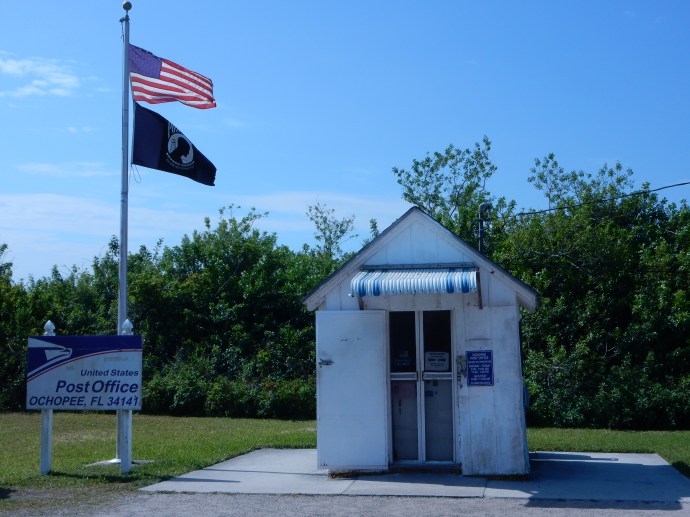
Ochopee FL Post Office

Before we entered our second visitor center and gateway to Everglades National Park, we made two stops. Well, maybe two and a half stops. The half stop was a quick stop and visit to a working post office serving Ochopee FL. It is billed as the smallest U.S. Post Office. We thought we had previously visited the smallest post office somewhere in Door County WI.

In honor of Clyde Butcher, we took one of our photos and converted it to black and white

The first real stop was at the gallery of Clyde Butcher (clydebutcher.com), a well-known photographer who has been honored for his large-scale black and white photography still made in the ‘wet’ darkroom. Much of his black and white work has been done with a large format view camera that he caries and sets up in the middle of forests, swamps, and rivers. His gallery here (he has two others) showcases his work and that of a few others. One of them, Andy Morgan, was staffing the gallery today with Andy’s wife. Andy’s work was also on display and we spent about an hour here. (andymorganphotography.com).

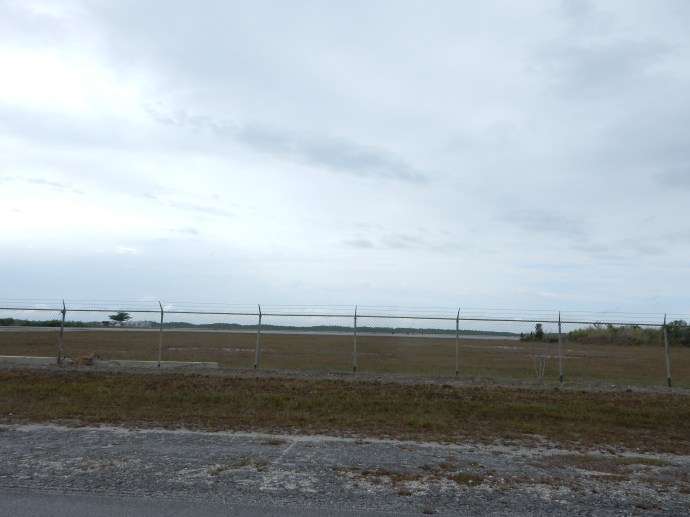
The runway at the canceled Miami Jetport

Our second stop was at the Dade-Collier Training and Transition Airport. Actually this was kind of a half stop too; maybe we did only make two stops before the Everglades. You may recall in an earlier post that Big Cypress Preserve was created in response to stopping a new airport. This “Everglades Jetport” or “Big Cypress Jetport” would have been five times the size of JFK in New York and would have been the largest airport in the world at the time. Since one 10,500’ runway had already been built, the runway was kept. It is considered part of Miami Dade Airport Authority. We drove to it-you had to know what you were looking for to find it. After driving three miles in, we found the gate locked. A person can gain access if they pick up an attached phone, call Miami Dade Airport Authority and probably convince the powers that be that access should be granted to them. No visible activity was evident to us.

Scenes along the Shark Valley Tram Tour, Everglades National Park

Finally, we stopped at Shark Valley Visitor Center for Everglades National Park. We had a 10 AM Friday reservation for the two-hour tram ride. In talking with the staff, we were informed that it might take us two hours to drive to this visitor center Friday morning due rush hour traffic and road construction on the major road leading from Florida City to Shark Valley. Tomorrow’s weather was projected to be sunny and no rain. This afternoon rain was forecast. We chose to take a chance that the rain would not come and changed our Friday reservation to a tour leaving in 20 minutes.

By now, I think we could give most of these tours. Not a lot of new information was given, hopefully hearing the history, etc once again will help us retain it. The major difference is the lack of marsh and much fewer forests. The Shark Valley area is actually a depression, about 7 feet above sea level. Tampa to the west and Miami to the East are 20-30 feet higher. Not huge but enough to direct the flow of water to this central region and validate the concept that this is a river and a valley.

The water here is fresh, not the brackish fresh/salt combination back at Gulf Coast Visitor Center. Remember, Everglades is 1.5 million acres. Shark Valley is sort of at the north central part of the park. Gulf Coast is at the north west end. There are two other visitor centers. Coe is at the east central and Flamingo at the south central portions of the park. Part of the park includes water. While not a true rectangle, the park width is about 65 miles and its length about 60 miles. It is big and encompasses differing terrain. Tomorrow we will go to the Flamingo Visitor Center area.

A typical scene from the tram tour; prairie grass, a few trees, a dry season water hole, an alligator and some birds

The tram tour drives through the prairie area. As the guide indicated, even the difference of a few inches changes the prairie grass to clumps of trees with different vegetation and animal life. Prairie grass predominates. This is the end of the dry season when some areas are dry and birds, fish, and alligators congregate in the remaining wet areas. When the rains begin soon, the entire area will be wet and we would be less likely to observe the mix of animals so close together.

Alligators were numerous. We have restricted our alligator photos to particularly unusual ones, we have so many. It is almost like seeing deer or squirrels. Halfway through the tram ride we stopped at an observation tower built on the site where Humble Oil drilled for petroleum. They found it but of a low quality so they shut it down and gave it to the feds in exchange for a tax deduction. But our guide did slip up. On the way back, we passed an alligator by the side of the road with it’s mouth wide open. They do this to help cool off. He ignored the chance to educate the tram riders.

Tonight we are lodging at Florida City, close to Homestead, FL. It is an easy shot from here to the next two Everglades Visitor Centers.

Young alligators. Despite Mom alligator’s best efforts, less than 10% will make it to year thee.

Ed and Chris Florida City FL, April 4

Categories: road trip, travel | Tags: , , , , , , , , , | Leave a comment

2019 Trip 3: South Florida: April 2

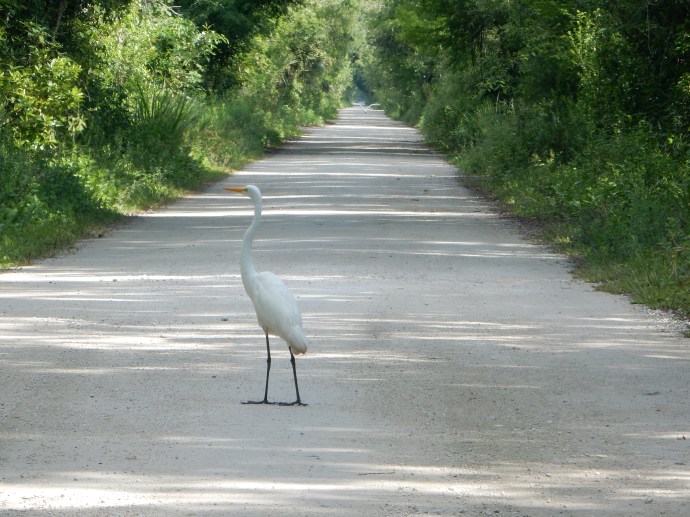
This bird knows he owns the road and he is not moving until he feels like it

Everglades City, FL April 2

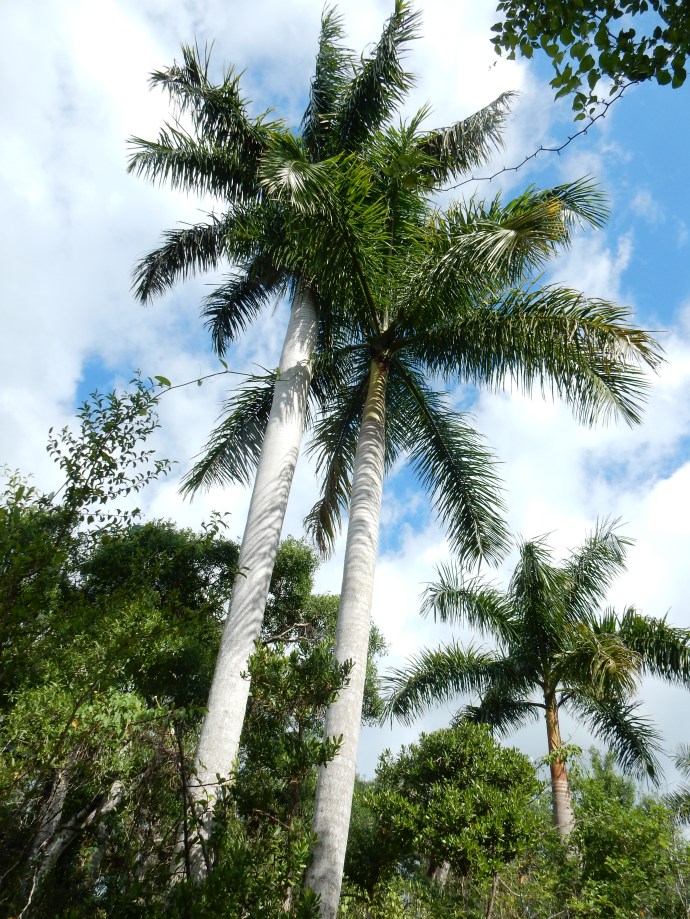
We spent much of the day in the Fakahatchee Strand Preserve State Park. Fakahatchee is Seminole for forked river and a strand means a long narrow, swamp forest. The Fakahatchee is Florida’s largest state park and is home to numerous wild orchids, one of which is in bloom now. The FSPSP connects Florida Panther National Wildlife Refuge (one of Sunday’s stops) to the Gulf of Mexico. FSPSP is the orchid capital of the US and has the largest population of native Royal Palms in the US.

Royal Palms in Fakahatchee Strand Preserve State Park

Met another volunteer couple staffing the welcome center; they summer in Rhinelander WI and have been volunteering here for over six years. They gave us a few pointers about the best places to hike. Instead, we ended up driving most of the time we viewed the park. The Janes Scenic Drive is gravel (not a problem) but full of potholes that suggest strongly that one drive slowly and carefully. The portion of the road that is open for cars is only 6 miles; we drove it at speeds of 3-6 mph. There were just many birds to see and it was relaxing to motor along nice and slow.

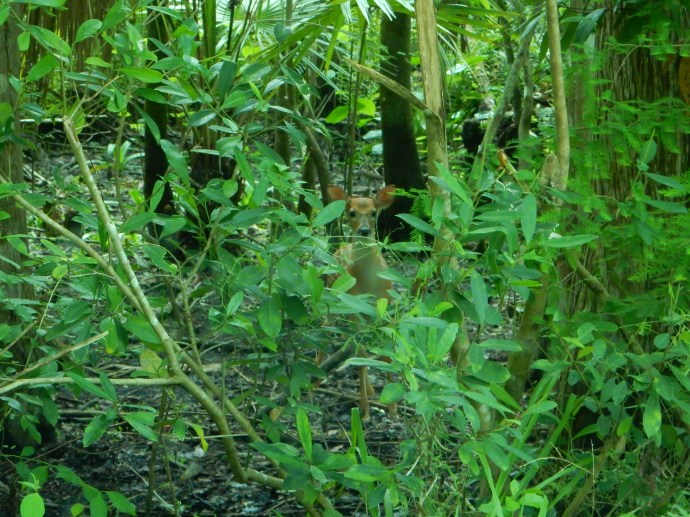
Can you spot the fawn?

Twice we headed out on hikes. For the first one, we chose to be safe rather than sorry. Signs about alligators tell you not to harass them, not to feed them, etc. The signs we read were not specific how to deal with them sitting in your trail path.
In general, alligators are not aggressive and do not attack humans. But what if they are just right there?? Alligators are big, have strong jaws and tails, and can move fast for short distances. On this first hike, the alligator was taking up about one-third of the trail. Oh, did we say they frequently just stay in one spot? Thus, the likelihood of the gator ambling along soon was low. We chose to turn around and abort this hike.

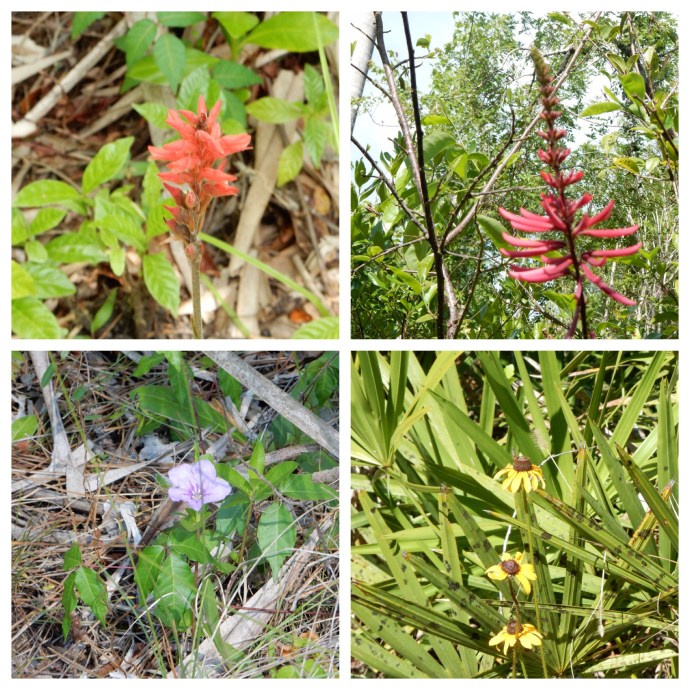
Along our hikes

On our second hike, we met another volunteer clearing the trail to assist people in walking along. We asked him about the alligator and he suggested that in the future, we should use a big stick and gently touch the alligator on the tail. That touch normally would encourage it to just move forward a bit. We thanked him but I am not sure we will take advantage of this suggestion in the future.

Along the Big Bend Cypress Boardwalk at Fakahatchee Strand Preserve State Park

All in all, we spent about three hours at Fakahatchee Strand Preserve State Park. We returned to the Ivey House, had a snack, went in the pool, and then returned to our exploring. This time we went to a different portion of the park to explore the Big Cypress Bend Boardwalk Trail. Here, we were told that a bear was just ahead on the right side and to be quiet as we approached it. Well, we were quiet but alas, the bear had disappeared. Chris, who was not excited about seeing any bear, was nonetheless 30 feet ahead of me on the trail; I was trying to look everywhere and she was just marching at double pace. In any event, it was just a walk in the woods.

Our final stop was exciting. Monday we had taken in a presentation at the Everglades National Park Visitor Center. The ranger giving the talk, besides telling us about his adventures in Alaska, advised us to take the Marsh Trail to watch the birds returning to the roost at sunset. The experience was magnificent. An observation tower is strategically placed for bird watching. We spent at least 45 minutes there until sunset had occurred.

Birds landing along the Marsh Trail at Ten Thousand Island Wildlife Refuge

Birds at Marsh Trail at Ten Thousand Island National Wildlife Refuge

When we arrived, the ponds and marsh were already busy with roosting birds. As we watched, more birds arrived in groups of 1, 2, 3 or 4. As time went on, the groups grew in size to have 20, 30, or 40 returning birds. A variety of species were landing, chirping, and gathering. But as time went on, many of the birds which had landed in the pond to our right picked up and flew to a group of trees on our left to roost for the night. It must be a safer location to avoid predators there. Only about 20 people were here, it was a great experience and lightly attended. Several of the human attendees had cameras that likely cost at least 10 times the cost of our point and shoot but our pictures are sufficient to illustrate the experience.

On our way back to the car, we saw an alligator crossing the paved trail from west to east about 100 feet in front of us, heading home evidently for the night. When we passed the point where the gator had crossed, we could see the wet trail his feet and tail had made on the pavement. This time we did not have to worry about what to do with a gator on the trail.

This marsh area was also part of Ten Thousand Islands National Wildlife Refuge. We did not observe any damage from Hurricane Irma here, evidently the barrier islands had helped to mitigate the storm. When we had taken the boat ride Monday, several islands had been hit with a 14 foot tidal surge. The amount of salt water was enough to kill a long line of mangrove trees at the edge of the islands. We did not observe that here.

Ed and Chris Everglades City FL. April 3

Sunset over the Everglades and Ten Thousand Islands

Categories: road trip, travel | Tags: , , , , , , , , | 1 Comment

2019 Trip 3: South Florida: March 31

Corkscrew Swamp, Florida

North Fort Myers, FL. March 31

Sunday was a little slower. Our Evergreen hosts had a delicious egg bake for breakfast before we went to church with the husband. We headed out exploring about 12:30 to Corkscrew Swamp Sanctuary, an Audubon sponsored preserve. The first detailed governmental report on this Everglades area described it as: “useless to civilized man, for any purpose”. Another description characterized our attitude towards the Everglades as fear (alligators, bears, bugs, snakes, etc), followed by greed (cattle, crops, bird feathers,etc) and concluding (hopefully) with understanding as we learn the interconnectedness of nature and how our short-sighted actions have long-term consequences (farming and over-building eliminate the fresh water aquifer that feeds both the Gulf Coast and Atlantic Coast urban areas).

Corkscrew Swamp Sanctuary

Corkscrew Swamp Sanctuary had to be preserved twice. In the early 1900s, hunters were killing massive numbers of herons and egrets to sell their feathers as decorations in ladies hats. Feathers were more valuable than gold on a per pound basis. Locals and the Audubon Society hired wardens to successfully chase away the plume hunters. Then after WWII, the area around Corkscrew was being logged heavily, primarily for cypress trees used in rebuilding Europe. Once again, groups of local residents and the Audubon Society worked together with the lumber companies to stop the lumbering, preserving the last and largest collection of old growth cypress trees.

When the state of Florida was unwilling to spend money to preserve the area, the Audubon Society took possession of the property and still owns it today. The initial acreage of 5,680 acres has grown to almost 16,000 acres. The most important rookery in the country for wood storks is also preserved-and off-limits.

The transition between two types of habitat, an ecotone where marsh and cypress forest come together

Our walk was on a 2.25 mile boardwalk above the swamp, allowing one to look down and up without fear of getting wet. The eco system includes (in their terms) marsh, pond cypress, wet prairie, pine flatlands, bald cypress, and lettuce lakes. The Sanctuary has numerous landmark trees, the really large and old bald cypress trees.

However, Hurricane Irma came through this area in September 2017. Nearby Naples recorded gust winds of 142 mph. Corkscrew Swamp was just 2.5 miles east of the eye of the storm. Many trees were felled by high winds, either at the root level or twenty feet up. At least three of the 12 landmark trees were victims to the storm. Rainfall was 12.6 inches on the Sanctuary over three days. Volunteers responded to the call for assistance and came out to clear debris and repair the boardwalk; it took two months before the full boardwalk and visitor center were re-opened.

A strangler fig wrapped around a tree at Corkscrew

The walk took us 90 minutes as we wandered at a slow pace, enjoying the view and listening for birds. At one point, I waited for 5-10 minutes to try to find the bird (likely a woodpecker of some species) that made a tremendously loud drumming sound. Several of us strolling on the boardwalk tried but were unable to spot it.

When we finished up Corkscrew, we headed over to another sanctuary. CREW, Corkscrew Regional Ecosystem Watershed Land and Water Trust is a public-private partnership and non-profit that coordinates the purchase and protection of 50,000 acres of land. Land once purchased is turned over to the South Florida Watershed Management District for land management. They sponsor five main pieces of land and we walked a portion of one of them, Bird Rookery Swamp.

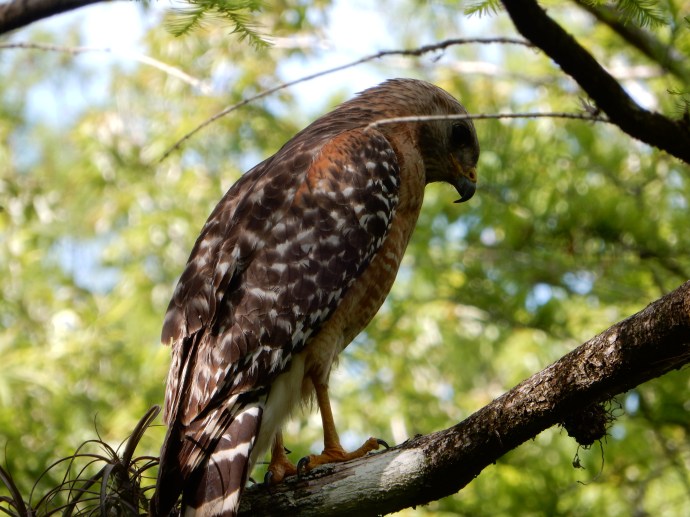
Red tailed hawk at CREW Bird Rookery Swamp

The CREW trail starts out on a boardwalk and then segues into a grassy trail. The trail follows the old route used by logging companies to cut the cypress in the mid-twentieth century. We did not hike the entire 12 mile trail, only about three miles. The highlight of this hike was a red-tailed hawk perched on a railing and then in a tree just feet away from us. During the hike, we talked with several other hikers. One couple mentioned how a bobcat had been seen by friends of theirs on the trail a week ago. Five minutes after we left them, we heard a strange cat-like sound. We looked and looked but did not see anything. Two women coming from the opposite direction stopped and, being more knowledgeable than us, speculated that we had just heard a grey catbird. No bobcat for us.

Sunday was our final night with our second Evergreen hosts. Their home in North Fort Myers suffered only minor damage from Hurricane Irma. There were several homes in the area completely destroyed but, in general, it appears that North Fort Myers suffered less from Hurricane Irma in 2017 than Punta Gorda had suffered in 2004 from Hurricane Charlie. We expect to see continued hurricane damage left over from Hurricane Irma as we drive through the Everglades and on to the Keys.

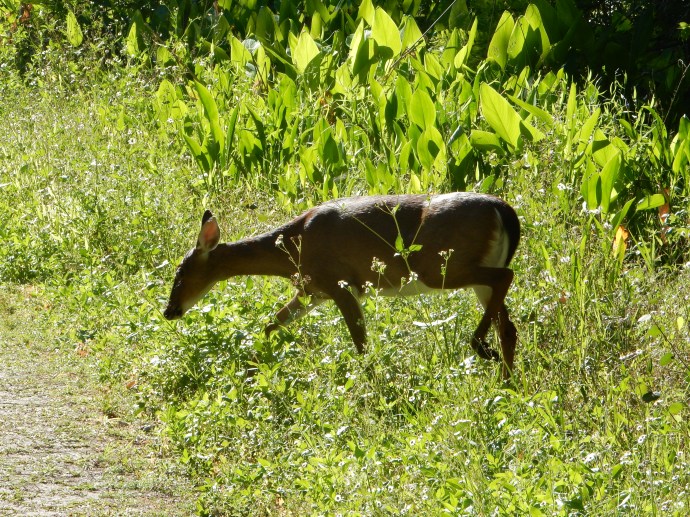
No bob cat at CREW, just a deer

Ed and Chris. Everglades City. April 1

Categories: road trip, travel | Tags: , , , | Leave a comment

2019 Trip 3: South Florida: March 30

Can you find the alligator?

North Fort Myers, FL. March 31

Ding Darling National Wildlife Refuge is located on Sanibel Island on the Gulf Coast of Florida. It occupies about one-third of Sanibel, about another one-third is protected conservation areas under other authorities and about one-third is developed with buildings no higher than the tallest pine tree. Ding Darling is the most visited national wildlife refuge in the U.S. with about one million visitors per year. We have frequently encountered people and Refuge rangers who said we just had to visit here. So we did.

Saturday, we spent the entire day at Ding Darling, arriving around 8:30 AM to hike the Bailey tract, a marsh area near the Gulf of Mexico. The area was quiet, some people were out hiking but it was not real busy. In terms of beauty, the area was so-so; but the function of wildlife refuges are to protect the habitat for birds and animals, not to grow public gardens.

Our tram-it filled up completely and we also observed people being turned away from the 1 PM tour

We had previously made reservations for a 90 minute tram ride at 11:30 AM along Wildlife Drive with a naturalist to talk about the refuge and what we were seeing. By now it was 9:30 and at the visitor center we made arrangements to transfer our reservation to the 10 AM tour which had a few seats available. It was a good decision, the naturalist was knowledgeable and she enlightened us about numerous topics as we drove along. Bird sightings were plentiful.

Red mangrove at Ding Darling National Wildlife Refuge

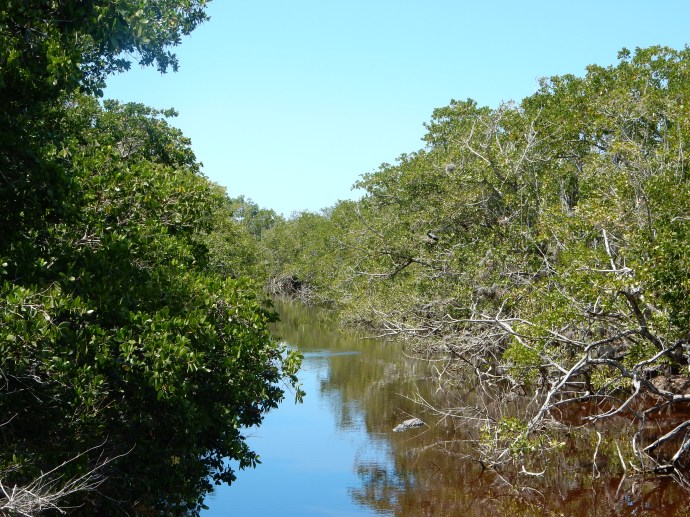
Ding Darling was hit by Hurricane Irma in 2017, we could see where some of the oldest and tallest mangroves had been knocked down. Research has shown that mangrove forests can decrease hurricane impact by 30%. Where mangroves had been knocked over, new mangroves were already growing, their new shoots green under the open sky created by the destroyed, taller trees. Red mangroves have a root system that looks like your hand upside down with fingerlike roots growing down into the water that makes the tree look like it is a person walking. (There are also white and black mangrove trees.)

This estuary refuge with its combination of salt and fresh water is the only place mangroves grow, they can tolerate the mix of water types. On one stop we noticed mangrove crabs, ugly crabs that thrive living on the trees, not along the beach. At another stop, we could see manatees in the distance doing their courtship ritual, splashing and frolicking in the water instead of their usual just cruising along.

Squadron of American pelicans and a reddish egret

A squadron of pelicans was standing in a marsh, surrounded by smaller shore birds and a reddish egret. We were informed that the reddish egret is relatively rare and this refuge is one of the few where you can frequently see them. Great blue herons, ibis, egrets, swallowtail kites, osprey, and other birds were easily seen. The American pelican is the second largest U.S. bird, after the California condor. The pelican has a nine foot wingspan; the bald eagle has a wingspan ranging from 6-8 feet.

After the tram ride, we had a quick sandwich for lunch at one of the many retail hubs on the island and then back to the refuge. This time, we went on the Indigo trail with a volunteer guide. This woman and her husband are spending five months here before taking a month off to “re-position” themselves and their RV to Grand Teton National Park for their sixth, five month summer volunteering stint there.

While Ding Darling is the most visited national refuge, it has still seen its annual federal allocation reduced by 50% in the last years-a reflection of our national priorities. Volunteers are critical to its existence. The refuge has over 300 volunteers, they staff the visitor center. The volunteer groups raised the funds and built the new visitor center without federal dollars.

Ding Darling Refuge is named after J.N. “Ding” Darling, a Midwesterner who drew editorial cartoons for the Des Moines IA Register. He also spend vacations in Florida. Darling was known for his fierce emphasis on protecting the natural environment and his cartoons were an important messenger in an era where newspapers were the critical force in national life. He began the national duck stamp program, was the founder of the National Wildlife Federation, and served as FDR’s first head of the agency that was the forerunner of today’s Fish and Wildlife Service.

The two friendly alligators

The Indigo trail hike was too much for a family with three young children who preferred the beach today but the rest of us enjoyed the hike through the refuge, learning about the inter-relationship among the plants, insects, water, trees and birds. Towards the end of the hike, we watched two alligators. Initially 100 feet apart, the second slowly drifted towards the second gator, eventually laying quietly together on the shore bank just inches from each other.

A new mangrove tree growing in the estuary, likely to form another island in the future.

Following the hike, Chris and I drove the Wildlife Drive in our car, replicating the ride we had on the tram. This time although the pelicans were still around, fewer birds were to be seen and the manatees were no long visible. Switching to the 10 AM tram ride had been a good decision. After visiting the lighthouse, we left Sanibel Island at 5 PM to re-fuel at dinner for Sunday’s adventure.

Sanibel Island lighthouse

Ed and Chris. April 1

Categories: road trip, travel | Tags: , , , , , , , , , , , , , , | Leave a comment

2019 Trip 3: South Florida: March 29

The autonomous vehicle in Babcock Ranch

Babcock Ranch, March 29

We rode on our first autonomous, driverless vehicle today. And, we rode on a bumpy old school bus through mud and swamps. Quite a variation. Both rides occurred within a few miles of each other at Babcock Ranch.

With a history that goes back to the late 1800s, Babcock Ranch has changed focus with the years. Its first owner was a Montana gold miner who struck it rich. Perry McAdow moved to the warmer climes of Florida and chartered the Punta Gorda Bank. He purchased thousands of acres of land in the area. Edward Babcock was a Pittsburgh native who owned a lumber company, at one time the largest in the world. He also liked the warmer climes of Florida and bought out McAdow in 1914. Babcock added on to McAdow’s holdings, eventually owning over 100,000 acres.

Cracker cattle at Babcock Ranch Preserve

The Babcock Ranch cut timber, using much of the cypress logs for shoring in mining due to cypress’ ability to resist rot. After the timber was cut, Babcock added raising cracker cattle, rock mining, and agricultural products. You may recall from an earlier Florida posting that cracker cattle were brought over by the Spanish. Cracker cattle can live off the land but their meat is low quality. The term cracker comes from the sound of the whips used by the Spanish cowboys to control the cattle.

The ranch lies astride an important water connection between Lake Okeechobee and the Gulf of Mexico. By the late 1900s, the ranch was run by Babcock descendants willing to part with the land. A plan was devised to divide the ranch into two parts; making most of the land into a preserve with about 20% going into a planned community. Today that division has resulted in the state-run Babcock Ranch Preserve and Eco-tour as one part and the Babcock Ranch planned development as the other. We visited both today.

Momma alligator with baby alligators on her back

The preserve is 67,000 acres and continues the timbering and ranching operations. The preserve protects critical waterways and diverse natural habitats. In addition, a eco-tour is offered that brings visitors through grasslands, swamps, and woodlands. In Florida, an elevation difference of just a few feet changes the habitat from swamp to woodland in just a blink of an eye.

Wild pigs on the eco-tour

Barred owl in the swamp

Our tour and bus driver has his own horse and cattle and enjoys hunting wild pigs. His understanding of the Florida environment added immensely to the tour experience. We had arrived early and were able get on a tour that had about 15 people. Each of us had our own window seat. Luckily (for us), the school kids who arrived had their own tour and a separate bus.

Alligators and birds on the eco-tour

On the tour, we came across wild pigs, sandhill cranes, alligators, deer, egrets, limpkins, several types of herons, and a barred owl. None of these were new to us but still it was a pleasure to observe them again and hear the tour leader’s additional information.

The preserve has a small cafe on the premises and the cook gave us special attention, making sure our hot dogs were well burnt-after we assured her we truly did want them burnt.

After the preserve, we drove a few miles to Babcock Ranch. This planned community expects to eventually have 20,000 housing units, with only a few multi-unit properties. A mix of housing, commercial, retail, and public facilities are planned. Initial homes were just completed a year ago but signs of rapid construction are evident. We stopped in at the town center where the information center is located. We also observed a school, day care, health care facility, a restaurant, etc. open for business.

It was at the town center that we rode the autonomous self driving “bus”. The vehicle has six seats and standing room. Our vehicle did have a human manipulating some controls. The system is still being planned, programmed, and de-bugged. For instance, the vehicle stopped and would not move at a pedestrian crossing where a temporary sign indicating pedestrian crosswalk had been placed in the middle of the street. Since the temporary sign was not included it its programming, the vehicle thought the sign was a pedestrian and would not advance. Our human overrode the system while a few cars backed up behind us. Eventually the system will have individual addresses programmed and will take riders anywhere in the community. The vehicles will be called and dispatched via a smart phone app.

One of the initial features planned into the community is solar power generation. Between solar power, batteries, and natural gas, the community should be green beyond belief. It re-uses waste water for irrigation and individual homes must receive at least bronze level energy conservation certification. Fiber internet is everywhere. The Babcock Preserve surrounds the community. All in all, the vision of a livable, pleasant community seems doable.

The home prices are not outrageous although it seems certain to be an income-segregated community. The sales lady I talked to you professed ignorance of the concept of “affordable housing”. For all the talk of a planned community, though, our new Evergreen hosts mentioned that the county until just recently has not even planned road improvements to the existing road network to handle the increased traffic which will be generated.

After the autonomous vehicle ride, I worked outside on the blog in the town square. We had an early dinner there before driving to North Fort Myers where we will be staying for the next three nights.

Working on the blog at Babcock Ranch

Ed and Chris. March 29

Categories: road trip, travel | Tags: , , , , | Leave a comment

Blog at WordPress.com.