road trip

2019 Trip 5: Alaska: Sept. 9-10

Lodge typical of southeast Alaska cultures

Anchorage, AK. Sept. 10

Our last days in Anchorage were less busy since we switched two nights in Cooper Landing to two nights in the Anchorage area due to the Swan Lake wildfire. Most of Monday was spent at the Alaska Native Heritage Center. The elders of the indigenous cultures came together and opened this center 20 years ago to teach outsiders and their own children.

Buildings from three of the villages at Alaska Native Heritage Center

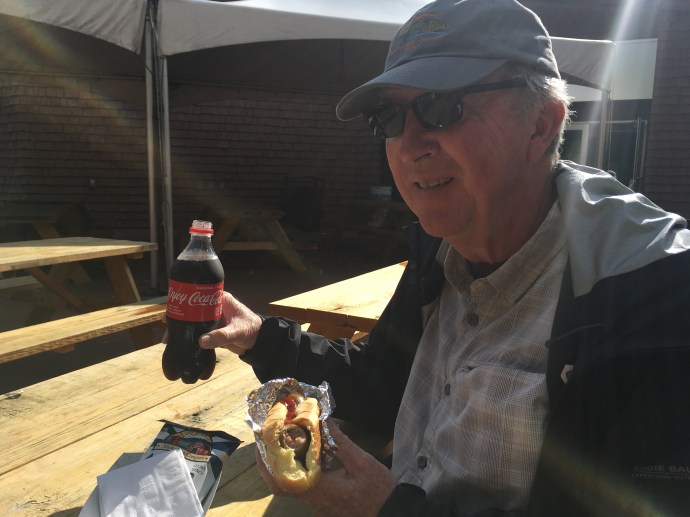
Reindeer sausage for lunch at the Alaska Native Heritage Center. Chris had a granola bar.

The center offers a rotating, continuous selection of live presentations and movies in conjunction with an exhibit hall and tours of replicas of six traditional Native dwellings. Of course there is also a gift shop, a cafe, and artists creating and selling arts and crafts. We spent four hours here and enjoyed it immensely. I can’t say I could lead a tour now after several museums and exhibits; but I certainly have a deeper understanding of the various cultures and how geography and natural resources have shaped them.

From the docent, we learned again how the native cultures differ, but more poignantly, how the cultures have suffered. From the loss of elders and shamans due to disease, from the brutal enforcement of non-use of native language and traditions, to the enticements and pervasiveness of modern comforts, the old ways which had so much meaning and community cohesiveness have become less known.

Basket reflecting Inupiaq traditions

Through this center and others like it, children and young adults are slowly learning their language and culture. Even with these efforts, it is a slow process. Some of the culture and traditions have been lost and will never be recovered. The peoples may not have invented gunpowder or nuclear power, but the cultures fit the people allowing them both a means of sustenance and an opportunity to express creativity.

Throughout the center, ten universal values are emphasized. Share what you have. Know who you are. Accept what life brings. Have patience. Live carefully. Take care of others. Honor your elders. Pray for guidance. See connections. Show respect to others.

What a plan to live by. Compare the ten universal values with the Biblical commandments which have so many negative directives.

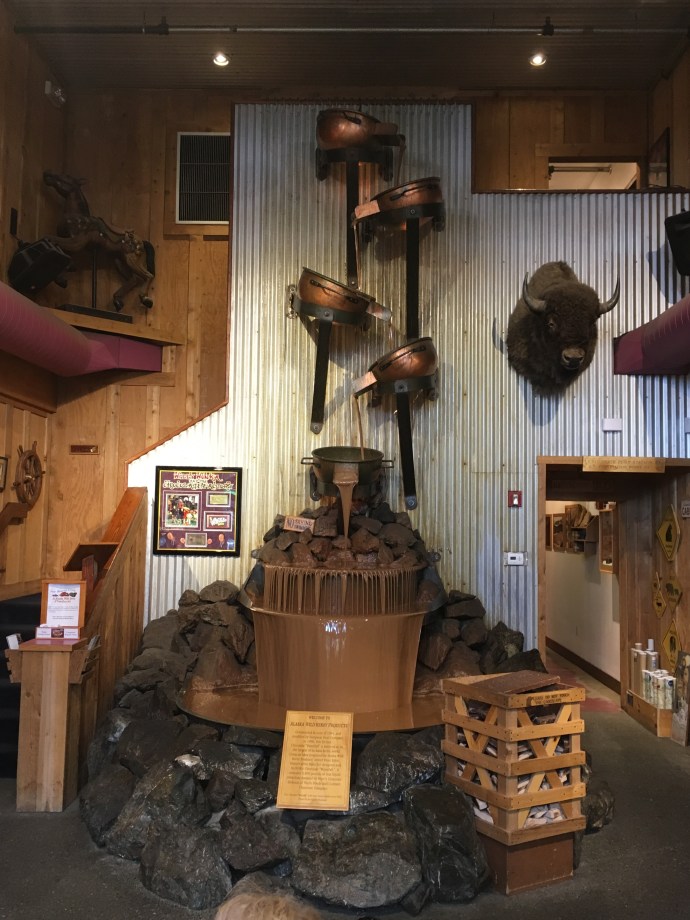
Chocolate waterfall at Alaska Wild Berry Products

The rest of our day, which happened to be our 47th wedding anniversary, was anti-climatic. A little shopping at the Alaska Wild Berry store, a local chocolate confectionery and gift shop. The Ship Creek Overlook supposedly is a great place to see salmon. It was not for us. Don’t know if the salmon were down here or what but we were glad we saw salmon in several other places.

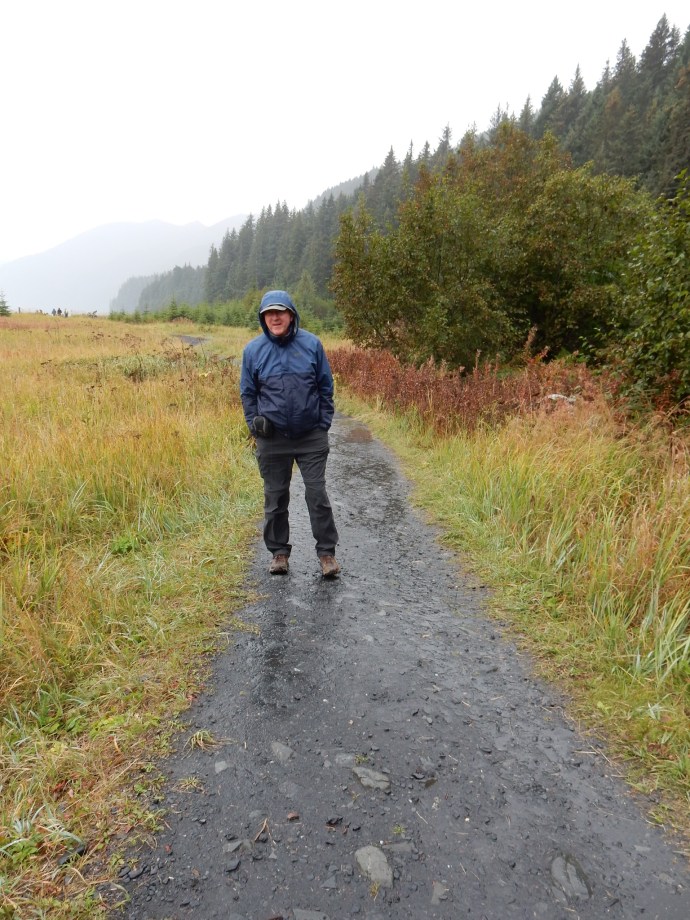
We drove up to Eagle River Nature Center in Chugach State Park and did some hiking. One of the trails was closed; it runs by a salmon spawning stream heavily used by bears at this time of the year. Dinner was at Texas Roadhouse for steak dinners.

Today, Tuesday, we fly to Seattle for one night before picking up our Amtrak Empire Builder train Wednesday. Our Alaska 4 x 4 Jeep was picked up and we arrived at the airport early as usual. Just after arrival, Delta notified us that our flight will be delayed by 90 minutes. That will allow us to stop at Cinnabon and a few other places for treats before the plane leaves.

Alaska has been a great place to visit. If you have plans to come here, don’t just take a cruise with a few side trips. Spend some time. Rent a car and travel at your own pace. Buy the Alaska Tour Saver coupon book, you will more than recoup your cost. We believe our blogs will give you some good ideas. Only strong tip we would make is to not travel any later than we did. Our trip timing took advantage of fewer crowds and few mosquitoes. However, most of the places we visited would be closing within a week or two. One or two places closed on Labor Day and we missed their events but overall, late August to early September is optimal in our mind.

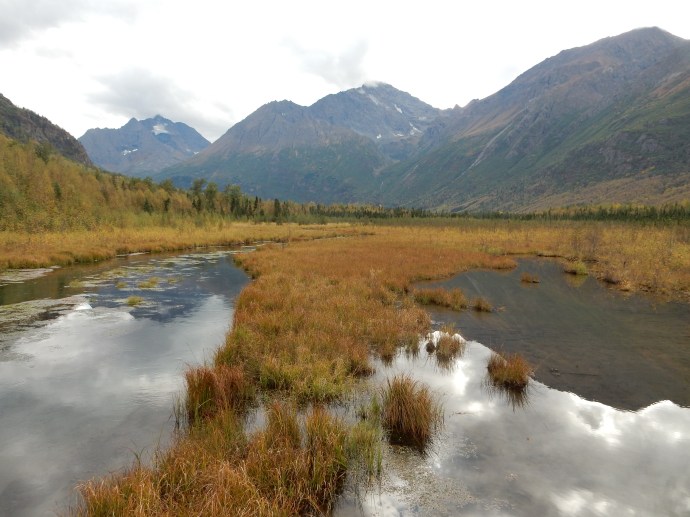
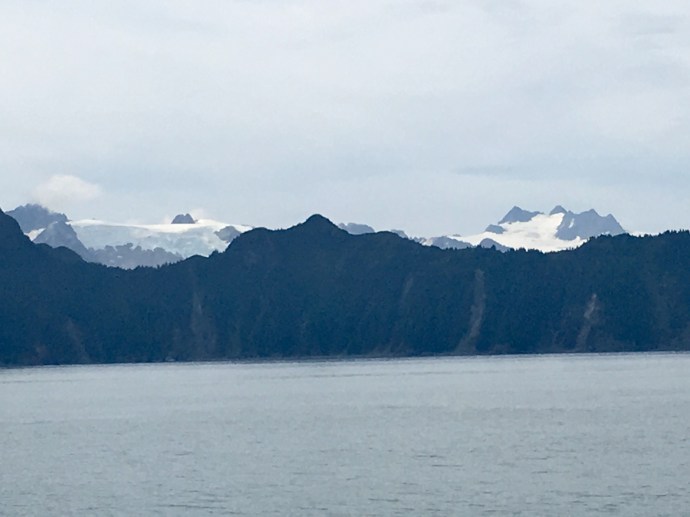
Our last picture of Alaska from Chugach State Park

Ed and Chris Anchorage Airport, Tuesday Sept. 10 12:30 PM

Categories: road trip, travel | Tags: , , , , , | 2 Comments

2019 Trip 5: Alaska: Sept. 7-8

Lake Hood Floatplane Base, Anchorage

Anchorage, AK. Sunday September 8

Saturday was the first day of consistent rain since we began this trip three weeks ago. Luckily Seward had a few options for indoor activities. The Alaska Sealife Center is basically an aquarium although one with a heavy research and conservation emphasis. The admission is pricey at $30 per person but again the Alaska Tour Saver Book came in handy with a buy one, get one coupon.

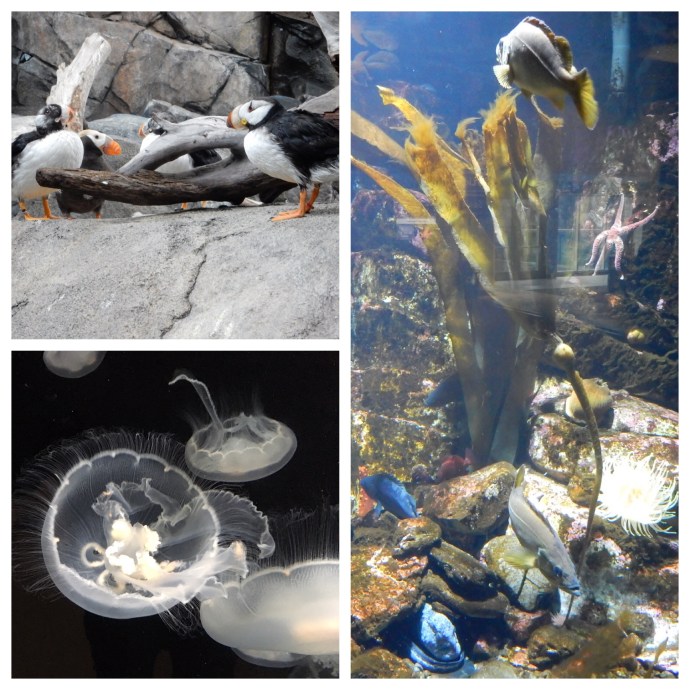
Alaska Sealife Center in Seward

Besides keeping us dry, the Sealife Center gave us an opportunity to closely observe some of the animals we have been seeing. The puffins, for instance, were much cuter when seen from a close distance. Although the fish were ugly, the underwater creatures like jellyfish, anemones, etc. are always cute and surprising.

Educating the visitor to climate change and pollution’s impact was a consistent, secondary theme presented by the Sealife Center. Given the importance of the Alaskan fisheries to the production of seafood supplies, the theme is timely. It has taken a while for the world to understand sustainable fishing, now it has to more fully practice it.

Two of the many murals in Seward Alaska

During our time in Seward, we had the occasion to enjoy the many murals painted on the walls of buildings. Seward has been proclaimed the mural capital of Alaska, with about thirty murals scattered around the community. Local artists paint local scenes and topics. I will admit some of our photos came while driving from place to place during rainy Saturday rather than walking all over town to observe them. Seward is not the first town we have visited using murals to make a statement about local history and pride, but whenever it is done, we have enjoyed it.

A second indoor stop was at the Seward Community Library and Museum. The museum is small but was a visual insight into life in early Alaska. Seward’s ice free port, Resurrection Bay is over 900 feet deep, had long been its claim to fame for fishing and shipping. The 1964 earthquake changed that into tourism as the destruction by the earthquake and tsunami wrecked the piers and railroad line. The lengthy rebuilding process and less severe destruction in Anchorage switched the shipping function to Anchorage harbor and to Anchorage’s airports.

Statue in Seward honoring the Iditarod Trail, dog and man

The library/museum hosts two half hour films daily which we viewed. The first recaps the severity and impact of the earthquake. The second discusses the Iditarod National Historic Trail. Not to be confused with the Iditarod race, the Iditarod Trail was a dog sled route that predated the railroad and provided a means of travel for the early gold rush. The almost 1,200 mile trail began in Seward and ended in Nome, utilizing many trails used by indigenous peoples. Later supplanted by the railroad and then highways, the Iditarod Trail was an important supply route in the early days of Alaska. It has been recognized as one of the first historic trails in the U.S. by the Bureau of Land Management.

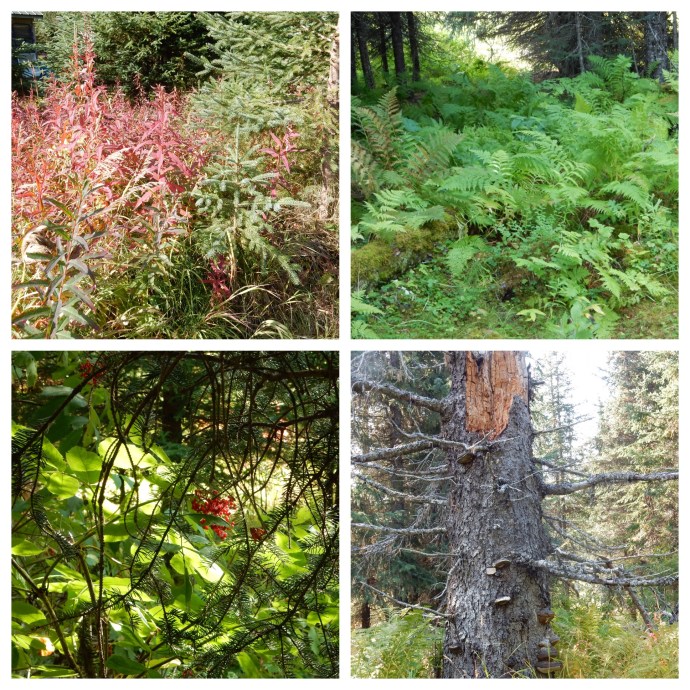
Fall in Alaska

Fall in Alaska

After the videos, we left Seward for our last Alaskan destination, Anchorage. We will be here until Tuesday morning when we fly to Seattle. Sunday morning’s church service had another Minnesota connection as we met a woman who had recently been back there to visit family and had made sure she took in the Minnesota State Fair. It was a low-key day, still a bit drizzly. We walked along Earthquake Park, built around a portion of town that actually slid into Cook Inlet during the 1964 earthquake. The signs here confirmed the earthquake impact but that Anchorage was spared the tsunami that destroyed so much of Valdez and Seward.

Fixed wheel plane using road to reach runway at Lake Hood Floatplane base

The highlight of the day was time spent at Lake Hood Floatplane Base. This is the largest seaplane base in the world with over 2,000 take-offs daily. There is a runway for fixed wheel planes also so we were constantly turning our heads to determine if the sound of another plane’s engine came from the land runway, the water runway, or the skies. Besides large closed hangers, open storage of planes occurred at large marina like locations but also stacked alongside the roadway. Frequently a small building would be built alongside the planes along the roadway. Signs warn you to yield to planes on the road which we thought was cute until we actually observed a plane warm up and head down the road to the land runway.

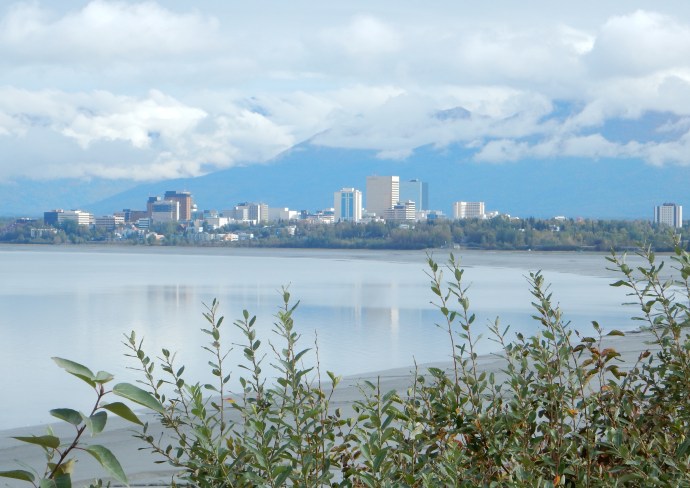
Anchorage Alaska skyline

Ed and Chris Monday September 9 4 AM

Categories: road trip, travel | Tags: , , , , , , , | Leave a comment

2019 Trip 5: Alaska: Sept. 6

Leaving Seward for a 5 hour cruise of Resurrection Bay

Seward, AK. Friday September 6

Orcas!! Zounds. There must have been 15 or more of them hunting in several pods within viewing distance of our cruise ship. We were mesmerized watching them. They started out farther away, we were just slightly able to see their tail fins periodically. Our boat inched closed and the sharks hunted closer to us; the boat captain supposedly following the strict guidelines to be used when viewing wild animals by official tour operators.

Orca pods seen along Resurrection Bay

With several pods, there was no need to jostle for a certain position. There were pods in several directions, we all got front row seats. Even for me, after a while I could stop taking photos and just enjoy the view.

Our ship, Star of the Northwest, is run by Major Marine. MM offers several boats and tour lengths. As mentioned yesterday, the five hour tour we selected seemed long enough, served a buffet lunch, we had $20 off coupons, and a National Park Service ranger was on board to provide commentary and education. The cruise did not disappoint.

The ranger covered numerous topics from geology to birds to history to climate change. Some information was known to us, much was new or enhanced previous knowledge. We had met the ranger earlier in the day when we visited the visitor center. She was a new seasonal ranger but lives in the area. Her commentary confirmed our decision to choose a tour with a ranger on board.

Animals and birds seen during cruise

Kenai Fjords began as a national monument authorized by President Carter in 1978 to protect the Harding Icefield and marine mammals. Alaskans in general and the people of Seward were upset and did not want it. Within five years, tourism was booming and the town of Seward put Kenai Fjords at the top of its marketing material. We have seen this type of public reversal repeat itself at many national park units over the years.

Resurrection Bay

Resurrection Bay

The Harding Icefields are an area up in the mountains which can receive up to 100 feet of snow in higher elevations. This snowfall feeds 38 glaciers. This area is generally not open to the public. Through run-off from the glaciers, necessary minerals are deposited into Resurrection Bay, feeding the phytoplankton and zooplankton at the bottom of the food chain. In other areas, where rain rather than snow falls, a temperate rain forest exists. Thus as we traveled up and down Resurrection Bay we frequently saw mountain sides covered with trees, not snow.

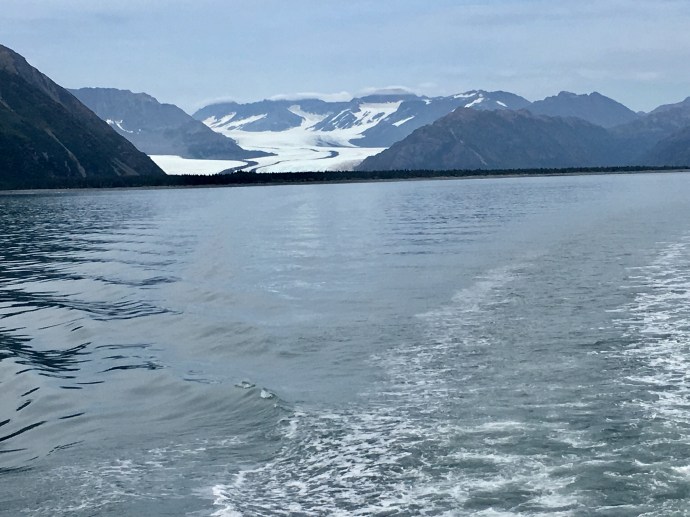
Bear Glacier in Kenai Fjords National Park

The five hours went quickly. This cruise was maybe not as overwhelming as the cruise out of Whittier, but still very enjoyable and we would definitely repeat it on any future trip.

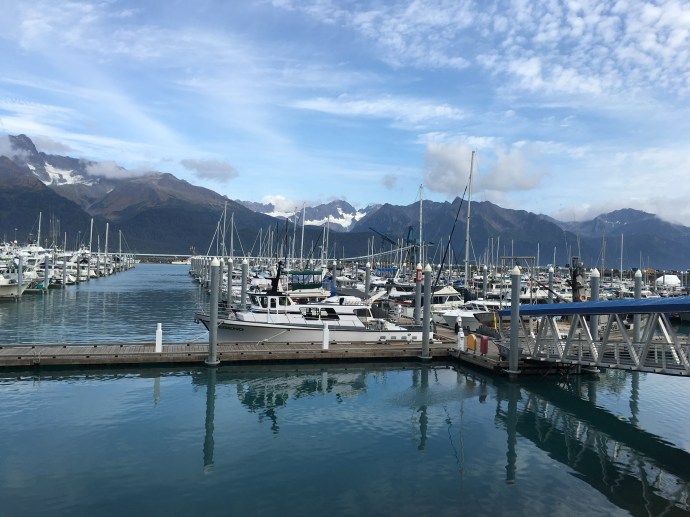
Back at Seward dock

Ed and Chris Seward AK Sept. 6. 10:30 PM

Categories: road trip, travel | Tags: , , , , | Leave a comment

2019 Trip 5: Alaska: Sept.4-5

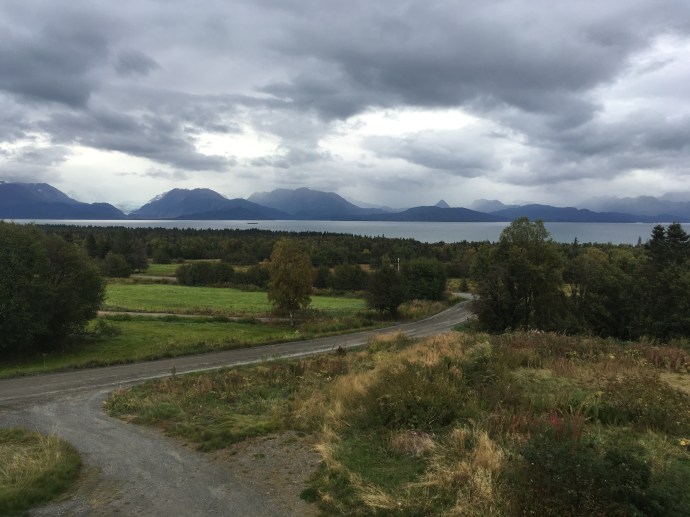
On the hills above Homer AK

Seward, Alaska, Sept. 4-5

Wednesday and Thursday were two relaxing days seeing the sights bookended by the exciting air flight on Tuesday and Friday’s upcoming water cruise.

Fishing boat design varies by the type of fishing being done

The day started at the Pratt Museum, the local historical society in Homer. While small, it had good displays unique to the Kachemak Bay Area. Coal mining was an early driver of settlement from the Lower 48. Fishing has historically been important, changes and overfishing have made full time commercial fishing a difficult occupation. That is one reason for the growth of fishing tourism.

The area covered by the oil spill from the Exxon Valdez

One display section focused on the Exxon Valdez oil spill. This was an oil tanker which after leaving the oil terminal in Valdez, ran aground in Prince William Sound on Good Friday 1989. 11 million gallons of crude oil were released, creating a monumental environmental crisis.

The display in the Pratt showed the extent of the spill. To help one visualize the extent of the oil spill, they have a U.S.map with a portable outline of the spill area. I placed the spill along the Mississippi River. The spill would have stretched from the headwaters at Lake Itasca in northern Minnesota almost to St. Louis. This gave me a better realization of the spill and its consequences.

Hiking around Homer

Homer offers numerous hiking options from full day hikes across the bay at Kachhemak State Park to strolls around town. Wednesday we selected more leisurely options. While mountains line the south side of the bay, Homer itself has steep hills behind it on the north. To us, it resembled Duluth MN with its hills and view of Lake Superior.

Hiking around Homer

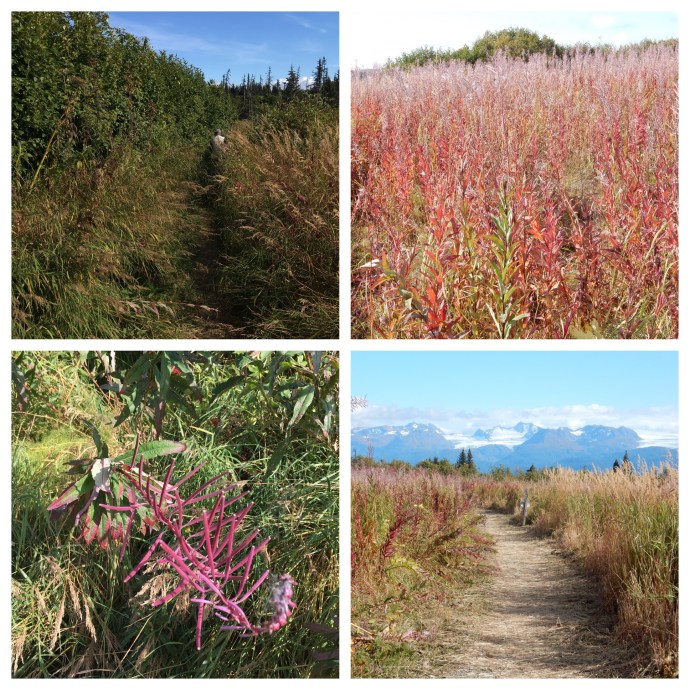
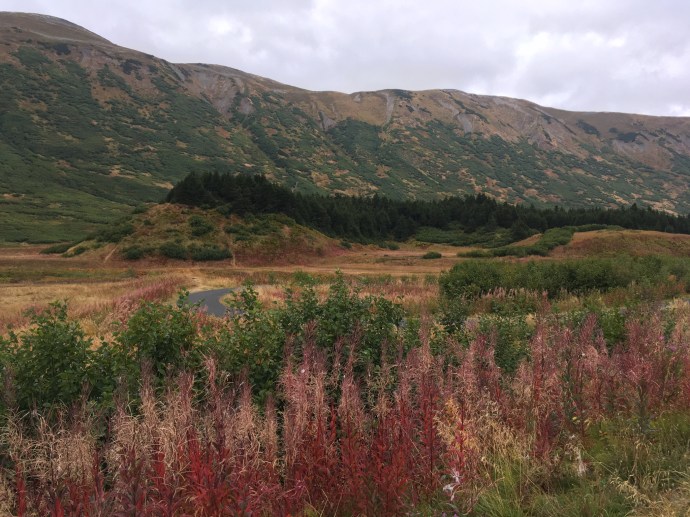
While deciduous trees are not abundant, there are some. Our expectations of a colorful scene of orange, and red, and yellow is not to be seen. Most of the deciduous trees have brown, falling leaves. The underbrush, however, has been colorful. Fireweed is a common plant here and can carpet a field completely or line the roadside with its 4-6 foot tall stalks. It is coming to the end of its season and depending on locale, may still be flowering or starting to seed. Its fluff is similar to cottonwoods or dandelions and you can walk through a cloud of the fluff as you walk along.

Our hikes did not produce any wildlife viewings. On one, a moose and her calves had been seen in the area and when we came across very fresh moose scat, we decided to take a different path. Female moose are known to be aggressively protective of their young. Views of mountains, sea, and glaciers were pretty much everywhere.

Routine tasks came into play, we had several loads of wash to do. The mud from the walk on Tuesday was on numerous articles of clothing and even the rinsing and washing down on Tuesday only partially got rid of the mud. An excellent halibut dinner capped our Wednesday activities.

Holy Assumption Orthodox Church, Kenai AK

Thursday was time to retrace our steps through the fire zone over to Seward. The people at the Maritime Islands National Wildlife Refuge had recommended a slight detour into the city of Kenai where a herd of caribou frequently hang out. Today they were absent.

The Nikiski area north of Kenai along the east shore of Cook Inlet

Since we were in Kenai, we decided to drive a few more miles north along the Cook Inlet looking for evidence of the oil industry. The Alaska papers had written about BP selling its Cook Inlet oil interests to a smaller firm out of Houston. I had not realized oil was a big deal outside of the North Slope Area. Evidently Cook Inlet is a major player as are several new fields elsewhere in Alaska that are getting attention. Those new fields will require new roads to be built through tundra and wilderness area. I am not going to get into the complicated history of oil, Alaska, tax write-offs, annual payments to residents and environmental concerns but did want to at least see this aspect of Alaska.

Nikiski is about 10 miles north of Kenai and a world away. As you leave Kenai, the roadside changes to an industrial setting with oil related businesses lining the sides, along with a surprising number of small churches. We passed a fertilizer plant, refinery, liquid natural gas processing facility, etc. Oil drilling rigs in the inlet were too far out to be visible to the naked eye although an exhibit at the Kenai Visitor Center said they were there.

Driving along the Sterling Highway in the Swan Lake fire zone

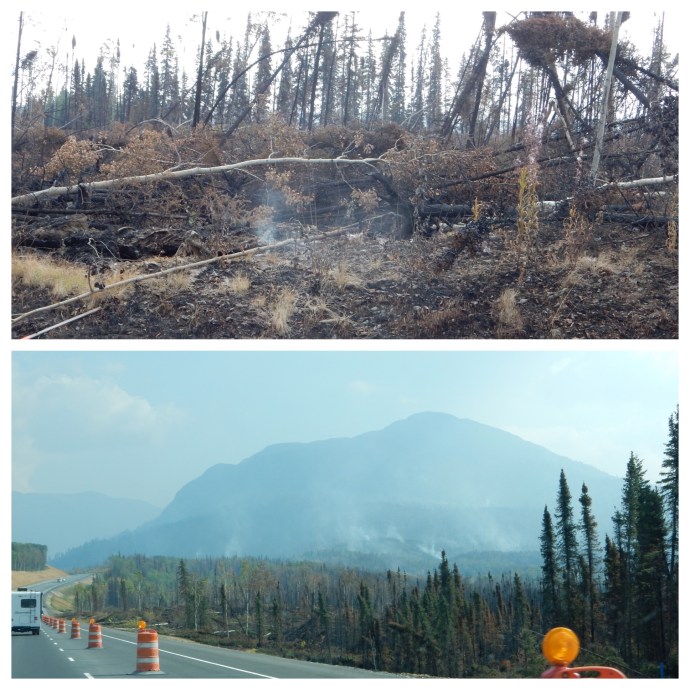
Leaving Nikiski, we continued our journey. Several times today we were stopped and had to wait for pilot cars to lead us through road construction zones. Going through the Swan Lake fire zone was slower this time. On Monday, Labor Day, the pilot car had zipped through. On Thursday, with construction crews active alongside fire containment workers, speeds rarely reached 20 mph. No fire was visible and the wind seemed to keep most of the haze to the south side of the road. But numerous areas not far from the roadside were smoldering and sending out heavy plumes of smoke. We had frequently heard comments predicting that the fires will return next spring. The boggy area tends to allow the fire to burn slow under the surface.

Exit Glacier, Kenai Fjords National Park

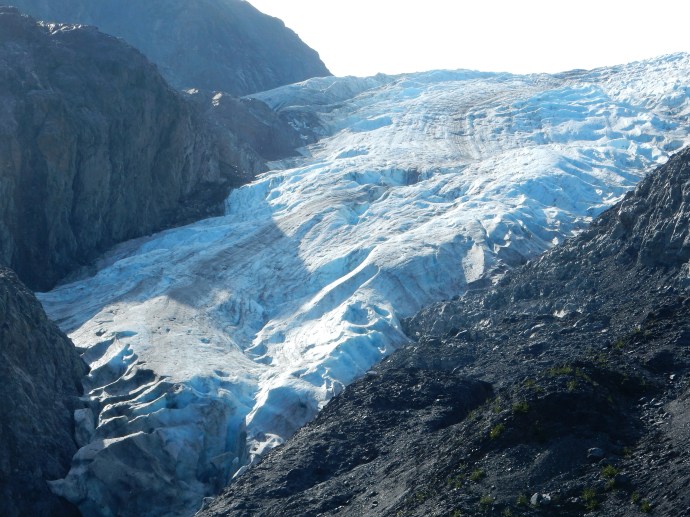
For us, the major attraction in Seward is Kenai Fjords National Park. Once again, much of the park is wilderness and difficult to reach. One accessible area is Exit Glacier just north of Seward. We reached it in time to take a hike to the viewing platform short of the glacier itself. Along the way are the usual signs indicating how the glacier has retreated. As you drive in and then as you hike, you pass signs indicating the glacier was down here in 1815, here in 1899, here in 1929, here in 1951, etc.

Friday the cruise is with Major Marine, a five hour expedition with lunch and views of the glaciers and fjords of Kenai National Park. Five hours seemed long enough, longer ones exist but take you out on rougher seas. After the Florida trip, rougher seas seemed not to be a wise option. We will let you know how this cruise fared.

Tern Lake, Seward Highway

Ed and Chris. September 6. 6:45 AM

Categories: road trip, travel | Tags: , , , , , , , , , , | 4 Comments

2019 Trip 5: Alaska: Sept. 3

Safety briefing number two at the runway by our plane

Homer AK. Tuesday September 3

Another WOW experience but maybe not for the reasons you might expect. Today was airplane vistas, bears and mud. The bears we were “hunting’ were in Katmai National Park, along the coast near Mt. Douglas. This is their natural environment and although we had planes and knew where they tended to congregate, there was no guarantee. Our locations were scattered; not Brooks Camp, a spot in Katmai National Park where bears line up to catch salmon and the Park Service had to install a boardwalk for people to see the bears without getting too close to them.

Our time to arrive at the hangar and begin the prep was 10 AM. Time is based on tides (we need low tide to land and take-off at Katmai), weather, and bear spotting. We arrived at the hangar early and were the second ones there. First task is to get fitted for waders, crotch high rubber boots with a strap at the top that goes through your belt or belt loops to make sure the waders stay up. Chris and I ended up selecting one size smaller than the initial estimate based on our shoe size; it seemed a better fit. (Remember for later.) You do not wear your shoes, just socks, inside the waders. I noticed our guide/naturalist/pilot wore a different type; waders with socks attached and lace-up boots over the waders.

Today Alaska Bear Adventures used three planes. Each was a Cessna 206, a plane highly popular and long in production. It holds six people, the pilot and five passengers. Our plane had us plus another Minnesota couple (from Eagan and he worked at WestLaw) and a local woman who was a firefighter with a day off from working the wildfires. We formed a jovial group.
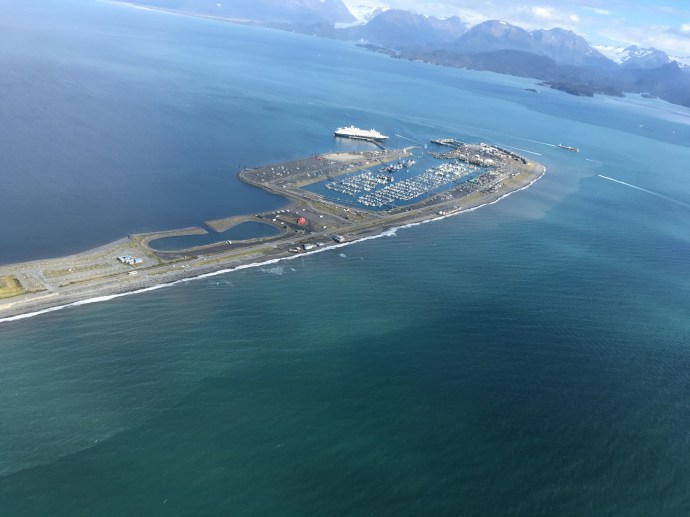
View of Homer Spit

The flight from Homer to Katmai takes about an hour. It is over water, we had on personal flotation devices. ABA gives you two safety talks, in the hanger area and at the plane. Chris and I had the two middle seats, each with a window. You are given ear plugs to use if desired, small plane engines can be noisy. Take-off was no worse than a normal take-off with a jet, just that everything is so close outside your window.
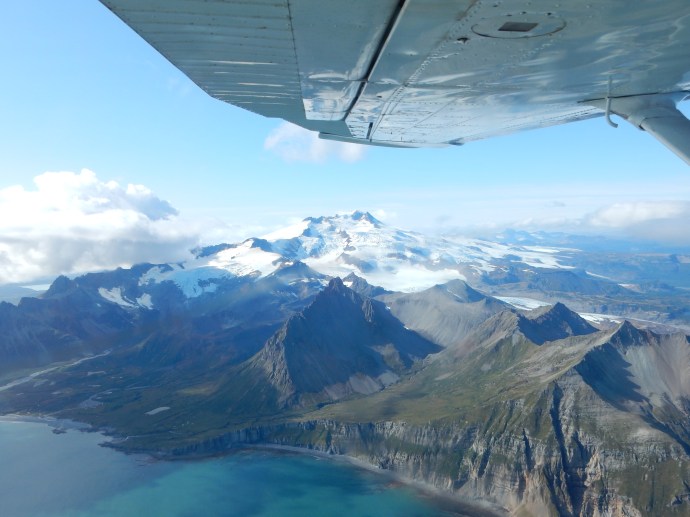
Flying to Katmai National Park from Homer

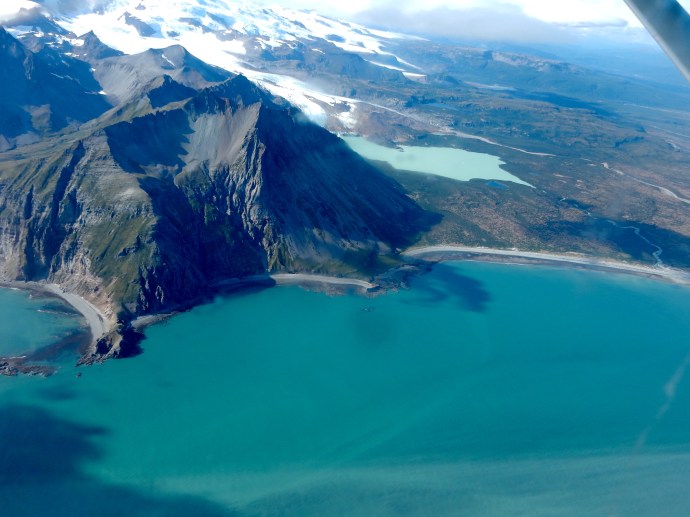
The views are amazing. We had never flown on small planes before, just the helicopter ride in Kauai, Hawaii six years ago. Frankly the plane ride was a big reason to take the trip, seeing bears was just a bonus. Chris had worried about it for weeks, even to the point of making sure she did not eat too much and gain weight. Well in advance of the trip, you have to weigh yourself at home with the clothes you are likely to be wearing. You can not be more than ten pounds more at weigh in than the weight you told them in advance. The night before the flight I found myself getting nervous about the flight over water and the bears for no apparent reason.

Our circular rainbow

The landing strip on the beach, our planes, and walking back to the planes after bear number three

Out the window we saw the Homer Spit with a cruise ship in port; fishing boats in the bay, Seldovia, mountains, glaciers, and islands. I saw my first circular rainbow down below the plane. When the conditions were right, the outline of the plane was inside the rainbow! Our landing spot was on the coast near Mt. Douglas, a volcano, between high tide line and low tide line. It had a lot of small rocks, quite bumpy. And Chris loved it; this from a woman who used to close her eyes and say a prayer at every commercial plane take-off and landing.

Beach view of Mount Douglas after landing at Katmai National Park

Katmai is huge, we were touching only a tiny portion of it. Katmai is the fourth largest national park, about the size of Connecticut. Katmai was initially a national monument formed to protect the area around a volcano. In 1912, severe earthquakes rocked the area for a week before Novarupta erupted with a force over ten times stronger than Mt. St. Helens in 1980. It is estimated that only two eruptions in modern times displaced more volcanic matter than Novarupta (Greece’s Santorini in 1500 BCE and Indonesia’s Mount Tambora in 1815). The isolation of the region prevented major loss of life. It is estimated that if the eruption had occurred in Manhattan, there would have been zero survivors, ash in Philadelphia would have been over a foot deep, and the sound would have been heard in Chicago. The eruption left a valley with thousands of smoke vents; named Valley of 10,000 Smokes.

Walking to find bears
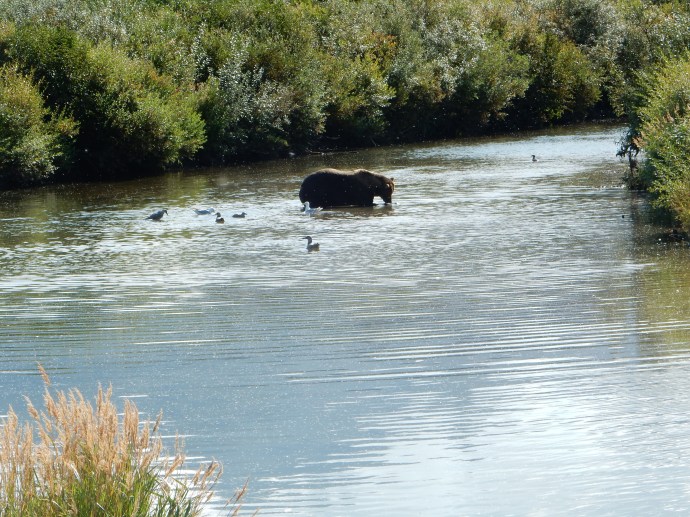
Bear number 1
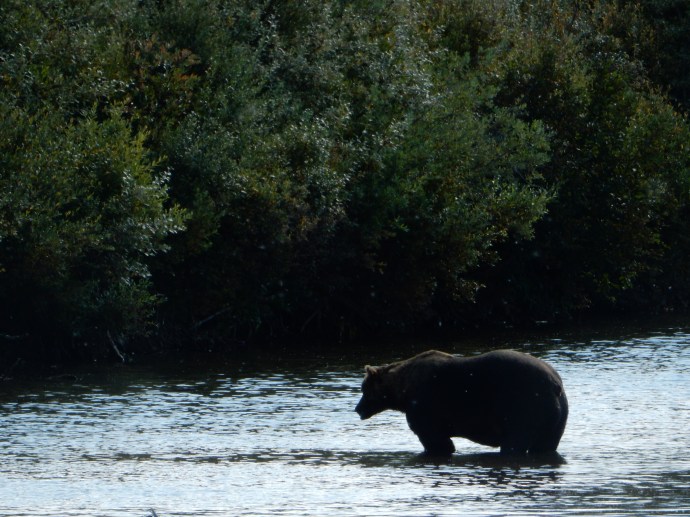
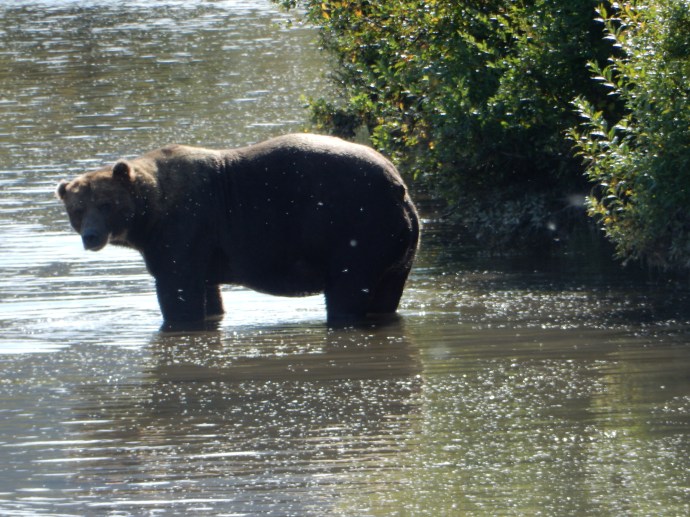
We were here to see bears though. Off on our hunt we went. Successfully. We saw three bears. The first was after a hike through the grasses to a creek feeding into Douglas River. We passed two indentations dug out along the creek where a bear had carved out a napping spot. The path we followed was one used by bears also. We maintained a safe distance of 50 yards or so; the bear acknowledged we were there but did not interest him. The guide estimated this one was about 900 pounds. Coastal brown bears tend to get larger than most in Alaska (1200 is not unusual here) due to the abundance of good food sources on a year around basis.

Salmon were abundant in the stream, many having already spawned and just starting their death spiral. These do not interest the bear. Given the abundance, the bears here can be choosy looking for fresh salmon who have yet to spawn. We spent about 20 minutes just watching the bear as it waded along the stream, catching fish, and eating.

To reach our next bear was a longer hike. Most of the travel was beside a creek bed where we walked along the creek on top of rocks. Here was where the lack of any real support in the waders became evident. One could feel the outline of each rock you stepped on. After a while the process was less than exciting. Some of the time we walked in or across the creek. The waders were essential. The water was frequently knee high. The creek bottom alternated between rocks and sand, that glacier flour we have commented on before which gives the unique coloring to glacial waters. One tried to avoid stepping on dead salmon. One woman found her waders had a hole so that at a certain depth in the creek some water came into the bottom of her wader.

Bear and human tracks across the mud

At other times we walked across the land left muddy by the changing tide levels. Frequently we passed the tracks of bears; large paw prints heading in the general direction we were traveling. It was curious to compare their prints with that of the six of us marching through the muddy plains.
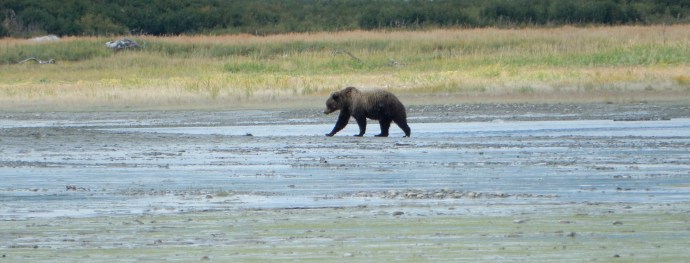
Bear number two that led to our adventure

The two other groups had taken off from the airport first, landed first, and then were the lead hikers. We were several minutes behind them. On the hunt for a second bear, the two of them followed a path and then our group started to veer away from theirs. Our leader had seen a bear in the distance. As we approached the bear, it noticed us and decided to take a hike. It walked behind a ridge and out of our view.

This left our group with the need to catch up with the first two groups. We, led by our naturalist/guide/pilot, cut across the muddy flats. Suddenly the muddy flats were turning into a quicksandish type of goo. One could not easily move forward without taking small steps, pulling up on your waders as you tried to move forward. Each slow step meant you were standing on your other foot for a longer period of time, allowing the pressure to push that foot further into the goo. You could hear the boots go “schlupp, schlupp” as they emerged from the suction grip of the goo. If we had been in the bigger boots, I fear they would have been pulled off despite the straps, the suction power of the goo was that strong. The phrase “stuck in the mud” has a much more personal feeling now.

After our mud adventure. Smiling? It was pretty scary.

Then in attempting to pull a foot out of the goo, one of the group went down. Getting back up is not easy. Then both Chris and I went down, getting goo over much of us. It took our guide with his more firmly attached boots to help each of us over to a safer location about 100 yards away. Each member of our group either fell or was stuck, needing assistance in getting to more solid ground. As one member stated, if a bear had come along then, we would have been a tasty morsel. As it was, all ended well. Clothes needed to be washed down and then laundered. We had a bonding experience. Long-lasting memories were made with a humorous tale to recount.

Bear number three

The two other groups had found a third bear and we joined them. This bear was lying down, trying to nap. our appearance caused it to raise its head periodically before it went back to attempting to nap. Despite our waiting and watching for the bear to do something more exciting, it just laid there. Eventually we headed back to the planes, only then realizing that we had come a long distance and the hike to the plane took longer than I thought it would. During the “goo” time I had stated I would no longer think poorly of walking on the stones and rocks. However, the long walk back along the rocky shore made we almost wish for the soft sand and mud.

Flying back from Katmai

The flight home was a gem. Our pilot took us up and around Mount Douglas. Mount Douglas is 7,000 feet in elevation, is a stratovolcano with a small crater lake near the top, and active fumaroles. Gorgeous views.

Flying home from Katmai
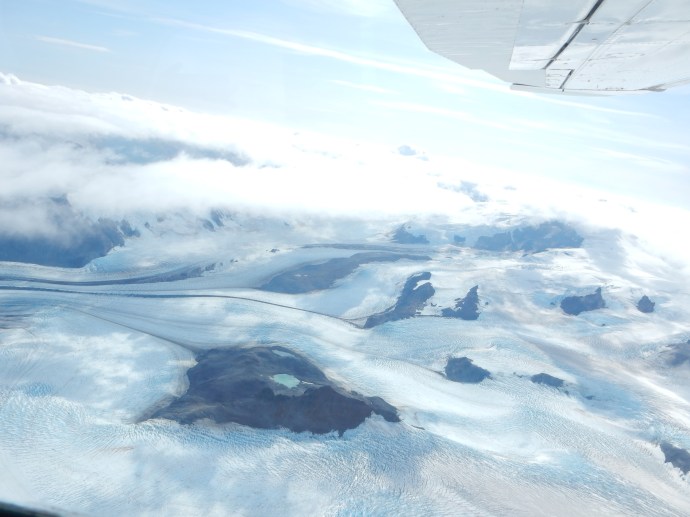
Kenai Mountains flying back to Homer

The trip back over Cook Inlet was uneventful but the views of the mountains and glaciers across from Homer (Kenai Mountains, town of Seldovia, Kachemak Bay and Kachemak Bay State Park, Wosnesenski Glacier, etc.) were another treat.

All in all, the day was 7.5 hours of fun and excitement. The vistas were great, Chris is even willing to try flying in a small plane again.
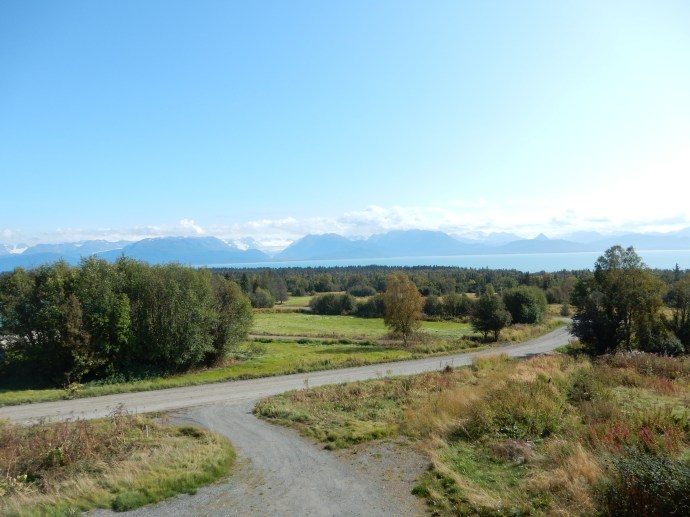
The view Ed had of Kachemak Bay and Kenai Mountains from the kitchen of our AirBnB while working on the blog

Ed and Chris. September 4. 4 PM

Categories: road trip, travel | Tags: , , , , | Leave a comment

2019 Trip 5: Alaska: September 2

First view of Cook Inlet from Kenai Peninsula at Ninilchik, AK

Homer, AK. Monday (Labor Day) September 2

Just about the end of the world here. The road to Homer continues for about 20 miles past it and then comes to a stop. Everything else has to be reached by air or boat. The weather varies greatly from the impact of mountains, ocean currents, as well just variation within the day. We can see rain shower clouds frequently in the distance which has dissipated by the time we arrive at that estimated location. During Monday we had several periods of rain as well as sunny skies.

Driving through the fire zone on the Sterling Highway between Cooper Landing and Sterling

The day began with the drive. We left Cooper Landing, able to drive on our own for five miles until there would be a check point. At the check point, you wait for the pilot car to follow it through the fire zone. Well, for us, we had not yet reached the check point when we saw the pilot car gaining on us from the rear. We pulled over, let it pass, and then joined the group. When we passed the next check point, the group just kept going. Cars waiting at the check point joined in at the end.

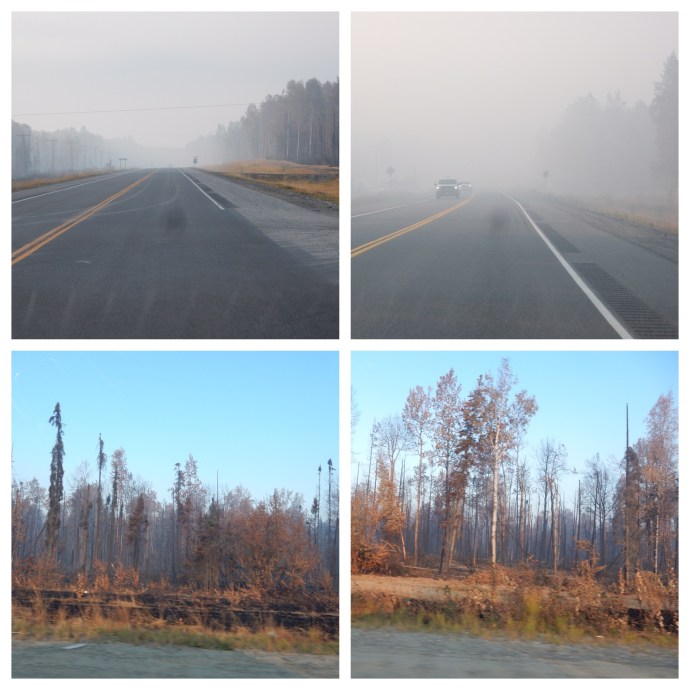
Sunday, the stretch to Cooper Landing looked like any other roadway except for the fire preparations areas. Monday, the stretch of road with the pilot car was definitely going through a fire zone. Our pictures are not the best, quick shots from a car moving at 55 mph through hills, curves, and stretches of gravel road. The gravel road portions were unclear to us; was this road under construction before the fire and unable to be finished or did the fire cause damage to the road surface? Don’t know the answer yet.

In several places, the forest fire had jumped the road. Burnt trees were on either side of us. Trees were down, some trunks coming close to the road. Areas of smoldering turf lurked just past the shoulder, wisps of smoke curling to the sky. The road had been completely shut down for two periods of time, we could see why. Smoke smell was everywhere, smoke haze was minor today. Our assumption was that the light rain had cleared the skies somewhat. This stretch continued for about 12 miles, then the pilot car pulled over and we continued the rest of the drive to Homer as if nothing was out of place.

The Kenai Peninsula is slightly larger than the state of West Virginia with a population of about 55,000. Four towns, Kenai, Sterling, Soldotna, and Homer each have a population between 5500 and 8000. The vast majority of the land is part of governmental units; Kenai National Wildlife Refuge, Chugach National Forest, Kenai Fjords National Park, and Kachemak Bay State Park.

A short hike at Kenai National Wildlife Refuge in Soldotna, AK

We drove through Sterling and Soldotna on our way to Homer. In Soldotna, we stopped at the visitor center for Kenai National Wildlife Refuge. It was relatively new with wonderful exhibits and friendly, informative staff. Out back, we went for a nature hike between light rain drops. Evidently, we had just missed the arctic terns who summer on the lake (and other lakes). Arctic terns make the longest migratory journey of any bird, flying between the Arctic to the Antarctic every six months.

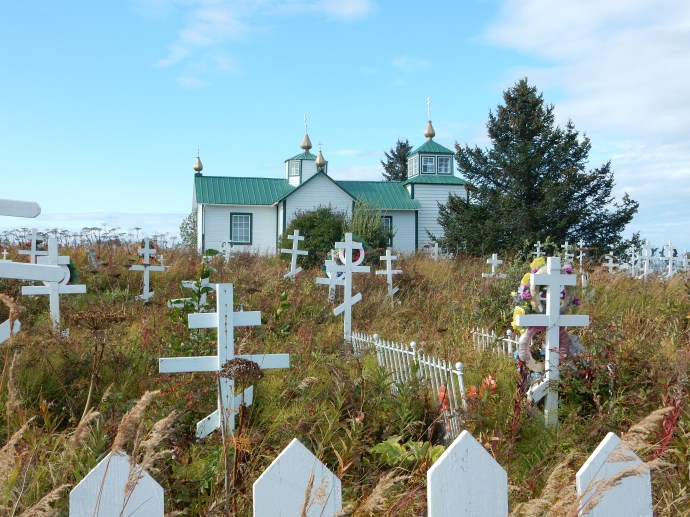
Church of the Transfiguration, Russian Orthodox Church in Ninilchik, AK

Interior of church

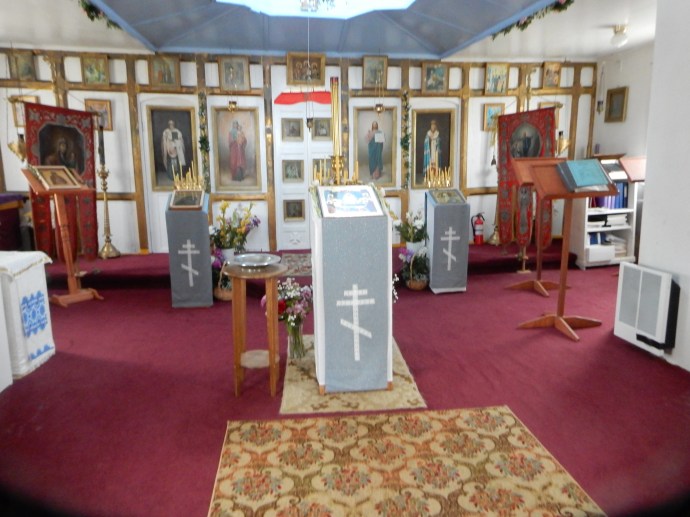
The Kenai Peninsula was one of the areas that Russians settled during its period of Alaskan colonization (1733-1867). We stopped in Ninilchik to visit a Russian Orthodox Church. By now, the sun was out and the church overlooks Cook Inlet with a beautiful view of the water. To our surprise, a bearded gentleman was sitting outside the church! Turns out he is a priest, born down by Sitka. The church itself is very small with numerous icons and paintings inside. The priest was clear that the Orthodox Church is the one Christian Church true to the original Christian beliefs and service.

Views from Homer Spit

Our drive continued to Homer, stopping for periodic photos. In Homer, we drove first to the Homer Spit; a 4.5 mile peninsula jutting out into Kachemak Bay. The town of Homer began as a fishing spot, with canneries and fleets. Competing towns existed across Kachemak Bay but the Sterling Highway came to Homer in 1950, and the 1964 earthquake damaged the towns across the bay to a greater degree. Now Homer is the major commercial center of the southern area with the towns across the bay accessible only by air or boat. The spit itself dropped nine feet in elevation during the earthquake, with most buildings destroyed. It is rebuilt now, both commercial fishing and sport fishing being major economic drivers.

Another Homer Spit photo

On the spit is the office of our air flight service, Alaska Bear Adventures. We had to be weighed in as the plane has a limit to what it can carry. We received our instructions, including that the departure time is now scheduled for 10 AM. Early morning fog is expected and pushed back a more normal start time of 6 AM. We should arrive back in Homer at 4:30 PM or thereabouts on Tuesday.

Beluga Slough, part of Alaska Maritime National Wildlife Refuge, Homer AK

Lunch was at a nice restaurant overlooking the water with fresh halibut as our meal choice. Homer claims to be the halibut fishing capital of the world. After lunch we stopped at another wildlife refuge, Alaska Maritime National Wildlife Refuge. At 3 million acres stretching from the end of the Aleutians to the southeastern tip of Alaska, it is the largest national wildlife refuge. More sea birds nest here than all other U.S. wildlife refuges combined. We took a hike to an estuary slough and finished with dessert at a local bakery.

For three nights we will be in Homer. Our lodging is east of town on the road that dead ends into nothingness. We checked out a portion of the road, hoping to return later when the rain has stopped and the sun is out to get better photos of the glaciers across the bay.

View overlooking Kachemak Bay from the patio at our AirBnB in Homer, AK

Ed and Chris. Homer Alaska. Tuesday September 3, 3:30 AM

Categories: road trip, travel | Tags: , , , , , , , | Leave a comment

2019 Trip 5: Alaska: September 1

Kenai Lake at Cooper Landing, AK

COOPER LANDING FINALLY. Sunday September 1

Cooper Landing, population 286, lodging for this evening. We only had to wait about 15 minutes for the pilot car to lead us on the highway. Rain yesterday and cooler temperatures appear to have brought down the fire threat. Most of the actual burnt areas are west and north of here in the forest. Cooper Landing is still on “set” status; that is, be set to depart if the fire changes dramatically.

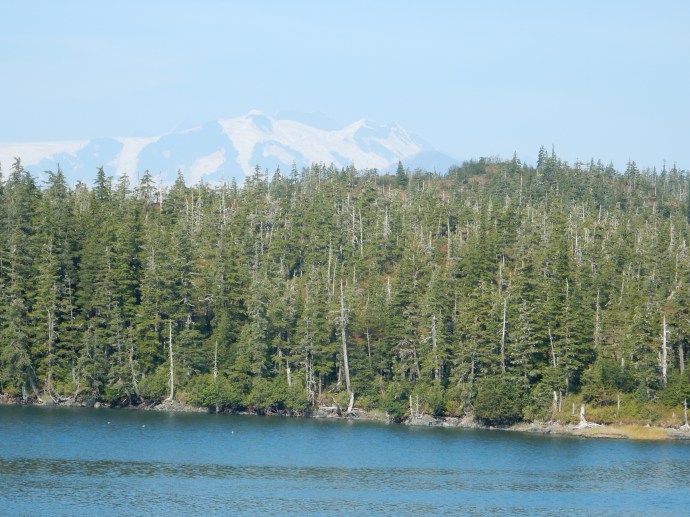
Driving to Cooper Landing along the end of Turnagain Arm

We left Anchorage around 9 AM. The rain cleared the skies a bit and we were able to view the southern shores of Turnagain Arm for the first time. Mountain peaks and valleys surrounded us as we drove past the Whittier turn-off onto new road. Cooper Landing came into view as we crossed the Kenai Lake and River with perhaps a dozen businesses. We drove past the rafting company that had to cancel our Saturday evening rafting adventure.

Can you spot Ed having dessert at the Kingfisher Restaurant?

The Kenai Princess Lodge is closed to overnight guests, not sure where Princess Cruises is housing the people who were scheduled to stay there. The Princess Lodge is open for meals, apparently most of their business is for fire fighters. We plan to patronize a small, local restaurant for dinner called the Kingfisher. It is on Kenai Lake and when fire fighting planes load up with water, they do so from Kenai Lake. Evidently it takes about 12 seconds for the plane to fully load as it scoops water from the lake. We are staying at The Hutch, a small B and B here in Cooper Landing.

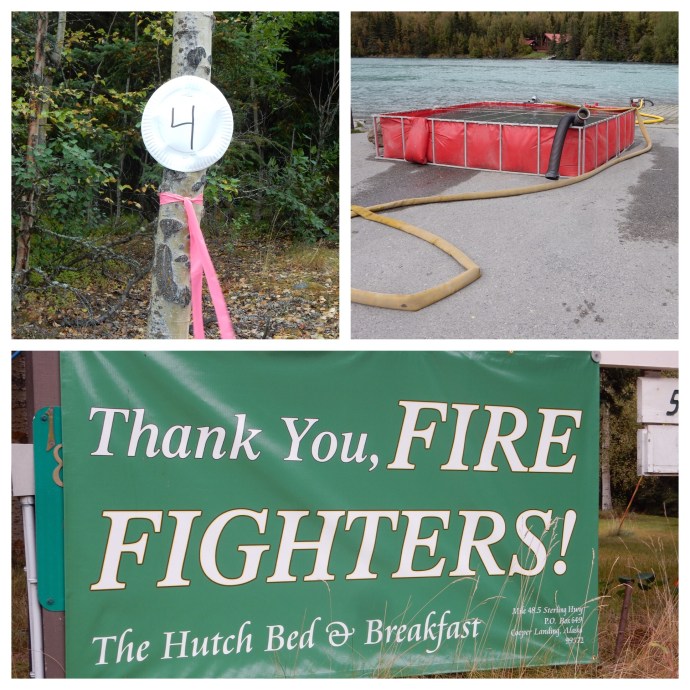
Paper plate ID, water pumping readiness for fire fighters, Thank you sign

A short walk took us to the outlet where Kenai River runs out of Kenai Lake. With mountains,of course, in the background, it made for a great picture of Alaska. The firefighters have pre-planned their fire stoppage efforts. A pump, hoses, and tank lined each side of the river. Homes and business have temporary identification markers posted on paper plates at the front of each property. Signs are frequent to thank the firefighters for their efforts.

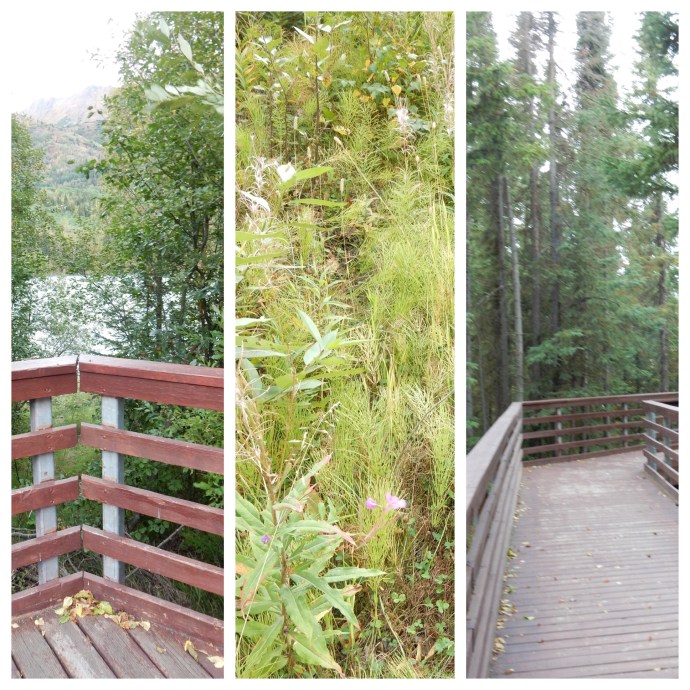
Along one of the walks

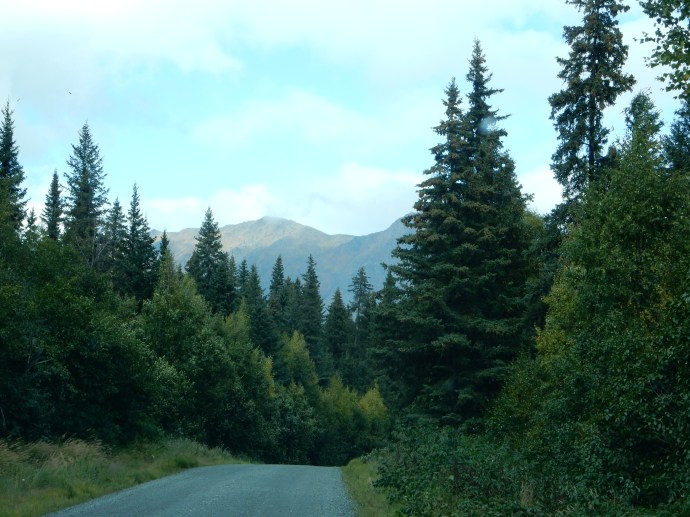
Driving back roads near Cooper Landing

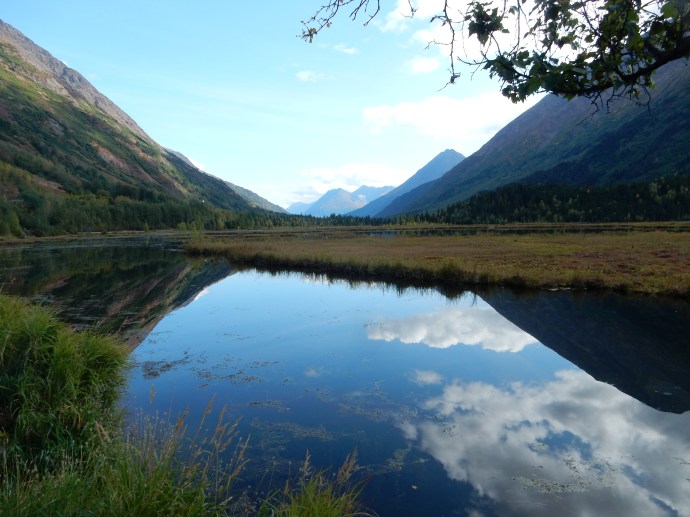
We went for a few short walks. The scenery is beautiful. Every now and then the sun would peak out, then the clouds, wind, and a few drizzles show up.

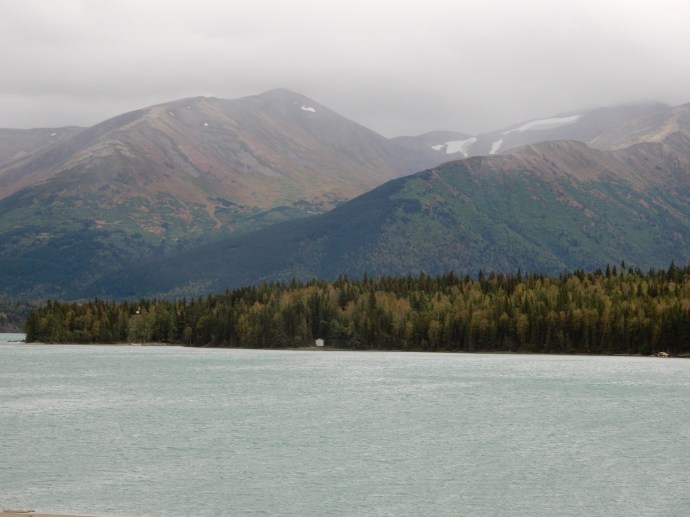
Kenai Lake at Cooper Landing

Ed and Chris. Cooper Landing. September 1. 8 PM

Categories: road trip, travel | Tags: , , , | 2 Comments

2019 Trip 5: Alaska: August 31

Potter Marsh, Anchorage Alaska

Anchorage, Alaska. Saturday August 31

While people back in Minnesota are thronging to the State Fair in record numbers, we are still exploring Alaska. Our current adventure has us in Anchorage for an alternate date, avoiding the town of Cooper Landing since the wildfire would not have allowed us to do the hiking and touring we had planned. It does appear that last night’s rain may make travel to Cooper Landing Sunday and Homer on Monday much more feasible.

Potter Marsh just south of Anchorage

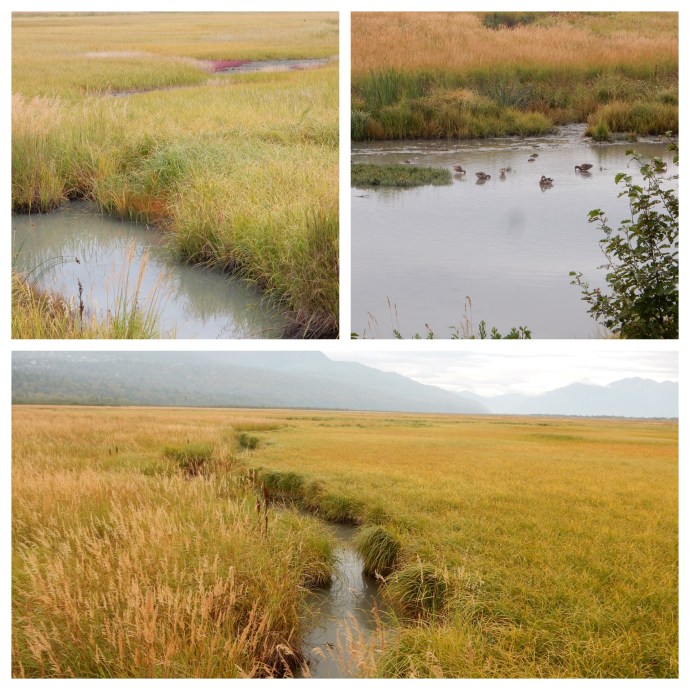
The day started at Potter Marsh, a well-known and highly touted wildlife marsh just minutes from downtown Anchorage. The boardwalk at Potter Marsh takes you on several paths into the marsh. The marsh is partially salty with tidal influence. The day was windy with overnight rain and a promise of more rain to come. The birds did not cooperate. We saw a few ducks of some type and a magpie or two but that was it. The boardwalk was popular with humans; none seemed to be having better luck at finding birds.

Leaving the marsh, we went in to Anchorage and spent four hours at the Anchorage Museum. The museum is the largest in Alaska and focuses on Alaskan art, cultures, history, and science. We took advantage of two docent led tours although the one focusing on art was less worthwhile. The art collection focuses on images of Alaska and, where feasible, on art by Alaskans. Sydney Lawrence, probably the best known Alaskan painter, is heavily represented.

Chris and I were extremely impressed by the areas of the museum that focus on the various native groups of indigenous Alaskans. I used to wonder why there appeared to be so many different names; weren’t they all Eskimos or some such? The docent covered it nicely; as did James Michener in his novel “Alaska”. When the last period of glaciation occurred in North America and Europe, sea levels dropped dramatically exposing Beringia.

In very basic terms, Beringia is the land exposed by that sea level drop; extending from the McKenzie River in Canada to the Lena River in Russia. The Chukchi and Bering Seas were not seas then, but grassy steppes. Peoples from Asia migrated at many different times; each group of migration tended to end up as a different indigenous people. The indigenous peoples stayed in Alaska, developing their own history and culture since the glaciers in America and Canada blocked further southward movement until the glaciers receded, Each group developed according to its own locale; vast differences occur between the Tlingit people down along the southeast coast of Alaska from the Unangan people of the Aleutian Islands, as an example.

Child’s snowshoe hare parka

Somewhat similar to the museums in Flagstaff and in Fairbanks, each indigenous group is highlighted. The items in the displays have been selected by the elders of each group from items in the possession of the Smithsonian Institute. The exhibits are enhanced by video monitors that describe each specific item in greater detail. One can go online to see this at: http://Alaska.si.edu. A snowshoe hare child’s parka might only be made every few years; the snowshoe hare population has peaks and troughs. The peak years would produce enough hares for a parka, other years, no.

An example that the docent highlighted included a winter parka made out of the intestinal guts of seal and a winter parka made out of ground squirrel hides. Each used the wealth of resources Alaska makes available to them in the area in which they live. Each peoples had sufficient free time to create works of art, either for pleasure or for ceremonial purposes.

Of course, the coming of Russian and American explorers and settlers negatively brought disease and high rates of death, forced labor, forced loss of cultural habits, etc. Positively, it brought new materials and habits that made their life easier. The resources of the state were a prize to be extracted and shipped back to the parent country, whether that was furs, salmon, or gold and copper. The profits from the resources were not spent on local improvements.

A separate exhibit highlighted the past and current media representations of Alaskan indigenous peoples. “Molly of Denali”, a new PBS kids show, was highlighted as an example of improved accuracy in media presentation. Another exhibit demonstrated the role and importance of salmon. Hopefully we will not foolishly waste away that important resource in favor of indiscriminate mineral extraction. It took time for humans to acknowledge their overfishing of salmon threatened it with extinction. Reasonable safeguards and regulations seem to be keeping the salmon fisheries at a sustainable level.

AAA rates the Anchorage Museum a “Gem”, the top honor. We would agree and encourage others to take time to explore it in depth.

The rest of the afternoon was housekeeping; laundry, church, and dinner. Tomorrow, Cooper Landing.

Varied photographs by Fred Marchetanz of Alaskan scenes in the Anchorage Museum

Ed and Chris, Saturday August 31. 9 PM
Categories: road trip, travel | Tags: , , , | 1 Comment

2019 Trip 5: Alaska: August 29

Alaska

Girdwood, AK. Thursday August 29

A most interesting day. You will get your fill of animal and scenery pictures. Thursday was dedicated to one activity, a five hour boat cruise out of Whittier in Prince William Sound. But first, we had to get there. As noted yesterday, Whittier was not inviting as a lodging option. We are staying in Girdwood, about 45 minutes west of Whittier. The challenge in reaching Whittier is that if you are coming by car, you have to use the Whittier Tunnel. There is no other option.

The tunnel was constructed during WWII for railroad traffic and only much later converted to combined rail and auto traffic. And I mean combined. It is one lane wide with trains and autos using the same path. To enter Whittier from the west, you line up and wait for the tunnel to allow east bound traffic at 30 minutes after the hour. To leave Whittier, you line up and wait to enter the tunnel at the hour. If you miss your time, you wait an hour.

It should take 45 minutes to reach the tunnel from Girdwood. We allowed an hour. But, experienced travelers that we are, we missed the turn-off! We were zipping along when suddenly the road signs just seemed wrong. No cell service to check on Google maps. We decided we had to re-trace our steps. Going speeds I have not reached since the wide open spaces of west Texas, we reached the line at 10:35. Luckily at that time there were enough cars that the line was long and the tunnel was still open. Close call.

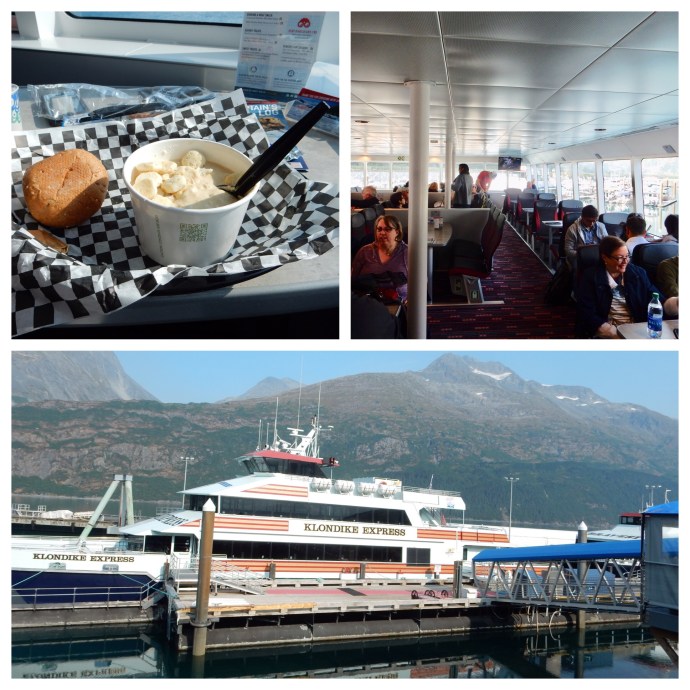
Logistics of the day: Boat, Lunch (plus a kale salad not in the photo), Seats (Top deck, front row, right by window) Chris at the far right front

Our cruise was with Phillips Cruises for a five hour journey on a new boat. They assign seats and since we had booked back in March, we had prime seats in front, by ourselves, looking forward, right next to windows in front and to our right. For the next five hours we took in magnificent scenery and a long list of sea animals. Once out on the Sound, the smoky haze was minimal. Whittier and this area of Alaska receive huge amounts of rain and snow but today was clear. Temps were in the high 50s, we did not need the extra gear we brought to stay warm on the water.

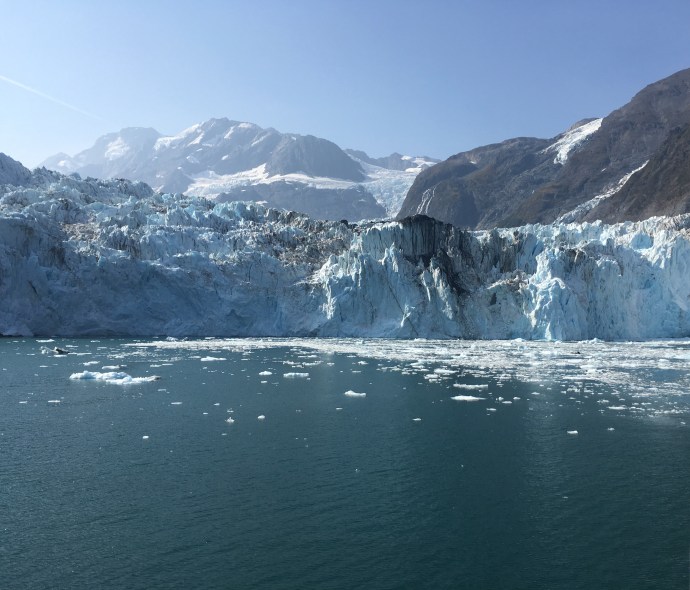
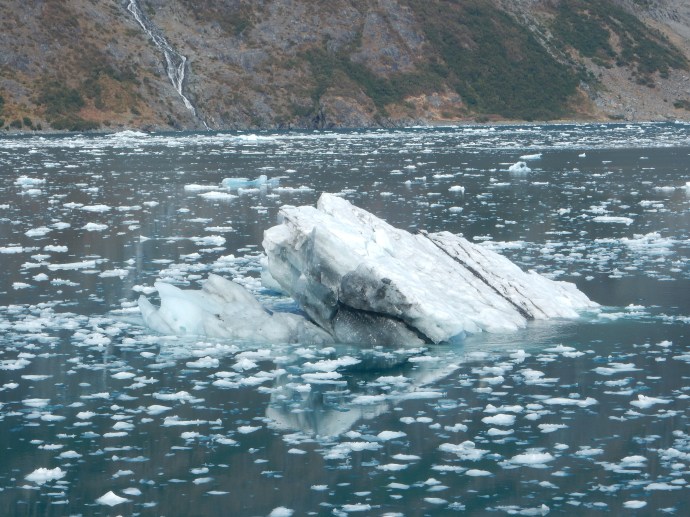
Glaciers

A U.S. Forest Service Ranger from the Chugach National Forest was on board providing narration. The Chugach is our second largest U.S. forest and includes huge swaths of water surface within its boundaries. He discussed glacier formation, the weather, the impact of climate change and the dramatic shrinking of the glaciers.

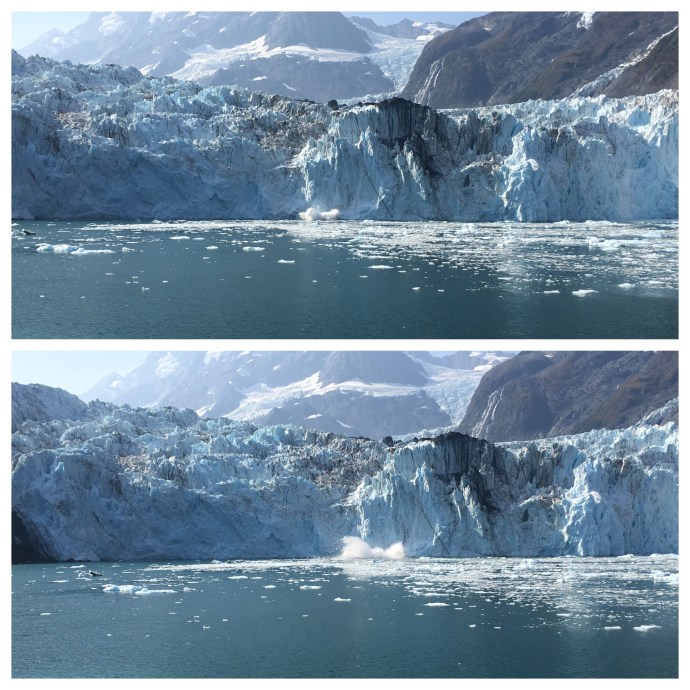
Glacier calving: Breaking off top, splashing bottom

Waterfalls

Alaska water falls that seemed so puny before were dramatic in height as water from melting snow and glacial ice poured down tall mountain sides.

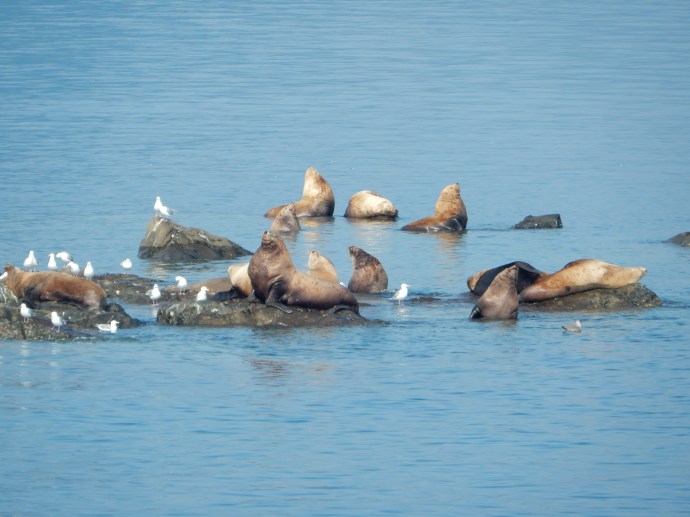
Stellar seal lions

I could discuss the habits of Stellar sea lions and the other animals; we picked up fact sheets on all of them. But I won’t except for a few brief comments here and there.

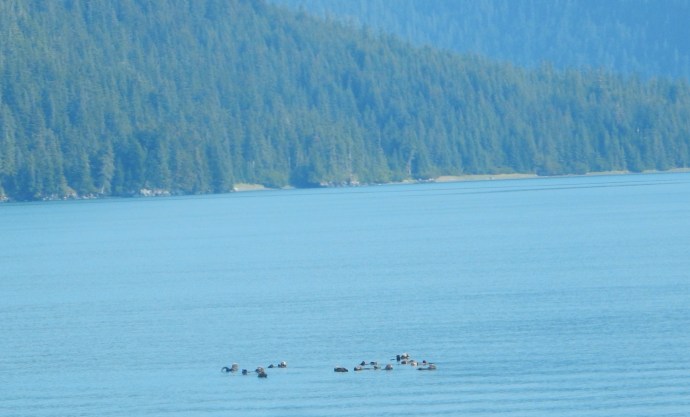
Sea otters at play

Sea otters in Prince William Sound

Sea otters were almost hunted to extinction. Their pelts are amazing in their ability to resist water and keep warmth. If you want to be disgusted, read a history of how they were hunted and natives here treated.

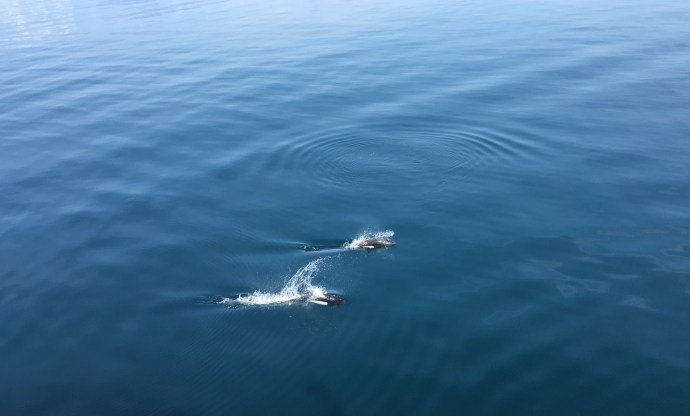
Dall’s porpoises

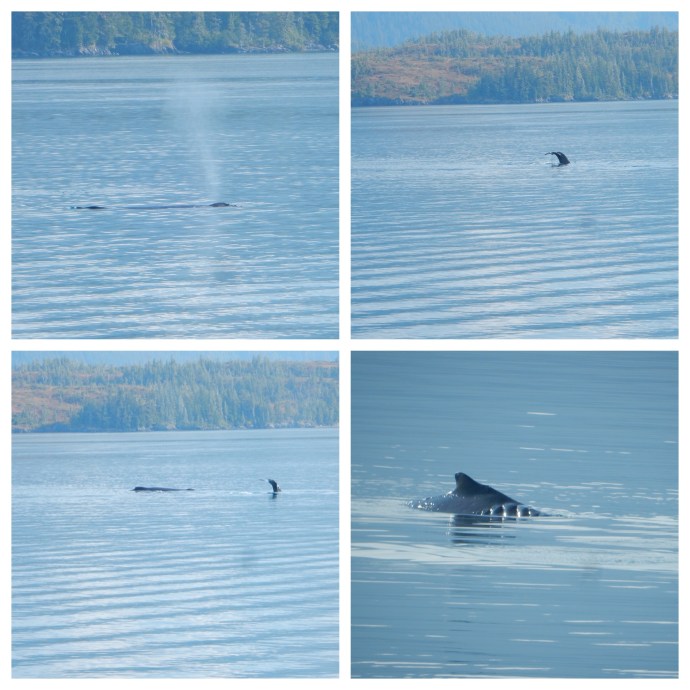
The porpoises were the highlight. They buzzed the ship. They dived and splashed. They went out and “played” with the humpbacks whales. There must have been at least ten of them. Porpoises are fast. It was hard to take a photo; by the time they jumped out of the water, they were gone again.

Harbor seals in Prince William Sound

Humpback whales

This is not the season for orcas, so humpbacks were the “only” whales we saw today.

We did not bother taking pictures of bald eagles. Kind of ho-hum for a couple from Minnesota.

This was the Alaska of our imagination. A great cruise. A lucky day weather wise. A wealth of wildlife to observe and glaciers to marvel at.

Oh, we have canceled our first night in Cooper Landing due to fire issues. Our river rafting excursion has been canceled also. Still debating the next two nights in Cooper Landing and our three days in Homer. A Homer cancellation will hurt; we had splurged on an air trip over Cook Inlet to Lake Clark or Katmai National Park. They are remote and only reached by air or boat.

Alaska

Ed and Chris August 30. 3:30 AM

Categories: road trip, travel | Tags: , , , , , , , , , , , , , | 1 Comment

2019 Trip 5: Alaska: August 28

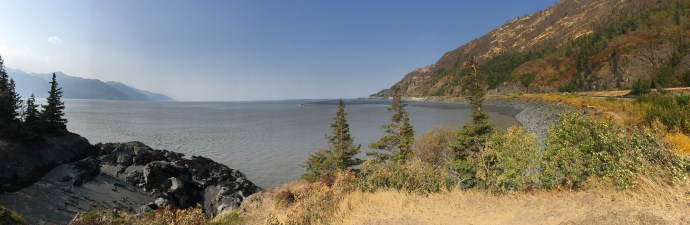
A view along Turnagain Arm, between Anchorage and Whittier. Left side, south, shows evidence of smoke from the Swan Lake Fire on the Kenai Peninsula

Girdwood, Alaska. Wednesday August 28

Smoke and fire were major concerns today. We left Talkeetna to drive to Girdwood, east of Anchorage. We plan to stay here in Girdwood for two nights. The drive here continued on the Parks Highway, along a 20 mile stretch of road that has been plagued by wild fires. Over the past week, travelers were only allowed to go in one direction at a time, led by a pilot car, much as you might encounter in some construction zones. Emergency firefighting crews had first priority over the travel lanes. Delays of several hours had been common. The Alaska Railroad had canceled some of their runs since the fires were even closer to their tracks.

Fire view along Parks Highway between Talkeetna and Willow Alaska

Luckily the roadway just opened to full two lane traffic, although at reduced speeds. We past numerous stretches of burnt forest. Smoke stench was still prevalent. No structures that we could see had burnt, though. Many properties had signs thanking firefighters.

We spent an hour this evening listening to a local radio station live broadcast a community meeting in Cooper Landing, AK where we planned to spend Friday, Saturday, and Sunday nights. Our lodging host said “No problem, come on down.” This town on the Kenai Peninsula south of Anchorage was likely to be the area in which we hiked the most. The topic of the community meeting was the Swan Lake Fire, a blaze that has been burning for 84 days north and west of Cooper Landing. It is the largest fire in the U.S. So far it has burnt 160,000 acres. (see this video from Accu Weather: https://www.accuweather.com/en/weather-news/apocalyptic-footage-shows-cars-narrowly-avoiding-flames-from-massive-alaska-wildfire/70009192) For most of that time it had not been threatening more developed areas.

Recently, the Sterling Highway through Cooper Landing over to Homer has been closed off and on; when open, it usually has a pilot car leading traffic one-way for a 20 mile stretch from Cooper Landing west towards Soldotna and Homer. We have to decide if we seek alternate lodging and forego one, two, or three of the expeditions we have reserved. At the moment, we are leaning to making different arrangements. You will find out the end result as it happens.

The Turnagain Arm is a body of water off Cook Inlet. The British Captain James Cook-he of fame for being a major European explorer to visit and map much of the Pacific Ocean. During his voyage to Alaska looking for the Northwest Passage, he came up the now-named Cook Inlet and turned right. That right turn led to a dead end and so he had to turn again to reverse his travel. Thus this body of water was named. It is ringed by mountains, forests and glaciers. It was the site of several gold strikes in the early 1900s.

The Turnagain Arm drive is rated as one of the most scenic in the country. The Seward Highway as it is called, is the only road route to the Kenai Peninsula, home to hiking, glaciers, boat tours, and great fishing. It is difficult for us to comment on its scenic beauty; most of it, particularly the southern side across the water from the road, was obscured by smoke from the Swan Lake fire.

Beluga whale in Turnagain Arm

Smoke did not make the drive uneventful though. At Beluga Point, we pulled over and watched Beluga whales diving for food. Belugas hunt for other fish to eat in shallow waters where killer whales have difficulty maneuvering. We could see several belugas, their white color in sharp contrast to the gray water as they dove and re-surfaced over and over again. Our pictures show them although not really close up. We have been “out-camera’d“ throughout this trip by the visitors with huge spotting scopes and zoom SLR cameras.

Mountain goats in Chugach State Park along the Seward Highway

Still at Beluga Point, we simply turned around and up on the mountains a group of about 25 mountain goats were walking single file along a narrow path. There was less smoke on the northern mountains. The goats stood out clearly with their white against the dark rocks.

McHugh Falls, another stop along the Seward Highway

The Chugach State Forest and Chugach State Park cover a large swath of land from Anchorage over east to past Valdez and south as far as Seward. We will be making numerous stops in these two during the remaining two weeks in Alaska. Beluga Point was just one of several stops today. We had lunch at the Turnagain Armpit Bar B-Q in Indian, AK. Great food.

A view of Alyeska Resort

Our lodging tonight is at Alyeska Resort, one of our splurges. It is a resort close to Anchorage with winter skiing and summer mountain hiking and biking. We chose it since it is very close to Whittier, home to one of our boat rides, and the lodging in Whittier appeared to be the pits.

Views from Alyeska Resort, non-smoke obscured

We rode the tram up the mountain and obtained great views of the smoke on the other side of the water. Our host at Armpit Bar BQ indicated today was a good day, the wind was keeping the smoke on the south side. Our planned hike was cut short by swarms of “no-see umm”. The small gnats were so irritating we headed back down again.

Thursday we drive to Whittier. Several aspects of that day should be interesting and fire free.

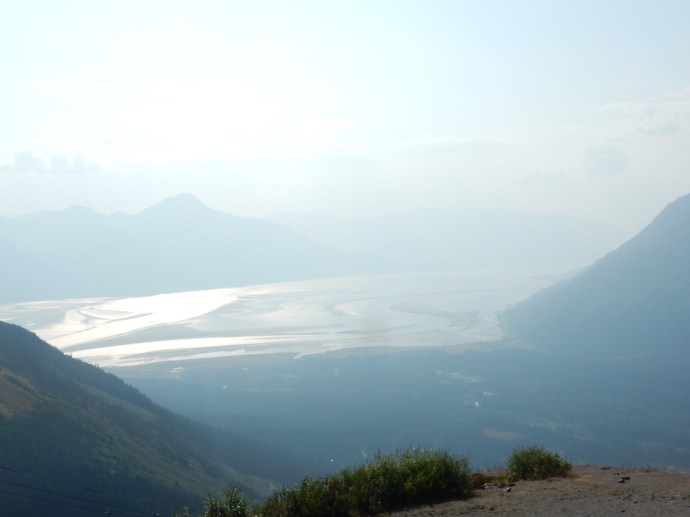
Smoke obscuring the view of Turnagain Arm as seen from top of tram ride at Alyeska Resort in GIrdwood

Ed and Chris. Thursday August 29 4:30 AM

Categories: road trip, travel | Tags: , , , , , , , , | 1 Comment

Blog at WordPress.com.