road trip

2016 Trip Four, Southwest Discoveries, June 5-6

Las Vegas, June 6, 2016

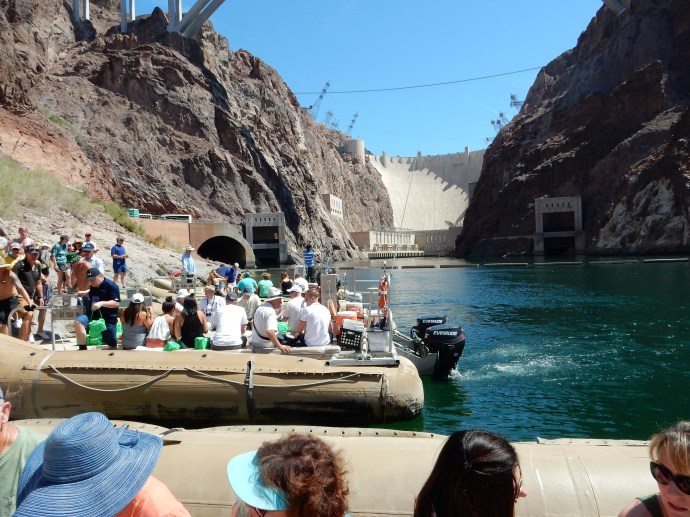
Hoover Dam as viewed from Black Canyon of the Colorado River

Hoover Dam as viewed from Black Canyon of the Colorado River

Last full day in Vegas and we celebrated it by taking a rafting trip down the Black Canyon of the Colorado River just below Hoover Dam.

A view of the boats loading up

A view of the boats loading up

The gathering spot is a RV park on Lake Mead where we meet at 9:15 AM, get organized, wait for late arrivals, take a shuttle through security gates, wind our way down a steep, narrow road, and finish up at the bottom of Hoover Dam-downstream side. There are three raft type boats, capable of holding about 40-50 people. We have maybe 35 on ours-after 4 people from Paris decided, 10 minutes into the trip, that they changed their minds and did not want to go on the raft trip. We were still in the general area of the take-off point discussing Hoover Dam so we brought them back to the dock and they were able to catch one of the shuttles which had not yet returned to the RV park. Never did get a reason from them and it did not appear to be a normal occurrence.

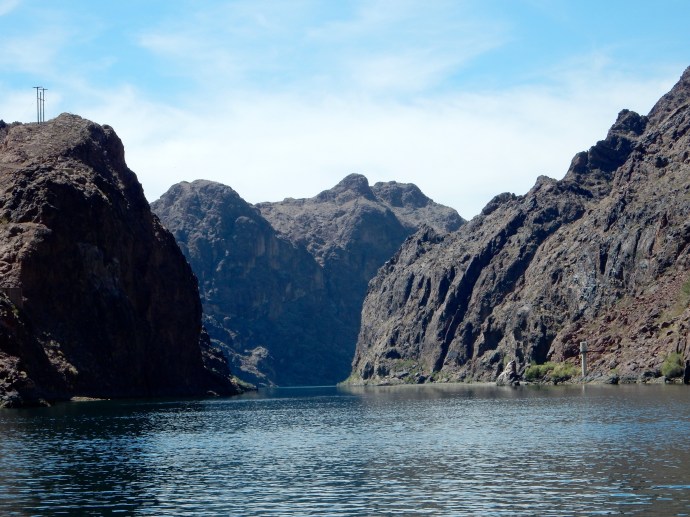
Looking south down the Black Canyon

Looking south down the Black Canyon

Anyway, back to the journey. Jeff from Wisconsin was our captain and tour guide. He emphasized the need to keep safe and cool. The temperature was over 100 again. Jeff and Chris and I were the only ones wearing long sleeved shirts and pants. Besides plenty of water and sun screen, Jeff passed out towels after soaking them in buckets of cool water. Just about everyone had one or two of them, usually around their neck.

Chris on the boat

Chris on the boat

Yes, Joyce, it is a dry heat but it is still hot. The towels dry out quickly but we re-wetted them in the bucket or just in the Colorado River water. The water below the dam comes through a pipe from the bottom of Lake Mead, up stream of the dam. Thus, sediment has settled out and the water temperature is around 50-55 degrees. Part of the time the boat is going fast enough to generate spray that lands on you and also helps to keep you cool. At faster speed also, the river water slops over the front of the boat and runs down the aisle by your feet so you can dunk your feet in the water and keep them cool.

Jeff told us some history on the construction of Hoover Dam and the geology of the canyon; pointed out rock formations that if you were imaginative looked like something other than just rocks; and steered the boat. He demonstrated the art of recovering hats that went over the side of the boat, helped by a little girl who lost her hat. We saw the small carts suspended above the river that two people had to use to transport themselves across the river to reach a gauge station that recorded water level and quality until finally technology made obsolete the daily one hour, one way trek along and across the river and canyons to work. That made rush hour seem easy.

One of the passengers checking out the hot springs along the Black Canyon

One of the passengers checking out the hot springs along the Black Canyon

We saw a mountain goat in a cave high on the cliff side. We passed hot springs. Water that seeps into the ground is heated and comes out various cracks at about 130 degrees. One such spring we stopped at and everyone got out and felt the water. Yup, it was hot. We passed two spots where rainfall, when it comes, generates tremendous, although short-lived, waterfalls. Lunch was eaten at a small cove, an insulated lunch cooler with sandwich, water, apple, cookie and snack are provided. We get to keep the cooler. Not sure we have space in our luggage for them though.

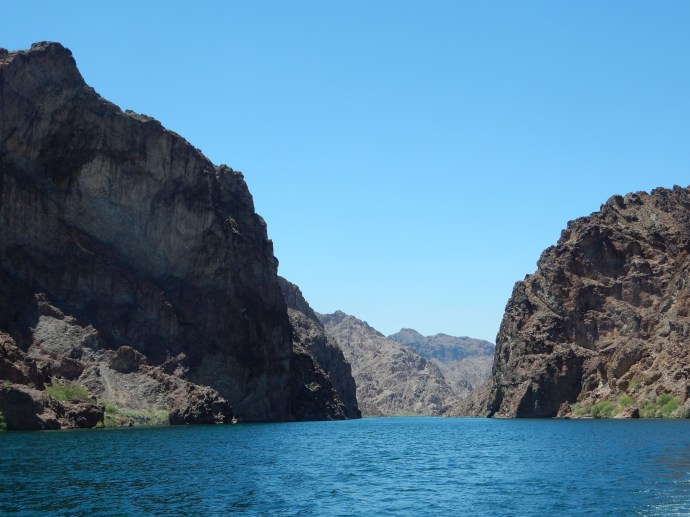
Black Canyon of the Colorado River

Black Canyon of the Colorado River

All in all, a very enjoyable day. We left our hotel at 8 AM and returned around 4 PM with a stop for a cold A & W in a frosted mug in Boulder City. Life is good. Tomorrow we will probably sleep late and arrive back in St. Paul in the evening.

Ed and Chris

Categories: road trip, travel | Leave a comment

2016 Trip Four, Southwest Discoveries, June 3-4

Las Vegas,Nevada, June 5

Sunrise at the North Rim of the Grand Canyon

Sunrise at the North Rim of the Grand Canyon

Heat Advisory to Snow. Friday and Saturday were days of contrast. The North Rim of the Grand Canyon is higher in elevation than the South Rim with greater precipitation, more trees, and cooler temperatures. It did get into the high 80s both days on the North Rim but the temperature on the canyon floor was to reach between 115-120 degrees F. When we arrived in Las Vegas Saturday evening, the temperature was 107 degrees. But let me back up a bit on the story line.

Friday morning we were scheduled to go on a rim top mule ride. Only one hour, and not the ride down to the bottom and back up again. However, on this trip I began to experience problems with altitude headaches and shortness of breath. I have been at higher elevations than the 8000 feet or so at the North Rim in the past and have not experienced those problems. Second, I have some vertigo issues but again, on this trip, it was worse than usual. In fact, I was getting nervous Thursday night while trying to sleep just thinking about Friday’s rim ride. Finally, I was getting a sinus headache and my eyes were watering. I told Chris Friday morning we were not going to do the mule ride; I did not want to be on a mule, my eyes watering and getting dizzy from looking over the edge. We canceled the ride. One has to accept one’s limitations, even if they are increasing.

Sunrise at north rim

Sunrise at north rim

Seeing the sunrise on Friday was still on the agenda. We were up at 4:30 AM but Chris took many of the pictures. I stayed back from the edge. There were fewer people out for the sunrise than had been out Thursday night for the sunset. The sunrise, and sunset, would have been enhanced by more clouds and more color but still it was a unique experience to watch it over the huge canyons below us.

Reflecting now on our visit, I think the vastness of the Grand Canyon reduced its pleasure for us. Driving the roads along the many mountain cliffs, where the cliffs are closer, change color, and contrast with the valley floors provided a more intimate and more visually rewarding experience. Even the drive down I-15 is impressive through the mountain valleys in that stretch of Utah, Arizona, and Nevada (as long as you ignore the haze/pollution).

We did take a morning ranger talk about the Grand Canyon. He explained how the geology contributes to the heavier rainfall that flows southward from the Kaibab Plateau to the north of the canyon edge down here to its edge. The north gets 15 feet of snow per year and that melting water creates more erosion on the north rim. More erosion equates to more visually stimulating gorges, rocks, etc for viewing compared to the steep drop-off of the South Rim. The 400 bison here are one of the more genetically pure herds in the U.S. Many herds have some cattle genes intermixed.

The North Rim has greater variety in vegetation. One can walk a few hundred feet and the juniper and pinyon pines of the desert change to Ponderosa pines of the forest. The south facing canyon wall provides for up drafts of warm air from the canyon floor 5500 feet below that limit the vegetation along the edge. Roaring Springs Canyon which runs just east of our cabin provides all of the water for the North and South Rims from the springs in its gorge. The vast majority of the park’s electric bill is for pumping water.

Chris on front porch of our cabin

Chris on front porch of our cabin

After the ranger talk, we took most of the day easy. We enjoyed the views, watched people, did our laundry, and listened to a second ranger talk. It was more relaxing for me to not feel the pressure to go on long walks or look over the edge. With the trees and the breeze, it was a comfortable day. We had our meals in the Grand Canyon Lodge; there are few options and the food was tasty. Our evening dinner was a buffet with a wide-screen showing a variety of National Park films. All of the accommodations are in cabins, the lodge is for meals, gift shop, etc.

Saturday we drove to Las Vegas via two National Park units; Pipe Spring and Cedar Breaks National Monument. Quite a difference between the two. Pipe Spring is in the northern strip of Arizona, just south of the Utah border. It proved handy for the early days of the Mormons when they could cross over the border to avoid prosecution for polygamy.

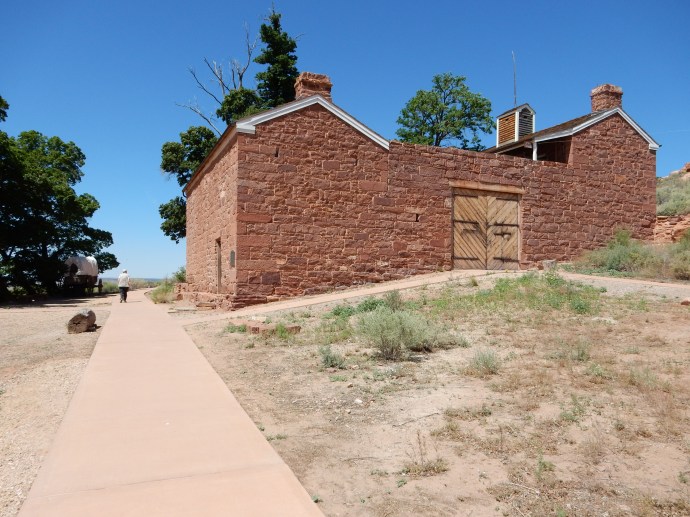
The fort at Pipe Spring National Monument

The fort at Pipe Spring National Monument

Pipe Spring had been a long time habitation for the Kaibab Paiute Indians. It has a spring sufficient to support wildlife or some grazing and growing of crops. A Mormon missionary came across the spring, passed the word up the chain of command, and the inevitable conflict over land use and water rights began. Grassland was more abundant then and Mormons established a ranch here. During the building of their temple in St. George, Utah, this ranch provided meat, dairy and cheese to the workers. In order to provide protection against raiding Navajos (the Paiute here were peaceful) and to support the early Mormon desire to establish their own kingdom of Deseret, a small fort was built at Pipe Spring. The fort was built right over the spring; Indian access to the water was denied.

Interior court yard at Pipe Spring National Monument

Interior court yard at Pipe Spring National Monument [/caption

Pipe Spring has a video of the conflict of values that existed here. In addition, the park rangers provide a 45 minute tour of the fort designed to show how the fort operated. It was less a US Army style fort as a walled in ranch house with enclosed courtyard. The Mormons even had their our telegraph system to connect their far-flung outposts with the headquarters and main temple in Salt Lake City.

From the over 100 degree temperature at Pipe Spring, we drove scenic Highway 89 in Utah in the area between Zion and Bryce National Parks. We continued through the Dixie National Forest on Highway 14, a road normally closed in winter due to snow. Our destination was Cedar Breaks National Monument.

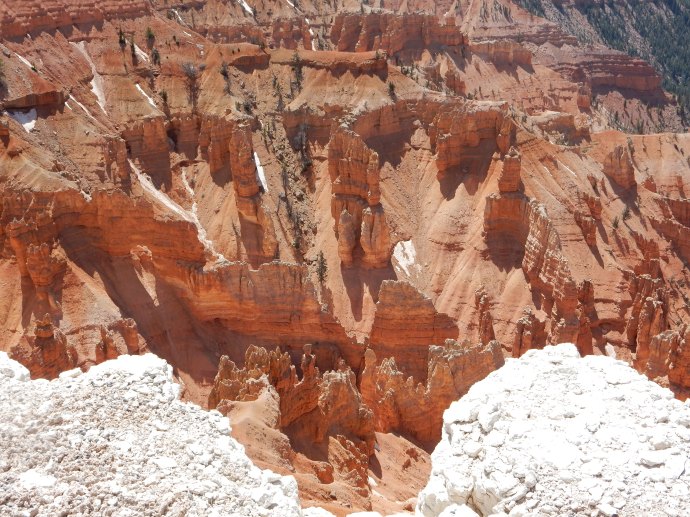
Cedar Breaks National Monument Cedar Breaks National Monument

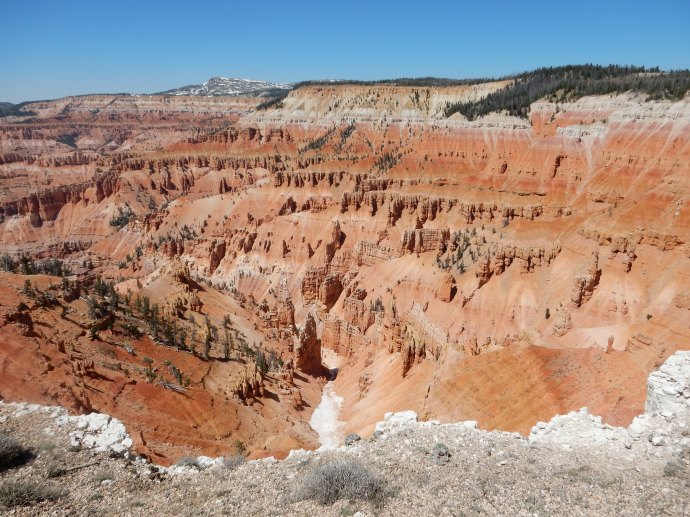
Cedar Breaks is another of the mis-identification by early settlers. The trees here are not cedars as they thought but junipers. Breaks refers to the steep, heavily eroded terrain. The road winds through forest and climbs up to a 10,400 foot elevation. As we approached the visitor center, snow appeared on the side of the road and the car gauge indicated the outside temperature was 68 degrees. Heavenly.

Cedar Breaks National Monument

Cedar Breaks National Monument

Cedar Breaks does not have many trails and the two we attempted still had snow blocking much of the trail. At this altitude, I was not inclined to do a long walk anyway. The main feature here is to observe the rocks in “The Amphitheater”, which we did from several locations. The rangers here were all young and enthusiastic about being assigned to such a scenic location. I can’t blame them. The sight was amazing and quite unexpected. We enjoyed our “lunch” of granola bars overlooking “The Amphitheater”.

Cedar Breaks National Monument

Cedar Breaks National Monument

Cedar Breaks might be a great place to return to in late summer when the wildflower are out. For now, it will remain a great memory of wonderful vistas. For once the time differences among these states proved to our advantage. We were in Utah, an hour later than Nevada and Arizona so we had an early dinner at a steakhouse in Cedar City. Cedar City is also the home of the Utah Shakespeare Festival which begins here in late June with an expansive schedule of plays.

After dinner, it was a quick 2.5 hour drive down the Interstate to Las Vegas. We are here for three nights with a timeshare spiel tossed in Sunday.

Chris and Ed at Cedar Breaks National Monument

Chris and Ed at Cedar Breaks National Monument

Ed and Chris

Categories: road trip, travel | Tags: , , , | 1 Comment

2016 Trip Four, Southwest Discoveries, June 2

North Rim, Grand Canyon, Arizona. June 2

Grand Canyon close to dusk

Grand Canyon close to dusk

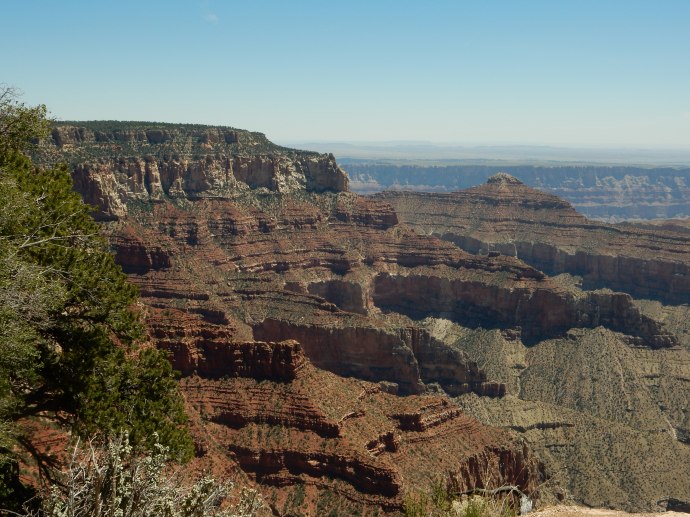
Heresy. That’s what it is. After you look at the Grand Canyon for a while, you (us, anyway) say what’s next? Yes, it is deep and wide and has varied colors of rock. But we have seen so many great sights, that the hype of the Grand Canyon seems greater than its reality. Are we really so jaundiced in our view?

We will hold off on a full decision to determine how sunset and sunrise light affect the color of the rocks. I think, with no proof, that much of the color grandeur shown in photographs comes from varied lenses and filters used by the photographers.

Driving to Navajo Bridge at the Colorado River

Driving to Navajo Bridge at the Colorado River

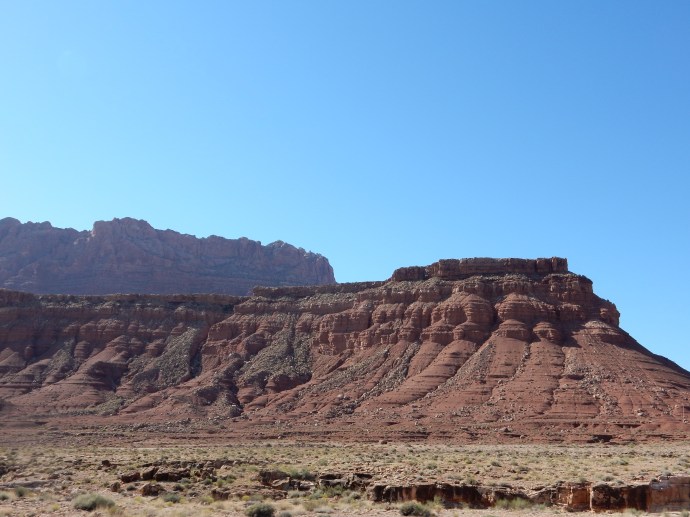
Vermillion Cliffs

Vermillion Cliffs

We left Page AZ early this morning, on the road with breakfast by 8 AM. We wanted to fully enjoy the Grand Canyon views. The drive went down and around steep, high, dramatically red cliffs leading to the Colorado River crossing at Navajo Bridge (3500 feet above sea level); along the equally steep and colorful Vermillion Cliffs National Monument; climbing up to almost 9000 feet on the Kaibab Plateau and National Forest (ponderosa pine trees!); before finally descending to about 8000 feet at the various north rim overlooks.

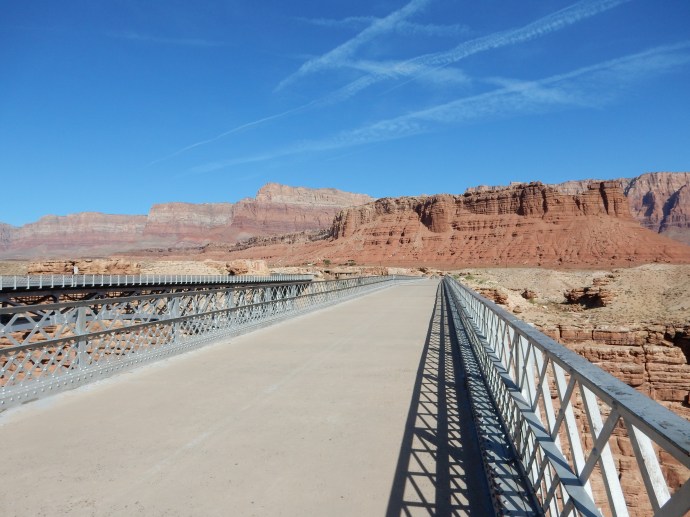
Walking the 1929 Navajo Bridge

Walking the 1929 Navajo Bridge

Navajo Bridge crosses the Colorado River near Lee’s Crossing; the only place for hundreds of miles where the banks on both sides of the river allowed for relatively easy crossing. A ferry was operated by a Mormon settler fleeing the law for his role in the Mormon massacre of a non-Mormon wagon train in 1857. The ferry operated until the first Navajo bridge was completed in 1929. That first bridge is still in existence today for pedestrians and was the location for our pictures of the Colorado River here. A new bridge was completed in 1995 to allow for greater traffic and heavier loads.

After crossing the river on the bridge, we drove along and up the Vermillion Cliffs, a national wilderness area whose rocks show hues of red, white and blue. The road continued up into the Kaibab Plateau where we suddenly crossed a transition zone and were presented with larger juniper trees and then Ponderosa pine. The temperature cooled down (Page was to reach a high of 100 degrees).

Showing new growth in Kaibab Forest

Showing new growth in Kaibab Forest

When we reached the entrance station for the North Rim of the Grand Canyon, it was only 11 AM. Our first viewing point was going to be at the end of the park drive at Cape Royal. We passed through areas burnt by the fire of 2006; new growth shows as a bright green contrast. At Cape Royal and again at Roosevelt Point, we went hiking along the rim and had our first views of the Canyon from this angle.

Grand Canyon

Grand Canyon

Grand Canyon

Grand Canyon

As noted in the first paragraph, the views are fine. Grand Canyon is amazing, just not our first preference for overwhelming. I am sure all of you have at least seen pictures of it. We are tossing in a few more.

View from Cape Royal at Grand Canyon

View from Cape Royal at Grand Canyon

Grand Canyon from Cape Royal

Grand Canyon from Cape Royal

Grand Canyon view from Roosevelt Trail

Grand Canyon view from Roosevelt Trail

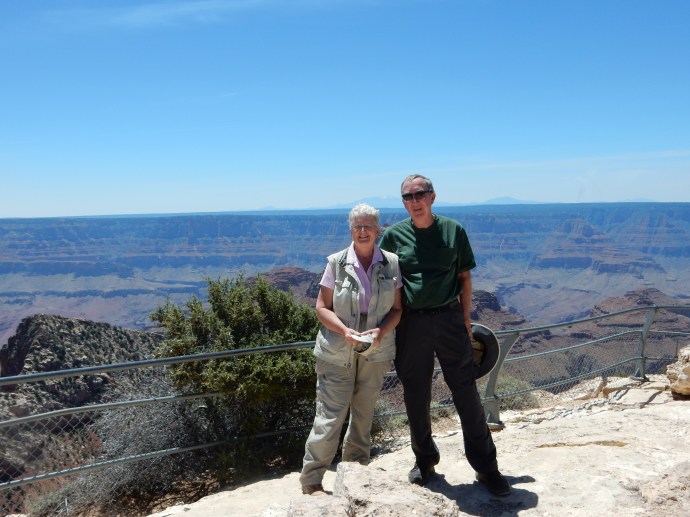
Chris and Ed at the North Rim of the Grand Canyon

Chris and Ed at the North Rim of the Grand Canyon

The park is full, but it is a very manageable size. Many of the visitors here had come from Zion previously and talked of the crowds at that park. We are in a “western” style cabin near the visitor center and Lodge. The Lodge is a gathering and feeding place, no accommodations are offered there. We had dinner in the main dining room with a window table providing views of the canyon below. A ranger gave a talk about the re-emergence of California condors and then sunset viewing wrapped up our day.

Ed and Chris

Categories: road trip, travel | Tags: , , , , | 1 Comment

2016 Trip Four, Southwest Discoveries, May 31-June 1

Page, AZ. June 1

Lower Antelope Canyon

Lower Antelope Canyon

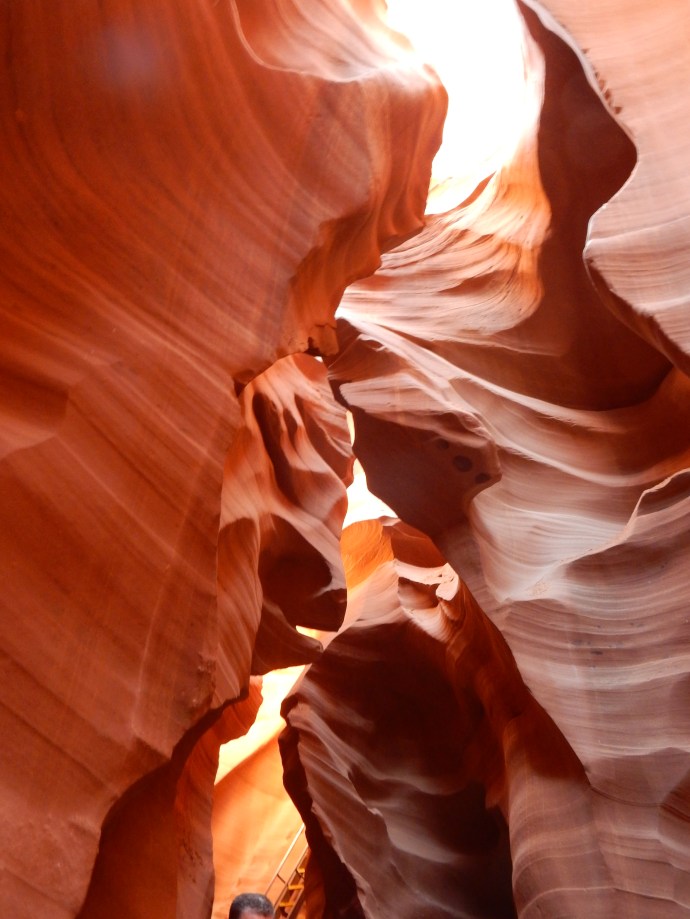
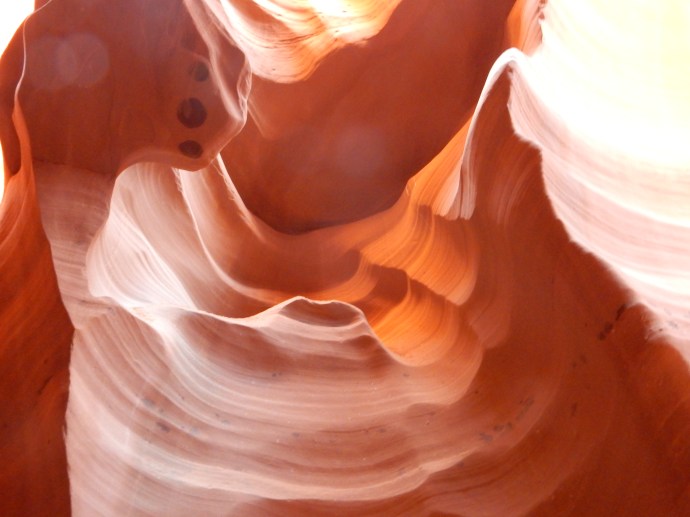
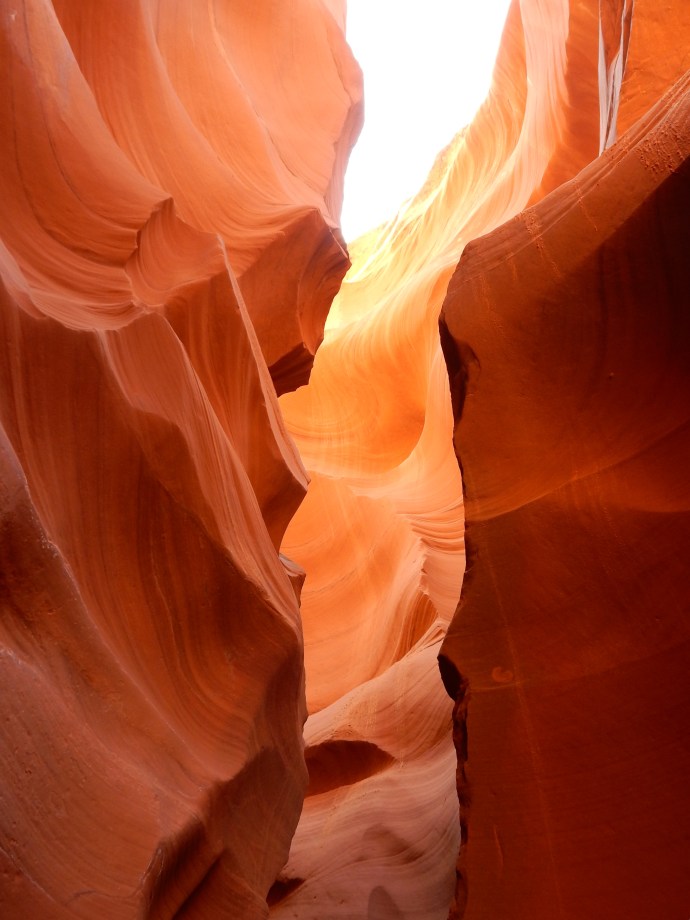
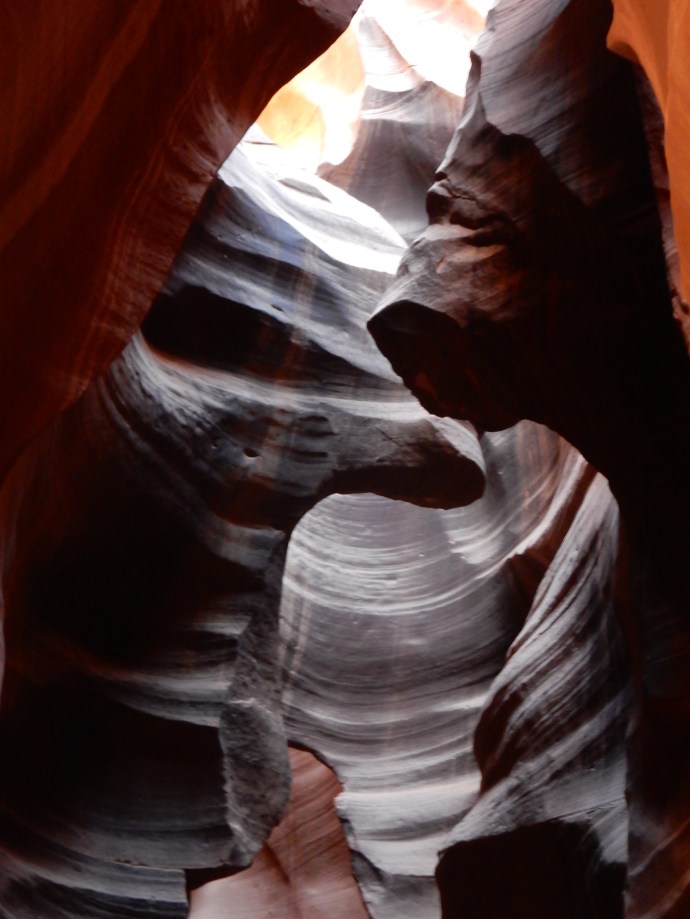
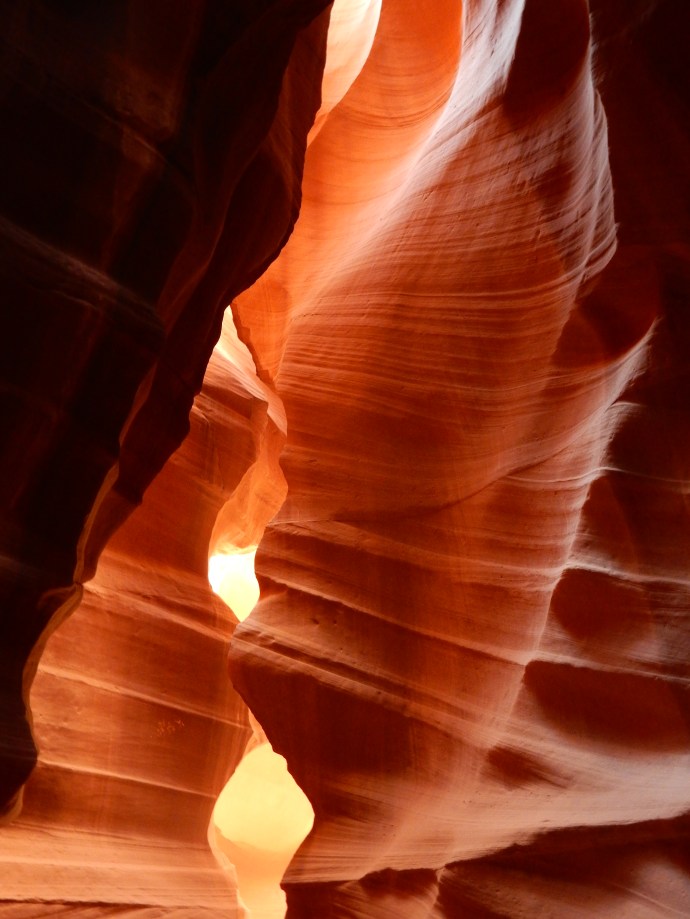
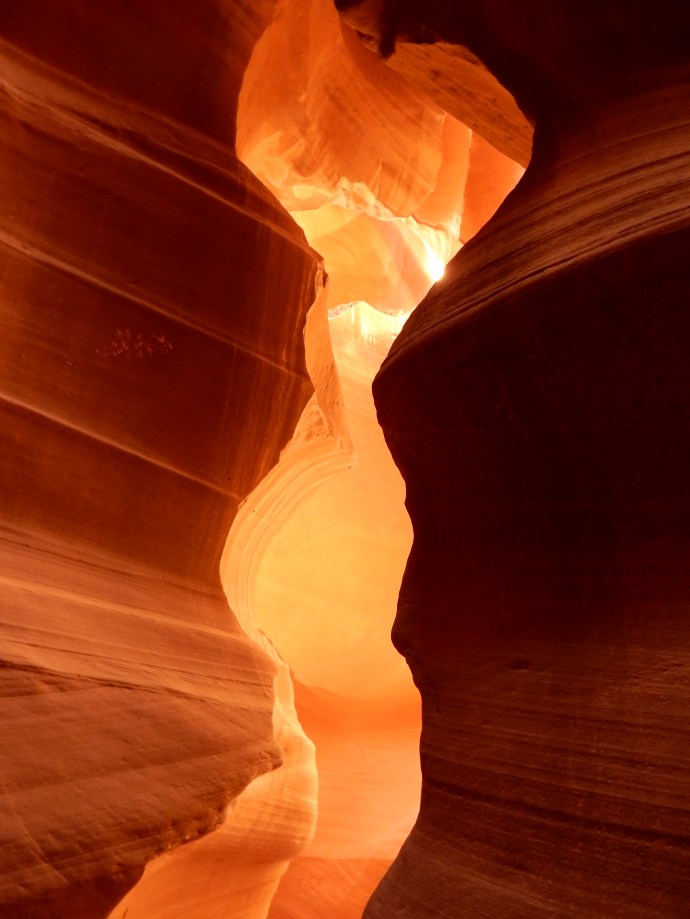
Antelope Canyon is all that it is cracked up to be-and more. Antelope Canyon is within the Lake Powell Navajo Tribal Park and features slot canyons with amazing views. All of the reviews raved about its beauty-and its lines and crowds and how certain times (usually mid-day) are best, certain tours are reserved for photographers with tripods, etc. And there are two canyons. You must visit the canyons through a Navajo Nation tour guide. It all seemed a little daunting.

The noon time tours were booked when we went online for Upper Canyon. We made a reservation for 5 PM. For Lower Antelope, there appeared to be plenty of openings just about whenever you showed up. Seemed like it would be a faint cousin of Upper ANtelope given the fewer number of people taking the tour. We decided to take our chances and just check in when we arrived there after driving up from Moenkopi.

At 9:45 AM we arrived in Page and checked in with Ken’s Lower Antelope Tours. We were told there would be openings at 9:00 AM, in 15 minutes. Oops. we had the time zones mixed up again. Anyway, we signed up for the 9 AM tour. John was our tour guide and had only been doing this for two months. Not a big deal, there is some history and geology involved but the real task for John was to: a. make sure our camera settings were adjusted; and b.) take some photos of us; and c.) show us some of the best views. After that, the canyon takes over and does all of the work.

And yes, there are a lot of people. There are stairs to climb. Not all people followed all of the rules exactly. But even for me, with my fussy attitude about people obeying the rules, it was a relaxing and stupendous time clicking away. Boy, if I still had Kodak rolls of film, we would have spent a fortune of film and processing.

The canyon is carved primarily by flash floods from water flowing off the mesas into the Colorado River and now, Lake Powell. Heavy rains can fill the canyon 1/2 to 2/3 full. Last major flash flood was in 2013. ANtelope Canyon was named because the Indians found pronghorn deer in here.

Enough history. Enjoy the pictures of Lower Antelope Canyon.

Lower Antelope Canyon

Lower Antelope Canyon
Lower Antelope Canyon
Lower Antelope Canyon
Lower Antelope Canyon

Lower Antelope Canyon

Lower Antelope Canyon

Lower Antelope Canyon

Lower Antelope Canyon

Lower Antelope Canyon

Lower Antelope Canyon

Lower Antelope Canyon

Lower Antelope Canyon

Lower Antelope Canyon

Lower Antelope Canyon

Lower Antelope Canyon

Lower Antelope Canyon

Lower Antelope Canyon

Upper Antelope Canyon was a 5 PM tour. It has good and bad points. At 5 PM, the light is not as sharp. Upper Antelope is a deeper canyon than Lower and thus more direct light is beneficial. A good part of the time we were in shadows and 30-40% of our pictures did not turn out. THere are still plenty of good ones though. At 5 PM, we were the last tour and there was less pressure to hurry up and get done. Upper Canyon is shorter and you go out and return the same way. During mid-day, making way for returning groups could be a real hassle.

Personally I would suggest doing both tours; Lower Antelope Canyon early or late; Upper Antelope during mid-day.

Our lodging this evening is the Lake Powell Resort, located on the shores of Lake Powell in Page Arizona. Glen Canyon Dam on the Colorado River creates this lake over 150 miles long. A beautiful sight.

Upper Antelope Canyon pictures. May 31 details follow the pictures.

Upper Antelope Canyon
Upper Antelope Canyon
Upper Antelope Canyon

Upper Antelope Canyon

Upper Antelope Canyon
Upper Antelope Canyon

Upper Antelope Canyon

Upper Antelope Canyon

Upper Antelope Canyon

Upper Antelope Canyon

Upper Antelope Canyon

Upper Antelope Canyon

Ed and Chris at Upper Antelope Canyon

Ed and Chris at Upper Antelope Canyon

May 31.

First Mesa is a Hopi community continuously inhabited for more 1100 years. It is 70 miles from Moenkopi and Tuba City. We called and made reservations for a 10 AM tour. No pictures are allowed of First Mesa or its landscape. We have a few photos of the drive that went through Navajo Nation land but that is it.

Driving to First Mesa

Driving to First Mesa

First Mesa is 1000 feet above the valley floor, about 6000 feet compared to the town of Polacca at 5,000 feet. Most of the Hopi now live in Polacca. There are three villages up on First Mesa, our tour was of the oldest portion. This section now is reserved for use only during weekends and ceremonial activities. Each clan, there are about 100 Hopi clans, may maintain a clan house there. Our guide was Coyote clan and she pointed her house out to us. Hopi is a matriarchal society and the property will pass on to her oldest daughter.

On weekends and for ceremonies, each house is open and clan members come and partake of food and activities all day long. On weekends during the summer, there are ceremonial dances which visitors may watch-but no pictures. The clan homes open on to one main street. Communal break baking is undertaken by the women in a special oven. There are nine kivas and the Chief of the village will lead the men in the ceremonial dances from his kiva along the street, with several plaza openings where members gather and watch.

The clans are responsible for their own home upkeep, the Hopi people as a whole will work to maintain plazas, kivas, etc. The homes in First Mesa are still constructed of stones quarried from rocks at the base of the mesa. In the other two villages, some homes are made of concrete block. One of the two villages is reserved for members of the Tiwa tribe, who came over from New Mexico at the time of the Pueblo Revolt (1680) at the request of the Hopi to help protect the Hopi.

Views from on top of First Mesa offer a 360 degree view of the valley floor and neighboring mesas. Our guide oriented out her clan’s agricultural plot which looked to be a good mile or more away. The Hopi are known for their skill at dry farming; they do not irrigate but grow crops based on yearly rainfall and skill. At this altitude, snow comes late and early. The crops are just about to be planted. The Hopi can still see snow on the San Francisco Peaks by Flagstaff. When the snow is gone, then they plant. On our drive to First Mesa, we passed a small plot of land where a Hopi man was preparing the field by hand.

Our guide talked of the pressures facing the Hopi. Lack of jobs to keep the young, drugs and alcohol, land issues with the Navajo. During our tour there were several stops where Hopi were marketing their hand-made crafts. We also stopped for lunch at Second Mesa where there is a cultural center with a museum, restaurant and gift shop. The material for sale is always remarkable but it seems the Navajo have out-marketed the Hopi. Maybe it is just due to sheer numbers, but the Navajo shops seemed larger and better organized. It made us root for the Hopi who seem to be the underdog in the area.

Next we stopped at a roadside tourist trap marketing “dinosaur tracks”. We had read about this, arguments on both sides. Frankly to our eye, they are pleasant little erosions that faintly resemble tracks. Dinosaurs? I doubt it. The biggest hassle was the effort of some young men to be “our guides” to show us the tracks for a donation. We managed, with difficulty, to ignore them.

Our final stop on Tuesday was back at a Navajo museum; the Navajo Code Talkers museum. It case you are unaware, about 400 Navajo served in WWII in the Pacific with the Marines. The Navajo set up a code in the Navajo language. The Navajo Code Talkers then relayed information, by speaking this code in Navajo, from the front lines back to the commanders. The code was never broken by the Japanese and provided a quicker communication link than using code machines.

Like many other governmental and military situations, this was not made public until 25 years after WWII. The museum described their efforts and their willingness to serve the US despite our governmental history of abuse and neglect.

Ed and Chris

Two notes: First, we visited Lake Powell in May of 2014 and pictures of the Lake Powell and Glen Canyon can be viewed in the archives. Second, I do not recall if the North Rim of the Grand Canyon, our lodging for the next two nights, has any Internet service. We might be out of touch for a few days.

Categories: road trip, travel | Tags: , , , , , , , , | 3 Comments

2016 Trip Four, Southwest Discoveries, May 30

Moenkopi, AZ. May 30

Where am I? What time is it?

Well I am in Arizona, a state in the Mountain Time Zone. BUT, Arizona does not observe daylight savings time as do the other states in the Mountain Time Zone. BUT I visited a National Park Service site in Arizona and the National Parks in Arizona are on daylight savings time. BUT I am staying at the Moenkopi Legacy Inn on Hopi reservation property which does not observe daylight savings time. BUT I had dinner at the Hogan restaurant in Tuba City, right across the highway from the Moenkopi Legacy Inn, and Tuba City is in the Navajo Nation, which does observe daylight savings time. Huh?

Joyce and Lou, our hosts in Flagstaff

Joyce and Lou, our hosts in Flagstaff

Cameron's Trading Post

Cameron’s Trading Post

We said good-bye to Lou and Joyce in Flagstaff and headed up to Navajo National Monument, about 150 miles northeast of Flagstaff. About an hour into our journey, we stopped at Cameron’s Trading Post. Cameron’s dates back to 1916 when a bridge was built over the Little Colorado River gorge. Like the Hubbell Trading Post we visited earlier on this trip, Cameron’s was a place for trading and bartering among whites, Navajo, and Hopi. Unlike Hubbell, Cameron’s is but one mile from a turnoff to the Grand Canyon and has re-made itself into a modern-day tourist stop for bus groups and families on their way to the Grand Canyon or Lake Powell. Cameron’s is an employee owned company, so congrats to them.

Along the drive from Flagstaff to Navajo National Monument

Along the drive from Flagstaff to Navajo National Monument

The Little Colorado River was completely dry underneath the bridge. I do not know if that is due to drought, normal seasonal variation or the taking of river water for irrigation and other human uses prior to the bridge. The gorge is deep and one can visualize why it would be a barrier for white settlement.

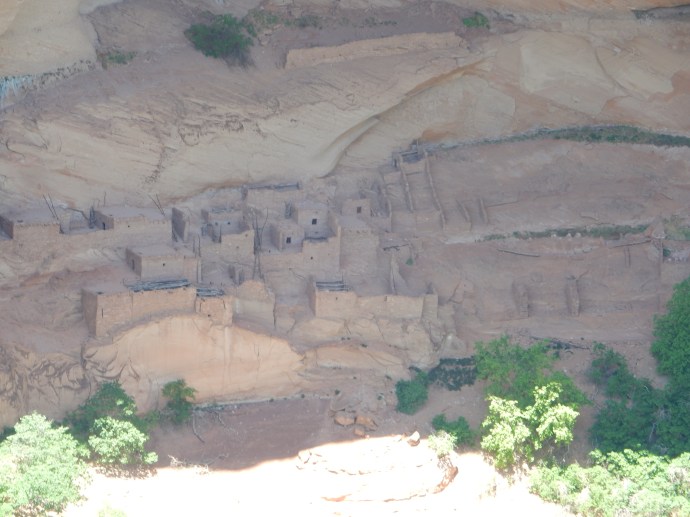
Betatakin cliff dwelling at Navajo National Monument

Betatakin cliff dwelling at Navajo National Monument

We bought nothing here and kept on moving. Navajo National Monument was established in 1909 to protect pueblo dwellings established by the Anasazi, or Ancestral Puebloans. The dwellings here are built into alcoves in the cliffs and are protected from the elements. We were not timely to take a tour down to the actual dwellings, but hiked out to an overlook to view Betatakin, one of three dwelling sites in the monument.

View into the valley at Navajo National Monument

View into the valley at Navajo National Monument

The valley here had been occupied with villages of farmers for hundreds of years. Valley dwellers built Betatakin and two other cliff dwellings. Betatakin was only inhabited for 50 years; speculation is because of drought or enemies but no one knows for sure. They only inhabited them for 50 years, from 1250 to 1300. The inhabitants moved on, speculation is that they intermingled with Hopi, Zuni, and other Pueblo groups. Betatakin is smaller than Chaco and other sites we visited but the dwellings are well preserved. (The word pueblo can mean both the architectural style of building and also can mean the cultures that have built and lived in villages of this style.)

After the hikes, we retraced our steps to Tuba City and visited the Navajo Interactive Museum. This museum shows Navajo, who prefer to be called Dine, history, culture, creation stories, etc.

A short history, my summary so you might wish to explore further on your own, about the conflict between Hopi and Navajo. First, the Hopi are a peaceful, farming people. They did not fight the US Army when whites came out to settle the West. The Navajo did, and were forced from this area on “The Long Walk of the Navajo” to New Mexico in the 1860s where they were imprisoned for four years. They suffered terribly on the walk, during imprisonment, and after being released.

The Hopi, since they did not fight, do not have a treaty with the US. The Navajo, after 1860s, returned to this area and settled in many cases on what had been considered Hopi land. US treaties with the Navajo gave them land which had been considered Hopi. Over the years, the Navajo have been successful, whether right or wrong, in having court opinions and Congressional actions solidify their hold over previous Hopi land. Now, the Hopi live on a reservation surrounded by the Navajo Nation and are vastly outnumbered by the Navajo, about 20,000 Hopi to 300,000 Navajo.

These ongoing land disputes and access to spiritual locations continue to cause rifts between the two tribes. An additional factor seems to be Peabody Coal which has large mining operations on the reservation. Navajo seem more inclined to authorize coal mining, Hopi do not.

Tomorrow we go to a Hopi cultural center.

Ed and Chris May 30

Categories: road trip, travel | Tags: , , , | Leave a comment

2016 Trip Four, Southwest Discoveries, May 27-29

Flagstaff Arizona. May 29

Driving to Valles Caldera

Driving to Valles Caldera

Southwest US scenery has been the focus of the last few days. Friday we drove to Valles Caldera northwest of Los Alamos, NM. We received our first backcountry permit. Before you get too excited, it was still primarily driving over rutted dirt roads instead of backpacking and camping in the wilderness.

Entrance area of Valles Caldera National Preserve

Entrance area of Valles Caldera National Preserve

Valles Caldera was made a national preserve last fall. Prior to that time, it was a managed by a trust and was supposed to generate enough fee income to cover its costs. It did not. The post Native American history of the area goes back to Spanish land grants and includes over grazing by sheep and over timber cutting of old growth trees. The trust was supposed to be a means to preserve the land without costing the US any money. Eventually Congress approved purchasing the land for $101,000,000. Part of the land reverted to the Santa Clara pueblo.

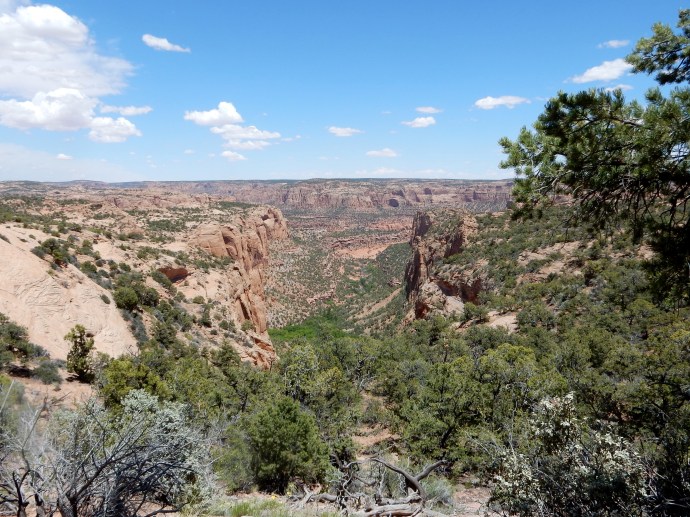
View from the back country of Valles Caldera

View from the back country of Valles Caldera

The National Park Service control is so new, there is no park brochure yet. The preserve covers a 13 mile depression created by a volcanic eruption over a million years ago. The backcountry permit allows one to traverse 12 miles into the preserve to view the mountains and meadows. Only 35 permits are allowed per day.

A portion of the area burnt by the 2011 fire

A portion of the area burnt by the 2011 fire

The preserve is also home to over 2,000 elk-none of which we saw. In 2011 there was an enormous fire in this area, threatening the buildings at Las Alamos Lab and the town of Los Alamos. The fire was eventually stopped short of the town and the lab but thousands of acres at Valles Caldera, Bandelier National monument, and Jemez Mountains were burnt. The fire created more open area, which provides grasslands for the elk to feed. More options for feeding means less concentration of elk in Valles Caldera. Ergo, no elk did we see.

Driving to the back country

Driving to the back country

The drive goes through a series of valleys surrounded by mountains. The highest in the preserve is at 11,250 feet. The road is dirt, passable by regular cars at slow speed. We made our way towards the end of the road and had a picnic lunch. The wind was strong so we ate in the car, peanut butter and jelly sandwiches.

Ed and Jude at her home in Santa Fe

Ed and Jude at her home in Santa Fe

Driving to Flagstaff

Driving to Flagstaff

Driving to Flagstaff in Arizona with BNSF train near base of mountains

Driving to Flagstaff in Arizona with BNSF train near base of mountains

San Francisco Mountains at Flagstaff, AZ

San Francisco Mountains at Flagstaff, AZ

Saturday we left Jude’s and drove the 400 miles to Flagstaff to Lou and Joyce’s home. This drive was completely on Interstates so the ride was easy. There is a small forest fire burning south of Flagstaff which affects air quality and visibility but it does not appear to be serious.

Dinner at Lou and Joyce's house

Dinner at Lou and Joyce’s house

We are relaxing in Flagstaff before we enter the last phase of this trip: brunch this morning, a walk this afternoon, Italian dinner tonight and star/planet viewing with Lou’s telescope tonight. The planned highlight of the next 10 days will be visiting the north rim of the Grand Canyon, but who knows what else will occur?

Ed and Chris

Categories: road trip, travel | Tags: , , , | Leave a comment

2016 Trip Four, Southwest Discoveries, May 26

Santa Fe, NM. May 26, 2016

The lobby of the St. James hotel in Cimarron NM

The lobby of the St. James hotel in Cimarron NM

The free continental breakfast at the Budget Host was discarded in favor of breakfast 42 miles away at the St. James Hotel in Cimarron, NM. The St. James was built in 1872 when Cimarron was home to the Wild West and it still has bullet holes in the dining room to prove it. It is stated that at least 26 people lost their lives in the saloon or hotel. The Earp Brothers, Buffalo Bill Cody, and Jesse James were all outlaws who visited here. The hotel is still operating, run by one of the owners of Express Ranches-a major cattle operating company with two large ranches around Cimarron. We came for the food, though, and breakfast was worth the drive.

The 42 miles were on a road where cattle, pronghorn, and bison were roaming. The bison were probably part of the stock being raised on the Vemejo Park Ranch of Ted Turner. We passed by the ghost coal mining town of Dawson. The 42 miles were an easy viewing sight of plains on either side of the road with mountains to our west. This part of the day was a prelude to the mountain driving to follow after breakfast.

Driving through the mountains of New Mexico

Driving through the mountains of New Mexico

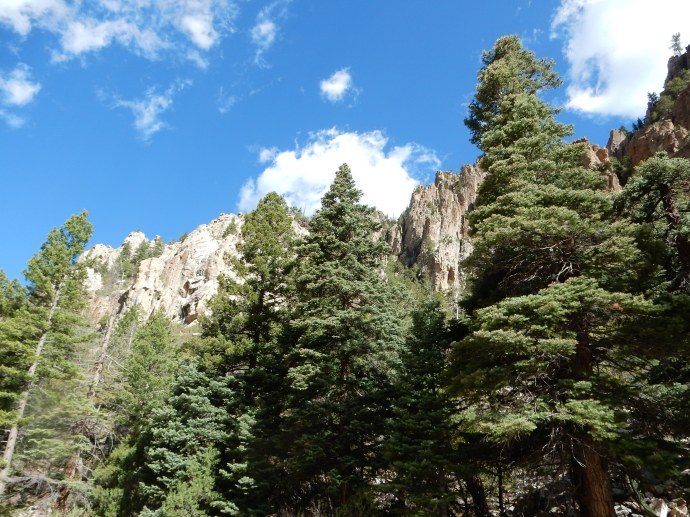
Most of the day’s journey was through mountains-usually with (my words) “real” trees instead of the scraggly piñon we were used to seeing. We drove through Carson National Forest, Rio Grande Gorge, Rio Grande del Norte National Monument and also passed the site of the Chevron molybdenum mining operation.

I had thought we would pass closer to the snow-capped mountains we had seen in the distance during our Wednesday late afternoon drive but no such luck. Evidently those mountains were in Colorado. There was snow in scattered places on a few mountains but nothing for a photo opportunity. The rivers and streams we passed were running strong, but lakes were obviously well below their normal levels.

Taos NM was to be the host of a motorcycle rally this weekend. Red River, one town on our route and on the “circle tour” of Taos, was preparing for them with scads of vendors setting up their tents and wagons. It was a little early for the mass arrival of motorcycles but a sprinkling were observed throughout our journey.

Rocky Mountain Bighorn Sheep

Rocky Mountain Bighorn Sheep

One highlight of the drive was seeing a Rocky Mountain Bighorn Sheep. These animals have been one of the most difficult for us to spot. This Bighorn was spotted when we drove in to the Carson National Forest visitor center. We lucked out, when we came out of the center it was no longer in sight.

Molybdenum mining reclamation site

Molybdenum mining reclamation site

The molybdenum mining operation was also overwhelming even though we could not view its entire operation. As we drove along Highway 38 east of Questa, we came across an immense mountainside that looked like it had been bulldozed and terraced. It was dramatic and we had no idea what it was. When we reached the Carson Forest office, the staff member indicated it was a molybdenum mining site and was being reclaimed. Molybdenum is a critical ingredient in making steel alloys. Mining had been open-pit, now was underground, although actual mining depend on mineral prices and whether it is economically viable to run the mine.

Before writing this post, I did a quick check on the Internet and according to Amigos Bravos, an environmental watchdog, the site has been placed on the Superfund list, the mine has excavated 360 million tons of acid-generating waste rock that cover more than a thousand acres around Questa, the Red RIver is unable to handle the amount of acid mine drainage, local wells are contaminated, etc. The whole story is complicated but seems to me to indicate once again our inability to control necessary mining operations without causing damage for future generations.

Rio Grande Gorge

Rio Grande Gorge

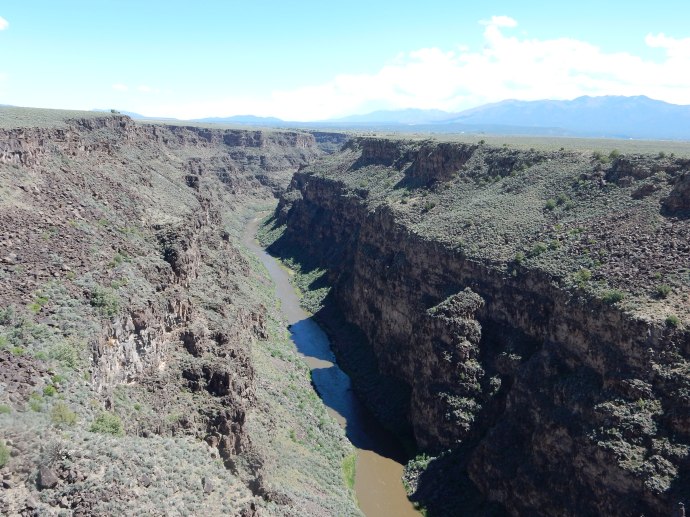
Enough of the depressing stories. We continued on to the Rio Grande Gorge bridge. This bridge carries highway 64 over the Rio Grande River. Usually we see the Rio Grande in the Albuquerque NM area where the water has been siphoned off for irrigation and municipal drinking water. In addition, the river is much wider in Albuquerque. Up here, the river runs faster in a narrow channel and has historically carved a deep and wide gorge. The views from the bridge bring bus loads of people to view the gorge and take pictures.

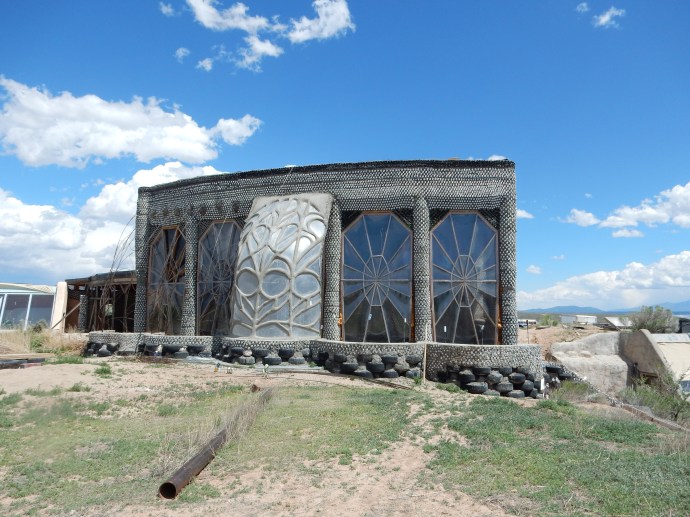
Earthship Biotecture demo building

Earthship Biotecture demo building

Earthship Biotecture

Earthship Biotecture

Just north of the bridge is an operation called Earthship Biotecture. This was started by a guy named Michael Reynolds over forty years ago. In their words: “Earthships heat and cool themselves passively, produce their own electricity, collect their own water, treat their own sewage and grow a significant amount of their own food.

So, for instance, in our tour of a demonstration home, the foundation is made from recycled car tires with rammed dirt inside of it. Walls are concrete with bottles and can used to decorate and provide filler. Rain water is collected from the roofs into cisterns and re-used for toilet flushing, to irrigate food bearing plants, etc. The operation trains people from around the world on the process of building homes in this sustainable environment. There are three different communities in the Taos area in which homes designed by them have been built.

Rio Grande del Norte National Monument

Rio Grande del Norte National Monument

Hiking in the National Monument

Hiking in the National Monument

Our last stop was to take a hike in Rio Grande del Norte National Monument. This National Monument was just created in 2013 and is operated by the Bureau of Land Management. It encompasses 240,000 acres of land owned by the BLM. We went hiking along a trail that overlooks the Rio Grande. Later on our way back to Jude’s, we saw a group of rafters going down the river.

Ed and Chris

Categories: road trip, travel | Tags: , , , | Leave a comment

2016 Trip Four, Southwest Discoveries, May 25

Raton, NM May 25

New Mexico’s state motto is “Land of Enchantment”. It could be “Land of Volcanoes”.

Capulin Volcano National Monument

Capulin Volcano National Monument
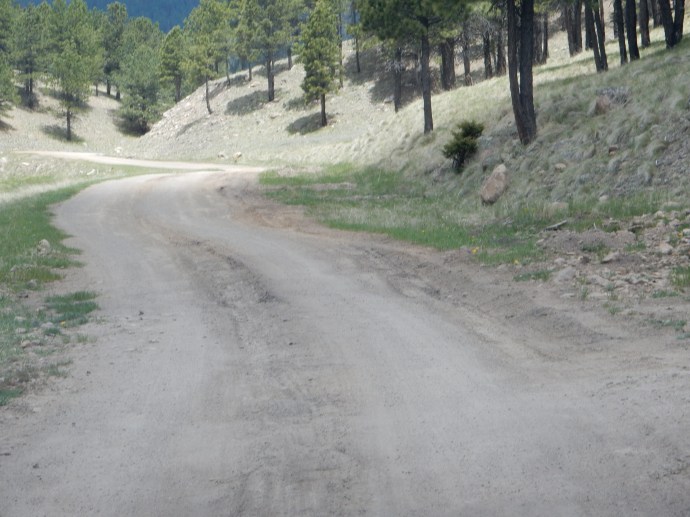
Today we visited Capulin Volcano National Monument, east of Raton near the Colorado border, and discovered that New Mexico has more volcanoes than any other U.S. state. We were quite surprised; it certainly would not have been our guess. We would probably have placed it around 10th. The volcanoes are inactive but as one can see driving along I-25 in northern NM, volcano cones are quite evident. In addition, many of the mesas and uplands in this area are the result of various types of lava flows or volcanoes.

Lava boulders near Capulin

Lava boulders near Capulin

Capullin formed somewhere around 60,000 years ago. It is part of the Raton-Clayton volcano field,some 8,000 square miles in northeast New Mexico. It is a classic cone volcano, where eruptions spewed gas and lava up through a vent in the earth. The debris falls back to earth in a cone shape around the vent. At Capulin, lava also flowed from around its base, creating a stable foundation. Lava flowed for miles all around the cone, eventually covering 16 square miles. Vegetation later took hold on the slopes as time and erosion broke down the cinders and boulders into soil. Small wildflowers were growing along the paths.

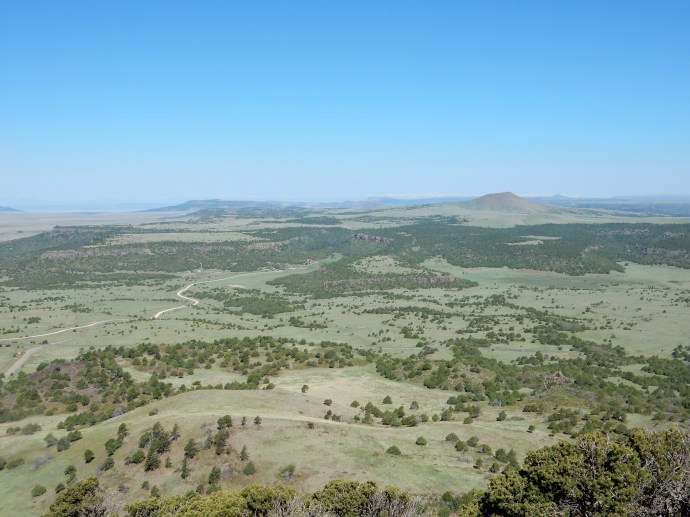
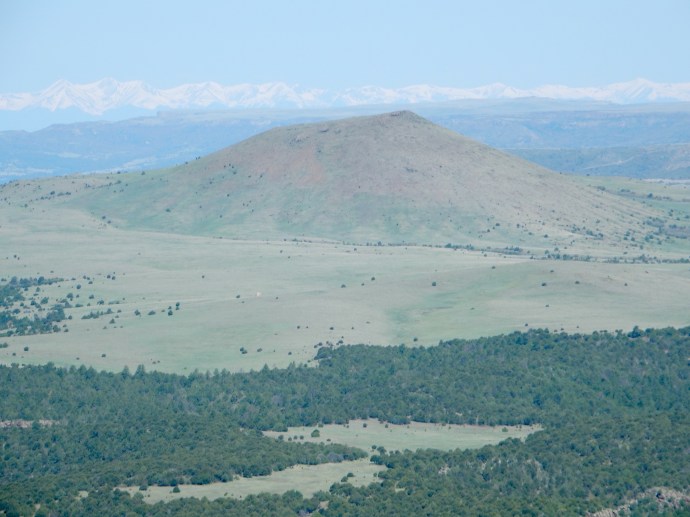
View looking at other volcanoes and lava flow ridges, etc. from Capulin Volcano

View looking at other volcanoes and lava flow ridges, etc. from Capulin Volcano

The National Monument was created to preserve this classical example of a cone volcano. We went on three hikes here. The first was around the lava flow at the base of the volcano. The hike had only minor hills to climb, but the footing on the lava and cinder rocks was a challenge.
A view from the rim walk on Capullin

A view from the rim walk on Capullin

Chris along the rim walk

Chris along the rim walk

The visitor center is at an elevation of 7,242 feet. There is a road leading up, stopping at a parking area at 7,877 feet above sea level. Then you hike up (and down) 305 more feet along a mile long loop trail aroound the rim. The views are fantastic. Today it was windy (we took our hats off for about one half of the walk so they would not blow away) and the temperature at 9 AM was about 70 degrees F. I did experience a bit of vertigo. The path starts out right along the cliff edge but it is paved so that helped me to keep my footing. Later on, it widens out. In the distance are other volcanoes; Sierra Grande is the highest at 1,000 feet above Capulin. The third hike was only half a mile, descending another 105 feet into the crater vent.

Looking west toward snow capped mountains

Looking west toward snow capped mountains

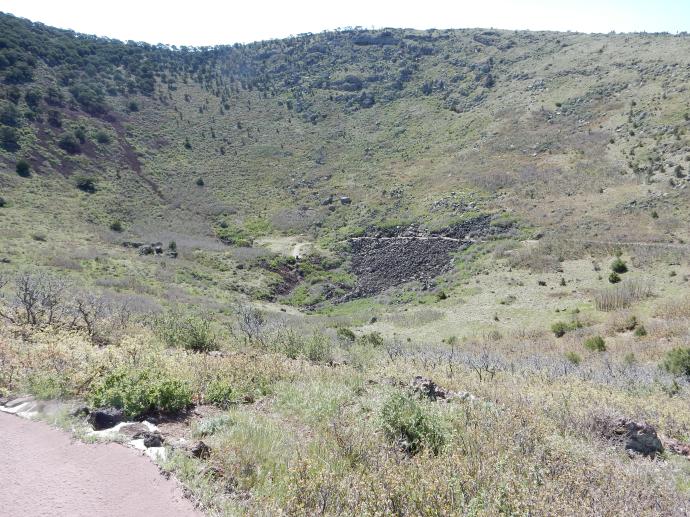
Looking into the vent at Capulin Volcano

Looking into the vent at Capulin Volcano

Before and after the volcano hikes, we took two snack and water breaks. Our lodging, the Budget Host in Raton, was better than I had expected but the continental breakfast did not have many options that appealed to me (other than cold milk). And as it turned out, there was no lunch break today, only another snack. The small towns we went through are devoid of food options.

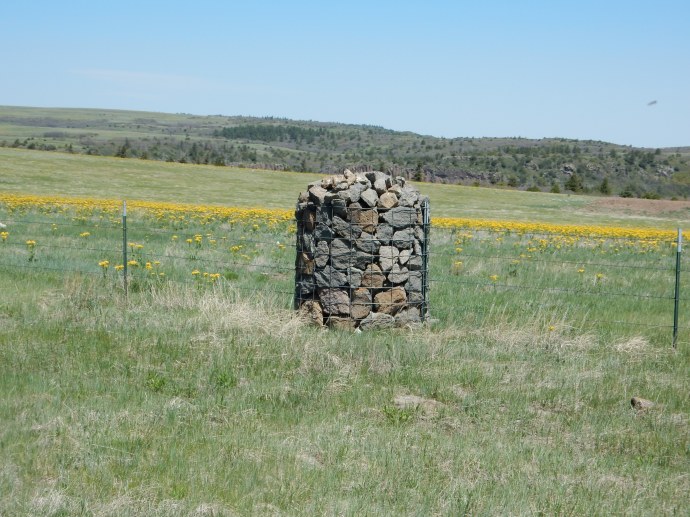
On Johnson mesa, numerous fence posts are made from stones

On Johnson mesa, numerous fence posts are made from stones

Our next stop was Sugarite Canyon State Park and we drove back roads on top of the mesa to reach it. Pronghorn, cattle and horses were in frequent view. We stopped at a little back roads church that had been thriving during the mining days. Today, cattle ranches surround it and the local churches try to take turns holding services in it throughout the summer. The doors were supposed to be unlocked 24/7 but we were unable to get them open. Birds loved the church though, there were numerous bird nests along the outside roof line.

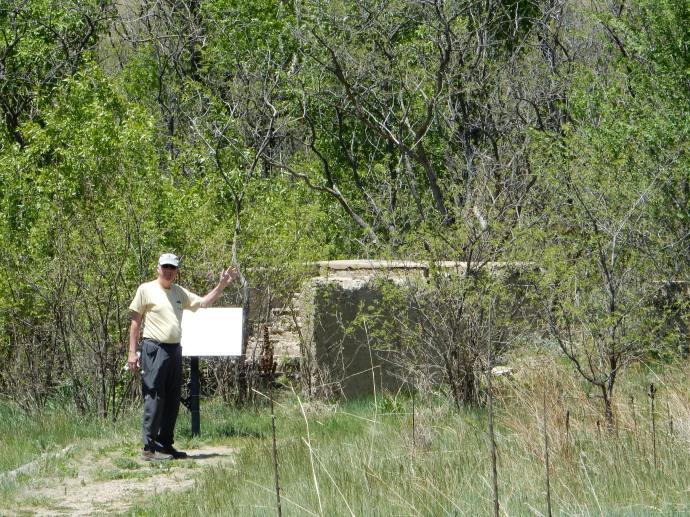
Ed inspecting ruins at Sugarite Canyon State Park

Ed inspecting ruins at Sugarite Canyon State Park

Sugarite Canyon State Park is nestled up against the Coloado border, just a few miles from Raton. Over time at Sugarite, two levels of peat were laid down from time when the central US was a sea. The peat hardened and became coal. Those coal layers were covered by basalt and sandstone from land uplift and volcanic action. The coal layers are quite thick.

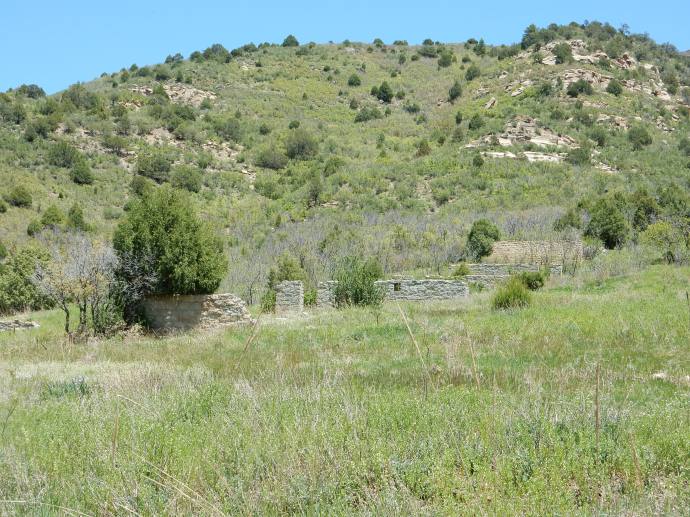
More ruins from Sugarite Canyon coal company town

More ruins from Sugarite Canyon coal company town

From 1912 to 1941, Sugarite was a company coal town run by the St. Louis, Rocky Mountain and Pacific Railroad. Between 400 and 1,000 people lived here and mined coal. The mines closed and a state reclamation project has stabilized the slag beds and now a park is situated in this canyon.

The company town was built on the slopes of the canyon below the coal mines. Only the foundations are left, but the one mile trail up the side of the canyon has markers and displays at various sites, highlighting the buildings which stood there decades ago. The park also includes several lakes that had been created to provide water for the City of Raton and for the Santa Fe railroad. Mines in the area are closed and company towns demolished. This park and its hike provided room for the imagination to visualize the scene when it was lively.

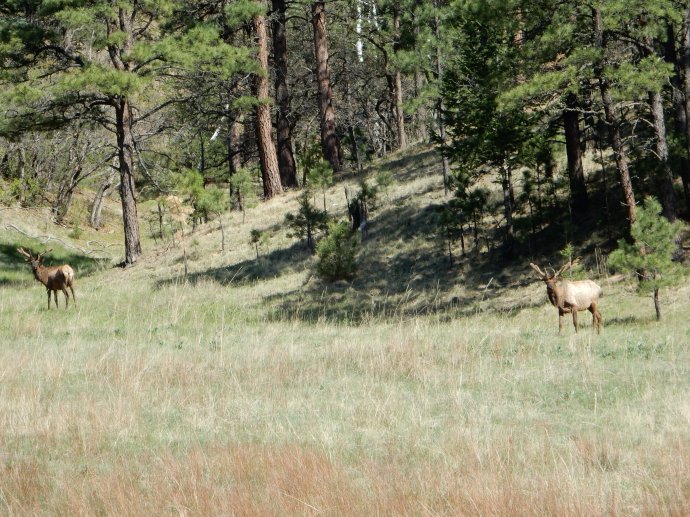
Elk along our drive to find Ted Turner's "farm"

Elk along our drive to find Ted Turner’s “farm”

A view along our drive to see a portion of Vermejo  Park Ranch

A view along our drive to see a portion of Vermejo Park Ranch

When we left the park, we returned to Raton and stopped for ice cream at Patchwork Phoenix. The proprietors mentioned a drive into the mountains that might have elk, bear, and deer visible. The road is along part of the property owned by Vermejo Park Ranch. This ranch is owned by Ted Turner and is considered the largest privately owned continuous property in the US. The ranch focuses on various ecological and animal preservation efforts. It also offers lodging at various properties. At Casa Grande, you can have exclusive use of the lodge, with meals, for 8 guests for about $5,000 per night. Needless to say, this information is from their web site, not from personal experience. In any event, we took a 30 mile ride down a state road bordering part of the property and only saw two elk.

Dinner was back (we ate there last night) at Mulligans, the restaurant at the Best Western Plus, the “only full service hotel” in Raton. Food was good with decent menu options. Thursday we head back to Santa Fe.

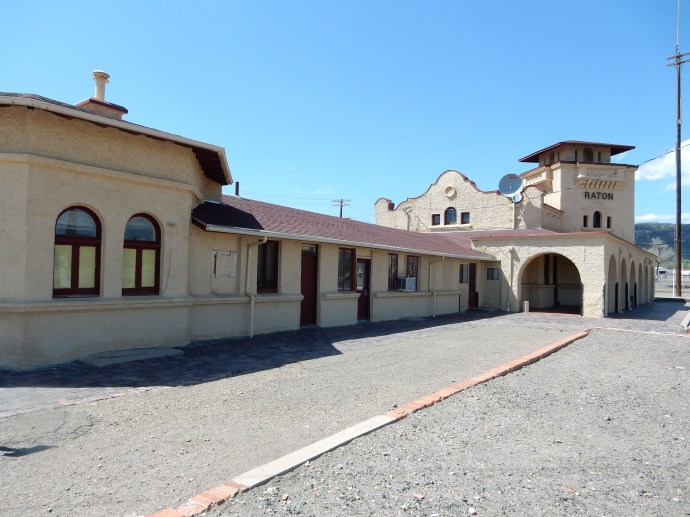
Amtrak station in Raton NM

Amtrak station in Raton NM

Ed and Chris

Categories: road trip, travel | Tags: , , , | Leave a comment

2016 Trip Four, Southwest Discoveries, May 24

Raton, NM. 5/24/16

The Distribution Hub of a Young America. That is one description of Fort Union National Monument.

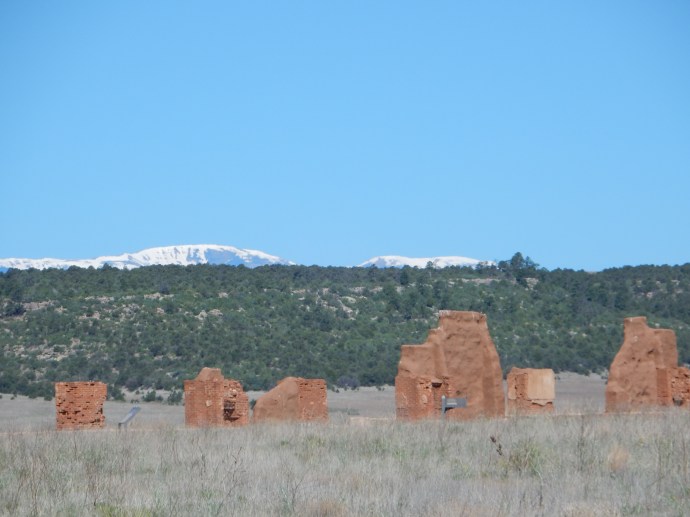
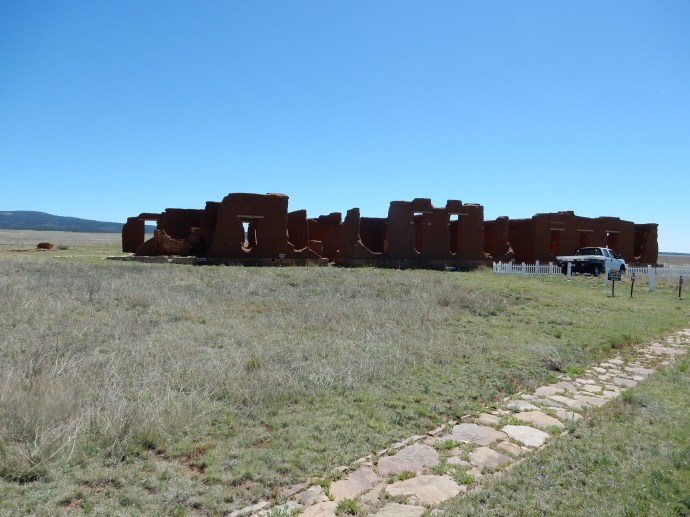
Fort Union National Monument, NM

Fort Union National Monument, NM

We are on a two night, three-day swing through northeastern and north central New Mexico. Fort Union is one hundred miles northeast of Santa Fe by interstate. For once, we were happy to leave behind two lane roads at 45-60 m.p.h.and zip along at 75 mph. We are still in mountains, the elevation is usually somewhere between 6 and 7,000 feet above sea level. Once again, the terrain changes. Santa Fe scrub brush and small pines changes to full-grown trees east of Santa Fe in the mountains to change again to wide, grassy fields good for feeding cattle and horses. There is probably 50 times as many cattle and horses in the fields here compared to northwestern NM. The fields just look much richer, not grassy fields like the Midwest, but still fuller than previously.

Another view of Fort Union

Another view of Fort Union

Fort Union is a preserved, but not restored, Army post dating from 1851 to 1891. It is located at the confluence of two branches of the Santa Fe Trail. The mountain branch went over the extremely difficult to cross Raton pass which was desirable for its safety from Indians and better water supply. The Cimarron branch had water shortages and Indian raids but was shorter. Both routes had heavy traffic once Mexico opened the area for settlement after its independence from Spain. When the US won the area in the Mexican-American War, oxcart traffic and settlers increased tremendously. The US Army was charged with protecting them.

Walls of the storehouse area of Fort Union

Walls of the storehouse area of Fort Union

During the Civil War, Fort Union troops helped to repulse Confederate attempts to control the Colorado and California gold fields. After the Civil War, until the railroads finished their lines into Santa Fe and Albuquerque, Fort Union once again protected the settlers and wagon trains. Wagon trains that might be lined up three or four wagons abreast as they traveled along the Santa Fe Trail had to merge into one line as they reached the fort where they had to be inspected and registered before proceeding on to Santa Fe.

Hospital at Fort Union

Hospital at Fort Union

But Fort Union was more than just a military post protecting against Indian attacks. It served as the quartermaster supplying 23 Western forts with materials. Fort Union was the largest military post in the 1800s Southwest frontier. The fort was clearly divided into two separate compounds (post and quartermaster), each controlled by its own military command. It had a 24 bed hospital that served civilians and military.

The fort influenced the local area. Supply depot work had been done in Santa Fe previously but now this area out on the high prairie was growing food for the people and animals stationed at the fort, or traveling through to Santa Fe. While the fort boomed, farmers had a ready market for their crops and hundreds of civilians worked on wagon repairs, laundry, blacksmithing, clerical functions for the quartermaster, etc.

When abandoned in 1891, the fort was just left to sit. Over time, residents of the area raided the fort for building materials, etc. It was not until 1954 that it was made a national monument. The act creating the monument specifies that the NPS is to preserve but not restore the fort. Our visit took us around the two compounds where displays and building foundations give a feel for the immensity of the operation here 140 years ago.

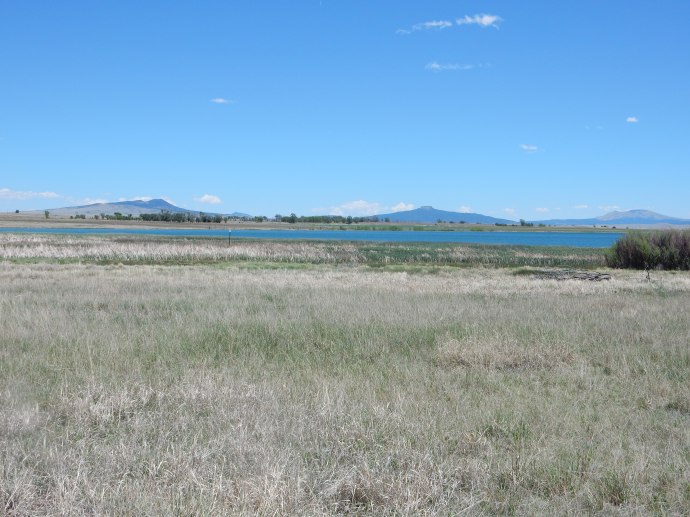
View from picnic table at Maxwell National Wildlfie Refuge

View from picnic table at Maxwell National Wildlfie Refuge

Maxwell National Wildlife Refuge was our second stop and a bust. The visitor center was not open (it was supposed to be open) and few trails were listed for hiking. We had a picnic lunch and moved on. Raton was just 30 miles away and I was afraid we would be bored for the remainder of the afternoon.

Maxwell National Wildlfie Refuge

Maxwell National Wildlfie Refuge

I wanted to stop at McDonald’s for a Coke and fries. Chris was not ready for food. We agreed on a compromise, the Raton Museum. It seemed like a typical small town museum, with collections of various local related topics. It would have been ho-hum and a 10 minute visit except for the Collections Steward who gave us a personal hour-long tour of the museum with a narrative that was both insightful and detailed.

A few items that we learned are:
A. Raton was founded due to the Atchison, Topeka and Santa Fe need for a rail yard after its trains went over (or before they went over) the 7800 foot above sea level Raton Pass.
B. The area is rich in coal. While no mining occurs now, the coal supply here could be mined yet for hundreds of years. Mining, in company owned towns, made and broke several towns in the region.
C. One of those company towns, Dawson, was owned by Phelps Dodge who recruited new immigrants fresh off the boat. Two major accidents here killed 263 in 1913 and 123 killed in 1923. Dawson is now a ghost town, the company razed the buildings.
D. Raton used to have 12,000 people. Now it has 6,000. The closing of the mines, the closing of the rail yards, the closing of ARF Electronics, etc. had left the town in difficult shape. Over 800 homes are for sale.
E. The Amtrak station here is the busiest in the state, due primarily to the Philmont Boy Scout camp located west of town by Cimarron. Many of the 22,000 scouts who come here in the summer arrive via Amtrak.
G. The Colfax county war went on for 13 years as people who had settled on land owned by Lucien Maxwell were being evicted as squatters despite what had been seen as an oral agreement to sell the land to the settlers in return for years of paying 50% of the crops to Maxwell. The Maxwell side eventually won.

We had a great time listening to the stories attached to the items on display. The Collections Steward made us realize the depth and color that lie behind many small towns. One can, and we have, jump to quick conclusions about a community based on a quick drive-through. No photographs were allowed, sorry.

Ed and Chris

Categories: road trip, travel | Tags: , , , , , | Leave a comment

2016 Trip Four, Southwest Discoveries, May 23

Santa Fe, NM. May 23 Monday

Petroglyphs again. On May 19, we wrote about the petroglyphs we observed along the historic trail just minutes from Jude’s house. Today, we drove an hour to Petroglyphs National Monument in Albuquerque where over 24,000 petroglyphs have been identified. Petroglyphs National Monument was created in 1990 to preserve 12 square miles of land on the west mesa across the Rio Grande River in Albuquerque that was facing immediate development pressure. Previous efforts had created a state park, but the area preserved was not inclusive enough. Five years of furious research prepared the way for the national monument status. Today, the eastern and northern ends of the monument are surrounded by urban development.
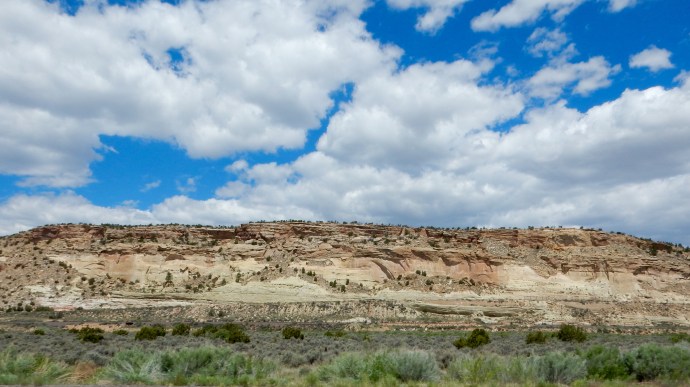
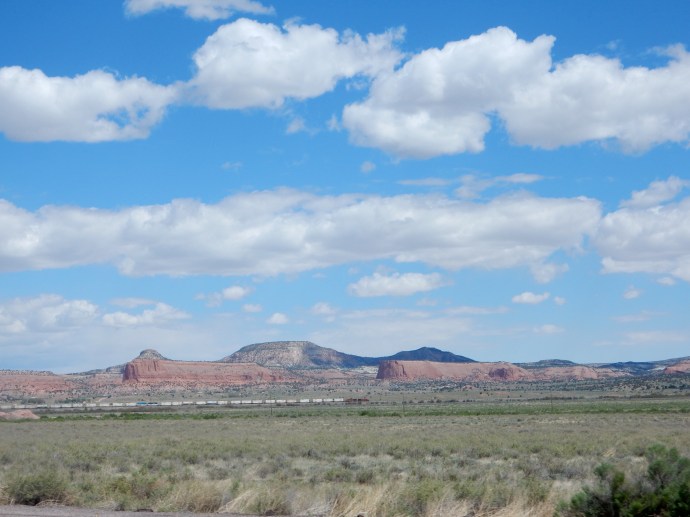
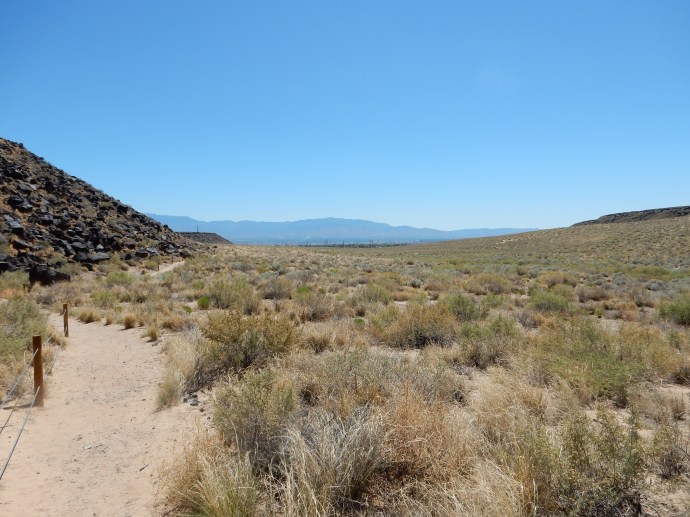
From the back of Rinconada Canyon looking east to Albuquerque, escarpments to left and right, Sandia Mountains in background

From the back of Rinconada Canyon looking east to Albuquerque, escarpments to left and right, Sandia Mountains in background

To understand why the petroglyphs are here, one first needs to understand a bit of geology. I will make it brief and very concise (recognize we are talking about actions over millions of years). First, the subsidence of land created the Rio Grande Rift, a thirty mile wide valley extending 500 miles from Mexico up into Colorado. Second, land uplift created the Sandia Mountains along the east edge of the rift. Third, six volcanoes in the middle of the rift in the Albuquerque area spewed out enough lava to create a 17 mile escarpment of very hard basalt rock. Fourth, the Rio Grande River created a source of irrigation and a natural migration path for human activity from Colorado to Mexico.

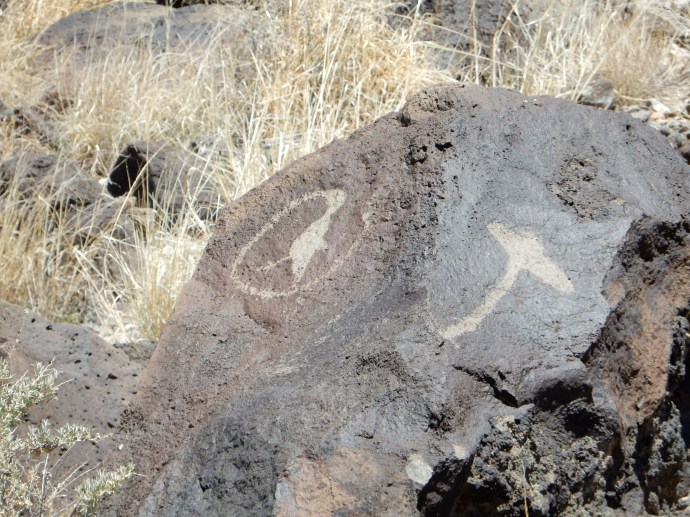
One of many petroglyphs

One of many petroglyphs

The basalt escarpment is close to the Rio Grande River, and as humans have traveled along the river they had this urge to leave a message for following generations carved into the basalt rock. The surface rock was chipped away, leaving a gray symbol on the black rock. These symbols are sometimes recognizable and other times not so much. Some of the symbols date from the 1600s since sheep are shown, an animal not native to the U.S. Most pre-date the Spanish arrival, estimated to go back as far as 1000 BCE.

The Monument has four major visiting areas. We went to two of them. At Rinconada Canyon we hiked out,and back, 1.2 miles along the escarpment to view numerous petroglyphs carved into the rock. Many are still very clear from the trail. In general, we were not able to get as close to the petroglyphs as we did last week here along La Cienguilla trail. Rinconada Canyon gives a clear view across the valley to the Sandia Mountains and to Albuquerque. The river is a minimum of two miles from the escarpment; the land in between was cultivated for crops.

Two of the volcanoes

Two of the volcanoes

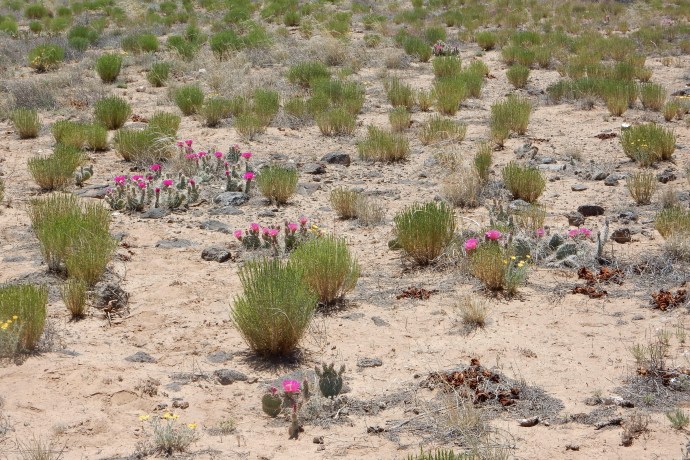
After Rinconda we drove over to the west side of the monument and viewed the volcanoes area. The separate volcanoes stand out along the flat mesa. Chris and I hiked out to JA Volcano but were prevented from climbing to the summit due to trail restoration work (which was not noted until you were just ready to start the climb up). Along the way, desert flowers were blooming; a mix of yellow, white, pink and orange. Not as profuse or vibrant as summer wildflower in the mountains, but still amazing to view.

A view of desert flowers

A view of desert flowers

The volcano top is clearly rimmed by black rock. The flat mesa up here is basically the top of the escarpment of which we were earlier walking along the bottom at Rinconada Canyon. The view of Albuquerque was even better up here. After a picnic lunch, we headed out to our second stop.

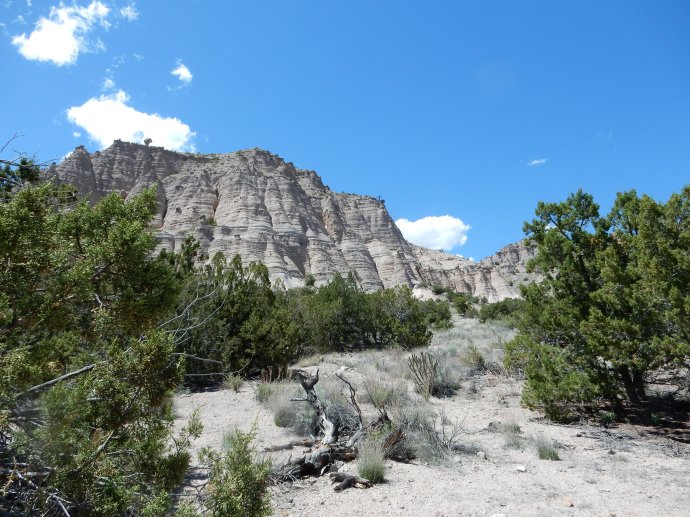
White cliffs of Kasha-Kutuwe

White cliffs of Kasha-Kutuwe

Kasha-Kutuwe

Kasha-Kutuwe

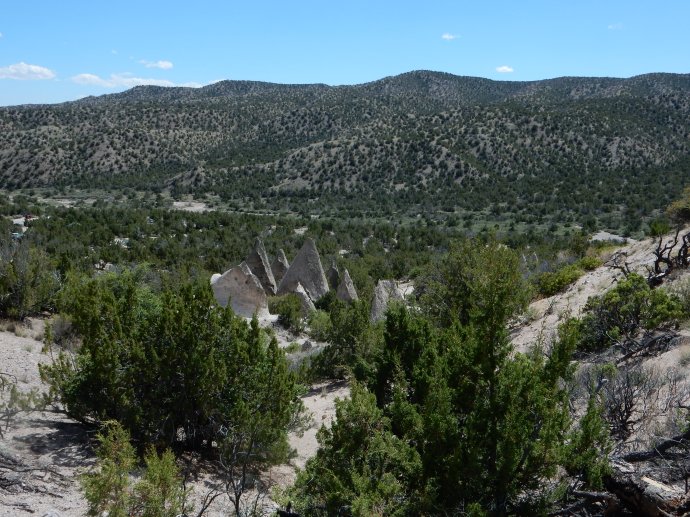
Kasha-Katuwe, or Tent Rocks, is a National Monument managed by the Bureau of Land Management. This was not our first time here, we had been here with Jude many years ago but wanted to stop in one more time. “Kasha-Katuwe” means “white cliffs” in the traditional language of the pueblo. It has been a national monument since 2001.
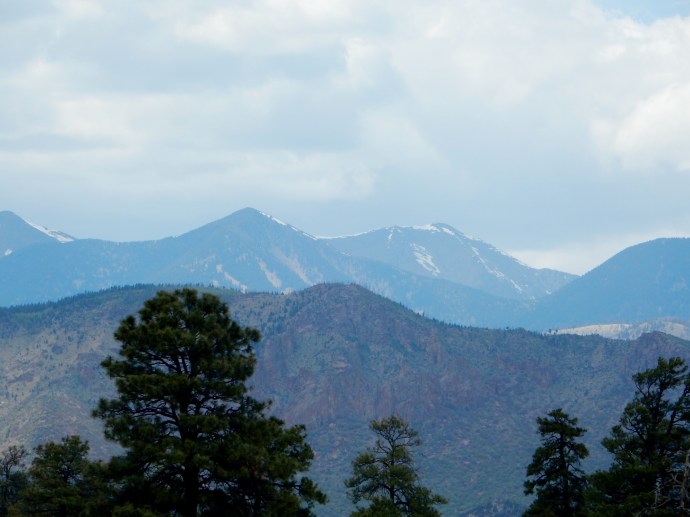
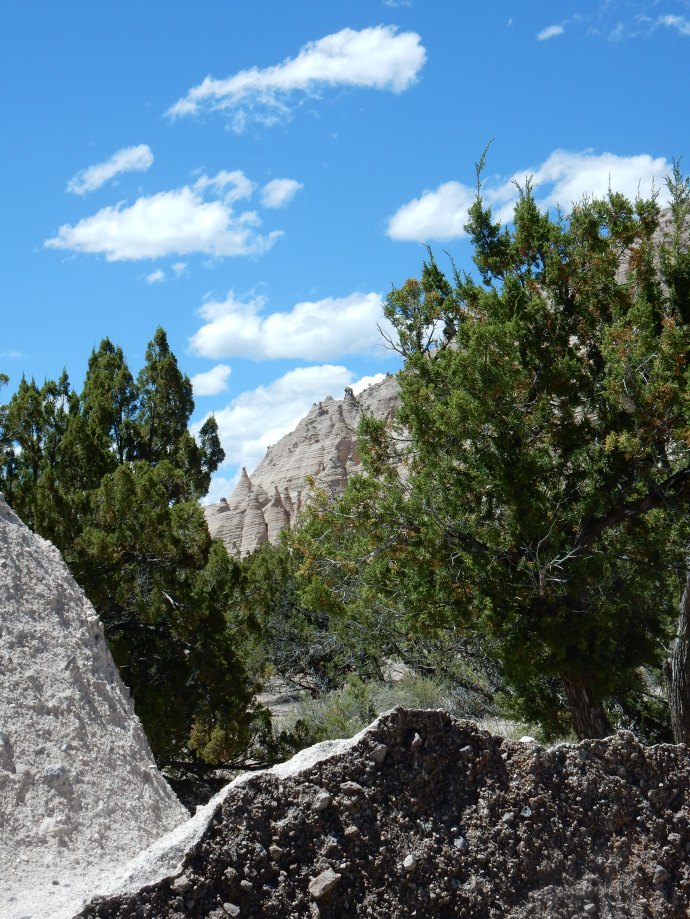
Tent rocks-showing why the area was named that by Anglos.

Tent rocks-showing why the area was named that by Anglos.

Explosions from the Jemez volcanic field, shaped by wind and water, have created slot canyons, hoodoos topped by cap rocks, and steep cliffs. We did another hour hike here and talked to two guys from Amarillo TX who took our photo in one of the slot canyons. Another group included a woman from Minnesota now living in Honduras.

Ed and Chris in slot canyon at Kasha-Katuwe (tent rocks)

Ed and Chris in slot canyon at Kasha-Katuwe (tent rocks)

Ed and Chris. May 23

Categories: road trip, travel | Tags: , , , | Leave a comment

Blog at WordPress.com.