road trip

2017 Trip Two: Tour of Texas March 4 Part 2, and March 5

Topeka, KS. Sunday March 5

Part 2 of March 4 (Part 1 of March 4 focused solely on sandhill cranes. This post discusses the rest of Saturday.)

Saturday was more than cranes. We kidded each other that Saturday was birds and bombs. The sunrise crane watch ended around 7:30. We drove the 30 miles back to the hotel for breakfast before heading out again. Our first stop was Hastings, NE, home to the Hastings Museum. This museum was rated as a “Gem” by AAA. The couple we met leaving the lunch at Southeast Community College on Thursday had also recommended another place to see in Hastings as well as a great lunch place so we had several stops planned for Hastings.

Hastings is 50 miles from Kearney and the first 10 miles of our route took us through the corn fields used by the sandhill cranes to feed while laying over on the Platte River. Birds were crowded in many fields, flocks flying to and from fields were crowding the sky.

The Hastings Museum was the creation of Albert Brookings (1880-1946) who was a collector from his youth. The Museum officially dates back to 1926 and has been a collaboration with the City of Hastings which supports it to this day. The museum in its early days moved from excess building to excess building, usually school buildings.

Inside the museum are collections of: dioramas showcasing animals of North America, Plains Indians exhibits, early autos and late-model buggies, information about European immigrants to Nebraska, firearms, and the creatures and the time period when this part of the United States was covered by an inland sea. There is a planetarium and large screen movie theater (similar to IMAX). Finally there is a special exhibit focused on Kool-Aid.

Part of the Kool-Aid exhibit at the Hastings Museum

Kool-Aid was an invention of Edwin Perkins while he was living in Hastings. The Perkins family ran a grocery and distribution business in Hensley NE. Edwin moved to Hastings and began inventing products, selling a brand of items called Onor-Maid which I relate to Watkins products. He was quite successful. His most successful invention was Kool-Aid which was first manufactured in Hastings in 1927. It proved extremely successful. Eventually Perkins moved the factory and company to Chicago but maintained his roots to Hastings. The exhibit does an excellent job presenting the family history, his business endeavors, and the development and marketing of Kool-Aid.
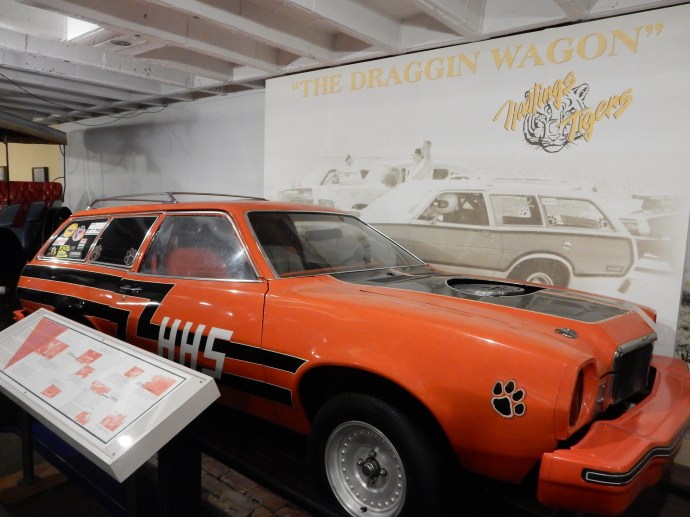
The Hastings High School exhibit at the Hastings Museum

I am sure each person who visits here has their own particular memory. Some of the items that resonate with us included the fact that Cliff notes, that college staple, was created by a Nebraskan, Cliff Hillegas. The Hastings High School had a program in drag racing, where over the years students worked on car repairs. Some of those 240 cars were used in drag racing, at the local raceway; others were re-sold or used by the local Fire Department for “Jaws of Life” practice. We also learned that Sears Roebuck sold automobiles from 1905-1911.

One exhibit had a section on notable Hastings and Nebraska people. Notable in this regard is less newspaper famous and more notable in their accomplishments as a member of their local community. First female dentist or notable business person are examples. Another tid-bit of American history was presented through the story of a Japanese man who had been interned in camps during WWII. As he grew up, he matured and fell in love with a local woman. Unfortunately Nebraska had until 1963 a mixed marriage law. A white person could not marry a person who had one-eight or more or Negro, Chinese,or Japanese blood. The couple had to get married in Kansas but fought to have the law overturned, being successful in 1963.

We were impressed with the museum and the accuracy of the exhibits. For instance, the information and sensitivity to the Plains Indians and the impact by the arrival of European immigrants was accurate and culturally sensitive. The information did not appear to be recently added which made the sensitivity more remarkable. We have been to numerous museums around the country and this museum rates very highly, particularly when you consider this museum is financed by a community of about 25,000.

For lunch, we went to the Back Alley Bakery in downtown Hastings. This small cafe served an excellent strata which both of us enjoyed. We did not have room for any of the excellent appearing desserts.

In the afternoon, we drove around one of the nation’s most significant naval landmarks. Yes, a naval landmark in Kansas, 900 miles from the nearest ocean. The Naval Ammunition Depot in Hastings produced 40% of the US WWII munitions for the navy, including bombs, rockets, torpedoes, mines, etc.

The depot was located here, far inland where it would not be subject to enemy attack by ship or plane. Three major railroad lines could ship the product easily. Over 200 properties were condemned to build 2200 buildings on 48,000 acres of land with all of the related roads, railroad tracks, water, sewer, electrical and gas lines, etc. 10,000 workers doubled the pre-war population of Hastings. The facility did have one major explosion that killed nine people and was heard 100 miles away in Lincoln.

Just a few of the ammunition storage vaults at the Hastings Naval Depot.

The depot was decommissioned in 1996. Today parts of the facility ae used for a community college, a golf course, National Guard training, and industrial facilities. However, there are still numerous facilities still in evidence. Hundreds of concrete bunkers that had been used for explosives storage are lined up in rows. Over 1,000 ammunition vaults can be seen as you drive along the roads.

Thus came our motto for the day, birds to bombs.

Sunday March 5

A close-up of Sandhill Cranes feeding in fields south of the Platte River

A view of prairie preserve near Red Cloud NE
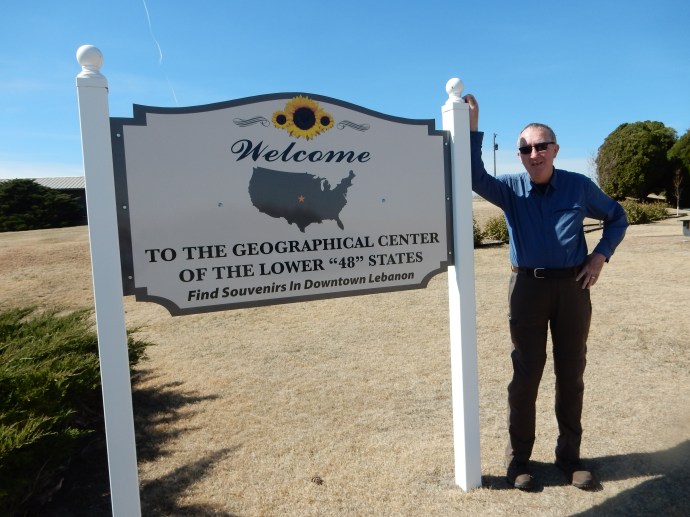
The geographical center of the 48 contiguous U.S. states

After church and breakfast, we left for our next destination, Topeka Kansas. No interstate today, it was two lane roads through farming country. The first portion of the day passed through the traditional flat corn and grain raising fields; frequently populated by sandhill cranes feeding on left over corn. As we drove further south, the land became less flat with rolling hills. Just south of the Nebraska-Kansas state line, we made a quick stop at the “Geographical Center for the Lower 48 States”. This location in the middle of agriculture is marked by a small chapel, a U.S. flag, a picnic table, and two markers.

The world’s largest ball of twine in Cawker City, Kansas

As we continued through Kansas, our next stop was unplanned. In Cawker City, we stopped at the “largest Ball of Twine”. Now, you have to understand, we thought we had already seen the largest ball of twine back in Darwin MN. Well, according to Roadside America, there is quite the competition between the two. Evidently, the one here in Cawker City is larger, but, it was rolled by several people. The original largest ball of twine in Darwin MN was accumulated by one man. When he died, the Darwin ball surpassed the Cawker City ball of twine. The people in Cawker City decided they would continue the process and added more twine to their ball. The Darwin people decided to be purists; to this day, the ball of twine in Darwin is the “Largest Ball of Twine Made by One Person”. The Cawker City ball of twine is the largest but made by numerous people.

Now, there is still another controversy. The Cawker City ball of twine is so large, it can no longer be lifted up easy enough to allow the twine to be added on all sides. New twine is only added to the top and sides. Soon it will no longer be circular. Can it still be a “ball” of twine if it is not round?

Our route to Topeka took us through Manhattan Kansas, home to the Flint Hills Discovery Center. The Center partially focuses on the Flint Hills, partially serves as a children’s hands-on learning center. We came here to learn more about the Flint Hills. The Flint Hills are a region in Kansas and northern Oklahoma distinguished by its rocky hills. This area was the site of an inland sea millions of years ago.
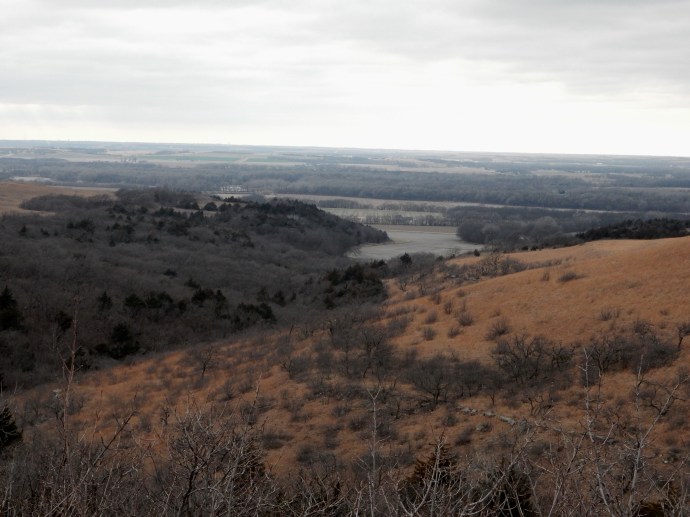
A view of the Flint Hills area in Kansas, showing the taller hills than were present at the prairie near Red Cloud NE

In the Flint Hills, the limestone soil is interlaced with flint rocks which erode more slowly. The result has been an area with land being taller and rockier than the rest of Kansas. Rockier soil meant the European settlers were unable to till the soil. The result means more cattle farming and less grain crops. In this rocky area, the prairie grass roots have to maneuver through cracks in the rocks and flint. The water source is beneath the rock layer and thus the roots are deeper into the ground than the eight foot height of the grass above the ground.

The Discovery Center was impressive but given the heavy emphasis on children’s learning, we did not spend a long time here.

Sunday and Monday nights we will be staying with an Evergreen host couple in Topeka.

Ed and Chris. March 6. Topeka KS

Categories: road trip, travel | Tags: , , , , , , , | 2 Comments

2017 Trip Two: Tour of Texas March 4, Part 1

Kearney, NE March 4. Saturday

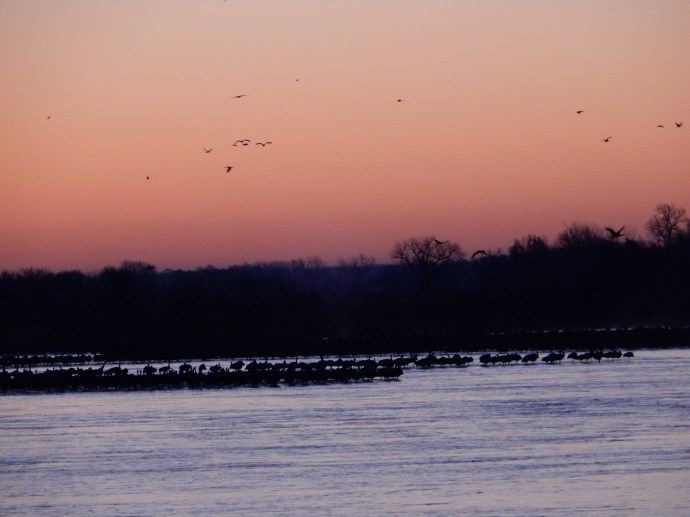
Sunrise on the Platte River from the Crane Trust blind

Sunrise on the Platte River from the Crane Trust blind

We stumbled through the dark at 5:15 AM, trying not to trip on the person ahead of us. 18 of us, bundled up, hoping to see, and hear, large numbers of sandhill cranes. Most people were in dark jackets which would have been great if they were trying to be a cat burglar. But as they blended in to the early morning gloom, it was difficult to see them. Our destination was a blind, a wooden structure with windows overlooking the largest roost of sandhill cranes along the Platte River. We parked our cars about a block away. We were told it was critical to be quiet and to not use cell phones for calling or lighting the way. Our leader had a small, red colored flashlight to slightly show the way. But towards the back of the line, the red light of the guide only indicated in a general sense where we were headed.


Morning video at Crane Trust

We made it to the blind without any major incidents and sat down, after fumbling around in the dark to find the benches. Now the waiting began, until enough light appeared to see the cranes. We heard them first, a cacophony of bird calls that increased and decreased spasmodically. Besides the cranes, we could hear ducks and song bird type calls. The sound level increased as the light increased. Eventually there was enough pre-dawn light to begin taking photos. I waited to shoot until at least two other people began taking photos; I did not want to be the first and then discover I made some noise that would alert the cranes to our presence.

Sunrise on the Platte River

Sunrise on the Platte River

My first photo was taken at 6:20 AM and the last at 7:25. The light was colorful but still not enough to do a good panoramic shot showing the full roost. Most of the birds were still, not a lot of preening and dancing. Around 7 AM, birds started flying around, not necessarily leaving the roost to feed but just flying around the river. Chris and I took turns with the camera and the iPhone. Some people had their 35 mm cameras with zoom lenses; you will not see those close-up shots from what we have.

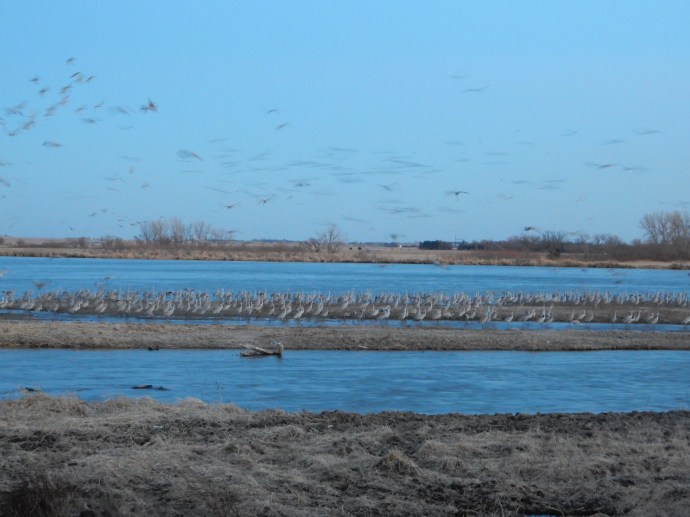
It was a great experience. The Crane Trust says about 200,000 cranes are in the area at the current time. As we returned to our hotel, a 30 minute drive from the Crane Trust offices, we started seeing flocks of cranes, from 5 to maybe 100 birds in a group, flying from the river area and landing in fields along I-80 to feed. Heck, they woke up hours after we did and got to have breakfast well before we did. Not fair.

We returned to the blind for the evening, sunset crane watch. We had signed up (in early January) for both sunrise and sunset out of concern that the weather would not be conducive for at least one of them. Frankly I was concerned that both of them would wash out, either due to weather or lack of birds. The sunset crane watch was even more spectacular than the sunrise.

Sunrise was about 30 degrees and we had to wait an hour before we saw anything. Sunset temperature ranged between 71 and 61 degrees Fahrenheit, some birds were already present, and at the end, a huge throng of cranes roost less than 150 feet from the blind. There were more people, but not enough more to degrade the experience. Since we already had pictures, we could relax a bit more and enjoy just watching and listening.

Evening sandhill crane watch on the Platte River

Evening sandhill crane watch on the Platte River

The blind faces roughly southeast and the Platte River runs from the right (west) to the left (east). The sandhill cranes seemed to return primarily on a route that brought them in along the course of the river, they gathered in the air at a spot to our left front-but still a distance away, then seemed to congregate on land or a sandbar in a combined slow glide, helicopter fashion. Groups of 5 to 100 would mesh into this big group, circle around a bit-sort of like a whirlpool or eddy, and then slowly drop down. Every now and then a small group would come across land. This group would head to the west, get towards the end of a larger group, and make a slow turn similar to a cloverleaf exit ramp to a highway, and then become part of the larger river group. It was fascinating.

Sandhill cranes land close to us

Sandhill cranes land close to us

We had to use binoculars to watch individual cranes. Our cameras were not powerful enough to shoot images as the cranes landed and roost across the river. As the afternoon faded, more and more groups kept arriving. The sound of their calls kept increasing. As the light was almost gone, a large flock, maybe several thousand, started landing on a sandbar less than 150 feet in front of us. Our guide later said he had never seen them come this close to the blind before. You could hear the camera shutters click away constantly. Unfortunately, one of our group had a flash go off and 95% of the cranes rose almost instantaneously and flew off. (Using a flash in a big no-no. I even had electrical tape over my flash to make sure it stayed off.) Over the next 10-15 minutes, some of them returned but most were circling around trying to decide if they were returning or roosting somewhere else. We left shortly afterward since it was too dark to see and certainly too dark to shoot photos.

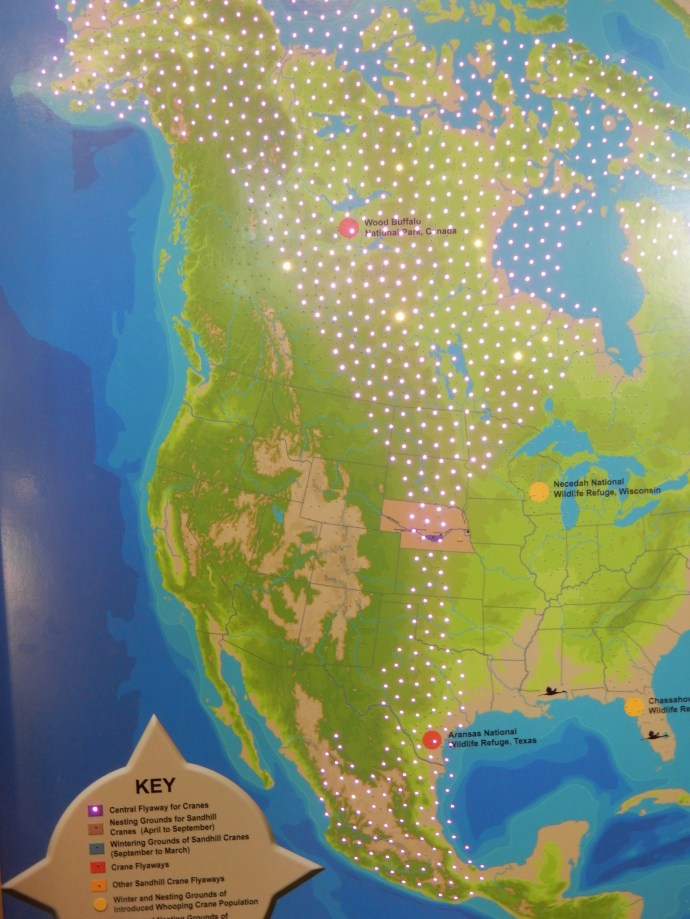
Crane migration path showing the pinch point on the Platte River

Crane migration path showing the pinch point on the Platte River

This was a once in a lifetime experience. We are glad we decided to go and lucky that the weather and birds cooperated. The migration here is of critical importance. The picture demonstrates the migration pattern of not only sandhill cranes, but whooping cranes, Monarch butterflies, and numerous other migratory birds and waterfowl. For the sandhill cranes, this is a stopping point where they eat and add 15-20% of their body weight. Without this stop, they would not have enough food and energy to make it to their summer breeding grounds.


Evening video at Crane Trust

However, the addition of over 20 dams along the Platte has reduced its volume by 80% and changed its hydraulics so that it no longer scours the shore. The dams provide for recreation, irrigation and drinking water, and hydro power. The impact for the birds is dramatic. THe picture below demonstrates the migration path and how it narrows here at the Platte River. If this one small, pinch point becomes eliminated, the migration path is destroyed.

The pinch point is only about 20 miles wide. Every Monday, a plane flies between Odessa and Overton Nebraska. One man in the plane is responsible for counting the number of cranes in the area covered by his fist, then he counts the number of fists that it takes to cover the sea of cranes below. This provides the first rough estimate. The more detailed count is provided by a person manually counting the cranes seen in the pictures taken by cameras in the plane as it flies along the river. Not a job I would want.

The Crane Trust was established to use human means to keep the Platte providing suitable habitat in this region. Environmental groups had sued when the Greylocks Dam was proposed on a tributary of the Platte. The judge allowed the dam but mandated the establishment of the trust to mitigate the dam’s impact.

Our day had other activites. We decided to make this fantastic crane adventure be part 1. We will complete a part 2 later of the other activities.

Ed and Chris. March 3 Saturday in Kearney NE

Categories: road trip, travel | Tags: , , , , | 3 Comments

2017 Trip Two: Tour of Texas March 3

Kearney NE. March 3, Friday

Wow. Another scrumptious meal from our Evergreen hosts. This could get addictive. After breakfast, we toured another uniquely Nebraskan facility, the Larsen Tractor Test and Power Museum. Not high on your list? Too bad, it was an informative look at the only agricultural tractor test site in the Western Hemisphere.

 A scene at the tractor Test Museum depicting two unrestored tractors

A scene at the tractor Test Museum depicting two unrestored tractors

Why here in Nebraska? Well, in 1918 Nebraska farmer W.F. Crozier bought a Minneapolis Ford tractor (not associated with the Ford Motor Company). The new tractor did not live up to its advertised claims. So he and Nebraska State Senator Charles Warner put into motion a bill to advance consumer protection; specifically protecting farmers by requiring that any tractor sold in the State of Nebraska must be tested and proved to meet its advertised claims of performance. Voila, thus was born the University of Nebraska Tractor Test Laboratory.

The tractor test track at University of Nebraska

The tractor test track at University of Nebraska

We had a tour of the facility by a retired professor, and dean, of the university who provided the background above and explained the various tractors on display. This facility has set the standard the world over and other countries abroad use the performance standards and testing measures to test their own tractors. Any tractor sold in the U.S.now will be first tested here on the test track with the equipment the lab has perfected. It will take about one week for each tractor to be tested. If the tractor does not pass, it will not be put on the market and has to go back to the manufacturer. And, the manufacturer can not just then lower the advertised claim of performance. The tractor has to be re-manufactured to meet the original professed standards.

A quilt by Pauline Burbridge

A quilt by Pauline Burbridge

From tractors we headed over to the International Quilt Study Center and Museum housed at the University of Nebraska-Lincoln. This museum is one that Chris has been hoping to visit for several years. Our tour focused on special exhibits. The first was a series of 12 quilts, more like artwork than household textiles, made by a British artist, Pauline Burbridge.

One of the award winning Japanese quilts

One of the award winning Japanese quilts

The second exhibit was from Japan, about 23 quilts by Japanese artists. The quilts are selected in Japan’s largest contest sponsored by the Japan Handicraft Instructors association. Neither Chris nor I quilt, but even we were impressed by the intricacy and detail obvious in the quilts exhibited.

Some of the Luke Haynes quilts

Some of the Luke Haynes quilts

The third exhibit was a group of 50 quilts by a Luke Haynes from New York. These quilts were displayed on and over a series of metal cubes created since the artist did not wish to have his work hanging on walls.

While all of the quilts were impressive, I guess overall we were disappointed not to see more of the 5000 plus quilts the Museum has in its archives. The museum follows strict protocol in storage and care of quilts lent for other displays. It also has quilts (I believe all but maybe only most of them.) available to be viewed online. Our recommendation would be to view them online where you can observe more of them and can do it at your leisure.

Our final stop at the University was at their dairy store. The University produces its own cheeses and ice cream and locals say it is the best. Of course, you hear that comment around any local creamery. We decided to test out the product, trying Karmel Kashew, Butter Brickle and Butter Pecan. The ice cream was good, worth the trip, but not outstanding. Maybe it would taste better when the weather was 20 or 30 degrees warmer.

Some sandhill cranes feeding in fields by the Platte River near Kearney NE

Some sandhill cranes feeding in fields by the Platte River near Kearney NE

We left Lincoln around 12:30 and headed out to Kearney NE-Sandhill Crane Capital of the World. More than 80 percent of the world’s sandhill crane population converges on the Platte River of Nebraska. Here they feed, gain weight, rest up, and prepare for their final journey to their summer breeding grounds in Alaska, Canada, Siberia and parts of the northern U.S. We hope to view hundreds of thousands of them tomorrow. We stopped at the Crane Trust headquarters and they indicated that the birds have arrived. We drove a few back roads to make sure.

A view of the Archway spanning Interstate 80

A view of the Archway spanning Interstate 80

Before checking in to our hotel, we stopped at The Archway, a tourist attraction spanning Interstate 80. This unique arch has a privately sponsored attraction providing a Reader’s Digest version of the westward expansion of the U.S.from the 1840s on. Displays, videos, and audio exhibits cover topics such as the early pioneers, Pony Express, the transcontinental railroad, the Lincoln Highway, etc. The tour consumed about an hour and is probably best for families with kids or people with just an overall understanding of US history. But, it got us out of our car and satisfied our curiosity as to what the heck was this thing crossing over the entire Interstate.

Ed and Chris. Kearney NE March 3

Categories: road trip, travel | Tags: , , , | Leave a comment

2017 Trip Two: Tour of Texas March 2

Lincoln, NE Thursday March 2

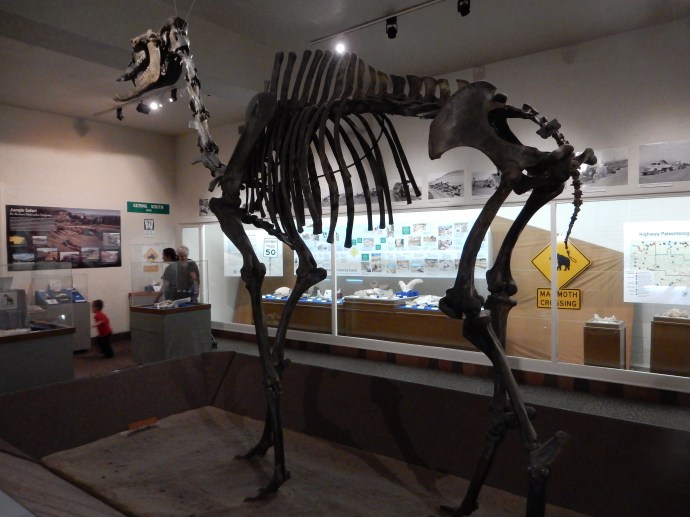
The camel skeleton at Morrill Hall at the University of Nebraska

The camel skeleton at Morrill Hall at the University of Nebraska

Who knew that camels originated in Nebraska? You doubt me? Well, the University of Nebraska State Museum in Morrill Hall at the campus says so and has a large display discussing how camels originated here and migrated elsewhere. Nebraska is evidently a major, major location for fossils. “Three floors of exhibits focus on the cultural diversity, biodiversity and paleontology of Nebraska. The museum houses one of the world’s best collections of elephant fossils, including one of the world’s largest mammoth skeletons.” (Per the AAA description)

Three of Todd Williams' Paintings the the Nebraska History Museum

Three of Todd Williams’ Paintings the the Nebraska History Museum

We had a blast at the museum. Actually it was the culmination of a very interesting day. We started out at the Nebraska History Museum. We only spent about 60-90 minutes here, but they were enjoyable. A new exhibit just opened up today. Over the last five years, the artist Todd Williams (from Nebraska) has painted 123 works of art, representing scenes from all 93 counties in Nebraska. The art includes portraits, landscapes, buildings, animals, etc. that cover the entire modern history of Nebraska. All scenes were realistic and, to my eye, extremely well done.

Kool Aid and Nebraska

Kool Aid and Nebraska

The second floor had an exhibit featuring items from their collection telling a story about a piece of Nebraska history. It might be a Kawasaki motorcycle since the first U.S.made Kawasaki was made in Nebraska. It might be a packet of Kool Aid since that product originated in Nebraska. It might be a Ku Klux Klan robe with the story of how the guy who wore it began a local Klan around 1990 and began harassing Jews. One Jewish family he called responded with kindness and compassion. Over a few years, the Klan member renounced the Klan, converted to Judaism, became ill and the Jewish family acted as his hospice service. It might have been a story about a Latino girl who picked sugar beets out in western Nebraska. The exhibits gave you a personal feel for the history of Nebraska and its people, not just a rote telling along a timeline.

After the Nebraska History Museum, we had lunch. Our Evergreen hosts had invited us to share with them lunch at Southeast Community College where the culinary students were preparing and serving the luncheon. Faith was our server, hoping to graduate this fall and to go into a bakery career. For the first course you chose between navy bean and ham soup or smoked duck salad. The main course options were carpet bagger steak, herbed salmon or bangers and mash. Dessert was your choice of milk chocolate pots de crime, dried fruit bread pudding, or white chocolate mousse. None of us had the bangers and mash but everything else was chosen and rated excellent. For $12 including tax and gratuity, it was a grand meal that fed us for the entire day.

As we left the college, we talked with another couple who gave us tips for other places to see and eat at between Lincoln and Grand Island NE, our next lodging location.

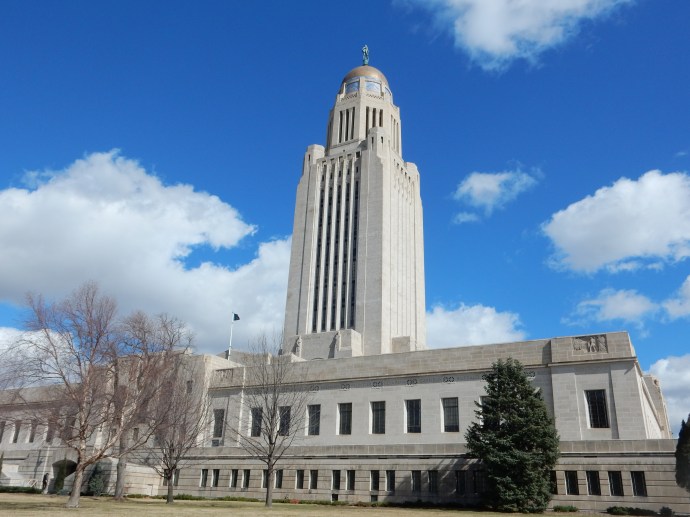
The Nebraska State Capitol in Lincoln

The Nebraska State Capitol in Lincoln

Next stop: Nebraska State Capitol. For a state capitol, the Nebraska capitol is a grand and pleasing surprise. Nebraska’s population is a little less than two million with over one half of that in the metro areas of Omaha and Lincoln. Nebraska has the only unicameral (one house) legislature in the United States, dating back to the 1937. The capitol building was built between 1922 and 1932 so there are two legislative chambers, but one is never used now. The state built the capitol on a pay as you go basis so it was completed and paid for at the same time. The building is also one of only four (I believe) that are shaped as a tower; Florida, Louisiana and North Dakota are the other three.

An interior dome at the Nebraska Capitol

An interior dome at the Nebraska Capitol

One of the murals in the north wing hall of he Capitol in Lincoln NE

One of the murals in the north wing hall of he Capitol in Lincoln NE

The capitol tower does have a small dome with a statue of “The Sower” on top. There are four rectangular low-rise office wings with their own courtyard surrounding the tower. Each wing extending out from the rotunda area has its own unique feel. For instance, the Supreme Court wing is dark and gloomy. The north wing has numerous murals, friezes, and tile works that amaze and delight the person walking down the hall. We were the only people on the 2 PM tour so we were also able to get into the locked Supreme Court chambers and the locked unused legislative chambers. Both were filled with symbolism of Nebraska and ancient philosophers and, while well-done, did not “Wow” us.

We made a quick stop at a small museum. The American Historical Society of Germans from Russia. This museum is sponsored by a group of people intent on maintaining their heritage. During the time of Catherine the Great and Alexander I of Russia, about 1760 to 1820, these two Russian leaders invited foreigners to settle in Russia to fill in population voids. Foreigners were guaranteed the ability to run their own communities in their own languages and to not be drafted to serve in the Russian army.

Tens of thousands of Germans took up the offer. Lousy economic conditions, forced military service-frequently for other countries (think of the Hessians fighting with the British in our Revolutionary War), religious intolerance, shortage of land, etc all contributed to this movement. But around 1870, Alexander II revoked those promises. Migration to the United States and South America followed with most of those emigrating to the US settling in North Dakota, Nebraska and other Plains states. This museum is dedicated to telling their story and preserving the records of who came over and when. It was pleasant, a new bit of history but not necessarily the highlight of the day.

The day’s highlight was Morrill Hall. If the name sounds familiar to Americans, it is because there are a dozen Morrill Halls on college campuses. They are named after Justin Morrill, a U.S. Representative from Vermont who sponsored the Morrill Land Grand College Act that gave land to the states to pay for establishing universities.

Morrill Hall has wonderful, but dated stylistically, exhibits on the unique and numerous role of fossils in this state. If I remember the exhibits correctly, Nebraska has more fossil finds than any other state in the US. Nebraska works extensively with road building projects and any fossils found become a cooperative effort between the contractor and archaeologists to extract the fossils without slowing down the road construction.

So camels are but one fossil find. In fact, there are over 100 camel fossil sites in Nebraska. Woolly mammoths and other prehistoric fossils and recreated extinct animals are the major focus of many exhibit halls. Some of the exhibits are unique and found nowhere else in the world.

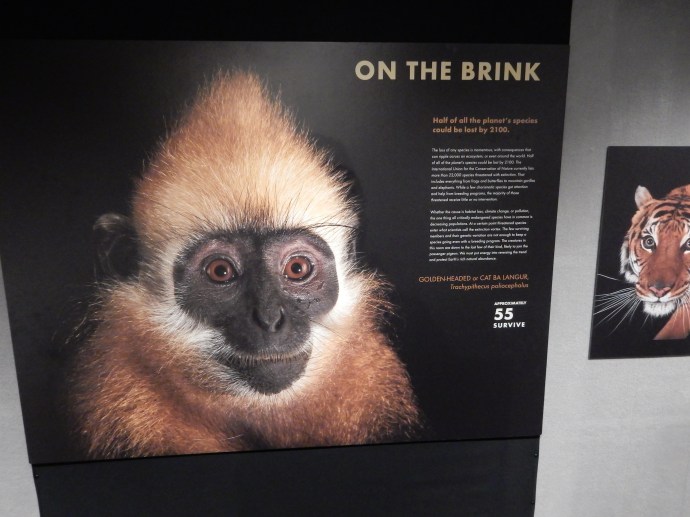
From the National Geographic PhotoArk exhibit

From the National Geographic PhotoArk exhibit

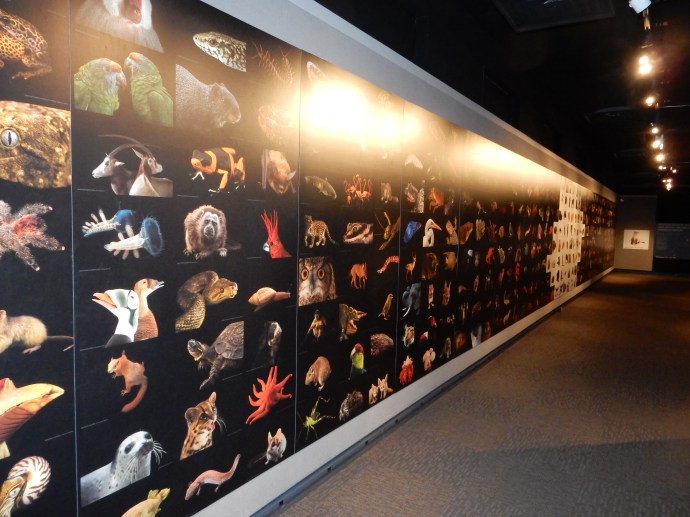
The PhotoArk: trying to provide a sense of the immensity of the task

The PhotoArk: trying to provide a sense of the immensity of the task

Another display showcases the National Geographic PhotoArk. This is an effort to photograph biodiversity by showcasing all species on earth. A stupendous effort. One exhibit hall is dedicated to photos of hundreds of animals with an emphasis on the species close to extinction.

2017 is the sesquicentennial of Nebraska’s statehood and the Museum was sponsoring several events tonight. We could have done yoga-we did not. There was story time we skipped. And we almost skipped free pizza because we were just suspicious about why free pizza. Well, there was a catch. We were invited in to be creative and make some art work as part of the process. We probably could have passed and still eaten the pizza but Chris was a good sport and gave it a go. Let’s just say the final product will not be hanging on anybody’s wall.

So, a long day filled with some unique activities. Tomorrow we finish up in Lincoln and head out to Grand Island and Kearney NE.

Ed and Chris. March 2

Categories: road trip, travel | Tags: , , , , , | Leave a comment

2017 Trip Two: Tour of Texas, March 1

March 1, 2017

On the Road Again.

Well, we are off on our longest journey yet. This trip is projected to be 61 days, arriving back in St. Paul on April 30. We actually deleted a few days at the end that we were going to spend in Oklahoma City and Tulsa, OK. Upon reflection, we decided that we would probably be in a mood just to zip home by the end of April. Our previous longest trips were 54 days driving around Florida in 2015 and 50 days in 2013 going to western Canada and parts of northwest U.S.

The schedule and dates were driven by several goals: A. to visit Big Bend National Park along the Rio Grande in southwestern Texas; B. to visit Kearney NE to try to observe the sandhill cranes in their northern migration; C. to spend a week at our timeshare in Miami Beach; D.to see the bluebonnets and other flowers in bloom in Texas; and E. to see previously unexplored areas of Texas. As usual, getting lodging inside a national park (this time Big Bend) meant having to pick a day months ahead of time before the rooms were all booked up. The Miami Beach timeshare also books up months ahead of time. After Big Bend and Miami Beach were locked in, we had to make the rest of the journey work. Some decisions may not provide for visiting at the optimal time. The sandhill cranes make their own timetable, usually the birds are most numerous in mid-March but we will be there in early March. While early April is normally a good time for bluebonnets, the weather has been warmer earlier than usual so blooms will pick their own dates as when to blossom. Since we will be in Texas, we will visit relatives in Houston and San Antonio, cities we have visited previously.

St. Paul MN Wednesday March 1.

St. Paul MN Wednesday March 1.

Today we started out in light snow in St. Paul. Maybe fifty miles into Iowa the snow from today and from last Friday’s storm had disappeared. We had left home a little later than usual in order to have lunch with my niece Shannon and her husband Adam in Iowa. Lunch was really just an excuse to get together and get caught up since we had not visited with them for over a year.

As we made our way through Iowa, we passed one intersection in Ames Iowa that had three large manufacturing facilities on three of the corners. Danfoss is a Danish company that makes pumps, motors, refrigeration equipment, compressors, etc. Amcor is an Australian company that manufactures packaging products. Barilla is an Italian company making pasta and sauces. Such a commentary on our world, three large international companies with a substantial corporate presence in the heartland of the U.S.

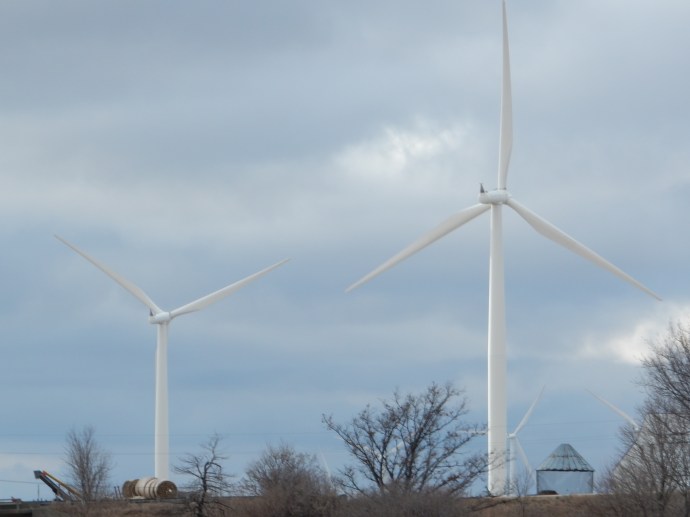
Wind Turbines along I-80 in Iowa

Wind Turbines along I-80 in Iowa

As we turned west at Des Moines, the winds picked up. We could have attached a sail to our car and used wind power to get us to Nebraska. Very appropriately as Iowa has jumped to number two in the ranking of states and the amount of wind power generated in that state. Texas is number one. Along both Interstate 35 and Interstate 80, one can observe numerous large wind farms. We recently decided to switch our home energy use to all wind power through Xcel Energy; maybe it will help offset the gasoline we use in our trips around the country.

When one thinks of Iowa, a flat landscape of fertile farm fields comes to mind but it is not all flat and agricultural. We have already mentioned the manufacturing presence in the state. As we drove west on Interstate 80, the flat landscape we had encountered driving south on Interstate 35 transitioned to a series of rolling hills.

Why? Loess. Loess can occur in differing parts of the world but here loess is glacial “flour” or dust (according to Wikipedia) that was laid down as sediment by glacial action and blown into hills and sediments basins as the wet sediment dried. In other parts of the upper Mississippi RIver valley, it forms part of the rich farming soil. Here the wind has shaped it into peaks and saddles of land noticeably different from the flat agricultural land of northern Iowa and parts of Illinois.

We ended the day in Lincoln Nebraska where we will be visiting for the next two days. The land has reverted to the flat lands although we expect to be driving through the Flint Hills of Nebraska and Kansas shortly.

At the top of the blog, we stated this will be a 61 day trip. We have been asked how we decide on our route and what to see along the way. The first step is similar to the description in the paragraph above; to envision an area of the U.S. we have not seen, or relatives to visit, or both. Then we start looking at Google Maps and our National Geographic 12 x 15 bound US map to get an overall sense of a route, focusing more on areas we have not traveled to previously. From there we hit the books, printed books first. Resources like AAA Tour books (particularly their Gems), a map of the 400+ National Park Service units around the country, books by National Geographic like Best Small Towns, Best Scenic Drives, etc., books (these are older but still valuable) by Readers Digest on Off the Beaten Path, the Road Less Traveled, Public Gardens in the U.S, etc. Reading these allows us to highlight locations relatively close to the area we are considering. Most of these books, when writing about a particular destination, also mentioned other interesting places within a reasonable distance. Then we go to the Internet, checking current reviews, hours of operation, how the attraction describes itself, etc. After choosing the most important locations, we sketch out a timetable, using an Excel Spreadsheet to list mileage, attractions to see that day, etc. It allows us to project how many days to spend in any one location and how long to get to the next night’s lodging. Finally, we will go to sources like Roadside America or Atlas Obscura to discover unusual attractions that might be along the way and can fit into our schedule.

The map included in this blog gives a general sense of the route we have plotted out.

2017 Trip Two, Tour of Texas

2017 Trip Two, Tour of Texas

Ed and Chris, March 1, 2017 Lincoln Nebraska

Categories: road trip, travel | Tags: , , , | 3 Comments

2017 Trip One; January 11-13: Mississippi River Headwaters

January 11-13, 2017

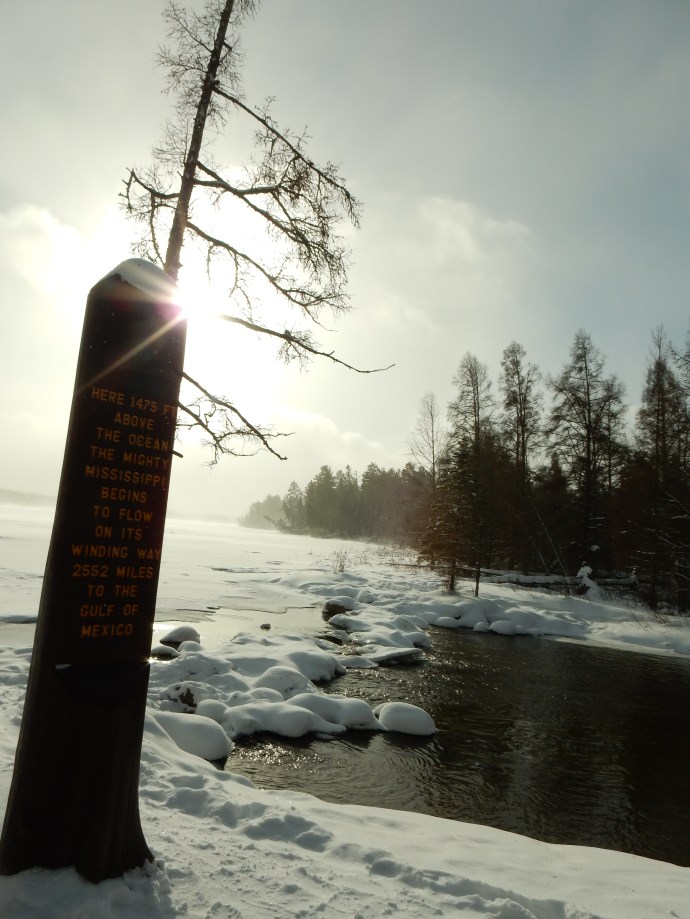
Mississippi River Headwaters marker as the river exits Lake Itasca

Mississippi River Headwaters marker as the river exits Lake Itasca

We live in Minnesota, right? And January is the month of Chris Klejbuk’s birthday, right? In Minnesota in January, you celebrate the experience of winter, right? Right.

So we are enjoying three days and two nights in northern Minnesota. We are staying at a winterized cabin at Itasca State Park, 20 miles north of Park Rapids Minnesota, and 250 miles north of the “Cities” (Minnesota speak for St. Paul, Minneapolis, and their suburbs.) Itasca was the first state park established in Minnesota, in 1891. It was the second state park to be created in the United States. It is large, at over 32,000 acres. And while it has over 100 lakes within its boundaries, one small stream is its main claim to fame.

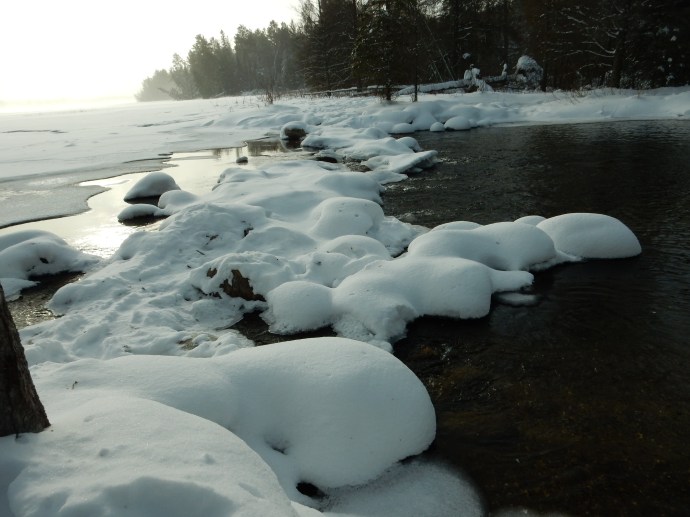
The end of Lake Itasca and the start of the river

The end of Lake Itasca and the start of the river

Flowing out of Lake Itasca, the Mississippi River begins its 2500 mile journey to the Gulf of Mexico. The terrain up here has been formed from the glacial ages. Without being scientific, there are depressions and hillocks caused by glacial action and/or glacial melting that form wetlands and forest regions. This area was under threat of having its timber, primarily red pine, harvested in the late 1800s. By a narrow vote in the state legislature, the area was saved from timber harvesting and some of the areas here still have virgin red pine forest.

Four Season Suites at Itasca

Four Season Suites at Itasca

It has been several decades since Chris and I have been here. For her birthday, she likes to do something different. Her choice this year was to spend two nights in a cabin here at Itasca State Park. Luckily the cabin is insulated, winterized, and heated. The temperature for these three days will range from about five above to about 20 below. That is Fahrenheit, and not wind chill. The cabin is built on a concrete slab and while the temperature at head level is nice and warm, the floor is still a bit chilly. Shoes or two pairs of socks are required.

We left the Cities at the tail end of a minor snowstorm. The total was only about 4 inches but a fair amount of blowing accompanied the storm. The road surface was usually compacted snow into icy patches. For those of you not living in northern climes, road salt does not have much effect on clearing road surfaces at temperatures around 0° as we were experiencing.

We had lunch in Wadena Minnesota, a town of about 4000 people, at The BBQ Smokehouse. This is primarily a meat market with a side business of lunch and early dinner. We had the daily special, turkey sandwich with cowboy beans and potato salad for $6.50. The sandwich was huge and very tasty. The sides were great also.

Sunset walk at Itasca State Park

Sunset walk at Itasca State Park

We checked in around 4 PM. After unpacking, we had time for a sunset walk before settling in for the night. Wednesday, we slept in and then headed out for our first walk, to the headwaters of the Mississippi River. It took the European explorers several decades to agree on the source of the Mississippi River. One simple reason for the delay was that the first explorers never asked the Native Americans to help them. Once Henry Schoolcraft decided to ask for assistance from Ozawindib, a Ojibwe chief, the headwaters were “found” quickly. After all the Native Americans lived here for centuries and knew all about “Great River”.

The Mississippi River had great political significance to the United States. Primarily, it marked the early western boundary when the American people revolted against the British and won their independence. Yet the river had never been fully surveyed. The Mississippi was also one of the great trade routes for the new country. Rivers provided clearly marked and easily navigable transportation sources.

The Mississippi River starts flowing north as it leaves Lake Itasca.

The Mississippi River starts flowing north as it leaves Lake Itasca.

As we know now, the Mississippi River runs for 2500 miles from northern Minnesota to the Gulf of Mexico. It provides the boundary between numerous states along that route. While it runs primarily in a southern direction, from here it actually runs for 80 miles to the north, due to elevations created by the glacial age, before it starts its southerly course.

The headwaters are officially marked as the location where Lake Itasca drains into the creek beginning the Mississippi. There are scientific requirements to meet to designate the beginning of a river. While the lake and creeks draining into Lake Itasca stretch farther back from the official beginning, there has to be a sufficient flow to be considered as a river. This is what occurs at the northern channel of Lake Itasca where the Mississippi River begins.

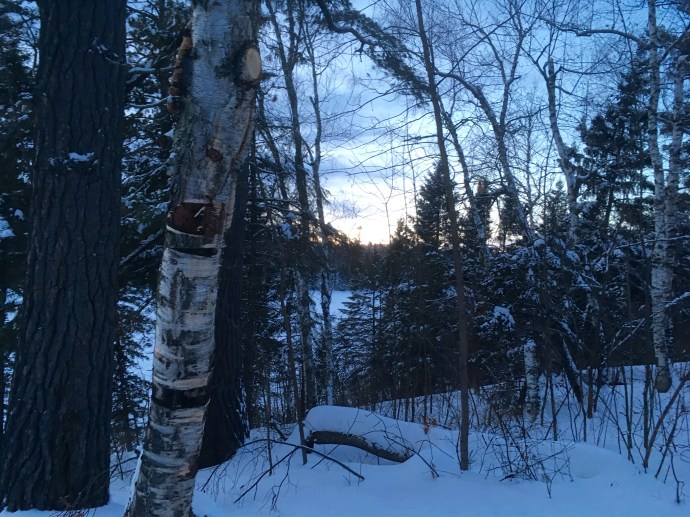
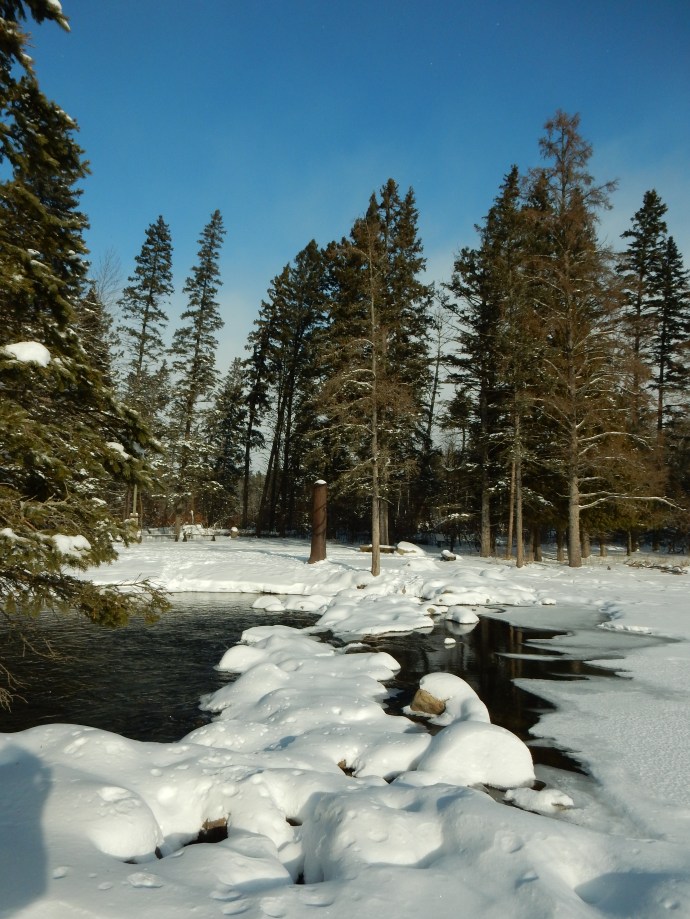
Walking in the woods

Walking in the woods

Lake Itasca with winds

Lake Itasca with winds

Today, the air temperature was about -5 F with a 15 mph wind. Wind makes the cold air worse. Standing by open spaces, like lakes, allows the wind to have full effect. Walking in woods, however, tends to minimize the wind. So we experienced both the full wind effect at the shore of Lake Itasca and its muted form in walking through woods to reach the headwaters. But the sun was usually out and we enjoyed the varied views provided by the park.

Itasca State Park includes both pine trees and mixed deciduous hardwood trees. The pine trees were here first but, like numerous other locations around the U.S., the loggers in the late 1800s cut the pine trees indiscriminately. The park was formed partially to save some of those virgin pine forests. Interestingly, the daughter (Mary Gibbs) of the first Itasca Park superintendent was named the interim superintendent when her father died. During her short term, she stood up to logging companies who while logging legally on private land, were illegally damming up the Mississippi River to aid in floating the cut logs downstream. They were not pleased by her courageous stand, and the new permanent superintendent that was appointed was more favorable to the logging interests.

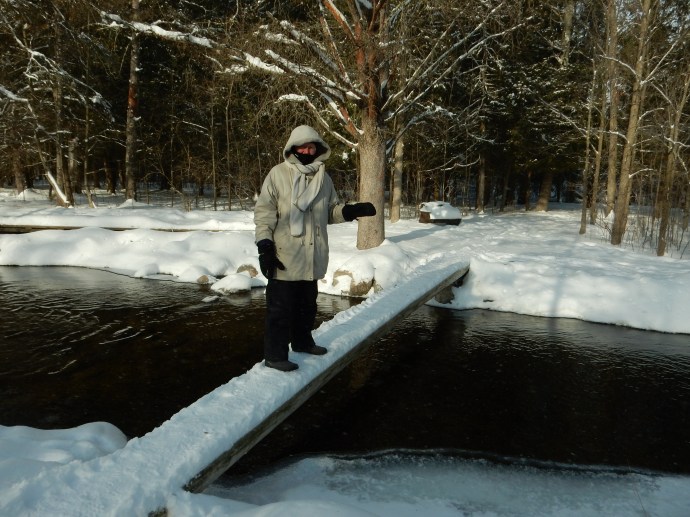
Chris walking over the headwaters of the Mississippi River

Chris walking over the headwaters of the Mississippi River

After the headwaters, we made a brief stop at the visitor center to warm up (they have two fireplaces and heated restrooms that are open 24 hours a day) and to explore the interesting museum there. Then it was back to our cabin for lunch. The smell of apple cider with cinnamon sticks and brown sugar greeted us as we entered the cabin. Our afternoon walks were through the woods where the wind was quiet and the sun peered pleasantly through the tree trunks. A quick warm-up in the cabin was followed by another walk at sunset.

Tonight the full moon is out so we waited a sufficient period to make sure it was above the trees. We drove to the lake and watched the moon shining on the ice covered lake and the shadows cast by the trees. However, since it was now 13 below and heading down further, we did not take a long walk but headed back to the cabin.

Friday, January 13th.
Our final goal of this trip was to visit La Salle Lake State Recreation Area. It would be our 59th state park visited since we began that program in 2015. I took a wrong turn and added 20 miles on to what should have been a quick jaunt from Itasca State Park. But that time was justifiable to obtain the park stamp since this recreation area is basically closed during the winter. The web site does not state that DNR does not plow the access roads in the winter. Since we do not have a snowmobile, we just drove by and turned around to head home.

One last view of the headwaters.
dscn3873

Trip One for 2017 completed. Just a teaser really before the first big one begins on March 1 and under current planning, will go for 63 days.

Ed and Chris.

Categories: road trip, travel | Tags: , , , , , , , | Leave a comment

2016 Minnesota State Parks: Water and Woods

Friday, November 4, 2016 Saint Paul

The St. Croix River, looking into Wisconsin

The St. Croix River, looking into Wisconsin

This was a three-day, two night swing to cover six state parks. Chris has a goal of seeing almost all 76 state parks in three years. So far, we are sixteen months into the project and have visited 57 of 76 state parks. One state park is only accessible by boat and we do not have a boat. Fall colors are past peak. (For those of you unfamiliar with this, in the fall deciduous trees shed their leaves after the leaves turn red, orange, yellow and shades in between. This is not the scientific explanation, but the simplistic explanation of what we see. The vibrancy of the colors and actual dates of coloration vary from year to year. In general, this fall was spectacular.) For early in November, the weather was perfect. Ten to twenty degrees warmer than usual. Bright blue skies. Plenty of rainfall earlier so rivers are still running strong.

The six parks are no more than 100 miles apart. For this journey, we stayed somewhat in the center of the region at the Grand Casino at Mille Lacs Lake. How could we not? The mid-week, off-season rate was only $40 per night!. The indoor pool was large and the spa could hold 21, if that many actually showed up. We went to the spa and pool both days, at 4-6 PM it was practically empty. At 8-9 PM, there were maybe 20 people, 1/3 kids. Recognize that the casino is run by the Mille Lacs Band of Ojibwe. There is smoking in the casino (although our room was non-smoking.), there is no alcohol (fine by us), and no ADA compliant entrance/egress into the pool or spa. We ate at the buffet both nights and the food was tasty. Good choice for lodging.

Hiking through the woods at Wild River State Park

Hiking through the woods at Wild River State Park

So, on to the parks, the reason for the trip. Tuesday we drove to Wild River State Park, only 60 miles from our house. Wild River is along the St. Croix River, one of the eight rivers originally protected under the Wild and Scenic Rivers Act of 1968. About 70% of the land was donated by Northern States Power Company. Pre-state park days, great swaths of northern Minnesota pine trees were the source of lumbering with great fortunes made. The St. Croix was a transportation route for shipping the cut logs downriver to sawmills. At a point in the park, a dam was constructed to control the logs and to help enhance a hydroelectric power plant downstream. NSP ended up owning the land and when the dam here was not needed to control logs or for the hydro plant, they were willing to donate the land to the state. Thus, the park is long and narrow, along the banks of the river.

Inside the park, alternating areas of tallgrass prairie, mixed hardwoods forest (that replaced the cut pines), and oak savannah plains intermingle. We hiked primarily along the river, overtaking and then being overtaken by a group of six people who seem to hike here regularly. We did not see boaters today but the river itself was flowing fast and we could hear it gurgle as it swept into and then around small rock islands. It appears that horse back riding has ended for the season so those trails were quiet and it is too soon for cross-country skiing and snow shoeing. Hikers seemed to have the park to themselves today.

From Wild River we headed west to Mille Lacs Lake. Mille Lacs is shallow, only about 40 foot maximum but it is the second largest lake in Minnesota. It is about 14 miles wide and about 19 miles long. It was formed when the glaciers retreated and at the point where the end moraine of one glacial lobe created a ridge blocking most water from flowing out. The park is named after Father Louis Hennepin, a French Franciscan Recollect priest-explorer. Father Hennepin came to Mille Lacs Lake after Native Americans captured him and two fellow explorers in 1679 hundreds of miles south along the Mississippi River and brought him to Mille Lacs Lake. Eventually he was released and returned to France. Mille Lacs was a gathering, hunting, and fishing location for Native Americans for hundreds of years. It is still home to many Native Americans. The casino here is on reservation land. The State of Minnesota and Indian tribes have a mutual agreement over fishing rights to Mille Lacs under treaties dating back to the 1800s, although Governor Dayton this summer unilaterally broke the mutually agreed upon 2016 limit for walleye which did not endear him to the Indian tribes.

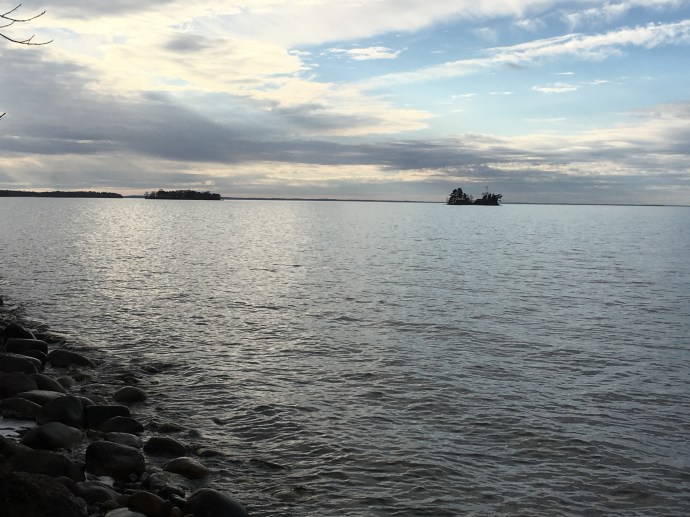
At Father Hennepin State Park, looking at the two islands comprising the national wildlife refuge

At Father Hennepin State Park, looking at the two islands comprising the national wildlife refuge

Father Hennepin Park is small, located on the south shore of Mille Lacs Lake, and is not even where he is thought to have been held but it still represents the early exploration period in Minnesota. On the lake are two small islands which are the smallest national wildlife refuges in the country. The two islands are the nesting and breeding grounds for the common tern. We walked along the shore, out to a headland jutting out into the lake. After Father Hennepin, we drove a short distance to Mille Lacs Kathio State Park, located along the southwest corner of Mille Lacs Lake. Mille Lacs Kathio is much larger, about 10,000 acres. The naming of the park takes after names from the Dakota Indians for the “Sacred Lake”. The Dakota lived here before the Ojibwe replaced them in this area in the 1800s. The word Kathio comes from poor translations by the French of Dakota words.

We have been to Mille Lacs Kathio before, both to cross-country ski and to geo-cache and to hike with Bernie and Tony. Our stay here was brief, daylight was drawing to a close. Grand Casino Mille Lacs is just a few miles away so we checked in and enjoyed the spa and buffet.

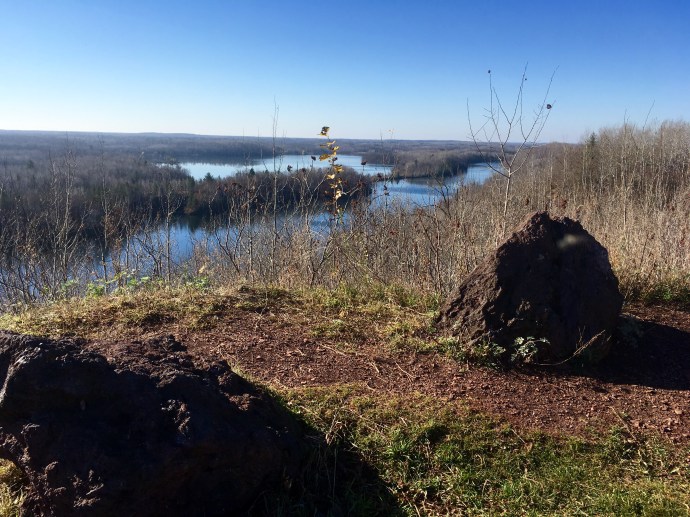
Looking down on Cuyuna Country Recreation Area from one overlook

Looking down on Cuyuna Country Recreation Area from one overlook

Thursday morning we drove an hour to visit a new type of state park. Cuyuna Country State Recreation Area is new, technically becoming a park in 1993. However, it took almost twenty years before it became a major recreational site. The 5,000+ acres were home to open-pit iron ore mining. The area was abandoned by mining companies over thirty years ago and the park specializes in mountain biking. Over 25 miles of trails will challenge the mountain bike rider with a new trail center to allow for competitions to be held here.

Cuyuna Country with mining waste hill to right

Cuyuna Country with mining waste hill to right

Cuyuna has 21 lakes, 15 of which are former iron ore mines. The water is clear now and scuba diving has found a home here along with fishing. Vegetation is now prevalent on the abandoned hills of mining waste; although the red rock roads and hills are stark reminders of the iron ore geology. Hiking is not a major focus here although one state trail goes through the park. After mistaking exploring back roads of private property next to the park, we viewed the park from the water level and then again from the top of two overlooks. There were just a few mountain bikers out; I guess most were in school. The trails certainly seemed challenging enough. They did not tempt us to try to rent a mountain bike, we will leave that for the more agile and adventurous.

"Main Street" of Old Crow Wing with Mississippi River just to the left

“Main Street” of Old Crow Wing with Mississippi River just to the left

Crow Wing State Park is thirty miles from Cuyuna and is much more your typical state park. Crow Wing was a gathering place at the confluence of the Crow Wing and Mississippi Rivers. The Dakota and Ojibwe gathered here in settlements. The Red River Oxcart Trail had one branch traveling through this area. This trail was the major trading route between St. Paul and Winnipeg. Fur traders and missionaries began a settlement here and the logging industry in Minnesota kept the town prosperous until the railroads laid their tracks through the neighboring community of Brainerd and Crow Wing as a town dried up.

Hiking along the old Red River Oxcart Trail

Hiking along the old Red River Oxcart Trail

At Crow Wing we were able to view the old town site, lined along the banks where the two rivers meet. A recreated boardwalk and building foundations give one a sense of life here 160 or so years ago. Canoeists on the river replaced the thousands of pine logs that would have floated down the river to sawmills downstream. A hike through the woods demonstrated the sandy soil of much of the area which keeps the trails dry. The hike presented a peaceful way to end the outdoor part of the day. The spa and buffet took care of the indoor portion.

Friday we headed east for 70 miles, back to the St. Croix River which forms much of the Minnesota-Wisconsin northern border. St. Croix State Park at 33,000 acres is our largest park. The St. Croix is joined here by the Kettle River, both active rivers duirng the lumbering period of the late 1800s. Most of the land was purchased when homesteaders tried, and failed, to make a living farming on the cut-over logging land. The Civilian Conservation Corps and Works Progress Administration constructed many of the park facilities still in use.

Hiking along the Kettle River at St. Croix State Park

Hiking along the Kettle River at St. Croix State Park

It took us 30 minutes of driving inside the park to reach our first destination; an overlook touting the “Head of the Rapids”. For once, it was more hype than reality. We retraced our steps partially and went for a nice hike along the Kettle River, spotting our second bald eagle of this trip. We checked out the camper cabins but they appeared to be less modern than my taste prefers. We also wasted time trying to get Chris’ State Park Passport book stamped. Normally there is a ranger at the main office or visitor center; when there is none, some form of outside stand will hold the stamps along with self registration and entrance fee paperwork. Neither option presented itself to us, despite returning to the office several times, stopping a carpenter who was working on a building, and driving through the staff only area in search of a ranger. We finally left and just wrote in the book: We Were Here-Really.

St. Croix is only 90 minutes from home so it was an easy drive back. Interstate 35 northbound was busy; Saturday was the first day of deer hunting season and the boys and their toys were gunning up the highway to be in place before the season started 30 minutes before dawn.

Ed and Chris

Categories: road trip, travel | Tags: , , , , , , , , , , , , | 1 Comment

2016 Trip Eight, The Rockies, Oct. 13-14

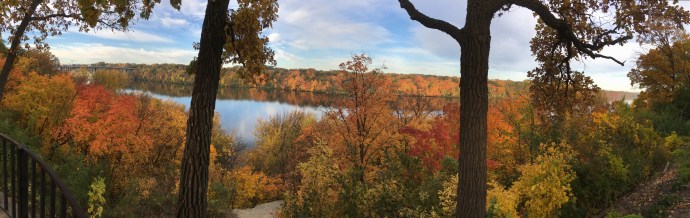
Examples of the fall colors that greeted us in Saint Paul MN

Examples of the fall colors that greeted us in Saint Paul MN

Saint Paul, MN Oct. 15

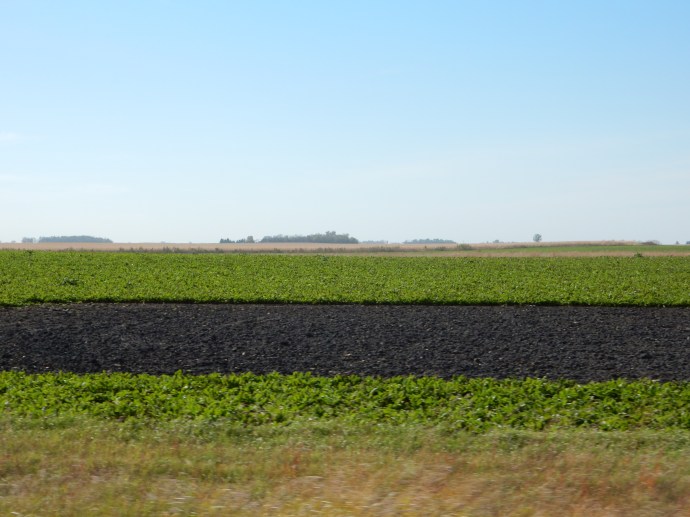
The deep black soil in MN agriculture

The deep black soil in MN agriculture

Our trip finished by driving through South Dakota and Minnesota agricultural areas. To us, the difference was obvious. The MN soil was a deep black color. MN had more trees than South Dakota. MN had more towns and a larger population in those towns. Not huge populations, mind you, but the range of the populations was definitely higher. As we expected, we also saw more fall color in Minnesota, with the greatest abundance in the Twin Cities area where the hardwood forest topography provided more trees with a greater variety of species.

The Minnesota River flowing out of Big Stone Lake

The Minnesota River flowing out of Big Stone Lake

Thursday, after we left the Redlin Art Museum, we drove to Big Stone Lake State Park. This state park is on the border between South Dakota and Minnesota. The lake is 26 miles long and is notable for being the headwaters of the Minnesota River. In this area is a sub-continental divide, where waters north of here flow into Hudson’s Bay; south of here they flow into the Gulf of Mexico via the Mississippi River. The Minnesota River flows almost in a “V” direction, heading SE and then NE until it joins the Mississippi River at St. Paul, less than two miles from our house. Glacial Lake Agassiz covered portions of western Ontario, northwest Minnesota, northern North Dakota, and much of Manitoba and Saskatchewan 10,000-12,000 years ago. At various times during its existence, Glacial Lake Agassiz was fed by melting glaciers and portions of the lake drained southward into what is now the Minnesota River. This ancient river was much larger than the current Minnesota River.

Part of Big Stone National Wildlife Refuge in west central MN

Part of Big Stone National Wildlife Refuge in west central MN

Big Stone Lake is well-known for fishing and waterfowl. The lake is on the pathway for numerous migratory birds but our time here was not propitious for viewing any great numbers of birds. After a hike in the park, we left for the Big Stone National Wildlife Refuge. We attempted to have lunch in Odessa, a small town of 150 people but the one person cafe was not interested in scrounging up a meal at 1:30 PM. Instead we had a granola bar and drove the wildlife loops. This refuge has rock outcroppings like Blue Mounds Park and a series of marshlands, pools and streams where fish and waterfowl congregate. Again, no major flocks of birds were present but the views were enjoyable.

Lac Qui Parle Mission

Lac Qui Parle Mission

Our next stop on Thursday was at Lac Qui Parle State Park. Lac Qui Parle is a French translation of the name given by Dakota Indians to this lake, meaning “lake that speaks”. The lake is also on the migratory path for Canada Geese and other waterfowl. Again, we saw, and heard, very little. We had stopped at these locations hoping we might be at the correct time for migrations but our timing was off. One of the earliest mission settlements along the river was located at Lac Qui Parle. In 1835, the first church in Minnesota was built here by missionaries from the American Board of Commissioners for Foreign Missions. During their time here, the missionaries devised their own alphabet for the Dakota language. The mission was part of the effort to assimilate American Indians into the culture and ways of the European immigrants. It had only partial “success”. In 1854, when one home burnt, the mission moved farther south to Yellow Medicine Agency.

The reconstructed dormitory building at Upper Sioux Agency

The reconstructed dormitory building at Upper Sioux Agency

We spent the night in Montevideo MN and Friday visited our last state park on the journey home, Upper Sioux Agency State Park and historic site. The Upper Sioux Agency was also known as the Yellow Medicine Agency where the Dakota, also known as Sioux, people dug for medicinal herbs. The Upper Sioux Agency grew into a small village where a U.S. Indian agent supervised the application of the Indian treaties. In 1851, under pressure, the Dakota gave up their lands in Minnesota for a swath of land 20 miles wide along the Minnesota River along with cash payments, goods and services. In 1858, the twenty-mile swath of land had been reduced to ten miles wide. By 1862, tensions had arisen between Indians willing to accept the white man’s ways and those favoring the traditional hunting and gathering ways. Worse, the cash payments were usually delayed or withheld. White traders got much of the payments first to pay inflated costs for items the Indians needed to farm. Food shipments were late, rotten, or of poor quality. Redress to the government provided no relief. A 1861 crop failure and severe winter made conditions explosive in 1862. In August a six-week war broke out when Dakota Indians attacked another mission agency nearby. When the six-week war was over, both Upper and Lower Sioux Agencies had been burnt, over 500 white settlers were killed along with an unknown number of Dakota. The government hanged 38 Dakota men in one mass hanging and forced the rest of the Dakota onto reservations in Nebraska and South Dakota. Besides reading the displays about the Dakota War of 1862 and the Agency tasks, we took two hikes along the Minnesota River.

Lunch was at a family owned restaurant in Glencoe MN as we said goodbye to the agricultural area of MN and returned to St. Paul. As predicted, fall colors were at their best when we returned home.

Panorama view of Mississippi River in the Twin Cities

Panorama view of Mississippi River in the Twin Cities

Ed and Chris

Categories: road trip, travel | Tags: , , , , , , | Leave a comment

2016 Trip Eight, The Rockies, Oct.12-13

Watertown, SD. Oct. 12

Harvest time in South Dakota

Harvest time in South Dakota

“Leo’s is happy to make a chocolate malt for you, but it will take a few minutes.” Such was the comment from a waitress at Leo’s in Redfield SD where we stopped for lunch. Small town restaurant where the waitress was concerned that we knew the impact of ordering a malt. I love it. The malt was great too.

These days continue our travel back home, mainly through back roads and small towns. It is harvest time, tractors, combines, tractor trailers clog the fields and roads. We did not make this trip to see fall color; in fact we left the Twin Cities at a time when the changing leaf color was just beginning and we will probably return as it is near completion. Along these roads, we have only seen yellow fall colors, no orange or red.

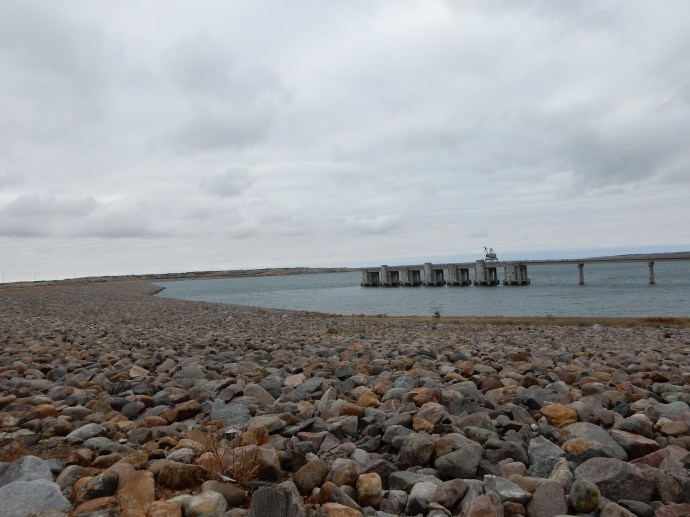
Looking at the hydropower intake gates at Oahe Dam

Looking at the hydropower intake gates at Oahe Dam

We left Pierre SD and stopped at Oahe Dam. This is a US Army Corps of Engineers facility, constructed in the late 1950s on the Missouri River. This dam and four others on the Missouri try to balance competing priorities: flood control, irrigation, recreation, fish and wildlife enhancement, navigation on the lower Missouri River, and hydropower.

The hydropower plant alone can produce sufficient power for all 300,000 homes in South Dakota. The dam creates the fourth largest reservoir in the U.S. Before the dam was constructed, Pierre and Fort Pierre, just downstream from the dam location, suffered severe flooding.

Oahe Mission Chapel

Oahe Mission Chapel

Oahe Dam is constructed of dirt, with separate areas for water to flow to the hydropower turbines and for water to flow directly to the Missouri River. The visitor center has an educational display, and tells us that, like other dams, the reservoir created by the dam did submerge homes, buildings and facilities used by the people living here at the time. Included in that list was the Oahe Mission Chapel, built in 1877 to serve the Congregationalist minister to the Sioux Indians of the region. The mission church has been moved next to the visitor center. Oahe comes from the name of an old Arikara Indian village that had been located where the dam was built.

After the dam, we visited (sort of) the town of Zell, past home to relatives of my brother-in-law. The town is pretty much deserted now, although the Catholic church will be having a Hunter’s Mass this weekend since it is the opening of pheasant hunting for non-residents. Normally the church is closed. The town is now only populated by 50 persons.

Historic Redfield SD train depot

Historic Redfield SD train depot

The nearby town of Redfield, population 2300, was a more lively community. My brother-in-law does still have relatives here. We had lunch at Leo’s, referenced above. They expect a hopping time in town this weekend with pheasant hunting underway. After lunch, we visited the historic Chicago & Northwestern Railroad depot. A volunteer gave us a tour of the depot, with its separate waiting rooms for women/children and for men. Meals were served to travelers and locals in the in-depot dining room. Passenger service ended in the 1950s and the depot was rehabilitated in the early 2000’s. The Chicago and Northwestern rail line, like many railroads, went through numerous expansions and contractions and was finally sold to the Union Pacific in the 1990s. The track through Redfield, however, was separately sold to the Rapid City, Pierre & Eastern Railroad.

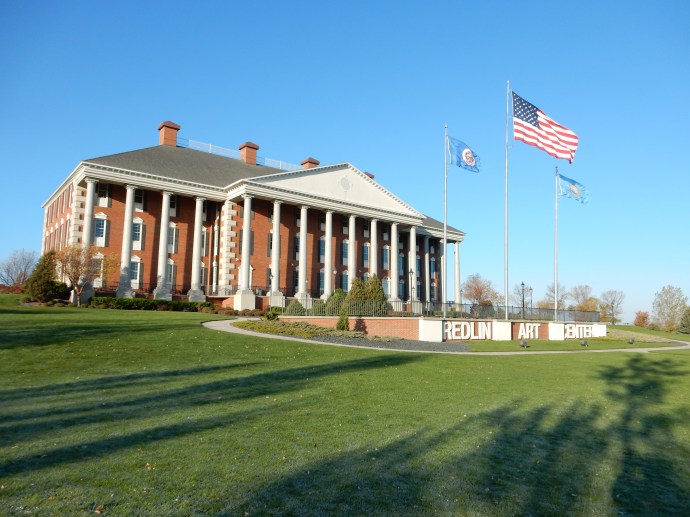
The Terry Redlin Art Museum in Watertown SD

The Terry Redlin Art Museum in Watertown SD

After Redfield, we continued on to Watertown SD. Watertown is the home of the Terry Redlin art museum. We only had time to view a portion of the musuem Wednesday and finished it Thursday morning. Dinner Wednesday night was at Buffalo Wild Wings. What is it nowadays that menus do not display the prices for non-alcoholic beverages? Is this a new “in” thing like not providing spoons with the silverware? This is the second restaurant where we have had to ask the cost for pop, iced tea, milk, etc. Everything else has a price prominently listed. This time instead of asking the staff, I sent an email off to Buffalo Wild Wings.

A portrait of Redlin with his chair and easel

A portrait of Redlin with his chair and easel

The Terry Redlin art museum was a surprise to us. I must have seen his work previously but his name did not ring a bell with us. He died just this April but his museum opened in 1997. At age 15 he lost a leg in a motorcycle accident. The state of South Dakota gave him a scholarship to art school in St. Paul. He began work as a graphic artist, not dissimilar to Norman Rockwell. He worked for companies in St. Paul and then moved on to having his own art career.

One of Redlin's paintings with waterfowl

One of Redlin’s paintings with waterfowl

In 1981, Redlin won his first competition for the state of Minnesota duck stamp. He went on to have a fantastic career in wildlife and nostalgia painting. He won numerous awards for artist of the year and lithograph of the year. For eight years, he won the US Art Magazine award for most popular US artist. During his career, he gave away millions of dollars to non-profit organizations such as Ducks Unlimited and the Courage Center in Golden Valley Minnesota which helps disabled individuals.

Redlin married his high school sweetheart who was from Watertown. Her family had begun a local dairy and ice cream company called Langenfeld’s. His son came up with the idea of saving Redlin’s original paintings, rather than selling them, to create the centerpieces of the museum. Redlin normally created signed prints and also had sold the originals to support his family.

The Redlin art museum is a three-story, dramatic structure just off interstate 29. Over time it has added an Event Center, park, and, of course, gift shops. One specialty area of the museum focuses on an ice cream memorabilia collection created by one of the Langenfelds. There is an introductory video presented in the amphitheater surrounded by those ice cream memorabilia.

A typical Redlin painting

A typical Redlin painting

One statement included in a framed newspaper clipping on the wall as you enter the museum was a comment by his art teacher that she wished Redlin had broadened his focus. As I went through the galleries, I can understand better her comments. His art is striking, colorful, (even though he only used three basic colors to mix his palette), and notable. But the themes of the South Dakota outdoors, wildlife, and nostalgia for rural and small town family life are everywhere.

Redlin’s early success was helped by his victory in painting “duck stamps”. These are stamps sold by the U.S.and States to finance the purchase of wetlands and wildlife habitat. These are national competitions and Redlin won the Minnesota competition two years after starting his career and placed second for the Federal Duck Stamp three years after the Minnesota victory. Ducks, geese, deer and other animals make a frequent appearance in his paintings.

One of the America the Beautiful paintings

One of the America the Beautiful paintings

Later in his career, Redlin did produce a series of paintings that moved away from his earlier work. So, his “America the Beautiful” is a group of eight paintings representing scenes over the history of America. Another series of paintings portray the growth of an individual boy from his move to the city from a farm to his death serving his country in the military. His work strikes a chord with many people and continues to be popular even after his death.

It was a pleasant day and a half. Our next, and last, post for this trip will consolidate the last 36 hours spent primarily going through Minnesota state parks on our way to St.Paul.

Ed and Chris

Categories: road trip, travel | Tags: , , , , , | Leave a comment

2016 Trip Eight, The Rockies, Oct. 11

Fort Pierre, SD. Oct. 11

Sunrise in the Badlands

Sunrise in the Badlands

Great Plains or Ground Zero? So read the sign at the Minuteman Missile Historic Site just north of the Badlands of South Dakota. We left Cedar Pass Lodge in time to reach the site when it opened its doors at 8 AM. A limited number of 6 tickets to view a launch control center are given out first come, first serve. It was tough to get out of bed since overnight winds blew in a cold spell that should last two days. Luckily most of today was spent driving or indoors.

Why visit this National Park Service site? Some of you may not remember, or maybe even never knew about, the Cold War between Russia and the United States. The two powers faced each other and competed to stockpile nuclear weapons, including intercontinental ballistic missiles (ICBM). Thousands of these missiles existed. In the United States, most of these missiles were placed in hardened, underground concrete silos across the Great Plains. The strategy during the Cold War was mutual deterrence. If each country possessed vast numbers of nuclear weapons and if one side started a war, the other side could retaliate at such a level that each side would be destroyed.

The START (Strategic Arms Reduction Treaty) was signed in 1991 and mandated a reduction in the number and quality of nuclear weapons held by the United States and Russia. Each country would inspect the removal efforts by the other. It is estimated that the treaty reduced the number of nuclear weapons by 80%. ICBMs located in South Dakota were among those targeted for removal. As the shut down was occurring, the National Park Service and the U.S. Air Force cooperated to save facilities that would demonstrate how the ICBM missiles were controlled.

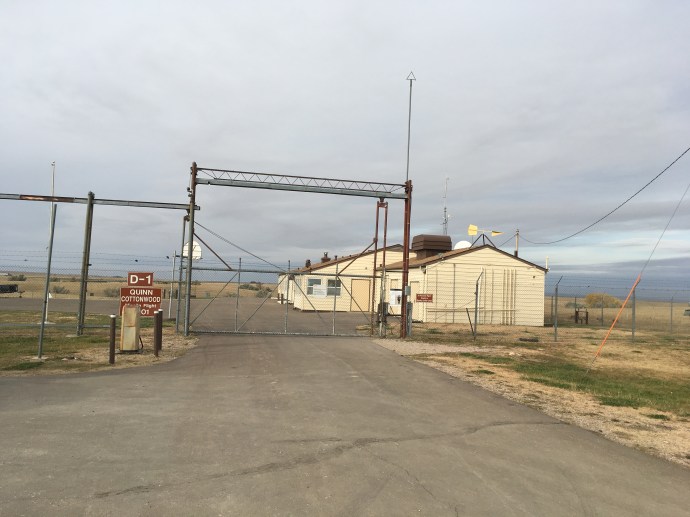
Minuteman Missile National Historic Site consists of three sites: the visitor center with displays and exhibits, a decommissioned control facility about four miles from the visitor center, and an empty underground silo about 11 miles from the control center. Our tour guide was a volunteer who had once been a missileer, he had worked at a silo in the Great Plains and completed twenty years in the Air Force before retiring.

The above ground control facility at Minuteman Missile Historic Site.

The above ground control facility at Minuteman Missile Historic Site.

The tour covers two facilities. The above ground building housed the cook, facility manager, and security police. There were extra rooms for maintenance and missileers to sleep in when necessary. There was an armored vehicle used by the security police to travel from site to site. Communications equipment and towers are present behind the fenced in enclosure.

The underground facility at Minuteman Missile Historic site.

The underground facility at Minuteman Missile Historic site.

The below ground “building” was an egg-shaped, steel hardened shell with an elevator access to the huge, safe style door. Two missileers worked down here, 24 hours at a time. Our guide spent considerable time explaining the intricacies, redundancies,and safeguards built into the system which are too numerous and intricate to recapture here. In the early years, the crews were all male. By the time the missiles were de-activated, crews could be co-ed.

When other sites were de-activated, the missiles were removed, the silos filled in and capped with concrete. At the control facilities, equipment removed, underground facilities imploded and capped with concrete. The above ground buildings were offered back to the owners of the land around the sites. Some are used to store hay, some removed, a few are now bed and breakfast inns. Only this site remains as a memento of a time in history when mutual destruction was a commonly understood term.

One scary note. The visitor center display mentioned “near misses”, where missiles were almost fired. In 1983, a Russian Lt. Col. chose to ignore an alarm that the US had launched five ICBMs. He figured the US would not just send five missiles if they were launching an attack. He was right. If he had reported it at the time, a period of heightened national concern, the Russians would probably have retaliated. This incident was not reported to the West until much later. The Russian was honored by the UN in 2006 for his actions and came to visit this NPS site in the spring of 2007.

By the end of the tour we were hungry. Cedar Pass Lodge was not open for breakfast when we left this morning so we detoured a few miles to Wall Drug in Wall SD. Now Chris and I have been here before, and if you are not aware of Wall Drug, then you have never traveled. Wall Drug dates to 1931 and was founded by a young couple. The husband had just graduated and was looking for a drug store to buy in a small town with a Catholic church. They settled on Wall, SD, a town of 326 people. They had a five-year lease and as the five years were coming to a close, business was not good.

The wife had an idea. There were travelers heading to the Black Hills along a nearby highway. She said: Let’s offer them free ice-cold water. They put up Burma Shave type signs (look it up, young’uns) and before the signs were all installed, the crowds started pouring in. They have continued to pour in to this store, still owned by the same family. However, Wall Drug is now a one block square cornucopia of necessary and frivolous items for sale. We had a tasty breakfast, with its five cent coffee. Okay, we also bought a few trinkets.

South Dakota State Capitol Building

South Dakota State Capitol Building

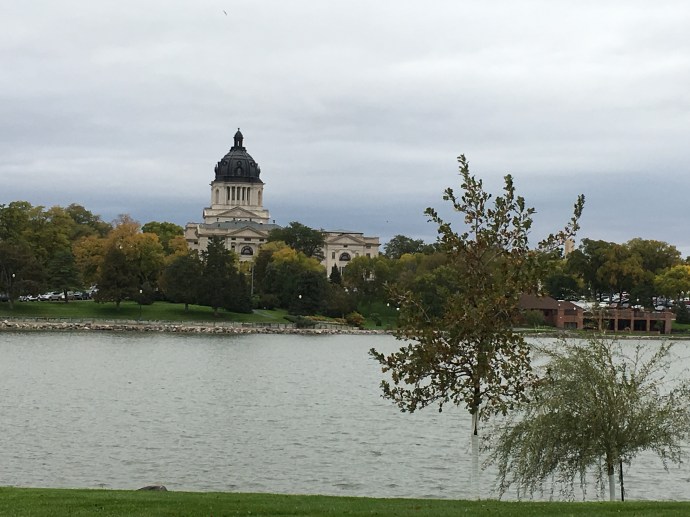
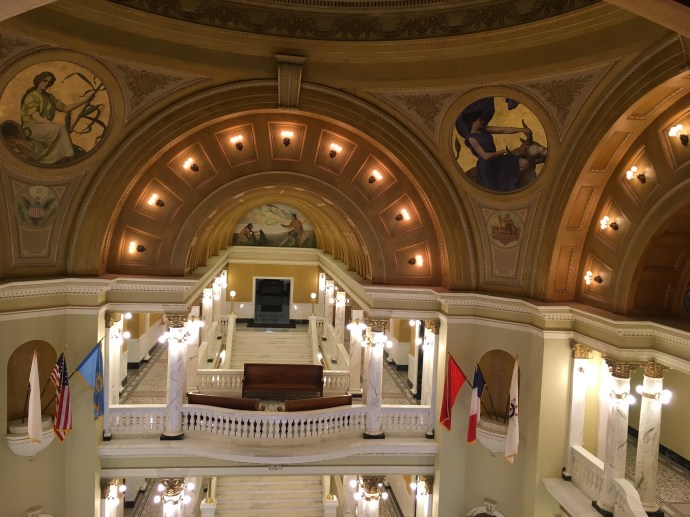
After Wall, it was on to Pierre SD. Pierre is the capital of South Dakota and a town of about 20,000. Pierre is the second smallest capital city of any U.S.capital city. We spent an hour touring the capitol by use of a written self-guided tour script. The building was constructed in 1910 and renovated in the 1980s. Given the size of this state, we were surprisingly impressed with the quality of the building and its beauty. It was not stunning, but very, very nice. It was also interesting that the selection of which town should be the capital of the state was subject to four state-wide referendums; all of which proclaimed Pierre as the capital.

Interior shot of dome of SD State Capitol

Interior shot of dome of SD State Capitol

Shot of inside hall at SD State Capitol

Shot of inside hall at SD State Capitol

The Governor’s Reception Room had a “Come On In” sign, so we did. The receptionist gave us a pleasant description of the room. The Senate and House chambers were open, but empty, so we were able to view each one. Their aesthetic decor differ but present well. The Capitol Building rises slightly above the surrounding land and there is a small, nearby lake that sets off the building nicely.

Ed and Chris

Categories: road trip, travel | Tags: , , , | 1 Comment

Blog at WordPress.com.