road trip

2017 Trip Two: Tour of Texas April 8-9

Fort Worth Texas Sunday April 9
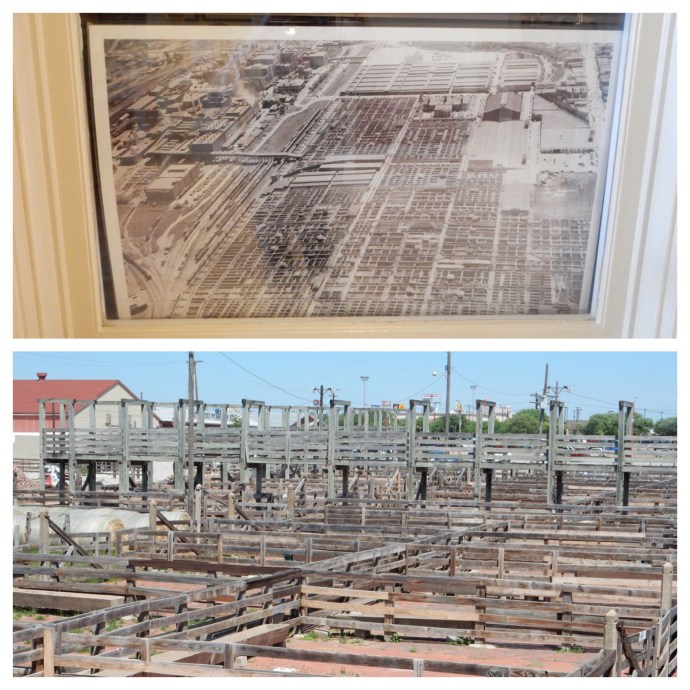
Above: An early photo of the stockyards; Below some of the remaining cattle pens

Saturday April 8
Saturday was a tourist type day. The Stockyards area of Fort Worth is a historical area, focused on the old stockyards. History buffs probably recall there were major stockyards in Chicago, Omaha, Fort Worth and South Saint Paul MN. Only Fort Worth has really maintained a vestige of the old buildings.

Here in Fort Worth, after the Civil War cattle were herded from the ranching communities to railheads, locations where the cattle were loaded onto train cars and shipped east to be slaughtered. Fort Worth had business leaders who realized the future was not in shipping the cattle but in producing the beef here. Swift and Armour, two of the major beef processing companies, were attracted here in the early 1900s and built plants across the street from each other.

One interesting story about the stockyards is that financial struggles were causing concerns about its ability to survive in the early 1890s. A Boston investor came out to check the situation. He observed cattle pens that were full and figured this was a great investment. He bought in and provided financial security. However, the pens were abnormally full due to wet weather and a railroad strike that limited the ability to move cattle out. The data for the Boston investor was bad, but the investment proved strong.

During WWII, meat rationing and price controls led to some black market meat production, particularly at smaller plants around the country. After WWII, the demand for meat exploded and the small plants started to grow. The stockyards in Chicago, Omaha, South St. Paul, and Fort Worth now had older facilities and found it hard to compete. By 1971, the last plant here had closed.

The Livestock Exchange

Several of the buildings still exist. The Exchange Building where stock were sold. The Coliseum, where livestock auctions were held (site of our Friday night rodeo). The Livery, where horses were stabled. The Railroad Station, where trains came in. The pens, where stock were kept until slaughtered. The old hotel where people slept when here on business.
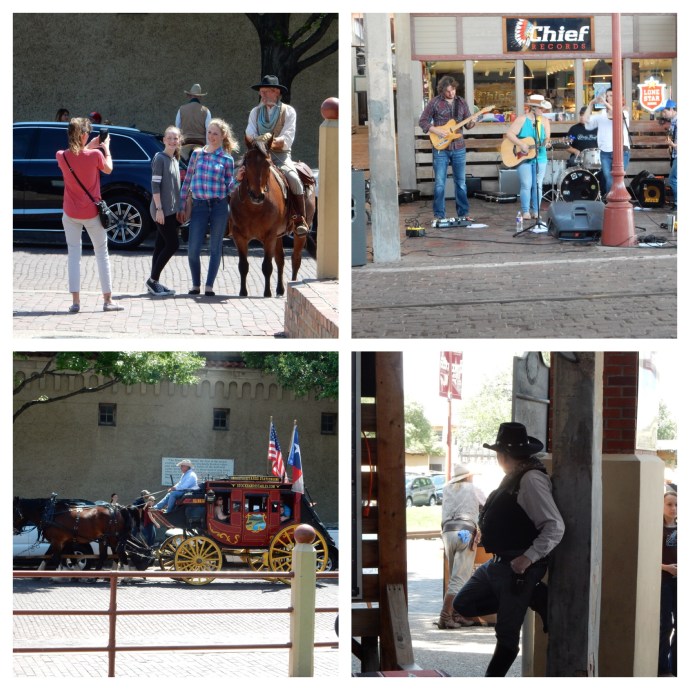
A few of the activiites occurring in the Stockyards district

The historical district runs an active tourist program. Rides in buggies, stagecoaches, etc are offered. Horseback rides are available. People dressed in period dress walk the streets and talk to people. Several cowboys are riding horses down the Main Street so little, and big, kids can pet the horses and get their pictures taken with the horse and cowboy. Twice a day, the cowboys drive about a dozen longhorn cattle from the pens down the Main Street for tourists to see and take pictures. So we played the tourist and just took it easy.

Longhorn cattle

We toured the buildings. We went through a small museum. We shopped and actually bought a few items. We people watched. We took pictures. We ate lunch at a small,less-touristy cafe. We sat and relaxed. We viewed the Longhorns at their pens.

Saturday evening we made 5:00 PM Palm Sunday service and went out to eat with our Evergreen hosts and some friends at a local barbecue restaurant. Tall tales were told and promises made not to spread them around. Sorry.

Sunday, April 9
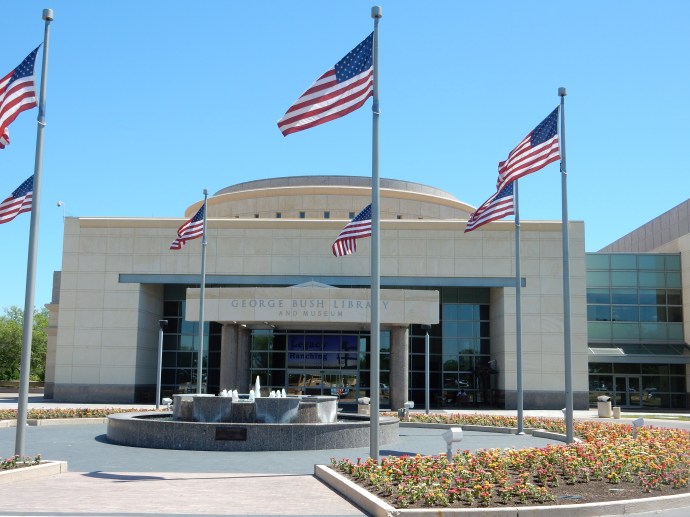
The United States has had only two father-son combinations as President. The Adams and the Bushes. Last week we visited the George H.W. Bush Presidential Library (the 41st). Today, Sunday, we visited the Presidential Library for George W. Bush, the 43rd President of the United States. It is at Southern Methodist University in Dallas. SMU is the host; Laura Bush went to SMU and the Bushes live in Dallas.
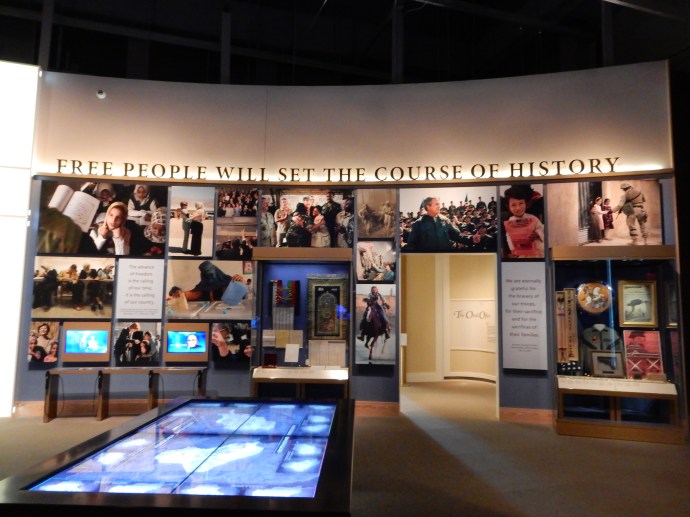
At the George W Bush Presidential Library at SMU in Dallas

Bush was President from 2001 to 2009. He was President during the 9/11 tragedy, the Hurricane Katrina tragedy, and the Financial Crisis of 2008. As do most Presidential Libraries, there is a replica of the Oval Office. The displays are more technically savvy, the print on the exhibits is large and easy to read. The exhibit did a decent job of summarizing the Bush Presidency.

What we did find lacking in the library, was information about George Bush before he became President. No information on his time as Governor, nothing about his one failed attempt to become a U.S. Congressperson, extremely little about his business career, and relatively light on college and military. Still, it was two hours well spent. Other people seemed to agree; this library was much busier than the library for Bush 41. Bush 43 Library has only been open for four years; so far the numbers show twice the attendance for Bush 41. Of course, Bush 43 is in the Dallas-Fort Worth metro area; Bush 41 is located in College Station with a metro area population less than 1/10 of DFW.
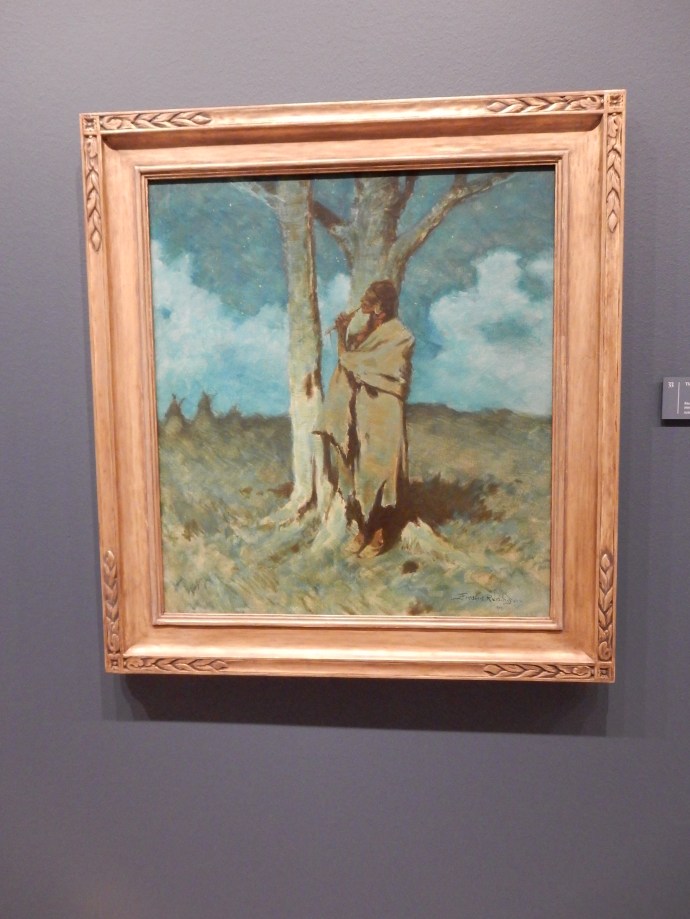
One of the Frederic Remington paintings at Sid RIchardson museum in Fort Worth

After the library and lunch, we visited another western art museum. Sid Richardson was an independent oil driller/explorer who struck it rich and lost it all several times. Finally, he found consistent success in West Texas and became extremely wealth. The Sid Richardson Museum is in downtown Fort Worth and focuses on western art, similar to the Amon Carter Museum of American Art. This is an excellent gallery, full of Frederic Remington and Charles Russell and a few others. The gallery is relatively small, less than fifty works of art on display. Of particular value is the gallery brochure which each visitor receives. The brochure identifies each piece of art, describes its strong points, when it was painted, etc. A visitor to this free museum can walk around the gallery and read about each painting with ease from this brochure.

Sundance Square in downtown Fort Worth

Our final stop was to Sundance Square in downtown Fort Worth. Sundance Square is an integral part of the revitalization of the downtown. We sat in the square and watched the children play in the splash fountains. Downtown has a vibrant combination of historic and new buildings created by a coalition of political and civic leaders.

We wrap our evenings discussing all sorts of topics with our Evergreen hosts.

Ed and Chris

Categories: road trip, travel | Tags: , , , , , | Leave a comment

2017 Trip Two: Tour of Texas April 7

Fort Worth Texas Saturday April 8

View of Fort Worth skyline from Amon Carter Museum of American Art

Friday April 7
Lest you think we are getting lazy, we left Athens TX early Friday morning and walked for an hour around the East Texas Arboretum. Our Evergreen hosts had to travel to southern Texas for a wedding Friday afternoon so we left the house early. The Arboretum had been our goal Thursday afternoon but, as you may recall, we spent that time watching pigs being judged instead.

East Texas Arboretum

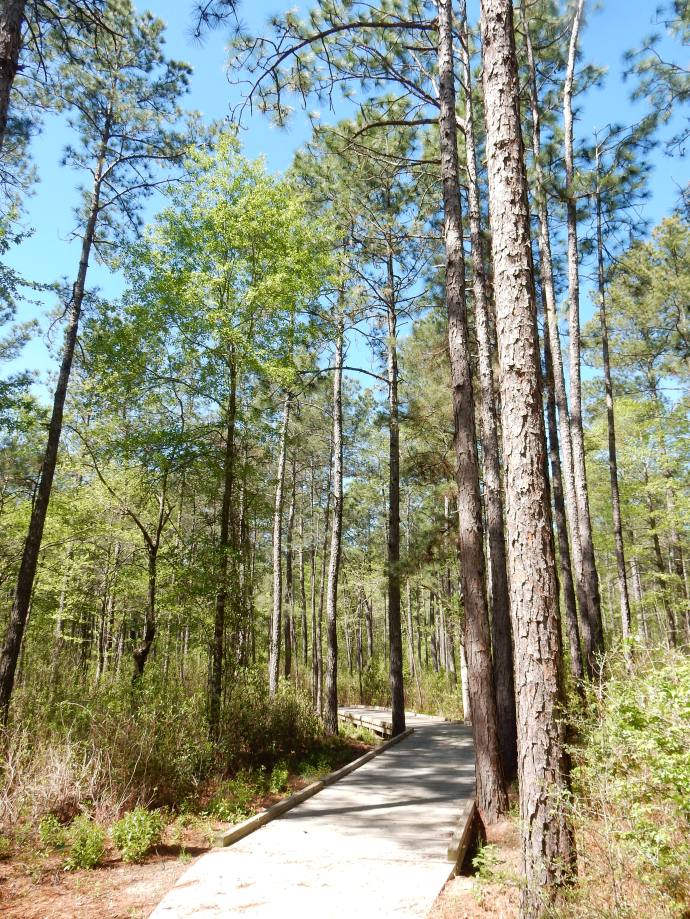
The Arboretum had walks through a bog, a dogwood trail (no dogwoods in bloom), and a hardwood forest among its options. The early morning sun and cool temps gave some nice contrast to the heat and sun of the afternoons.

Fort Worth was to be our next destination for lodging. Fort Worth appeals to us more than Dallas. Dallas is bigger than Fort Worth (1,260,000 vs 800,000) and each one is bigger than either St. Paul or Minneapolis but I viewed Fort Worth as the little brother to Dallas; similar as St. Paul is viewed to Minneapolis. Fort Worth also seemed to have more interesting attractions. A major impetus to the growth of Fort Worth’s is tied to the cattle business; from the shipping of cattle via railroad in the late 1800s to the meat-packing business of Armour and Swift.

But Dallas did have one or two items we wished to see. One was Dealey Plaza, the area around the assassination site of President John F. Kennedy. Good luck came our way and we found an on-street parking spot half a block from the museum. When we arrived at the museum the cashier told us it would be 90 minutes before we could gain admittance. Chris and I looked at each other and decided it was just not worth our time to wait. (Our Evergreen hosts in Fort Worth later agreed with our decision.)

The Mustangs at Las Colinas

Instead we hopped back in the car and drove to Las Colinas. This was a destination recommended to us by one of our Evergreen hosts. The Mustangs at Las Colinas at Williams Square in Irving Texas is the largest equine sculpture in the world. Las Colinas is a combined residential-commercial development that was once a family ranch. The owner-developer wanted a signature sculpture to showcase the development. He commissioned an African wildlife artist to create a sculpture of mustangs running in the wild. The end result is shown.

The sculpture depicts nine mustangs, two stallions, two foals, and five mares running in a stream. The setting is in the midst of a stark plaza surrounded by three high-rise office buildings. There is a small museum in one of the buildings with exhibits and a video explaining the eight year process from concept to final installation in 1984.

From the mustangs, we headed over to the National Cowgirl Museum in Fort Worth. Along the way we stopped at the Railhead Bar B Q in Fort Worth for lunch. Turns out Railhead is one of the top rated barbecue places in Dallas Fort Worth. We chose it by happenstance. I loved the saying on the staff shirts: “Life is too short to live in Dallas”.

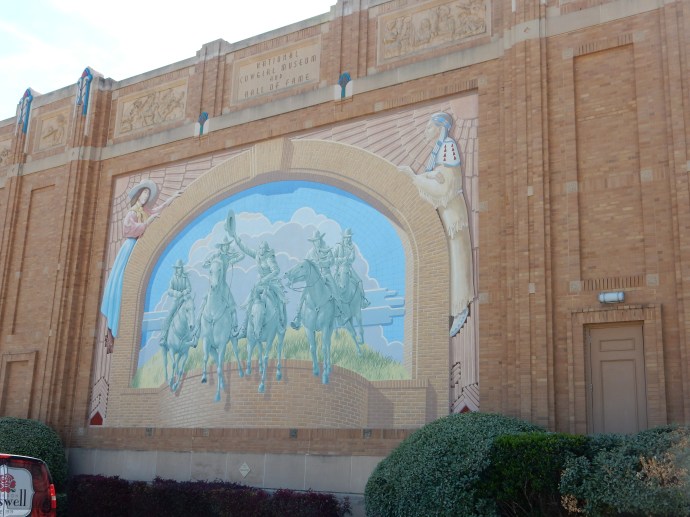
National Cowgirl museum in Fort Worth Texas

The museum started in 1975 in western Texas (by Amarillo). Over time, it expanded, gained funding and moved to a brand new museum building in the Cultural District of Fort Worth. (Pictures are not allowed inside.) The Cowgirl Museum discusses the overlooked role of women in the cattle business. There is a Hall of Fame listing notable women and yes, Annie Oakley does get major play.

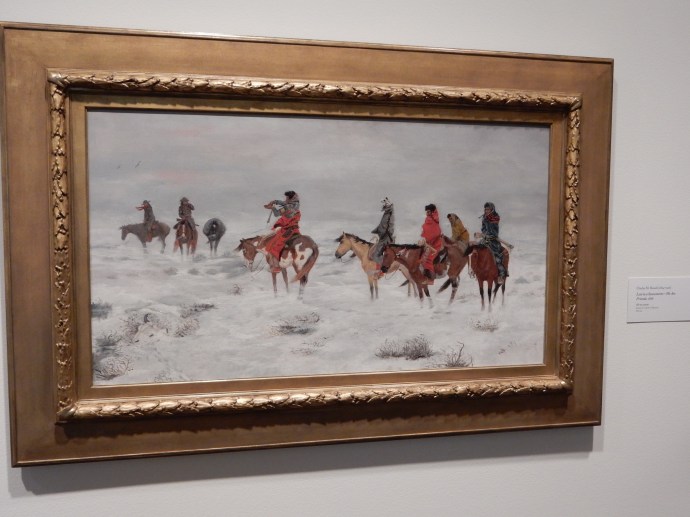
A Charles Russell painting at the Amon Carter Museum of American Art

The Fort Worth Cultural District includes, among others, the Amon Carter Museum of American Art. The museum began as the personal collection of Amon Carter, a Fort Worth businessman. Carter was born in a log cabin and quit school at age 11. His business sense led to his work with the local newspaper and over time into oil and aviation. He started collecting works by Frederick Remington and Charles Russell in 1935. He died in 1955 and this museum was established through his foundation. It opened in 1961 and his funding provided for it to be free to all.

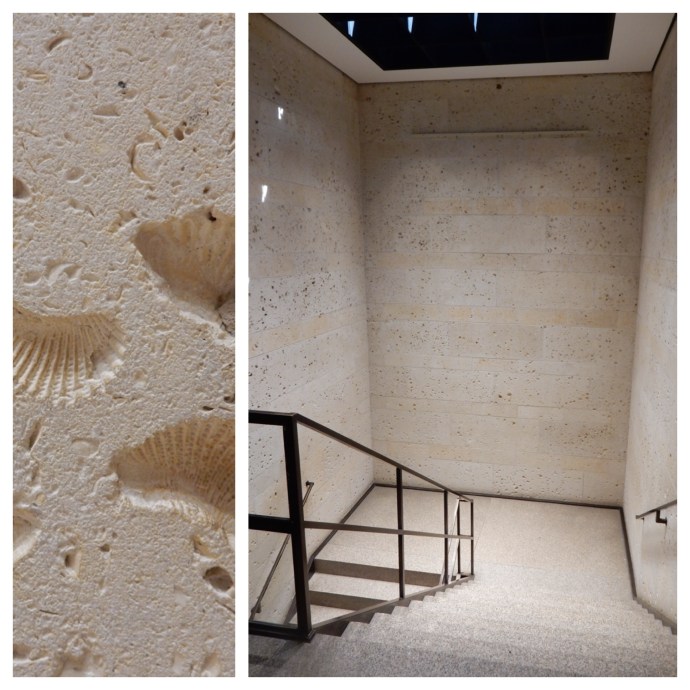
Cordova shellstone interior wall at Carter Museum

One of the interesting notes about the museum building was the use of Cordova shellstone for the exterior and interior walls. If you look closely, one can observe the imprints of the shells from the ocean that covered this area of Texas hundreds of millions of years ago. (Remember the discussion from the oil museums?) Besides the exhibits of works by Remington and Russell, there were special exhibits. To be frank, several of those (Avedon in Texas and Gego as Printmaker) did not excite me. Two others, Invented Worlds of Valton Tyler and Prints of Helen Frankenthaler, were more my cup of tea.

After the museums, we met our Fort Worth Evergreen hosts for a quick meeting before heading back out the door for an evening performance of the Stockyards Rodeo. One does have to pay for parking of course. Simple, right? Well, not if you are me. I foolishly, I know not why, put my credit card in the cash slot. Well, the cash slot did not give my card back but the people behind me in line were patient and considerate. Others tried to help but it took Chris going to get a needle nosed plier from one of the open retail shops to get the card out while I was on hold trying to cancel the credit card. Fortunately, Chris got the card out before I canceled the credit card. We made the rodeo after the Star Spangled Banner.

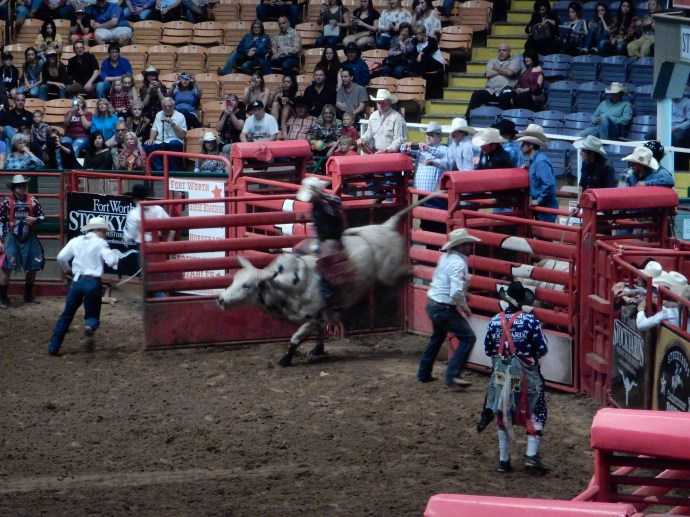
Bull Riding at the Stockyards Rodeo in Fort Worth

The rodeo was fine; in my mind it was a little more oriented to a family show. Twice they had children come out onto the arena and let loose a calf and a sheep. Surprised the heck out of me but no one was hurt and they all seemed to have fun.

The two hours covered bull riding, barrel racing, calf wrestling, roping, etc. I even behaved myself and mainly watched the show versus taking pictures. The fact that we had seen rodeos before probably helped. My sister-in-law keeps insisting that there is no rodeo to compare with the Houston Rodeo. Despite our times in Houston, we have never attended the Houston Rodeo so I will have to take her word for it.

Ed and Chris

Categories: road trip, travel | Tags: , , , , , | Leave a comment

2017 Trip Two: Tour of Texas April 4

Waco TX. Tuesday April 4

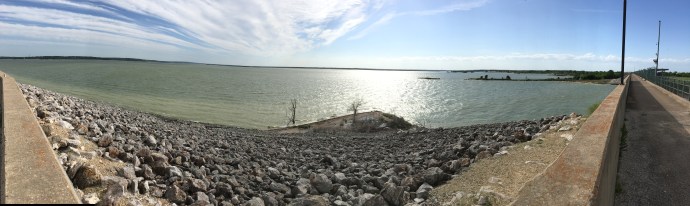
Lake Waco formed by damming the Bosque River

From mammoths to poetry to Dr Pepper to cupcakes. What a varied and delightful day! We started out with rye bread French toast, new to us but very tasty. It will have to be added on to our list for home breakfast options.

In 2015, the Waco Mammoth site was added as a National Historical Monument. Maybe you have not heard of mammoths in Texas before? We had not. Woolly mammoths up north during the glaciers, yes, but non-woolly mammoths? In 1978 two men discovered an unusual bone in a creek bed near the Bosque River outside Waco. Okay, let’s be honest. It was two teenage guys trespassing along a creek bed but given the discovery, it seems the trespassing part is downplayed. Momma, sometimes your teenage boys doing wrong do right.

The two boys took the bone to museum staff over at Baylor University. They identified it as a femur of a Colombian mammoth. Colombian mammoths were huge; more than 14 feet in height and up to 20,000 pounds. This is 2-4 feet higher and up to 8,000 pounds more than a wooly mammoth. It is also much bigger than current African or Asian elephants.

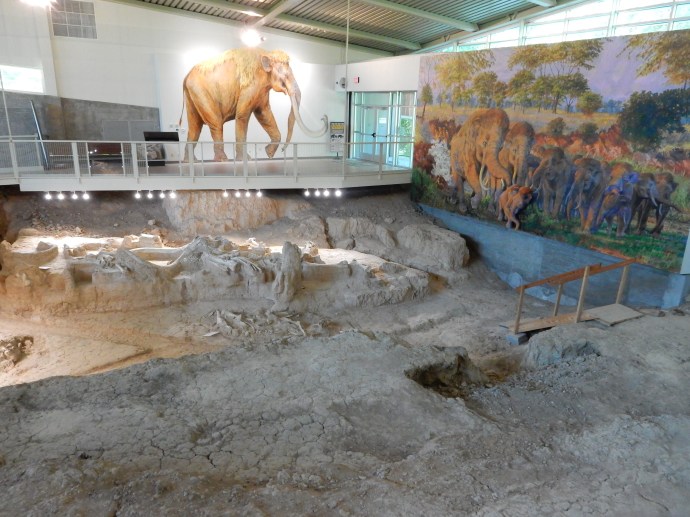
The dig site showing an artist rendering of a mammoth-actual size and the nursery herd along with the bones still in place down below.

Once Baylor identified the femur, they spent 20 years excavating the site. Baylor identified a nursery herd of mammoths (females and their young) and they probably all died together around 65,000 years ago. Other mammoth bones have been discovered in the same area, having died 10,000 years after the nursery herd. This must have been a popular area; bones of Western camels (remember our Museum visit in Nebraska earlier on this trip?), saber tooth cat, dwarf antelope, and giant tortoise have been excavated. 24 separate mammoths have been identified over the years. Further excavations are on hold pending more money.

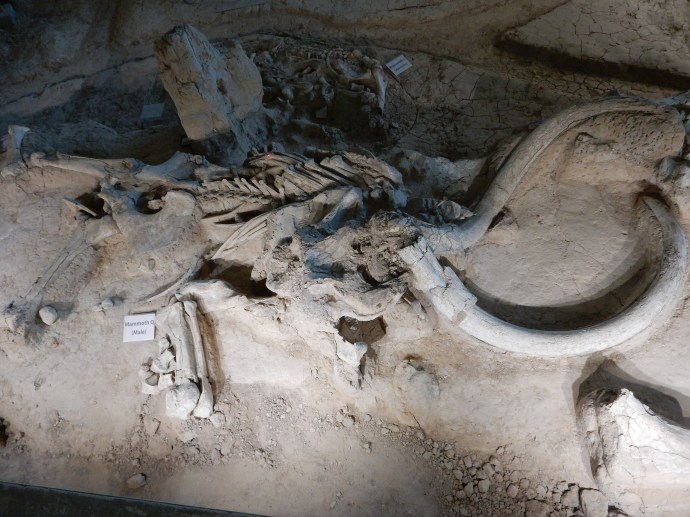
Close in look of the in place bones

Most bones are stored at Baylor but the NPS site has a climate controlled exhibit building where a visitor can observe bones still in place, partially excavated. A guide gives a 45 minute tour and does a great job of explaining the history and identifying the bones and tusks, etc. We met a dad from Columbia MD who was taking a slow drive to San Francisco to deliver to his daughter the oar she had been presented at graduation from the crew team. I guess she had finally moved into a place that could hold an oar of that length. One of the rangers on duty was originally from MN so we shared stories.

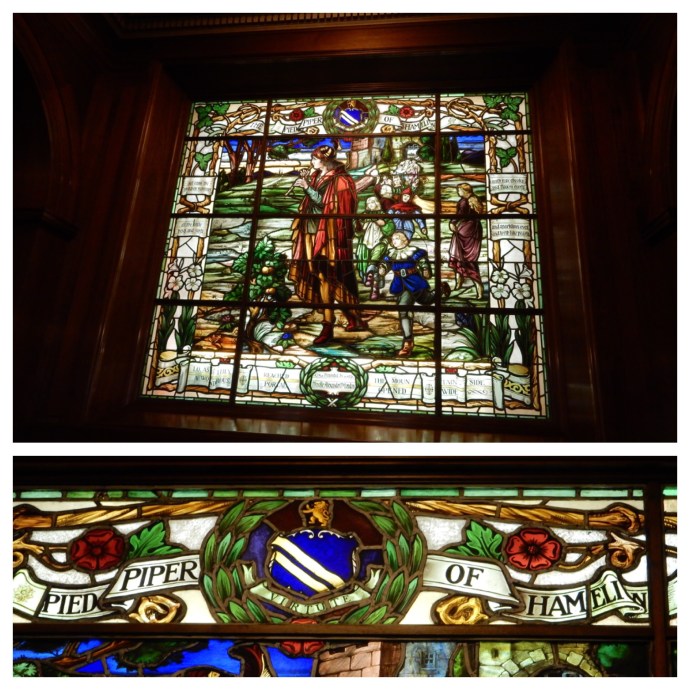
The Pied Piper of Hamelin stained glass window-on a Browning poem

After the mammoths, we went to Baylor but not for more bones. Instead we viewed the largest collection of secular stained glass in the world. The Armstrong Browning Library is named after Professor Armstrong who taught English at Baylor from 1912 to 1952 (He was 79 when he retired.) and after Elizabeth and Robert Browning. Armstrong was a Browning scholar and collector. The Brownings, if you do not know, are a husband and wife couple who were English poets of the Victorian era.

When the library was being built in the 1950s, they called it “The Most Beautiful Literary Shrine in the World and it is owned by Baptists!” Baylor is a Baptist university; at 16,000 students it is the largest Baptist owned university in the world. The library is beautiful. It is more a repository for the Browning collection than a major working library of the school. Few students were using it for study but music recitals and practices are held here due to the wonderful acoustics in the McLean Foyer of Meditation.

Stained Glass window by Willet at Armstrong Browning Library at Baylor

We came primarily to see the stained glass. Distinct styles are presented in the various major rooms of the library, spread over the basement and three additional floors. One of the stained glass artists/makers is the company of Willet Stained Glass which has a location in Red Wing Minnesota.

The Dr Pepper museum in Waco, the change in brick coloration indicates where the Waco tornado of the 1950s damaged the building

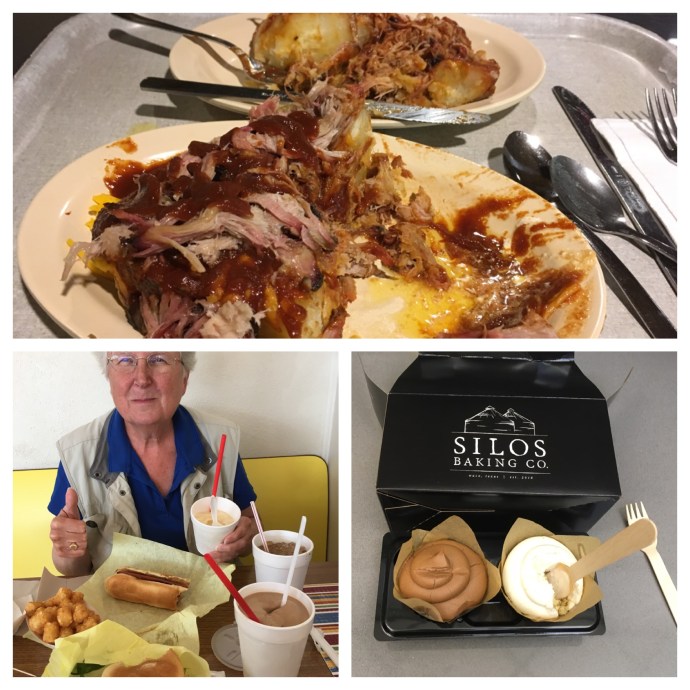
Lunch was a local staple, the Health Camp. Nothing healthy here, burgers, hot dogs, shakes, fries, etc. Then it was on to more sugar, the Dr Pepper Museum. Dr Pepper originated in Waco at a local drug store. One of the pharmacists mixed various tastes together, 23 in total, and it became Dr Pepper. The HQ for Dr Pepper is now in Dallas and it is part of a larger food conglomerate, Cadbury-Schweppes. Over the years, it has had financial difficulties and Cadbury Schweppes now markets Dr Pepper with Snapple, 7-UP, and other beverages.

The Dr Pepper museum showcases the history of the beverage, the tie-in with Waco, various leaders of the company, the bottling process, and marketing efforts. Chris and I spent 20 minutes watching old TV commercials for Dr Pepper and Diet Dr Pepper. We realized we could not recall ever seeing any of the commercials before coming here. Either our memory is weak, they ran when we were not watching TV, or the ads were not shown in our part of the country. In any event, we found the commercials humorous. We also realized it had been decades, or never, since we had a Dr Pepper. We stopped at a convenience store and shared one. Not too bad.

The Magnolia store and silos related to the HGTV show of Chip and JoJo Gains

After Dr Pepper, our steps took us over to a new experience for us. Chip and JoJo Gains have a TV show on HGTV that is evidently a big hit. News to us-our Evergreen host told us about it this morning. The Gains are based in Waco and their store, Magnolia, and show draw big crowds. It took us 20 minutes waiting in line to buy two of the cupcakes for sale at their bakery. The store selling their items is crowded with an outdoor seating area and play yard for kids-and parents of kids. Cars are parked for blocks. A trolley and Baylor buses stop here on a regular basis. But we did not even find a post card that interested us in the store. The cupcakes are another story; we just ate them. Wunderbar!

Vaquero and cattle-Mexicans were the original cowboys of the West.

Last experiences of the day were outdoors. It was just an excellent day to be outside. We walked over the suspension bridge crossing the Brazos river in downtown Waco. The Chisholm cattle trail went through Waco and there ae sculptures recalling that period at the west end of the bridge. Then it was a walk up to the dam on the Bosque River creating Lake Waco outside of downtown. Crossing the suspension bridge and looking down at the Brazos River it struck me how brown, brown, brown all of the rivers in Mississippi, Louisiana, Georgia and Texas have been. Not that Minnesota rivers are pure, but the deep, deep brown of all of these southern rivers was unnerving. How can one enjoy them?

Our healthy diet for the day

We wrapped up with dinner at another local staple, Uncle Dan’s where we shared a huge stuffed, baked potato.

Ed and Chris Tuesday April 4

Categories: road trip, travel | Tags: , , , , , , , | Leave a comment

2017 Trip Two: Tour of Texas April 2-3

Waco, Texas Monday April 3

Wildflowers in the median of Texas Highway 6

Our driving through Texas has begun. Obviously our observations are not an accurate picture of Texas but simply a snapshot of what we have seen and how we interpret them. For instance, Texas is showing us roadside flowers, unlike Louisiana. In Louisiana, we observed state crews mowing the median and sides of roadways. I had thought states had stopped roadside mowing in order to allow for habitat for birds and butterflies, particularly nesting birds. I guess I was at least partially wrong. Louisiana’s roadsides looked sharper since they had just been mowed, but Texas roadsides were more attractive with the additional color. I was told this evening that azaleas in the Waco area have come and gone. Early spring and heavy rains have ended their season. I have hopes for other parts of Texas.

On the road north from Houston to College Station, it appeared that every property was a ranch with detailed and fancy gates and driveways. I did not have Chris take any pictures, thinking the gates would continue in areas further along where the traffic might be lighter. So far, wrong. The gates ended at College Statin and did not re-appear on our way to Waco.

Of course, my favorite criticism is drivers. In Florida we had truly reckless and extremely speedy drivers. In Louisiana it seemed the law must require drivers to never use a turn signal. In Texas it is speed, but in an unusual way. When the speed limit is 75, speeding is minimal. When the speed limit is 55 or 65, no matter what the legal or safety reason might be for the lower limit, everyone still drives at 75 mph. It is as if a lower limit is an affront to the moral right to drive at 75.

Sunday was our day to visit with relatives, our daughter-in-law Sarah’s maternal grandparents. They invited us over for a delightful brunch. We also visited with Sarah’s mother, sister, nephew and cousin. We did not do any other tourist or outdoor activities. The weather was stormy but the rain held off surprisingly.

Presidential Library of George H.W. Bush, 41st President of the United States

Today our major stop was at the George (H.W.) Bush Presidential library in College Station. College Station is home to Texas A & M University. Bush is not an Aggie, he went to Yale. George and Barbara Bush moved to Texas in the early 50’s and they became dedicated Texans. President Bush stated that he was always impressed with the Aggie spirit and mission; locating his library here was a means to recognize that.

Chris and I have come to truly enjoy and appreciate presidential libraries and homes. (We will see two more on this trip.) The early ones like the homes of Taft and Garfield are less impressive but it is re-connecting with the spirit of the person who became President of the United States that is so meaningful. It is helpful for us to have space between the time when a man was President and when we view the library to have a fresh perspective; to not have our thoughts impacted by current angst over a particular decision or occurrence. We also frequently have “Ah ha” moments; remembering old tidbits of history or learning brand new ones.

A few of George Bush’s favorite quotes

The Bush Library struck us as a reflection on the life and family of George and Barbara Bush. The Clinton Library, in contrast, was overwhelming in facts, data, events. Here there was a more nuanced reflection on life background, moments and activities that shaped the couple. There was a broader recounting of George Bush’s military service history, political history (Ambassador to U.N and China, CIA Director, Vice President, U.S. Congressman) and dedication to a life of service, including before and after his term in office.

The accomplishments of Barbara Bush in her first 100 days as First Lady

The exhibit does discuss the challenge of being President when both houses of Congress are in the hands of the opposition party; the passage of the Clean Air Act and Americans with Disabilities Act; the invasions of Iraq and Panama; and the fall of the Berlin Wall.

Our second stop was at the Texas Ranger Hall of Fame and Museum. What can be more Texan than that? The museum has a history of the Rangers from inception under Stephen Austin (10 Rangers) at the beginning of the Texas colony under Mexico. There were times of less than stellar activities but primarily it is a well-earned positive image. Today the Rangers are a small (150) portion of the Texas Department of Public Safety, serving all over the state primarily in criminal investigation functions.

Chris holding one of the earliest Colt pistols, weighing just under five pounds

At one early stage in its history, the Rangers also served as surveyors. Their focus shifts as the state changes. Defense of white settlers from Indian raids was an early task, the suppression of outlaws during the wild and wooly days after the Civil War is well-known. Border protection has been a constant; the desire by criminals to commit crimes across national borders seems to be never-ending.

In Waco we are staying with an Evergreen host. We will be with Evergreeners for ten nights during this stretch in central Texas. Dinner was dutch treat with our host at a local restaurant.

Ed and Chris. April 4

Categories: road trip, travel | Tags: , , , | 1 Comment

2017 Trip Two: Tour of Texas. March 31-April 1

April 1, Saturday, Houston Texas

We titled this trip Tour of Texas and after a month of travel we finally made it to Texas. You may have wondered if we knew what we were writing about. We do, it just took us a while to arrive here. No problem, though, we have a month of travel left for Texas.

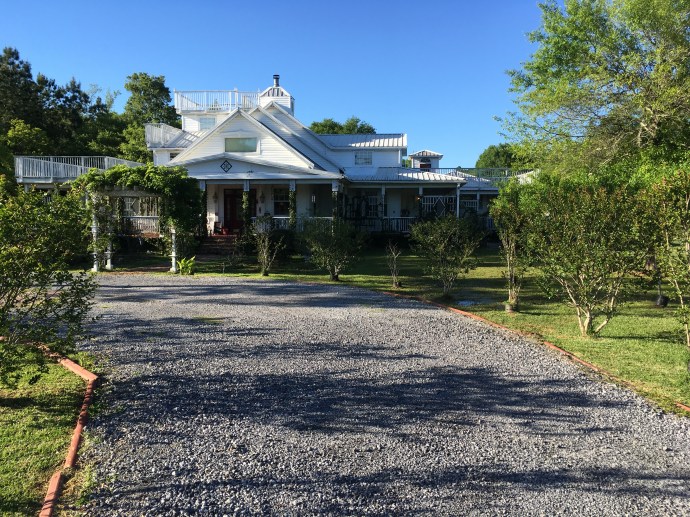
The Book Nook Inn B & B in Lumberton TX

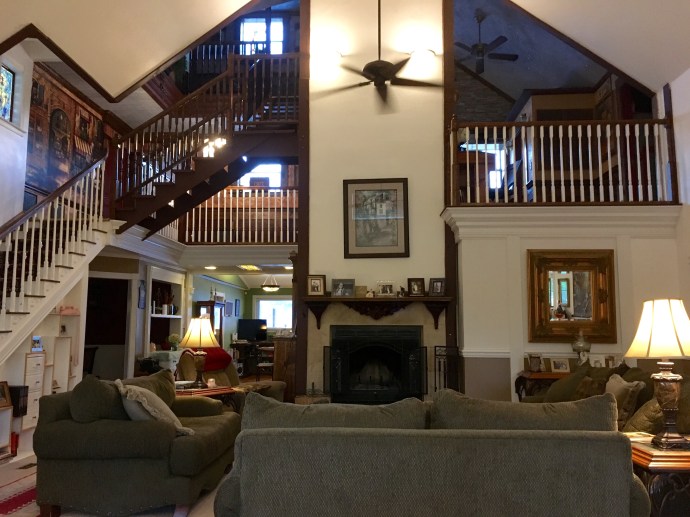
Inside the Book Nook Inn in Lumberton TX

Friday, March 31st, was a slower day than planned. Our goal was to spend most of the day hiking at Big Thicket National Preserve. However, the Southern cuisine did a number on my stomach and walking far was the least of the activities I wanted to undertake. Luckily, the Book Nook Inn B & B was a welcoming place and we spent time on the veranda sitting, contemplating, or talking with the owners.

Big Thicket National Preserve

We did go to Big Thicket and walked a short hike. Big Thicket Preserve represents about 5% of the original pine and cypress forest, hardwood forest, meadow, and black water swamp that was here. The other 95% of the forests, swamps, meadows, etc. disappeared due to wood cutting, rice-growing, oil drilling and the homes and businesses of 500,000 people.

Forests and trees are probably not your conception of Texas but the uniqueness of this area and the diversity of flora and fauna made even partial preservation a natural concept. In gaining approval, though, the enabling legislation mandated the continuance of hunting, trapping, oil and gas exploration, and cutting of non-native tree species.

We are spending the weekend in Houston to visit some relatives. On the drive here, we stopped at two lesser known museums. First was the Babe Didrikson Zaharias museum in Beaumont. The name may be unfamiliar to most of you. Babe was probably the most well-known female athlete of the first half of the 20th century and considered the greatest all-around sportswoman in history.

The museum was small and probably does not get many visitors. It showcased her early life in Beaumont, her three gold medals in the 1932 Olympics (all three categories she was in), and her unmatched golf prowess. Golfing gave her the best recognition, she won 82 amateur and professional golfing tournaments. Babe died in 1956 at age 45 of colon cancer.

Our second stop was in Houston at the Buffalo Soldiers National Museum. Our trip to Yellowstone in 2013 first made us aware of the “Buffalo Soldiers”. The term was first used to refer to black soldiers who fought against Native Americans in the West. The Indians respected their fighting ability and saw a similarity between the mane of a bison and the curly hair of some African-Americans. The term has broadened over time to become a generic name for all African-American soldiers from 1866 through WWII.

This museum was founded in 2001 through the dedication of one man who visioned it as an American history museum, not a black history museum. Plentiful memories and tidbits of history are showcased in the video and display cases of the military tribulations and successes of black soldiers. Despite the segregation and lack of acceptance, black soldiers represented this country proudly. Their segregated use in WWII led many of them to come home and not accept Jim Crow but to begin the march to full repeal of segregation laws.

The Harriet Tubman historical reenactor at Buffalo Soldiers National Museum in Houston

We received an extra bonus at the museum. A historical reenactor made a moving presentation as Harriet Tubman, tieing it into Harriet’s role in the Civil War. Harriet was the first woman to lead an armed expedition, hers freed 700 slaves. We had visited the Harriet Tubman post Civil War home in Auburn NY last fall.

Tonight we are just at a Springhill Suites. We got an excellent rate at a hotel in a business park, they must be slow on weekends.

Ed and Chris. April 1

Categories: road trip, Uncategorized | Tags: , , , , | 1 Comment

2017 Trip Two: Tour of Texas March 30

Lumberton, TX. Friday March 30

Our one time on this trip to see the Gulf of Mexico in Texas

Our patio at the Savoy B & B in Lafayette LA

Rice, ranching, and roseate spoonbills; our day in a nutshell. We left our great B & B in Lafayette, the Savoy B & B, with fond memories. Overnight the area received a real soaking of rain, the morning began cloudy but cleared up as the day went on.

Views from our Thursday drive

Back roads continue to be our primary choice. We use Google maps more frequently now than the Rand McNally atlas; choosing less traveled options, roads that frequently are not even on the atlas. The view is a more varied countryside, hence the views of rice paddies today and sugar fields the last two days. We pass run-down homes and sub-divisions of large, expensive brick homes.

Twice in the last week though, Siri has dictated errors from the Google Maps plan. Once we were routed off a portion of Interstate, reversed direction, and had to turn around at the next interchange to get back to the planned route. The other time when the traffic got slightly heavy, we turned at the next signal light, making a right, left, right and rejoined our original road two blocks farther along. You wonder what is happening but don’t have time to stop and check the directions before you arrive at the questionable direction location.

Roseate Spoonbills

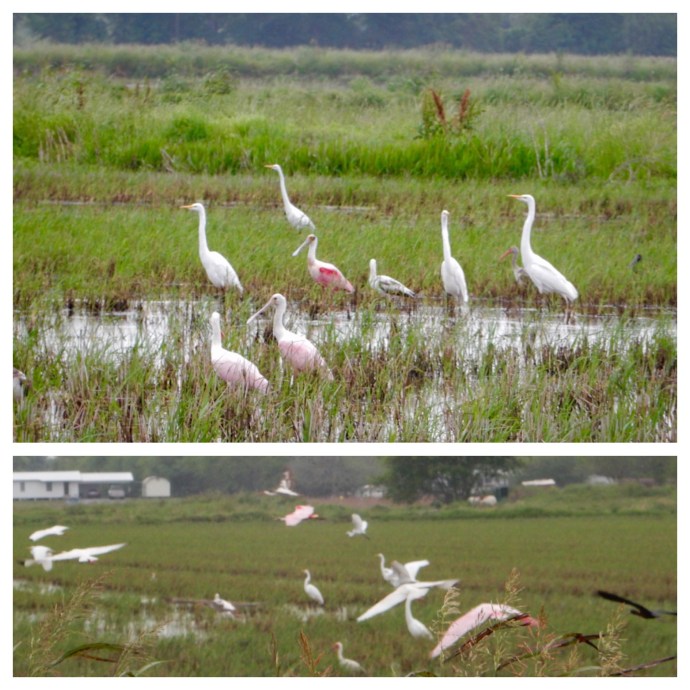
Our route today took us along Creole Nature Trail, the road closest to the Gulf of Mexico. The Gulf was not normally in view but marshes and waterways next to it were. As we were driving along, we came across a mass of birds in the fields, numerous roseate spoonbills among them. Their pink color made for a great contrast to the white and black of the other birds. This road was so little used, we stopped the car in our lane and took pictures with no worries of cars coming up from behind us.

The Rand McNally was used to direct us to a side trip to see the Gulf. Chris said it was just a five-mile jog to a public access beach. The view was not overwhelming, there were some oil rigs in the distance, but a pleasant diversion.

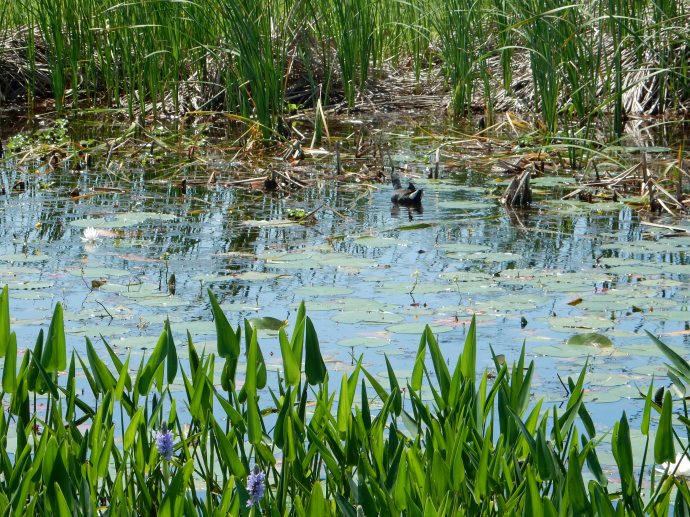
Much more interesting was Pintail Drive, a three-mile trail in Cameron Prairie National Wildlife Refuge, south of Lake Charles Louisiana. (We ran into a Minneosta couple here that had also been on our swamp tour in Lafayette, LA.) A forty-five minute slow drive showcased alligators, turtles and countless birds of types we could not identify.

Along pintail wildlfie drive in Cameron Preserve

Along Pintail Wildlfie Drive in Cameron Preserve

Along Pintail Wildlfie Drive in Cameron Wildlife Preserve

Did you know alligators do not eat during the winter months? When spring comes, they need heat more than food to get their body back into full operating mode. Once they heat up and get energy, they will start eating-and then go onto mating.


Video-alligators use an open mouth to help regulate body temperature

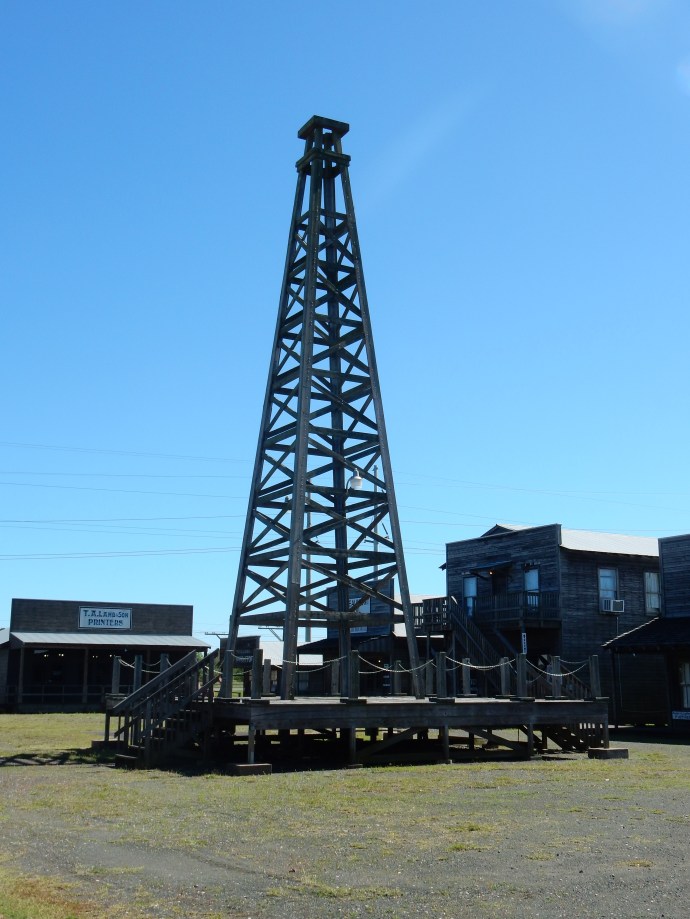
A final stop before bedding down for the night at the Book Nook Inn in Lumberton Texas was the Spindletop-Gladys City Boomtown Museum. Spindletop was the first true oil gusher in 1901 and really ushered in the wide-spread use of oil as a fuel. Mobil/Exxon, Gulf, and Texaco all got their start here.

A replica of an early oil derrick at Spindletop Museum

I had been confused by pictures showing oil derricks in the hundreds sort of cheek to jowl. Evidently in those early days, lease rights were parceled out in lands as small as 1/64 of an acre. Spindletop’s big push lasted only 10 years but it gave the impetus for this stretch of Texas and Louisiana to produce and refine oil and for cities like Port Arthur to become shipping cities.

Ed and Chris. Lumberton TX. March 31

Categories: road trip, travel | Tags: , , , , , | 1 Comment

2017 Trip Two: Tour of Texas March 28-29

Lafayette, Louisiana. Wednesday March 29

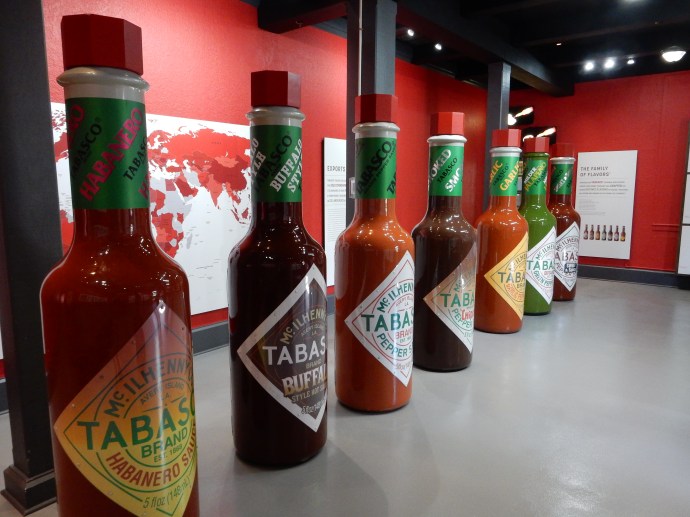
Tabasco Sauce oversize bottles at the factory tour

Zydeco. Cajun. Acadian. Tabasco. Bayou. Sugar. Oil. Crawfish. Catfish. Alligators. Floods. What do you think of when Louisiana and its delta area are mentioned? We have spent an enjoyable two days touching on all of those and other aspects of life in the area between New Orleans and Lafayette.

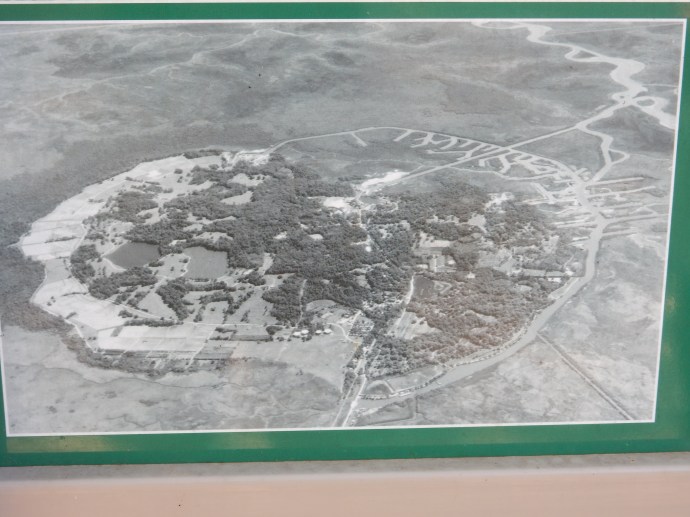
An aerial view of Avery Island

Tuesday we made a stop at Avery Island. First off, Avery Island is not an island in the usual sense. It is an area of land (2200 acres) rising above the marshy, more flat ground in this section of Louisiana. So the islands stand out and above from the rest of the landscape; there are several “islands” in this area. Some of these islands are unique in that they are salt domes, pillars of salt tens of thousands of feet deep, deposited eons ago and now mined for the salt. Cargill mines the salt under Avery Island.

On Avery Island, the McIlhenny family began growing peppers and preparing their unique sauce, Tabasco Sauce, after the Civil War. The family still runs the business and makes the sauce here on Avery Island, growing the peppers, using the local salt, preparing and mixing the sauce, then bottling and shipping it from here. We toured the factory and watched the process in action.

On a side note, there is another salt dome and mine less than 10 miles from Avery Island. In 1980, by mistake, a Texaco Oil Company rig drilled into a Diamond Crystal Salt Company salt mine. A hole was punched into the roof of the mine and the lake (Lake Peigneur) drained into the cavern that had been created from years of mining. The cavern was so large and deep, water from the nearby bayou flowed in reverse, the freshwater became saltwater, geysers spewed out of the mine, and a waterfall began where the water now flowed into the mine opening. No one died and nine of eleven barges sunk during the disaster later popped out of the whirlpool. Today the mine is closed but the dome is still used as a storage and hub facility for pressurized natural gas. Just a tidbit for your edification.

Side note number 2. In 2012, another salt dome collapsed. Bayou Corne sinkhole was a dome with numerous caverns. Drilling created a weakness and gas and oil escaped into the dome. The sinkhole is swallowing land and discharges gas into the water and air. Hundreds of families have been evacuated and many will eventually be relocated.

Side note number 3. In 2002, the American Chemical Society recognized the 1843 invention by a free man of color named Norbert Rillieux who invented the multi-state evaporator for refining sugar as one of the greatest inventions of chemical engineering. It paved the way for greater efficiencies in sugar production. Rillieux owned part of the land that Chalmette Battlefield of Jean Lafitte National Park is located on.

Side note number 4. Oil was discovered in this area in 1901. Off-shore oil drilling began in 1947. We observed numerous oil field supply companies and airports with more helicopters than airplanes.

Back to the fun stuff. The McIlhenny family also runs Jungle Gardens and Bird City. This is a 170 acre botanical garden and wildlife refuge, also on Avery Island. Touring the gardens and factory were a pleasant afternoon diversion. The gardens are nice but once again very little blooming plants were to be seen. I was expecting the azaleas or iris or camellias to be in flower. Where are the bountiful blooms of gardens like the Portland Oregon Rose Garden or the gardens at Richmond and Norfolk VA, etc? The best part of Jungle Gardens was Bird City, a nesting area for egrets and herons.


Bird Island video

Tuesday morning, besides watching sugar cane fields and refineries, driving along bayous, seeing more ships, marveling at huge live oak trees with their spreading branches, we visited the Wetlands Acadian Cultural Center in Thibodaux LA-part of the Jean Lafitte National Historical Preserve. Together with the visit Wednesday afternoon at the other Acadian Cultural Center in Lafayette, we read and heard about the history of the French Acadians in Louisiana.

This blog has already mentioned the intermingling of cultures that has given flavor to Louisiana; Spanish, African, Canary Islands, several Native American tribes, Irish, German, Chinese, and Filipinos. One of the most notable cultures is that of the French, particularly the French Acadians.

The history is complicated but essentially French settlers came to that part of Canada we now consider as Nova Scotia but which was called Acadia at that time. Later the settlers spread to Prince Edward Island and Cape Breton Island. Over several decades in the late 1600s and up to the middle 1700s, control of this portion of Canada switched between the British and the French. When the British controlled the area, they sought pledges of allegiance or at least neutrality, from the French living in Acadia. However, around 1750, the British controlled the area and were fearing the French would try to re-take Acadia.

The British became more forceful with the French Acadians who resisted a full pledge of allegiance. In response, the British began a seven-year process of forced deportation of the Acadians. A brutal process that separated men, women and families; the Acadians were shipped to American colonies and back to France. Most American colonies did not want them, the Acadians were denied entry, were separated among many towns, and many died of disease. For instance, Massachusetts never allowed the refugees off the ships and 1500 died of smallpox. Virginia sent their 1500 exiles off to camps in England. In South Carolina, 940 escaped to the interior of the colony while some escaped to go back and fight the English in Acadia. In Pennsylvania, many of the 450 exiles were imprisoned for not giving up their children to English-speaking families. Over time many of the Acadians exiled to American colonies returned to France, and too independent to live under royal rule in France after being gone for so long, they decided to try a new spot in America. Combined with French from the West Indies, Louisiana became their new home. Louisiana was under French or Spanish rule, depending on the year, and the French Catholic Acadians were welcome here.

The Acadians in this area preferred to settle on the levees, the fertile high banks along the slow-moving rivers. Surveyors would parcel out land to them including fertile land, waterfront for fishing rights, and back country land for grazing animals. (This is not dissimilar to the process used in Hawaii to give natives pieces of land in a pie shape to include ocean, hilly terraces and mountainous land.) The term Cajun became the English pronunciation of Acadian. Their French is still spoken here, although dissimilar from continental French.

The Acadian culture was almost lost. In 1916, Louisiana undertook legal steps to forbid the teaching of French and the Acadian culture and two generations suffered by not learning their history. Not unlike the efforts made by the U.S. government to undo Native American culture.

Scenes from Lake Martin

Wednesday morning we took a two and a quarter-hour swamp tour. We are staying at the Savoy Bed and Breakfast at Lafayette LA. The owner gave us the name of a company, Cajun Country, that he recommended to replace one we were contemplating that is run cooperatively with the National Park Service. Cajun Country gave us an excellent experience. This is not our first swamp tour. We have completed ones at the Okeefenokee Swamp in Georgia, the Everglades in Florida, and Horicon Marsh in Wisconsin. Still, it is not our everyday experience.

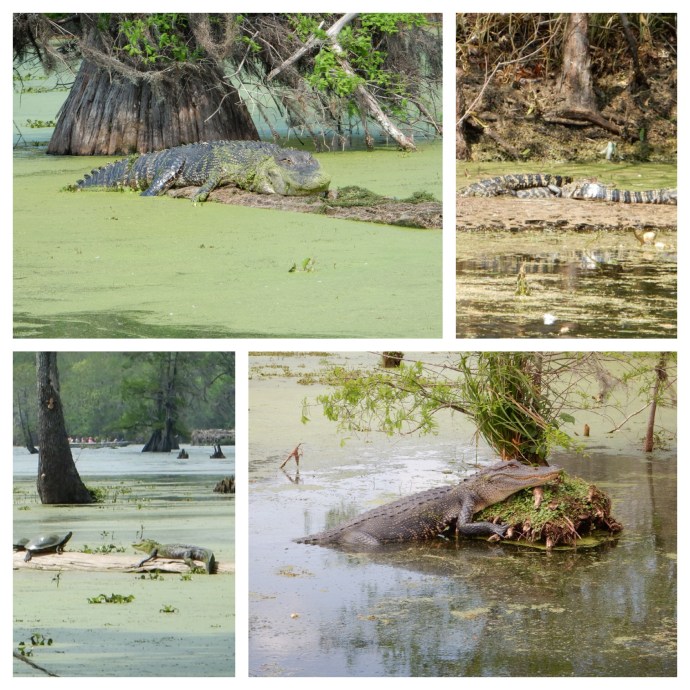
Alligator collage

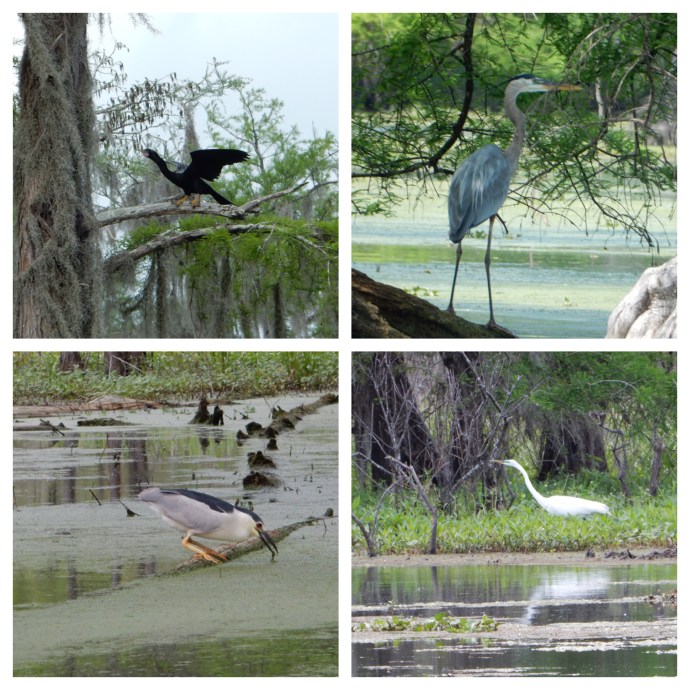
Bird Collage from Lake Martin

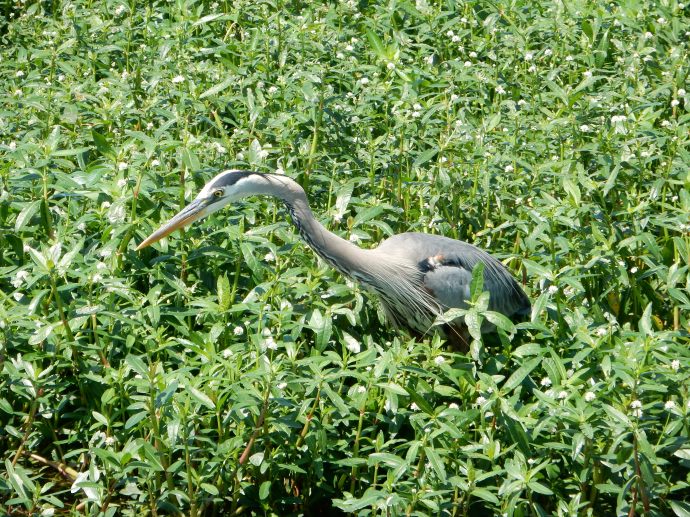
As our guide stated: “A marsh is a lake with trees in it.” Lake Martin runs between four and seven-foot of water and is now managed by The Nature conservancy. Together with the nearby Cypress Island Preserve, 10,000 acres of land, water, forest, and marsh are protected. Great Blue Herons, Great Egrets, Roseate Spoonbills, Anhingas, Cormorants, Whistling Ducks, etc. breed here and we observed all of those species. Alligators and turtles were everywhere, from small to large.

We ended the evening with dinner eating Cajun food and listening to Cajun music at a local restaurnt also recommended by our Savoy B & B host.


Video

Ed and Chris. March 29

Categories: road trip, travel | Tags: , , , , , , , , , , | 4 Comments

2017 Trip Two: Tour of Texas March 27

New Orleans, Louisiana Monday March 27

Longue Vue House and Gardens, one of today’s stops

A rag-tag group of diverse soldiers, mainly untrained, saved the United States. Back in 1812, the United States was still a rough, unrespected experiment in government. European powers were doing their usual wars against each other. Britain was stopping United States ships and “impressing” males into service in the British Navy. Basically, they needed sailors in their Navy and took any able-bodied male on captured ships and pressed them into involuntary service and made them British Sailors. When protests by the U.S. had no impact, the U.S. declared war on Britain in 1812. In addition, the Brits were still influencing Native Americans to resist the U.S. The United States also had ambitions to take over Canada.

The Monument at Chalmette Battlefield, site of the Battle of New Orleans Jan. 1815

The British were hampered by still fighting Napoleon but he and the French were defeated in the spring of 1814. Fresh troops were sent to quell the U.S. One effort coming south out of Canada stalled after a defeat at Lake Champlain. The British were successful in burning the White House in D.C. but Fort McHenry in Baltimore held off British ships and that effort failed.

A third attack was sent out of the West Indies and headed for New Orleans. The British had 10,000 well-trained troops with experienced commanders. The US under General Andrew Jackson had only about 1,000 trained troops. In order to repel the British, the U.S. troops were fortified with free black men, with Choctaw Indians, with state militias from Kentucky and Tennessee, pirates of Jean Lafitte, and volunteers from all walks of life in New Orleans, many of whom were recent immigrants from the Canary Islands, from Germany, from Ireland, and French Acadians from Canada.

We won. The British had a two to one advantage in soldiers when the battle began. When the battle ended, the British had lost (dead, wounded and captured) ten times as many soldiers; 2,000 to 20 for the U.S. By all rights, the British should have won. Bad luck, wet and muddy ground, a few poor decisions, some poor timing, and the death on the battlefield of top commanders hindered the British.

A view of where the earthen ramparts would have been for the Battle of New Orleans

The Americans were aided by great marksmanship by the militia from Kentucky and Tennessee, by smart tactics, and by well-constructed ramparts that negated artillery impact and protected the Americans from British fire.

This we learned at Chalmette Battlefield, part of the Jean Lafitte National Historical Park and Preserve. Two videos, displays, and an excellent presentation by the NPS Park Ranger told us this and much more. The presentation was well-attended as the talk is timed for the arrival of passengers on a paddle wheel boat coming downriver from New Orleans.

Chris and I chose to drive down. Driving gave us more flexibility and saved us time. It also took us through the Ninth Ward, an area of New Orleans that was particularly hard hit by Hurricane Katrina. We chose not to take photos of the area. One observes homes and businesses still destroyed 12 years after the hurricane. There are also many rebuilt structures and structures undergoing rehabilitation. The use of stilts and concrete foundations to raise the living areas of buildings several feet into the air is marked. The exhibit at the Presbytere we saw on Sunday mentioned that there has also been an attempt to use more environmentally and long-lasting materials in reconstruction.

I did notice one sign advertising an upcoming festival sponsored by an Irish-Italian-Islenos social group. Diversity is still thriving. A different feel is given to the area by the shipping and petrochemical facilities which loom large over the landscape everywhere.

The New Orleans population is recovering. It had been just under 500,000 at the time of the hurricane and is estimated to be just under 400,000 today. The 2010 census had it at 343,000 people. Right after Katrina, it was estimated to have gone as low as 200,000 people.

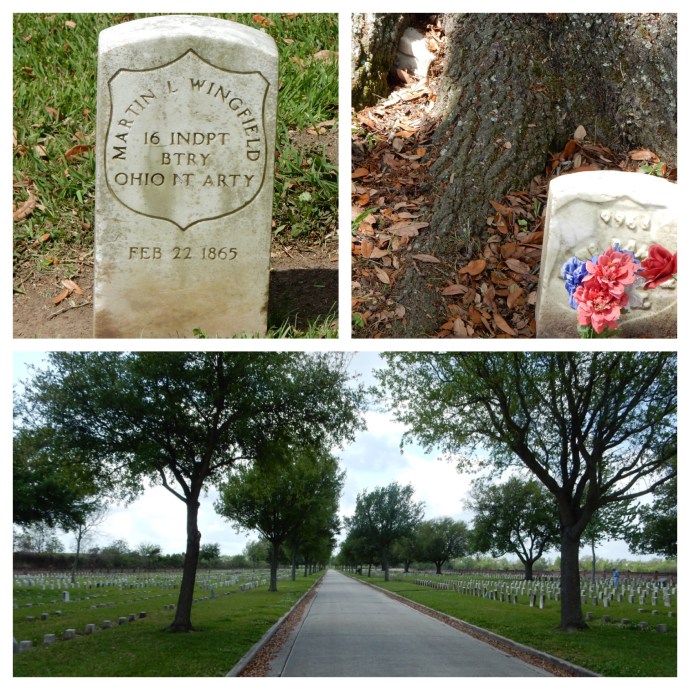
We did not ask the park rangers how the battlefield had been damaged. However, part of the Chalmette battlefield is the Chalmette Battlefield cemetery and we also took in a cemetery tour by a student volunteer docent. She indicated that the cemetery which is right next to the battlefield was covered by eight feet of water. The brick wall and headstones were damaged. Unique to the New Orleans area, graves at this cemetery are below ground. There is a build up of silt from years ago flooding and this is considered high ground. You may know that graves in most cemeteries in New Orleans are above ground due to the high water table. We had observed that and a funeral march at an earlier visit.

Chalmette Cemetery

The cemetery is not for dead from the Battle of New Orleans. It began as a cemetery for Union dead during the Civil War for bodies that could not be sent north for burial. Many graves are marked as “unknown.” It is also used for veterans from other wars since the Civil War and all available space has been reserved or used. This cemetery was the first in the area to be integrated; one sees headstones marked “colored troops” from the Civil War. A female Union soldier is buried here. You may have read that some women dressed as men and served as soldiers in the Civil War. Pay was good and most went undetected until injured or death.

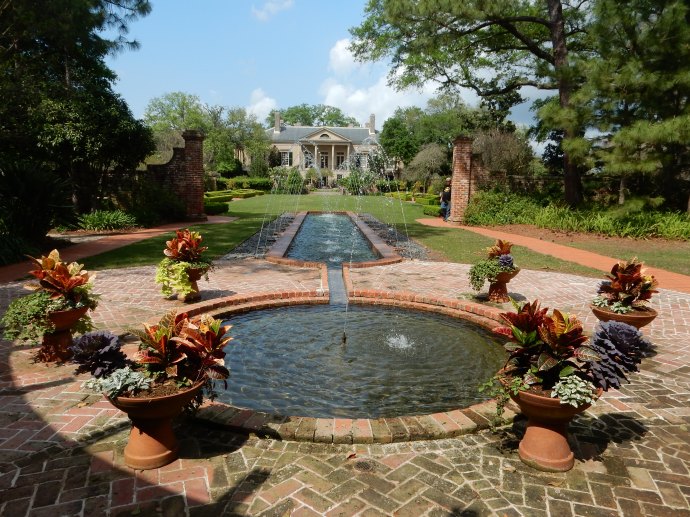
Our next stop was Longue Vue House and Gardens; a mansion built by Edith and Edgar Stern. She was a daughter of the Sears company founder. The docent here was candid. The hurricane devastated the grounds and the basement, unique for New Orleans, of the home but the house itself was not damaged. The grounds were laid out extensively. The first home on the site was moved away so the current mansion (over 20,000 s.f.) could be built to maximize the view of the gardens from all rooms. The owner over the years had shared cuttings from the plants here with other gardens around the country. When the gardens had to be re-built, they contacted those gardens and received back cultivars of the original garden plantings to recreate the gardens.

New Orleans is known for a series of fantastic plantations but we had no desire to see more great houses built on the backs of slaves. Longue Vue House was a reasonable compromise. The husband and wife admitted they lucked into money. Their philanthropy in the New Orleans area is well-known.

Longue Vue House

The house was the second home in the South to have air conditioning. Several of the rooms were “decorated” by the practice of going to Europe and purchasing a whole room of an estate house that was being destroyed or for sale. Each room had a view of some part of the extensive gardens that were designed by Ellen Biddle Shipman.

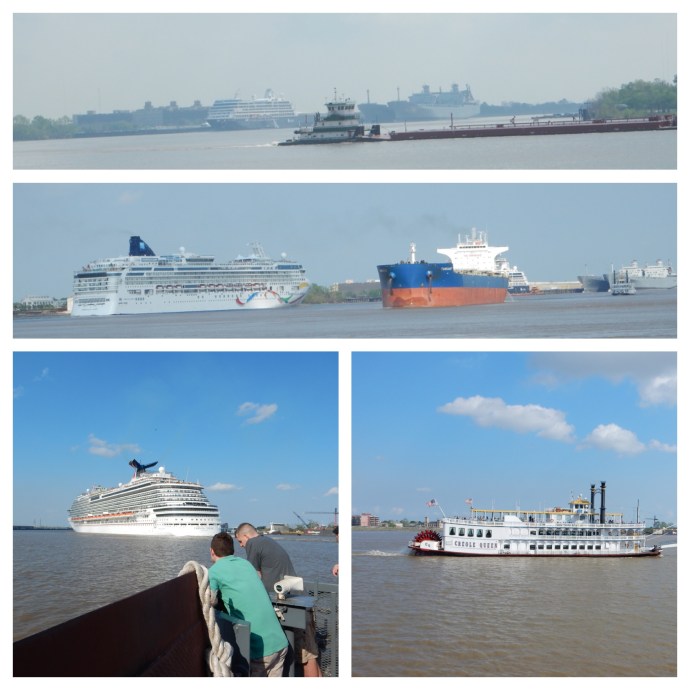
After we returned to our lodging, we took a later afternoon walk along the levee, watching the ships traveling along the Mississippi.

Ed and Chris.

Categories: road trip, travel | Tags: , , , | Leave a comment

2017 Trip Two: Tour of Texas March 26

New Orleans Louisiana Sunday March 26

St.Louis Cathedral flanked by the Cabildo on the left and the Presbytere on the right.

A sugar surge is keeping me energized as I write this post. Pralines (sugar, pecans, butter, milk and vanilla) from the New Orleans School of Cooking sit before me. Hopefully I will resist enough not to overdose on them.

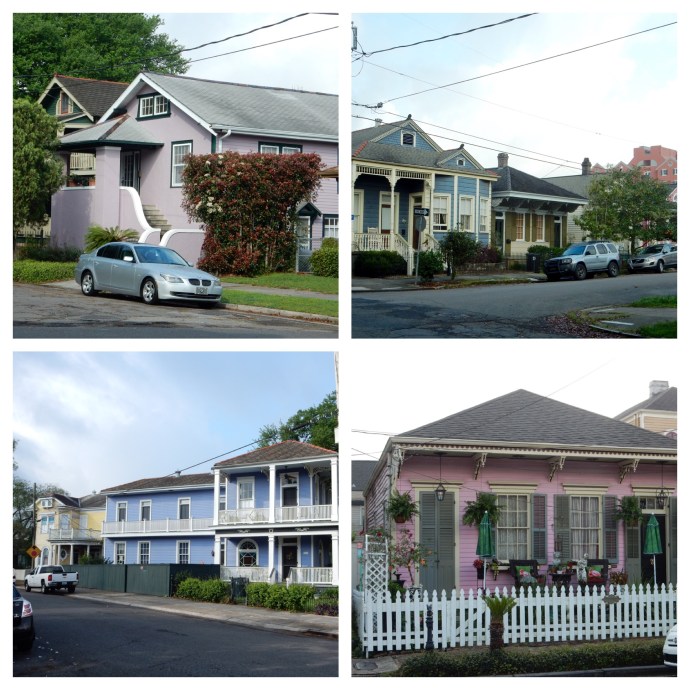
Some examples of homes in Algiers Point

Today was the opposite of yesterday. Early morning clouds and fog gave way to sunshine, a mild breeze, and temperatures in the high 70s. Algiers Point was settled in 1719 but many buildings burnt down in a major fire in the late 1800s. Wood homes seem to predominate in the historic district and are colorfully decorated. Chris and I walked numerous blocks marveling at the varied colors. On the negative side, in this area the streets are poorly paved and sidewalks in rough condition when they exist. Utility poles and wires are everywhere. I can not profess to be an expert on the area; when we drove 3 miles tonight to a grocery store, we encountered much better streets and new home construction. A former Navy base is being re-developed into a mix of public and private offices, businesses and housing.

From what we can tell, most of Algiers Point escaped major destruction during Hurricane Katrina. It is on higher elevation although walking on the levee this morning made that difficult to believe. During Katrina, there were incidents where the mostly white residents of Algiers Point shot blacks who were escaping the floods. News reports indicated that the whites were claiming they were protecting their homes from looters but facts proved otherwise. They shot first and asked questions later. The men shot all had legitimate reasons for being in the area. Issues I can not fully resolve for you.

Walking along the levee at Algiers Point. On our way to the ferry

After walking the neighborhood and the levee, we arrived at the Algiers Point Ferry Terminal. We took the ferry across the Mississippi RIver to a dock at Canal Street. The ferry charges $2 per person, exact cash only. We had to use some quarters to have the exact change. For the return trip, we had to make sure we bought just one post card to have four one dollar bills with us. We did encounter two women on the return trip asking people waiting in line if they had change. We saw them on the ferry so evidently they found a Good Samaritan with change.

There is a fancier river walk along the downtown New Orleans side of the river which we took to our first destination, the New Orleans Jazz Museum at the Old U.S. Mint. The first floor of the museum is dedicated to history of the mint. It had some unique roles in that during the Civil War it was seized by the State of Louisiana and used briefly to mint coins for the state and later for the Confederacy. Since New Orleans was re-taken by Union forces by the middle of 1862 and the Confederacy ran out of silver and gold bullion early on in the war, not many Confederacy coins were minted here. Items on display include a coin press and a gold bullion scale.

The second floor has exhibits about New Orleans Jazz and Louis “Satchmo” Armstrong. Displays discuss his upbringing here before he later moved to Chicago and New York. The last trumpet he used before his death is on display. There is an additional exhibit of art by southern artists, focusing on self-taught artists.

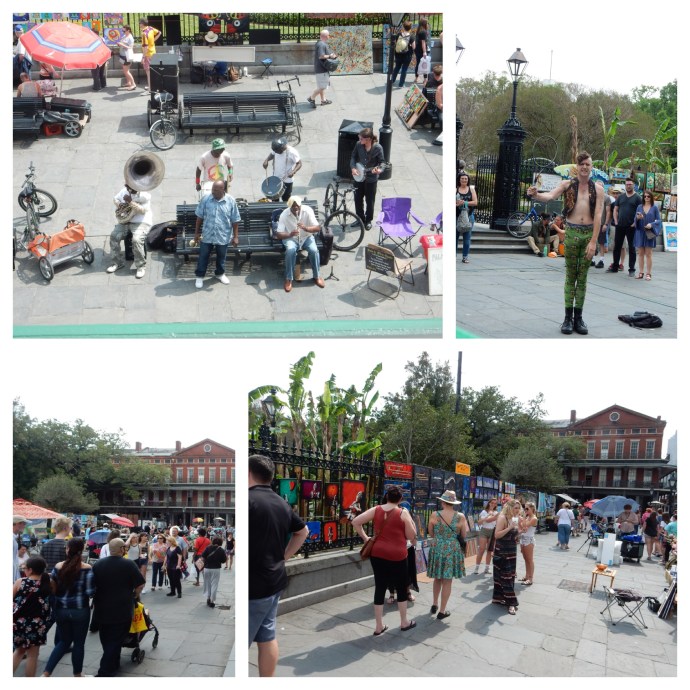
A collage of Jackson Square scenes

We left the Mint and headed to Jackson Square. Jackson Square is a large green space, with St. Louis Cathedral, the Cabildo Museum (history) and the Presbytere Museum (culture) flanking the Cathedral on the northwest side of the square. Three sides of the square were home to artists selling their wares and buskers performing for the tourists. One or two musical groups were always performing so you were serenaded as you strolled along inspecting the art. Even inside the two museums, you could hear the music. (Jackson Square is named after Andrew Jackson, the hero of the Battle of New Orleans where the Americans defeated the British in the War of 1812.)

The Cabildo was a pleasure. Three floors of displays on the history of New Orleans. There was so much info, I fear most of it went in one eyeball and out the other. When the museum covered the Battle of New Orleans, it mentioned how Andrew Jackson did not follow-up after the battle on his promises to the citizens. One of his actions was to not repeal martial law after the battle, waiting until the whole war was declared over. When a newspaper editor dared to write that the martial law could be lifted, he had the writer tossed into jail. When the judge said the writer was entitled to a public trial, he judge was tossed into jail. Gee, do we have a president who admires Andrew Jackson now? During his presidential elections, Jackson did not carry the city.

Some other tidbits.

The town early on had a Catholic heritage. The Catholics liked to go to Sunday Mass and then go out and eat, socialize, party on Sunday afternoon. When Protestants moved in, they were shocked at this scandalous behavior that did not keep holy the Lord’s Day.

New Orleans had six to ten times the number of saloons as were in Boston or Philadelphia.

New Orleans in its formative years had a wide variety of immigrants from Germans to Irish to French to Santo Dominguians to Canary Islanders etc that contributed to the mixed population. They called it the gumbo of the people. Yet, this did not stop anti-immigrant fever sporadically or the profitable discrimination against Indians and blacks.

Due to the early surrender of New Orleans, the Union government made an effort to test some Reconstruction plans here. Sort of “Reconstruction Light”. But actually due to the easy defeat, the citizens never faced the hardships of war. Thus the residents of New Orleans were more of a hassle to deal with than a pitched battle. They resisted the efforts and that helped lead to the eventual “Radical Reconstruction” that followed the Civil War with harsh enforcement. Louisiana was one of the last three Southern states to have rule by the military ended. Military forces left the state in 1877.

French quarter views

After the Cabildo (previously home to governmental functions), we went to the Presbytere Museum (previously associated with religious functions). The Presbytere focused on Hurricane Katrina (2005) and Mardi Gras. The Katrina exhibit had video of the storm, the damage and the stories of individual people. It discussed the geography of the area, the engineering failure that led to the horrendous flooding, and the actions of people who have destroyed the natural features of the land to help minimize the effects of major storms. The great flood of 1927 (the one that Herbert Hoover led the reconstruction for and which helped him to be elected President) was a major impetus in the levee building which now protects the city from river flooding. That same levee building makes the city more susceptible to hurricane flooding.

The Mardi Gras exhibit was informative but less interesting. Possibly this is due to our having seen the Mardi Gras museum in Mobile which covers the subject quite well also.

The Mississippi RIver at New Orleans is a busy river

All in all, a tiring yet informative day.

Ed and Chris
Categories: road trip, travel | Tags: , , , , , , | Leave a comment

2017 Trip Two: Tour of Texas March 22-25

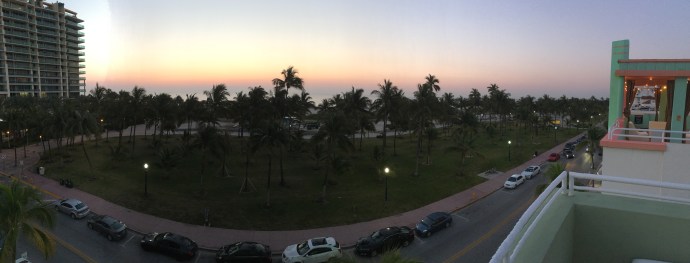
Sunrise Miami Beach March 23 from our hotel

New Orleans, Louisiana. Saturday March 25

The last four days have been, and will be, the most casual and slowest paced of the entire 60 day trip. I saw no need to write a post saying nothing much happened so I have waited until several occurrences cobbled together can make an interesting post.

Wednesday the 21st was an excellent beach day. We spent all day at the beach, nothing earth-shattering occurred. But isn’t that the point of just relaxing at the beach?

Thursday, our nightly destination was Ocala Florida. An hour out of Miami Beach we visited the Morikami Museum and Japanese Garden in Delray Beach. 110 years ago, a Japanese graduate of New York University came up with the idea of starting a colony of Japanese farmers in southern Florida. The colony was called Yamato, after a name used for Japan. The colony had ups and downs and never really made a continuing success. One of the colonists, George Morikami, stuck it out. However WWII intervened and over 6,000 acres of the land owned by the Japanese, and other U.S. residents, was taken by eminent domain for a military base. After the war, George Morikami bought land back and in his later years donated it to the county for a park and museum to preserve the memory of that early 20th century Japanese community.

Photos from Morikami Gardens in Delray Beach Florida

We toured the gardens first, as the weather was projected to turn rainy and windy. The gardens are spread over 16 acres and present a series of styles of gardens from Japan. As are most Japanese gardens, the theme is reflection and contemplation. A visitor is not presented with masses of flowering trees, shrubs, and plants. Benches are placed strategically and a reflective moment can be spent observing the interplay between the rocks, plants, water, etc.

The original museum is now used to display information about the original settlement. The settlement had difficulty establishing long-term continuity due to the difficulty in attracting Japanese women to marry the young , single men that were the original settlers. Second, competition from Cuban grown fruit decreased revenues. Finally, the land boom in Florida in the 1920s meant many of the settlers could sell their land for a better return than farming and they sold out and moved on. Then, the remainder got wiped out as mentioned above when the military base took their land.

This original building also is a hands-on learning area for children. Finally there was a wall display that demonstrated how KitKat candy bars took off in popularity in Japan. Uniquely Japanese flavors were added to KitKat, such as Kyoto powdered green tea KitKat and Shinshu apple KitKat.

The new museum building had an exhibit on Japanese Art Deco from the period of the 1920s and 1930s. It failed to mesmerize us.

Our second destination before Ocala was the Wakodahatchee Wetlands, a 50 acre wetlands established on utility land. It is a great bird watching area introduced to us by my cousin Chris and her husband Nelson. However, all of the parking places were occupied and there was a line of cars waiting to pounce on the first newly vacated parking space. We did not wait and continued our drive to Ocala.

Leaving early was fortunate as several downpours enveloped us as we made our way northwest along the Florida Turnpike. During one particular outburst, we pulled over along the side of the road with numerous other cars and trucks since we could not see the road or vehicles in front of us.

Ocala lodging was with a great Evergreen couple. We had several points of synergy including a connection to living in Pennsylvania previously. The Ocala area is huge with horse farms. Horses are bred and trained here and horse auctions are big business. The Ocala airport is used to send horses around the world.

Chris and Ed in Niceville. The husband of the Evergreen couple took up painting after retirement.

Friday we drove to Niceville Florida. Niceville is in the Florida panhandle. We have toured in the area on previous trips and this was meant as a stopover on our way to Texas via New Orleans. We spent the night with an Evergreen couple. When we set this night up, the couple had indicated that on Friday nights they helped serve dinner for a church function and we volunteered to help out.

We got a tour of the Crosspoint United Methodist Church in Niceville and its church facilities and programs at its main campus. The church now has five churches in the Niceville area and seems to be dramatically serving its population through numerous ministries. The function we were at was the CR Recovery dinner. CR Recovery is a Christ centered recovery program for all types of hurts, habits, and hang-ups. The program takes the 12 step AA program and adapts it to a 12 step program with biblical comparisons. They combine it with an eight step recovery program again tied to biblical comparisons. Chris and I had helped serve dinner and clean up afterwards. It was a popular night, we gave out all of the food so the four of us went out to Panera’s for dinner.

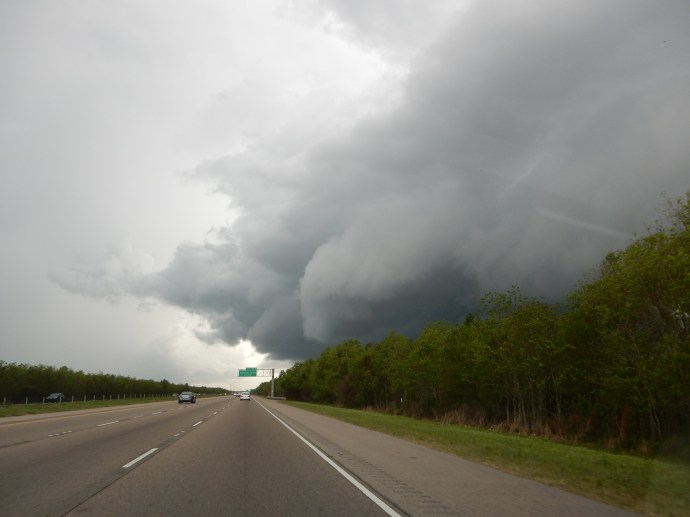
Thunderstorm approaching as we drove to New Orleans

Saturday the 25th we drove to New Orleans and once again got hit with thunderstorms. It was still raining when we arrived in the city and traffic was slow in the French Quarter as pedestrians were anxious to cross the street without getting too wet. Our only stop was at the Jean Lafitte National Historical Park Visitor Center. Surprisingly, the center is closed on Sunday and Mondays due to budget cuts. The orientation film was not working but we viewed the displays and obtained information from the ranger about the site. There are actually six locations as part of the National Historical Park and we plan to visit several of them over the next few days.

We have had to plan our visits in New Orleans tactically since Sunday, Monday, and Tuesday are all days in which museums and historical sites are closed. We are here through Tuesday morning. Our lodging for the three nights is through Airbnb in Algiers Point, an old neighborhood on the West Bank of the Mississippi River across from downtown New Orleans. The rain and clouds gave us limited time to explore on Saturday, but it appears to have some unique features. Most of the homes are brightly painted and we will have some photos for you in our next post.

the front of the Appetite Repair Shop in Algiers Point New Orleans

The community is not overly served with restaurants but we found a unique spot for dinner. The Appetite Repair Shop is 240 square feet in size ( I counted the floor tiles for a measurement), only open Thursday-Sunday from 5 pm until the food is gone, and only serves take-out. When we arrived at 6 PM, we were sixth in line. It took half an hour to get our food. The chef-owner cooks each person’s order from a limited menu that changes daily. We spent our time in line talking to the other customers and getting their life stories.

Most menu items were noted as “Hot”, “Spicy”, or “Silly Hot”. We chose the already prepared banana pudding, crackaroni and cheese (an upgraded mac and cheese), and Moroccan carrots and chickpeas salad. All were excellent. We went to bed after seeing some smokestacks of ocean-going ships in the distance over the banks of the levee.

Ed and Chris
March 26, 2017

Categories: road trip, travel | Tags: , , , , , , , | 2 Comments
Blog at WordPress.com.