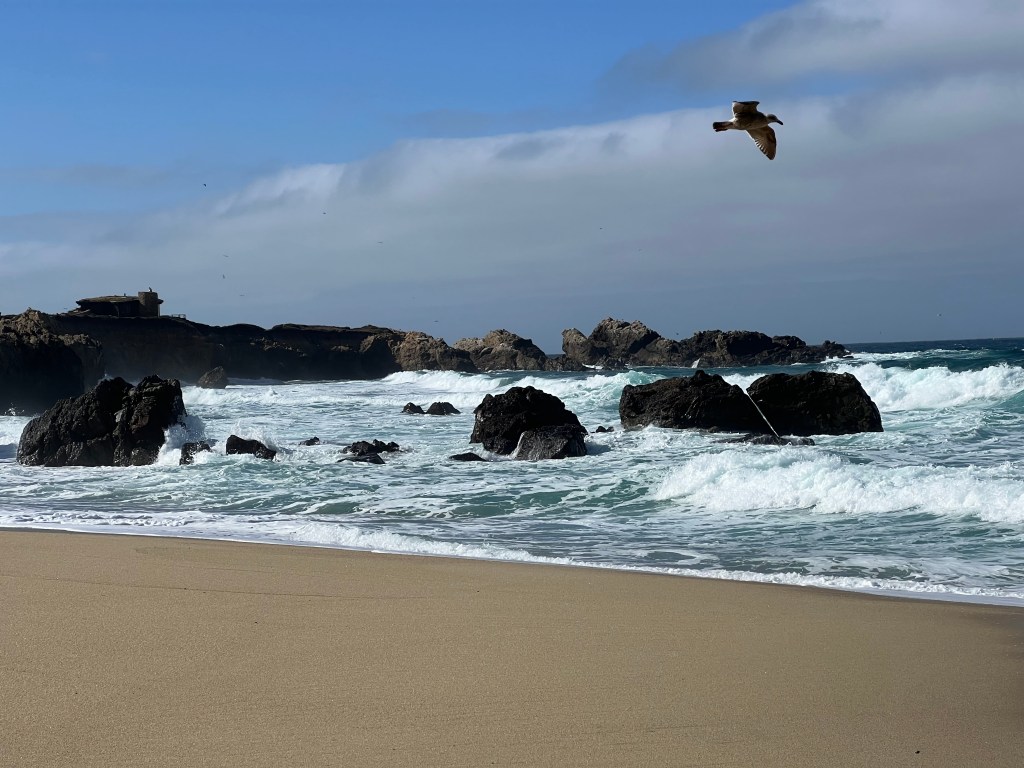
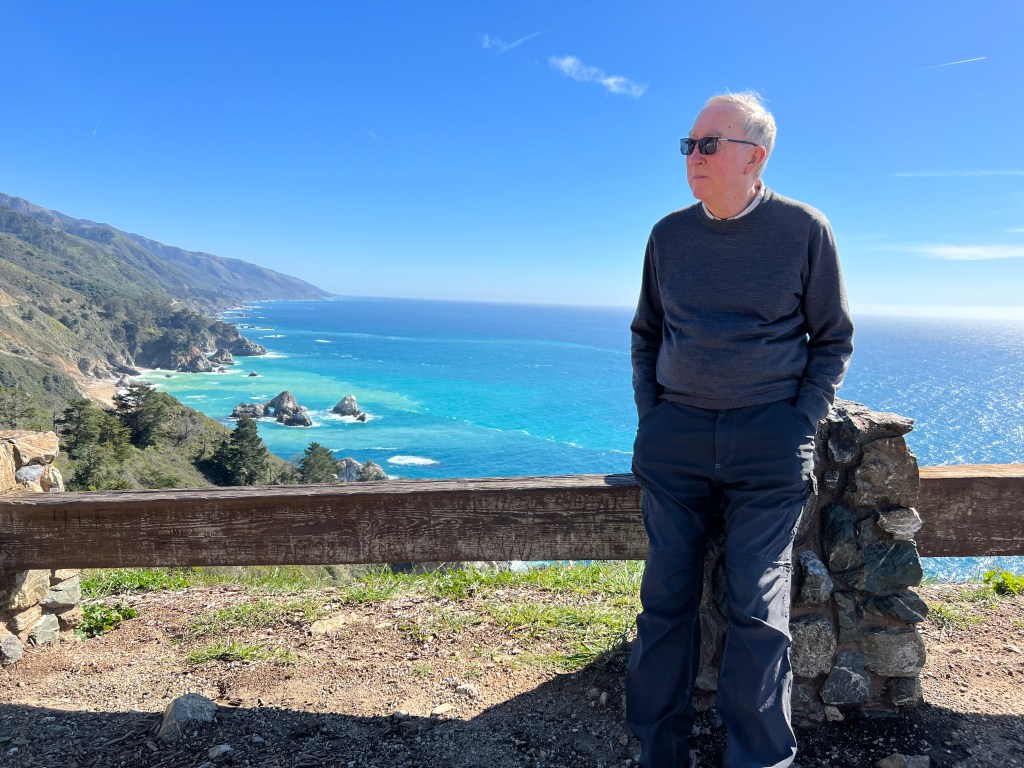
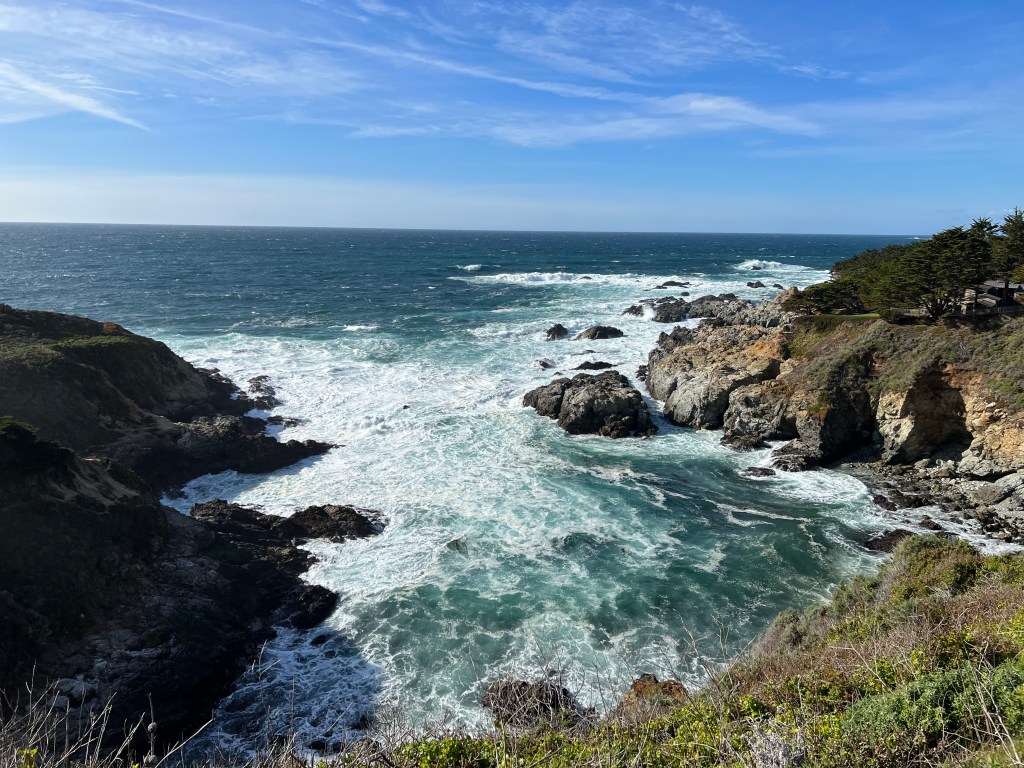
Follow Ed Heimel and Chris Klejbuk as we explore the USA and Canada. Trips began in 2013. See sidebar. Since Jan. 2013, over 220,000 miles traveled and 1100 days on the road. Over 700 blog posts written. 2023-We are closing in on 350th National Park unit. Photo below is Pacific Ocean by Big Sur, CA
About Ed Heimel and Chris Klejbuk, MN travel bloggers; ckeh72@comcast.net
We are a husband and wife team living in St. Paul MN. Both of us retired by the end of 2012 and decided to travel and visit areas of the U.S. and Canada that we had not seen before. Most of the time we head out for 3-7 weeks; usually by driving, first in our 2001 Saturn and then when it hit 225,000 miles we traded it in for our 2016 Subaru Legacy . This travel blog is written to help us remember the great places we have visited and people we have met as well as to inform family and friends of our whereabouts.
Contact us at ckeh72@comcast.net
In 2013 we took the following trips: Trip 1-January--2 weeks in Florida to visit Orlando, St. Augustine, Jacksonville, Amelia Island. Trip 2-February and March-4 weeks in Hawaii, visiting the four major islands. Trip 3-March and April--several weeks in New Mexico visiting family followed by traveling cross-country to VA for VA Garden week. Trip 4-May and June--6-7 weeks driving to Las Vegas, the Sierra Nevada Mtns, Yosemite, Kings Canyon, Sequoia N.P, Salt Lake City, Grand Tetons, Yellowstone, Devils Tower and home. Trip 5-June- a quick trip to Boston to visit family. Trip 6-July and August-a 6-7 week trip to Calgary, Banff, Mt. Ranier and Mt. St. Helens, Olympic N.P., North Cascades N.P., Victoria, Vancouver, Whistler, Revelstoke, Jasper, Yoho,Whitefish lake, Theodore Roosevelt N.P. Trip 7-August and September- our daughters wedding in MD and returning home through the Upper Peninsula of Michigan. Trip 8-October and November-3-4 weeks in the Ozarks, Arkansas, Missouri. Trip 9-December and January 2014-Christmas in Santa Fe and New Years in Flagstaff and points in between.
In 2014 we took the following trips: Trip 1--a week in Ely MN, most of it dog-sledding in late Feb. Trip 2--6 weeks in the Deep South including LA, MS, AL, GA and FL in March and April. Trip 3--a trip to Boston to visit family Trip 4--May and June houseboating on Lake Powell followed by Monument Valley, Arches and Canyonlands N.P, Black Canyon of the Gunnison N.P, San Juan Mtns of CO Trip 5--time spent in MN and the Midwest Trip 6--visiting Ontario, Ottawa, Montreal, Quebec, the Adirondack Mtns of NY, our daughters wedding in CT and home through Philly and Ohio, 7 weeks in September and October. Trip 7--Southern California including Joshua Tree and Mojave Desert N.P, Anza Borrego Desert State Park, and then to Flagstaff for Thanskgiving for three weeks in November.
In 2015, we took the following trips: Trip 1- 8 weeks traveling around FL in February and March, most of it on the panhandle, penninsula and Gulf Coast. Trips 2 and 4 to Boston in April and July. Trip 3 was to Isle Royale National Park in Lake Superior. Trip 5 was to southern MN. Trip 6 was to Voyageurs National Park and northwestern MN. Trip 7 was to the Great Smoky Mountains and neighboring areas.
In 2016 Trip 1 was to Chicago IL. Trip 2 was to southwestern MN. Trip 3 was to Boston. Trip 4 was to southwestern United States. Trip 5 was to Lake Superior. Trip 6 was to Winona MN. Trip 7 to western Massachusetts (the Berkshire Mountains). Trip 8 to the Rocky Mountains in Colorado. Trip 9 to Boston and Rhode Island.
In 2017, Trip 1 was to the Mississippi River Headwaters. Trip two will be a month long tour of Texas and another month traveling to and from Texas across the southern US.
Image
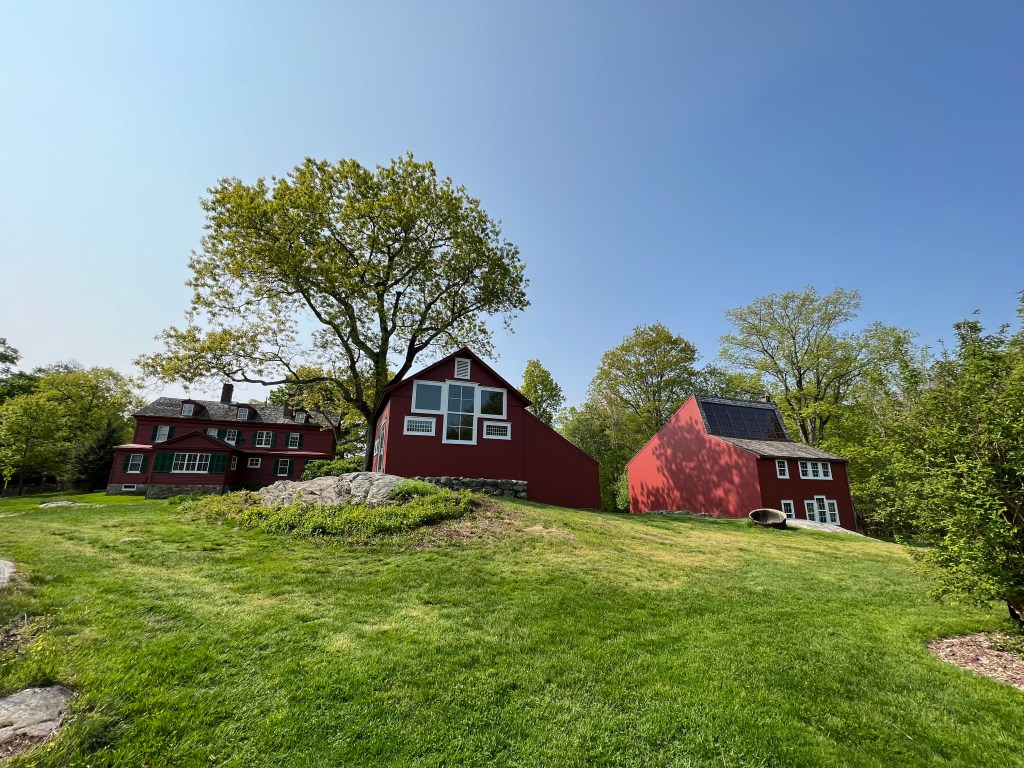
This trip is primarily to visit family in Boston but of course we managed to squeeze in a National Park Service site we had not yet experienced. Weir Farm National Historical Park is in SW Connecticut, about 15 miles south of Danbury (which is along I-84) and about 10 miles north of Norwalk (which is along I-95 and the coast). Instead of just zipping along the Interstates from Boston’s Logan Airport, we took numerous two lane roads through the Connecticut countryside, enjoying the green trees and blooming flowers.
At Weir Farm, while the grounds are open year round, the buildings and visitor center are only open during warmer months of the year. Since we seem to usually be in New England during colder months, this was our first opportunity to visit the site while the buildings were open and rangers present.
We also lucked out in that one of the rangers here used to work at Mississippi National River and Recreation Area and a contact there put us in touch with Kristin Lessaard, the Weir Farm Visitor Experience Program Manager. Kristin signed us up for one of the tours, gave us an intro to the park, and was kind enough to send us on our way at the end with several mementos.
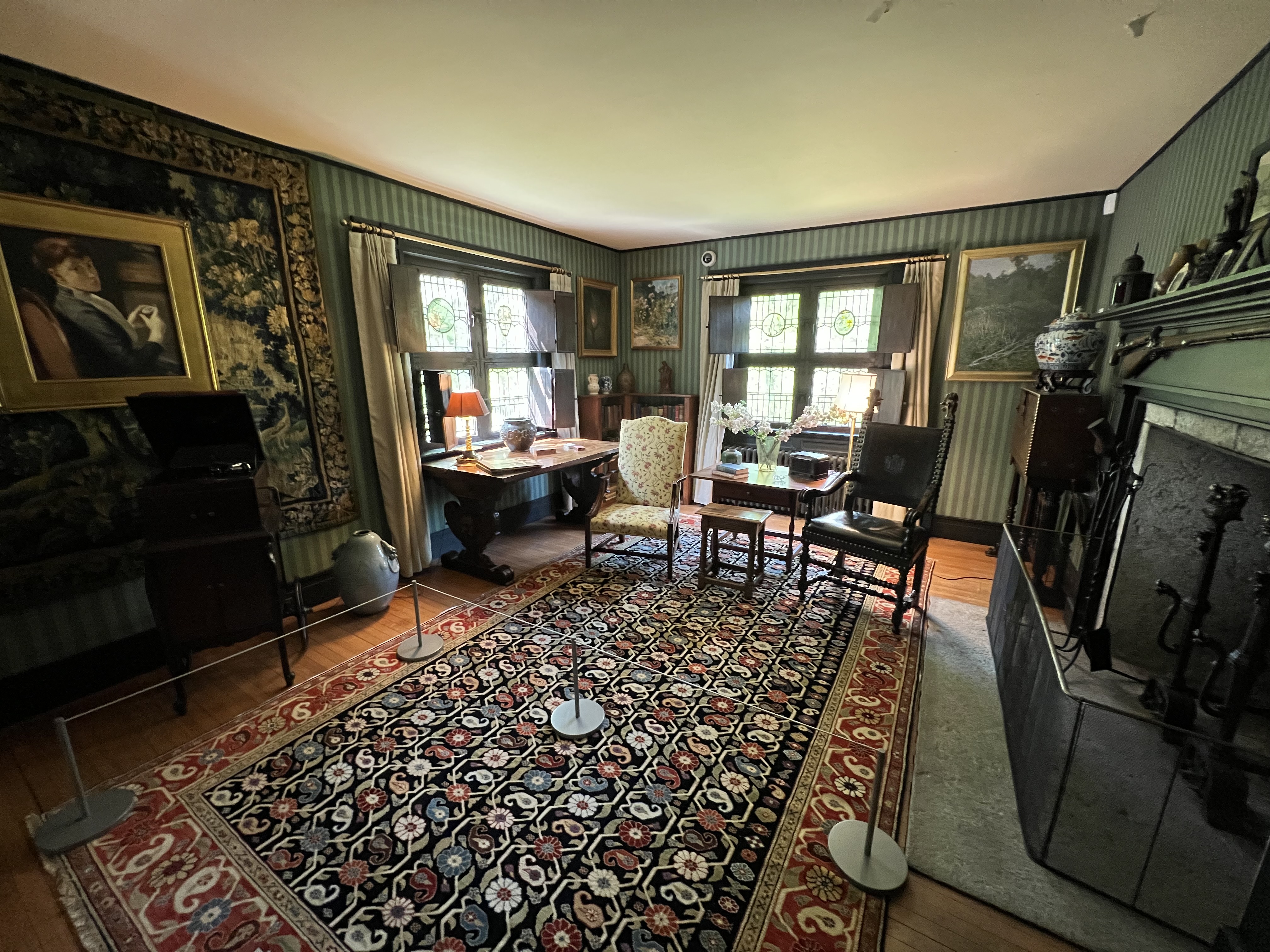
Weir Farm was the summer home of J. Alden Weir, one of the early American Impressionist painters and an energetic force in introducing America to Impressionism. Starting in 1882, he and his wife Anna (and after Anna died, his second wife Ella) moved into the farmstead, expanding the house, farm land, and buildings over the years. The Weirs were gracious hosts to many of the impressionists such as Childe Hassam, John Singer Sargent, and John Twachtman among others. Weir had a studio here, allowing him to use the soft light and pleasing landscape as the setting for many paintings.
Weir died in 1919 but his daughter, Dorothy, and her husband Mahonri Young continued the tradition of the farmstead as a legacy of art. Upon Mahonri’s death in 1957, artists C. Sperry Andrews and his wife Doris bought the property. It was Doris and J. Alden Weir’s youngest daughter Cora Weir Burlingham who were the moving forces that undertook the efforts that resulted in the property becoming part of the National Park Service. As such, it is the only NPS site dedicated to American painting.
The park not only tells about the artists, it offers an art experience also. The property is one of many NPS sites that hosts an Artist in Residence. Here at Weir Farm, they host six painters each year for a month at a time. In addition, classes are offered and visitors have the opportunity to include painting as part of their visit. Junior Ranger badges offer several art focuses.
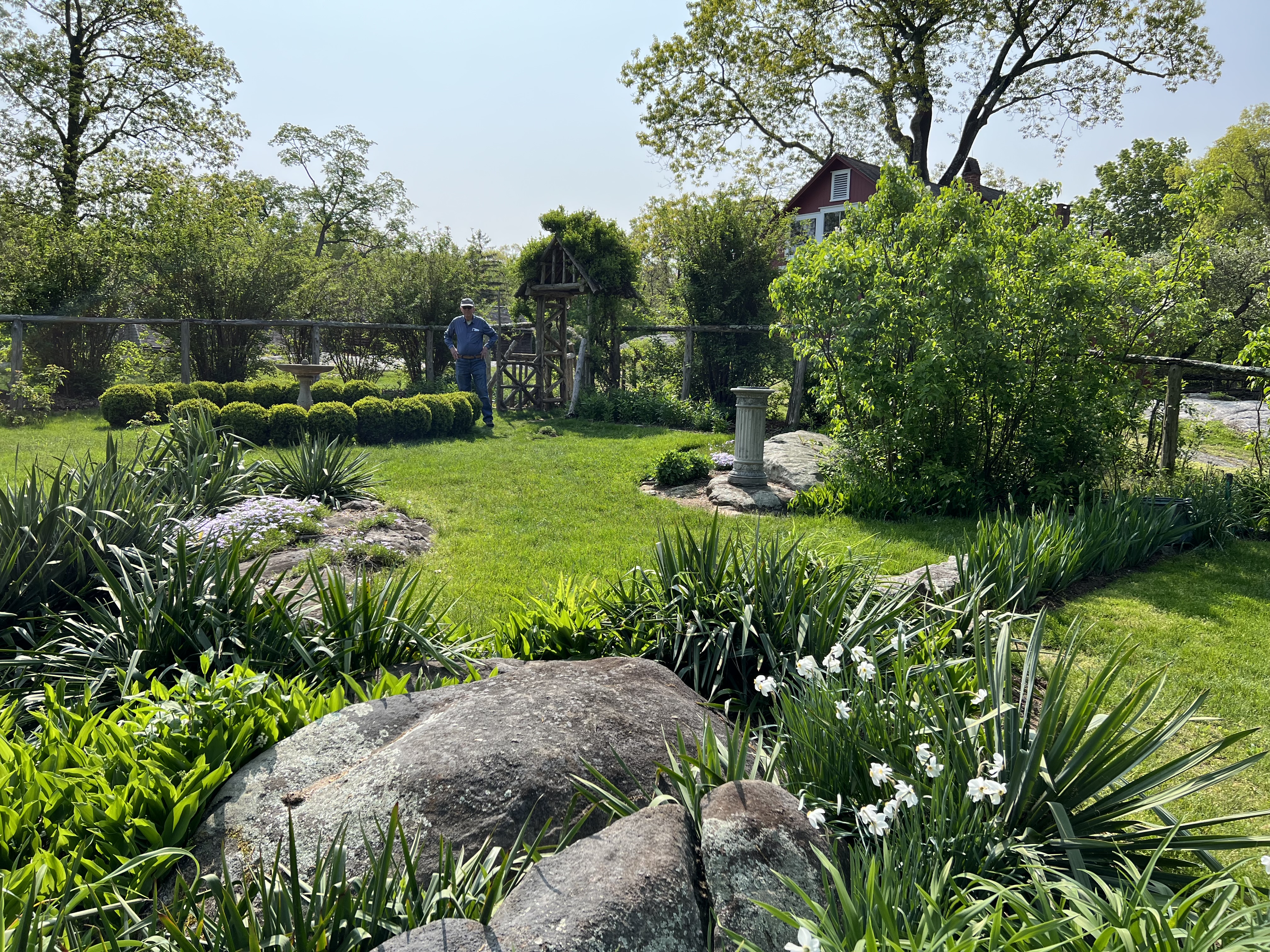
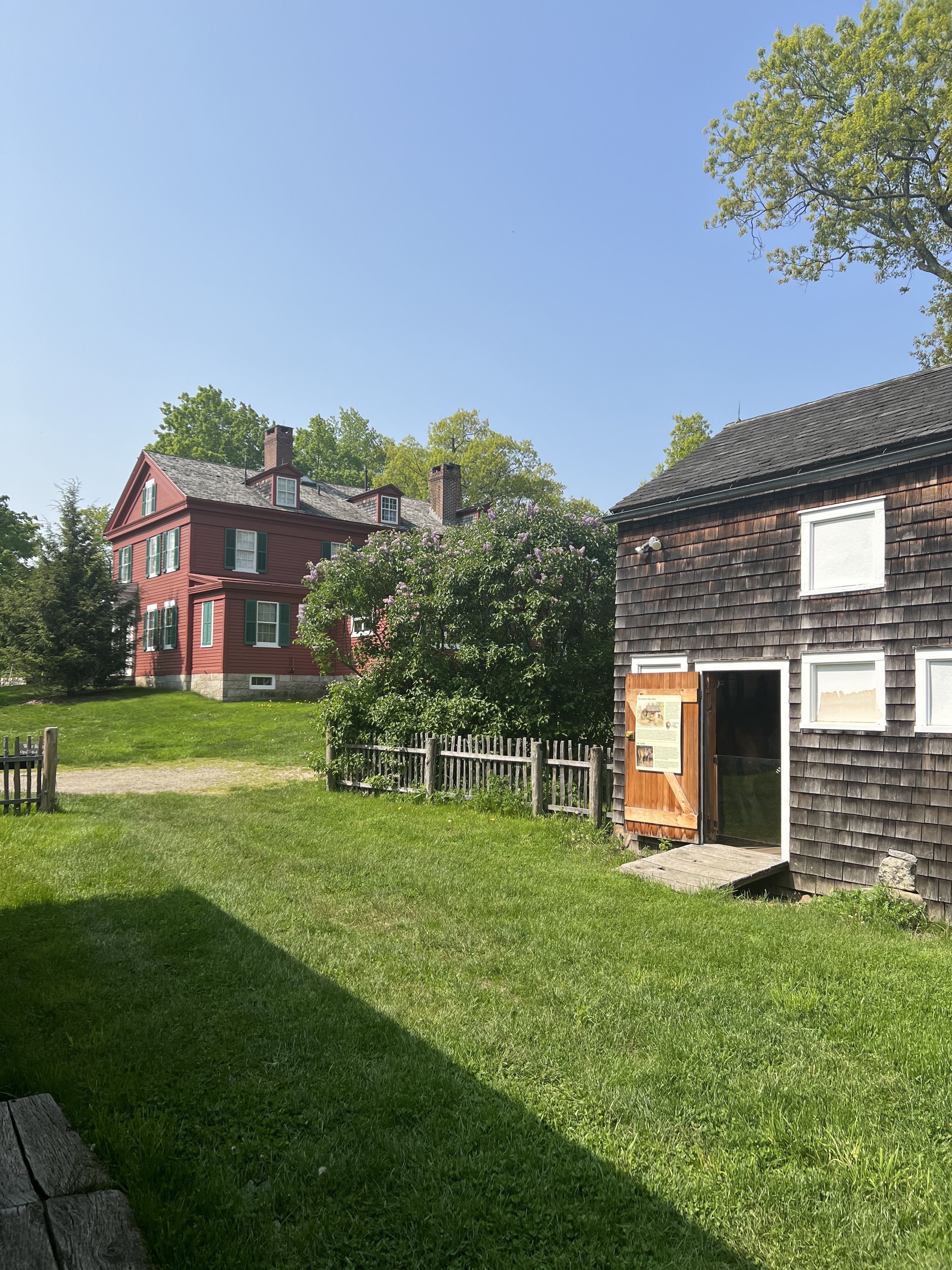
Our time at the park included a short video, a walk around the grounds including some small gardens, visits to several buildings, and a 30 minute tour of the Weir homestead with a knowledgeable ranger. We even learned some of the history of Connecticut, how sheep farming was an important element of the early state economy. Timber was a first product but its removal also created grazing land for sheep as the rocky fields were not great for plowed crops. The removal of the rocks was time conuming but created the walls to manage the sheep. Over time, the stone walls, which have a character and style of their own, lined the narrow roads and define the boundaries of forests and residential properties.
We left Weir Farm with a greater appreciation for American Impressionism. For the next several days, we are spending time with family by relaxing at an Airbnb in Providence Rhode Island. We have been to Providence before, Roger Williams National Memorial. We took time out to walk along the Woonasquatucket River walk and to enjoy the architecture of various buildings in downtown Providence.
Tuesday we flew home with our next major trip being a 4-6 week late summer, early fall adventure to western Montana and Idaho.
Two major objectives on this trip: Great Basin National Park and visiting relatives in Flagstaff Arizona. Great Basin National Park was established in 1986 and represents a small portion of the great basin area of the western US. The great basin area stretches from southern Idaho and Oregon to just north of Las Vegas and over into Zion national park area of Utah.
The great basin is marked by water courses that stay within the region. There is no outflow of water to any river that leads to an ocean. This huge geographic region is marked by multiple mountain ranges with valleys in between. Since it is a desert area, there’s not a lot of water. What do you do is see small rivers and lakes scattered throughout the region.
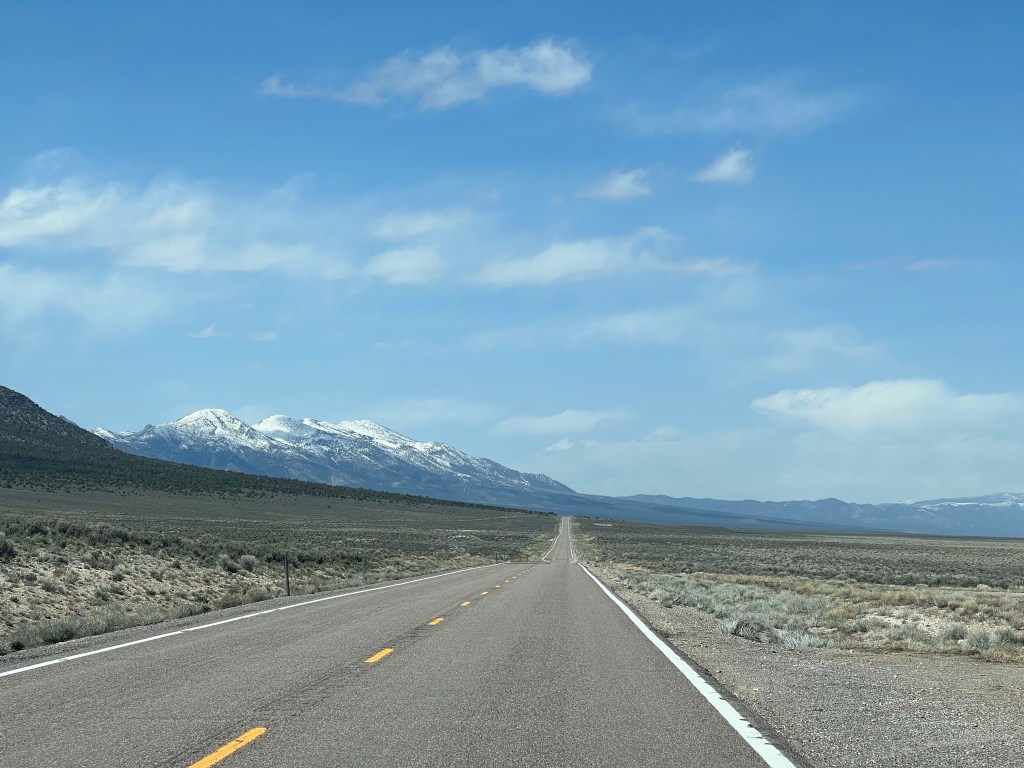
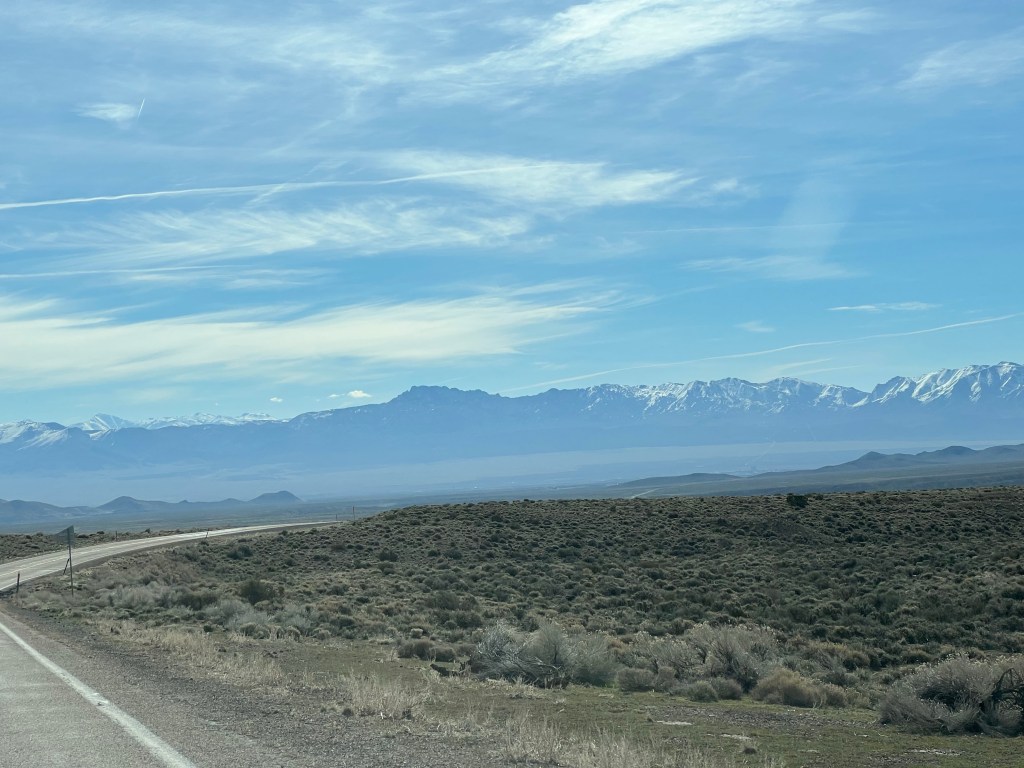
Thus, there is a wide diversity of topography, flora and fauna. However, the repetitive nature of going up a mountain side to a pass and then going down the other side of the mountain and through the valley up to the next mountain range, repeating that process again and again, is the common theme of this region.
Great Basin National Park is 300 miles from Las Vegas and about 250 miles from Salt Lake City. We chose to fly into Las Vegas as a cheaper flight alternative. Fying into Vegas also gave us the option to add on a quick trip, visiting Tule Springs Fossil Beds National Monument, just north of Las Vegas.
Tule Springs Fossil Beds National Monument does not have a visitor center. It does have some temporary trails. We were able to pick up the National Park Service passport stamp at Lake Mead national recreation area visitor center about 25 miles east of Las Vegas. We made stopping here on Tuesday afternoon our priority after landing at the airport.
Lake Mead, national recreation area visitor center
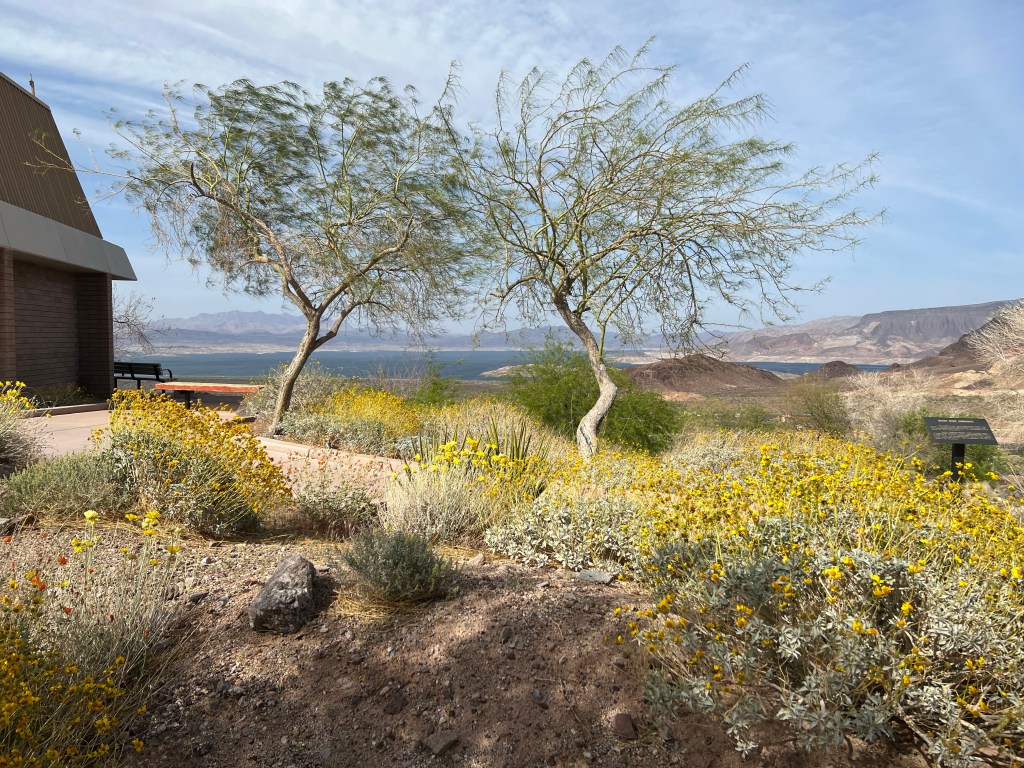
The Lake Mead visitor center gave us an opportunity to observe the lowered water level of Lake Mead, see the visitor center film once again, and enjoy the profusion of wildflowers around the visitor center. We stopped in Boulder City for dinner, having a great barbecue meal at our second choice restaurant. The first choice was closed for the filming of some movie scene but we were very pleased with the Fox Smokehouse Barbecue. We spent the night at the Tru hotel located close to the airport, giving us easy access to Lake Mead, and to Tule Springs.
Tule Springs Fossil Beds National Monument
Wednesday morning we drove up to Tule Springs, leaving the hotel around 8 AM. There are no permanent trails established yet. Tule Springs Fossil Beds is going through the park planning program and the temporary trails are the best they have to offer at the moment.
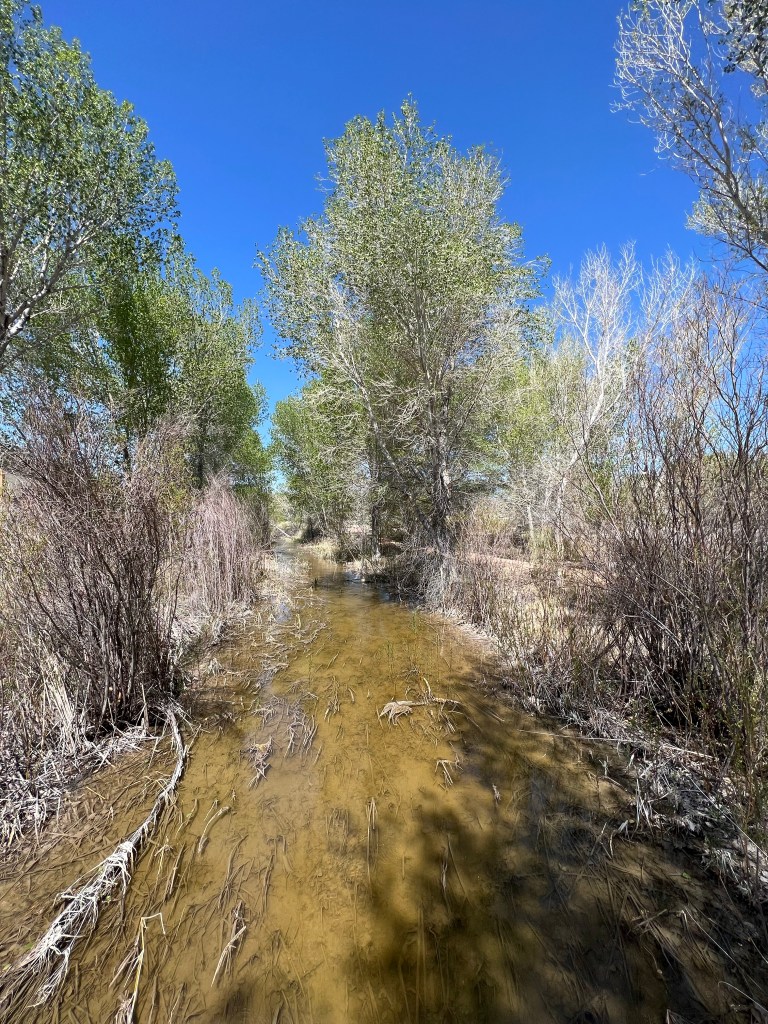
We rarely like to just drive from one destination to another so we stopped at Pahranagat National Wildlife Refuge. The wildlife refuge contains some of those streams and a small lake contained in the great basin area. There was a pleasant half mile walk along the water course, mostly in shade. The visitor center was closed on Tuesdays and Wednesdays so we had a snack outside on one of the benches.
Pahranagat national wildlife refuge
We stopped for lunch in the small town of Pioche, Nevada, population about 1400. The diner was empty when we walked in but 10 to 12 people came in while we were there, providing a bit of people watching opportunity. We gassed up once again, as we were leaving town, at the local Sinclair station, as Chris conversed with the owner, who came out to wash our windshield.
Hidden Canyon Retreat
Our lodging destination was Hidden Canyon Retreat, located about 10 miles outside of the almost deserted town of Garrison, Utah. Great Basin Park is in Nevada, Lodging opportunities are rare. Hidden Canyon retreat was a very pleasant find, located as the name implied down in a canyon by a stream just outside of the park boundary. We had a high clearance vehicle because the road to the resort is gravel, but was in good shape and could’ve been handled easily by a car, at least at this time of year. Hidden Canyon has a little store that provides basic food purchasing opportunities and we picked up our dinner for the two nights and breakfast in their store before proceeding to our room.
Hiking at Great Basin National Park
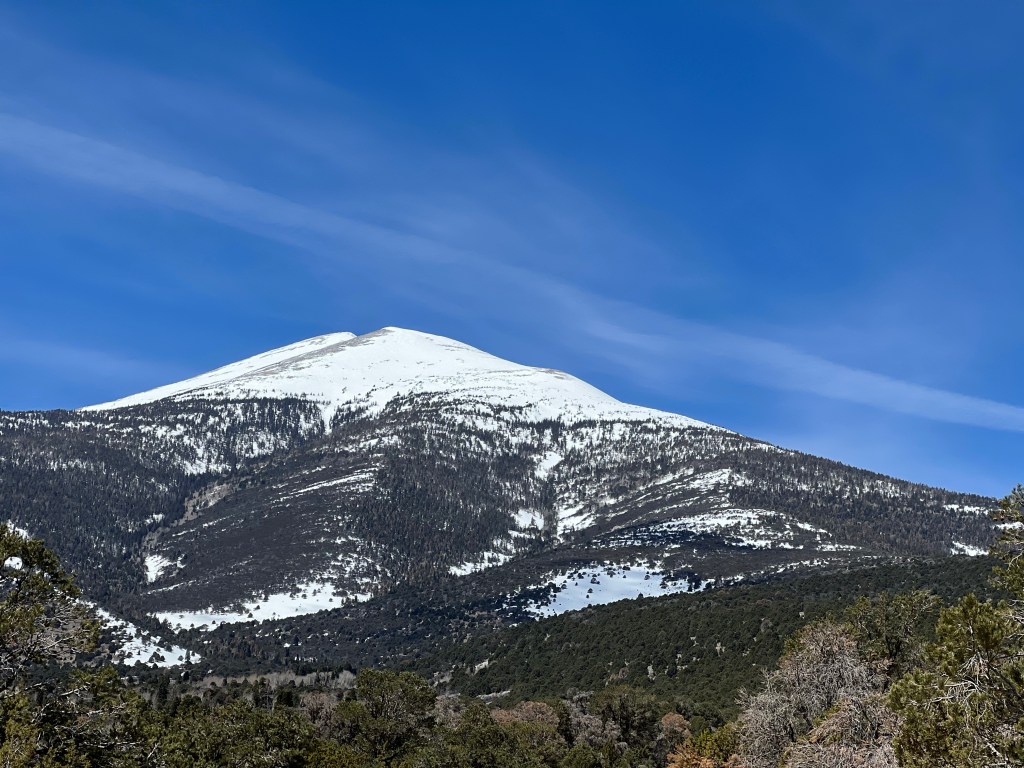
We drove to the national park the next morning. It’s the end of April, but the roads to the top of the 12,000 foot mountains are still closed due to snow. We spent the time before our 1 PM cave tour watching the video, reading exhibits, and going on two hikes located at two campgrounds not far from the visitor center.
Lehman Cave at Great Basin
Lehman cave is one of the star attractions of Great Basin National Park. Our 90 minute tour was led by a volunteer who did an excellent job explaining the cave and the various natural wonders one can observe in the cave.
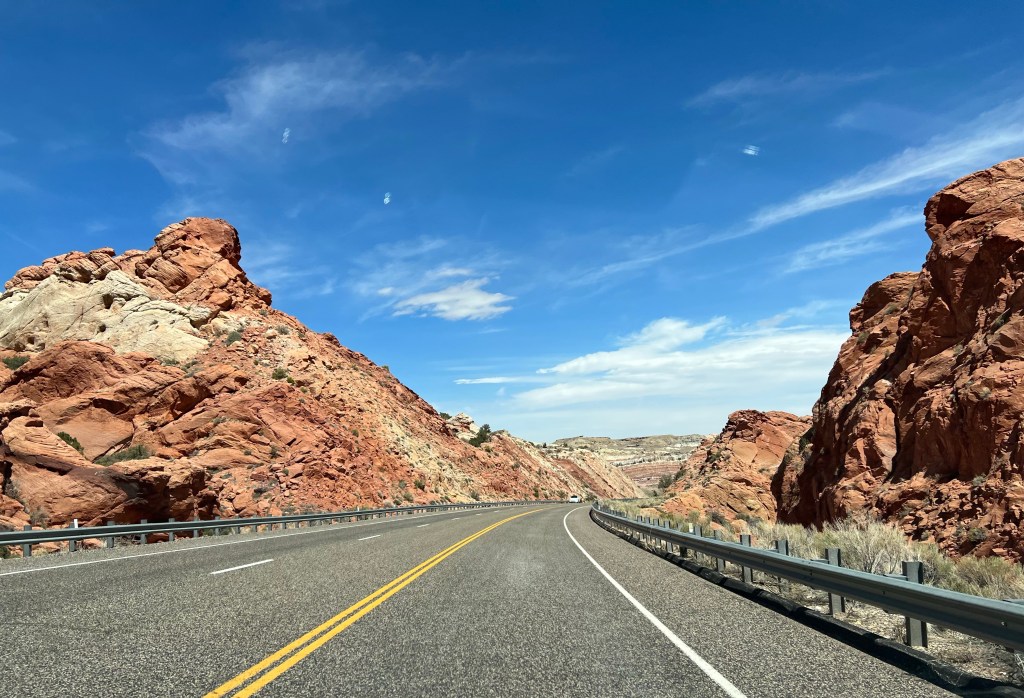
Friday we left the resort before eight in order to reach Flagstaff at a reasonable time. The first section of the drive continued the great basin topography of mountain ranges and valleys as we headed over to interstate 15 in Utah. From interstate 15 over to Flagstaff was territory we have experienced several times before. However, we managed to stop at one new spot, Coral Pink Sand Dunes State Park, in southern Utah.
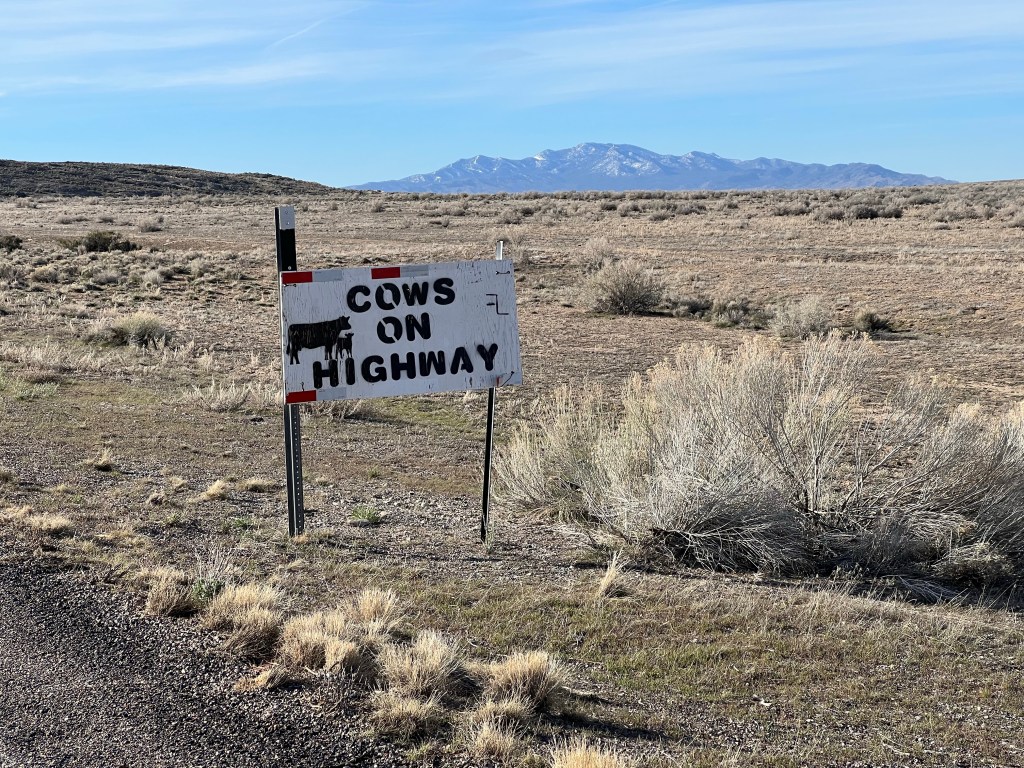
On our way to interstate 15We had to wait for the cows to cross the highway and get off the road
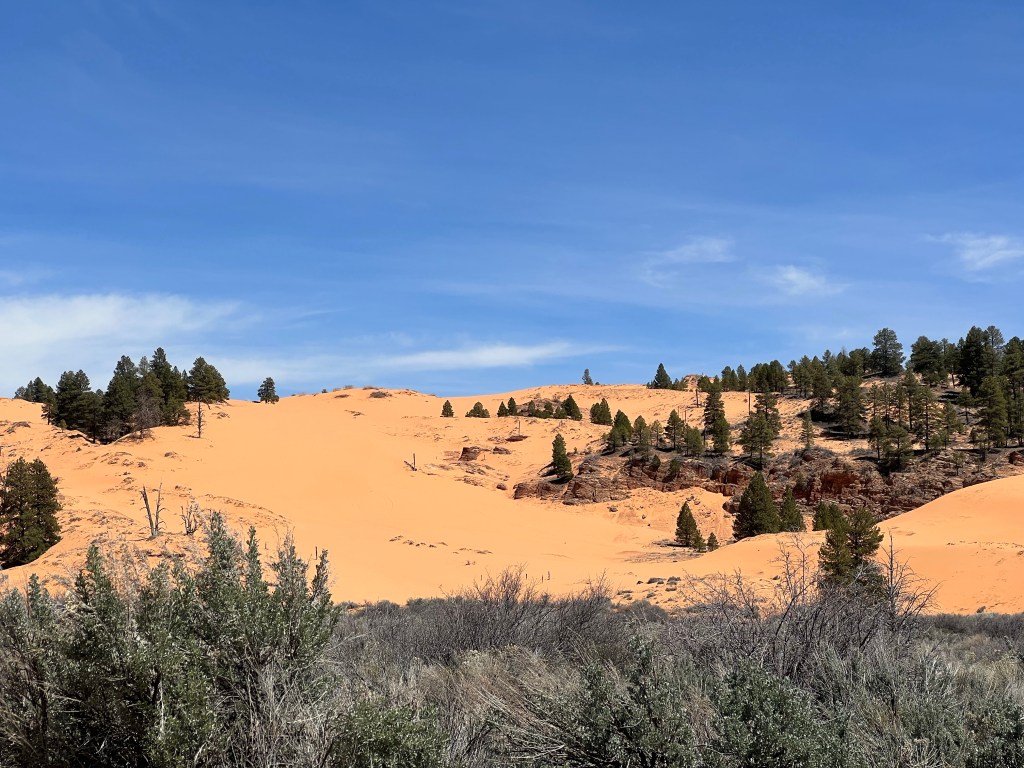
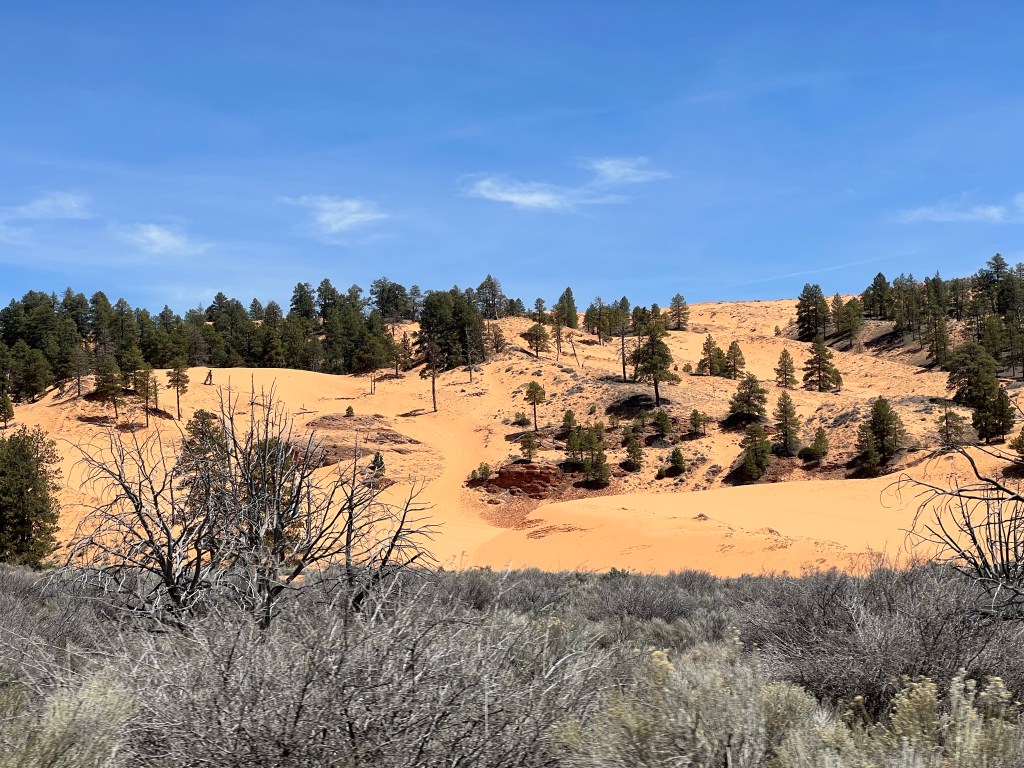
Coral Pink Sand dunes was on our list, even though we have been to several other sand dune state and national parks, because of its name. I was hoping for more of a pink color to the sand dunes, but it was more in the coral range. 
Coral Pink Sand Dunes State Park
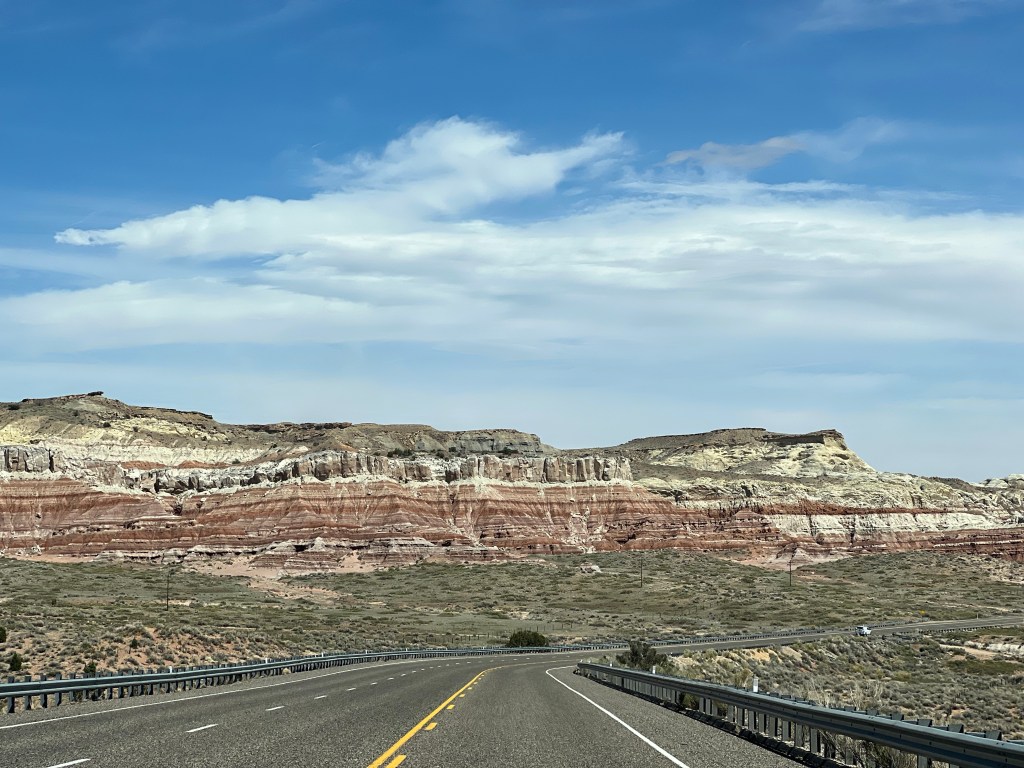
The final drive was along US 89 past Grand Staircase Escalante National Monument with its colorful, extremely high ridges. We also stopped at Lake Powell and photographed the lower water level in this lake where we had houseboated for a week in 2015.
Our alternate Amtrak transportation on Sunday March 19
March 24, 2023
We made this trip to Chicago to use up our timeshare points since we waited too long to book South Beach and because a trip to Chicago on the Amtrak would refresh my memory of the route prior to beginning this summer’s Trails And Rails program. The plan was to take Amtrak down on Sunday, spend four nights at the Hilton Grand Vacation Club location in the Doubletree hotel, and then return on Amtrak Thursday, March 23.
I try not to dump on Amtrak too much. After all, air travel is full of hassles also. However, Amtrak‘s on-time record for the Empire Builder going east from Seattle to Saint Paul to Chicago is poor. The train is normally late, sometimes dramatically so. The Amtrak app gives an overly optimistic view of the time the train will arrive in Minneapolis St. Paul. I use another program that tracks the Empire Builder’s journey once it leaves Seattle. For this trip, while the train left Seattle on time Friday early evening, east of Spokane it encountered a delay and was running 3 1/2 hours late. It never made up the time as it traveled further east.
Saturday afternoon around 4 PM we received an email from Amtrak that while the train was running late, they had made alternate arrangements for us. Turns out they had arranged for a nice coach bus to take us directly to Chicago. We should still show up at our usual departure time Sunday morning at Saint Paul’s Union Depot. This left some questions for us, but we were willing to go with the flow. Sunday morning we arrived at Union Depot and after talking to the Amtrak agent we learned we could either take the bus or wait for the train. At this point the train was scheduled to be about 3 1/2 hours late. (It ended up being 5 1/2 hours late.) We talked to some people in the waiting area and discovered that 35 students and chaperones from Richfield Senior High were going down to Chicago for two nights on a class trip. We ended up taking the bus with them. Our belief is that the bus was only arranged because there were so many people going directly to Chicago. A second bus was arranged for people going to intermediate stops, including Milwaukee. But our bus would go directly to Chicago.
The bus left around 9 AM, made a one hour lunch stop in Wisconsin Dells, and arrived in Chicago’s Union Station about a half hour sooner than the train would have. That is, sooner than the train would have arrived if it were on time. Since the train was actually over five hours late, we got to Chicago six hours earlier than if we had waited for the train. We took a taxi to the hotel, checked in, and had dinner at an Irish sports bar (O’Toole’s) across the street. Chris had their shepherd’s pie while I had their meat loaf. Both were very tasty. While we were on the 23rd floor, the view was only of downtown office buildings, so not as dramatic as the view in San Francisco.
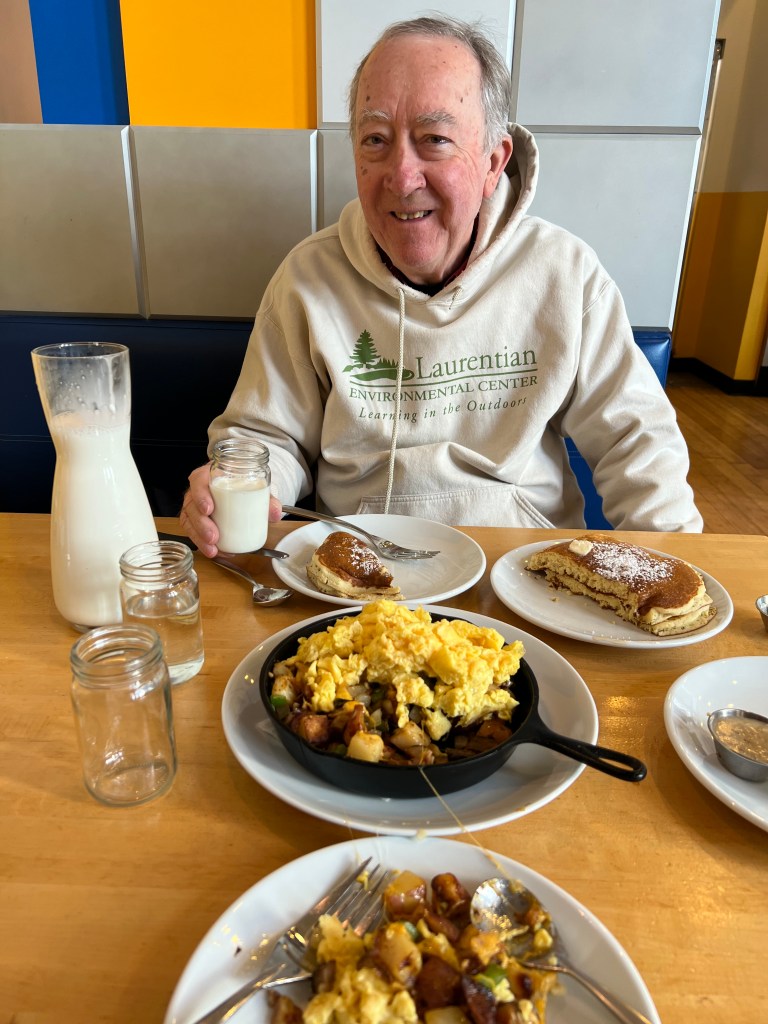
Monday morning we walked to a local breakfast place called Yolks. Great breakfast menu and it offered a carafe of 32 ounces of milk for $10. What a deal. We ordered it of course. We had only one scheduled activity for the day which was the Adler planetarium. There was a taxi outside the hotel, and we took it down to the Adler, part of the museum complex in Chicago.
At the Adler
The Adler planetarium was the first planetarium to open in the United States and did so in 1930. It has several floors of exhibits and theaters. We paid for one planetarium show called planet nine about Pluto and other planetary like bodies in the Kuiper belt area of the solar system. We found the exhibits well done covering some topics we knew such as moon exploration, but numerous topics that we had no concept of prior to our visit. One such new item was “retes”, which are pierced plates on an astrolabe. Hopefully we walked away remembering some of that information. Monday afternoon was probably the nicest day, weatherwise, and we walked 3 miles back from the museum complex to our hotel.
Walking back from the Adler
Pop Up book of Our Lady of Guadalupe
Tuesday we changed our plan a bit and took a tour of the Newberry library. The Newberry is a private research library devoted to the humanities, renowned in its field and in genealogy. We had a tour of the library which dates back to 1887. We viewed the original building but not the archival section which is off-limits. They had an exhibition of book arts, the process of creating fold up and pop up books. We are used to these nowadays as more of a children’s book with pop-up pictures. However, the history of these goes back hundreds of years and it was interesting to see the origins and variety that have been created as publishing skills have expanded. Another special exhibit presented the perspective of black and indigenous artists and how their art has shown resilience and resistance in the face of oppression.
The tour of the Newberry had a particularly curious twist. Mr. Newberry, another one of those millionaires with too much money to spend, left his money for a library. As Chris would say, long story short, he died on a boat trip to Europe to meet his free spending wife and two daughters. A superstition of the time was to have a dead body on board a ship. Given his wealth, people accompanying the trip convinced the captain to stuff his body into a barrel that had been emptied of it’s cargo of rum. The barrel was then lashed to the side of the boat. He and his barrel were transported to England, where his body greeted his wife and daughters. The docent did not describe how the body got back to Chicago for eventual burial.
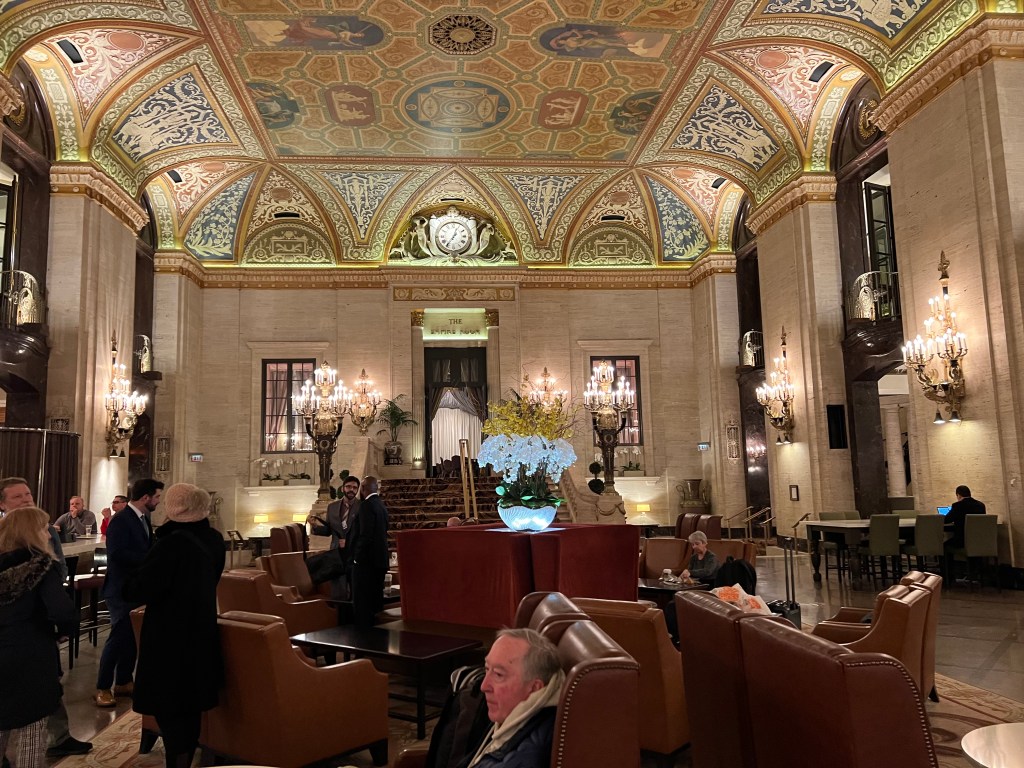
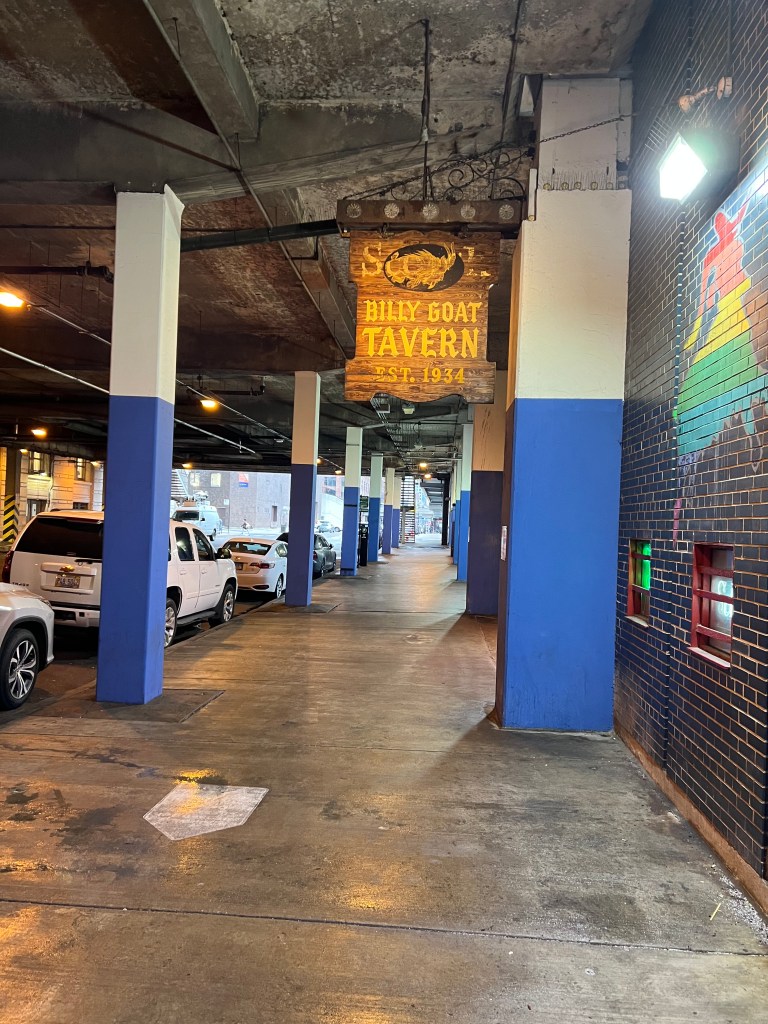
Chicago dining, from upper left, Palmer House, Giordano’s, Billy Goat Tavern, at Yolk, at O’Toole’s
For lunch, we walked a few blocks down Rush Street to Giordano‘s pizza, a Chicago institution since 1974. Once there we discovered they have expanded so much there is a location only a few miles from us in Richfield MN. Since their deep dish pizza is famous but would take an hour to create, we had the thin crust pizza with a salad, and were quite pleased.
Chris liked this from the Museum of Contemporary Art
After that, we walked over to the Museum of Contemporary Art. This was kind of a snoozer, I would’ve been happy to have skipped it. A lot of space, but not much art that spoke to me. In fact, not much art at all given the size of the building.
Sue
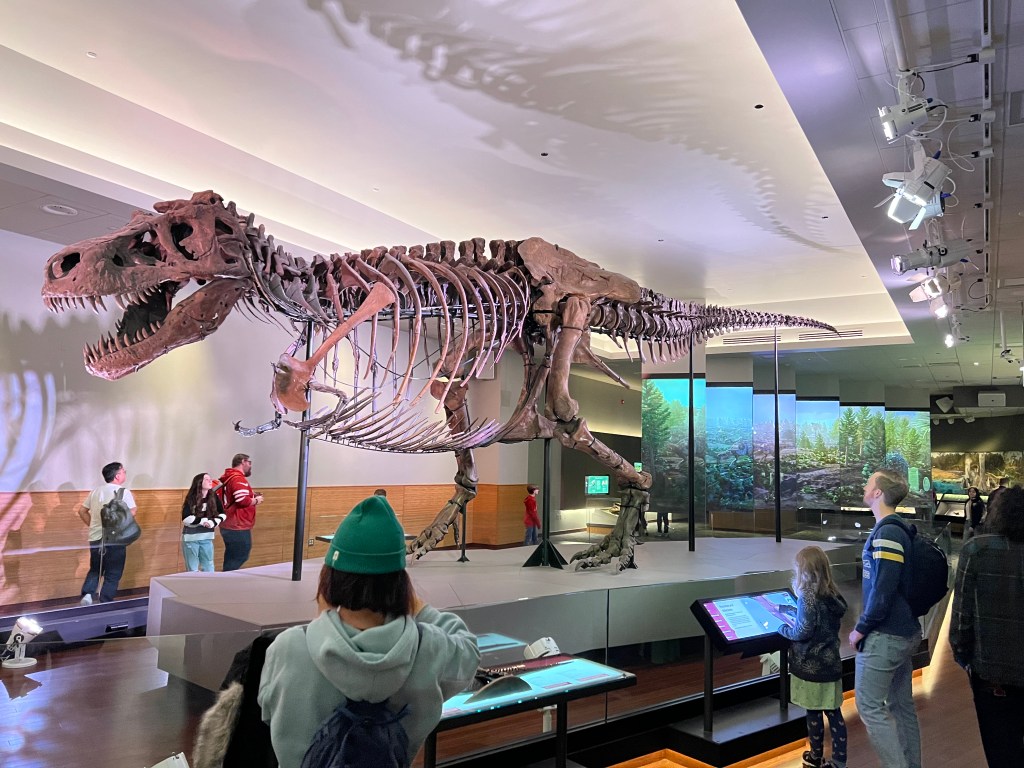
Wednesday morning started with our having the breakfast buffet in the hotel restaurant which gave us a chance to have fruit, vegetables, protein, etc. to fortify ourselves for a busy day. After breakfast, we took another taxi to the museum complex, this time to visit the Field Museum of Natural History. The Field dates back to 1894. It is one of the largest natural history museums in the world. Here we purchased the special exhibit about China, and also had an hour tour focusing on dinosaurs. Their main dinosaur, called Sue, is a Tyrannosaurus rex found in South Dakota, and named after the female archaeologist, Sue Henderson, who was the first to spot the bones of the dinosaur. The docent gave a very knowledgeable talk about the mass extinctions that led to, and killed off, the dinosaur, as well as the various types of dinosaurs that existed during the time frame they inhabited the earth.
Other exhibits were equally well done and extensive. We spent five hours here and by the time we got back to the hotel, I was pretty well wiped out. Not too wiped out, though, as we explored a dive type hamburger place located on a dingy lower level street. For some reason I thought at the Billy Goat Tavern, I could get a great burger and tater tots. But no, the burger was good, but it was only chips as your optional accompaniment. I made up for it by stopping at a little deli next to our hotel, and picking up some chocolate chip cookies and milk.
At the American Writers Museum
Thursday was our last day in town. We slept in, and then spent an hour at the American Writers Museum. This museum opened in 2017, and has a series of static and interactive displays of a wide range of American writers. They even had a section of manual typewriters where younger people visiting had a chance to find out how to properly insert a piece of paper in the typewriter so you type on the page with the logo at the top front. They also had difficulty understanding that you had to hit the keys smartly in order to make an impression. It was a bit of humor to watch among the multitude of displays about individual writers.
We had lunch at the Palmer house, another Chicago institution before heading to Union Station to catch our Amtrak home. The homebound train was only about 10 minutes late leaving the station. It was kind of a madhouse in the waiting room, but everything got sorted out smoothly as people were directed to the proper car for the journey west. We spent over half the time in the observation car enjoying the scenery. Only major hiccup was a male rider who appear to have some mental health issues. The train was stopped in Tomah, Wisconsin to escort him off the train for violating the no smoking rule, among other things.
We arrived back in Saint Paul about 11:15 p.m. There were no taxis wedding, so we dialed up an Uber and got home a little bit after midnight. Next trip, Arizona and Nevada for Great Basin National Park, and visiting family.
Walking back from the Adler to our hotel in downtown Chicago
Tomorrow we fly home from San Francisco Airport. This last blog will cover the Monterey Peninsula area, from noon Friday to Sunday afternoon (today). We left the Calla lilies and came north up the coast to Monterey. Not for us the 17 mile drive or Monterey Aquarium. Instead we went to discover the history of the area.
Our learning started at the Monterey Historical Park. This is the area of old Monterey, where California began its transition from being part of Mexico to the 31st American state. In 1542 Spanish explorers first discovered Monterey Bay, a large sheltered bay capable of receiving large ships. It was not until 1770 that settlers, military, and missionaries arrived to establish up a more permanent settlement. In 1776 Spain named Monterey the capital of upper and lower California. In 1822, control shifted from Spain to Mexico after Mexico won its independence from Spain. From this point, the population, trading, and development of ranches increased.
The Custom House in Monterey
In 1827, the old Custom House was built by Mexico to collect tariffs on the shipping of goods into and out of California. This building still stands today. The warehouse for the Custom house is used as a museum whose exhibits we viewed. The Custom House is the oldest surviving government building in California. The exhibits helped us understand the history of this area, from the earliest Native Americans living here to the statehood period. An excellent docent tour Friday afternoon deepened our understanding and knowledge.
In 1846, war between the U.S. and Mexico broke out and most of the fighting occurred in Texas and Mexico. On July 7, 1846 U.S. Commodore John Drake Sloat landed in Monterey and with marines and sailors seized Monterey and proclaimed California to be part of the United States. When the war was over, with the Treaty of Guadalupe Hidalgo signed on Feb. 2, 1848, this large and poorly defined area of “California” became part of the U.S. Just in time for the U.S. Gold was discovered in California on January 24, 1848. News of this did not reach the U.S. or Mexico until after the treaty was signed. Would not have life been different for the U.S. if Mexico retained not only California but those parts of Nevada, Utah, Arizona, New Mexico, Colorado and Wyoming that became part of the U.S. also?
The inside of Colton Hall where the California Constitution was debated
In 1849 the first American built government building was constructed. Colton Hall, still standing, was built “out of the slender proceeds of town lots, labor of convicts, taxes on liquor shops and fines on gamblers.” This is where the constitution of California was debated and approved. Note that: California went directly from a province of Mexico to a U.S. state without first being a territory, has a constitution that outlawed slavery and guaranteed married women could keep the property they had before they got married, and the first capital was in San Jose. Monterey never was the capital of California.
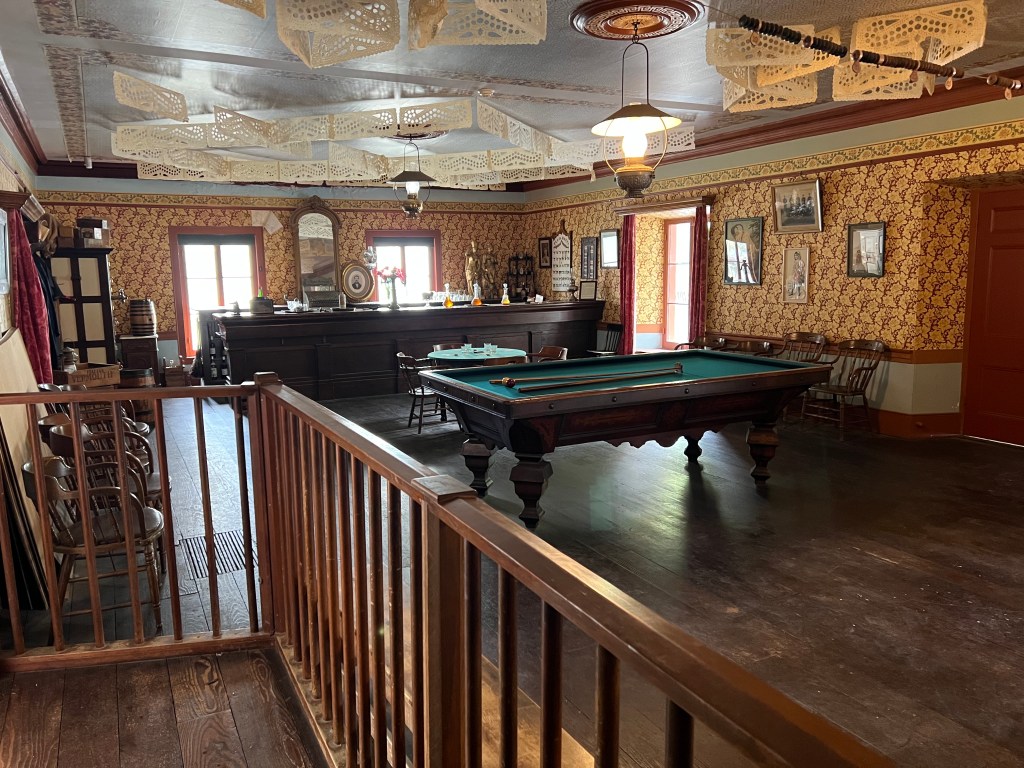
The docent tour started at the Custom House and the docent explained the history of Monterey. We walked among sections of the historic area; seeing portions of a sidewalk constructed from whale bone, and two other buildings dating from the mid to late 1800s. We saw another example of papel picado, a Mexican folk art which cuts elaborate designs into tissue paper. Our docent explained different designs and colors would be used to celebrate various holidays and celebrations. Earlier we had seen them in the bar of the hotel at San Juan Bautista.
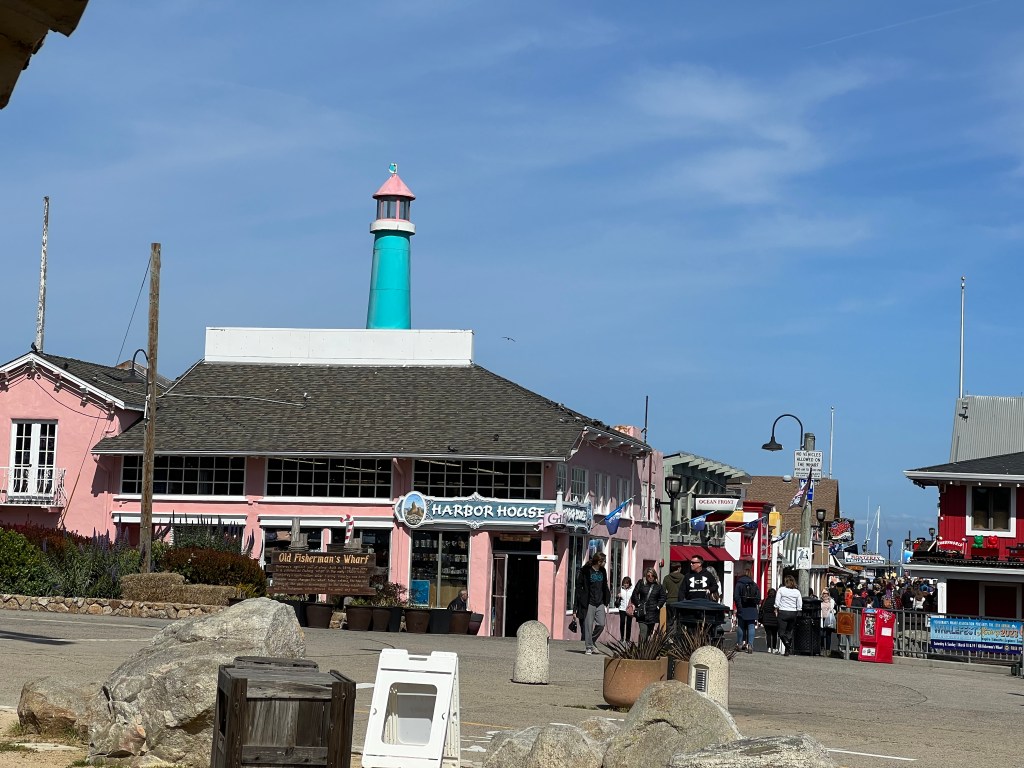
Fisherman’s Wharf
Lunch/dinner was at a fancy restaurant along Fishermans Wharf. The clam chowder was excellent.
Saturday we visited Cannery Row, the area of Monterey where fishing, particularly for sardines, was a huge business from about 1915 to 1955 when the sardines were either overfished or just at natural down cycle in their existence. Cannery Row was made famous by John Steinbeck’s novel of the same name. We wandered around the Cannery Row area, mainly tourist shops except for the Monterey Aquarium. After that, we did our tour of Coltan Hall and old Monterey Jail, finishing up as the afternoon rains kicked in.
San Carlos Cathedral
Church was at San Carlos Cathedral, originally the chapel for the Monterey Presidio. It is the second smallest cathedral in the U.S. (after the one in St. Louis.) and the oldest continually operating parish in California. Dinner was at a very popular Italian restaurant downtown, we were lucky church was at 4 PM and we arrived at the restaurant before the hordes.
Sunday we had one destination in mind. The National Steinbeck Center is in Salinas, just 15 minutes from Monterey. First though, Chris had us stop and walk over the dunes to have a last look at the Pacific Ocean. Then we drove over to Salinas. In case you have a good memory, yes we spent the night here earlier this week but the Steinbeck Center was not open at that time. I had not realized that John Steinbeck, the author, grew up in Salinas. Towns and locales we have been visiting or driving through the last few days are the sites of many of his books. His life here gave him a perspective on working people and their experiences, thus his books are based on people he knew and their lives. Not for him the well off life in the books of Sinclair Lewis for instance. Some of his novels include: Of Mice and Men, Grapes of Wrath, East of Eden, Cannery Row, and Tortilla Flat. Steinbeck won one Pulitzer Prize and one Nobel Prize.
The National Steinbeck Center is a museum devoted to his life and his works. We spent two and a half hours viewing videos, listening to recordings of actors reading his works, viewing the exhibits, realizing that during WWII he experienced the war firsthand and wrote about it for wide spread circulation, and in general, re-acquainting ourselves with his literary works and impact. It was time well spent and a fitting end to our time in the south bay of San Francisco.
The camper used by John Steinbeck when traveling around the U.S. gathering insights for his book “Travels with Charley” The truck was named after Don Quixote’s horse-Rocinante.
Ed and Chris Burlingame CA-just south of the San Francisco airport March 5
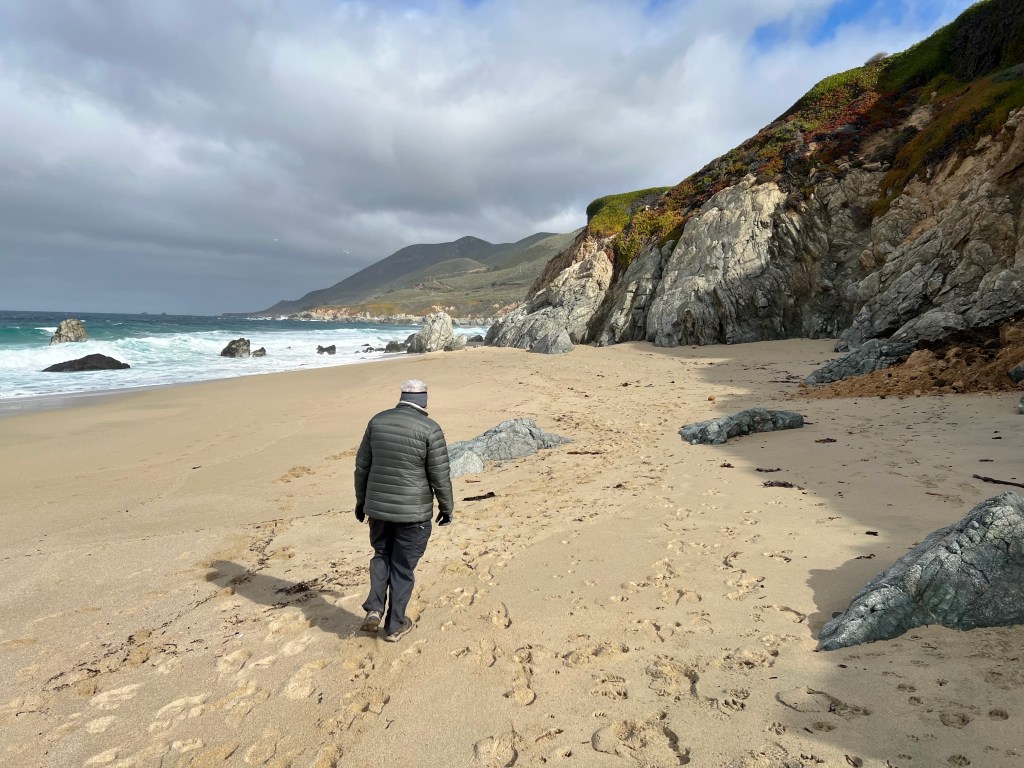
Big Sur is a rugged area of the central coast of California. Multiple state parks offer the opportunity to explore the forest and beaches; except now the 2023 rain storms have closed most of the trails leading to the beach. The Pfeiffer Big Sur park brochure states that the park is still recovering from a 2008 lightning strike fire that burnt 160,000 acres along the Big Sur coast. Our plan is to stick to the forests and coastal cliff tops today, tomorrow we will explore the one place where access to the beach still seems possible.
Hiking to Pfeiffer Falls
An open trail in the forest will take us to Pfeiffer Falls. There is an easy trail that is closed due to the rains so we start out on a smooth path which switches over to the usual rocky steep hike one frequently finds in mountainous forests. I complain as is usual lately. Chris and I reminisce about previous long and/or steep hikes we have taken in the past: the 11 mile, unshady round trip along the Columbia River in Wenatchee-East Wenatchee WA on a hot day, the long, steep hike up Two Sisters Mountain in Rocky Mountain National Park that we never finished, the 600 plus stairs up the Mississippi River bluffs in John Latsch State Park, and others. I am glad we did those when I was younger.
Pfeiffer Falls
Waterfalls are fun to find and watch. Pfeiffer Falls is nice but not overwhelming. We meet a much younger couple and we give them hints about other waterfalls they should seek out. They are shocked that we are married as long as we are; we are shocked that they are dating since she lives in NYC and he lives in New Zealand. In any event, Chris and I make it back to the trailhead safely. Lunch is our first crackers and peanut butter on this trip.
McWay Falls in Julia Pfeiffer Burns State Park
After lunch we drive south along CA 1, the coastal highway, making several stops for ocean views. McWay Falls is our second destination of the day. McWay spills out of the rocks and lands on the beach sand. One is unable to walk down to the beach so our views and pictures are limited. The falls are a popular stop, they are part of Julia Pfeiffer Burns State Park. The first Pfeiffers arrived here in 1869. When a developer wanted to buy land and build homes, Pfeiffer’s son John (who was then the owner) refused and sold the land to the state in 1933 and the land was the beginning of Pfeiffer Big Sur State Park. The CCC built many of the trails and bridges in the park. They also built the lodge, completing it in 1941. Friends of John and Florence Pfeiffer’s daughter Julia donated the land that became Julia Pfeiffer Burns State Park in 1962.
Two large, freshly made sandwiches from the Big Sur Deli and Bakery made up dinner, along with chips and Coke. After picking up the sandwiches, we stopped at a multi-agency visitor center where the staff person helped us figure out how to actually get to the ocean. He was the only one who also knew where to find the Calla lilies blooming in the wild. I had read about these but the directions to find them were vague.
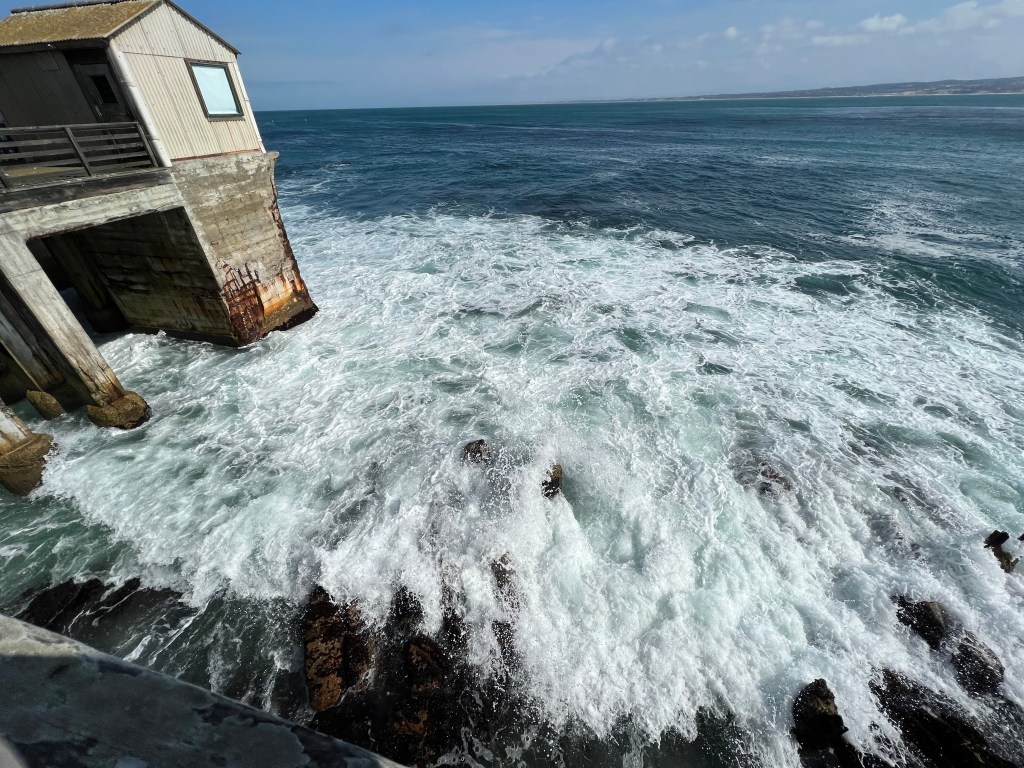
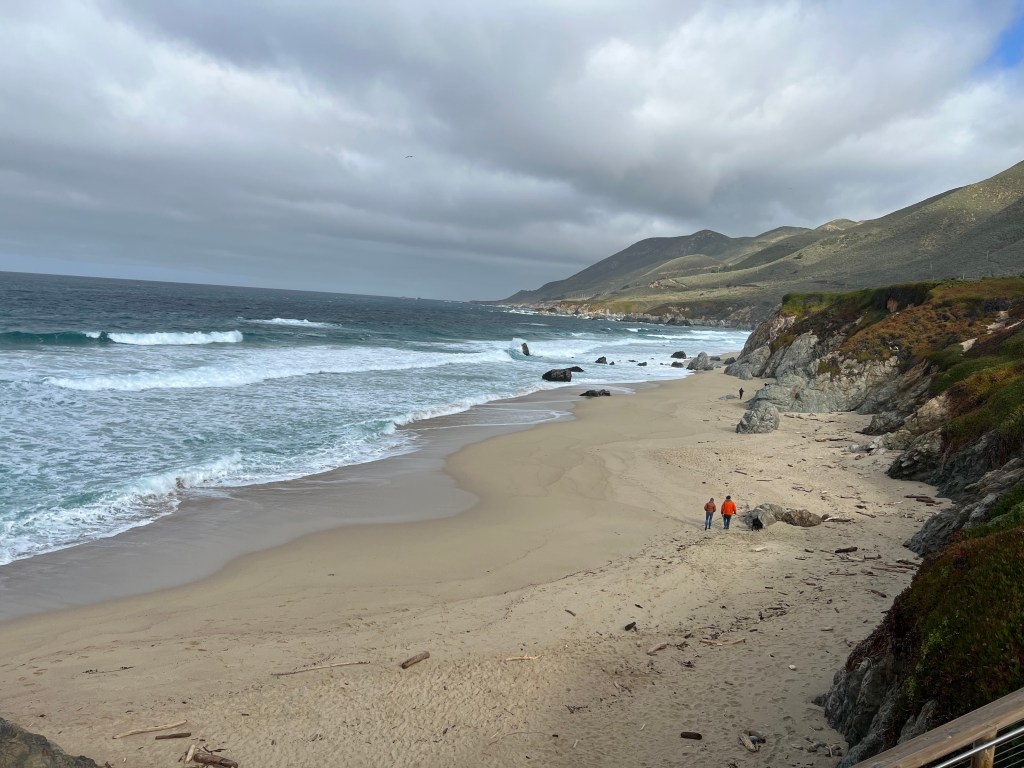
Friday morning the 3rd, we packed up and headed north on CA 1 looking for Garrapata State Park. According to yesterday’s information, the park is basically undeveloped and we had to park on the side of the road just past the bridge construction. We found the parking spot and located the trail leading down to the beach. Finally, ocean waves are at our feet, not hundreds of feet below us. Chris loves ocean waves so she is particularly happy. The beach going north should lead to the trail along the canyon/valley of the Calla lilies.
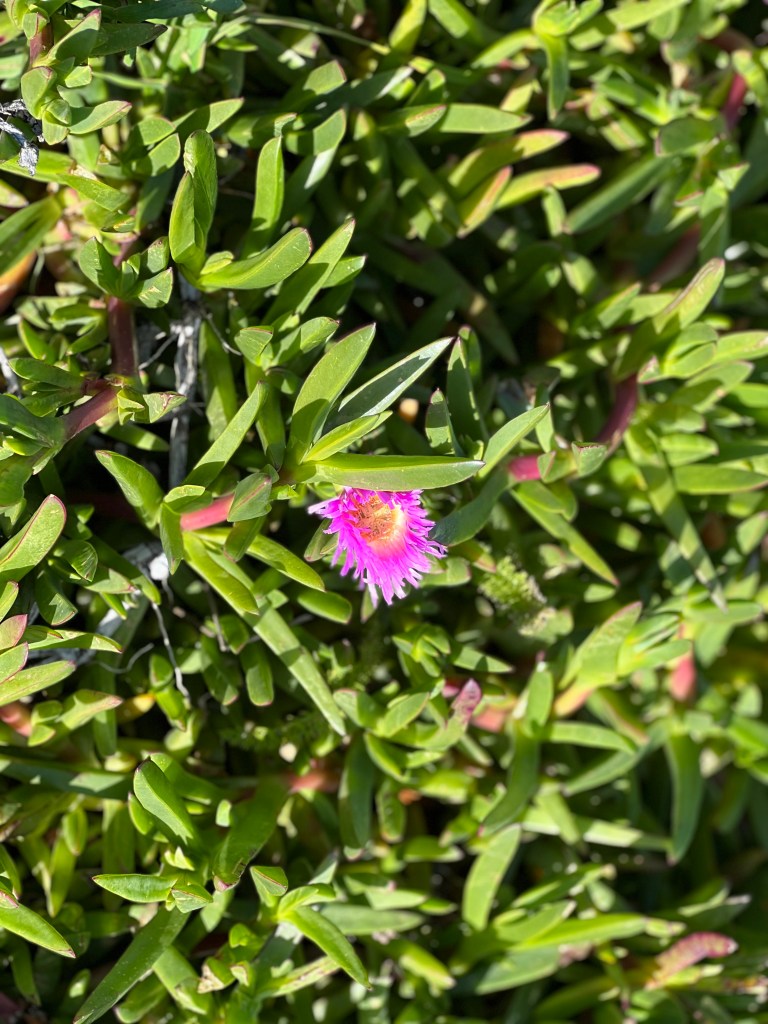
The canyon is full of running water, our information person yesterday thought the water would have receded by now. In some ways, it was just as well. The walk along the beach had one area with very little space between the cliff and the ocean waves. We did not know if the tide was coming in or out. Walking back to the stairs up the cliff guaranteed we were not stuck on the beach with the tide coming in. An alternate trail to the lilies ran along the top of the cliff, through greenery that was about to explode with blooming flowers. Not the Calla lilies but these will be beautiful in a week or two.
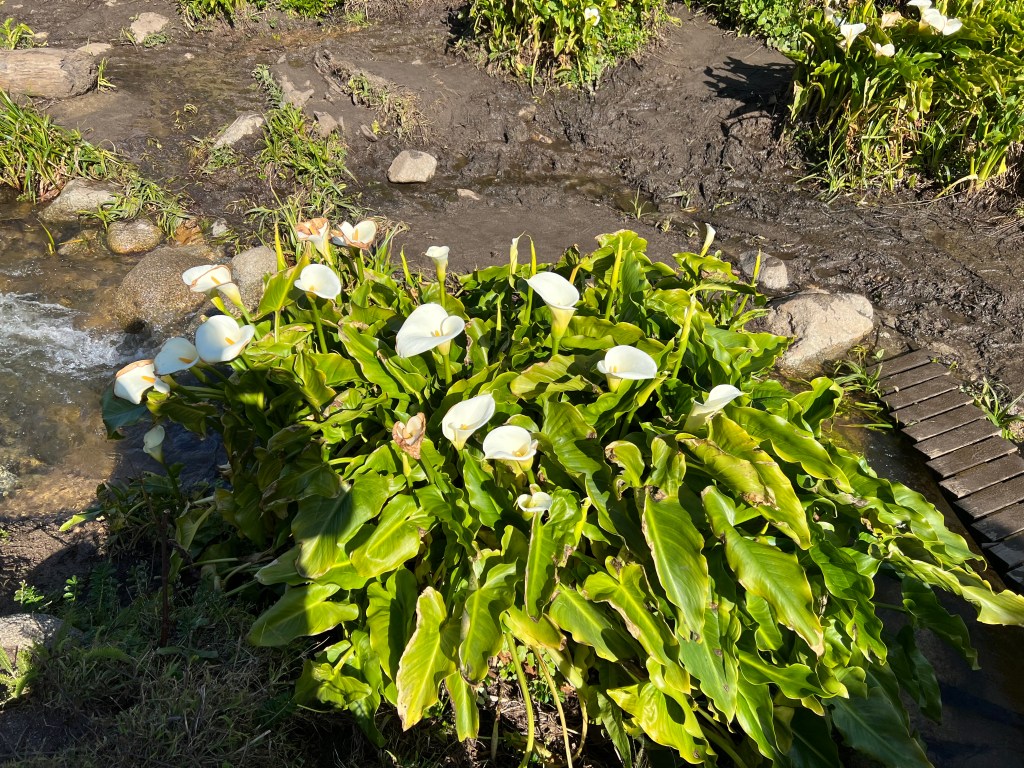
Calla lilies blooming in the wild
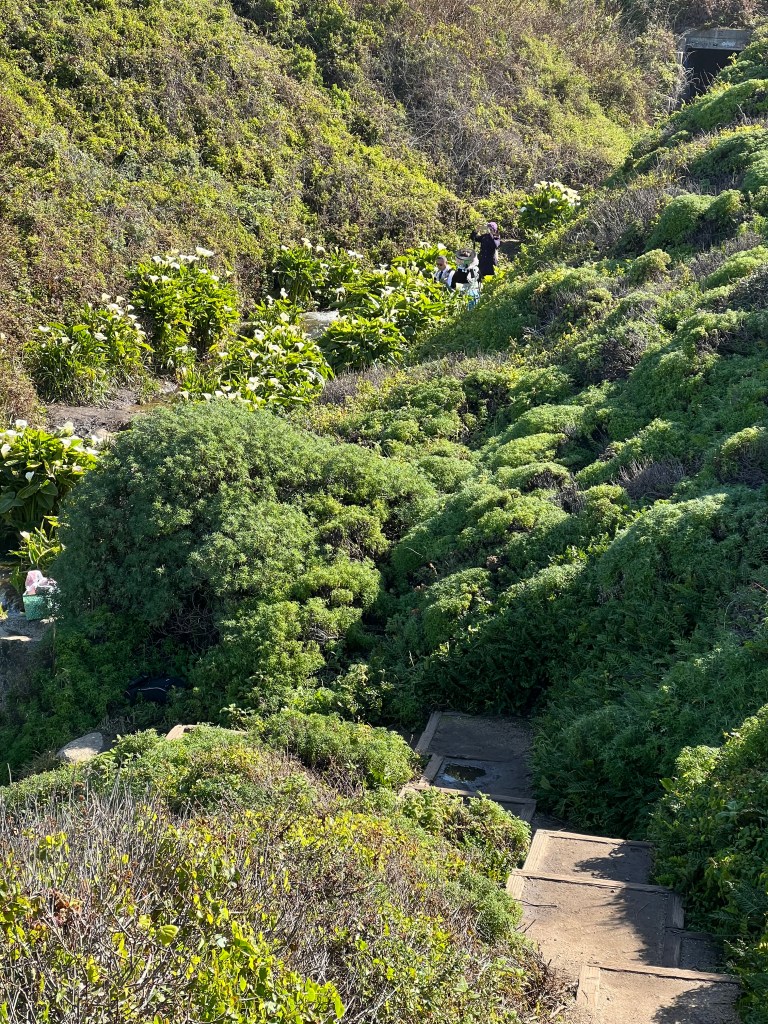
We got back to the canyon and found the wild growing lilies. They are abundant in a confined area. A few other couples are taking pictures. What appears to be a formally dressed party of Vietnamese are having a photo shoot. We stay out of their way and take our photos around them. I am pleased we made it here; it is not a riot of color or a huge area but it is something unique we were able to find.
The rest of Friday will be combined with Saturday as we explore Monterey.
Pinnacles National Park and Big Sur coastal area,Wednesday March 1
Well today, March 3, we are back into territory that has WiFi and cell coverage. Weather the last three days has been sunny although still cool, and we have made the best of it. It turns rainy again beginning tomorrow so the next few blogs covering the past three days will have some wonderful scenery pics with sunny skies.
Pinnacles National Park was our sole focal point for Wednesday. Pinnacles was declared a national monument in 1908 and a national park in 2013. Much of its 26,000 acres are declared wilderness and not likely to see us walking and hiking in those less explored areas. Many Californians come here to go rock climbing. The geology of this park is tied into plate tectonics, the San Andreas fault, and erosion. Movement of the earth’s plates has made part of the volcanic field that created the Pinnacles area to be located 195 miles southeast of here by Los Angeles. There is no road going through the park either north-south or east-west.
We concentrated our time on the east side of the park where the bookstore is; the visitor center has been closed for a while. Actually, many of the park trails are closed, some due to the January storms, some due to flooding and fires dating back to 2021. We took three trails, turning back when the trail was closed or when our legs were tired from climbing up steep and rocky paths. Parts of the park like the reservoir, the caves, and high prairies were not areas we were able to visit.However,..
Condors
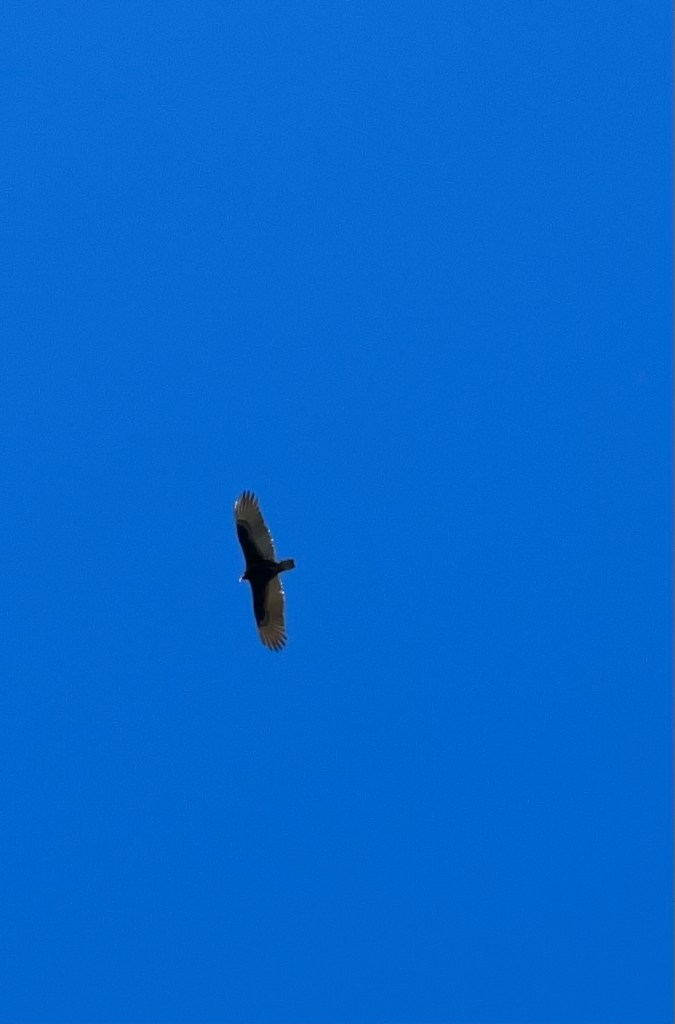
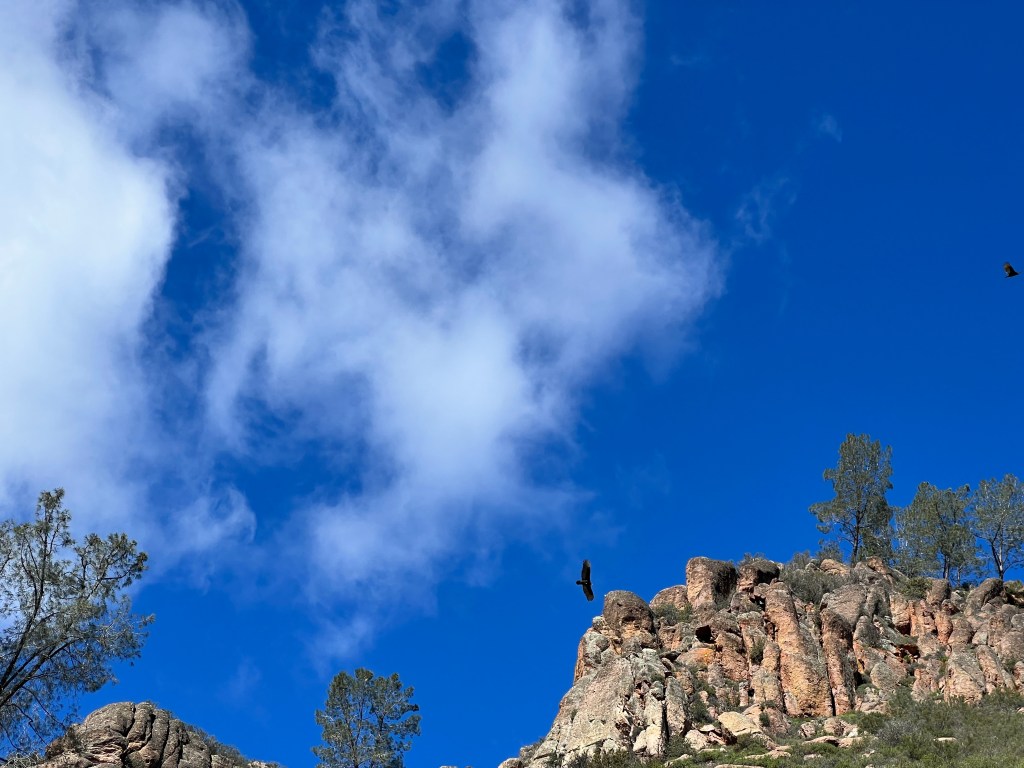
CONDORS!!. This was our first verifiable sighting of the California condor. In 1987 the last wild condors were removed to a breeding program at the Los Angeles Zoo and have been slowly reintroduced into the wild. It is estimated there are over 300 condors in the wild at five various locations. Pinnacles is one of the five. The volunteer at the bookstore gave us a quick tutorial on how to positively identify the condor and not confuse it with a turkey vulture. Flying as high and fast as it does, the tips were invaluable.
On our second trail, we had only traveled several hundred feet up the trail when we spotted several raptors in the air. One came close enough to us for positive identification. As we climbed farther and higher, we saw a total of six condors circling in the sky, riding the air currents, and, from our perspective, just having a good time circling around. Breeding pairs are sitting on the one egg they laid which takes two months to hatch, about twice as long as bald eagle eggs. We did not see any nests but they would have been located higher than we were able to climb.
This sighting of multiple condors was a great experience. We had dared not get our expectations high, sightings of wild animals is so unpredictable. Seeing the six made it an easier decision to acknowledge our tired legs and return to the car.
Driving to Pinnacles National Park
But Wednesday had other positive experiences also. We left our lodging in Salinas and drove down new roads seeing new vistas. The topography and vegetation along the road were a surprise to us. Yes, California is a big state but saying that and understanding the variety of landscapes is different. It may have helped that the past two months have been wet; the greenery was all around us and in varying hues.
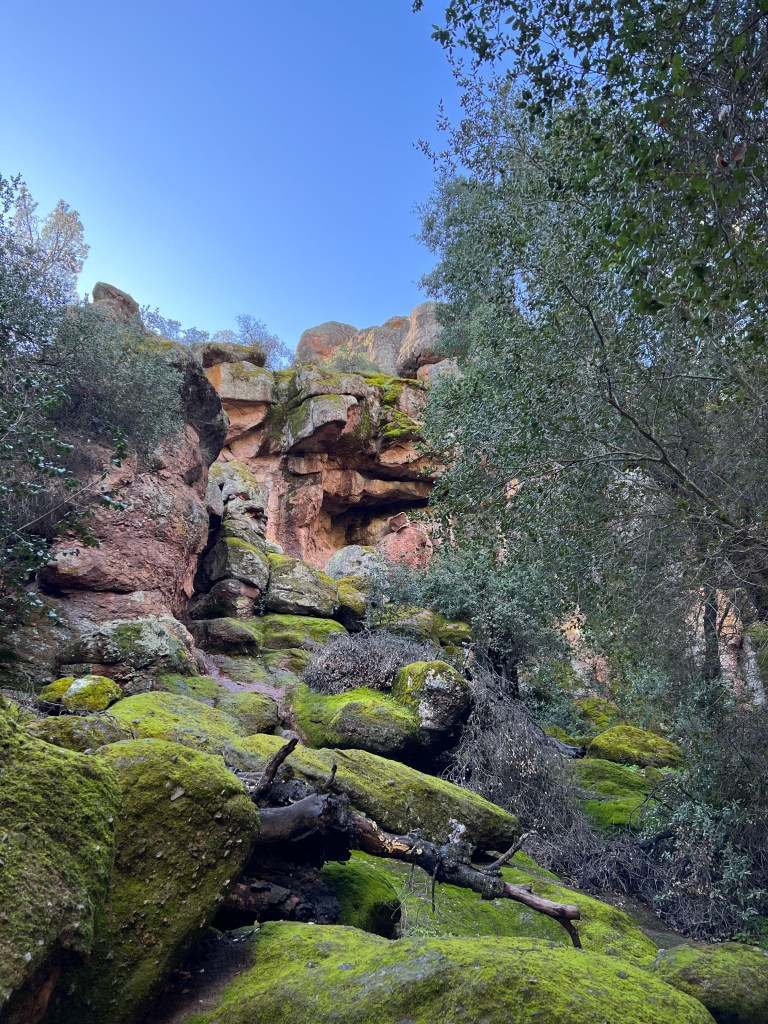
Pinnacles was not crowded today. On weekends, natives from Los Angeles and from San Francisco come here to explore nature and the wild side. Parking then is at a premium. Our first hike got us to experience the jagged cliffs and tumbled boulders that create unique caves, tunnels and rock formations. The cliffs rose pointedly into the sky, with the blue backdrop, it created a picturesque sight. Eventually the hike ran into the water we had been warned about. Rather than hiking through water, we turned around and began a second hike, the one that showcased the condors.
Our first hike along Moses Spring Trail at Pinnacles National Park
Our third hike was on flat land along a creek. After a while, it was boring compared to the first two. We called it a day for Pinnacles, excited for seeing the condors and for viewing the mountain peaks.
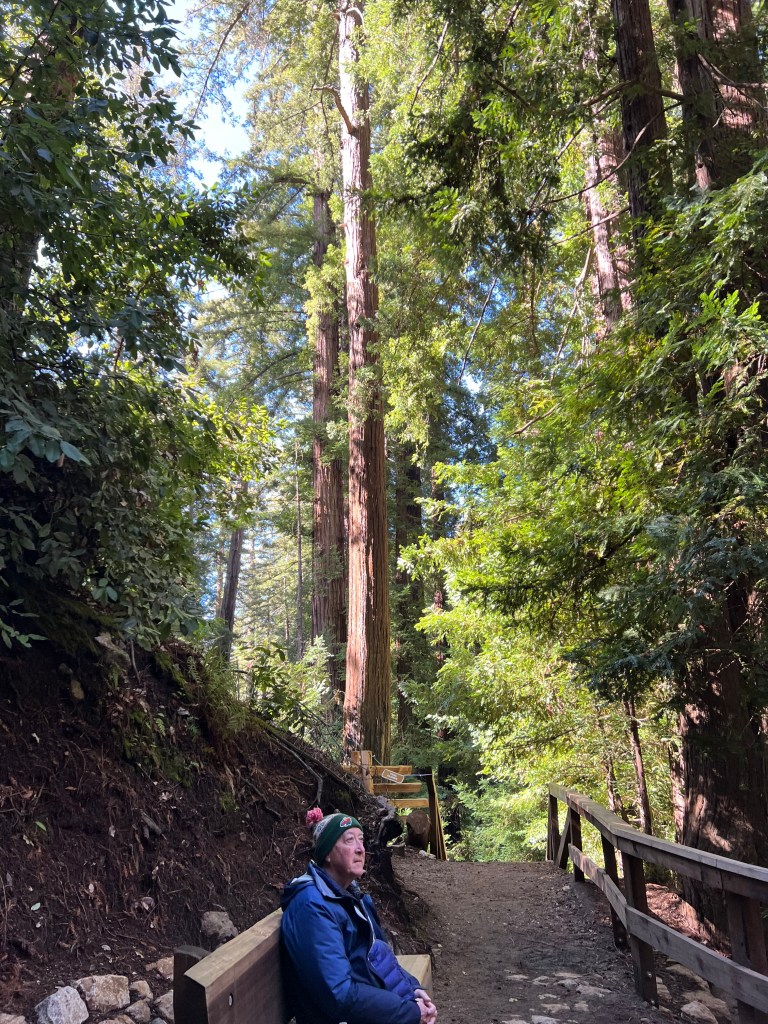
It took us two hours to reach the Big Sur Lodge in Pfeiffer Big Sur State Park. This area is the southern edge of the growing range for coastal redwoods. This park honors those trees, not the raging surf of the ocean-which we can not see from the park housing. The forest and the Big Sur River are the center points. Pfeiffer Big Sur State Park and the neighboring parks of Andrew Molera State Park and Julia Pfeifer Burns State Park have trails that lead to the ocean-but all were closed due to storm damage. We had a cabin here, with a skylight that allowed the moon to shine in during the night. It can not be called fancy but was pleasant and comfortable. It was too late in the day for more hiking so we had a nice dinner at a restaurant three miles down CA 1, the coastal highway. We had expected the lodge restaurant to be open from 8 to 8. Somehow their website had not been updated.
Dinner in Big Sur CA
CA 1 is the highway that hugs the Pacific coast-and not at the beach level. Chris got great views of the coast, waves, rocks, and mountains. I got great views of the road, keeping my eyes away from the drop offs. We did stop for a few pictures, but realized we had more time over the next few days to take more. In several areas, road work was ongoing and resulted in single lane traffic. It appeared that most of this was scheduled repairs. However, about 25 miles past Big Sur, the highway was closed completely due to damage from the atmospheric rivers of rain that California has experienced since January 1. Portions of the coastal highway are lined by forests that had been burned by previous wild fires; the 2023 rains created mudslides that wreaked havoc on the highway. Luckily for us, it was farther south than our lodging.
Is my memory poor? It seems as if more places are closed on Mondays and Tuesdays than I remember from when we first start our major travels in 2013. It might be COVID; museums, parks, arboretums etc have less money and are hesitant to liberalize the number of days and hours they are open. In any event, traveling on a constant basis means the pickings might be slim on Mondays and Tuesdays. For instance, we are in Salinas CA which has a national John Steinbeck Center which is not open today (Tuesday). Or Monday for that matter. 10 AM seems to be the default opening time. Didn’t it used to be 9 AM? Then, of course there is the weather. We are less likely to go hiking on solid rainy days.
So we deal with it and some days the traveling may be less than others. Today was one of those days. Constant rain in the morning meant our planned adventure at Pinnacles National Park was delayed. The park said to expect muddy paths with the potential for falling trees and mudslides. Rain tonight will increase that a bit but we are going there tomorrow anyway since Wednesday through Friday look to have a window of sunshine that we need to take advantage of.
So inside activities are needed. We start at the historical museum in the town of Gilroy with a sizable population of 58,000. The museum is housed in an old Andrew Carnegie library building. We discover that Gilroy has a robust agricultural base and a large sense of self-worth. In various spots throughout the museum, Gilroy is proclaimed as, or proclaimed as once having been: Hay and Grain Capital of California, the Tobacco Capital of the U.S., Dairy and Cheese Capital of America, Prune Capital of America, and Garlic Capital of the World. We had heard about garlic. As it turns out, China grows 75% of the world’s garlic but California is tops in the U.S. and Gilroy is the center of garlic growing in CA. Christopher Ranch is the largest single grower of garlic in the U.S.
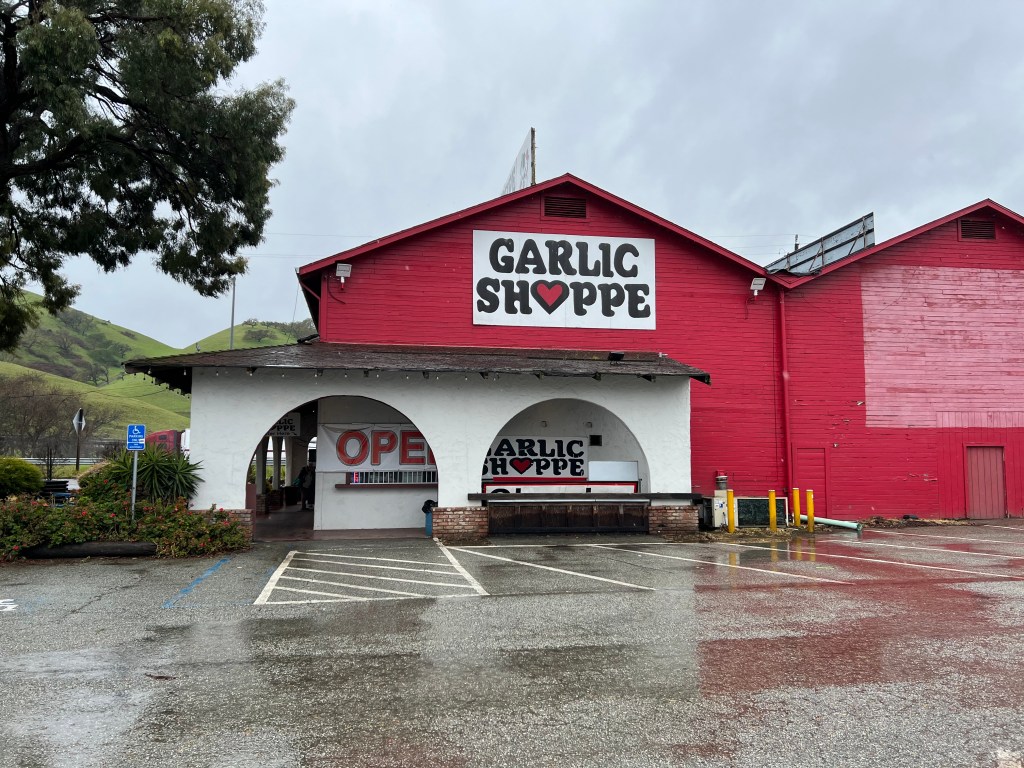
We stopped at a local garlic store and I tried some garlic ice cream. In small doses, not too bad.
The museum does have a reasonable display about the history of the various American Indian tribes in the area. A nice map detailed where various tribes in the area lived. The exhibits also mentioned the tragic deaths caused to Native Americans by the Spanish missions, the illegal loss of land by the secularization of the missions when transferred by Mexico from the Catholic Church, the sale and indenturing of Native American children, the selling of state bonds to finance expeditions to kill Native Americans, and the impact of papal bulls (proclamations with the effect of law) issued by the Catholic Church to justify European conquering people in the New World and Africa.
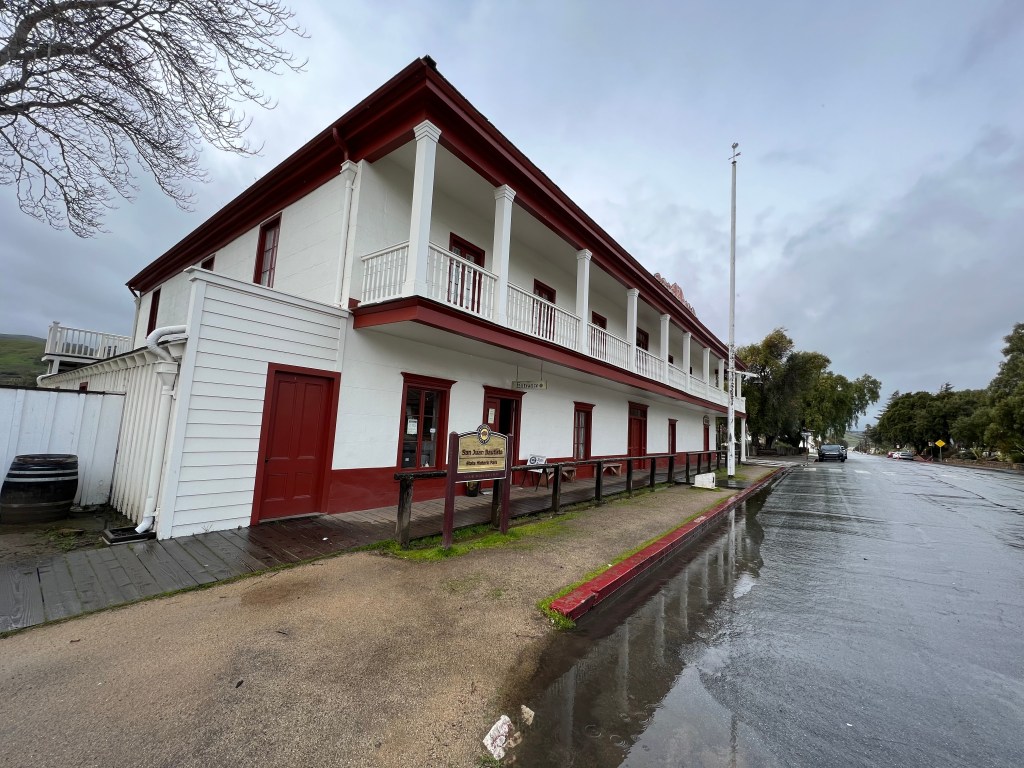
From Gilroy we drove 15 minutes to San Juan Bautista, home to a mission and to a state historical park. The focus of the state historical park is not the mission, but the buildings that represent the development of California between 1859 and 1890. This is a time when California has become a state and the Mexican ranches are becoming agricultural lands owned by settlers from the American East. At San Juan Bautista, the Mexican owner has welcomed Irish immigrants, survivors of the infamous Donner party, to the area. They intermarry and begin new traditions.
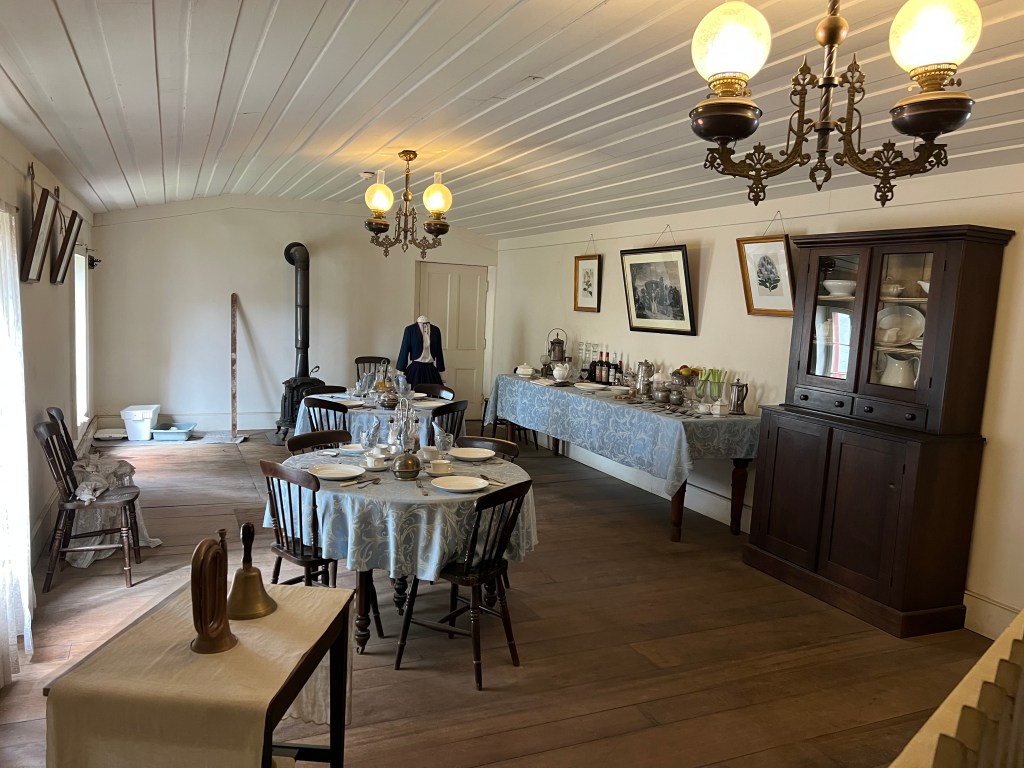
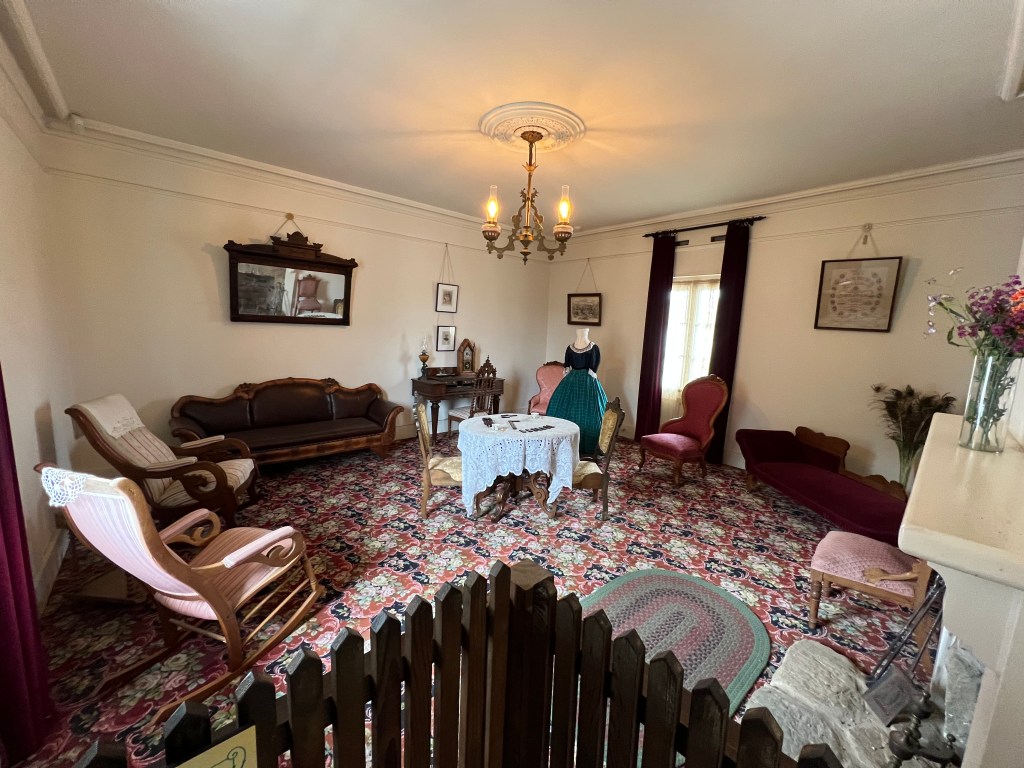
From top left, the hotel dining room, the stables and home, the women’s parlor at the hotel, hotel at bottom
Other immigrants from Italy arrived and established a hotel, well known and frequently visited due to its location on several stage coach lines. Seven to eleven stage coaches would arrive daily. Unfortunately, the railroads never came to San Juan Bautista and the town slowly lost importance. It must not have helped that the 1906 SanAndreas quake left cracks in many of the town’s buildings. Today San Juan Bautista is a community with a population of 2,000 and a pleasant, old style downtown.
Rosie the Riveter was the focus of our activities today. The morning was constant rain so spending the time inside of a National Park site building was a good choice. As a bonus, one park ranger and one volunteer grew up in Minnesota so we swapped stories for a while before we really got into the exhibit. The park site is located inside of an old WWII factory along the wharf area and an area still heavily industrial.
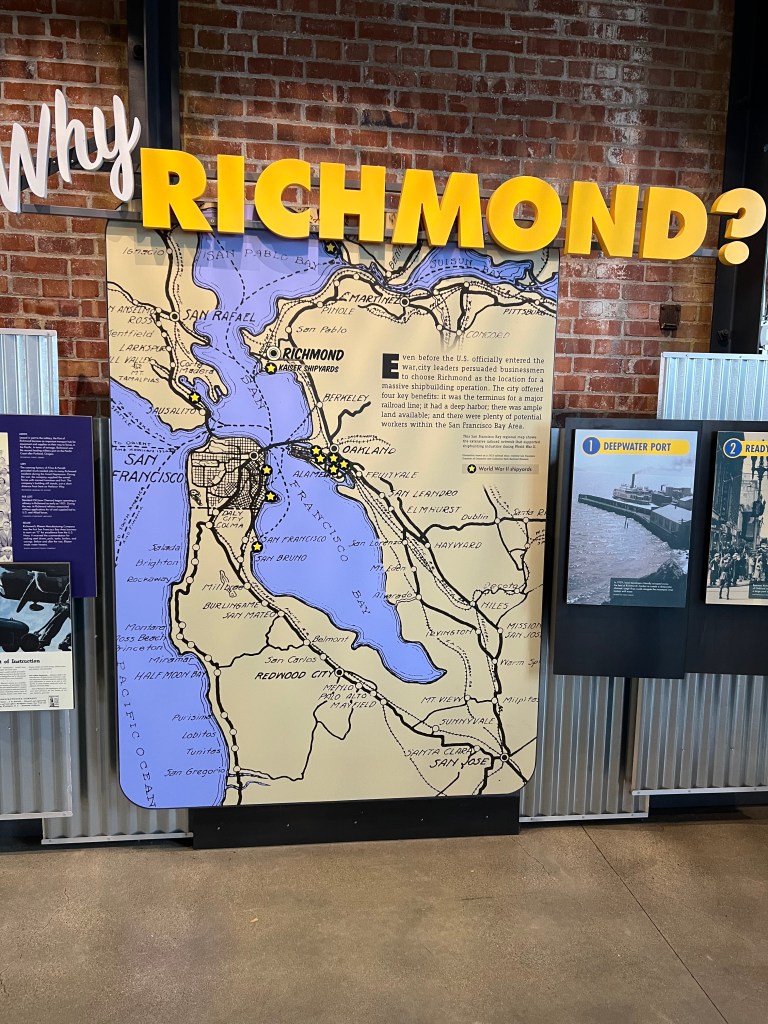
The mission of the Rosie the Riveter/World War II Home Front National Historical Park is to honor and to explain the sacrifices made by Americans of all walks to supply the war material needed to win WWII. Richmond CA was chosen due to its important role in producing war material and as a community that dealt with the changes brought about by the rapid increase of people.
Richmond’s location in San Francisco Bay
Richmond was a town of about 23,000 people in 1940. It had a deep harbor with excellent rail connections. It was chosen to house a major shipbuilding program that by war’s end built 747 ships in Richmond, more than any other shipyard in the U.S. People came from all over the country to work here. During the war effort, it exploded to over 100,000 people with over 90,000 people working in the shipyards. The exhibit discusses the impact this had on Richmond from childcare to housing to health care to segregation.
The huge number of ships built was due to a process of using prefabricated assembly methods allowing inexperienced workers to capably excel at basic tasks. This allowed the shipyards to bring in women and minorities that normally would not be hired. The well known Rosie the Riveter image masks the reality of a slow battle for acceptance of women, blacks, Indians, etc. African Americans created a “Double V” campaign for Victory in the war and Victory over racism in the U.S.
A Jeep crated and ready to be shipped overseas
Rosie the Riveter park site explains these and other issues through exhibits and films. We were particularly fortunate to view the 50 minute video about Betty Reid Soskin titled “No Time to Waste”. Betty was an African American woman who became a NPS ranger here at Rosie the Riveter in 2007 at age 85. Previously her jobs and activism had her playing a role in the design of this park site. She realized the plans ignored the situation of African Americans and worked to change that oversight. Her success in that effort lead to numerous honors, including that of introducing Present Obama at the 2015 Christmas Tree Lighting ceremony.
After leaving the visitor center, we had lunch at a cafe overlooking the harbor. Chris convinced the waiter to seat her near a heater vent since the cafe was chilly; these temps in the low 40s seem to be taxing the CA heating systems.
There is a Rosie the Riveter outdoor memorial which was less than overwhelming. Finally, we drove to the Red Oak Victory ship, an actual Victory class cargo ship built here in Richmond and preserved at one of the piers in the harbor.
We are spending the night in Morgan Hill as we re-focus our visit on attractions south of San Francisco. Rain has been a constant companion and may have us re-think our planned schedule.
Photo of the masses of people reporting for work at just one of the four shipyards in Richmond
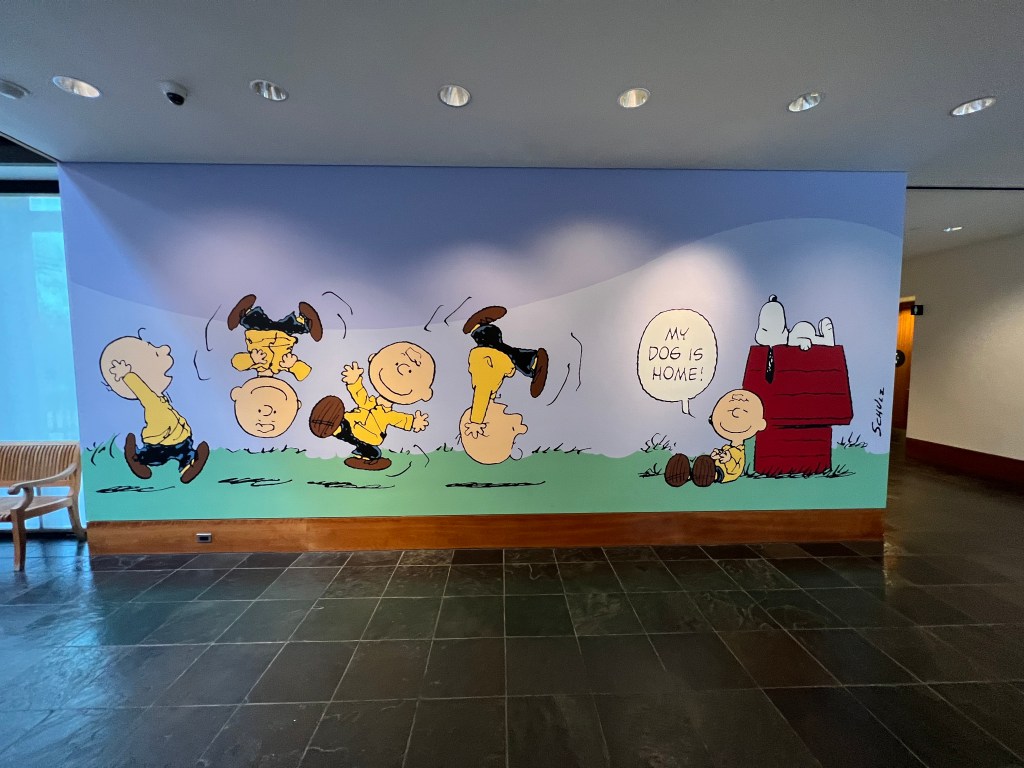
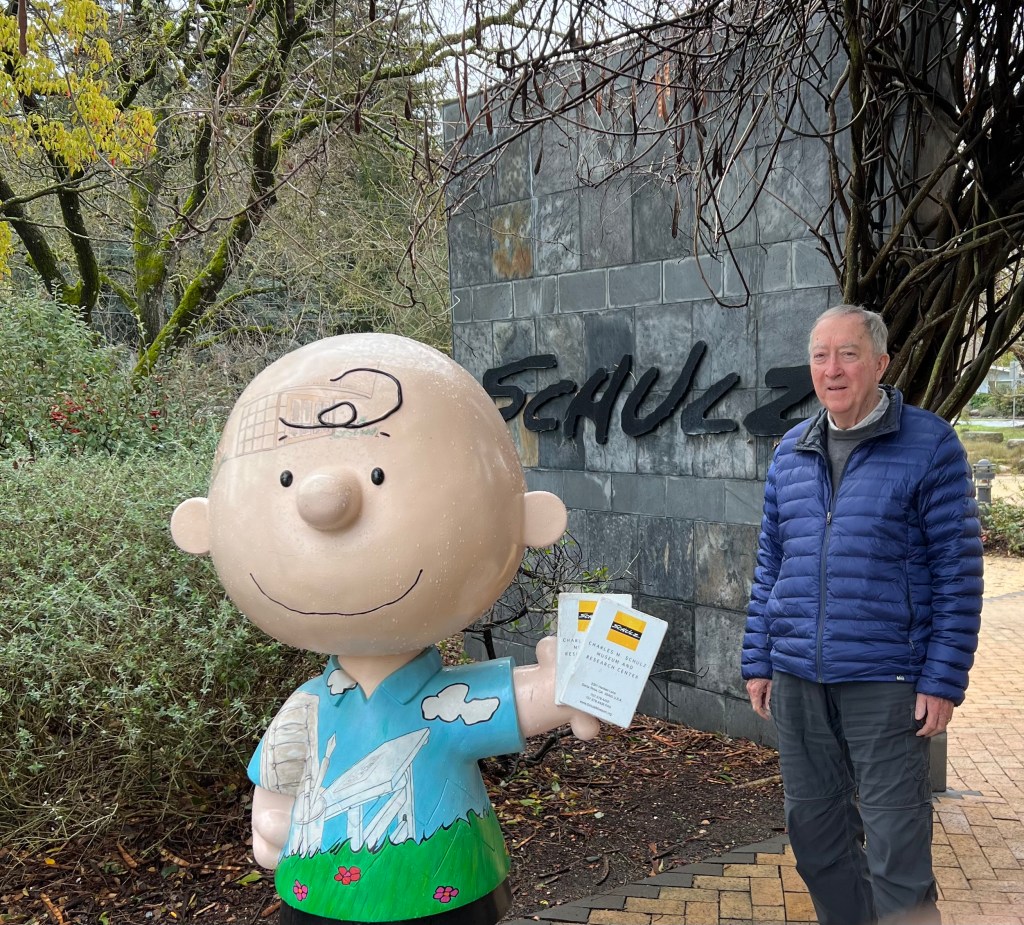
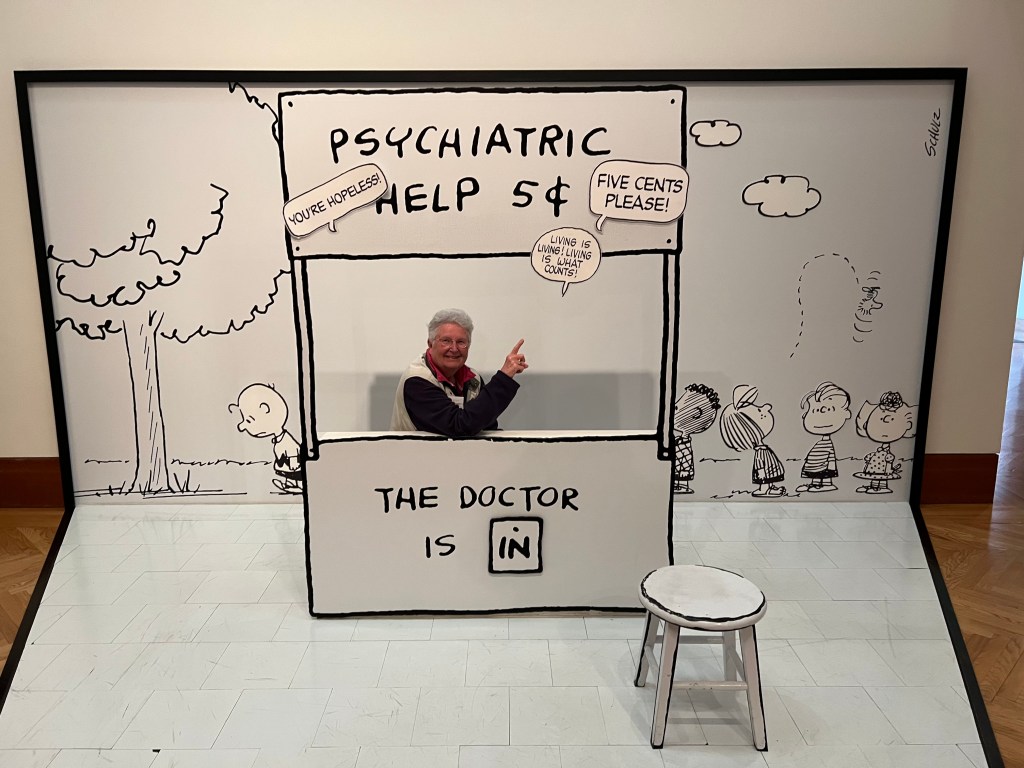
Saturday and Sunday have been our literary days, visiting the museum of cartoonist Charles Schulz (1922-2000), the museum of author Robert Louis Stevenson, and the home and National Park Service historical site of playwright Eugene O’Neill. Saturday started with the 75 minute drive back north to Santa Rosa where the Charles Schulz museum is located. Hopefully you have surely heard of Charles Schulz who for 50 years drew the Peanuts cartoon strip with Charlie Brown, Snoopy, Peppermint Patty, Marcie, etc. If not, look it up now.
Schulz has a special appeal to us since he spent many of his early years in St. Paul, MN. His interest in drawing and in cartoons dates from an early age and classes in Minnesota introduced him to new skills, mentors and life long friends whose names pop up as characters in his comic strips. His hockey references date back to these days and he continued to play hockey even after he moved to California in 1958 at age 36. After his service in WWII, he returned to MN and one of his first jobs was as a letterer for a Catholic newspaper. He worked on a 48 page anti-communist booklet given to school children. Luckily he had been working on drawings for comic strips for years and in 1950 Peanuts first appeared in seven newspapers. By the year 2000 when he died, it had appeared in over 2600 newspapers.
Charles Schulz writing office-where he made doodles of potential ideas
The museum has both permanent and rotating exhibits. It includes references to the cartoonists who influenced him and the many cartoonists whom he inspired and mentored. He drew all of his strips, doing even the lettering of the captions. He always considered himself as skilled in lettering and his use of various type styles and fonts was an important element of expression necessary in comic strips of just four panels. As he grew older, he was less able to master the details and one can observe a change in the print size and fluidity of the drawings due to his essential tremor illness.
Driving to St. Helena
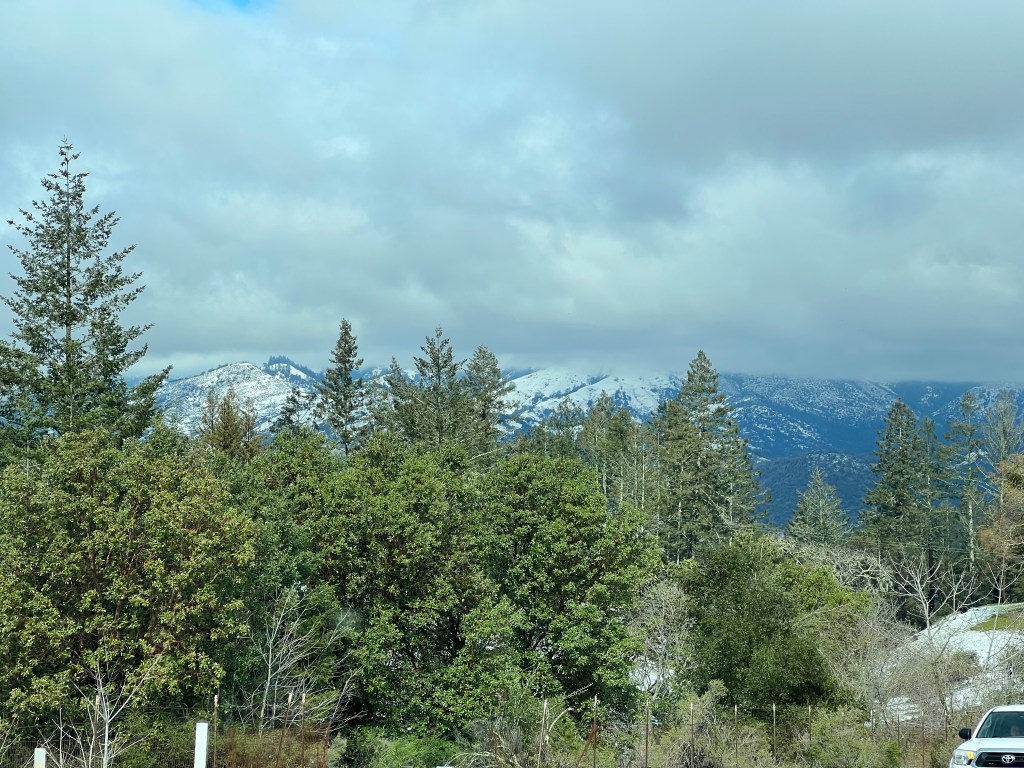
Leaving Santa Rosa, we drove over mountains with snow, through valleys, and among vineyards to St. Helena, CA. Due to a wealthy American businessman, St. Helena is the home to a small museum housing a huge collection of artifacts relating to Robert Louis Stevenson (1850-1894). Stevenson is a Scotsman, not an American. He did spend some time in this area, including his honeymoon. Among others, Stevenson wrote Treasure Island, The Strange Case of Doctor Jekyll and Mr.Hyde, Kidnapped, and a Child’s Garden of Verses.
At the museum we received a 30 minute guided tour of the premises which highlighted Stevenson’s life. He suffered from poor health for much of his lifetime. Rejecting the expected career route of lighthouse design and engineering practiced by his male ancestors, Stevenson received a university education in law which he never practiced, turning to the arts and writing. With an allowance from his parents, he traveled around Europe, eventually arriving in Grez-sur-Loing where he met his brother and a married woman named Fanny van de Grift Osborne. Fanny was an American, 11 years older than Stevenson. Several years after the first meeting, they began a relationship that eventually ended with her divorcing her husband and marrying Stevenson. They traveled extensively around Europe, spent some time in America, and then lived in the Samoa for his last years.
Stevenson’s was a celebrity during his lifetime but critical opinions varied over the years with his scholarly reviews increasing lately. He has always remained popular around the world, he is one of the most translated authors of recent time.
Napa Valley and wild mustard
We left St. Helena and drove back roads through Napa Valley. Vineyards were everywhere, as part of large wineries and as part of backyards. The yellow blossoms of wild mustard are visible where ever one looks, the period from January to March being bloom time. Wild mustard has been planted in many vineyards to protect the soil and replenish it with nutrients.
Finally back in Pleasant Hill, we have dinner at a local Italian restaurant. While dinner last night at Outback was very good, their happy hour meal specials are only valid on weekdays.
Sunday began with church in Danville, about 15 minutes south of Pleasant Hill. St. Isidore was probably the most crowded church we have been in for years. Afterwards we had a pastry and visited the Museum of the San Ramon Valley. The museum was having a display of local quilts created during the pandemic. A volunteer with extensive knowledge of quilts gave us a wonderful explanation of the quilts while we waited. We had 2 PM reservations for a tour of the Eugene O’Neill house which is a National Park site.
Eugene O’Neill National Historic Site
O’Neill (1888-1953) received four Pulitzer Prizes and one Nobel prize-which funded the purchase of this home. His most famous works include Beyond the Horizon, Anna Christie, Strange Interlude, Long Days Journey into Night, Mourning Becomes Electra, and the Iceman Cometh. His style of realism engaged theater goers to think, not just laugh. O’Neill and his third wife Carlotta purchased 158 acres of land on a hillside for a writing retreat. He was successful at this time, both financially and artistically. After a nomadic existence for most of his life, he was seeking a writing refuge, a place he could call home. Carlotta and he decorated the home to reflect Taoist contemplative concepts.
ONeill also had health problems and a tremor in his hands made his ability to write almost impossible. WWII took away access to servants and he and his wife lived in a series of hotels for the remainder of his life, dying in 1953. After moving out, most of his possessions were sold or distributed so the house does not fully reflect the home as it was during their time there.
We were lucky for the indoor activities, today the rain was steady and cold. Dinner was just a sub from Jersey Mikes, eaten back at our hotel room.
John Muir’s office where he did most of his writing
Pleasant Hill, CA
This day messed up our schedule. One of the National Park Service sites to see in the San Francisco area is the Port of Chicago Naval Magazine National Monument. Port Chicago is one of the most difficult sites to visit and thus one of the least visited sites in the National Park Service. In 2018 it had only 653 visitors. It normally only has tours on Thursday, Friday, and Saturday. To get on a tour, you have to register two weeks ahead of time. The site is on an active Army base so permission must be given to enter. The tour takes less than a dozen people each time. The tour can be canceled at any time. It is run through the John Muir NPS site in Martinez, CA since Port Chicago does not have a visitor center of its own. You have to arrive at the John Muir site by 12:15 pm for the one tour given each day.
We planned to visit on Saturday February 25. We requested to be on the tour about five weeks in advance. We were then notified that there would be no Saturday tour on the 25th, we would have to take the tour on Friday the 24th. Well, our schedule had us leaving Jenner along the coast on Friday morning and spending the day in Santa Rosa, directly on the way to Pleasant Hill CA where we would be staying three nights while we visited the four NPS sites in the East Bay Area. A very efficient use of time and gasoline. Changing our schedule to make Port Chicago on Friday meant on some other day we would have to backtrack for an hour and a quarter each way to see the Santa Rosa locations we planned to visit. Well, there was not much choice. Inconvenience or miss visiting one more NPS site that we would be unlikely to ever see in the future.We voted for inconvenience.
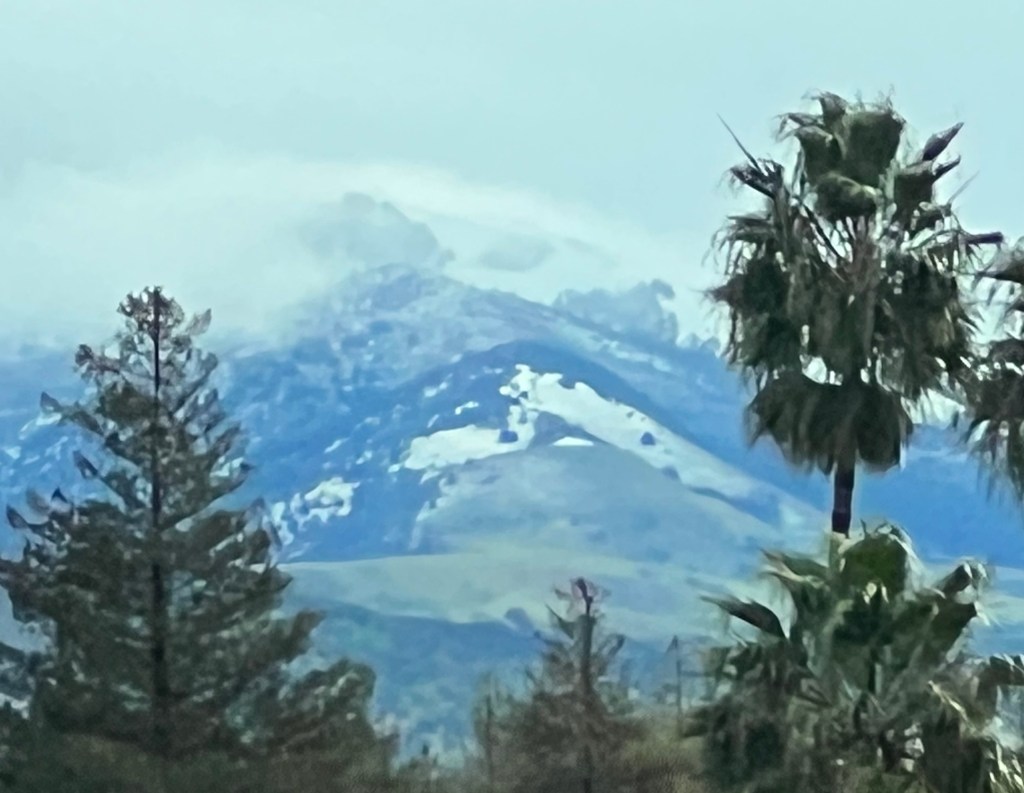
We left Jenner Friday morning at 8 AM for the two hour drive to Martinez CA and the John Muir National Historic site. (This is his main place of residence while alive, not to be confused with Muir Woods.) More than enough time you say. True, but we were going over the mountains after 12 hours of rain might have caused mud slides or fallen trees. It was a Friday at rush hour, what would the roads be like? And remember, we were in an area of no cell or Internet coverage so we could not plan for road problems in advance. We later found out Thursday night/Friday morning had the highest snowfall in memory for this part of California. In the higher areas along San Francisco Bay, several inches of snow had fallen. People were getting in their cars and taking their kids out to experience snow. Not exactly the 15 inches or so that had fallen back in the Twin Cities, but pretty exciting for this area of California
Snow on one of the peaks around Martinez, CA
Our luck continued to hold. We had no driving issues, made it to Martinez with enough time for a McDonalds breakfast and a tour of the John Muir homestead before the Port of Chicago tour.
John Muir is one of the premier early conservationists in the U.S. He was a founder of the Sierra Club. He wrote prodigiously on the need for preservation and the value of spending time outdoors. His efforts are credited with the creation of Yosemite National Park and with influencing President Theodore Roosevelt to actively create national monuments and forests. Born in Scotland in 1838, his family immigrated to central Wisconsin in 1849. As a young man, he traveled extensively around the U.S.
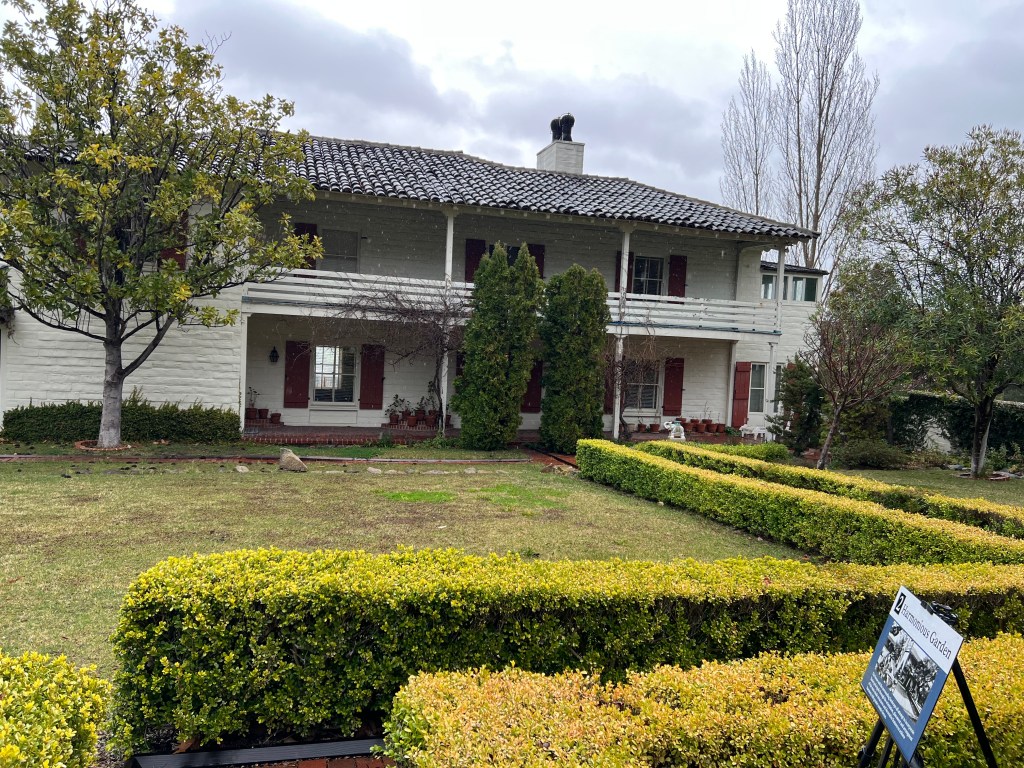
The John Muir home in Martinez, CA
The NPS site in Martinez reflects his later life. He married Louisa (Louie) Wanda Strenzel when Muir was 42. His father in law owned extensive fruit orchards and Muir managed the orchards for a number of years. The 10,000 s.f. home we visited originally belonged to his father in law, who was wealthy due to his fruit business. When the father in law dies in 1890, Muir, his wife Louie and children move into the ornate house where his mother in law is living. Louie takes over the handling of the fruit business, freeing Muir to write and travel. Muir dies in 1914 at age 76.
For the Port of Chicago Naval Magazine tour, you probably need a bit of history. We had no idea what this NPS site was when we looked at the list of National Park sites in California. I will try to make the history concise yet sufficient. First, in World War II, the U.S. still practiced informal segregation. After the Civil War, the 13th, 14th, and 15th amendments to the U.S. Constitution were supposed to end segregation and slavery. Yet in reality, segregation still existed throughout the U.S. The military was not different. Black soldiers in the Navy were used as cooks and stewards, not active participants in warfare. They were commanded by white officers. They lived in segregated housing.
Port Chicago was constructed as a naval facility to load ships with supplies and munitions for the Pacific Theater of War. It had a deep harbor, direct rail lines, and isolation from populated areas. Blacks were used to load the ships under the direction of their white officers. Neither the officers nor the seamen had special training in handling munitions. Bets were placed by the officers as to which crews could load ships the fastest.
On 10:18 PM July 17,1944, two explosions ripped the air. One of two ships was full of munitions,16 rail cars lined the pier. The blasts obliterated the ships, pier, and rail cars. Debris went 12,000 feet into the air. The shock wave was felt for 40 miles. Businesses a mile away in the town of Port Chicago were damaged. But this national monument is not for property damage.
Inner ring shows how far debris was blown, the outer ring the extent of damaged buildings
320 men lost their lives that night. For most of them, their remains were never found. 202 were African American enlisted personnel loading the ships, nine of their officers, 64 crewmen from the two ships, 33 Naval personnel guarding the ships, 6 civilian workers, five Coast guard crewmen and one Marine on guard duty. Yet the consequences of the blast weighed most heavily on the African Americans. White officers were given 30 days leave and transferred to other duty-away from the trauma and memories. The African American seamen who worked on munition loading details but had not been present on the pier received no time off and three weeks later were ordered to load munitions at another naval shipyard in the area.
258 of the seamen refused, saying they were afraid to load. Threatened with death by firing squad, 208 gave in and were given bad conduct discharges after serving their term. The 50 who persisted faced the largest mass mutiny in naval history. Despite questions about the base’s safety practices and the men’s fear of being blown sky high, all were convicted and given sentences of 8 to 15 years. After the war, the Navy granted clemency and put them on ships to finish their enlistments. No whiteNavy officer faced punishment for lax or unsafe procedures. Though their convictions were not overturned, their acts of civil disobedience brought to light the injustice of racial segregation in the military.
In 1948 President Truman issued an Executive Order beginning the process of integration of all military forces although it took years for it to be fully implemented.
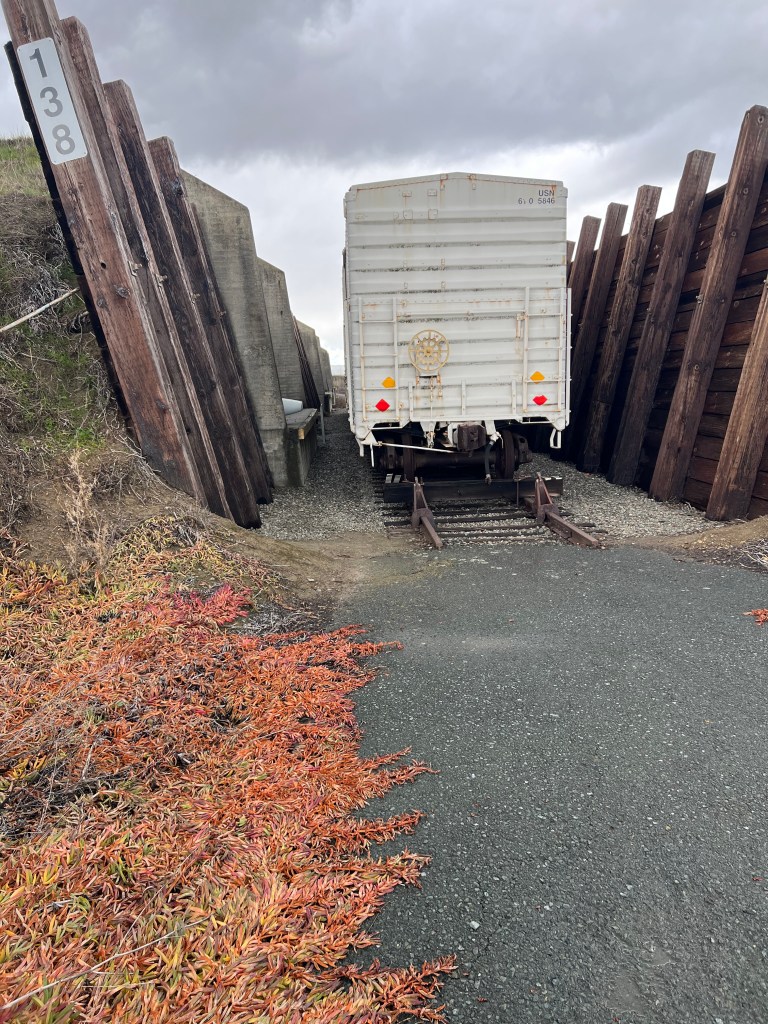
One of the revetment areas at Port Chicago Naval Magazine National Historic Site
The memorial for Port Chicago is located where the explosion occurred. The NPS has plans to build a new and more comprehensive visitor center in the next 10 years. For now, 8 visitors, one ranger and one volunteer traveled by car from the John Muir historic site driving through land cleared of old and damaged buildings. Some of the revetments remain, structures designed to temporarily hold munitions until they were loaded onto ships. The names of the 320 men who died are listed on memorial plaques. The rest is memory.


















































 Chris Klejbuk and Ed Heimel travel adventure
Recent Comments