Follow Ed Heimel and Chris Klejbuk as we explore the USA and Canada. Trips began in 2013. See sidebar. Since Jan. 2013, over 220,000 miles traveled and 1100 days on the road. Over 700 blog posts written. 2023-We are closing in on 350th National Park unit. Photo below is Pacific Ocean by Big Sur, CA
Can you imagine it?! Immigrants built the transcontinental railroad! Immigrants from all over the world! Immigrants worked in the California gold mines! Immigrants from Chile were among the first and arrived with extensive mining experience! Chinese immigrants took over mines Americans from the east coast abandoned and were very successful in extracting gold! Can you imagine that?? In case you could not tell, those sentences were meant as sarcasm in an America that once again is demonizing immigrants.
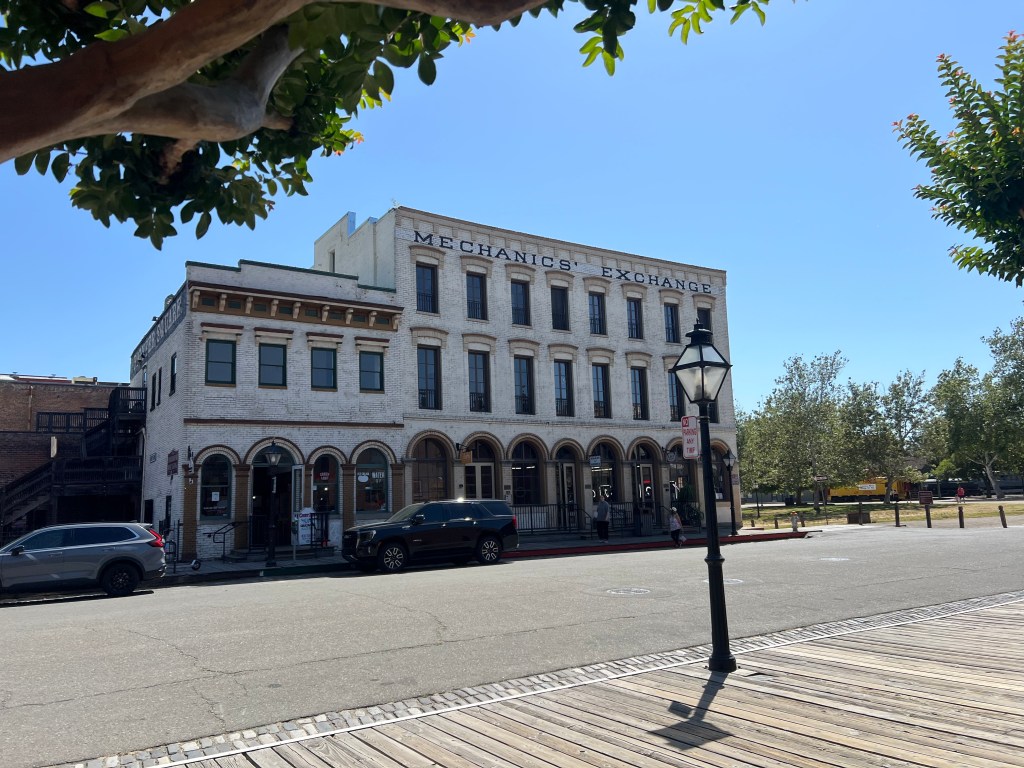
Today’s two museums, the Sacramento History Museum and the California Railroad Museum, were informative and interesting. Both were located in Old Sacramento. We started at the Sacramento History Museum and also took their underground tour.
Sacramento should not have been built where it stands. It was low lying land at the confluence of the American and Sacramento Rivers which flooded often. The first real settler, John Sutter, listened to the Native Americans and located his farm and property several miles away on higher ground. Once gold was found in the area, newcomers wanted to be near the river and its availability to shipping.
A scene from Old Sacramento
Early Sacramento suffered from a major conflagration that burned 90% of the town. Floods destroyed the town also. The levees that were built to protect it ended up later causing more damage when water from the next floods got behind the levees and had no way to return to the river.
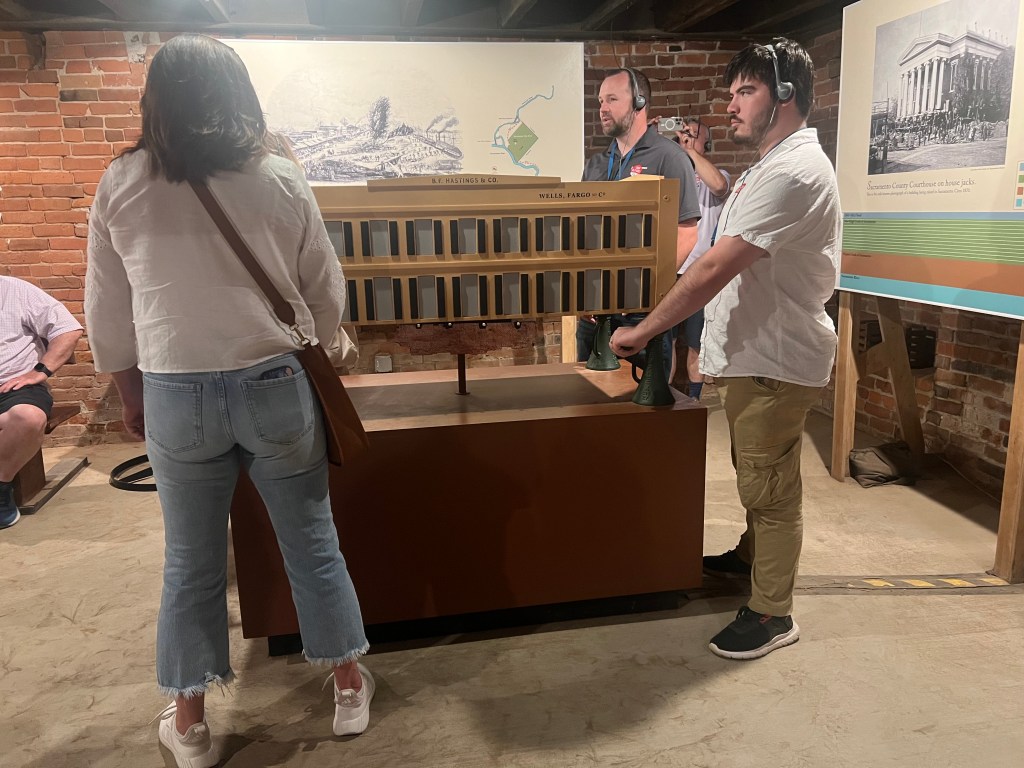
Tour participants doing a mock jacking up of a building
The people here did not want to move to higher ground so they did two things. They moved the American River channel so it met the Sacramento farther from the city center. Second, they raised the town. Yup, they raised most of the town about 23 feet. It took over a decade and was paid by each business. The tour explained the process of excavation, jacking up buildings, and constructing new foundations. Amazing. Sacramento has grown since then, protected partially by levees. Yet the chance of severe flooding still exists as this is lowland surrounded by mountains and traversed by numerous streams and rivers.
Other exhibits at the Sacramento History Museum explained the growth of agriculture, canning of food products, and the impact of railroads in encouraging the continued growth of agriculture, canning, and transportation. While not mentioned here, yesterday’s museum explained how the growers mandated the use of short-handled hoes in weeding fields of crops. The short handled hoe caused back pain and injury as the worker was forced to stoop continuously. The hoe was mandated because it made it easier for overseers to determine if a worker was vigorous enough in their tasks. If the worker was standing up, the overseer would be able to yell at them to get back to work. The short handled hoe mandate was not abolished until 1975.
A new exhibit focused on the role of Campbell Soup company, its employees, and its impact on the community. Sacramento made a concerted effort to attract Campbell’s to open a factory here. After all, this part of California is a major producer of fruits and vegetables. After WWII, Sacramento was successful and Campbell’s operated a major plant here for almost 70 years.
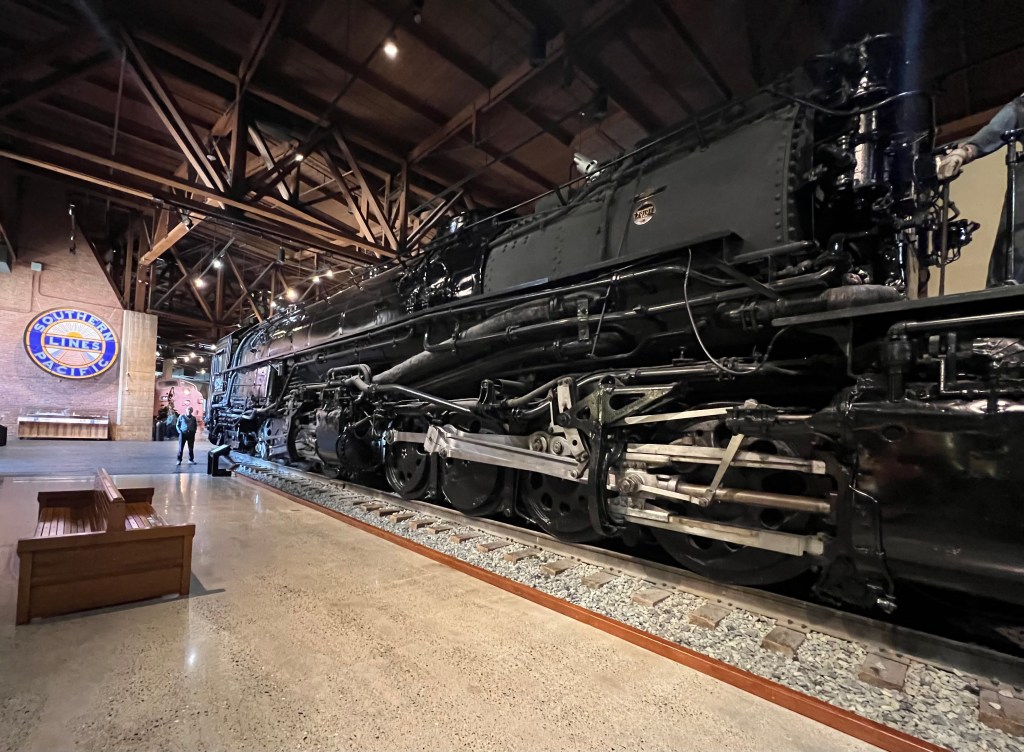
The California Railroad Museum exhibits numerous examples of locomotives and a few specialty cars such as a diner and a railway post office car. Exhibits once again discussed how the transcontinental railroad was built and displays one of the two golden spikes used at Promontory Point in Utah. The role of women and minorities in railroading was displayed frequently.
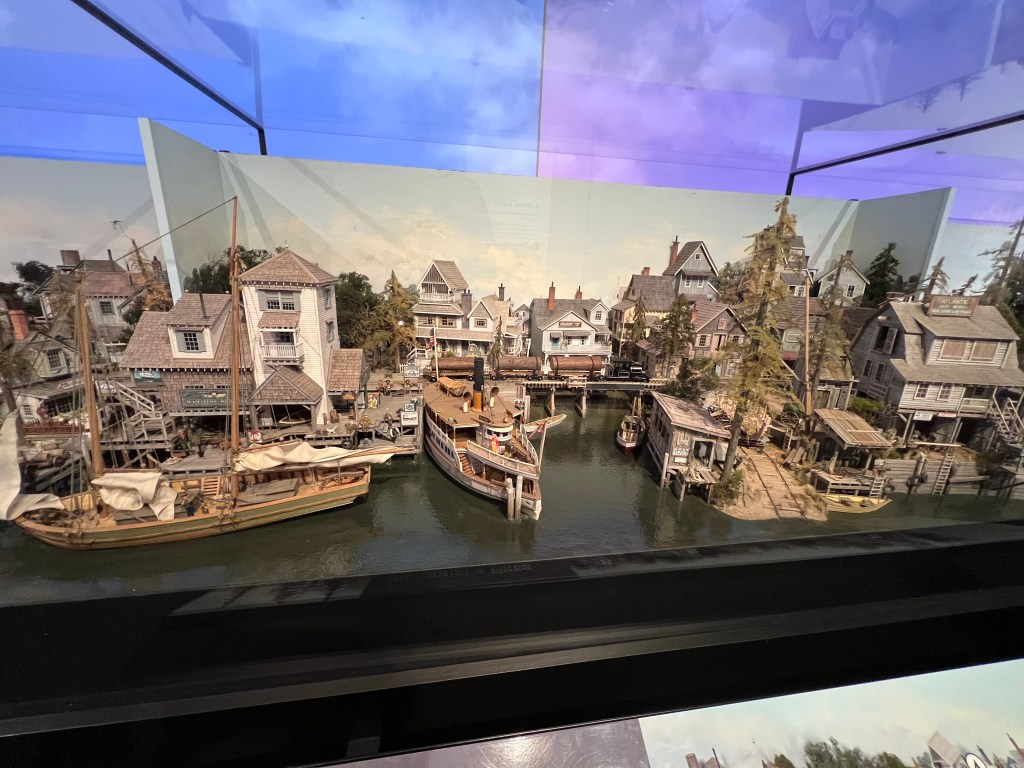
There was an area of model railroads, most of which was devoted to displays of collections of various model equipment. The sample of model railroads running was small. We have seen much better layouts. Their collection of hand constructed villages was impressive.
Tomorrow we fly back to St. Paul. There may not be a further blog post.
Sacramento, May 28
Ed and Chris
Ed and a Southern Pacific steam locomotive. The cab was in the front to shield the engineers from the smoke that would have choked them in tunnels
Our plans for Sacramento are to visit a few locations downtown. As in Denver, we have no car. We took an Uber to our Residence Inn seemingly near the State Capitol, one of our sites to visit. In retrospect, after walking to Old Sacramento and to the Capitol, other hotels may have involved less walking. Luckily, the temperature will not reach over 100 until Saturday, two days after we leave, so our walking has not been overly strenuous.
One note about Sunday. The train stopped a ways outside of the Roseville, CA station. The conductor announced we were stopped due to freight traffic ahead. Once we were moving and reached the Roseville Amtrak station, the train was met by three Roseville police cars and several police officers. They were concentrated around the coach cars. I believe they took a person off the train, if not into custody. I have observed this before, that Amtrak conductors will brook no misconduct and have no hesitancy in kicking people off the train and calling police if the conductor believes the actions of the passenger warrant it. It is my belief, with no specific knowledge, that the stopping of the train before Roseville was to allow time for the police to arrive.
We arrived at our hotel around 4 PM and took care of details. Chris did the wash, I worked on the blog, we ate at a Mediterranean restaurant around the corner from the hotel.
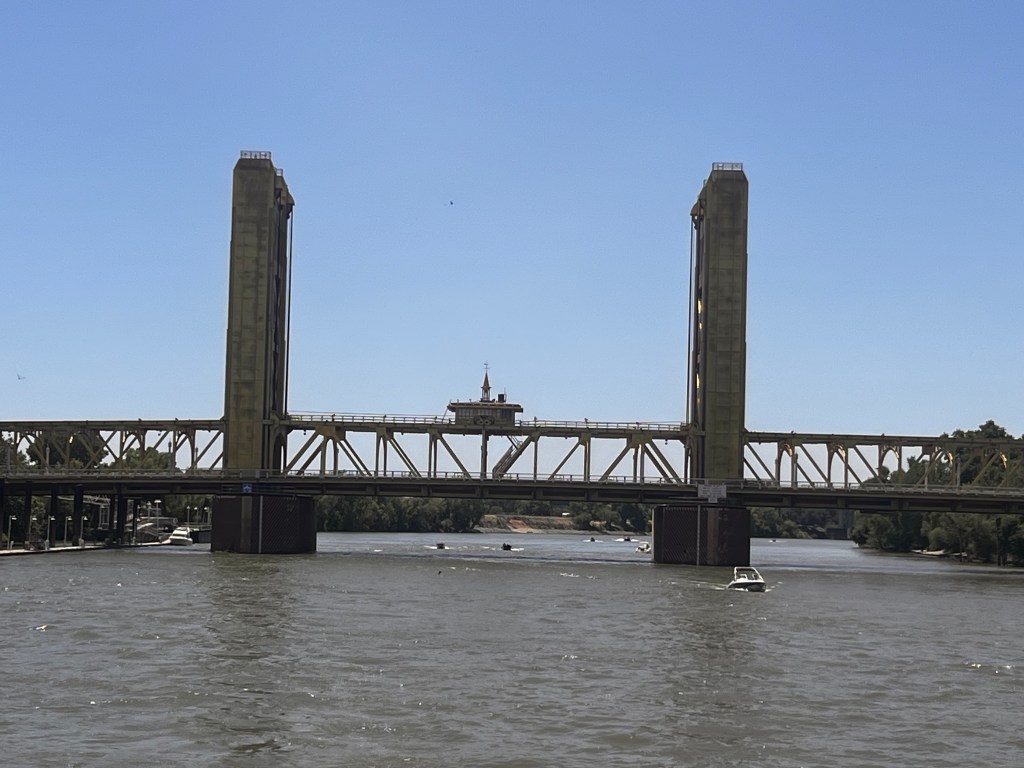
Monday, Memorial Day, our main activity was a boat ride on the Sacramento River. Both the Sacramento and the American River flow through Sacramento. Old Sacramento is the area along the river where the town began. We walked past the State Capitol to reach the river and discovered construction of a new Capitol Annex building had closed numerous walkways, making our journey a tad more complicated.
Old Sacramento’s historical significance derives from its geographical location. It was the western terminus of the Pony Express, the first transcontinental railroad, and the transcontinental telegraph. Old Sacramento covers almost 300 acres. It has over 50 historical buildings, more than any other area of similar size in the West.
We walked around the area and at the Visitor Center met the docent whose family goes back six generations here in Sacramento. He convinced us to try the Sacramento Underground tour which we were not going to take. Evidently the town buildings were raised about 15 feet to protect them from flooding. We will find out more on the Wednesday tour-which we booked after we returned to the hotel Monday afternoon.
Our river cruise lasted for an hour. We were surprised by several items. First, large numbers of people were fishing from boats and the riverbanks. Evidently, now is time stripers migrate up river to spawn. Second, there is a marker along the river indicating the height of the most notable floods. That marker gave me a better feel why the buildings in Old Sacramento were raised. Third, the water clarity where the American River joins Sacramento River clearly demarked cleaner water from the American. The water in the American generally comes from the mountains while the Sacramento picks up mud and contaminants from the valley.
Fourth, we saw sea lions by the port. Sea lions are not new to us, we just were not expecting to see them this far up the river. Fifth, an interesting sight was the original drinking water intake station just slightly upriver from the new, modern intake system. The juxtaposition made for a chance to reflect on the growth in population and in drinking water treatment over the years.
The river view was not that scenic. The breeze and the awning made the ride pleasant although I could have done without the background music that frequently blocked us from being able to clearly hear the captain’s presentation.
After walking to and around Old Sacramento, I had to wonder how St. Paul would have fared if I-94 had not cut off the State Capitol from downtown. In Sacramento, the state government complex blends into the city, the freeway separates this from Old Sacramento, but that area is more a touristy area than a living and working area. The California Capitol greenway and downtown make a favorable impression, although the Capitol is not a particularly attractive building in our opinion (more on that for Tuesday).As in Denver, neither downtown had many people out and about.
Sacramento’s population is over 500,000 with the metropolitan area around 2.6 million.
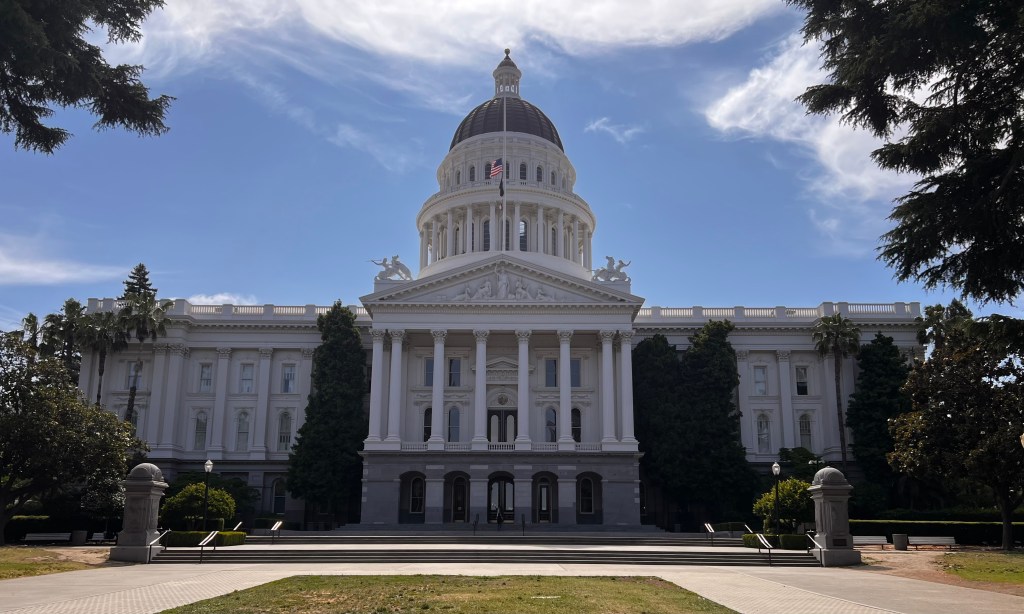
Monday the hotel pool called to us. We spent more time in the hot tub and resting our weary bones than in the pool. The hot tub’s rejuvenation was not long lasting. Tuesday we walked to the State Capitol for a one hour tour. This tour guide rarely commented on the architecture or building materials. Our guess-they were not that notable. I take that back, the Capitol is one of the oldest in the West, the guide mentioned the architect, and the same red and green motif in the two legislative chambers was covered. But our distinct impression was blah.
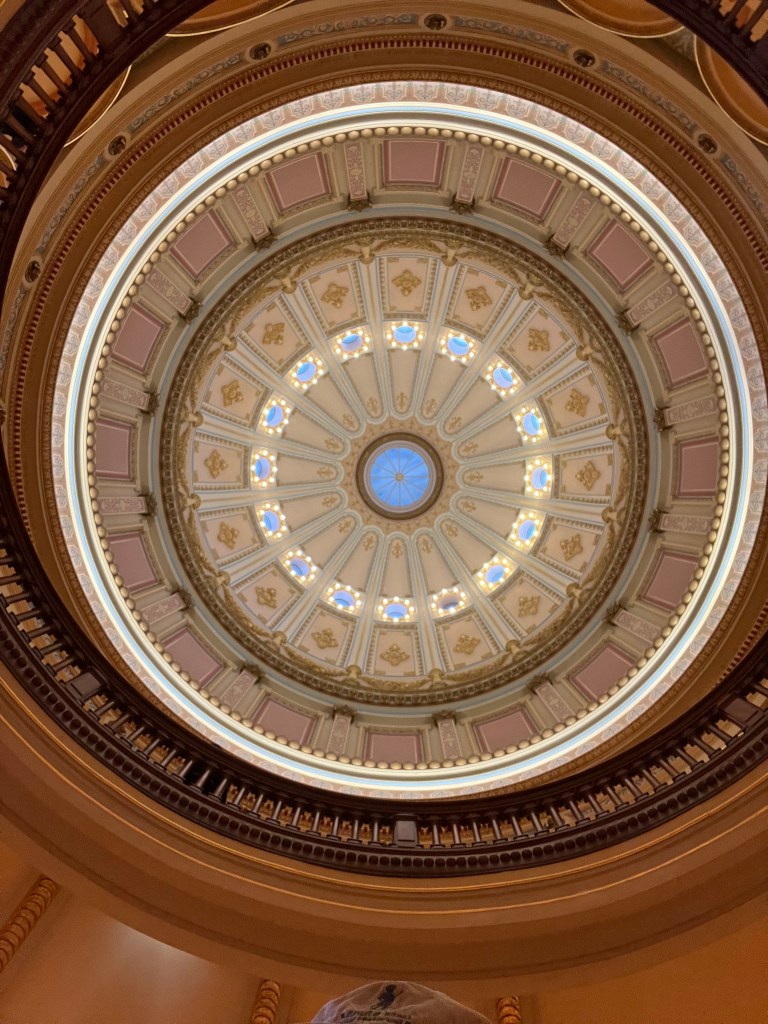
The one big deal was a series of murals depicting four periods of California history. What I thought was dark and foreboding, or simply a dirty canvas, was a result of “tonality”, an artistic method that is meant to contrast light and dark. This one came across as all dark.
Ceiling mural in California Museum
Just a few blocks away is the California Museum. This museum focuses on commonly overlooked stories, reflecting the state’s diverse population and the cultural contributions of all Californians. It took me a little while to get used to its format, generally briefly highlighting people around specific topics. For instance, the second floor, the first section we visited, highlighted activism; people who made a difference in art, politics, sports, culture, etc.
The first floor focused on stories and people around four themes that particularly interested me: incarceration of Japanese Americans in WWII, California Indians, California missions, history and contributions of Chinese Americans. While many stories were uplifting, others honestly portrayed negative actions by government and people. I had to compare these displays to the anti-honesty of the Trump administration and its Interior Secretary mandating that historical information be presented in a positive light. “Negative” facts about our past are to be buried; with visitors to national parks and monuments actively encouraged to report on negative facts presented by Department of the Interior employees. Both Colorado and California are to be commended for accurate portrayals of their state’s history.
Well I lost several paragraphs from the beginning of this post. Hopefully I’ll remember enough of it to re-dictate. They are not showing up in back up either.
This post will be primarily pictures. I will start with narration to explain the trip and then finish with the pictures.
This journey is about the California Zephyr. Zephyr is one of Amtrak’s long distance routes, going from Chicago to Emeryville, California, which is across the bay from San Francisco. The stretch between Denver and Grand Junction Colorado is noted as particularly scenic. Since we have driven the flatlands of Illinois, Iowa, Kansas, Nebraska, we flew to Denver and skipped those sections.
We thought the journey would be important enough that I purchased a digital book that explains the scenery outside the window as a train travels west. Some of Amtrak‘s long distance routes have the Trails and Rails program that narrates that scenery to the people sitting in the observation car. The Zephyr no longer does.
Our train was on time and boarding began at 8:15 AM. We left our hotel early enough to make it via walking to Union Station. We’re in a family room, which is considered one of the sleeper units. The other sleepers are called roomettes and sleepers.All of the sleeper passengers boarded last in Denver. In this way, the crew has sufficient time to clean the rooms that were used last night and were vacated here in Denver. Our family room was the last of the sleeper suites available when we bought our tickets.
The family room is on the lower level and is the only unit that stretches the width of the train. It’s narrower, so the total size is not much bigger. Amtrak says it’s suitable for two adults and two children under 12. The family room does not have a private bathroom or shower. That is only available in the sleeper unit. The roomettes also do not have a shower or private toilet. While the communal toilets were clean enough, they could’ve have been enhanced by the judicious use of air fresheners. We chose not to shower on the train, it’s only one night.
Passengers traveling in the coach cars are given a ticket while on the platform by the conductor that indicates which car and which seat they will be in. This ticket is put above their seat and also has written on it their destination. This information is used by the conductor to make sure that people getting off the train in the middle of the night are awakened at the proper time.
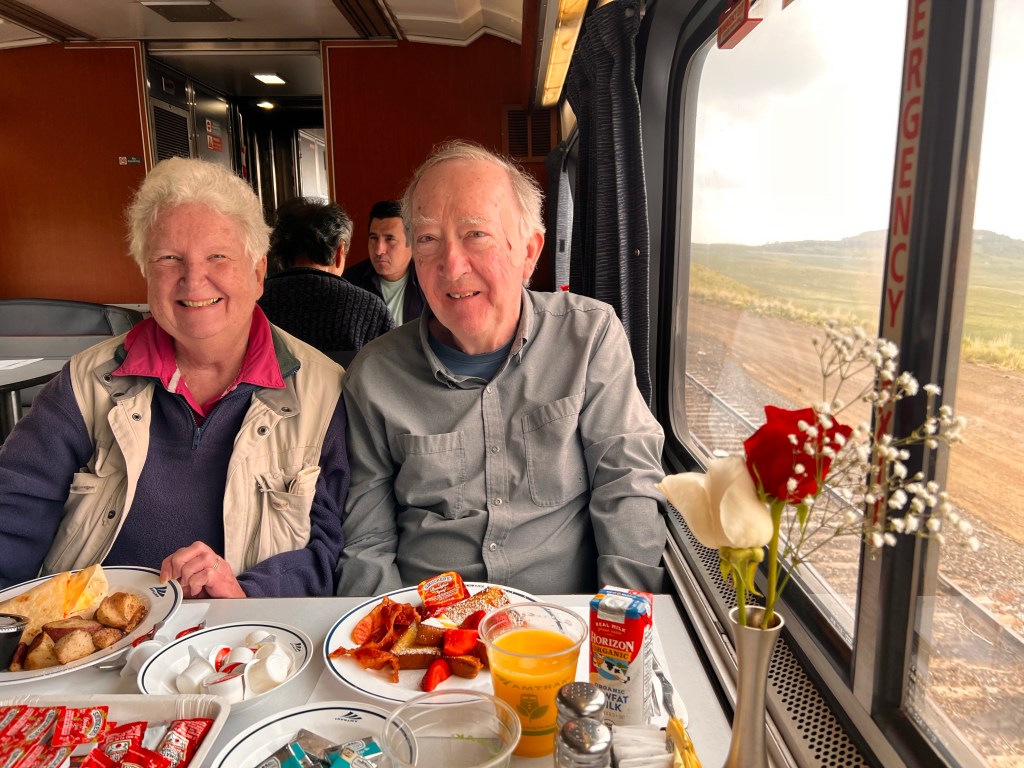
Food on Amtrak trains is quite good. There’s no variation, the menu has stayed the same for several years. Meals are part of the package for those in sleeper units. For those of you who do not know, the equipment, (coaches, sleeper cars, observation car, and dining car) are all at least 30 years old.
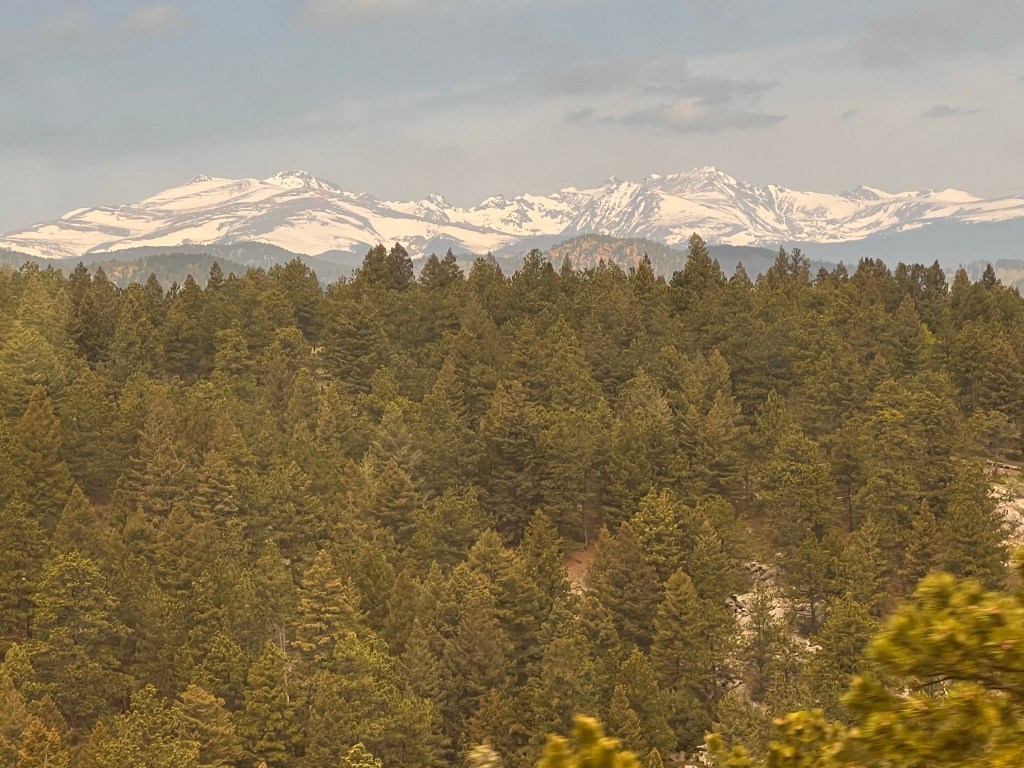
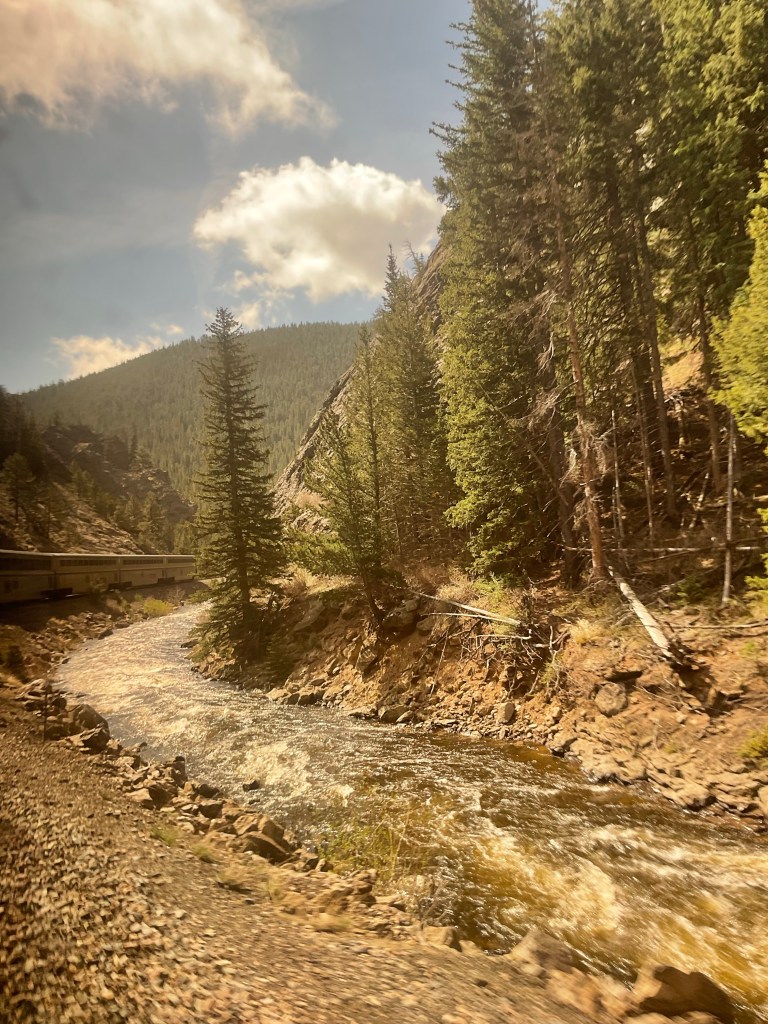
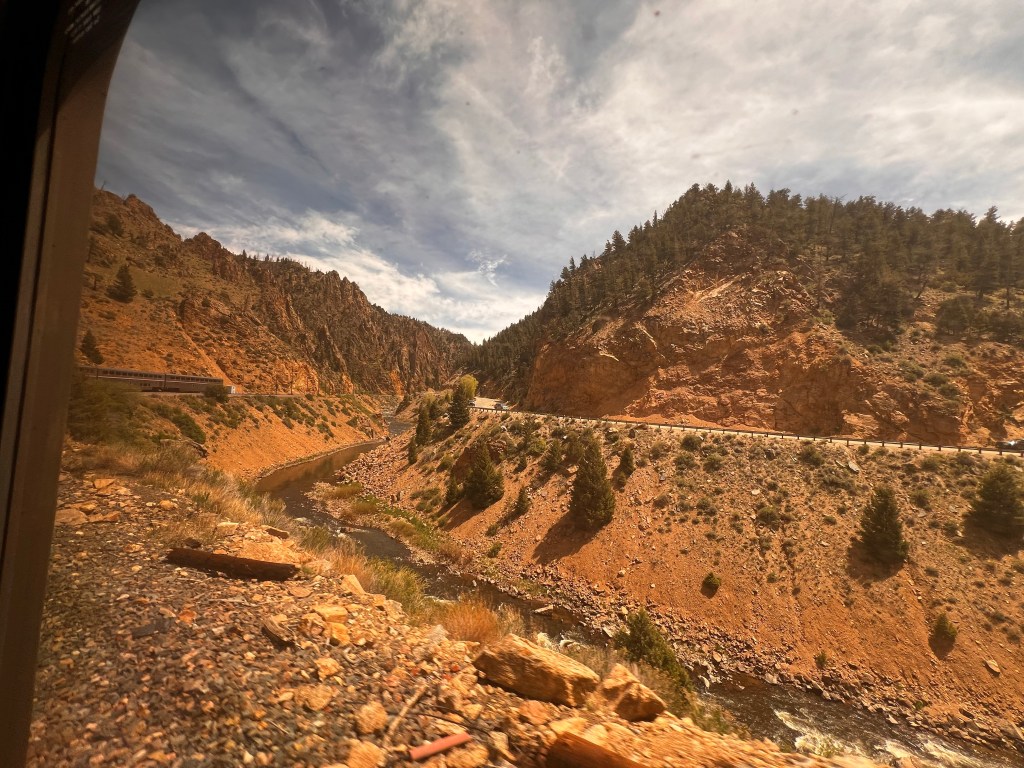
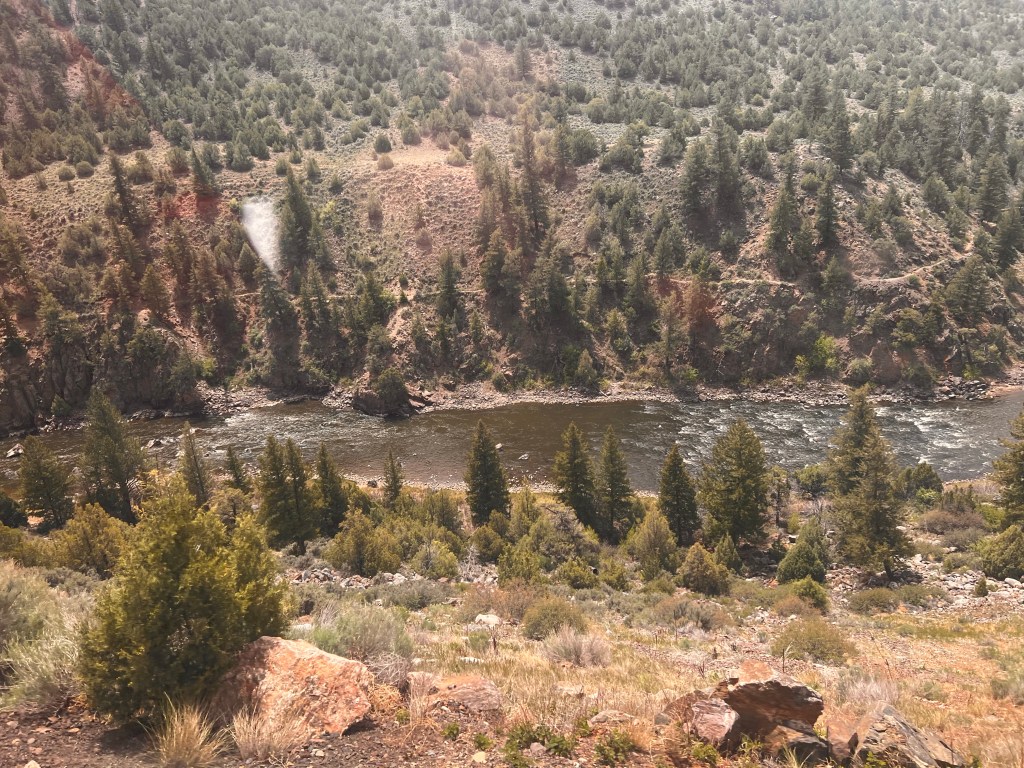
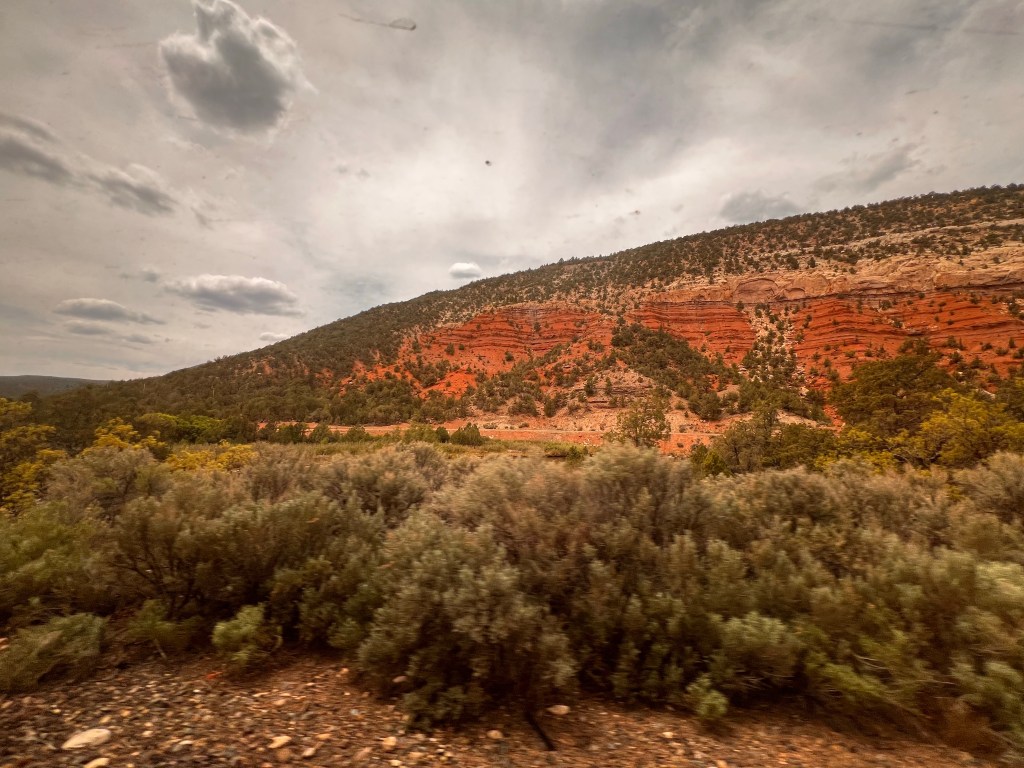
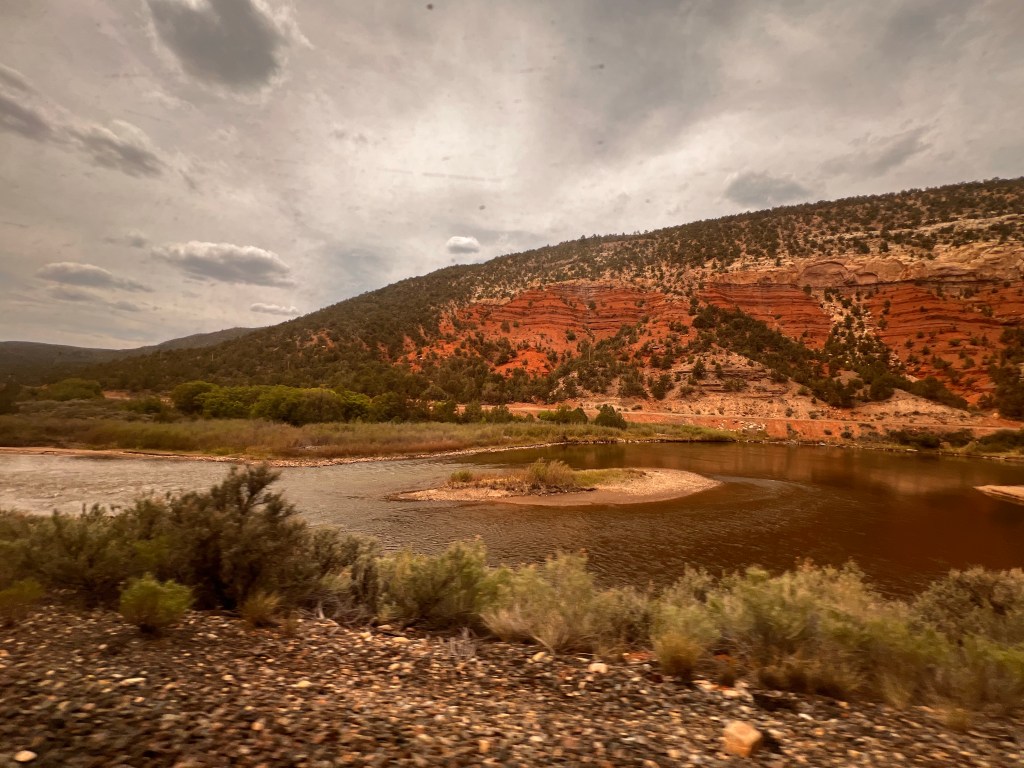
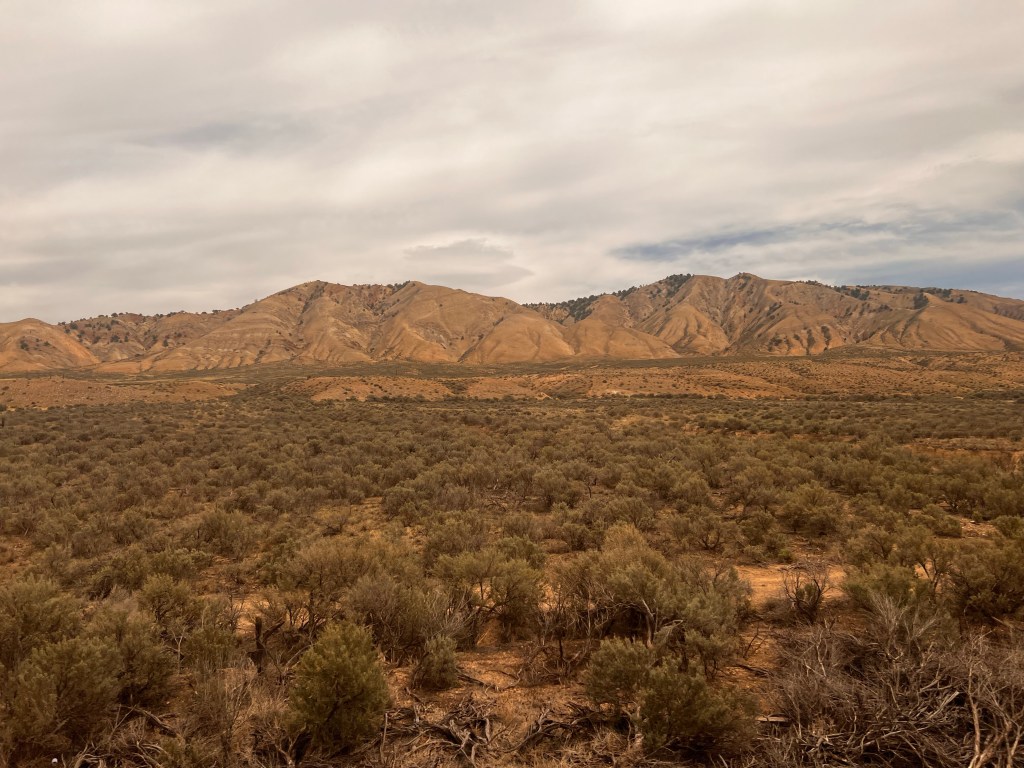
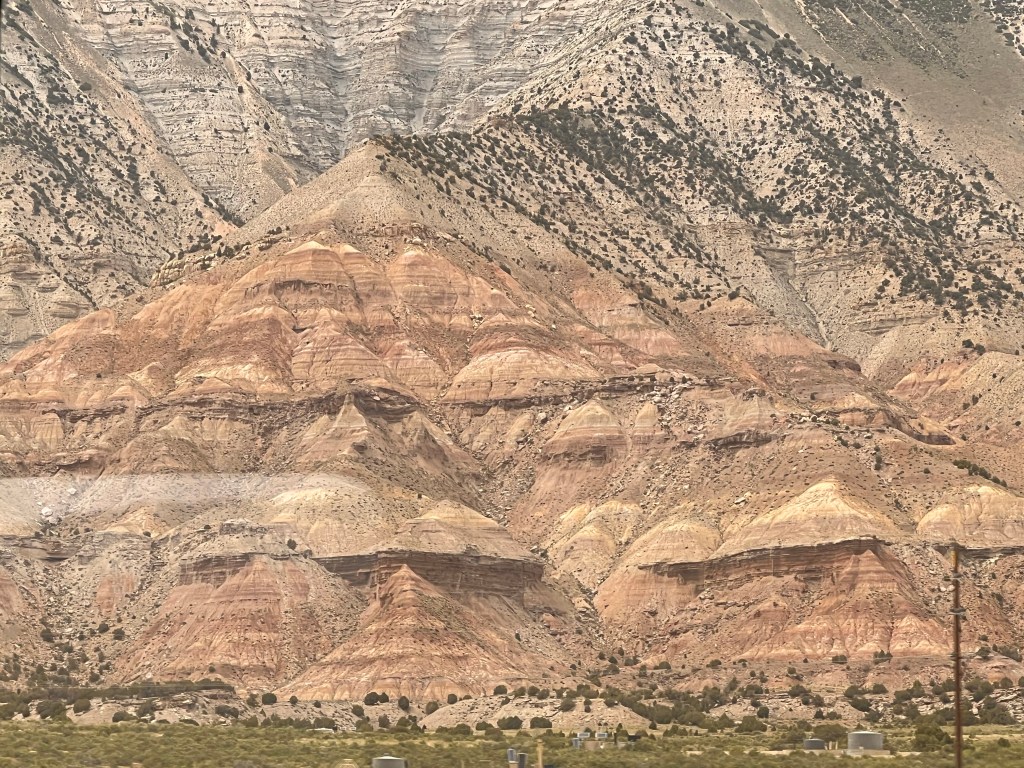
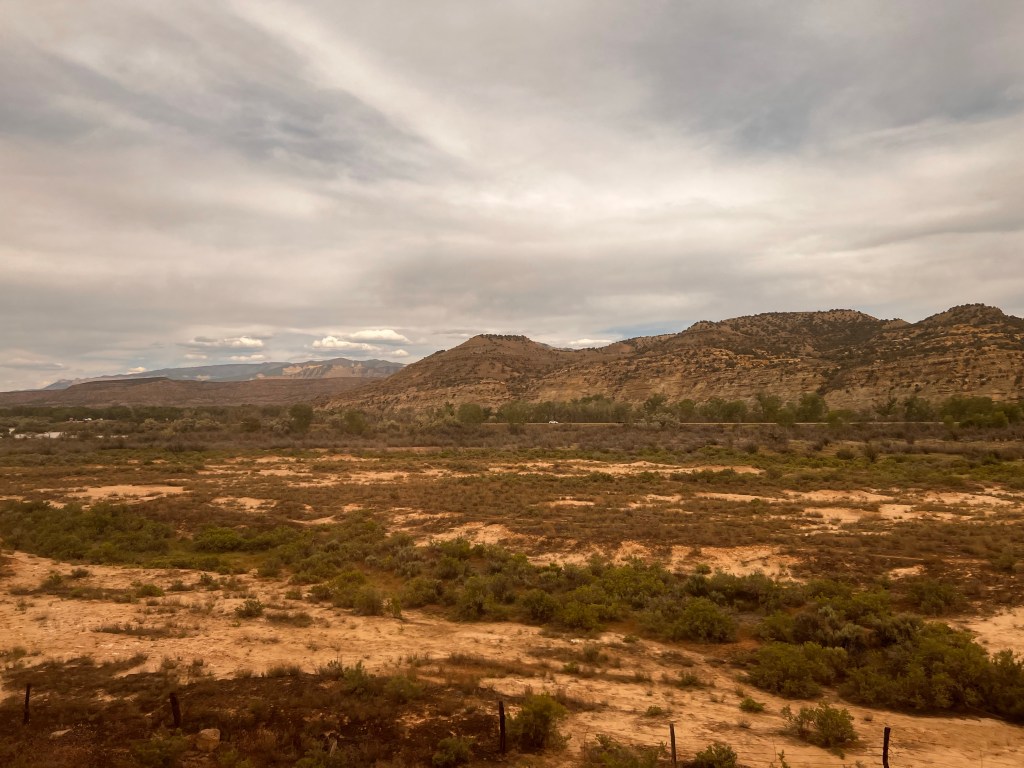
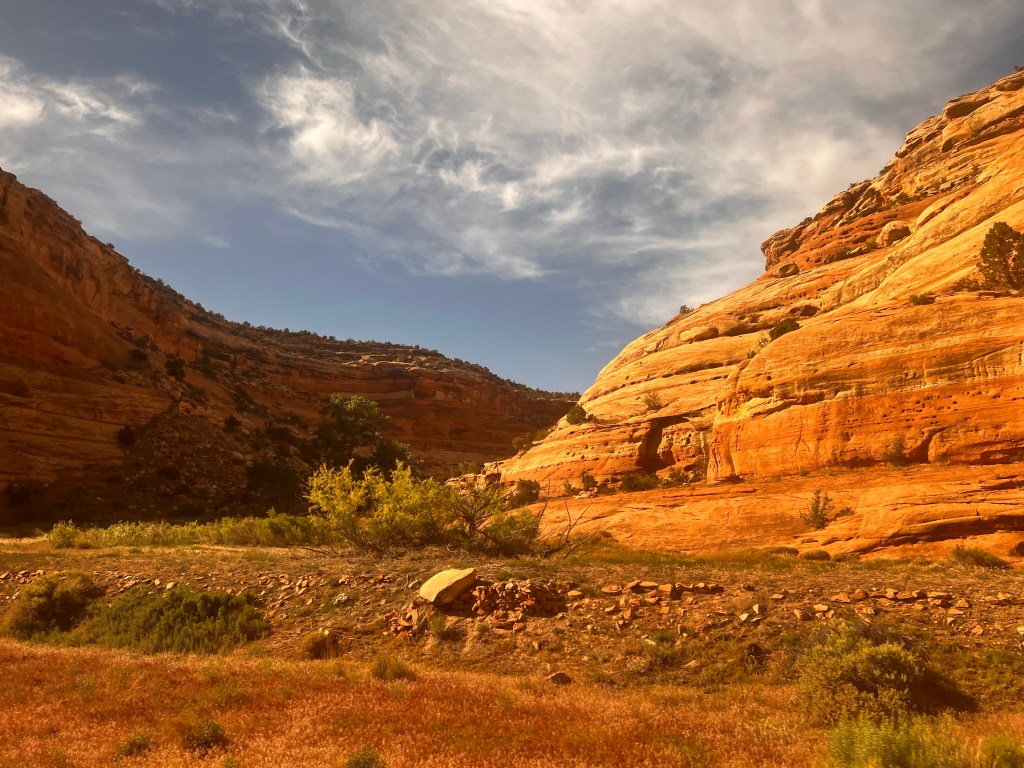
Instead of going due west and following interstate 70 all of the way, the California Zephyr leaves Denver and goes northwest towards Winter Park and Granby before dropping down in the southwesterly direction to pick up Interstate 70. The California Zephyr picks up the Colorado River around Granby. We went through numerous canyons and tunnels, along rivers, and generally had great scenery.
One tunnel, the Moffat tunnel, is 7 miles long. I think in total we went through well over 50 tunnels. Being somewhat egotistical, while the scenery was very nice, it was not dramatically different from other locations we have visited around the US. The meals on the train were good. The sleeping arrangements, while tight, accommodated two people easily in the family room. Amtrak says the family room can accommodate four people, two adults and two children under the age of 12. However, neither one of us slept well or long. We are not anxious to repeat an overnight travel trip on Amtrak in the future.
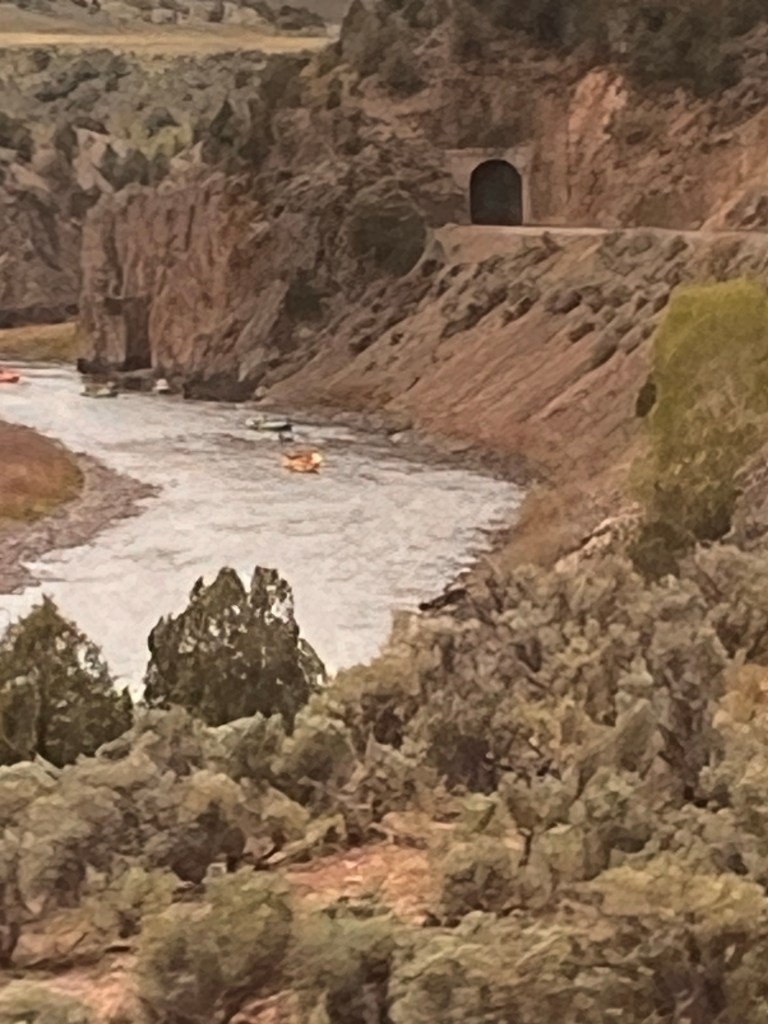
On a sidenote, I mentioned the digital book I had purchased. The book was written 15 or 20 years ago and it referred to a section of the Colorado River as Moon River. Along that section of the river, fishing and kayaking are popular activities. At the time of publication, it was not uncommon for these people to drop their drawers to moon the passengers on the Amtrak. I certainly thought the passage of time would have eliminated that tradition. However, the tradition is still alive and we were mooned four times during the trip. I did not take any pictures of that. 
As I mentioned, the train was full. This translated into a very busy observation car. For those of you who do not know, the observation car does not have assigned seats. People come to it from their regular seat. The advantage here is that the windows are twice as tall as the regular windows and go high enough to observe the sky and tall mountains. The conductor, every hour or so, would make an announcement that people in the observation car should leave in order to allow new people to come in and take advantage of it.
The observation car seats about 40 to 50 people. A coach car can hold over 70 and we had several of them. Sleeper cars can handle easily 30 and we had three of them. So it is not difficult to conclude, as the train travels through particularly scenic areas, it becomes difficult to snare a seat in the observation car. In this regard, the family room was an advantage, although even while at a lower level and with smaller windows, you could observe scenery on both sides of the train.
Enough with the narration. On to the pictures.
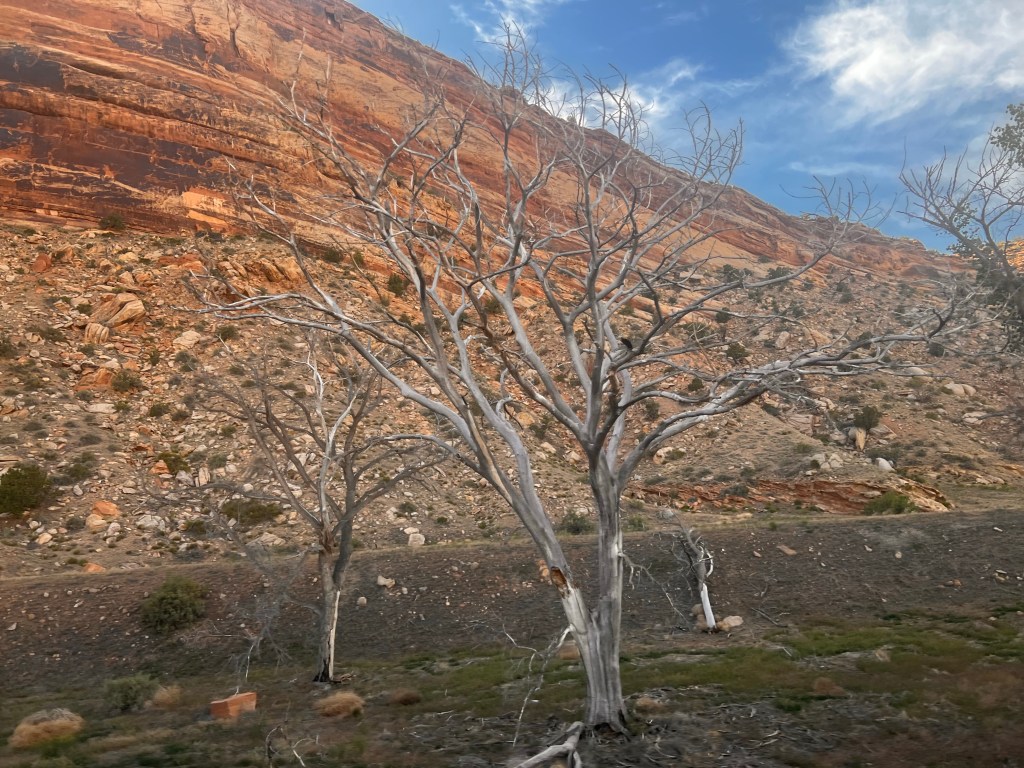
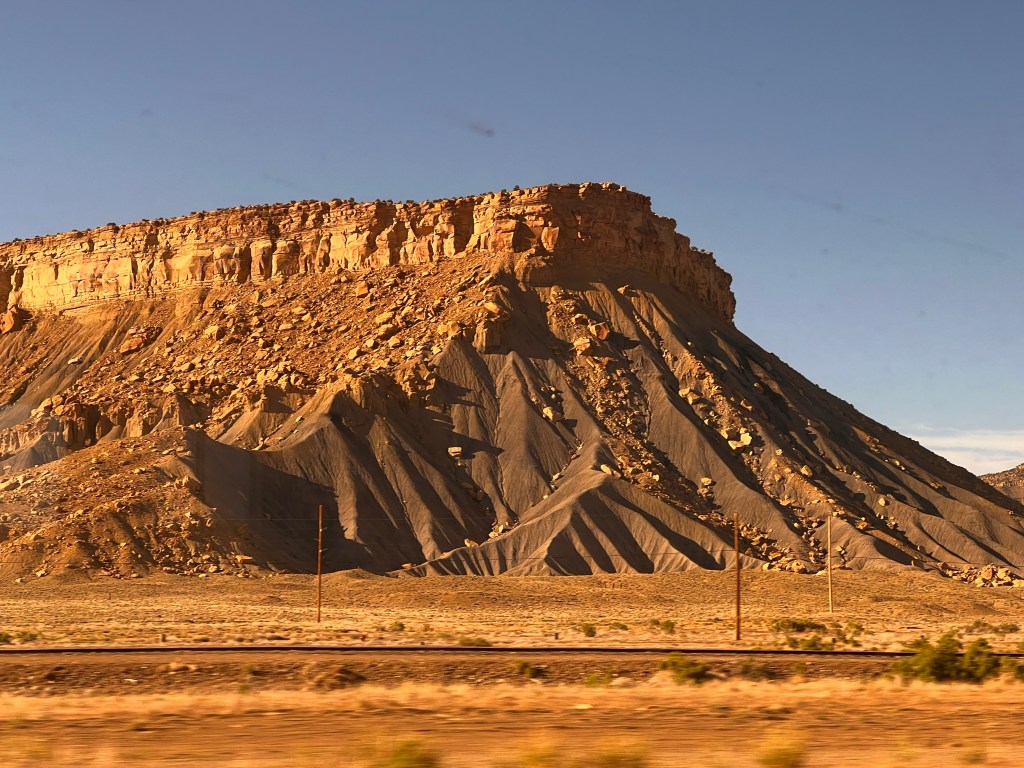
Starting to climb up to the Rocky Mountains Rocky Mountains The moon River area People on the river and one of the tunnels 
In the Sierra Nevada Mountains. Almost to Sacramento.
We are in Denver for two reasons. First, we have not spent any significant time here, usually just driving through. Second, we wanted to take the Amtrak California Zephyr through the Rocky Mountains, a very scenic trip. Scenic, at least, if the train is on time so our travel is during daylight hours through the Colorado mountains and part of the Utah mountains. Trains in America are frequently delayed by freight trains and my mechanical difficulties with the old equipment.
We flew out Wednesday, flying first class for the first time in decades. The cost to Denver was minimal. Our flight home from Sacramento will be in Delta Comfort. Normally we fly the cheapest seats, sitting in back. I wanted to see if the more expensive seats were worth the cost to lessen the difficulty and pain with my restless legs. I found that first class on Delta gave me plenty of room-as much as a coach seat on Amtrak.
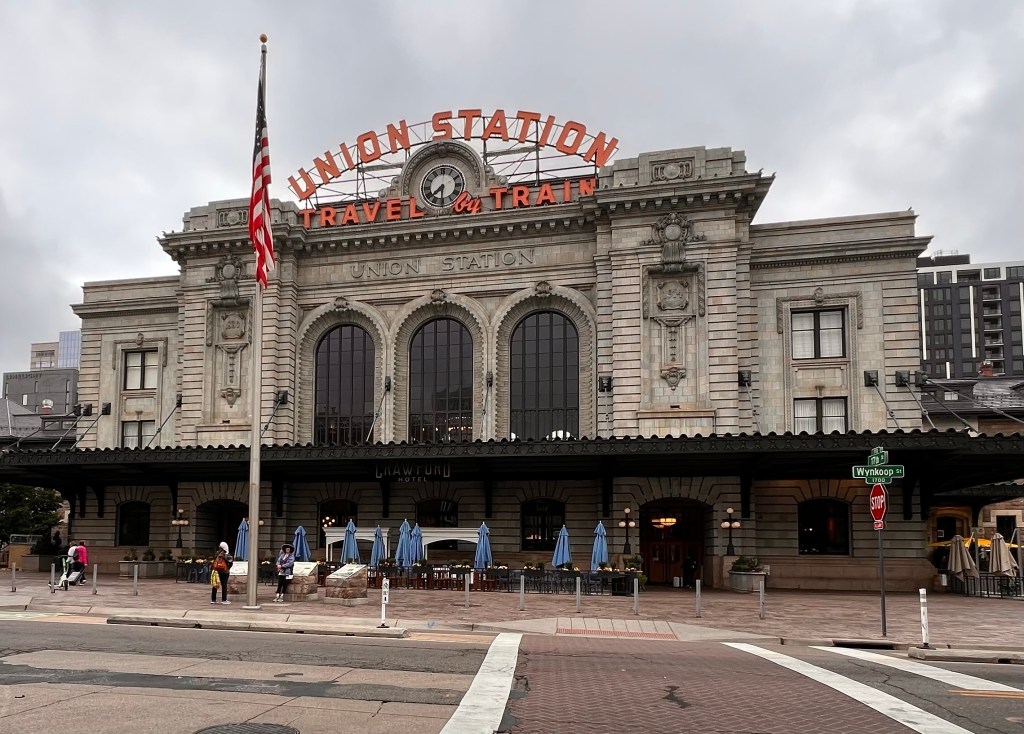
Our travel arrangements did not give us any time to do sightseeing on Wednesday. Lunch was at the Denver airport after we got off the flight. We are not renting a car so we took the Denver light rail from the airport to downtown Denver Union Station. Union Station is where we will pick up the Amtrak on Saturday morning so we spent a little time checking out Union Station. It’s busier than the St. Paul Union Depot.
The city of Denver has about the same population as the two cities of Minneapolis and St. Paul combined but the Minneapolis-St. Paul metropolitan area is about 20% greater. What did surprise us was the greater number of passengers flying through Denver International Airport. Denver has over twice as many passengers flying in and out. In fact, Denver is the 5th busiest airport in the world.
Our Residence Inn hotel is a 20 minute walk from Union Station. We will be staying here for three nights before we get on the California Zephyr Saturday morning. The hotel is about halfway between Union Station and the Colorado Capitol building.
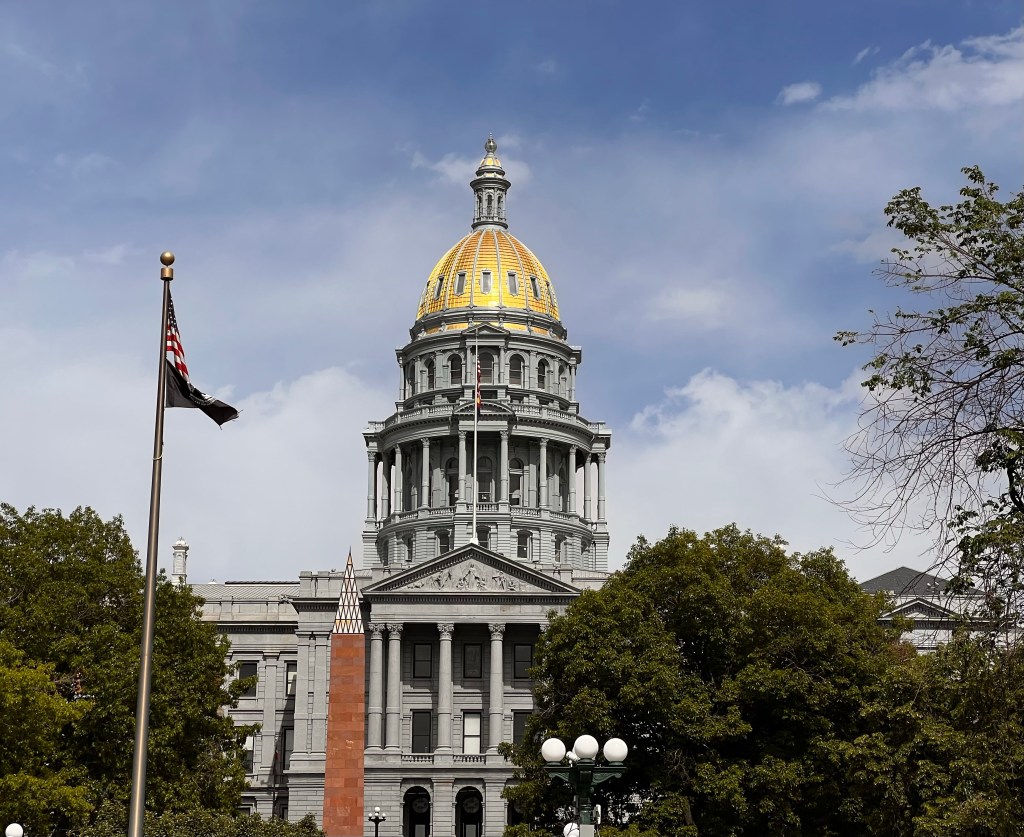
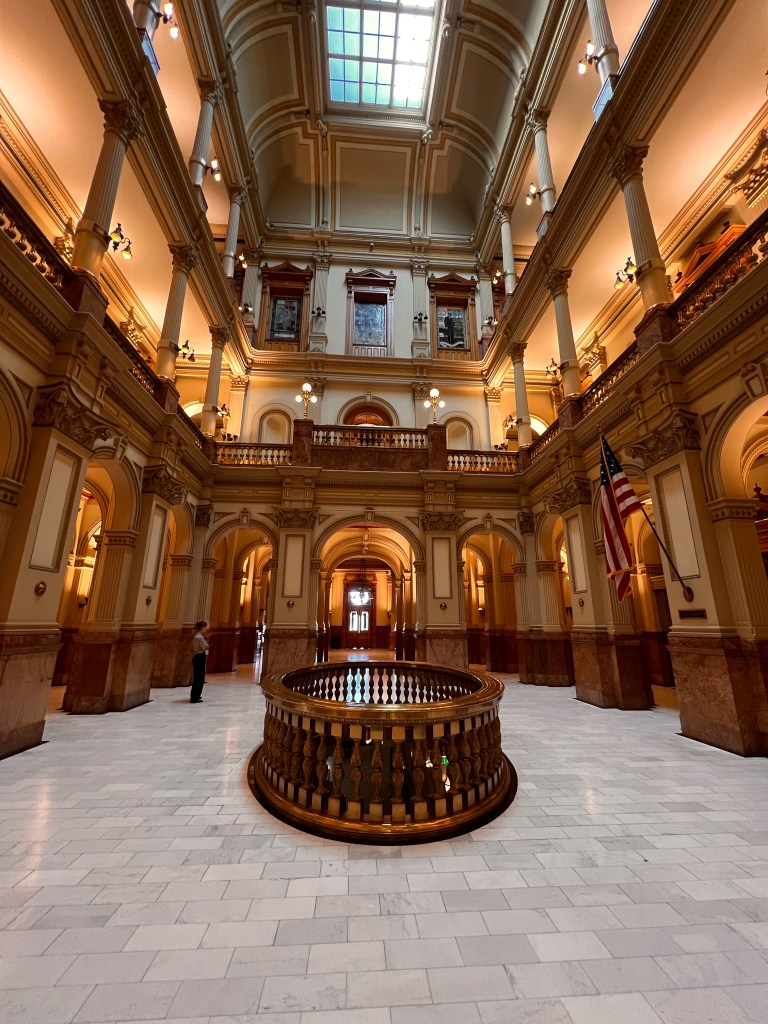
Colorado State Capitol
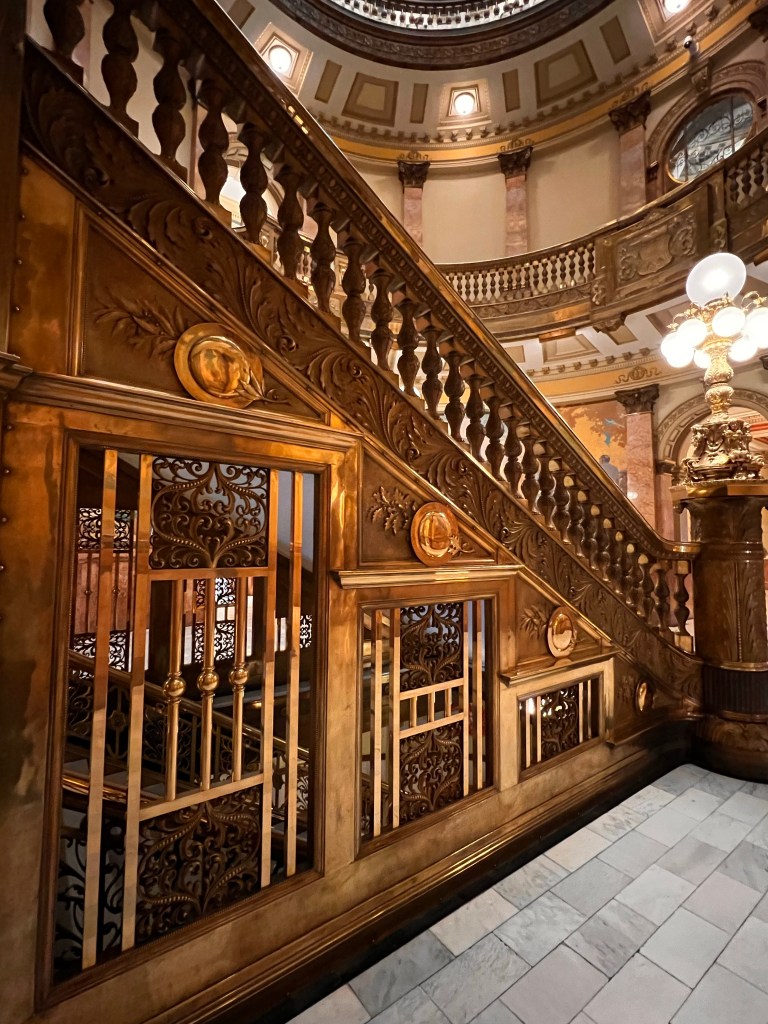
Denver has a free downtown bus shuttle so Thursday morning we took it to the Capitol. It is supposed to travel up and down a pedestrian mall but the mall is under renovations so it took a parallel street instead. We made it to the Capitol in time for the 10 AM tour. It is a lovely building with the usual stone surfaces but an attractive mix of wood features, stained glass, and painted murals.
As usual on a tour, several highlights are pointed out. Local construction materials predominate, even if those materials were located in areas of the state which were not particularly accessible at the time of its construction (1886-1894). That added to the final cost of the building. Portraits of U.S. Presidents are in one gallery, most were donated rather than purchased. The one of Abraham Lincoln was stolen and so a copy of his portrait is on display. Donald Trump did not like his portrait so it was removed and as yet no one has donated a satisfactory replacement.
The green color in the House of Representatives and the red color in the Senate follow the English traditions of the House of Commons and House of Lords. The Colorado State Capitol is not the highest in the U.S. Cheyenne WY and Santa Fe NM are at higher elevations. However, the Capitol is situated one mile above sea level, as noted on one of the steps leading up to the entrance.
One Colorado Governor back in 1936 closed the border with New Mexico to keep out indigents and aliens. (Boo) He was persuaded to open it back up before too many days had gone by. Another Colorado Governor refused to intern Colorado residents of Japanese background during the WWII and treated Japaneses Americans from other states interned by the US government in Colorado with respect. (Yay)
A visitor on the tour is able to get close to the Capitol Dome but today we chose not to climb the additional 99 steps. Our climb to the Wisconsin State Capitol dome a few weeks ago left my left hip sore the next day. I decided to pass on the dome in order to do more walking on Friday.
After the tour we headed for History Colorado, the state history museum. We were quite impressed. The history museum has four floors, the top floor was on the Ute Indians and Sand Creek Massacre. Since we have been to Sand Creek, we did not spend much time. It was gratifying to observe the historical accuracy of the incident, and not a whitewashing.
Side note: In March, Donald Trump issued an executive order on “Restoring Truth and Sanity to American History”. Talk about the title meaning the opposite as last week The Secretary of the Interior, former ND Governor Doug Burgum started implementing the EO by mandating that signs be posted at Dept of Interior property (national parks, monuments, and more) to have visitors report any information presented that reports a negative view of American history. Thus negative history must be downplayed or ignored. Let’s hope Colorado keeps its honesty in the forefront.
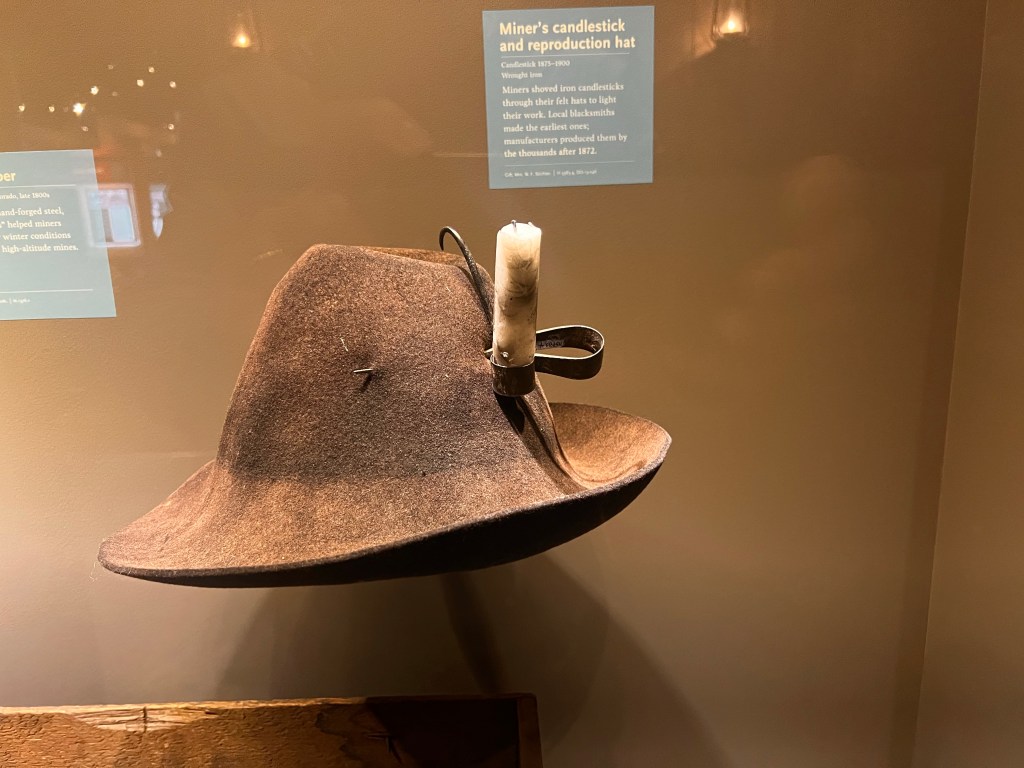
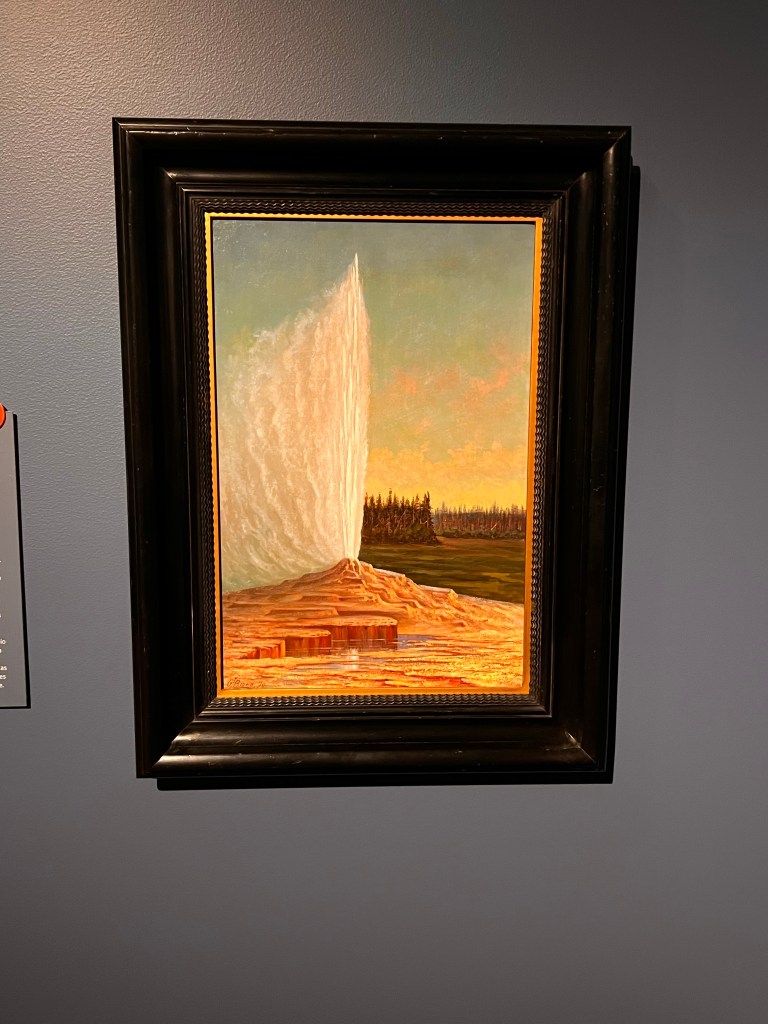
The third floor was devoted to a display of 100 artifacts that summarize Colorado both in well known and in obscure objects. As on the fourth floor, history was not whitewashed. Colorado was depicted in its glory and in its warts. It was impossible to examine all 100 artifacts but we gave it a diligent try. Some well known artifacts are shown in pictures below.
Miners hat with candle, gold ingot, seat from a ski lift, Colorado fruit
Floor two was heavy on stories of Colorado communities and individuals that exemplify the state. We spent more time on the Denver from A to Z exhibit that tried to highlight Denver in 26 ways. Some of them seemed a little farfetched but enjoyable.
Sample building murals from Colorado communities
We ate a late lunch here and then finished up the day in the basement of the museum. Their special exhibit was a retrospective of the 1990s, globally, nationally, and locally. Several times we had to stop and say, “That happened back in the 90s?”
From the Western art gallery at DAM
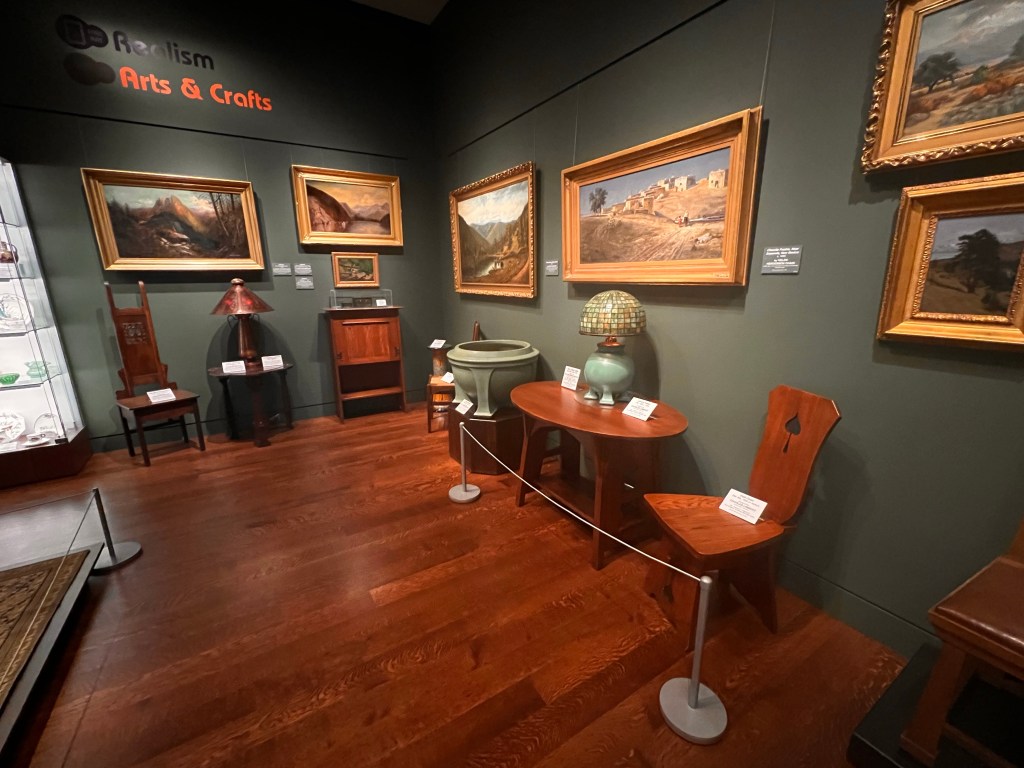
Friday was art day, visiting the Denver Art Museum (DAM) and Kirkland Museum of Fine and Decorative Art. The Denver Museum was not busy in the morning until some school groups came in. If you can believe it, I spent more time looking at art than did Chris although we both spent considerable time on the seventh floor (western art) of the Martin Building. (There is also a Hamilton Building.)
We took a docent tour in the afternoon about the work, primarily textile, of Nancy Hemenway Barton.
One of Barton’s large tapestriesA Barton “travelogue”, a two sided painted, folding book of one of her travels.
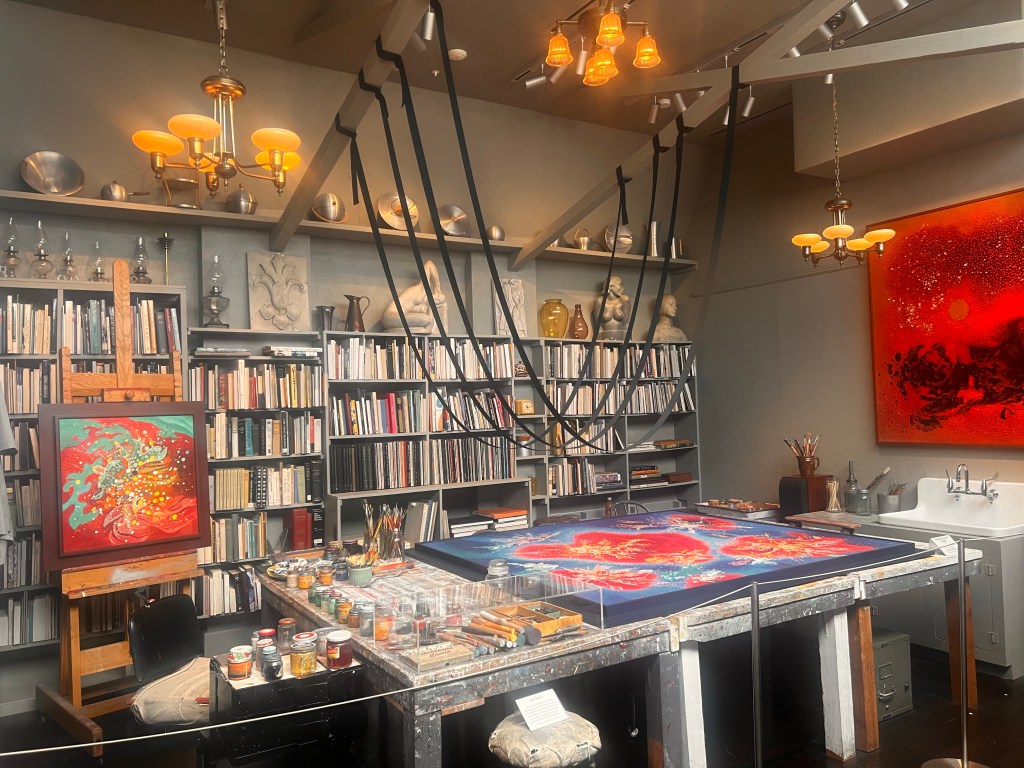
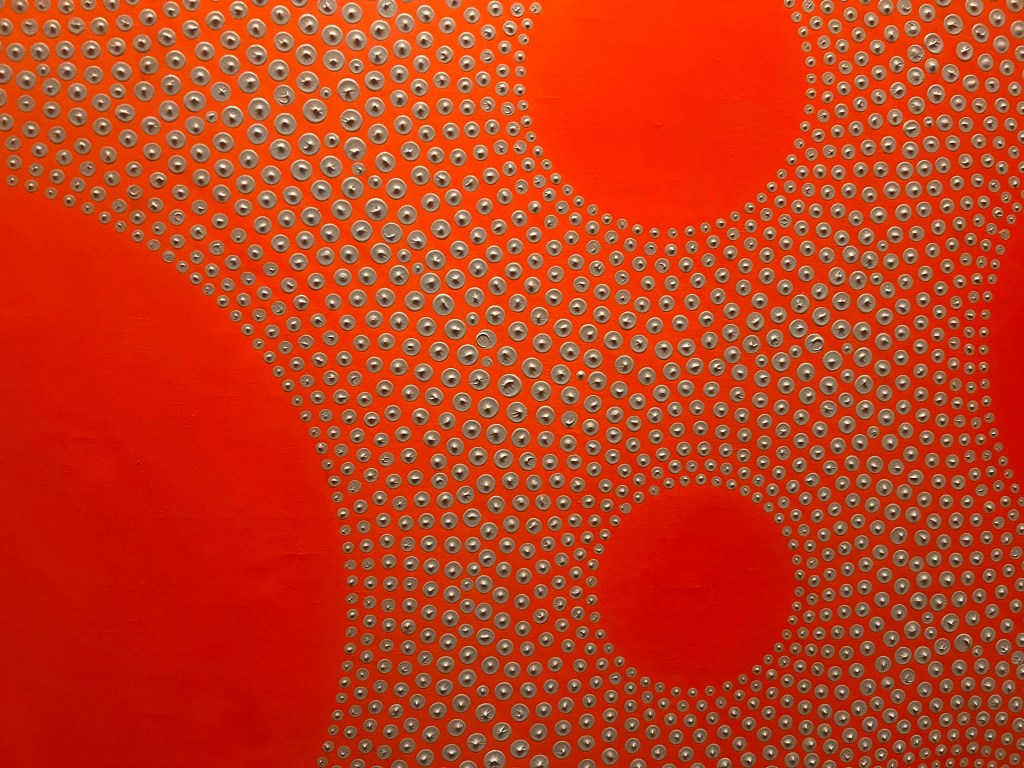
The Kirkland had been a specialty museum which recently merged with the Denver Art Museum. Kirkland had been a local artist and educator and his collection of his works and other stylistic art pieces is now overseen by DAM. One of his signature styles was the application of numerous dots buried within large works of art. He applied the dots while hanging above the works in a hanger type apparatus.
The harness used by Kirkland in his large “dot” paintings (at right) and a close up of the dots in the center
Since I am not knowledgeable about art, I will simply display some works that are a part of the Kirkland Institute of DAM that struck my fancy.
Another short trip to get back into the swing of things. We had believed we had never spent any time in Madison and wanted to visit the WI state capitol. (A week ago, in going thorugh some pictures, Chris saw that we had visited the capitol back in the late 1970s-but that visit certainly was not top of mind.) Two nights seemed sufficient.
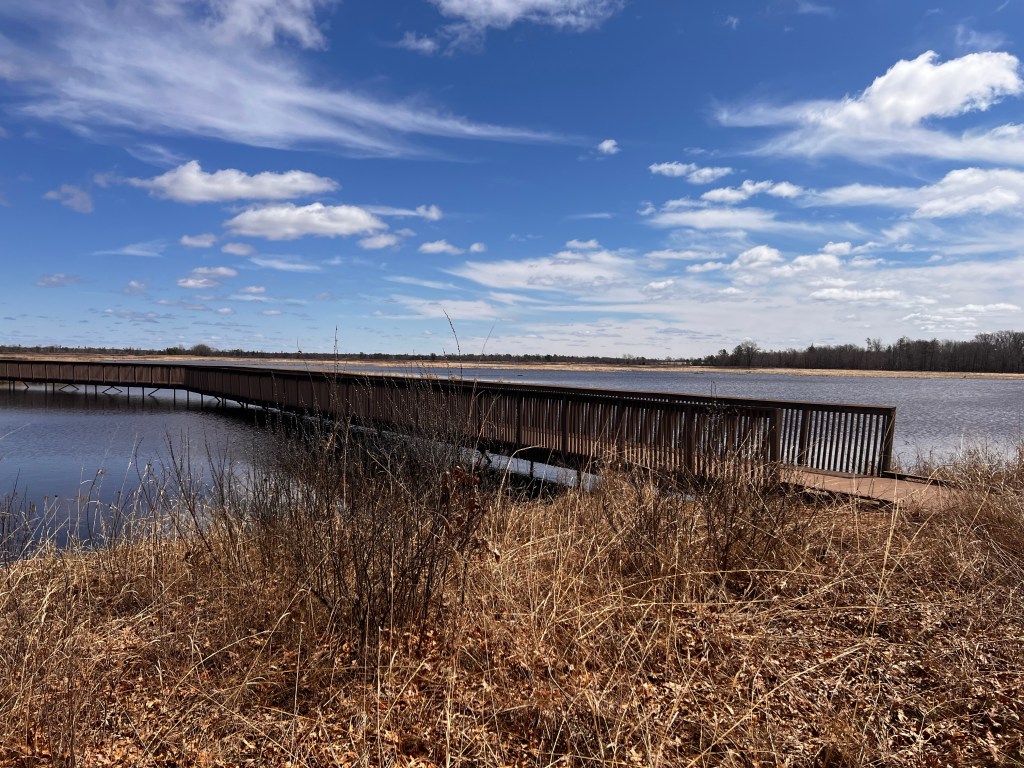
Necedah National Wildlife Refuge
On the way to Madison, we stopped at Necedah National Wildlfe Refuge. This gave us a chance to break up the drive with some walking. The visitor center was impressive, although closed. The center/HQ was constructed of various LEED type materials. The style reminded me of the large HQ at Voyageurs National Park in International Falls.
We made two short walks around the visitor center area. It is not prime time yet for migratory birds, but we saw Canada geese, swans, and some sort of ducks in the distance. We were impressed with the quality of the boardwalks used in the wet, marshy areas. Maybe not your most dramatic item on our trip, but it was nice to see boardwalks that were well made and maintained.
As we were driving, Chris was looking at the Rand McNally maps. She asked me how far Columbus, Wisconsin, was from Madison and if it was out of our way to visit it. Columbus, Wisconsin, is the turnaround point for the Trails and Rails program on the Amtrak Empire Builder. This is the volunteer program I do in the summer. The Trails and Rails program is a joint venture between Amtrak and the National Park Service.
We decided the detour to Columbus was relatively short and we could eat at one of the three places Trails and Rails guides frequent when we are in town. I showed Chris the highlights, and I was able to expand my knowledge. Having a car here was unusual for me and parts of town otherwise inaccessible to me were now discovered.
Columbus WI
We ate at the bar with Mexican food, quite tasty. I stopped in at the Amtrak depot and learned that station platform repiars were not yet completed and would impact how the trains loaded. This information I later passed on to the other T and R guides. It seems like various repairs have been ongoing for several years. It might have been easier and quicker to knock it down and start over.
On the way to Columbus, on one of the back roads, we passed a shrine called Queen of Peace. Evidently back in the 1970s a local woman said she saw a vision of Mary, Mother of Jesus. The Catholic CHurch investigated and did not validate her claim. Despite that, others felt the woman’s vision was valid and built a shrine here. It is still going strong 50 years later and they have an elementary school also. The shrine was closed, even the gift store, so we just drove around and did a Google search about it.
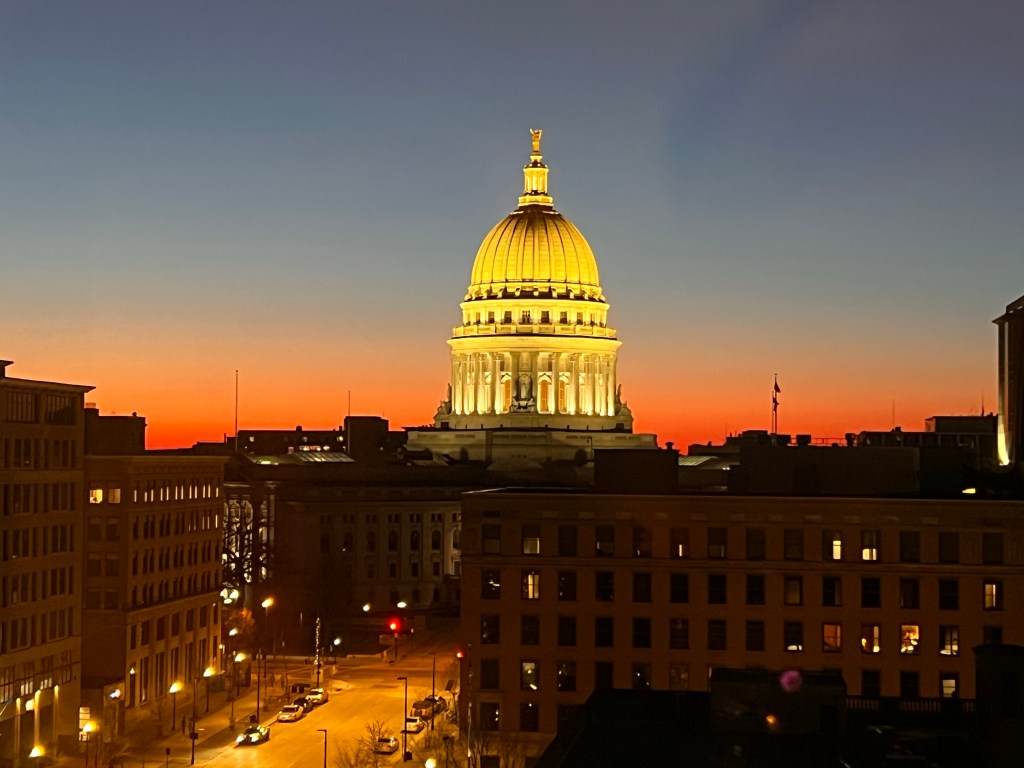
After Columbus we made our way to Madison. We stayed at a Hilton downtown in a corner room with a great view of the Capitol and Lake Monona. Madison is built in an area the Ho-Chunk Indians called Four Lakes. Downtown and the University are built on an isthmus between two lakes, Lake Monona and Lake Mendota. The Madison Convention Center is on Lake Monona just a block from the Hilton.
Sunday was Easter. Before going to church, we had breakfast. Our deal at the hotel included a full, off the menu breakfast. It was quite good and we avoided the crowd that showed up for their Easter brunch. We went to church at the Catholic Church on the UW-Madison campus. We had arrived early, found a parking space, and were going to walk the campus for a while. Walking past the church, we saw people going in, 40 minutes prior to Mass starting. The person at the reception desk told us people were arriving early to get a seat. So we went in and waited along with others in order to have a seat. There were so many attendees that they ran out of Communion hosts.
A full size work by Esherick
The Chazen Museum of Art is on the campus and we visited there after church. Part of the building was being renovated so only a portion was viewable. I particularly liked an exhibit featuring works by Wharton Esherick from PA.
Easter was rainy but we took a chance and went to the Arboretum. The visitor center was open but really had no exhibits or flowering plants of any interest. Once we realized that, we left and went to The Chocolate Shoppe for an afternoon ice cream treat.
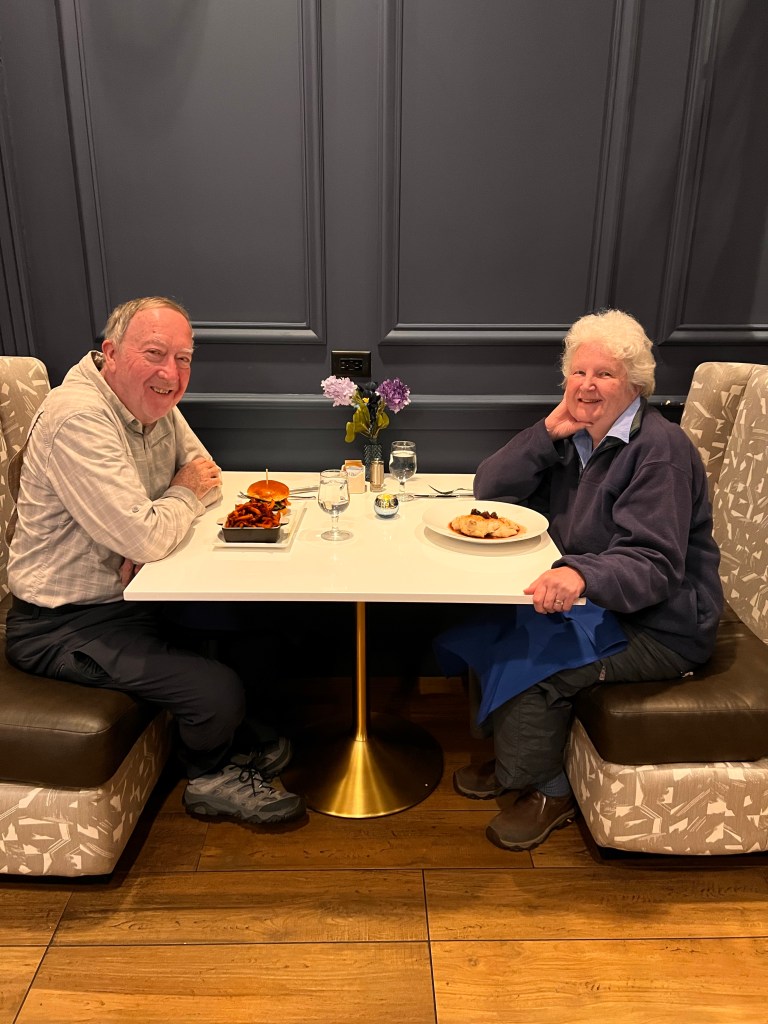
Returning to the hotel, we walked over to the Convention Center and enjoyed the lake view. Dinner was also in the hotel. It was not very crowded, I guess everyone had Easter brunch.
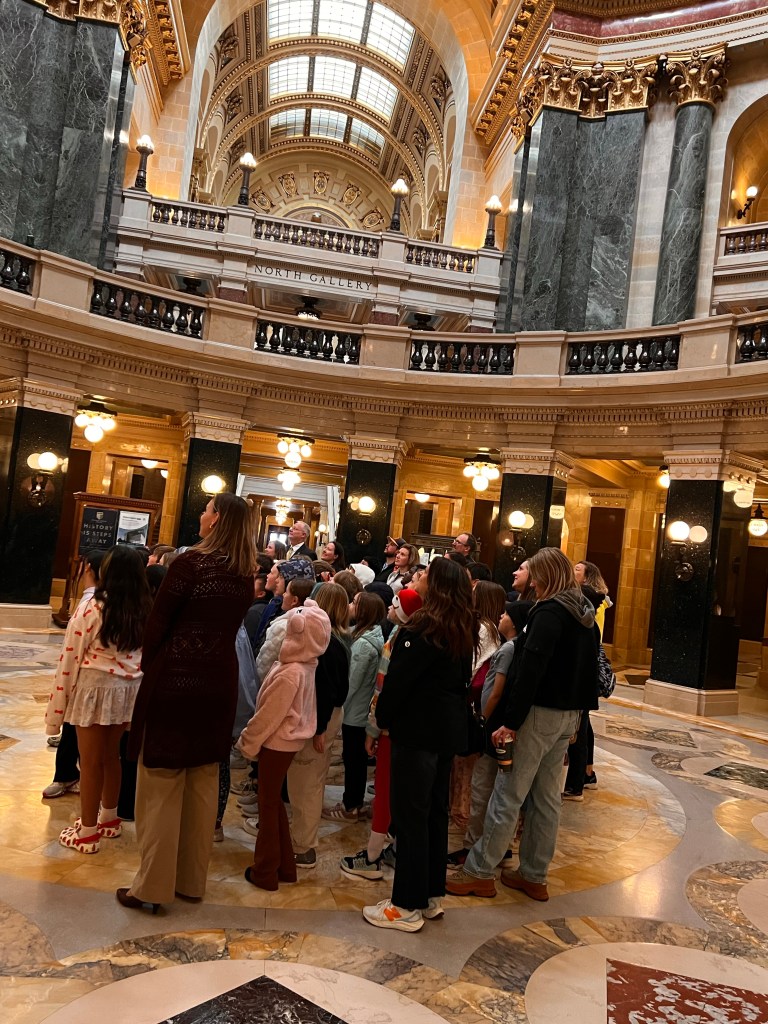
Touring the Capitol
Monday was our busiest day. We started out with another full breakfast at the hotel, then over to the Capitol. Unfortunately, our tour was joined by children from two classrooms. Fortunately, they were well behaved.
The tour lasted an hour and included numerous steps to climb with the final climb up to the outside observation deck. The school kids had returned to their buses so the small space was uncrowded . Inside was a small museum of history about the Capitol, outside was a great view of both lakes and the campus.
After the tour we packed up and left the Hilton and Madison. Our next destination was Cross Keys, headquarters for the Ice Age Trail Alliance (IATA). IATA is an non-profit partner to the National Park Service Ice Age Trail. The Trail is 1200 miles, following the edge of the last glacier in North America in its journey through Wisconsin.
The Ice Age Trail is only in Wisconsin and the Trails and Rails program guides talk about it on our Amtrak Empire Builder journey. The people from IATA would be presenting a one hour Teams online training for the T and R guides on Friday. Since I was in the area, I thought it made sense to stop by and say hello. I picked up a few items for guides to distribute on the train.
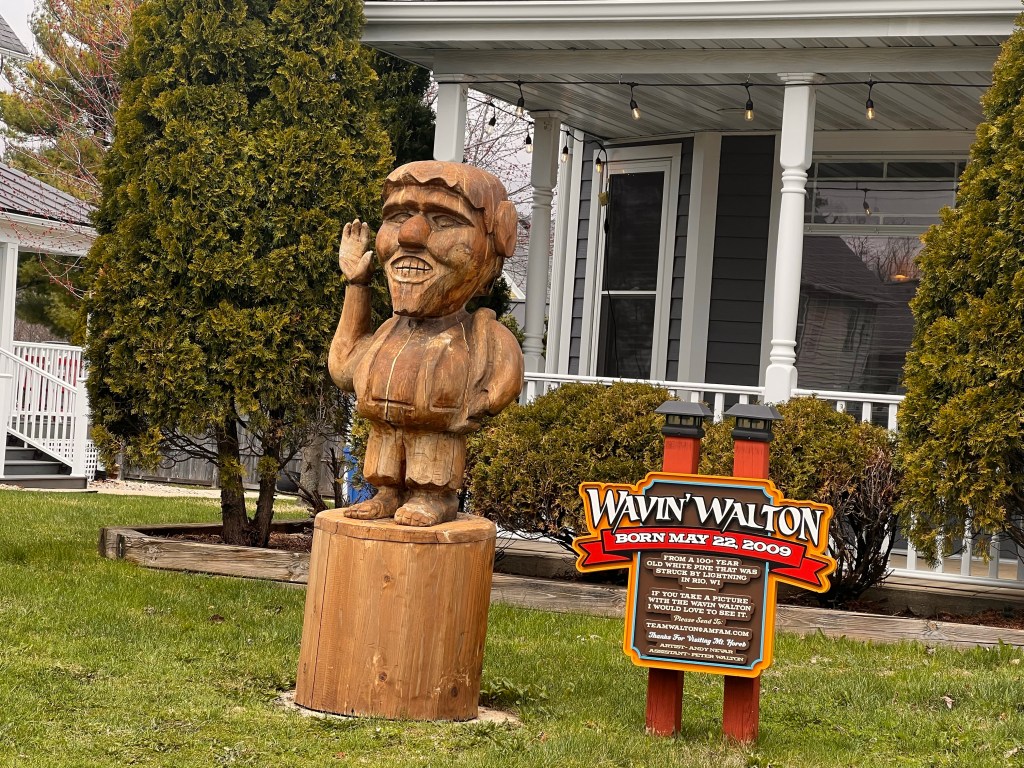
Leaving Cross Keys, we knew we had extra time before our last planned stop of the day so we made a side journey to Mount Horeb. This town has marketed itself around trolls. Norwegians had become the dominant immigrant group in the area and trolls seemed a natural fit for marketing. The local museum discussed the history both of the local area, the Driftless Region, as well as the troll theme. It was a pleasant and surprising diversion.
The Epic campus
Our final stop of the day was the campus of the company Epic. Epic develops “software to help people get well, help people stay well, and help future generations be healthier.” It is privately held and must make a lot of money. The campus is divided into six regions, each region consisting of a cluster of office buildings connected to each other.
Epic allows visitors to wander around the campus area and inside the office buildings, starting at 2 PM each weekday. Each of the six campus areas has a self guiding tour, in a glossy written multi-page handout that highlights conference rooms, artwork, even hallways. It takes about one hour to tour each campus. We chose the campus titled “Prairie” since it is located right at the visitor check-in and we did not have to walk to another area. A mother and her three children were in front of us. This was their third time here, driving up from their home in Illinois each time.
It is hard to describe everything we saw. We will put in some pictures to try. You might do an Internet search for Epic tours and see for yourself.
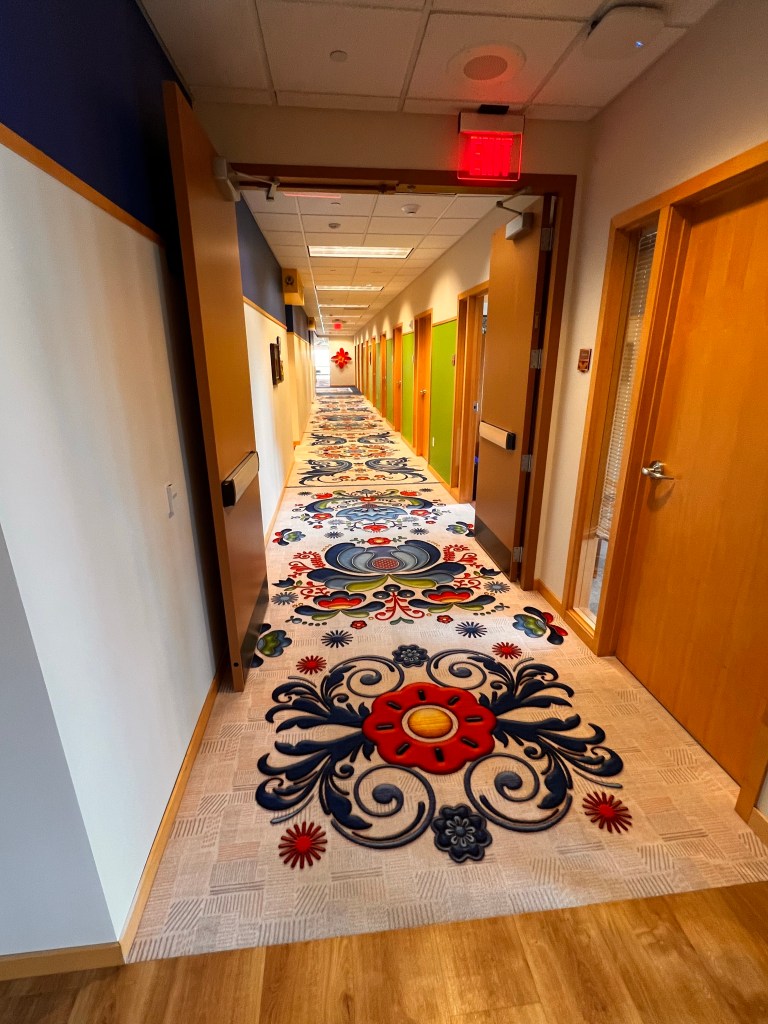
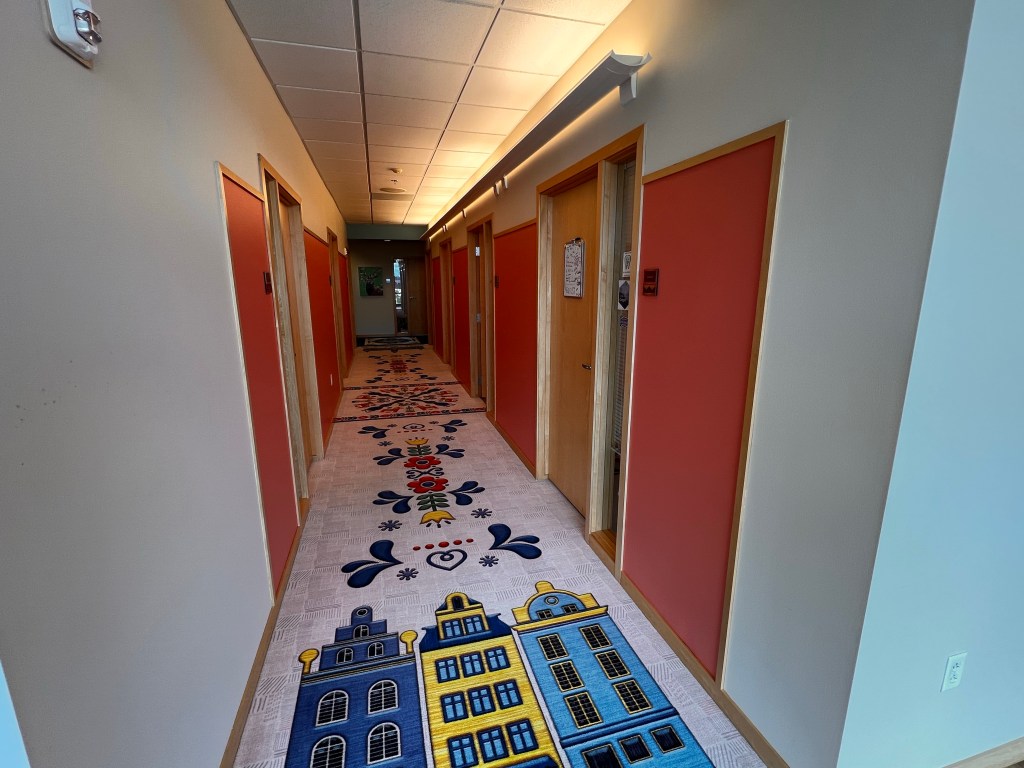
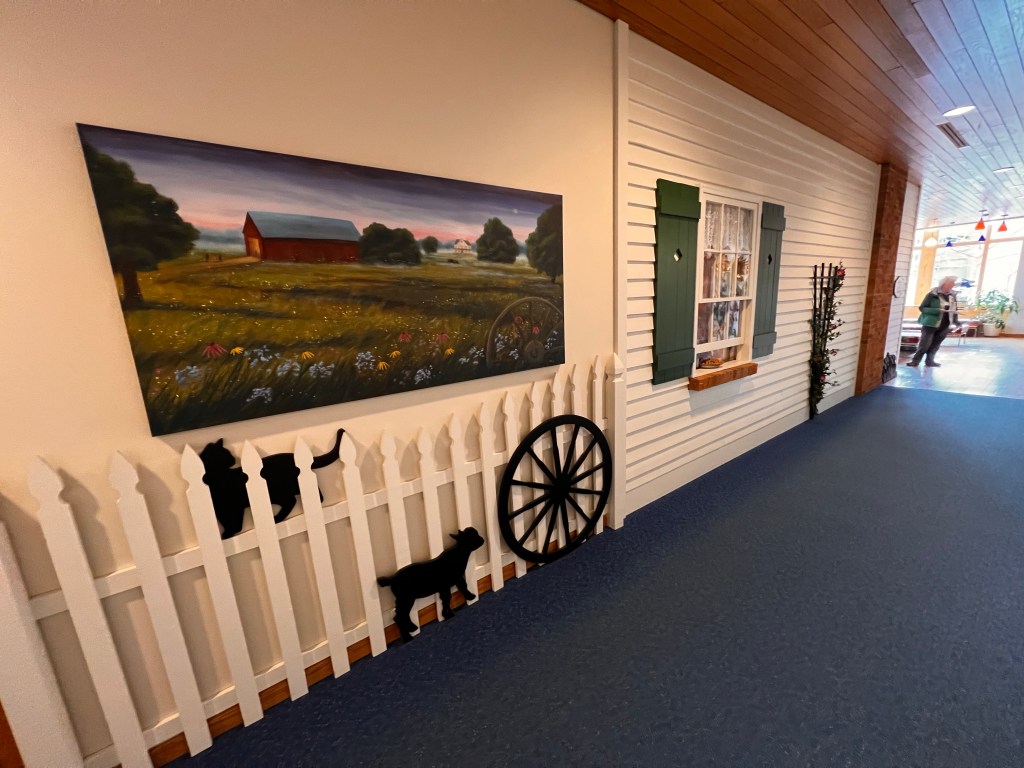
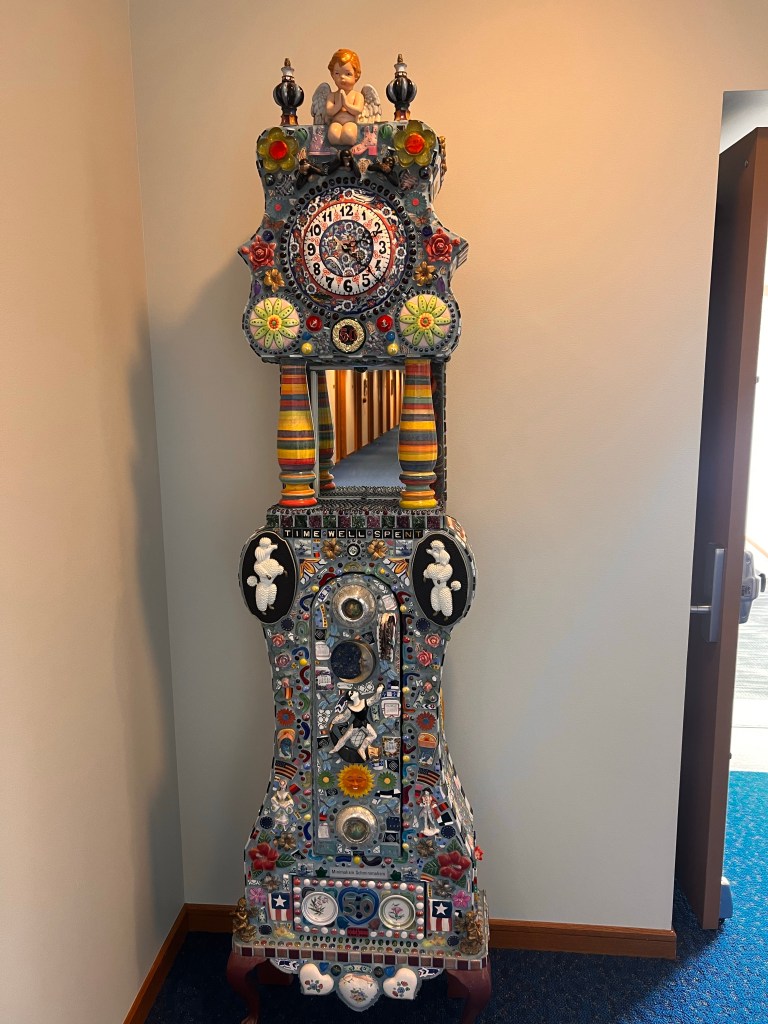
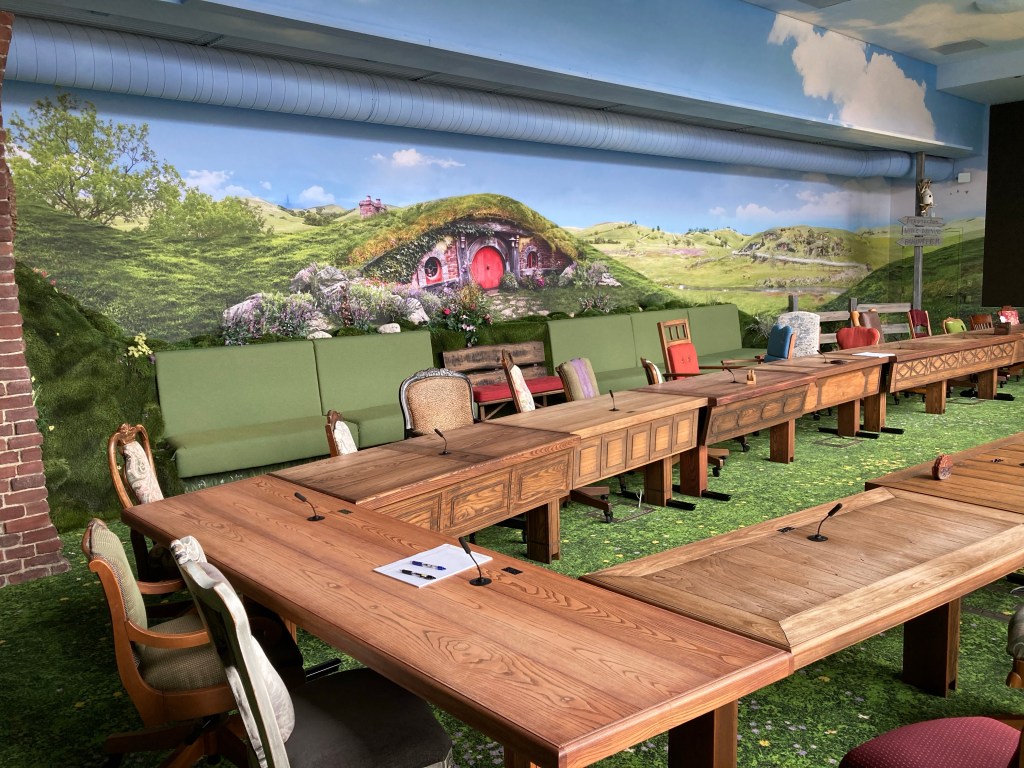
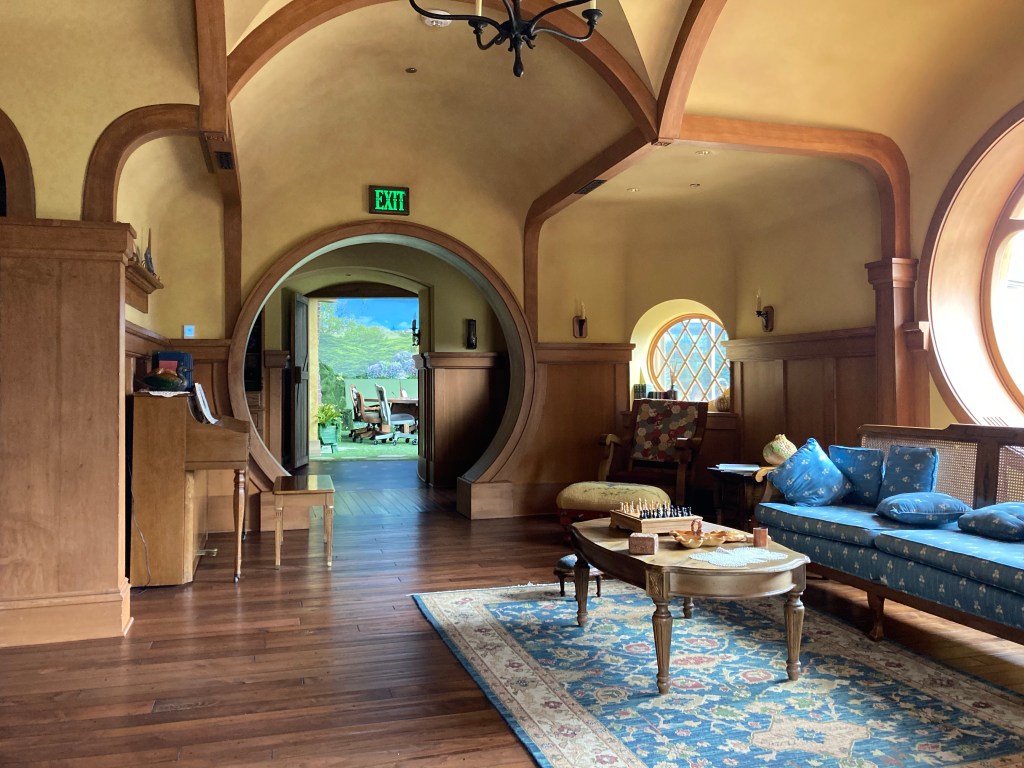
Epic hallwaysEpic elevatorsEpic artworkThe door to the Shire (From the Hobbit and Lord of the Rings) Conference RoomThe Shire Conference Room
We were astounded. While not knowing the Epic work culture, the setting made me think I would never retire if I worked here. Every person has an office with hallways that are not bland. There is a conference hall/amphitheater that seats 11,000. There are bikes and a tram to get around the campus. The artwork is from Wisconsin artists suggested by employees
Evidently the building design people went to Disney and to Microsoft to determine if creativity or efficiency is more important. One said creativity drives efficiency, the other said efficiency drives creativity. Epic tried to combine both.
Chris and I could only handle one tour, taking an hour to complete. The sensory overload made us think we could not handle a second one. Maybe during one of our driving trips to the South or East, we will stop in for a visit to another campus.
The drive home was uneventful. One more small trip under our belts. Next effort will be late May.










































 Chris Klejbuk and Ed Heimel travel adventure
Recent Comments