

Twin Falls, Idaho, September 30
Friday and Saturday were primarily days of natural beauty with a little bit of history tossed in for good measure. We retraced our steps from Mackey, Idaho, south through Arco, Idaho, and onto our first stop at Craters of the Moon National Monument and Preserve. All of the hype we had read about this place described its similarity to the surface of the moon. Not having been to the moon, we cannot attest to the accuracy.

Craters of the Moon
As we drove to the park, the terrain started to show evidence of lava. However, the impact increases dramatically once you enter the park’s boundary. The impact continues as you travel through the Loop Road demonstrating the impact of the lava flows over millenia. Yet we see only a portion of the park, much of it is protected as wilderness. However, the multiple types of lava were well represented in this huge park and preserve (750,000 acres). This is 30 times larger than Lava Beds National Monument in northern California, which we saw a few weeks ago.
The visitor center had a well prepared introductory video. However, I found more helpful the 3-D map in the visitor center showing the movement of the thermal hotspot underneath the earth’s crust that has moved from the south west Idaho border with Oregon to its with current location underneath Yellowstone National Park. The Snake River valley follows much of this path of the movement of the earth’s crust.

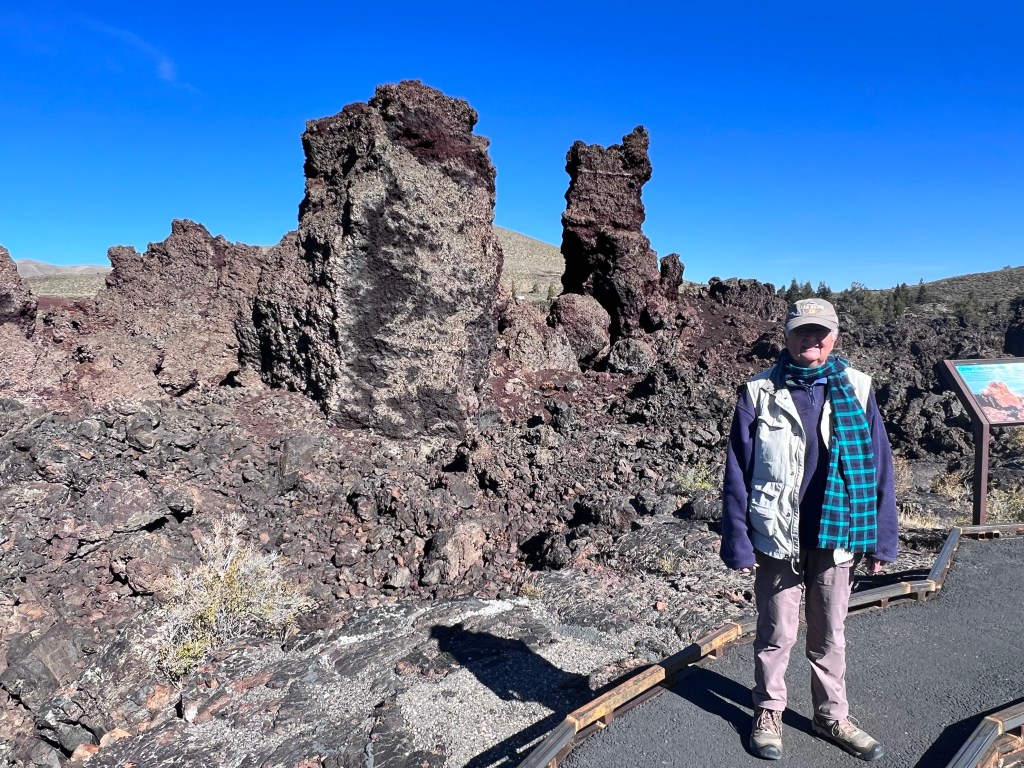
The loop road allows multiple opportunities to stop and take short hikes observing the various types of lava, its slow erosion, and the steady growth of small living plants which continue to break down the rock. Over time, enough soil is created to allow for the growth of trees and shrubs. We had our lunch surrounded by lava rocks and a few of those shade trees.
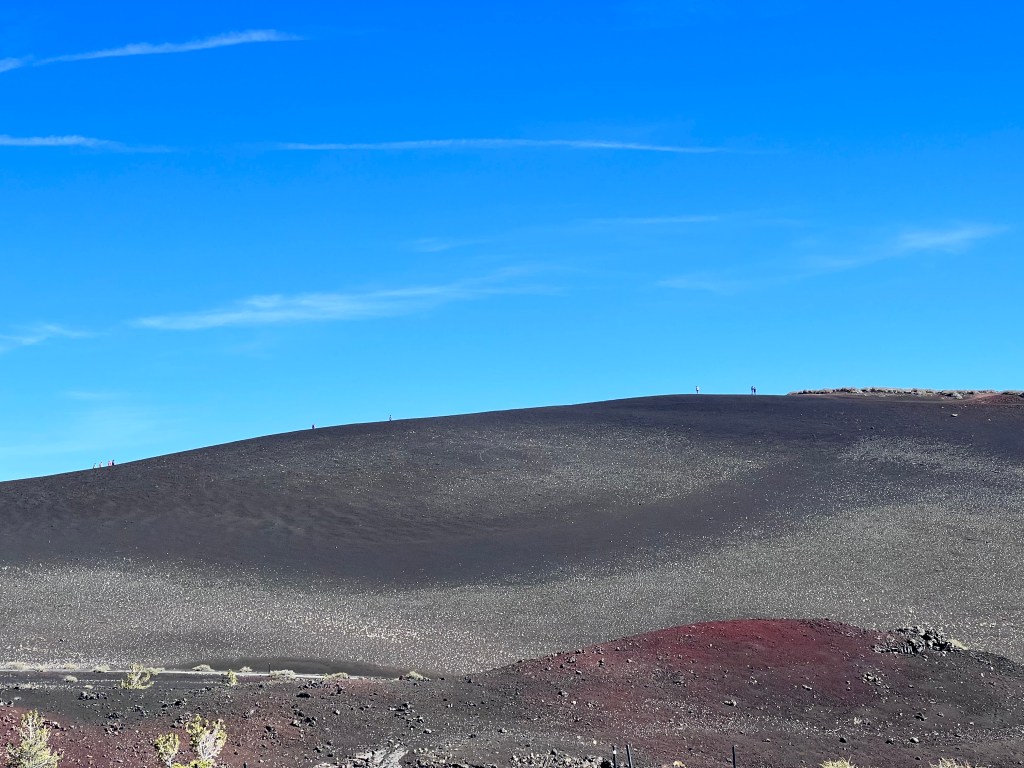
Inferno Cone, do you see the people on the hill?
A real highlight for us was climbing Inferno Cone, which has a steep grade to its top with a wonderful view of the surrounding area. Unfortunately, by that evening, I realized that the steep climb up and down the cone had a negative impact on my left hip. The result was unsteadiness in my step, which limited our hiking on Saturday.
Leaving Craters of the Moon, we continued our journey on our usual style of two-lane roads. We stopped for a popcorn and potato chips snack at a city park in Shosone. Next stop, Minidoka National Historic Site. At Minidoka, over 13,000 of the 120,000 people with Japanese ancestry who were imprisoned during WWII were housed. The Japanese American imprisonment is a sad and disturbing story during a shameful period of our history. However, the story needs to be presented so we can discuss and learn about its implications for the future as well as the past.

On our way to Minidoka, we had railroad tracks to the right of our car. It made me realize it was probably the same tracks used by the railroad to transport the Japanese Americans from the West Coast area to this eastern side of Idaho. As compared to Tulelake in northern California, the displays and residual buildings were much better preserved and presented. The visitor center was closed, only open during summer months, but the outdoor exhibits were available to be viewed.
Saturday morning, we stopped at the Perrine bridge over the Snake River here in Twin Falls. The canyon here presents a stupendous view of the river and its power to erode the basaltic rock of this area. The bridge is well known and its impact as a visual treat was exceptional. The Perrine bridge is 1500 feet long, nearly 500 feet tall, and is the fourth tallest arched bridge in North America.
We had not realize that the Perrine bridge is one of the countries only bridges where people can do BASE jumping without obtaining a permit throughout the year. BASE is an acronym that stands for each of the categories of objects people jump from: buildings, antennae, spans, and earth, such as a cliff. A simple explanation: it’s basically strapping a parachute on your back and jumping off a bridge with hope that you land safely down below.
We discovered this as we were looking at the bridge and walking to diverse viewpoints. At one viewing point a gentleman was sitting. OK, you know the rest of the story. Chris started talking to him, and we discovered that he and his wife are from Rochester, New York. That morning, his son, who lives in Medford Oregon, had done a tandem jump from the bridge. His 64 year old wife was scheduled to do it in the next 15 minutes. A tandem jump means that a novice holds on, and is harnessed, to an experienced jumper and they go down together. Of course we had to stay to watch this. We had not seen anyone else doing it that morning nor had we come to the bridge expecting to see such a spectacle.
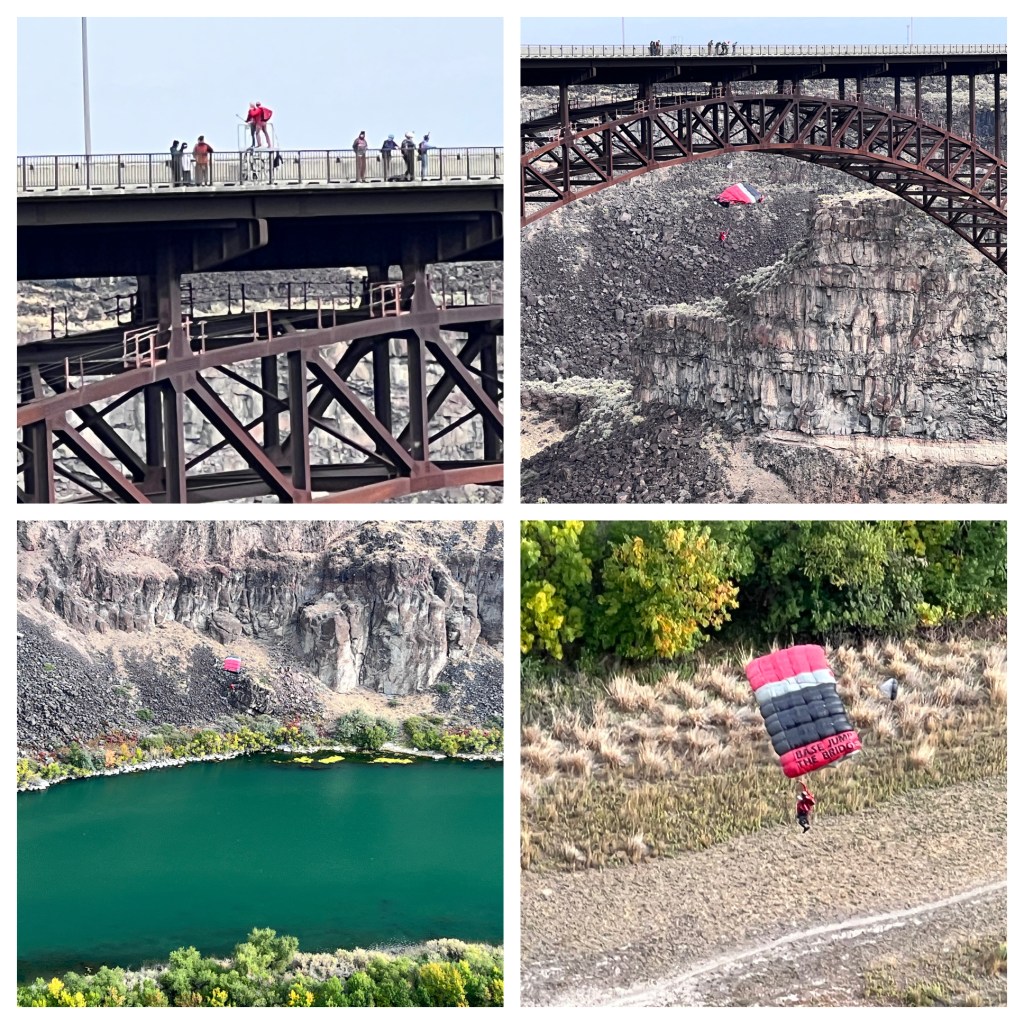
BASE jumping from Perrine Bridge
Well, the jump went great. We even took pictures for the couple since the husband’s camera was a bit shaky as he was trying to watch and not be nervous. After the wife jumped, there were four or five others making a jump, most of them as singles. They were the experienced jumpers who come here often.
Our next scene of adventure was 90 minutes away at City of Rocks National Reserve. Today is September 30 and when we were at City of Rocks, we did not know if the federal government would go into a shut down mode for lack of a budget. City of Rocks was our last Idaho National Park Service unit to visit. If there was to be a shut down, we would’ve been able to get all of the Idaho parks visited before the October 1 shut down date.
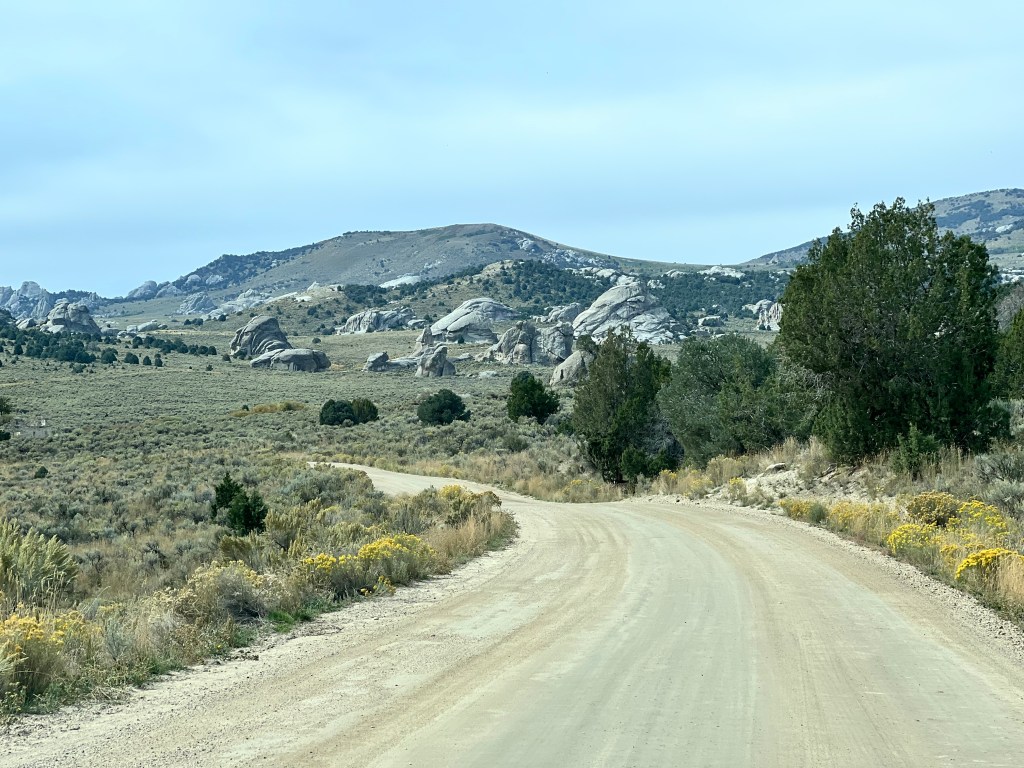
City of Rocks
Other than rocks, we had no idea what to expect when visiting this NPS unit. We did gain 3000 feet of elevation going from Twin Falls to City of Rocks. The road was not too curvy so the ride was pleasant. One half of the journey was on Interstate 80 so we zoomed along towards our destination. Of course, the final half of the trip was through high desert plains, or very small towns. When we arrived at the visitor center, we discovered it was like Hagerman Fossil Beds, that is, co-managed with the State of Idaho and a state park. City of Rocks would have remained open, even if the federal government had gone into a shut down mode.
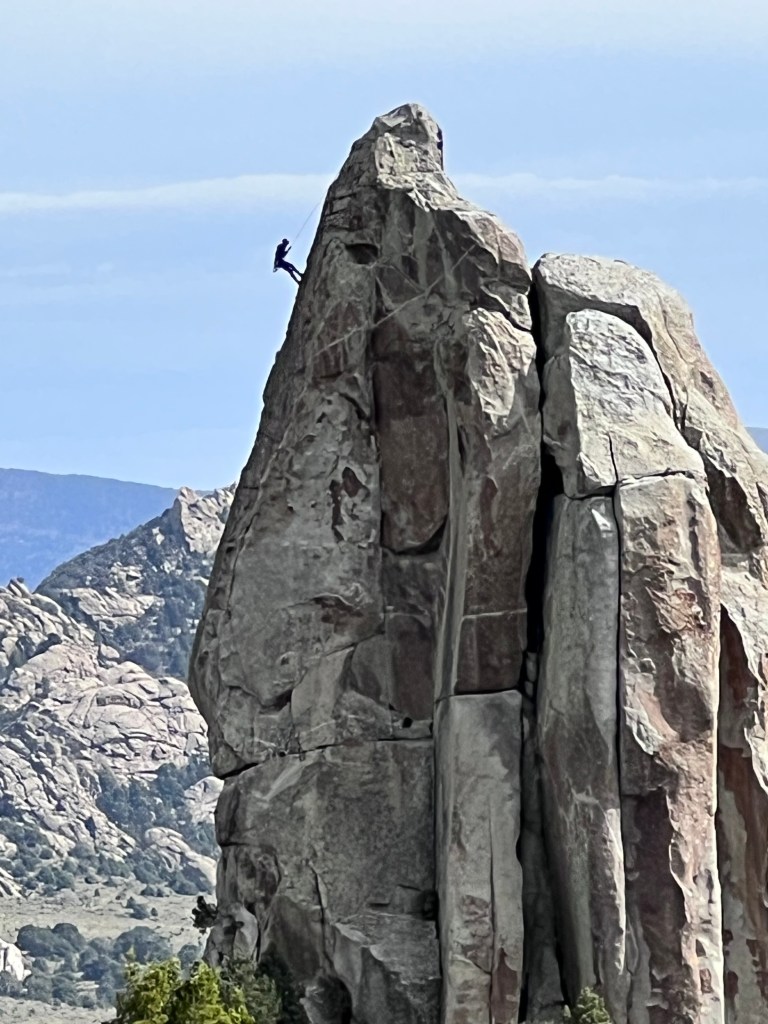


Driving into the park, we discovered huge granite rock monoliths littering the landscape. They stuck up like sore thumbs, with a swift transition from open fields to the rock monoliths. What we also discovered was that City of Rocks is a huge rock climbing location, even internationally renowned. Experienced rock climbers are able to tackle a large number of the rocks. There is even a training area for novices; sort of a bunny hill. As you can expect, we did not sign up for any training. There are many scattered, diverse campsites throughout the park. We observed more people camping and actively using this park than we had any of the previous parks. It is a well-known rock climbing destination among those who are interested in that. There are over 700 different climbing routes developed throughout the reserve and state park.
At lunch among the rocks and trees, we had a recurring happening. Just two picnic tables at the site and the other table had a gentleman who had grown up in Maple Grove, Minnesota. Only in this case, he approached us first once he saw the Minnesota license plate.

Our final adventure for the day was Shoshone Falls. This is hyped as a falls taller than Niagara. Well, we were disappointed. I’m sure the height is accurate. However, the falls have been so developed for hydro power and with low rainfall lately, that the view is less than impressive despite the wonderful canyon setting.
We did manage to rescue the day with sampling a new ice cream supplier- Reed’s Dairy. We tried their location in Twin Falls, although they have several in southern Idaho. The ice cream was fine, worthy of a stop, but maybe not quite up to par with our previous experiences on this trip.
Ed and Chris, Twin Falls Sept. 30

 Chris Klejbuk and Ed Heimel travel adventure
Recent Comments