
Ontario, Oregon September 16
Chris was not excited about visiting Lava Beds National Monument. When she heard it had lava tube caves, she was even less excited. When we left the national monument on Friday afternoon, she had reversed herself, but not because of the caves.
McDonald’s was our breakfast source Friday morning since the local motel did not serve breakfast with the room charge. We managed to walk in just before the rush began and threw the staff into a tizzy. We felt sorry for the many workers who were delayed trying to get their meal and off to work.
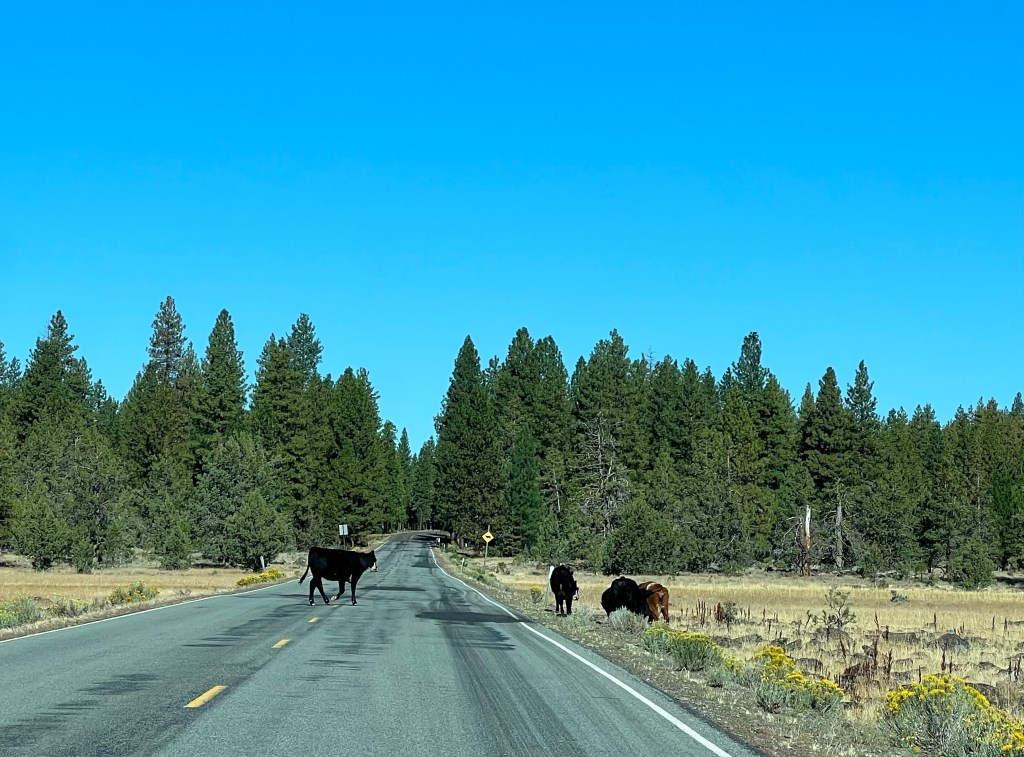
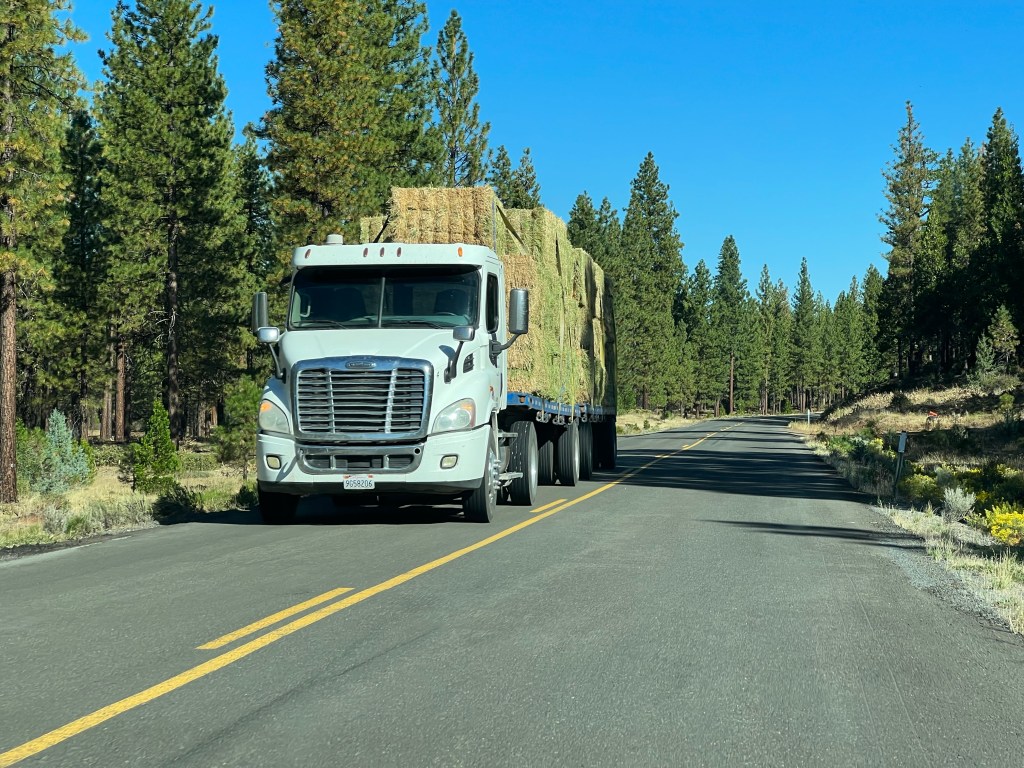
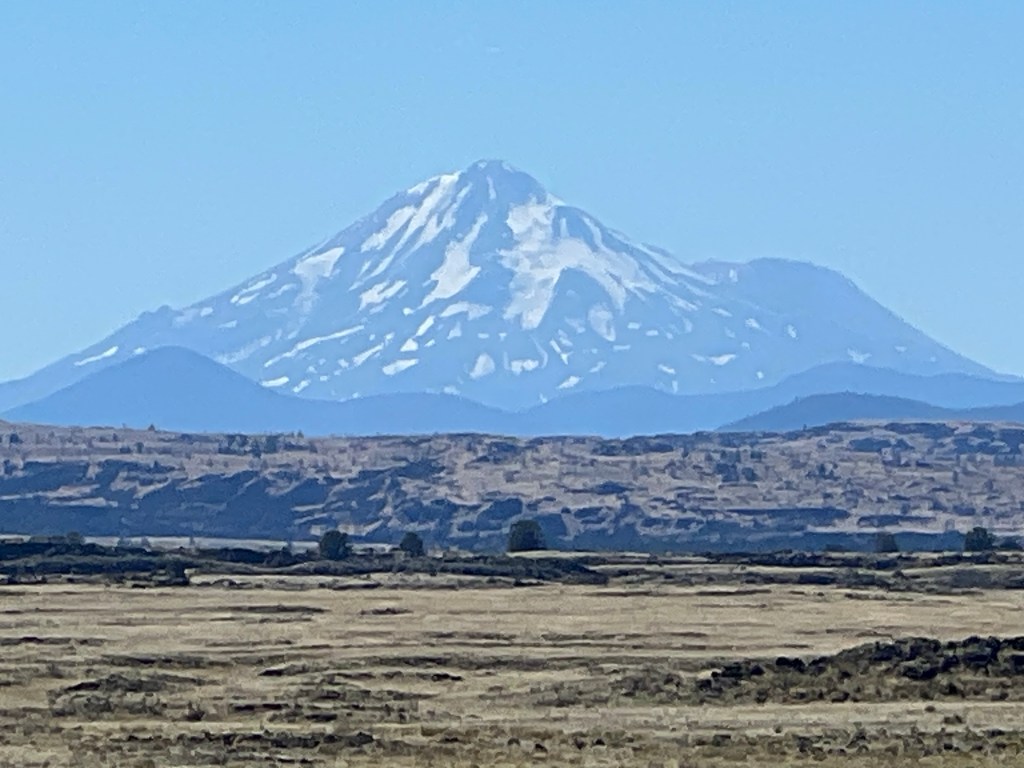
The drive to lava beds continued on the Volcanic Scenic Byway that we mentioned yesterday. Our road companions were frequently trucks full of hay or of huge logs, and periodically cattle crossing the road, usually very slowly. Every now and then through the trees we saw glimpses of Mount Shasta, the tallest mountain in California at 14,180 feet.
When we reached Lava Beds National Monument, Chris kept interrupting me and the Ranger to re-state she did not want to see more caves. If we were going to see caves, we had to decontaminate our shoes since we have been to other caves in the recent past. Decontamination is necessary to prevent the spread of white nose syndrome which kills bats.
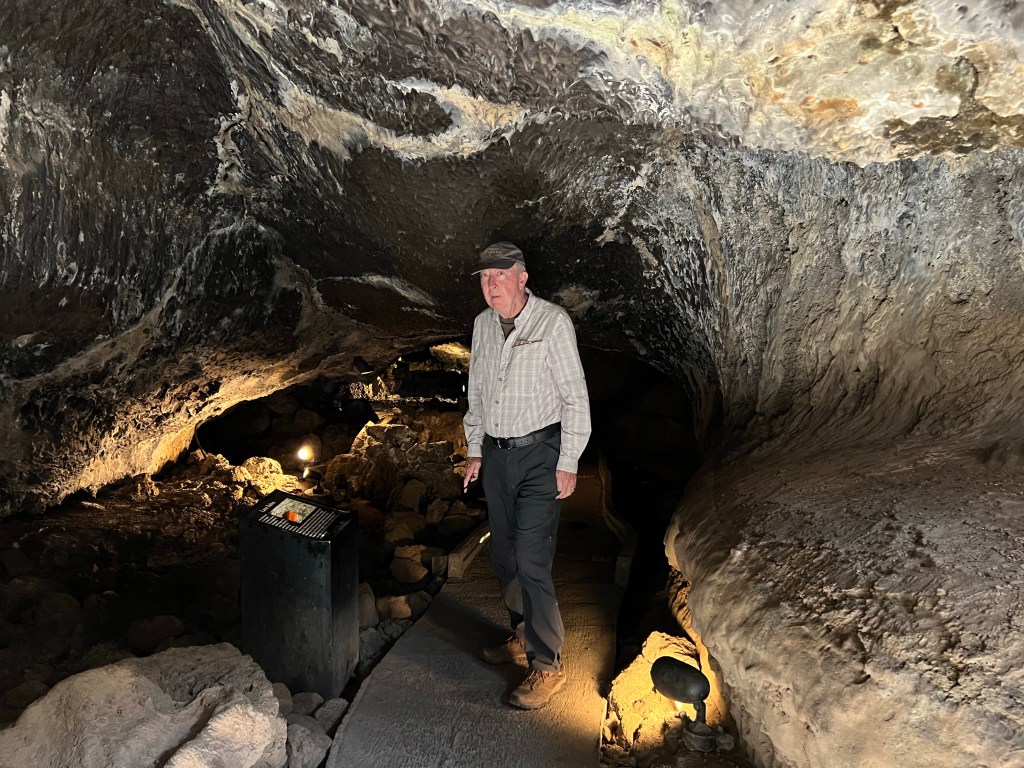
What are lava tube caves? As one of the park documents describes it, “in areas of lower elevation, such as valleys, the lava moves faster, and takes longer to cool, creating a network of lava rivers and tributaries. Eventually, in much the same way that a river of water can freeze over with ice, the surfaces of these lava rivers cool and harden into rock. This rock insulates the lava that continues to flow inside. When the supply of lava stops, the tube drains, leaving behind a hollow cast known as a lava tube.“

I finally managed to convince Chris to visit the one lava tube cave which is lit. The others require flashlights and frequent duck walking. Ours had a smooth bottom. These caves are unique and not your normal caverns with formations. The process of lava flowing from different types of volcanoes periodically produces a tube-like chamber that one can walk or crawl through. The walk-through was satisfactorily concluded, and the educational lesson learned for both of us. No need to see more of the same thing so we moved on to other portions of the national monument.
Lava Beds National Monument is built on the site of the Medicine Lake shield volcano, which is the largest volcano by volume in the Cascade Range. Shield volcanoes are broad, gently sloping mountains that form from many dispersed, low energy eruptions of very fluid, molten rock. These liquid rock flows are able to travel great distances before hardening and result in a large low profile volcano.

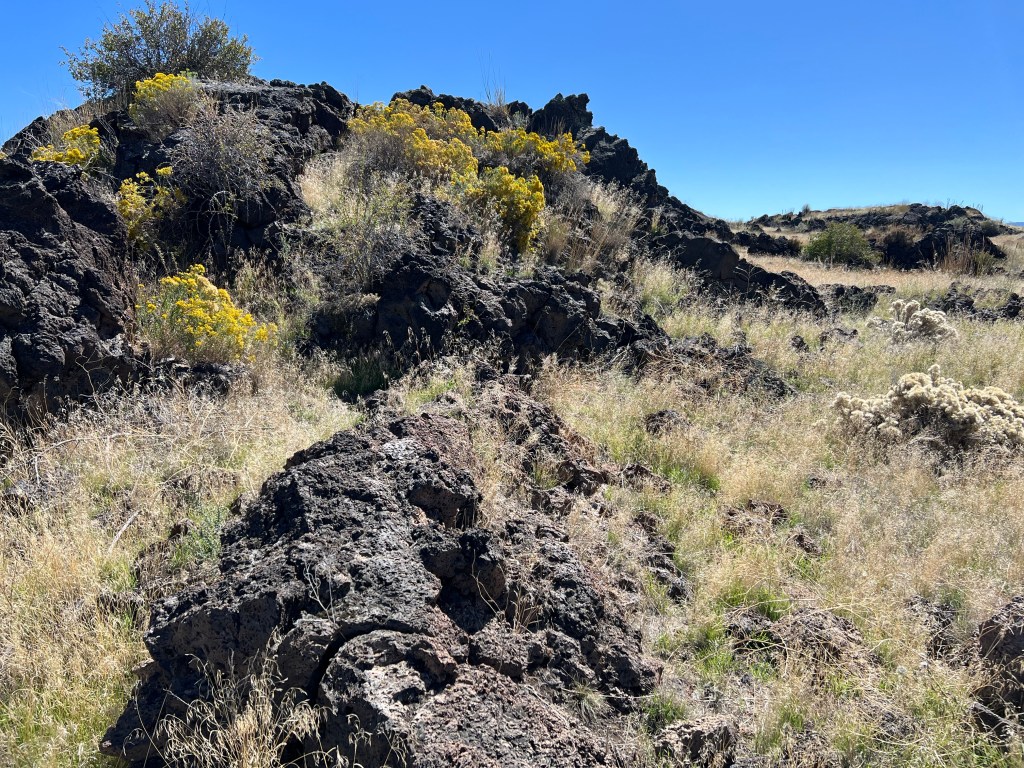
Continuing around the National Monument we observed multiple examples of different types of lava. Most interesting were those conglomerations of lava boulders with their rough, sharp, edges piled high across an extended portion of the valley floor.
Unfortunately, as one begins to expect traveling around any of these areas, the local tribes of Native Americans went through the usual decimation by guns and germs and the loss of promised reservation land. Here the broken treaties led to what is called the Modoc War. This was a six month conflict beginning in late 1872. Notably, the Battle of the Stronghold was held in a portion of Lava Beds National Monument. The Modoc warriors were able to hold out for six months, keeping at bay a much larger US Army force. The final result follows the all too familiar pattern of the Modoc people being forced to move to either Washington State or Oklahoma State, although over time, some returned to this area on their own.
From Native Americans being mistreated to Japanese Americans being mistreated, was the second stop of the day for us. Tule Lake Segregation Center is part of the WWII Valor in the Pacific National Monument. Tule Lake started as a War Relocation Center and housed 15,000 Japanese Americans who were forced on short notice to move out of their homes to a series of relocation centers. Of course, this was not required of Italian Americans, nor German Americans.
Each family relocated here occupied one room ranging in size from 16 x 20‘ to 24 x 20‘. It was furnished with a single light bulb, a coal stove and up to eight army cots. Meals were served in community mess halls. Latrines were set up military style with no dividers between toilets or shower stalls. Barbed wire fences, guard towers, tanks, etc. were all part of the security of the area.
Tule Lake was re-categorized in 1943 as a segregation center to handle disloyal individuals. This really was a problem as the one size fits all loyalty oaths could not apply to some in varying stages of citizenship. Without going into a ton of details, the camp existed until the end of World War II. Some individuals were deported to Japan. Others went out to try and reestablish their lives in the United States. The facility itself was basically torn down and today a small visitor center is all that really remains.
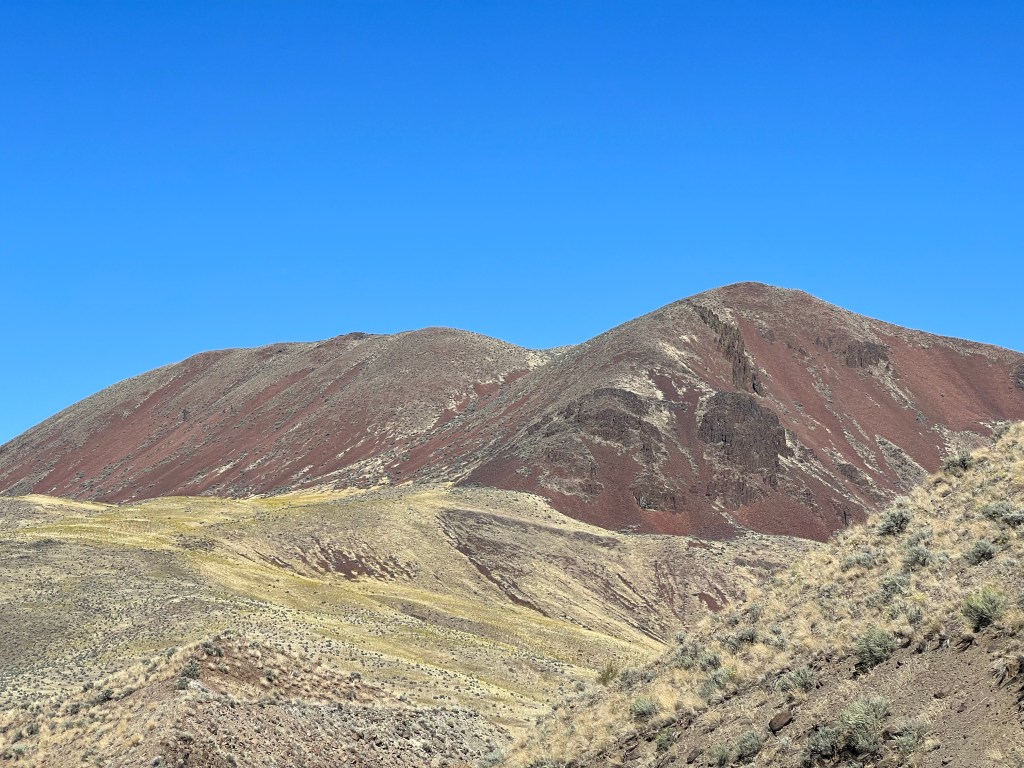
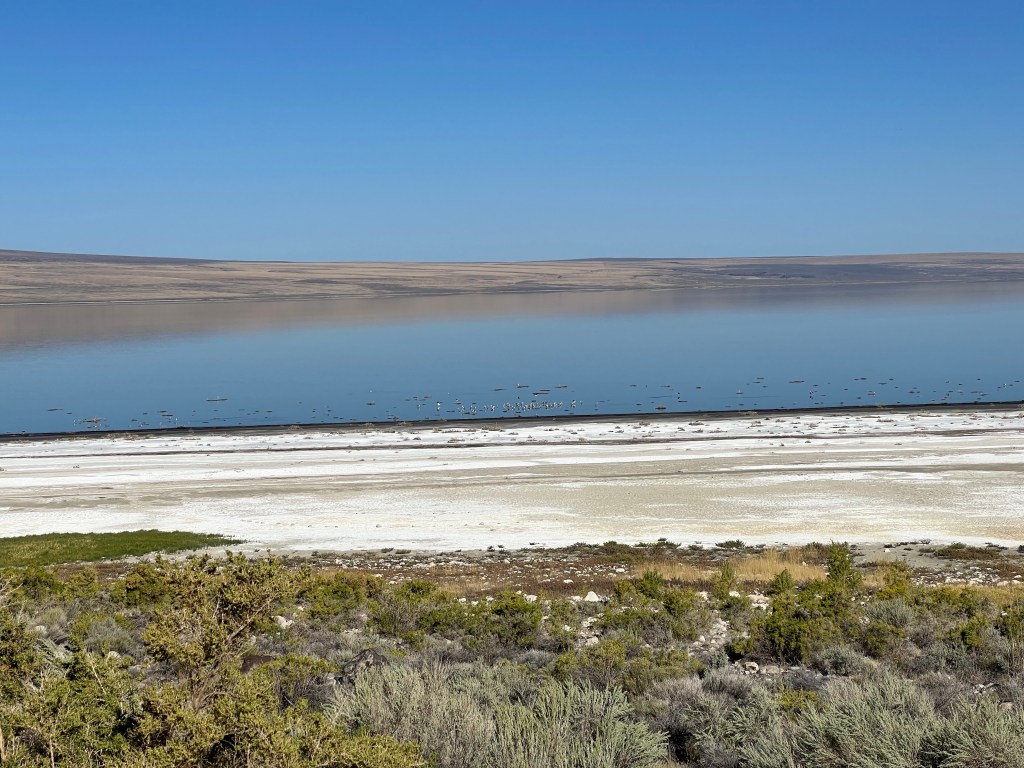
We spent the night in Lakeview, Oregon, a jumping off point for our trip to the eastern side of Oregon on Saturday. The lake view name seems a stretch as the nearby lake, Goose Lake, seems to suffer dramatically from contraction and expansion even to the point of disappearing for a while, depending upon precipitation.

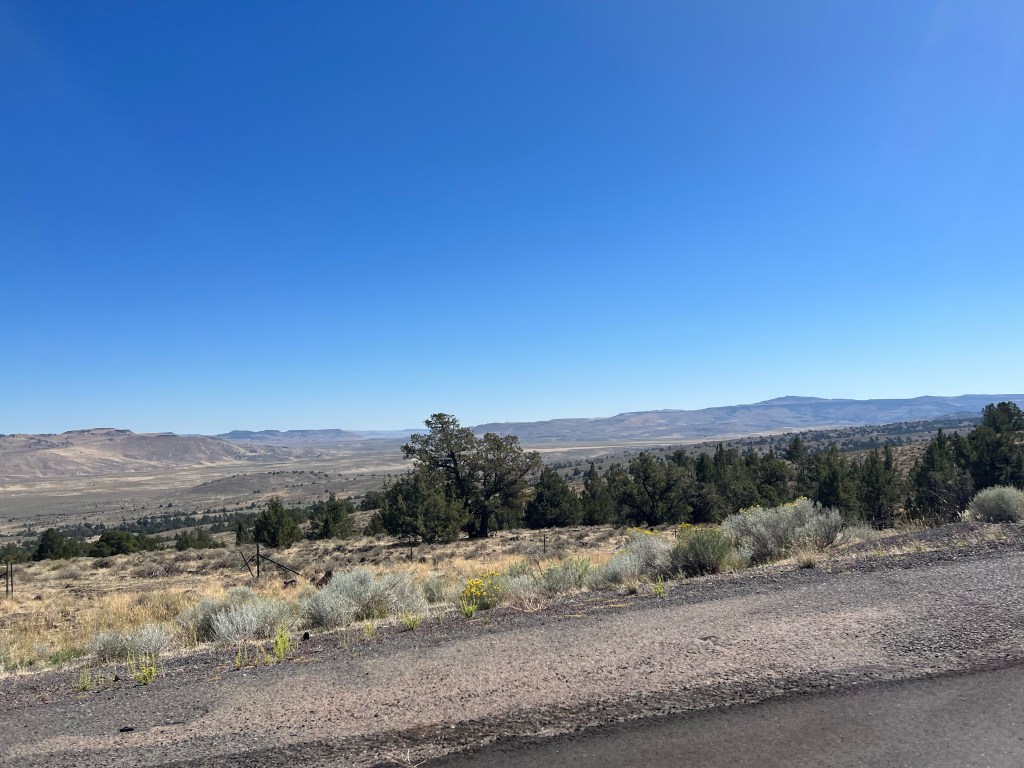
Saturday’s drive was from southwest Oregon to east central Oregon. The terrain was familiar as we experienced valleys, rocky buttes, cattle, juniper, shrubs, and grazing land. One of the counties we went through is the largest county in the state by size as well as the lowest in population. Cell coverage was frequently nonexistent. We crossed our fingers that we would not have a problem and have to wait for someone to come along and stop. The only issue we did encounter were slow moving recreational vehicles that couldn’t keep up to the speed limit.
At our lodging in Ontario, we picked up a local paper that discussed the special festival occurring this weekend: the tater tot festival. It seems that the founders of the Ore-Ida potato company developed tater tots back in 1953 and so the little festival today is to honor that introduction. We stopped by but we could’ve missed it.
Ed & Chris, Ontario, Oregon, September 16.
 Chris Klejbuk and Ed Heimel travel adventure
Recent Comments