Monthly Archives: March 2023

2023 Trip 3: Quickie to Chicago: March 19-23

Our alternate Amtrak transportation on Sunday March 19

March 24, 2023

We made this trip to Chicago to use up our timeshare points since we waited too long to book South Beach and because a trip to Chicago on the Amtrak would refresh my memory of the route prior to beginning this summer’s Trails And Rails program. The plan was to take Amtrak down on Sunday, spend four nights at the Hilton Grand Vacation Club location in the Doubletree hotel, and then return on Amtrak Thursday, March 23.

I try not to dump on Amtrak too much. After all, air travel is full of hassles also. However, Amtrak‘s on-time record for the Empire Builder going east from Seattle to Saint Paul to Chicago is poor. The train is normally late, sometimes dramatically so. The Amtrak app gives an overly optimistic view of the time the train will arrive in Minneapolis St. Paul. I use another program that tracks the Empire Builder’s journey once it leaves Seattle. For this trip, while the train left Seattle on time Friday early evening, east of Spokane it encountered a delay and was running 3 1/2 hours late. It never made up the time as it traveled further east.

Saturday afternoon around 4 PM we received an email from Amtrak that while the train was running late, they had made alternate arrangements for us. Turns out they had arranged for a nice coach bus to take us directly to Chicago. We should still show up at our usual departure time Sunday morning at Saint Paul’s Union Depot. This left some questions for us, but we were willing to go with the flow. Sunday morning we arrived at Union Depot and after talking to the Amtrak agent we learned we could either take the bus or wait for the train. At this point the train was scheduled to be about 3 1/2 hours late. (It ended up being 5 1/2 hours late.) We talked to some people in the waiting area and discovered that 35 students and chaperones from Richfield Senior High were going down to Chicago for two nights on a class trip. We ended up taking the bus with them. Our belief is that the bus was only arranged because there were so many people going directly to Chicago. A second bus was arranged for people going to intermediate stops, including Milwaukee. But our bus would go directly to Chicago.

The bus left around 9 AM, made a one hour lunch stop in Wisconsin Dells, and arrived in Chicago’s Union Station about a half hour sooner than the train would have. That is, sooner than the train would have arrived if it were on time. Since the train was actually over five hours late, we got to Chicago six hours earlier than if we had waited for the train. We took a taxi to the hotel, checked in, and had dinner at an Irish sports bar (O’Toole’s) across the street. Chris had their shepherd’s pie while I had their meat loaf. Both were very tasty. While we were on the 23rd floor, the view was only of downtown office buildings, so not as dramatic as the view in San Francisco.

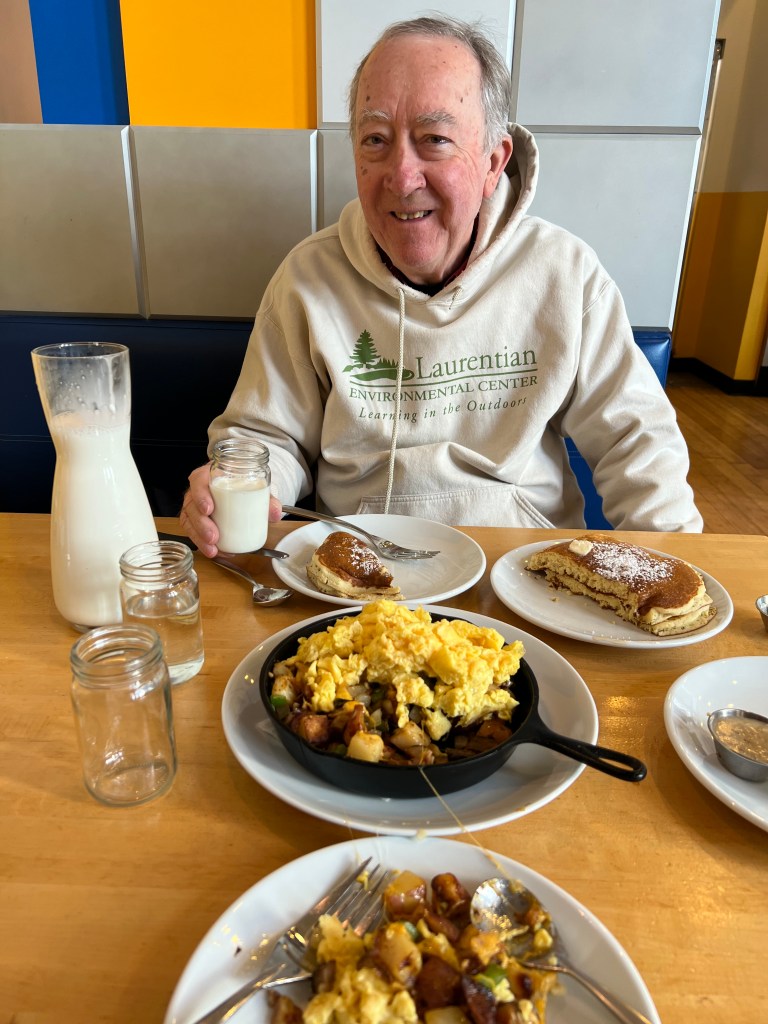
Monday morning we walked to a local breakfast place called Yolks. Great breakfast menu and it offered a carafe of 32 ounces of milk for $10. What a deal. We ordered it of course. We had only one scheduled activity for the day which was the Adler planetarium. There was a taxi outside the hotel, and we took it down to the Adler, part of the museum complex in Chicago.

At the Adler

The Adler planetarium was the first planetarium to open in the United States and did so in 1930. It has several floors of exhibits and theaters. We paid for one planetarium show called planet nine about Pluto and other planetary like bodies in the Kuiper belt area of the solar system. We found the exhibits well done covering some topics we knew such as moon exploration, but numerous topics that we had no concept of prior to our visit. One such new item was “retes”, which are pierced plates on an astrolabe. Hopefully we walked away remembering some of that information. Monday afternoon was probably the nicest day, weatherwise, and we walked 3 miles back from the museum complex to our hotel.
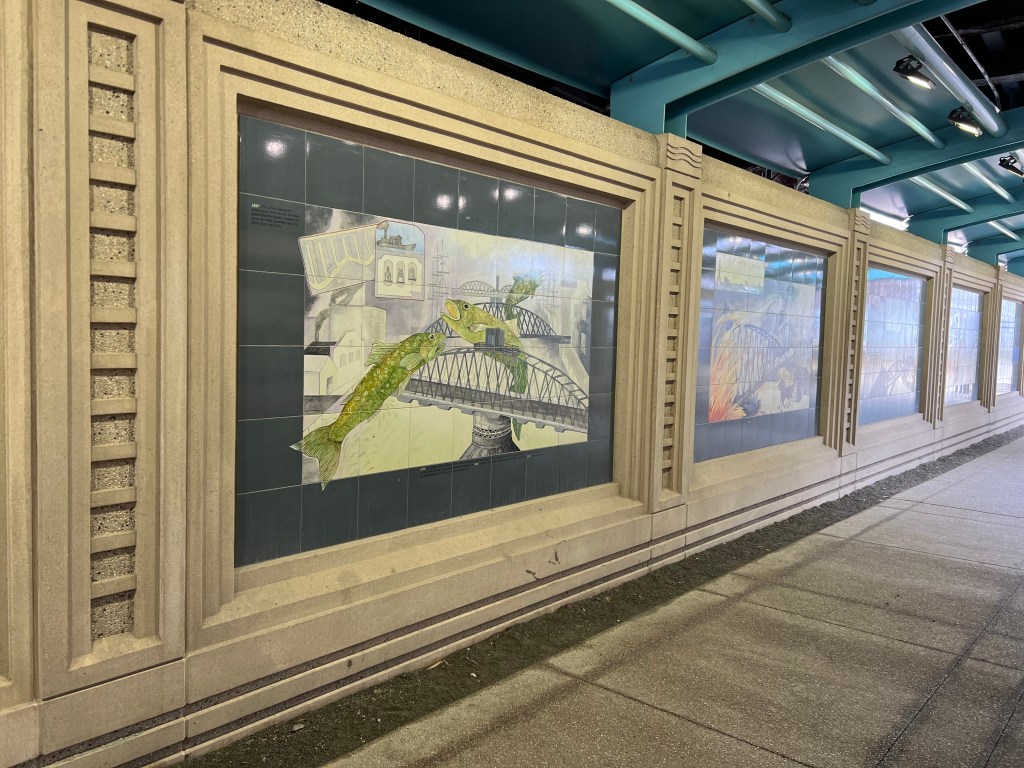
Walking back from the Adler

Pop Up book of Our Lady of Guadalupe

Tuesday we changed our plan a bit and took a tour of the Newberry library. The Newberry is a private research library devoted to the humanities, renowned in its field and in genealogy. We had a tour of the library which dates back to 1887. We viewed the original building but not the archival section which is off-limits. They had an exhibition of book arts, the process of creating fold up and pop up books. We are used to these nowadays as more of a children’s book with pop-up pictures. However, the history of these goes back hundreds of years and it was interesting to see the origins and variety that have been created as publishing skills have expanded. Another special exhibit presented the perspective of black and indigenous artists and how their art has shown resilience and resistance in the face of oppression.

The tour of the Newberry had a particularly curious twist. Mr. Newberry, another one of those millionaires with too much money to spend, left his money for a library. As Chris would say, long story short, he died on a boat trip to Europe to meet his free spending wife and two daughters. A superstition of the time was to have a dead body on board a ship. Given his wealth, people accompanying the trip convinced the captain to stuff his body into a barrel that had been emptied of it’s cargo of rum. The barrel was then lashed to the side of the boat. He and his barrel were transported to England, where his body greeted his wife and daughters. The docent did not describe how the body got back to Chicago for eventual burial.
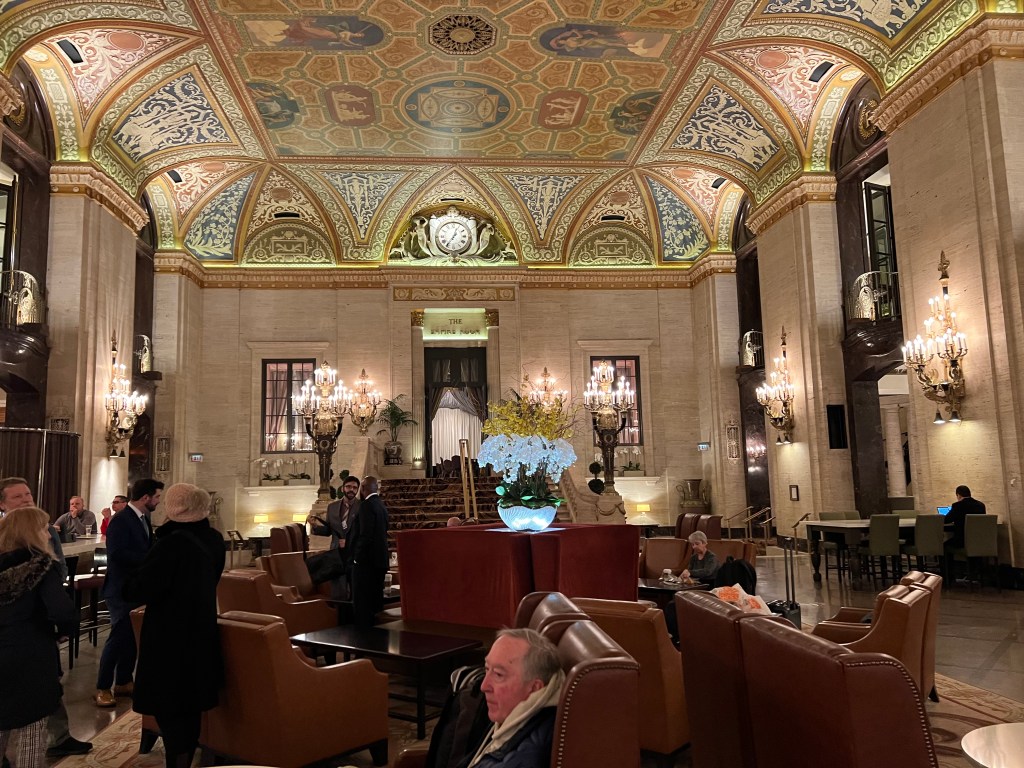
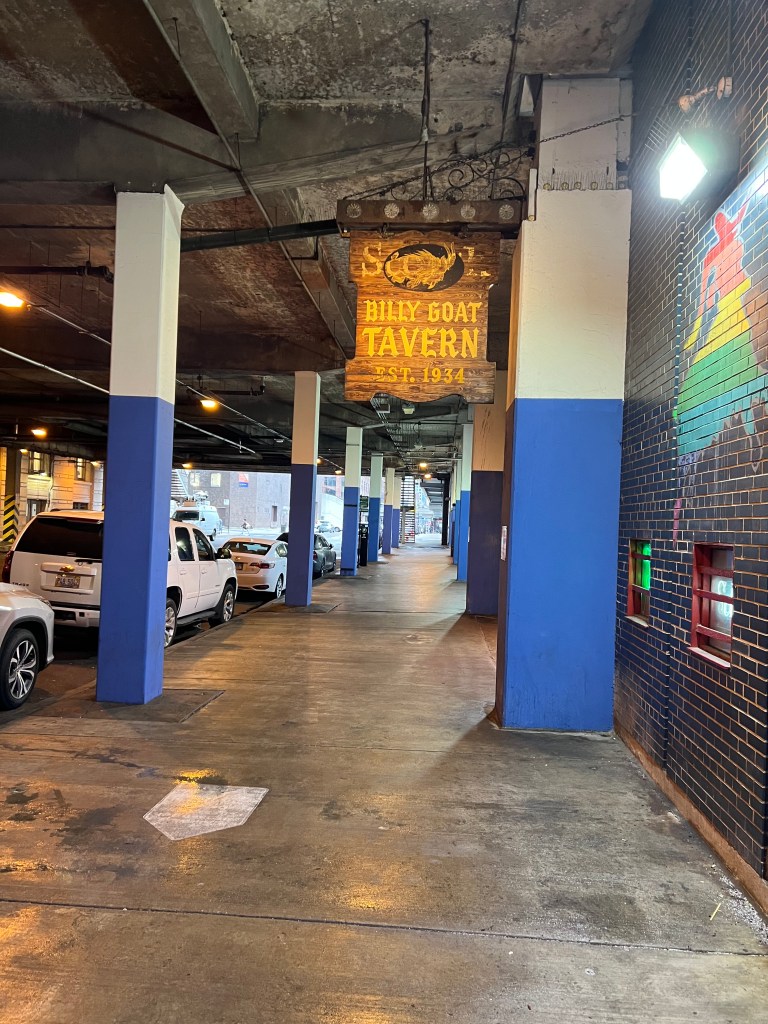
Chicago dining, from upper left, Palmer House, Giordano’s, Billy Goat Tavern, at Yolk, at O’Toole’s

For lunch, we walked a few blocks down Rush Street to Giordano‘s pizza, a Chicago institution since 1974. Once there we discovered they have expanded so much there is a location only a few miles from us in Richfield MN. Since their deep dish pizza is famous but would take an hour to create, we had the thin crust pizza with a salad, and were quite pleased.
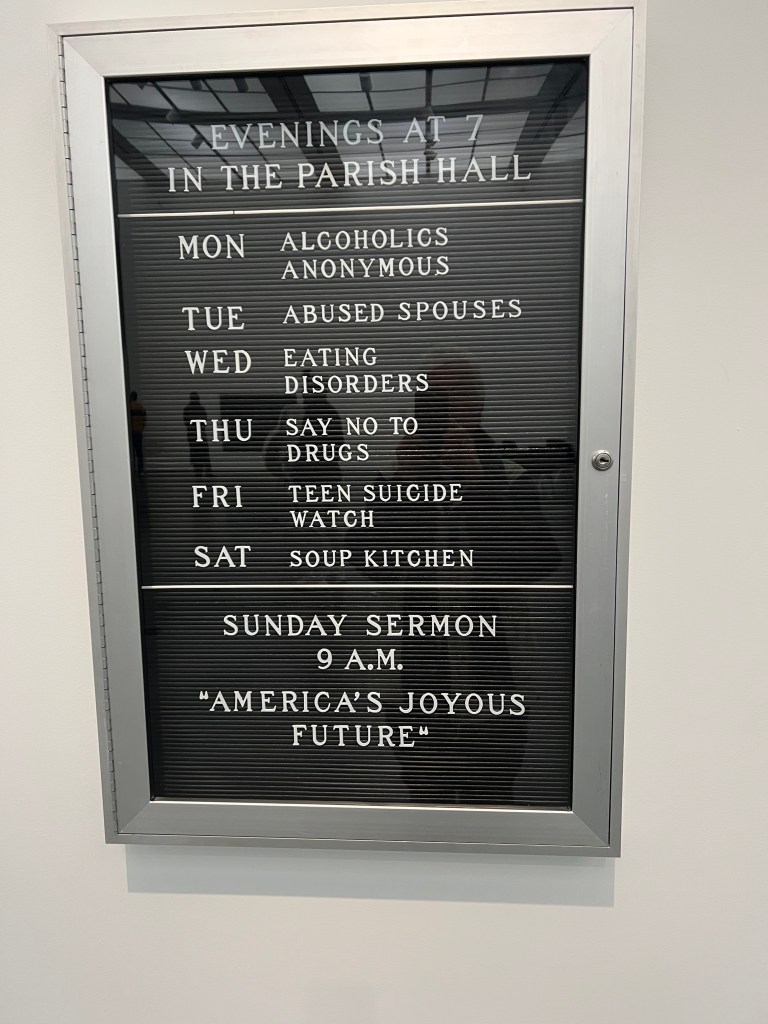
Chris liked this from the Museum of Contemporary Art

After that, we walked over to the Museum of Contemporary Art. This was kind of a snoozer, I would’ve been happy to have skipped it. A lot of space, but not much art that spoke to me. In fact, not much art at all given the size of the building.
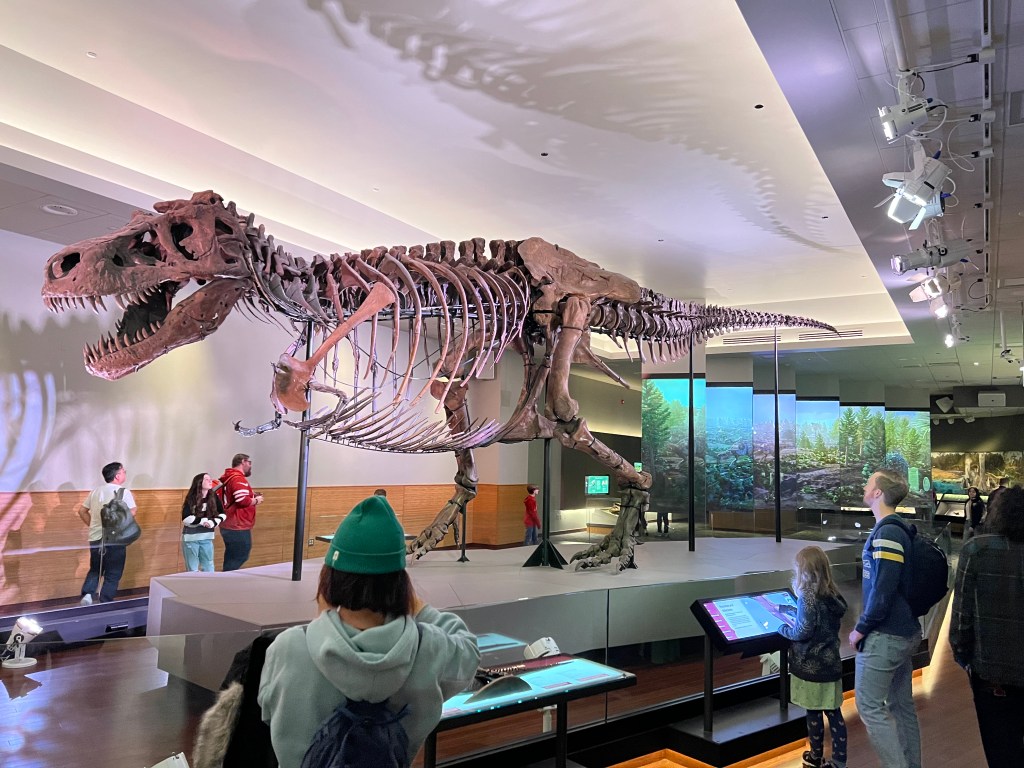
Sue

Wednesday morning started with our having the breakfast buffet in the hotel restaurant which gave us a chance to have fruit, vegetables, protein, etc. to fortify ourselves for a busy day. After breakfast, we took another taxi to the museum complex, this time to visit the Field Museum of Natural History. The Field dates back to 1894. It is one of the largest natural history museums in the world. Here we purchased the special exhibit about China, and also had an hour tour focusing on dinosaurs. Their main dinosaur, called Sue, is a Tyrannosaurus rex found in South Dakota, and named after the female archaeologist, Sue Henderson, who was the first to spot the bones of the dinosaur. The docent gave a very knowledgeable talk about the mass extinctions that led to, and killed off, the dinosaur, as well as the various types of dinosaurs that existed during the time frame they inhabited the earth.

Other exhibits were equally well done and extensive. We spent five hours here and by the time we got back to the hotel, I was pretty well wiped out. Not too wiped out, though, as we explored a dive type hamburger place located on a dingy lower level street. For some reason I thought at the Billy Goat Tavern, I could get a great burger and tater tots. But no, the burger was good, but it was only chips as your optional accompaniment. I made up for it by stopping at a little deli next to our hotel, and picking up some chocolate chip cookies and milk.

At the American Writers Museum

Thursday was our last day in town. We slept in, and then spent an hour at the American Writers Museum. This museum opened in 2017, and has a series of static and interactive displays of a wide range of American writers. They even had a section of manual typewriters where younger people visiting had a chance to find out how to properly insert a piece of paper in the typewriter so you type on the page with the logo at the top front. They also had difficulty understanding that you had to hit the keys smartly in order to make an impression. It was a bit of humor to watch among the multitude of displays about individual writers.

We had lunch at the Palmer house, another Chicago institution before heading to Union Station to catch our Amtrak home. The homebound train was only about 10 minutes late leaving the station. It was kind of a madhouse in the waiting room, but everything got sorted out smoothly as people were directed to the proper car for the journey west. We spent over half the time in the observation car enjoying the scenery. Only major hiccup was a male rider who appear to have some mental health issues. The train was stopped in Tomah, Wisconsin to escort him off the train for violating the no smoking rule, among other things.

We arrived back in Saint Paul about 11:15 p.m. There were no taxis wedding, so we dialed up an Uber and got home a little bit after midnight. Next trip, Arizona and Nevada for Great Basin National Park, and visiting family.

Walking back from the Adler to our hotel in downtown Chicago

Ed and Chris, Saint Paul, March 25

Categories: travel | Tags: , , , , , , | Leave a comment

2023 Trip 2: San Francisco: March 3-5

Burlingame, CA March 5

Tomorrow we fly home from San Francisco Airport. This last blog will cover the Monterey Peninsula area, from noon Friday to Sunday afternoon (today). We left the Calla lilies and came north up the coast to Monterey. Not for us the 17 mile drive or Monterey Aquarium. Instead we went to discover the history of the area.

Our learning started at the Monterey Historical Park. This is the area of old Monterey, where California began its transition from being part of Mexico to the 31st American state. In 1542 Spanish explorers first discovered Monterey Bay, a large sheltered bay capable of receiving large ships. It was not until 1770 that settlers, military, and missionaries arrived to establish up a more permanent settlement. In 1776 Spain named Monterey the capital of upper and lower California. In 1822, control shifted from Spain to Mexico after Mexico won its independence from Spain. From this point, the population, trading, and development of ranches increased.

The Custom House in Monterey

In 1827, the old Custom House was built by Mexico to collect tariffs on the shipping of goods into and out of California. This building still stands today. The warehouse for the Custom house is used as a museum whose exhibits we viewed. The Custom House is the oldest surviving government building in California. The exhibits helped us understand the history of this area, from the earliest Native Americans living here to the statehood period. An excellent docent tour Friday afternoon deepened our understanding and knowledge.

In 1846, war between the U.S. and Mexico broke out and most of the fighting occurred in Texas and Mexico. On July 7, 1846 U.S. Commodore John Drake Sloat landed in Monterey and with marines and sailors seized Monterey and proclaimed California to be part of the United States. When the war was over, with the Treaty of Guadalupe Hidalgo signed on Feb. 2, 1848, this large and poorly defined area of “California” became part of the U.S. Just in time for the U.S. Gold was discovered in California on January 24, 1848. News of this did not reach the U.S. or Mexico until after the treaty was signed. Would not have life been different for the U.S. if Mexico retained not only California but those parts of Nevada, Utah, Arizona, New Mexico, Colorado and Wyoming that became part of the U.S. also?

The inside of Colton Hall where the California Constitution was debated

In 1849 the first American built government building was constructed. Colton Hall, still standing, was built “out of the slender proceeds of town lots, labor of convicts, taxes on liquor shops and fines on gamblers.” This is where the constitution of California was debated and approved. Note that: California went directly from a province of Mexico to a U.S. state without first being a territory, has a constitution that outlawed slavery and guaranteed married women could keep the property they had before they got married, and the first capital was in San Jose. Monterey never was the capital of California.

The docent tour started at the Custom House and the docent explained the history of Monterey. We walked among sections of the historic area; seeing portions of a sidewalk constructed from whale bone, and two other buildings dating from the mid to late 1800s. We saw another example of papel picado, a Mexican folk art which cuts elaborate designs into tissue paper. Our docent explained different designs and colors would be used to celebrate various holidays and celebrations. Earlier we had seen them in the bar of the hotel at San Juan Bautista.

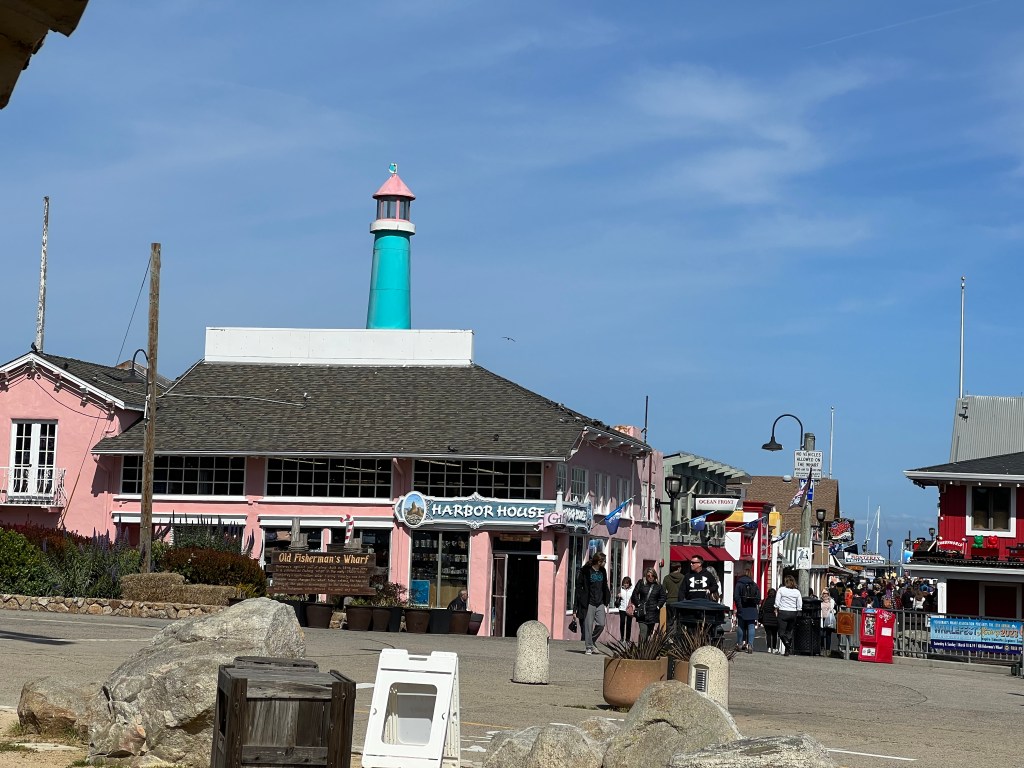
Fisherman’s Wharf

Lunch/dinner was at a fancy restaurant along Fishermans Wharf. The clam chowder was excellent.

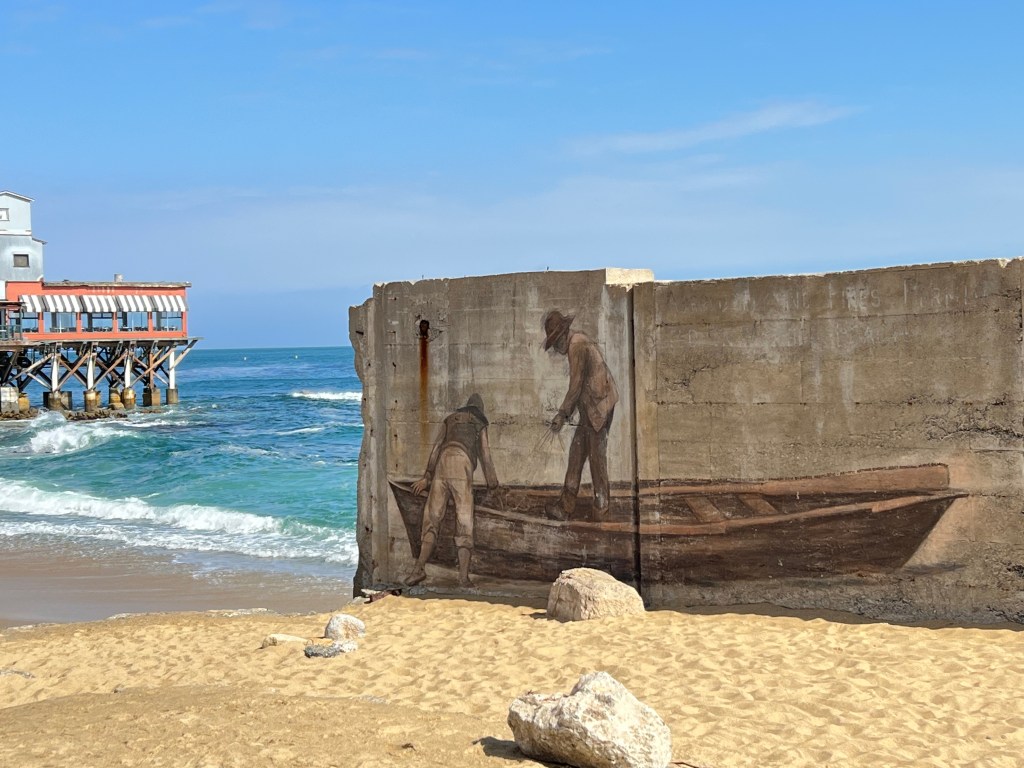
Saturday we visited Cannery Row, the area of Monterey where fishing, particularly for sardines, was a huge business from about 1915 to 1955 when the sardines were either overfished or just at natural down cycle in their existence. Cannery Row was made famous by John Steinbeck’s novel of the same name. We wandered around the Cannery Row area, mainly tourist shops except for the Monterey Aquarium. After that, we did our tour of Coltan Hall and old Monterey Jail, finishing up as the afternoon rains kicked in.

San Carlos Cathedral

Church was at San Carlos Cathedral, originally the chapel for the Monterey Presidio. It is the second smallest cathedral in the U.S. (after the one in St. Louis.) and the oldest continually operating parish in California. Dinner was at a very popular Italian restaurant downtown, we were lucky church was at 4 PM and we arrived at the restaurant before the hordes.

Sunday we had one destination in mind. The National Steinbeck Center is in Salinas, just 15 minutes from Monterey. First though, Chris had us stop and walk over the dunes to have a last look at the Pacific Ocean. Then we drove over to Salinas. In case you have a good memory, yes we spent the night here earlier this week but the Steinbeck Center was not open at that time. I had not realized that John Steinbeck, the author, grew up in Salinas. Towns and locales we have been visiting or driving through the last few days are the sites of many of his books. His life here gave him a perspective on working people and their experiences, thus his books are based on people he knew and their lives. Not for him the well off life in the books of Sinclair Lewis for instance. Some of his novels include: Of Mice and Men, Grapes of Wrath, East of Eden, Cannery Row, and Tortilla Flat. Steinbeck won one Pulitzer Prize and one Nobel Prize.

The National Steinbeck Center is a museum devoted to his life and his works. We spent two and a half hours viewing videos, listening to recordings of actors reading his works, viewing the exhibits, realizing that during WWII he experienced the war firsthand and wrote about it for wide spread circulation, and in general, re-acquainting ourselves with his literary works and impact. It was time well spent and a fitting end to our time in the south bay of San Francisco.

The camper used by John Steinbeck when traveling around the U.S. gathering insights for his book “Travels with Charley” The truck was named after Don Quixote’s horse-Rocinante.

Ed and Chris Burlingame CA-just south of the San Francisco airport March 5

Categories: road trip, travel | Tags: , , , , , , | 1 Comment

2023 Trip 2: San Francisco: March 2-3

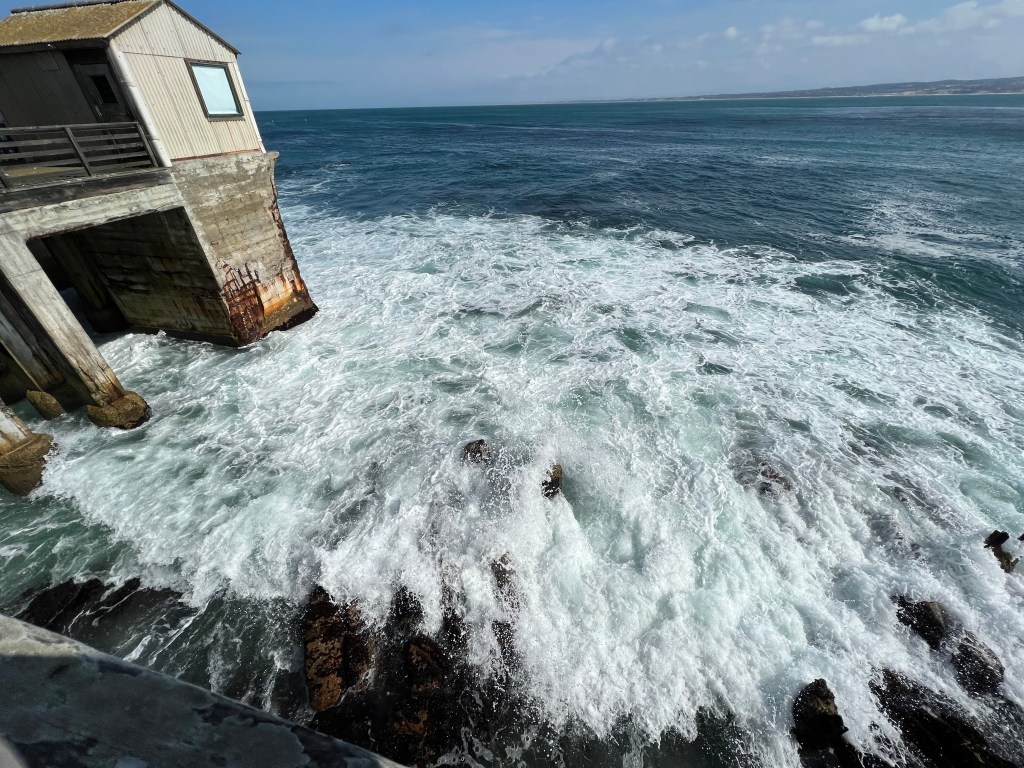
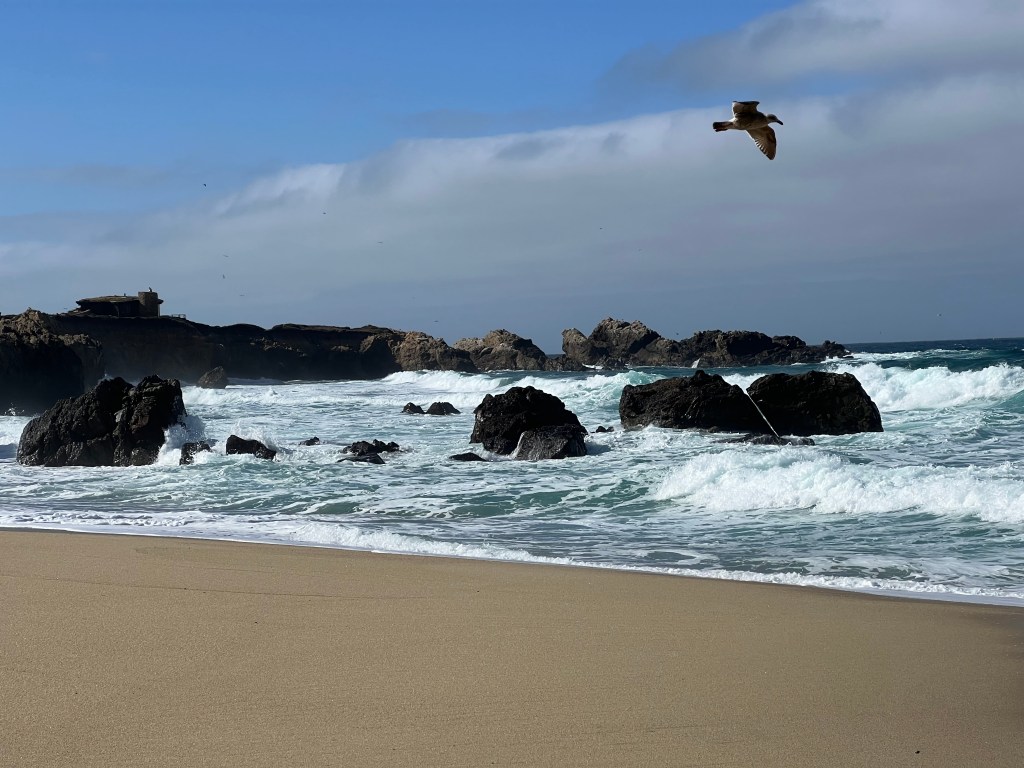
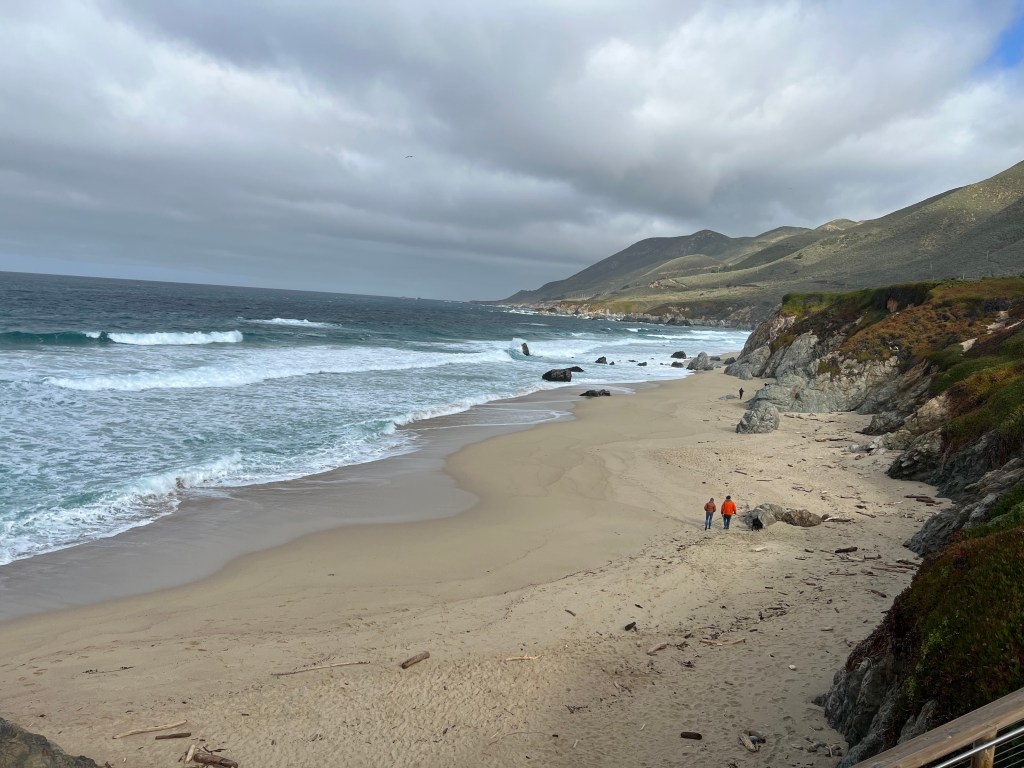
At the ocean at Garrapata State Park

Big Sur, CA March 2

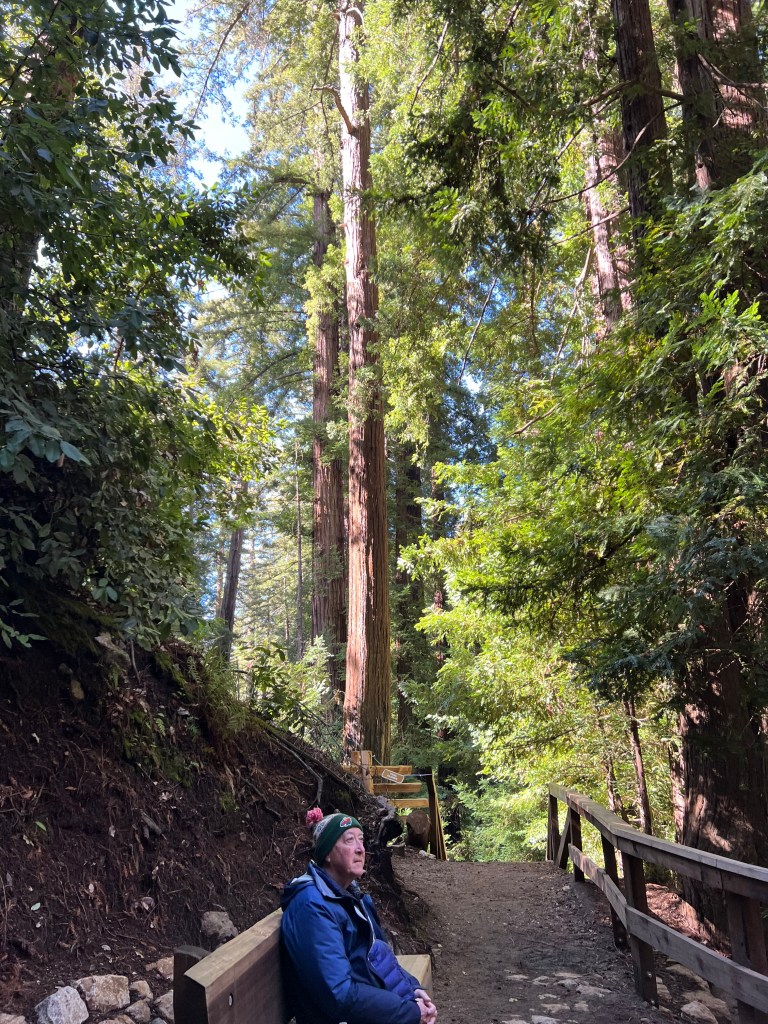
Big Sur is a rugged area of the central coast of California. Multiple state parks offer the opportunity to explore the forest and beaches; except now the 2023 rain storms have closed most of the trails leading to the beach. The Pfeiffer Big Sur park brochure states that the park is still recovering from a 2008 lightning strike fire that burnt 160,000 acres along the Big Sur coast. Our plan is to stick to the forests and coastal cliff tops today, tomorrow we will explore the one place where access to the beach still seems possible.

Hiking to Pfeiffer Falls

An open trail in the forest will take us to Pfeiffer Falls. There is an easy trail that is closed due to the rains so we start out on a smooth path which switches over to the usual rocky steep hike one frequently finds in mountainous forests. I complain as is usual lately. Chris and I reminisce about previous long and/or steep hikes we have taken in the past: the 11 mile, unshady round trip along the Columbia River in Wenatchee-East Wenatchee WA on a hot day, the long, steep hike up Two Sisters Mountain in Rocky Mountain National Park that we never finished, the 600 plus stairs up the Mississippi River bluffs in John Latsch State Park, and others. I am glad we did those when I was younger.

Pfeiffer Falls

Waterfalls are fun to find and watch. Pfeiffer Falls is nice but not overwhelming. We meet a much younger couple and we give them hints about other waterfalls they should seek out. They are shocked that we are married as long as we are; we are shocked that they are dating since she lives in NYC and he lives in New Zealand. In any event, Chris and I make it back to the trailhead safely. Lunch is our first crackers and peanut butter on this trip.

McWay Falls in Julia Pfeiffer Burns State Park

After lunch we drive south along CA 1, the coastal highway, making several stops for ocean views. McWay Falls is our second destination of the day. McWay spills out of the rocks and lands on the beach sand. One is unable to walk down to the beach so our views and pictures are limited. The falls are a popular stop, they are part of Julia Pfeiffer Burns State Park. The first Pfeiffers arrived here in 1869. When a developer wanted to buy land and build homes, Pfeiffer’s son John (who was then the owner) refused and sold the land to the state in 1933 and the land was the beginning of Pfeiffer Big Sur State Park. The CCC built many of the trails and bridges in the park. They also built the lodge, completing it in 1941. Friends of John and Florence Pfeiffer’s daughter Julia donated the land that became Julia Pfeiffer Burns State Park in 1962.

Two large, freshly made sandwiches from the Big Sur Deli and Bakery made up dinner, along with chips and Coke. After picking up the sandwiches, we stopped at a multi-agency visitor center where the staff person helped us figure out how to actually get to the ocean. He was the only one who also knew where to find the Calla lilies blooming in the wild. I had read about these but the directions to find them were vague.

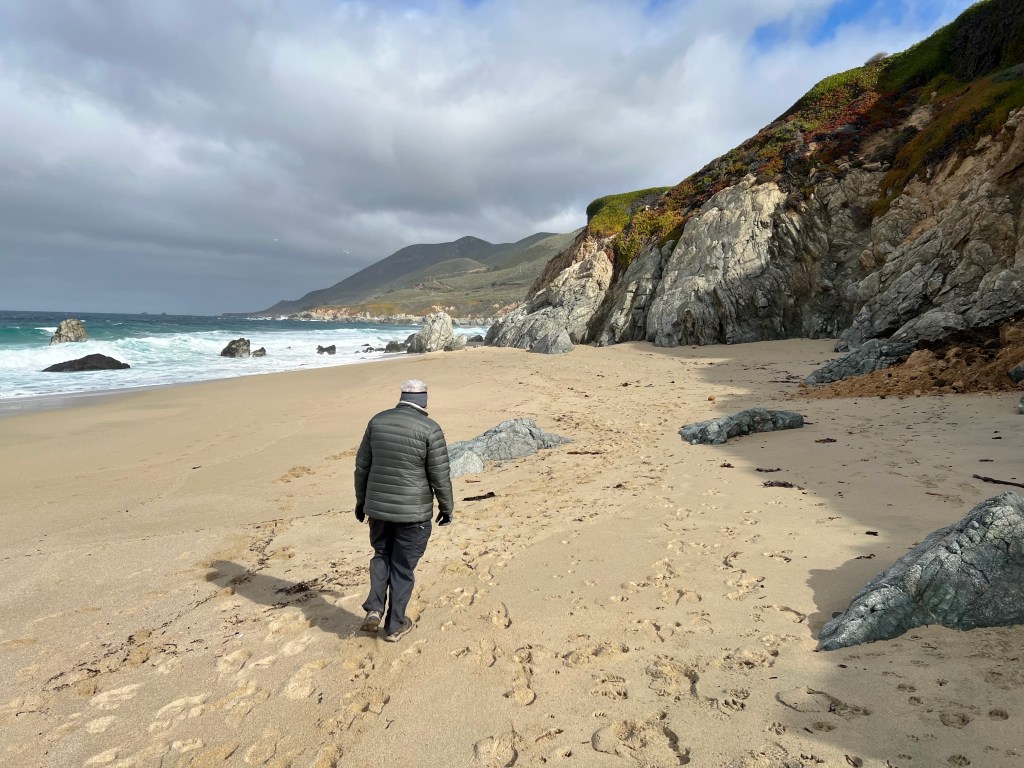
Friday morning the 3rd, we packed up and headed north on CA 1 looking for Garrapata State Park. According to yesterday’s information, the park is basically undeveloped and we had to park on the side of the road just past the bridge construction. We found the parking spot and located the trail leading down to the beach. Finally, ocean waves are at our feet, not hundreds of feet below us. Chris loves ocean waves so she is particularly happy. The beach going north should lead to the trail along the canyon/valley of the Calla lilies.

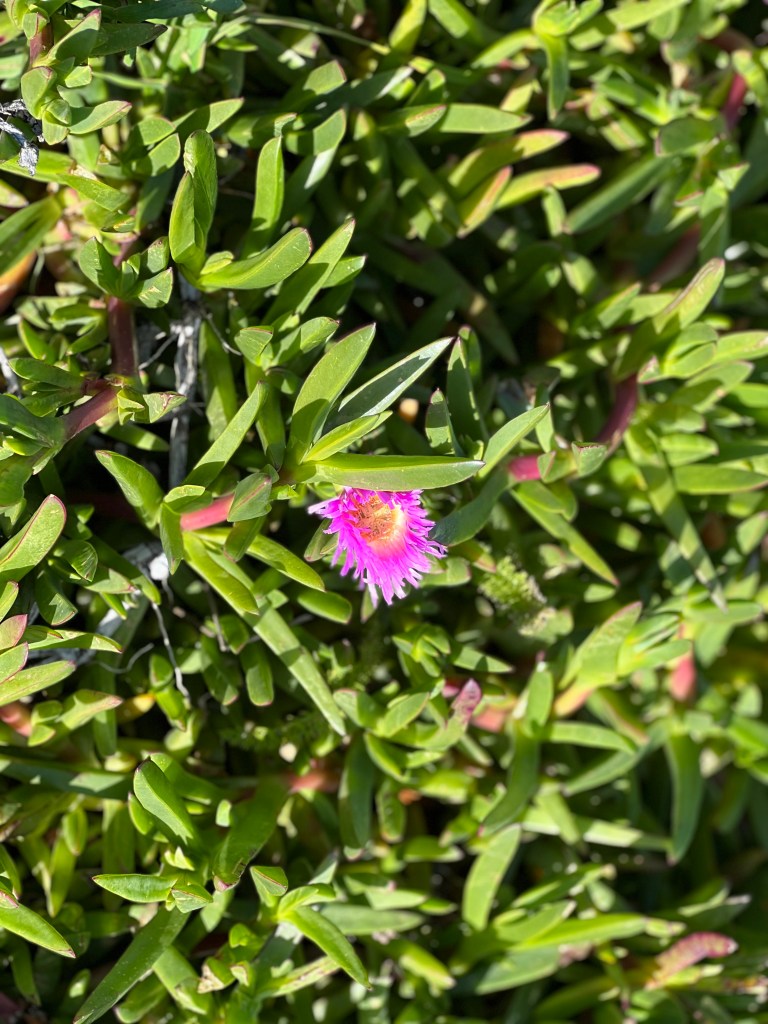
The canyon is full of running water, our information person yesterday thought the water would have receded by now. In some ways, it was just as well. The walk along the beach had one area with very little space between the cliff and the ocean waves. We did not know if the tide was coming in or out. Walking back to the stairs up the cliff guaranteed we were not stuck on the beach with the tide coming in. An alternate trail to the lilies ran along the top of the cliff, through greenery that was about to explode with blooming flowers. Not the Calla lilies but these will be beautiful in a week or two.

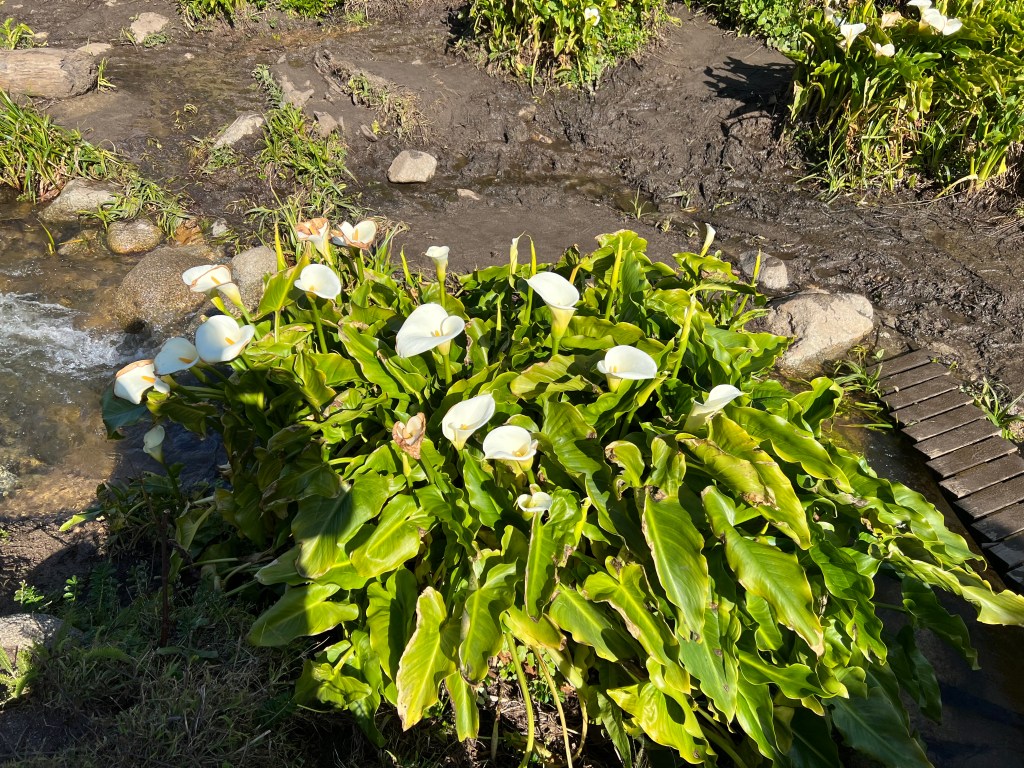
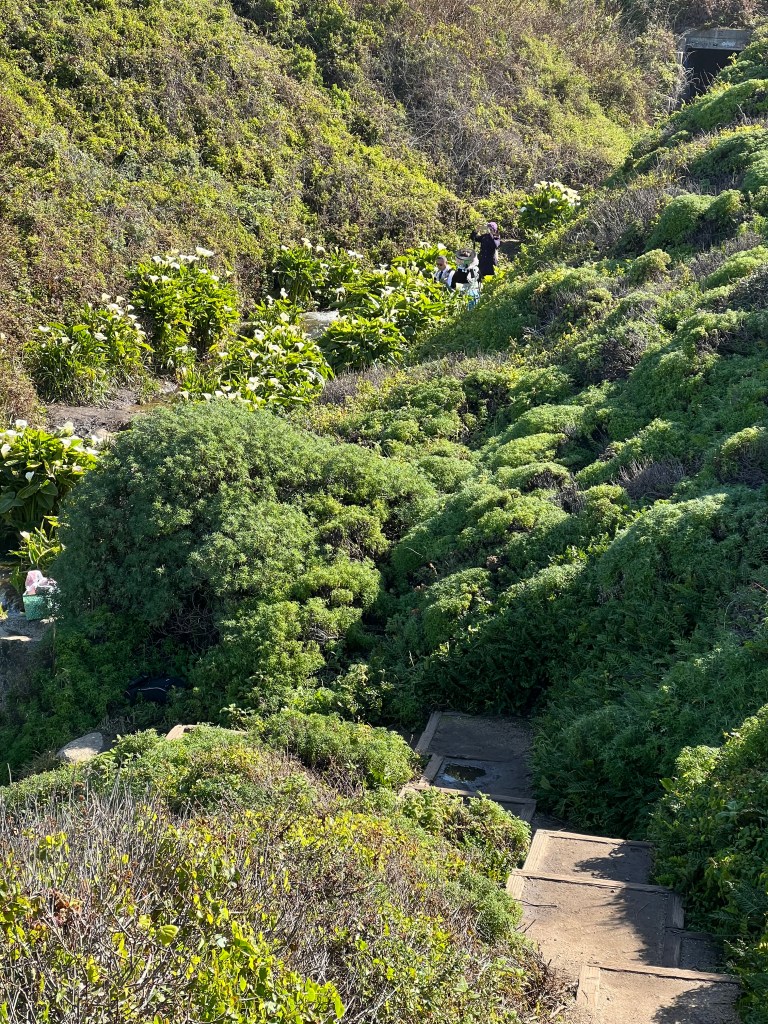
Calla lilies blooming in the wild

We got back to the canyon and found the wild growing lilies. They are abundant in a confined area. A few other couples are taking pictures. What appears to be a formally dressed party of Vietnamese are having a photo shoot. We stay out of their way and take our photos around them. I am pleased we made it here; it is not a riot of color or a huge area but it is something unique we were able to find.

The rest of Friday will be combined with Saturday as we explore Monterey.

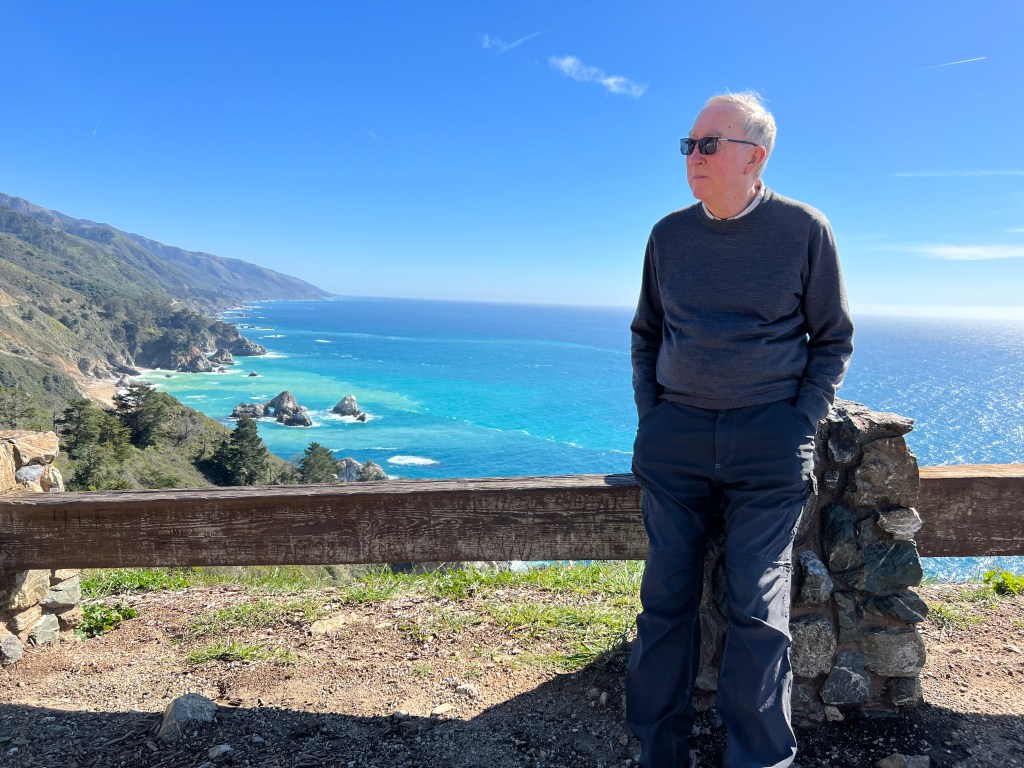
Along CA 1 south of Big Sur

Ed and Chris Monterey March 4

Categories: travel | Tags: , , , , , | 1 Comment

2023 Trip 2: San Francisco: March 1

Pinnacles National Park

Pinnacles National Park and Big Sur coastal area,Wednesday March 1

Well today, March 3, we are back into territory that has WiFi and cell coverage. Weather the last three days has been sunny although still cool, and we have made the best of it. It turns rainy again beginning tomorrow so the next few blogs covering the past three days will have some wonderful scenery pics with sunny skies.

Pinnacles National Park was our sole focal point for Wednesday. Pinnacles was declared a national monument in 1908 and a national park in 2013. Much of its 26,000 acres are declared wilderness and not likely to see us walking and hiking in those less explored areas. Many Californians come here to go rock climbing. The geology of this park is tied into plate tectonics, the San Andreas fault, and erosion. Movement of the earth’s plates has made part of the volcanic field that created the Pinnacles area to be located 195 miles southeast of here by Los Angeles. There is no road going through the park either north-south or east-west.

We concentrated our time on the east side of the park where the bookstore is; the visitor center has been closed for a while. Actually, many of the park trails are closed, some due to the January storms, some due to flooding and fires dating back to 2021. We took three trails, turning back when the trail was closed or when our legs were tired from climbing up steep and rocky paths. Parts of the park like the reservoir, the caves, and high prairies were not areas we were able to visit.However,..

Condors

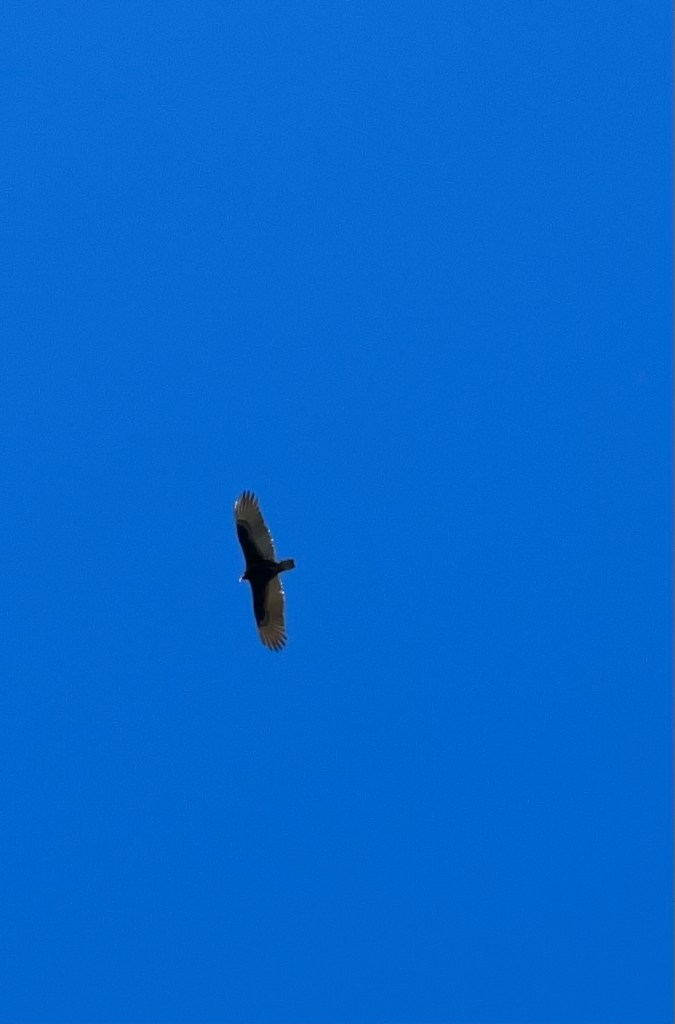
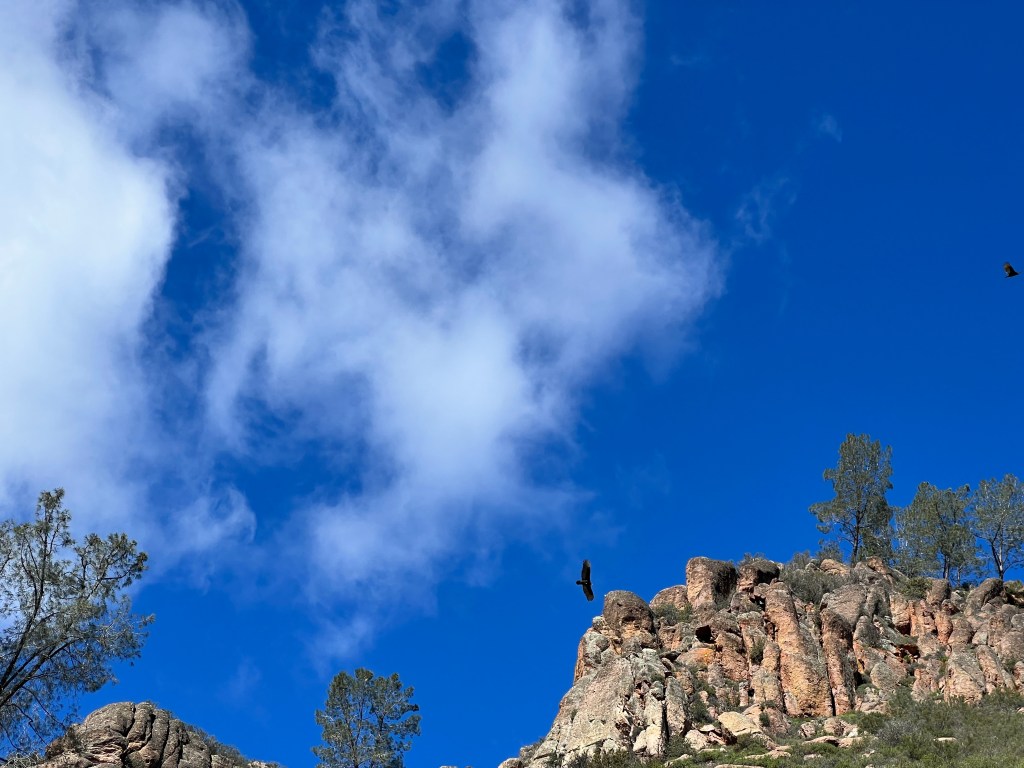
CONDORS!!. This was our first verifiable sighting of the California condor. In 1987 the last wild condors were removed to a breeding program at the Los Angeles Zoo and have been slowly reintroduced into the wild. It is estimated there are over 300 condors in the wild at five various locations. Pinnacles is one of the five. The volunteer at the bookstore gave us a quick tutorial on how to positively identify the condor and not confuse it with a turkey vulture. Flying as high and fast as it does, the tips were invaluable.

On our second trail, we had only traveled several hundred feet up the trail when we spotted several raptors in the air. One came close enough to us for positive identification. As we climbed farther and higher, we saw a total of six condors circling in the sky, riding the air currents, and, from our perspective, just having a good time circling around. Breeding pairs are sitting on the one egg they laid which takes two months to hatch, about twice as long as bald eagle eggs. We did not see any nests but they would have been located higher than we were able to climb.

This sighting of multiple condors was a great experience. We had dared not get our expectations high, sightings of wild animals is so unpredictable. Seeing the six made it an easier decision to acknowledge our tired legs and return to the car.

Driving to Pinnacles National Park

But Wednesday had other positive experiences also. We left our lodging in Salinas and drove down new roads seeing new vistas. The topography and vegetation along the road were a surprise to us. Yes, California is a big state but saying that and understanding the variety of landscapes is different. It may have helped that the past two months have been wet; the greenery was all around us and in varying hues.

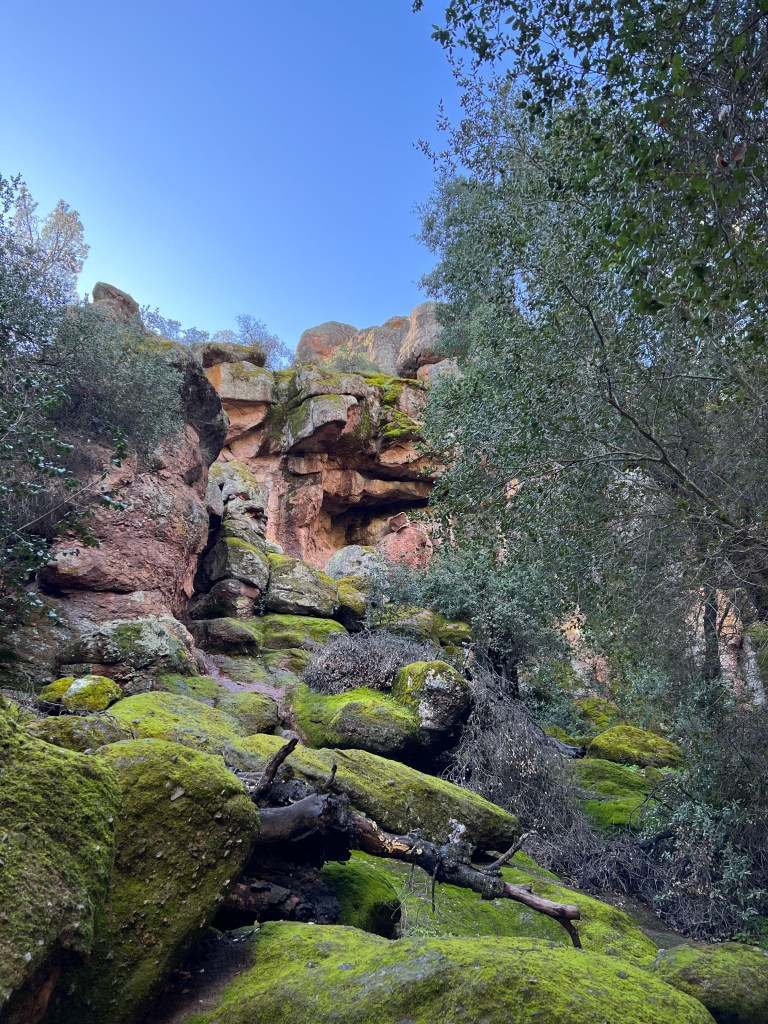
Pinnacles was not crowded today. On weekends, natives from Los Angeles and from San Francisco come here to explore nature and the wild side. Parking then is at a premium. Our first hike got us to experience the jagged cliffs and tumbled boulders that create unique caves, tunnels and rock formations. The cliffs rose pointedly into the sky, with the blue backdrop, it created a picturesque sight. Eventually the hike ran into the water we had been warned about. Rather than hiking through water, we turned around and began a second hike, the one that showcased the condors.

Our first hike along Moses Spring Trail at Pinnacles National Park

Our third hike was on flat land along a creek. After a while, it was boring compared to the first two. We called it a day for Pinnacles, excited for seeing the condors and for viewing the mountain peaks.

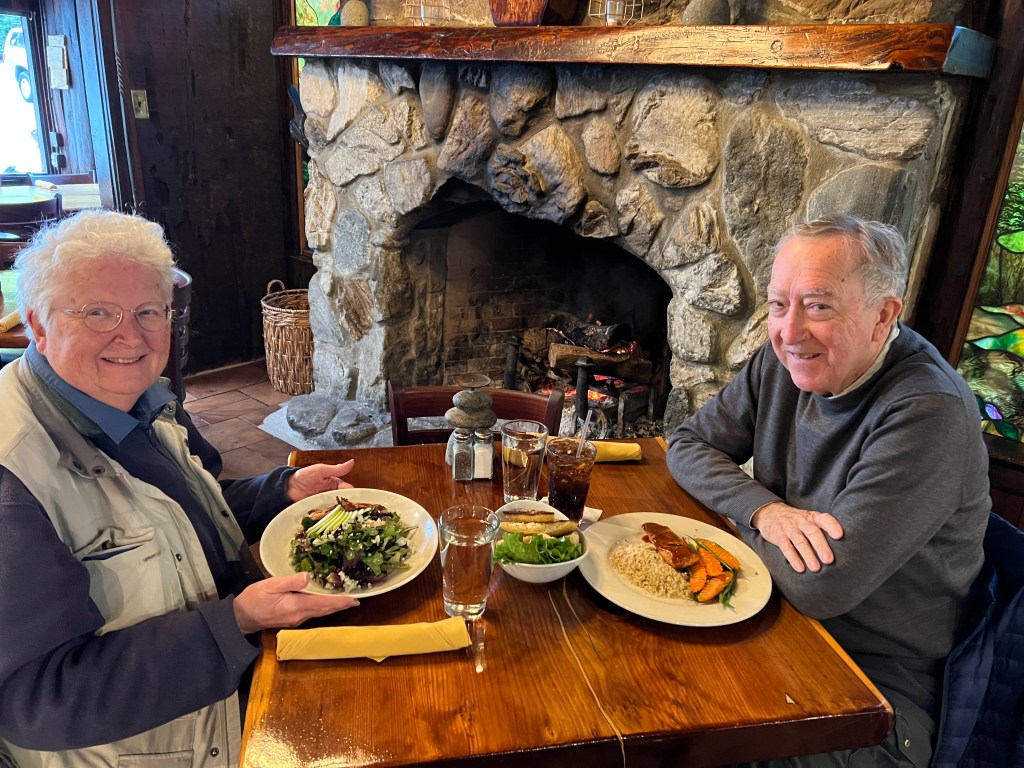
It took us two hours to reach the Big Sur Lodge in Pfeiffer Big Sur State Park. This area is the southern edge of the growing range for coastal redwoods. This park honors those trees, not the raging surf of the ocean-which we can not see from the park housing. The forest and the Big Sur River are the center points. Pfeiffer Big Sur State Park and the neighboring parks of Andrew Molera State Park and Julia Pfeifer Burns State Park have trails that lead to the ocean-but all were closed due to storm damage. We had a cabin here, with a skylight that allowed the moon to shine in during the night. It can not be called fancy but was pleasant and comfortable. It was too late in the day for more hiking so we had a nice dinner at a restaurant three miles down CA 1, the coastal highway. We had expected the lodge restaurant to be open from 8 to 8. Somehow their website had not been updated.

Dinner in Big Sur CA

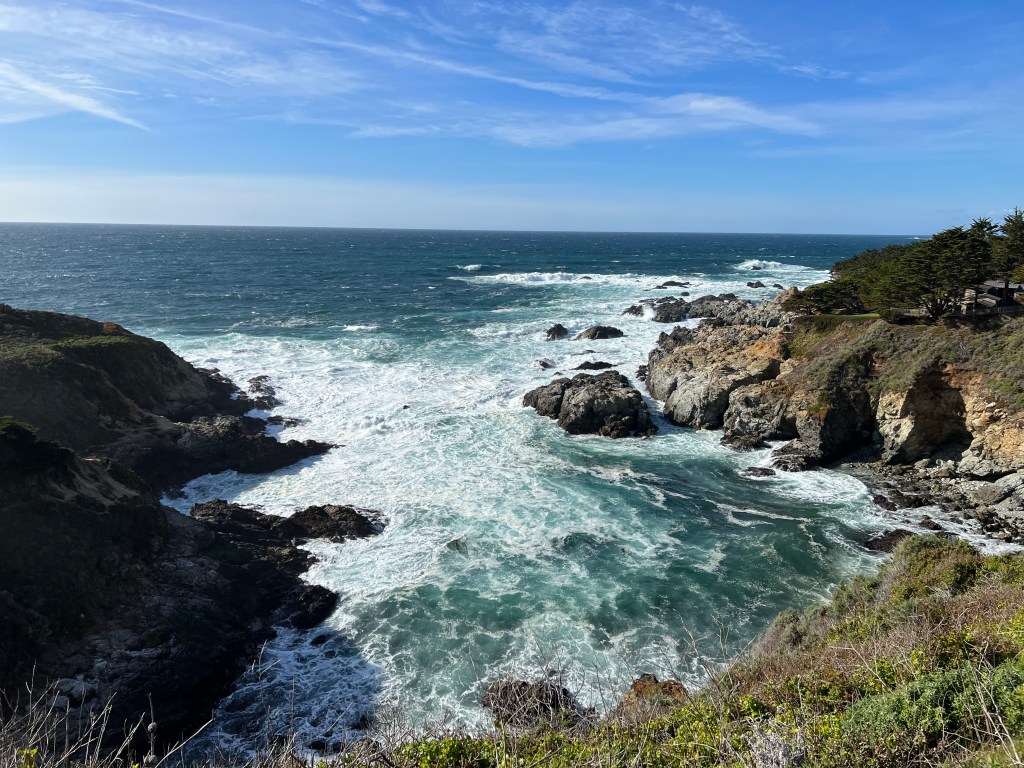
CA 1 is the highway that hugs the Pacific coast-and not at the beach level. Chris got great views of the coast, waves, rocks, and mountains. I got great views of the road, keeping my eyes away from the drop offs. We did stop for a few pictures, but realized we had more time over the next few days to take more. In several areas, road work was ongoing and resulted in single lane traffic. It appeared that most of this was scheduled repairs. However, about 25 miles past Big Sur, the highway was closed completely due to damage from the atmospheric rivers of rain that California has experienced since January 1. Portions of the coastal highway are lined by forests that had been burned by previous wild fires; the 2023 rains created mudslides that wreaked havoc on the highway. Luckily for us, it was farther south than our lodging.

Driving along CA Highway 1

Ed and Chris, Monterey CA Friday March 3

Categories: travel | Tags: , , | Leave a comment

Blog at WordPress.com.