Monthly Archives: February 2023

2023 Trip 2: San Francisco: February 28

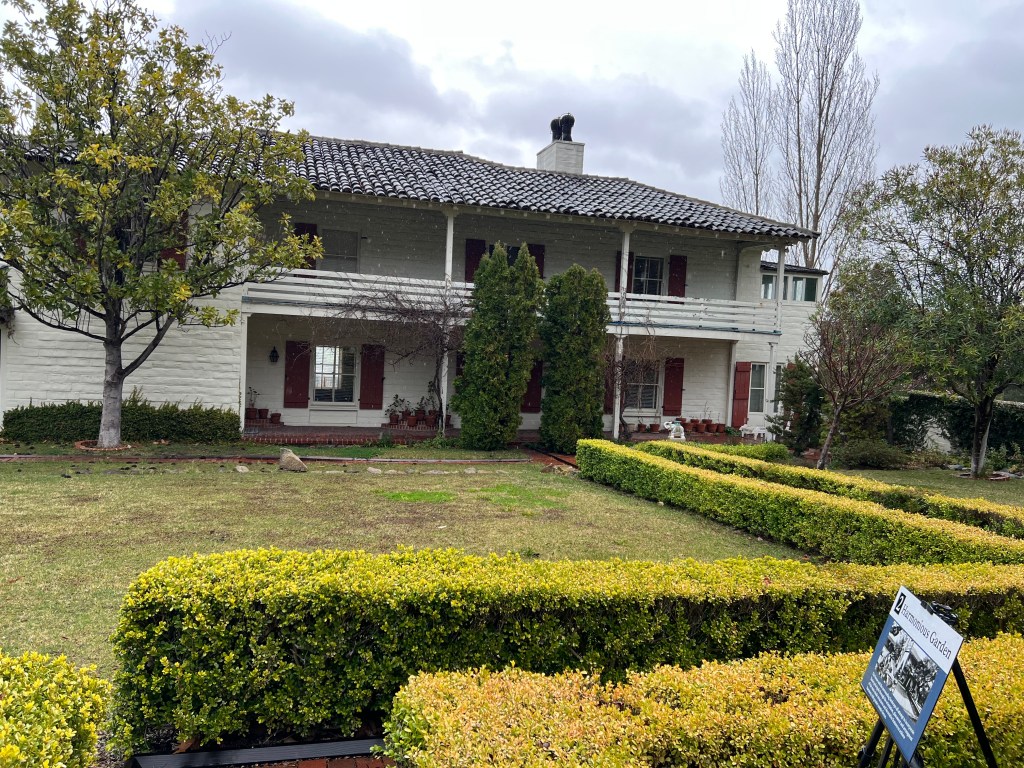
The Gilroy Museum in the old Carnegie Library

Salinas, CA

Is my memory poor? It seems as if more places are closed on Mondays and Tuesdays than I remember from when we first start our major travels in 2013. It might be COVID; museums, parks, arboretums etc have less money and are hesitant to liberalize the number of days and hours they are open. In any event, traveling on a constant basis means the pickings might be slim on Mondays and Tuesdays. For instance, we are in Salinas CA which has a national John Steinbeck Center which is not open today (Tuesday). Or Monday for that matter. 10 AM seems to be the default opening time. Didn’t it used to be 9 AM? Then, of course there is the weather. We are less likely to go hiking on solid rainy days.

So we deal with it and some days the traveling may be less than others. Today was one of those days. Constant rain in the morning meant our planned adventure at Pinnacles National Park was delayed. The park said to expect muddy paths with the potential for falling trees and mudslides. Rain tonight will increase that a bit but we are going there tomorrow anyway since Wednesday through Friday look to have a window of sunshine that we need to take advantage of.

So inside activities are needed. We start at the historical museum in the town of Gilroy with a sizable population of 58,000. The museum is housed in an old Andrew Carnegie library building. We discover that Gilroy has a robust agricultural base and a large sense of self-worth. In various spots throughout the museum, Gilroy is proclaimed as, or proclaimed as once having been: Hay and Grain Capital of California, the Tobacco Capital of the U.S., Dairy and Cheese Capital of America, Prune Capital of America, and Garlic Capital of the World. We had heard about garlic. As it turns out, China grows 75% of the world’s garlic but California is tops in the U.S. and Gilroy is the center of garlic growing in CA. Christopher Ranch is the largest single grower of garlic in the U.S.

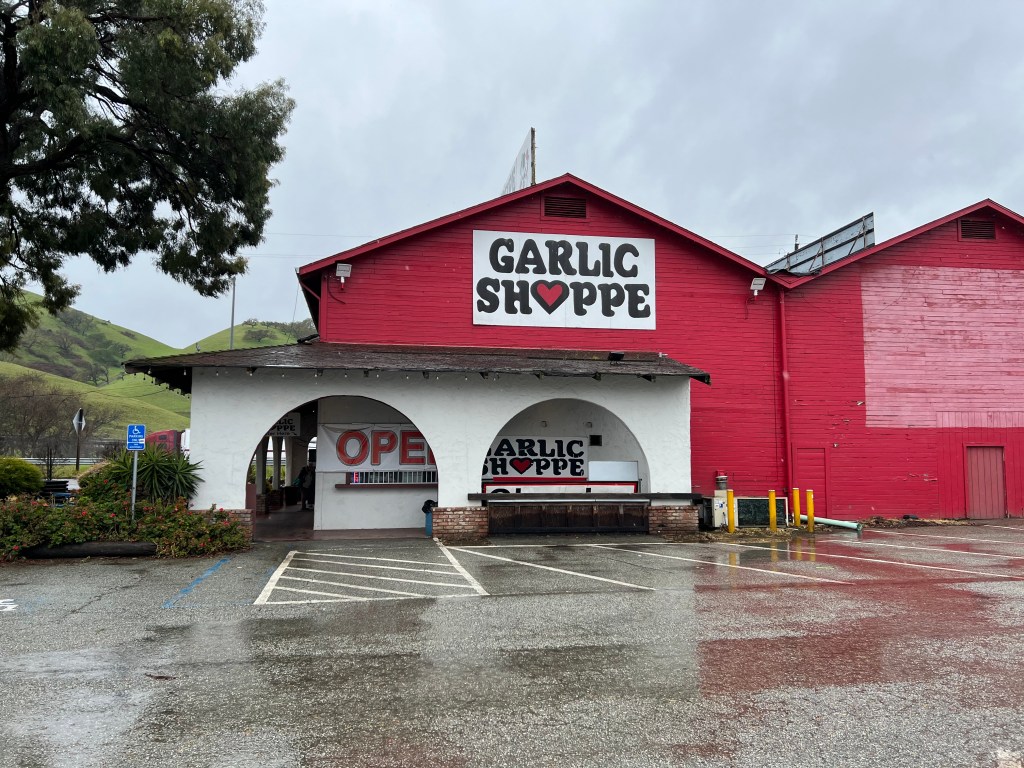
We stopped at a local garlic store and I tried some garlic ice cream. In small doses, not too bad.

The museum does have a reasonable display about the history of the various American Indian tribes in the area. A nice map detailed where various tribes in the area lived. The exhibits also mentioned the tragic deaths caused to Native Americans by the Spanish missions, the illegal loss of land by the secularization of the missions when transferred by Mexico from the Catholic Church, the sale and indenturing of Native American children, the selling of state bonds to finance expeditions to kill Native Americans, and the impact of papal bulls (proclamations with the effect of law) issued by the Catholic Church to justify European conquering people in the New World and Africa.

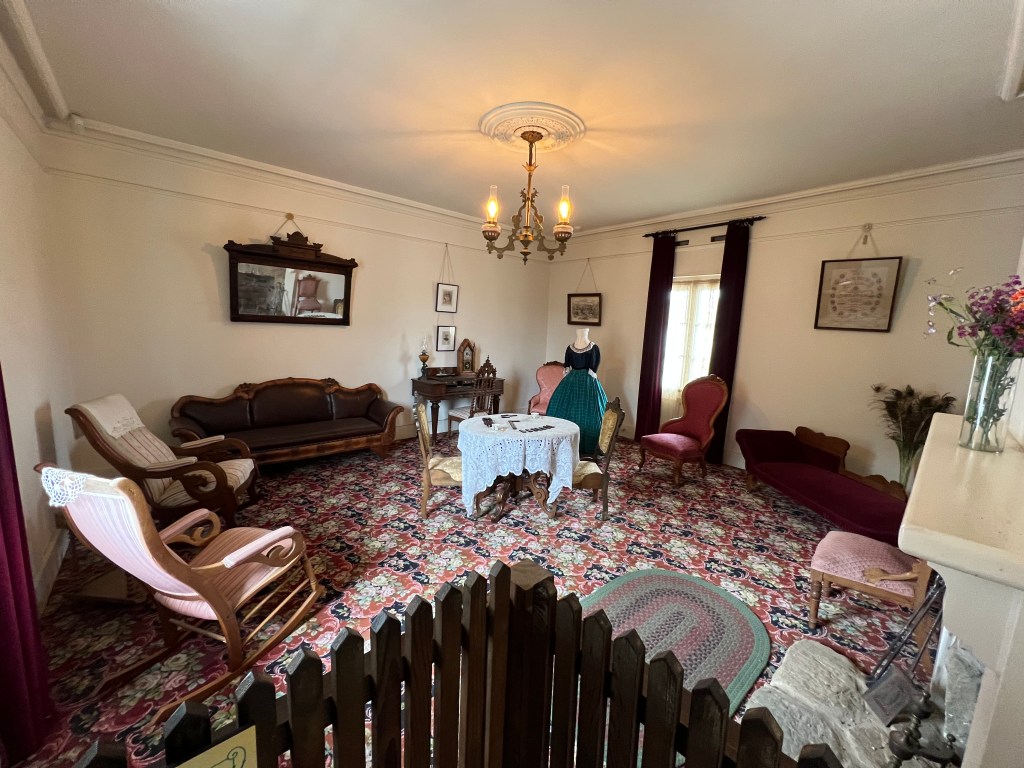
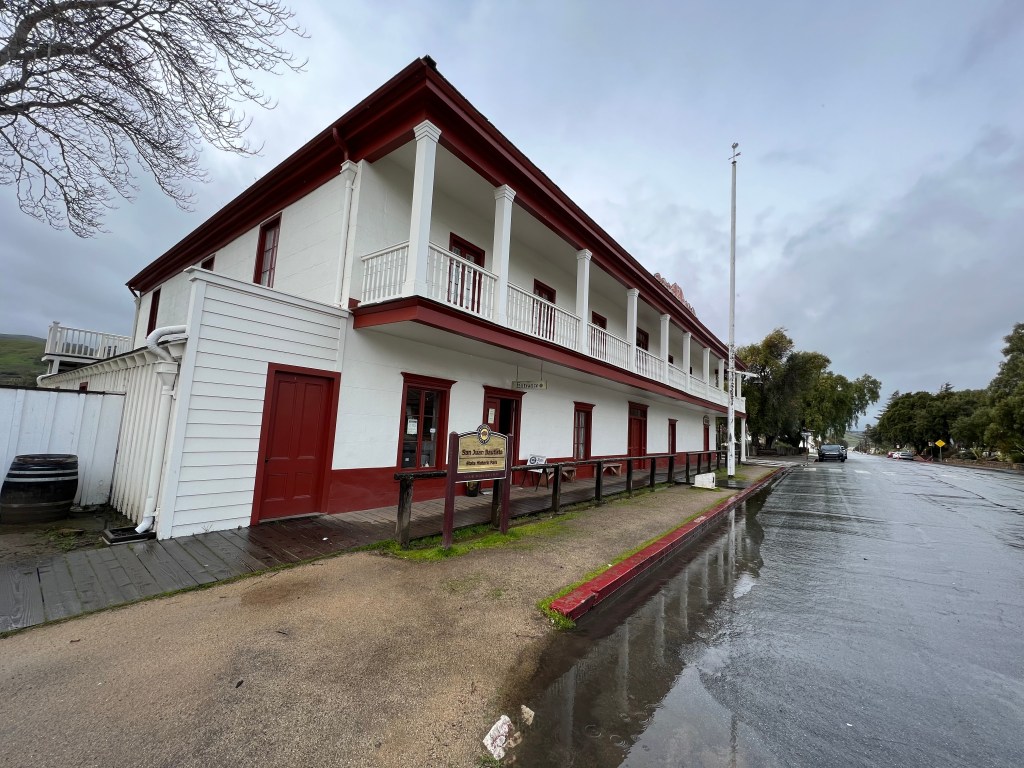
From Gilroy we drove 15 minutes to San Juan Bautista, home to a mission and to a state historical park. The focus of the state historical park is not the mission, but the buildings that represent the development of California between 1859 and 1890. This is a time when California has become a state and the Mexican ranches are becoming agricultural lands owned by settlers from the American East. At San Juan Bautista, the Mexican owner has welcomed Irish immigrants, survivors of the infamous Donner party, to the area. They intermarry and begin new traditions.
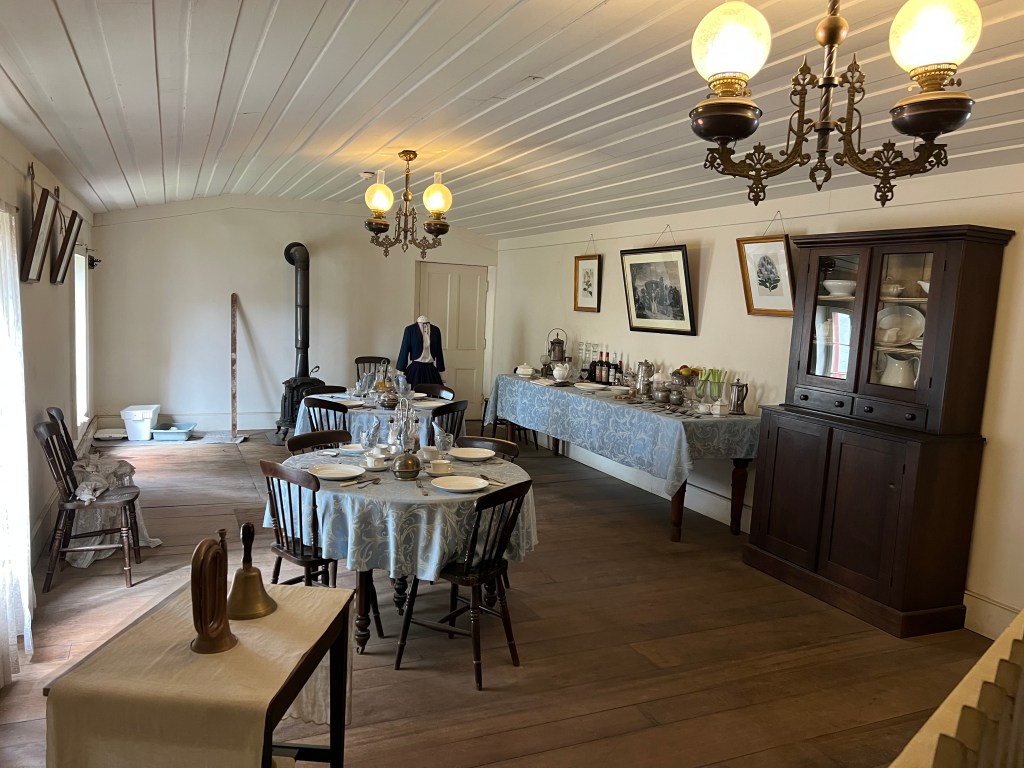
From top left, the hotel dining room, the stables and home, the women’s parlor at the hotel, hotel at bottom

Other immigrants from Italy arrived and established a hotel, well known and frequently visited due to its location on several stage coach lines. Seven to eleven stage coaches would arrive daily. Unfortunately, the railroads never came to San Juan Bautista and the town slowly lost importance. It must not have helped that the 1906 SanAndreas quake left cracks in many of the town’s buildings. Today San Juan Bautista is a community with a population of 2,000 and a pleasant, old style downtown.
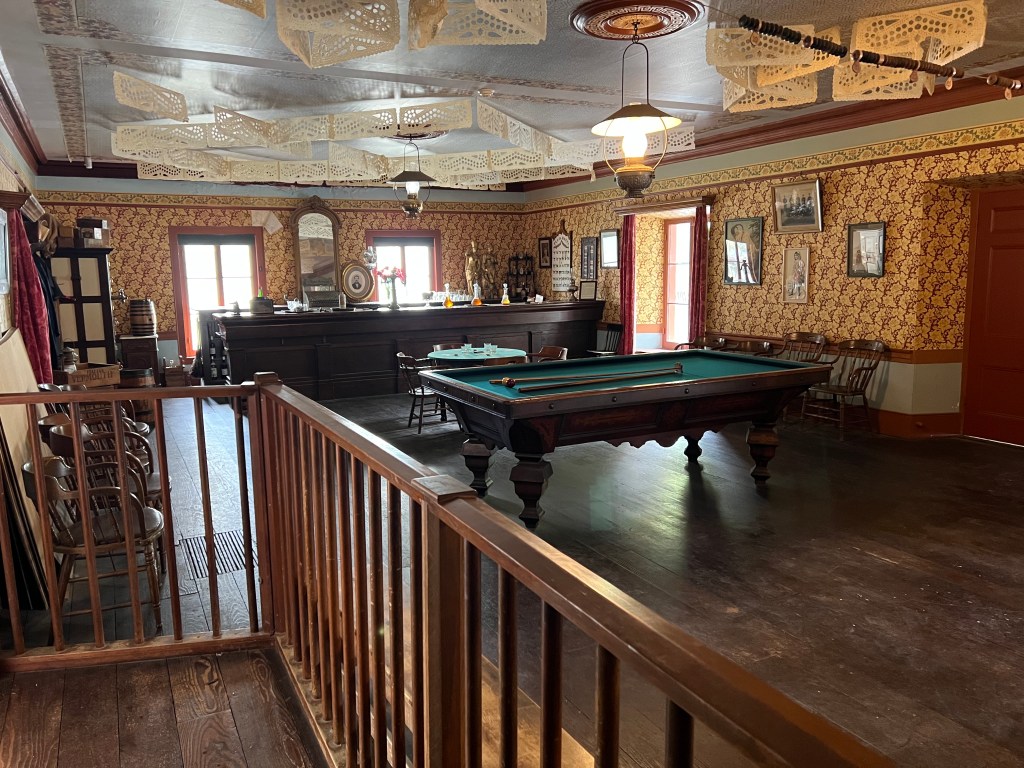
The bar area in the hotel at San Juan Bautista

Ed and Chris, Salinas Feb. 28

Categories: travel | Tags: , , | Leave a comment

2023 Trip 2: San Francisco: February 27

Red Oak VIctory ship and gan

Morgan Hill, CA

Rosie the Riveter was the focus of our activities today. The morning was constant rain so spending the time inside of a National Park site building was a good choice. As a bonus, one park ranger and one volunteer grew up in Minnesota so we swapped stories for a while before we really got into the exhibit. The park site is located inside of an old WWII factory along the wharf area and an area still heavily industrial.

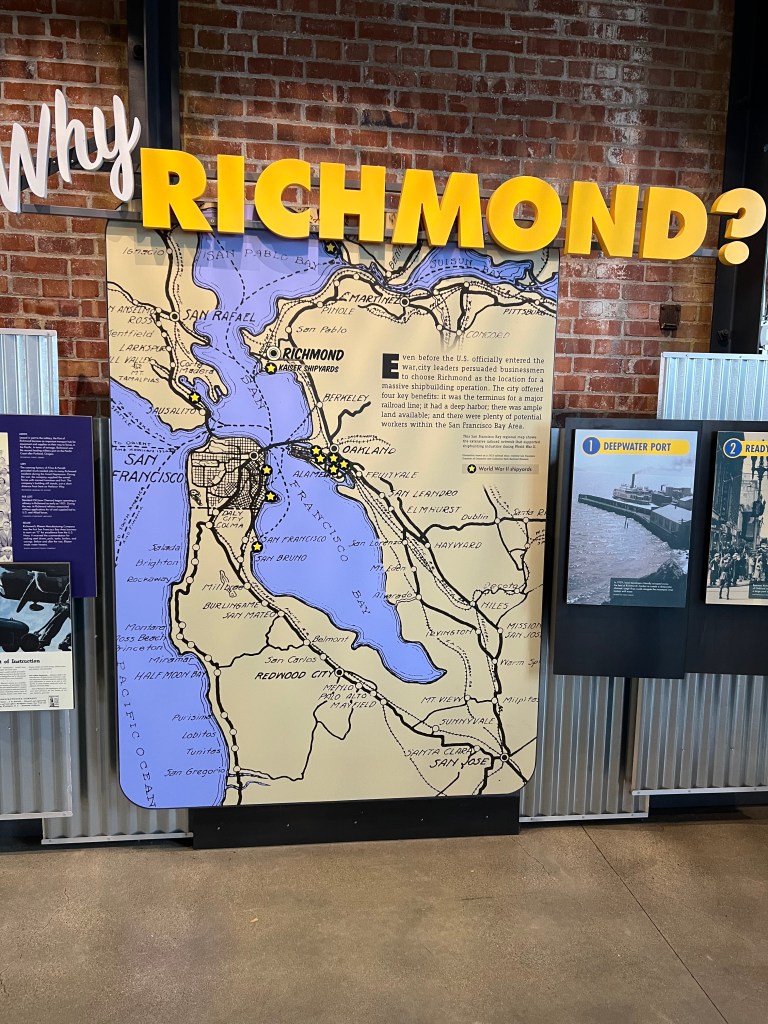
The mission of the Rosie the Riveter/World War II Home Front National Historical Park is to honor and to explain the sacrifices made by Americans of all walks to supply the war material needed to win WWII. Richmond CA was chosen due to its important role in producing war material and as a community that dealt with the changes brought about by the rapid increase of people.

Richmond’s location in San Francisco Bay

Richmond was a town of about 23,000 people in 1940. It had a deep harbor with excellent rail connections. It was chosen to house a major shipbuilding program that by war’s end built 747 ships in Richmond, more than any other shipyard in the U.S. People came from all over the country to work here. During the war effort, it exploded to over 100,000 people with over 90,000 people working in the shipyards. The exhibit discusses the impact this had on Richmond from childcare to housing to health care to segregation.

The huge number of ships built was due to a process of using prefabricated assembly methods allowing inexperienced workers to capably excel at basic tasks. This allowed the shipyards to bring in women and minorities that normally would not be hired. The well known Rosie the Riveter image masks the reality of a slow battle for acceptance of women, blacks, Indians, etc. African Americans created a “Double V” campaign for Victory in the war and Victory over racism in the U.S.

A Jeep crated and ready to be shipped overseas

Rosie the Riveter park site explains these and other issues through exhibits and films. We were particularly fortunate to view the 50 minute video about Betty Reid Soskin titled “No Time to Waste”. Betty was an African American woman who became a NPS ranger here at Rosie the Riveter in 2007 at age 85. Previously her jobs and activism had her playing a role in the design of this park site. She realized the plans ignored the situation of African Americans and worked to change that oversight. Her success in that effort lead to numerous honors, including that of introducing Present Obama at the 2015 Christmas Tree Lighting ceremony.

After leaving the visitor center, we had lunch at a cafe overlooking the harbor. Chris convinced the waiter to seat her near a heater vent since the cafe was chilly; these temps in the low 40s seem to be taxing the CA heating systems.

There is a Rosie the Riveter outdoor memorial which was less than overwhelming. Finally, we drove to the Red Oak Victory ship, an actual Victory class cargo ship built here in Richmond and preserved at one of the piers in the harbor.

We are spending the night in Morgan Hill as we re-focus our visit on attractions south of San Francisco. Rain has been a constant companion and may have us re-think our planned schedule.

Photo of the masses of people reporting for work at just one of the four shipyards in Richmond

Ed and Chris.

Categories: travel | Tags: | 1 Comment

2023 Trip 2: San Francisco: February 25-26

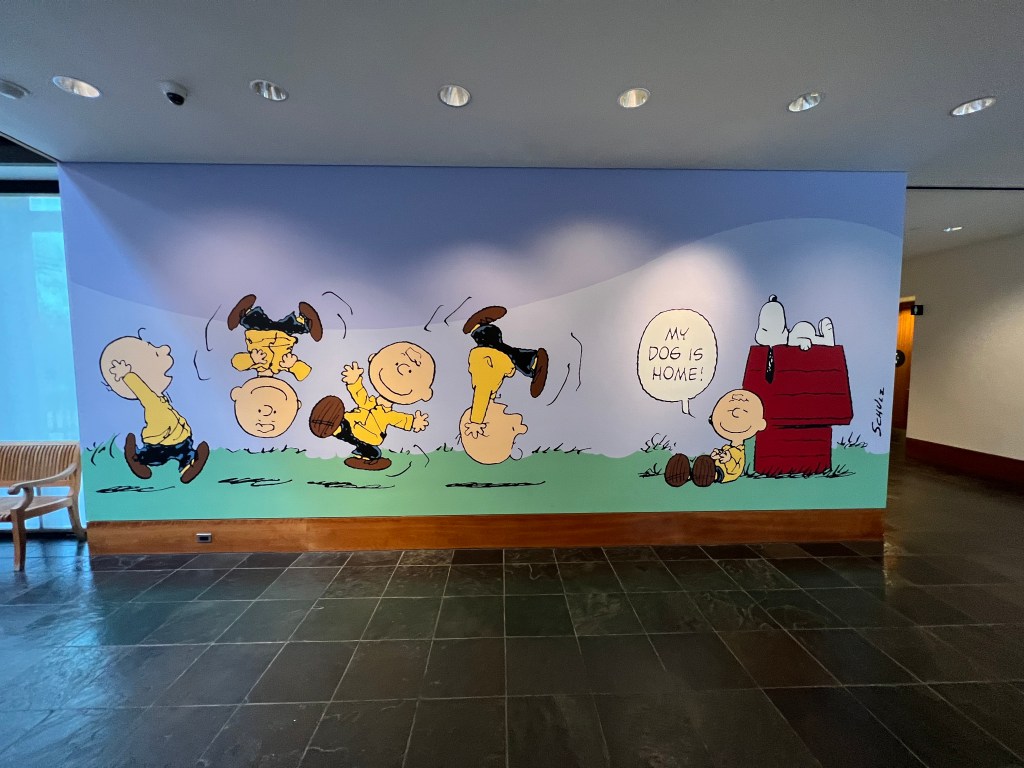
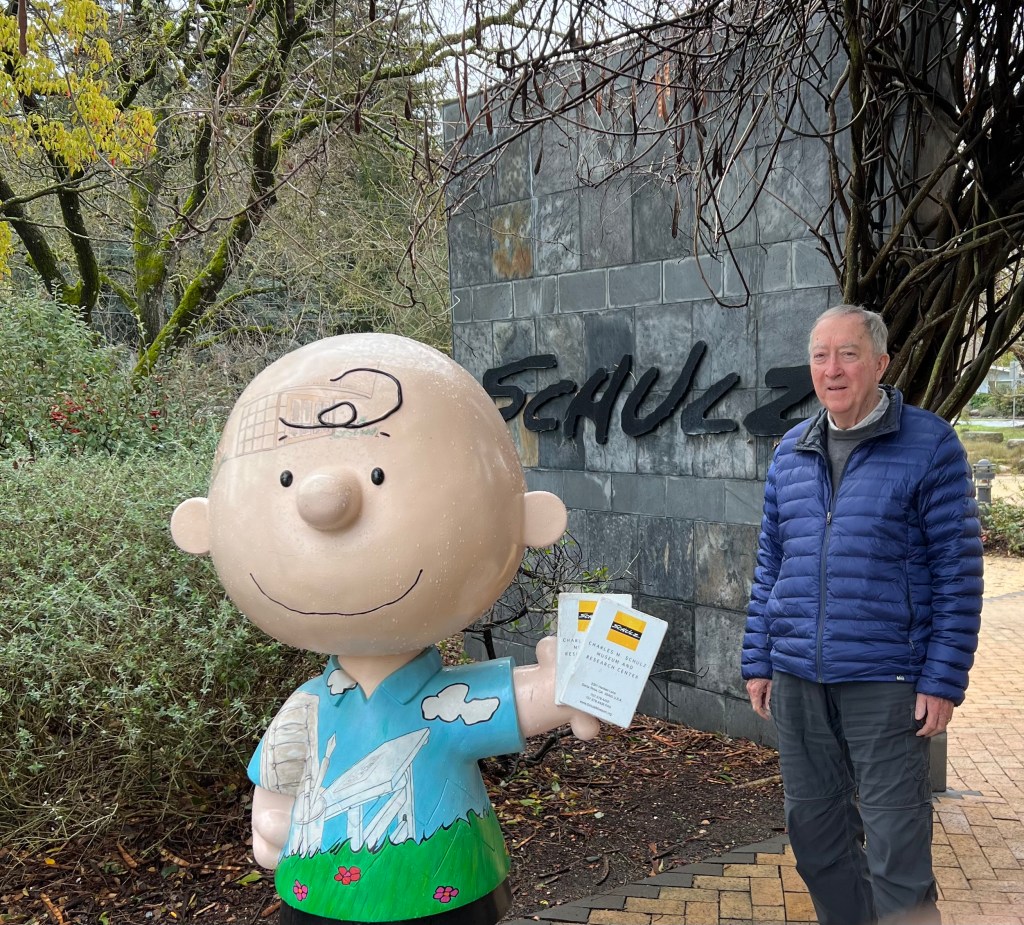
Charles Schulz museum

Pleasant Hill, CA

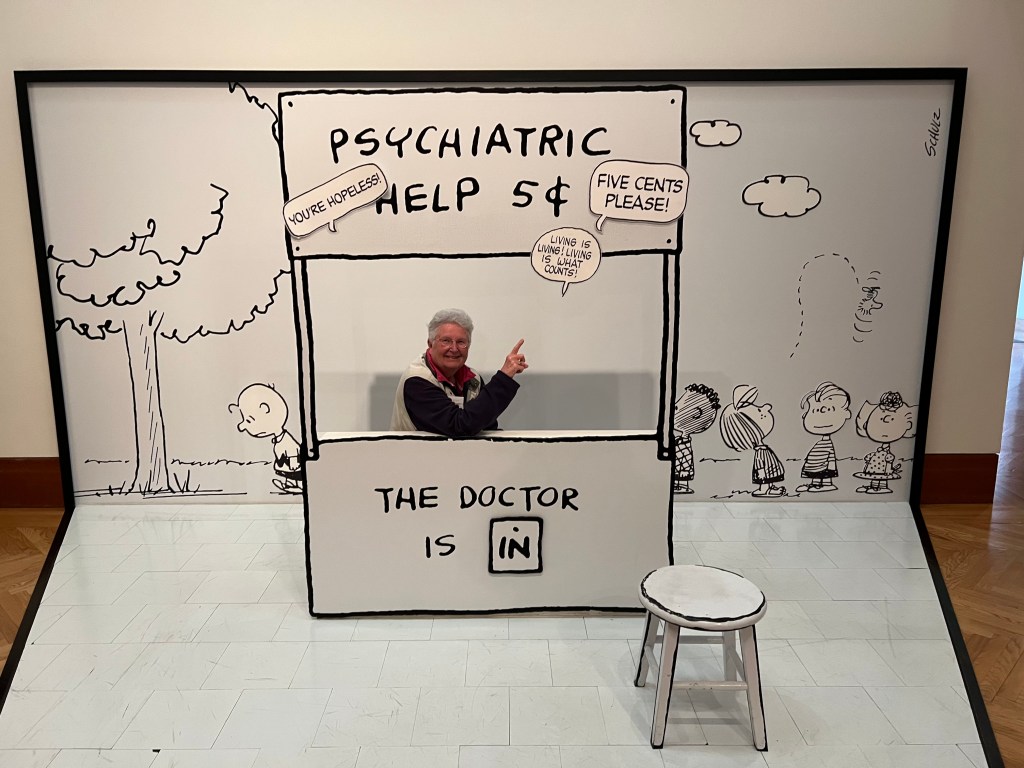
Saturday and Sunday have been our literary days, visiting the museum of cartoonist Charles Schulz (1922-2000), the museum of author Robert Louis Stevenson, and the home and National Park Service historical site of playwright Eugene O’Neill. Saturday started with the 75 minute drive back north to Santa Rosa where the Charles Schulz museum is located. Hopefully you have surely heard of Charles Schulz who for 50 years drew the Peanuts cartoon strip with Charlie Brown, Snoopy, Peppermint Patty, Marcie, etc. If not, look it up now.

Schulz has a special appeal to us since he spent many of his early years in St. Paul, MN. His interest in drawing and in cartoons dates from an early age and classes in Minnesota introduced him to new skills, mentors and life long friends whose names pop up as characters in his comic strips. His hockey references date back to these days and he continued to play hockey even after he moved to California in 1958 at age 36. After his service in WWII, he returned to MN and one of his first jobs was as a letterer for a Catholic newspaper. He worked on a 48 page anti-communist booklet given to school children. Luckily he had been working on drawings for comic strips for years and in 1950 Peanuts first appeared in seven newspapers. By the year 2000 when he died, it had appeared in over 2600 newspapers.

Charles Schulz writing office-where he made doodles of potential ideas

The museum has both permanent and rotating exhibits. It includes references to the cartoonists who influenced him and the many cartoonists whom he inspired and mentored. He drew all of his strips, doing even the lettering of the captions. He always considered himself as skilled in lettering and his use of various type styles and fonts was an important element of expression necessary in comic strips of just four panels. As he grew older, he was less able to master the details and one can observe a change in the print size and fluidity of the drawings due to his essential tremor illness.

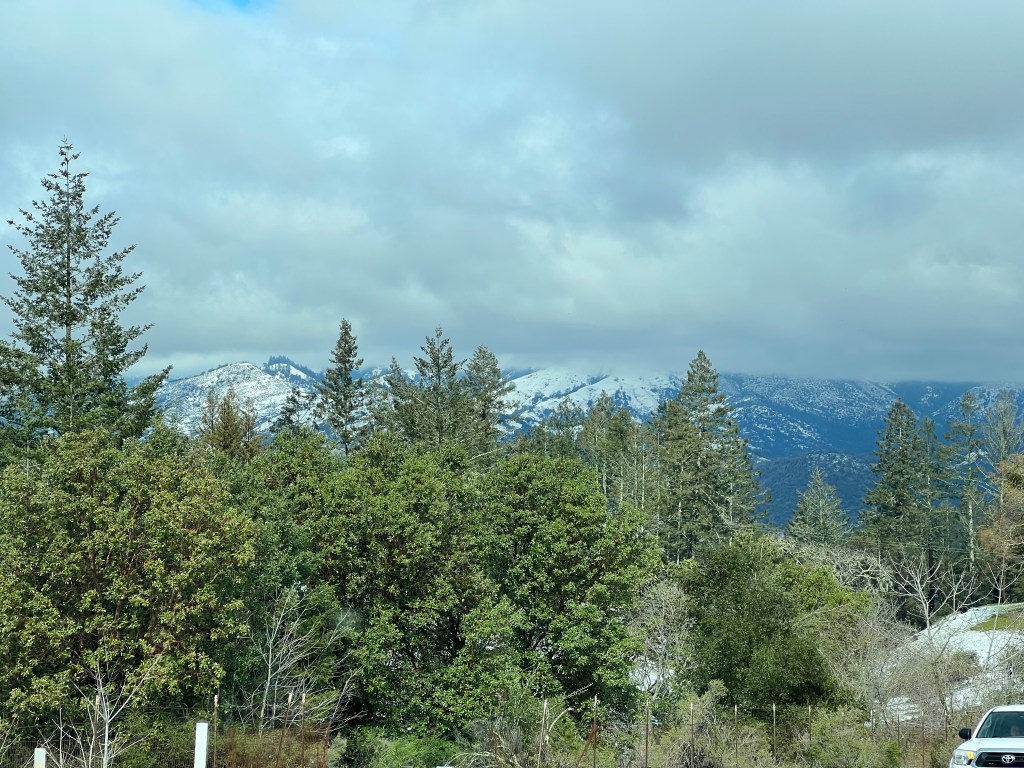
Driving to St. Helena

Leaving Santa Rosa, we drove over mountains with snow, through valleys, and among vineyards to St. Helena, CA. Due to a wealthy American businessman, St. Helena is the home to a small museum housing a huge collection of artifacts relating to Robert Louis Stevenson (1850-1894). Stevenson is a Scotsman, not an American. He did spend some time in this area, including his honeymoon. Among others, Stevenson wrote Treasure Island, The Strange Case of Doctor Jekyll and Mr.Hyde, Kidnapped, and a Child’s Garden of Verses.

At the museum we received a 30 minute guided tour of the premises which highlighted Stevenson’s life. He suffered from poor health for much of his lifetime. Rejecting the expected career route of lighthouse design and engineering practiced by his male ancestors, Stevenson received a university education in law which he never practiced, turning to the arts and writing. With an allowance from his parents, he traveled around Europe, eventually arriving in Grez-sur-Loing where he met his brother and a married woman named Fanny van de Grift Osborne. Fanny was an American, 11 years older than Stevenson. Several years after the first meeting, they began a relationship that eventually ended with her divorcing her husband and marrying Stevenson. They traveled extensively around Europe, spent some time in America, and then lived in the Samoa for his last years.

Stevenson’s was a celebrity during his lifetime but critical opinions varied over the years with his scholarly reviews increasing lately. He has always remained popular around the world, he is one of the most translated authors of recent time.

Napa Valley and wild mustard

We left St. Helena and drove back roads through Napa Valley. Vineyards were everywhere, as part of large wineries and as part of backyards. The yellow blossoms of wild mustard are visible where ever one looks, the period from January to March being bloom time. Wild mustard has been planted in many vineyards to protect the soil and replenish it with nutrients.

Finally back in Pleasant Hill, we have dinner at a local Italian restaurant. While dinner last night at Outback was very good, their happy hour meal specials are only valid on weekdays.

Sunday began with church in Danville, about 15 minutes south of Pleasant Hill. St. Isidore was probably the most crowded church we have been in for years. Afterwards we had a pastry and visited the Museum of the San Ramon Valley. The museum was having a display of local quilts created during the pandemic. A volunteer with extensive knowledge of quilts gave us a wonderful explanation of the quilts while we waited. We had 2 PM reservations for a tour of the Eugene O’Neill house which is a National Park site.

Eugene O’Neill National Historic Site

O’Neill (1888-1953) received four Pulitzer Prizes and one Nobel prize-which funded the purchase of this home. His most famous works include Beyond the Horizon, Anna Christie, Strange Interlude, Long Days Journey into Night, Mourning Becomes Electra, and the Iceman Cometh. His style of realism engaged theater goers to think, not just laugh. O’Neill and his third wife Carlotta purchased 158 acres of land on a hillside for a writing retreat. He was successful at this time, both financially and artistically. After a nomadic existence for most of his life, he was seeking a writing refuge, a place he could call home. Carlotta and he decorated the home to reflect Taoist contemplative concepts.

ONeill also had health problems and a tremor in his hands made his ability to write almost impossible. WWII took away access to servants and he and his wife lived in a series of hotels for the remainder of his life, dying in 1953. After moving out, most of his possessions were sold or distributed so the house does not fully reflect the home as it was during their time there.

We were lucky for the indoor activities, today the rain was steady and cold. Dinner was just a sub from Jersey Mikes, eaten back at our hotel room.

The books of Robert Louis Stevenson

Ed and Chris, Feb. 26

Categories: travel | Tags: , , | Leave a comment

2023 Trip 2: San Francisco: February 24

John Muir’s office where he did most of his writing

Pleasant Hill, CA

This day messed up our schedule. One of the National Park Service sites to see in the San Francisco area is the Port of Chicago Naval Magazine National Monument. Port Chicago is one of the most difficult sites to visit and thus one of the least visited sites in the National Park Service. In 2018 it had only 653 visitors. It normally only has tours on Thursday, Friday, and Saturday. To get on a tour, you have to register two weeks ahead of time. The site is on an active Army base so permission must be given to enter. The tour takes less than a dozen people each time. The tour can be canceled at any time. It is run through the John Muir NPS site in Martinez, CA since Port Chicago does not have a visitor center of its own. You have to arrive at the John Muir site by 12:15 pm for the one tour given each day.

We planned to visit on Saturday February 25. We requested to be on the tour about five weeks in advance. We were then notified that there would be no Saturday tour on the 25th, we would have to take the tour on Friday the 24th. Well, our schedule had us leaving Jenner along the coast on Friday morning and spending the day in Santa Rosa, directly on the way to Pleasant Hill CA where we would be staying three nights while we visited the four NPS sites in the East Bay Area. A very efficient use of time and gasoline. Changing our schedule to make Port Chicago on Friday meant on some other day we would have to backtrack for an hour and a quarter each way to see the Santa Rosa locations we planned to visit. Well, there was not much choice. Inconvenience or miss visiting one more NPS site that we would be unlikely to ever see in the future.We voted for inconvenience.

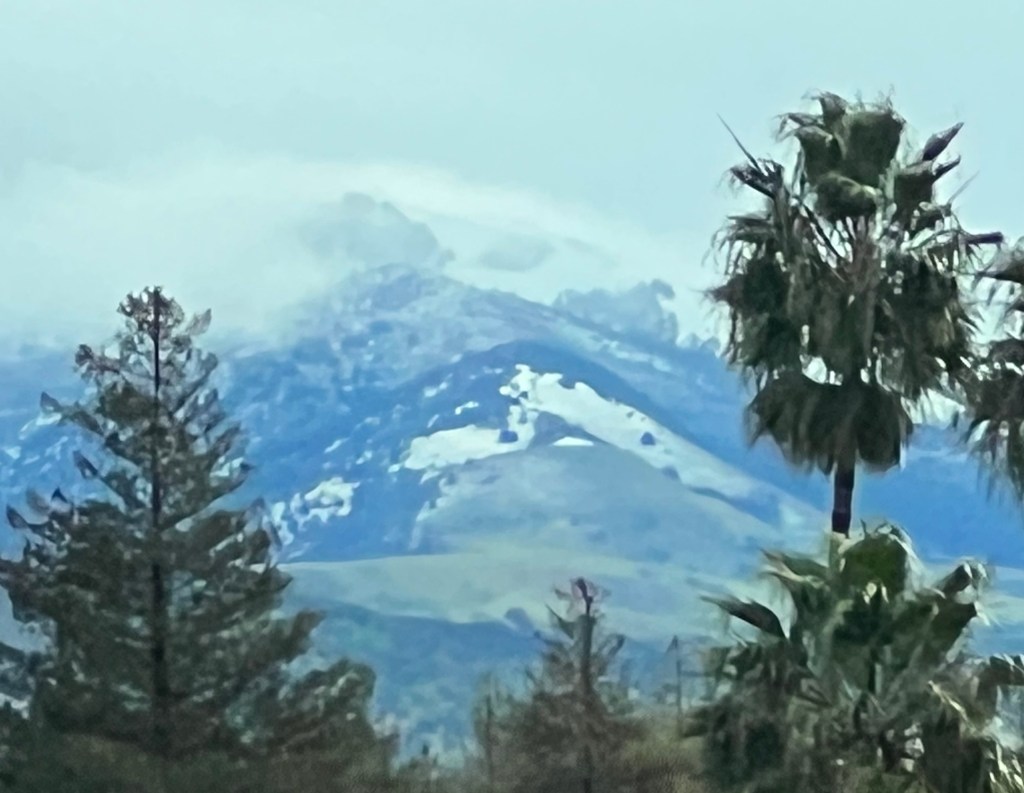
We left Jenner Friday morning at 8 AM for the two hour drive to Martinez CA and the John Muir National Historic site. (This is his main place of residence while alive, not to be confused with Muir Woods.) More than enough time you say. True, but we were going over the mountains after 12 hours of rain might have caused mud slides or fallen trees. It was a Friday at rush hour, what would the roads be like? And remember, we were in an area of no cell or Internet coverage so we could not plan for road problems in advance. We later found out Thursday night/Friday morning had the highest snowfall in memory for this part of California. In the higher areas along San Francisco Bay, several inches of snow had fallen. People were getting in their cars and taking their kids out to experience snow. Not exactly the 15 inches or so that had fallen back in the Twin Cities, but pretty exciting for this area of California

Snow on one of the peaks around Martinez, CA

Our luck continued to hold. We had no driving issues, made it to Martinez with enough time for a McDonalds breakfast and a tour of the John Muir homestead before the Port of Chicago tour.

John Muir is one of the premier early conservationists in the U.S. He was a founder of the Sierra Club. He wrote prodigiously on the need for preservation and the value of spending time outdoors. His efforts are credited with the creation of Yosemite National Park and with influencing President Theodore Roosevelt to actively create national monuments and forests. Born in Scotland in 1838, his family immigrated to central Wisconsin in 1849. As a young man, he traveled extensively around the U.S.

The John Muir home in Martinez, CA

The NPS site in Martinez reflects his later life. He married Louisa (Louie) Wanda Strenzel when Muir was 42. His father in law owned extensive fruit orchards and Muir managed the orchards for a number of years. The 10,000 s.f. home we visited originally belonged to his father in law, who was wealthy due to his fruit business. When the father in law dies in 1890, Muir, his wife Louie and children move into the ornate house where his mother in law is living. Louie takes over the handling of the fruit business, freeing Muir to write and travel. Muir dies in 1914 at age 76.

For the Port of Chicago Naval Magazine tour, you probably need a bit of history. We had no idea what this NPS site was when we looked at the list of National Park sites in California. I will try to make the history concise yet sufficient. First, in World War II, the U.S. still practiced informal segregation. After the Civil War, the 13th, 14th, and 15th amendments to the U.S. Constitution were supposed to end segregation and slavery. Yet in reality, segregation still existed throughout the U.S. The military was not different. Black soldiers in the Navy were used as cooks and stewards, not active participants in warfare. They were commanded by white officers. They lived in segregated housing.

Port Chicago was constructed as a naval facility to load ships with supplies and munitions for the Pacific Theater of War. It had a deep harbor, direct rail lines, and isolation from populated areas. Blacks were used to load the ships under the direction of their white officers. Neither the officers nor the seamen had special training in handling munitions. Bets were placed by the officers as to which crews could load ships the fastest.

On 10:18 PM July 17,1944, two explosions ripped the air. One of two ships was full of munitions,16 rail cars lined the pier. The blasts obliterated the ships, pier, and rail cars. Debris went 12,000 feet into the air. The shock wave was felt for 40 miles. Businesses a mile away in the town of Port Chicago were damaged. But this national monument is not for property damage.

Inner ring shows how far debris was blown, the outer ring the extent of damaged buildings

320 men lost their lives that night. For most of them, their remains were never found. 202 were African American enlisted personnel loading the ships, nine of their officers, 64 crewmen from the two ships, 33 Naval personnel guarding the ships, 6 civilian workers, five Coast guard crewmen and one Marine on guard duty. Yet the consequences of the blast weighed most heavily on the African Americans. White officers were given 30 days leave and transferred to other duty-away from the trauma and memories. The African American seamen who worked on munition loading details but had not been present on the pier received no time off and three weeks later were ordered to load munitions at another naval shipyard in the area.

258 of the seamen refused, saying they were afraid to load. Threatened with death by firing squad, 208 gave in and were given bad conduct discharges after serving their term. The 50 who persisted faced the largest mass mutiny in naval history. Despite questions about the base’s safety practices and the men’s fear of being blown sky high, all were convicted and given sentences of 8 to 15 years. After the war, the Navy granted clemency and put them on ships to finish their enlistments. No whiteNavy officer faced punishment for lax or unsafe procedures. Though their convictions were not overturned, their acts of civil disobedience brought to light the injustice of racial segregation in the military.

In 1948 President Truman issued an Executive Order beginning the process of integration of all military forces although it took years for it to be fully implemented.

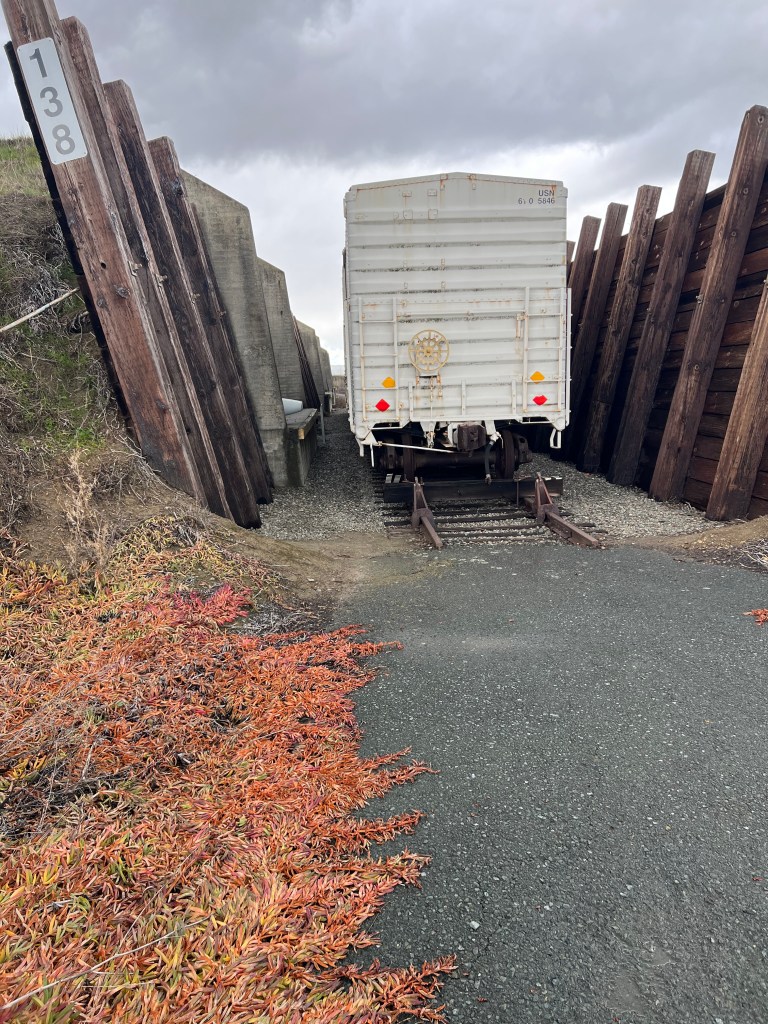
One of the revetment areas at Port Chicago Naval Magazine National Historic Site

The memorial for Port Chicago is located where the explosion occurred. The NPS has plans to build a new and more comprehensive visitor center in the next 10 years. For now, 8 visitors, one ranger and one volunteer traveled by car from the John Muir historic site driving through land cleared of old and damaged buildings. Some of the revetments remain, structures designed to temporarily hold munitions until they were loaded onto ships. The names of the 320 men who died are listed on memorial plaques. The rest is memory.

Ed and Chris, February 25

Categories: travel | Tags: | 1 Comment

2023 Trip 2: San Francisco: February 23

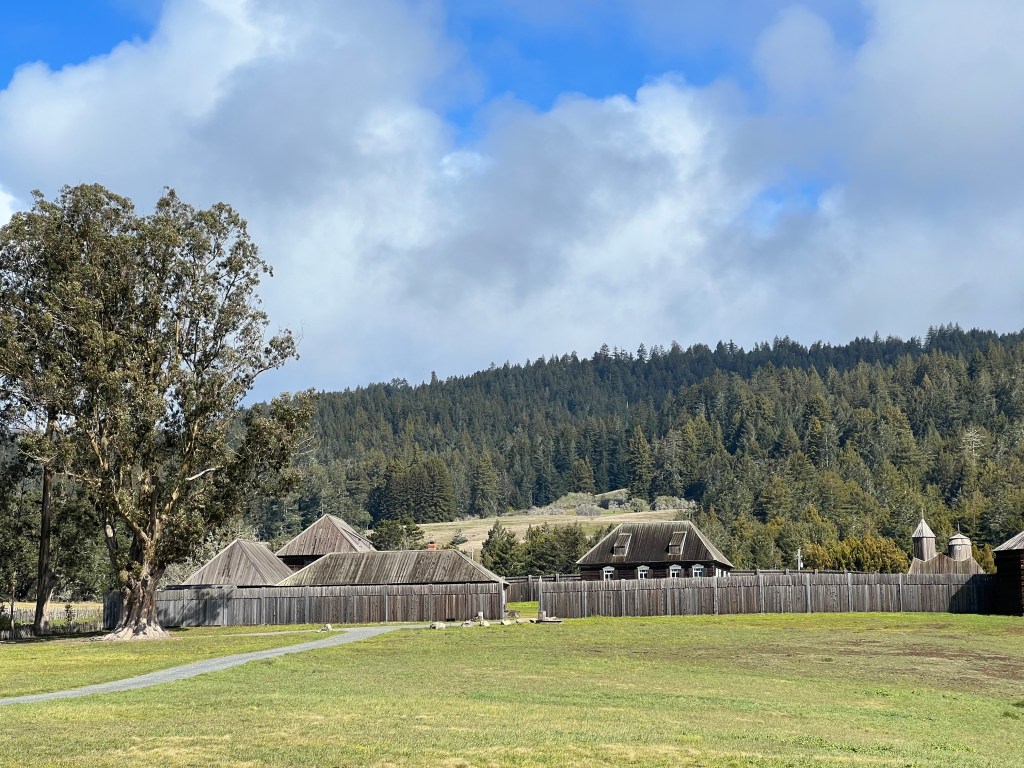
The re-created chapel at Fort Ross State Historical Park

Pleasant Hill, CA

Day 2 in Jenner began with a stop at the Cafe Aquatica for a coffee and biscotti for Chris while Ed had milk and a cookie. Not many breakfast options in a town of 120. Our drive north continued along the two lane coast road with a few single lane stretches where road construction was ongoing-and necessary. The goal was Fort Ross State Historical Park, 12 miles and half an hour north of Jenner.

Fort Ross

Fort Ross was a Russian settlement and fortification along the coast, established in 1812 by the Russian-American Company. It had built permanent locations in Alaska stating in 1784 and needed to provide food for its settlements in Alaska and protection from Spanish settlements to the south of Fort Ross and British settlements to the north. Alaskan Alutiiq natives helped construct the fort and dwellings. Out of Fort Ross, the Russians traded with Americans, farmed, built ships, had a blacksmith shop, etc. The first ship built in California was constructed here in 1818.

Hunting here, as in many locations along both coasts, so depleted the marine mammals that the Russians imposed a four year hunting moratorium on seals and otters. This was the first marine-mammal conservation law in the Pacific. Russian scientific studies contributed greatly to the understanding of the geography, biology botany, etc. of this area.

But increasing deficits in the running of the Russian-American Company forced the Russians into closing Fort Ross and selling off its assets to John Sutter who transferred most of the cattle, sheep, hardware, etc and moved them to his Sacramento area holdings. Ranching and lumbering were the primary products of later American owners of the fort area.

Currently the state historical park has one surviving original structure, the home of the last manager of the Russian American Company. Re-creations of the stockade, chapel, blockhouses, and a warehouse can be viewed along with exhibits. Chris and I pondered about how America managed to stave off becoming a series of colonies belonging to England, France, Spain and Russia. What other country has managed to thrive, yes with many faults, but thrive with people from so many varied countries from around the world and not be ruled by an oligarch or monarchy?

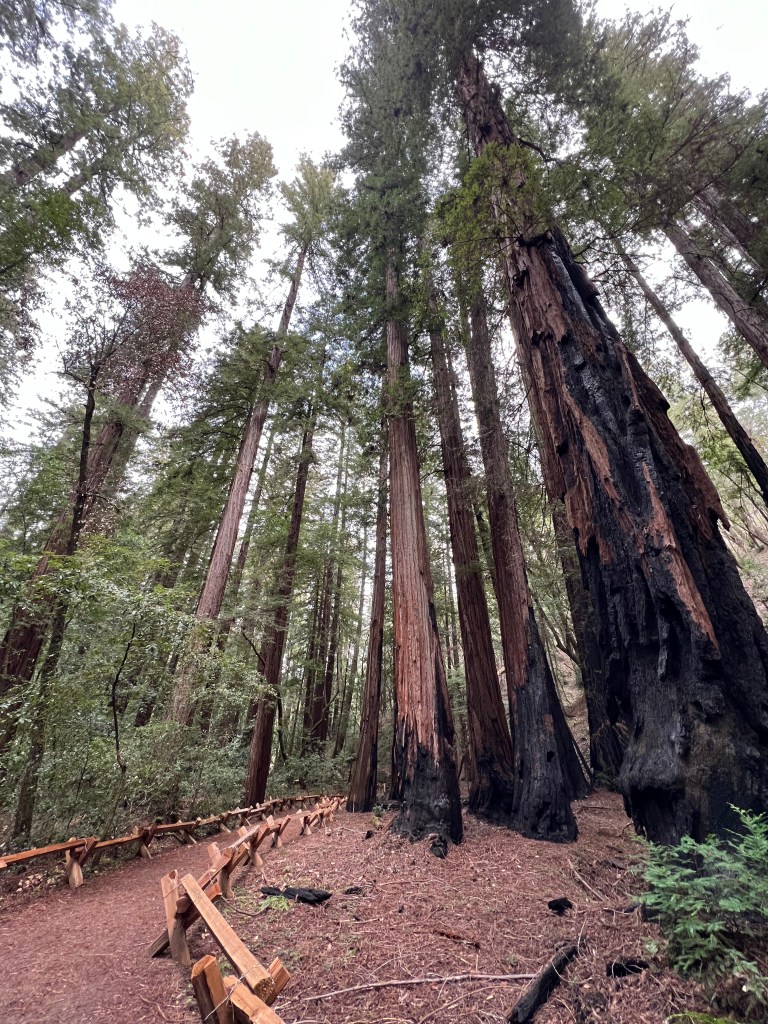
We reversed course and headed back south, passing through Jenner and then east into the mountains on our way to Armstrong Redwoods State Natural Reserve. This redwood forest had been devastated two years ago by fire and much of the park is still off limits to foot traffic. Here we were able to view redwoods with fire scars on their trunks but, so far, still thriving. This fire was started by lightning, not arson or recklessness. Again the majesty of the enormous trees and the diverse habitats underneath the trees made for a calm, yet awe-inspiring walk through the only trail currently open to the public.

Walking through Armstrong Redwoods State Natural Reserve

The coastal redwoods, tallest living trees on Earth, grow naturally only along a narrow coastal belt from southern Oregon to central California. In the late 1800s, James Armstrong helped save this section of the redwoods by donating the land to his daughter with plans for a natural park. California obtained the land in 1934. Armstrong also purchased and cut huge swaths of other sections of redwood forest to run his sawmills. One interesting display in the park shows a section of cut redwood, with tree rings running from the post Civil War era back to well before the Magna Carta in 1215.

Friday morning view from our cabin

We returned to Northwood restaurant for an early dinner and made it back to our cabin just before 12 hours of rain began. No night sky viewing tonight, last night’s stars were replaced by a steady drumming of rain on the roof. The roar of the ocean waves continued as loud Thursday night as it had been Wednesday night. Something, possibly the rain, chased away the harbor seals which had been sunning on the land between the river and the ocean and only a few of them greeted us Friday morning.

View from Fort Ross Thursday morning

Ed and Chris, Pleasant Hill CA Feb. 24.

Categories: travel | Tags: , | Leave a comment

2023 Trip 2:San Francisco: February 22

Muir Woods National Monument

Pleasant Hill, CA Feb. 24

The second phase of our journey began Wednesday the 22nd as we left downtown San Francisco to explore the larger San Francisco Bay Area. Once again we walked to the BART station, leaving the hotel around 7 AM, and went to the airport to pick up our rental car. While the temperatures were in the lower 40s, at least there was no rain. Rain, however, is forecast for today and the next 10 days. We were headed for Muir Woods National Monument on the north side of the Golden Gate Bridge. Muir Woods requires you to obtain an advance purchase parking reservation given its nearness to San Francisco, its few parking spaces, and its popularity.

We had chosen a 10:30 to 11 AM window not knowing how much time we would need to pick up the rental car, etc. Luck was on our side and we were early enough that we stopped for a McDonalds breakfast. To get to Muir Woods, we drove over the Golden Gate bridge, up into the mountains north of San Francisco. Much of this land is protected between state and federal parks with abundant opportunities to enjoy the outdoors.

Instead of its normal 8 AM opening, Muir Woods opened at 10 AM Wednesday. Tuesday the heavy winds mentioned in yesterday’s blog had forced the park to close early. Wednesday they delayed the opening time to allow staff to inspect the trails and the buildings to minimize injuries to park visitors. Thus, our 10:30 time got us in ahead of most visitors for the day. Surprisingly the expected rains were holding off and we were able to get numerous pictures with lovely blue skies surrounding the treetops.

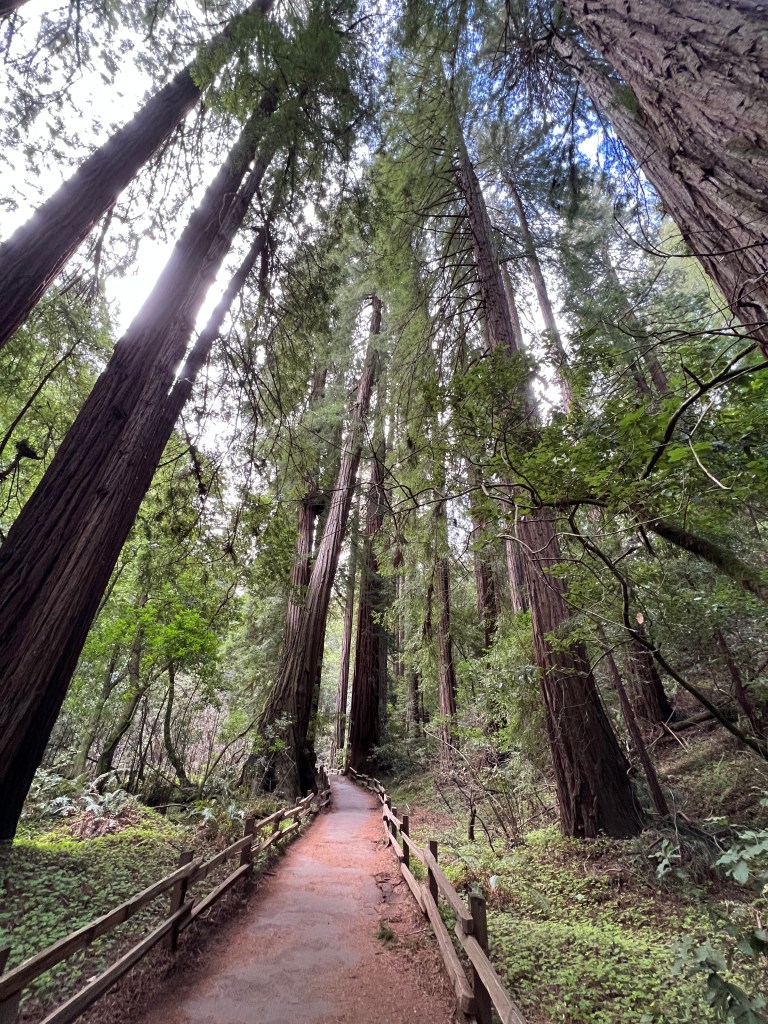
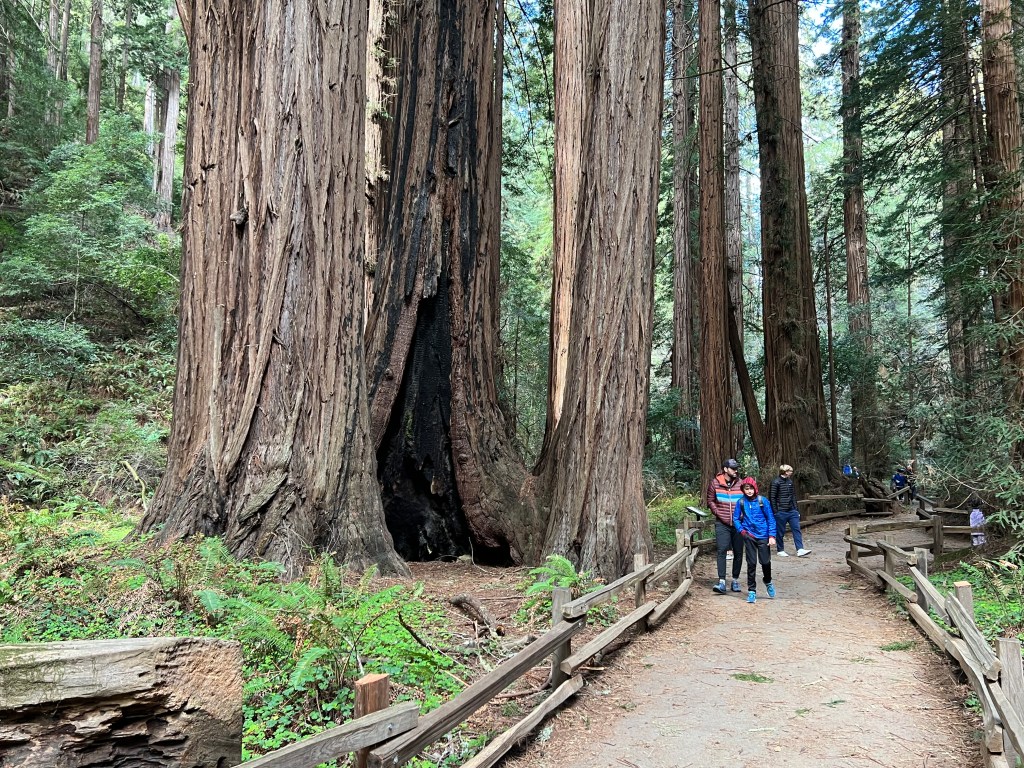
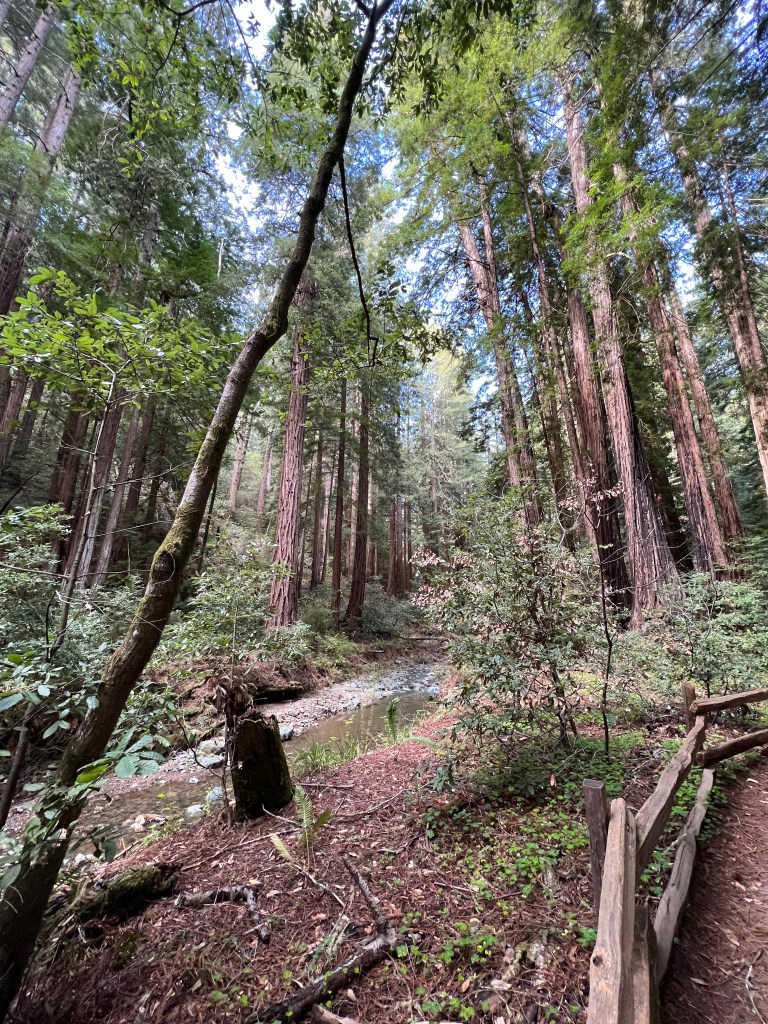
Chris and I can’t agree if we have been here before. We do know we visited Point Reyes Lighthouse just north of here and climbed up and down the 313 or so stairs to the lighthouse. Muir Woods was established in the early 20th century to protect its natural beauty and prevent logging of its massive redwoods. Our walk in the woods was magical, looking up at the towering trees and gazing at their massive trunks. The main trail meanders along a small brook and is in a valley so you also look up at the trees growing higher on the hillside. Some of the trails are off-limits due to trail erosion. We spent about an hour here, walking, admiring, enjoying the peace and quiet, and just plain relaxing.

We left John Muir and drove through the mountains and along the coast to Point Reyes National Seashore. This was our first look in a number of years at the Pacific ocean coast, much different than the coastline of the Atlantic ocean. Although close to downtown San Francisco, this area has small towns, two lane roads, ocean and mountains, and surprisingly to us, a fair amount of agriculture. We had known that California has passed Wisconsin as the number one dairy state but still we were not expecting to see cattle, sheep, goats, etc. populating the area that would normally be crowded suburban developments.

Point Reyes National Seashore was set up and accommodated concerns and opposition from local landowners. In this case, the agricultural interests that had been in the area worked together with conservationists to create a park that co-exists with agriculture. The seashore is maintained and protected while inland farms predominate. The visitor center is in the Bear Creek Valley area, part of the flatter, agricultural area. As mentioned, we skipped the lighthouse this time and chose not to walk down to the ocean. We expect to do more of that in the Big Sur area later in this trip.

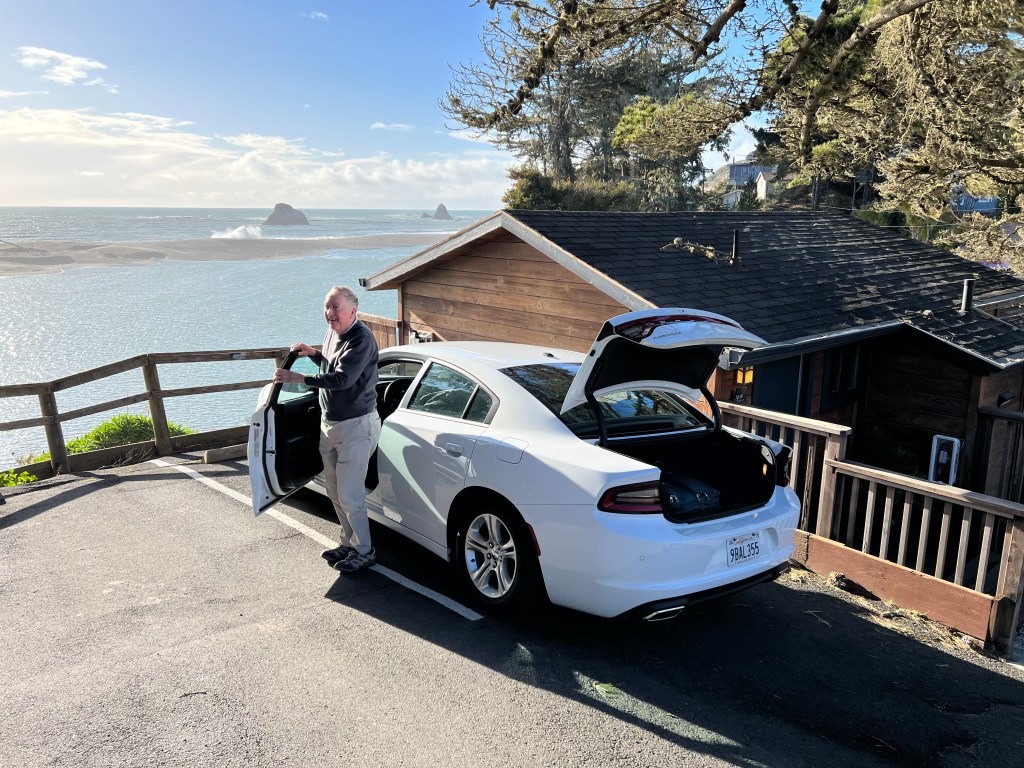
The journey continued, driving through the ever-changing mixture of flat lands, valleys, mountainsides, and coastline hugging the narrow two lane road. Our lodging for Wednesday and Thursday nights was in the town of Jenner, population 120 people. We chose it not because of the abundance of restaurants, definitely not the abundance of restaurants, but for the cabin overlooking the Russian River emptying into the Pacific Ocean. The cabin sits on the bluff and its view was unobstructed towards the rocks, coastline, river, and harbor seals that were frequently populating the land buffering the river from the ocean. Our lodging was not glamorous but clean and neat and, as noted, with a fantastic view. Parking was tricky, as we had to make sure we stopped before we hit the wooden fence that would probably not have stopped the car from going over the cliff. The heat from the propane gas fireplace/stove was a little spotty but given that they’re not used to temperatures in the high 30s and low 40s, we put up with it.

We drove inland about 20 miles and had dinner at a restaurant attached to the local golf course in Guerneville California. Food was very good and its name was Northwood, close call to the restaurant in North St. Paul MN owned by my parents back in the 50s through the 70s. The lodging in Jenner had no TV, no cell service, and no Internet. Thus the posting for the last several days has been delayed until we were able to come back into a more technological type of society.

Ed and Chris Pleasant Hill CA Feb. 24.

Categories: travel | Tags: , , | Leave a comment

2023 Trip 2: San Francisco: February 21

Whitecaps forming on San Francisco Bay

San Francisco, Feb. 21

The wind is the big story of the day, consistently over 30 mph. It picked up around noon, while we were walking along Fishermans Wharf and Embarcadero Boulevard. Our journey today started with a bus ride. The number 8 bus runs right along side the Hilton and goes directly to Fishermans Wharf. Or at least, most of them do. We got on a number 8 bus after waiting all of one minute. We had just missed another one so we we happy to hop on this bus. After only four blocks, the driver said: (politely) end of the line, everybody off. So all four of us got off since evidently this number 8 bus did not go all of the way. We crossed the street, waited another minute, and caught the next number 8 and this one took us within 3 blocks of the wharf area. Close enough.

Chris was looking for postcards and there were more than enough options of stores selling tourist trinkets that she was able to pick up several postcards, none of the Presidio or Golden Gate Park though. In another store, the man on duty was telling us of his connections to Minnesota and that this week, numerous school districts have closed for a week of vacation. San Francisco has not, but suburban ones yes. That may help explain the crush of families we encountered Monday at the Academy of Sciences. I wonder if there is a national database of school vacation closings??

Our next stop might surprise you. Chris saw a magic shop and we went in. She is still impressed by the card tricks we encountered at the Exploratorium. Chris made two purchases and plans to spend a little time to try to learn a few magic tricks. Results may or may not be published in future editions of the blog.

We checked out the sea lions, they were still there and made a snack stop at Boudin’s bakery. Same bakery as Sunday but in a different location. Pastries were just as good. We were feeling like a couple of hobbits having our second breakfast.

At the Cartoon Art Museum

Our next destination was several blocks away at the Cartoon Art museum. This small museum is dedicated to cartoon artists and their methods. Panels from many artists were present and we picked up information about new heroes that are peppering the books younger people are now following.

As the winds were picking up, we decided to head back to the hotel. It was still sunny but the temperature was dropping and we had accomplished our goals for the day. The Cartoon Art museum is not far from the turnaround point for the Hyde Powell cable car line so we that was our means of transportation to return. The waiting line today was short, we hopped on the second cable car and got off in Chinatown.

Late lunch was at Ladle and Leaf, a small San Francisco based soup and sandwich shop with a touchy feely mission statement posted out front. Food was good, the staff even cut off a hunk of butter from their stash for me to use on the bread that goes with the soup. I guess they normally expect you just to dunk the bread in the soup since there were no knives around to spread the butter.

Tomorrow we pick up our rental car early and head north towards Muir Woods.

Our cable car ride back to the hotel

Ed and Chris, San Francisco, February 21

Categories: travel | Tags: | Leave a comment

2023 Trip 2: San Francisco: February 20

San Francisco Botanical Garden

San Francisco, February 20

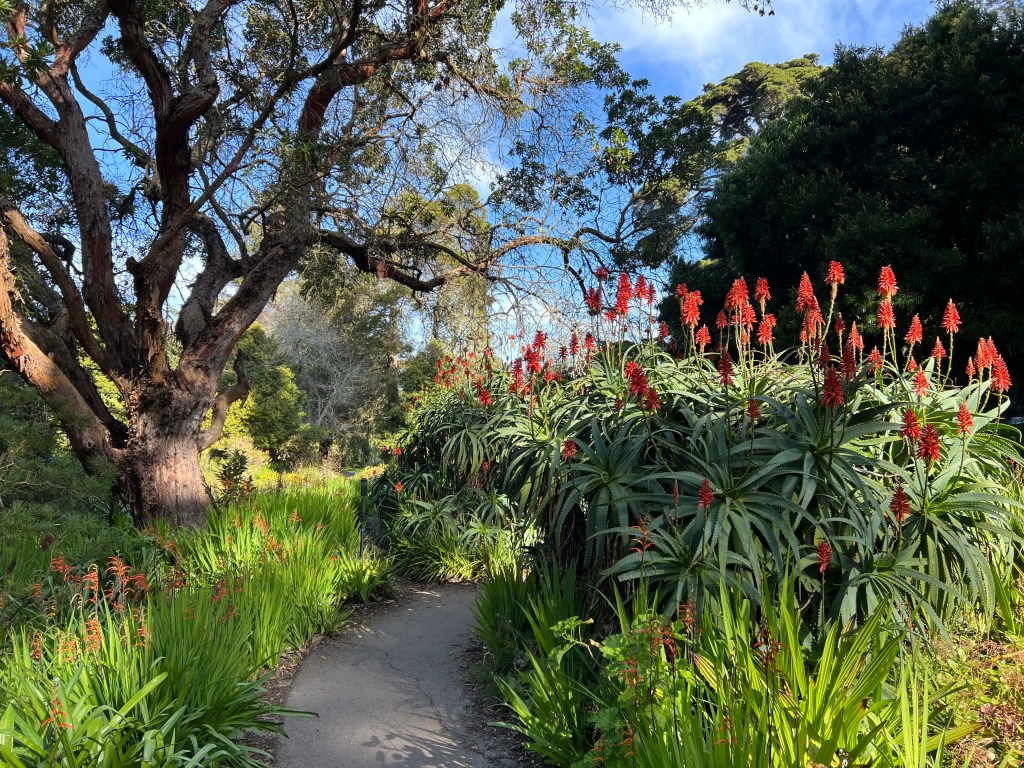
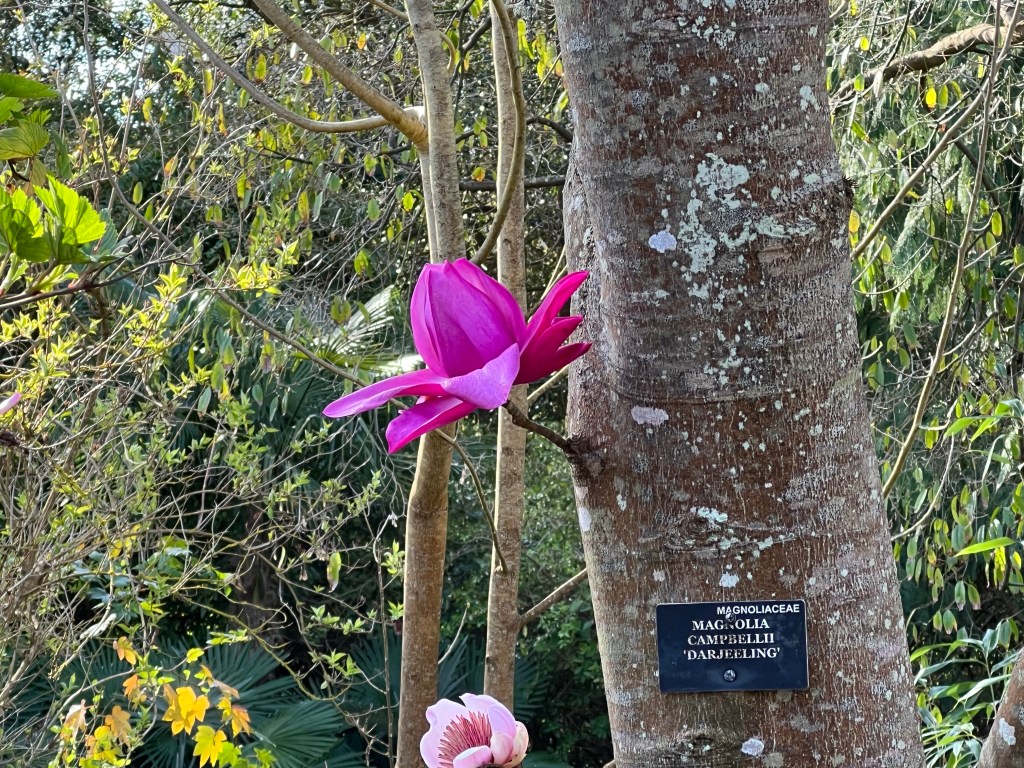
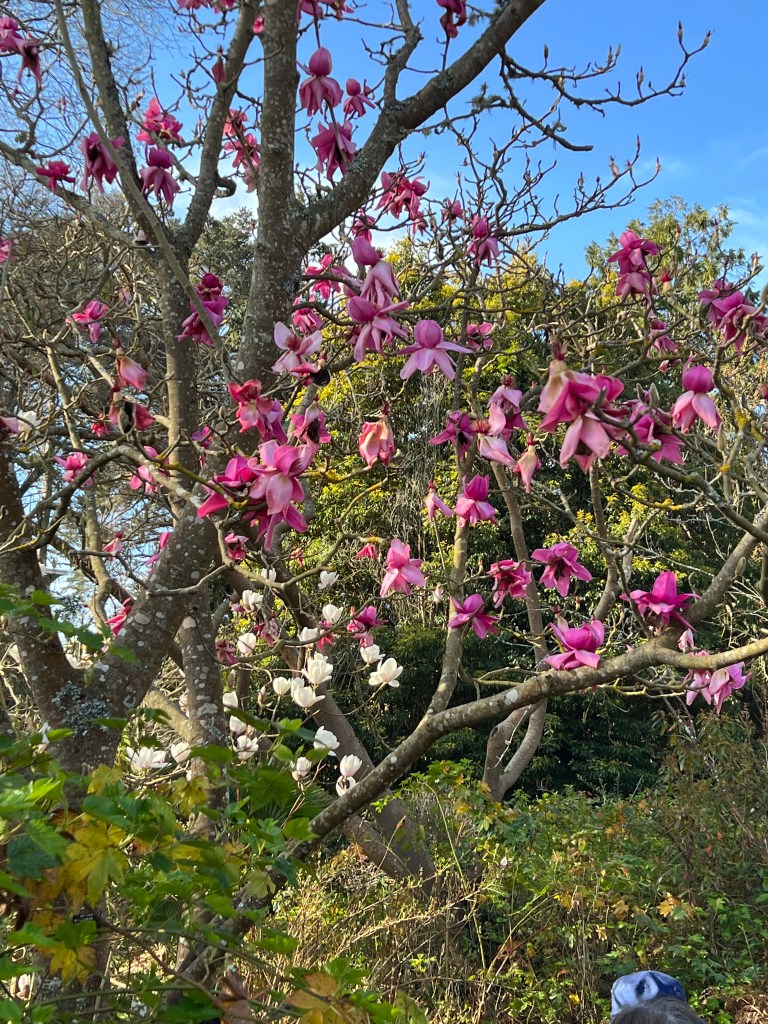
It was the best of days, it was the worst of days. Slight exaggeration but you get the idea. First stop of the day was great. The San Francisco Botanical Garden at Strybing Arboretum. In prepping for this trip, I thought the Conservatory of Flowers would be a highlight and the Botanical Garden would be ho-hum. I was wrong. As you read before, the Conservatory was disappointing. The Botanical Garden, however, was a delight. Plants and trees bloom at varying times throughout the year but there were numerous varieties in bloom today. Some at peak, some before or past peak, but enough blooms to add plenty of color throughout the garden. Add to this the interesting shape and colors of the green vegetation and the two hours we spent walking around the botanical garden were pure enjoyment.

We arrived early and while there were plenty of people also enjoying the day, it did not feel crushed. The temperature started in the mid to high 50s on its way to the low 60s with plenty of sun. Benches are scattered profusely around the walkways so sitting and enjoying the view was easy and encouraged. Magnolias and camellias were the highlights, showing off large and colorful blooms. The Garden brings in plants from similar climates from around the world and the unusual was a normal occurrence here.

The Academy of Sciences was just a hop, skip and a jump away from the Botanical Garden but a world away in terms of the crowds. This place was the big disappointment. Forget that it was crowded and over run with kids, strollers, and parents. That would have detracted from our enjoyment if there had been a reason to enjoy the facility. First, it was overpriced. Somehow, my notes had indicated the cost to enter was $6. Wrong. For seniors, the cost was $43. Per person. But my research had indicated this place was a marvel. It sounded that way. It has a planetarium, an aquarium, and a natural history section in a building that was completely renovated in 2008. A place you must experience. Certainly it must be worth the money, here too there was a line to get in.

Well, the aquarium is small and modest. The exhibit areas are also small and uninteresting. The rainforest display is rated very highly but the line to get in was as long as a line at DisneyWorld. Walking around the exterior indicated it too was relatively small. Given the other exhibits, we could not see wasting our time in a very long line for the unlikely chance of seeing a marvelous exhibit.

I know I am being harsh but we have been to all sorts of museums around the U.S. We would not put this on anyone’s must see list unless this is likely to be the only museum of its type you are ever going to visit.

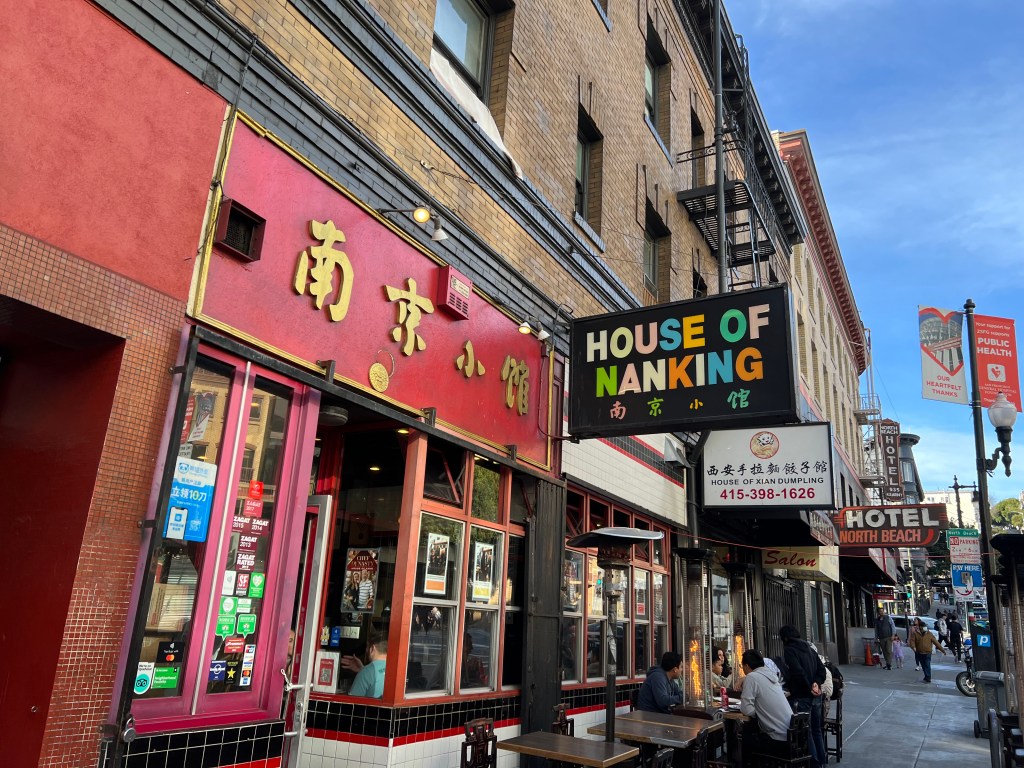
We came back and had an early dinner at the House of Nanking. This is a Chinese restaurant run by the same family since 1988. When we came back from Cafe Zoetrope and again from City Lights Bookstore, there was a line waiting outside to get in. This was in sharp contrast to most restaurants we passed which were lucky to have a few tables occupied. Luckily for an early dinner there was no wait. The food was good but not spectacular. Gee, I am sounding a bit negative today aren’t I? It is not that we did not enjoy the meal, just that it did not seem dramatically better to justify the long lines of the previous days.

Our streak of great weather will be coming to an end. Tomorrow the high will only be in the low to mid 50s with clouds and winds over 20 mph by mid day. Even cooler on Wednesday and rain by Thursday.

Ed and Chris, San Francisco February 20

Categories: travel | Tags: , , , , | Leave a comment

2023 Trip 2: San Francisco: February 19

Japanese Tea Garden in Golden Gate Park in San Francisco

Surely you have heard the phrase “The early bird gets the worm”. Well today it was “The early traveler avoids the lines”. Golden Gate Park is 1100 acres in size, 20% larger than New York’s Central Park. It is home to museums, gardens, trails, picnic areas, etc. We plan to spend two days there, the first being today. Our first stop at 9:30 AM was at the Japanese Tea Garden. In front of us waiting to buy tickets were three groups totaling seven people. When we left Golden Gate Park around 2:30 pm, the line to buy tickets appeared to be a block long with about 100 people waiting to get in.

Golden Gate Park has been described as the lungs of San Francisco, with green grass and trees abounding. Today those San Franciscans who had not headed to the Sierra Nevada Mountains to go skiing must have gone to Golden Gate Park. The runners, joggers, and bikers we saw the last few days brought their kids and were teaching them how to ride a bike. Their parents and grandparents were with them also. It made for a slow go when trying to move about the park.

The park has a shuttle service, not heavily used today. We rode it to get a lay of the land. The shuttle drives down a road that is closed to vehicles except for the shuttle. Well, the walkers were going faster than the shuttle. People were all over the road and the shuttle never used its horn but waited for people to realize the shuttle was behind them. Then the people slowly moved over. The parents with kids learning how to ride a bike never seemed to think to pay attention to anyone other than their child. People who had stopped to talk just looked at the shuttle until they finally realized maybe they should get out of the traffic lane. We weren’t in a hurry and when it was not a safety issue, it was entertaining.

On the shuttle at Golden Gate Park

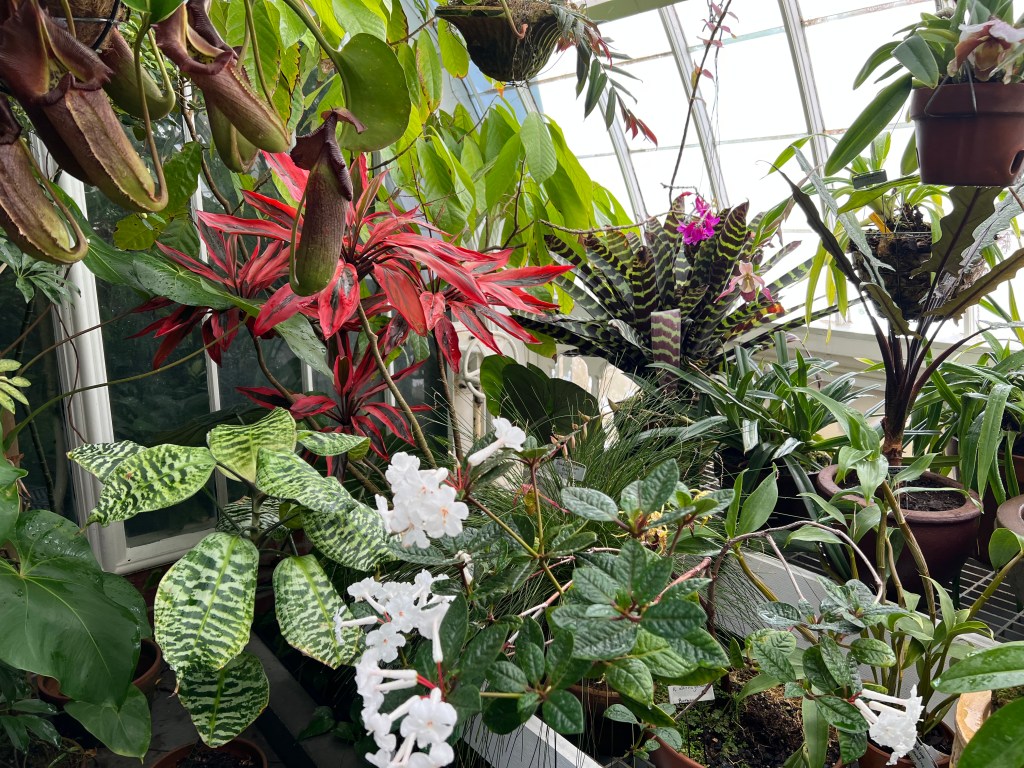
After the Japanese Tea Garden we went to the Conservatory of Flowers. It is closed on Monday so today was the day to get in. I must admit I was disappointed. Yes, it had unusual plants and a mix of types of habitat. However, it was just underwhelming. I could not find official size comparisons but the Como Park Conservatory in St. Paul seems larger, with more displays-and its free.

A few blooming flowers at the Conservatory of Flowers in Golden Gate Park

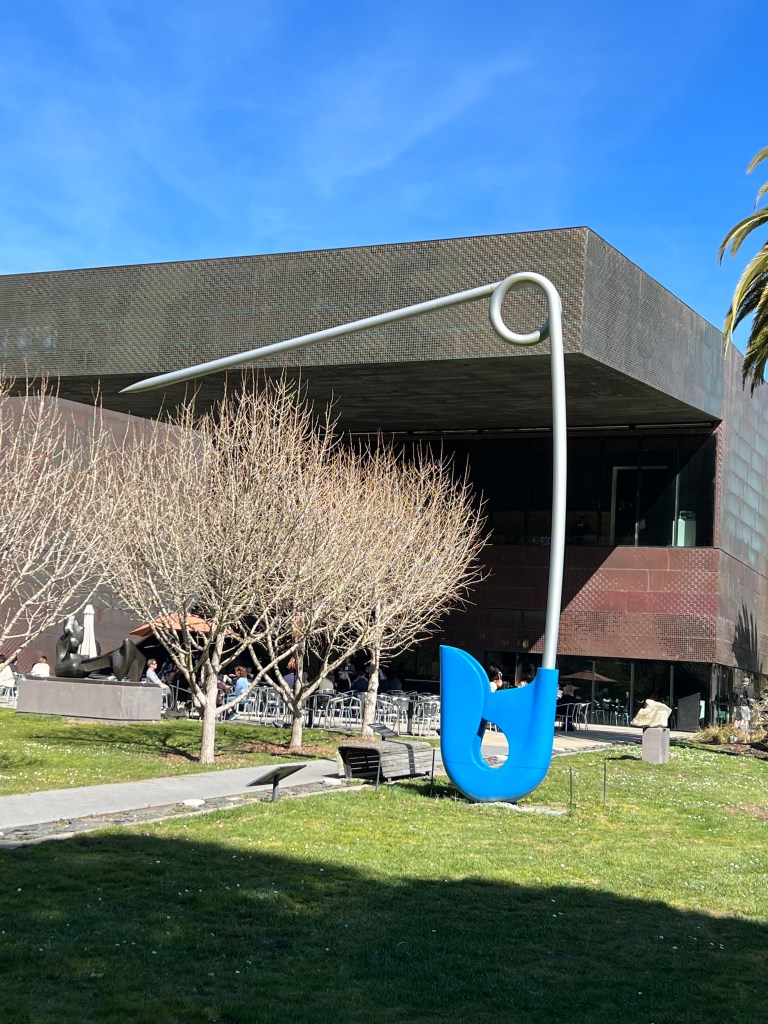
Next stop, the deYoung Museum. Golden Gate has two art museums. The de Young is also closed on Monday so it was on today’s (Sunday) schedule. The museum’s focus is on American, African and Oceanic art. The second museum, the Legion of Honor, focuses on European art. I hate to sound like I am whining but truth be told I am finding myself more tired and less energetic. Thus, going around an art museum was more of a mandated exercise than an exercise of fun. The art did not grab me. I just wandered aimlessly around the galleries. More enjoyment came from the museum’s observation tower which provided a new view of San Francisco and a delicious lunch from its cafe.

The de Young Museum in Golden Gate Park

A few photos to prove we did go into the art museum

Going back to the hotel, we fed Chris’ new addiction-Uber. I must admit, Uber was a lot easier than finding the bus stop, transferring to another bus or train, and walking the last half mile to the hotel.

San Fran today seemed much more vibrant and alive, both out at Golden Gate Park and as we walked around downtown on our way to the famous City Lights Bookstore. With a population density three times that of St. Paul, it seemed inevitable that we would finally come across that vibrancy.

Outdoor sculpture at de Young Museum in Golden Gate Park

Ed and Chris, San Francisco February 19

Categories: travel | Tags: , , | Leave a comment

2023 Trip 2: San Francisco: Feb.18

San Francisco, February18, Saturday

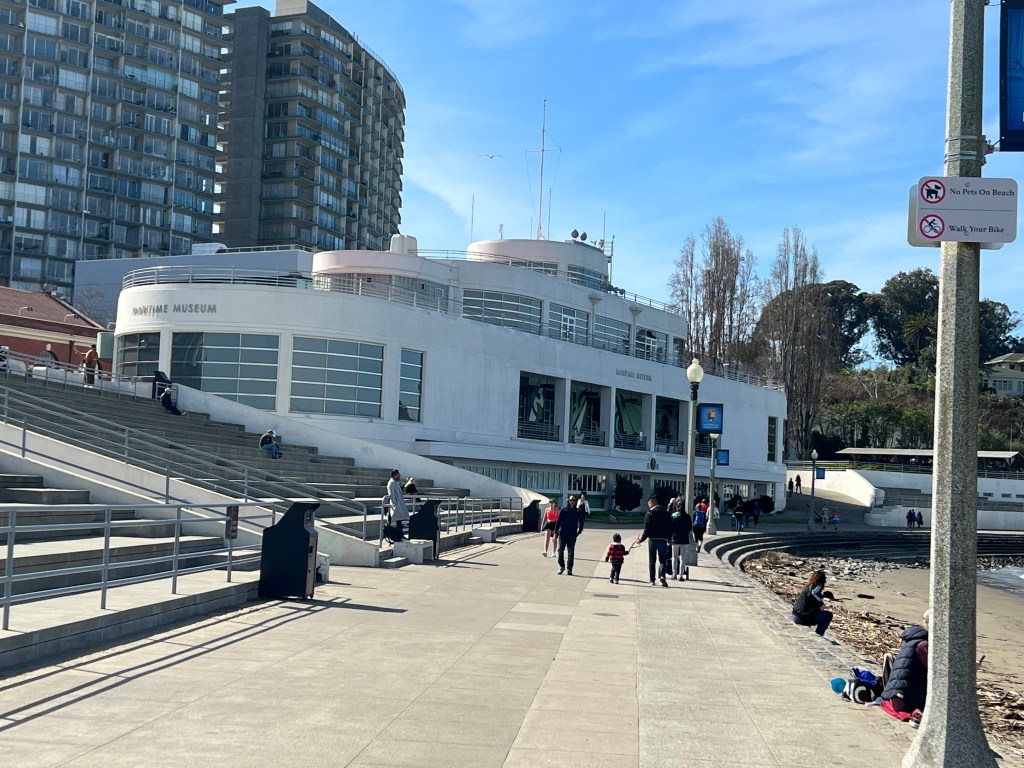
This is Presidents Weekend and the tourist areas were busier than the previous two days. Still mainly sunny and people were out enjoying the day. We upped our touristy quotient by visiting the Fishermans Wharf area. We took an Uber up to the San Francisco National Maritime Museum Historical Park area and walked around for an hour and half since we got here at 9 and many places were not yet open for business. We walked and sat and enjoyed the morning. For us, it was a more relaxed pace than usual, with a mid-morning pastry break and an early afternoon ice cream break.

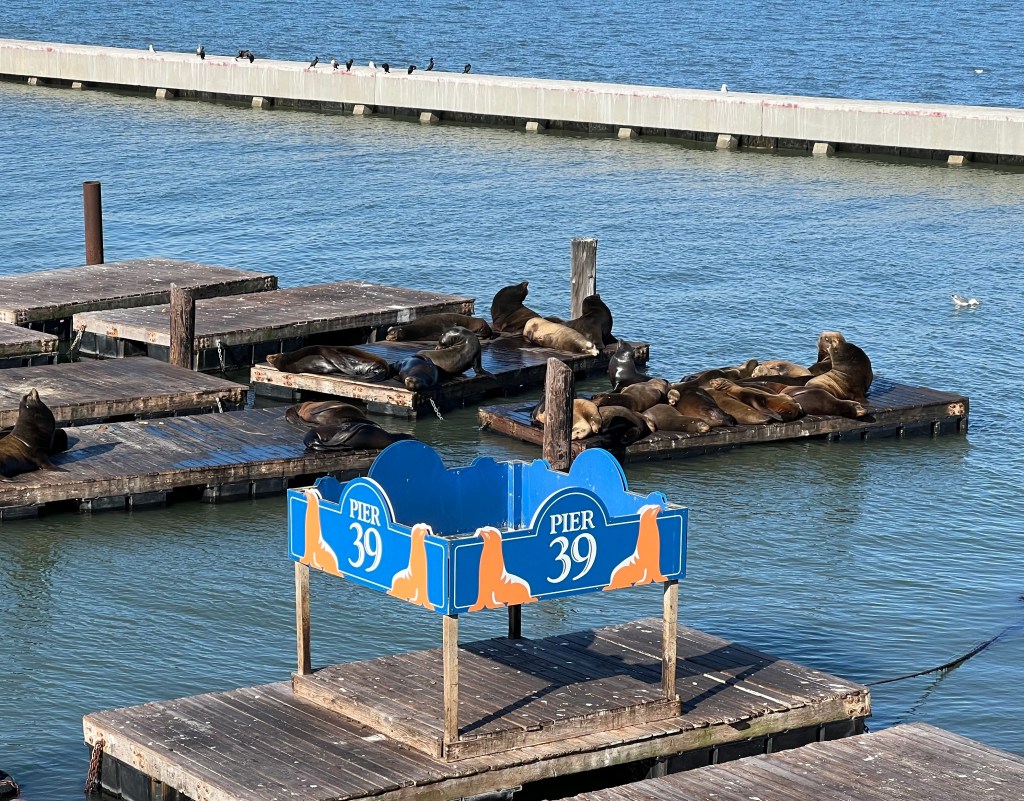
People and scenery watching were good. Besides the usual joggers, bikers, and walkers, there were about half a dozen people swimming in the water off the cove by the old Aquatic Bathhouse. A few sailboats were in the water, we did see more by the middle of the afternoon. Several guys were out selling fresh caught crabs to anyone who was interested. The sea lions were entertaining a crowd at Pier 39.

As a side note, there is a much higher percentage of people here wearing face masks. Interestingly, when you see a couple of people together, one might have a mask while one does not. There is also a very high percentage of people obeying the “Walk, Don’t Walk” lights. I guess there are not any visitors from Boston or D.C. here.

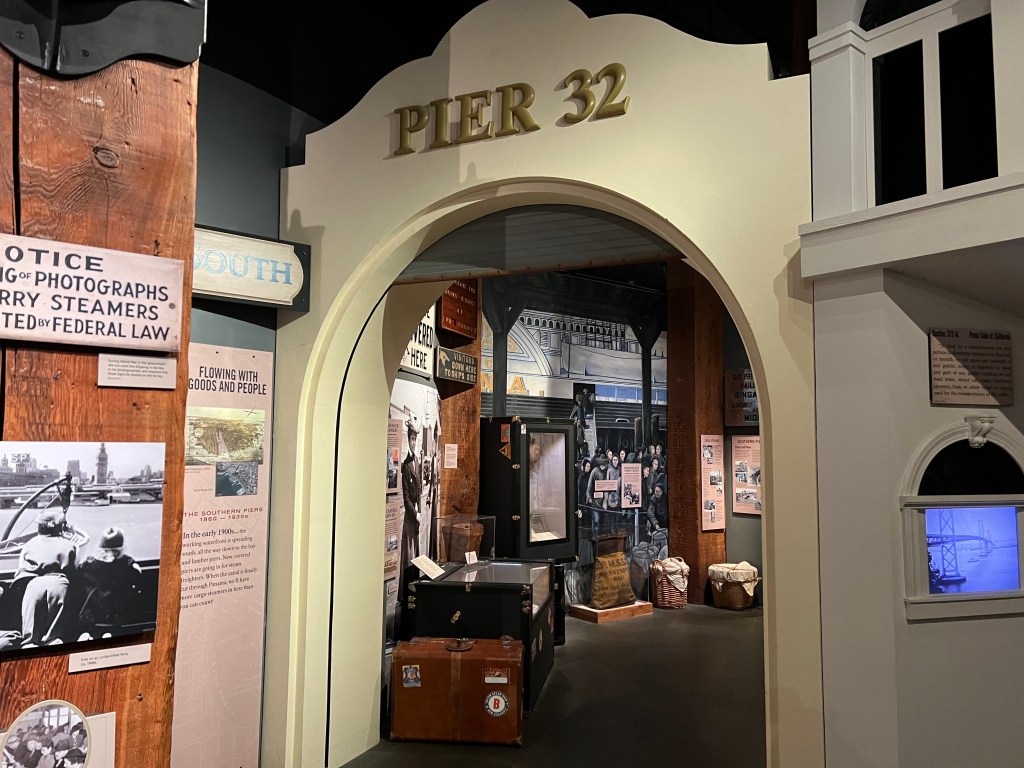
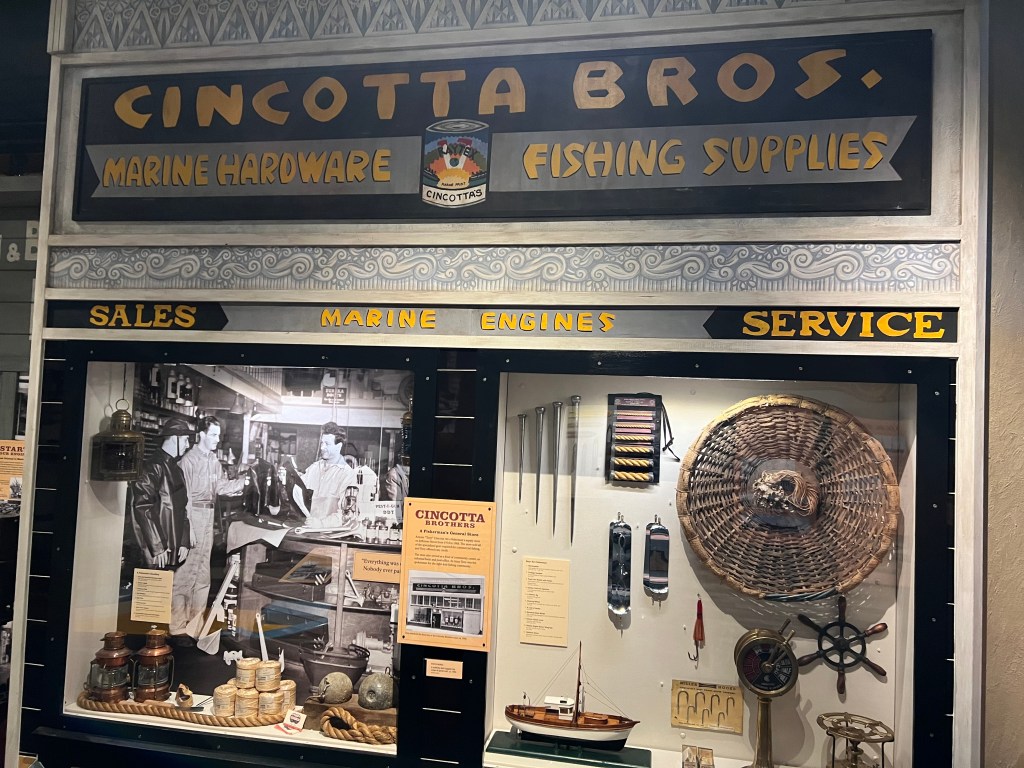
We only visited the two buildings associated with the National Park Service’s San Francisco Maritime National Historical Park. One building was based in an old cannery and had the bulk of the exhibits and videos-but no bookstore. The exhibits told the story of San Francisco from its sea perspective. The vast majority of new arrivals came by boat; land routes were practically non-existent and the railroads came at least 20 years after the gold rush. Even after railroads arrived, San Francisco had a western perspective with trade to China, Japan, Alaska a major economic driver.

The exhibits demonstrated how various sections of San Francisco were tied to different economic drivers, such as lumbering, fishing, ship building, cargo handling, etc. Historic vessels are available to be examined. New technologies kept disrupting the status quo but San Francisco has managed to thrive.

Among others, we discovered: how rivers feeding into San Francisco Bay allowed travel far into central California; how the gold rush led to numerous ships being abandoned in the harbor as sailors went searching for gold and the ships sank to the bottom and today lie beneath the buildings of the Financial District; and how container ships pushed cargo from San Francisco to other cities like Oakland and San Diego that had more land available to store the containers until loaded onto railroads.

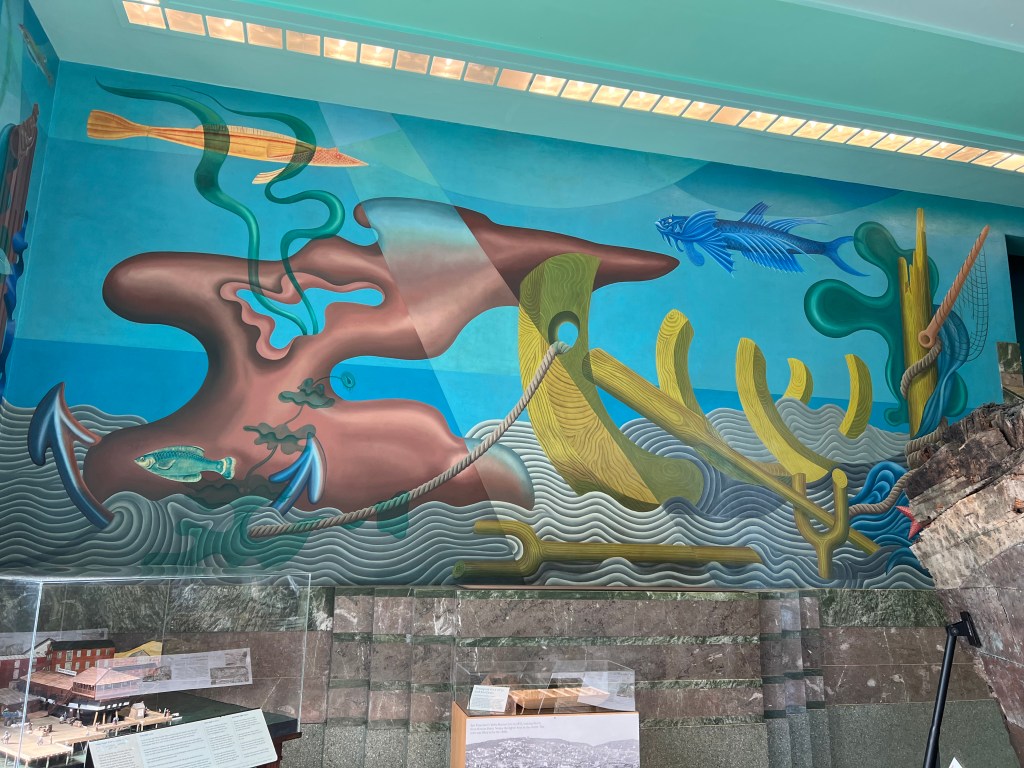
The second NPS building was the renovated Aquatic Park Bathhouse. Built by the WPA during the period before WWII, it has had a sorry history. The city leased the building to private casino operators rather than making it open to the public. WWII saw the facility used as headquarters for various military groups. After the war, part of the building was used as a senior center but much of it sat vacant until a maritime museum was established in the building. In 1998 the San Francisco Maritime National Historical Park was established and the museum in the old Aquatic Park Bathhouse was added to the park.

The NPS has renovated part of the building with more to be accomplished. The murals constructed by WPA artists gleam. Models of various types of ships are enclosed in glass cases. A highlight of their display is the 19 foot sailboat Mermaid used by 23 year old Kenichi Horie in 1962 for the first solo voyage from Osaka to San Francisco. He left Japan in secrecy but was a hero by the time he made it to San Francisco. Horie went on to make numerous solo voyages. In 2022 at age 84, he made the trip from San Francisco to Japan becoming the oldest man to sail solo non-stop across the Pacific.

The cable car was our transportation option to get home. At $8 per ride per person, it seems to be mainly used by tourists. There was a long line to get on the Powell Hyde line and a transit ambassador helped us navigate the way to the Powell Mason line that also goes to Fishermans’s Wharf. The wait here was much shorter. There was a service glitch and the line could not bring one all the way to the downtown end but would end in Chinatown. This was great for us, Chinatown is basically where our hotel is.

We went to church at Old St. Mary’s Cathedral in Chinatown. All during the service we heard Chinese music playing on the sidewalk outside the church. The pastor happened to be in the back of the church when we arrived and in talking to him, found out he used to live in Minneapolis when he was the pastor of the Newman Center at the University of Minnesota.

Dinner was Italian at Mangia Tutti, not far from our hotel. Everyone working there seemed to be family members. Good food.

Ed and Chris, San Francisco, February 18.

Categories: travel | Tags: , , , | Leave a comment

Blog at WordPress.com.