Follow Ed Heimel and Chris Klejbuk as we explore the USA and Canada. Trips began in 2013. See sidebar. Since Jan. 2013, over 220,000 miles traveled and 1100 days on the road. Over 700 blog posts written. 2023-We are closing in on 350th National Park unit. Photo below is Pacific Ocean by Big Sur, CA
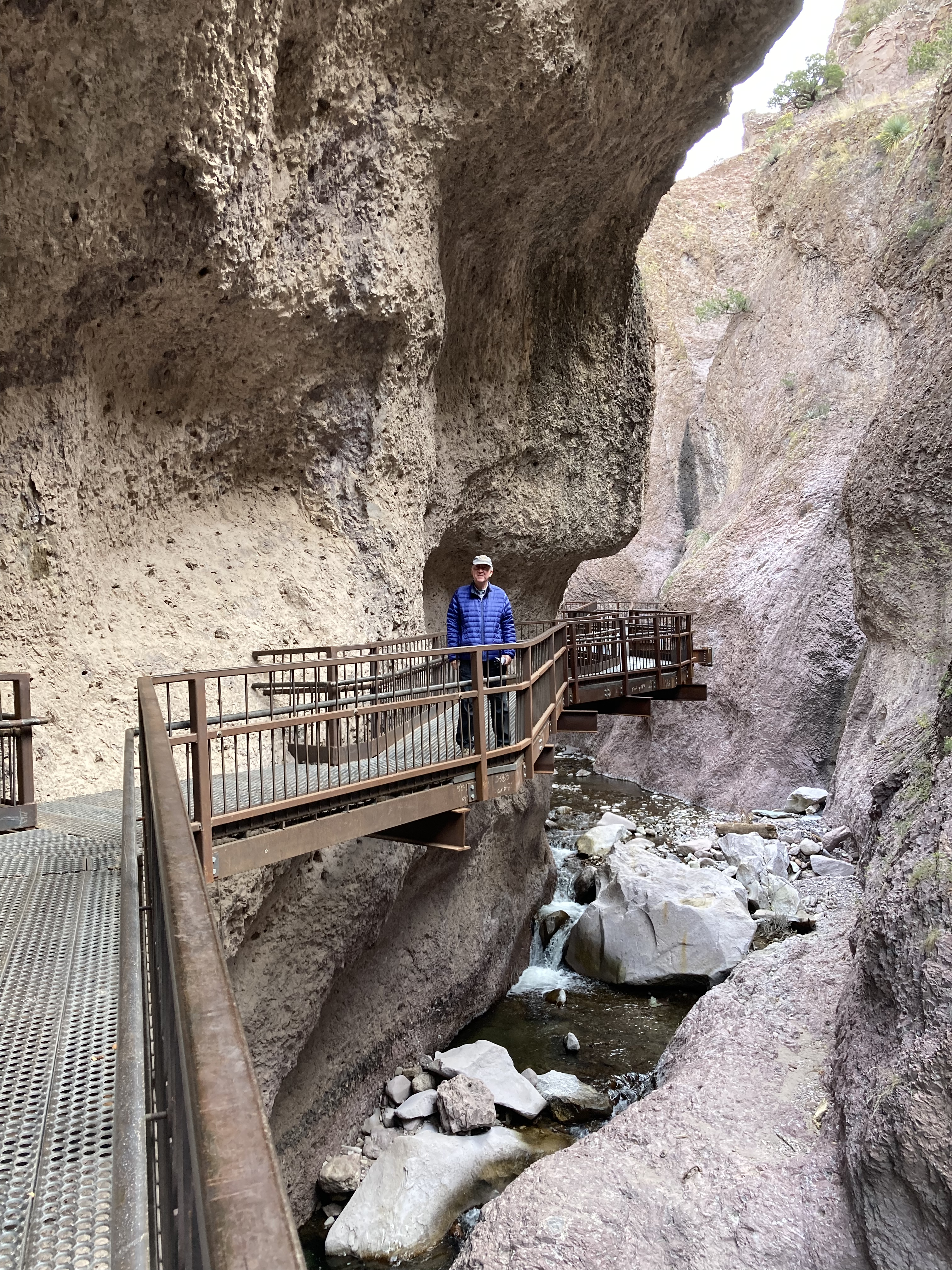
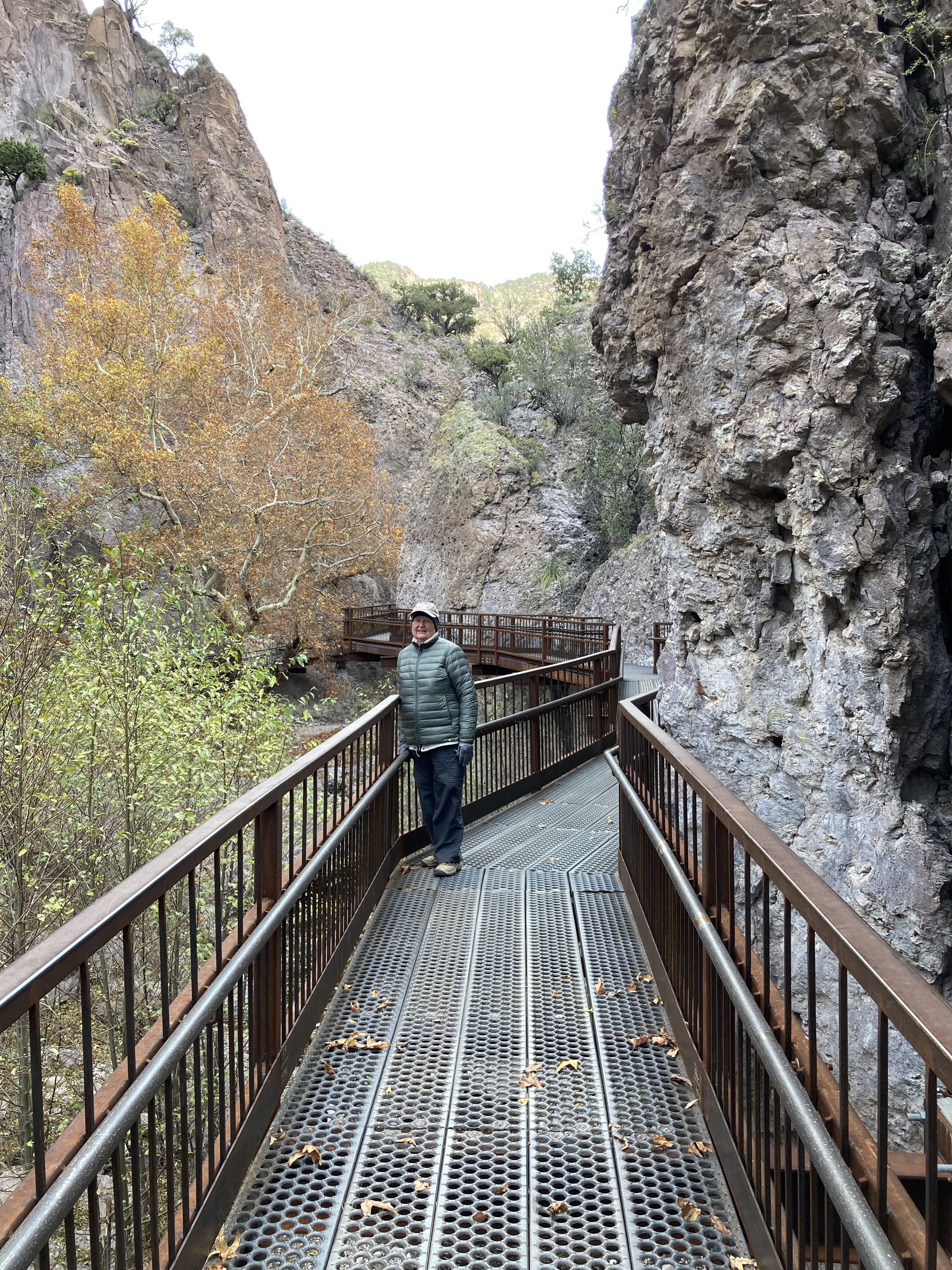
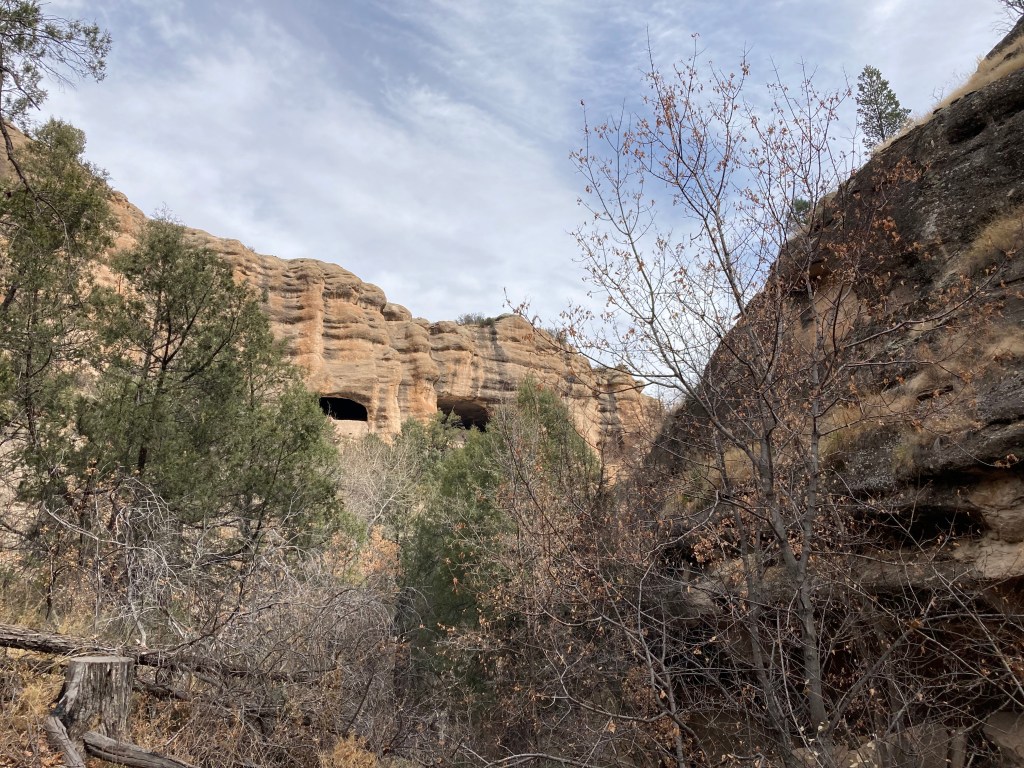
Just a quick note and a few photos. We made it to Flagstaff Arizona for the Thanksgiving week. Monday was meant to be basically a straight driving day. Travel literature picked up in Silver City NM mentioned an location called ”The Catwalk”. It was just a 5 mile detour off our planned route so we decided to give it a try.
The Catwalk dates back to the mining days of the late 1800s. The geology and topography of this area of New Mexico were impacted by a caldera formed by a series of volcanic explosions. This is evident by the bowl shaped region and by the volcanic rocks along the walls of the canyon. Gold discovered in the mountains above this canyon presented difficulties in operating a mill to process the gold-a lack of water. Resolution was to construct the mill at the end of the canyon below the mines and construct a water pipeline from water sources higher in the mountains down the canyon to the mill.
The catwalk and whitewater canyon
The bolts used to attach the water pipeline are still evident in the sides of the canyon. The mill only lasted 10 years. In the 1930s, the CCC installed a wooden recreation trail along the canyon. In the 1960s, the U.S. Forest Service installed a metal railing and upgraded it in 2003. This is what we walked along. The brief delay and short hike were well worth the extra 40 minutes in travel time.
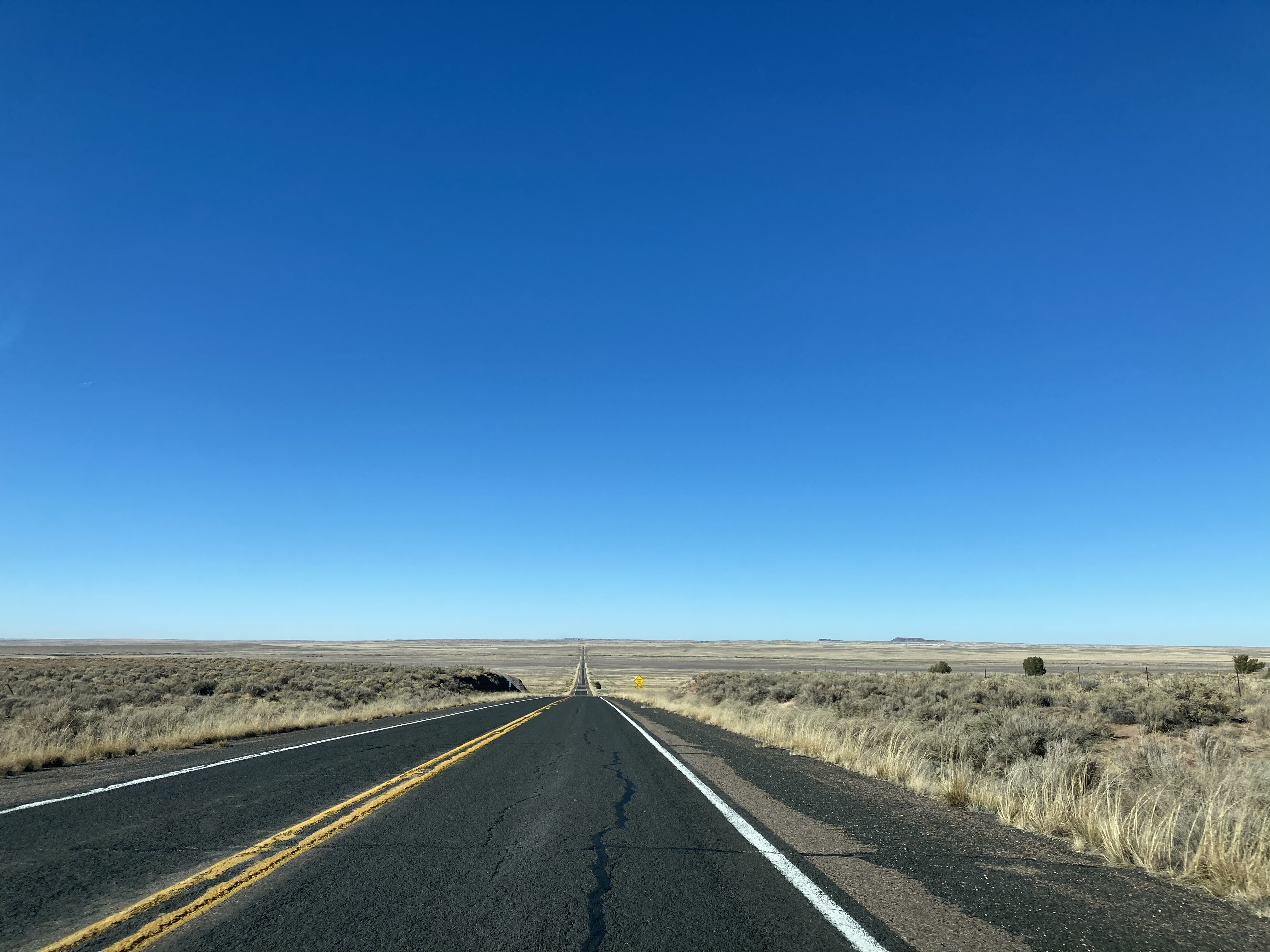
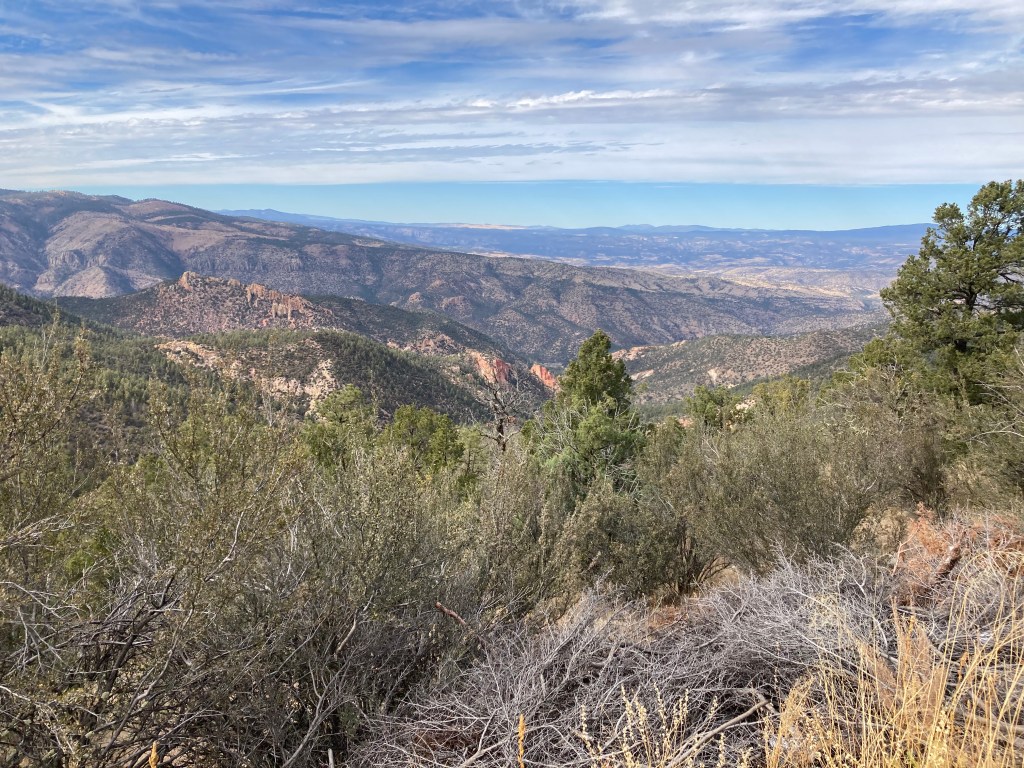
The rest of the trip was uneventful. Pleasant mountain and desert scenery. We passed previous travel attractions such as the NPS Petrified Forest, the town of Winslow, and Meteor Crater. We will be in Flagstaff for the next week.
Where the mill was located, the beginning of the hike to the catwalk
We are still here. A famous saying now for Native Americans. Appropriate for today’s activities, the trip up to Gila Cliff Dwellings National Monument. Actually a more accurate term, or terms, would be up, down, around, repeat. The elevation at the actual cliff dwellings is not much higher than Silver City New Mexico. It is just that the road to reach the National Monument goes over and around numerous mountain ranges.
I am not sure who is responsible for the signage on the road. I imagine the State of New Mexico since one drives NM 15 to get there. The road had been recently resurfaced and line striping had not yet been completed. But my wonderment goes to two items. First, some times, but not all of the time, maybe not even most of the time, there is a road sign warning you of a very sharp curve or need for a lower speed. How the state determines which very sharp curves deserve a warning sign and others do not is beyond me. Second, there are frequent warning signs that the road is not snow plowed at night or on weekends. Now nights I understand. Dark and dangerous for the snow plow operator. Don’t want them plunging over the cliff. But other than overtime cost, why not weekends? Nobody goes to church here? I mean it is 25 miles with many homes and businesses. Oh well, not my problem.
The drive to Gila Cliff is a scenic byway called ”Trail of the Mountain Spirits”. The road goes through the Gila National Forest and Wilderness. Forested hillsides show differing tree species at different elevations. Steep mountain cliffs and steep abysses alternate on either side of your car.
Gila River flowing near Gila Cliff Dwellings National Monument
We drive over the Gila River which had more running water than the Rio Grande. Heck, even Cliff Dwellings creek had more water than the Rio Grande.
Hiking the trail to the cliff dwellings
The hike to the actual cliff dwellings is only a mile loop trail. It is rocky with numerous steps, elevation gain of 200 feet. Got a little winded but quite a doable hike. This NPS site was busy for its small size. Half a dozen cars at the visitor center and maybe two dozen at the trailhead.
At the cliff dwelling
These cliff dwellings were only occupied for several decades, from about 1276 to about 1300. The year 1276 is carbon dated to the tree limbs used in the construction. This time period also correlates to a long period of drought in the Southwest. The springs, creek and river in the immediate area may have been able to produce enough moisture that this area was a haven for the Mogollon Puebloans who moved here.
The Chiricahua Apache lived in this area at least by the 1500s. Spanish explorers are not known to have reached as far as the cliff dwellings. It was not until prospecting in 1878 that settlers discovered the dwellings and looting of artifacts followed. The Apache were forcibly removed by 1886 and additional settlement occurred at that time in the valleys to the south and southeast of the dwellings. In 1907 the national monument was created to protect the remaining archaeological ruins.
The scenic byway took us back to Silver City by a new route. This route followed the Mimbres River, an area south and southeast of the cliff dwellers. It was occupied by a sub-group of the Mogollon called the Mimbres. They lived along the Mimbres River from 550 to 1140 C.E. predating the cliff dwellers. They are well known by a distinctive black and white pottery style.
This land would have been occupied by the pit houses and pueblo villages of the Mimbres
One particular location along the Mimbres River has been studied since 1883. Our scenic byway took us to the site. Their museum was closed but visitors are still able to walk the site. Outdoor exhibits allow one to visualize how their villages would have appeared. They seem to have moved from the area by 1140 C.E.
Typical design of Mimbres pottery
We returned to Bear Mountain Lodge by 4 PM, a seven hour round trip day. Dinner was again at the lodge and was equally tasty as Saturday night.
Saturday was a time to leave the beaten path behind and explore history and beauty along a scenic byway. It ended up being a relaxing day filled with pleasant, unplanned surprises. The end goal was to reach Silver City, NM, about a two to three hour drive depending on which route we take. Silver City will be our lodging for two nights. Sunday we head up to Gila Cliffs National Monument. The road to Gila Cliffs is twisty and mountainous and we have been advised to plan for two hours to reach it from Silver City. So, two hours to reach it, two hours to visit it, and two hours to get back again. In effect, a full day experience.
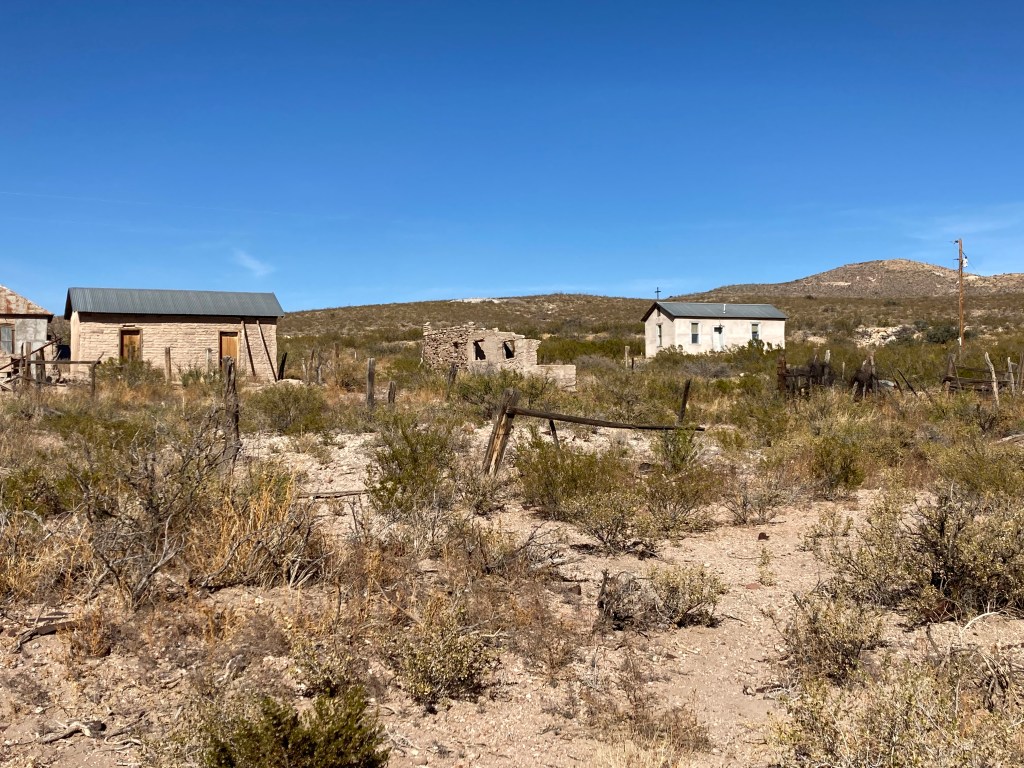
But first we had to reach Silver City. The Lake Valley Back Country Byway is sponsored by the Bureau of Land Management (BLM). It runs through ranching territory, old and new mining areas, mountainous forests, and an abandoned town. At the start of the byway, we passed wind turbines and solar farms. Those gave way to pecan farms and cattle ranches. Soon we reached Lake Valley, a once thriving mining town. In much of this area, a silver boom in the late 1800s collapsed when silver was devalued in 1893. Overnight, the economics of silver mining changed. Lake Valley became deserted.
Lake Valley Historic Townsite
BLM sponsors a museum at Lake Valley that was open. However, the volunteer docent was nowhere in sight although it seemed their RV housing right behind the museum was occupied. In any event, we were able to view the museum and walk around the few buildings that were still here. Despite the museum and signs, it was hard to imagine this area as a silver mining hotspot. The ranches that proliferate here among low lying hills appeared to be the normal way of life.
As we left Lake Valley, we passed through land where Apaches and outlaw bands roamed. The stage coach and railroad spur to the mines had to be protected by the U.S. Army. We reached Hillsboro, a community of 184 people that dates back to those days. Luckily for Hillsboro, its mining was more than silver and though Hillsboro may not have prospered, it survived. There was a small farmers market here and we stopped to read a historical marker. Across the street from the marker was the Black Range Museum. It was open. We stopped in.
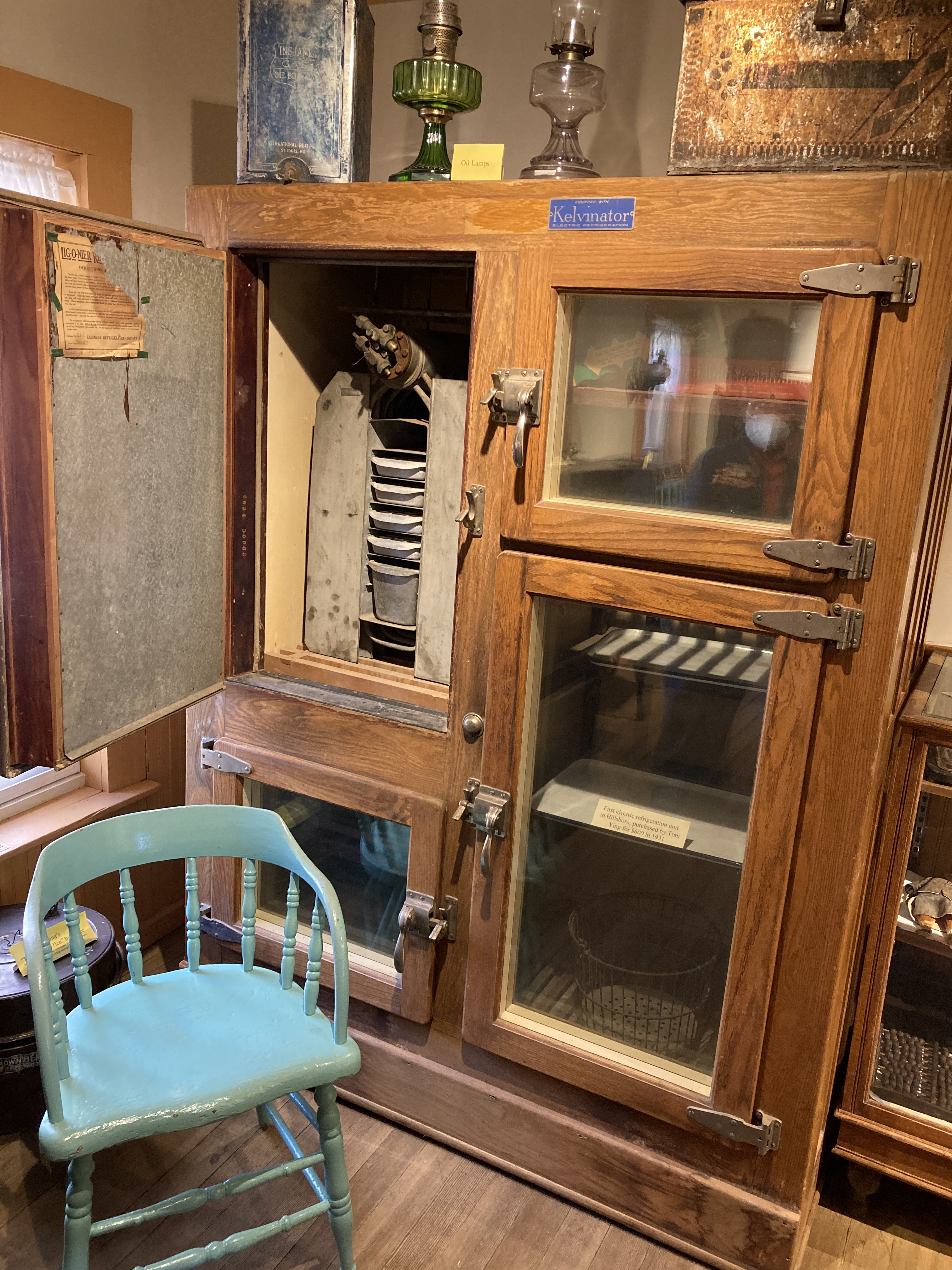
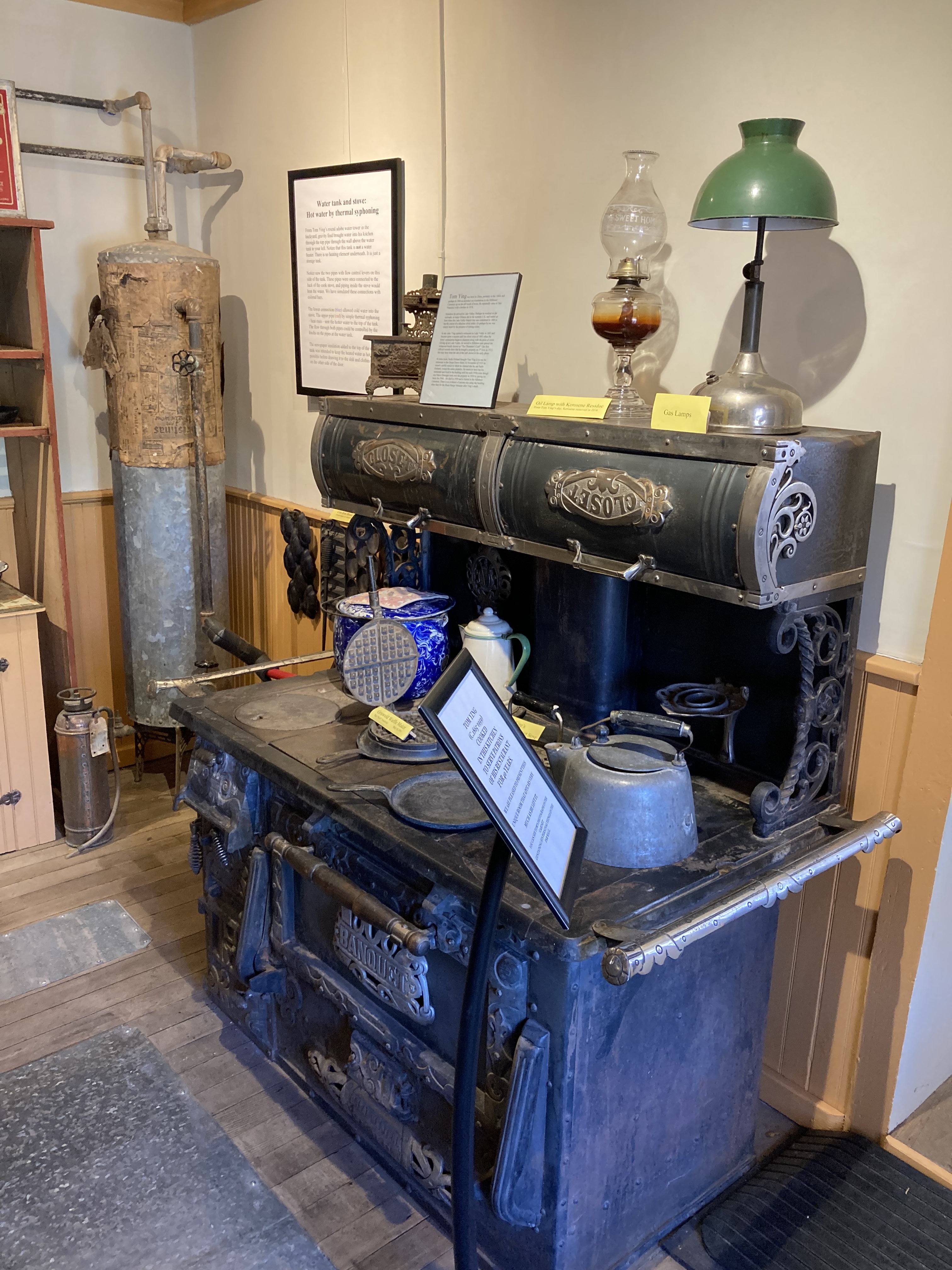
One of the docents gave us a wonderful tour. The museum building once housed Sadie Orchards Ocean Grove Hotel and Tom Ying’s restaurant. Both of them were fascinating characters. Sadie was a strong woman, of whom it was once said: ”For a bad woman, Sadie was one of the best.” Sadie drove a stage coach, ran the hotel, operated a brothel and was a prostitute, among other occupations. Tom Ying was Chinese and immigrated prior to the Chinese Exclusion Act. He operated the restaurant in Sadie’s hotel for decades. Pictured above are the refrigerator and stove he used. The refrigerator was the first electric refrigerator in Hillsboro and came with an ice maker.
After the tour, and a short stop at the farmers market, we drove on to Silver City. This 58 mile drive took us two hours as the hairpin turns, mountainous ascents and descents, and sharp curves required a slower travel speed. At Emory Pass, 8700 feet, we stopped for a quick lunch and numerous photos. The wind was so powerful we passed on sitting at the picnic table with a great view to eat in the car. We did not want to get blown over the side of the cliff.
Emory Pass is on the southern edge of the Gila National Forest and Wilderness area. For ecology folks, this was the first wilderness area in the United States. This wilderness area was created in 1924 primarily through the work of Aldo Leopold.
Santa Rita Mine
Leaving Emory Pass, we drove by another one of those huge mining sites we seem to frequent. The Santa RIta mine operates 24 hours a day, 365 days per year. Grant County, where the Santa RIta is located, has been the most important metal producing county in New Mexico. Native Americans were mining copper here before the Spaniards arrived. In 1853 the Gadsden Purchase transferred control of this area along with a swath of land over through Arizona to the United States from Mexico. This land transfer gave the U.S. huge mineral deposits and a path for a southern route for a transcontinental railroad. The Santa RIta was one of the first open pit copper mines in the U.S. It is huge. Similar to some other mines, as the ores were extracted, the new veins of ore extended underneath the city of Santa Rita. Eventually the town was bought out and disappeared.
Bear Mountain Lodge
Silver City also had mining back in the 1800s but today tourism, higher education, and servicing the surrounding areas keeps the town functioning. There is a thriving arts community here. We are helping the tourism sector survive. Our lodging is at the Bear Mountain Lodge, an establishment that dates back 90 years. The lodge has comfortable rooms, great food (our dinner tonight was excellent) and 180 acres of land on the edge of the Gila National Forest.
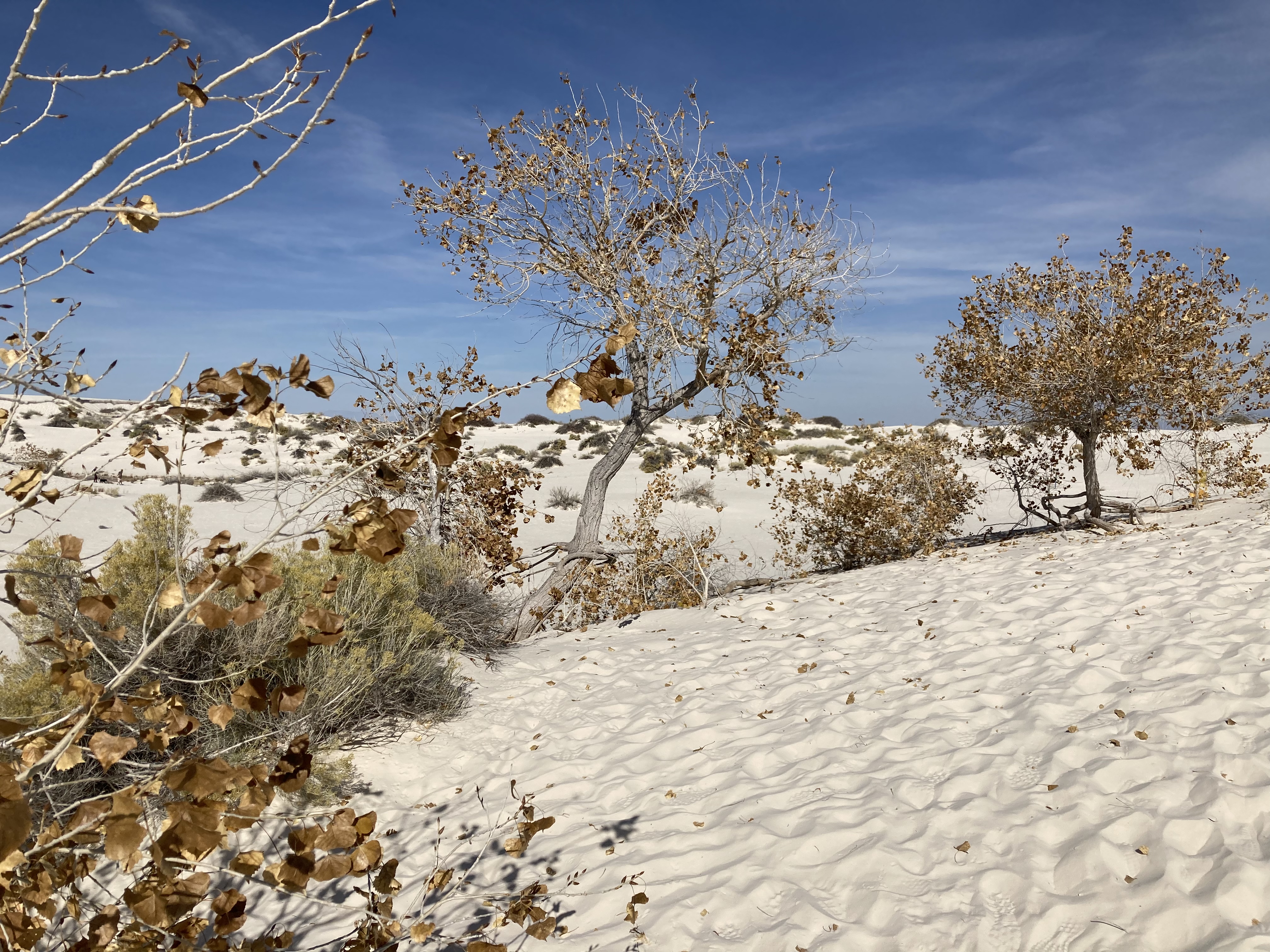
White Sands National Park exceeded our expectations. Previously we have been to Great Sand Dunes National Park, Imperial Sand Dunes Recreation Area, Sleeping Bear Sand Dunes National Lakeshore, and Oregon Dunes National Recreation Area. Were these New Mexico dunes really going to be any different? We would vote yes.
As always, we stopped at the visitors center (right as it opened), saw the movie, looked at displays, picked up the park brochure, and used the restrooms with running water. Walking in deep, soft sand is taxing. No need to come home with aching legs so our pre-planning had three short hikes on our list to experience the park. Walking on a raised boardwalk was an easy decision. It gave us an overview of the terrain while showcasing some of the plants that are able to live in the sand.
Just like a winter’s day driving in snow
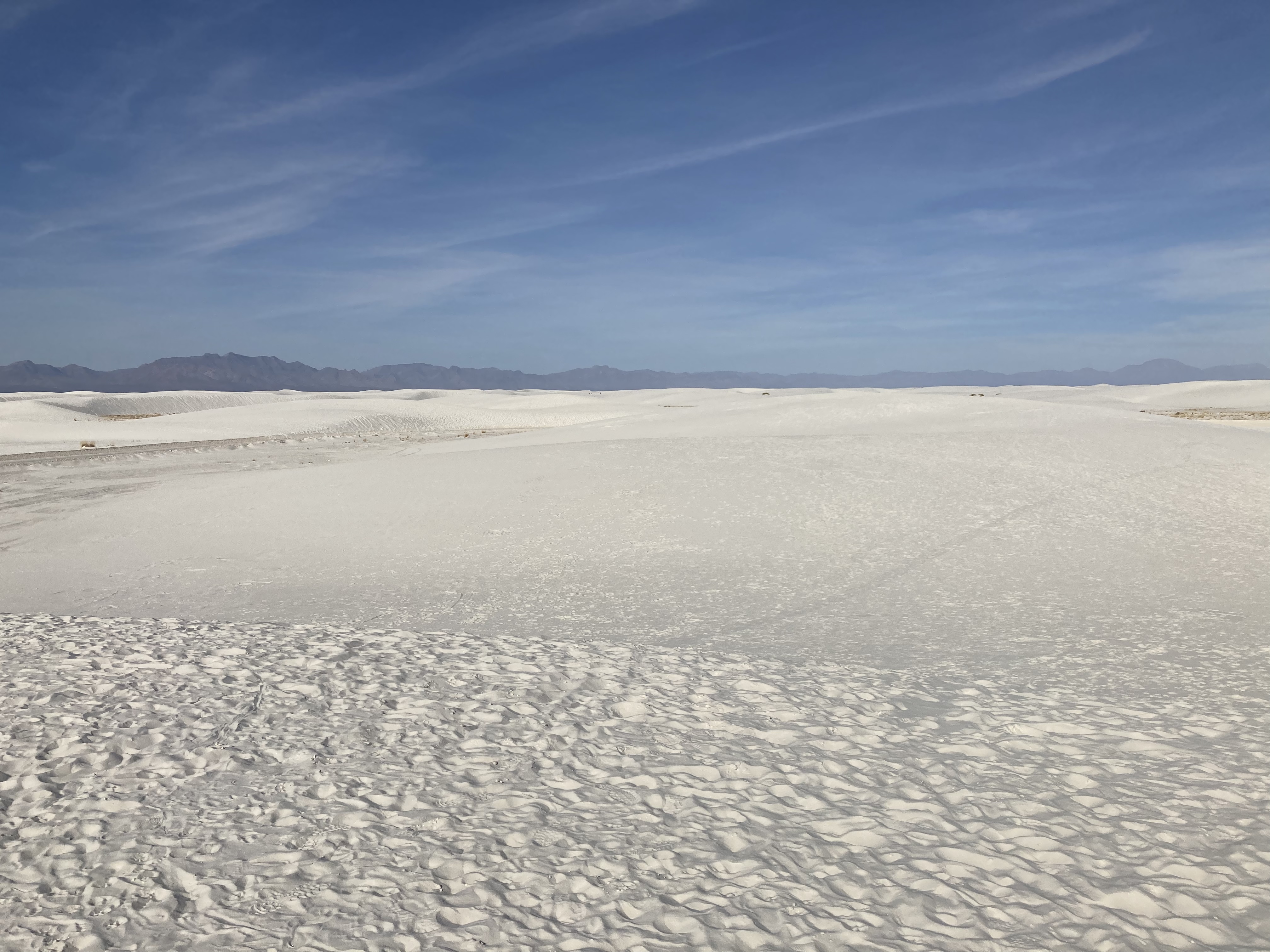
As we drove further into the park, off the paved road and on to the hard packed sand road, I had flashbacks to driving on frozen lakes in Minnesota. ”Snow” was piled up on all sides, the sun glared on the brilliant white, and a grader was clearing the road. Except the ”snow” was sand. The sand at White Sand Dunes is gypsum, laid down millions of years ago when an inland sea covered this area. Over eons, the gypsum layer was uplifted by mountains and then eroded down into this basin which has no direct water outlet. Wind and water repeat the process, making sure the gypsum crystals are broken down into small and smooth grains. Strong southwest winds produce dazzling white sand dunes.
As in all deserts, animals and plants adapt to the harsh conditions. While some dunes are completely clear of vegetation, other dunes have a variety of plants and shrubs that survive. These micro oases will harbor the animal life that normally comes out at night.
Before taking hikes two and three, we drove further into the park. Stopping several times, we climbed a number of dunes to observe the varied dune shapes, background vistas, and plants. The whiteness was stunning. On a day with beautiful blue skies, the combination was spectacular. In many directions, the surrounding mountains added extra dimensions. The wind was light, so there was no sand blowing in your face. The temperature was in the 40s and 50s, so the sun felt warming while the light breeze kept you cool. Why would someone climb these dunes in summer when the temperature can be over 100 degrees?
Hike number two took us to a playa, a shallow basin that holds water for a portion of the year-an ephemeral lake. Water run-off from the mountains stays in the basin, frequently only a few inches to a few feet below the surface. This high water table is a factor in plant growth and sand stabilization.
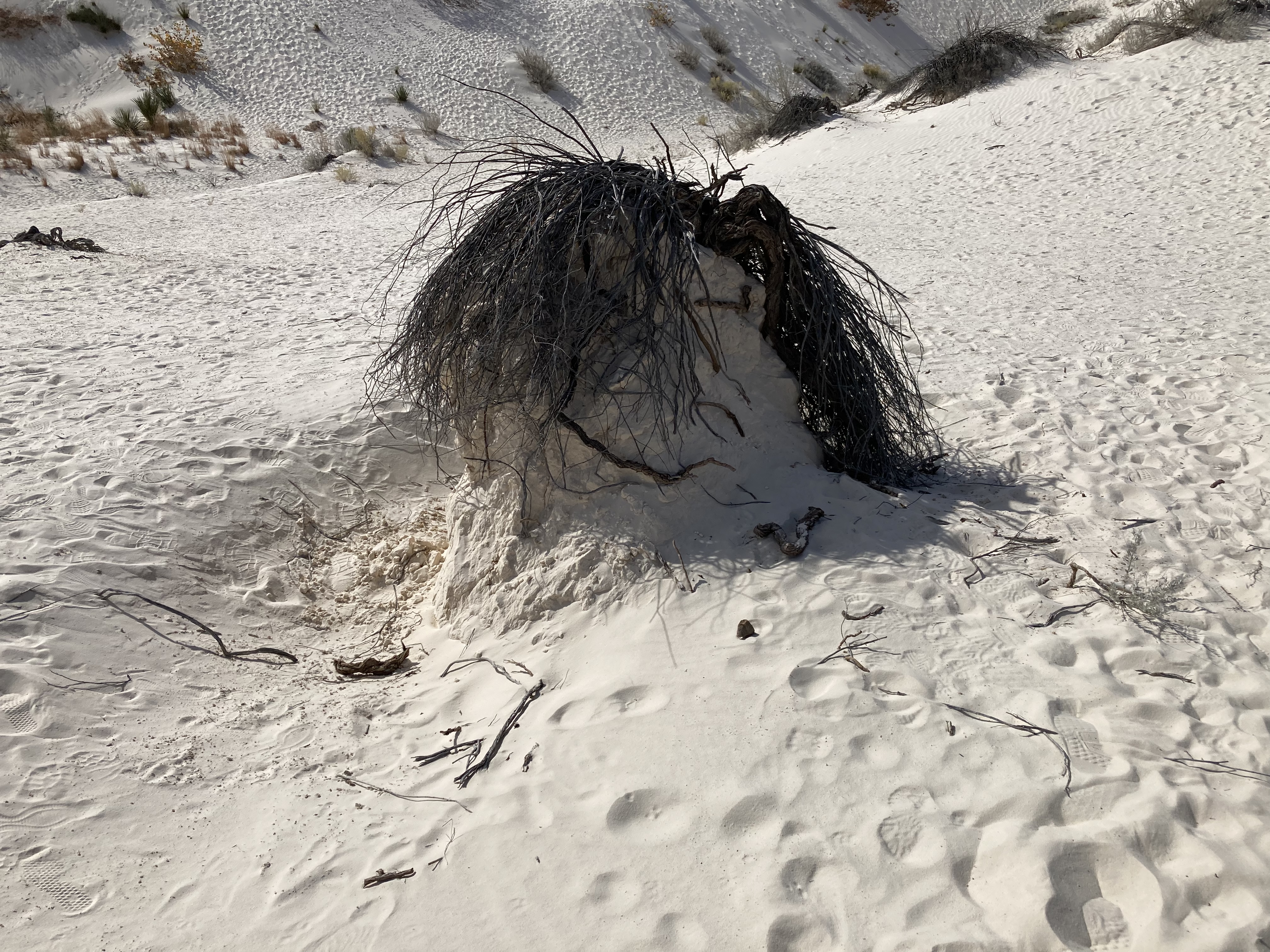
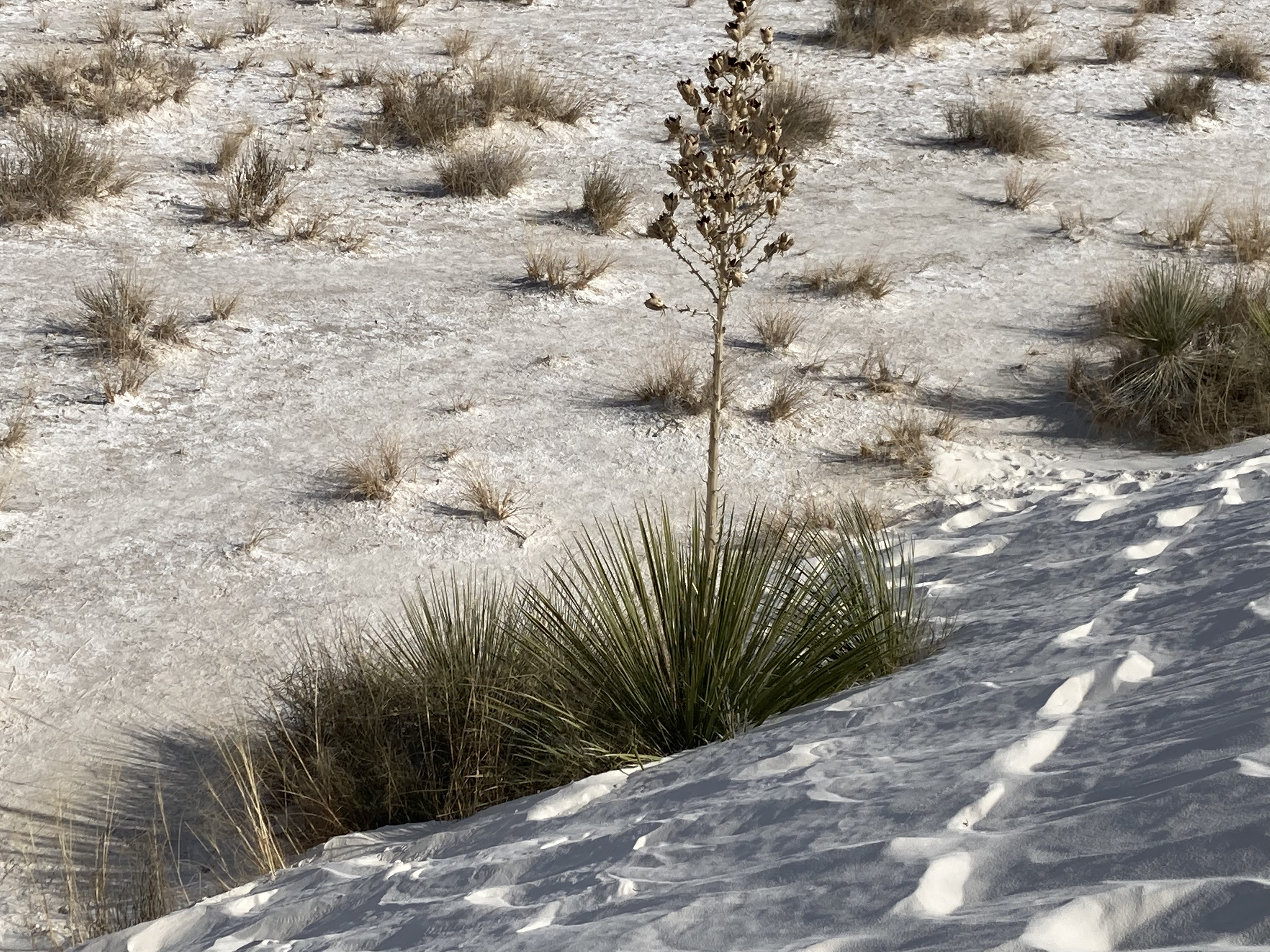
Hike number three was a mile long and took us up and down several dunes. This hike created greater opportunities to scrutinize plants. Of particular note was one plant whose roots go down deep and by some process I forget, hardens the sand to create its own mound. Yucca plants that grow a tall flowering stem to protect itself from increasing sand dunes falls apart when the drifting sand moves on leaving the tall plant unable to support itself.
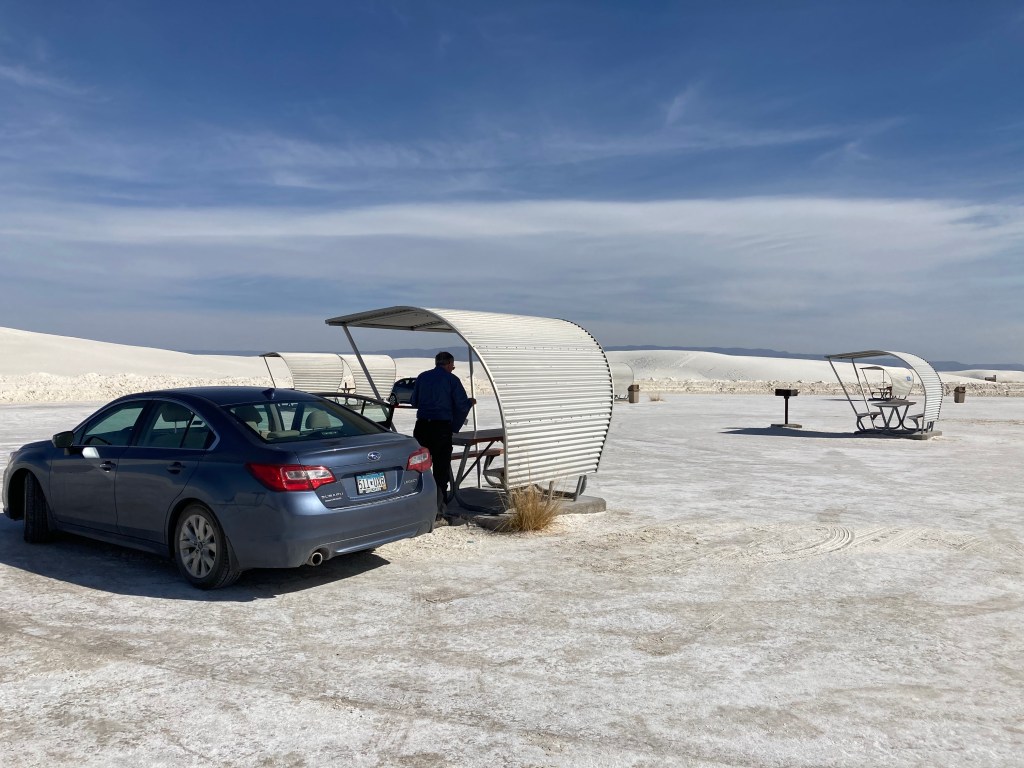
Picnic shelters
We wrapped up our time at White Sand Dunes by having lunch at a picnic table sheltered by an innovative shield to block winds. Still, with the white sand dunes all around us, we felt we were eating in the middle of a snow field.
The interior of the elevator at New Mexico Museum of Space History
Unfortunately, our second stop of the day was a let-down. The New Mexico Museum of Space History was chosen due to the history of missile and space endeavors in New Mexico. It is located on the campus of New Mexico State University-Alamogordo. We knew it was undergoing some renovations and interactive displays were inactive. However, our dismay was due more to outdated exhibits, some exhibits way too technical for us, and overall it was a pale image of other space and aeronautic museums we have visited. Oh well, nothing ventured, nothing gained.
The dunes at White Sand Dunes National Park in New Mexico
Ed and Chris, Las Cruces NM, Friday November 19, 2021
In the space of 10 hours, we went from areas almost deserted of people to extremely dense communities. It was a day of contrasts. Leaving the Fairfield Inn of Carlsbad, we drove to Guadalupe Mountains National Park. In western Texas, just below the border with New Mexico, the Guadalupe Mountains, rising steeply from the plains, are the remains of an ancient marine reef, uplifted over time. 47,000 acres or half of this park is wilderness. There is no scenic drive or criss-crossing the park on paved roads. Given its location away from major interstates, even the non-wilderness areas are not crowded. The park visitor center had a limit of 6 people at a time. Was not a problem when we arrived.
Since we are past the point of even considering back packing into the wilderness, we undertook two morning hikes that would give us a flavor of the park. The hikes presented some history of the area and a view of the varied plants that exist in this arid, mountainous land. We kept our hikes to the area around the visitor center. The park visitor center is at 5700 feet although Guadalupe Peak at 8751 feet is the highest point in Texas. The temperature was 40 degrees but the wind was gusting so hard, even the birds were not flying around. Flowering shrubs and plants were still evident, despite the lateness of the season.
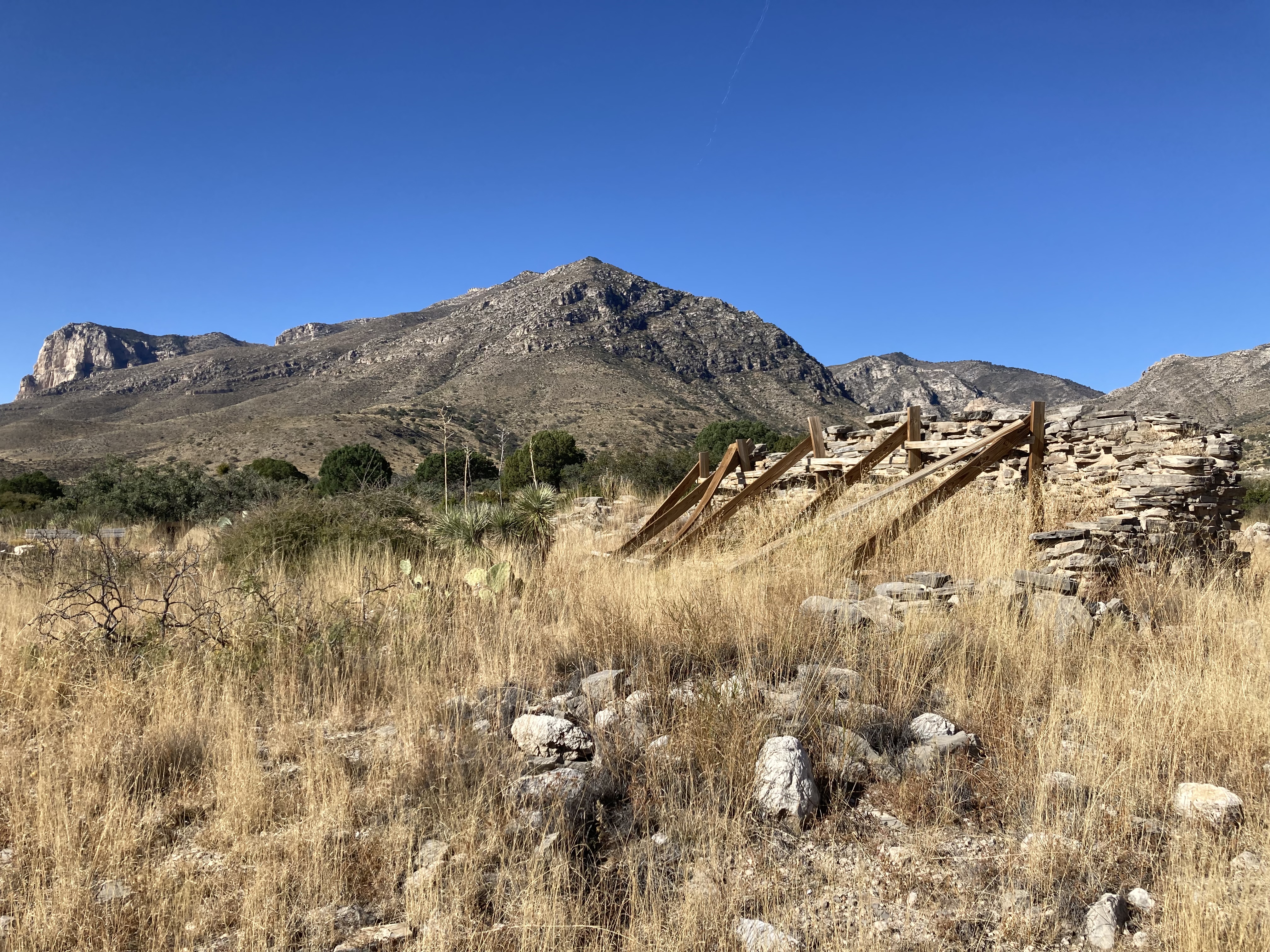
Guadalupe National Park
Nde, or Mescalero Apache, were living in this area in the 1800s and fought the U.S. Army from about 1850 to 1880 to retain their homelands. They lost. Cattle ranches generally took over their land. The Mescalero have a reservation northeast of Alamogordo.
The first overland mail route from St. Louis to San Francisco went through this area. The Butterfield Overland Mail was the first successful attempt to deliver the mail across the country. Previously mail went by ship around the tip of South America. This 2700 mile overland route was competed in 25 days with coaches being driven night and day by rotating shifts of drivers and mules. The Butterfield only lasted 11 months (Sept. 1858 to August 1859) on this route before being shifted farther south and then curtailed due to the Civil War. A small ruin (see photos above) still exists on park property.
Driving to our next stop in El Paso took us to lower elevations and warmer weather. First, though, we had to drive along the edges of the mountains and through scrubland and salt flats. El Paso, at just under 700,000 people is the 23rd largest city in the United States. It pops up quickly, to our eyes there was not a lot of urban sprawl. While trees, shrubs, and grass exist, there is no canopy of tall trees projecting a cover of green. Homes, businesses, concrete, and yards of dirt and stone are the images that remain in ones mind. But obviously people are comfortable here. A town does not reach a population of 700,000 people without positive attributes.
We were here not to evaluate El Paso but to visit Chamizal National Memorial. Chamizal celebrates history and cross-cultural artistic endeavors. Due to Covid-19, the art aspect has been curtailed. We were left with the history portion, which provided a rich lesson in U.S.-Mexican relations. This will not be a long history lesson but several salient points need to be made.
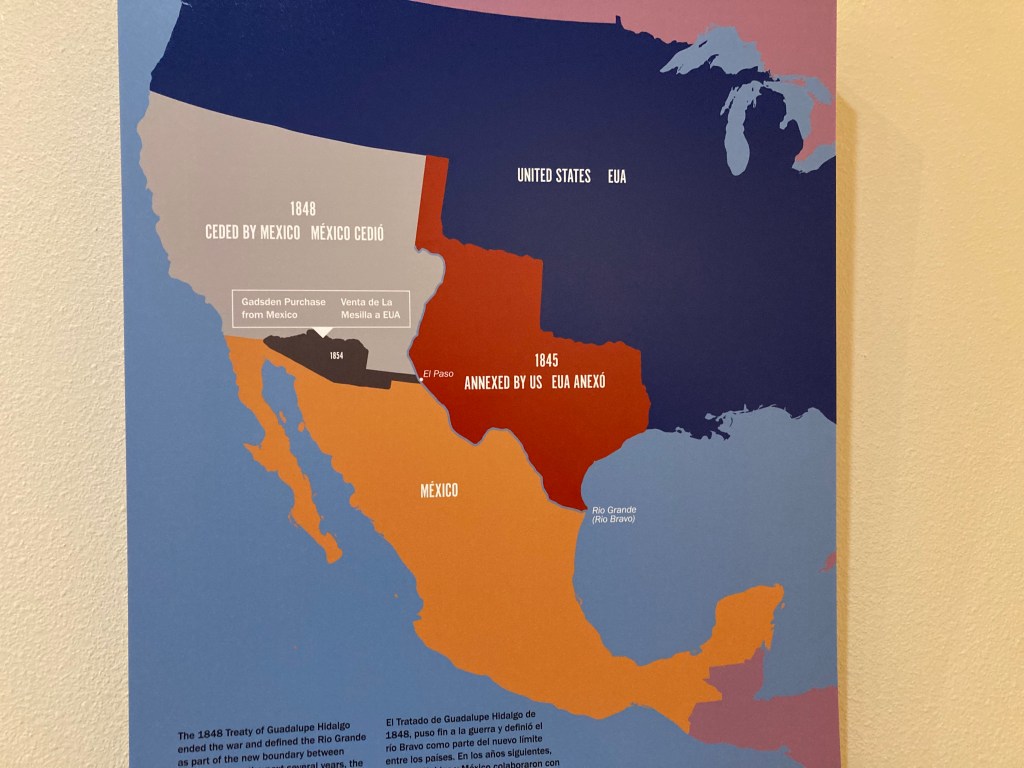
Mexican Land now part of the U.S.
Over time, the U.S. has absorbed or taken one-half of Mexico’s original land mass. One half! Imagine if it was the reverse, and one-half of the U.S. was now part of Mexico or Canada. California, Nevada, Utah, Arizona, New Mexico, Texas and part of Colorado all were originally part of Mexico. For the most part, borders have been surveyed and agreed upon. Disputes have arisen and resolved although not always quickly.
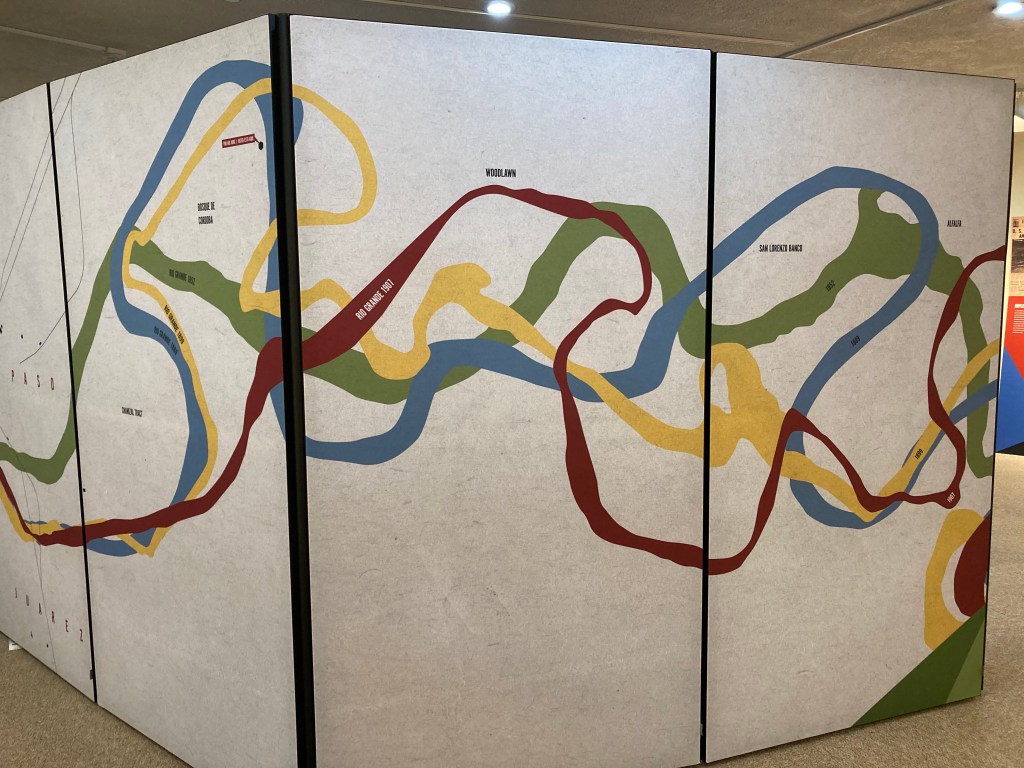
Depiction of the meandering path of the Rio Grande at El Paso-Ciudad Juarez border
Some of the borders are along rivers. As discussed earlier in this trip, rivers can move due to floods and other weather phenomena. We have seen portions of Iowa and Nebraska end up on the ”wrong” side of the Missouri River. There are two understandings about border changes due to river changes. Accretion is the process of a river changing slowly due to erosion of one bank and the addition of land on the opposite bank. In this case, the boundary moves with the river’s deepest channel. Avulsion is the process where a river changes suddenly, leaving its river bed and adopting a new one. Under this process, the boundary remained in the old river bed. Over the history of river changes by the Rio Grande and Colorado Rivers, border issues have had to be addressed frequently. (The photo above with different river paths marked by various colors demonstrates easily how land can shift from one side of the border to the other.)
One case remained unique. Without going into great detail, a section of land called Chamizal was caught in a tug of war between El Paso in the U.S. and Ciudad Juarez in Mexico. Shifting boundaries created a flash point that began in 1866 and went to formal dispute resolution in 1895. It took personal involvement of the two Presidents to resolve the dispute in 1963! Resolution of the dispute meant the purchase of hundreds of homes and rebuilding of public facilities. People and communities were uprooted due to the long delay in resolving the dispute. Through displays and videos, Chamizal National Memorial commemorates this peaceful, although delayed, difficult dispute resolution.
El Paso was left behind as we drove back into New Mexico. Our plan is to visit two more national park units before reaching Flagstaff. Las Cruces, a community of 100,000 will be our base for the next two days. The town grew through farming and the railroad, enhanced by the establishment of New Mexico State University here. Now, it is a space hub. White Sands Missile Range and Test Facility are here. Spaceport America and Virgin Galactic have their headquarters in the Las Cruces area.
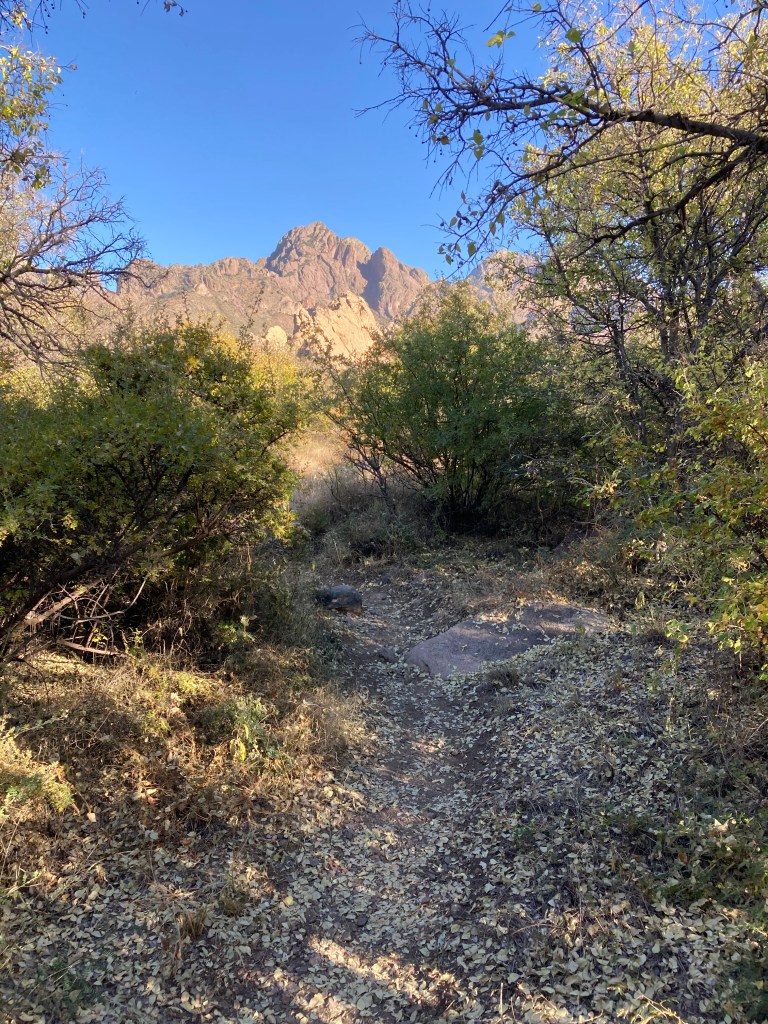
Dripping Springs Natural Area
The Bureau of Land Management administers the Dripping Springs Natural Area of the Organ Mountains-Desert Peaks National Monument east of Las Cruces. The Dripping Springs section has a colorful history. Unfortunately, we arrived too late to spend extensive time here. We managed to get in a hike before the national monument gates were closed. The national monument has several sections worth investigating that are on our potentials list for the next few days.
Hiking at Dripping Springs Natural Area
Ed and Chris, Las Cruces New Mexico Thursday Nov. 18, 2021
Those are not aliens but rock formations at Carlsbad Caverns National Park
Carlsbad Caverns. One of the largest caves in the United States, Carlsbad has been a National Park Service site since 1923 when it was designated a national monument. It became a national park in 1930. Caves are usually ranked by number of miles of caverns. Carlsbad is 15th with 39 miles. In the U.S., the top four are Mammoth Cave with 420 miles, Jewel Cave with 208 miles, Wind Cave with 154 miles, and Lechuguilla Cave with 150 miles. Lechuguilla is actually located on Carlsbad National Park property. . In 1986, cave explorers received permission to explore another area on Carlsbad Park property where they discovered what is now known as Lechugilla Cave. Lechuguilla is off limits to the public as scientists use it for research. Chris and I have been to Mammoth, Jewel and Wind Cave previously.
Carlsbad is best known for the Big Room, the largest chamber in North America, and for an evening bat flight from early spring through October where gigantic swarms leave the cave seeking food. So we missed the bat flight but saw the Big Room. Well, actually saw some of it. The cave is very humid, masks are required, and Chris had difficulty with her glasses fogging up frequently. Her viewing of the cave suffered because of that.
With Covid-19, ranger led tours are no longer offered. Instead visitors sign up for a limited time entry block and undertake a self-guided tour. Frnakly, I was just as happy with that. Tours at other caves frequently try to get cutesy and assign descriptive names to formations that vaguely, at best, resemble the name the formation has been assigned. With this method, you go at your own pace. I don’t know what constitutes normal visitation numbers but we had no difficulty getting around without being blocked or slowed down by other visitors.
The paths are smooth, no stairs and almost no areas in which one has to duck their head or squeeze through a narrow opening. Railings line the entire route and the low lighting is more than adequate to observe various formations. The first third and last third of the route are more interesting. The middle third is relatively humdrum.
Before Carlsbad was made a national monument, and even after, mining of bat guano and the taking of souvenirs destroyed numerous formations. However, there are still a vast number of formations to view. Stalagmites, stalactites, soda straws, draperies, flowstone, columns, popcorn, and others amaze your eyes.
Past pictures taken in caves never seem to properly portray the dimension of the experience. We have inserted a few photos just because.
Carlsbad was pretty much a full day for us. The drive from Roswell was two hours, we spent 90 minutes exploring the cave, and additional time with the park video and displays. After lunch at a picnic table in the parking lot, we explored a portion of the wilderness area that is part of the park. The 9.5 mile scenic drive takes you past canyons, rock formations, and desert foliage. Chris spotted several mule deer on the scenic drive and we stopped to watch them for a while. She had spotted Barbary sheep on the drive in to the park but the narrow road did not allow for any photo opportunities.
Scenic drive, Rattlesnake Canyon, and mule deer
Ed and Chris, Carlsbad New Mexico, Wednesday Nov. 17.
How can one visit southern New Mexico and not stop in Roswell, site of famous UFO and alien encounters? So we stopped there today, Tuesday, but first, we had to get there. We knew Monday would be a long day for us so we left Salina Kansas early on our way to Amarillo Texas. Kansas is relatively flat but we did run across one more “ hilly area” called the smoky hills. For us, we were mainly viewing slight variation of elevations of prairie grass and range land for cattle. I am not knocking it, it has a beauty of its own and I guess when you don’t have much elevation change, any change becomes a hill.
When traveling in an area like this, you appreciate attractive and well laid out farm complexes. Diverse landscapes across our country are a feature that you don’t see or appreciate unless you drive, particularly back roads. Little oddities stick out, sometimes we stop for them, sometimes we don’t. Three examples. First, we saw a concrete early style grain elevator that was unique to our previous experience.
Windmill on the plains of Kansas
Second, a grain kept appearing in farm fields that looked like miniature corn. Several pictures helped Chris determine that it was sorghum, a crop little grown in Minnesota. Third, we noticed a greater use of the old fashioned windmills to pump drinking water for grazing cattle. Frequently, a windmill provided an artistic picture of its own against the skyline. Sighting the windmills was quite a coincidence because today at the Roswell Art Center, we saw several photographs and drawings by Peter Hurd of windmills with a famous saying of his: ”I am just nuts for windmills.”
The bucolic countryside of central and southern Kansas of morning and mid-day Monday contrasted sharply with the ugly and smelly industrial complexes leading into and out of Amarillo Texas. Petrochemical, agricultural, and meat packing feedlots and processing plants gave off dust, odors, and an unsightly appearance that although the products may be necessary, there appears to be no concern for the environment or the neighbors. No desire to return to this area unless necessary for a quicker drive.
Our first major stop Monday was at Fort Larned National Historic Site. However, we added another national wildlife refuge before visiting the fort. Quivira National Wildlife Refuge seemed to offer an opportunity to see more waterfowl. There had even been sightings of whooping cranes here recently. Waterfowl were few and far between, whether flying or swimming around. No value received for the effort.
Fort Larned National Historic Site in Kansas
Fort Larned lasted for roughly 20 years from 1859 to 1878. Its mission was to protect mail service, keep peace on the plains, and protect overland trails that are the routes to move settlers from the east to New Mexico, Colorado, and points west. The famous Santa Fe Trail came right by the fort. The Trail actually began much earlier than Fort Larned, going back to 1821. Commerce and people on the trail moved both to and from Santa Fe. Supplying demands for products and movement of people, decades of heavy wagon traffic created ruts still visible in locations near to the fort.
The fort exhibits do a great job of explaining relevant portions of U.S. history. Many Americans conveniently forget that Texas, New Mexico, California, etc. were part of Mexico that we took from them. The Plains Indian Wars developed from stolen land, broken treaties and promises, and the eradication of a way of life and culture leading up to the Plains Indian Wars.
Before and after photos of Greensburg Kansas
Leaving Ford Larned, we drove to Greensburg Kansas. This town was destroyed on May 4, 2007 when a rare and powerful EF5 tornado leveled the community, killing 12 people. There are still vacant blocks around the community although major efforts have been made to rebuild the town. New public facilities have been constructed, including a museum which features the history of the county, its people, and the tornado.
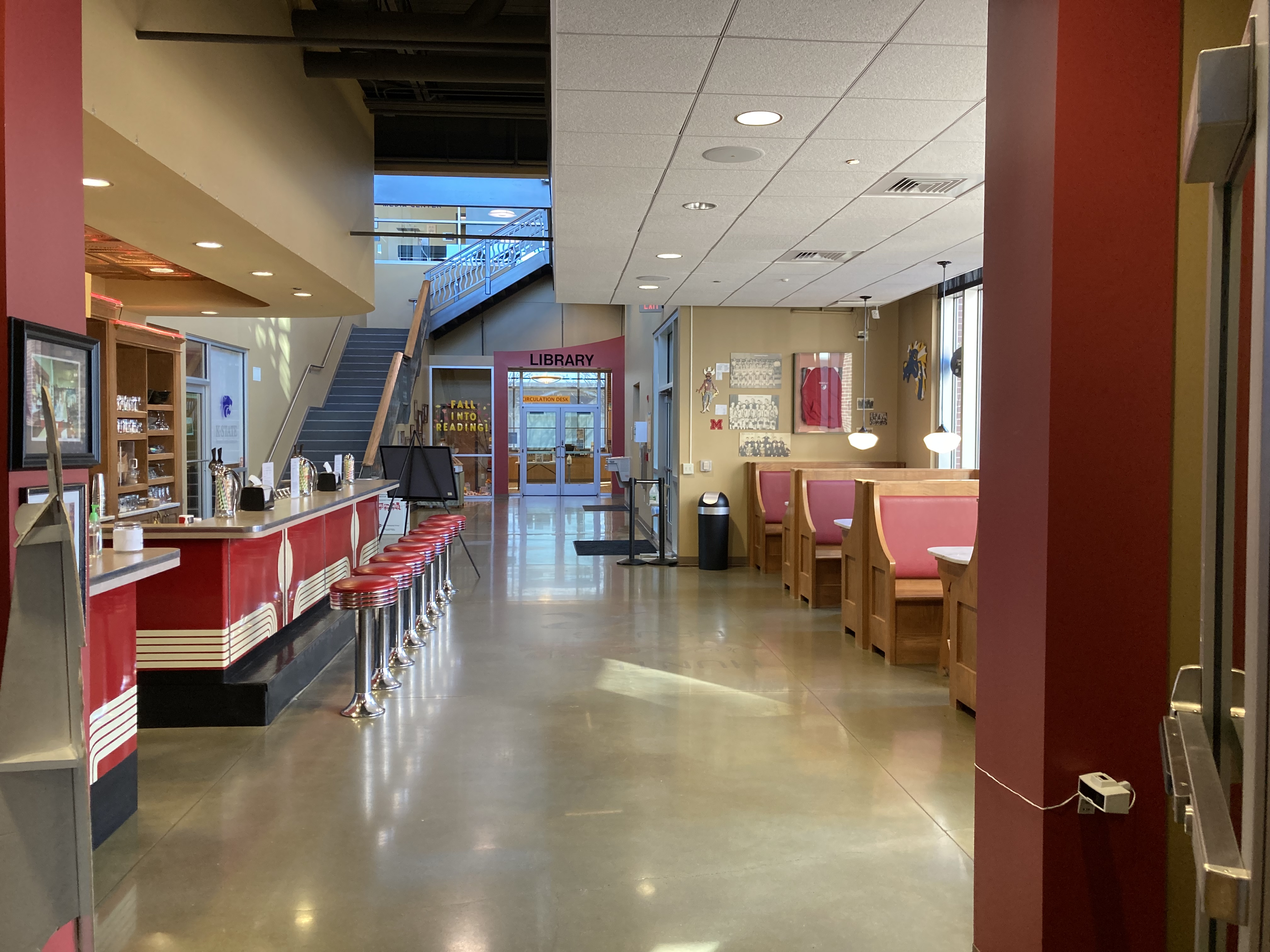
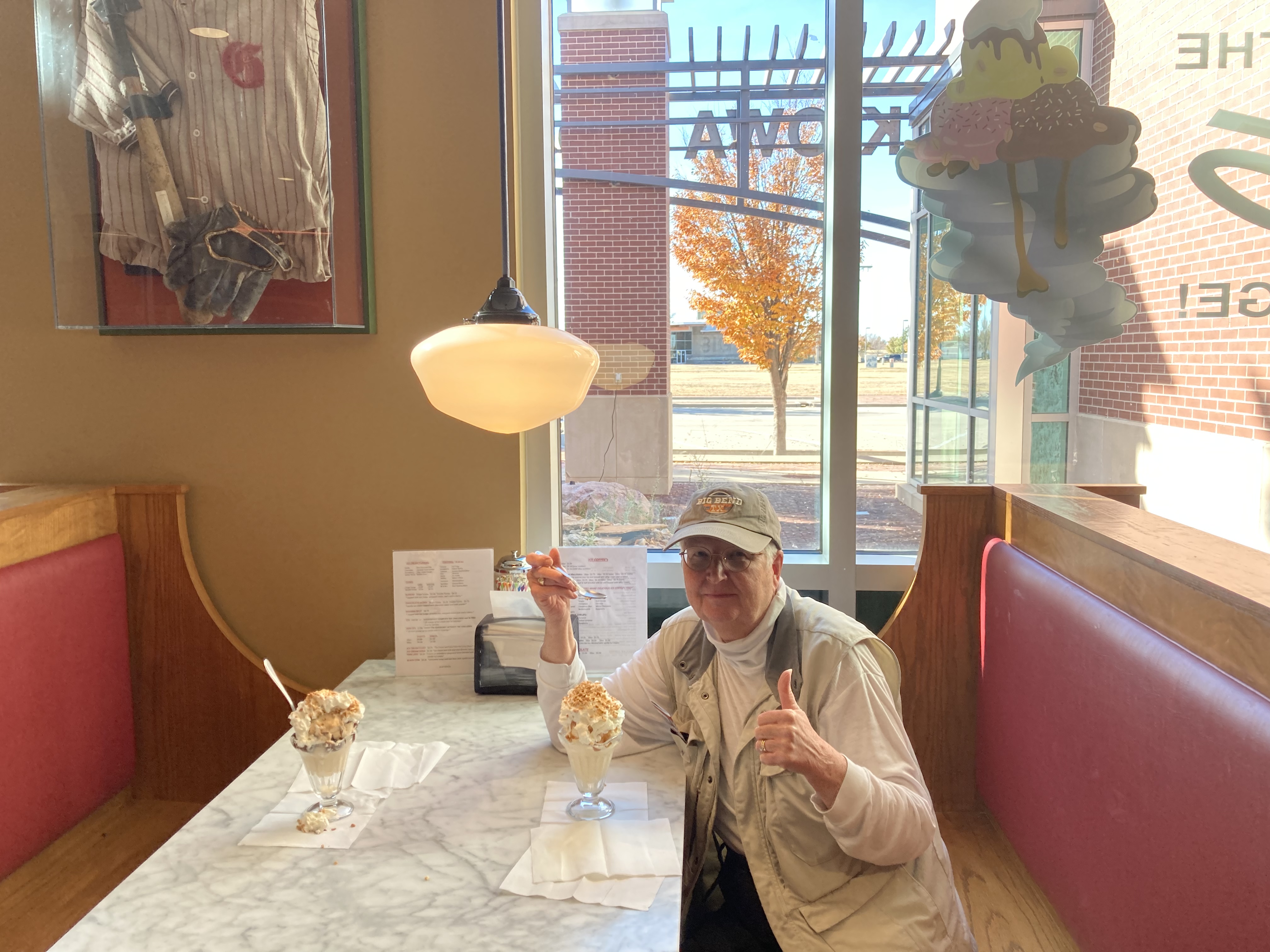
A part of the museum is a living history section, including an old-fashioned soda fountain. We just had to try out the ice cream which was very good. While we were there, a woman, even older than us, came in to get two milkshakes for herself and a friend. The woman had lived through the tornado although the tornado destroyed her family Chevrolet dealership. In her opinion, the town just has not come back to the way it was before.
In the town of Mullinville, just a few miles west of Greensboro, was an art museum devoted to the sculptures of M.T. Liggett. Liggett died in 2017 at the age of 83. He was known for creating politically charged metal totems and whirligigs. There is a line of his sculptural pieces stretching along two sides of the museum property. This museum is another effort funded by the Kohler Foundation. You may recall we saw two similar art endeavors in Wisconsin during our trip in early September. The docent at the Liggett Museum had known the artist and while liking much of his work, agreed that he could be abrasive and maybe even obnoxious. He enjoyed creating art that would stir discussion and controversy.
One Liggett story in particular stood out. Liggett was poor growing up. In third or fourth grade, his art teacher assigned the task of drawing a cow. Liggett only had a purple crayon so he drew a purple cow. The art teacher held up his work to the rest of the class and criticized it for its purple color. Liggett said he dropped art for years due to that. Eventually he returned to art and his property is proof of his prolific production.
Monday finished up with our drive to Amarillo, arriving around 8:30 pm with dinner being peanut butter crackers in the hotel room and off to bed. In contrast, Tuesday was set to be a shorter day. Roswell was our destination since there were two places we wanted to visit and hotel prices in Carlsbad, our Wednesday destination, were much higher.
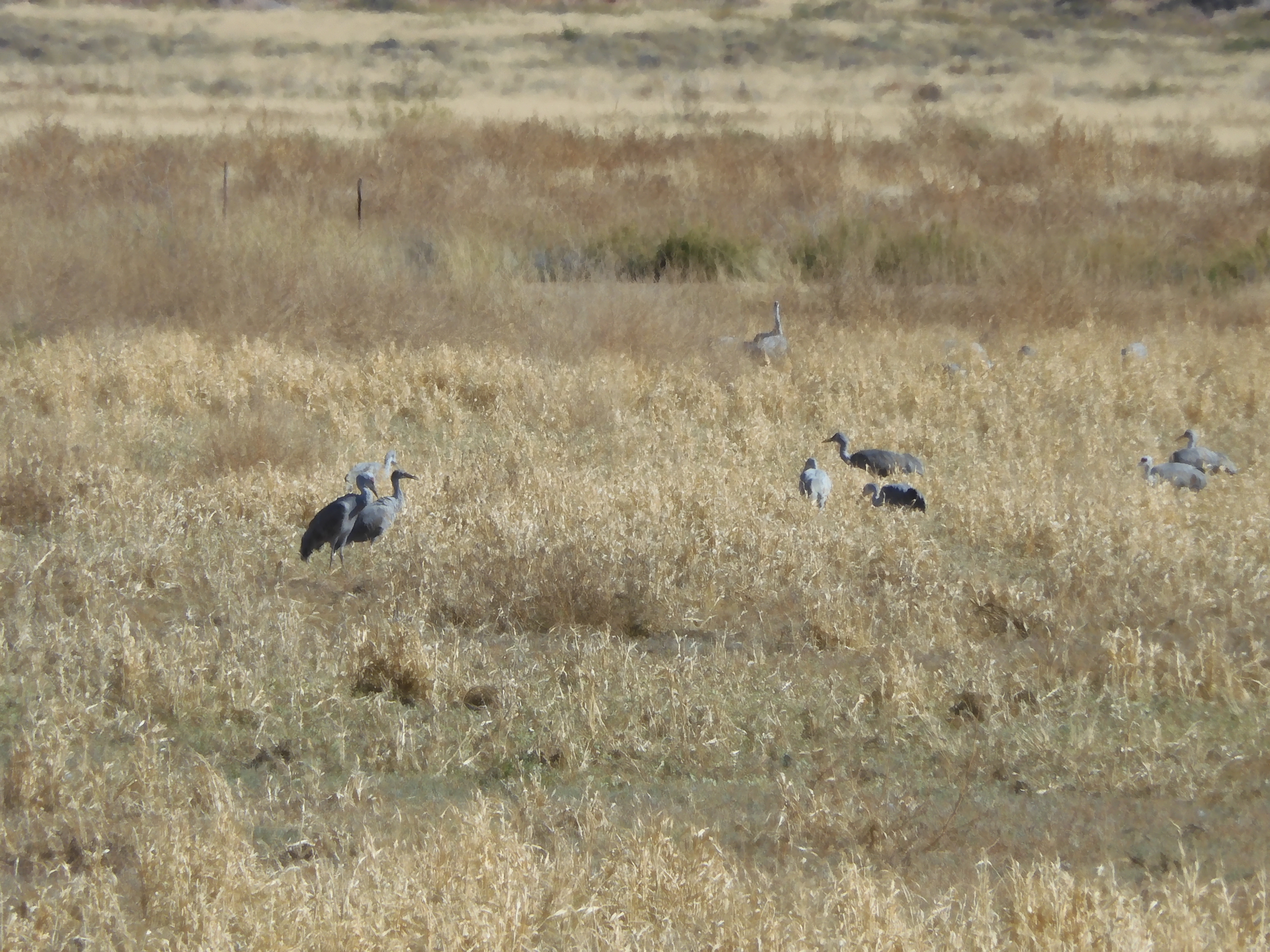
Just outside of Roswell was another national wildlife refuge, Bitter Lake. Sandhill cranes, Ross’s geese, and other waterfowl species were in abundance. We even spotted a hawk perched in a tree, then taking off intent on catching a meal.
Roswell is a town of 50,000 people and the fifth largest city in New Mexico. In popular lore, it is known for UFOs and aliens due to the 1947 reported sighting of a crashed UFO and the death of four aliens. The incident is well-known and heavily debated. The museum here presents the information strongly skewed to the side of it actually occurring with the narrative of a number of participants and witnesses being the strongest evidence. Government explanations appear convoluted and even ridiculous. We aren’t going to take a stand but enjoyed being able to say that we have been here.
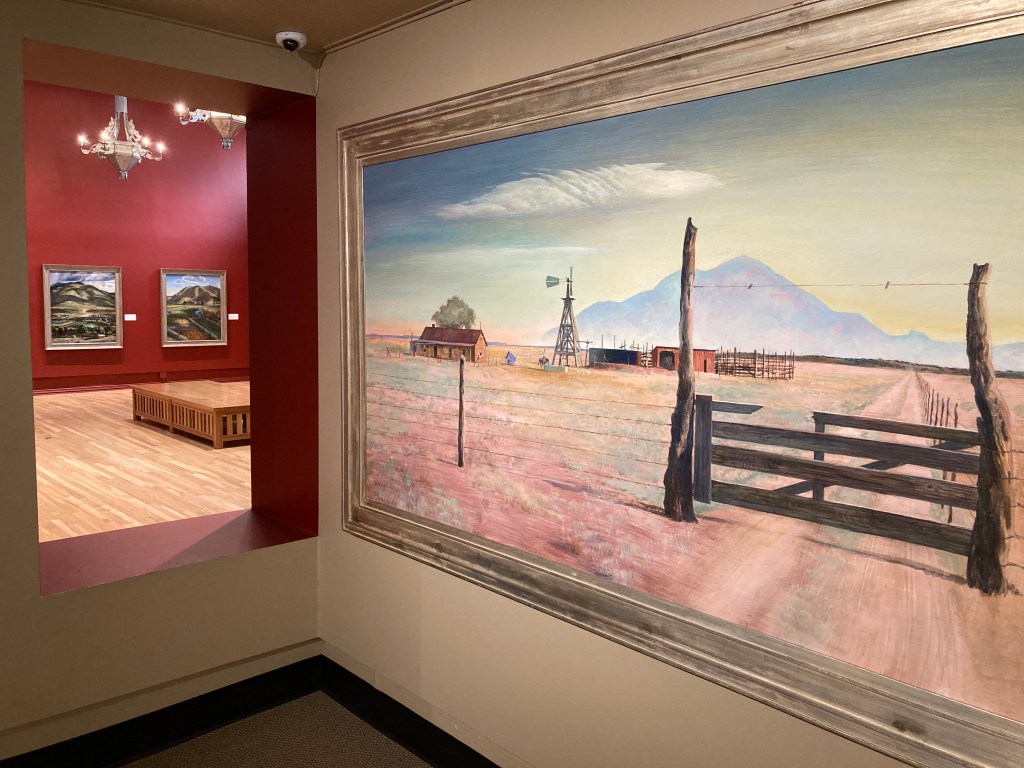
Three paintings of Peter Hurd
The Roswell Museum and Art Center was our second stop. Portions of the museum are devoted to the Southwest and to New Mexico art and life. Other sections focus on New Mexico artists. A section is devoted to Peter Hurd and Henriette Wyeth. Hurd is a native of Roswell and Wyeth is one of the Brandywine Wyeths. In 1940, the family made this area their home and their future artistic endeavors focused on the area and its people.
Robert Goddard, the rocket scientist, worked on his theories and experimented with rockets in the Roswell area from 1930 to 1941. WWII put a halt to his work and he died in 1945. The exhibit here showcases his research and the efforts of his wife after his death to obtain patents for the work he had conducted.
Roswell has an artist in residence program and art works from numerous participants hang in other galleries. Rogers Aston, a local rancher, oil man, collector and artist (Bronzes), has filled several display cases of southwestern life artifacts. Topics include ranching, spirituality, family life, trade and commerce, etc. The museum surprised us with its beauty and extensive collections on display.
Tomorrow, Carlsbad Caverns.
Sunset Monday in Oklahoma
Ed and Chris, Tuesday November 16, 2021 Roswell New Mexico
Traveling on a Sunday, particularly off-season, is always a challenge when one wants to visit places, not just drive. Today was a perfect example. Two places that might be open before noon, as noted on their websites, turned out that one was not open on weekends and the second was undergoing renovations. For both locations, we had checked several websites and they all indicated no problem in visiting today. Why have a website if you don’t keep it updated?
We pivoted to different options that Chris quickly located between the Rand McNally spiral US map book that we keep with us and Internet checking on the smart phone. We wrote off Omaha Nebraska for another time-maybe.
Our first new stop was the Loess Bluffs National Wildlife Refuge along the Missouri River in the state of Missouri. This required driving south by southeast ( I know, we should be going south by southwest.) along miles of the Loess Hills ( I have seen plenty of these hills by now.) On the way to Loess Bluffs, we stopped at a rest area in Missouri that featured information about the town of Rock Port. This farming community of 1300 people claims to be the first community in the U.S. whose energy is derived solely from wind power. Their wind farm was built in 2008.
The Loess Bluffs NWR is about 30 miles north of St. Joseph Missouri. We knew the visitor center was closed but the auto tour route was open. At the parking lot for the visitor center indoor restrooms, I talked to a gentleman from Missouri who wondered if we were here to look for eagles also. I informed him we were from Minnesota and see eagles all the time. He understood.
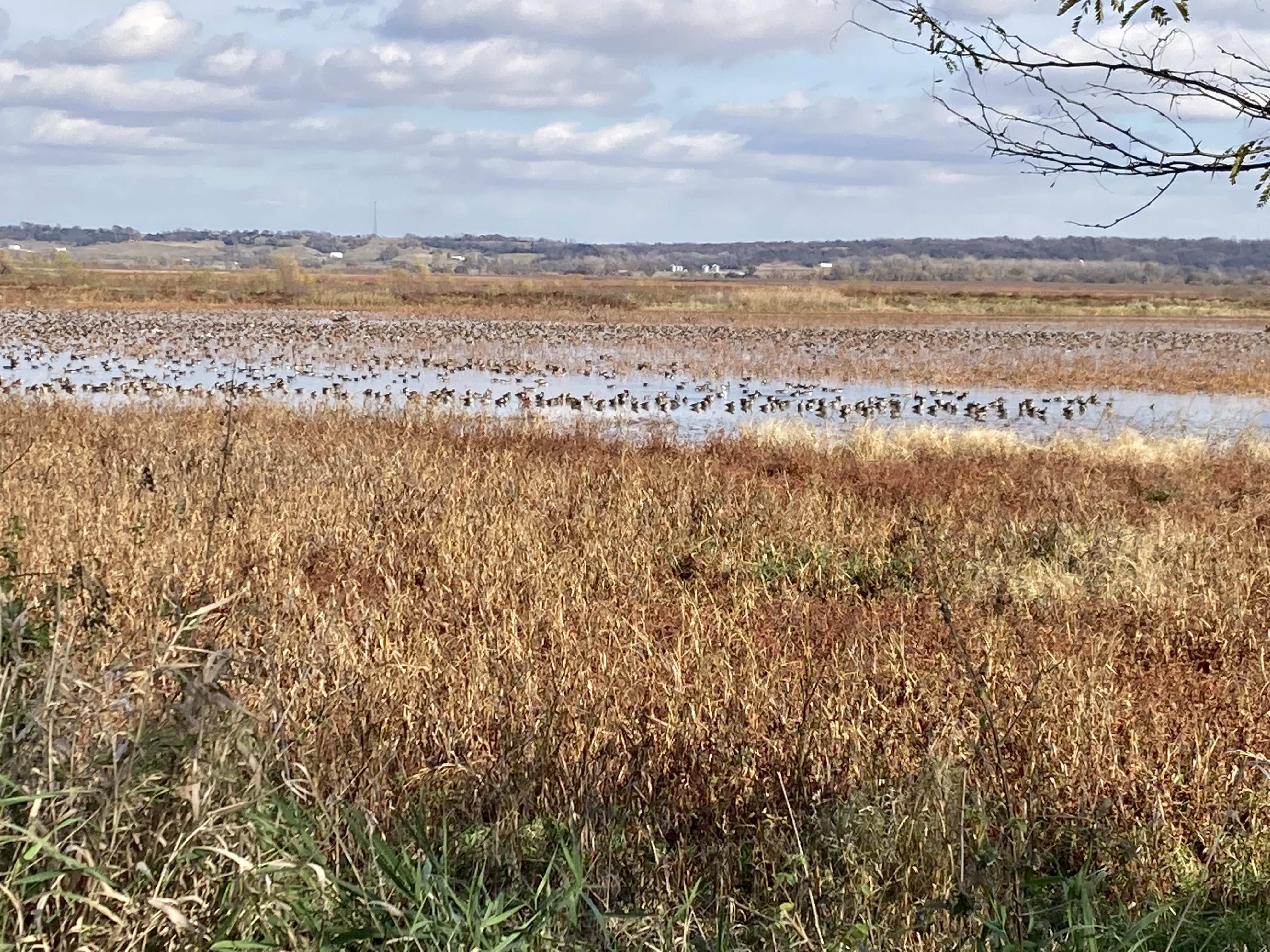
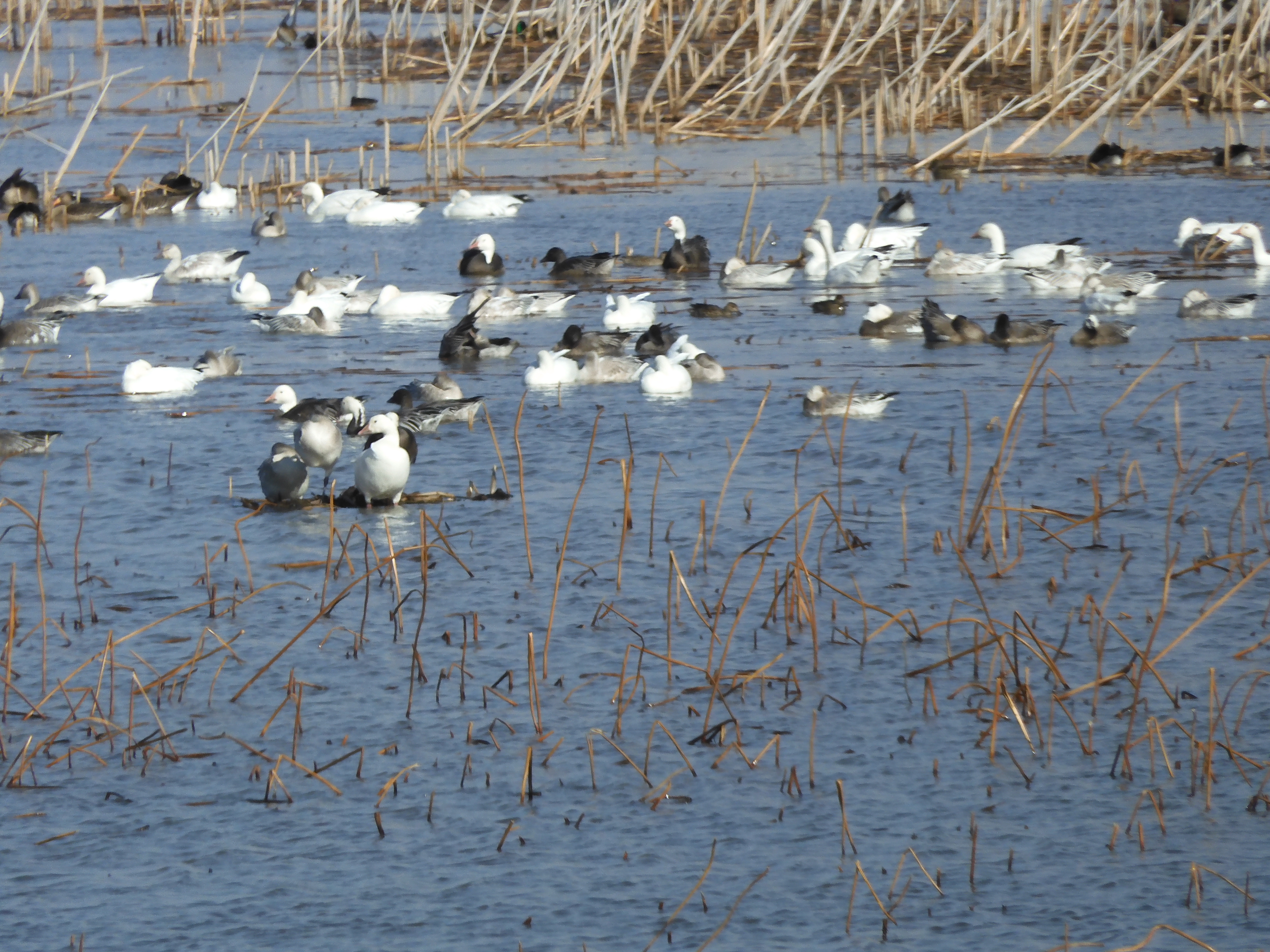
We did see a lot of ducks, and a huge flock of snow geese. Muskrat houses dotted the lakes and marshes, providing a perch for birds. But to give you a better idea of the number and types of birds present, we went to the Loess Bluffs eBird Trail Tracker. Here are some of the larger numbers observed in the last 24 hours.Snow goose-2600; Greater white fronted goose-2400; mallards-270; american coot-100; green winged teal-500;ring-necked duck-400; then there was one american white pelican, one downy woodpecker, one black-capped chickadee, one european starling, and one bald eagle plus a bunch of birds with numbers in between the two extremes. We actually saw two bald eagles. I hope the gentleman I met saw them also. Our stop today was just lucky; our visit to DeSoto National Wildlife Refuge on Saturday, while enjoyable, did not have the number of birds observed here.
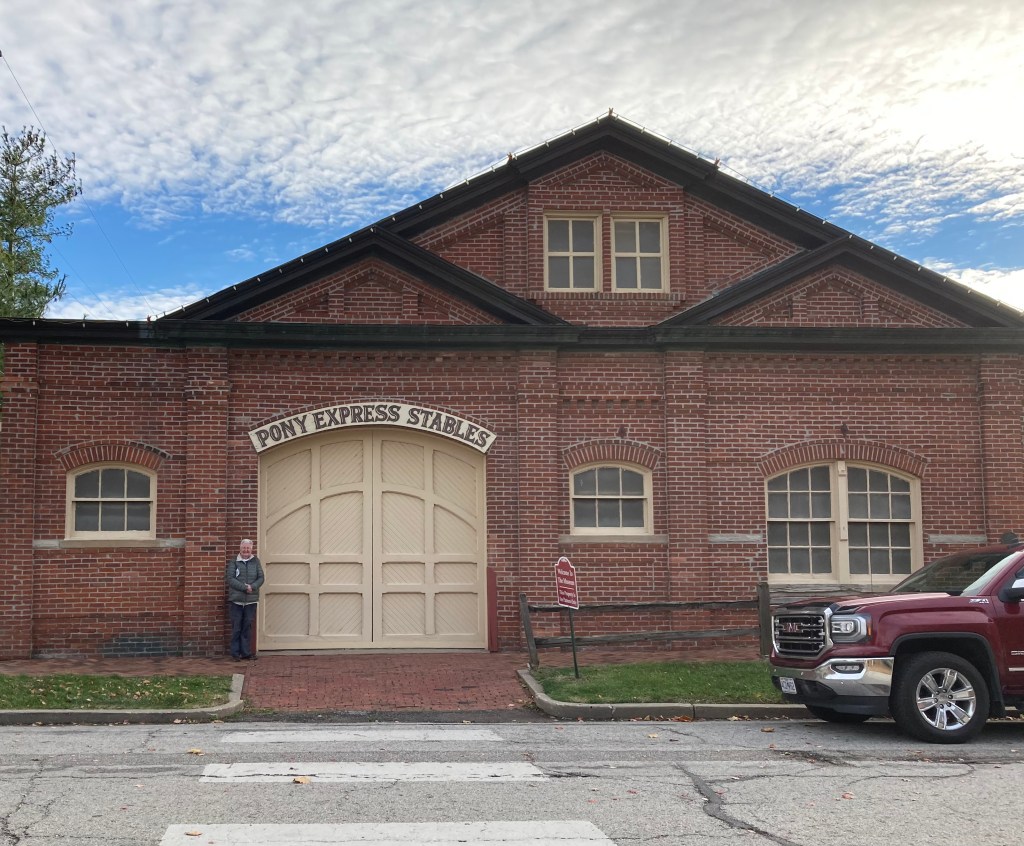
The Pony Express National Museum
Our second stop was at a museum (The Pony Express National Museum) open on Sunday in November. The museum is housed in the original Pony Express Stables in St. Joseph Missouri. St. Joseph Missouri was a major ”jumping off point” for Americans headed for the gold fields or new homes on the prairies or west coast in the mid to latter 1800s. It was also the eastern terminus for the Pony Express, that short-lived but famous deliverer of the U.S. mail between the east and the west coast. The Pony Express traveled 1,996 miles in 10 days. That is 8.3 miles per hour.
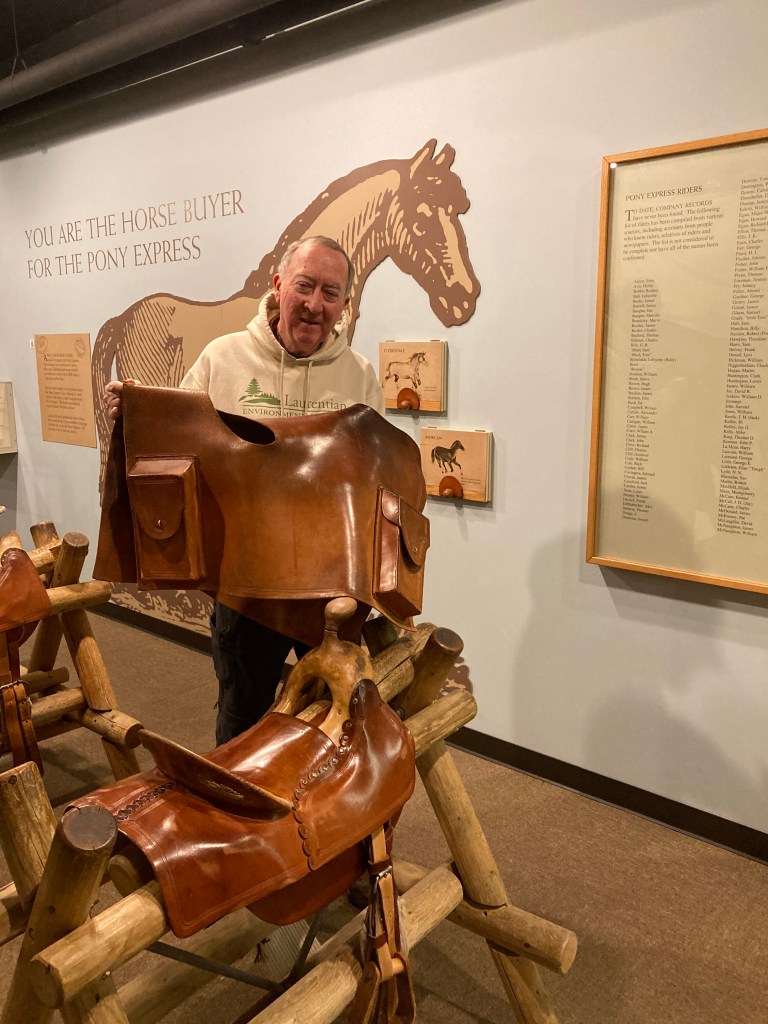
Ed holding the mochila that held the mail and was tossed over the saddle
The Pony Express began on April 3, 1860 and ended when the transcontinental telegraph was completed on October 24, 1861. It was not profitable. The company opened about 160 relay/resting stations about 15 miles apart. Each station had to have stables, bunks, staffing, food and feed. A special mail pouch called a mochila was used which was thrown over very light weight saddles. They purchased 400 horses and hired 200 riders-usually young, wiry men good on horseback. They rode through blizzards, rain and tornadoes. They beat all odds in reducing the time to deliver mail from 25 days on stagecoaches and months on ships to just 10 days. The Pony Express has remained a legend in American folklore.
We thought the museum did a nice job. It is not flashy but has graphics, exhibits of saddles and blacksmithing, videos, recorded messages, etc. covering topics such as the origins of the Pony Express, detailed histories of numerous riders, model stations, large scale maps of the route, etc.
After leaving the museum, we drove 185 miles to our lodging in Salina Kansas. I found it amusing that we began the morning at the Loess Hills of Iowa and finished driving through the Flint Hills of Kansas. (Flint Hills are named for the abundant flint found along the top of the ridges in this area.) During the last hour, our westward journey allowed us to watch the sunset as the colors changed from yellow to orange to a mix of pink, rose, and purple. Scattered cloud cover gave the colors an opportunity to be reflected in a variety of patterns. It was a scenic end to the drive.
Dinner was at Popeyes Louisiana Chicken-our first time at a Popeyes.
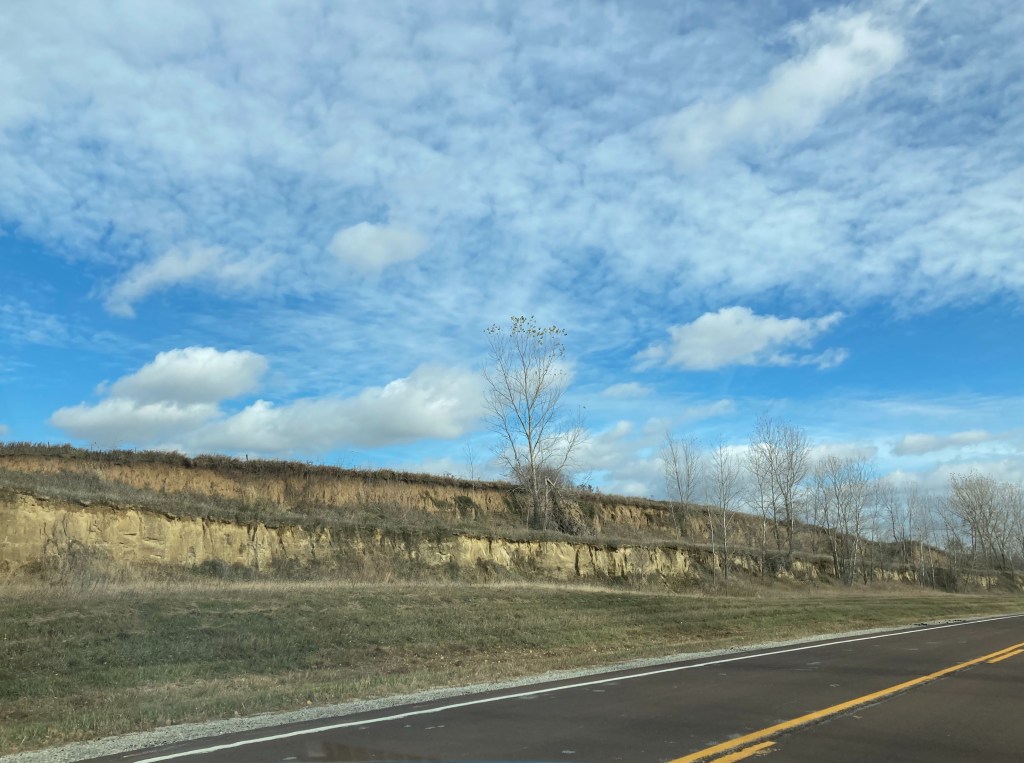
Close-up of the silty sediment making up the Loess Hills
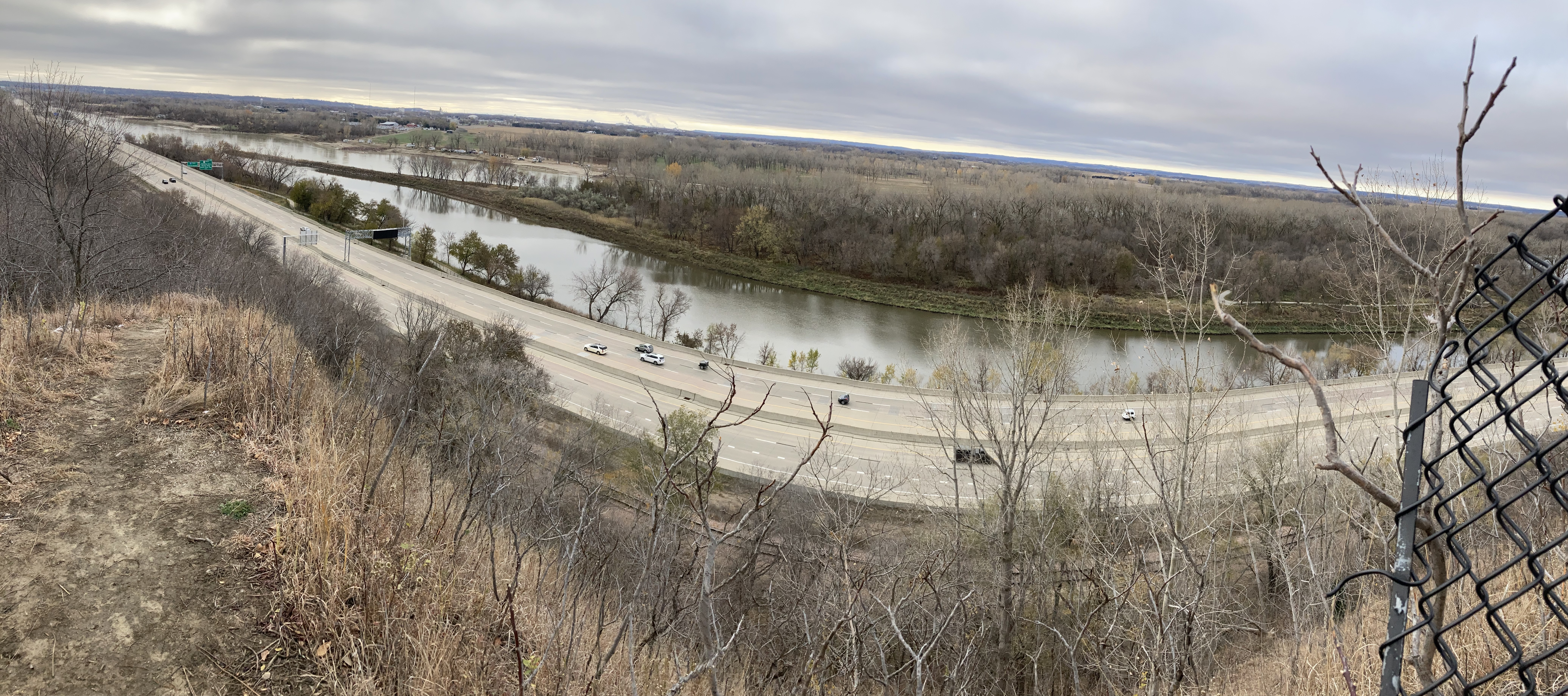
Today was museum surprise day. But, for the first part of Saturday, we remained in the Sioux City Iowa area. Our first stop was on top of a bluff overlooking the confluence of the Sioux and Missouri rivers. The statue of Chief War Eagle is there, looking down on the rivers and the city of Council Bluffs. Chief War Eagle was born in Minnesota or Wisconsin around 1785 as a member of the Santee or Eastern Dakota Indians. He seems to have moved around the region and ended up along the Missouri River. As a chief in the area he spent most of his life with white settlers and constantly promoted peaceful relations between Native Americans and the European settlers. This monument recognizes those peaceful efforts.
I had mixed feelings regarding the monument. It was constructed by the white Europeans to recognize his efforts but one wonders the tension he must have faced within the Native American tribes given the conflict and difficulties between those tribes and European settlers. As we all know, peaceful efforts, as well as warlike efforts, were unable to save the Native Americans from the settlers greed and spread of diseases. The Missouri River which flows below the bluffs, was transformed from a river teeming with wildlife to a river engineered with dikes and dams to be harnessed for commercial purposes. What would Chief War Eagle think if he looked down on his river today?
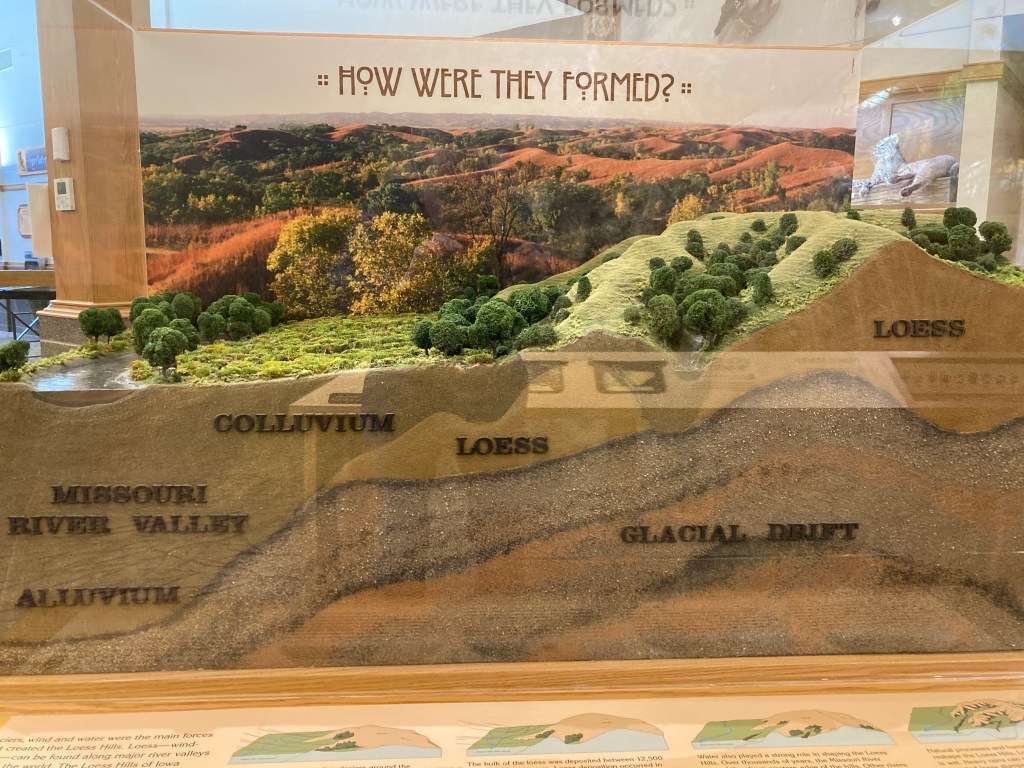
Our second stop was a late addition to our schedule. The Dorothy Pecaut Nature Center was just a few miles from the Chief War Eagle statue. I was drawn to it because of its emphasis on the Loess Hills of Iowa. Loess is a geologic term. Loess is a product of “glacial flour”-a term we have encountered previously. Glacial flour is bedrock ground up by the movement of glaciers. The glacial flour gets deposited into rivers by erosion, which sediment moves down river during floods. As the floods recede, the sediment accumulates into mud beds. The mud beds dry out, winds come along, and pick up the dried sediment, and blow it all over the surrounding areas.
Loess depiction at Dorothy Pecaut Nature Center
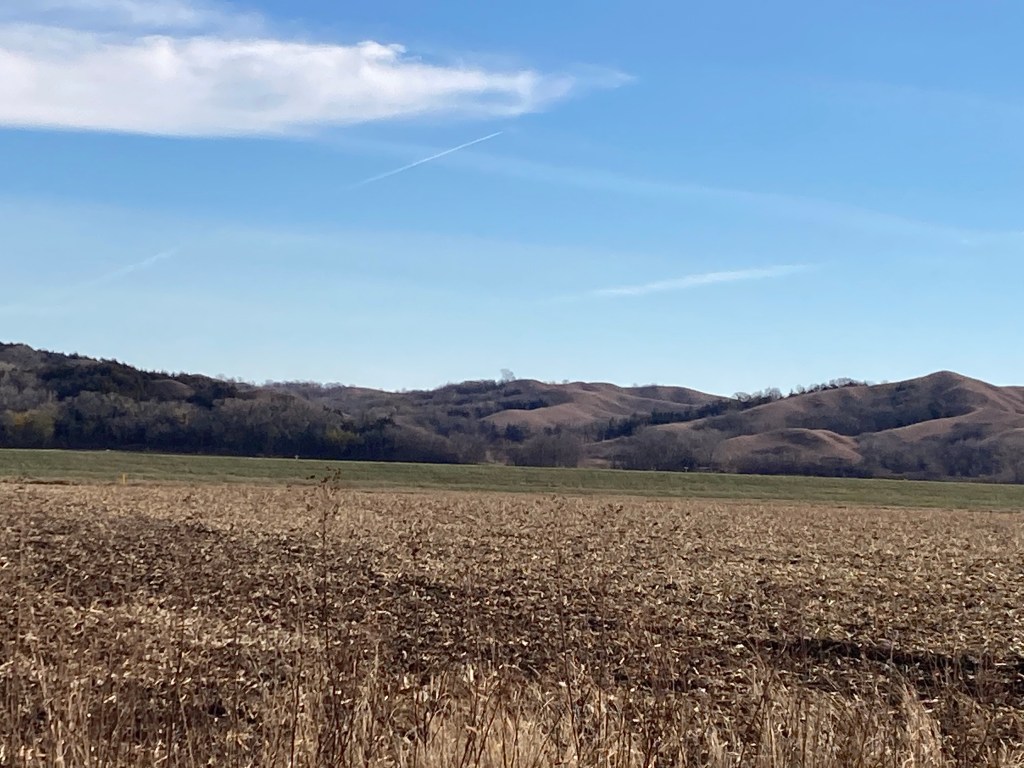
This loess and the centuries of growth of prairie grasses and forbs is a major reason for the fertile agricultural fields of Minnesota, Iowa, Illinois, Nebraska, etc. The Loess Hills of Iowa are a region along the Missouri River where wind and water have created hills next to flat plains. The Dorothy Pecault Nature Center had a nice explanation of this phenomena and it was just a short drive from our other planned stops of the day.
Bur oak branches and roots
We also learned that bur oaks, a staple of the oak savanna and the prairies, have a root system somewhat symmetrical to its tree branches. Chris loved the depiction of the golden pheasant, we normally have only seen ring-neck pheasants.
Next, we visited the Palmer Candy Company of Sioux City. This is a regional candy company whose claim to fame is a popular regional candy called Twin Bing. The candy is a cherry filling with nougat and a chocolate and peanut coating. We purchased a bag of snack sized bars and we each tried one. Very sweet, nice flavor but I still prefer Pearson’s Nut Goodie bars and Salted Nut Rolls.
Sgt Charles Floyd Monument
Our final stop in Sioux City was the Sergeant Charles Floyd monument. This 100 foot tall monument honors Sgt. Floyd, the only member of the Lewis and Clark expedition who died during the two years of the trip. The monument was constructed in 1901 from of sandstone obtained from a quarry along the Kettle River in Minnesota. The Kettle River quarry is now part of a state park which Chris and I have visited numerous times. Floyd’s original grave was subject to erosion and moved twice before finally being placed on this high hill overlooking the Missouri River.
Leaving this second monument, we drove along the Loess Hills Scenic Byway for close to an hour to get better glimpses of the hills ”up close and personal”. Okay, interesting but we do not need to return for a follow up visit.
But the DeSoto National Wildlife Reserve (where nature meets history) was a beaut!!. Only part of the auto drive would be open due to protections for migratory waterfowl, but the visitor center was worth two hours of our time. Two videos of the refuge and the birds that use it were our first treat. Next, and the focal reason of our visit, was the museum section that was devoted to the Steamer Bertrand.
A little background. The Missouri River was nicknamed the Big Muddy since it carried a lot of silt. They used to say its water was too thick to drink and too thin to plow. The Missouri River, like numerous rivers, floods often. This creates sandbars, oxbows (where the river creates a new channel and cuts off a previous river channel, snags (trees felled by eroded riverbanks that float downriver until they get stuck), etc. The Missouri River, at 2340 miles long, travels from St. Louis to the Rocky Mountains in Montana. In the 1800s, the Missouri River was the major transportation route for early settlers and miners. Steamboats brought people and supplies up river.
Model of the Steamer Bertrand
Stemaboats were extremely profitable. The major impediment to profits were boiler explosions (which killed people and destroyed cargo) and snags which punctured hulls and sank boats. The steamer Bertrand was on its maiden voyage with a veteran pilot, departing St. Louis on March 18, 1865. It was bound for Fort Benton, Montana which it hoped to reach sometime in June. On April 1, it departed from Omaha, traveled about 25 miles, hit a snag which punctured the hull. No lives were lost but the boat flipped over, sunk in the river, and only a small portion of the cargo and equipment was recovered before the river and its silt covered up the boat. Passengers were rebooked on other boats (sounds like airline hassles of today). The veteran steamboat pilot who was on the Bertrand was the pilot that trained Samuel Clemens (Mark Twain). Life went on.
Fast forward to 1968. Over 100 years, the river has created several oxbows. In fact portions of Iowa and Nebraska have flipped which side of the river they are on due to the new river channels. Two archaeologists are exploring for the Bertrand and find it buried 30 feet down in a grassy field east of the river. It takes two years to excavate the wreck but a treasure trove of artifacts are buried in the mud and the muck. Another ten years are required to unearth and clean the artifacts but when completed, the 200,000 artifacts present a miraculous portrayal of ordinary life on the prairie. (Alcohol is one of the materials used to clean these artifacts. The cleaning process took so much alcohol that the conservators (who were from the National Park Service) were required to obtain a liquor license.)
Back to the main story. The visitor center at DeSoto holds those artifacts with a number of them on display. Shovels (many from the Ames Corporation which still makes shovels today), dishes, ammunition, kitchen utensils, etc. are all there to see. Clothing is less frequent as its material is more subject to deterioration under water. It was fascinating to take the time to view various artifacts.
Where the Steamer Bertrand was found, DeSoto Lake in the right background
We drove out to the site where the Bertrand was found. Although we did not cross the river, the site was in Nebraska. The bottom hull of the boat was not excavated and is still buried under water and mud in a pond on the refuge property. All in all, a fascinating time at this museum in a national wildlife refuge. Oh, and the displays in the visitor center relating to nature were quite good also.
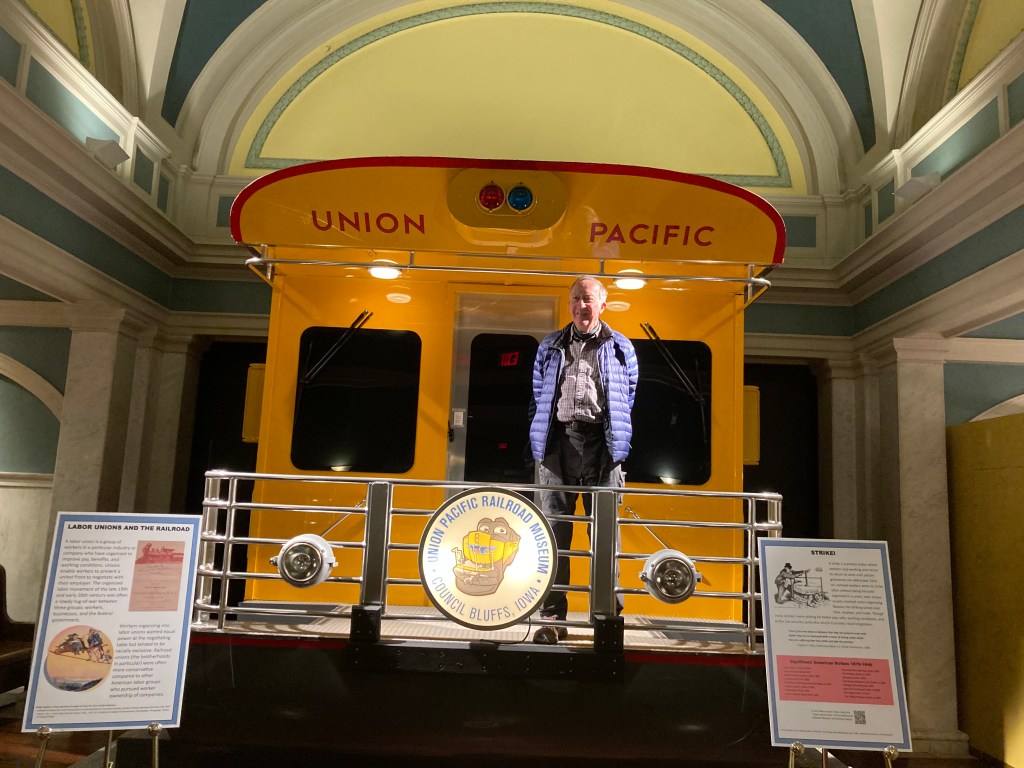
We had 4 PM timed admission tickets to the Union Pacific Railroad Museum in Council Bluffs Iowa. Council Bluffs was decreed as the eastern terminus of the transcontinental railroad connecting California to the rest of the United States. The Union Pacific was to build track going west while the California Pacific built track going east. Today the Union Pacific still has rail yards in Council Bluffs while their corporate headquarters are in Omaha Nebraska, across the Missouri River. The UP also has their national rail traffic control center in Omaha in an extremely secure building. From here, all UP trains are monitored and controlled across the country.
The museum is funded by UP but only open Friday and Saturday. During our 90 minute visit, we found it a fascinating trove of information. Most of the information is presented on mural boards one must read so it does take a while to make your way around the two floors of exhibits. What did we read about? We will mention just a few.
Before WWII, UP had train coaches for women only to allow single female travelers to feel safe. The coaches were staffed by women with nurse type training and the rest of the train staff (all male of course) needed special permission to enter the coaches.
Standard time zones set by the railroads
The railroads were responsible for establishing standard time in the United States. Congress would not end the practice of each town setting its own time based on sunrise, etc as it occurred in their community. This mish mash of parochial stubbornness crated havoc for the operation of trains and a severe potential for accidents. In 1883, railroads in Canada and the U.S. implemented a system of times and time zones. It took Congress until 1918 to pass the Standard Time Act, formalizing that which the railroads started 25 years earlier.
Railroads used to have their own depots so in a city like Council Bluffs that was served by as many as eight railroads at one time, passengers might have to disembark and travel to another depot to catch their next train. Under pressure from cities, railroads finally cooperated in creating ”Union Depots”-one central depot serving all railroads.
Automatic traveling train equipment machines now install concrete ties with better ballast and longer rails than the previous manual process. Employees with remote train controllers hanging on a belt from their waist direct trains around switchyards with no onboard engineer. Passenger trains used to be faster, more frequent, and more luxurious until Americans became enamored of their automobiles.
Not surprising to us as we have traveled is the awareness of the impact railroads created throughout the U.S. Land grants given to them for the building of the transcontinental railroad fueled the immigrants who settled the prairies. This settlement contributed to the taking of Native American land. Prairies were plowed under and while crops were grown, erosion and loss of habitat skyrocketed. As a display indicated back at DeSoto National Wildlife Refuge, progress in building towns and growing food led to ”the other side of the coin’, that is, each positive step had a negative effect.
Towns fought to have rail roads go through their community and to be a hub for servicing passengers and crews. Later those towns would find out that economic benefits might be short-lived as technological changes and economic pressures consolidated and closed facilities. Labor strife over low pay, dangerous working conditions, and long hours resulted in strikes usually won by the railroads. Discriminatory labor practices were prevalent.
If you are in the area, we encouage you to stop in at any of these locatons. We found them interesting and well worth our time. There is more to learn than just what we mentioned today.
The day ended with dinner at McAllister’s Deli before checking in to our Hampton Inn.
What a crappy day! High 20s, but winds gusting over 40 mph. The interstate had semis and cars in the ditch. Not much snow but blustery and cold. It made us drop the state park hike we had planned and to skip the nutcracker exhibit at the Rock County Minnesota Museum in order to make it on a timely basis to Sioux City Iowa. In this corner of the world North Sioux City South Dakota and Sioux City Iowa and South Sioux City Nebraska come together in good old Siouxland at the confluence of the Big Sioux River and the Missouri River.
We have chosen to take this route towards an eventual arrival in Flagstaff Arizona for Thanksgiving. We have not done a lot of exploring along the Missouri River. Over the next two days, we will visit portions of the Missouri River, the Lewis and Clark Trail following the explorers trip through the Louisiana purchase area to the Pacific coast in 1804 through 1806, and the Loess Hills of Iowa.
Our stop today was at the Louis and Clark Interpretive Center and the Betty Strong Encounter Center in Sioux City Iowa. This is a combined complex along the Missouri River. It was not crowded today when we arrive at 3 PM. Understatement. Maybe no one else wanted to go out in this kind of weather. However, the complex was very well done and we enjoyed our time there.
Thomas Jefferson speaking about the Lewis and Clark expedition
One portion of the complex has murals, animatronics, and written displays about the Lewis and Clark expedition. It clearly explains the critical and positive dependence the explorers had from the Native Americans along the route out to the Pacific and back again. Without that assistance, the expedition would never have been successful. In exchange, Lewis and Clark tried to sow good relations with the Native American tribes. Of course, we all know that while their efforts may have been positive, disease and westward expansion soon killed most of the Native Americans and put the rest on reservations in undesirable locations.
Sergeant Charles Floyd exhibit
There was a section of the complex devoted to Sergeant Floyd. Sergeant Charles Floyd was the only member of the Lewis and Clark expedition that died during it. Researchers today believe he may have died of appendicitis. The Floyd river is named after him and there are several monuments in the area, one of which we will visit tomorrow.
Two small tidbits. The expedition was delighted and amazed by prairie dog colonies. They had a difficult time trying to capture one but eventually did and ended up sending it to Washington as one of their amazing finds of the expedition. Second, I had not realized they had a big black Newfoundland dog named Seaman accompanying them on the vast majority of the trip.He may have saved their lives by several times barking and warning them of attacks by bison and grizzly bears.
Just one of many depictions of floods in Sioux City
Another section of the museum talks about the history of Sioux City with familiar topics nicely done. Flooding by the Missouri River, the Big Sioux River, and the Floyd River have had a major impact on this region. The work of the Corps of Engineers on the Missouri River has not always been beneficial to protecting the area from floods. That is understandable, but sad. The Corps has to balance conflicting major mission objectives of hydroelectricity, recreation, irrigation, drinking water, river navigation, water quality control and fish and wildlife all while dealing with whatever weather problems that develop.
Along the Missouri, as along the Mississippi, the same issues of trying to maintain a navigable channel for barge traffic to provide an alternative and competing counter to railroad dominance, has resulted in the loss of habitat and greater erosion.
Sioux City Iowa attracted many immigrants to the area due to the meatpacking facilities that developed in the late 1800s and early 1900s. Labor strife between the workers and the companies erupted several times. The companies normally won. Meat packing is still a major employment driver in the area.
The Betty Strong center had an art gallery, a display of the US Navy ship the Sioux City, and photographs of young Native Americans with their career goals highlighted.
Dinner was in our room at the Hampton Inn where we ate the lunch we had packed.

































 Chris Klejbuk and Ed Heimel travel adventure
Recent Comments