Monthly Archives: August 2019

2019 Trip 5: Alaska: August 21

Driving to Valdez

Copper Center, AK. Wednesday August 21

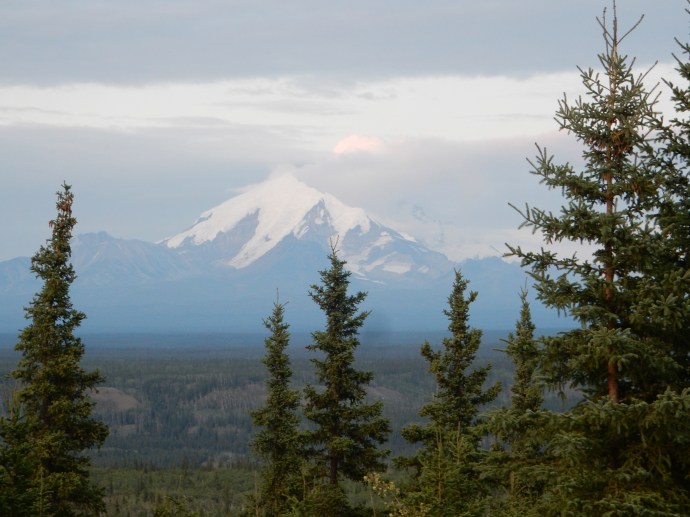
The combination of wild fires by Denali and over in Siberia are making the skies hazy. The picture of Mt. Drum that finished yesterday’s blog could not be repeated today, you can not see the mountain. This was true all 100 miles south to Valdez, our destination for the day. Our original plan was to simply drive the Richardson Highway south to observe the glaciers and waterfalls that are just north of Valdez. But Valdez is only a short distance more and who wouldn’t want to visit Valdez??
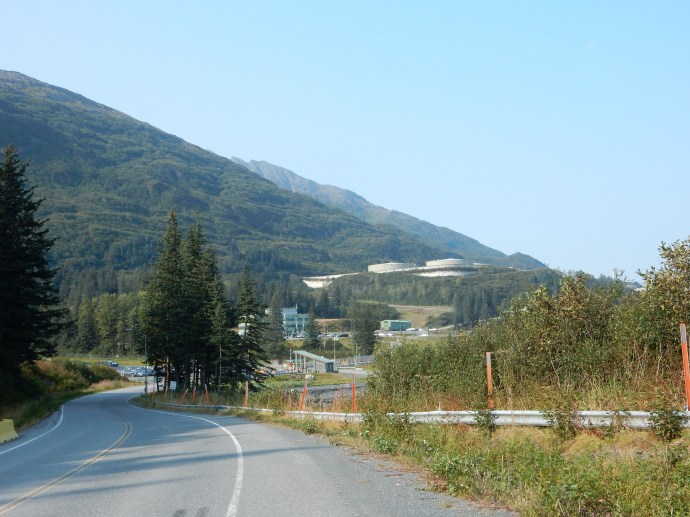
Trans Alaska Pipeline terminus

Valdez has been called the Switzerland of America since it is ringed by mountains. It has the northernmost ice-free harbor in America. It is the terminus of the Trans-Alaska Pipeline. It was founded as one of many towns to outfit gold miners heading to the northern gold fields. Its population is about 4,000. On Good Friday 1964 the town was destroyed by the largest recorded earthquake to hit North America. On Good Friday 1989, the Exxon Valdez tanker spilled 10.8 million gallons of crude oil into Prince William Sound.
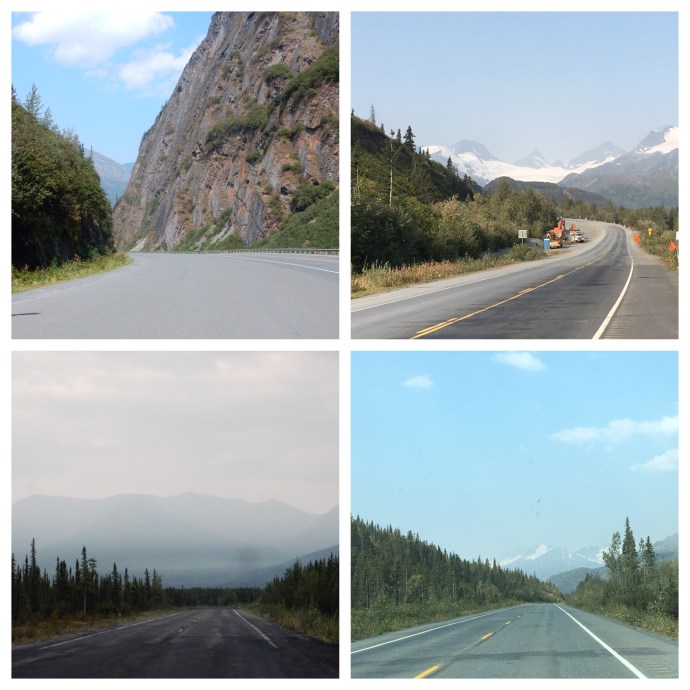
Driving the RIchardson Highway to Valdez

The Richardson Highway south from Copper Center was very lightly traveled. We had been warned that culverts were being installed and to expect travel delays. Delays there were. Two long areas where one had to wait for a pilot car which led you through the construction zone at 12-20 mph. Each zone, each way, probably added 20 minutes to our day’s drive time. I earned my Coca-Cola reward when we got back to the Copper Princess Wilderness Lodge.
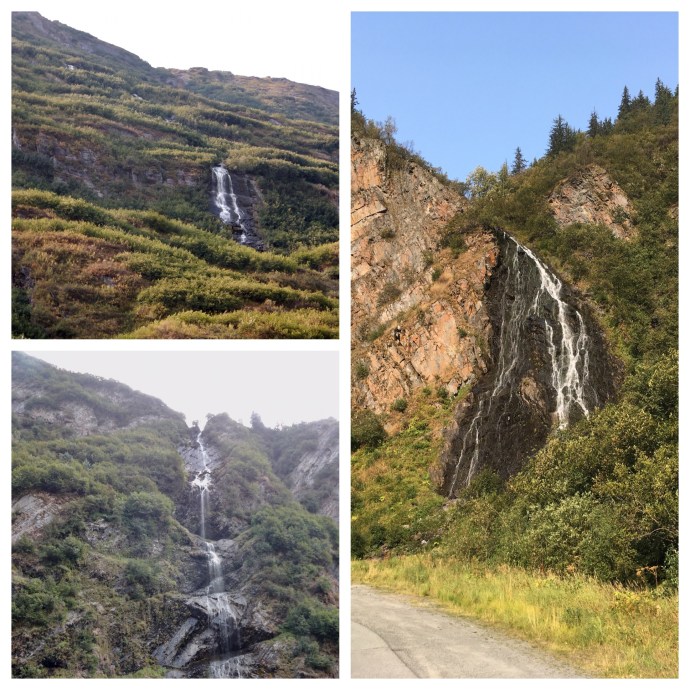
Waterfalls along the Richardson Highway north of Valdez

The scenery was blah for the first 50 miles or so, then the last 50 miles are in the middle of mountains on both sides, with numerous glaciers. Waterfalls were to be a highlight, two of them named similar to Yosemite, Bridal Veil Falls and Horsetail Falls. They did not truly resemble Yosemite’s falls. These two were pleasant but not overwhelming. All across America waterfalls superior to these exist; if you come to Valdez, don’t get your hopes too high.

We ate in downtown Valdez, pleasant sitting outside on a windless day in the 60s with hazy, smoky skies. We were able to people watch. The oil tankers load at the terminus of the pipeline, an area off-limits to civilians and beyond our view.
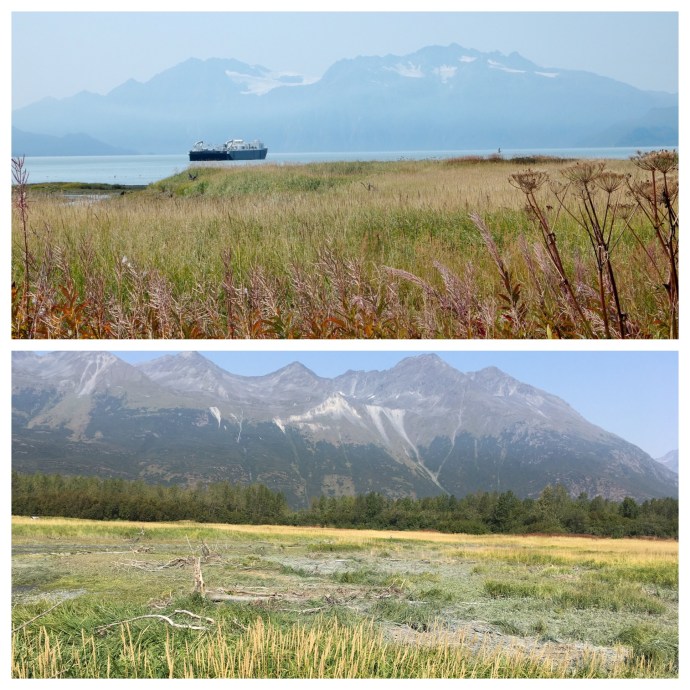
Town site of old Valdez destroyed in 1964 earthquake

We drove to the old town site of Valdez. The earthquake caused a tsunami and underwater earth slide. The town was destroyed as well as damage to several neighboring areas. In Valdez, 31 people died, mainly children. The town was so destroyed and the earth so messed up that the Army Corps of Engineers declared the area unsuitable for reconstruction. A new town site about four miles away was selected and is where Valdez is now located.

the gull “waterpark”

In Valdez we visited the salmon hatchery. Salmon have been overfished and streams blocked so the fish hatchery acts as an artificial spawning grounds. Fish have been raised here, released, then return to the hatchery where the eggs are artificially fertilized and raised. More salmon return than are needed to raise the next crop; one can observe dead salmon outside the hatchery decomposing and returning to nature. Supposedly bears come here to feast-we did not see any.

We did see some sort of gulls, lots of them. While most are just sitting around, a sizable group presented the appearance of birds at a water park. Water coming out of the hatchery and stream create a strong current. Gulls land at the head of the current and ride the current down to the sound where they then fly back to the head of the current and ride it down again. Amazing.
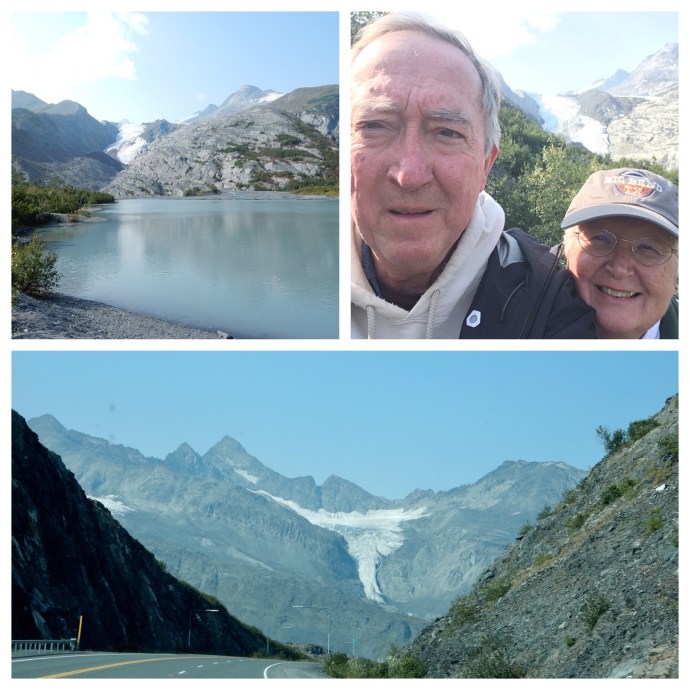
Worthington Glacier

On our way back to Copper Center we stopped at Worthington Glacier and hiked up a bit to get a better picture. The glacier has retreated but we also watched the water melt into a lake at its foot before tackling the construction zone.

A pleasant day, not overwhelming but pleasant. A lot of driving in order to see as much of Alaska as possible. Tomorrow it is up to Fairbanks. Current fire conditions have travel possible but slow south of Denali and road closed on a portion of the Kenai Penninsula-directly where we will be driving.
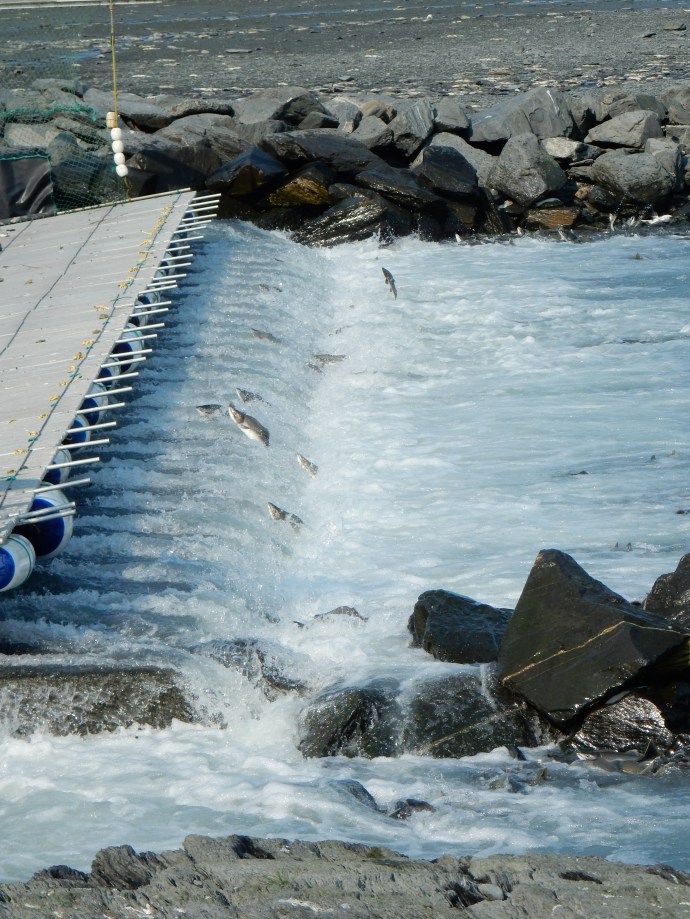
Salmon fighting to get back to the hatchery to spawn.

Ed and Chris. Copper Center August 22. 3:30 AM
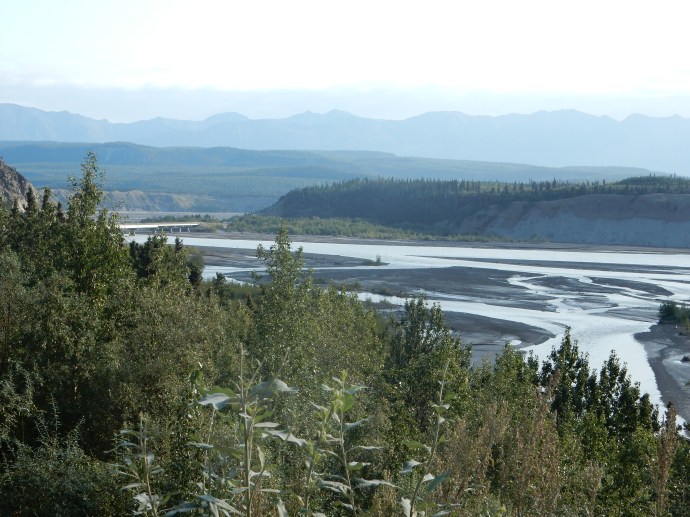
Categories: travel | Tags: , , , , | Leave a comment

2019 Trip 5: Alaska. August 20

Confluence of the Chitina and Copper Rivers

Copper Center, Alaska, August 20 Tuesday

Copper Center. Copper River. Gee, I wonder why the name is used here. Well, today we found out as we traveled long into Wrangell-St. Elias National Park and Preserve. The Ahtna Athabascan people who lived here mined copper well before European immigrants arrived and the Ahtna traded copper and other materials with tribes in the region. When the Russians and Americans came to the area and saw the copper usage by the Ahtna, the Ahtna chief told them where copper could be found-although not the best locations. Over time, prospectors discovered copper high on the Kennecott Mountain. That discovery led to the Kennecott Copper Company after more than $100 million of profits were made by the owners (in today’s dollars, about 1.5 billion dollars in profits.)

But I get ahead of myself. After a great breakfast buffet with plenty of bacon, we left the Copper Princess Wilderness Lodge around 7:45 AM. The first stretch of our journey was on paved roads with only a smattering of gravel sections. We had a brief scare with the car. Entering Chitina, where there are vault toilets at a NPS ranger station just before the park begins, we heard a scary dragging noise underneath the car. Stopping and investigating discovered nothing amiss. Starting up the car brought back the noise. Another inspection. Nothing. Driving the car into the ranger station parking lot, the noise disappeared. It seemed some item got caught and then worked its way free. We drove carefully for the next 10 minutes or so but the sound did not return. Good thing, it probably would have taken hours to get auto repair service to Chitina from Valdez.

So why else did we drive carefully? This was the McCarthy Road, written up as a thing of terror for many drivers. A road you should not take per many rental car companies. 60 miles in and 60 miles out, the only way to get to the towns of McCarthy and Kennecott, site of the famous Kennecott copper mine and Kennicott glacier. (As I was informed today, Kennicott with an “i” refers to the glacier and water related objects, Kennecott with an “e” refers to everything else. i=ice, e=everything else-get it?) Discussions of the road are hot topics on the Internet and at the visitor center.

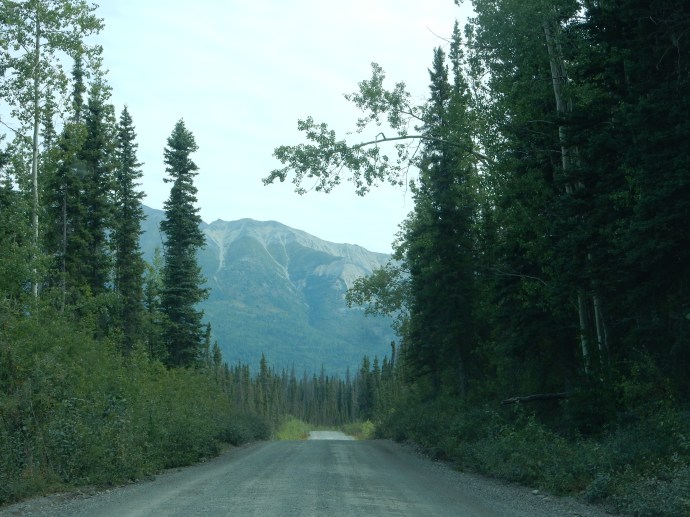
Driving on the McCarthy Road

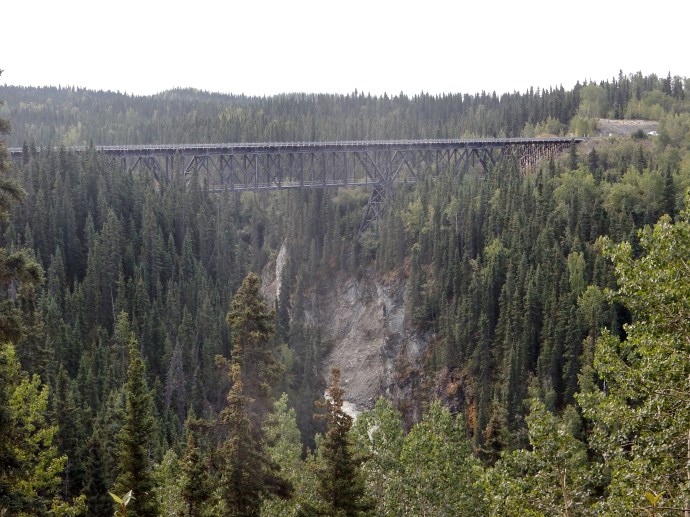
Warnings are justified but the road was doable. It is primarily gravel with a section of poorly maintained asphalt. The gravel is usually in a washboard state with big potholes only in a couple of miles of the road. There is one dramatic bridge to drive over, a 525 foot one-lane bridge over a river 285 feet below you with a wood plank surface currently under renovation. Portions of the road we drove at 20 mph, much of it was okay at 30-35 mph if you had high clearance and a good suspension. Clouds of finely grained sand dust swirled behind us. I was happy we were in a rental rather than my own car. The drive in was two and one-half hours with stops for pictures, the drive out was closer to two hours. Kennecott is at 2200 feet elevation while Chitina is at 600 feet so there is some elevation gain, most of it in the first five miles. When meeting oncoming cars you normally have to slow down; for larger vehicles (pickups with campers in the bed) one pulls over and stops.

Since Wrangell-St.Elias is mountainous, mountain peaks are all around you. The road follows much of the old railroad bed that was built to haul in supplies and haul out coal; transporting it to the port of Cordova about 120 miles away. Construction of the Copper River and Northwestern Railway was expensive and a feat of accomplishment as the route went over mountains with numerous trestles. Portions of it were built during the Alaskan winter during the years of 1908-1911.

The Root and Kennicott glaciers became visible as we arrived at McCarthy. McCarthy was the private town, providing entertainment to the miners living in the company town of Kennecott just five miles away. 600 people lived at Kennecott, primarily single men but some families. Today the roles are similar, McCarthy has a few bars and shops and a population of 28; Kennecott has the restored buildings and ranger talks of the National Park Service. To reach McCarthy itself after the drive, one walks across a footbridge over the river and either walks another quarter mile to the town or takes a private shuttle. After driving for three and a half hours from Copper Center, a brief walk felt good.

The Kennecott Copper Mill

Chris and I had lunch, finishing in time to take the 1 PM shuttle (they run every half hour and cost $15 round trip per person) the five miles and 25 minutes to Kennecott-the road here is uphill and full of potholes also. Kennecott is full of stories, the discovery of the mother lode, the back breaking work to construct the railroad and town, its abandonment in 1938 (truly abandoned, it was too expensive to remove items so buildings,dishes, food, etc. were all left here), the lives of the miners, the huge profits made here by the Guggenheim and J.P. Morgan families, the years of neglect, and finally the resurrection by the National Park Service and the ongoing restoration of many of the buildings. We learned as much as we could from videos, exhibits, and ranger talks before taking the 4 PM shuttle back to McCarthy and the footbridge to our car.

Glacial drift at Kennecott Mine

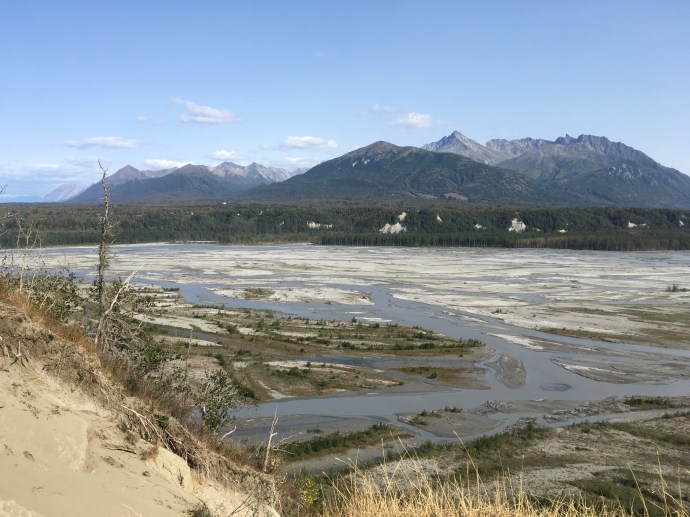
The glaciers here are receding but our preconception that we were looking at tons of mining waste in the valley was corrected. Down below us as we stood in Kennecott were miles of glacial drift. Remnants of the Root and Kennecott glaciers have become covered with dirt and ground up rock and look like a moonscape below us, stretching out everywhere we look. Even more amazing, when the miners were here, the glacier drift we see now were glaciers towering 300 feet above them. Talk about living next to an icebox, it must have provided summer air conditioning to the entire valley.

We did not stop along the road on our way out although we slowed down frequently as we passed numerous prime moose viewing areas. We looked and looked but no moose came into view. We were feeling pretty despondent. We have seen moose in Yellowstone and Grand Tetons but missed them in northern Minnesota and at Isle Royale National Park. But this is Alaska, moose are supposedly everywhere.

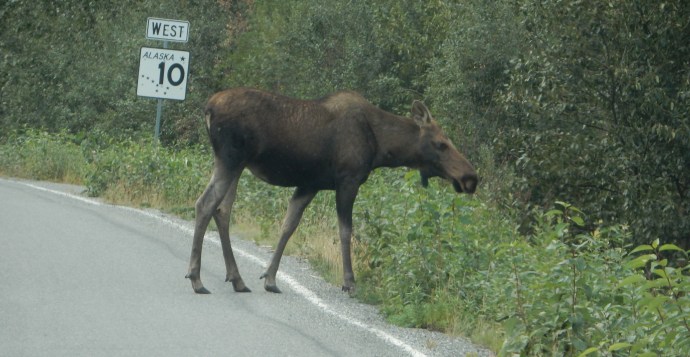
Our moose!

We made a restroom stop at the wayside in Chitina (population of 126), scene of our car scare on the way in this morning. As we left town, standing on the left side of the road was a moose! It ambled across the road, ate some leaves from bushes on the right side and continued on in to the brush and out of view. It took maybe two minutes between sighting and disappearance, just a lucky coincidence in our favor this time.

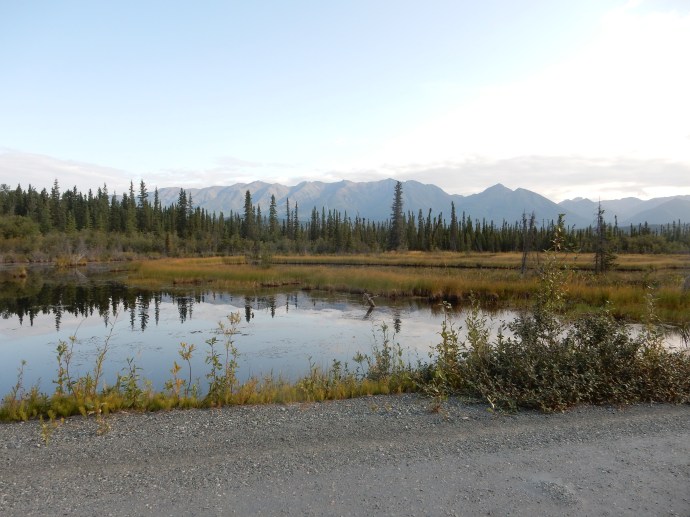
View from the Copper Princess WIlderness Lodge, 9:15 PM August 20

Ed and Chris Wdnesday 6 AM

Categories: road trip, travel | Tags: , , , , , , , | 1 Comment

2019 Trip 5: Alaska. August 19

We are in Alaska

Copper Center Alaska. Monday August 19

On this, the fourth day of this trip, Chris could finally say that she felt she was in Alaska, that the views matched her expectations of Alaska, not her previous feelings that we were traveling in the Canadian Rockies or even New Zealand. Today was primarily a travel day, a day of observing, a day of stopping to take photos, a day to have the scenery change. Fortunately the weather was pleasant. The strong winds died down as we left Palmer, with sunny to partly cloudy skies. Temperatures are starting to get cooler, highs in low 60s but dropping to mid 40s for part of the day.

The drive begins as we follow the Matanuska River, in the valley between the Talkeetna Mountains to our north (left) and Chugach Mountains to our south (right). The Glenn Highway was constructed in the 1920s, is designated Route 1, and was the first major highway in Alaska. It is primarily two lanes at this stretch with some passing lanes as one ascends hills. The river is frequently visible, still with that braided style of multiple channels and the milky white color from glacial “flour”, or ground up rocks, originating from glacial ice/snow/water moving over the mountains. But the river is below us, not a bubbling creek rushing alongside the roadbed, but a broad river a little distance away.

Roadside scenic overlooks are frequent, we take constant advantage of them, stretching out the time it would normally take to drive the 150 miles from Palmer to Copper Center. Towns are rare, even those are generally a small cluster of buildings, not a concentrated downtown or even a strip mall type of gathering. Traffic is busy with numerous pickups, travel trailers, and RVs.

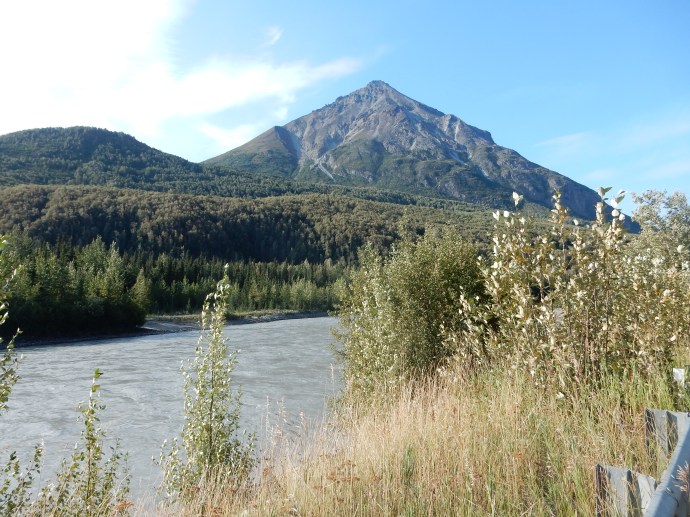
King Mountain and the Matanuska River

Glaciers appear

It seems about two-thirds of the way into the journey that the snow on the mountains begins. We pass a definite glacier, than a few more; recognizing that we do not know if they are interconnected and just one official glacier with multiple views or separate glaciers. In any event, snow in the crevasses is more frequent and easily visible in the Chugach Mountains to the south. The Talkeetna Mountains are drier and steeper, no snow is visible there. We pass King Mountain, a massive looking mountain that squats ponderously across the river.

The “tundra” area

Finally the Chugach and the Matanuska river veer away from us, angling to the south. We enter an area of what I call tundra, a series of rolling hills and plains with spruce trees and low vegetation. These are black spruce we later learn, heavily infested with an invasive beetle that is killing many of them. We can see the difference, the dying trees are blacker with the needles still on them but not as green. The difference is quite noticeable as the dead and living trees are intermingled.

Again later we learn that even here there is permafrost; that permanently frozen ground that may be just 16 inches or 16 feet below the surface. Black spruce is aptly suited to grow where the soil is shallow. We take a break in Eureka to have a piece of pie at the Eureka Roadhouse, an 83 year old small cafe and gas station with a few rooms to rent.

Mountains or clouds??

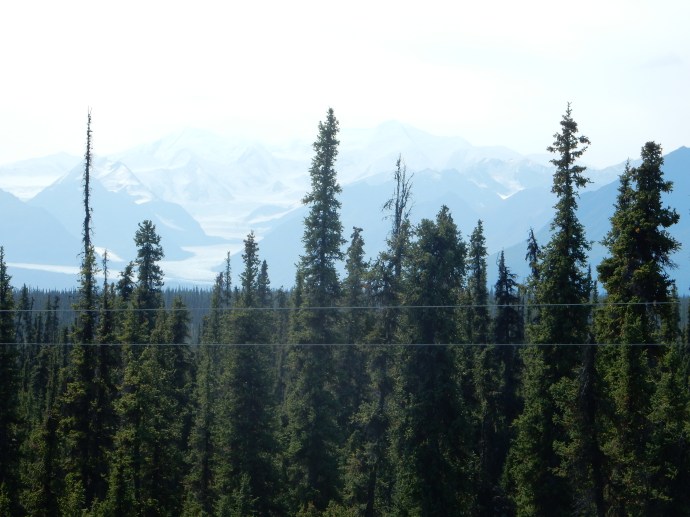
As we leave and continue our drive, to the east appear either clouds or a new mountain chain. As we get closer it is clear, the view is more mountains but more massive than the Chugach or Talkeetna. This is our first, far off view of what will be Wrangell-St. Elias National Park and Preserve. We drive to Glennallen, a slightly larger community with a grocery store and three gas stations. We gas up here as the Glenn Highway meets the Richardson Highway. The Glenn will continue on to Tok and the Alaska (Alcan) Highway. The Richardson travels between Valdez to the south and Fairbanks to the north. Here the Richardson is our choice as it follows the Copper River which forms the western boundary of Wrangell-St.Elias.

Lunch at the visitor center of Wrangell-St.Elias National Park and Preserve AK

The main visitor center for Wrangell-St. Elias is 10 miles south of the juncture of the two highways. We spend about two hours here; talking with the rangers, viewing the movie, shopping, viewing the exhibits, having a late lunch that we had packed, and taking a short hike.

Wrangell-St.Elias is huge. It is the largest national park. It is the size of six Yellowstones, bigger than New Hampshire and Vermont combined, bigger than Switzerland. 20% of the park is covered by snow and there are only about 100 miles of road in the entire park, concentrated on two spurs that enter the park, one from the north, and the McCarhy Kennecott Road that we will be taking Tuesday. Parts of four mountain ranges are in the park; the Alaska Range, the Wrangell Mountains, the Chugach, and the St. Elias. It has nine of the 16 highest mountains in the U.S. These monsters are over 13,000 feet with Mt. St. Elias at 18,008 feet being the second highest in the U.S.; the Hatcher Pass mountains were only 4-5,000 feet. The park is 150 miles wide and 200 miles top to its bottom at the Gulf of Alaska. This is one massive park, most of which is wilderness and challenging to explore.

We will tackle a small piece of the park Tuesday. Tonight we are staying at the Copper Princess Wilderness Lodge; one of four lodges Princess Cruises has set up in Alaska. It is about the only lodging of substance and size in the area. This one closes in mid-September. Until then though the park service offers talks and walks here on a daily basis. Our ranger presenter tonight is a seasonal with experience in Alaska and Iceland with her home base being a small cabin in Maine.

Our walk around the forest surrounding the lodge discusses the animals and vegetation common in this area. For instance, she led us to a branch that had been eaten by a snow-shoe hare and recounted how one time she had been crouched down to examine some bushes when a snow-shoe hare ran past her without stopping. Moments later a lynx also ran past but as it passed it realized she was there and skidded to a halt, turned around and just stared at her for half a minute before bounding off. Chris and I related immediately to the story, we have a diorama at the Bell Museum in St. Paul that tells the story of the interconnectedness between the hare, the lynx and food sources.

Later, after the walk, the ranger presented a talk and slide show in one of the meeting rooms of the hotel. Open to all, it did seem to have a hard time competing with the bus travelers who headed straight for the dining room. This presentation covered climate change with detailed historical backing to present how the current change in the climate occurs, and how the current increase is so dramatic in such a short period of time without any connection to past changes caused by rotation of the sun, etc.

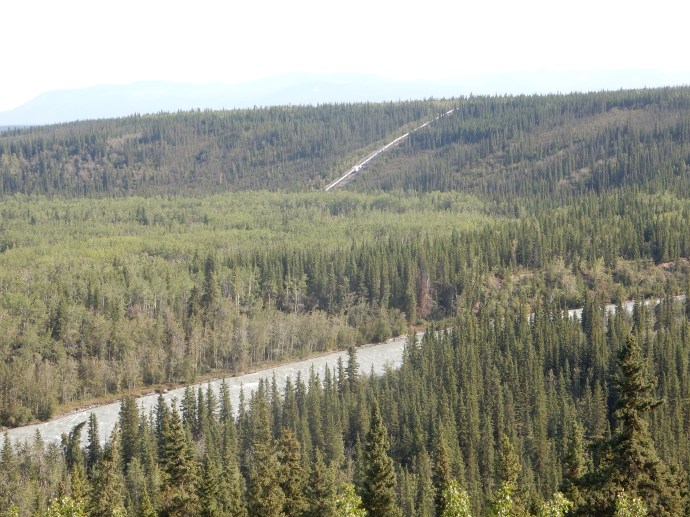
Our first view of the Trans Alaska pipeline

Of particular note for us traveling in Alaska is the danger caused by the melting of the permafrost. Just one obvious example is the danger posed to the Trans-Alaska Pipeline. The pipeline is built and heavily dependent on permafrost. If the permafrost melts, the stability of the pipeline is threatened and pipeline breaks are likely; threatening the supply of oil, the economics of the companies and of Alaska, and the resultant environmental damage.

Part of her presentation discussed Wrangell-St. Elias. Between her presentation and the movie, we could understand the beauty and majesty of the park, most of which we will not be able to see firsthand. Snow, ice and glaciers abound here; actually there are more glaciers in this southeastern section of Alaska due to the effect of the high mountains stopping the Pacific storms. Parts of the park receive over 60 feet of snow per year; the areas down around Juneau and Sitka can receive up to 100 feet of snow. The more northerly parts of the state, while colder, are drier.

Wrangell-St.Elais houses a building showcasing the Ahtna native culture but it was not open today and has not been most of the summer. It was unclear if funding or staffing was an issue but we will miss learning about the Ahtna. They are part of the Athabaskan group of indigenous peoples and were well-known as a trading people. Just east of Palmer as we started off the day, we were able to visit the Alpine Heritage Park in Sutton-Chickaloon. It is a small but well-maintained grouping of buildings that serves a historical purpose and as a community park. The Dene’ branch of the Athabascan tribe lived in this area.

The Alpine Historical Park in Sutton, Chickaloon AK

The Alpine Historical Park related the native culture and the history of the Russian and American coming to the area. Coal had been discovered in the area and a railroad spur was constructed to provide coal to the U.S.Navy. Unfortunately, the Navy switched to diesel fuel before the coal could have a major impact on the economy here. The park has numerous building well-preserved with descriptive information available about each one. We were impressed with the quality of the work, particularly for such a small community.

Ed and Chris. Copper Center AK August 20. 6 AM

Categories: road trip, travel | Tags: , , , , , , | Leave a comment

2019 Trip 5: Alaska: August 18

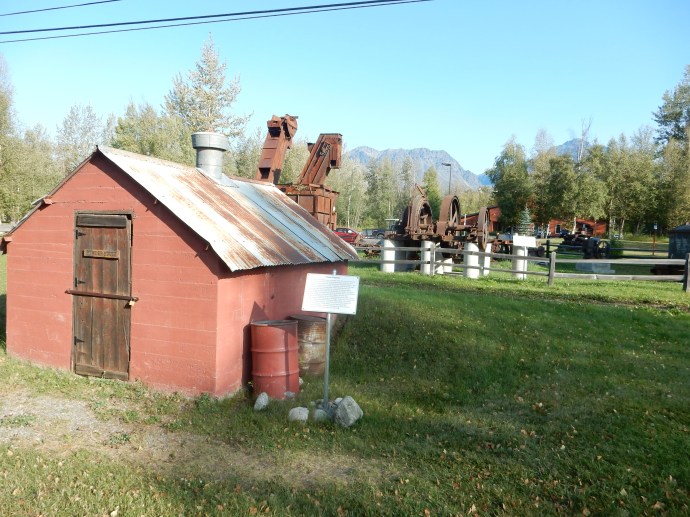
Independence Mine State Historical Park near Palmer AK

Palmer, AK. Sunday August 18

Today will be a day that justifies our Jeep rental. Yesterday, Chris was a little hesitant to drive the Jeep through a water crossing along the Knik River. Today, however, we will be driving Hatcher Pass, a gravel road with sharp switchbacks and only open from July 4 to mid-September. Now, we could come here in the winter and do dog sledding, skiing, snowmobiling, or even backpacking, etc. but for now our adventurousness is limited to driving a few remote roads.

Hatcher Pass leads into and over the Talkeetna Mountains. Miners looking for gold found flakes in the creeks flowing from these mountains and explored the mountains to find a mother lode. In 1906 the first mother lode was discovered and mines operated here until 1951 when the high cost of underground mining forced the decision to close the last mines. Today, Independence Mine State Historical Park maintains the mine site and buildings.

That is the plan as we sit here at 6 AM listening to the wind howl, marveling at the mountain peaks across the valley, watching the almost full moon in the sky, and waiting for official sun rise. Yesterday our guide was talking about the wind in Palmer. There are three mountain ranges that produce strong winds throughout the year and we experienced it during the day. During the night one could hear it blowing even stronger. We have not yet explored if there are any wind farms here.

The day started with instant oatmeal and church. The local church was well attended for 8 AM Mass with several large families. Two people came up to us and discussed their St. Paul background. (Chris stood up and introduced us when they asked if there were any visitors present.) After the service ended, we were off to Independence Mine and to Hatcher Pass. A bright blue sky accompanied us although the winds were strong, giving a slight nip to the air as we left Palmer.

Driving up to Hatcher Pass

The drive to Independence Mine is paved. There is a lush green color on the agricultural fields which continues as one goes up the mountains. The mountain tops are at 4-5,000 feet. Some are granite, rocky, and steep. Others are still steep but covered in green trees or grass. Somehow, despite reading, seeing, and hearing otherwise, one still expects to see snow everywhere in Alaska. The green mountainsides, in this area, were a constant source of amazement.

Independence Mine State Historical Park, Alaska

Independence Mine jumps out at you. The buildings are abandoned and many are falling down. However, the first impression is of the mountains. The first gold claim was near the top of Skyscraper Mountain, to the left as you drive up. There is a gap in your view and then Granite Mountain takes over on the right side. The buildings, creek, waste piles, etc. are bunched in the middle gap between the two peaks. Information boards give the history of the mine and of each building.

The mines here produced 141,000 ounces of gold, at today’s prices that is 210 million dollars. But of course, for much of the time the mine was operating, the price of gold was fixed at $35 per pounce, so only about $5,000,000. At its peak, 203 miners worked here, with only Christmas and the 4th of July off. The 38 mines around here were the second most productive gold hard-mining area in the state of Alaska.

Some views of Independence mine State Park

This mine was costly to operate. Supplies were shipped to Seattle or San Francisco from the east and then re-shipped to Seward. Finally supplies were placed on trains to Palmer where the final leg brought them up to the mine site. Some families lived here; a school was begun to teach the children. One young girl raised here learned to ski the mountains and went on to be on the 1956 U.S. Olympic Alpine ski team. Generally miners and other workers were single men living in bunk houses and were fed at the commissary. Huge quantities of ore had to be extracted from deep in the earth, with machinery to pulverize the rock before separating the gold.

Today it is abandoned. As we walked among the ruins, the wind increased in intensity. We had to wear both a fleece jacket and a down jacket to stay warm. While we could enjoy the views while warmly dressed, the miners would have had to work even during the worst of the winter.

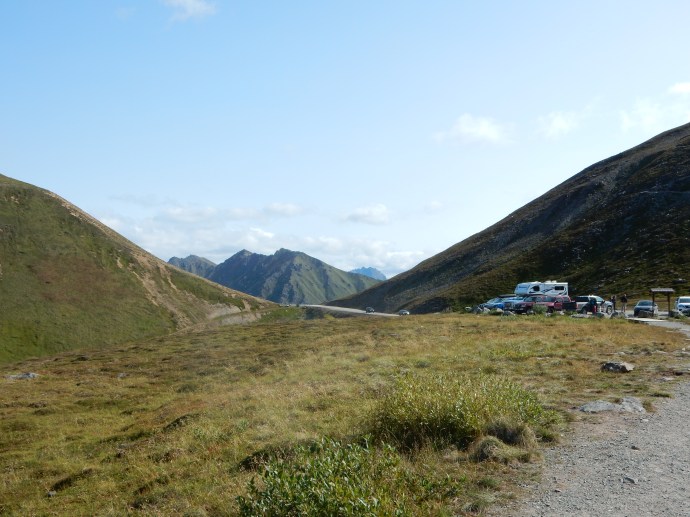
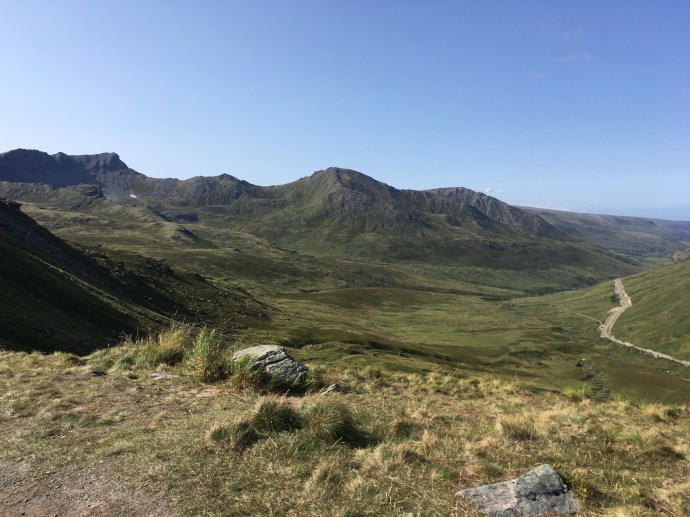
Hatcher Pass

Hatcher Pass

Hatcher pass

We left the mine and looked forward to our drive over Hatcher Pass and a nice meal at the Hatcher Pass Lodge with potential scenic views of the valleys and mountains. Unfortunately, the lodge was accommodating lodgers but the cafe part of the lodge, supposedly open according to the web site, was closed. Chris and I each had a granola bar for lunch instead.

The Hatcher Pass Road was not as bad as its reputation. I think the most difficult part of it may be the likelihood the road will be closed due to snow. The road is wide enough for two cars and only the first few miles (of 23) were washboardy. There is a drop-off at the sides of course, but we have experienced much worse.

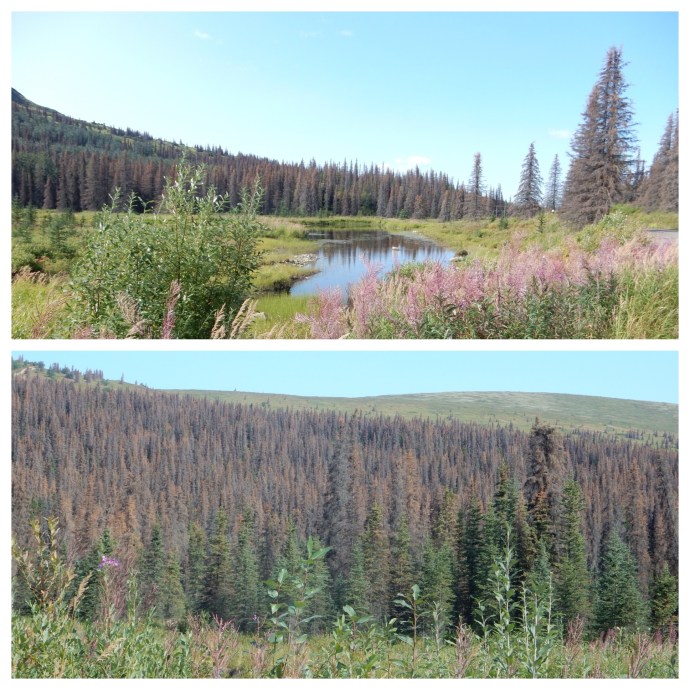
Dead trees on west side of Hatcher Pass

Numerous pull-offs provided opportunities for short hikes and for picture-taking. We frequently observed groups of people picking berries in the fields along the road; off road vehicles could be seen off in the distance but rarely on the road itself. After the pass, as we went west and down, the Little Susitna River was frequently by the side of the road. No moose were seen grazing along its banks. BUT, remember those nice comments about the lush green grass and trees?? On the west side of the pass, dead trees were everywhere. I am not sure what insect or disease is at work here, but the result was devastating.

At one of the overlooks, we met again two brothers (they were at the mine site earlier) originally from Miami (although one now lives north of Anchorage) who warned us that fires and smoke were closing portions of the Parks Highway connecting Fairbanks and Anchorage, usually right in the Denali area. We will have to monitor that, it could be a major disruption in our plans.

Hatcher Pass Road took about an hour but now we are west of Palmer. It took us another hour or so to return to Palmer. We could smell smoke in the air and traffic was heavy on the Parks highway. Eventually we made it back to Palmer and had a late lunch downtown at the same small cafe we enjoyed Saturday. Sunday is a much busier day for them, lucky to find a table.

But after lunch it was off to our last stop of the day, the Musk Ox Farm. Chris and I were particularly interested in this since our docent work at the Bell Museum in St. Paul includes a display of a musk ox-and a wooly mammoth. Both existed in Minnesota thousands of years ago. Musk ox became extinct in the U.S. but were re-introduced from small herds still remaining in Canada and Greenland. Our admission includes a 30 minute tour; our guide, a young man, made a nice presentation about musk ox, the farm, and fire plans for the farm-which is located on one of the Great Depression colony farms.

Musk ox in Palmer AK

This group of about 80 animals are domesticated and raised for their hair, called quivut. Pound for pound it is the warmest material on the planet and the quivut combed and gathered from the oxen are provided to indigenous women to weave into scarfs, mittens and hats. The techniques replicate the traditions of their heritage. Nowadays one can buy the finished products-although at a hefty price. The musk ox calves born each year are named after a theme: cheese (Gouda and Munster), national parks (Zion, etc), trees (larch, maple, oak), etc.

Dinner was take out from the local grocery store; fried chicken with two sides and a roll. Good food and we came back to our lodging and relaxed.

Matanuska River north of Palmer, looking toward Chugach Mountains

Ed and Chris Palmer AK 9:30 PM

Categories: road trip, travel | Tags: , , , , , | 1 Comment

2019 Trip 5: Alaska August 17

Eklutna Historical Park near Palmer AK

Palmer AK. August 17

If you divide Alaska in half, Texas would be the third largest state. Given that fact, it is egotistical to state that we will know Alaska by the time we leave the state on Sept. 10. However, we will certainly do our best to see as many different areas as we can. Today was an excellent start.

Thunder Bird Falls in Chugach State Park, AK

Thunder Bird Falls is only 25 miles northeast of Anchorage. It is viewable after a one mile hike along a cliff side trail that features a constant parade of up and down hills. The trail is wide and relatively smooth. Halfway along the trail is an overlook that presents views of the falls on Thunder Bird Creek which flows into the Eklutna River. Another half mile brings you to the view of the falls; today, however, the angle of the sun created poor photo opportunities. Still, the walk was in a forest, temperature was 65 degrees, and the sun was shining. A pleasant interlude to begin the Alaskan adventure.

Our next stop was the Eklutna Historical Park. This small collection of buildings is a result of the intermingling of the Dena’ina Athabaskans and Russian hunters and traders. The Athabaskans moved in here from the west thousands of years ago. The Russians came in the 1700s searching for pelts; beaver, sea otter, etc. as well as copper and gold. The story of Russian exploration is long and complicated; murderous and greedy combine with concern and compassion. By the time they sold Alaska to the U.S. in 1867, Russian Orthodox churches had gained a foothold in various settlement areas.

A variety of spirit houses at Eklutna Historical Park

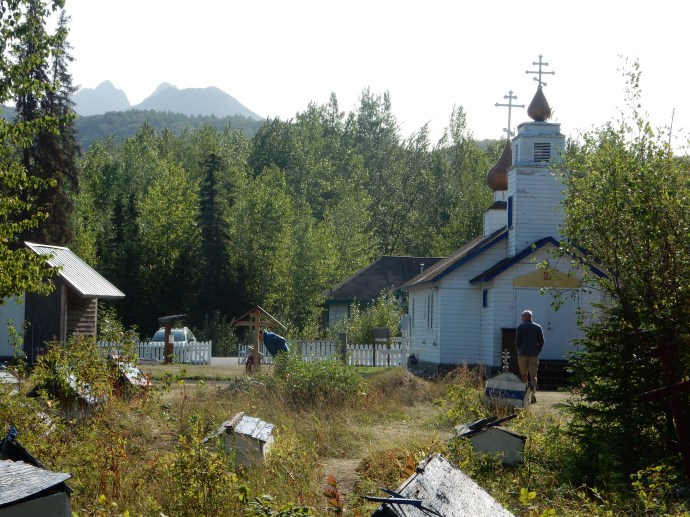
The Eklutna Historical Park retains the old St. Nicholas Church originally built in Knik and moved to Eklutna in 1900. The new St. Nicholas Church was built in 1962. Both are very small and are locked on Saturdays, we only viewed the outsides. An unusual feature of the area are the “spirit houses”. These burial markers are a unique combination of Athabaskan tradition married to Russian Orthodox practices. While small in number, it appeared to us be about 50 or so spirit houses, they exhibit a variety of styles and care. Some are care-worn, possibly reflecting the end of a family line who no longer live in the area. Others are painted, well-maintained, and have fresh flowers on display.

The Matanuska River near Palmer AK

We left Eklutna for Palmer, our lodging site for the next two nights. To get to Palmer, we took the Old Glenn Highway which ambles along the Knik River. The Knik River begins at Knik Glacier-which we did not drive to. The river is a milky white color with wide, sandy beaches. With the Talkeetna Mountain Range across the river to the west, it made for a much better photo op than Thunder Bird Falls. Then, as we got closer to Palmer, we were driving along another river, the Matanuska, which was flowing much faster than the Knik. It is the Matanuska River that we will be following on Monday, over to Wrangell St. Elias National Park and Preserve.

In Palmer, we took a 90 minute docent tour of the historic Palmer Colony. Forgive me, but I need to present a little background data first. 10,000 years ago the last great ice age had this part of Alaska under thousands of feet of ice. The glacial melt left glacial drift in the valleys, dirt that is finely ground and fertile. (Similar to the plains of the Midwest.) This section of Alaska is thus one of the few areas in the state that presents great agricultural opportunity. With a short growing season but long hours of daylight, this fertile soil produces vegetables that are much larger than normal. Some of the record vegetables at the Alaska State Fair include: 39.2 pound turnip, 82.9 pound rutabaga, 138.25 pound green cabbage, a 1469 pound pumpkin, and a 71.75 pound carrot-all world records.

The Colony Inn B & B, formerly a dormitory for service personnel for the Palmer relocation program

During the Great Depression, one of the lesser-known recovery efforts was the transplanting of 203 Midwestern farm families to the Palmer area. This federal government program was conceived, planned, and put into execution with the first families arriving in Alaska in May 1936. Without going into great detail, the effort failed and succeeded. One-half of the families returned to the lower 48 by the end of 1937. But the effort laid the groundwork for greater development of Palmer and its agricultural resources which proved vital when WWII began. With the Japanese invading and capturing several Aleutian Islands, the American armed forces began a swift build-up in Alaska. The bases built then, and still maintained, provided labor for the farmers, a ready market for produce, and an introduction to the area for military personnel; some of whom made the area their permanent home.

The docent tour presented the story well. We saw several of the original homes, one of the churches, and a former dormitory now a B and B. The docent provided plenty of time for questions and we obliged by asking a lot.

After the Palmer tour, we checked in to our Airbnb lodging, got groceries, and had dinner at a small cafe in downtown Palmer. Since it is still light out, we drove down to the Hay Palmer flats and took a one mile hike around Reflection Lake. Hay Palmer Flats are a wildlife refuge at the confluence of the Knik and Matanuska Rivers and the Knik Arm of the Cook Inlet.

Of particular interest is the fact that this area had been a hay growing area for the dairy farms around Palmer. On Good Friday 1964, a 9.2 earthquake with a resulting tsunami, the largest in North American history, struck Alaska causing widespread death and destruction. The ground was pushed up in some places and depressed in others. Here, at Hay Palmer, the land subsided 4-6 feet and the hay fields became too swampy for growing hay. The marshes and swamps became a gathering place for wildlife. Reflection Lake is in the refuge and there is a pleasant one mile hike around it.

Ed and Chris. 10:30 PM

A view at Hay Palmer wildlife refuge, Palmer AK

Categories: travel | Tags: , , , , ,

2019 Trip 5: Alaska

St. Paul, Minnesota August 16, 2019

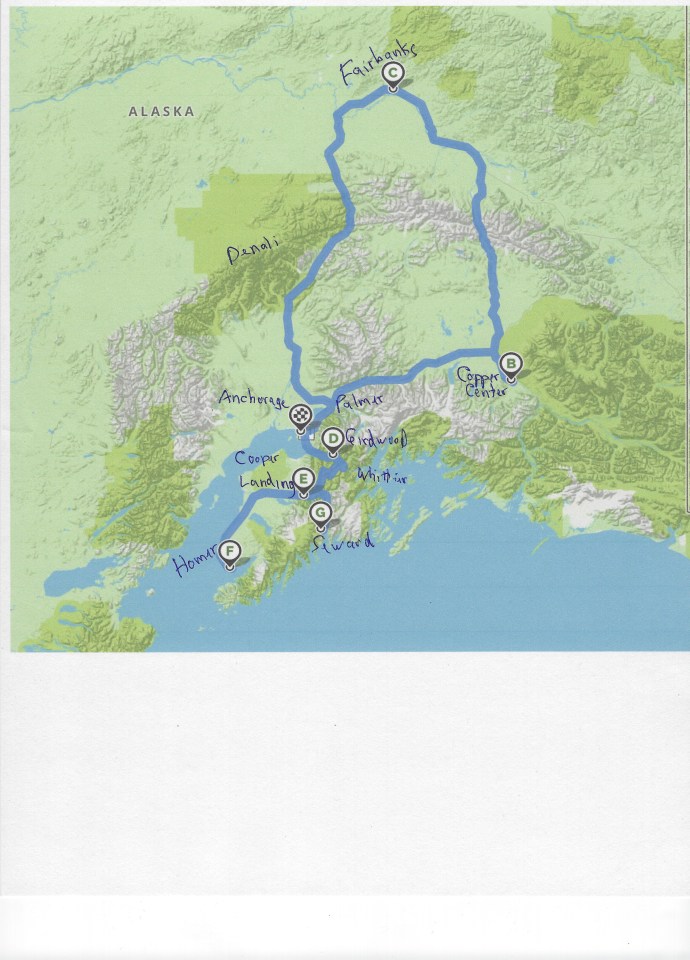
Well, our next trip starts this Friday, as we leave for Anchorage and 3.5 weeks driving around Alaska, wrapped up with an Amtrak train ride from Seattle home to St. Paul. As usual, planning is detailed and finished.

Anchorage, Saturday 17, 2019

A five hour and 45 minute plane ride brought us to Anchorage. We were unable to view much from the plane windows (hint for future travelers: Should the weather cooperate, choose the “F’ window seat for a view of the mountains.). The ride to our hotel at sunset (9:30 PM-no longer daylight for 24 hours but the sun is still setting later than it did back home) just showcased the business side of Anchorage.

We were a little embarrassed on this trip. We packed an additional suitcase in addition to our two carry-ons and backpacks and used the baggage check service. This is the first time in eons we have done this but with the variety of weather, outdoor conditions, and tours we are taking, it seemed essential.

Our Jeep arrives at 9 AM and after packing it so our usual tools of the trade are close to hand, we will be off. Our first stop is Palmer, a town of about 7,000 people. We will be in Palmer for two nights. (Hint to travelers: We rented a Jeep from Alaska 4 x 4 and obtained a great rate; ability to drive roads Hertz, etc. would not allow; and the drop-off at the hotel avoids about $300 in airport rental car fees).

Anchorage we will visit in more detail at the end of the trip. We did discover that the Anchorage airport is the second busiest U.S. airport for cargo, and the fifth busiest cargo airport in the world. Population here is just under 300,000; so the weather and population are not dissimilar from that of St. Paul. Anchorage’s winter weather is less dramatic than much of Alaska.

An article in a local Alaska business magazine spotlighted greenhouses/nurseries and the impact climate change has on them. Plants are being started 2-4 weeks earlier than the historical average. Another current article highlights the negative impact salmon are facing due to the higher summer heat. Draw your own conclusions.

Ed and Chris. Much more to come.

Categories: travel

Blog at WordPress.com.