
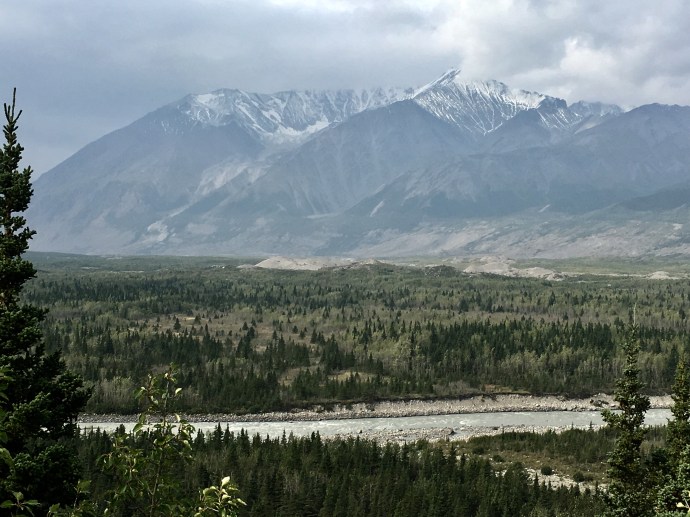
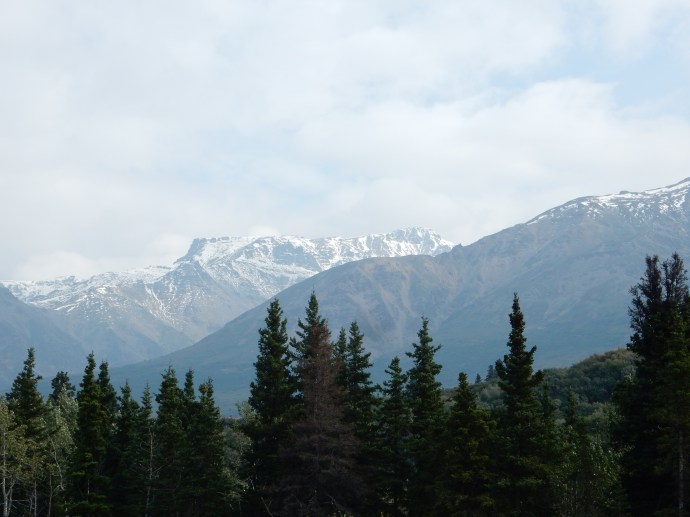
Part of the Alaska Range along Richardson Highway
Fairbanks Alaska Thursday August 22
The Richardson Highway stretches from Valdez to Fairbanks and was Alaska’s first major road. Today we drove the 250 mile stretch from Copper Center to Fairbanks. For a major road, we were surprised by light traffic, sections of road with narrow lanes and no shoulders, and portions of road with dips, bumps, gravel, and just plain rough road. We guessed the dips are caused by permafrost problems; slowing down was smart to avoid being tossed into the air. We passed a patching crew on a hill in the section of road with no shoulders and had to stop and wait for them to signal it was safe to pass.

Driving the Richardson Highway
Our scenery started in the hilly areas with black spruce forests around us. We drove along portions of the Copper, Delta and Tanana rivers. The TransAlaska pipeline crossed from left to right and back again. No caribou, moose, bear, etc. made an appearance. Portions of the route were treeless with only scrubby brush. We drove through two military reservations. The show stopper for scenery was the Alaska Range with peaks, glaciers, lakes, and colored rock formations.
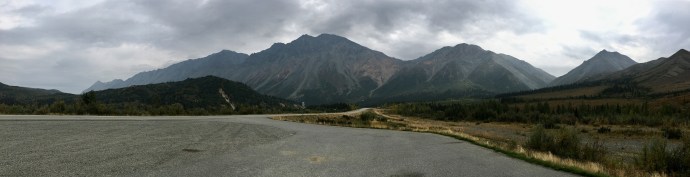
Along the Richardson Highway
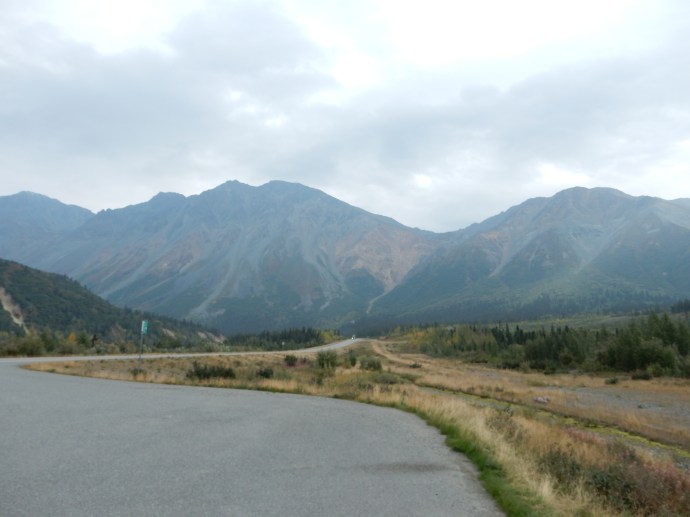

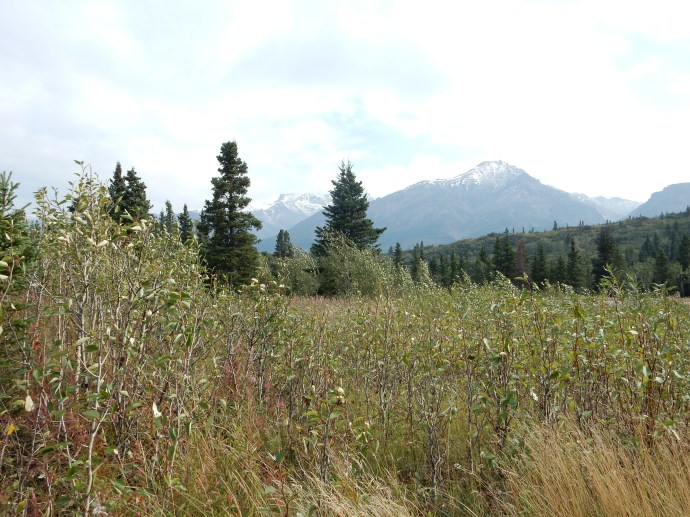
The route contains only small towns, some where roadhouses used to exist. Despite looking, we missed the remnants supposedly by the side of the road. Fortunately, pull-offs are common, so we could take pictures of the pipeline, the colored talus slopes of Rainbow Ridge, the creek flowing out of Summit Lake where other travelers were looking for fish that normally inhabit the creek, the early fall colors . Unfortunately, seeing the sun was rare; the photos would have been fantastic with a bright blue sky behind the mountains for contrast.
Two vignettes for you. We stopped at Sullivan Roadhouse Historical Museum in Delta Junction. Alaska Roadhouses were an important historical landmark in the early 1900s, particularly on the Richardson Highway. Roadhouses provided food and lodging for people and horses. Given the difficulty of Alaskan life then, the costs were high. For instance, at Sullivans a meal cost $2 when a fancy meal in Seattle cost 15 cents. Roadhouses began a decline around 1917 when car travel became possible on the road.
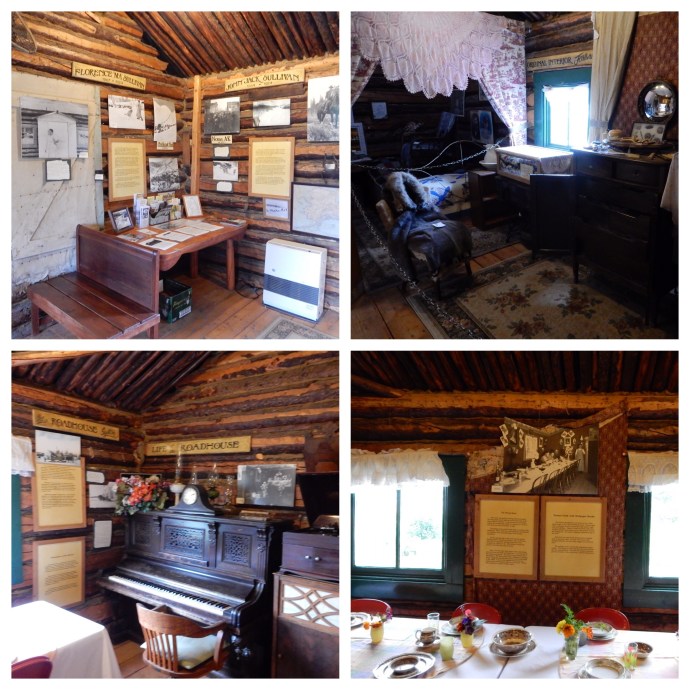
Interior of Sullivan Roadhouse
But the story at Sullivan’s has multiple angles, two of which we will relate. First comes the beginning of the story. The owners came separately to Alaska in the mid-1890s seeking their fortune in the gold fields. Separately they both traveled during the winter of 1899-1900 from Dawson City to Nome. She hired two men to pull her sleds of goods while she walked in front through the snow and broke the trail. It was only after several years in Alaska that they met in Nome and married in 1900. They built the Roadhouse in Delta Junction in 1905. It was well-known and well-regarded having surmounted all of the hassles involved in running such an establishment in Alaska in the early 1900s.

The Sullivan Roadhouse in Delta Junction AK
The second angle of the story relates to the building itself. The vast majority of Alaskan roadhouses burned, were abandoned and fell apart,etc. The Sullivan Roadhouse survives intact. Why? Well, the Sullivans had to move from the original site when the road moved. When moving, they installed a metal roof, rare at the time, to replace the sod roof. This contributed to the building’s permanence.
But in 1921 the trail was abandoned and the Sullivans did the same with the building. It sat empty even through WWII when it became attached to a new Army base used as a bombing range. Wildfires came close but the building survived. In the 1970s the artifacts in the building were unofficially squirreled away to a private site. Finally a federal program to save historic buildings on Army land, as its last job before budget cuts killed it, moved the roadhouse to its current site by taking each individual log by helicopter to the site it occupies today.
We heard this story while viewing the museum and talking to the guide, a man who still has family land around Portage WI. And, of course, the next people in the museum were from southern MN visiting a son/sibling stationed at the military base nearby.
The second vignette relates to Pennsylvania, our home for almost 30 years. We had a late lunch/early dinner at North Pole, Alaska at Little Richards Family Diner. In chatting with the wait staff, we learned she has been with the diner for nine years, since it was established. The owners, who work the breakfast shift, used to own a similar diner in Camp Hill PA, close to where Chris worked. Chris remembered eating breakfasts and lunches there. Another small world incident.

Inside the Morris Thompson Cultural and Visitor Center
We finished the day at the Morris Thompson Cultural and Visitor Center in downtown Fairbanks. It is very well done and has a wealth of information available through displays, materials, and volunteers. The exhibits display history on native cultures and life even today. There are 11 distinct Athabascan groups, each with its own characteristics, language, and territory. Also, only 11 of 42 Athabascan villages in interior Alaska are connected to the outside world by roads.

TransAlaska Pipeline
Ed and Chris Fairbanks AK Friday Aug. 23 6 AM
 Chris Klejbuk and Ed Heimel travel adventure
Recent Comments