Monthly Archives: March 2019

2019 Trip 3: South Florida: March 29

The autonomous vehicle in Babcock Ranch

Babcock Ranch, March 29

We rode on our first autonomous, driverless vehicle today. And, we rode on a bumpy old school bus through mud and swamps. Quite a variation. Both rides occurred within a few miles of each other at Babcock Ranch.

With a history that goes back to the late 1800s, Babcock Ranch has changed focus with the years. Its first owner was a Montana gold miner who struck it rich. Perry McAdow moved to the warmer climes of Florida and chartered the Punta Gorda Bank. He purchased thousands of acres of land in the area. Edward Babcock was a Pittsburgh native who owned a lumber company, at one time the largest in the world. He also liked the warmer climes of Florida and bought out McAdow in 1914. Babcock added on to McAdow’s holdings, eventually owning over 100,000 acres.

Cracker cattle at Babcock Ranch Preserve

The Babcock Ranch cut timber, using much of the cypress logs for shoring in mining due to cypress’ ability to resist rot. After the timber was cut, Babcock added raising cracker cattle, rock mining, and agricultural products. You may recall from an earlier Florida posting that cracker cattle were brought over by the Spanish. Cracker cattle can live off the land but their meat is low quality. The term cracker comes from the sound of the whips used by the Spanish cowboys to control the cattle.

The ranch lies astride an important water connection between Lake Okeechobee and the Gulf of Mexico. By the late 1900s, the ranch was run by Babcock descendants willing to part with the land. A plan was devised to divide the ranch into two parts; making most of the land into a preserve with about 20% going into a planned community. Today that division has resulted in the state-run Babcock Ranch Preserve and Eco-tour as one part and the Babcock Ranch planned development as the other. We visited both today.

Momma alligator with baby alligators on her back

The preserve is 67,000 acres and continues the timbering and ranching operations. The preserve protects critical waterways and diverse natural habitats. In addition, a eco-tour is offered that brings visitors through grasslands, swamps, and woodlands. In Florida, an elevation difference of just a few feet changes the habitat from swamp to woodland in just a blink of an eye.

Wild pigs on the eco-tour

Barred owl in the swamp

Our tour and bus driver has his own horse and cattle and enjoys hunting wild pigs. His understanding of the Florida environment added immensely to the tour experience. We had arrived early and were able get on a tour that had about 15 people. Each of us had our own window seat. Luckily (for us), the school kids who arrived had their own tour and a separate bus.

Alligators and birds on the eco-tour

On the tour, we came across wild pigs, sandhill cranes, alligators, deer, egrets, limpkins, several types of herons, and a barred owl. None of these were new to us but still it was a pleasure to observe them again and hear the tour leader’s additional information.

The preserve has a small cafe on the premises and the cook gave us special attention, making sure our hot dogs were well burnt-after we assured her we truly did want them burnt.

After the preserve, we drove a few miles to Babcock Ranch. This planned community expects to eventually have 20,000 housing units, with only a few multi-unit properties. A mix of housing, commercial, retail, and public facilities are planned. Initial homes were just completed a year ago but signs of rapid construction are evident. We stopped in at the town center where the information center is located. We also observed a school, day care, health care facility, a restaurant, etc. open for business.

It was at the town center that we rode the autonomous self driving “bus”. The vehicle has six seats and standing room. Our vehicle did have a human manipulating some controls. The system is still being planned, programmed, and de-bugged. For instance, the vehicle stopped and would not move at a pedestrian crossing where a temporary sign indicating pedestrian crosswalk had been placed in the middle of the street. Since the temporary sign was not included it its programming, the vehicle thought the sign was a pedestrian and would not advance. Our human overrode the system while a few cars backed up behind us. Eventually the system will have individual addresses programmed and will take riders anywhere in the community. The vehicles will be called and dispatched via a smart phone app.

One of the initial features planned into the community is solar power generation. Between solar power, batteries, and natural gas, the community should be green beyond belief. It re-uses waste water for irrigation and individual homes must receive at least bronze level energy conservation certification. Fiber internet is everywhere. The Babcock Preserve surrounds the community. All in all, the vision of a livable, pleasant community seems doable.

The home prices are not outrageous although it seems certain to be an income-segregated community. The sales lady I talked to you professed ignorance of the concept of “affordable housing”. For all the talk of a planned community, though, our new Evergreen hosts mentioned that the county until just recently has not even planned road improvements to the existing road network to handle the increased traffic which will be generated.

After the autonomous vehicle ride, I worked outside on the blog in the town square. We had an early dinner there before driving to North Fort Myers where we will be staying for the next three nights.

Working on the blog at Babcock Ranch

Ed and Chris. March 29

Categories: road trip, travel | Tags: , , , , | Leave a comment

2019 Trip 3: South Florida: March 28

The north lighthouse on Gasparilla Island

Punta Gorda, FL. March 28

Our plans were to bike Gasparilla Island, one of the Gulf Coast islands with a state park, two lighthouses, an old town and new fancy housing. We did not, for two reasons. First, it was a little breezier than we prefer for biking. Second, the paths/trails were overrun by golf carts, sometimes driven by adults, sometimes by kids, sometimes by adults holding toddlers in one arm while driving with the other arm.

Gasparilla Island is reached via a toll causeway bridge connecting the mainland to the island. The southernmost lighthouse has a nice museum detailing the history of the area. Gasparilla Island was home to the Calusa Indians who used the area for fishing and harvesting the natural vegetation. They did not practice cultivation farming, they had no need to. When the Spanish arrived, the Indians refusal to farm resulted in the Spanish assumption of Indian ignorance and low intelligence. Over time, the Spanish ways predominated and with the later English settlements, the Calusa either died off or moved with the Spanish to Cuba.

The island and its population center of Boca Grande survived based on the fishing industry; first shipping salted fish to Cuba, and then with the arrival of the railroad and ice, shipping fresh fish to the eastern seaboard. Recreational fishing for tarpon and other fish also contributed to the marketing of Gasparilla Island to wealthy northerners. Later, the shipment of potash replaced the fishing industry. Eventually potash shippping was cheaper from other locations and today the island subsists on tourism and second homes.

We wandered around the island and the beach, visited the museum and had lunch at a small bakery. Lazy beach days will probably wait for Key West and Miami Beach.

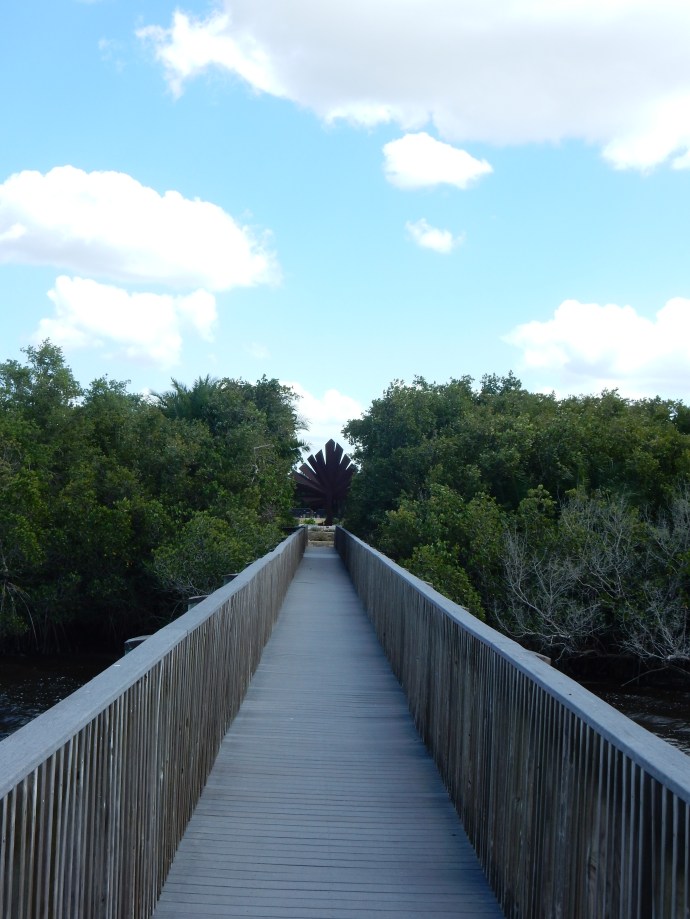
Peace River Botanical and Sculpture Garden

In the afternoon we drove a little northeast of Punta Gorda to the new Peace River Botanical and Sculpture Gardens. Only open for 18 months but years in the planning, the gardens are the vision of a former chief executive of McDermott Industries and his wife. McDermott is big in oil drilling pipelines and drilling rigs. At one time, McDermott also owned Babcock and Wilcox which is deep into energy and environamental technology. The present appearance of the gardens is that a bundle of money has been spent on the project, with more to come when a planned art museum opens. A very nice project. Many of you know my biases; it is money from an overpaid executive who is spending funds that could have been paid to company employees instead of being used to create an appearance of a local philanthropist.

View from Peace River towards the botanical and sculpture garden

Putting my uninformed biases aside, the gardens combine manicured lawns, water features, shrubs and sculptures among 11 acres on two sides of a road. The western side fronts on the Peace River. The gardens need more flora to be truly memorable; at present it is pleasant with real promise for the future. The sculptures have a flavor of whimsy. While I am not conversant with the names of top sculptors, the signs informed us that one of them at least has created works for well-known celebrities from around the world.

Chris and I returned to Punta Gorda, did some book shopping and had a picnic dinner watching the water. We finished up the evening chatting with our great Evergreen hosts and playing a few games of Mexican Train which I only mention since I was the winner.

Ed and Chris. March 29

Categories: road trip, travel | Tags: , , | Leave a comment

2019 Trip 3: South Florida: March 26-27

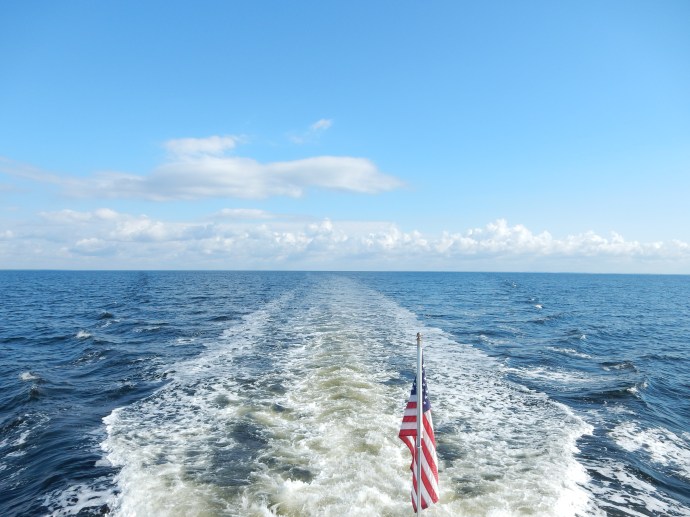
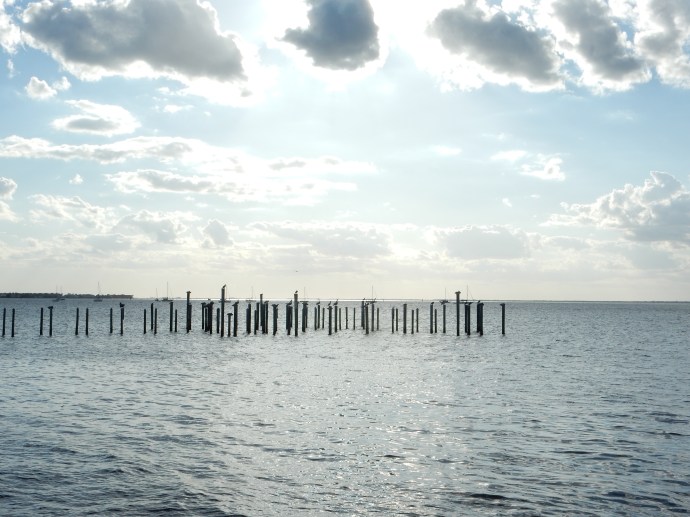
Charlotte Harbor from the back of the Island Star

Punta Gorda, Florida. March 27

We are on the Gulf Coast of Florida, about 100 miles south of Tampa. This trip, 3.5 weeks long, will likely be slower paced, more relaxing than many of our trips. Today was an excellent example of that slower pace.

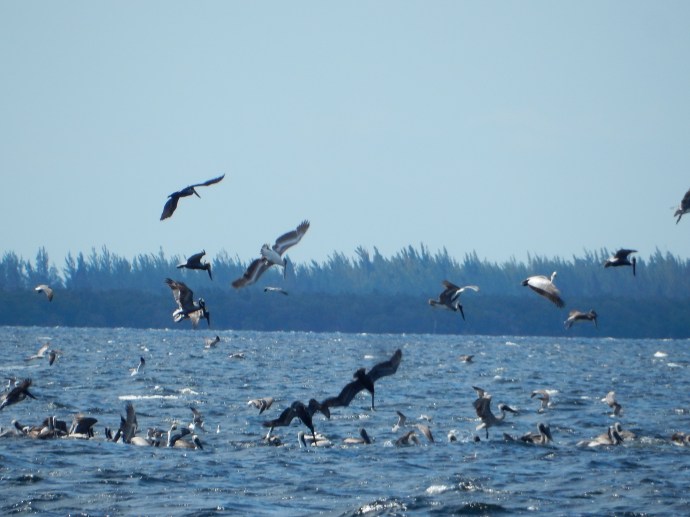
One shot of the feeding frenzy on the way back

We took a 2.5 hour cruise on Charlotte Harbor out of Punta Gorda to Cabbage Key, had a two hour lunch break, and returned on the same 2.5 hour cruise. So pretty much the entire day was occupied by the cruise. The water was relatively smooth and we just relaxed and enjoyed the ride and the view. I admit I might have even dozed off a few times. This was not a manatee or dolphin spotting cruise, although one dolphin did race alongside us, perform three jumps and then disappear. There was also a feeding frenzy of birds evidently attacking a school of fish. Otherwise it was just taking life easy.

Map of Charlotte Harbor with Fisherman’s Village at upper right and Cabbage Key at lower center.

Charlotte Harbor is fed by the Peace River and the Myakka River. It is shallow, usually 6-12 feet in depth. Boaters have to be careful to avoid sandbars. Part of the journey to Cabbage Key is through the Intracoastal Waterway which is dredged as necessary and marked by buoys and channel markers.

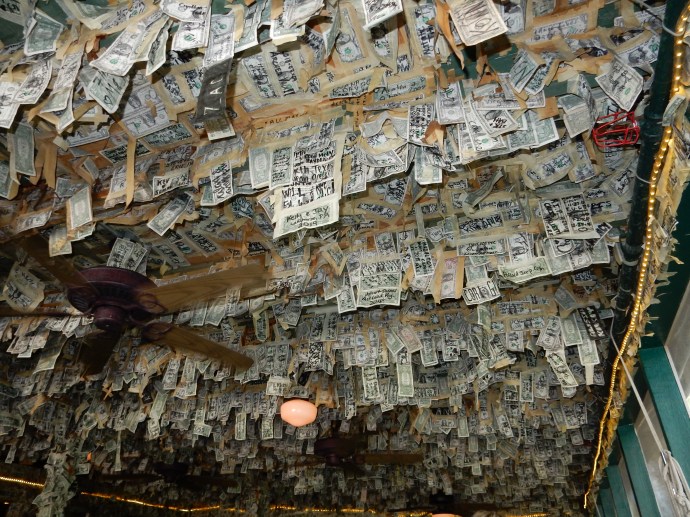
Island Inn restaurant at Cabbage Key with dollar bills hanging from the ceiling

Cabbage Key has a resort and restaurant, partially made famous by Jimmy Buffett. It also has dollar bills hanging from the ceiling of two rooms of the restaurant. Legend has it the tradition began with one customer taping a dollar bill to the ceiling way back when so that he would always have money to pay his tab. The practice has grown over the years. The ceiling in the two rooms are covered with dollar bills (of various denominations) and when they fall, they are collected and given to charity.

Several cruise boats (about 30-80 passenger size) from up and down the area land here for lunch at staggered times to spread out the business and reduce waiting times. Many of the wait staff live on the island and from overhearing one of them, the tips are very good and the isolation is well offset by the pay.

Our boat, the Island Star from King Fisher Cruises, leaves and departs from Fisherman’s Village, a combination shopping, marina, and resort. It was built on an abandoned wharf that used to house fish packing factories. Nowadays it hums with people, particularly it seems with grandparents and their grandchildren here on visits during spring break. We ate at two restaurants, had popcorn and ice cream but did no shopping.

Some of the murals in downtown Punta Gorda

After the harbor cruise, we went to downtown Punta Gorda. The city has a new Harborwalk and the community has installed about thirty murals on the walls of various buildings downtown. On our walk, we met the artist responsible for many of them as he was working on a new installation on the slanted wall of the Harborwalk underneath a highway. Murals are not his only artistic endeavor, he also paints and does digital photography.

We had also stopped to see one of his murals on two walls of the bays of the PG Fire Department. Our Evergreen hosts had specifically mentioned this location; the husband knew several of the firefighters from supervision classes he had taught at the local college. At the Fire Department offices, they said just go and look, so we did. Sure enough, the firefighter we met inside the bays knew our host and asked after him. Reinforced that knowledge that staying with Evergreeners gives you a greater local flavor of the community.

Punta Gorda was hit by Hurricane Charley in 2004, a Cat IV hurricane with winds of 150 mph. It destroyed much of the town. In effect, it was instant urban renewal. While many people suffered, particularly those in mobile home parks, 15 years later, the city has seen an influx of new housing and re-built public buildings and infrastructure. Many of the homes that were damaged, versus destroyed, were re-built. Thus, walking downtown presents a view of buildings, sidewalks and street in good repair.

We had arrived in south Florida Tuesday and landed at Fort Meyers Regional Airport. After getting the rental car and picking up a few odds and ends, we spent the balance of the afternoon at Fisherman’s Village. They have a small military history museum there, staffed by volunteers. It was heavy on uniforms and weapons but we found two different but similar interesting facts we had never previously known.

WWII playing cards with hidden escape route.

During WWII, the Red Cross was allowed to ship a very limited number of items to POWs. Playing cards and games were allowed items. The US made special playing cards that when steamed, separated to reveal an escape route map printed on the inside. Putting together the various pieces created a detailed route that could be used to reach Allied territory. The maps were created and sent to specific POW camps. On display at the museum was one such map.

The British created speical Monopoly pieces that had similar information on a silk like material that could handle being folded multiple times without tearing and fold into a very small, hideable item. Monopoly pieces also had foreign currency and a tiny magnet hidden into the board pieces. Only certain sets of Monoploy had the tools, marked by a tiny red dot on the “Free Parking” space. This ruse was not revealed until 2007. Both of these two maps were successfully used by thousands of escapees; it is estimated one-third of the escapees used the Monopoly maps.

Charlotte Harbor

Ed and Chris. March 28

Categories: road trip, travel | Tags: , , , , , , | 1 Comment

Blog at WordPress.com.