
Green Valley, AZ. May 22, Tuesday
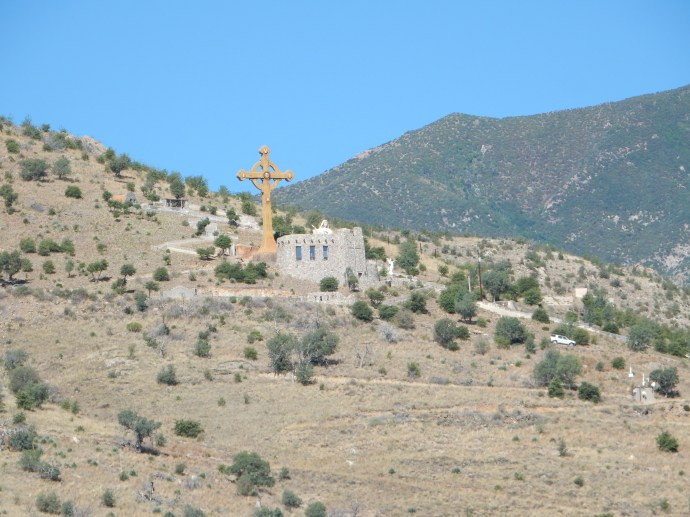
The shrine that drew us in
We have been to the mountain top and back to the valleys. Leaving Sierra Vista, our primary goal was to traverse the Huachuca Mountains and end up in Green Valley AZ, our lodging stop for the next two nights. Coronado National Memorial was our intended first stop and home to the road taking us over the mountains.

Looking down from the shrine
On our drive south from Sierra Vista, we knew we would pass the The Lady of the Sierras Shrine. We had not planned to stop. From Highway 92, though, the shrine stood out on the eastern slope of the mountains. It drew us in. The shrine has a chapel which is supposed to open at 9 AM but was still closed when we left around 9:15. A large cross and statue of an angel were also attention grabbers.

Stations of the Cross at Our Lady of the Sierras shrine south of Sierra Vista
After parking in the main lot, we hiked up the slopes past the Stations of the Cross; each one built into the side of the mountain, the next one always a little higher up than the previous one. The culmination of the 14th station was the tomb built into the hillside. We were not planning to do a lot of hiking today, the steps up this hillside were unplanned but proved to be sufficient exercise for the day.
On to Coronado. This NPS unit was created in 1941 with a hope that an adjoining park would be created in Mexico. The result would be a joint park like Glacier-Waterton on the U.S. Canada border. Mexico did not reciprocate. The purpose of the park is to recognize the goodwill and cooperation between the U.S. and Mexico through recognition of the endeavors of Francisco de Coronado. Coronado was a Spaniard who led a large expedition through a large swath of the southwestern United States. He and his subordinates went east as far as Kansas between 1540 and 1542. They were looking for gold, particularly the rumored “Seven Cities of Gold” which never did exist.

On the next turn after this one we encountered an oncoming NPS jeep.
The Coronado National Memorial visitor center has exhibits and displays, which we read. After the visitor center, we began the driving journey, about 20 miles on a twisty mountain road. Tight corners and switchbacks gave little warning of oncoming vehicles (nothing over 23’ allowed); at one corner we had to back up a ways to find a spot where we and an oncoming NPS pick-up were able to pass each other.

The view from Montezuma Pass in Coronado National Memorial
Three miles in, twenty minutes, and 1,300 feet higher, at 6,575 feet we reached Montezuma Pass Overlook. Far ranging views both east and west greeted us. The road continues westward as a gravel mountain journey for another 18 miles to Parker Canyon Lake. Other than the sections that resembled a washboard, the road surface was reasonable. On this stretch we encountered half a dozen Border Patrol vehicles. None stopped us.
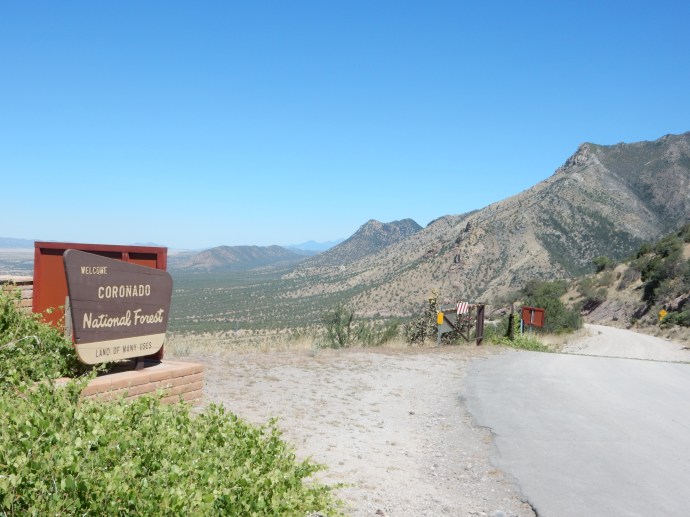
Looking west from Montezuma Pass
Parker Canyon Lake is maintained by the Forest Service, part of the Coronado National Forest. Reclamation efforts were visible to stop erosion. Parker Canyon Lake is used to provide irrigation water for the surrounding lands. We just made a picture-taking stop since it was nice seeing a lake in Arizona. Pictures completed, we moved on to Sonoita to have lunch. No luck, no restaurant open.
Next town was Patagonia where the downtown was more thriving. Of course, Patagonia has more people, about 900 compared to Sonoita’s 800. We had lunch at a hotel with an attached restaurant, good food. The free Patagonia Regigonal Times newspaper did have a headline though that lead zinc mining sludge has been seen leaching out of a local, long-abandoned mine.
To reach our next destination, we drove southwest toward Nogales before heading north to Tumacacori National Historical Park. In 1908 Tumacacori was recognized as a National Monument to recognize and protect the then deteriorating buildings of a mission started in 1691. In 1990 it was redesignated as a National Historical Park.

The mission church at Tumacácori National Historical Park
Tumacácori was founded in 1691 by a Jesuit missionary (Padre Kino) to convert and aid the O’odham people who had requested assistance from the “Black Robes” (Jesuits) in improving the O’odham peoples agricultural practices. Kino was to work in this area for over 20 years and established numerous missions. The Santa Cruz River is less than a mile away and provided irrigation water. Kino introduced wheat, livestock and fruit to diversify the food supply. The O’odham and Yaqui Indians were taught Spanish and Catholicism.
Like most of the history of Spain in America, conflicts developed. Apache raids, Spanish infighting back home, lack of government support, encroaching settlements, disease, the Mexican Revolution all contributed over time to a dwindling Indian presence and to a dwindling Spanish and Mexican presence at the mission. It was abandoned in 1848.

Interior of the mission church at Tumacácori National Historical Park
When named a national monument in 1908, the buildings had deteriorated but restoration efforts have been effective. The brightly colored paintings that existed at the time of the active church are not present, only a few faint images. The site includes Tumacácori and two neighboring missions. Main visitation is at Tumacácori where the later mission church stands, along with several outbuildings foundations. The intro video is old but between it and a well done museum, the story of the mission and the people of the area is effectively told.
After the mission we drove to Tubac. Tubac historically was the site of a military presidio, now a state park, which we skipped. Tubac is a collection of bright painted and decorated adobe style buildings occupied by a variety of artists and accompanying tourist stores. We stopped for some ice cream and enjoyed the pleasant day in the shade.
Our lodging for the next two nights is with an Evergreen host in Green Valley. Green Valley has a population of over 20,000 and is just 20 miles south of Tucson. It is primarily a retirement community surrounded by agricultural and mining lands. As we drove in we could observe the recognizable terraced hillsides of a mining area being reclaimed.
Ed and Chris May 23


 Chris Klejbuk and Ed Heimel travel adventure
WHERES DEB AND REBECCA ?? Sent from my iPhone
You are too early. They arrive Friday night