
Willcox, Arizona, Friday May 18
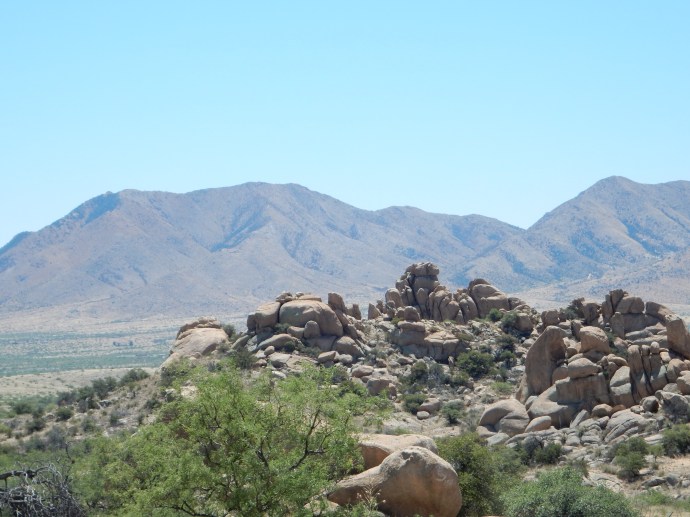
View from the I-10 Texas Canyon Rest Stop
Chris and I are in Arizona for 17 days. The first half of the trip will be along the southern border areas from Willcox in the east to Ajo in the west. There are five National Park Service units here we wish to visit, plus wildlife refuges, mine tours, etc. We hit our first roadblock Thursday just before we left Saint Paul. Chiricahua National Monument has a small forest fire blazing and the park is closed. It may open as soon as Monday, but we will probably be heading west by then. We will just have to combine it with a trip to southern New Mexico which is still on our list.
This stretch of southern Arizona was added to the U.S. by the Gadsden Purchase in 1853-54. I believe most Americans think that the Louisiana Purchase added all of the land west of the Mississippi River to the U.S. But no, the Louisiana Purchase approximately only added land between the Mississippi RIver and a line drawn diagonally northwestward starting at New Orleans and ending near Glacier National Park, close to the current Idaho-Wyoming border. Washington and Oregon were in dispute but generally considered under British control. Alaska was in Russian hands, and everything else (California, Texas, New Mexico, Arizona, Nevada, Utah, parts of Colorado) was part of Mexico. No wonder Mexico may look at the U.S. and get indignant that they should pay for a wall. Didn’t we get enough land and mineral rights from them to pay for a wall?
While not wanting to make this a major history lesson, let me just briefly cover the Gadsden Purchase. Completed in 1854, the purchase allowed the U.S. to buy enough southern land to construct another transcontinental railroad without going through mountains (Rocky, Sierra Nevada, etc.). Mexico needed cash and thought it was better to sell the land and get paid than to have the U.S. take it away. The U.S. bought about 30,000 square miles, about the same size as 8-9 Yellowstone National Parks. The land goes from the Mexican border to a point between Tucson and Phoenix Arizona. Our first week will be within this area.
A late flight out Thursday night got us to our Phoenix hotel by 1 AM Friday morning. We were up and out by 8:30 and on the road to Willcox . Our first stop was an Interstate Highway Rest Stop. The Texas Canyon rest stop on I-10 is roughly 25 miles west of Wilcox and well-known for its intriguing rock formations. It was an easy introduction to desert geology. Our second stop was another simple, easy one. Annie’s Pies. Apple Annie’s Orchard is in Wilcox and while apples are nowhere near ready for harvesting, Apple Annies has a market, lunch counter, and pie shop right next to our hotel in Willcox . A shared wrap and an apple crumb pie slice and an apple-raspberry pie slice continued the pleasant feelings.
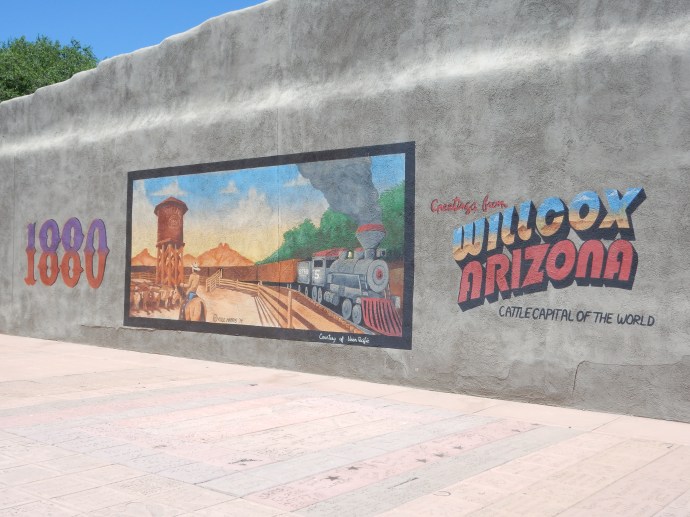
Downtown Willcox Arizona
We are in Willcox because it has one decent hotel close to Fort Bowie National Historic Site and Chiricahua National Monument. Willcox itself has two small museums dedicated to old-time western singers, Rex Allen Senior and Marty Robbins; not exactly major household names today but still worth a visit.
Our plan had been to go to Fort Bowie Friday afternoon and Chiricahua on Saturday. With Chiricahua out of the way, we are switching Fort Bowie to Saturday. Friday afternoon after Apple Annie, we stopped at the two small museums in downtown Willcox. Willcox, population 3,700, was a major cattle-raising area and when the Southern Pacific Railroad went through the town, Willcox also became a major shipping point for beef.
Nowadays it appears to be struggling, numerous store fronts were empty. But this weekend will be busy. Unbeknownst to us when booking our hotel, there is a wine festival this weekend. This area has 15 vineyards and wineries and the Wines of Willcox Taste and Tour is this weekend.

The Rex Allen Museum in Willcox AZ
The two museums were not busy, At the Rex Allen Museum, the tour guide gave us a five minute orientation to Rex Allen, the “Last of the Silver Screen Cowboys”, part of group that included Gene Autry and Roy Rogers. As the museums states, “take time to return to those days of yesteryear when our heroes were the clean cut, God-fearing Americans of the Wild West, who wore white Stetson hats, loved their faithful horses, and had loyal sidekicks who shared their adventures. Koko was Rex’s faithful horse and received equal billing in the movies. Koko is buried across the street from the museum in the Willcox Railroad Park, next to a life size statute of Rex Allen. Allen’s ashes were scattered around the park.
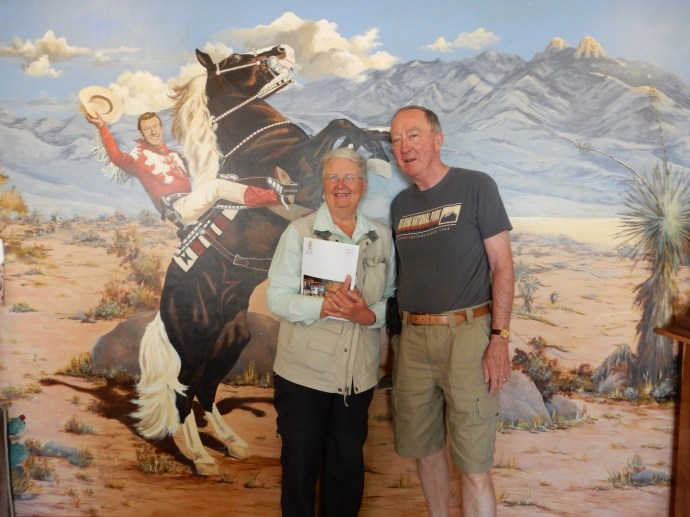
Chirs and Ed in front of a painting of Rex Allen and his horse Koko
Rex appeared in ten years of comic books, did voices for Disney movies, had a TV show for one year, and advertised products like Ford tractors and Purina. His singing career started locally at age 14 and sang on the radio station WLS for the “National Barn Dance”-which we learned about during our last tour of Kentucky and Tennessee in March and April. All of this was news to us. Rex was born near Willcox and always considered this town his home.
The next museum was for Marty Robbins (1925-1982). Robbins was a successful country singer and songwriter. His museum was in Glendale AZ but moved here about ten years ago. I assume it was not overly popular there and Willcox promised a better option for it. It did not take long to go through the museum. Both were pleasant and basic but a quick visit was sufficient.
There was still time left in the day for touring so we moved up a visit to the Amerind Museum, located not far from the I-10 Texas Canyon rest stop. The Amerind (no pictures allowed inside) focuses on the culture and history of American Indians and their ancestors. In its words it: “houses a spectacular collection of prehistoric objects from archaeological excavations in the Americas as well as more recent items from Native cultures since the time of contact with the first Europeans.”
The museum was established in 1937 by William and Rose Hayden Fulton. His money came from the Waterbury CT foundry, hers from a copper mine here in Arizona. Their trips out here generated a deep interest in the Southwest, its history and people. The Foundation has sponsored numerous archaeological excursions in the U.S. and Mexico. The displays include an art museum displaying art that Rose collected. The museum’s second building displays artifacts and historical information about the peoples of the southwest. Once again, it was pleasant, but pottery and baskets can get old after a while. The historical information was more interesting to me; my challenge is to remember it a week later.

Driving back to Willcox
We drove back to Willcox on back roads, driving through Pearce, an almost ghost town (population 15) and Dos Cabezas, an area with a scattering of homes where there used to be a town and a mine. Dinner was at an unremarkable bar-b q restaurant in Willcox.
Ed and Chris. Willcox Arizona. May 19
 Chris Klejbuk and Ed Heimel travel adventure
Recent Comments