
Pineville, KY. April 16
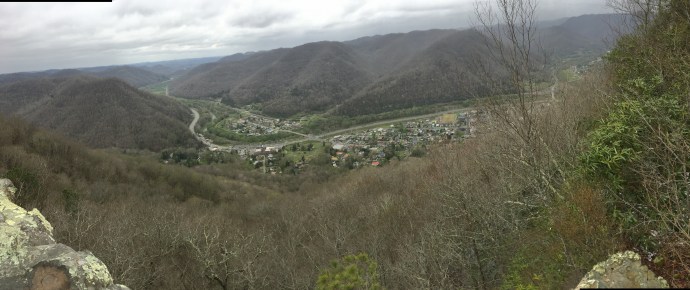
View of the Pine Mountain Narrows, pretty much the end of the Cumberland Gap trail
We followed in history’s footsteps today. The Appalachian Mountains were a formidable barrier to early westward settlement. Cumberland Gap is a notch in the Appalachian Mountains that served as a primary gateway to the west for the years 1780 to 1810. It is estimated that 200,000 to 300,000 settlers used this gap during those years to reach new lands in the Ohio Valley. Today we stood in the gap itself and walked a portion of the Wilderness Road that had been followed by 300,000 people. Other historic roads we have been on include the Natchez Trace, the Oregon/Mormon/California Trail, the Santa Fe Trail-and Route 66.
Cumberland Gap had been known as Warriors Run by Native Americans. Warriors from northern and southern tribes used the route to conduct raids on each other. Bison and other animals used it also as a route to various feeding grounds. The Gap was first mapped by an American of European ancestry in 1750 when Dr. Thomas Walker “discovered” it, mapped it, and wrote about it. Dr. Walker’s initial prognosis was not favorable, he did not follow the opening far enough to understand it led to verdant lands ripe for settlement.
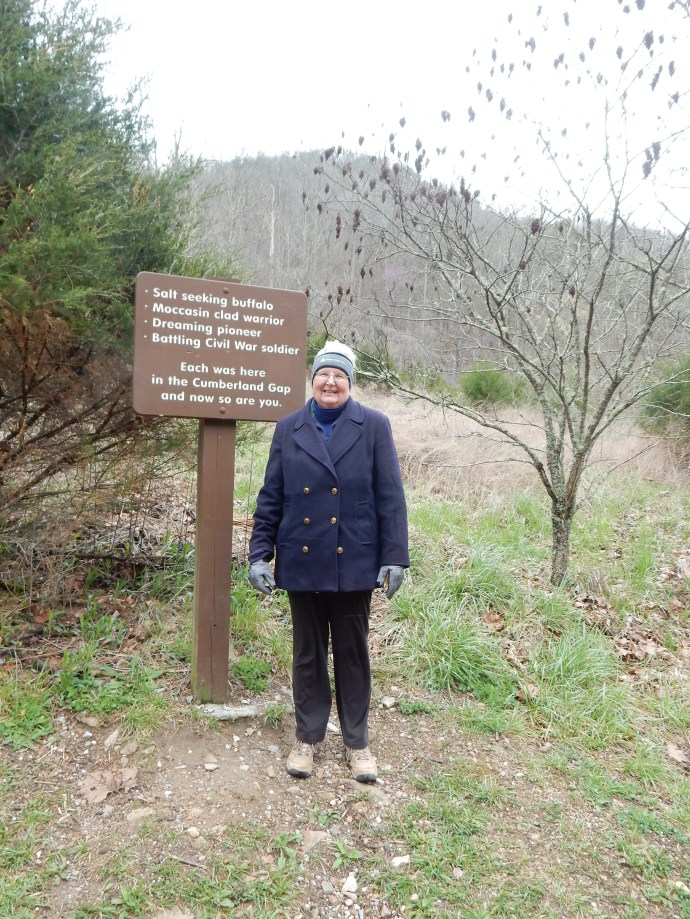
Standing at the Cumberland Gap
Daniel Boone has received credit, rightly so it seems, for making the Cumberland Gap the road to the West for settlers. He made his first trip through the Gap in 1769 and led the efforts to settle the Kentucky lands beyond the Gap. He lost his brother and two sons in the process, killed by Indians protecting their lands from encroachment.
As settlers moved west, they made the road into a two-way thoroughfare as they sent grains, cattle, pigs, and corn whiskey back to the eastern markets. Soon, however, canals and then railroads became the foremost transportation method and the Wilderness Road declined in usage. During the Civil War, both sides tried to control the passage. However, possession switched hands several times, not due to battles but to fatigue from bad weather and low morale. In 1889 a railroad tunnel was completed through the area and in the 1920s, a US highway went over the Gap. Today, the highway runs through a tunnel and the Wilderness Road is back to its conditions during the 1780-1810 period.
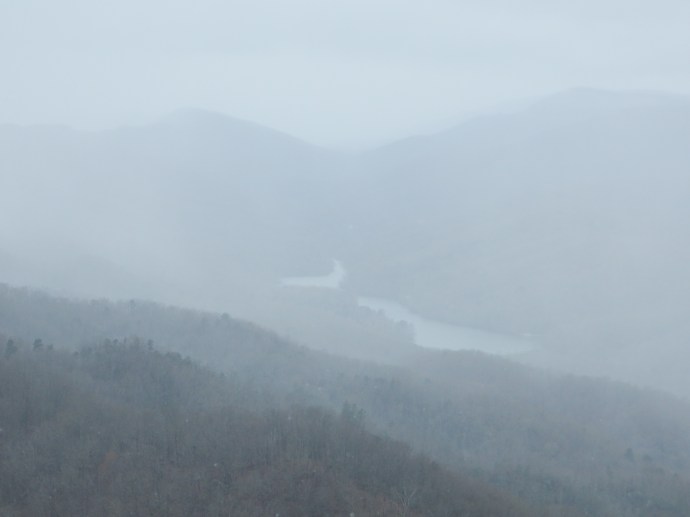
View from the Pinnacle Overlook into the KY-TN-Va triangle area
We drove up to Pinnacle Overlook to get a view into this corner spot where Kentucky, Tennessee and Virginia converge. The Gap itself rises 300 feet above the valley floor but is 600-900 feet below the ridges surrounding it. Our view from Pinnacle Overlook was limited; when we were there, the temperature was 31 degrees and falling sleet obscured the view.
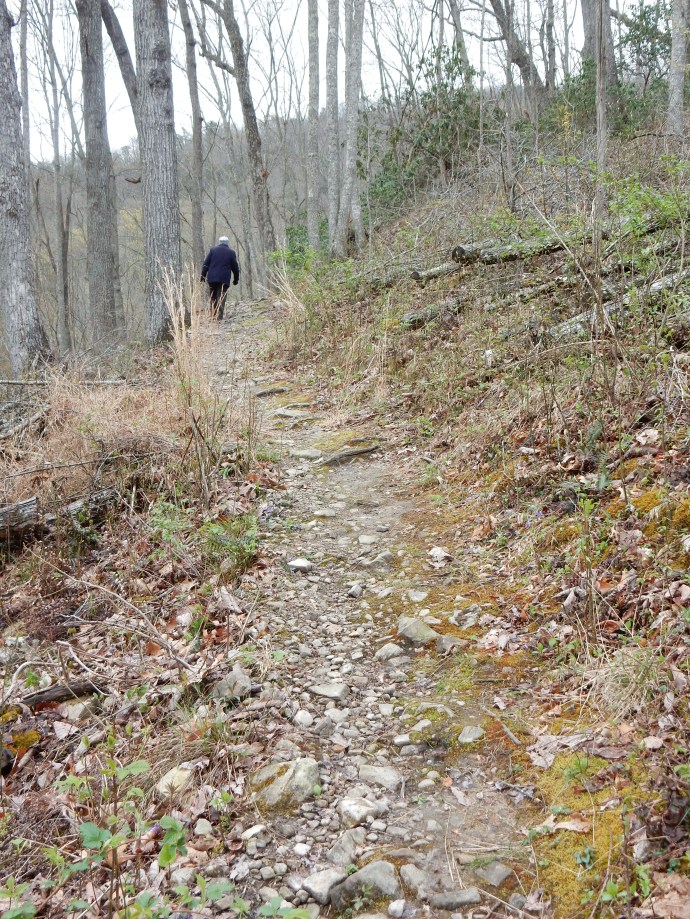
Walking on the Wilderness Trail at Cumberland Gap National Historical Trail.
Cumberland Gap National Historical Park preserves a portion of the Wilderness Road trail. It is about 2 miles long and winds its way along the mountain ridges and through the forest. Given the rain over the last two days, the path was frequently muddy but hiking it gave us a better feel for the trek those early settlers endured. It also humbled us; we took the trail violating our own rules. No water, no map, no remembrance of how long the trail was to give us an indication when we should be completed. Periodic cell phone coverage allowed us to verify the trail was a loop and we made it back to our car without major incident.
An interesting side trail was called the “Object Lesson Road”. In 1908 the U.S. Government completed sample roads around the country to showcase “modern” road-building techniques. The goal was to convince states and cities to improve the rutted, muddy roads still in use. One was built here. For us, the Object Lesson Road was a wide, limestone trail that contrasted sharply with the Wilderness Road.
Our lodging for tonight and tomorrow is at Pine Mountain State Resort Park, similar concept to Cumberland Falls State Resort Park we just left. So far no ants and the heat, while inconsistent, is working enough. The room is more motel like. We are 60 miles from Cumberland Falls, still located within the Cumberland Plateau. Pine Mountain is at an area called “The Narrows” by Boone and the setlers.
Much of the following is from: “The Historic Cumberland Plateau” by Russ Manning. In the forward of the book, Jim Casada writes: “In between is a vast tableland intersected by deep canyons like so many laughter lines on an old man’s face.” The Cumberland Plateau is a strip of land that runs southwest through eastern Kentucky while spilling eastward over the border into Virginia. It then passes through TN, grazes the northwest corner of GA, and extends into Alabama. when it is in the three state area of KY/TN/VA, it is 55 miles wide. When it leaves TN near Chattanooga, it narrows to 38 miles wide.
The Cumberland Plateau is part of the broader Appalachian Plateau’s province. The eastern edge of the plateau is an escarpment (this was an obstacle to western migration in our contry’s early years), at places a steep mountainside over 2,000 feet above sea level. At other places, a long rock cliff standing atop a wooden slope. The western wall of the plateau is not so clearly defined, generally because drainage off the plateau erodes it. The plateau is covered with forests, dotted with waterfalls and sandstone stone arches. Its rivers and streams have carved canyons and caves. The plateau has a series of mountains or ridges with valleys and flat tablelands in between. There are two distinct woodlands: the uplands forest and the ravine forest.
We have found it intriguing and attractive, dotted with hiking, canoeing, and other outdoor activities. It is an area that deserves more time for investigation.
Driving up to Chained Rock in Pine Mountain State Resort Park, Pineville KY
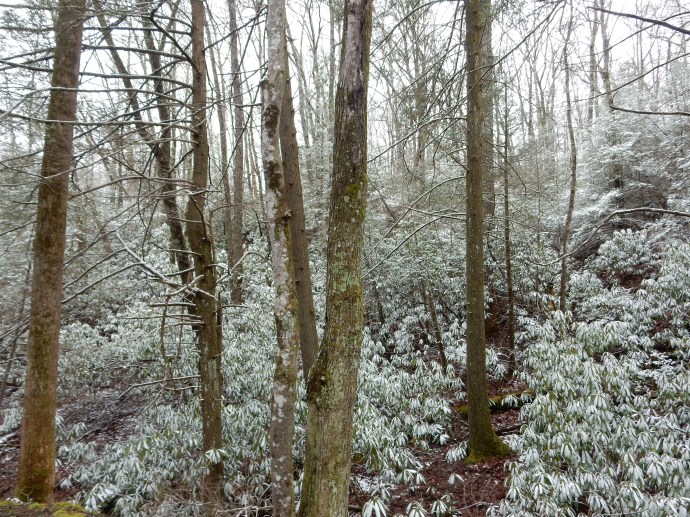
Pine Mountain State Resort Park is only 1500 acres but surrounded by the largest of Kentucky’s state forests, the Kentucky Ridge State Forest. The park was the first in the state park system, created by a donation of land from local citizens. The lodge was built in the 1930s by the Civilian Conservation Corps. The park has a particular tourist attraction; Chained Rock. Chained Rock is a jutting rock formation that looks like a loose boulder. In the 1930s, 50 men plus mules put a 101 foot chain (from a steam shovel in a VA quarry) across a gap in the formation to look like the chain was holding the boulder in place. We hiked up there in the sleet and show showers, and from a close vantage point, it was unremarkable. Supposedly the chain is visible from the town of Pineville; the community protected by the chain from the rock falling and crushing buildings in town. We will have to visit downtown Pineville and take a better look to see if the chain is truly visible.
PS. Very slow Internet here. 30 minutes to upload the few pictures in this blog post.
Ed and Chris. April 16
Epilogue: Snippets on life in America from Chris
Day 32: Our goal on this trip was to explore KY and TN. We have been on many, many country roads where houses are scattered around and “towns” are few and far between. I grew up in the country-no sidewalks, well water, mailboxes at the end of our street. Some neighborhoods had numerous cars on their property. Dogs were never leashed and we would call for my brother to come home for dinner and he would hear us three houses away. I now live in a city of just under 300,000. I prefer city living to country living.
 Chris Klejbuk and Ed Heimel travel adventure
Recent Comments