Monthly Archives: March 2018

2018 Trip 3: KY and TN: March 18

Paducah, KY. March 18

Superman Museum in Metropolis IL

Okay. I will get my grouchy, curmudgeon comments out of the way up front. We visited the National Quilt Museum in Paducah, rated one of the top 20 Southern museums (I forgot who by). They do not allow picture-taking inside the museum which is disappointing but the reason stated is to protect the artists creativity since taking a picture might encourage another quilter to replicate the theme shown. BUT, the museum is plenty willing to sell you a glossy, high quality book (for only $16) that replicates 300 of the quilts on display or in their archives. Yet, those high quality photos would better allow a quilter to replicate the quilts on display more than my humble photograph would. To me, their reasoning is faulty at best and self-serving at worst. In any event, you will see no pictures from this quilt museum

That is a shame because the museum was exhibiting numerous quilts of stunning design, color and quality. Past readers may recall that we visited the International Quilt Study Center and Museum in Lincoln NE. The Lincoln museum has three to four times as many quilts in its collection and does allow photographs to be taken. However, I believe the quilts on display in Paducah represented a more stunning variety of quality quilts than I recollect seeing in Lincoln. You will have to take my word for it, OR, you could go on the Internet and search for Paducah Quilt Museum images and lo and behold, numerous quilts are available for viewing, many posted by the museum.

The quilt museum is part of the city’s effort to market itself as a “Creative City in Arts”. The United Nations Educational, Scientific and Cultural Organization (UNESCO) sponsors several different categories of specialized communities around the world. These “Creative Ciites” are designated in the areas of craft and folk arts, gastronomy, film, literature, design, music, and media arts. 180 cities have been so designated with Paducah being recognized as a UNESCO Creative City in Craft and Folk Art.

In the U.S., Paducah joins Santa Fe in the Craft and Folk Art category, Detroit in Design, Austin in Media Arts, Tucson in Gastronomy, and Iowa City in Literature. GIven that Trump plans to withdraw the US from UNESCO at the end of 2018 to protest what he calls its anti-Israel bias, Paducah’s claim to fame may disappear.

Superman Museum

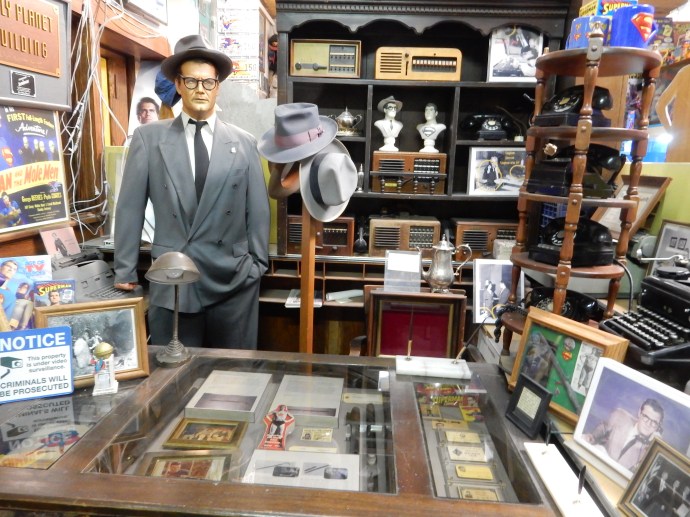
Sundays can be a difficult time to sightsee, especially in the off-season. We managed to fit in one other attraction today, a real hokey, tourist stop. Metropolis IL is home to the Superman Museum and Statue. Metropolis is the town’s original name and they have a written agreement with DC Comics to use the Superman name and logo in marketing, etc.

Superman Museum

Downtown Metropolis is home to the Superman Museum, the collection of all things Superman amassed by one collector. Superman was created in the 1930s by two teenage boys in Cleveland Ohio and has gone on to include comic books, newspaper comics, cartoons, TV shows and movies. Oh, yes, and merchandise. The comics, movies and TV shows have varied over the years but Superman is still an internationally recognized figure.

The museum is tacky. It is unorganized. It could use improved displays. It is cheap and 10 miles from our hotel and open on Sunday morning so after church we drove to Metropolis and visited the museum. I mean, how could we be this close and not at least give it a try? It was a diversion while we waited for the Quilt Museum to open. I am not disappointed we went but one does not need to drive out of the way just to see it. We did actually buy a DVD of the history of the Superman story and watched it back at the hotel. The rest of Sunday was slow.

Ed and Chris. March 18

Epilogue: Snippets on life in America from Chris

Day 3: Did you attend a formal worship this weekend? We know that we are living in very disturbing times; however, we were able to participate in a Catholic Mass today without fear of practicing our faith. Perhaps if we were going to a mosque or synagogue it would be different. There was once a time when Catholics were not warmly received in some communities. God bless America!

Categories: travel | Tags: , , , , | Leave a comment

2018 Trip 3: KY & TN: March 17

Paducah, KY. March 17

The first signs of spring occurred in southern Illinois.

We were on the road early this morning. Last night provided extra incentive to make sure we arrived at breakfast early. When we had checked in, we noted our hotel had as guests numerous families with young people. Champaign was the host site for the Illinois State wrestling tournament for boys ten and under. Evidently when you have wrestlers under age ten, the whole family comes along for the event. Our assumption was that if we were downstairs for breakfast by 6:30 AM, we would be in good shape.

Wrong. Evidently our assumption was based on when our daughters would prefer to get up. Wrestlers are up early and on their way to the tournament which started at 8:30 AM. There were three people for every two seats in the meal area when we arrived at 6:30 AM. A glass of orange juice was our sole take-away and we set out on the road. Breakfast ended up being at a local restaurant located inside of the IGA grocery store in Effingham Illinois, an hour south of Champaign.

Our daily journey was projected at 280 miles, most of it on two lane, 55 mph roads below Effingham, but that allowed us to make several stops today. First off was the “Garden of the Gods” Recreation Area in Shawnee National Forest. The journey there did take us by oil fields and coal mining locations. Illinois was supposedly the first state in which Europeans discovered coal. Today, it is still the fifth largest coal-producing state, but the amount of coal shipped is decreasing and the number of miners has dropped dramatically.

A view from the Garden of the Gods Recreation Area in Shawnee National Forest

A close-up of rock formations in Garden of the Gods Recreation Area

Located in extreme southeast Illinois just above the Ohio River, Garden of the Gods provides some of the most photographed outdoor locations in Illinois. We opted for the Observation Trail that contains unique rock formations and outstanding views of the valleys and hills that line the southern most portions of Illinois.

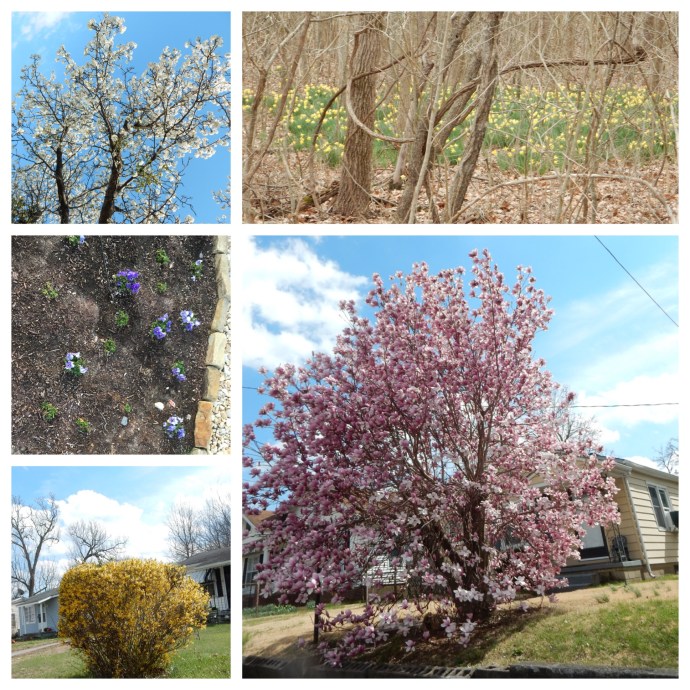
Trails abound in the forest and wilderness area surrounding the observation trail but today was not meant to be a major hiking day. After we saw the sights, we drove the Ohio River Scenic Byway to Paducah, KY. Unfortunately, the scenery was not all that spectacular with only one view of the Ohio River. While daffodils became abundant, few other trees were blooming. The temperature increased nicely though, from 32 degrees in Champaign to 68 degrees around the Shawnee Forest.

While Effingham appeared prosperous, the smaller towns we passed through on our way to Paducah seemed poorer and passed over. There appeared to be a more liberal attitude of what was permissible to store outside your house along with the quantity of what was stored in the yard. Possibly the decrease in coal mining jobs led to this but agriculture still seemed to be strong economic factor.

We made it to Paducah in time to visit the River Discovery Center, also called the River Heritage Museum. It is not open Sunday so we had to ensure our arrival allowed us to visit it today. The museum focuses on several rivers in this area, the Ohio, Tennessee, and Cumberland also with the Mississippi. Paducah has a long history with the Ohio River, and its location at the confluence of the Ohio and the Tennessee has led to the city having boat building and maintenance facilities.

The museum educated us about the 1937 Ohio River flood where 90% of Paducah was flooded, 30,000 people here were evacuated, the river was seven miles wide with flood waters, and the flood was so extensive along the Ohio that it led to the building of new levies to try to limit flooding. A new factoid for me was the use of “snagboats”, steel covered boats that would ram submerged trees and tree trunks (snags) to remove them or to use it’s on board cranes to lift the snags out of the river.

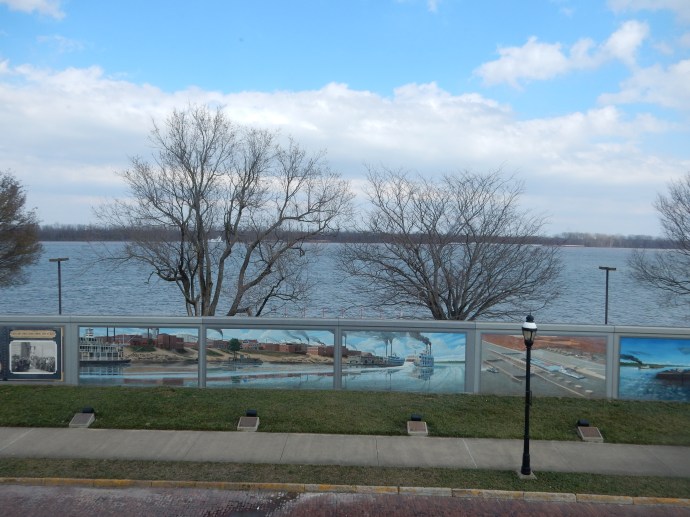
A view of some of the murals and the Ohio River from the River Discovery Center.

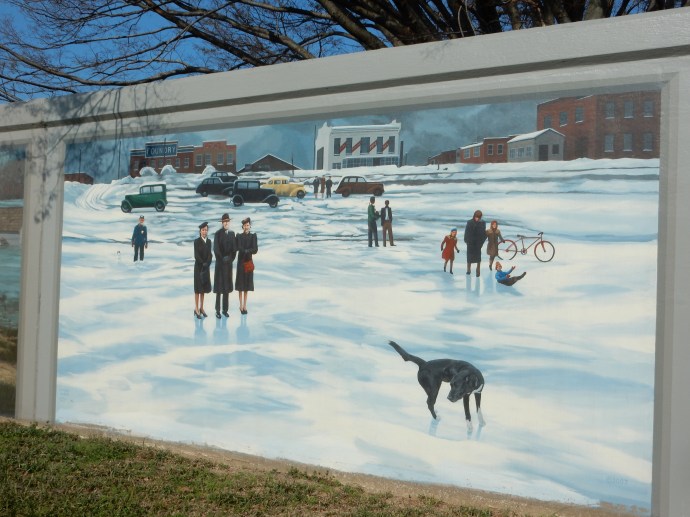
A close-up of just one of the murals, this one depicts a rare occurrence when the Ohio River froze over.

After the museum, we walked along the riverfront to enjoy the river murals. The murals, sponsored by local businesses or individuals, portrayed notable events in the history of Paducah. We had observed similar murals in Vicksburg TN, but the murals in Paducah seemed smaller. The murals here have the advantage of being located still in the downtown district; in Vicksburg who have to walk a few blocks out of the downtown to see the murals up close. Robert Dafford is the painter; well-known for his murals and having created murals in several other Ohio river towns.

Wacinton statue in Paducah KY

Our final stop was at the 35 foot tall wood carving of Wacinton. This carving started with a 56,000 pound red oak and was completed over thirty years ago. The statue is meant to honor the Chickasaw Indians who lived in the area prior to the arrival of European settlers. The sculptor is Peter Wolf Toth who has completed statues in each of the fifty states-although not all are still standing. His message is to honor the indigenous peoples of America.

Ed and Chris March 17

Epilogue: Snippets on life in America from Chris

Day 2: Driving along the 2 lane road at the posted 55 MPH (or a little above), one sees on either side acres and acres of farmland. Houses, barns and silos are off in the distance as the deep brown soil lies quietly near the road, prepped for spring planting. We are alerted to a speed change to 35 MPH; an assortment of houses close to the road announces a town. No traffic signals, no sidewalks, no schools, some boarded stores, no green park space. In a minute or two, after the Dollar General store, we are back to 55 MPH, passing again part of America’s farmlands.

Categories: road trip, travel | Tags: , , , , , , , , , | Leave a comment

2018 Trip 3: KY and TN: Caves and Crafts, Booze and Bluegrass (Music and Horses): March 16

Champaign, IL. March 16, 2018

This trip will last six weeks, possibly to be our longest of 2018. The primary goal is to spend more time in Kentucky and Tennessee with a week in Miami Beach, FL. We are calling the trip: “Caves (Mammoth Cave) and Crafts (handmade Appalachian crafts), Booze (for bourbon distilleries) and Bluegrass (for the music and Thoroughbred horses).

Approximate route for 2018 Trip 3.

Today, Friday is a travel day with no real stops to sightsee; that will begin tomorrow. Our initial route is an old familiar one, I-94 out of the Twin Cities down through Illinois on I-39. Thus, breakfast was on the road and lunch was at the largest Culver’s in Edgerton WI (which we had been at before). Dinner was different, a lenten fish fry at St.Patrick’s Church in Champaign. The fish for dinner was one of the tastiest we have experienced this Lenten season.

Only incident of note, stopping at a rest stop in north central Illinois, we came out of the rest room to observe two young college students, men, examining our car, even looking under the car. Our first thought: “Oh, s***, they hit our car and damaged it.” We went over to talk with them and to understand their concern. They were discussing how the car was making a strange sound and the young men thought a piece of the car was hitting the front passenger tire. It took several minutes for them to realize they might be right about the sound but they had the wrong car. Evidently the young men were riding with another student, a woman, and could not well identify the car they were riding in.

The guys were tossing swords back and forth, evidently props from their circus studies at Illinois State University at Normal. Evidently the intent on catching the swords disrupted their car identification skills. We passed pleasantries after the clarification and headed back on the road.

Ed and Chris

Chris has decided to add a daily addition to our travel blog.
Epilogue: Snippets on life in America from Chris
Day 1: We decided to start this trip early today and get breakfast on the road. Around 9, we stopped for breakfast at a fast-food restaurant in WI. We went in and 8 elderly women were seated around a table enjoying morning coffee and conversation. Around the corner from them was a group (eventually 12) of elderly men with coffee and occasional breakfast sandwich; jeans, working boots, occasional military cap and an exciting conversation at one end of the tables was about bees. Welcome to McDonald’s.

Categories: road trip, travel | Leave a comment

2018 Trip Two: Boston Again

Boston, January 22-29

Another trip to Boston. Well I never wrote up this trip to Boston and since we leave in 10 days for another six-week trip down through Kentucky and Tennessee, I thought I’d better get caught up. Much of the trip was family related but this blog will cover the sites that we saw in the Boston area. We have been to Boston numerous times, but we are still able to find a few things that are new to us.

One of the Map Room maps

Our plan was to leave on Monday, January 15 for about a week. However, a major snowstorm was projected and Delta was offering free flight changes, so we took them up on their offer and left on Sunday the 14th. Hertz rental car company was not as agreeable. Changing our reservation and adding one day would’ve doubled the cost. Instead, Deb picked us up on Sunday at the airport. Monday morning Rebecca gave us a ride to downtown Boston. We spent the morning going through the Boston Public Library. That might seem a strange way to spend the morning but the library is home to numerous famous murals. Chartered in 1848 as the first large, free American municipal library, it was so successful it outgrew its home.

The current Boston Public Library, built in 1895 and expanded in 1972, has three sets of murals of dramatic import and size which are noteworthy. However, our first stop was at the Map Room. The Leventhal Map Center is primarily a research center but has a changing exhibit of maps. The exhibit expands one’s understanding of the numerous varieties of maps depending on the material to be presented. The area had children sized nooks and desks also to allow kids the opportunity to explore at a less overwhelming level of detail. As we headed on to the murals, we passed an interesting wall mounted art piece that upon closer inspection was a mural/painting/composition created by various book covers.
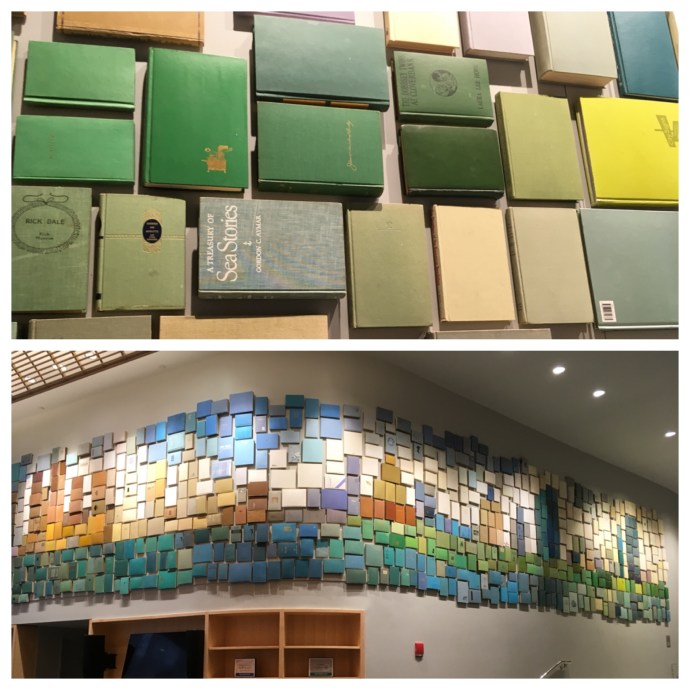
The book collage at the Boston Public Library

From the map room we headed to the murals. The murals are all located in the McKim Building, the 1895 building. Edwin Austin Abbey was an American who worked primarily in Europe. His mural is entitled “Sir Galahad’s Quest for the Holy Grail” and was installed in 1902. It is installed on all four walls below the ceiling in the Abbey Room on the 2nd floor. The 15 paintings depict the Arthurian legend.
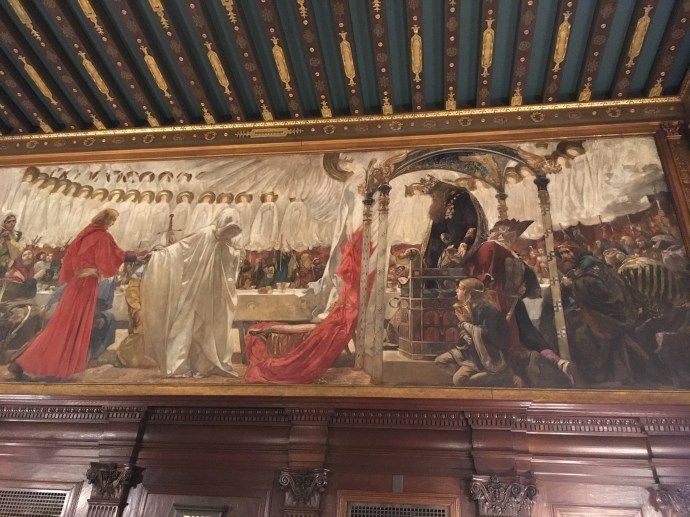
One of the Abbey murals at Boston Public Library
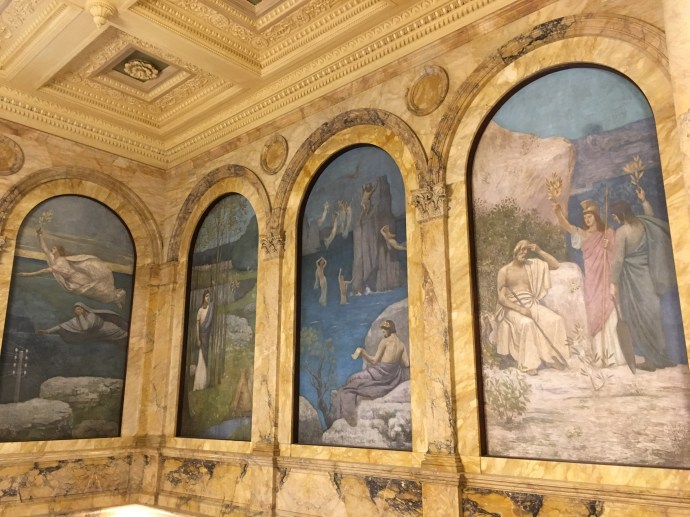
Pierre de Chavannes mural at Boston Public Library

Part of the Sargent murals at Boston Public Library

The French Artist Pierre de Chavannes’ “Muses of Inspiration” was completed in 1895 and is installed outside of Bates Hall on the second floor and on the grand stairway leading from the first floor to the second. Finally, John Singer Sargent’s “Triumph of Religion” was completed during the period of 1895-1919 and is installed in the Sargent Gallery on the third floor of the McKim building. During our time in the library, numerous people and even groups came in to examine the murals. Given that my art knowledge is rudimentary, if you are interested there are numerous on-line articles that provide greater detail regarding the murals. While at the library, we made a stop in the Bates Room which had genealogical records and looked up some family names but had no luck in finding anyone halfway related to our ancestors.

From Copley Plaza we hopped on an airport shuttle that took us directly to Logan airport and the rental center where we picked up our rental car and managed to avoid the heavy penalty Hertz would have charged us for coming in a day early.

Tuesday was a wet, rainy day, excellent for inside activities so we visited The Boston Museum of Fine Arts (MFA) which is the fifth largest museum in the United States. Obviously one does not see the entire museum in one visit. Our plan was to partake of docent tours; a.) Three Masterpieces from Asia (30 minutes); b.)Art of the Americas (60 minutes); and c.) Art of Europe (60 minutes). Seven different tours are available; docents have to be able to lead all seven. After training, a docent is active for only four years, providing for a rotation of new docents and greater opportunities to lead. After the four years are over, a docent can provide sporadic tours. A little different than most museums we have visited. All three of our docents were knowledgeable and easy to understand.

Our Asia tour talked about Buddha and the development of Buddhism. Evidently the first portrait of Buddha in art did not allow for a human visage. The next development allowed for the image of a footprint and it was not until the third phase that Buddha himself was portrayed. Interestingly, even though Buddhism started in India, the real development and current strength of Buddhism is in China; India is primarily Hindu.

Art of the Americas exhibit

Art of the Americas took us into the newest wing of the museum. We found it notable that the galleries are not white and glass like so many new museum galleries, but are painted in a series of shades that I would call neutral naturals contrasting with wall fabrics to break up the gallery features. After lunch, the third tour was the Art of Europe. It was a good way to spend a rainy day in Boston.

Tuesday evening we attended the open house for REACH, the domestic violence center and shelter for which our daughter Deb is the Associate Executive Director. The organization was finally able to move to a new administrative office where they are able to provide individual advocacy, run support groups, offer child art therapy and a safe place to meet. It was exciting to see an arrangement that provides a proper working environment.
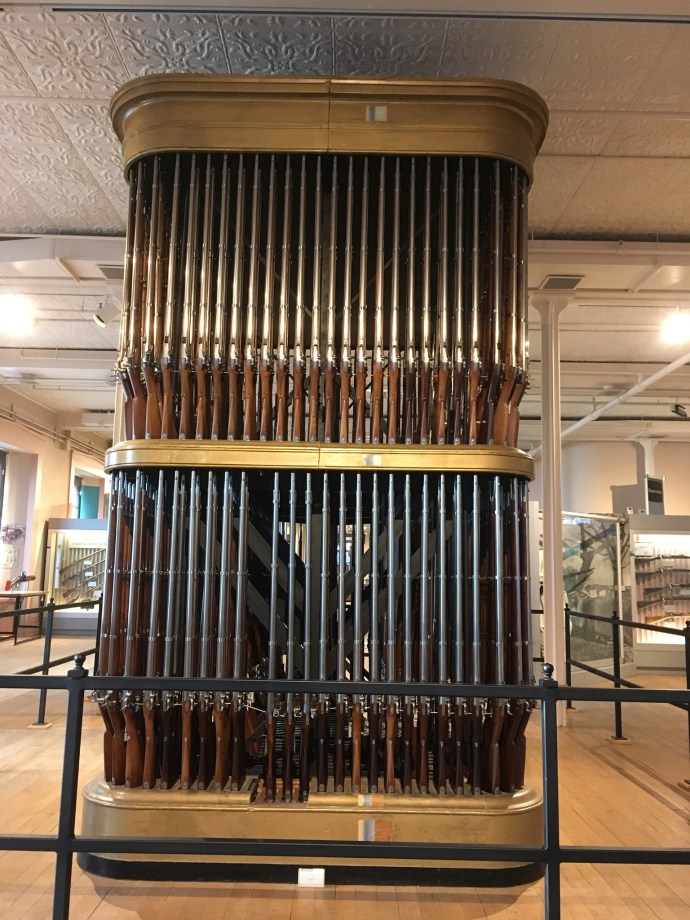
Exhibit at the Springfield Armory

Our travels for family and a funeral also took us to Springfield Massachusetts. This town of 150,000 is home to numerous museums and attractions. We revisited (actually Chris does not remember us being here but I am certain we visited decades ago) the Springfield Armory, part of the National Park Service. The Armory was established in 1794 to manufacture muskets so that the new country would not be dependent on foreign countries for its arms. A second armory was established at Harpers Ferry VA (think John Brown’s raid of 1859). The Armory was a large facility; the NPS site is reduced to one building while the rest of the buildings and grounds are home to the Springfield Technical Community College with over 7,500 students.

Exhibit at the Springfield Armory

Until 1968, the Armory was the pivotal point for the manufacture, research and development of military weapons (pistols and rifles). Along the way, the military arms development also developed advancements in manufacturing processes and the inventiveness of Springfield employees flowed also to other industries. One of the creative geniuses at Springfield was instrumental in developing early manufacturing replicating machinery to produce exact copies of each gun, in creating an automobile, and a steamboat.

Chris and I got a little over exposed to gun models but did note a display covering the development of the Lyle Life Saving Cannon which we had seen at other NPS sites. It was used to rescue sailors at sea. “These line guns are used primarily for shore based rescue operations. The Lyle Gun was hauled to the shoreline usually by U.S.L.L.S. surfmen in specially made beach carts. The iron wheels that supported the cart had wide bands outside the wheel to keep it from sinking into soft sand. The Surfmen would set up and fire the Lyle gun, aiming over the stranded or wrecked vessel and then pull the line within reach of the victims. The line fired to the ship in distress was a messenger line that was in turn tied to a heavier line, the Tally Board (with instruction in English and French), and a Tail block designed to support the breeches buoy. Once the breeches buoy lines and the Crotch Pole(an A frame) assembled, the survivors could be removed from the vessel by hand hauling the breeches buoy lines. The Lyle Gun could shoot the projectile about 700 yards (640 m), although in actual rescues the practical range was much less. Rescues at greater distances were to be accomplished by lifeboats.” (Wikipedia)

In 1964 the decision was made to close the Armory, ostensibly to save money despite local cost/benefit studies that deemed the Defense report inaccurate. Closing went ahead due to “the basic evolution” of Defense Department policies that were never explained. By then, Rock Island Illinois was performing administrative functions and private manufacturers were producing our weapons. (Note that the Colt firearms company facility in Hartford CT has also closed and another NPS site has been proposed there. As usual, Congressional approval for the site was relatively easy and funding to create the site almost impossible.)
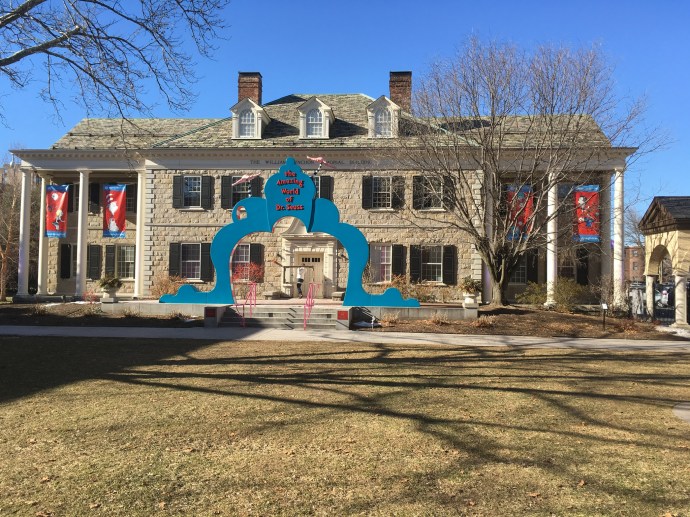
Dr. Seuss museum in Springfield MA

Friday before returning to Boston we visited the Springfield Museums with Chris’ cousin and her husband. The Museum complex includes a science museum, a history museum, two art museums and the Dr. Seuss museum. Our first stop was the delightful, although small, “Amazing World of Dr. Seuss Museum”. Theodor Seuss Geisel was born in Springfield MA in 1904 and while he moved to CA after WWII, many of the ideas, locations, and concepts in his childrens’ books are based on Springfield images and occurrences. Even though he died in 1991, his books are still popular. Chris frequently looks for his books as a gift idea. He is ranked in the top ten fiction authors of all time by the number of books sold.

Dr. Seuss museum in Springfield MA

Part of the museum recounts his life through photos, displays and personal letters and while we enjoyed learning more about him, it was the exhibits based on characters in his books that tugged at the emotions. Good memories all around.
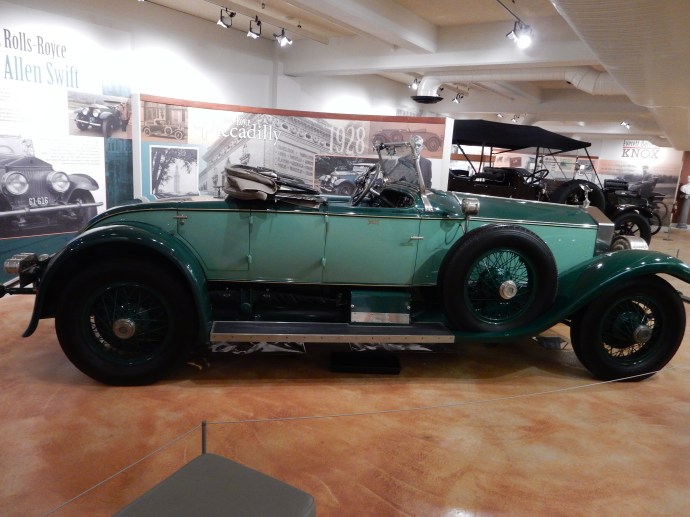
A Rolls Royce Phantom built in Springfield MA

After Dr. Seuss, we visited the Museum of Springfield History. Even Chris’ cousin was not aware of the extent of Springfield’s history and the number of companies that began here. Springfield was home to Breck shampoo, Milton Bradley games, Merriam Webster books (think dictionary), Fisk (Uniroyal) rubber, Indian motorcycles, Knox automobiles, and the only U.S. manufacturing facility of Rolls Royce back in the 1920s, among others. The museum is new, well laid out and was a pleasure to visit.

Replica of U.S. Senate at Sen. Edward Kennedy Institute

The rest of the weekend was family oriented with one visit to the Edward Kennedy Institute for the United States Senate on the University of Massachusetts Boston campus. The Institute is less about his life and more designed to educate people about the role and processes of the U.S. Senate. Sen. Kennedy had served from 1962 to 2009. The Institute includes a full size replica of the U.S. Senate and visitors are encouraged to take part in a mock debate and vote on rotating issues.

The displays are all electronic with each visitor touring with a tablet computer around the building. Frankly, it turned me off, the information struck me as limited and pre-packaged. Evidently, my impression is not unique, the attendance numbers for this institute are well below projections.
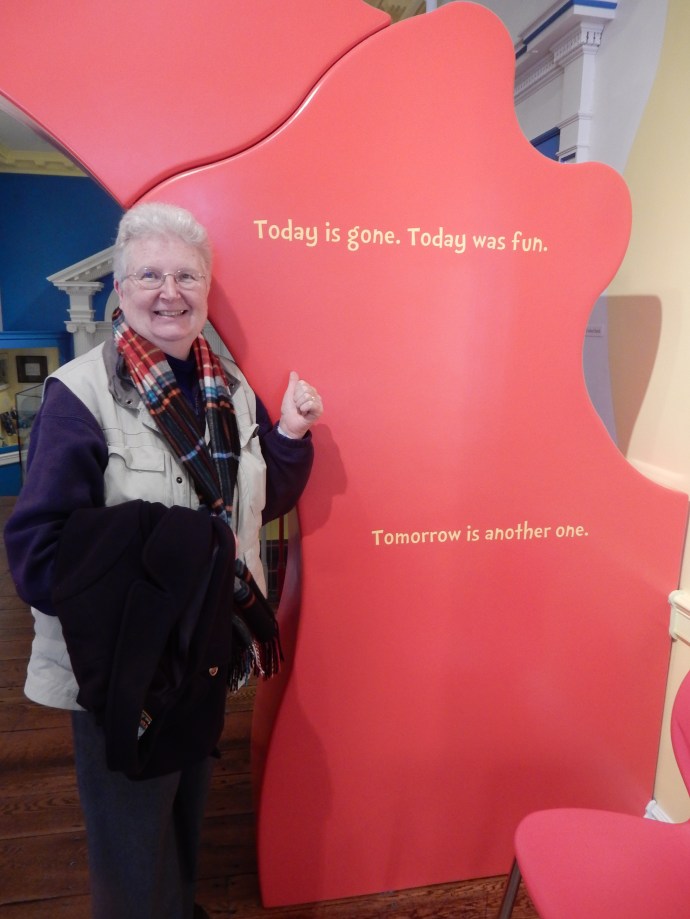
Chris and Dr. Seuss message

Ed and Chris
March 6, 2018

Categories: road trip, travel | Tags: , , , , , , , , , , , | Leave a comment

Blog at WordPress.com.