Monthly Archives: April 2017

2017 Trip Two: Tour of Texas April 17

Big Bend National Park, Monday April 17

At the entrance to Big Bend National Park

Big Bend National Park, Monday April 17

Well, we are finally at Big Bend National Park. Along with viewing the sandhill cranes along the Platte River, seeing the Texas wildflowers, this was one of the primary new sights that inspired this trip. It is just under 500 miles from Kerrville, and Chris drove the entire trip. I think the 80 mph speed limit energized her. We thought the scenery along the way would be boring, but found it enjoyable as the topography changed from the Hill Country to flat plains to desert to mountains. Not much color in the rocks though.

Driving from Kerrville to Big Bend

Lunch was at a regional chain of steakhouses in Fort Stockton but we both opted for the extensive salad bar-see, we can eat our fruits and vegetables. The skies were a gorgeous blue with fluffy clouds, it was a nice change from the multiple gray days we encountered recently.

Driving into the mountains for Chisos Lodge

We arrived in time to see the introductory video at one of the visitors centers but we checked in at Chisos Mountain Lodge, located inside the park, up in the mountainous area. Big Bend is the 14th largest national park, 7th largest outside of Alaska. Due to its remote location, it is not heavily visited in comparison to the other large parks. The combination of desert (Chihuahuan), river (Rio Grande), and mountains (Chisos range) makes it unique. The park warns that the road to the lodge is steep and winding, but we found it tame. The road is off-limits to RVs and large trailers.

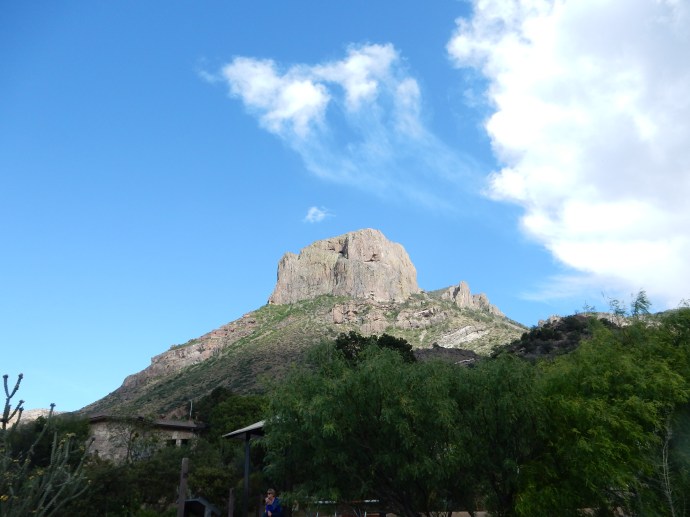
Peak behind Chicos Lodge

The storm approaches

Sunset photos

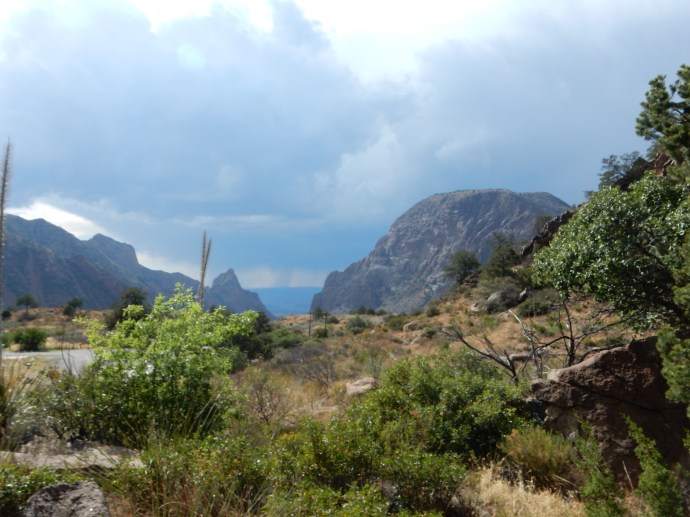
We had dinner in the lodge restaurant, with window view seats overlooking the mountains and a storm off in the distance. By the time we returned to our room, the storm had arrived. Mild at first, it turned cold with a brief, fierce hail storm. When the rain had passed, the sun came out and we took a walk observing a rainbow and the interplay of dark clouds and sunlight. Numerous people joined us at an overlook to watch the sunset and take the requisite sunset photos.

Our camera is unable to take photos of the night sky, but it is amazing out here away from the lights of civilization. The stars are brighter and more numerous. When the moon rises later in the night, it dims the affect of the stars but does not eliminate it.

There is no cell phone coverage at the Lodge, it is spotty elsewhere. There is slow WiFi here but expect postings to be sporadic for the next few days.

Pictures take a long time to load. I may add a few of todays on tomorrow’s post.

Ed and Chris.

Categories: road trip, travel | Tags: | Leave a comment

2017 Trip Two: Tour of Texas April 15-16

Kerrville, Texas. Sunday April 16

Saturday April 15

National Museum of the Pacific War in Fredericksburg, Texas

Bombs and Blossoms, the theme of the last two days. We drove to Fredericksburg, 30 minutes away, and home to a German community that immigrated to Texas before the Civil War. Germans constitute one of the largest European immigrant groups in Texas, and the Texas Hill Country was one of the major destinations for them. Germans left their homeland due to inheritance laws that gave all family land to the eldest son, due to crop failures, and religious oppression.

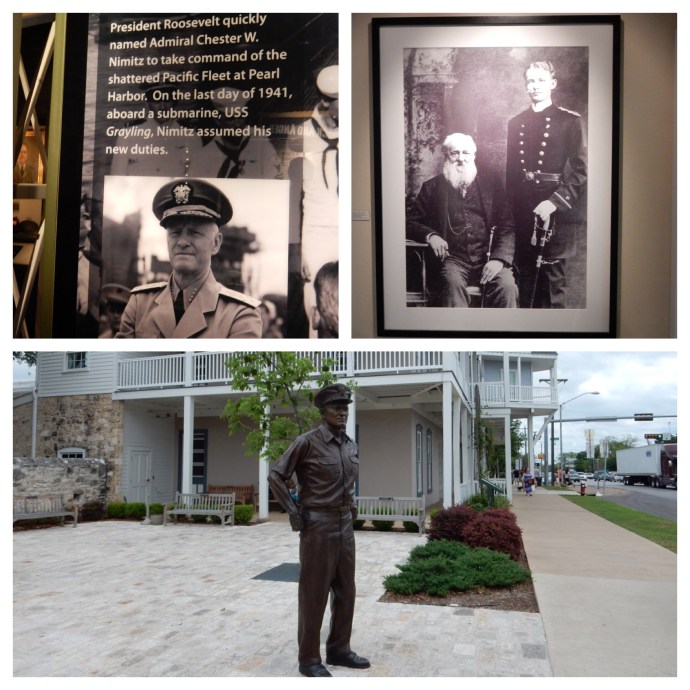
The Nimitz family was part of that German immigrant wave. From the Nimitz’ family tree sprang Chester Nimitz who was the Admiral serving as Commander-in-Chief Pacific after the Japanese attached Pearl Harbor. Fredericksburg is home to a fantastic National Museum of the Pacific War which started as a museum honoring Admiral Nimitz.

Nimitz during WWII, Nimitz with his grandfather, Nimitz statue in front of Hotel Nimitz

Chester Nimitz’ dad died a few months before he was born in 1885 and his grandfather was a major male influence in his life. The grandfather’s tales of life on the sea sparked an interest in the military and Chester tried to obtain an appointment to West Point (free tuition too). All of the Texas appointments had been made but he was told there were still appointments available for the Naval Academy. He went for it, and diligently studying, he got the appointment and passed the entrance exam.

Nimitz made a name for himself early, one of the first to promote the submarine service. (Yes, they had them back then.) We worked his way up over the years, and Roosevelt tapped him as the Chief for the Pacific War. During the war, titles changed and two other areas were carved out for separate command; for instance, so Douglas McArthur could command the Philippines area. However, Nimitz was the person who led the combined military forces of the Allies to victory over Japan in WWII.

The museum has a new 33,000 square foot gallery to go with the old Nimitz hotel which displays Nimitz family memorabilia. The new gallery uses large display boards, videos, personal testimony, computer kiosks, and battle graphics to retrace the causes, conduct, and legacy of the war. The amount of information is overwhelming. One excellent element of the museum was the significant allocation of exhibit space to the causes leading up to World War II in Asia. I walked away reflecting on the role face, poor economies, military dominance over civilian rule, ancient feuds between countries, and the development of national self-myths have in encouraging people to support wars.

The Pacific Theater is detailed campaign by campaign. The fighting was influenced by the Japanese unwillingness to surrender, making the casualty tolls high for limited land space captured. As in many events in life, luck, poor decisions, and mistakes play a crucial role, not just heroics, good planning, coordination, etc.

One of the Sunday houses in Fredericksburg

The rest of the day was spent in Fredericksburg. The Vereins Kirche Museum illustrates the history of the German immigrants in Fredericksburg. The museum mentions Sunday houses, small houses built by farmers in Fredericksburg so farm families could shop on Saturday and worship on Sunday before returning to the farms the rest of the week. The German immigrants reversed their living practice from Germany; in Germany they lived in towns and walked out to the farms daily. In America, they lived on the farms and came to the towns to shop and worship.

The drive to and from Fredericksburg from Kerrville only takes 30 minutes, we enjoyed wildflowers along the roads as part of our day’s activities.

Sunday, April 16. Easter Sunday

Wildflowers in Texas Hill Country

We slept in and went to 11 AM Mass in Kerrville. As part of the introductions, visitors were asked to stand and state where they were from. Chris mentioned we were from Minnesota. The woman up front of course said: “Great, from Minnesota-o-o-ta” trying to replicate the Scandinavian accent. After Mass, a guy came up to me and introduced himself; he had been a city manager in Shoreview MN and his son still lives around Cretin High School.

Wildflowers in Texas Hill Country

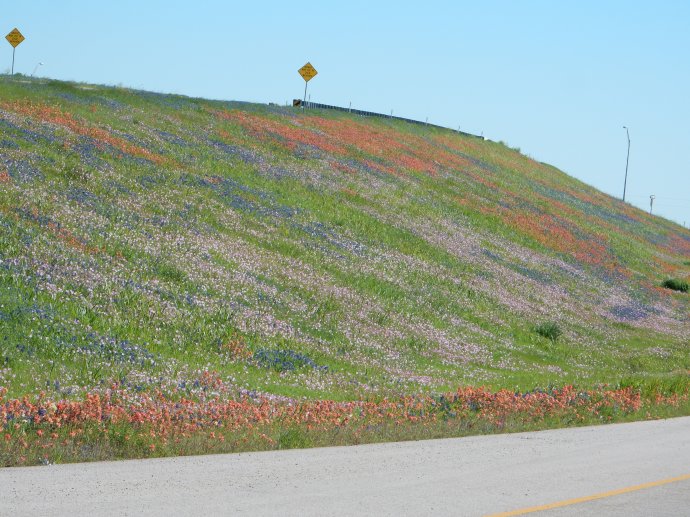
The rest of the day was driving. We thought we had seen wildflowers before but today’s crop was overwhelming. Red and yellow were the predominant colors from the artist’s palette but blues, whites, and purples were also present. We drove north from Fredericksburg along 495 to Llano, then east to Burnet, south to Marble Falls and back to Llano and Fredericksburg. It was stunning; it rivaled the wildflowers we saw at Revelstoke National Park in British Columbia and at Mount St. Helen’s in Washington State. Miles upon miles of multi-colored hues along the shoulders of the roads. Unfortuantely, most roads had absolutely no shoulder and a speed limit of 70 mph. Well,maybe it was alright or I would have been stopping constantly to shoot more pictures. Once again the sky was gray and overcast or the pictures would be more vibrant. It was a great way to end our time in the Hill Country and to enjoy God’s beauty on Easter Sunday.

Wildflowers in Texas Hill Country

Dinner was at a German restaurant (what else?) in Fredericksburg,


Video of wildflowers

Ed and Chris. April 16

Categories: road trip, travel | Tags: , , , , , , , | 1 Comment

2017 Trip Two: Tour of Texas April 14

Kerrville Texas Friday April 14

The LBJ Ranch-The Texas White House

I admit it. Texas “Hill Country” is hilly, hillier than the eastern portion around Ennis and Waco. The Balcones Fault Zone that we briefly discussed in yesterday’s post about the Meadows Center in San Marcos did its job. The fault zone runs from Del Rio by the Rio Grande northeast towards Dallas. Today’s drive showcased hills, escarpments, and valleys. Roads have dips where flooding occurs during heavy rains. Those flat lands closer to the Gulf are gone.

Driving around the Texas Hill Country

Our drive today was 200 miles north from San Antonio to Johnson City and then southwest to Kerrville-with a few back and forths for exploratory purposes. Motorcycles were out in greater numbers than previously seen. Wildflowers were not as extensive as a week ago but still present and profuse periodically. Cattle and sheep were frequent. This is supposed to be an area where peaches grow but we were not able to identify any orchards. The large number of vineyards and wineries did catch us by surprise although we did not stop at any. The day was normally cloudy so outdoor pictures are not vibrant, but at least it did not rain.

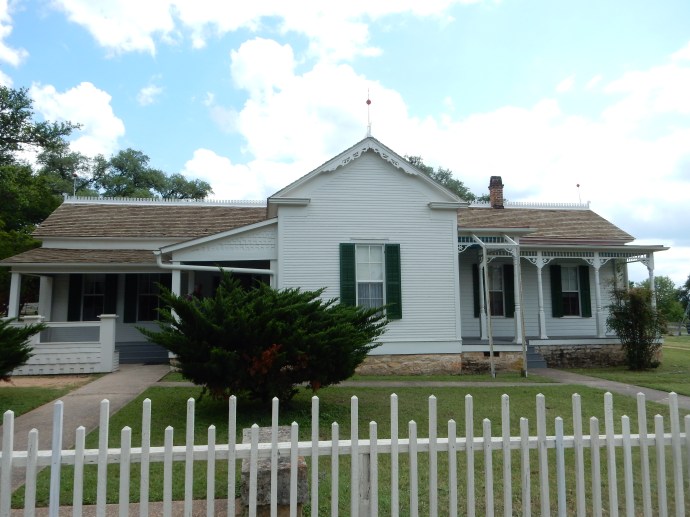
LBJ, Lyndon Baines Johnson, our 36th President, was our primary target for the day. We spent hours visiting his birthplace, his boyhood home, his grave, and his ranch-the Texas White House. All three are located in the Texas Hill Country within twenty miles of each other. People of my generation identify Johnson with the Vietnam War and while the displays cover this, our blog post will list a few other facts of his life and Presidential career. Such as the fact that LBJ spent over 25% of his time as President working at the Texas White House.

LBJ’s mother, Rebekah, went to college and received a degree in journalism (so did Lady Bird). Very unusual for a woman at that point in history. Education was important to her, one of the reasons the family moved from the countryside where he was born into Johnson City where the schools were better. Rebekah tutored him also, and concentrated on debate and elocution, two traits that would aid him greatly in his political career.

LBJ’s boyhood home in Johnson City Texas

LBJ’s father served for 12 years in the Texas Legislature and Lyndon learned political skills from him. LBJ visited him while the Legislature was in session and went out on the campaign trail with his father. His father would meet constituents at home but Rebekah made him hold many meetings outdoors on the porch due to the smoking and cussing that occurred. LBJ’s bedroom abutted the porch, though, so his informal education in politics was not hampered.

Early in LBJ’s career in Congress, he had promised his constituents that they would get electricity in Johnson City. Recognize that electricity was not universal, in fact, most rural areas did not have electricity. It was too expensive for electrical companies to set up power plants and run wires for less populated communities. During the Depression, FDR and Congress passed the Rural Electrification Act to allow for the formation of electrical cooperatives in rural areas. The federal government would provide and guarantee loans for that purpose but REA regulations set minimum population levels that Johnson City did not meet. LBJ was not able to convince the REA administrator to waive the requirements so he went directly to FDR who granted a waiver just for the Johnson City area.

Where LBJ signed the education bill, on a picnic table outside his one room school house with his first teacher by his side.

During Johnson’s five-year stint as President, over 1000 pieces of legislation were passed. Only during Franklin Roosevelt’s twelve years was a greater number of bills made into law. LBJ’s time as Minority Senate Leader and then Majority Senate Leader put him in a rare position to get legislation passed. The Elementary and Secondary Education Act of 1965 was signed into law by LBJ sitting at a picnic table outside the first school he attended with his first teacher by his side.

One has to wonder how LBJ would operate today. He sold his legislation to conservatives on giving a helping hand so people can improve themselves. Today, we seem to be in a mood to not do anything for people but to make them improve all on their own, despite poor schools, broken families, poverty, ill-health, etc. We could use his political skills today and his concern for helping people.

We had lunch in Hye TX, a small unincorporated community where the cafe is housed with the post office. At this post office in 1965, LBJ’s Postmaster General was sworn in. Down the road ten miles, we had a snack of peach ice cream at a small cafe/gift store/fruit stand.

On our drive to our hotel in Kerrville, we stopped in Luckenbach. Luckenbach, I believe, exists solely as a place where an establishment acts as a general store, bar, and dance hall. During the afternoon, free music flows. An eclectic gathering of locals, tourists, bikers, and VW drivers were in the crowd. (Evidently the Texas VW Classic is happening in Fredericksburg this weekend.)

Video of Luckenbach Texas

Ed and Chris

Categories: road trip, travel | Tags: , , , , , , | Leave a comment

2017 Trip Two: Tour of Texas April 12-13

Austin, Texas. April 12. Wednesday

Graffiti Hill in Austin

1,483. That is the number of school children scheduled to be visiting the Bullock State History museum today, as we were told by several docents and employees. It was the largest number in several weeks and they expected to be busy. They were busy, but the museum is large (three floors) and we were not overly bothered by throngs of young students.

Our arrival at the museum was preceded by dropping off our car at the Austin Subaru dealership for its 30,000 mile check-up. It was a little before it was needed but there aren’t any dealerships in the sections of West Texas we will be visiting over the next week to ten days and the miles will be adding up. The dealership provided us with a ride downtown and picked us up in the afternoon.

Bullock Texas State History Museum

AAA rates this museum as a gem and said to expect to spend three hours here. We were here for 4.5 hours, including lunch in their cafe and did a pretty good job of visiting exhibits of interest. There were two exhibits that we went through quickly (Music Festivals and Stevie Ray Vaughn).

As one expects of a state history museum, the focus is on Texas history from Native Americans through its time under Spanish and then Mexican rule up to the 20th century. The Texas Independence movement a highlight and is told from the American side, as one would expect. The Mexican immigrants and European settlers that were invited into this province of Mexico were losing their previously granted freedom of action and subject to stronger central Mexican rule. They chafed under it and demanded their independence. Mexico said no way and the Mexican army was the better prepared.

Then in 1836 came Mexican victories at the Alamo and Goliad (lesser known outside of Texas but the Texas rebels were slaughtered by the Mexican forces). Instead of shutting down the independence drive, the two losses fueled it. Sam Houston and his troops defeated the larger and better trained Mexican forces under Santa Anna at San Jacinto and Texas became a newly independent country. In 1845, under request of the Republic of Texas, Texas was annexed into the United States. It was not an easy decision, even though many Texans were for it from the beginning. Some Texans wanted to remain a separate country and many US Northerners did not want an additional slave holding state to enter the US. The Republic of Texas faced a mounting debt, a weak currency, and continual threats of invasion by Mexico. Becoming part of the Unites States addressed those issues. The Mexican-American Was of 1846-48 (or from the Mexican side, the War of the United States against Mexico) resolved the question of Texas and portions of today’s Colorado, New Mexico, Arizona and California were added to the United States.

I was struck by how long-lasting and deep can be the development of cultural myths and story lines. All history is complicated but people have a pattern of developing a concise world view that is usually based on some facts but which facts are kept and which discarded form the lens by which we decide current issues.

Texas’ varied geography is shown along with the crops and minerals produced by those different geographic areas. Wool, rice, cotton, cattle, goats, lumber, mercury mining, wheat, and oil all played a major role in different areas. The new role of technology is presented but we breezed through that.

As we have seen in other museums, the fact that cowboys were not really white males with European ancestry but began as Mexicans and were significantly influenced by newly freed blacks after the Civil War was prominently shown.

The Broken Spoke honey tonk restaurant in Austin

Our Evergreen hosts took us to a honky-tonk restaurant (the Broken Spoke) for dinner and for a ride around Austin. The photo at the top of the page illustrates “Graffiti Hill”, a landmark Austin shows off to outsiders. People are invited to paint their own graffiti message and the wall changes constantly. We saw several new works of art going up as we stood there.

Treaty Oak in Austin

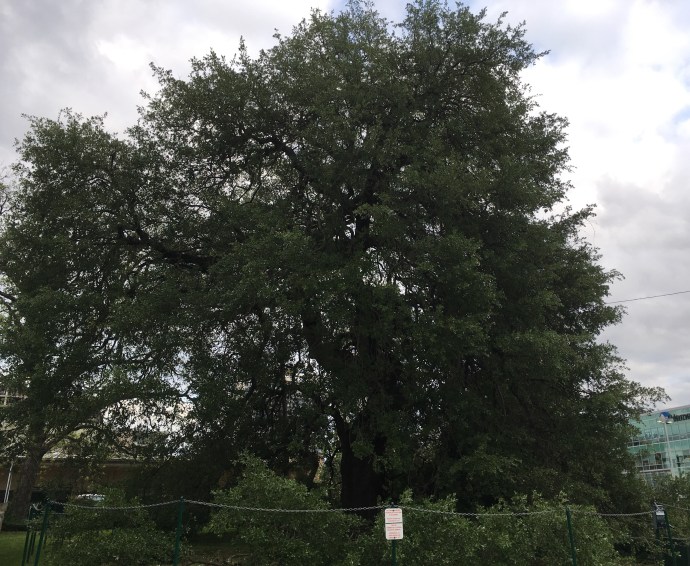
A second stop was the Treaty Oak, the last remaining oak tree from a grove of trees (the others fell victim to neglect and urban development) standing when, according to folklore, Stephen Austin negotiated a treaty with Indians. In 1989 a vandal poured an enormous amount of pesticide on the roots of the tree. Two-thirds of the tree died but a massive effort funded by a “blank check” from H. Ross Perot of Dallas saved the rest of the tree.

Thursday, April 12

Glass bottom boat on Spring Lake at the Meadows Center

From glass bottom boat: Turtle, scuba diver, springs bubbling up

Our drive to San Antonio took us through San Marcos, Texas and we stopped at the Meadows Center for Water and Environment run by Texas State University. The Meadows is located at a spring on the Edwards Aquifer, a huge aquifer providing drinking water for people from Austin to San Antonio. The spring is on a fault where the flat land starting at the Gulf of Mexico ends and the hills of the Texas Hill Country begin. The aquifer bubbles up here through numerous springs and creates Spring Lake where we took a glass bottom boat ride. The boat ride allows one to see the springs bubbling up, turtles, fish, vegetation, and two scuba divers who were trimming the vegetation underwater so it does not get out of control.

Mission San Jose y San Miguel de Aguayo

In San Antonio we stopped at one of the five missions still standing from the 1718-1824 period when the Spanish originated missions were vital in establishing control and settlement. The missions are now church buildings run by the Catholic archdiocese in San Antonio while also part of the National Park Service.

San Jose Mission in San Antonio Texas

The Park Service has films and displays about the Spanish role in colonization. Native Americans were decimated by European diseases and threatened by other Indian tribes. A number of the Indians gave up their way of life for a chance at survival by living at the missions and being almost forced labor to keep the missions functioning. It did work in that many Indians were converted to Catholicism and are a significant cultural force in Texas today. It also was one of the factors in the loss of Indian traditions.

Ed and Chris. April 13

Categories: road trip, travel | Tags: , , , , | 1 Comment

2017 Trip Two: Tour of Texas April 10-11

Austin, Texas April 11

Monday, April 10

Austin is a short drive down I-35 from Dallas-Fort Worth but we, of course, drove the longer, smoother, and more scenic route along two lane roads west of I-35. The wildflowers re-appeared but not in the same profusion as around Ennis. The northern half of the route is hilly, once again surprising us about Texas geography. The ranches are different from the farms of the Midwest-no huge silos to store the crops.

Our first stop was at the junction of I-20 and US 281 as we began the two lane road drive. Gilbert Pecans beckoned to us and we purchased some pecans for us and for my sister (to use to hopefully make a pecan pie). Our second stop was in Hico Texas, population 1300, for a piece of pie at a local, well-known pie shop.

The Lyndon Baines Johnson Presidential Library In Austin

In Austin, we visited the Presidential Library of Lyndon Johnson at the University of Texas-Austin campus. LBJ’s library is well done, being completed in 1971, shortly before his death. There are several levels of exhibits, with six floors of archived records also in the building. This was a Presidential Library which we both appreciated.

LBJ had a tremendous record of legislative accomplishments, although the Vietnam War legacy is one that he can not escape. Sometimes we forget that he chose not to run for re-election almost seven years before the war actually ended. During the five years of his presidency, monumental legislation was passed; such as: Medicare, Head Start, the War on Poverty, Civil Rights Act, Voting Rights Act, Immigration Act (changing from heavy European preference to world-wide acceptance), creation of the Department of Housing and Urban Development, Clean Water Act, VISTA, new educational programs, National Foundation for the Arts and Humanities (think Sesame Street and Corporation for Public Broadcasting, and other programs), etc.

Part of the records collection of the library-maintained by the National Archives

It was somewhat disheartening to think that today, fifty years later, we are still arguing how to implement voting rights, how to get kids properly educated, how to allow immigrants in from non-European countries, etc.

One story we had to pull out of a library aide was the details behind the courtship of Lyndon and Lady Bird. The exhibits only mentioned the dates they met and the date they married. Lady Bird came from a well-to-do family, Lyndon did not. A friend lined up a blind date for the two of them when Lyndon was home from his job as a congressional aide in D.C. They spent the weekend together and Lyndon proposed, Lady Bird declined. They corresponded for the next two months, he came home at Thanksgiving, she accepted and they eloped.

The library allows you to listen to numerous selections of telephone conversations between Johnson and others on a variety of topics. One moving conversation we listened to was between the President and Jackie Kennedy about two weeks after JFK’s assassination. The fondness between the two was touching. Another feature here was a modern-day triptych, a series of three-part panels combining TV clips and memorabilia about the cultural and political happenings over three-year periods around the time of his Presidency.

After the Library, we had lunch at La Madeline, a national chain but a nice French cafe style restaurant. On our way to our Austin Evergreen hosts, we stopped at Mueller Lake. We thought it was just a park and we would get a little exercise walking around the lake. Turns out Mueller Lake is a 700 acre former airport now being converted into a planned community within the City of Austin. The lake does have walkways so we hiked around it land got our extra exercise for the day.
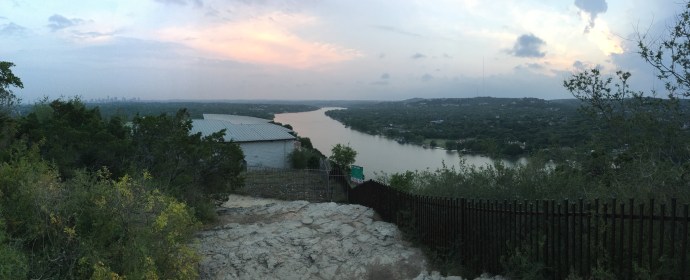
Sunset view from Mt. Bonnell overlooking the Colorado River and downtown Austin at the far left

Our Evergreen hosts took us out exploring that evening. We visited Covert Park at Mount Bonnell. The park provides a great observation point for the city, showcasing the hills along the Colorado River; the other Colorado River. This Colorado River begins in Texas, south of Lubbock, and travels 862 miles to the Gulf of Mexico, all within the state of Texas.
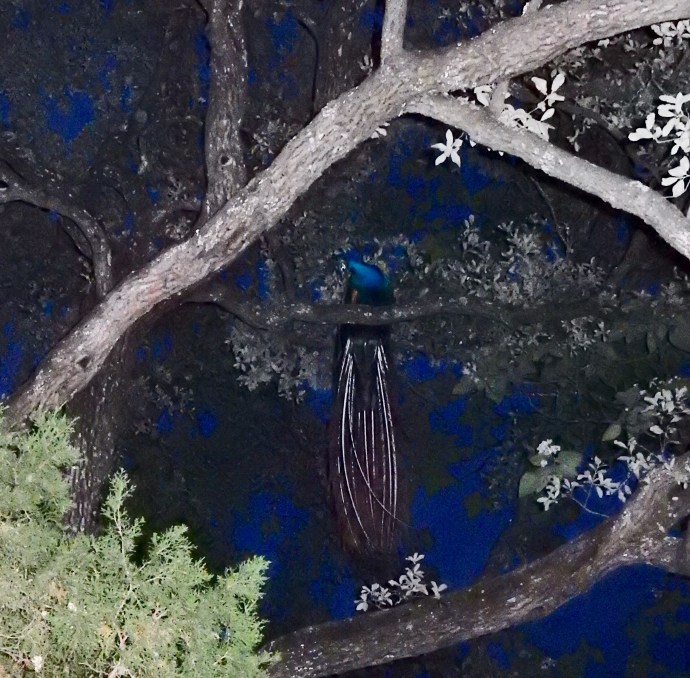
Peacock roosting at night

After Covert Park, we made a quick stop at Mayfield Preserve, home to a group of peacocks. The peacocks were roosting in the trees for the evening. It was amazing seeing the birds with their feathers hanging down from the branch the bird was perched on.

Tuesday, April 11

One can not control the weather. We had planned for this day to be our time outdoors, hiking and observing nature. The rain slowed us down and made a slight adjustment to the planned schedule. The initial stop was at the Lady Bird Johnson Wildflower Center and the Texas Arboretum. Two and a half hours gave us plenty of time to walk the trails, view and smell the flowers, and even eat lunch during the heaviest portion of the rain.
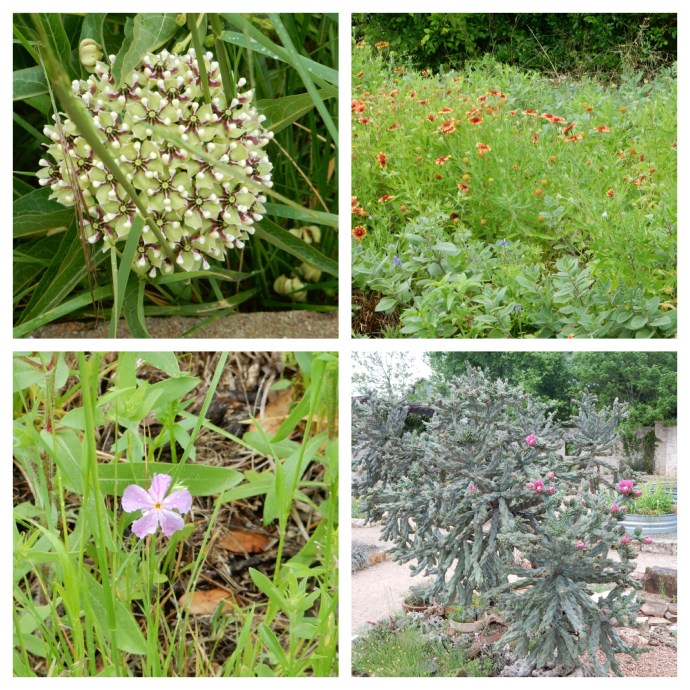
A selection of photos from the Lady Bird Johnson Wildflower Center in Austin Texas

The Center is 279 acres, self-supporting, devoted to education and research, an arm of the University of Texas, and specializing in native wildflowers of Texas. The gardens and trails were well laid out, with plenty of color to keep me busy snapping photos. The rains came about 90 minutes into our walk so we visited the inside exhibits and then had lunch in their cafe.
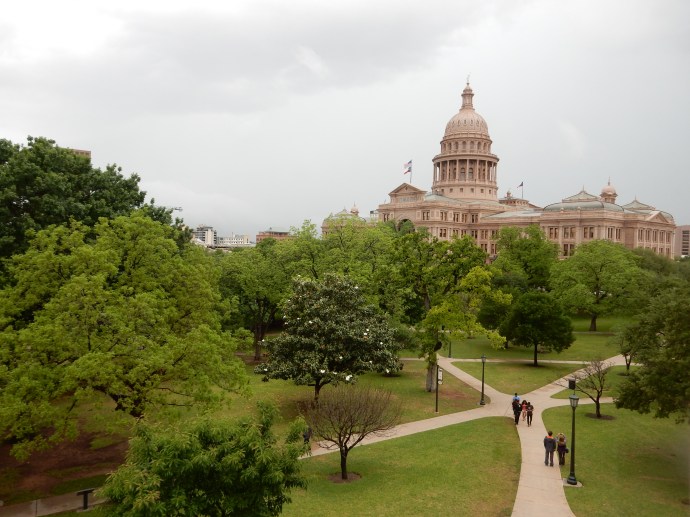
The Texas State Capitol clad in red granite from Texas

After lunch, the rain persuaded us to drop McKinney Falls State Park and went to the Texas State Capitol for a tour. The Texas Capitol is the largest capitol in the nation, is 14 feet higher than the U.S. Capitol, and underwent a major renovation and expansion in 1993. The Texas Legislature meets for 140 days every other odd-numbered year. Thus, it was in session while we were here. Tours could not go into the chambers but after our tour we did go into the visitor gallery and view each chamber.

The tour was strong on the major points of Texas history, the control by six different nations; Spain, France, Mexico, the independent Republic of Texas, the Confederate States, and the United States. Portraits of all Texas Presidents and Governors are on the walls, including the first woman Governor (who served two separate terms, the first being in 1924).
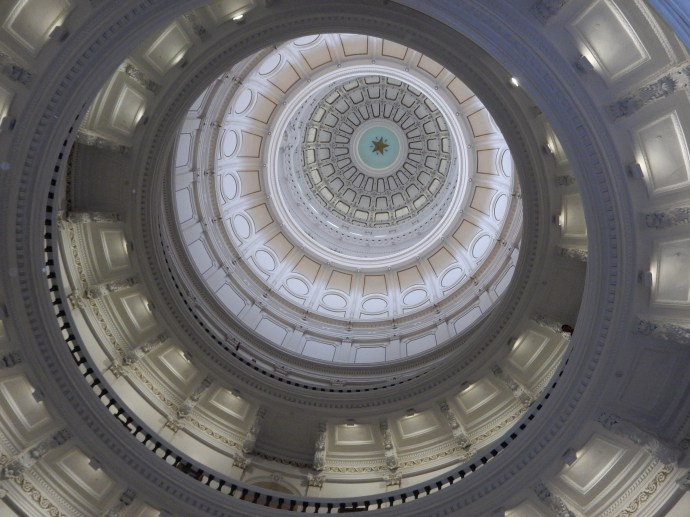
The dome of the Texas State Capitol

The Capitol itself was, while imposing and majestic, a disappointment in terms of artistic embellishments. Most of the state capitols we have toured have entire corridors devoted to large, grandiose, and impressive murals and paintings. The Texas Capitol walls are uniformly white. Only in the Senate chambers are two large paintings, one for the battle of the Alamo and one for the battle of San Jacinto.

A separate visitors center is located on the grounds of the Capitol complex, housed in the former General Land Office. In this building were excellent displays that explained the building of the current Capitol. In brief, this second Capitol (the first went up in flames) was financed by two Chicago investors who received a land grant of 3,000,000 acres of land out by the border with New Mexico. Unfortunately for the Chicago guys, the land grant did not make them rich. The market for beef fell apart. The land was too far out to really cash in on settlers homesteading the area. But the Capitol got built.

One other novelty was mentioned in the exhibits. O. Henry, the short story novelist, moved to Texas in 1882 when he was 20. From 1891-1894, he worked in the General Land Office (where the visitor center is located) and several of his short stories include significant references to this building and people he worked with while here.
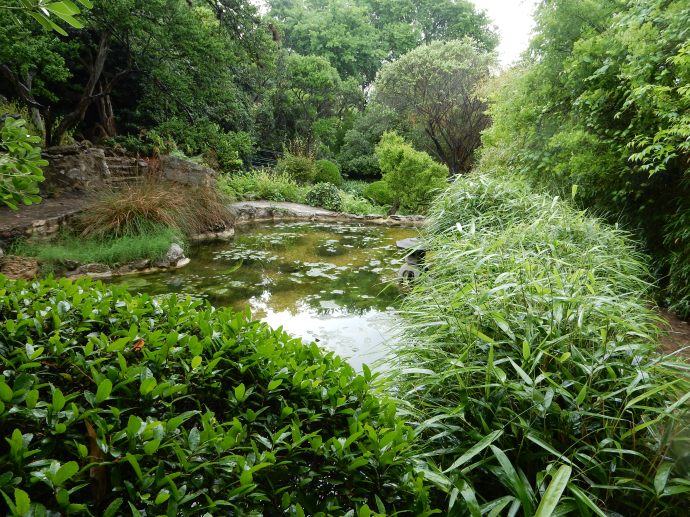
walking in the Japanese Garden in Zilker Botanical Garden in Austin TX

After the Capitol, the skies were only gray and drizzly so we drove to the Zilker Botanical Gardens. This 31 acre garden has separate sections maintained by different garden clubs in the City of Austin. The Japanese Garden was built by one man, when he was 70, over the course of two years. He had retired and moved here to be near his son. He had free time and offered to help at the garden. They asked him to construct a Japanese garden. He designed and constructed the wonderful garden we observed today.

A selection of photos from the Zilker Botanical Gardens
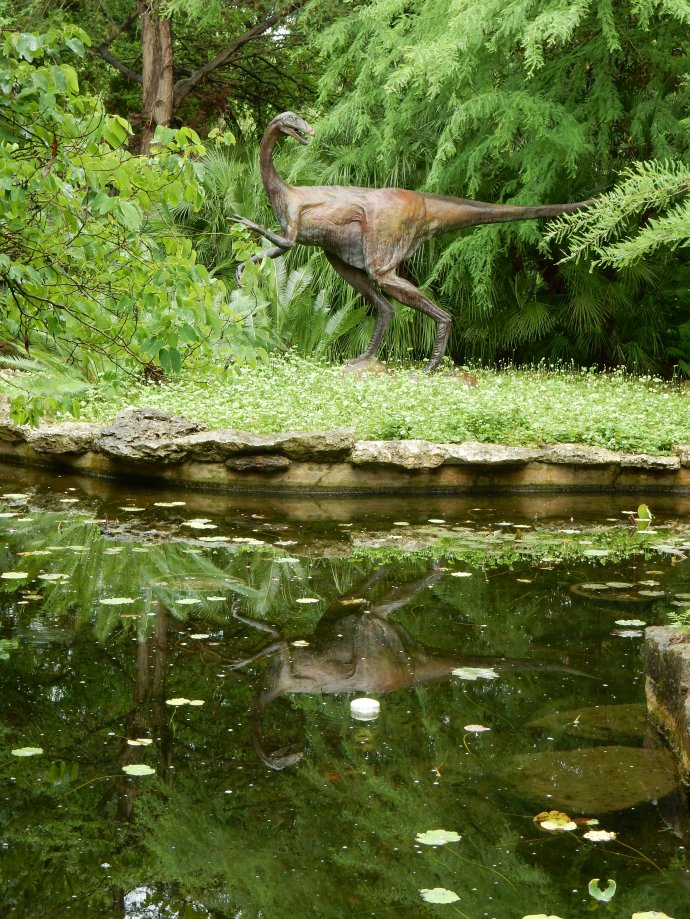
Prehistoric Gardens at the Zilker

We spent 90 minutes here walking the grounds; we had our rain jackets but the skies remained just gray with no major rain. The rain earlier in the day made the walking stones slippery but the leaves still had raindrops glistening on them and the odors of the flowers were rich and heavy.
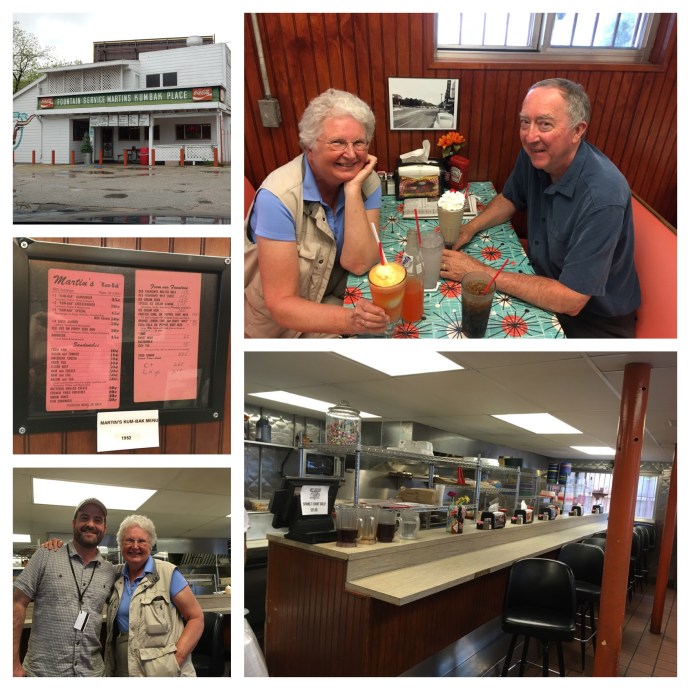
Dirty Martin’s in Austin TX

Dinner was at Dirty Martin’s, an establishment dating back to 1926. It is an old style (in the best sense of the words) hamburger joint, serving burgers, fries, and shakes-and alcohol now. We love to visit restaurants that have stood the test of time but which today have to fight the franchise chains and newest “in” restaurant. We talked to the staff, one cook having been here for 20 years. The General Manager showed us around and gave us the history. He is working to keep attracting new customers while still maintaining the regulars. In today’s world, the name Dirty Martin’s can have several negative connotations; yet the name has its history-it goes back to the original days when the floor was made of dirt.

I was impressed with the cleanliness; remembering back to my youth and the amounts of grease on and behind the stoves at the restaurants our family owned. Our Evergreen hosts had recommended the place and we were happy they had. Of course we had burgers with onion rings and tater tots, chocolate malt for Ed and an orange creamsicle for Chris (vanilla ice cream with Fanta orange pop).

Ed and Chris April 11

Categories: road trip, travel | Tags: , , , , , , , , , | Leave a comment

2017 Trip Two: Tour of Texas April 8-9

Fort Worth Texas Sunday April 9

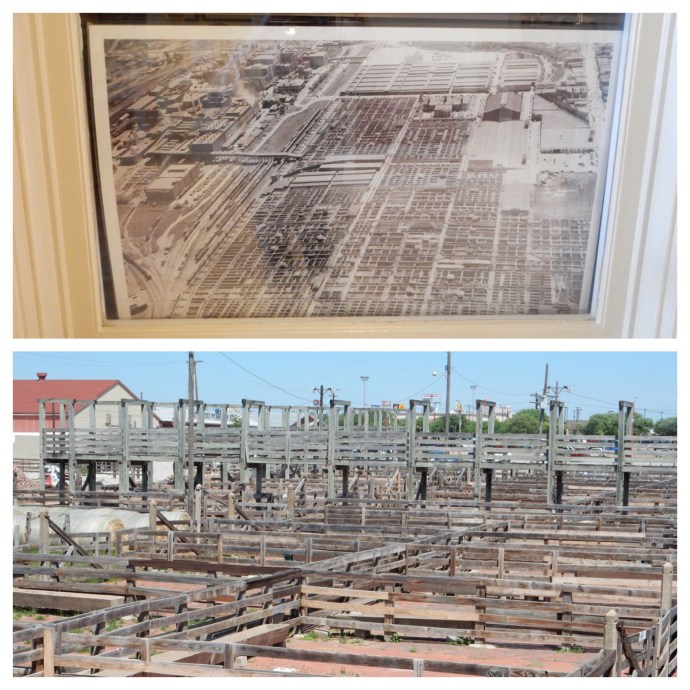
Above: An early photo of the stockyards; Below some of the remaining cattle pens

Saturday April 8
Saturday was a tourist type day. The Stockyards area of Fort Worth is a historical area, focused on the old stockyards. History buffs probably recall there were major stockyards in Chicago, Omaha, Fort Worth and South Saint Paul MN. Only Fort Worth has really maintained a vestige of the old buildings.

Here in Fort Worth, after the Civil War cattle were herded from the ranching communities to railheads, locations where the cattle were loaded onto train cars and shipped east to be slaughtered. Fort Worth had business leaders who realized the future was not in shipping the cattle but in producing the beef here. Swift and Armour, two of the major beef processing companies, were attracted here in the early 1900s and built plants across the street from each other.

One interesting story about the stockyards is that financial struggles were causing concerns about its ability to survive in the early 1890s. A Boston investor came out to check the situation. He observed cattle pens that were full and figured this was a great investment. He bought in and provided financial security. However, the pens were abnormally full due to wet weather and a railroad strike that limited the ability to move cattle out. The data for the Boston investor was bad, but the investment proved strong.

During WWII, meat rationing and price controls led to some black market meat production, particularly at smaller plants around the country. After WWII, the demand for meat exploded and the small plants started to grow. The stockyards in Chicago, Omaha, South St. Paul, and Fort Worth now had older facilities and found it hard to compete. By 1971, the last plant here had closed.

The Livestock Exchange

Several of the buildings still exist. The Exchange Building where stock were sold. The Coliseum, where livestock auctions were held (site of our Friday night rodeo). The Livery, where horses were stabled. The Railroad Station, where trains came in. The pens, where stock were kept until slaughtered. The old hotel where people slept when here on business.

A few of the activiites occurring in the Stockyards district

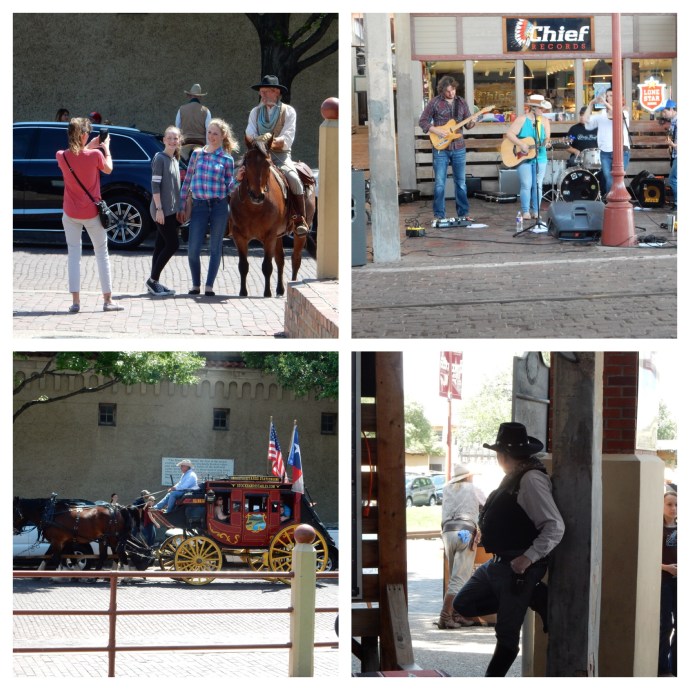
The historical district runs an active tourist program. Rides in buggies, stagecoaches, etc are offered. Horseback rides are available. People dressed in period dress walk the streets and talk to people. Several cowboys are riding horses down the Main Street so little, and big, kids can pet the horses and get their pictures taken with the horse and cowboy. Twice a day, the cowboys drive about a dozen longhorn cattle from the pens down the Main Street for tourists to see and take pictures. So we played the tourist and just took it easy.

Longhorn cattle

We toured the buildings. We went through a small museum. We shopped and actually bought a few items. We people watched. We took pictures. We ate lunch at a small,less-touristy cafe. We sat and relaxed. We viewed the Longhorns at their pens.

Saturday evening we made 5:00 PM Palm Sunday service and went out to eat with our Evergreen hosts and some friends at a local barbecue restaurant. Tall tales were told and promises made not to spread them around. Sorry.

Sunday, April 9
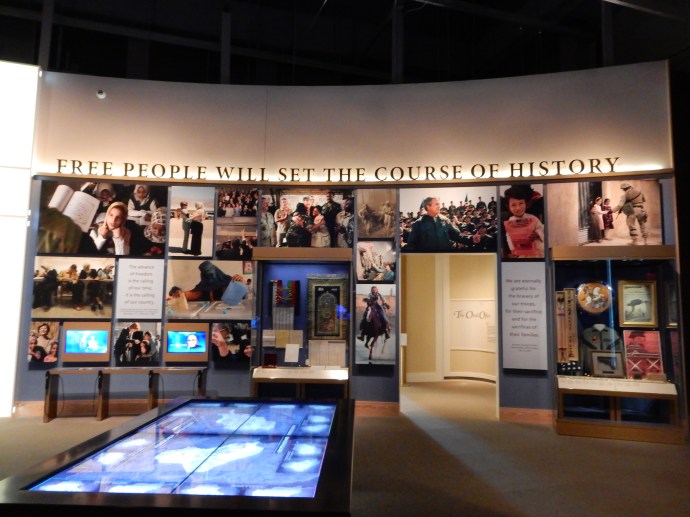
The United States has had only two father-son combinations as President. The Adams and the Bushes. Last week we visited the George H.W. Bush Presidential Library (the 41st). Today, Sunday, we visited the Presidential Library for George W. Bush, the 43rd President of the United States. It is at Southern Methodist University in Dallas. SMU is the host; Laura Bush went to SMU and the Bushes live in Dallas.

At the George W Bush Presidential Library at SMU in Dallas

Bush was President from 2001 to 2009. He was President during the 9/11 tragedy, the Hurricane Katrina tragedy, and the Financial Crisis of 2008. As do most Presidential Libraries, there is a replica of the Oval Office. The displays are more technically savvy, the print on the exhibits is large and easy to read. The exhibit did a decent job of summarizing the Bush Presidency.
What we did find lacking in the library, was information about George Bush before he became President. No information on his time as Governor, nothing about his one failed attempt to become a U.S. Congressperson, extremely little about his business career, and relatively light on college and military. Still, it was two hours well spent. Other people seemed to agree; this library was much busier than the library for Bush 41. Bush 43 Library has only been open for four years; so far the numbers show twice the attendance for Bush 41. Of course, Bush 43 is in the Dallas-Fort Worth metro area; Bush 41 is located in College Station with a metro area population less than 1/10 of DFW.
One of the Frederic Remington paintings at Sid RIchardson museum in Fort Worth

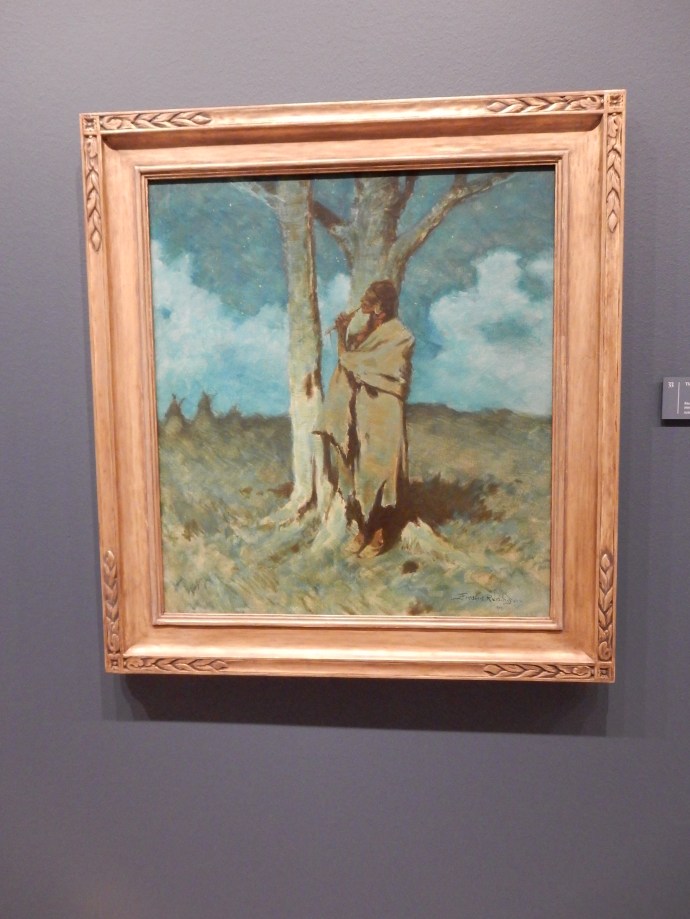
After the library and lunch, we visited another western art museum. Sid Richardson was an independent oil driller/explorer who struck it rich and lost it all several times. Finally, he found consistent success in West Texas and became extremely wealth. The Sid Richardson Museum is in downtown Fort Worth and focuses on western art, similar to the Amon Carter Museum of American Art. This is an excellent gallery, full of Frederic Remington and Charles Russell and a few others. The gallery is relatively small, less than fifty works of art on display. Of particular value is the gallery brochure which each visitor receives. The brochure identifies each piece of art, describes its strong points, when it was painted, etc. A visitor to this free museum can walk around the gallery and read about each painting with ease from this brochure.

Sundance Square in downtown Fort Worth

Our final stop was to Sundance Square in downtown Fort Worth. Sundance Square is an integral part of the revitalization of the downtown. We sat in the square and watched the children play in the splash fountains. Downtown has a vibrant combination of historic and new buildings created by a coalition of political and civic leaders.

We wrap our evenings discussing all sorts of topics with our Evergreen hosts.

Ed and Chris

Categories: road trip, travel | Tags: , , , , , | Leave a comment

2017 Trip Two: Tour of Texas April 7

Fort Worth Texas Saturday April 8

View of Fort Worth skyline from Amon Carter Museum of American Art

Friday April 7
Lest you think we are getting lazy, we left Athens TX early Friday morning and walked for an hour around the East Texas Arboretum. Our Evergreen hosts had to travel to southern Texas for a wedding Friday afternoon so we left the house early. The Arboretum had been our goal Thursday afternoon but, as you may recall, we spent that time watching pigs being judged instead.

East Texas Arboretum

The Arboretum had walks through a bog, a dogwood trail (no dogwoods in bloom), and a hardwood forest among its options. The early morning sun and cool temps gave some nice contrast to the heat and sun of the afternoons.

Fort Worth was to be our next destination for lodging. Fort Worth appeals to us more than Dallas. Dallas is bigger than Fort Worth (1,260,000 vs 800,000) and each one is bigger than either St. Paul or Minneapolis but I viewed Fort Worth as the little brother to Dallas; similar as St. Paul is viewed to Minneapolis. Fort Worth also seemed to have more interesting attractions. A major impetus to the growth of Fort Worth’s is tied to the cattle business; from the shipping of cattle via railroad in the late 1800s to the meat-packing business of Armour and Swift.

But Dallas did have one or two items we wished to see. One was Dealey Plaza, the area around the assassination site of President John F. Kennedy. Good luck came our way and we found an on-street parking spot half a block from the museum. When we arrived at the museum the cashier told us it would be 90 minutes before we could gain admittance. Chris and I looked at each other and decided it was just not worth our time to wait. (Our Evergreen hosts in Fort Worth later agreed with our decision.)

The Mustangs at Las Colinas

Instead we hopped back in the car and drove to Las Colinas. This was a destination recommended to us by one of our Evergreen hosts. The Mustangs at Las Colinas at Williams Square in Irving Texas is the largest equine sculpture in the world. Las Colinas is a combined residential-commercial development that was once a family ranch. The owner-developer wanted a signature sculpture to showcase the development. He commissioned an African wildlife artist to create a sculpture of mustangs running in the wild. The end result is shown.

The sculpture depicts nine mustangs, two stallions, two foals, and five mares running in a stream. The setting is in the midst of a stark plaza surrounded by three high-rise office buildings. There is a small museum in one of the buildings with exhibits and a video explaining the eight year process from concept to final installation in 1984.

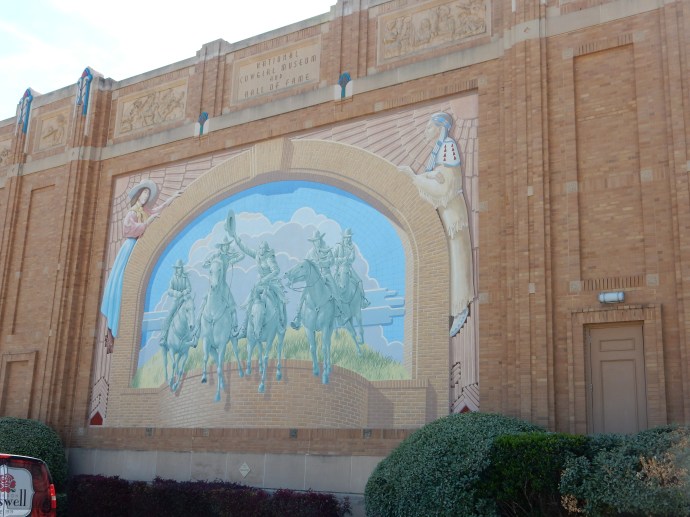
From the mustangs, we headed over to the National Cowgirl Museum in Fort Worth. Along the way we stopped at the Railhead Bar B Q in Fort Worth for lunch. Turns out Railhead is one of the top rated barbecue places in Dallas Fort Worth. We chose it by happenstance. I loved the saying on the staff shirts: “Life is too short to live in Dallas”.

National Cowgirl museum in Fort Worth Texas

The museum started in 1975 in western Texas (by Amarillo). Over time, it expanded, gained funding and moved to a brand new museum building in the Cultural District of Fort Worth. (Pictures are not allowed inside.) The Cowgirl Museum discusses the overlooked role of women in the cattle business. There is a Hall of Fame listing notable women and yes, Annie Oakley does get major play.

A Charles Russell painting at the Amon Carter Museum of American Art

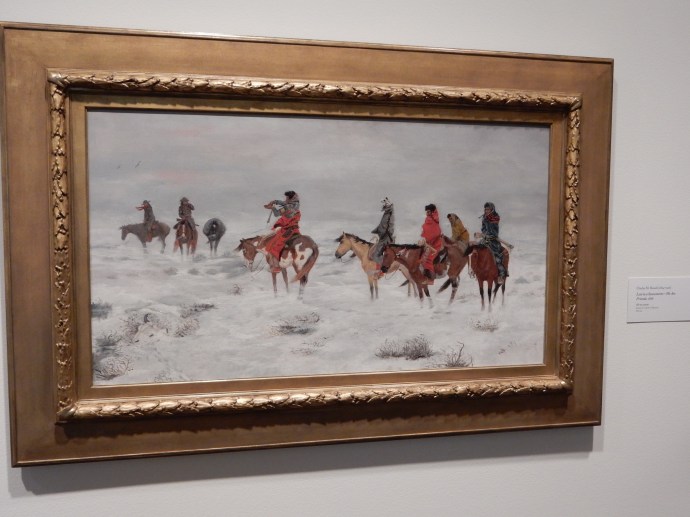
The Fort Worth Cultural District includes, among others, the Amon Carter Museum of American Art. The museum began as the personal collection of Amon Carter, a Fort Worth businessman. Carter was born in a log cabin and quit school at age 11. His business sense led to his work with the local newspaper and over time into oil and aviation. He started collecting works by Frederick Remington and Charles Russell in 1935. He died in 1955 and this museum was established through his foundation. It opened in 1961 and his funding provided for it to be free to all.

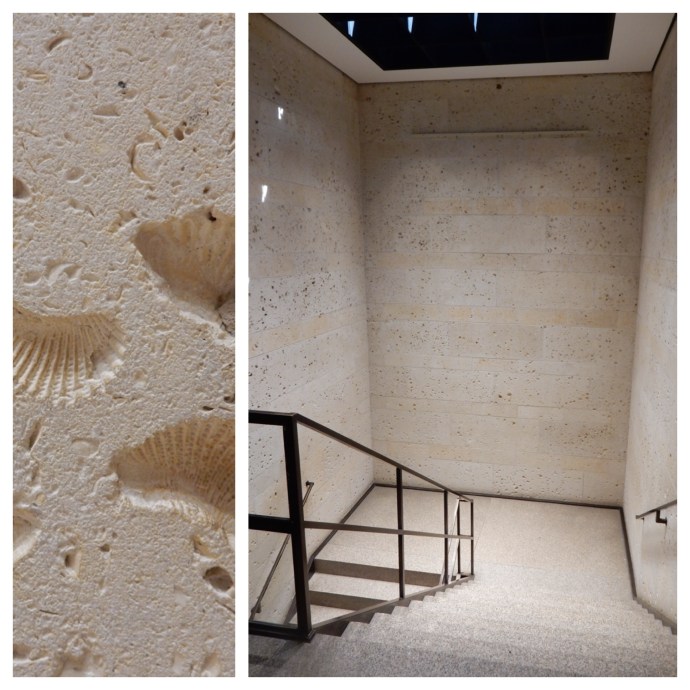
Cordova shellstone interior wall at Carter Museum

One of the interesting notes about the museum building was the use of Cordova shellstone for the exterior and interior walls. If you look closely, one can observe the imprints of the shells from the ocean that covered this area of Texas hundreds of millions of years ago. (Remember the discussion from the oil museums?) Besides the exhibits of works by Remington and Russell, there were special exhibits. To be frank, several of those (Avedon in Texas and Gego as Printmaker) did not excite me. Two others, Invented Worlds of Valton Tyler and Prints of Helen Frankenthaler, were more my cup of tea.

After the museums, we met our Fort Worth Evergreen hosts for a quick meeting before heading back out the door for an evening performance of the Stockyards Rodeo. One does have to pay for parking of course. Simple, right? Well, not if you are me. I foolishly, I know not why, put my credit card in the cash slot. Well, the cash slot did not give my card back but the people behind me in line were patient and considerate. Others tried to help but it took Chris going to get a needle nosed plier from one of the open retail shops to get the card out while I was on hold trying to cancel the credit card. Fortunately, Chris got the card out before I canceled the credit card. We made the rodeo after the Star Spangled Banner.

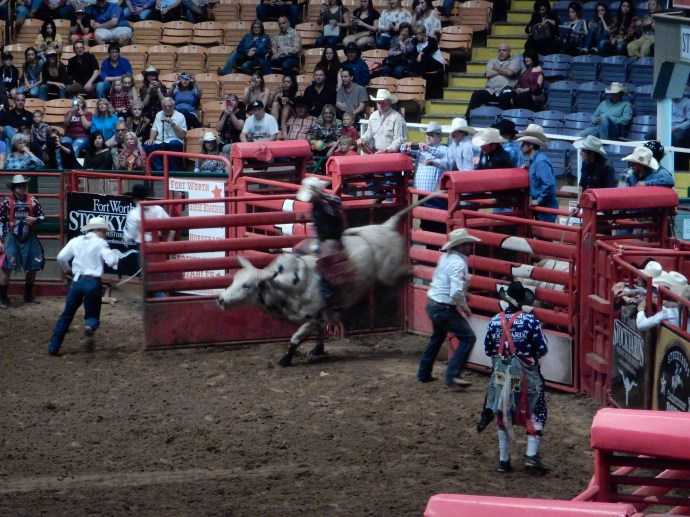
Bull Riding at the Stockyards Rodeo in Fort Worth

The rodeo was fine; in my mind it was a little more oriented to a family show. Twice they had children come out onto the arena and let loose a calf and a sheep. Surprised the heck out of me but no one was hurt and they all seemed to have fun.

The two hours covered bull riding, barrel racing, calf wrestling, roping, etc. I even behaved myself and mainly watched the show versus taking pictures. The fact that we had seen rodeos before probably helped. My sister-in-law keeps insisting that there is no rodeo to compare with the Houston Rodeo. Despite our times in Houston, we have never attended the Houston Rodeo so I will have to take her word for it.

Ed and Chris

Categories: road trip, travel | Tags: , , , , , | Leave a comment

2017 Trip Two: Tour of Texas April 5-6

Athens, Texas. Thursday April 6

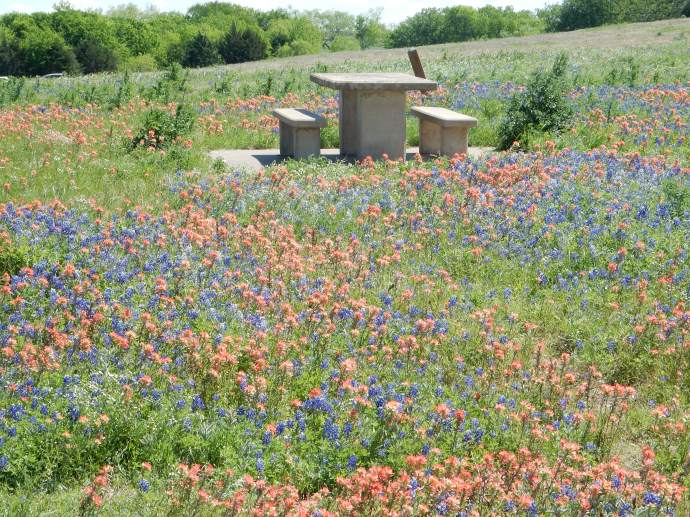
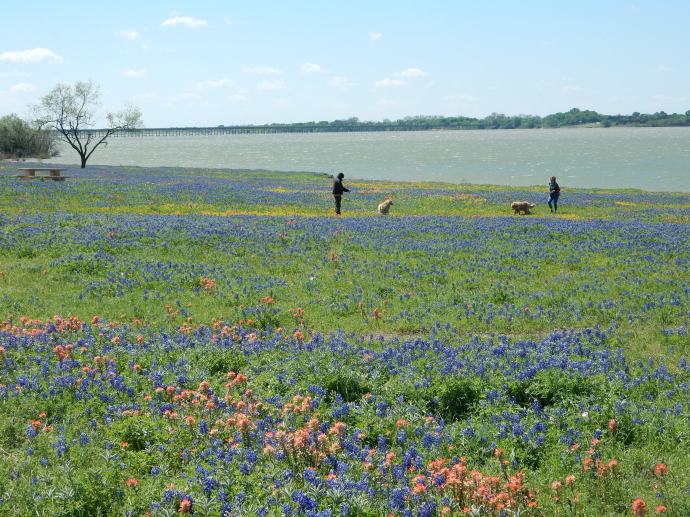
Fewer words, more pictures, and one surprise for you. One of our hopes for this trip was to see various flowers throughout Texas. We had some success and some failures. Wildflowers like bluebonnets and Indian paint brush were plentiful. Azaleas and Dogwood were long gone, victim of an early spring. Roses are blooming but some were just a bit past prime.

Along Texas Highway 31 between Waco and Ennis

By Ennis Texas

Wednesday morning we left Waco for our lodging in Athens Texas, just south of Tyler Texas. We left behind one Evergreen Club host for a new Evergreen couple in Athens. In both cities, our hosts have been delightful people, going out of their way to accomodate us. Once again, meeting with Evergreeners provides a welcome opportunity to discuss travel and interesting life experiences.

Ennis Texas was an intermediate stop. This day was hopefully our Texas bluebonnet day. As we drove Texas highway 31 from Waco to Ennis, the medians were overrun with colorful wildflowers. It was not feasible to take plentiful pictures but we did shoot a few. The flowers were nice but I was hoping for something with a greater impact. Ennis TX is a designated bluebonnet trail by the State of Texas. Would the bluebonnets still be out??

By Ennis Texas

Well, Ennis was a hit. First off, the town is organized with weekly maps printed of the current hotspots. Trails are marked. Printed directions of the route are also available. There is an iPhone app. Two hours were not enough time to see all of the locations on the current map. Massive fields of blue or pink or intermingled colors were visible. After a while, if the view was only great, we passed it by. We just wanted stupendous. Ennis by itself was worth the trip.

By Ennis Texas

Palestine Texas has a three-week dogwood festival, combined with azaleas, so it was our next stop after Ennis. Internet research was inconclusive whether the dogwood and azalea would be blooming. We went to Davey Dogwood park, supposedly the center of the Dogwood Trail. Zip. Nada. Nothing. Green trees but not a scrap of colored leaves. That was two hours of driving to just view more of Texas countryside. Which, by the way, is somewhat hilly here. I will be curious to see if the Texas “Hill Country” is any hillier.

Video of bluebonnets

Thursday, April 6

Tyler Municipal Rose Garden

Up in Tyler Texas, the city maintains a municipal rose garden. Smith county, in which Tyler is located, ships most of the U.S. grown roses. Rose growing started here before the Civil War but it was problems with peach diseases around 1900 that pushed local farmers to switch from fruit trees to growing roses.

Roses at Tyler

The Tyler Rose Garden encompasses 14 acres and 35,000 rose bushes. Roses were blooming and visitors were light. Chris and I spent an hour walking the paths, looking at flowers, and enjoying the day (72 degrees, sunny, light wind). I took way too many pictures. After the gardens, we walked through the Rose Garden Museum. The museum is dedicated to the Rose Fest, held each October in Tyler.

Tyler Rose Garden

The Rose Fest started in 1933 with queens, parades, and balls. It is still functioning. It appears, though the museum itself did not state this, that the royalty must come from family with wealth to be able to afford the gowns and balls. Tyler is a town of 90,000 people and the community seems to survive economically on oil and roses at a minimum. The museum exhibits numerous ball gowns and a picture and biography of each of the Queens since 1933.

The process to grow rose bushes is another feature of the museum. We had no idea it takes two years to grow rose bushes. The hand planting, grafting, harvesting, etc is time-consuming.

After Tyler, our destination was Kilgore Texas, home to the East Texas Oil Museum at Kilgore College. AAA rates the museum as a gem. It turns out that East Texas was, and is, home to one of the major oil fields in the world. It is the second largest oil field in the U.S. outside of Alaska. The museum does an excellent job explaining the oil discovery and drilling process.

One exhibit discusses how saltwater is brought to the surface along with oil. The oil and saltwater have to be separated and then the saltwater is returned deep into the earth under strict EPA regulations. Another exhibit explains the earth’s geology; how the central portion of the U.S. was ancient seas and over millenia the advancing and retreating of the sea deposited various sediments and organic matter that is today’s source of petroleum and gas.

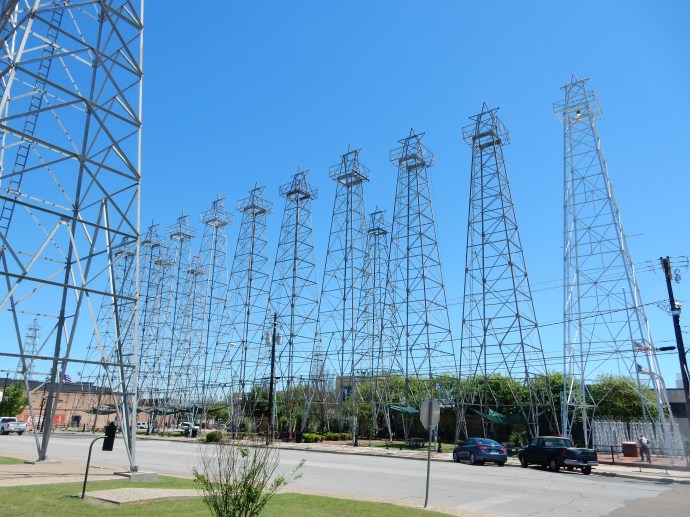
Replica oil derricks in Kilgore demonstrating how close derricks were to each other-similar to Spindletop.

Kilgore as a town went from 800 to 8,000 people in almost 24 hours when the first gusher was drilled in 1930. The resulting boom kept the Depression at bay for this part of Texas, although prices skyrocketed. Gas was selling for 18 cents a gallon, water was selling for $1.10 for a gallon.

On our way home, we thought we would stop at the Athens Arboretum for some hiking. But curiosity trumped good intentions. We drove by the Henderson County Livestock Show and spent an hour watching the judging of the barrows and gilts brought in by the surrounding FFA and 4H clubs. An interesting and different way to end our day.

A video of the Livestock judging of barrows and gilts

Ed and Chris. April 6

Categories: Uncategorized | Tags: , , , , , , , , , , | Leave a comment

2017 Trip Two: Tour of Texas April 4

Waco TX. Tuesday April 4

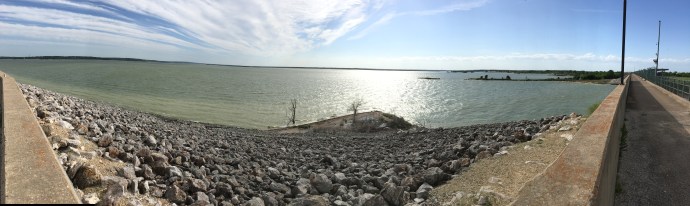
Lake Waco formed by damming the Bosque River

From mammoths to poetry to Dr Pepper to cupcakes. What a varied and delightful day! We started out with rye bread French toast, new to us but very tasty. It will have to be added on to our list for home breakfast options.

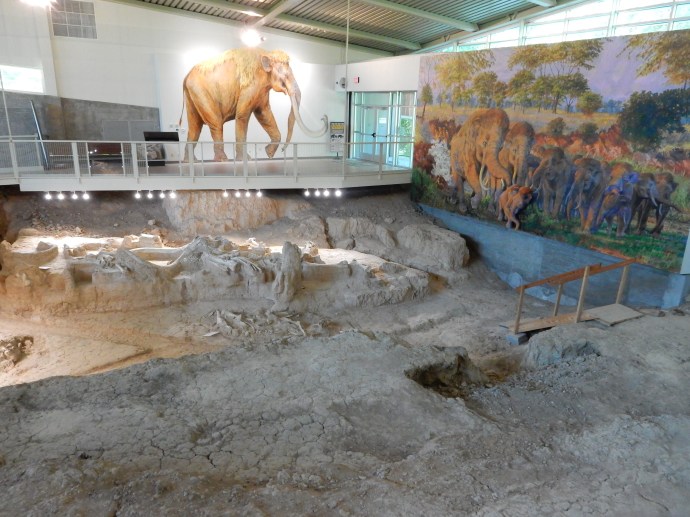
In 2015, the Waco Mammoth site was added as a National Historical Monument. Maybe you have not heard of mammoths in Texas before? We had not. Woolly mammoths up north during the glaciers, yes, but non-woolly mammoths? In 1978 two men discovered an unusual bone in a creek bed near the Bosque River outside Waco. Okay, let’s be honest. It was two teenage guys trespassing along a creek bed but given the discovery, it seems the trespassing part is downplayed. Momma, sometimes your teenage boys doing wrong do right.

The two boys took the bone to museum staff over at Baylor University. They identified it as a femur of a Colombian mammoth. Colombian mammoths were huge; more than 14 feet in height and up to 20,000 pounds. This is 2-4 feet higher and up to 8,000 pounds more than a wooly mammoth. It is also much bigger than current African or Asian elephants.

The dig site showing an artist rendering of a mammoth-actual size and the nursery herd along with the bones still in place down below.

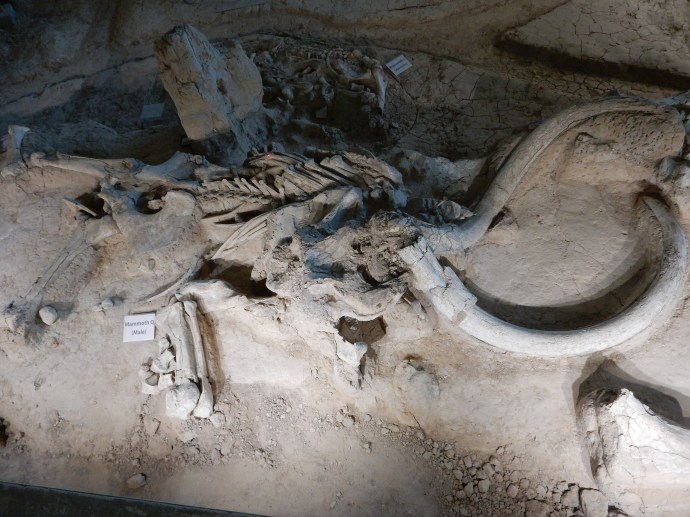
Once Baylor identified the femur, they spent 20 years excavating the site. Baylor identified a nursery herd of mammoths (females and their young) and they probably all died together around 65,000 years ago. Other mammoth bones have been discovered in the same area, having died 10,000 years after the nursery herd. This must have been a popular area; bones of Western camels (remember our Museum visit in Nebraska earlier on this trip?), saber tooth cat, dwarf antelope, and giant tortoise have been excavated. 24 separate mammoths have been identified over the years. Further excavations are on hold pending more money.

Close in look of the in place bones

Most bones are stored at Baylor but the NPS site has a climate controlled exhibit building where a visitor can observe bones still in place, partially excavated. A guide gives a 45 minute tour and does a great job of explaining the history and identifying the bones and tusks, etc. We met a dad from Columbia MD who was taking a slow drive to San Francisco to deliver to his daughter the oar she had been presented at graduation from the crew team. I guess she had finally moved into a place that could hold an oar of that length. One of the rangers on duty was originally from MN so we shared stories.

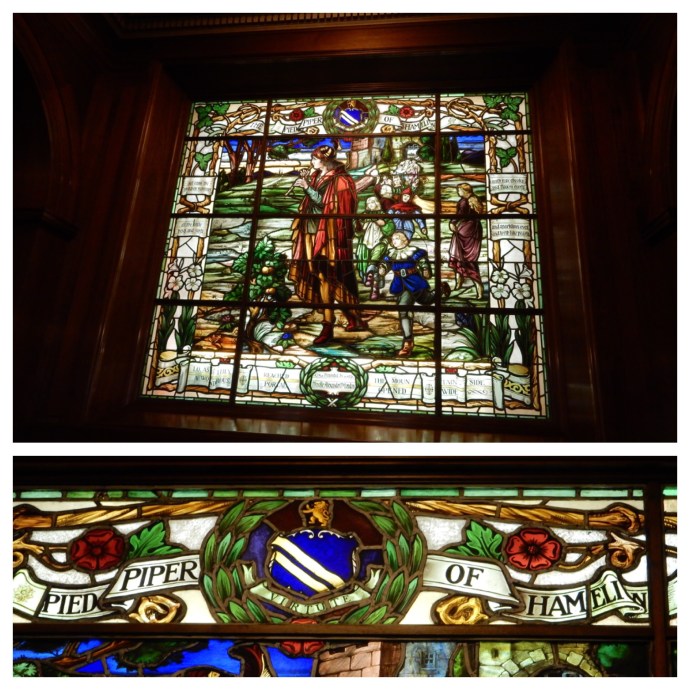
The Pied Piper of Hamelin stained glass window-on a Browning poem

After the mammoths, we went to Baylor but not for more bones. Instead we viewed the largest collection of secular stained glass in the world. The Armstrong Browning Library is named after Professor Armstrong who taught English at Baylor from 1912 to 1952 (He was 79 when he retired.) and after Elizabeth and Robert Browning. Armstrong was a Browning scholar and collector. The Brownings, if you do not know, are a husband and wife couple who were English poets of the Victorian era.

When the library was being built in the 1950s, they called it “The Most Beautiful Literary Shrine in the World and it is owned by Baptists!” Baylor is a Baptist university; at 16,000 students it is the largest Baptist owned university in the world. The library is beautiful. It is more a repository for the Browning collection than a major working library of the school. Few students were using it for study but music recitals and practices are held here due to the wonderful acoustics in the McLean Foyer of Meditation.

Stained Glass window by Willet at Armstrong Browning Library at Baylor

We came primarily to see the stained glass. Distinct styles are presented in the various major rooms of the library, spread over the basement and three additional floors. One of the stained glass artists/makers is the company of Willet Stained Glass which has a location in Red Wing Minnesota.

The Dr Pepper museum in Waco, the change in brick coloration indicates where the Waco tornado of the 1950s damaged the building

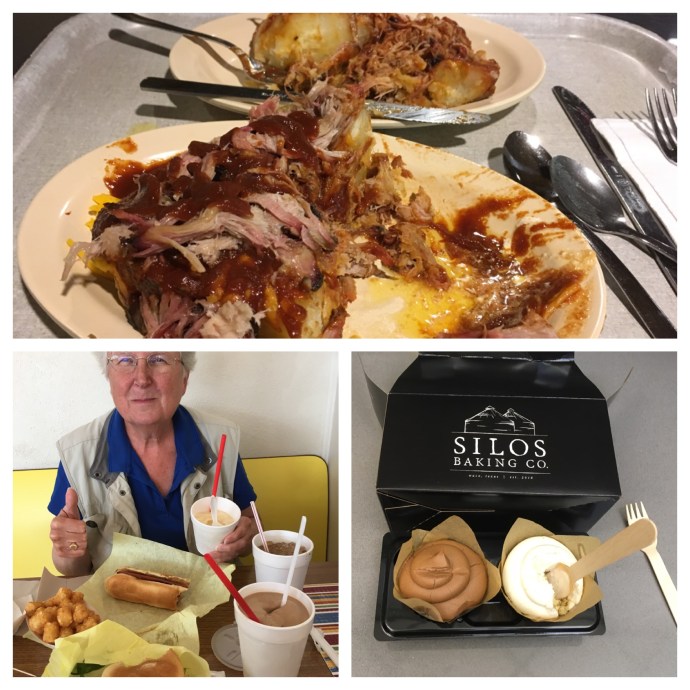
Lunch was a local staple, the Health Camp. Nothing healthy here, burgers, hot dogs, shakes, fries, etc. Then it was on to more sugar, the Dr Pepper Museum. Dr Pepper originated in Waco at a local drug store. One of the pharmacists mixed various tastes together, 23 in total, and it became Dr Pepper. The HQ for Dr Pepper is now in Dallas and it is part of a larger food conglomerate, Cadbury-Schweppes. Over the years, it has had financial difficulties and Cadbury Schweppes now markets Dr Pepper with Snapple, 7-UP, and other beverages.

The Dr Pepper museum showcases the history of the beverage, the tie-in with Waco, various leaders of the company, the bottling process, and marketing efforts. Chris and I spent 20 minutes watching old TV commercials for Dr Pepper and Diet Dr Pepper. We realized we could not recall ever seeing any of the commercials before coming here. Either our memory is weak, they ran when we were not watching TV, or the ads were not shown in our part of the country. In any event, we found the commercials humorous. We also realized it had been decades, or never, since we had a Dr Pepper. We stopped at a convenience store and shared one. Not too bad.

The Magnolia store and silos related to the HGTV show of Chip and JoJo Gains

After Dr Pepper, our steps took us over to a new experience for us. Chip and JoJo Gains have a TV show on HGTV that is evidently a big hit. News to us-our Evergreen host told us about it this morning. The Gains are based in Waco and their store, Magnolia, and show draw big crowds. It took us 20 minutes waiting in line to buy two of the cupcakes for sale at their bakery. The store selling their items is crowded with an outdoor seating area and play yard for kids-and parents of kids. Cars are parked for blocks. A trolley and Baylor buses stop here on a regular basis. But we did not even find a post card that interested us in the store. The cupcakes are another story; we just ate them. Wunderbar!

Vaquero and cattle-Mexicans were the original cowboys of the West.

Last experiences of the day were outdoors. It was just an excellent day to be outside. We walked over the suspension bridge crossing the Brazos river in downtown Waco. The Chisholm cattle trail went through Waco and there ae sculptures recalling that period at the west end of the bridge. Then it was a walk up to the dam on the Bosque River creating Lake Waco outside of downtown. Crossing the suspension bridge and looking down at the Brazos River it struck me how brown, brown, brown all of the rivers in Mississippi, Louisiana, Georgia and Texas have been. Not that Minnesota rivers are pure, but the deep, deep brown of all of these southern rivers was unnerving. How can one enjoy them?

Our healthy diet for the day

We wrapped up with dinner at another local staple, Uncle Dan’s where we shared a huge stuffed, baked potato.

Ed and Chris Tuesday April 4

Categories: road trip, travel | Tags: , , , , , , , | Leave a comment

2017 Trip Two: Tour of Texas April 2-3

Waco, Texas Monday April 3

Wildflowers in the median of Texas Highway 6

Our driving through Texas has begun. Obviously our observations are not an accurate picture of Texas but simply a snapshot of what we have seen and how we interpret them. For instance, Texas is showing us roadside flowers, unlike Louisiana. In Louisiana, we observed state crews mowing the median and sides of roadways. I had thought states had stopped roadside mowing in order to allow for habitat for birds and butterflies, particularly nesting birds. I guess I was at least partially wrong. Louisiana’s roadsides looked sharper since they had just been mowed, but Texas roadsides were more attractive with the additional color. I was told this evening that azaleas in the Waco area have come and gone. Early spring and heavy rains have ended their season. I have hopes for other parts of Texas.

On the road north from Houston to College Station, it appeared that every property was a ranch with detailed and fancy gates and driveways. I did not have Chris take any pictures, thinking the gates would continue in areas further along where the traffic might be lighter. So far, wrong. The gates ended at College Statin and did not re-appear on our way to Waco.

Of course, my favorite criticism is drivers. In Florida we had truly reckless and extremely speedy drivers. In Louisiana it seemed the law must require drivers to never use a turn signal. In Texas it is speed, but in an unusual way. When the speed limit is 75, speeding is minimal. When the speed limit is 55 or 65, no matter what the legal or safety reason might be for the lower limit, everyone still drives at 75 mph. It is as if a lower limit is an affront to the moral right to drive at 75.

Sunday was our day to visit with relatives, our daughter-in-law Sarah’s maternal grandparents. They invited us over for a delightful brunch. We also visited with Sarah’s mother, sister, nephew and cousin. We did not do any other tourist or outdoor activities. The weather was stormy but the rain held off surprisingly.

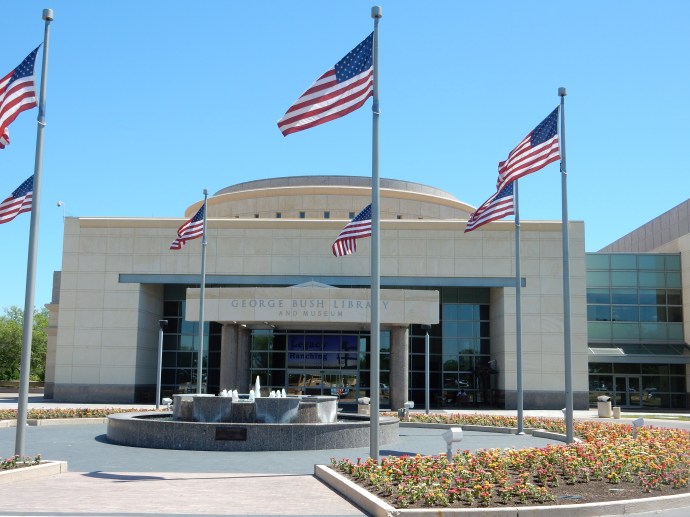
Presidential Library of George H.W. Bush, 41st President of the United States

Today our major stop was at the George (H.W.) Bush Presidential library in College Station. College Station is home to Texas A & M University. Bush is not an Aggie, he went to Yale. George and Barbara Bush moved to Texas in the early 50’s and they became dedicated Texans. President Bush stated that he was always impressed with the Aggie spirit and mission; locating his library here was a means to recognize that.

Chris and I have come to truly enjoy and appreciate presidential libraries and homes. (We will see two more on this trip.) The early ones like the homes of Taft and Garfield are less impressive but it is re-connecting with the spirit of the person who became President of the United States that is so meaningful. It is helpful for us to have space between the time when a man was President and when we view the library to have a fresh perspective; to not have our thoughts impacted by current angst over a particular decision or occurrence. We also frequently have “Ah ha” moments; remembering old tidbits of history or learning brand new ones.

A few of George Bush’s favorite quotes

The Bush Library struck us as a reflection on the life and family of George and Barbara Bush. The Clinton Library, in contrast, was overwhelming in facts, data, events. Here there was a more nuanced reflection on life background, moments and activities that shaped the couple. There was a broader recounting of George Bush’s military service history, political history (Ambassador to U.N and China, CIA Director, Vice President, U.S. Congressman) and dedication to a life of service, including before and after his term in office.

The accomplishments of Barbara Bush in her first 100 days as First Lady

The exhibit does discuss the challenge of being President when both houses of Congress are in the hands of the opposition party; the passage of the Clean Air Act and Americans with Disabilities Act; the invasions of Iraq and Panama; and the fall of the Berlin Wall.

Our second stop was at the Texas Ranger Hall of Fame and Museum. What can be more Texan than that? The museum has a history of the Rangers from inception under Stephen Austin (10 Rangers) at the beginning of the Texas colony under Mexico. There were times of less than stellar activities but primarily it is a well-earned positive image. Today the Rangers are a small (150) portion of the Texas Department of Public Safety, serving all over the state primarily in criminal investigation functions.

Chris holding one of the earliest Colt pistols, weighing just under five pounds

At one early stage in its history, the Rangers also served as surveyors. Their focus shifts as the state changes. Defense of white settlers from Indian raids was an early task, the suppression of outlaws during the wild and wooly days after the Civil War is well-known. Border protection has been a constant; the desire by criminals to commit crimes across national borders seems to be never-ending.

In Waco we are staying with an Evergreen host. We will be with Evergreeners for ten nights during this stretch in central Texas. Dinner was dutch treat with our host at a local restaurant.

Ed and Chris. April 4

Categories: road trip, travel | Tags: , , , | 1 Comment

Blog at WordPress.com.