Monthly Archives: April 2017

2017 Trip Two: Tour of Texas April 28

Oklahoma City, Friday April 28
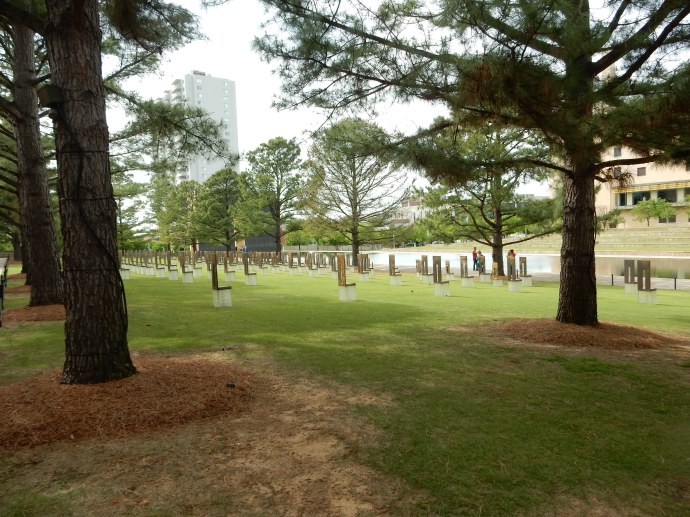
Oklahoma City National Memorial: the chairs, the reflecting pool, and one of the gates.

Two Tragedies. Not the most positive way to start drawing our trip to a close but the travel geography dictated our stops during our drive today.

A crop duster plane near the Texas-Oklahoma border

We left Amarillo Texas and drove into Oklahoma. Most of today’s journey continued on two lane state roads; speeds around 70-75 mph on roads with no shoulders and narrow traffic lanes. We never exactly left oil country but instead of well pumps, we observed tanks and pipelines. The sight of railroad traffic returned as a portion of our journey paralleled the main tracks of the BNSF Railway. Scrub brush gave way, usually, to fields dedicated to growing wheat and cotton. Grain elevators started to appear. Large cattle ranching operations were more obvious. I am guessing, but I believe the better quality grass here allows for more concentration of cattle ranching than in the lower rainfall, desert area we just left.

We saw more wind turbines today than we had in all of our trip prior to this. Texas is the largest producer of wind power, much of that generated in West Texas. Evidently though, the four largest wind farms in Texas are in an area east of Odessa, a part of Texas we did not drive through. However, Iowa is the state with the highest percentage of its electricity produced by wind power.

As we left Texas and drove into the western section of Oklahoma, the countryside seemed greener. The land was less endlessly flat with rolling hills. The Washita River flows through this section of Oklahoma and we stopped at the Washita Battlefield National Historic Site.

The Washita Battlefield site

In November 1868, the camp of Cheyenne Chief Black Kettle along the Washita River was attacked in the early morning hours by the 7th U.S.Cavalry under the direction of Lt. Col. George Custer. When the battle was over, 30-60 Cheyenne, including women and children, were dead. Another 53 women and children were taken into captivity. Over 800 horses were slaughtered. Most of the Indian braves were elsewhere; this camp was the winter home of primarily the women, children and elderly.

This incident was an almost unavoidable result of the western expansion of settlers, the taking of Indian land, the rapid extension of the railroads, the hostility and lack of trust between the Indians and the U.S., the string of broken treaties, and continued hostilities by Indian braves who were enraged by the Sand Creek massacre in Colorado four years before. The U.S. Army had adopted the policy of total warfare to drive the remaining Indians onto reservations. Ironically, Black Kettle was one of the chiefs who was cooperating and trying to convince his people to accept the inevitable. The result of capturing and killing women and children and slaughtering horses and burning possessions was a recognition by the Southern Plains Indians that they had no choice but to accept reservation life.

Eventually, even driving the Indians onto reservations did not satisfy the settlers. Surviving Indians from all over the country were forced into Indian Territory, now Oklahoma. But settlers were not satisfied and the Indians were forced onto small, individually owned parcels of land. The balance of the reservation was then sold or given to settlers, most notably during the Oklahoma Land Rush of April 22, 1989. The Oklahoma nickname “Sooners” stems from settler who disobeyed the law and entered the “Unassigned Lands” prior to the official entry time in order to claim prime land.

From Washita Battlefield we drove to Oklahoma City. We stopped at the Oklahoma City National Memorial. On April 19, 1995, the Alfred Murrah Federal Building in downtown Oklahoma City was torn apart by a truck bomb that killed 168 people and more than 650 people were injured. Until 9/11, this was the worst case of terrorism in the U.S. The bomb blast was executed by an American with right-wing extreme hatred of the U.S. government. He set the federal building bombing for the two-year anniversary of the Branch Davidian compound inferno near Waco Texas.

The memorial has several parts. The location of the federal building is now a grassy site with 168 chairs representing the people who died; the children who died (they had been in a nursery program) are represented by smaller chairs.

There are two entry gates at each end of what had been Fifth Street in front of the building. At one end is recorded 9:01, at the other end 9:03. The bomb went off at 9:02, the gates represent the innocence before the attack and the healing after the attack. Fifth street is now a shallow reflecting pool with gently flowing waters.

The Survivor Tree

Across the street from the building had been an American Elm tree. After the bomb blast, only a portion of the trunk remained. It grew back and now is a full-size tree surrounded by a brick promontory wall. There is an orchard of new trees to represent the emergency responders enhanced by a wall of representative hand-painted tiles sent by children from around the world.

A chain link fence is still outside a portion of the site. Originally put up to keep people from encroaching on the crime scene, people left mementoes on the fence and it has been continually used for that purpose ever since. Finally, a small wall was the only remaining portion of the Murrah Building and has been retained with the names of survivors from the blast.

Ed and Chris.

Categories: road trip, travel | Tags: , , | Leave a comment

2017 Trip Two: Tour of Texas April 27

Amarillo, Texas Friday April 27

A view of Cadillac Ranch near Amarillo Texas

The end is near. Today is day 58 of 61. Tomorrow we start the drive home although there are two sight-seeing stops planned. Our primary goal for today was the Alibates Flint Quarries National Monument.

Before Alibates though, we made a quick stop to one of those weird oddities that exist around the country. We have been here before, but thought a quick visit would provide a picture or two for the blog today.

Cadillac Ranch is a piece of land west of Amarillo with 10 Cadillacs buried half way into the ground and allowed to be graffiti painted. It has been around for over 40 years. Cars park along the frontage road of I-40 and people get out to gawk, to take photos, and to add some new graffiti. Frankly Graffiti Hill in Austin was more artistic but this is older. Chris and I don’t approve of graffiti but technically Cadillac Ranch and Graffiti are not illicit, but allowed and even encouraged, so these two pass the moral muster.

Then it was off to Alibates Flint Quarries National Monument. The route took us through some new roads and we visited the town of Borger. Lo and Behold! Another oil town. In 1921 oil was discovered in Borger and Borger underwent a boom period accompanied by major crime that took the Texas Rangers to end. While this Panhandle oil area never reached the level of oil produced by the Permian Basin, it has been sufficient to keep the largest inland petrochemical plant in operation here. Borger has facilities producing carbon black, fertilizer, and plastics. The skyline here is not littered with well heads, we saw some but in a much less obtrusive manner than around Odessa.

Examples of flint pieces and rock; left here because it had some flaw we do not see.

But oil was not our goal. We were researching old practices of Native Americans. Going back as far as 13,000 years ago and as recently as 700 years ago by the Antelope Creek people, mining of flint occurred here. The area around the Canadian River 30 miles north of Amarillo produces an extremely hard flint that can be used for spears, arrows, knives, etc. Due to geologic conditions, ash from eruptions from the Yellowstone Caldera combined with dolomite rock to produce this flint that is rated as 7.5 on a scale of 10. (Quartz is ranked at 7, glass at 5.5.). The Indians here not only used the flint for themselves, but traded it to other Indians as far as 1,000 miles away.

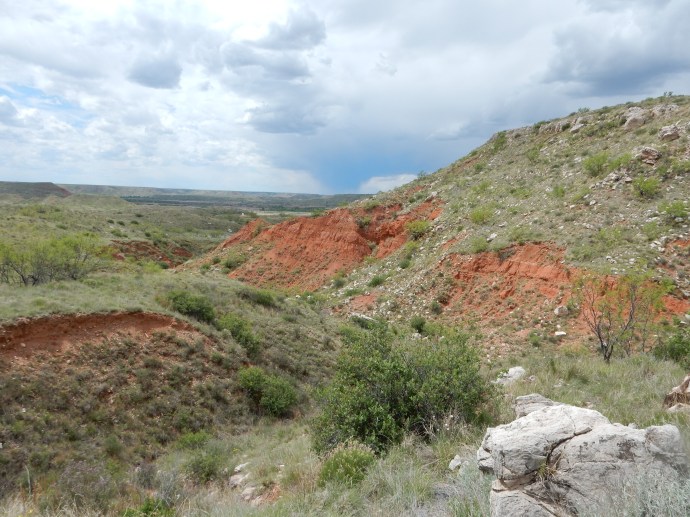
A view from the top of the mesa at Alibates Flint Quarries National Monument where the flint is found

We had a 90 minute walk with a Park Ranger who discussed the history of this area and the amazing knowledges the natives brought to bear on their life. The plants here were like the bison, almost all parts of the plant had a use for their lives. They figured it out without computers. The flint “quarries” are just areas where the flint material appears close to the surface or at the edge of a cliff. When the dolomite erodes, which it does more slowly than the other rock in the area, it tumbles down the hill, revealing the flint inside the dolomite rock.

A volunteer was here demonstrating how flints produced knives, spear points, etc. Given the rules of leaving everything natural in place, he has to obtain his flint from other private sources. There are other flint “quarries” on private land in the area. As we left for our hike with the Ranger, a bus of 45 people traveling around to National Park sites was arriving.

Lake Meredith Reservoir at today’s water level, about 60% of its capacity.

The Canadian River that flows through the area has been dammed and produces Lake Meredith. Lake Meredith provides recreational use but also drinking water for Amarillo and Lubbock. The water depth at the dam crest could be as high as 111 feet. It currently is in the high 60s; in recent years it has been as low as 26 feet. The reservoir was designed to provide drinking water for Texas panhandle cities but due to recent droughts, those cities have begun digging their own wells and drawing down the aquifer in the area.

After the talk-walk, it was back to Amarillo for dinner and the hot tub. It will be interesting to see if Oklahoma will have as many donut stores as we have seen in Texas. I don’t mean Krispy Kreme or Dunkin’ Donut but homegrown, small stores selling donuts-and staying in business.

Ed and Chris

Categories: travel | Tags: , , | Leave a comment

2017 Trip Two: Tour of Texas April 26

Amarillo Texas Wednesday April 26

Palo Duro Canyon from the canyon floor

It was a day of contrasts as we journeyed from Odessa 260 miles north to Amarillo in the panhandle of Texas. The day was much cooler and windier, jackets were necessary as early morning temperatures labored to be in the mid-50s. Leaving Odessa-Midland, the dust was blowing everywhere. Somewhere north of Odessa, at a point lost in memory, the oil fields disappeared and agriculture and ranching operations dominated the horizon. This area of Texas is cotton farming area but the fields were generally plowed without any obvious crops yet growing. Flat horizon, I might add. Reminded us of Kansas and Nebraska with the endless flatness.

Driving from Odessa to Lubbock Texas

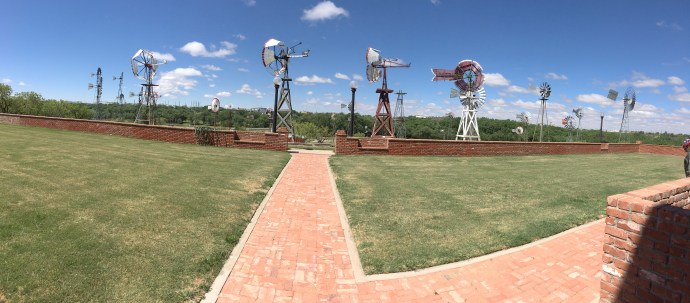
Some of the windmills outside at the American Wind Power Museum in Lubbock Texas

The journey was broken up three times, twice in Lubbock TX. Lubbock has a population of 240,000 people and several museums. We stopped at two of them. The American Wind Power museum was a pleasant surprise. It has a large facility and is dedicated to windmills.

The model train layout at American Wind Power Museum

Inside the museum, the first section has a few windmills but the focus is on a model train layout. The old-time trains ran on steam and without water those trains were going nowhere. The history of Teas has a strong component tied to the railroads’ ability to find a plentiful source of water. Windmills were the major power in bringing water up from underground wells so the tie-in between windmills and trains is realistic. The model layout had numerous model windmills along its path, including one that, in real-life, was over 125 feet tall in order to catch winds blowing across the canyon bluffs above the train tracks.

The miniature house display

Another exhibit was a tack-on, a series of miniature houses built by a local wife and husband couple. Interesting but not really central to the theme of the museum, although a few were incorporated into the train layout.

The next two exhibits were unexpected. One display case, from people in Wheaton Minnesota, was devoted to the weights used to balance and control the windmills. A second display consisted of millstones. Yes, those stones used in mills to grind flour, animal feed, etc. Did you now that the stones were “dressed” or cut in varying ways in order to facilitate the grinding of different types of materials? Neither did we, even though we have seen numerous mills in operation.

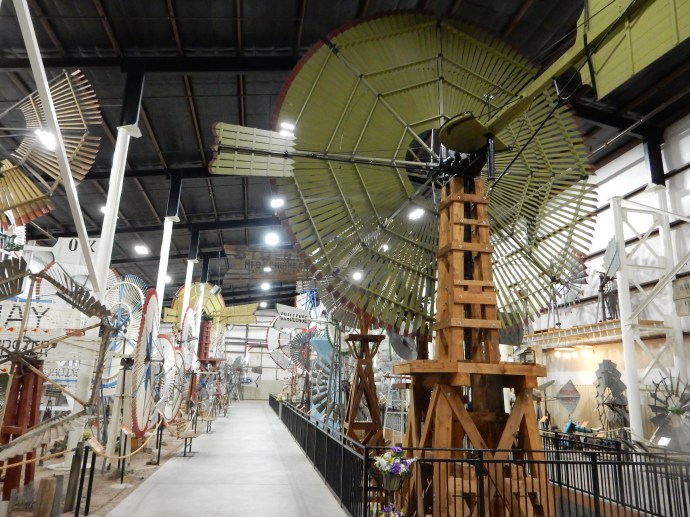
The inside display of windmills

Then we got to the exhibit of windmills. There were dozens of them, some complete with towers, some just with the windmill. Windmills from foreign countries and windmills from companies in America still making them, such as Aeromotor. If you were really in to them, you could read the history of the various models and companies. We just marveled at the variety and beauty on display. Many were working, even indoors.

Legacy of the Wind mural at American wind Power Museum in Lubbock Texas

The final indoor display was their event room where meetings, balls, weddings, etc. could be held. On the wall of the room was a humongous mural, the “Legacy of the Wind”. It is 200 feet long and 34 feet high. The theme is the history of wind power in America. It starts with the Dutch style windmills and moves on through the evolution of windmills that could survive the power of the American prairies.

The mural depicts authentic types of windmills incorporated into farm and town settings, as well as gradually moving into current times. Some of the settings include a Harvey House restaurant, a cotton farm, railroad sidings with the mill and water tank, dug-out sod house, and a modern farm with a John Deere tractor.

The replica 1621 windmill

Outside the building are arranged several dozen windmills in operation, including a replica of a 1621 windmill built near Jamestown VA. That windmill was believed to be the first constructed in America. The American Wind Power museum was a very pleasant and unusual surprise.

After lunch we visited the Buddy Holly museum. Buddy Holly was born in Lubbock and became an early pioneer in rock and roll music. The Beatles, Bob Dylan, The Rolling Stones and Elton John all publicly stated that his style and innovations influenced their music. His death in a plane crash in Iowa when he was only 22 cemented his name into music history. The museum displays personal artifacts and the history of his career. I had not remembered that he had gotten married just several months before his death. He proposed to the woman on their first meeting and were married two months later.

Amarillo is another 120 miles from Lubbock but we made a third stop just outside of Amarillo. We have driven through Amarillo several times in past years but never before had we stopped at Palo Duro Canyon State Park. Palo Duro is considered the second largest canyon system in the United States after the Grand Canyon.

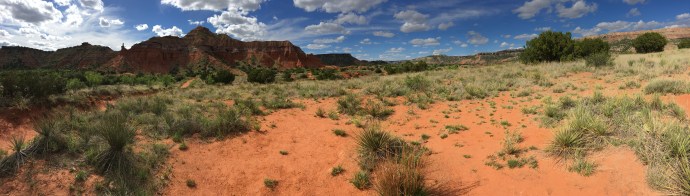
Palo Duro Canyon State Park in Texas

Palo Duro is 120 miles long and 800 feet deep. You are driving along the flat prairie land wondering where is this supposed canyon? Then you come upon it and it presents a great vista. We drove a loop road in the western section of the canyon and took several short hikes. There had been rain earlier in the day and some of the trails were still muddy. The canyon was formed by a fork of the Red River of the South. The state appears to have constructed all new bridges over the creek so while portions of the road had dried mud from today’s rain, the drive was still easy-going.

Looking toward the “Lighthouse” formation at Palo Duro Canyon State Park, Texas

Palo Duro was home to several Native American tribes. When the U.S. Cavalry was forcibly moving the Indians from here to reservations in Oklahoma, one battle was fought here in which the cavalry captured over 1,000 Indian horses and slaughtered the horses to remove the Indian’s means of transportation. They had to surrender. An American rancher later opened up his ranch here and raised over 100,000 cattle.

Our home in Amarillo is at the Home2 Suites by Hilton. This is our first time in this specific brand of Hilton. It strikes us as themed for the millennial trade in its sleek lines. We will be staying at one in Oklahoma City also. It is spacious and well-laid out.

Ed and Chris.

Categories: travel | Tags: , , , , | Leave a comment

2017 Trip Two: Tour of Texas April 24-25

Odessa TX. Tuesday April 25

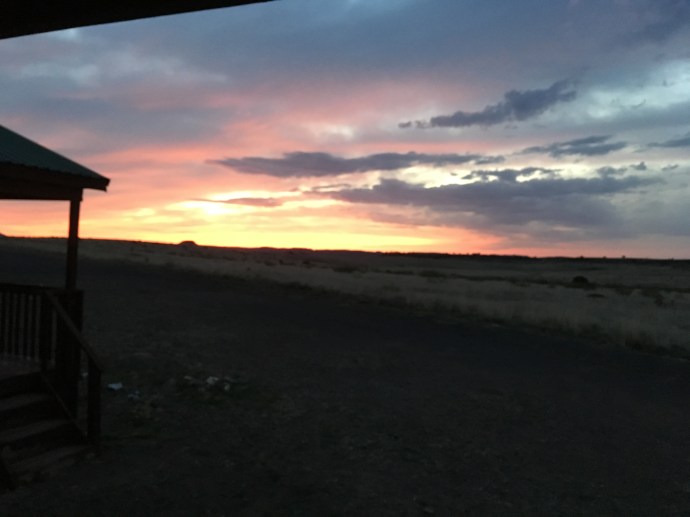
Sunrise on our last morning in Fort Davis, TX.

When we mentioned to someone from West Texas that we were spending two nights in Odessa, they asked: “Why?” Well it is not the most touristy place in Texas but there is the Permian Basin Petroleum Museum in the area. The museum is in Midland which is 20 miles from Odessa. An Evergreener earlier on this trip said that the oil field workers live in Odessa, the oil field owners live in Midland. From a quick look, that seems to be the case. Midland was ranked #1 in Texas in 2013 in the concentration of high-income households.

In the Balmorhea area, irrigated crops, well pumping, well production equipment

Monday morning we left Fort Davis. The first 45 minutes were spent continuing to drive through the mountains and desert. As we approached Balmorhea, the terrain flattened. The impact of oil fields just started to intrude on one’s senses; flares from burning gas, the smell of petroleum, the swirl of dust in the air, the sight of oil well pumps began and increased dramatically the closer we got to Odessa.

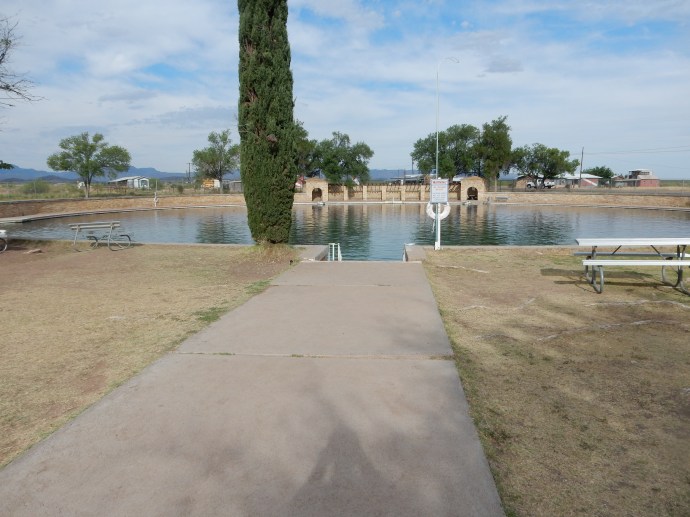
Part of the swimming pool at Balmorhea State Park

In Balmorhea is a state park located around a large artesian spring. The San Solomon spring system still pumps out water for residential and commercial use, with agricultural use primary. One can observe the irrigation canals and the green crops as contrast to the desert brown miles away from the springs. At Balmorhea state park, the largest spring fed swimming pool in the world was constructed by the CCC. At the deepest end by the springs, it is 20 feet. Other recreational portions are five feet deep. The spring water flows out of the pool into the irrigation system. We arrived around 9 AM. While it was too cool for us to take a dip, there were a handful of people in the pool.

Apache Corporation is located in Houston but was founded by three men from Minneapolis. They recently discovered in the Balmorhea area one of the largest oil discoveries in recent years. Previously oil drilling in the Balmorhea area was relatively light. Apache plans to drill 300 wells in the area. Thus, again will there be the fight between trade-offs. Oil production and jobs versus water use and potential degradation. The regional water board has already approved a water sale to Apache. The McDonald Observatory has already weighed in with its concerns for an increase in night sky light pollution. In its behalf, Apache Corporation seems to have one of the more responsible environmental records.

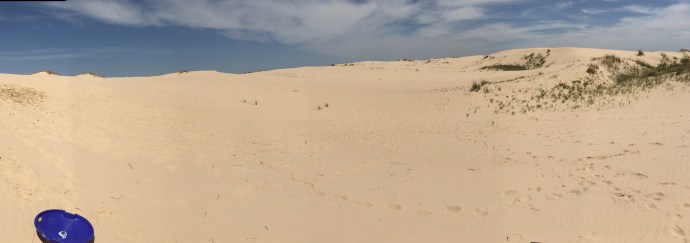
As mentioned earlier, the oil field impacts increase dramatically as we drove towards Odessa, 115 miles away. Two-thirds of the way to Odessa, we stopped at Monahans. The Monahans Sandhills State Park is known for its sand dunes. Smooth sand dunes as well as dunes with vegetation exist here with the smooth sand dunes beckoning to one. The park rents sand discs (originally designed for snow) but makes no promises as to slideability. As the day heats up, the sand becomes more resistant to sliding. We had arrived around noon, after having breakfast in Pecos and the stop in Balmorhea.

Monahans Sandhills State Park

Chris and I popped for the rental fee and took a chance. One drives out to the smooth dunes area, hikes up the hill, and tries to slide down. No luck. Too hot, sand too sticky. It was still fun and an unusual way to break up the day.

The sand here originated in New Mexico and was transported during the last post-glacial period. The dunes were probably formed 5-7,000 years ago and since they are located in the Permian Basin, the winds swirl around the basin but don’t blow the sand out of the basin. The dunes are here to stay under current conditions.

One of the sand piles

As we continued our drive to the northeast and Odessa, the well heads, collection systems, and utility poles providing electricity seemed to sprout everywhere. Most surprising to me were the numerous, large sand mining areas. I had been hearing about the use of Wisconsin and Minnesota sand for fracking but sand is used in regular well drilling also. One exhibit indicated 600 truckloads of sand can be used to drill one well. Sand here in the desert is mined also and used. Another exhibit listed the factoid that one gallon of oil needs 2,000 tons of tar sands to produce.

Given the wind, dryness, and lack of vegetation, blowing sand occurs frequently and must be adding to air pollution. We could visibly see the low-level pollution increase as we entered the Balmorhea area and then moved on to Odessa. BUT, as I checked national records, the air quality index for Odessa is similar to that in St. Paul, MN. Sometimes maybe you see things with a new eye when traveling. I will have to look around home with a critical and impartial eye when I return.

The drinking water quality here in West Texas seems to be universally criticized. TV news and newspapers have commented on it. But unemployment is low, population growth is occurring and construction seems to be occurring everywhere. Those are situations people like. Midland is even home to the first primary commercial service airport to be granted a spaceport license. The city is home to a space flight research facility and a space pressure suit manufacturing company.

For the rest of our trip we are lodging in national chains. Our TownePlace Suites here is nice, with an outdoor pool. Restaurant options are abundant with most of the usual food chains present. We ate at a regional steakhouse Monday night and regional deli today.

Today (Tuesday the 25th) we planned to see one museum, the Permian Basin Petroleum Museum in Midland. This was another AAA GEM and for us, it was a chance to learn more about the petroleum business. And it is big business, over 1,500,000 oil wells have been drilled in Texas over the last 100 years. We spent three hours here. The museum is excellent, covering geology and drilling techniques. They have a “Disney-like” ride discussing future oil exploration; through it we learned that laser drilling is under active research.

The Permian Basin is named for a geologic period of time ranging from 250 to 300 million years ago. The mass extinction of most living creatures on earth occurred at the end of this period. Today’s extraction of oil is due to the living organisms in the sea covering this area and the transformation of those organic creatures into oil under heat and pressure from layers of rock. The Basin is considered to cover an area 250 miles by 300 miles and has been one of the largest oil producing fields in the world.

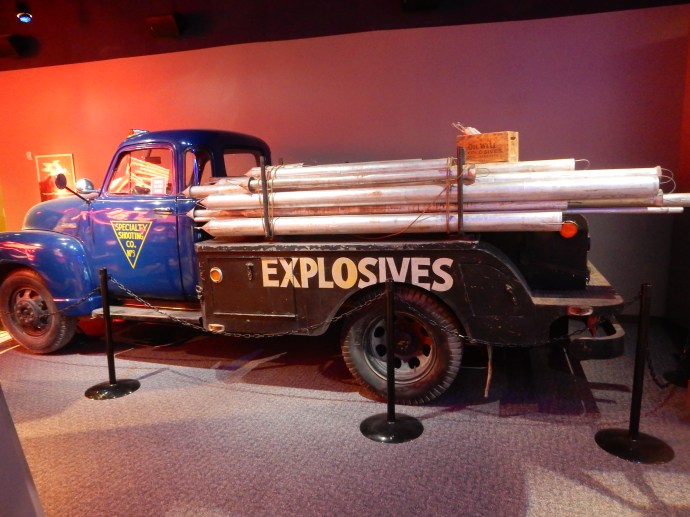
In the early days, nitroglycerin was carried to well sites in vehicles like this

The museum showcases the discovery in oil in the Midland-Odessa region, dating back to 1923. The entrepreneurs who lived through boom and bust are highlighted, along with a clear description of the oil drilling process. We finally learned that those cylindrical tanks that we observed next to wells are devices to separate water, oil, and gas that are pumped up from the well.

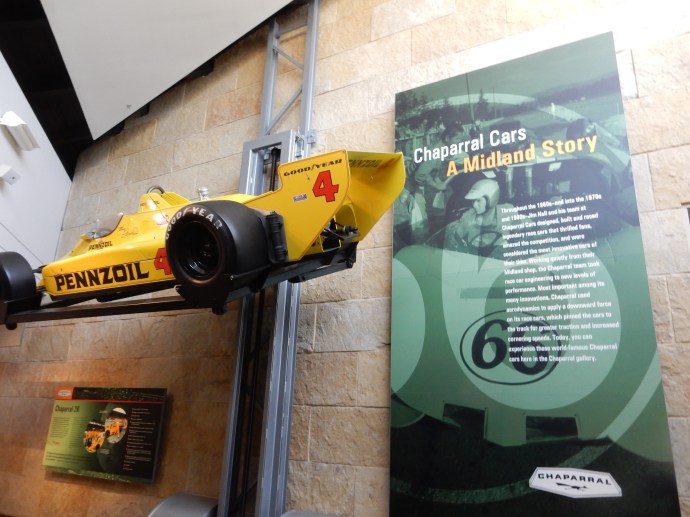
One of the Chaparral racers

An additional gallery details the history of the Chaparral racing cars. Jim Hall, the founder of the Chaparral was from Midland. The chaparral racing cars were a major innovation in race cars in the 1960s and 1970s. Several of the original race cars are here along with a model of the garage where research and repairs were undertaken.

The Oil Patch outside the Permian Basin Petroleum Museum

Outside, the museum has a collection of antique oil field equipment. The items range from the early 1900s to the 1990s.

We cooled off in the pool at the hotel before heading out to dinner. Tomorrow our end goal is Amarillo with a stop in Lubbock, Texas.

Ed and Chris. April 25

Categories: road trip, travel | Tags: , , , , , | Leave a comment

2017 Trip Two: Tour of Texas: April 22-23

Fort Davis, Texas Sunday April 23-and some from Saturday April 22

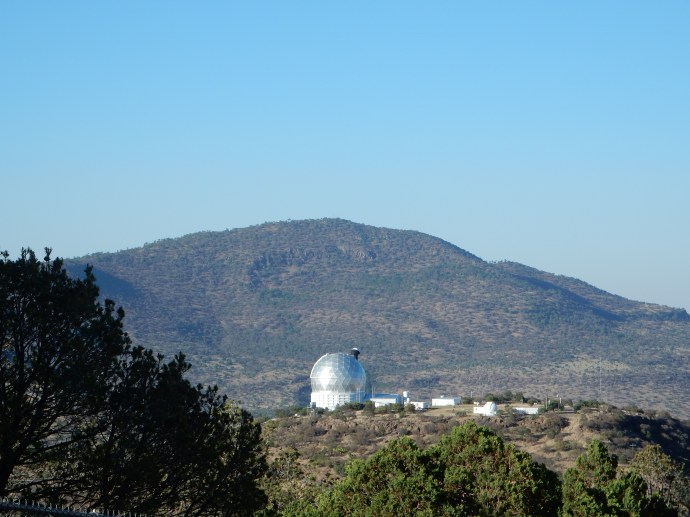
Looking up at McDonald Observatory, Fort Davis Texas

A fantastic experience! That describes the hours we spent at the McDonald Observatory in Fort Davis, Texas. The Observatory began in 1939 due to an unexpected bequest from a Texas banker and lawyer, William Johnson McDonald, who left money to start an astronomy program at the University of Texas. At the time of his death in 1926, Texas had no astronomy department. The university began a collaborative program with the University of Chicago which had a premier department. A local woman donated the land on the mountain top where the observatory was built. The McDonald Observatory is now solely run by the University of Texas and has four major research telescopes (an 82″, a 30″, a 107″, and a 360″). on two mountain tops and a support community. Other instruments, some owned by UT and some belonging to partner organizations, are used for research into radio waves, infrared, etc. and to educate visitors.

Why did we decide to visit the observatory? Well, AAA rates it a GEM. Evergreeners have recommended it. We have enjoyed several night sky programs at national parks over the years. This part of Texas is high on the list of areas to observe bright stars and where better to follow-up on bright stars than an observatory? We went “whole hog” in scheduling activities. Our experience began Saturday evening, April 22 with a one hour educational presentation. That was followed by a 90 minute star-gazing adventure. Then we came back Sunday morning for a 2.5 hour talk and tour of two of the telescopes.

Every program was well-done. The initial 60 minute lecture was held indoors for about 100 people. Graphics were used well to illustrate the points the lecturer was making; generally about our solar system and the planets. A few of the points both Chris and I remembered; more of the points were new and understandable; some of the points were over our heads.

After a 30 minute wait to allow for the skies to darken, 336 of us went outdoors to an open-air amphitheater for a “Star Party”-a sky viewing presentation and telescope viewing. (Obviously additional people came just for the Star Party.) Chris and I did not line up to use one of the dozen or so telescopes set up. Instead we spent the 90 minutes listening to a guy just do a fantastic presentation. It was humorous, it was understandable, it was educational, and it was fun. He used some sort of laser pointer that enabled him to point out constellations, stars, planets, satellites, etc. using the sky as his chalkboard.

After the programs we better understood the concept of the solar ecliptical plane; the constellations and why there are 13, not 12; why you can not see all constellations or planets at one time, etc. At 10:06:36 he pointed out a satellite. We observed it crossing the sky and then for about 3 seconds it gained immensely in brightness. This satellite by Iridium Communications has reflective antennae that gather and reflect sunlight causing the brief burst in brightness.

Did I mention it was cold? The previous blog post discussed how the weather had changed from temperatures in the 90s to clouds and cool temps. When we arrived in Fort Davis on Saturday and as we toured other locations, the skies were dark. We were uncertain if the program would be canceled. However, around 6 PM the sites cleared up. The temperature remained in the 40s for the program but we were bundled up and had a blanket to place on the concrete bench.

McDonald Observatory, home to the original 82″ telescope

Sunday morning after breakfast and Church, we returned to McDonald Observatory. This “Daytime Solar Viewing and Tour” began with another lecture, accompanied by video and graphics. Through filters and media hook-ups, we viewed live shots of today’s sun-well, delayed by 8 minutes for transmission time. The topic was the sun, solar flares, coronal mass ejections, sun spots, etc. There was some repetition of information that had been presented the previous evening, probably helpful to us in remembering data.

The 107″ telescope-completed in 1968 and the third largest in the world at that time

After the lecture, we drove up to see first-hand the 107″ telescope. We stood right next to it; young girls were given the controls and made the telescope turn, the building’s opening rotate, and the curtains that shield the telescope move up and down. The floor by the telescope can also be raised to allow for maintenance. The operation and history of the telescope were covered. The telescope area is kept chilled to 46 degrees. Some of the other tour-takers were quite chilled by the end of our time in there.

The building housing the Hobby-Eberly Telesope

After the 107″ scope, we drove over to the next mountain (also donated land) to view the 402″ scope. Actually this telescope, the Hobby-Eberly, is a prismatic scope that utilizes a series of 91 hexagonal prism segments rather than one large mirror to collect the light. By use of the prisms, it actually does not have to be 402″ across to have as much capability as a 402″ mirror telescope. It is currently being upgraded to work on a Dark Energy Experiment and while we could view it, we could not get as close to it as we did with the 107″ scope. The people here were quite proud of the construction design which allowed the telescope to be constructed in 1997 at well below expected cost due to using “off-the-shelf” components. It is currently tied for second largest telescope in the world.

All in all, an excellent time; interesting, illuminating, enlightening.

Ed and Chris. Monday April 23 in Odessa Texas
Categories: road trip, travel | Tags: , , , , , , | Leave a comment

2017 Trip Two: Tour of Texas April 22

Fort Davis, Texas Saturday April 22

Fort Davis National Historic Site

What a difference a day makes! Friday the sites were clear and the termperature was in the high 90s. Today as we drove to Fort Davis we encountered gray skies, fog, and temperatures mainly in the 40s. Luckily the border checkpoint (75 miles from the border) was well-marked and could be seen even with the fog. The drive was only 100 miles and the elevation change went from 3,000 feet to 5,000 feet. Still in the desert, though.

Heading for the fog and clouds

Our first stop was a bust. Marfa Texas receives lots of attention as an “in” place to visit. Back in the late 1970s, a major art installation began with works of Donald Judd. Now the Chinati Foundation offers guided and self directed tours of locations where large-scale art and the landscape are linked and in buildings where large-scale art is installed.

One of the large scale Donald Judd concrete art installations

My negative take is based on viewing one site and the fact that other sites are only open for limited times, resulting in the need to stay in this small town all day in order to view them. The long guided tours by docents sell out though, so some people are evidently enthralled by it. We toured the untitled works of Judd in concrete.

Part of my negative take may also be the lack of reasonable food at 9:30 AM. If we stayed longer, options included Dairy Queen and Subway. Other choices also opened later or were back in the high-end cutesy variety. We were out of town by 11 AM.

Fort Davis was a little better in the food choices although the list of restaurants put out by the Chamber had multiple errors in the dates and times the restaurants were open. No Dairy Queen, no Subway. The ice cream store is open Wed-Sun, so that suits us just fine-it was listed as Mon-Fri. Thirteen restaurants are listed, two are open for just two or three days of the week. We had lunch at the state park restaurant, luckily it stayed open until 2 PM (the brochure siad it would be open for dinner. Wrong.) One of the restaurants is usually open on Saturday but for some reason it was closed yesterday.

Our choice for dinner opened at 5 PM. We got there are 5:05 and the next opening was at 7 PM. I was not sure if that restaurant is usually crowded or if the crowd was due to the Christian Motorcyclists Association being in town and taking up all of the few food choices. Yes, the CMAs were on Harleys and had their leathers on but they looked to be at least 65 years old, overweight, and there were a lot of trikes among the motorcycles. Dinner was at Lupita’s, a small Mexican restaurant with seven tables-all occupied.

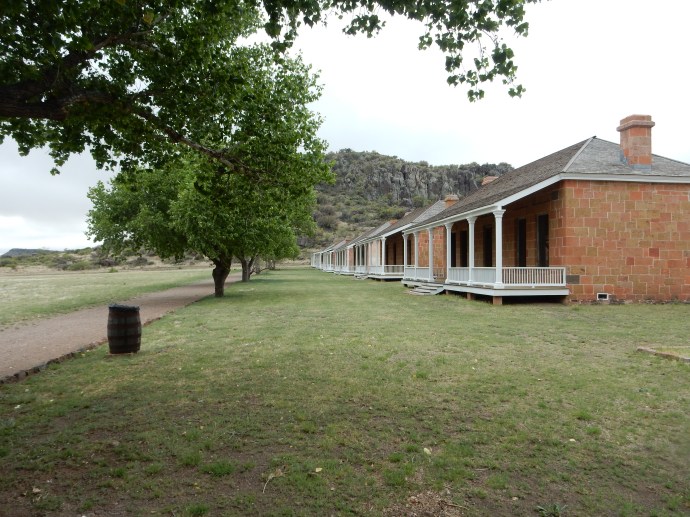
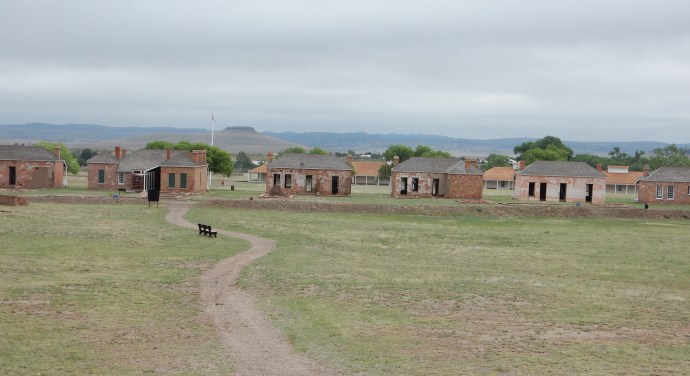
Part of Officers Row at Fort Davis

Fort Davis is home to the Fort Davis National Historic Site. Described as the one of the best remaining frontier military post in the Southwest, the fort is also known as home to the Buffalo Soldiers, the Ninth and Tenth Cavalry comprised of all “colored men”; except for the officers. The Buffalo Soldiers were stationed here from 1867 to 1885.

From the video and displays, the fort may have been a critical component in maintaining the peace during the Indian Wars but the soldiers spent more time on buidling the fort, roads and telegraph lines than fighting. The San Antonio-El Paso Road goes right by the fort. The fort was established in 1854 as part of the guarantee to Mexico to stop marauding Indians from crossing the border. In 1891 it was abandoned, having outlived its usefulness. For the next 70 years it was lightly used and started to deteriorate. In 1963 it became a national historic site.

From the fort, we drove to the Chihuahuan Desert Nature Center and Botanical Gardens. We had a nice walk through the gardens; everything was blooming nicely due to their drip irrigation system. But what I really wanted to mention was the greenhouse. The greenhouse is devoted to preserving the natural diversity of the desert. For us, it was an eye-opener.

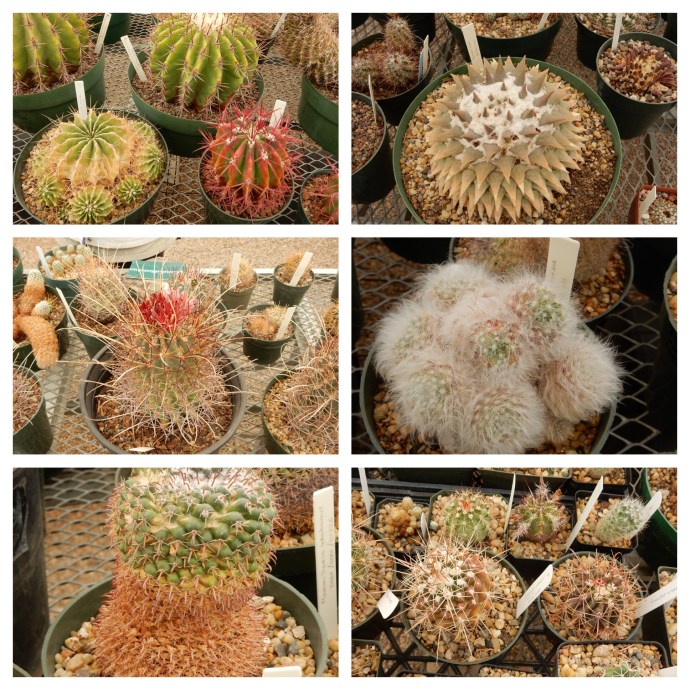
Some of the many cacti in the greenhouse at Chihuahuan Desert Nature Center in Fort Davis, TX

The greenhouse is chock-full of cacti; varieties of cactus we had never seen before. Yes, I know we are from Minneosta but we have been traveling for several years and have visited numerous deserts, desert gardens, and botanical centers. The differing colors, styles, formations, etc. just were mind-boggling. A few of the more interesting ones, to us, are shown above. I could present many more.

Saturday night’s activity will be included in the blog post for Sunday.

Ed and Chris

Categories: road trip, travel | Tags: , , , , , | Leave a comment

2017 Trip Two: Tour of Texas April 21

Terlingua Texas Friday April 21

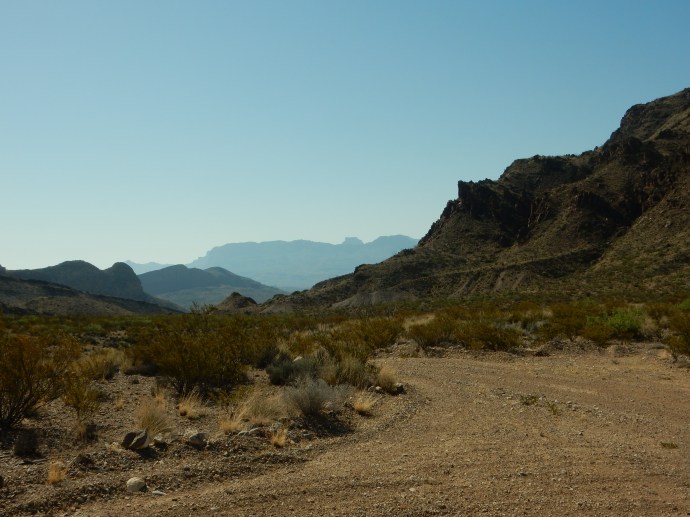
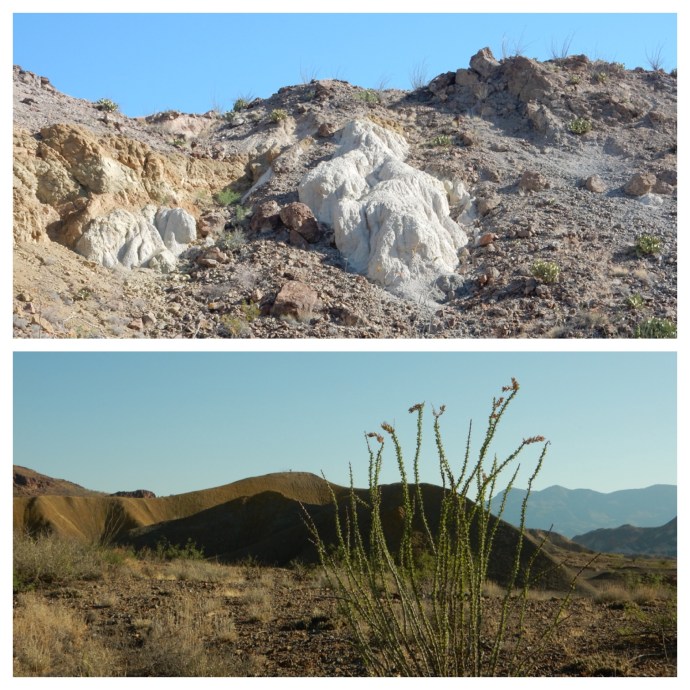
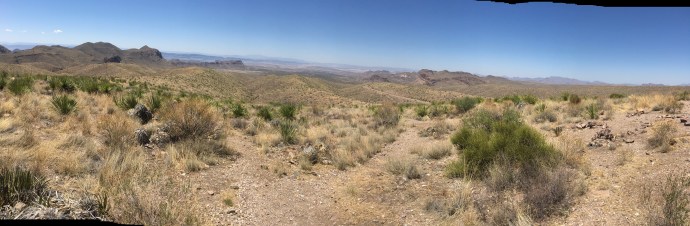
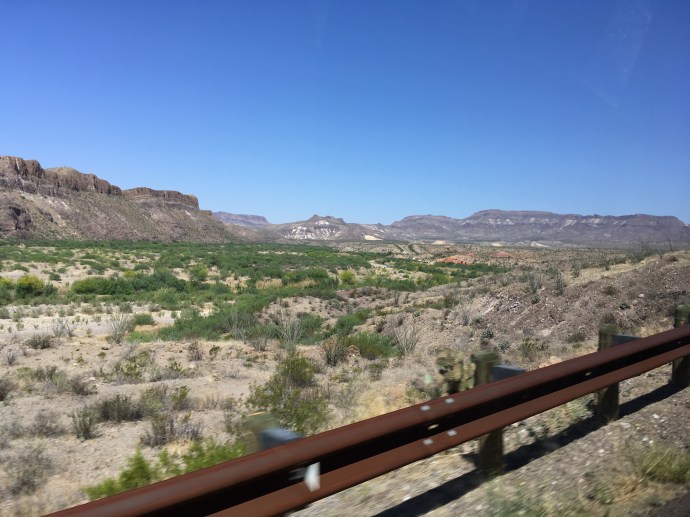
Desert View just west of Big Bend National Park boundary

Hot and Dusty. The schedule for the day was a three-hour Jeep trip into the backcountry. While our Subaru is all wheel drive, it is not high clearance. This is our fourth Jeep ride into backcountry since we began traveling. It provides us with an opportunity to see terrain up close and personal that we would not view or hike to under normal conditions, particularly when the temperature for the day quickly climbed into the 90s.

Driving to Christmas mountains

The Jeep had a canvass top with bench seats that were raised to provide a good view. Unfortunately, I spent part of the time bracing myself since the seats were vinyl. As the Jeep drove into the backcountry, the land traversed was rarely flat. On the vinyl seats, when the Jeep went downhill, I tended to slide forward and down, even wearing a seatbelt to assist in holding one upright. Not exactly the worst problem in the world, but the legs did get a workout stopping my slides. I know, it is a tough life traveling, isn’t it, but what else do I have to complain about?

Housing styles in the desert

Randy, our guide, gave us a geology and botany lesson as we drove along the dirt tracks. We gained several thousand feet in elevation between Terlingua and the turn-around point, although the elevation gain was not usually noticeable. There were a few homes out in the desert, trying to live off the grid. There were more “pads”; a clearing with a small cabin or car port where people might spend a weekend or a week away from the city. First requirement, build a shelter device and a water retention system. Almost all water out here is provided by collecting and saving rainwater. Normal rainfall is 10 inches per year.

Desert Views

This area is all part of the Chihuahuan Desert. The Chihuahuan is the largest of four deserts in North America, stretching down well into Mexico. Vegetation changes based on rainfall and elevation, the only wildlife we saw was a jack-rabbit. Evidently most of the wildlife hunts and travels at night. Smart.

Randy mentioned the force generated by the flash floods that occur when it rains. A friend had built a concrete dam along an arroyo, it took the floods only two years to wipe it out. The guides have to monitor the weather and the area. Rains that occur further north can put the road we traveled under water and/or mud even when it is clear and dry around Terlingua. That is similar to the Terlingua Creek rising down by Santa Elena Canyon on our hike Wednesday even though there had not been any rainfall around the canyon.

The Terlingua area had some ranchers trying to make a living here, but the main economic force was the mining of cinnabar to produce mercury. After WWII, the need for mercury in switches and bombs took a nosedive and the population got up and left. It got so bad, the town was classified as a ghost town. Today there is a population of less than a hundred but with the people in nearby Study Butte, the population is over 300.

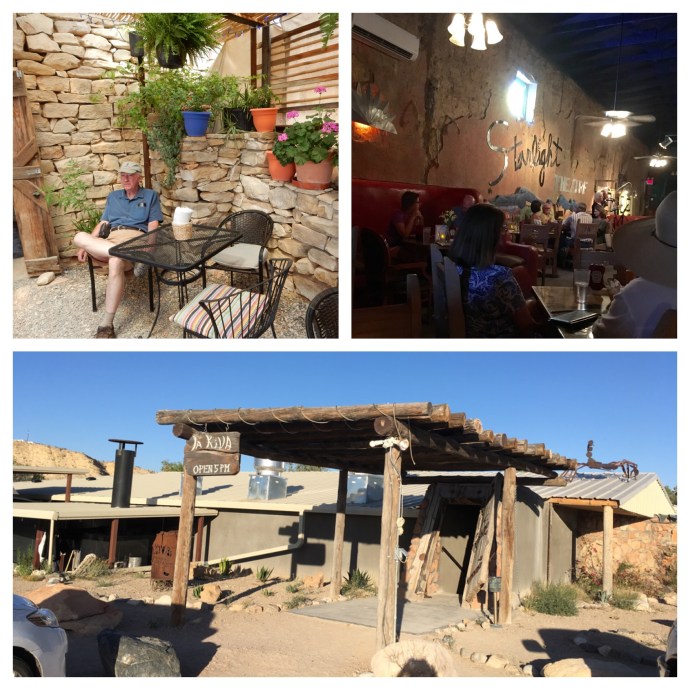
Dining in Terlingua

Terlingua markets itself as one of the gateways to Big Bend and the Terlingua ghost town is a part of the marketing. A couple of bars and gift stores bring in the tourists, along with some RV parks. A Texas Chili Cook-Off in the fall can attract 10,000 people and a hundred state police to patrol and control the drinking. Although limited in number, we found the restaurants to be good. We had dinner at the Starlight twice, with live music. La Kiva, built like a cave, was a second dinner site with good food. Both had their share of characters, whether they were local or tourists was hard to determine. Lunch has been at a gas station cafe and an artsy, artisanal cafe. The cat at the artsy cafe must have been related to the cat at the Far Flung Outdoors center. At Far Flung it sat on the counter where you paid your bill since it was the Queen of the outfit. At the cafe, it was constantly rubbing our legs despite the entreaties of its own.

Photos from Terlingua ghost town

The ghost town still has remnants of buildings, mine shafts, and machinery from the mining days. The old mining company store made of adobe is still here along with the Catholic Church, jail, theater and cemetery. It survives due to the mix of artists, ex-hippies, and free-thinkers who enjoy life here.

Friday afternoon we drove to Lajitas Texas and visited the Burton Warnock Center of Big Bend Ranch State Park. The state park is east of the Big Bend National Park, the visitor center has an exhibit about the Chihuahuan Desert. The exhibit is nice, the center not terribly busy. We chose not to go hiking in the afternoon heat so our time here was short.

The fire pit was busier tonight than Thursday evening. While the fire creates some glare for Starlight viewing, the stars are still more plentiful and clearer than in cities. We woke at 4 AM and spent some time watching stars from our patio.

Ed and Chris.
Categories: road trip, travel | Tags: , , , | Leave a comment

2017 Trip Two: Tour of Texas. April 20

Terlingua Texas Thursday April 20

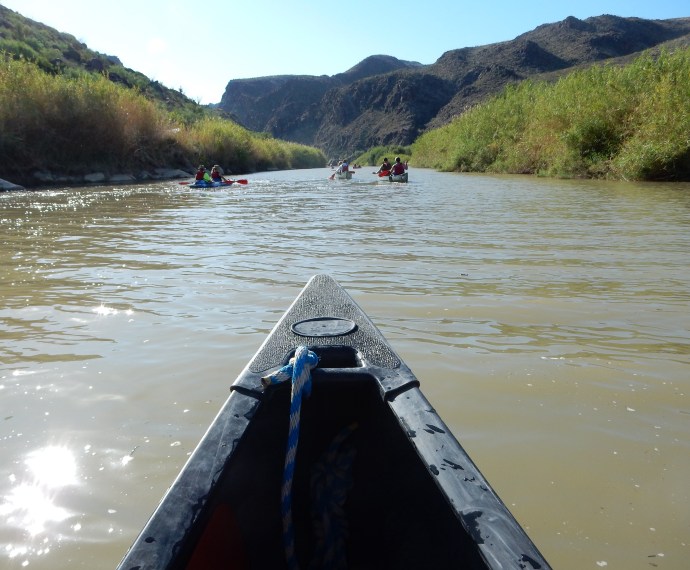
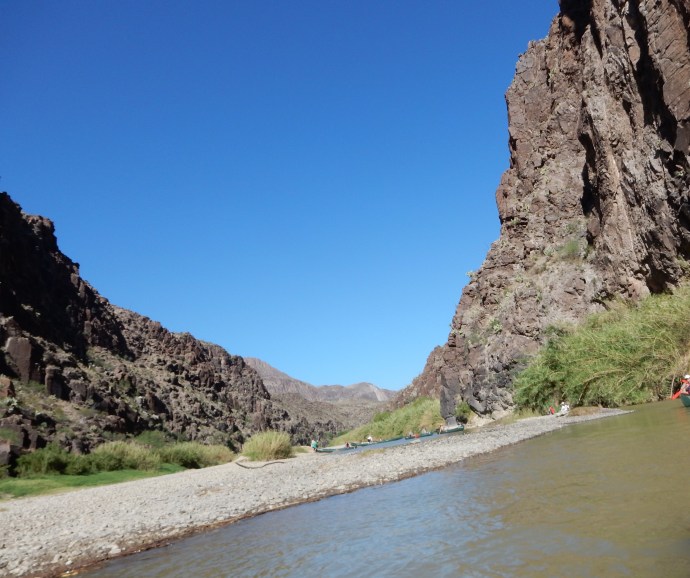
Canoe trip on the Rio Grande River

It is currently 98 degrees Fahrenheit in Terlingua. We are very happy we chose to schedule our canoe trip on the Rio Grande River for the morning. Far Flung Outdoor Center in Terlingua was the outfitter; just a few hundred feet from our casita. There were 18 people and three guides on this trip. While on the Rio Grande, it was not within Big Bend National Park. We drove past Lajitas, a small town with one resort and the entrance to the Big Bend Ranch State Park. The state park is one-third the size of the national park, still very large. There is a national park in Mexico that is on the opposite side of much of the two Big Bend parks.

The scenery along the route to and from the canoe launch site

The drive to the put-in location on the river takes about 45 minutes from Terlingua. The actual canoe ride is about two and one half to three hours. We had a mild current with us but there was a headwind pushing against us. It was a curse for slowing us down, it was a blessing as a cooling factor. If you did not paddle, though, you did not get anywhere. So arm exercise was the health benefit of the day. This stretch of the river involves a few minor rapid type spots, most of it was easy for the canoes to handle. Close to shore you might get hung up on low water and rocks but the main channel was probably 3 to 4 feet deep. There were “S” curves where some skill was needed to not run into the weeds growing high along the bank when you got to turn two or three.

Canoeing on the Rio Grande River

Canoeing on the Rio Grande River

Not all of our companions were skilled in handling a canoe. I would call Chris and I “advanced beginners” and we seemed to be about the best of the bunch. One canoe in front of us made a habit of going from one bank of the river to the next; frequently we had to hang back in order to avoid ramming them broadside. One couple, most were man-woman couples, were sad to see it end as “we were just getting the hang of it”.

At our rest stop on the shore in Mexico

We made one stop during the paddle, it was on the south side of the bank so we were in Mexico at the time. The rock walls were high on both sides of the river, although frequently a flat stretch of land ranging between fifty yards to a half mile existed before the walls came up.

By the time we returned to Far Flung, had lunch and showered, we decided to take the rest of the day off. Too hot to hike the desert and too far to get anywhere.

Ed and Chris Thursday April 20

Categories: road trip, travel | Tags: , , , | Leave a comment

2017 Trip Two: Tour of Texas. April 19

Terlingua Texas Wednesday April 19

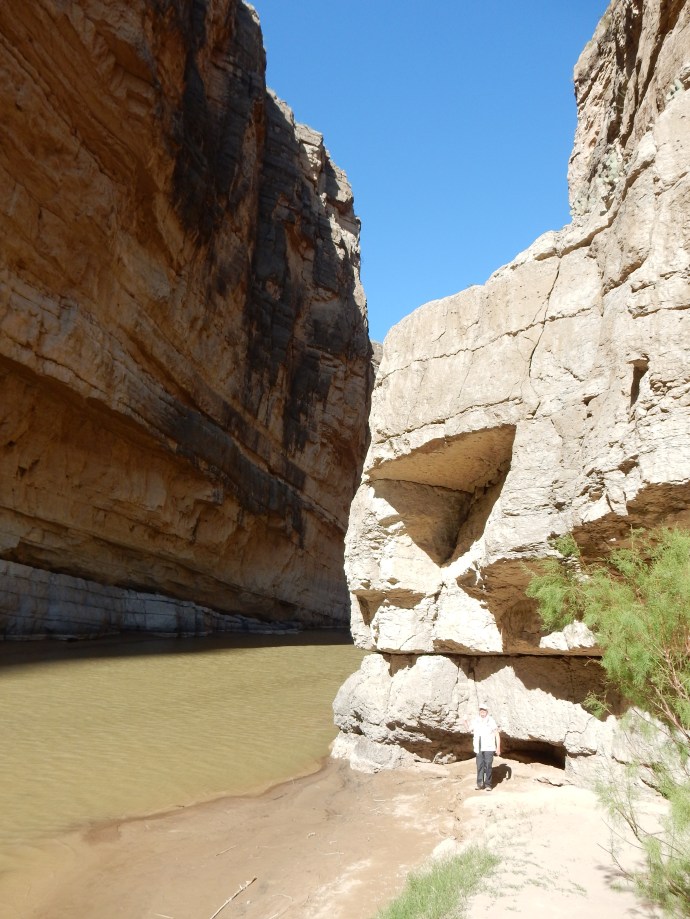
Santa Elena Canyon

Remember that brown, yucky water I have been writing about? Well, today we got to walk in it. That’s the headline, next comes the story.

Our goal for today was to hike the Santa Elena Canyon Trail. It was on our priority list, it was recommended by one of our Evergreen hosts, and a fellow hiker said it was nice but do it early before it gets too hot. Well, it is 38 miles from Chisos Lodge in the center of the park to Santa Elena Canyon on the southwest side of the park. With speed limits on the straight aways of 35 or 45 mph, it took us 75 minutes to reach the trail head. Did I mention Big Bend is a large park?

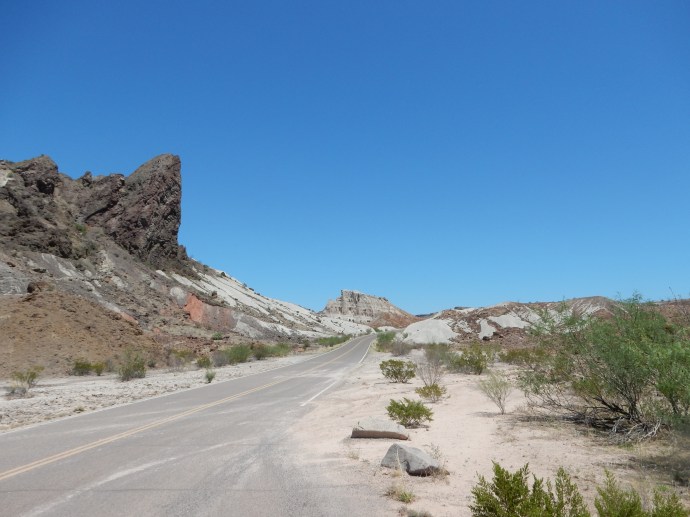
Driving along the Ross Maxwell Scenic Drive

The drive takes us down out of the mountain area around Chisos Lodge, through desert with varying rocky formations along the Ross Maxwell Scenic Drive. Generally the rock formations are brown to gray, we saw only one section of rock that had red and white coloring. It reminded us a bit of the Badlands in South Dakota. There was a particularly nice view as we came over a rise and saw the desert in front of us stretching out to the mountain border with Mexico.

Santa Elena Canyon, Mexico wall on left, US wall on right, canyon in middle

Santa Elena Canyon is at least seven miles long with cliffs ranging between 1,000 to 1,500 feet in height. The Rio Grande runs through the canyon, thus separating the cliffs in Mexico from the cliffs in the United States. The hike up Santa Elena Canyon starts where the river flows out of the canyon. To hike it, you cross the bed of the Terlingua Creek, climb up an embankment, walk through a brief shady flat section, and then hike up and down and up and down a rocky path before reaching a flat section that parallels the Rio Grande River.

Starting the hike, through the flat land, on the rocky trail, looking down from the trail back towards where we started with Rio Grande on your right

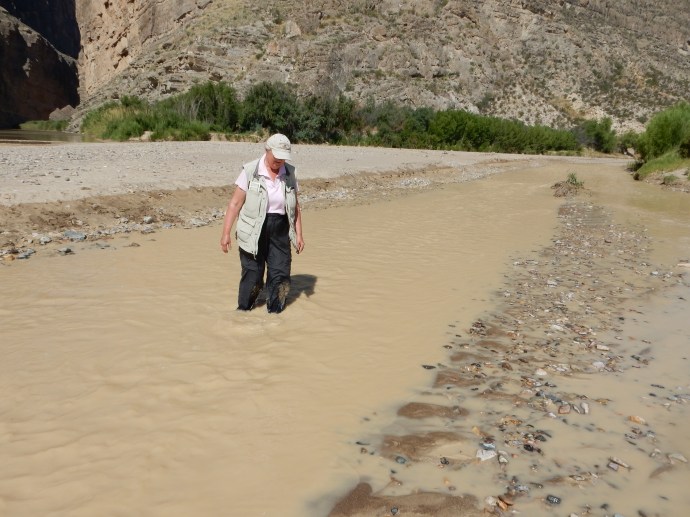
Rain had fallen farther up the watershed of the Terlingua Creek that raised the water in the creek bed from one inch to almost a foot, necessitating a hike into the water. Luckily a volunteer was on hand to guide us at the start of the trail. One actually had to cross the creek twice as the path had braided into channels before reaching the Rio Grande. We aimed for the shallowest sections to cross, managing to drown our shoes in water but only getting a portion of our pants wet. Glad we were not wearing jeans, the gear we have is quick drying.

At the end of the trail, can you spot Chris at the lower right center?

The round trip took us just under two hours at our slow pace and reflecting the temperature, already into the high 80s. The hike was memorable and delightful, a mild breeze helped to keep us cool. A canoe junket from an outfitter was working its way up the river, I assume they were going to follow the current on the return trip.

Crossing Terlingua Creek coming back from Santa Elena Canyon

On the return trip we passed a couple with two young children who had just crossed Terlingua Creek. They were trying to dry out and commenting that they had not planned on a water crossing. As we reached the area where we would have to cross Terlingua Creek, the volunteer was not there. We advised two people contemplating the hike on how best to cross. As we made our way back, we both slipped on the bank and landed on our butts, half in the water and half in the mud. With dignity, we got up, washed off our hands and pants in the nice, brown creek water and headed back to our car. At the car, we switched shoes, dumping out the accumulated water from the shoes. We changed into shorts and had lunch; granola bars and warm water.

Parked for the oasis walk, can you spot the snake?

Driving through the desert

Our plan for the afternoon did not change. To reach our lodging in Terlingua, we back tracked on the Ross Maxwell Scenic Drive, stopping at several overlooks to take advantage of photo opportunities we passed by on our drive to Santa Elena. We only walked one short trail out to an old homestead with its derelict windmill and a newer windmill. The water provides for a desert oasis, the greenery could be seen for miles before you reached it.

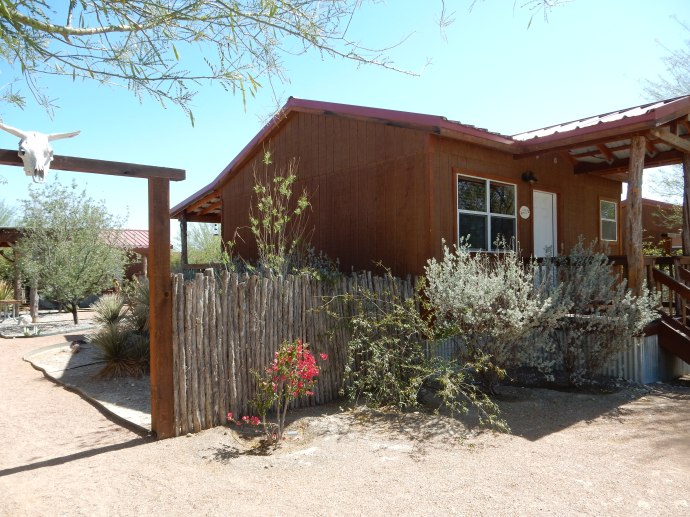
Our casita at Far Flung Adventures

Terlingua and Study Butte are very small towns, relying on Big Bend visitors to survive. We are only here due to the lodging at the casitas at Far Flung Outdoor Center. Terlingua is classified as a ghost town although there are now 250 some people living here. Most residents ae artists, musicians or work in Big Bend or with various outfitters dependent on Big Bend.

We are taking a canoe trip tomorrow and a jeep trip on Friday. More importantly, the casitas are very nice. Roomy, a small kitchenette, back porch, TV and radio, AND decent Internet. Dinner looks like it will be at one of two halfway decent restaurants in town, the Starlight Theater with live music.

Ed and Chris. Terlingua. April 19

Categories: road trip, travel | Tags: , , , , , , | Leave a comment

2017 Trip Two: Tour of Texas April 18

Big Bend National Park, Tuesday April 18

Along one of our hikes to the Rio Grande River

The Rio Grande River is the 4th or 5th longest river (depending on how some rivers are measured) in the U.S. at 1,896 miles, about 1,200 of which form the border between Mexico and the U.S. The river is also heavily drawn down for irrigation and at its location here in Big Bend National Park, it is currently flowing between 2.5 and 5 feet deep. The river here is wadeable, we observed a man riding across the river on a mule followed by his dog.

For those of you worried about illegal border crossings, recognize that crossing the river is probably the easiest portion of the journey. The terrain here is hot, rocky, dry, and terribly inhospitable. The river is brown and you would not want to slip and ingest any of the water. We have observed airplanes overhead and we passed through a checkpoint with cameras recording us and our vehicle as we drove here.

The U.S. and Mexico have had rocky relations for much of our history. Remember Texas, New Mexico, Colorado and California were once part of Mexico. We have normally treated Mexico with disrespect when we deigned to consider them at all. So today’s bombast is nothing new, even if unnecessary and counter-productive.

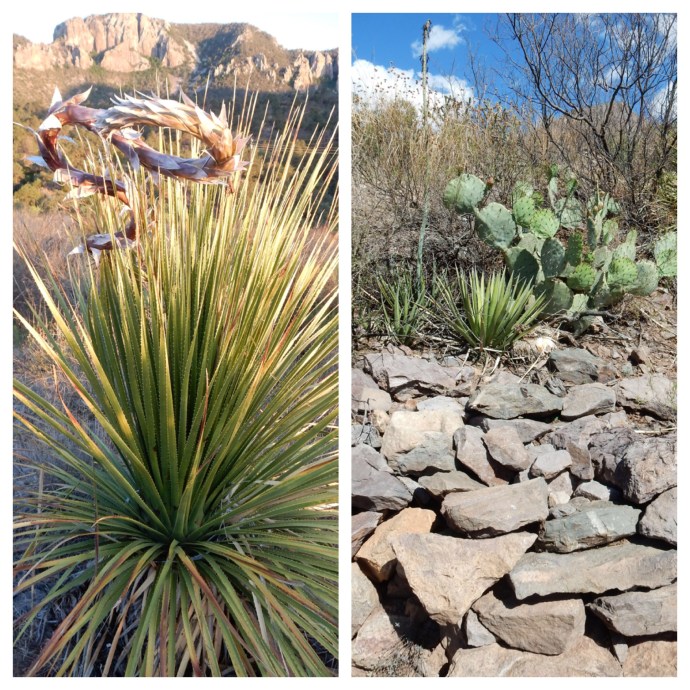
Some desert plants

So much for the politics. We spent most of the day’s hiking time going to the river or along the river. Now, I will admit once again that we no longer are interested in hiking 12-15 miles a day with great changes in elevation. Shorter hikes at a slower pace are just fine. Our goal normally is to see specific, varied sections of the area we are visiting. Enjoying the view, listening to birds, viewing wildlife are all primary goals.
Examples of desert blooms

For instance today we saw: a road runner, minnows in a backwater of the Rio Grande, small blossoms of red, yellow, blue, and white on varied plants, bird nests stuck in crevices high up in rock walls, three desert bighorn sheep (or auodad, a non-native species introduced by accident), a man on horseback with his dog plus the guy on a mule crossing the river, rabbits, multiple lizards and slithering creatures, prickly pear plants trying to bloom, and tons of birds we don’t even try to identify. Big Bend is supposedly a birder’s paradise; the diversity of birds and plants is huge based on its varied topography. We did not see Mexican black bear or mountain lions, both of which are plentiful in the park.

Top: Desert mighorn sheep. Bottom: Mountain they were on top of

This national park is ranked 45 out of 59 in attendance. The walks are not crowded, but there are enough people to meet and talk to on each walk. It seems like there is always some connection; they lived where we used to live, or a relative does; we traveled to the same park or location; or we share tips on various trails in the park.

Hot Springs: The old general store, part of the hike, the pictographs, and the springs by the Rio Grande

We traveled to Hot Springs, a small pool framed by rocks next to the Rio Grande. One couple was in the pool, it did not look that inviting although there is probably some bragging rights to say you did it. The walk to the pool passes by the old general store and post office. This area has been inhabited by Indians years ago, there are pictographs on the rock walls. We had our first glance of the Rio Grande River as a border river, noting that it is not very wide, was flowing fast, and was a yucky brown color. Oh, right, we are going on a raft trip in this river Thursday. Great.

After lunch of a granola bar and warm water, we hiked to the river again, walking through a back water area. The path crossed flood plains heavy with deposited rock and sand. (Forgive me while I swear. The Internet system here did not successfully save about 30 minutes of writing which would have taken us up to the end of the day. Of course, that version was much more interesting than the re-creation I will now attempt.)

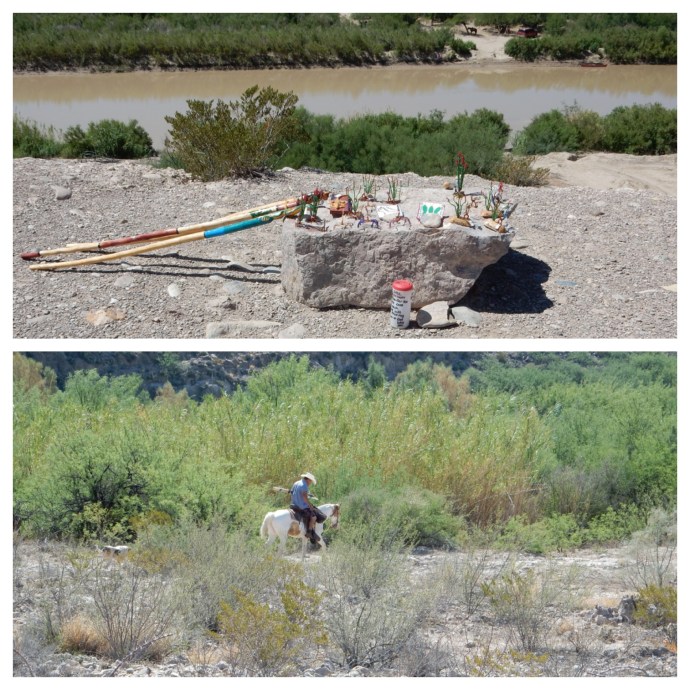
Animal figurines top; re-stocker? on horseback

Along the path we observed the man on horseback, with a dog trailing behind him. He was carrying some colorful sticks which from a distance we could not clearly make out. Later on we figured what it was. In several locations, there is a homemade stand of animal figurines and carved walking sticks. Next to them is a small can for honor system payment for the items. There is a note on the can indicating that your payments will go to assist the schoolchildren at an elementary school in Mexico. Nice touch, we thought, although we did not make a purchase. However, reading park material when we returned to our room we discovered that this process is illegal. Anything which we purchase is considered contraband and could be seized from us.

Boquillas Canyon: the rocky path, view of the river bend, path along the River, the canyon entrance

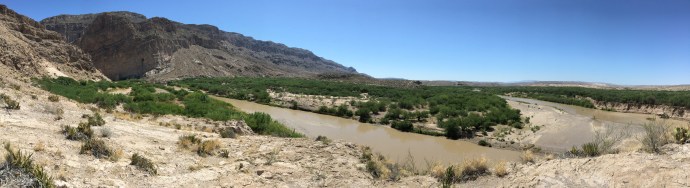
Panorama of Boquillas canyon through bend in Rio Grande RIver

Our next hike to the Rio Grande took us to Boquillas Canyon. The river takes another bend here before it enters into the canyon. The canyon walls are 1200 feet high but we did not wade into the water to observe them closely. This hike involved more elevation gain and loss than the other two and occurred during the early afternoon when the temperatures were approaching 90 degrees Fahrenheit. The path was primarily in the sun so we were pleased to return to our car.

Back at Chisos Lodge, we rested up before taking another short hike close to our room. Dinner was in the Lodge restaurant, the food has been surprisingly good and affordable. There is no TV, radio,or phones; so hiking and enjoying the outdoors is pretty much it. We plan to view the sunset once again and check out the stars to determine if they are as bright tonight as they were last night.

Tomorrow we check out but spend three more days in the park. We are just moving our lodging to the small town of Terlingua on the west side of the park.

April 19, 3:30 PM Hallelujah. New lodging internet service is great!

View after the rain storm Monday night

Ed and Chris for April 18

Categories: road trip, travel | Tags: , , , | 1 Comment

Blog at WordPress.com.