Monthly Archives: May 2016

2016 Trip Four, Southwest Discoveries, May 17-18

Santa Fe, New Mexico May 18

View at Blue Mesa, Petrified Forest National Park

View at Blue Mesa, Petrified Forest National Park

We are back on-line after spending Tuesday night in Ramah New Mexico at a small RV and cabin park. And yes, you urban dwellers, there are parts of the U.S.without Internet and with poor cell connections. Our Verizon wi-fi connection was very weak and we kept losing coverage. So, you get two days for the price of one.

It is a good thing we travel for the adventure and not the weather. The temperature was warmer and the skies were clearer back home in St. Paul. We left Show Low Tuesday morning and drove north on the two lane roads through high desert land alternating between scrub brush, rock, and piñon/juniper trees. Tuesday morning was partly cloudy but around us on all sides were rain clouds. Periodically the sun would break through, luckily for some of the pictures at our first stop, Petrified Forest National Park. Petrified Forest was not our main destination for the day but was directly on our route so we made a stop here.
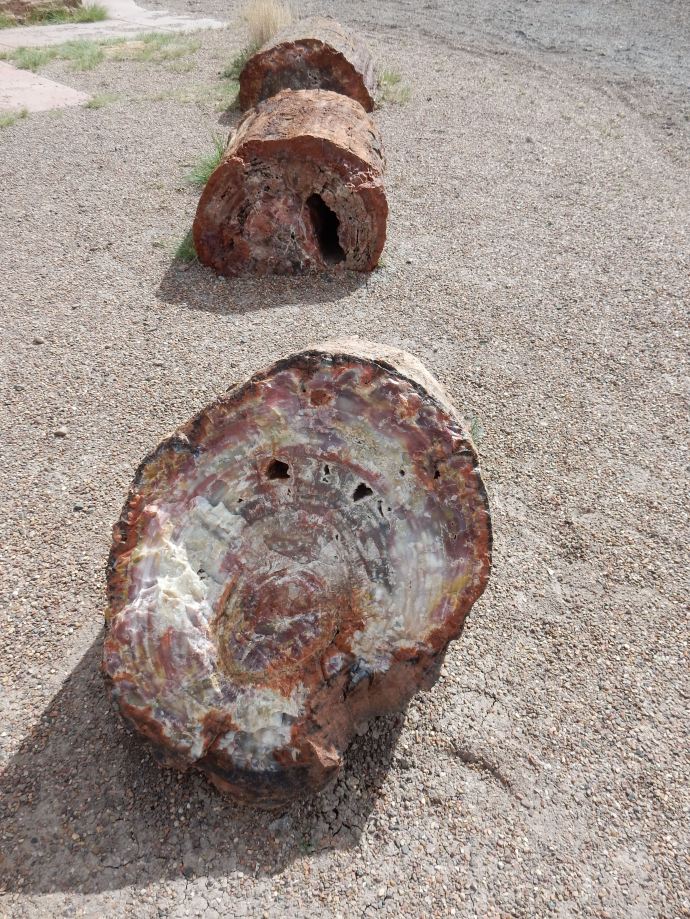
Petrified logs at Petrified Forest National Park

Petrified logs at Petrified Forest National Park

In December of 2013 we made our first visit to Petrified Forest National Park and its Painted Desert area. On this second visit, we ventured into a few areas we had passed by in 2013. 225 million years ago, Arizona was a lush tropical rainforest. As continents moved and climate changed, Arizona became the desert state that we now experience. However, remnants of an ancient forest died and their trunks were carried to locations where they were buried by sediment. Over time, the logs absorbed water and silica and then crystallized into quartz. These remnants are visible throughout the park in stunning displays. One unique example was at agate bridge where an ancient tree trunk, now petrified, crossed over a dry stream bed and acts as a bridge-although the park now forbids anyone to walk on it.
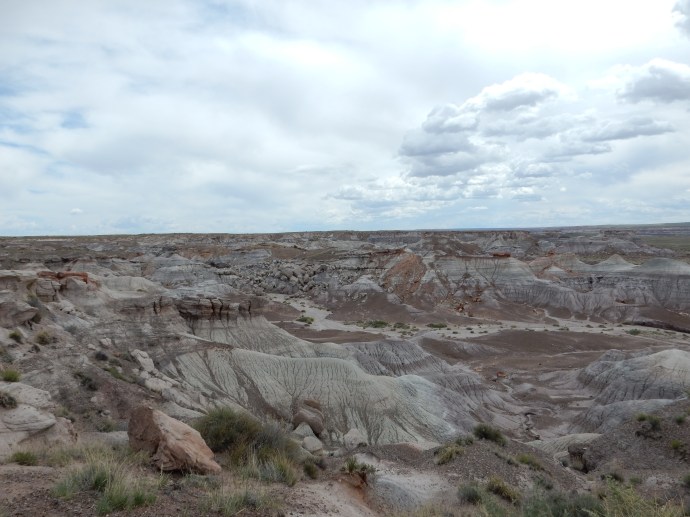
Another view at Blue Mesa

Another view at Blue Mesa

However, while we visited the petrified wood sections, we spent more time looking at some of the rock formations that we missed previously. Blue, grey, purple and green bands of rock deposits are showcased at the Blue Mesa area of the park. We hiked down into the lower levels to get a closer view. The rock coloring here is a sharp contrast to the gray, red and white seen in other parts of Arizona.

Blue Mesa

Blue Mesa

From Petrified Forest we drove up to Hubbell Trading Post in Ganado AZ. Same topography mix but the road here was normally straight as an arrow, while driving up and down canyons and valleys. Hubbell Trading Post is a National Monument preserving the trading post era of the late 1870s to the 1960s, with a unique twist. As a national monument, the trading post had to continue as a functioning general store to the Navajo of the area. When we arrived here, we were surprised at the number of visitors up here in remote Arizona; later we realized many of them were shoppers at the trading post.

Hubbell Trading Post

Hubbell Trading Post

John Hubbell opened the trading post at the invitation of Navajo Chief Totsonii Hastiim (Ganado Mucho). The Navajo were trying to resurrect their lives in their home lands after having been forced to walk to New Mexico and being imprisoned for four years after being defeated by the US Army. Most Indian agents, missionaries, and teachers tried to force their white culture and beliefs on the Navajo. Hubbell was one of the honest traders and was respected by the Indians. He bridged the two cultures and did not force changes. His post continued operating through his descendants until the 1967 when the family and National Park service came to agreement for NPS to operate it. We toured the family’s home with a park ranger and walked the site. The log building, barn, and outbuildings are still in good shape.

Our Tuesday lodging was at the Ancients Ways RV Park and cabins near Ramah NM and El Morro National Monument. We stayed at Ancient Ways in December 2013. It is a funky place and inexpensive. Our cabin was nice, clean, and warm. The trip there, however, was long and tiring. The rains came and made driving more of a challenge. We even chose to use the Interstate for a portion of the drive.

We came across a group of 21 bicyclists at the New Mexico Welcome Center. They were riding from Los Angeles to Boston, having left LA May 6 and plan to reach Boston in mid-June. Due to the cold (41 degrees), wind, and rain, the group was deciding if they would wait for a transport car or continue the ride to Gallup NM where they had lodging for the evening. The bikers are scheduled to average 85 miles a day, paid for the experience, and had to train in advance to make sure they could complete the journey. To each their own–but not on our future plans.
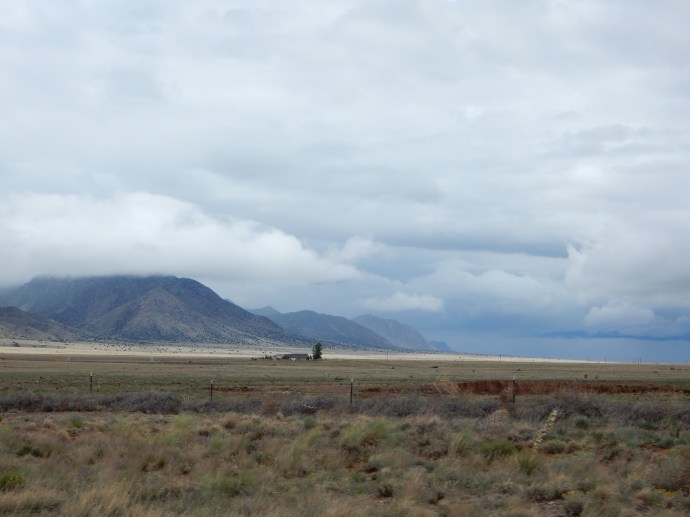
Driving to Salinas Pueblo Missions

Driving to Salinas Pueblo Missions

Our only scheduled location for today (Wednesday) was the Salinas Pueblo Missions. This is a series of four spots in a valley 70 miles southeast of Albuquerque. There is a main visitor center in Mountainair NM and three pueblos north, south, and east of Mountainair. We did skip the southern most pueblo.

While archaeologists have found evidence of nomadic peoples dating back nearly 20,000 years, the pueblos represent the last group here, with possibly 10,000 people living in the Salinas Valley in the 1600s. The Mogollan and Anasazi peoples inhabited the area starting in the 900s. The Spanish came around 1600 and what had been a self-sustaining community that traded with its neighbor’s underwent strains that ended up devastating the area and resulting in the complete abandonment of the pueblos by 1670.
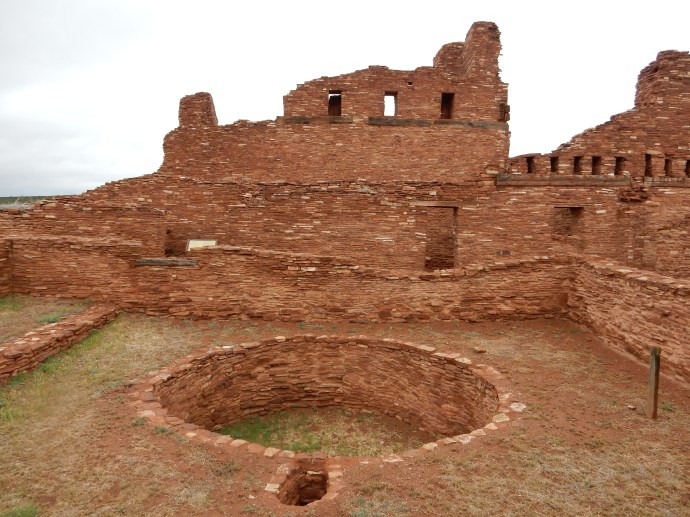
Abo mission ruins. Note the circular kiva in front of the church walls-did the Franciscans accept this Indian practice? Who knows?

Abo mission ruins. Note the circular kiva in front of the church walls-did the Franciscans accept this Indian practice? Who knows?

The Spanish, with their own internal conflicts between the wealth seeking military and settlers and the Franciscans who wanted to convert the Indians, expected the Pueblo Indians to help build the pueblo mission buildings, pay tribute in corn and labor to the military, and continue to provide for themselves. Compounding the problems were the Apache who used to trade on a friendly basis, now raiding as retribution for Spanish slave raids. Finally, new diseases and drought resulted in the Pueblo Indians leaving the area and moving to live with cultural relatives in other pueblos.
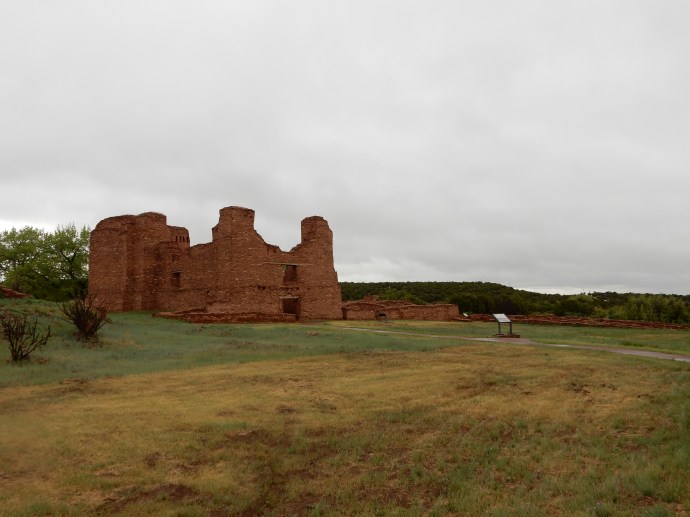
Quarai Mission

Quarai Mission

We visited Abo and Quarai missions (in the rain) which still have numerous well-preserved buildings and foundations. These are not re-constructed missions, but ones that have stood the test of time-with some rehabilitation. The displays tell the story of the clash of cultures. The Indians were willing to absorb one new spiritual story; the Franciscan emphasis on nature and the interweaving of all facets of life was not dissimilar to their own spirituality. However, 17th century Christianity was not one to accept alternate religious beliefs. It was all or nothing. The Indians moved out and even after the Spanish reconquered the land after the 1680 Pueblo Revolt, never came back to these missions.
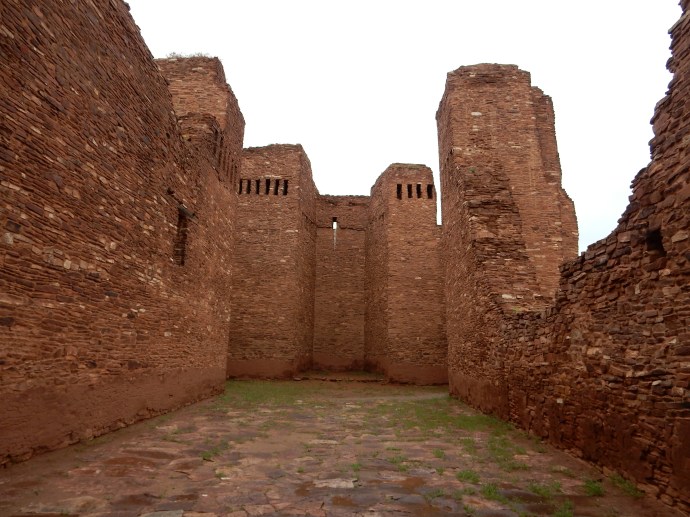
Another photo of the Quarai Mission Church

Another photo of the Quarai Mission Church

I did purchase my Christmas ornament to memorialize this trip. I usually make sure it is locally made. I asked the origin of the one I wanted. It was not made locally. It was made by Dineen Pottery-of St. Paul MN. I just had to buy it.

From Mountainair we drove to Jude’s in Santa Fe which will be our base of operations for the next week or so. We will make side overnight trips to Farmington and Raton NM to explore those areas.

Ed and Chris
Categories: road trip, travel | Tags: , , , , , , , , , | 1 Comment

2016 Trip Four, Southwest Discoveries, May 13-16

Show Low, Arizona, Monday May 16, 2016

Well we are back on the road, with a trip of just under four weeks scheduled. I say scheduled since for each of the last two years, we had some medical issue that forced changes to our travels scheduled for this time of the year. Hopefully not this year. The planned route takes us from Scottsdale AZ to Santa Fe NM to Las Vegas NV. Numerous side trips and excursions are planned, particularly in Arizona and New Mexico.

This trip is 1/3 family and 2/3 adventure. We started out on Friday with a flight to Phoenix (Scottsdale) to spend the weekend with Lou and Joyce. Minnesota was 41 degrees (F) when we departed. Scottsdale was 102 degrees F when we landed. So what do you do in hot weather? Jump in the pool!

Lou and Joyce have moved and are living in a community of condos, townhouses, homes, etc. Their community has several pools, along with other amenities. We enjoyed the pool Saturday and Sunday afternoons. The community does have a number of owners who are only there for the winter months so the pool, despite the high temperatures, was not crowded, had shade and sun areas, and was just the right temperature to cool off without being cold.

Saturday morning walk

Saturday morning walk

Saturday morning (early, before the heat) the four of us went for an hour walk with Manning, their Corgi. Flowers are blooming everywhere; oleander and bougainvillea being particularly overwhelming. Saguaro, and other, cacti are flowering also.

Remember our houseboat ‘adventure’ on Lake Powell with Lou and Joyce in May 2014? Well,their friends Dave and Toni had joined us on the houseboat for that 2014 weekend and on this trip we met them for lunch on Saturday. We went to Ted’s Hot Dogs in Tempe where we were able to get burnt, grilled hot dogs for Chris and a chocolate malt for Ed. Great!!

Sunday brunch at El Charro

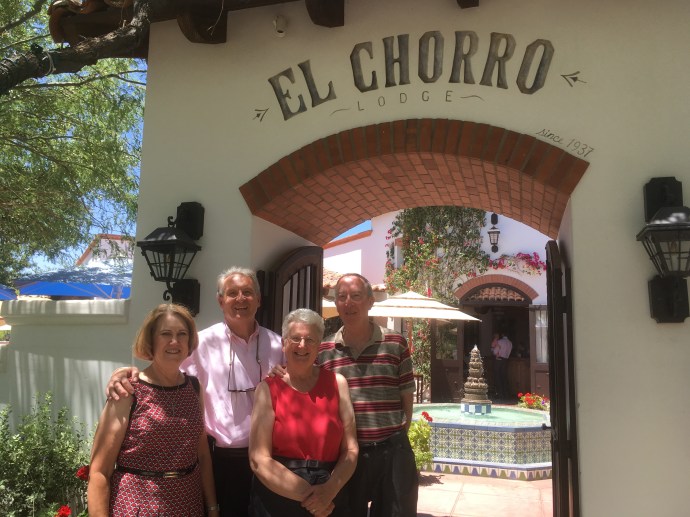
Sunday brunch at El Chorro

Sunday was Pentecost Sunday and we went to services, coffee and danish, and a pre-service discussion at Lou and Joyce’s church, Christ Church of the Ascesion. Brunch afterwards was at a Scottsdale landmark, El Chorro. Dinner was at The Thumb, a BarBQ restaurant located in a gas station. Like the gas station restaurants in Lee Vining CA and Franklin NC, the food was worth the stop.

Monday morning we were on the road by 7:30 AM. Monday night’s stop is in Show Low, Arizona. We had a stop at Dunkin Donuts for Chris to get her fix before we tackled the Apache Trail. The Apache Trail is the scenic route from the Phoenix area up to Lake Roosevelt and Tonto National Monument. However, every time I tried to schedule a trip on Mapquest or Google Maps, this road would be ignored and the infinitely more intelligent computer routing system would refuse to use this road. It really is not that bad.

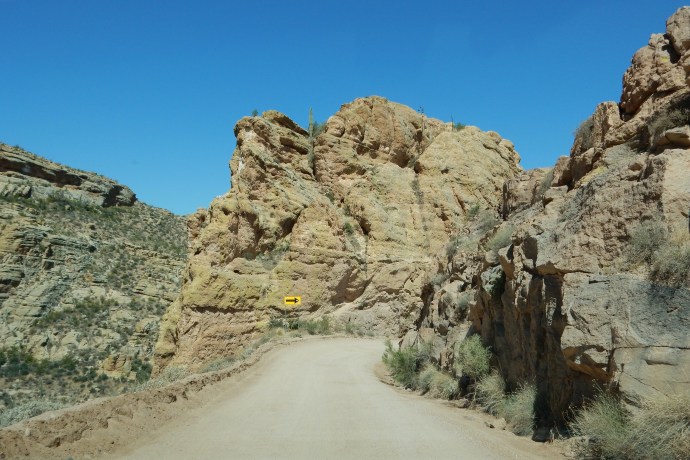
The Apache Trail

The Apache Trail

The Apache Trail goes over the Superstition Mountains northeast of Phoenix. It had its beginnings centuries ago as an aboriginal highway through the mountains and was used as a horse trail for settlers and Indians. In 1905 construction began on the Roosevelt Dam and the Bureau of Reclamation “improved” the road so supplies could be brought to the site.

The Apache Trail is a scenic byway, is 39 miles long, winds through awe-inspiring scenery, and is unpaved for much of its length. Portions are narrow, slightly more than one lane, with steep elevation drops. The Trail is within the Tonto Natonal Forest, one of the largest national forests in the US with nearly 3 million acres. The forest encompasses desert, mountain forests, mining regions and some lumbering.

We took the route and enjoyed it. We have experienced many roads which were more narrow, with bumpier road surfaces, and had scarier cliff side drops. Luckily the gravel portion did not have huge ruts or rocks jutting up that might threaten the under carriage of your vehicle. That said, I was glad we were using a rental car. The road surface was like an old-fashioned washboard and even at low speeds was extremely rough. Two Germans who tried to ride it on motorcycles had to turn back. I would have turned back also if I had been driving our old Saturn with the much worn suspension. It took us three hours to drive the 40 miles but that included numerous stops for hikes and pictures.

While the trail was not crowded, we encountered a few cars at each major vista. Some of the people we kept seeing for the next four hours. Most of them had heard of the horror stories about the Apache Trail, but all of us had also heard so many positive opinions on the scenery that we were bound to take the road anyway. While cell phone coverage was spotty, if there had been a problem, other people would have been driving by shortly.

Apache Lake

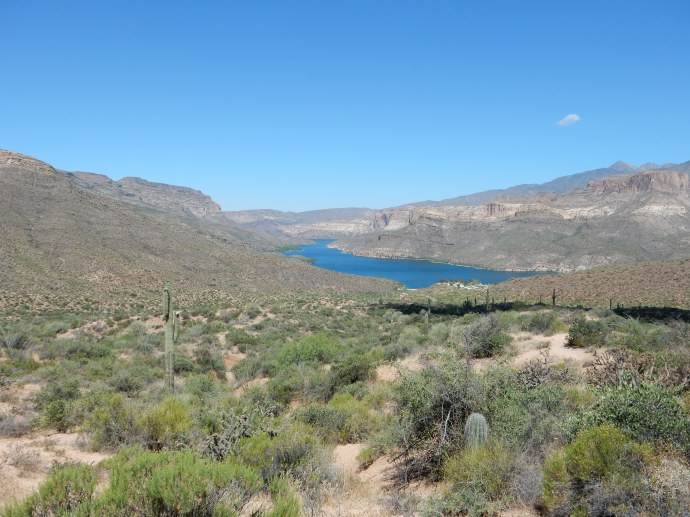
Apache Lake

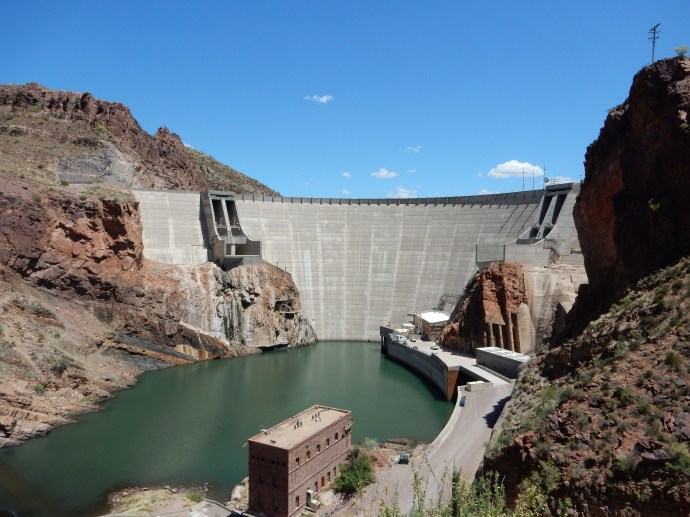
The Apache Trail parallels portions of the Salt River that begins in the White Mountains. The Salt River Project is a cooperative utility providing power and water to areas in central Arizona. They manage Roosevelt Dam (and two others) on the Salt River that create Canyon Lake, Apache Lake, and Roosevelt Lake. All three lakes provide for recreational use even though their earliest purpose was for agricultural irrigation and water supply to further the development of the West. We took advantage of numerous vistas to view and photograph the lakes and canyons. Roosevelt Dam at its completion in 1911 was the largest masonry constructed dam in the world. It was renovated and heightened in the 1990s due to concerns that the floods it was designed to control might actually be greater than had been projected in the early 1900s. With 4,000,000 people in the Phoenix area, this could cause problems. Currently the water level in the lake behind the dam is at about 50% of its capacity.

Theodore Roosevelt Dam

Theodore Roosevelt Dam

Lou works for Salt River Project so we wanted to make sure we saw the dam on our way up to Show Low. Technically we could reach Roosevelt Dam by taking a quicker, longer route which would have avoided the Apache Trail but the journey is half (or more) of the experience. Right?

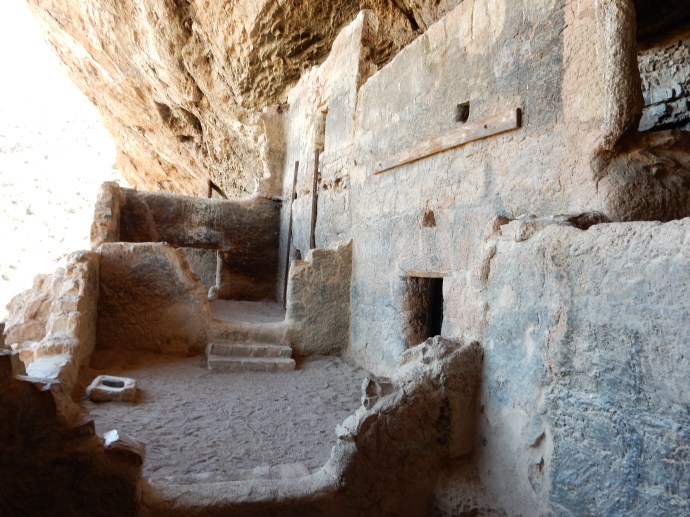
After completion of the Apache Trail and seeing Roosevelt Dam, we visited Tonto National Monument. Luckily we had packed granola bars and cold (thanks Lou and Joyce) water since the Roosevelt Dam area is basically a no food zone. Tonto National Monument preserves two examples of cliff dwellings belonging to what is called the Saloda people. The cliff dwellings are 700 years old.

The creators of the cliff dwellings are long gone although they may have migrated and become part of other Native American groups in the area. This area of the Tonto Basin underwent growth and contraction as flooding, drought, and plant and animal depletion impacted on the ability to live in the area. It is thought that the earliest inhabitants arrived around 100 CE. By 1250, the inhabitants were reacting a form of pottery now called Salado pottery which was traded widely. By 1450 the area was basically deserted.

Part of the cliff dwellings at Tonto National Monument

Part of the cliff dwellings at Tonto National Monument

Two hikes to two different cliff areas are part of the National Monument. We took the shorter one-it was the only one open today. The hike is only a half mile one way but has 350 feet in elevation gain. The day was warm, temperatures in the mid-80s so we made sure we had plenty of water. Original portions of the dwellings can still be seen although vandals did destroy portions of the dwellings before the monument was created in 1907.

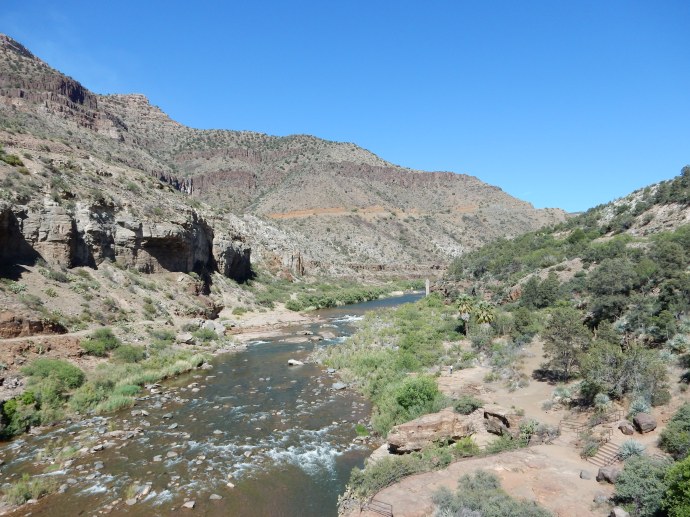
Salt River flowing from the White Mountains

Salt River flowing from the White Mountains

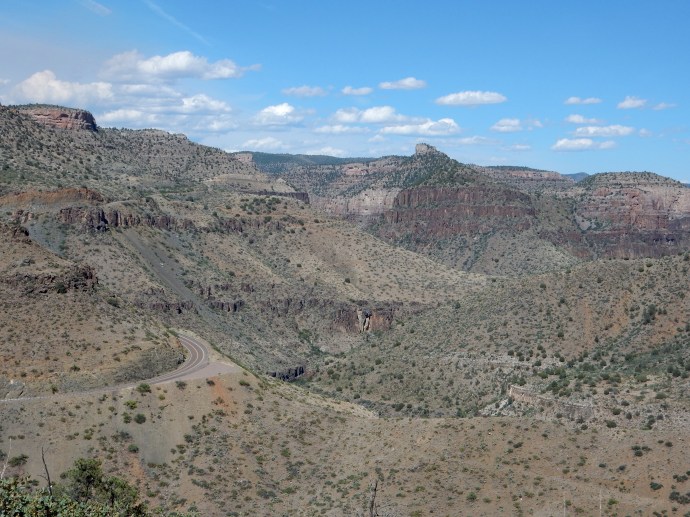
From Tonto we drove to Show Low. Show Low is a resort community in the White Mountains, about 200 miles northeast of Phoenix. Show Low is at an elevation of about 6350 feet. This makes it a cool retreat from the scorching temperatures in Phoenix, elevation about 1100 feet above sea level. The route from Roosevelt Lake follows much of the Salt River, through two Indian reservations, and another national Forest. This road, while paved, also is curvy with frequent, significant elvation gains. Road speed at times is listed at 25, 35 and 45 mph. Smoother surface than Apache Trail but still a slow go if you obey the speed limit (we did).

Salt River Valley

Salt River Valley

Dinner tonight was as the Lion’s Den in Pinetop, another resort community maybe 10 miles south of Show Low. A great burger place, just what we were seeking. It was quiet, no music tonight and the worm crawl is not scheduled until May 29th. Sorry, I did not ask the rules for the worm crawl.

Tomorrow we drive to Ramah NM.

Ed and Chris

Categories: road trip, travel | Tags: , , , , , , , , , | 1 Comment

2016 Trip Three, Boston, April 29-May 1

Boston, Sunday May 1

Boston is a great city to visit. I do not intend to try to cover the city in detail, our blog posts only cover our current activities. Since we have been here often, we keep searching out activities we have not done before. Three National Park Service units fell into this category; one, Blackstone River, we covered in the previous post.

Friday, Deb took the day off from work and joined us as we toured the Boston African-American National Historic Site. Through exhibits, video, walks, and ranger talks we learned about the role Boston played in the early days of abolition; and by implication, the mixed history of advances and retreats in how America has dealt with slavery. For while recent history is not the focus of this historic site, one can not help but remember the difficult days in Boston of the 1970s when school integration and busing showed the undercurrent of bias still present in American society.

An important stop on the Underground Railroad in Boston

An important stop on the Underground Railroad in Boston

But the focus here is the 1700 and 1800s. Boston can rightly be proud of the steps taken to end slavery and discrimination. A small population of African-Americans were at the core of the efforts, individually and as a group. Due to the efforts of one slave, Quok Walker who sued for his freedom, Massachusetts was the first state to abolish slavery, in 1783.

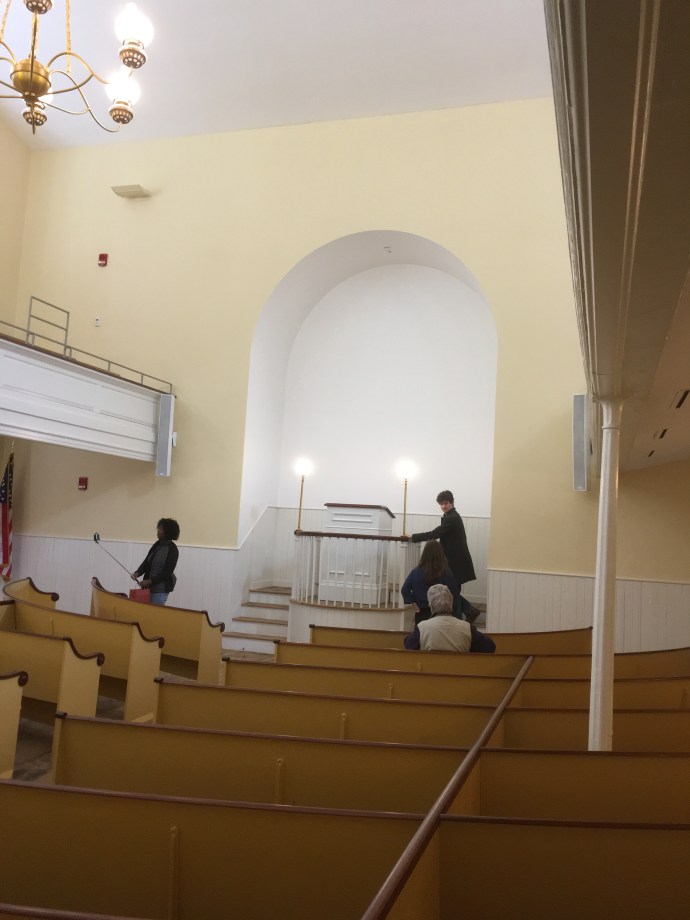
Interior of African Meeting House

Interior of African Meeting House

While slavery was abolished, discrimination was not. Schools were segregated until 1855. Until then, separate but unequal schools were the norm. This National Historic site occupies the site of the first public school, Abiel Smith School, which was the first black public school opened in 1835. Before that, the community educated their children at the African Meeting House, next door to Abiel Smith.

Black Americans were strong in their efforts to bring slaves north through the Underground Railroad. Writers were an important source of protest throughout the country. The African Meeting House, another part of this historic site, was the center of speakers and activists. White churches, however, were not necessarily the leaders in integration. When one member of the Third Baptist Church of Boston invited black friends to join him in his pew, he was expelled from the church.

In 1863, two years after the start of the Civil War, Massachusetts formed the first all-black regiment raised in the north. Most of its member came from Boston. The regiment was the basis of the 1989 film “Glory” that won Academy Awards.

After all of that learning, we replenished our spirit at Legal Sea Foods and decided to call it a day.

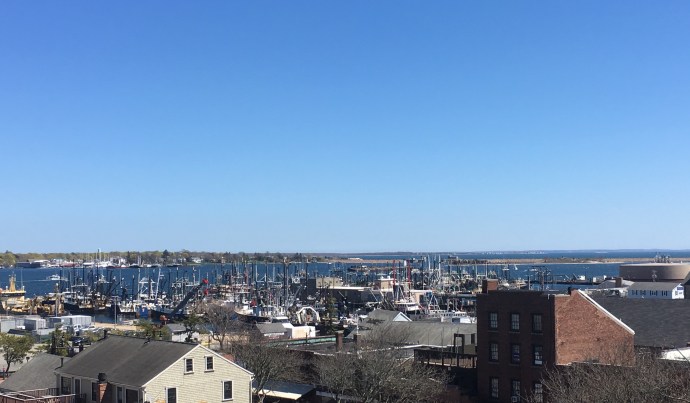
New Bedord Massachusetts harbor today

New Bedord Massachusetts harbor today

Saturday Rebecca joined the three of us and we headed an hour south to New Bedford. Last year Chris and I visited Salem, a city that was the center of international shipping for the U.S.beginning after the Revolutionary War and continuing to about the time of the Civil War. New Bedford, in contrast, was a whaling center. From 1780 to 1920, ships from many countries hunted whales for their oil. Whale oil was used for lighting homes and lubricating machinery. Whales were hunted in the North Atlantic, Pacific, and Arctic Oceans. While petroleum started to be produced in the 1860s in Pennsylvania, whale oil continued to be used for several decades.

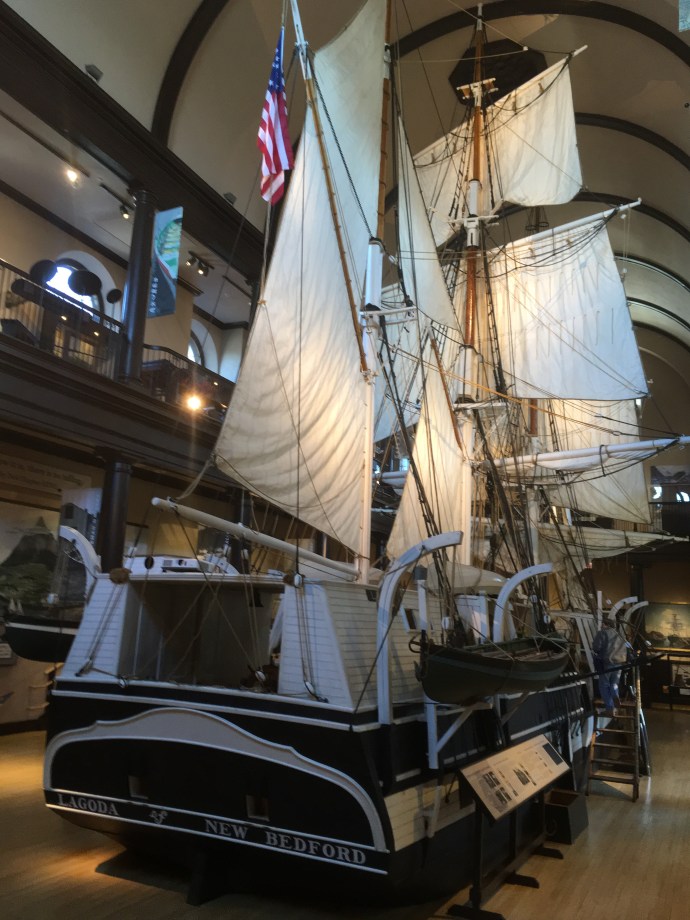
1/2 scale model of whaling vessel

1/2 scale model of whaling vessel

During the first half of the 1800s, New Bedford became the whaling capital of the world. Fortunes were made, and lost. The work was hard and unglamorous. The men who worked on the ships made their pay only if the ship was succesful in finding whales and in getting it back to New Bedford safely. The owners of the ships made the big bucks and while, as usual, hard work was part of the foundation of their wealth; the role of luck and the hard work of low paid men always seemed to be glossed over.

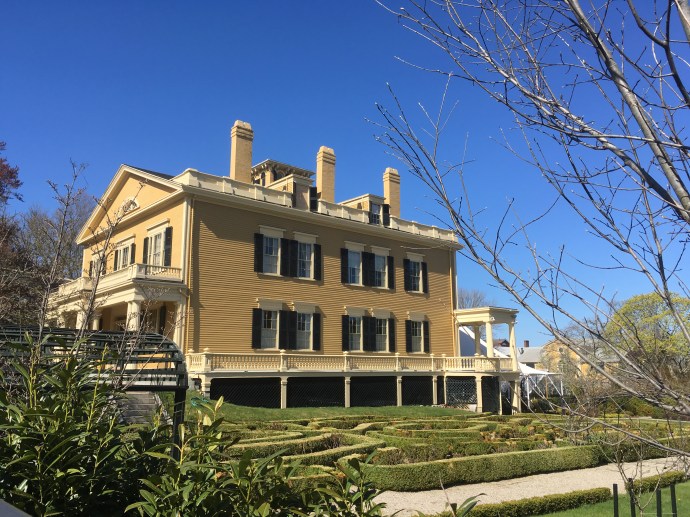
Rotch-Jones-Duff home in New Bedford MA

Rotch-Jones-Duff home in New Bedford MA

We toured the home of one such lucky, wealthy family, the Rotch-Jones-Duff house. It features the usual ornate fireplaces, high ceilings, delicate wallpaper, and ornate china and glass dishes. The gardens were not blooming yet, it seems that MA is blooming slower than MN this year. The original builder would have been a billionaire in today’s dollars. Rotch was wise enough to move his operations from Nantucket to New Bedford and to vertically integrate the whale oil business; sort of a precursor to the Standard Oil concept for petroleum.

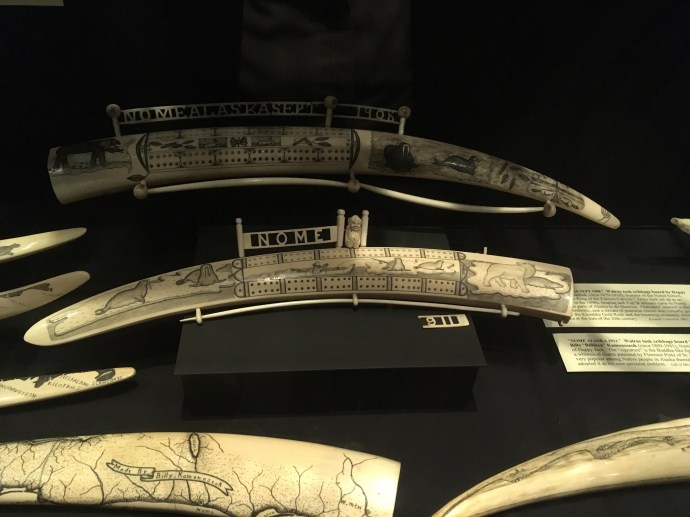
Scrimshaw cribbage boards

Scrimshaw cribbage boards

The exhibits at the New Bedford Whaling National Historical Park and at the privately owned New Bedford Whaling Museum presented well the diverse people who made whaling a success. The ships were at sea for 4-6 years. The crews became a mix of men from the U.S. but also from the Azores, Cape Verde Islands, Pacific Islands, and Hawaii. The ships became, by default, U.S. ambassadors by making international ports of call and intermingling people, ideas, and trade goods all across the globe. Barrow Alaska and New Bedford developed a connection due to the whale hunting in the Arctic Ocean.

Whale skeleton at New Bedford Whaling museum

Whale skeleton at New Bedford Whaling museum

New Bedford as a community was founded by Quakers who led the city for many years and shaped its development. Their more pacificist attitudes and advocacy of abolition made the community an important stop in the Underground Railroad. Blacks were able to work on whaling ships. Frederick Douglas, the black abolitionist orator and writer, lived in New Bedford for a number of years.

After the Civil War, as petroleum started to supplant whale oil, forward-looking merchants began to diversify and New Bedford moved from a whaling center to an industrial center. Textile and glass manufacturing was a major industry but numerous other manufacturing factories kept the town thriving for decades.

On our way out of town, we made our expected stop at Dunkin Donuts before dinner in downtown Waltham. Biaggio’s, an Italian restaurant, served us well in wrapping up the day in fashion.

Ed and Chris
Sunday May 1, 10 PM

Categories: road trip, travel | Tags: , , , , , , | 1 Comment

Blog at WordPress.com.